Empirical Analysis on Charitable Behavior of Agents
in the Public Sector: Cross-country Analysis Using
Microdata
Leiden University
MSc Public Administration: Economics and Governance Track
Master’s Thesis
Name:
Kinuko Kate Nakazawa
Student ID: s2092212
Date:
06/11/2018
Foreword
The topic of this master’s thesis originally comes from my curiosity and passion for understanding how we can improve services and products that public services provide for betterment of the society. One of the main reasons I decided to pursue a master’s degree in public administration was to deepen my knowledge about the public sector and its contribution to society, the economy, and many of the pressing matters that globalization brings. Furthermore, as I identify myself as a person with high altruistic preference and desire to contribute to the betterment of our society, analyzing charitable behavior of workers through the lens of altruism and public service motivation is very close to my heart.
Completing this research was definitely a journey. Through conducting my own research from the collection of data, identifying the appropriate method and analysis of the results, I had certainly deepened my knowledge of behavioral aspects of economics and that people are truly a crucial asset to the government and organizations in public sector. This research also taught me the importance of having organized and properly archived data. Having handled microdata has cultivated in me a curiosity for data science and how we can utilize collected data in the development of public sector and the services it provides. These are important aspects that I wish to carry with me as I proceed to becoming a professional in the field of public policy after completing my master’s program at Leiden University.
ABSTRACT
T
ABLE OFC
ONTENTSCHAPTER 1: INTRODUCTION ... 5
CHAPTER 2: BACKGROUND ... 7
2.1 ECONOMICS AND HUMAN DEVELOPMENT ... 7
2.2 LIMITATIONS OF HOMO-ECONOMICUS ... 9
CHAPTER 3: LITERATURE REVIEW AND THEORETICAL FRAMEWORK ... 13
3.1 ECONOMICS AND ALTRUISM ... 13
3.2 PUBLIC SERVICE MOTIVATION ... 17
3.3 MISSION ALIGNMENT ... 20
CHAPTER 4: HYPOTHESIS ... 22
4.1 KEY ASSUMPTIONS ... 22
4.2 RELATED RESEARCH ... 23
CHAPTER 5: DATA AND VARIABLES ... 27
5.1 DATA ... 27
5.2 DEPENDENT VARIABLE ... 27
5.3 INDEPENDENT VARIABLES ... 28
CHAPTER 6: RESEARCH METHOD ... 37
CHAPTER 7: RESULTS ... 40
7.1 RESULTS OF MAIN OLS REGRESSION ANALYSIS FOR FULL SAMPLE ... 40
7.2 RESULTS OF OLS REGRESSION ANALYSIS FOR OECD AND NON-OECD SUBGROUPS ... 44
CHAPTER 8: ANALYSIS AND IMPLICATIONS ... 45
CHAPTER 9: LIMITATIONS OF THE RESEARCH ... 51
CHAPTER 10: CONCLUDING REMARKS... 52
REFERENCES... 54
APPENDIX A... 63
APPENDIX B ... 64
APPENDIX C ... 65
CHAPTER
1:
I
NTRODUCTIONIn classic theories of economics, humans are assumed to be rational and self-interested, and make their financial and social decisions solely based on how those decisions would consequently maximize their utility. The selfish nature of humans is a main underlying assumption of economic theories by David Ricardo, Adam Smith, and John Stuart Mill, and is proven to be a very useful model in studying human behavior in economics to this day (Kluver et al., 2014; Persky, 1995). In reality, we see that people are not as self-regarding as these theories suggest. Many people choose to make donations to charity or public good such as schools and public parks (Konow, 2010; Andreoni, 1998, 1990). People choose certain types of professions because of their high altruistic preferences (Francois, 2000, 2007; Besley and Ghatak, 2005; Delfgaauw and Dur, 2008, 2009; Buurman et al., 2012, Dur and Zoutenbier, 2014; Dur and van Lent, 2017; Brekke and Nyborg, 2011). People make other-regarding decisions and take actions out of fairness (Kahneman et al., 1986; List, 2007; Camerer, 2003; Forsythe et al., 1994). Studies show that typically more than half of the population in rich countries make donations to charity (List and Price, 2012). Many people in poor countries donate their time, or actively help strangers in need (List and Price, 2012; Serneels et al., 2007; Serra, Serneels, and Barr, 2011). There are many non-profit organizations with missions dedicated to improving the well-being of others, or to a greater public good (Rose-Ackerman, 1986; Weisbrod, 1974; Gassler, 1986; 1987; 1990; 1998) A study by Andreoni and Miller (2002) found that majority of people are willing to give some of their money to complete strangers in order to help them improve their well-being. Society today offers many avenues and opportunities for us to participate in causes that aim to help strangers through online fundraising platforms and increasing use of social media. At the practical level, people can choose to make donations or engage in volunteering activities, or they can choose to work in jobs that aim to help others or contribute to well-being of society (Dur and van Lent, 2017). Individuals can decide to engage in either one of them, or both, to express their altruistic preferences.
alignment together yield higher likelihood of those workers volunteering outside work. The survey data provided by World Values Survey is rich and diverse, allowing cross-national comparison. In addition to the analysis on general population, I run the same regression analysis on two sub samples, OECD countries and non-OECD countries to observe heterogeneity and commonality.
The main goal of research is to contribute to the body of knowledge about the motivations of employees in public sector, as many of the related research such as Dur and Zoutenbier (2014), Dur and van Lent (2017), Coeley and Smith (2014) do as well. Better understanding of motivations of public sector workers lead to better management of public sector employees and thus better management of public sector organizations. Providing public service is highly labor intensive (Dur and Zoutenbier, 2014). This means that public sector employees are important asset in effectively operating their businesses. As I demonstrate below, public sector employers may need to rely on the altruistic motivation of individuals to self-select into public sector jobs, and the output of these organizations are impacted by the level of public service ethics and altruistic mission. Consequently, this research serves as a gentle reminder to public sector employers to consider the underlying motivations of their employees in their performance incentive schemes in order to maximize the halo effect created by mission alignment.
CHAPTER
2:
B
ACKGROUND2.1
E
CONOMICS AND HUMAN DEVELOPMENTthat the human capacity to think symbolically enabled the formation of more sophisticated language, enhancing communication and co-operation (Horan et al., 2005). These behaviors would pave the road for complex economic systems, trade, and labor specialization. According to Horan et al., (2005), it is these behavioral traits and not necessarily just biology that would ultimately allow Homo sapiens to avoid the same fate as Homo neanderthalensis. The paper ends with remarks that humans’ behavioral choice and ability to form economic institutions played an integral role in their rise to dominance over Homo neanderthalensis (Horan et al., 2005).
In modern history, humans’ behavioral choices in economics continue to be a central theme of economic and political theory, addressed in the works of celebrated philosophers such as John Stuart Mill and Adam Smith. One of the key underlying assumptions that emerged in the 19th
century was the notion of Homo economicus, which is considered to have emerged in response to John Stuart Mill’s work (Persky, 1995). In his essay “On the Definition of Political Economy; and on the Method of Investigation Proper to It”, Mill illustrates a hypothetical man with rigid, incredibly self-centered motives, serving as a useful abstraction in his economic analysis (Persky, 1995). According to Mill, political economy;
“… does not treat of the whole of man’s nature as modified by the social state, nor of the whole conduct of man in society. It is concerned with him solely as a being who desires to possess wealth, and who is capable of judging the comparative efficacy of means for obtaining that end (Mill, 1836. As cited in Persky, 1995, pp.222-223).”
“It is not from the benevolence of the butcher, the brewer, or the baker, that we expect our dinner, but from their regard to their own interest. We address ourselves, not to their humanity but to their self-love, and never talk to them of our own necessities but of their advantages (Smith, 1937. As cited in Dore, 1983, p.459).”
Many economists throughout the 19th century build mathematical models on the notion of Homo
economicus, and it became a dominant interest in the fields of behavioral economics and social sciences by the 20th century. For example, rational choice theory sought to explain mechanisms of
human decision-making where selfishness is the central mechanism. Advocates of rational choice theory claim that, in general, humans make decisions based on their desire to maximize their utility and satisfaction in view of their beliefs about what may or may not occur due to the decisions they make (Schulz, 2011). Homo economicus has been addressed extensively in analysis of neoliberalism, neoclassical economic theory and more broadly in the rise of capitalism — Michael Foucault, Gary Becker, Wendy Brown and David Harvey are a few notable scholars on the subject (Read, 2009). While there is no single definition for the term Homo economicus, the term signifies an underlying assumption that everything humans engage in—from marriage to crime to having a family—is the outcome of particular cost versus benefit calculation (Read, 2009). In more recent studies of human behavior in economics, Homo economicus has been prominently employed in analysis of sectorial divide in labor markets (such as public vs. private) and even more extensively addressed in analysis of workers’ motivation in public sector (see Francois, 2000; Glazer, 2004; Besley and Ghatak, 2005; Delfgaauw and Dur, 2005; Prendergast, 2007 for review)
2.2
L
IMITATIONS OFH
OMO-
ECONOMICUSWhile many studies and much empirical evidence has provided support for the Homo economicus framework, researchers and economists have contested the applicability of these assumptions to reality. Although Adam Smith observed the motivating force of human selfishness in his work, he also concedes there is more to economic theory than simply humankind’s self-centered decision making. Smith opens his book “The Theory of Moral Sentiments” by stating;
“How selfish soever man may be supposed, there are evidently some principles in his nature, which interest him in the fortune of others, and render their happiness necessary to him, though he derives nothing from it except the pleasure of seeing it. Of this kind is pity or compassion, the emotion which we feel for the misery of others, when we either see it, or are made to conceive it in a very lively manner (Haakonssen, 2002, p.11).”
Smith provides an extensive examination of sympathy in this book, which has been interpreted as a form of altruism by some readers (Ashraf et al., 2005). In “The Theory of Moral Sentiments”, Smith clearly views sympathy as one of the more important passions in humans (Ashraf et al., 2005, p.134). Anthony Downs is another acclaimed scholar who introduced an alternative perspective to Homo economicus. In his work “The public interest: its meaning in a democracy” (1962), he acknowledges vague but mixed motivations in people and politicians, stating “people and politicians have visions of a good society (Orchard and Stretton, 1997).” Before moving on to the alternative view presented by Downs, I emphasize here that Downs’ earlier work in fact aligned with that of J.S. Mill and T.H. Green, which became known as “public choice theory” (Orchard and Sretton, 1997). Public choice theory centers around the notion of homo economicus – that political behavior is determined by citizens material self-interest and satisfaction alone (Orchard and Sretton, 1997). This discourse has been developed, modified, and applied by American scholars between 1949 and 1971 (Orchard and Sretton, 1997). The most cited definition of public choice theory, according to Orchard and Sretton (1997) is one by Dnnis Mueller (1989), which goes as follows;
postulate of public choice, as for economics, is that man is an egoistic, rational, utility maximizer (Mueller, 1989. as cited in Orchard and Sretton, 1997, p. 409)”
Downs would later recant these theories in “The public interest: its meaning in a democracy” (1962), stating how it is time for scholars in the field to recognize the non-selfish motives of humans, and start taking ideas of public interest and common good as a measurement in judging the quality of government (Gassler, 1998; Orchard and Stretton, 1997). In his words;
“…As social scientists we should analyze the world realistically so that, as ethical men, we can design social mechanisms that utilize men’s actual motives to produce social contributions as close as possible to our ideal of “the good society”. Failure to be realistic about human nature would lead us to design social mechanisms that do not achieve their desired ends. Conversely, abandoning ideals lead to cynical nihilism. I hope my amended model will provide greater insights into how to go about making the real world more like the ideal one (Downs, 1962. cited in Orchard and Stretton, 1997, p.411)”
If our economy and society is driven by an individual’s selfish decisions, how does one interpret the existence of voluntary organizations and non-profit enterprises? Furthermore, how do we explain the motivations of those who work for such organizations? Burton Weisbrod (1975) provides a celebrated theoretical framework to explain the formation of non-profit and voluntary organizations (Gassler, 1990). Weisbrod (1975) argues that when the market fails to provide collective or public goods, it is likely that citizens get involved in deciding how much the government will provide. Individuals who think the government does not provide enough should form non-profit enterprises to provide the remaining public good (Weisbrod, 1974; Gassler, 1990). Susan Rose-Ackerman (1986), another celebrated researcher in the field presents three dimensions to understanding the existence of non-profit organizations;
“First, work on nonprofits is closely linked to the work of both the new institutional economists and those who study the relationship between the forms of public organizations and their behavior… Second, another line of research analyzes the selection mechanisms which sort people across institutions. Entrepreneurs who are especially interested in high level of personal income will gravitate to jobs in the for-profit sector, while ideologists and altruists will choose nonprofits. Third, the study of markets where nonprofit firms are active is analogous to analysis of monopolistically competitive market with imperfect information (Rose-Ackerman, 1986. cited in Gassler, 1990, p.140)”
Building on Weisbrod and Rose-Ackerman, Robert Scott Gassler (1986; 1987; 1990; 1998) claims that altruistic individuals who create private non-profit enterprises are focused on the outcome of their work without the requirement of addressing free-rider problems. If there were no free-rider problems, then the services provided by non-profit organizations could have been delivered by government. Gassler’s arguments boil down to a simple notion—some people simply just want to do good things (Gassler, 1998). Formation of non-profit organizations is a product of such altruistic motives and Kantian ethics in modern economy. Here, Kantian ethic is the principle that one should “so act that you could will the maxim of your action to be a universal law”, or more simply, “act like you think everyone should” (Gassler, 1998). Gassler provides evidence that altruistic motives of employees and Kantian ethics of the organizations explain the existence of non-profit organizations, and once we can recognize the existence of non-profit organizations he economic model of non-profit organizations becomes more realistic (Gassler, 1998).
loss of leisure time – meaning unemployment would increase one’s utility due to increase in leisure when income is fully compensated by insurance (Brekke & Nyborg, 2010). Nonetheless, empirical evidence show that while the relationship between happiness and income is relatively weak, unemployment is the core cause of reduced happiness and hinders life satisfaction (Brekke and Nyborg, 2010). This implies that income aside, working brings some intrinsic value to life (Brekke and Nyborg, 2010).
There have been many economists who argue that any act of kindness can ultimately be traced back to the individual’s desire for his or her own benefit and satisfaction (Gassler, 1998). Nevertheless, as I have presented in this section, there is a wealth of theory and empirical evidence that suggests people’s willingness and desire to do good for others plays an integral role in the economy. The next chapter presents a review of related literature, beginning with an elaboration of humans’ altruism in economics. As I demonstrate, there is rich supply of literature on altruism in economic institutions and our society. For instance, the study of altruism in behavioral economics offers some useful insight into understanding how we as humans make decisions in social contexts, choosing jobs, and making donations (e.g. Besley and Ghatal, 2005; Dur and Zoutenbier, 2014; Dur and van Lent, 2007). In addition, approaching altruism from different angles provides links between non-profit organizations and economics (e.g. Gassler, 1998; Rose-Ackerman, 1996). The literature review then moves onto introducing theories and empirical research on public service motivation and mission alignment. Providing a thorough overview of these elements are essential part of my research, as I draw my hypothesis from the rich set of existing literature on these values.
CHAPTER
3:
L
ITERATURER
EVIEW ANDT
HEORETICALF
RAMEWORK3.1
E
CONOMICS ANDA
LTRUISMcelebrated by many researchers (e.g. Boulding, 1979; Peston, 1979; Cherry, 1980). Collard (1978) designed a theoretical and mathematical foundation through the traditional “Edgeworth box” framework which demonstrates the general equilibrium properties of competitive economics and altruism. General equilibrium properties of competitive economics can be maintained in a case where altruism is non-meddlesome and prevailing of the Kantian outlook (Collard, 1978). If altruism is meddlesome, then Pareto optimality of equilibrium can only be achieved with individuals having to face different relative prices. If each individual is non-Kantian, it leads to free rider problem, where individuals act selfishly expecting altruistic and benevolent activities by others (Collard, 1978). The free rider problem could hinder altruistic individuals from voluntarily transferring resources to other people (Collard, 1978). Only if the strength of altruistic tendencies is beyond some critical level will individuals act voluntarily to provide resources to others (Collard, 1978). In Collar’s work (1978), this critical level is determined by a prisoner’s dilemma framework, and this framework is also used to study how altruism can induce cooperative behavior in situations where act of cooperation is socially preferable to other competitive outcomes (Collard, 1978; Cherry, 1980). Collard (1978) not only discusses the theoretical foundation of altruism in economics, but also demonstrates applications of his findings in realistic economic issues, such as voluntary wage restraint, communes, income, taxation and so on.
distinguish “warm-glow” altruism, pure altruism and altruism that results from individuals’ prosocial behaviour (Evren and Minardi, 2015).
other-regarding preferences portray is one where people show preferences for fairness when they are given freedom to anonymously divide their wealth (Dillenberger and Sadowski, 2012). Field experiments conducted by Frey and Meier (2004) analyzed the effects of social context on people’s behavior around voluntary contributions. Their study shows that when individuals are caught in a situation where they need to decide whether to contribute or volunteer in a social dilemma, people care a great deal about having to opt for pro-social behavior (Frey and Meier, 2004). Contrary to standard economic theory of homo economicus, this “conditional cooperation” creates a situation where individuals always suboptimally choose to contribute due to the intuitive incentive that engaging in cooperative behavior provides (Frey and Meier, 2004). The results of this experiment are in line with other related studies. March (1995), for example, argued that people may behave in particular way, or act “appropriately” to align with social norms and Rabin (1993) claimed that people have preferences to fairness and reciprocity. In light of the evidence of pro-social behavior of individuals, Vesterlund (2003) claims that contributions by others may be used as a barometer to determine the quality of public good or the organiations which produce them.
realistic consequences, and found similar results; generally, more than 60 per cent of subjects give up positive amount of wealth for others; mean transfer was around 20 per cent of the initial endowed amount (Forsythe et al., 1994). It is important to recognize the limitations of laboratory experiments and the evidence observed. In such game-oriented experiences, participants may be aware that behaving selfishly might yield moral cost, and that can prevent participants from making profit-maximizing choices (List, 2007). This effect is often called framing effects or hypothetical bias, and we need to be cautious in extrapolating the theoretical framework produced in lab experiments to reality (List, 2007).
As shown above, due to the multi-faceted nature of altruism, any attempt to limit the definition and impact of altruism in any context could lead to false results and misconceptions. There is a great deal of opportunity for further research into understanding cultural, social and economic factors that generates giving or prevents people from exhibiting altruism. The next section introduces a concept called public service motivation. Public service motivation is a key concept in research on concepts such as the sorting of employment sectors, management of civil servants and optimal ways to operate the public sector (e.g. Besley and Ghatak, 2005; Delfgaauw and Dur, 2008; Buurman et al., 2012). One of our key assumptions, as discussed extensively in a later chapter, is that employees in public sector are more likely to show altruistic preferences than employees in private sector (see e.g. Perry and Wise, 1990; Perry, 1996; Rainey and Steinbauer, 1990; Wright, 2001; Besley and Ghatak, 2005; Francois, 2007; Delfgaauw and Dur, 2008; Nyborg and Brekke, 2010). Jobs in the public sector often involve helping other people and serving the public, thereby attracting those with higher altruistic preferences (Buurman et al., 2012).
3.2
P
UBLICS
ERVICEM
OTIVATION(Delfgaauw and Dur, 2008). Such altruistic motivation observed in public sector employees is referred to as "public service motivation" and it has been a popular concept to address effectiveness of governments and government organizations, as well as the evaluation of employees in social services and their reward systems (e.g. Francois, 2000; Rainey and Steinbauer, 1999; Wright, 2007). Rainey and Steinbauer (1999) defines public service motivation as “general, altruistic motivation to serve the interests of a community of people, a state, a nation or humankind.” Another specification for public service motivation is an "individual's predisposition to respond to motives grounded primarily or uniquely in public institutions (Perry, 1996; Perry and Wise, 1990)" As I demonstrate, there is considerable empirical evidence which suggests that a significant amount of public service motivation is observed in the civil work force (see Francois, 2000; Glazer, 2004; Besley and Ghatak, 2005; Delfgaauw and Dur, 2005; Prendergast, 2007 for review).
The term public service broadly refers to work done by those who work in public sector, at all levels of government (Perry and Wise, 1990). However, it is important to understand that historically, the term symbolizes more than just one's employment. Elmer Staats defines public service as "a concept, attitude, a sense of duty—yes, even a sense of public morality (Staats, 1998 stated in Perry and Wise, 1990)". Frederickson (1997) and Gawthrop (1974, 1998) also recognize that public service entails much more than a sector of employment—it signifies the sense of duty and inner commitment to a cause beyond one's own interest. Their perception of public service reflects the depth and breadth of the connotation associated public service (Perry and Wise, 1990). Public service motivation serves as a crucial element in my research, as my hypothesis has the underlying assumption that those who choose to work for the public sector have higher sense of mission and desire to help others.
the public or non-profit realm (Perry, 1996). Furthermore, Perry’s scale also enables the measurement of ethics such as rationality and norm-based motives that are associated with individuals who seek employment in public sector (Naff and Crum, 1999).
Many scholars have extended public service motivation to address organizational effectiveness. Francois (2000) and Holtham and Kay (1994) provide evidences that certain public services is cost efficient because it provides an avenue for this type of service ethic to be expressed, thus lowers the price to tax payers. On the similar note, Rainey (1982) argues that the obvious differences in money-based incentives between private and public sector employees is compensated with non-monetary incentives, such as providing opportunities for them to meet their personal altruistic goals. One of the prominent features in the literature of public service motivation is relatively insignificant role that monetary rewards play in this type of ethic (see e.g. Houston, 2005; Brewer and Selden 1998). Evidences show that when even small monetary rewards are present volunteerism tend to decrease because monetary reward crowd out the intrinsic rewards of volunteering (Houston, 2005). In other words, workers with public service motivation who self-select themselves into public sector jobs may be volunteering a part of their services to the community for free (Gassler, 1998). While public service motivation is most often associated with sector-specific studies, it is rather a characteristic of an individual in public organizations than public sector as a whole (Houston, 2005). One reason is that it is the virtue of the public organizations' missions that provide individuals with an opportunity to engage in public service – in other words, individuals are more likely to self-select themselves into public organizations when their mission and the organization's mission align (Houston, 2005; Perry, 2000; Cowley and Smith, 2014; Wright, 2007). In sum, public service motivation is a multi-dimensional element, and it symbolizes motivations of benevolent individuals who choose to engage in pro-social activities. Public sector employers have many variables to consider in operating their organizations – they need to recruit individuals with strong public service motivations while providing sufficient amount of both extrinsic and intrinsic incentives, in addition to proactively encouraging and nurturing such ethic within their organizations.
3.3
M
ISSIONA
LIGNMENTAs mentioned previously, literature suggest that there is a difference in reward preferences in public and private sectors (Boyne 2002; Wright 2001). This difference in reward preferences is thought to have a functional influence on the performance and effectiveness of the organizations (Wright, 2007; Perry and Wise, 1990; Naff and Crum, 1999). Rainey and Steinbauer (1999) argue that task, mission, and public service are the three interrelated intrinsic rewards that individuals gain by working in public sector, and through these rewards employees shape the effectiveness and performance of public organizations. A study done by Perry and Wise (1990) present a theoretical foundation that there is a positive correlation between public sector employee's performance and public service motivation. Their theory goes as follows; the general expectation is that individuals have strong tendency to perform well when they find their work meaningful and impactful (Perry and Wise, 1990; Dur and Glazer, 2008). Those who are highly committed to the organizations are also likely to perform well and have higher tenure with the organization (Perry and Wise, 1999; Wright, 2007). Those with higher commitment to the job or the mission of the organization are more likely to engage in extra tasks or invest more time and effort into their job (Perry and Wise, 1999). Desire to go above and beyond their job description and going extra mile to achieve not just one's mission but also the goals of organization as a whole would likely lead to a good performance review. Thus, if public organizations are successful in attracting individuals with such high mission alignment and commitment, organizational performance and effectiveness are more likely to enhance. Naff and Crum (1999) builds onto Perry and Wise (1990) and respond by providing empirical research to support their theory. The evidences show that employees who have high public service motivation are more likely to have positive opinions about their job, and are more likely to yield higher performance and job satisfaction (Naff and Crum, 1999). On the similar note, Wright (2007) also provides supporting evidences that employees place importance on organizational mission. According to Wright (2007), employees perceive their job as important when there is high mission alignment, and that, in turn, enhances workers’ motivation. Thus, if employees view the organization's mission as important and compatible with their own values, they are more likely to find their work personally meaningful because organizational goals get incorporated into their own values, which is likely to result in employees exerting more effort into their assigned tasks. (Weiss and Piderit, 1999).
International Social Survey 2015 asked respondents whether their job provided opportunities to help other people, and whether their job is useful to society (Dur and van Lent, 2017). The result was that those holding jobs in public sector scored remarkably higher in both questions compared to those with jobs in private sector (Dur and van Lent, 2017).
CHAPTER
4:
H
YPOTHESIS4.1
K
EYA
SSUMPTIONSIn the previous section, I have demonstrated the breadth and depth of related literature to provide thorough understanding crucial underlying assumptions of this research. Bellow, I summarize the assumptions in 4 points;
i. Humans are not homo-economicus: although there are evidences that support humans as purely self-interested, utility maximizing economic beings, this research assumes that humans are ethical, moral and altruistic by nature. This is in line with views presented by Smith (1759), Downs (1962), Collard (1978), Weisbrod (1975), Rose-Ackerman (1986), Gassler (1986, 1987, 1990, 1998). Experiments by scholars in behavioral economics also support the theory, providing evidences that people have tendency to act out of fairness, or are at least aware of the moral cost of being selfish and act accordingly (for review see Kahneman et al., 1986; Forsythe et al., 1994; Camerer, 2003; List, 2007).
iii. Belief that their job contributes to the well-being of others is stronger among public sector employees than private sector employees: public sector jobs tend to involve tasks and duties that allow workers to help others through means of work, for example nurses (Antonazzo et al., 2003), teachers (Edmonds et al., 2002), social workers (Buurman et al., 2012; Blau, 1960) and so on. This assumption is in line with assumptions presented by Dur and Zoutenbier (2014), Cowley and Smith (2013), and Dur and van Lent (2017).
iv. Mission matters: while workers in both private and public sector are thought to care about extrinsic rewards such as wages, literature suggest that workers in public sector have higher preferences to intrinsic rewards such as certain values and mission alignment (Wright, 2007; Perry et al., 2010; Cowley and Smith, 2013). Thus, organizational goals do matter to public sector employees. This assumption is drawn by theory and evidences presented by Perry and Wise (1990), Wright (2007), Delfgaauw and Dur (2008), Besley and Ghatak (2005) and other aforementioned literature in the section of mission alignment. This assumption is also in line with the researches done by Dur and Zoutenbier (2014), Cowley and Smith (2013), and Dur and van Lent (2017).
4.2
R
ELATEDR
ESEARCHmotivation is to save the lives of others, researchers who strive to advance knowledge, and solders who enlist out of the desire to defend their country (Besley and Ghatak, 2005).
Dur and Zoutenbier (2014) builds onto the mission-alignment concept outlined by Besley and Ghatak (2005) and develops a model to analyze an individual’s choice of employment in an economy where people differ in altruism and mission preferences. They find evidence that altruism and mission alignment have a mutually reinforcing effect, particularly in determining the worker’s likelihood to take a job in the public sector (Dur and Zoutenbier, 2014). They find that the marginal effect of a worker’s mission alignment on his or her likelihood of working in the public sector is insignificant for workers with low altruistic preferences, while it is positive and statistically significant for workers with high altruistic preferences (Dur and Zoutenbier, 2014). The same pattern applies to mission alignment – the marginal effect of a worker’s altruism on the probability of working in public sector increases as the level of mission alignment increases (Dur and Zoutenbier, 2014). These findings coupled together indicate that workers with strong altruistic preferences and high mission alignment with public organizations are significantly more likely to end up in the public sector than those who do not meet a sufficient level in at least one of these categories (Dur & Zoutenbier, 2014).
altruistic preference, Dur and van Lent (2017) assume that individuals altruistic preferences are expressed within their job as well as outside their job. The important assumptions in their research are that; (a) services provided by public sector are more likely to increase the well-being of others than services provided by private sector, (b) donating money to charity is a way for workers in either of the sectors to help others and contribute to the public, and (c) making charitable donations and exerting effort into public sector jobs are perfect substitutes in enhancing the well-being of others (Dur and van Lent, 2017). Thus, by holding these assumptions, workers with public sector jobs are less likely to make charitable donations than workers in private sector, given the average level of altruism (Dur and van Lent, 2017). This is particularly the case when jobs in the public sector provide ample opportunities to serve the public needs and interests, such that workers in these jobs feel even less of an urge to make effort outside of work to help other people (Dur and van Lent, 2017). Their findings show that the amount of donations made increases with self-reported altruistic preferences, and for a given level of altruism, public sector employees make 32.15 euro less in donations than private sector workers do in a given year (Dur & van Lent, 2017). Their research also found evidence that older workers in the public sector do more than half an hour less of voluntary work per week on average compared to their counterpart in private sector (Dur and van Lent, 2017). This is in line with findings from Burrman et al. (2012) that workers with longer history of working in public sector tend to donate to charity less, while such tenure effect is unobservable in private sector (Burrman et al., 2012). Evidence from Dur and van Lent (2017) also suggest that those who claim to have voted for one of the political parties that is in office show small increases in volunteering for non-government workers, while it reduces the amount of volunteering done by government workers. Given these empirical evidences and based on my theoretical analysis, my main hypothesis is as follows;
Hypothesis: given higher altruistic preference of public sector workers compared to that of private sector workers, increase in the level of organization-persona mission alignment decreases the likelihood of them volunteering or engage in charitable activities, because higher mission-alignment gives them higher intrinsic value and reward, such that they feel less of a need to engage in charitable activities outside their work
Association. The data consists of survey responses of over 82,000 respondents across 58 countries around the world. Dur and Zoutenbier (2014) rely on the same set of data from the World Values Survey Association (WVS) in their analysis. The survey data from the WVS is rich in variation, ranging from wealthy and developed countries to developing countries in Asia, South America, Africa and Middle East. The diverse set of data allows for comparative analysis between countries with matured economy and those without. Such analysis could be useful in explaining interesting phenomenon of highly altruistic behavior of people in less-developed countries. List and Price (2011) analyzes charitable giving around the world and ranks countries according to different types of charitable giving, such as gifts of money, gifts of time, volunteering and helping strangers. The research places a strong emphasis on exploring the mechanisms behind why non-Westerners give, despite their lower GDP per capita (List and Price, 2011). Their research shows that while Australasia (Australia and New Zealand), North America and Western and Southern Europe rank as the top 3 countries in terms of giving money to charity, Turkmenistan, Sri Lanka and Central African Republic rank as the top 3 countries in individuals volunteering time in a given year (List and Price, 2011). Furthermore, when it comes to helping strangers, Liberia, Sierra Leone and Sudan rank as the top 3, followed by Canada in the 4th place (List and Price, 2011). None of the
top 3 countries are OECD countries.
There are a few studies that shed light on how people in developing countries choose to work for public sector with the motivation to help others. Serneels et al. (2007) show that desire to help the poor is one of the most valued intrinsic motivations for students entering the medical profession in relatively underprivileged rural areas in Ethiopia. Serra, Serneels, and Barr (2011) provides evidence from both survey and lab experimental data that health professionals in Ethiopia who are pro-socially motivated tend to choose to work in non-profit sector. Cowley and Smith (2014) analyze the diversity of intrinsic motivations of public sector workers across countries using survey data from WVS. Their results show that higher intrinsic motivation in public sector (in comparison to private sector) observed in previously published related studies is not a universal tendency (Cowley and Smith, 2014).
specifications of the main regression equation. Then the results of the regression analysis and their implications are discussed. I address some of the limitations of the research and then end with concluding remarks.
CHAPTER
5:
D
ATA ANDV
ARIABLES5.1
D
ATAI test key predictions using data from the World Values Survey, conducted by the World Values Survey Association. We use data from the survey carried out between 2005 to 2008 (Wave 5), which contains one year of observations for each country. I did not include previously published survey data (Wave 1 to 4) as they do not include questions about altruism and employment sector. The newest survey data (Wave 6) was conducted between 2010 to 2014, and it would have been ideal to use the newest data, however the number of responding countries differed across questions, and for that reason I am using the data from Wave 5 (2005-2008). The total number of respondents is 82,992. Respondents answered questions on a wide range of topics, including social, cultural, and political attitudes and a large set of demographics. Questionnaires were carried out face-to-face apart from Japan and Australia, where paper-and-pencil questionnaires were administered. There is a diversity in countries in terms of economic and political development, from wealthy and relatively stable OECD (Organisation for Economic Co-operation and Development) countries to less developed countries with political and economic instability.1 For the remaining section I
provide description of dependent variable, explanatory variables and control variables in my regression estimation and how the variables are constructed using the survey data.
5.2
D
EPENDENT VARIABLEVolunteerism
My outcome variable is “volunteerism”, which consists of series of 9 questions that asks individuals whether they are active members in various voluntary organizations. The individuals are asked to choose “active member”, “inactive member”, or “don’t belong” to any of the following organizations; church or religious organizations, sport or recreational organization, art, music or
educational organization, labour union, political party, environmental organization, professional association, humanitarian or charitable organization, consumer organization, or any other voluntary organization. For each question, I have eliminated participants who scored “missing”, “not asked”, “no answer”, and “don’t know” categories. I also combined the participants who answered “not a member” and “inactive member” into one category, since we are interested in participants who proactively engage in any voluntary activities, thus even if respondents claim to be a member of voluntary organizations, if they are not actively engaging in charitable work then they are equal to those who don't belong to any voluntary organizations. After combining all 9 questions into one variable, this variable became a continuous variable with a scale of 0 to 10. However, because we are only interested in the fact that respondents engage in volunteer activities, and not necessarily how many they engage in, we have compressed this variable into a dichotomous dummy variable, grouping all respondents who engage in at least one voluntary organization. For those in scale of 1 to 10 were grouped into 1, meaning, those who claim to be very active in many voluntary organizations (10) and those who claim to have been active in at least one (1) are grouped into the same category. Thus, the dependent variable "volunteerism" equals to 1 if respondents stated to be an active member of at least one of the organization types listed in the questions, and 0 if respondents stated to be an inactive member, or don’t belong to any of the organizational types. This process trimmed down the number of participants to 49,338, and of which 62.8% are inactive in any voluntary organizations, and 37.3% active member of at least one or more voluntary organizations. Note that throughout this paper, volunteering, charitable activities, voluntary activities and philanthropic activities are used interchangeably.
5.3
I
NDEPENDENTV
ARIABLESSector of employment
eliminate the respondents that belong to private non-profit organizations. This process brought the total number of observation to 45,542 with 70.55% of observations belonging to private sector and 29.45% belonging to public sector.
Mission alignment
Individuals mission alignment with public organizations is hard to operationalize, as recognized by Dur and Zoutenbier (2014) as well. Following their research, I use "confidence in political parties" as a way to operationalize individuals' mission alignment. In doing so, I assume that employees who express high confidence in political parties do so in part out of a belief that the mission of the political party in alignment with their own (Dur and Zoutenbier, 2014). For these workers, employment in the public sector would contribute to the public good; however, the same may not hold for workers with low confidence in political parties, who do not perceive contributions made in public service as public good (Dur and Zoutenbier, 2014). Participants were asked to identify their level of confidence in political parties by selecting a point from a four-point scale. The scale ranges from "none at all", "not very much”, “quite a lot”, and “a great deal”, and the scale increases as the confidence increases. Again, I have eliminated respondents who scored “missing”, “not asked”, “no answer”, and “don’t know”, trimming the number of respondents to 74,020.
This operationalization is not without its limitations. While political parties certainly contribute to the mission of the public sector, the reality is layered and complex (Dur & Zoutenbier, 2014). Dur and Zoutenbier (2014) also recognizes this limitation in their research, however, justifies it by the discussion provided by Miller (1974) and his work. Miller describes confidence in political parties as a component that reflects “the belief that the government is operating according to one’s normative expectations of how a government should function (Miller, 1974, p.989. As cited in Dur and Zoutenbier, 2014, p.147). For these reasons, I operationalize one's mission alignment with public organizations using respondents' expressed confidence in political parties and assume that higher confidence yields higher mission alignment.
Altruism
generally ethical, moral being, while understanding that public sector workers have higher altruistic preferences compared to workers in private sector. This is observed in previous studies in the related field (e.g. Dur and Zoutenbier, 2014; Dur and van Lent, 2017; Buurman et al., 2012; Besley and Ghatak, 2005), as well as in my descriptive statistics (see Figure 2). The variable altruism consists of a question “Is it important to this person to help the people nearby; to care for their well-being”. Respondents are asked to identify whether this statement sounds “not at all like me”, “not like me”, “a little like me”, “somewhat like me”, “like me” or “very much like me”. Again, I have eliminated respondents who scored “missing”, “not asked”, “no answer”, and “don’t know”, making it total of 74,020 respondents. It is important to note here that respondents who answered “not at all like me” to the question on altruism will include both workers with neutral attitudes (e.g. selfish) and negative attitudes (e.g. spiteful). Likewise, level of confidence in political parties will conceal differences between workers with neutral attitudes and workers with conflicting attitudes. As a result, the effects of altruism and confidence in political parties are primarily attributable to workers who have responded positively to these questions. Respondents who answered “not at all like me” to the question on altruism can include groups who are selfish (Dur & Zoutenbier, 2014).
Public sector x Mission alignment
The key variable of interest in this regression is the interaction term, which consists of variable sector of employment and confidence in political parties. Interaction term allows for estimation of mutually reinforcing effect of working for public sector and higher mission alignment. Thus, by interacting these variables, I expect to see the difference in effect of confidence in political parties for public and private sector workers, while controlling altruistic preferences of all workers. I predict that this variable would yield negative coefficient, as I expect workers in public sector to volunteer less as mission alignment increases.
Demographics
individuals to identify their social class from 5 categories; “lower class”, "working class”, “lower middle class”, “upper middle class”, or “upper class”. Since there are 5 categories, I treat this as a continuous variable. Number of children each respondent claims to have is controlled for because it is likely that more children one may have, less time he/she has outside work to dedicate to charitable activities. There was no question that would indicate the how many hours per week respondents worked, or any questions that could indicate how much time was dedicated to work. I also control for marital status, the variable is binary and 0 if respondents claim to be single, divorced or widowed, and 1 if respondents scored ''not married but living together as a married couple" and "legally married". Religion is controlled for, because people who are religious have higher likelihood of helping others, and they are more likely to participate in formal volunteering activities and charitable giving than those who are not (see Bennett and Einolf, 2017; Bekkers and Wieking 2011; Musick and Wilson 2008; Putnam 2000 for in depth research on the topic). Religion variable consists of a question that asks individuals how important religion is in your life, from scale of 1 to 4, 1 being "not at all important " and 4 being "very important". Since the variable consists of 4 categories, I treat this as a categorical variable in the regression, with the baseline category being “not at all important” as an indicator. Education variable consists of a question that asks the participants to identify the highest educational level obtained from ordinal categories 1 to 10, 1 being "no formal education" and 10 being "University-level education, with degree". In the regression, this variable is used as a categorical variable to observe the estimated effect of each level of education. The baseline category for this variable is "no formal education" for all regressions.
Figure 1
Density of Altruism by Sector of Employment
Notes: Altruism is measured by a question where respondents are asked to identify whether the statement “it is important to this person to help the people nearby” sounds “not at all like me”, “1=not like me”, “2=a little like me”, “3=somewhat like me”, “4=like me” or “5=very much like me”
Figure 2
Density of Confidence in Political Parties by Sector of Employment
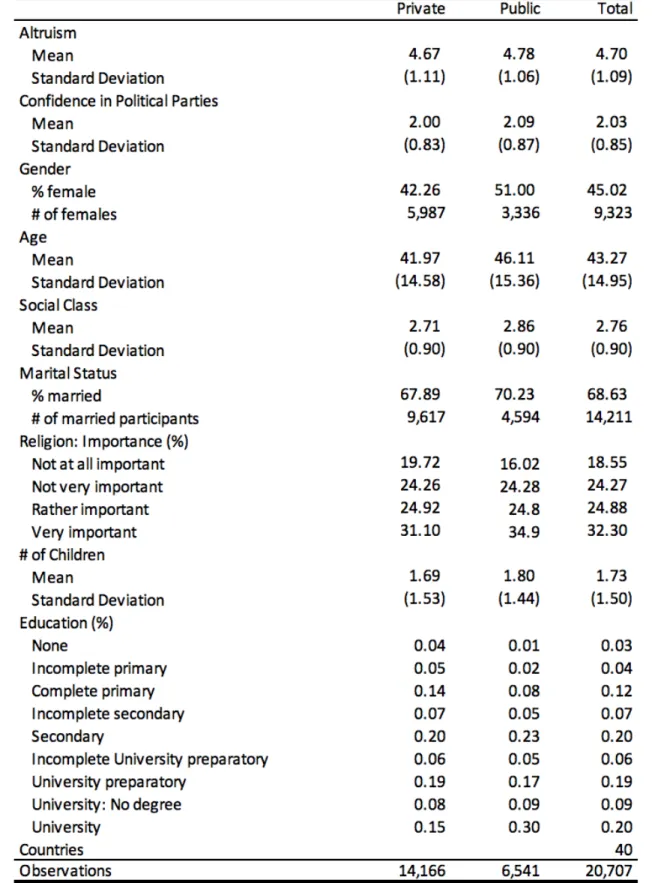
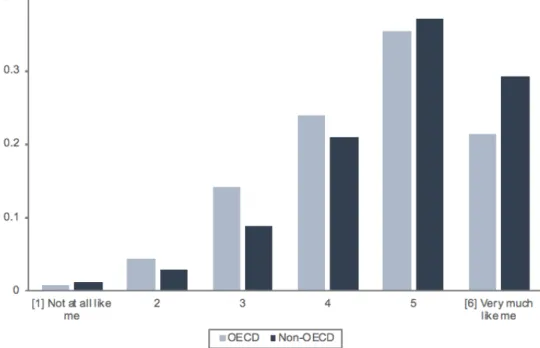
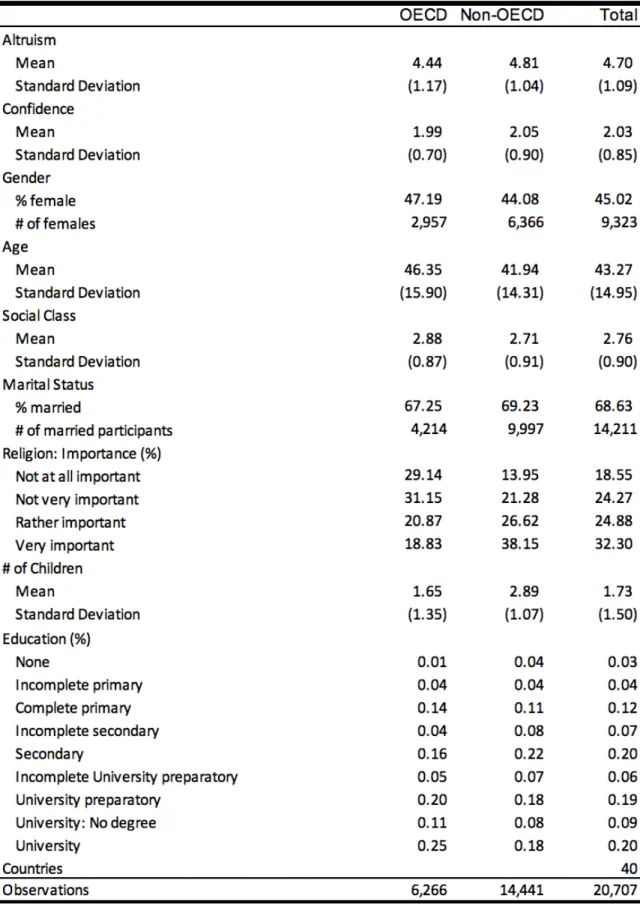
Table 2 provides those results by OECD and non-OECD subgroups. Standard deviations are expressed in parenthesis. The list of the countries in both OECD and non-OECD groups of the main regression sample can be found under Appendix B. Table 2 shows the summery statistics of OECD and non-OECD subgroups. The descriptive statistics show some heterogeneity between the two groups. We can see that altruistic preference is significantly higher in non-OECD countries. Perhaps unexpectedly, respondents in non-OECD countries express higher confidence in political parties compared to those in OECD countries. Respondents in non-OECD countries seem to place importance on religion substantially more than respondents in OECD countries do. Respondents in non-OEDC countries are less educated than those in OECD countries. People in developing countries have more children on average compared to OECD countries, though for OECD countries the mean does not appear to be statistically significant. Figure 3 and 4 show the difference in altruism and confidence in political parties between OECD and non-OECD subgroups. Figure 5 shows the sectorial distribution of workers in OECD and non-OECD countries. As you can see, there is only very little difference in sectorial distribution of workers between OECD and non-OECD countries. Both subgroups have about 70% of the sample population working for private sector, while approximately 30% working for public sector.
Figure 3
Density of Altruism by OECD and non-OECD subgroups
Figure 4
Density of confidence in political parties by OECD and non-OECD
subgroups
Notes: The same measurement of confidence in political parties as Figure 2 is applied
CHAPTER
6:
R
ESEARCHM
ETHODFollowing the research model in related literature Dur and van Lent (2017), Dur and Zoutenbier (2014) and Cowley and Smith (2014), I am going to test my hypothesis using regression analysis. In particular, it follows linear probability model. Linear probability model allows us to calculate conditional expectation as conditional probability in a case where the dependent variable is a dichotomous dummy variable (such as this case). When the dummy dependent variable is 1 for one category and 0 otherwise, we can interpret the expected value of dependent variable as the probability of dependent variable being 1. With this property of linear probability model however, the problem is that it doesn't have the property to understand that the probability must be between 0 and 1, and it forces marginal effects to be constant. Logistic and probit model understand the binary response better and would be able to highlight the changing impact of explanatory variables on volunteerism. Thus, I acknowledge that the theoretically appropriate way to test my hypothesis is to use logistic regression model, which ensures that the predicted probability falls between 0 and 1 for all parameters of explanatory variables. However, for the purpose of simplicity and more straightforward interpretation, I choose to use linear probability model, particularly Ordinary Least Square (OLS) regression estimate. Friedman (2012) published a paper for the World Bank discussing similar conflict between linear probability model and probit and logit model. He emphasizes that use of linear probability model for binary dependent variable is perfectly justifiable if heteroskedasticity issue is addressed, and if no predicted probabilities lie outside the binary interval (Friedman, 2012). Friedman (2012) states that even when the probit or logit models are thought to be the "right" method, they come with interpretive difficulties and it is unclear why these methods should always be preferred for regressions with endogenous dependent variables. A celebrated statistician Joshua Angrist (1999) also acknowledges that "the problem of causal inference with limited dependent variable is not fundamentally different from causal inference with continuous outcomes (Angrist, 1999, pp.2-3)." Below is the OLS regression specification of my linear probability model;
Volunteerism = α+ βSector of employment +
γ
Confidence in Political Parties +σ
Sector ofemployment*Confidence in Political Parties + µAltruism + fDemographics +e
β is the estimated effect of employment sector, γ is for estimated effect of confidence in political
CHAPTER
7:
R
ESULTS7.1
R
ESULTS OF MAINOLS
REGRESSION ANALYSIS FOR FULL SAMPLETable 3 shows the output of the main OLS regression for the full sample. The first regression estimation (1) includes only the "sector x confidence" interaction term as the explanatory variable in the regression equation to observe how the coefficient transforms as we add more explanatory variables. The coefficient on the interaction term is positive and highly significant at 1% level. Sector of employment variable is also positive and highly significant, indicating working for public sector in fact increase the likelihood of them volunteering without controlling for altruism. In (2), I add altruism variable in the regression. All variables still remain positive and significant at 1% level. The output (1) and (2) both indicate that without controlling for demographics, given the sufficient level of altruism, working for public sector has positive and significant effect on workers' likelihood of volunteering, and increase in confidence in political parties yields even higher likelihood of volunteering for public sector employees in comparison to the workers in private sector. (3) shows the final output of the regression estimate for the full sample with demographics. The effect of sector of employment decreases from 8.5 to 4.5 percentage points but remains positive and significance of 1% level. The effect of confidence in political parties rose from 1.1 to 3 percentage points after controlling for demographics for workers in private sector, indicating that a unit increase in confidence in political parties yields 3 percentage points higher likelihood for workers in private sectors to volunteer. Despite the slight decrease from 4.9 to 4 percentage points, the coefficient on "sector x confidence" interaction term remains positive, and it is highly significant at 1% level. The output of the full regression equation shows that 1.) conditional effect of a unit increase in confidence in political parties yields 3 percentage points higher likelihood of private sector individuals volunteering or engaging in charitable activities, and 2.) it yields 7 percentage points higher likelihood for individuals in public sector.
because of the potential time and financial constraints having children generally impose on parents, and higher number of children one has, less time they would have to spare for volunteering work. The coefficient on the variable shows contrary; increase in number of children yields 1 percentage point higher likelihood of individuals engaging in voluntary activities. Although the marginal increase is small, it is statistically significant at 1% level. One possible explanation for this could be that more children one has, more sports or recreational activities children participates, which then provide more volunteering opportunities for the parents, thus yielding positive results. Next, the coefficient on social class is positive and highly significant at 1% level, indicating that workers with higher social class are 4.5 percentage points more likely to engage in charitable activities. A possible explanation for this is that people who identify themselves with high social class may have bequested wealth, or own successful businesses which allow them to have more flexible schedule and free time. On the similar note, higher social classes are often associated with charity events and fundraisers in their community, and it may provide them more opportunities as well as social pressure to take part in the charitable activities.2 The coefficients on religion show an
interesting pattern. Compared to those who identified with the lowest category (“not at all important”) in response to importance of religion question, those who identified with 1 category higher (“not very important”) are 1.2 percentage points more likely to volunteer, however this unit increase yields no significance. Those who identified with “rather important” to the question are 2.7 percentage points more likely than those without religious importance (baseline category) to volunteer or engage in charitable activities. This effect shows moderate significance at 5% level. Those who identified with the highest category for the religious importance are 6.2 percentage points more likely than the lowest category to engage in charitable activities, and statistical significance increases to 1% level. Lastly, the coefficient on each category of education variable indicate that conditional marginal effect of higher education on individuals’ likelihood of volunteering is positive and highly significant at 1% level. This could also be due to the volunteering opportunities religious groups often provide, similar to how having more children or belonging to higher social class may provide more avenues to participate in charitable activities or volunteering events. Individuals with higher religious importance are more likely to be heavily
2 For decision making in social setting, see Frey and Meier (2004), Messick (1999), Fisher and Ackerman (1998)
7.2
R
ESULTS OFOLS
REGRESSION ANALYSIS FOROECD
AND NON-OECD
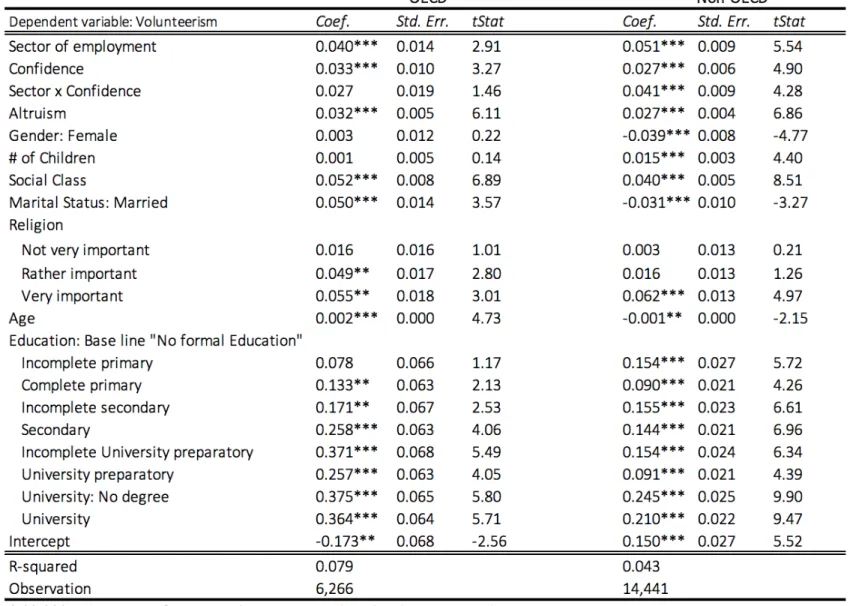
SUBGROUPSTable 4 shows the results of OLS regression analysis for OECD and non-OECD subgroups with all control variables. One unanticipated outcome is that when we separate the sample into 2 groups based on economic maturity, advancement and openness ("OECD: The Accession Process", n.d.), the coefficient on "sector x confidence" variable becomes statistically insignificant for OECD subgroup. Furthermore, both coefficients on gender and number of children become insignificant for OECD subgroup as well. On the other hand, for non-OECD subgroup the pattern we observed for the full population is sustained.
First, let us address the outcomes that 2 groups have in common. Again, all coefficients show conditional effect of each variable. Both groups show positive and statistically significant coefficients on sector of employment, confidence in political parties, altruism, social class, religion and education (with an exception of "incomplete primary" category for OECD countries). For both subgroups, conditional effect of public sector employment yields 4 and 5.1 percentage points increase in the likelihood of workers volunteering for OECD and non-OECD countries respectively. Unit increase in confidence in political parties yields 3.3 percentage point and 2.7 percentage point higher likelihood of private workers volunteering for OECD and non-OECD countries respectively. Coefficients on both variables in both groups are highly significant. This indicates that regardless of the difference in the level of economic development, public sector employees are generally more likely to engage in charitable activities. In both groups, the estimated effect of altruism on volunteerism is positive and statistically significant at 1% level. Higher social class also increase in the likelihood of engaging in charitable activities for workers in both groups, although in OECD countries higher social class yields slightly more likelihood of volunteering. In both groups, higher education yields increase in individuals’ likelihood of volunteering, but the effect is larger in OECD countries than that of non-OECD countries. Individuals with university degree in OECD countries are 36.4 percentage unit more likely than those with no formal education to engage in charitable activities, while in non-OECD countries having a university degree yields 20.8 percentage point higher likelihood of volunteering than those with no formal education.
increase in confidence in political parties yields 6.8 percentage points higher likelihood of volunteering for public sector workers in non-OECD countries, while the same increase yields 2.7 percentage point increase for private sector workers in non-OECD countries. For both countries, the effect of increase in religious importance yields positive coefficients, but the effect is significant only with sufficient level of importance one places on religion. For OECD subgroup, the effect is positive for those who identified with “rather important” and “very important”, with moderate significance at 5% level. This indicates that those with stronger religious values are more consistently likely to volunteer than those without any religious values or those with low religious importance. For non-OECD subgroup, the effect of religious importance is highly significant at 1% level only for the individuals who scored the highest category. Compared to those who do not place importance on religion, with the highest religious importance are 6.2 percentage points more likely to participate in charitable activities in less-developed countries. Interestingly, variable age does not have statistical significance in the analysis for the full population, but once separating the samples it shows small but significant effects. For OECD countries, unit increase in age yields 0.2 percentage point increase, whereas for non-OECD countries it yields 0.1 percentage point decrease in the likelihood of volunteering. Another interesting outcome is observed with marital status variable. In the regression for the full population, marital status showed negative coefficient and no statistical significance. When we divide the sample into OECD and non-OECD subgroups, the variable becomes statistically significant in both groups. In OECD countries, having a partner (legally or living together as married) yields 5 percentage point increase in individuals' likelihood of volunteering, while in non-OECD countries, having a partner decreases the likelihood by 3.1 percentage point.
CHAPTER 8: ANALYSIS AND IMPLICATIONS
Here I briefly summarize the underlying key assumptions of my hypothesis that I gathered from the related literature and theoretical framework. Fist, public sector workers tend to be more altruistic than workers in private sector, and this is in line with Dur and Zoutenbier (2014), and
many other studies that address 'public service motivation'.3 This is also observed in the survey
data I used for this analysis as well (see Figure 1). Second, my research follows Dur and van Lent (2017), with regards to the avenues available for workers to express their altruistic preferences; workers in public sector are able to express their altruistic motivation through both means of their job and outside their work, because compared to private sector jobs, public sector jobs provide more opportunities to serve the public interest or help others in need. Thus, when work provides substantial opportunities for the workers to fulfil their desire to help others, they engage in charitable activities less outside work compared to private sector workers (Dur and van Lent, 2017). On this note, the third key assumption was that since altruistic workers in public sector receive intrinsic value from fulfilling their personal "mission" through their job (Wright, 2007; Weiss and Piderit, 1999), when they work for organizations that have similar or same mission and goals, their altruistic desire is further fulfilled, thus higher persona-organization mission alignment should decrease the likelihood of public sector workers volunteering or engaging in charitable activities (Dur and van Lent, 2017).
The results of cross-country OLS regression analysis, this research has identified 2 major findings. First, given the 4 key assumptions of the research, public sector workers are in fact more likely than private sector workers to engage in charitable activities, despite their job providing them opportunities to express their altruistic preferences. Second, this phenomenon appears to be largely driven by public sector workers in non-OECD countries (less-developed countries). Contrary to my prediction, regression estimation for all 3 sample groups (full sample, and OECD and non-OECD subgroups) produced positive coefficient on the main variable of interest, which is the interaction variable of sector of employment and confidence in political parties. With the exception of OECD subgroup, the coefficient is positive and statistically significant. Contrary to the main argument of Dur and van Lent (2017), this implies that the likelihood of public sector employees volunteering or engaging in charitable activities increase when confidence in political parties
increases. In other words, when the organization's mission provides ample opportunities for individuals to engage in tasks that align with their personal mission to help others or contribute to the well-being of the society, it appears to have a positive impact on their philanthropic behavior outside work. When separating the full sample to OECD and non-OECD countries however, the interaction term shows positive but loses significance for OECD countries.