IN THE SERVICE OF KNOWLEDGE: RACE, GENDER, AND CLASS IN A NEW SOUTH UNIVERSITY COMMUNITY, 1930-1980
Jessica Auer
A dissertation submitted to the faculty at the University of North Carolina at Chapel Hill in partial fulfillment of the requirements for the degree of Doctor of Philosophy in the Department
of History.
Chapel Hill 2020
Approved By: Katherine Turk Benjamin Waterhouse Jim Leloudis
© 2020 Jessica Auer
ABSTRACT
Jessica Auer: In the Service of Knowledge: Race, Gender, and Class in a New South University Community, 1930-1980
(Under the direction of Katherine Turk)
“In the Service of Knowledge” joins a growing body of literature that explores the rise of the so-called service economy, focusing historical attention on an understudied economic
phenomenon in the twentieth century – the large-scale medical-educational complex in the transitioning South. Unlike other treatments of the “knowledge economy,” this dissertation examines the development of the non-academic and non-professional workforce at one such anchor institution, Duke University, in Durham, North Carolina. Enormous nonprofit institutions of higher learning like Duke University imagined themselves as drivers of middle-class and high-technology growth, increasingly essential in a region with a history of poverty and cultural “backwardness.” At the same time, they became employers of a large number of low-wage non-academic workers, creating new working-class communities as well. Long ignored in the historical literature, these workers and the cultural perception of their labors challenge our understandings of the knowledge economy.
Swept up in a fundamental reorientation of the political economy in Durham, Duke administrators, clients, and workers initially marshaled and adapted existing understandings of gender, race, and class in order to make sense of the burgeoning non-academic workforce on campus. In so doing, they often reinforced and repackaged patterns of racial and gender
ACKNOWLEDGEMENTS
There were many days when I feared that I would never be done with this dissertation. Its completion required a monumental outlay of intellectual effort, emotional labor, and financial sacrifice, but not one I bore alone. I am thankful to so many whose assistance, support, and kindness helped challenge me when I found myself in an intellectual rut, buoy me when my spirits were down, and keep me safe and secure when the inevitable emergency strained my graduate school budget. I offer gratitude and a few words of thanksgiving here, though I know it could not satisfy the debt owed.
I have been immensely lucky with the professional support I received throughout this process. I would especially like to thank my mentors and advisors, Katherine Turk and Benjamin Waterhouse, who saw me through an extremely rough start and provided invaluable feedback on this project every step of the way. They and the Waterhouse Writing Group prompted me to see things with more clarity, and hone and adapt my ideas as the project advanced. I am also grateful for the help and support I received from the archivists at Duke University, especially Amy McDonald, who always tracked down what I needed and kept an eye out for undiscovered materials.
Lars, Kirsten, and Erika are four of the brightest, kindest, and most loving people I have ever known, and I very literally could not have gotten through this without them. To be surrounded by such inspiring women is a true blessing.
I cannot begin to express the depth of my gratitude for my loving, generous, and patient family – they provided the emotional and intellectual foundation upon which all else was built. From the earliest, my Mom and Dad have always encouraged my intellectual curiosity, provided a safe harbor when life got rough, and given me a helpful push when I have been tempted to play it safe. LJ’s pride in me has always lifted me up. I hope she knows how proud I am of the kind, loving, capable woman I get to call sister. As a kid, Jenny taught me that I shouldn’t have to hide who I was to fit in, and as an adult, she has shown me a loyalty and devotion I hope to one day to be deserving of.
TABLE OF CONTENTS
Introduction……….…….1 Chapter 1: A New University, A New Deal: Duke and the Political Economy of
Higher Education, 1924-1960………25 Chapter 2: Durham’s New Domestics: Gender, Race, and the Public Household
of Duke, 1930 - 1960……….……69 Chapter 3: “A Lady in Every Respect”: Gender, Whiteness, and Clerical Labor
at Duke, 1930-1960………..129 Chapter 4: In Durham, and of It: Duke and Urban Geography, 1925-1965………185 Chapter 5: The End of That “Happy Informality” and the Making of the “Fourth Estate”…...242 Chapter 6: The University and the Unions: Redefining Service, Profit, and the
University Community at Duke, 1971-1978………..………..294 Epilogue: Terry Sanford and the Limits of Liberalism in a New South University
LIST OF FIGURES
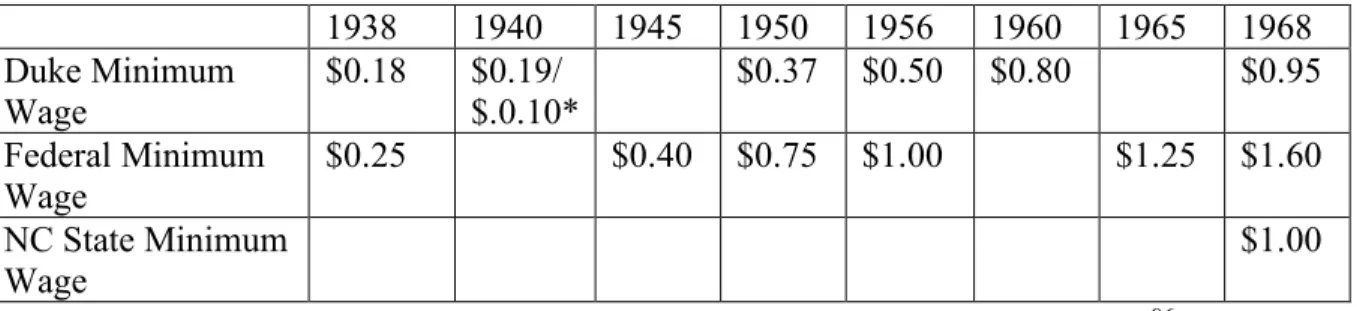
Figure 1.1 – Comparison of Duke, Federal, and State Minimum Wages………..56
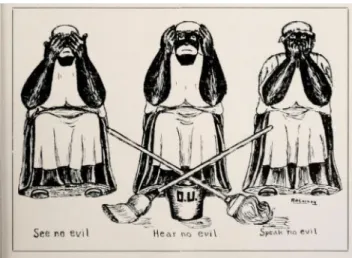
Figure 2.1 – Image from Student Yearbook, The Chanticleer, 1930……….70
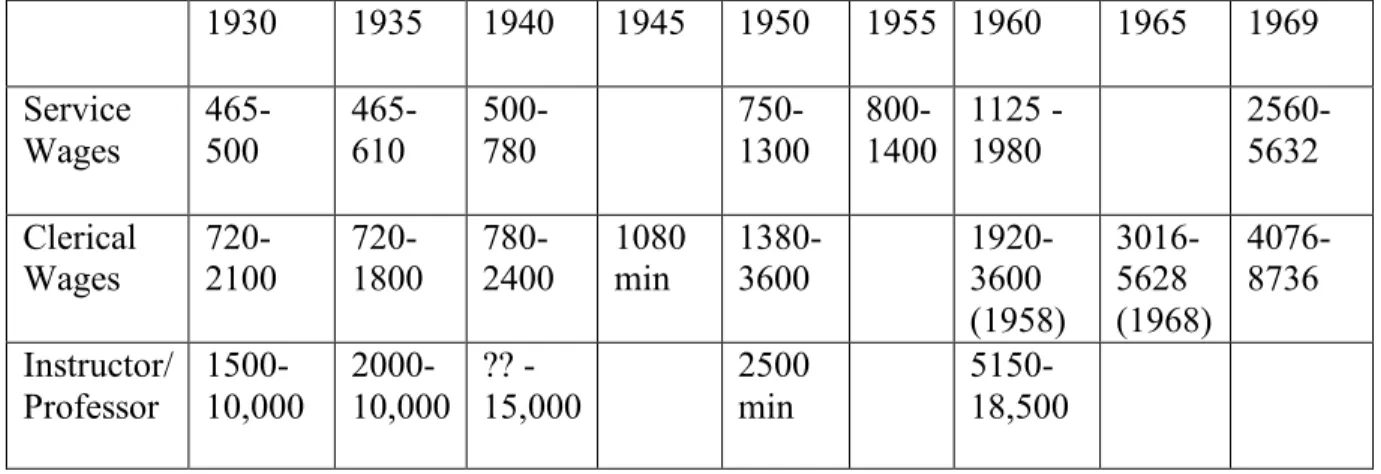
Figure 3.1 – Yearly Salaries Compared by Category of Employment………164
Figure 4.1 – Map of Durham with 1915 Racial Lines……….192
Figure 4.2 – Map of Trinity College, c. 1915, with Faculty Housing Marked………195
Figure 4.3 – Employee Residences in 1923……….196
Figure 4.4 – Employee Residences in 1932……….196
Figure 4.5 – White Employee Residences in 1942………..199
Figure 4.6 – Residences of White Clerical, Library, and Service Supervisors, 1949…………..208
Figure 4.7 – Table with Comparative Wages………..209
Figure 4.8 – Black Employees Residences, 1935………213
INTRODUCTION
“Textile mills built the New South,” declared the authors of the classic labor history of Piedmont industrialization, Like a Family, in 1987.1 That work charted the first entrance of
a largely white working class into waged labor across whole swaths of the American south. In North Carolina, the state’s other major product, tobacco, drew a more racially mixed group of workers to factories that churned out cigarettes for the nation’s smokers.2 According
to boosters in towns across the region, these factories promised to pry the South from the grip of planter feudalism and violent white supremacy, and deliver it to a bright, “modern” future of economic dynamism and social harmony.3 But by the 1960s and 1970s, many of the mills
and stemmeries that built the New South had closed, moved, or downsized into
1Jacqueline Dowd Hall et al., Like a Family: The Making of a Southern Cotton Mill World (Chapel Hill, NC: University of North Carolina Press, 1987), xvii.
2For a history of the tobacco industry in Durham, see Dolores Janiewski, Sisterhood Denied: Race, Gender, and
Class in a New South Community (Philadelphia: Temple University Press, 1985); and Beverly W. Jones, “Race, Sex, and Class: Black Female Tobacco Workers in Durham, North Carolina, 1920-1940, and the Development of Female Consciousness,” Feminist Studies 10, no. 3 (Fall 1984): 441-451.
oblivion.4 An assortment of service and technology industries rose to replace them as anchor
institutions of the New South’s latest reimagining: the “Sunbelt South,” a forward-looking incubator of research, innovation, and cultural modernization.5 Durham, North Carolina
exemplified this trend, transforming from the world’s leading “tobacco town” to the “City of Medicine” over the course of the twentieth century.6
Durham’s Sunbelt “knowledge economy,” like those elsewhere, centered on the increasing importance of an institution of higher education. Such institutions were not new to the twentieth century, of course. Building on European precedents, a variety of small
seminaries and other “colleges” dotted the colonial and early national landscape.7 By the
mid-nineteenth century, elements of the “modern” university had become to take shape, a process accelerated by a series of massive philanthropic gifts and the increasing embrace of the “German” model of research and scholarship.8 Some even forged formal relationships
4For de-industrialization in the South, see Timothy J. Minchin, Empty Mills: The Fight Against Imports and the
Decline of the U.S. Textile Industry (Lanham, Md: Rowman & Littlefield Publishers, 2013); Janiewski,
Sisterhood Denied, 171-174.
5For conception of the Sunbelt South and the importance of service and technology to that vision, see Elizabeth Shermer, Sunbelt Capitalism: Phoenix and the Transformation of American Politics, (Philadelphia: University of Pennsylvania Press, 2013); and Bruce J. Schulman, From Cotton Belt to Sunbelt: Federal Policy, Economic Development, and the Transformation of the South, 1938-1980 (Durham: Duke University Press, 1994). Schulman cites the Durham-Chapel Hill area and Research Triangle Park as a chief example of this sunbelt vision. Schulman, From Cotton Belt to Sunbelt, 169-173.
6The city launched a campaign branding itself the “City of Medicine” in 1980. Martha Carolina Rundles, “The Rise and Fall of the Brand: ‘Durham, City of Medicine, USA’” (master’s thesis, University of North Carolina at Chapel Hill, 2004).
7 See John Thelin, A History of Higher Education (Baltimore: Johns Hopkins University Press, 2011);
Christopher Lucas, American Higher Education: A History (New York: St. Martin’s Press, 1994); and Margaret Sumner, Collegiate Republic: Cultivating an Ideal Society in Early America (Charlottesville: University of Virginia Press, 2014).
8 See Frederick Ruldolph, The American College and University: A History (New York: Knopf, 1962); Thelin,
with hospitals, as the field of medicine grew more professionalized and became a growing object of scientific inquiry.9 Self-styled research institutions never entirely displaced the
liberal arts college, normal school, or land grant university, but they grew in size and prominence through the early twentieth century and a focus on academic scholarly
production spread beyond their walls.10 Academics in an increasingly diverse set of fields
began to view “knowledge production” as an essential element of their work. However, it was over the middle of the twentieth century that a more pronounced ecosystem which observers have dubbed the “knowledge economy” took shape, buoyed by growing student enrollments, considerable state investment in higher education, and, especially, an expanding market for the knowledge produced by academic research. Massive amounts of capital and social cache began to flow through universities, hospitals, research institutes, pharmaceutical and technology companies, consultancies, and any number of other associated entities. 11
Duke University’s ascendance serves as a paradigmatic example of this broader economic transformation. Over the course of the twentieth century, determined leaders had elevated a small regional college into national prominence, nurturing its growth into a medical-educational complex of enormous proportions – Duke University. Moreover, the university’s economic importance and significance grew just as the city’s industrial might
9 See Paul Starr, The Social Transformation of American Medicine (New York: Basic Books, 1982); Robert Durden, The Launching of Duke University, 1924-1949 (Durham: Duke University Press, 1993).
10 See Ruldolph, The American College and University: A History; Thelin, A History of Higher Education; Laurence Veysey, The Emergence of the American University (Chicago: University of Chicago Press, 1970); and Roger Geiger, To Advance Knowledge: The Growth of American Research Universities, 1900-1940 (New York: Oxford University Press, 1986).
11 See Rebecca Lowen, Creating the Cold War University: The Transformation of Stanford (Berkeley:
withered.12 By the 1960’s, Duke had become Durham County’s largest private employer and
would shortly become one of the largest in the state.13
Yet, despite their having become major economic institutions by midcentury, most historians of higher education have completely eschewed discussions of universities as employers, and especially employers of nonacademic labor.14 In one recent study of what she
called the “ultimate post-industrial city,” scholar Margert O’Mara framed her work as the history of the “scientists, the mathematicians, the economists, and the engineers of the new intellectual technology.”15 But a closer examination reveals that the high-wage knowledge
economy in Durham was inseparable from the growth of the low-wage service workforce that accompanied it. The American system of higher education represented middle-class uplift and the promise of social mobility but, in its particular form, it also depended
12This was mirrored elsewhere in former industrial towns. See LaDale Winling, Building the Ivory Tower:
Universities and Metropolitan Development in the Twentieth Century (Philadelphia: University of Pennsylvania Press, 2018).
13Robert R. Korstad and James L. Leloudis, To Right These Wrongs: The North Carolina Fund and the Battle to
End Poverty and Inequality in 1960s America (Chapel Hill: University of North Carolina Press, 2010), 176. 14Examples abound, but for an indicative sample, see Lowen, Creating the Cold War University; Glenn Altschuler and Isaac Kramnick, Cornell: A History, 1940-2015 (Ithaca: Cornell University Press, 2014); and Morton and Phyllis Keller, Making Harvard Modern: The Rise of America’s University (New York: Oxford University Press, 2001). The same critique holds true for foundational surveys in the field. This dissertation builds on several important exceptions, most of which have focused on strikes between the 1960s and 1980s. Gregg Michel, “‘Union Power, Soul Power’: Unionizing Johns Hopkins University Hospital, 1959-1974,”
Labor History 38 (Dec. 1996), 28-66. Herbert Janick, “Yale Blue: Unionization at Yale University, 1931-1985,”
Labor History 28 (1987): 342-369; John Hoerr, We Can’t Eat Prestige: The Women Who Organized Harvard
(Philadelphia: Temple University Press, 1997); and Deborah Sue Elkin, “Labor and the Left: The Limits of Acceptable Dissent at Yale University, 1920s to 1950s” (PhD diss., Yale University, 1995). In later chapters, my work builds on and reinterprets two works of historical sociology on labor organizing at Duke. Erik Ludwig, “Closing in on the ‘Plantation’: Coalition Building and the Role of Black Women’s Grievances in Duke University Labor Disputes, 1965-1968,” Feminist Studies 25, no. 1 (Spring 1999): 79-94; and Karen Brodkin,
Caring by the Hour: Women, Work, and Organizing at Duke Medical Center (Urbana: University of Illinois Press, 1988). I take as a model one particular standout in the history of higher education, which examines the role of faculty wives and servants in early colleges, Sumner, Collegiate Republic.
essentially on the low-wage, gendered, and racialized labors of many people.16 The ranks of
professors and doctors expanded over the course of the century, but these numbered only in the hundreds. Many more worked the campuses of Duke as housekeepers, cooks,
stenographers, aides, secretaries, and maintenance workers. Instead of taking their place at the foot of a loom or in a pungent drying room, thousands now toiled each day in the service of knowledge.
The process by which the university and hospital gradually became new centers of working-class life in Durham was complex and contested. Despite the increasingly
conspicuous size of its nonacademic workforce, Duke only awkwardly acknowledged its function as an employer, with a self-perception oftentimes hovering perilously between loyal benefactor and overt-taxed charity. And as Durhamites were drawn into this purportedly new “knowledge economy,” they confronted the legacies of older relations of gender, race, and class. In daily interactions and larger-scale conflicts, administrators, managers, workers, students, and patients wrestled with competing understandings of the prerogatives and responsibilities of the university as workplace.17 The labor relations that characterized the
modern university evolved out of this prolonged historical process of negotiation and
16For the view of universities as middle-class institutions, see Ruldolph, The American College and University:
A History; David O. Levine, The American College and the Culture of Aspiration, 1915-1940 (Ithaca: Cornell University Press, 1986).
conflict. These struggles thus reveal new dimensions to the knowledge economy’s emergence and its impact on class in modern America.
---
In 1924, James Duke, a tobacco and energy magnate, made a monumental series of gifts totaling over forty million dollars to launch provincial, segregated Trinity College in the small but bustling “New South” town of Durham, North Carolina on a path towards immense growth.18 Trinity College moved to Durham from its previous home in rural Randolph
County about fifty miles east in 1892, but continued to struggle in the decades that followed. The efforts of William Few, professor of English and Trinity’s president beginning in 1910, transformed the college’s fortunes. A Southern boy made good, Few embodied the
aspirations and beliefs of the men leading the “New South” revolution. Moreover, he believed that the university had a role to play in achieving it. Few had witnessed first-hand the prosperity and cosmopolitanism of both the old British universities of Cambridge and Oxford and also of stateside institutions like Harvard and Princeton. The South needed an educational revolution, he argued. Without it, the region would remain mired in the backwardness that accompanied planter aristocracy and slavery.
After years of careful cultivation, William Few and Benjamin Duke, the elder son of the patriarch Washington Duke, prevailed upon James, the younger brother and far more successful businessman, to plan for his philanthropic future with Trinity in mind. In 1924,
James Duke finalized proposals to endow a charitable foundation, the largest beneficiary of which would be Trinity College.In honor of Duke’s largesse, the Board of the college agreed to rename it Duke University, ostensibly after James’ father. The early twentieth century was a period of expansion in higher education across the nation, and James Duke’s gift signaled that the South too would take part in this project.19 He believed that “education […] is, next
to religion, the greatest civilizing influence,” and felt the limitations of his home region prodigiously in that regard.20 Thus, in his mind, the new university that now bore his name
was destined to “uplift mankind” in the South.21
Over nearly a decade, the university undertook a massive construction program that tripled its physical footprint and
transformed the city’s west end. On the
strength of this windfall and the architectural expansion it allowed, Duke University
19 For the early 20th century as period of growth in higher education, see Winling, Building the Ivory Tower, 2-5.
20 Duke, quoted in Durden, The Launching of Duke University, 28. 21 Ibid.
established a host of new facilities and programs, including the medical school and teaching hospital that Few had long desired.22 This transformation had profound and long-lasting
consequences for Durham. Over the twentieth century, Duke University fundamentally altered the city’s self-image: from a dynamic but grungy town of the “New South,” to a thriving and upwardly mobile “Sunbelt” city.
Before Duke University’s ascendance, Durham was known primarily as the nation’s biggest “tobacco town.” When the Duke family pioneered the mechanical production of the cigarette in the 1880s, they guaranteed Durham’s leading status in tobacco for decades.23 In
the closing decades of the 19th century, several successful tobacco men invested their profits
in what would become the city’s second major industry, textiles.24 Together these industries
employed more than eleven thousand workers by 1930.25
But like most New South industrial towns, Durham featured uneven development and widespread inequality. The small but powerful capitalist class thrived: men like Julian Carr and James Duke reaped fortunes from the tobacco and textile factories dominating the city’s turn-of-the-century landscape. However, dashing the hopes of one early booster who called Durham “an asylum for the poor,” wages in these industries were notoriously low, the work seasonal, and working conditions brutal.26 And, according to one sociologist, “the absence of
22 For President William Few’s desire to establish a medical school and hospital, see Ibid., 12, 19-21, 347-8.
23 Janiewski, Sisterhood Denied, 69. 24 Ibid., 74.
25 Ibid., 116.
large commercial concerns with many office workers [made] Durham a town with a small middle class.”27
Racial discrimination made the livelihoods of Durham’s black working-class particularly tenuous. In tobacco, black men and women were limited to the dangerous and strenuous jobs preparing the tobacco plant for production.28 Most of the textile and hosiery
firms exclusively hired white workers, with the exception of two all-black mills that were opened in the early 20th century in the city and which employed perhaps five hundred black
women.29 The majority of black women in Durham had to rely on private domestic labor for
their livelihoods.30
This was the place where Trinity College grew into Duke University. And it was where the new university’s administrators sought answers to the emerging challenges of its growth and development. Among the most pressing of these challenges was how to make the grand new university complex work. Once built, new dorms, new facilities, and new wards had to be staffed. As the university continued to grow through the twentieth century, administrators were confronted with a burgeoning number of non-instructional staff roles, including in housekeeping, food service, and clerical work.
27 Hugh Brinton, “The Negro in Durham: A Study of Adjustment to Town Life” (PhD diss., University of North Carolina at Chapel Hill, 1930), vi.
28 See Brown, Upbuilding Black Durham.
In sheer numbers, service and clerical workers came to dominate the university’s non-academic labor force.31 As more and more students came to live on Duke’s campus nine
months out of the year, and hundreds of visitors traveled to Duke Hospital daily for medical care, the university had to expand its capacity to provide them with the material sustenance of life. In doing so, the University accepted the responsibility of housing and feeding its growing campus populations, gendered labors one might think of as the maternal side of the university’s in loco parentis.32 At the same time, the university’s organizational structure
grew larger and more complex as new departments were created and already established departments expanded. Compounding the management challenges of a growing university, faculty, doctors, and administrators increasingly sloughed off tasks they no longer wished to perform. In daily university life, these changes meant Duke’s offices and corridors became filled with clerical workers tasked with meeting the institution’s mushrooming record keeping and communication needs. Maids, janitors, cooks, cashiers, busboys, aides,
stenographers, secretaries, punch card operators: these men and women performed the labor that made universities like Duke function.
For decades, the university had no formal personnel department or policies, and authority remained largely disbursed across the hospital, East Campus, and West Campus
31 In the category of “service worker,” I include all those who were engaged in the direct provision of personal service – predominantly the reproductive labors of cooking, cleaning, and caring for students, faculty, and patients. Though I do not include professional nursing personnel in this category, I do discuss the creation of the licensed practical nurse (LPN) position and its early grounding in administrators’ views of personal care. I use the term “clerical worker” to refer to a wide (and growing) range of positions involved extensively in record-keeping labors, including stenographers, punch card operators, clerks, secretaries, and data terminal operators. I do not focus much on the university’s maintenance workforce, though they do appear occasionally. This is because they did not represent nearly so large a contingent as the other two, and because there are almost no extant sources with which to reconstruct their experiences.
32 For the history of in loco parentis as a disciplinary regime, see Rudolph, The American College and
into the 1960s. Yet, notwithstanding the decentralized nature of personnel decisions at Duke, university administrators pursued clear demographic preferences in building their non-academic workforce and explicitly sought to shape these employees’ legal status as workers. The labor that those workers performed became important not just to the institution’s
economic bottom line but also to the story administrators told about higher education and medicine.
Like many other service institutions, Duke used gendered and racialized tropes to construct and justify relations of labor on campus. Administrators marshaled gendered rhetorical frameworks and appeals to family metaphors to shape both daily workplace interactions and the wage hierarchies that governed its increasingly bureaucratic structure. Clerical work at Duke in the first half of the century offered many white women consistent and respected positions that presented a respite from the dirty, taxing working-class jobs associated with the region’s industrialization. These positions, however, usually carried low pay and few long-term opportunities for advancement and required women to serve as surrogate wives for powerful male faculty or administrators.
Yet, while administrators appealed to notions of white womanhood, the university’s “public household” was more complex than the one described by scholars like Bethany Moreton.33 The university also depended on black men and women in Durham to perform
many specific (and low paying) service labors; labors which white members of the university community perceived black men and women particularly and constitutionally well-suited to
perform. Thus, the ideal household on which Duke was modeled was not itself a “private” retreat from the commercial world, but rather a public workplace in its own right.34 And
while white students and patients came to expect a particular “home-like” atmosphere, so too did many white employees. In particular, white women employees helped reinforce the scripts of a public household in their daily interactions with black workers at Duke. The new, modern economies of knowledge ultimately drew from and re-inscribed longstanding
gendered and racial logics in ways that reinforced differences among poor southerners even as it recast them in new terms.
Duke administrators structured university labor relations around ideals of selfless nonprofit service, fantasies of virtuous white womanhood, and stereotypes of black servility in order to promote its growth and legitimacy during key moments of change. This history points to important inadequacies in the way historians of higher education have discussed two key issues: the “collegiate ideal” (an emphasis on providing a robust, wholesome, and character-building campus life) and the “rise of administrative bureaucracies.”35 Historians
generally date these two transformations to the early twentieth century, when universities’ social legitimacy was under threat. But beyond off-handed mentions of “janitorial” staff or
34 It thus more closely approximated the mixed space familiar to women’s labor historians. See, for instance, Boris and Klein, Caring for America; Eileen Boris, Home to Work: Motherhood and the Politics of Industrial Homework in the United States (New York: Cambridge University Press, 1994); Elizabeth Clark-Lewis, Living In, Living Out: African American Domestics in Washington, D.C., 1910-1940 (Washington: Smithsonian Institution Press, 1994); Rebecca Sharpless, Cooking in Other Women’s Kitchens: Domestic Workers in the South, 1865-1960 (Chapel Hill: University of North Carolina Press, 2010).
gestures to when “typewriters appeared and typists began flooding” university corridors, they have failed to consider how these two processes transformed the makeup of the university community and, in particular, relations of gender, race, and class.36 Duke’s administrators
took responsibility for providing the full complement of material comforts to students and patients through the creation of a profoundly racialized workforce whose presence fit into their particular vision of a “home-like” atmosphere. Similarly, “bureaucratization” at Duke was a process intricately tied up in claims of masculine authority and mediated through appeals to feminine virtue: Duke administrators “engendered the office” in much the same way that leaders of 19th century financial institutions had before them, hiring large numbers
of white women to perform increasingly devalued clerical work.37 Thus, far from natural or
impersonal processes, the “collegiate ideal” and bureaucratization helped solidify the industry’s status as economic anchors while embedding gendered and racialized conflicts into the project of higher education.
However, they could not do so in a vacuum. Administrators’ visions of service and clerical work mapped imperfectly onto the aspirations of Duke’s employees themselves. These employees understood their roles in the university community through the filter of their own varied experiences with race, gender, and status in Durham and at Duke. This disconnect, paired with what seemed constantly increasing demands, bedeviled
administrators throughout the twentieth century. In particular, while many black service workers preferred the formal institutional setting at Duke over being subject to the
36 Veysey, The Emergence of the American University, 268, 306.
37 I draw here especially from Angel Kwolek-Folland, Engendering Business: Men and Women in the
vicissitudes of a mistress in a private home, they often chafed at the rules they were asked to follow in what they called “the big house” or sometimes simply “Dukes.”38 In the end, it was
mostly these workers who forced the university to confront its history of labor exploitation. Over time, many of them came to resent and resist particular aspects of their laboring lives, driving the tensions embedded in the knowledge economy into public view through
widespread collective action in the 1960s and 1970s. Ultimately, Duke’s management only reluctantly, and often disingenuously, responded to employee demands for reform.
The experiences of these workers help deepen our understanding of race, gender, and liberalism in twentieth century labor history and in Southern labor history in particular. First, Duke’s administrators, who eventually came from all over the nation, continued the legacy of earlier economic “modernizers.” They continuously reinvented and reasserted existing social hierarchies in the context of new economic structures. Their eventual resistance to employee activism ultimately reveals in new ways the limits of 20th century liberalism. Second, as
clerical workers at Duke, some working-class white women came to understand themselves as different from the university’s black service workers by virtue of status, rather than by virtue of race. These feelings eventually led most of them to resist efforts at cooperation and coordination when black service workers organized beginning in the 1960s. Thus, this story of conflict among workers offers a new part of the history of how rapid economic changes helped cement an ostensibly color-blind rejection of labor liberalism.
On the other hand, the story of Duke’s mostly black service workers revises further the once-standard narrative arc of twentieth century labor history which still tends to suggest
a New Deal-era highwater mark and a collapse in the 1970s. For workers at Duke, the New Deal represented not the triumph of working-class power but the formalization of their disadvantaged status.39 However, unlike the agricultural and domestic workers whose fates
we know more about, the exclusion of nonprofit workers from New Deal protections rested on moral and ideological claims of institutional deservedness that shrouded their status as employees and obscured the racial and gendered implications of their exclusion. Nor were the 1960s and 1970s necessarily a period of declining fortunes for workers within the knowledge economy.40 Their story reminds us of the complex way that the New Deal legal
regime intersected with local conditions and culture to shape economic possibilities in American labor history.
Duke’s nonacademic labor force was at the center of deep economic and social transformation on campus and in Durham. However, nonprofits like Duke and its hospital have remained largely outside the scope of historical inquiry in the fields of labor and
economic history. For the most part, scholars have followed tax law in treating universities as
39 For treatments of the New Deal as the emergence of working-class power, see Lizabeth Cohen, Making a
New Deal: Industrial Workers in Chicago, 1919-1939 (New York: Cambridge University Press, 2008); Nelson Lichtenstein, State of the Union: A Century of American Labor (Princeton: Princeton University Press, 2002); and Jefferson Cowie, The Great Exception: The New Deal and the Limits of American Politics (Princeton: Princeton University Press, 2016). This remains particularly true of scholars who emphasize the restraint imposed on unions by Cold War politics. At the same time, the New Deal portion of the narrative has undergone the most significant revision, with many scholars emphasizing the limited reach of the New Deal. See, for instance, Thomas Sugrue, The Origins of the Urban Crisis: Race and Inequality in Postwar Detroit
(Princeton: Princeton University Press, 1996); Ira Katznelson, When Affirmative Action Was White: An Untold History of Racial Inequality in Twentieth-Century America (New. York: W.W. Norton, 2005).
40 See Jefferson Cowie, Stayin’ Alive: The 1970s and the Last Days of the Working Class (New York: New Press, 2010); and Judith Stein, Running Steel, Running America: Race, Economic Policy, and the Decline of Liberalism (Chapel Hill: University of North Carolina Press, 1998). Important exceptions to this include Lane Windham, Knocking on Labor’s Door: Union Organizing in the 1970s and the Roots of a New Economic Divide
apart from and even above the commercial scrum.41 Moreover, both supporters and critics of
universities have characterized college campuses as liberal citadels, contributing to a widespread view of them as naturally benevolent and progressive institutions.42 In
contemporary culture, academics decry the “adjunctification” of their own work and graduate assistants across the nation seek to unionize, challenging the university’s liberal reputation. However, even their arguments sometimes promote an idealized vision of the university’s past labor practices.43 Looking beyond these ideals of public service and nonprofit status
demystifies the nature of work at institutions like Duke and reveals the long-term processes of conflict and change that shaped labor there.
In fact, the experiences of nonacademic workers at Duke suggest that historians have overemphasized the notion that “business” incursion in universities represents something new. Historians have long sought to understand the extent to which universities represented a unique sort of institution, with “business” serving as a useful, if always vaguely defined, foil. Though most scholars have ultimately acknowledged the presence of some elements of “a managerial culture” or a “‘businesslike’ tone” before World War II, they have generally contrasted that earlier period with the late twentieth century university’s more
41 Peter Dobkin Hall, Inventing the Nonprofit Sector (Baltimore; Johns Hopkins University Press, 1992) offers a succinct primer on how tax laws and other legal structures have treated nonprofits as noncommercial entities. See also Olivier Zunz, Philanthropy in America: A History (Princeton: Princeton University Press, 2012). For a representative treatment in this vein by a historian, see Keller and Keller, Making Harvard Modern.
42 See Francis Wilkinson, “Texas Professors Learn to Like Guns, or Else,” Tulsa World, Aug. 18, 2016; Christi Parsons, “Obama Backers Ask: Where is Change?” Daily Press, Nov. 5, 2009; William Buckley, Jr., God and Man at Yale: The Superstitions of “Academic Freedom (Washington: Renery Gateway, 1986).
consciously capitalist focus on “educational outputs.”44 The pioneer history of higher
education, Lawrence Veysey encapsulated this thinking with the pithy phrase, “business means but not business ends.”45 However, these seemingly contradictory frameworks –
business and nonprofit – actually worked together to shape the university as economic institution and indeed promote its growth in the early twentieth century, during a period of profound debate about working-class identity. Moreover, those “business means” profoundly affected the experiences of most workers in the knowledge economy, even if faculty were largely immune from such practices for decades.
By critically examining the notion of nonprofit exceptionalism, this history of labor at Duke ultimately seeks to suggest a more robust, integrated view of American capitalism. In a recent article reflecting on the resurgent interest in the subject, theorist Nancy Fraser argued that historians, philosophers, and activists need to incorporate an understanding of the nominally “non-marketized social relations which supply the background conditions of possibility” for capitalism’s function as an “institutionalized social order.”46 To some
observers, these arenas might appear to exist outside the structures of capitalist exploitation, or be at most only partially touched by them. Yet, Fraser argues that those very rhetorical distinctions – between labor and care, the economy and the environment, and between profit and nonprofit – have distorted the dependence of capital on supposedly non-marketized
44 Newfield, Ivy and Industry, 4; Veysey, The Emergence of the American University, 351. See also Allison Palmadessa, American National Identity, Policy Paradigms, and Higher Education: A History of the Relationship between Higher Education and the United States, 1862-2015 (New York, NY: Palgrave Macmillan, 2017).
45 Veysey, The Emergence of the American University, 354.
realms for its successful growth. By emphasizing those distinctions, institutions like Duke positioned themselves at the center of twentieth century economic development. As incubators of technological advancement and as anchor employers in their own right, nonprofit universities were foundational components of twentieth century American capitalism.
Thus, though Duke’s employees labored within a nonprofit institution, their story helps chart the changes and continuities that have occurred as “capitalism has reorganized reproductive labor” –what scholar Evelyn Nagano Glenn famously called the transition “from servitude to service work.”47 For years, historians neglected this field of study,
reflecting a longstanding discomfort with the meaning of service work. Many early theorists considered “servants” a relic of outmoded socio-economic systems – the last gasps of feudalism or the vanishing vestiges of slavery. On the other hand, critics of capitalism positioned service labor, and reproductive work more generally, as rooted in a more humane, natural, and organic relationship that operated as a bulwark against capitalism’s ruthless advance. Though early theorists disagreed over the economic value of service labor, they agreed on one thing: whatever it was, service work was not a part or product of the new economic order. As service work became increasingly associated with women’s domestic
47 Evelyn Nakano Glenn, “From Servitude to Service Work: Historical Continuities in the Racial Division of Paid Reproductive Labor,” Signs 18, no. 1 (1992), 3, 1. The literature on private domestic labor is relatively robust. See David Katzman, Seven Days a Week: Women and Domestic Service in Industrializing America
labor over the course of the nineteenth century, the view of service work as anachronistic, and by extension inherently degrading, grew stronger.48
Many practitioners of American labor history have imbibed that logic in ways that risk making the low-wage status of service work seem inevitable and natural, rather than historically conditioned. They have often positioned industrial “productive” labor as more central to the American political economy and more inherently given to radical activism. From the producerist viewpoint, the rise of service industries and the feminization of work that accompanied it led naturally and inexorably to an erosion in economic security and a crisis of masculinity.49 As historian Thomas Adams has argued, such critiques of the postwar
economic transformations have sometimes devolved into a dangerous nostalgia that
“devalues, both culturally and economically, the ‘traditional’ work of women - work that is increasingly the central experience of the twenty-first century working class.”50
A history of labor at Duke joins with recent scholarship in challenging this narrative, while treating higher education as a key element of twentieth century American capitalism. Tackling the histories of individual service professions, these works detailed how ideas of gender and race shaped service workforces and determined the relative respect accorded to
48 The above discussion of early theories of service under capitalism drawn from Thomas Jessen Adams, “The Servicing of America: Political Economy and Service Work in Postwar Southern California” (PhD diss., University of Chicago, 2009), 9-15. The notion that money corrupts care or service persists to this day, often making it difficult to advocate for better conditions for those who perform reproductive labor. See Eileen Boris and Jennifer Klein, Caring for America: Home Health Workers in the Shadow of the Welfare State (New York: Oxford University Press, 2012), 8.
49 See, for instance, Stein, Running Steel, Running America: Race, Economic Policy, and the Decline of
certain groups.51 Likewise, Duke’s administrators consciously constructed gendered and
racialized labor hierarchies, facilitating the university’s rise. These decisions combined with administrators’ powerful rhetorical claims about a university’s special status to identify nonprofit service labor as a separate sort of low-wage, emotionally-laden work. And when employees began actively resisting that status, they rose up not against the inherently degrading nature of service work, but rather against historically-specific relations of power and labor.
This dissertation is organized chronologically and thematically. Collectively, the first three chapters discuss the period roughly between 1930 and 1960, with different thematic emphases. Chapter one details the legal and political structures that allowed Duke University to develop into not just a 20th century model of ‘higher education,’ but also an anchor
economic institution. At the launch of their new university campus, administrators confronted a major test to their ambitions in the figure of the New Deal state. The New Deal’s proposed regulatory regime raised fundamental questions about Duke’s status as an employer and threatened to reveal the invisible underpinnings of its daily existence. In answering these questions, administrators used the institution’s position as a symbol of progress, advancement, and service to win important concessions and thereby guarantee its continued growth. Central to these efforts was a vision of these institutions as deserving protection from labor regulation; administrators’ success in this regard thus structured the experiences of the university’s employees for decades.
51 Some examples include Boris and Klein, Caring for America; Kathleen Barry, Femininity in Flight: A
Chapter two examines the experiences of workers who provided food, housekeeping, and care to the university’s students and patients from around 1930 to 1960. Early in the century, Duke administrators and managers confronted students’ and parents’ concerns about the university’s impersonality and rising costs by casting college and hospital social life in familiar and familial terms. The labor of black service workers was central to their vision of a “home-like” atmosphere. Duke’s would be a household modeled after the middle-class Southern home, distinguished by the black servants who performed the intimate work necessary to sustain life. Over time, student preferences and employee discontent threatened this vision, while postwar expansion made it increasingly impractical. Still, Duke
administrators, managers, and sometimes clients clung to these racialized frameworks for campus domestic labors, seeking new ways to blend modern business practices with older social scripts.
significant challenge, administrators and employees used symbols of gendered whiteness to resituate clerical work in a changing university.
Chapter four serves in some ways as a bridge chapter, covering 1930 to 1965. It outlines the long-term geographic consequences of Duke’s status as an employer, while showing how those spatial relations foreshadowed and even hastened the outbreak of labor conflict. This chapter traces the way that Duke’s employment and land-use policies reshaped the city of Durham in the university’s own image. The university helped create or exacerbate racialized communities with shared experiences of class, including racially restricted faculty enclaves and respectable, middle-class neighborhoods for their clerical and technical
employees. On the other hand, Duke tapped into black Durham’s kin- and community-based hiring patterns, but offered these employees no protections from the segregated and
exploitative housing patterns in the city, with wages too low to change their fortunes.
Eventually, these divergent experiences sharpened tensions among campus employees. Black service workers who lived and worked alongside one another developed shared working-class cultures that situated them as a working-class beholden to but also against Duke. Their critiques of Duke found fuller expression in the campus labor conflicts of the 1960s, discussed in chapter five.
collective action, but their efforts did not transform the domineering and racially hierarchical administrative structure.
Chapter six picks up the story of this struggle in the 1970s, as a series of union organizing drives at the hospital and university propelled a profound crisis in Duke’s labor structure. Employee organizing efforts met mixed results. University administrators and state officials marshalled the public’s ambivalent response to these drives to halt, and even
sometimes roll back, economic and social advancement. But, even when their formal
elections failed, employees’ activism on campuses like Duke called into question some of the very foundational conceits of the higher education system in America – namely the meanings of service and profit and the supposedly peripheral nature of nonacademic workers to the knowledge economy.
The epilogue uses the figure of Terry Sanford, Governor of North Carolina from 1961 to 1965 and Duke University President in the 1970s, to reflect on the limits of institutional liberalism in the period. Though a liberal southern Democrat, Sanford’s position at Duke put him on a crash course with many people who once might have thought of him as an ally.
CHAPTER 1: A NEW UNIVERSITY, A NEW DEAL: DUKE AND THE POLITICAL ECONOMY OF HIGHER EDUCATION, 1924-1960
September 24, 1930 was a momentous day in Durham. Six years prior, William Few, the President of local Trinity College, had secured a monumental, $40 million gift from James Duke, architect of a local tobacco and energy fortune.1 Under Few’s stewardship, the
gift promised to transform his corner of the world. His small, regional college had become the grand, research institution Duke University, renamed after its new benefactor’s father. And now, sheltered from the late summer heat in a just-dedicated auditorium, Few stood before an eager crowd and welcomed the first swell of students to their “splendid” new campus.2
In smaller gatherings as he prepared for the 1930 commencement, Few seemed to revel in predicting the impressive future ahead for the new university. The Hospital that he had long sought, and which Duke’s gift finally made a reality, would, he said, be the “Greatest in the World.”3 What is more, “enlightened citizens” would soon recognize the
university as “among the best in the world.”4 This gift would make the new Duke University,
almost overnight, one of the nation’s premier institutions of higher education.
1 See Robert Durden, The Launching of Duke University, 1924-1949 (Durham, N.C.: Duke University Press, 1993).
2 “Duke University Quickly Adjusts Itself to Its New Home,” The Alumni Register, Oct. 1930, 327.
3 “Duke’s Hospital Will Rank First in the World – President Few Predicts that Duke Hospital will be Greatest in World,” The Duke Chronicle, Nov. 9, 1927.
But on commencement day itself, Few struck a more sobering tone. He vaguely warned of the great “financial” and “moral” challenges ahead.5 Indeed, while the $20 million
construction project was a resounding success, the university’s long-term prospects were hardly assured. After all, Duke aspired to be the premiere educational institution of the South, but to do that it had also to be a new kind of employer. A great university would need people to clean the dorms, to feed the students and patients, to type the reports, and to file the student and medical records.6 That project would prove more challenging than Few had
anticipated because of the new context to which he alluded.
In the time between James Duke’s gift in 1924 and the campus’s launch six years later, the nation’s economy and political culture had changed. A mere year before the 1930 commencement, $30 billion in paper wealth was erased in one fell swoop as the stock market crashed, hastening a global economic crisis that lasted over a decade and occasioned a radical rethinking of the role of the state in American life and labor relations.7 President Few’s
concerns would only grow as President Franklin Roosevelt swept into office on the promise of “a new deal for the American people.”8 Working within a network of like-minded
educational leaders, Duke’s leadership sought to confront these new economic and political
5 Quoted in “Duke University Quickly Adjusts Itself to Its New Home,” The Alumni Register, Oct. 1930, 327. 6 Historians of higher education have largely neglected the growing importance of these institutions as
employers and overlooked the legal and social edifices on which that importance came to rest. Most histories of higher education ignore entirely the presence of non-academic employees on campuses. There are a few notable exceptions, most of which focused on important unionization drives among such staff in the 1960s and 1970s. See introduction.
7 For the history of the Great Depression’s impact on thinking about political economy, see Lizabeth Cohen,
Making a New Deal: Industrial Workers in Chicago, 1919-1939 (New York: Cambridge University Press, 2008); Alan Brinkley, The End of Reform: New Deal Liberalism in Recession and War (New York: Alfred A. Knopf, 1995).
8 For the rhetorical power of Roosevelt’s campaign, despite an absence of specifics, see Donald A. Ritchie,
challenges. The outcome of these efforts fundamentally shaped not just Duke’s future as a national academic empire but also, and inextricably, as an employer.
University leaders like Few sought to secure a piece of the expanding New Deal welfare state but strenuously resisted its oversight. To do so, they promoted a powerful vision of the private university and hospital that secured such institutions a privileged legal and social status. These institutions, Duke administrators and others argued, were public charities that served a “public good,” and were essential to the working of American democracy. As such, colleges and universities were at once worthy recipients of government largesse and
necessarily exempted from government regulation over their labor policies. For a variety of political and ideological reasons, government administrators and members of congress eventually agreed, offering institutions like Duke influxes of capital while granting them decades-long exemptions from the labor protections so central to New Deal reform.
The relationship of universities like Duke to the New Deal order reveals new facets to longstanding debates about the political economy of the twentieth century. Duke’s history emphasizes the importance of midcentury Keynesian economic policies on higher education and explains in new dimensions the limitations of the New Deal’s regulatory revolution. Much of the scholarship of the ‘New Deal order’ examines the dialectic relationship between its economic and social programs and the industrial working class, focusing on the Roosevelt administration's efforts to elevate that segment of the American public into relative security and prosperity.9 The New Deal also had a profound and more varied impact on workers in
9 For a good survey of the contours of the debate about the New Deal, much of which revolves around the relative radicalism of its reform efforts and the public’s appetite for liberalism, see the roundtable on Jefferson Cowie and Nick Salvatore’s “The Long Exception.” Jefferson Cowie et al. “Scholarly Controversy: Rethinking the Place of the New Deal in American History,” International Labor and Working-Class History 74 (Fall 2008): 3-69. For other works on New Deal policies and their impact on the industrial working class, see Cohen,
other sectors of the economy, like agriculture, domestic labor, and services.10 Yet, almost no
attention has been paid to how the New Deal order influenced supposedly ancillary sectors like nonprofit universities and hospitals, even though these institutions were, at the very same time, becoming paradigmatic examples of a high-tech, post-industrial America.11
Scholars have generally underestimated the extent to which the New Deal order transformed higher education, emphasizing the limited and “indirect” nature of federal subsidies.12 However, institutions of higher education also received invaluable protections
from regulation as employers. While federal funds inflated the coffers of Duke and other universities, exclusions from labor regulation artificially depressed their expenditures on wages. What is more, university officials’ success in establishing this special status profoundly shaped the work experiences and opportunities of the growing number of
10 Historians and political scientists have now established the role of Southern legislators in excluding
agricultural and domestic workers who were disproportionately African Americans, from New Deal protections and limiting the effectiveness of those policies altogether in the postwar period. Ira Katznelson has called this the “Southern cage.” Katznelson, Fear Itself: The New Deal and the Origins of Our Time (New York: Liveright Publishing Corporation, 2013). For the impact of the New Deal on men and women in agriculture and domestic labor, see Katznelson, When Affirmative Action was White: An Untold History of Racial Inequality in
Twentieth-Century America (New York: W.W. Norton, 2005); Mary Poole, Segregated Origins of Social Security: African Americans and the Welfare State (Chapel Hill: University of North Carolina Press, 2006); and Suzanne Mettler, “Federalism, Gender, and the Fair Labor Standards Act of 1938,” Polity 26, no. 4 (July 1994): 635-654.
11 Economist Victor Fuchs noted as early as 1968 that “the large corporation is likely to be overshadowed by the hospitals, universities, research institutes, government agencies, and professional organizations that are the hallmarks of a service economy.” Fuchs, The Service Economy (New York: Columbia University Press, 1968), 10.
12 See Elizabeth Tandy Shermer, “A Fraught Partnership: Business and the Public University Since the Second World War,” in Capital Gains: Business and Politics in Twentieth-Century America, eds Richard John and Kim Phillips-Fein (Philadelphia: University of Pennsylvania Press, 2017). Emphasizing the Roosevelt
administration’s failure to elevate the Department of Education to a cabinet position, Hugh Hawkins largely agreed. Hawkins, Banding Together: The Rise of National Associations in Higher Education, 1887-1950
(Baltimore: Johns Hopkins University Press, 1992). Ronald Story and LaDale Winling have begun to challenge this narrative. However, while I too note the impact of student-aid and construction, I shift the focus to consider the special privileges received by those institutions as well. Story, “The New Deal and Higher Education,” in
employees hired to work in the service of knowledge, structuring the content of their work, the value of their labor, and their opportunities for self-governance. The racial dynamics that structured many institutions like Duke – enrollments and professional employment was restricted to whites, while many of its service staff was black – meant that New Deal policy ensured that white opportunity continued to be wrung in part from the labor of African Americans.
Despite the far-reaching consequences of these processes for employees, it was administrators and not workers whose views on policy were loudest and most powerful. This asymmetry almost certainly reflects some manner of archival distortion, but is also a
testament to the influence of education lobbies, the relatively unorganized condition of these employees, and their broader status as racialized and gendered laborers. At Duke, an even more narrow cadre of administrators dominated the discussion: William Few, who was President from 1910 to 1940, his Vice-President and eventual successor, Robert Flowers, and the university’s postwar president, Hollis Edens. But while Duke’s workers rarely had the power to affect debates about New Deal policy, the social and legal frameworks that emerged from this period fundamentally shaped the context within which they labored, and the
strictures from which they would ultimately seek to break.
UNIVERSITIES AND NEW DEAL ECONOMIC STIMULUS:PRIVATE INSTITUTIONS,PUBLIC GOOD
that crisis. Duke administrators and their colleagues across higher education eventually succeeded in meeting the challenges of the New Deal state, turning possible disaster into privilege. They did so by repackaging themselves as a special sort of institution and
employer. Ultimately, they would marshal these same arguments in efforts to prevent federal oversight of their labor policies, including the wages of their growing nonacademic staff and those employees’ rights to form unions. Duke administrators’ response to the challenges of the New Deal thus helped promote ideas and legal arguments that ensured both continued growth and the favorable employment conditions which sustained that growth.
To be sure, private universities and nonprofit hospitals had long enjoyed certain legal and social privileges. Though mostly recalled for establishing the rights of private
corporations, the Dartmouth College v. Woodward case in 1819 was closely watched at the time for its impact on the legal status of “private” colleges. In fact, representatives from other colleges reportedly filled the audience as Supreme Court Justice John Marshall issued a ruling affirming the independence of the state-chartered and sometimes state-supported Dartmouth College.13 Prior to this ruling, little distinction was made between “private” and
“public” institutions.14 So, while historians of education continue to debate the scope of its
13 The Dartmouth ruling has become central to the history of American business because of the court’s ruling on the legal protections afforded private corporate charters. Dartmouth’s standing as an eleemosynary institution was not significant to the ruling. However, it obviously set important precedent for private nonprofit as well as private for-profit corporations. See Mordecai Lee, “Revisiting the Dartmouth Court Decision: Why the US has Private Nonprofit Agencies Instead of Public Non-Governmental Organizations,” Public Organization Review
7, no. 2 (June 2007): 113-142; Elizabeth Brand Monroe, “The Influence of the Dartmouth College Case on the American Law of Educational Charities,” Journal of Supreme Court History 32, no. 1 (2007): 1-21. Note about the attendance of representatives from other colleges in Monroe, page 3.
immediate impact, the Dartmouth ruling certainly established precedent for the legally private nonprofit sector in the United States free of government intervention.15
Yet, if the Dartmouth case hardened the distinction between private and public on the issue of governance, many Americans remained amenable to the idea that private institutions could serve a public purpose and even that a “mix of private and public resources” could be used to achieve that purpose.16 Despite what one historian called a “general tendency to
prohibit the appropriation of public moneys to enterprises under private control,” the latter half of the century saw a partial revival of this thinking and a slowly expanding scope of government support.17 In large measure, this attitude drove tax policy, an indirect but
essential element of government provision for private nonprofits.18 Before the late 19th
century, most taxes were levied by state and local authorities on real property. Though the legal privileges varied by state and the designation could be hard to secure, most states followed English common law in granting charitable institutions exemption from such taxes.19 The 19th century saw these exemptions expanded and the requirements for exempt
15 According to Peter Dobkin Hall, the legal status of eleemosynary corporations remained unsettled and uneven across states even after the Dartmouth ruling. It was not until the end of the 19th century, he claims, that the financial incentives to distinguish between for-profit and nonprofit corporate forms became more substantive. Peter Dobkin Hall, Inventing the Nonprofit Sector (Baltimore; Johns Hopkins University Press, 1992), 30-1. 16 Bernard Bailyn, Education in the Forming of American Society: Needs and Opportunities for Study (Chapel Hill: University of North Carolina Press, 1960), 11.
17 Edward Elliott and M.M. Chambers, Colleges and the Courts: Judicial Decisions Regarding Institutions of
Higher Education in the United States (New York: Merrymount Press, 1936), 285.
18 For discussion for some moments when the public questioned the validity of private charity, see Peter Dobkin Hall, “Historical Perspectives on Nonprofit Organizations in the United States,” in David O. Renz and Robert D. Herman, eds., The Jossey-Bass Handbook of Nonprofit Leadership and Management (Hoboken: Jossey-Bass, 2016), 7-9.
status liberalized.20 Moreover, with the Tariff Act of 1894, the federal government embraced
charitable exemptions, formally extending them to educational institutions. When the
Revenue Act of 1913 established the modern federal income tax system, the law included the same exemptions. In 1917, new tax preferences granting deductions for charitable
contributions encouraged nonprofit giving.21 Thus, nonprofit educational institutions like
Duke felt well assured of both their independence and their tax privilege by the early 20th
century. While the former rested on their “private” status, the latter relied on a persistent notion that these institutions worked for the “public” good.
Despite this favorable legal context, the interwar period presented significantly new challenges to colleges and universities seeking to ensure their own long-term growth and security, challenges that historians have largely overlooked. In their pursuit of economic recovery and reform, federal and state New Dealers began to raise, albeit sometimes
implicitly, questions both about what the state could offer institutions of higher education and also what it could demand of them. Duke’s leadership, like that of many other private
colleges and universities, sought to encourage some of those impulses and restrain others. In so doing, they built on earlier traditions of nonprofit exemption to consolidate and extend certain social and legal privileges that eventually ensured the private college or university a central place in the twentieth century economic and social landscape.
To a certain extent, college administrators like Duke’s President Few found
opportunity in the New Deal’s funding programs. Historians have shown that the New Deal was an experimental patchwork of programs, an “alphabet soup” without one clear
20 See Silber, A Corporate Form of Freedom.
ideological framework.22 That being said, the Roosevelt administration’s spending generally
sought to put money into the hands of average Americans. However, while Roosevelt
eschewed Hoover’s stubborn ideological commitment to associationism, neither did he favor direct payments to citizens. The New Deal’s relief programs – the Civilian Conservation Corps [CCC], the Public Works Administration [PWA], the Works Progress Administration [WPA], the Federal Emergency Relief Act [FERA], and the National Youth Administration [NYA] among others – thus worked to stimulate the economy largely through job creation and grants to state and local governments for the same. But while historian Hugh Hawkins is right to note that the New Deal placed a “low priority [on] educational matters,” several federal programs in fact aided middle-class institutions like higher education.23
Duke itself benefited from a variety of federal programs. For instance, the university managed to get some recipients of New Deal work relief assigned to work on campus, repairing homes owned by the university and maintaining Duke Forest.24 Over several years,
FERA and the NYA also provided funds to college students for part-time work, and Duke administrators promptly and consistently enrolled in these programs.25 Before the influx of
FERA money especially, students at Duke who needed to earn outside income resorted to many of the schemes pioneered by earlier “self-help” students, including milking cows, working as barbers, shoemakers, furnace firers, clerks, agents, and waiters.26 FERA and NYA
22 On the New Deal’s experimental and perhaps even haphazard nature, see Brinkley, The End of Reform. 23 Hawkins, Banding Together, 130.
24 C.F. Korstian to Flowers, Mar. 21, 1933, Box 8, Robert Lee Flowers Records, DU Archives.
25 These programs were discontinued in 1943. A permanent system of federally funded work-study grants would not develop for several decades. See Christopher Loss, Between Citizens and the State: The Politics of American Higher Education in the 20th century (Princeton: Princeton University Press, 2012), 53-90.