Effective restoration of dipole sum rules within the renormalized random-phase approximation
N. Quang Hung,1,*N. Dinh Dang,2,3,†T. V. Nhan Hao,1,4,‡and L. Tan Phuc1,§ 1Institute of Research and Development, Duy Tan University, K7/25 Quang Trung, Danang City, Vietnam 2Quantum Hadron Physics Laboratory, RIKEN Nishina Center for Accelerator-Based Science, 2-1 Hirosawa,
Wako City, 351-0198 Saitama, Japan
3Institute for Nuclear Science and Technique, Hanoi 122100, Vietnam
4Department of Physics and Astronomy, Texas A&M University-Commerce, Commerce, Texas 75429, USA
(Received 21 July 2016; revised manuscript received 7 September 2016; published 12 December 2016) The dipole excitations for calcium and zirconium isotopes are studied within the fully self-consistent Hartree-Fock mean field incorporated with the renormalized random-phase approximation (RRPA) using the Skyrme interaction SLy5. The RRPA takes into account the effect of ground-state correlations beyond RPA owing to the Pauli principle between the particle-hole pairs that form the RPA excitations as well as the correlations due to the particle-particle and hole-hole transitions, whose effects are treated here in an effective way. By comparing the RPA results with the RRPA ones, which are obtained for isoscalar (IS) and isovector (IV) dipole excitations in48,52,58Ca and90,96,110Zr, it is shown that ground-state correlations beyond the RPA reduce the IS transition strengths. They also shift up the energy of the lowest IV dipole state and slightly push down the peak energy of the IV giant dipole resonance. As the result, the energy-weighted sums of strengths of both IS and IV modes decrease, causing the violation of the corresponding energy-weighted sum rules (EWSR). It is shown that this sum rule violation can be eliminated by taking into account the contribution of the particle-particle and hole-hole excitations together with the particle-hole ones in a simple and perturbative way. Consequently, the ratio of the energy-weighted sum of strengths of the pygmy dipole resonance to that of the giant dipole resonance increases. DOI:10.1103/PhysRevC.94.064312
I. INTRODUCTION
The random-phase approximation (RPA) is one of the most frequently used methods in the theoretical study of vibrational collective excitations in low-energy physics. These collective modes include the low-lying vibrations and high-lying giant resonances. Within the RPA, these vibrational excitations are generated by the coherent superpositions of elementary excitations. For instance, the electric multipole excitations EJπ (Jπ =0+,1−,2+,3−, etc.), including the isoscalar (IS)
and isovector (IV) giant resonances, consist of many particle-hole (ph) components.
The basic assumption of the RPA is the quasiboson approximation (QBA), which implies that the operators of ph pairs behave like ideal bosons, ignoring the Pauli principle owing to their fermion structure. Algebraically, the QBA is the replacement of the exact commutation relation between the ph pair operators [Bph,Bp†h] with its expectation value HF|[Bph,Bp†h]|HF in the Hartree-Fock (HF) ground state,
where Bph† =a†pah with ap† and ah being the particle (p)
creation and hole (h) annihilation operators, respectively [1]. This assumption perfectly holds when the RPA vibrations consist of many coherent ph excitations, for instance in the case of high-lying collective excitations such as the giant
*[email protected] †[email protected]
‡On leave of absence from the Center for Theoretical and Com-putational Physics, College of Education, Hue University, Hue City, Vietnam; [email protected]
resonances or low-lying ones such as the first 2+or 3−states in medium and heavy nuclei, where the concept of a nuclear mean field works very well. However, in light nuclei the validity of the mean-field concept and the QBA itself become questionable. Hence it becomes necessary to take into account properly the fermion structure of the ph pairs, removing in this way the violation of the Pauli principle.
There have been several methods to preserve the Pauli principle between the ph pairs by including the correlations in the ground state, which are neglected within the QBA. These correlations are referred to as the ground-state correlations (GSC) beyond RPA. Among the earliest approaches to include GSC beyond RPA, the one proposed by Hara [2] is rather transparent and simple because it evaluates the expecta-tion value 0|[Bph,Bp†h]|0 of the commutation relation
[Bph,Bp†h] in the correlated RPA ground state|0 by using
the diagonal approximation, resulting in the particle and hole occupation numbers,fk≡ 0|a†kak|0(k=p,h). The latter are
approximately expressed in terms of the RPA backward-going amplitudesYphν . This leads to the renormalized RPA (RRPA)
equation, nonlinear with respect to the amplitudesYphν , which
can be solved by iteration. In the RRPA equation the residual interactions are renormalized by the so-called GSC factor
Dph≡
fh−fp, which is a function of (Yphν )2.
In a later development, Catara, Dang, and Sambataro derived in Ref. [3] an equation for the GSC factorDph, which
recovers the expression forDHara
ph obtained by Hara in the limit
of small Yν
ph. It has been shown by Dukelsky and Schuck
that this equation produces the exact expression for the GSC factor in the equidistant multilevel pairing model [4]. However, the application of the RRPA using this GSC factorDph has
lowest 3−1 state in146Gd and208Pb [3]. The RRPA was also studied by using the equations of motion method in Ref. [5] and the Green’s functions techniques in Ref. [6]. An alternative derivation of the occupation numbers by using the number-operator method was carried out in Refs. [5,7]. This method was employed in Ref. [8] to obtain an expression for the GSC factorDphwithin the improved RPA up to the order ofO(Y4),
which was applied to the calculations in metallic clusters. The results of Ref. [3] show that, due to the GSC beyond the RPA, the energy of the 3−1 state in these two nuclei increases, leading to the significant decrease of around 40% and 20% in the associate B(E3) values in 146Gd and208Pb, respectively. These effects are more pronounced than those predicted for the low-lying 2+ states [2]. No investigation was carried out for the 1− states, whose first moment m1, known as the energy-weighted sum rule (EWSR), is the most important. For the E1 transitions, this EWSR is related to the model-independent Thomas-Reich-Kuhn sum rule TRK= 60 NZ/A(MeV mb) for the giant dipole resonance (GDR) in a nucleus with A nucleons (N neutrons and Z protons). When a velocity-dependent effective interaction, such as the Skyrme one, or the meson-exchange interaction is used, the velocity-dependent and/or exchange terms contribute to the IV multipole sum rules. The IVE1 EWSR then exceeds the TRK as TRK×(1+κ) with 0< κ <1 [9]. The RPA (with the velocity-independent interaction) fulfills the GDR sum rule. However, being multiplied by the factorDph, the RRPA matrix
elements of the ph interactions are reduced. This leads not only to a shift down of the GDR energy but also to a decrease in the B(E1) values, causing the violation of the GDR sum rule.
The problem of model-independent sum rule violation within the RRPA was first pointed out in Ref. [10], where the authors attributed the origin of the problem to the adopted structure of both the Hamiltonian and the transition operators, which neglect the scattering terms coming from the particle-particle (pp) and hole-hole (hh) transitions. In Ref. [8], it has been shown that the improved RPA does not fulfill the EWSR as well. A practical idea to restore the EWSR within the RRPA was suggested in the same paper in the spirit of Ref. [10] by noticing that the transition operator, in general, has not only a ph part but also the particle-particle (pp) and hole-hole (hh) ones. Therefore, in order to restore the EWSR, the RRPA transition amplitudes should contain also the contributions from the pp and hh transitions.
As a matter of fact, the importance of the pp and hh transitions were evident already in the studies of the finite-temperature RPA (FT-RPA) in the 1970s and 1980s, where the FT-RPA equations were derived and studied in detail [11–14]. The FT-RPA equations, which were derived in these papers for the separable interactions, are formally identical to the RRPA ones if only the ph transitions are considered. The only difference is that the single-particle occupation numbers fk within the FT-RPA are described by the Fermi-Dirac
distributions for noninteracting fermions at finite temperature T. It has been shown in Ref. [12] that the GDR energy decreases with increasingT for the ph transitions within the FT-RPA, becauseDphbecomes smaller than 1 and decreases
with increasingT. However, after the pp and hh transitions are included together with the ph ones, the GDR energy remains
nearly the same as its value at T =0 when T varies up to 4 MeV. The E2 and E3 ESWRs also remain essentially constant up to T =2 MeV. As for the IV E1 excitations within the FT-RPA, the results of calculations obtained for 40Ca, including ph as well as pp and hh transitions by using a zero-range force in Ref. [13], have also shown that the EWSR remains nearly constant up to temperature T =6 MeV. A similar conclusion was obtained in Ref. [15], where the Skyrme force SGII was used in calculations.
With increasing number of neutrons, a phenomenon called pygmy dipole resonance (PDR) is predicted in neutron-rich nuclei and a number of theoretical and experimental studies were devoted to its properties in the recent years [16–23]. The PDR has often been interpreted as a manifestation of the oscillation of the weakly bound neutron skin against the isospin-symmetric core of protons and neutrons, although this picture is rather sketchy. As a matter of fact, the nature of the PDR still remains an issue open to debate. Different theoretical models still do not agree on its collectivity and coherence. For example, while the relativistic random-phase approximation predicted a prominent peak below 10 MeV in 120,132Sn and122Zr [17], which is identified as the collective PDR, the results of calculations including monopole pairing within the quasiparticle RPA (QRPA) show only a group of slightly collective states [18] in 122,130Sn, whereas for
120,132Sn [19] no collective
E1 states are even seen in the low-energy region. As the PDR is located in a low energy region, the effect of GSC beyond the RPA, which are included in the RRPA, should be taken into account in the study of the PDR. This study should be complementary to those, which include 2p-2h excitations such as the second RPA [20], the relativistic RPA plus phonon-coupling model [21], and the quasiparticle-phonon model [22], a version of which includes even couplings up to 3p-3h configurations in terms of three-phonon components [23]. However, the major drawback, as mentioned above as well as in Ref. [24], is that all extensions of the RPA to the RRPA so far violate the energy-weighted sum rules (EWSRs) for IS and IV dipole excitations.
paper is summarized in the last section, where conclusions are drawn.
II. THE RRPA FOR PARTICLE-HOLE VIBRATIONS (phRRPA)
The renormalized RPA for particle-hole vibrations, which is referred to as the phRRPA, has been discussed in detail in Refs. [2–8]. Therefore, we summarize here only its main formulation within the ph representation including all angular momentum couplings in spherical basis, which is necessary for its application to the calculations in the present paper.
The RPA operatorQ†J Mi is constructed as a superposition
of ph-pair operators in the form [1]
Q†J Mi =
ph
XJ iphBph† (J M)−YphJ iBph(J M)
, (1)
whereBph† (J M) is the ph-pair creation operator,
Bph† (J M)=
mpmh
jpmpjhmh|J Ma†jpmpajhmh, (2)
which couples the particle creation operator a†jpmp on the
orbital having the angular momentumjp and projectionmp
with the hole annihilation operatorajh−mh having the angular momentumjhand projection−mh, wheremk(withk=p,h)
takes (2jk+1) values, namelymk= −jk,−jk+1, . . . ,jk−
1,jk. The notations aj m≡(−)j+maj−m and Bph(J M)≡
(−)J+MB
ph(J −M) are used for time-reversal operators. The
quantum numbersJ andM(M= −J,−J+1, . . . ,J −1,J) denote the total angular momentum (the multipolarity of the phonon excitation) and its projection, respectively.
The RPA excited states are defined as
|J Mi =Q†J Mi|0, (3)
where the RPA correlated ground state |0 is the vacuum of the phonon operator, that is
QJ Mi|0 =0, (4)
and the excited states should be mutually orthonormal, namely
J Mi|JMi = 0|[QJ Mi,Q†JMi]|0 =δJ JδMMδii. (5)
The ph-pair operatorsBph(J M) andBph† (J M) satisfy the exact commutation relation
[Bph(J M),Bp†h(JM)]=δjpjp
mpmhmh
jpmpjhmh|J Mjpmpjhmh|JMa
†
jhmhajhmh
−δjhjh
mpmpmh
jpmpjhmh|J Mjpmpjhmh|JMaj†pmpajpmp. (6)
The expectation value of this commutation relation in the RPA correlated ground state|0can be approximated as
0|[Bph(J M),Bp†h(JM)]|0 =δjpjp
mpmhmh
jpmpjhmh|J Mjpmpjhmh|JM0|a
†
jhmhajhmh|0
−δjhjh
mpmpmh
jpmpjhmh|J Mjpmpjhmh|JM0|aj†pmpajpmp|0 δJ JδMMδjpjpδjhjhDph,
(7)
where the GSC factorDphis defined as
Dph≡fh−fp = 0|ajhmh† ajhmh|0 − 0|a†jpmpajpmp|0, (8)
with fk≡ 0|a†jk±mkajk±mk|0 being the particle and hole
occupation numbers in the correlated ground state |0 for k=pandk=h, respectively.
A. The quasiboson approximation (QBA)
Within the QBA, the expectation value (7) is replaced with that estimated in the HF ground state, |HF. This yieldsDHF
ph =1 becausefhHF≡ HF|a
†
jhmhajhmh|HF =1 and
fHF
p ≡ HF|a†jpmpajpmp|HF =0, so that the expectation value
of [Bph(J M),Bp†h(JM)] in the HF ground state becomes
HF|[Bph(J M),Bp†h(JM)]|HF =δJ JδMMδjpjpδjhjh. (9)
This equation shows that, within the QBA, the ph-pair operators Bph(J M) and Bph† (J M) behave like ideal boson operators, which mean that the following approximation holds:
[Bph(J M),Bp†h(JM)]δJ JδMMδjpjpδjhjh. (10)
Within the QBA, the orthogonality condition (5) becomes
J Mi|JMi = 0|[QJ Mi,Q†JMi]|0
HF|[QJ Mi,Q†JMi]|HF
=δJ JδMMδii. (11)
phonon operator (1):
ph
XphJ iXJ
i
ph −YphJ iYJ
i
ph
=δJ Jδii. (12)
The closure relations
i
XJ iphXpJ ih−YphJ iYpJ ih
=δppδhh,
(13)
i
XJ iphYpJ ih−YphJ iXJ iph
=0
ensure the following inverse expression of ph-pair creation operatorBph† (J M) in terms of phonon operatorsQ†JMi and
QJ Mi:
Bph† (J M)=
i
XphJ iQ
†
J Mi+YphJ iQJ Mi
. (14)
Within the RPA the occupation numbersfk are calculated
by using the mappings [3,26]
mp
a†jpmpajpmp→
J M
h
Bph† (J M)Bph(J M), (15)
mh
ajhmhajhmh† →
J M
p
Bph† (J M)Bph(J M). (16)
These mappings are exact within the QBA, where the operators Bph† (J M) and Bph(J M) behave like ideal boson operators
according to (10). In this case the commutation relations between the right-hand sides of (15) and (16) andBph† (J M) are
JMh
Bp†h(JM)Bph(JM),Bph† (J M) =δjpj
pB
†
ph(J M),
(17)
⎡
⎣
JMp
Bp†h(JM)Bph(JM),Bph† (J M)
⎤
⎦=δjhj
hB
†
ph(J M),
(18)
which are exactly equal to [m
pa
†
j
pmpajpmp,B
†
ph(J M)] and
[m
hajhmha
†
jhmh,B
†
ph(J M)], respectively.
By using Eq. (14) to express the right-hand sides of Eqs. (15) and (16) in terms of phonon operators in combination with the property of phonon vacuum (4) within the QBA, that is (11), the occupation numbersfkare found within the QBA
as [5]
fp =
1 2jp+1
0|
mp
a†jpmpajpmp|0
= 1
2jp+1
J i
(2J+1)
h
YphJ i
2
,
fh=1−
1 2jh+1
0|
mh
ajhmhajhmh† |0
=1− 1
2jh+1
J i
(2J+1)
p
YphJ i
2
. (19)
B. The phRRPA
The phRRPA method proposes to use Eq. (7) rather than Eq. (9), without imposing the QBA. Because the excited states should be orthonormal, this leads to the renormalized phonon operators in the form [3]
Q†J Mi = ph
XJ i
ph
Dph
Bph† (J M)−
YJ i ph
Dph
Bph(J M)
, (20)
which strictly satisfy the orthonormality condition (5) rather than (11), in which Q†J Mi and QJ Mi replace Q†J Mi and
QJ Mi, retaining the same normalization condition (12) for
the amplitudesXJ i
phandYphJ i.
The inverse transformation of (20) is
Bph† (J M)=
Dph
i
XJ i
phQ†J Mi+YphJ iQJ Mi
, (21)
instead of Eq. (14).
By using Eqs. (7) and (21), as well as the mappings (15) and (16), and proceeding similarly as has been done in Sec.II A, the occupation numbersfkwithin the phRRPA are
found as
fp =
1 2jp+1
0|
mp
a†jpmpajpmp|0
= 1
2jp+1
J i
(2J+1)
h
Dph
YJ i ph
2
,
fh=
1 2jh+1
0|
mh
ajhmh† ajhmh|0
=1− 1
2jh+1
J i
(2J+1)
p
Dph
YJ i ph
2
. (22)
It has been discussed in Ref. [5] that, if the number-operator method is used to derive the occupation numbers fk, the
expressions forfpandfhin Eq. (22) acquire a factor of 1/2
in front of 1/(2jp(h)+1), which reduces the effect of GSC. However, as has been pointed out in Ref. [27], the precise correspondence between the two methods is not immediately apparent, since it is not easy to pinpoint what effects are included in the number-operator method. Moreover, the expressions obtained in Ref. [8] for the same quantities include the term of even higher orders inXJ i
phandYphJ i amplitudes (see
Eqs. (2.20) and (2.21) in Ref. [8]), which makes them different from those given in Eq. (22) as well as in the number-operator method (Eq. (54) in Ref. [5]). However, as has been already mentioned in Ref. [5], in practice, such difference does not appear to be a serious effect, since only a few low-lying collective excitations contribute coherently to the GSC. For many noncollective state the backward-going amplitudesYphJ i are small and take place with random sign. Therefore, we decide to use the expressions in Eq. (22), keeping in mind that the resulting effect of GSC may be slightly overestimated compared to that predicted by the number-operator method.
Notice that, within the phRRPA, Eqs. (17) and (18) acquire the GSC factorDph in front ofBph† (J M) on the right-hand
relation (7) is equivalent to the approximation
[Bph(J M),Bp†h(JM)]δJ JδMMδjpjpδjhjhDph, (23)
rather than the approximation (10), which is valid only for the HF ground state|HF.
The central result of the phRRPA method is the equation for GSC factorDph[3], which is found by combining Eqs. (8)
and (22) as
Dph≡fh−fp
=1−
J i
(2J+1)
⎡
⎣ 1
2jp+1
h
Dph
YJ i ph
2
+ 1
2jh+1
p
Dph
YJ i ph
2
⎤
⎦. (24)
The QBA is justified only when the sums on the right-hand side of Eq. (24) become negligible compared to 1, so thatDph1.
The phRRPA equation is obtained in the standard way [1] by using the renormalized phonon operator (20) and Eq. (7) and a model Hamiltonian consisting of a mean field of single particles with energies k on the spherical orbitals |jk,mk
(k=p,h) and two-body residual interactions kk|Vres|ll. The matrix form of the phRRPA equation is given as [3]
A B
−B −A
XJ i
YJ i
=EJ i
XJ i
YJ i
. (25)
The matricesAandBhave the form
Aph,ph =(p−h)δppδhh+
DphDphph|Vres|hp,
(26)
Bph,ph =DphDphpp|Vres|hh,
where the residual interactions are renormalized by the factor
DphDph. Within the QBA, when Dph=1, one recovers
from Eqs. (25) and (26) the conventional RPA equation, and from Eq. (22) the expressions for occupation numbersfk(19) within RPA.
The phRRPA equation (25) is solved self-consistently with Eq. (24) and the normalization condition (12). First the RPA matrices (Dph=1) are diagonalized to determine
the eigenvalues EJ i(1) (phonon energies), and amplitudes
XJ i
ph(1) and YphJ i(1). The latter are then used to calculate
Dph(1) following Eq. (24). In the second step, the residual
interaction, which is renormalized by Dph(1)Dph(1), is
used in diagonalizing Eq. (25) (withDph(1)Dph(1) in the
submatricesAandB) to obtainEJ i(2),XphJ i(2), andYphJ i(2).
The process is repeated until convergence is reached; that is,
|EJ i(n)−EJ i(n−1)|<10−6MeV.
C. Transition probability and energy-weighted sum rules The nuclear vibrational excitations are generated by the electromagnetic field with one-body excitation operators ˆFJ M
and reduced matrix elements p||FˆJ||h, whose details are
given in Refs. [25,28]. The reduced transition probabilities B(EJ,0→ν) between the ground state|0 and one-phonon
state|ν ≡ |J Miare calculated within the phRRPA as
B(EJ,0→ν)= |ν|FˆJ|0|2
=
ph
Dph
XJ i ph+YphJ i
p||FˆJ||h
2
. (27)
The factorDphin Eq. (27) comes from the matrix elements of
the transition densitiesρph(1)νandρhp(1)ν[1] within the phRRPA:
ρph(1)J i = 0|Bph(J M)|J Mi
= 0|Bph(J M)Q†J Mi|0 =
DphXphJ i,
ρhp(1)J i = 0|Bph† (J M)|J Mi
= 0|Bph† (J M)Q†J Mi|0 =
DphYphJ i, (28)
following the inverse transformation (21) and orthonormal condition (5), which hold for Q†J Mi and QJ Mi with respect
to the correlated ground state|0.
In practice, the distribution of B(EJ,EJ i) values of
B(EJ,0→ν) (27) at discrete phonon energiesEJ i is also
presented as a continuous strength function SJ(E) by using
theδ-function representationδ(x)=ε/[π(x2+
ε2)], that is
SJ(E)= ε
π
i
B(EJ,EJ i)
(E−EJ i)2+ε2.
(29)
This kind of presentation not only improves the visual comparison of results obtained within the RPA and RRPA, but also mimics the so-called escape width ↑ ≡2ε, which arises from the direct decay to the continuum, consisting of a free nucleon and a hole state. This escape width ↑is around few hundred keV, compared to the total GDR width of around 4–5 MeV in medium and heavy nuclei.
The energy-weighted sum of rule (EWSR) of the strength distribution generated by the operator ˆFJ is defined in terms
of its the first moment as
m1=
Emax
0 ESJ
(E)dE=
i
EJ iB(EJ,EJ i), (30)
This first moment is equal to the half of the expectation value of the double commutator0|[ ˆFJ,[H,FˆJ]]|0ifHis the exact
two-body Hamiltonian and|0 is the exact ground state [1]. Therefore the EWSR0|[ ˆFJ,[H,FˆJ]]|0/2 is also referred to
as the double commutator sum rule, which is employed to test the validity of any approach to see if the model-predicted first moment at the left-hand side of Eq. (30) fulfills the EWSR.
For the dipole excitations the IS and IV EWSR,mIS 1 and mIV1 , are
mIS1 =
2 2m∗
A 4π(33r
4 −25
r22), mIV1 =(1+κ)TRK,
(31) respectively, where
TRK= 9 4π
2 2m∗
NZ
A (32)
dependence and exchange mixtures (Wigner force) in the residual interaction. This enhancement factorκ is calculated according to Eq. (35) of Ref. [25]. In Eqs. (31) and (32) the corrected massm∗ ≡mA/(A−1) is used instead of the bare nucleon massmin all Skyrme-HF calculations to take care of the center-of-mass effect on the total energy.
III. THE RRPA INCLUDING THE EFFECT OF PARTICLE-PARTICLE AND HOLE-HOLE
CORRELATIONS
As has been mentioned in the Introduction, all extensions of the RPA in the spirit of phRRPA so far violate the sum rules. The reason comes from the presence of the GSC factors Dphin the transition strengths (27), which are reduced because
Dph<1. This major drawback of the phRRPA was noticed
for the first time in Ref. [10], where it has been pointed out that the renormalized quasiparticle RPA (RQRPA) violates the Ikeda sum rule for the charge exchange excitations such as the Gamow-Teller resonance or for the Fermi transitions between the ground state of the initial even-even nuclei and the ground as well as excited states of the odd-odd nuclei. For the dipole excitations, the GSC factorDphcauses the decrease of the EWSRs. To resolve this problem, one needs to take into account the contribution owing to the expectation value of the commutation relation
0|Bss,Bs† 1s1
|0 δss1δss1Dss, (33)
which is neglected within the phRRPA. In Eq. (33),Dss=
fs−fs(ss=pporhh) are the correlation factors coming
from the pp and hh channels. As the result, the total transition probabilitiesB(EJ) are the sum of those associated with the ph, pp, and hh excitations. These transition probabilities are denoted asBph(EJ),Bpp(EJ), andBhh(EJ), respectively:
B(EJ,0→ν)=Bph(EJ,0→ν)+Bpp(EJ,0→ν)
+Bhh(EJ,0→ν), (34)
where
Bph(EJ,0→ν)=
ph Dph
XJ i ph+YphJ i
p||FˆJ||h
2
,
(35)
Bpp(EJ,0→ν)=
pp
Dpp
XJ i pp+YppJ i
p||FˆJ||p
2
,
(36)
Bhh(EJ,0→ν)=
hh
Dhh
XJ i hh+YhhJ i
h||FˆJ||h
2
,
(37)
withXssJ i andYssJ i being the vibration amplitudes that
corre-spond to the pp and hh excitations, whereas the GSC factors DppandDhhare expressed explicitly in terms of the GSCDph
and the amplitudesYphJ i by using Eqs. (22) and (33) [29] as
Dpp ≡fp−fp
=
J i
(2J+1)
h
1 2jp+1Dp
hYpJ ih
2
− 1
2jp+1Dph
YJ i ph
2
, (38)
Dhh ≡fh−fh
=
J i
(2J+1)
p
1 2jh+1Dph
YphJ i
2
− 1
2jh+1Dph
YJ i ph
2
. (39)
In principle, the phonon amplitudesXssJ iandYssJ ishould be
obtained by diagonalizing the full RRPA matrix, including all the ph, pp, and hh configurations, similar to that obtained in Ref. [12] for the FT-RPA. However, doing so will significantly enlarge the size of the RRPA matrix, leading to a sharp increase of computational time. This project is now underway. In the present study, for the feasibility in practical calculations as a preparatory step to test the effect of GSC in the restoration of the GDR sum rule, we employ the extended RRPA (ERRPA), proposed in Ref. [29], which considers a model Hamiltonian with a separable residual interaction in the form of Eq. (7) in Ref. [29]. The full RRPA matrix equations with the separable interaction can be easily transformed to obtain the phonon amplitudes in an explicit form, including theXssJ i andYssJ i of
the pp and hh excitations (Eqs. (18)–(20) in Ref. [29]). All the eigenvalues of the full RRPA equations are obtained by solving the secular equation (21) therein, instead of diagonalizing the full RRPA matrix.
As the formalism proposed on Ref. [29] is derived only for separable interactions, to use it in our study we adopt the approximate factorization of the interaction [1]
J
k l |Vres|lk
J
λ(J)fkl2 (kl=ph,pp,hh), (40)
with λ(J) =1. Because the contribution of pp and hh excitations is expected to be small, we treat it in a perturbative way. To this end, instead of solving Eq. (21) of Ref. [29] to obtain all the eigenvalues EJ iph, EppJ i, and Ehh
J i as well
as the amplitudesXphJ i,YphJ i, XssJ i andYssJ i, we approximate
the energies EJ i
ph and the amplitudesXphJ i andYphJ i with the
corresponding values obtained within the phRRPA described in Sec.II. Regarding the energies of the new phonon states, which appears between the poles s−s of pp and hh
excitations, their energiesEJ iss are considered to be close to
the corresponding poless−s, namely
EJ iss =s−s−δE. (41)
due to the pp (hh) configurations and the corresponding pp (hh) poles. The amplitudes XssJ i and YssJ i are calculated by
using the expression obtained with the separable interaction given by Eqs. (19) and (20) of Ref. [29] withk=1, whereas fph and fss are approximated with
√
|ph|Vres|hp| and
√
|ss|Vres|ss|, respectively, according to Eq. (40). This version of phRRPA, which takes into account the contribution of pp and hh excitations, is referred to as the RRPA hereafter. The advantage of this approximation is its simplicity, based on the solutions of the phRRPA, avoiding the diagonalization of a large-size matrix. Its shortcoming is the lost of self-consistency, which may not be serious so long as the GSC is not large to justify the validity of the perturbative approximation employed here.
IV. ANALYSIS OF THE NUMERICAL RESULTS The computer code for the self-consistent HF-RPA with Skyrme-type interactions, developed by Col`o and collabora-tors [25], is modified to include the effect of GSC beyond RPA. This code is restricted to the calculations of natural-parity states havingπ =(−)J in spherical nuclei with filled subshells; that is, without partial occupancies. The
2 4 6 8
0 10 20 30 40 E (MeV) 1 2 3 4 1 2 3 4 IS Ca 48 (a) Ca 52 (b) Ca 58 (c) 1 2 3 4 5
B(E1) (e fm )
2 4 1 2 3 4 5
B(E1) (e fm )
2 4 1 2 3 4 5
B(E1) (e fm )
2 4 Ca 48 (d) Ca 52 (e) Ca 58 (f)
0 10 20 30 40 E (MeV)
IV
B(E1) (10 e fm )
24
2
B(E1) (10 e fm )
24
2
B(E1) (10 e fm )
24
2
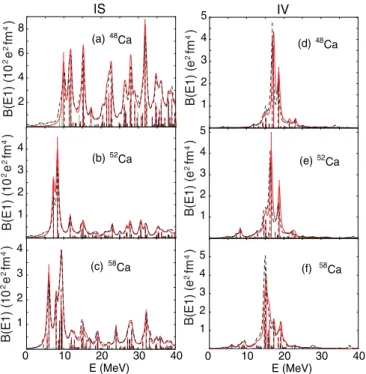
FIG. 1. Distributions of the IS (left panels) and IV (right panels) reduced transition probabilitiesB(E1,0→1−) and the correspond-ing strength functionsS(E) for48Ca [(a) and (d)],52Ca [(b) and (e)], and58Ca [(c) and (f)] obtained within the RPA, phRRPA, and RRPA. The solid and dashed vertical bars denote theB(E1) values obtained within the RPA and phRRPA, respectively. The dotted vertical bars stand for theBpp(E1) calculated based on Eq. (36). The continuous solid and dashed lines depict the total strength functions S(E) obtained within the RPA and RRPA [Eq. (34)], respectively. The units on theyaxis stand for theB(E1,0→1−) values, whereas the units of the strength functionS(E) are equal to those ofB(E1,0→1−) divided by MeV.
1 2 3 4 5 2 4 6 8 10 2 4 6 8 10
B(E1) (10 e fm )
24
0 10 20 30 40 E (MeV) IS Zr 90 (a) Zr 96 (b) Zr 110 (c)
0 10 20 30 E (MeV) 2 4 6 8 10 12 14 16
B(E1) (e fm )
2 4 Zr 90 (d) IV 4 8 12 16
B(E1) (e fm )
2 4 Zr 96 (e) 2 4 6 8 10
B(E1) (e fm )
2 4 Zr 110 (f) 3
B(E1) (10 e fm )
24
3
B(E1) (10 e fm )
24
3
FIG. 2. The same as in Fig.1but for90,96,110Zr isotopes.
particle energy spectra for neutrons and protons are discretized and superfluid pairing is not included. Regarding the effective nucleon-nucleon interaction, the density-dependent Skyrme interactions are employed in the calculations. The code first carries out the HF calculations for a specified nucleus using a given Skyrme-type interaction. The HF single particle energies, wave functions, and densities, which are obtained in a radial mesh extending toR(fm) and cutoff energyEcof
unoccupied states, are then used in solving the RPA equation. As for the phRRPA and RRPA equations, they are solved by iteration as has been specified respectively in Secs.IIandIII above. For the details of the HF-RPA code see Ref. [25].
In the present paper we restrict ourselves to studying the IS and IV dipole states in48,52,58Ca and90,96,110Zr isotopes. For the Skyrme interactions, we employ the SLy5 force, whose parameters have been specified and used in the HF-RPA code in a spherical box with radius R=15 fm and the cut-off energy Ec=60 MeV of unoccupied states. This value has been chosen because, for the IV E1 excitations in the nuclei under consideration, the energy of the lowest RPA state decreases very slowly with increasingEchigher than 60 MeV.
A valueε=0.4 MeV for the smoothing parameter is used in calculating the strength function (29).
TABLE I. The fulfillment of the EWSR for the IS and IV within the RPA, phRRPA, and RRPA for the nuclei under consideration in the paper. The results are obtained by using the SLy5 interaction with the summation taken from 0 toEmax=60 MeV.
IS IV
m1×105
mRPA
1 /m1 m
RRPA
1 /m1 m
phRRPA
1 /m1 T RK m
RPA
1 /T RK m
RRPA
1 /T RK m
phRRPA
1 /T RK
(%) (%) (%)
48Ca 2.52 99.80 100.08 91.16 196.6 1.17 1.09 1.02
52Ca 3.47 99.80 100.40 86.98 179.3 1.17 1.07 0.97
58
Ca 4.57 99.85 99.44 88.79 191.2 1.17 1.12 0.97
90Zr 9.05 100.03 100.98 92.00 326.3 1.18 1.04 1.03
96Zr 11.2 100.04 100.68 90.82 342.9 1.18 1.11 1.04
110
Zr 16.4 99.95 100.95 88.89 374.6 1.18 1.05 1.01
GDR main peak and a depletion strength at its high-energy side. As the result of these shifts in the distributions of the IS and IV strengths, the EWSRs calculated within the phRRPA are significantly reduced, as shown in the fifth and ninth columns of Table I. For the IS excitations, the largest value ofmph1 RRPA/m1amounts to only 92.0% for90Zr, whereas the smallest value is 86.98% for52Ca. For the IV excitations, the value ofmph1 RRPA/TRK ranges from 0.97 to 1.04.
The first excited IS state, which is the spurious mode caused by the center-of-mass motion, is shifted up within the phRRPA. However, in all the cases under consideration, this increase in the energy of the spurious mode is not large and the associated B(E1) values are negligible. Similar to the RPA case, the phRRPA spurious mode is still well separated from all physical states located at higher energies, and therefore does not affect these states. Within the RRPA, there are several IS and IV transition strengths caused by the pp excitations (green dotted vertical bars), but only few enhanced strengths are seen in the IS distributions, especially in48Ca and90,96Zr, whereas those seen in the IV distribution are quite small. The transitions associated with hh excitations are found to be negligible in the present calculations and, therefore, not shown in the figures. The largest IV transition strengths associated with the pp excitations are seen in the low-energy (PDR) region, which slightly redistributes the PDR strengths, especially for calcium isotopes. Adding the transition strengths associated with the pp excitations, the EWSRs obtained within the RRPA
TABLE II. Centroid energies calculated from the IS and IV B(E1,0→1−) strength distributions obtained within the RPA, phRRPA, and RRPA for the nuclei under consideration in the paper. The last column presents the results calculated from the empirical fitting of the experimental centroid energy, namelyEm= 31.2A−1/3+20.6A−1/6[30].
IS IV
RPA phRRPA RRPA RPA phRRPA RRPA Em 48Ca 26.60 26.87 29.74 18.22 17.67 18.24 19.39 52Ca 18.95 20.10 23.20 17.17 16.67 18.40 19.02 58Ca 17.56 18.39 20.59 16.18 15.70 18.02 18.53 90
Zr 25.40 26.08 28.63 16.28 15.83 15.99 17.16 96Zr 21.49 22.31 24.73 15.54 15.18 16.24 16.44 110
Zr 18.07 19.08 21.67 14.40 14.04 14.60 15.92
are fully recovered for both the IS and IV excitations as seen in the fourth and eighth columns of TableI, respectively. This result is particularly interesting because it reveals the reason why all extensions of RPA so far violate the EWSRs: They have neglected the transitions associated with the pp and hh excitations.
To have a deeper look inside the effects of GSC beyond the RPA, we report in TableIIthe centroid energies ¯E, which are defined as ¯E=m1/m0, wherem1is calculated from Eq. (30) andm0=
iB(EJ,EJ i), obtained within the RPA, phRRPA,
and RRPA for the IS and IV strength distributions. For the IS mode, as compared to the RPA, ¯E obtained within the phRRPA increases slightly, whereas a significant increase in ¯E obtained within the RRPA is observed, implying the significant contribution of the pp and hh strengths. For the IV mode, ¯E obtained within the phRRPA is always lower than that obtained within the RPA, whereas the RRPA centroid energy increases to be closer to the data obtained from the empirical fitting of the experimental centroid energy [30] as compared to the RPA one, except for90Zr nucleus. Once again, this increase in the centroid energy obtained within the RRPA for the IV mode shows the important contribution of the pp and hh transitions. To see the contribution of the PDR to the total B(E1) strength, we present in TableIIIthe ratior =SPDR/SGDR(%) of the energy weighted sum of strength (EWSS) of the PDR to that of the GDR, whereS=νEνB(EJ,Eν). The
summation is taken within 0Eν10 MeV for the PDR
and 0Eν 60 MeV for the GDR. The values ofrincrease
from almost 0% in the stable nuclei, such as48Ca and90Zr, to about 4% in very neutron-rich nuclei, such as58Ca and110Zr. Compared to the RPA, the phRRPA increases the ratior in most nuclei under consideration, except in52Ca, whereas this
TABLE III. Ratior=SPDR/SGDR(%) obtained within the RPA, phRRPA, and RRPA for calcium and zirconium isotopes.
RPA phRRPA RRPA
48Ca 0.02 0.02 0.33
52Ca 2.82 2.67 3.24
58Ca 3.99 4.20 4.20
90
Zr 0.01 0.01 0.06
96Zr 2.37 2.44 3.02
110
ratio is significantly enhanced within the RRPA due to the contributions of the pp transition strengths in the PDR region.
V. CONCLUSIONS
The present work studies the effects of GSC beyond RPA on IS and IV strength distributions in calcium and zirconium isotopes. The self-consistent RPA code using Skyrme inter-actions [25] has been modified and applied in the numerical calculations to include the effects of GSC beyond RPA within the phRRPA [3]. To restore the EWSR, which is violated within the phRRPA, we propose a simple RRPA calculations taking into account, in addition to the ph excitations, the contribution of the pp and hh excitations in a perturbative way, which increases the total energy-weighted sum of strengths, including those from the ph ones.
The analysis of numerical calculations obtained by us-ing the SLy5 interactions allows us to draw the followus-ing conclusions.
(1) Although GSC beyond RPA shift up the energy of the spurious mode obtained within the phRRPA and increases the corresponding B(E1) value for the IS spurious transition, this increase, however, is not large and the phRRPA spurious mode is still well separated from all physical states.
(2) GSC beyond RPA reduces the transition strengths associated with the IS mode, whereas it slightly increases the total strength on the low-energy region (the PDR region) and decreases the strength on the other side (the GDR region), leading to a significant decrease of the EWSRs for both the IS and IV modes obtained within the phRRPA. This violation of the sum rule is then fully recovered by taking into account the contribution of pp and hh excitations within the RRPA. This result reveals the reason why all the RPA extensions that do not take into account the pp and hh excitations violate the EWSRs.
(3) The ratio of the PDR EWSS to the GDR one, which is almost zero in stable nuclei, increases with the
neutron number. As compared to the RPA case, this ratio is in general significantly larger within the RRPA.
In the present RRPA calculations, for feasibility and sim-plicity of numerical calculations, the contribution of the pp and hh excitations is considered approximately in a perturbative way. To perform the complete RRPA calculations, we need to employ the method proposed in Ref. [12] or [29] in a fully self-consistent way, as has been mentioned previously. Moreover, the exact superfluid pairing, which has been shown to have a non-negligible effect on the PDR [31], is neglected in the present study. The extension of the HF mean-field approach incorporated with the RRPA into the renormalized quasiparticle RPA, taking into account the pp and hh excitations together with exact pairing, remains one of the goals in our future study.
ACKNOWLEDGMENTS
The numerical calculations were carried out using the Supermicro Intel Xeon E5-2670 Server of the Institute de Physique Nucl´eaire (IPN), Orsay (France) and the HOKUSAI-GreatWave supercomputer system at RIKEN. The authors are grateful to G. Col`o and L. Cao for the fruitful discussions related to the use of the computer code for self-consistent RPA with Skyrme-type interactions, and P. Quentin for reading the manuscript and useful comments. N.Q.H. acknowledges the support by the RIKEN Interdisciplinary Theoretical Science (iTHES) Research Group during his visit in RIKEN, where the initial part of this work was carried out. He is also thankful to the support by the National Foundation for Science and Technology Development (NAFOSTED) of Vietnam through Grant No. 103.04-2013.08. T.V.N.H. acknowledges the support by the U.S. NSF Grant No. 1415656 and U.S. DOE Grant No. DE-FG02-08ER41533.
[1] P. Ring and P. Schuck,The Nuclear Many-Problem(Springer, Berlin, 2004).
[2] K. Hara,Prog. Theor. Phys.32,88(1964); K. Ikeda, T. Udagawa, and H. Yamaura,ibid.33,22(1965).
[3] F. Catara, N. Dinh Dang, and M. Sambataro,Nucl. Phys. A579,
1(1994).
[4] J. Dukelsky and P. Schuck,Phys. Lett. B464,164(1999). [5] D. J. Rowe,Phys. Rev.175,1283(1968).
[6] P. Schuck and S. Ethofer,Nucl. Phys. A212,269(1973). [7] H. Lens and J. Wambach,Phys. Lett. B249,377(1990). [8] F. Catara, G. Piccitto, M. Sambataro, and N. Van Giai,Phys.
Rev. B54,17536(1996).
[9] K. F. Liu,Phys. Lett. B60,9(1975).
[10] J. G. Hirsch, P. O. Hess, and O. Civitarese,Phys. Rev. C54,
1976(1996).
[11] A. V. Ignatyuk, Yad. Fiz.21, 20 (1975) [Sov. J. Nucl. Phys.21, 10 (1975)].
[12] H. M. Sommermann,Ann. Phys. (N.Y.)151,163(1983).
[13] D. Vautherin and N. Vinh Mau, Nucl. Phys. A 422, 140
(1984).
[14] N. Dinh Dang,J. Phys. G11,L125(1985).
[15] D. Lacroix, P. Chomaz, and S. Ayik,Phys. Rev. C 58, 2154
(1998).
[16] A. Leistenschneider, T. Aumann, K. Boretzky, D. Cortina, J. Cub, U. D. Pramanik, U. Datta, W. Dostal, T. W. Elze, H. Emling, H. Geissel, A. Grunschloss, M. Hellstrom, R. Holzmann, S. Ilievski, N. Iwasa, M. Kaspar, A. Kleinbohl, J. V. Kratz, R. Kulessa, Y. Leifels, E. Lubkiewicz, G. Munzenberg, P. Reiter, M. Rejmund, C. Scheidenberger, C. Schlegel, H. Simon, J. Stroth, K. Summerer, E. Wajda, W. Walus, and S. Wan,Phys. Rev. Lett.
86, 5442(2001); E. Tryggestad et al.,Phys. Lett. B 541,52
(2002); T. Aumannet al.,Eur. Phys. J. A26,441(2005); O. Wieland and A. Bracco,Prog. Part. Nucl. Phys.66,374(2011). [17] D. Vretenar, N. Paar, P. Ring, and G. A. Lalazissis,Nucl. Phys. A692,496(2001); N. Paar, T. Niksic, D. Vretenar, and P. Ring,
[18] D. Tarpanov, C. Stoyanov, N. Van Giai, and V. V. Voronov,Phys. At. Nucl.70,1402(2007).
[19] D. Sarchi, P. F. Bortignon, and G. Col`o,Phys. Lett. B601,27
(2004).
[20] D. Gambacurta, M. Grasso, and F. Catara,Phys. Rev. C 84,
034301(2011).
[21] E. Litvinova, P. Ring, and D. Vretenar,Phys. Lett. B647,111
(2007).
[22] N. N. Arsenyev, A. P. Severyukhin, V. V. Voronov, and N. Van Giai,Acta Phys. Pol. B46,517(2015).
[23] N. Tsoneva and H. Lenske,Phys. Rev. C77,024321(2008). [24] D. Gambacurta and F. Catara,Phys. Rev. B77,205434(2008).
[25] G. Col`o, L. Cao, N. Van Giai, and L. Capelli,Comput. Phys. Commun.184,142(2013).
[26] M. Hage-Hassan and M. Lambert, Nucl. Phys. A 188, 545
(1972).
[27] P. J. Ellis,Nucl. Phys. A155,625(1970).
[28] A. Bohr and B. Mottelson,Nuclear Structure, Vol. I (Benjamin, New York, 1969).
[29] N. Dinh Dang and A. Arima, Phys. Rev. C 62, 024303
(2000).
[30] B. L. Berman and S. C. Fultz,Rev. Mod. Phys.47,713(1975). [31] N. Dinh Dang and N. Quang Hung, J. Phys. G 40, 105103