Agenda:
Diffraction Notes
h/w:
Read Hamper Chapter 4.8-4.11
Do exercises 23-27
Objectives
Understand diffraction and draw the
different diffraction patterns from a
rectangular slit, a sharp edge, a thin tube, and a circular aperture
Appreciate that the first minimum in
Objectives
Draw the intensity patterns for a single slit of
finite width and for two slits of negligible width
Show the effect of slit width on the intensity
Diffraction
The spreading of a wave as it goes past an
obstacle or through an aperture
Value of the wavelength in comparison to the
Superposition
..AKA….Interference
One of the characteristics of a WAVE is the ability to undergo INTERFERENCE. There are TWO types.
We call these waves IN PHASE.
Diffraction
Case 1: Wavelength Much Smaller
Than Aperture
Case 2: Wavelength Comparable to
or Bigger than Aperture
Diffraction takes place
‘Comparable’ means a few times smaller to
Diffraction Around an Obstacle
Sound, with a much larger wavelength, will
Case 1: Wavelength Much Smaller
Than Obstacle
Case 2: Wavelength Comparable to
or Bigger than Obstacle
Diffraction takes place
‘Comparable’ means a few times smaller to
Diffraction Patterns
When light is
diffracted, both
constructive
and destructive interference
Diffraction Patterns
Diffraction is
appreciable if wavelength, λ, is of the same order of
magnitude as the opening, b,
or bigger
b
Diffraction Patterns
Diffraction is
negligible if wavelength, λ, is much smaller than the
opening, b
b
Huygen’s Principle and Diffraction
Every point on a
wavefront acts as a secondary source of coherent radiation
Each point forms its
own wavelet
These wavelets will
Huygen’s Principle and Diffraction
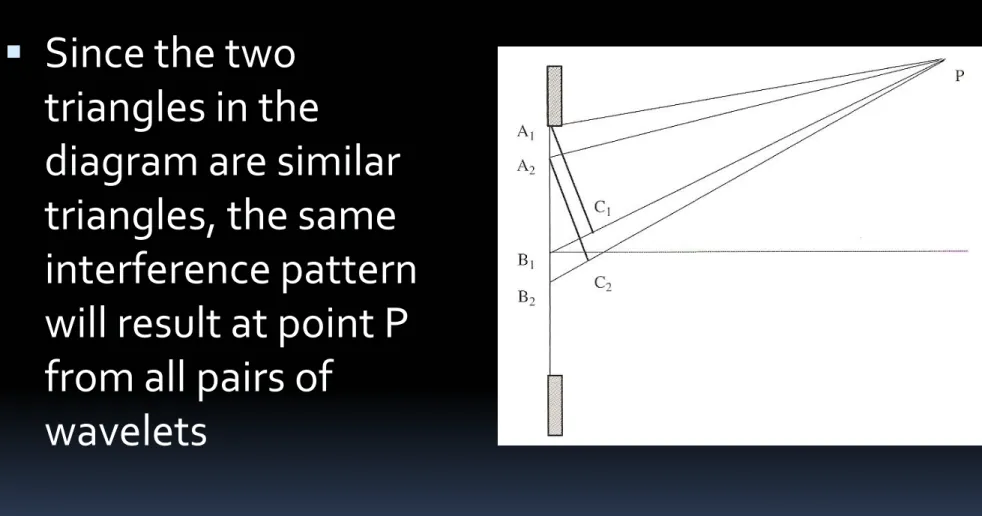
Because of the
diffraction angle, wavelet B1 has a
greater distance to
travel to get to point P than wavelet A1
This results in the
Huygen’s Principle and Diffraction
If the difference is
equal to half a wavelength, the
wavelets are 180° out of phase and they
Huygen’s Principle and Diffraction
If the difference is
equal to one entire wavelength, the
wavelets are in phase and they form a
Huygen’s Principle and Diffraction
Everything in
between will show varying levels of constructive and destructive
Huygen’s Principle and Diffraction
Since the two
triangles in the
diagram are similar triangles, the same interference pattern will result at point P from all pairs of
Huygen’s Principle and Diffraction
If we approximate AP and BP to be parallel since P
is distant and ACB to be a right angle, then
Huygen’s Principle and Diffraction
Destructive interference occurs when BC is equal
to one half wavelength, then
Huygen’s Principle and Diffraction
If we divide the slit into 4 segments instead of
Huygen’s Principle and Diffraction
In general, destructive interference occurs when,
This equation gives the angle at which minima will
be observed on a screen (P) behind an aperture of width b through which light of wavelength λ
passes
,...
3
,
2
,
1
sin
n
b
Huygen’s Principle and Diffraction
Since the angle θ is typically small, we can
approximate sin θ ≈ θ (if the angle is in radians), so the first minima would fall at
And for circular slits the formula becomes
b
b
Diffraction Patterns
Minima (blank spaces) appear in pairs
Maxima (bright spaces) appear about halfway
between minima
Smaller slit means larger central maximum
b = 2λ b = 3λ
b
Diffraction Patterns
If λ > b, then sin > 1 which is impossible, i.e.,
does not exist
The central maximum is so wide that the first minima does not exist
If λ ≈ b, then several minima and maxima exist If λ « b, then sin o which means 0 which
Resolution
Diffraction is a way of life
Diffraction occurs in all lenses, including your
eye
In diffraction there are maxima and minima In order to see two objects as two separate
Rayleigh Criterion
The Rayleigh criterion gives the minimum
Rayleigh Criterion
The criterion is that the central maximum of one
Rayleigh Criterion
Two unresolved sources
Rayleigh Criterion
In diffraction, the first minima for a
rectangular slit of width b occurs at:
The first minima for a circular slit
of diameter b occurs at:
Therefore, objects can be resolved
if their separation angle exceeds
(in radians!)b
b
Rayleigh Criterion
If two objects are separated by a distance s and
their distance from the observer is d, then their angular separation (in radians) is given by
d
s
Sample Problem
The camera of a spy satellite orbiting at 200km has a diameter of 35 cm. What is the smallest distance this camera can resolve on the surface of the earth? (Assume a wavelength of 500nm)
m
s
x
x
b
d
s
b
d
s
35
.
0
35
.
10
2
10
5
22
.
1
22
.
1
22
.
1
5 7
b
d
s
Microscopes
In microscopes, the object is
in focus when it is at the focal length of the lens (hence the name)
The condition for resolution
Microscopes
In practice, f is of the same order of
magnitude as b so f ≈ b
Therefore, in terms of order of magnitude,
s ≈ λ
To resolve a small object of size s, the
Electron Microscope
In order to see an object as small as 0.01nm,
we can’t use visual light
However, we can make use of the wave