570 Abstract:
This study was developed to investigate the influence of Effect of strategy conceptual maps corroborative with teaching instruments in the development of mental perception and intelligence and the most important forms of shooting for junior players in handball. Researchers used an experimental design study with equal groups and study society is determined by beginners players of Al-Qassim youth forum in handball that totaling 32 players and we selected randomly sample totaling (24) players then we divided the sample into two groups (experiment and control) each group included 12 players. Moreover, data of our study was analyzed by using (mean, standard deviation, K2 test, T-test for independent and dependent samples, person correlation coefficient, mode, and skewness coefficient). In conclusion we found that an improvement has been appeared in mental perception and intelligence test and tests of shooting forms for beginner players in handball for two groups.
Key words: conceptual maps, teaching instruments, mental perception, intelligence, shooting, junior players, handball.
1. Introduction:
Recently the world has seen significant developments in all fields including education field in Physical Education and this is an indication of the great interest from specialists and researchers in developing the educational process continuously in order to raise the sport level and achievement. Sport field is one of fields which using new strategies to develop fast of learning of basic skills and invest the effort in time.
Motor learning is more important part of learning sections which has diverse methods and numerous instruments through all these years. However, different strategies have been showed during sport developments in present time and one of these strategies is conceptual maps corroborative with teaching instruments which is a set of tools using to help required sport skills learning processes where approaching the idea with the image for the learner.
Effect of strategy conceptual maps corroborative with teaching instruments in the development of mental perception and intelligence and the most important forms of
shooting for junior players in handball
Ferass Suhail, Nabeel Kadim Hraibed
Faculty of Physical Education & Sport sciences/ University of Babylon Faculty of Literature/ University of Babylon
Article Info
Received:April 20, 2015
Accepted:May 21, 2015
571
The intelligence is the basis for mental capabilities which help the process of learning and problem solving to link intelligence with kinetic behavior of the player. In dead, it is a natural ability linked closely to the success of the individual in his career life and multiple intelligences theoretical which allows the individual to explore the attitudes and see for them in multiple views, so the individual can reconsider its position through living the events and the mental competency of human can be considered a set of mental abilities and skills called intelligences.
Handball game has been accompanied the development and progress which has seen many changes in the learning and training methods in different areas including particularly the changes in the methods of teams playing in terms of the application of defensive and offensive plans to surprise their rival as well as following new strategies to learn and develop basic skills through diversification positions of exercise and its forms in order to make the player has the ability to process of selecting the appropriate motor program to solve the motor duty in the best image and depending on the situation faced in the defense and his ability to carry out offensive skills well.
The important of present study is to know the effect of strategy conceptual maps corroborative with teaching instruments in the development of mental perception and intelligence and the most important forms of shooting for junior players in handball to be learning tools which using by coaches. However, the problem of our study is no study has been achieved about these strategies and most of coaches didn’t using these strategies to improve mental abilities and basic skills of handball.
2. Methodology
Researchers used the experimental approach with equal groups because it relevancies of the nature of the study as shown in table (1).
Table (1)
shows experimental design of study Research procedure
Groups
Pre-tests Researchprocedure Post-tests
Control group - Mental imagen questionnaire
- Intelligence questionnaire - Tests of shooting forms
Program of coach The same pre-tests
Experiment group - Mental imagen questionnaire
- Intelligence questionnaire - Tests of shooting forms
Learning program by
using conceptual
maps corroborative
with teaching
instruments
The same pre-tests
2.1 Participant
572
Table (2)
Shows mean, SD, and skewness coefficient for homogenization
N Variables Statistical Mean SD Mode skewness coefficient
1 Height 170 3.42 167 0.87
2 Weight 72.21 4.26 69 0.75
3 Age 14.3 1.07 14 0.28
4 Training age 4.10 1.02 4 0.09
Table (2) shows values of skewness coefficient for studied variables as well as height, weight, age, and training age which are less than (± 1) this confirm that our study sample is homogeneity at all variables.
After completing the homogenization we divided sample of the study into two groups (experiment and control) each group included 12 players, then we achieved the equal between groups in variables of the study by using T-test for independent samples as shown in table (3).
Table (3)
Shows the equal between study sample
N Tests Control group Experiment group T-test Significant Mean SD Mean SD
1 Mental auditory perception 11.08 1.16 10.58 0.99 1.30 No
2 Mental visual perception 11.91 2.19 11.83 1.58 0.10 No
3 Mental perception
sense-kinesthetic 12.41 2.06 12.16 1.52 0.33
No
4 Mental and emotional perception 12.66 1.77 12.25 1.54 1.61 No 5 Intelligence test for Raven 37.83 3.92 36.91 4.18 0.55 No 6 Focal shooting from head level 3.16 0.83 3.08 0.66 0.27 No 7 Shooting from high jumping 3.33 0.77 3.25 0.75 0.26 No 8 Shooting from fall to the front 2.57 0.45 2.50 0.52 1.25 No
Table (3) shows that T-test values for variables of study smaller than tabulate values amounted (1.71) at the significant level (0.05) and under freedom degree (22), this means there is an equal between groups in variables of the study.
2.2 Field study procedures:
2.2.1Validate of mental imagen questionnaire and intelligence test:
573
Table (4)
shows validate of mental imagen questionnaire and intelligence test
N Name of test Validate K2 Significant
Validity No validity
1 Mental perception scale 9 0 9 S
2 Intelligence scale for Raven 9 0 9 S
Table K2 value at the freedom degree (1) and significant level (0.05) amounting (3.84)
2.2.2Validate of shooting forms for junior players in handball:
To specify the most important shooting forms in junior handball, researchers choice a set of formats nomination of (11) forms which were placed in a questionnaire form and presented to the experts and specialists totaling (7) experts, after collecting the data from the forms we excluded some forms which gained the importance of relative less than (40) and the percentage (57%) and the table (5) illustrates this.
Table (5)
Shows the importance of relative and percentage for forms of shooting skill
N Skills N Forms Measurement
Unit
Relative importance
Percentage Test result
1 Shooting forms
1 Stable shooting Number of goals 34 %48.5 X
2 Focal shooting from head level
Number of goals
58 %82.8
3 Focal shooting from above a head
Number of goals
31 %44.2 X
4 Focal shooting from shoulder level
Number of goals 28
%40 X
5 Shooting from level of hip and knee
Number of goals
35 %50 X
6 Shooting from running Number of goals 39 %55.7 X 7 Shooting from forward
jumping
Number of goals
38 %54.2 X
8 Shooting from high jumping
Number of goals
64 %91.4
9 Shooting from fall to the front
Number of goals 61
%87.1
10 Shooting from fall to the side
Number of goals
24 %34.2 X
11 Fly shooting Number of goals 29 %41.4 X
2.2.3 Identify the tests of shooting skill forms in junior Handball
For the purpose of determining the most important forms of skill shooting in junior handball, the researchers nomination set of formats were placed in questionnaire form and presented to the experts and specialists totaling (5) experts, after collecting the data from forms we excluded some of forms which got the relative importance less than (30) and percentage (60%), table (6) illustrates this.
Table (6)
illustrates the relative importance and percentage of shooting skill forms tests
N Skills N Forms Measurement
Unit
Relative importance
Percentage Test result
1 Shooting
1 Focal shooting from head level to the squares of shooting
accuracy (50 × 50)
Number of goals
45 %90
2 Stable shooting from head level to the
Number of goals
574 rectangles
1 Shooting from high jumping to the squares
of shooting accuracy (50 × 50)
Number of goals
39 %78
2 Shooting from high jumping to the goal which is drawing on the wall and divide into
five circles
Number of goals
18 %36 X
1 Shooting from fall to the front to the squares
of shooting accuracy (50 × 50)
Number of goals
44 %88
2 Shooting from fall to the front to the overlapping boxes measured in degrees
Number of goals
22 %44 X
2.3 Pilot study:
Pilot study was achieved on 25\ 2\ 2015 for measurements of mental perception and intelligence and shooting forms tests in handball which is at exactly three o'clock in the afternoon on the sample is amounted approximately (8) junior players from training center in handball and we re-trailed on 10\ 3\ 2015 to know:
1. To make sure the clarity of the instructions and paragraphs of the questionnaire to the players.
2. Identify the time it takes to answer on the questionnaire.
3. Identification the conditions and difficulties of the questionnaire application. 4. Identify the negatives and positives which effect during achieve the tests. 5. Ensure appropriate of the tests to the nature of the study sample.
6. Extract the scientific bases for measurements and tests studied (consistency and objectivity).
2.4 Pre-tests:
Pre-tests were done on 15\ 3\ 2015 with number of players that amounted (24) players and the tests included tests of mental perception measurement, intelligence test for raven, and shooting forms tests.
2.5 Learning curriculum:
The researchers have prepared a learning program for experiment group by using strategy conceptual maps corroborative with teaching instruments for junior handball players. The program started on 20\ 30\ 2015 and finished on 19\ 5\ 2015 for a period of two months, three times per week and the total number of training unites is (24) unites. 3 o’clock is time of training and the worm time is (10-15) minutes.
2.6 Post-tests:
Post-tests were done on 20\ 5\ 2015 for two groups with the same way of pre-tests.
2.4 Statistical analysis
575 3. Results and discussion
Table (7)
Shows mean, SD, and T-test of pre and post-tests for control group in study variables
N Tests Pre-test Post-test T-test Significant
Mean SD Mean SD
1 Mental auditory perception 11.08 1.16 12.33 2.14 2.15 S
2 Mental visual perception 11.91 2.19 13.08 2.27 2.18 S
3 Mental perception
sense-kinesthetic 12.41 2.06 13.75 1.65 2.11
S
4 Mental and emotional perception 12.66 1.77 13.83 1.74 2.07 S 5 Intelligence test for Raven 37.83 3.92 39.75 2.34 2.73 S 6 Focal shooting from head level 3.16 0.83 4.08 0.66 3.52 S 7 Shooting from high jumping 3.33 0.77 4.16 0.83 2.15 S 8 Shooting from fall to the front 2.57 0.45 3.58 1.31 2.80 S
Table (7) shows different results between pre and post-tests which mean a significant improvement has been occurred, mean of pre-test of mental auditory
perception was (11.8) with SD (1.16) whereas mean of post-test of the same variable
was (12.33) with SD (2.14). However, means of pre-tests of Mental visual perception,
Mental perception sense-kinesthetic, Mental and emotional perception, Intelligence
test for Raven, Focal shooting from head level, Shooting from high jumping, and Shooting from fall to the front were (11.91), (12.41), (12.66), (37.83), (3.16), (3.33), and (2.57) with SD (2.19), (2.06), (1.77), (3.92), (0.83), (0.77), and (0.45), whereas means of post-tests of the same variables were (13.08), (13.75), (13.83), (39.75), (4.08), (4.16), and (3.58) with SD (2.27), (1.65), (1.74), (2.34), (0.66), (0.83), and (1.31).
Through means and standard deviations that were displayed to the variables, we find there are significant differences between the two tests so researchers have used T-test for the dependent samples to know the differences, the values of T-test were: (2.15, 2.18, 2.11, 2.07, 2.73, 3.52, 2.15, and 2.80) which are greater than the value of tabulate (T) amounted (1.79) at the degree of freedom (11) and the level of significance (0.05) which indicates a significant difference between the two tests and in favor of the post-tests.
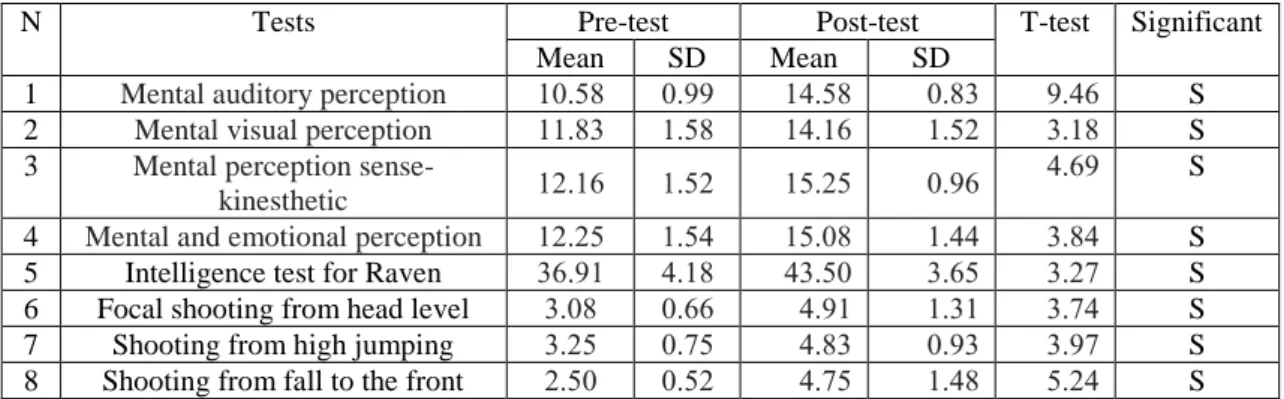
Table (8)
Shows mean, SD, and T-test of pre and post-tests for experiment group in study variables
N Tests Pre-test Post-test T-test Significant
Mean SD Mean SD
1 Mental auditory perception 10.58 0.99 14.58 0.83 9.46 S
2 Mental visual perception 11.83 1.58 14.16 1.52 3.18 S
3 Mental perception
sense-kinesthetic 12.16 1.52 15.25 0.96
4.69 S
4 Mental and emotional perception 12.25 1.54 15.08 1.44 3.84 S 5 Intelligence test for Raven 36.91 4.18 43.50 3.65 3.27 S 6 Focal shooting from head level 3.08 0.66 4.91 1.31 3.74 S 7 Shooting from high jumping 3.25 0.75 4.83 0.93 3.97 S 8 Shooting from fall to the front 2.50 0.52 4.75 1.48 5.24 S
Table (8) shows different results between pre and post-tests which mean a significant improvement has been occurred, mean of pre-test of mental auditory
576
was (14.58) with SD (0.83). However, means of pre-tests of Mental visual perception,
Mental perception sense-kinesthetic, Mental and emotional perception, Intelligence
test for Raven, Focal shooting from head level, Shooting from high jumping, and Shooting from fall to the front were (11.83), (12.16), (12.25), (36.91), (3.08), (3.25), and (2.50) with SD (1.58), (1.52), (1.54), (4.18), (0.66), (0.75), and (0.52), whereas means of post-tests of the same variables were (14.16), (15.25), (15.08), (43.50), (4.91), (4.83), and (4.75) with SD (1.52), (0.96), (1.44), (3.65), (1.31), (0.93), and (1.48).
Through means and standard deviations that were displayed to the variables, we find there are significant differences between the two tests so researchers have used T-test for the dependent samples to know the differences, the values of T-test were:
(9.46, 3.18, 4.69, 3.84, 3.27, 3.74, 3.97, and 5.24) which are greater than the value of
tabulate (T) amounted (1.79) at the degree of freedom (11) and the level of significance (0.05) which indicates a significant difference between the two tests and in favor of the post-tests.
Table (9)
Shows mean, SD, and T-test for post-tests of two groups in study variables N Tests Control group Experiment group T-test Significant
Mean SD Mean SD
1 Mental auditory perception 12.33 2.14 14.58 0.83 2.46 S
2 Mental visual perception 13.08 2.27 14.16 1.52 2.16 S
3 Mental perception
sense-kinesthetic 13.75 1.65 15.25 0.96
3.43 S
4 Mental and emotional perception 13.83 1.74 15.08 1.44 1.90 S 5 Intelligence test for Raven 39.75 2.34 43.50 3.65 2.99 S 6 Focal shooting from head level 4.08 0.66 4.91 1.31 1.96 S 7 Shooting from high jumping 4.16 0.83 4.83 0.93 1.84 S 8 Shooting from fall to the front 3.58 1.31 4.75 1.48 2.04 S
Table (9) shows that means of control group of post-tests such Mental visual perception, Mental perception sense-kinesthetic, Mental and emotional perception,
Intelligence test for Raven, Focal shooting from head level, Shooting from high jumping, and Shooting from fall to the front were (12.33), (13.08), (13.75), (13.83),
(39.75), (4.08), (4.16), and (3.58) with SD (2.14), (2.27), (1.65), (1.74), (2.34), (0.66), (0.83), and (1.31), whereas means of post-tests of the same variables for experiment
group were (14.58), (14.16), (15.25), (15.08), (43.50), (4.91), (4.83), and (4.75) with SD (0.83), (1.52), (0.96), (1.44), (3.65), (1.31), (0.93), and (1.48).
Through means and standard deviations that were displayed to the variables, we find there are significant differences between the two groups, so researchers have used T-test for the dependent samples to know the differences, the values of T-test were: (2.46, 2.16, 3.43, 1.90, 2.99, 1.96, 1.84, and 2.04) which are greater than the value of tabulate (T) amounted (1.71) at the degree of freedom (22) and the level of significance (0.05) which indicates a significant difference between the two groups and in favor of the experiment group.
577
training process and programming and the use of appropriate intensity and progressive and note individual differences as well as the use of optimal frequencies and periods of rest under the supervision of specialists coaches under good conditions in terms of space, time, and used tools. Hanafi Mahmoud (1994) confirmed that continuous training has an important role in the arrival of the player to good level in terms of performance, integration, and set of high performance mechanism.
Results of our study showed significant differences in favor of experiment group in study variables because of the learning curriculum which was made by researchers is developed player’s abilities and intelligence. In addition, researchers used conceptual maps corroborative with teaching instruments in the development of mental perception and intelligence and the most important forms of shooting for junior players in handball because these maps had displayed in a new method by using posters which helped to attract the attention of the player and increased their love and motivation toward learning where it was provoke their senses and thus increased their focus, Fouad et al., (1988) found that using more than one sense through learning is increased learning process. Moreover, this strategy helps player to make maps are required to increase their confidence of themselves and improve the performance which leads to reduce the negative desire into the skill performance during training who they believe is a difficult and this was confirmed by the results of the post-test, this results agree with (Mahmoud & Mustafa, 2001) they said that internal motivation emanating from within the individual helps the individual to overcome the difficulties and obstacles which require more effort and courage or because of pleasure aesthetic resulting from the agility and consistency of performance or as a result of internal motivation stemming from outside of the individual which raise and direct of the behavior towards practice or sport performance. In addition, researchers used positive reinforcement results in an impact to increase player’s motivation for more learning and these outcomes agreed with founds of (Osama & Ibrahim, 2005) that immediate positive reinforcement has a great role to increase the motivation toward learning more than later positive reinforcement. Researchers also find these differences because of watching visual models which entrenched in their mind the right performance and make the player compares between himself and his performances then improve their level, Sahar (2000) showed that models whether visual or printed player can be compared between the current performance and the model presented to realize his mistakes and weaknesses and the required responses, where the public image of the right response has become known for the player so he has to attempt to modify the responses to determine the desired objective.
4. Conclusions
578 References
Fouad A. et al., (1988). Educational psychology, Presses the Crescent Group
companies,Cairo, 34-48.
Hanafi Mahmoud, (1994).Footballcoach, Cairo, Dar AlArab Thought1:12-37.
Jabbar A. K., (2010). The impact of exercises using the assistance devices in
developing motor responsiveness and physical- motor intelligence of attack for
junior of badminton, Master Thesis, University of Babylon, Faculty of Physical
Education.
Mahmoud F. A. &Mustafa H. B., (2001). Introduction to Psychology of Sport, book
publishing center, Cairo, 2:51-68.
Osama K.R. & Ibrahim A. R., (2005). Growth and motivation in the steering motor activity of the child and sports activities, Dar Arab Thought, Cairo, 134-137.
Saad M. I., (1996). The effect of training methods for the development of the
explosive power of the legs and arms in the distant shooting accuracy by high
jumpinginhandball, Doctoral thesis. Baghdad.
Sahar Yassin, (2000). The effectiveness of micro-teaching by using some modeling
on teaching skills for students of Faculty of Physical Education Development