April 2015 – Draft of the Next Higher
Education Strategic Plan for Texas
4/20/15
ii
Table of Contents
Executive Summary ... i
Introduction ... 1
Texas Higher Education: You Are Here ... 2
Some Benefits of Higher Education ... 4
To Higher Education and Through Completion ... 5
Vision ... 7
Overarching Goal: 60x30 ... 8
Completion Goal ...10
Marketable Skills Goal ...14
Student Debt. ...17
The Challenge for Higher Education in Texas ...20
End Notes ...21
References ...22
Appendix A: Committee Information ...23
i
Executive Summary
Introduction
Since the last higher education plan was adopted in 2000, Texas has become increasingly engaged in a global economy dependent on skilled and knowledgeable workers. Many of those workers must come from the state’s institutions of higher education. Although higher education in Texas must continue to pursue greater learning, in general, as well as continually push toward higher standards of excellence in teaching, research, and innovation,
universities and colleges also must work toward achieving the objective many students have in mind when they attend college: to get a better job and achieve a better life through higher education.
For Texas to solve problems and address public concerns now and in the future, the state must have a large workforce
with the insight, skills, and knowledge to push it forward. This workforce must be educated and able to adapt and compete at the highest levels to maintain a strong state economy. All forms of postsecondary attainment will be critical to the state’s success.
The Goals of this Plan
By 2030, Texas will need
approximately 60 percent of its 25- to 34-year-old workforce to hold a postsecondary credential. Centered around students, the 60x30TX higher education strategic plan is designed to achieve this goal and help Texas remain competitive and prosperous. However, the state’s 25-34 year olds are increasingly Hispanic, and the inclusion of
underrepresented student populations, such Hispanics and African Americans, in higher education will be critical to this plan’s success.
Placeholder for graphic showing
goals/targets; this graphic needs to lay out simply but effectively the goals and targets of the 60x30 plan at a glance.
ii The first goal of this plan, the 60x30
goal, is overarching and aims to raise the percentage of the Texas younger adult population with postsecondary educational attainment. Because Texas has seen a relative decline in educational attainment by the younger population, this goal focuses on 25-34 year olds: By 2030, at least 60 percent of Texans ages 25-34 will have a postsecondary credential or degree. Although ambitious, given the current level of educational attainment, this goal is achievable through focused effort.
The second goal contributes to the first by supplying graduates from Texas
institutions: By 2030, at least 550,000 students in that year will complete a
certificate, associate, bachelor’s, or master’s from a Texas public, independent, or for-profit college or university. To reach this goal, Texas will need to maintain the strong degree production increases it has
experienced in recent years, with large increases needed among targeted groups.
The third goal emphasizes the value of higher education relative to the workforce: By 2030, all graduates from Texas public
institutions of higher education will have completed programs with identified
marketable skills. Students need to be aware of the marketable skills affiliated with their programs. This goal ensures institutions document, update, and communicate the skills students acquire in their programs.
The final goal is intended to help students who graduate with debt complete their programs with reasonable debt: By 2030, undergraduate student loan debt will not exceed 60 percent of first-year wage for graduates of Texas public institutions. This goal is designed to balance the levels of student loan debt with a graduate’s earning potential during the first year after college.
Conclusion
By charting a student-centered course and prioritizing higher education completion and workforce readiness, this plan enables the state, institutions of higher education, and the private sector to set Texas on a path toward continued prosperity. To compete and remain
relevant in the future, Texas workers need to complete quality postsecondary credentials, and exit their programs with skills that employers need. Furthermore, if graduates are to provide the state with sufficient revenue and have the means to pursue personal goals, they must exit their programs with no debt or reasonable debt, given their incomes.
This plan addresses students’ desire for a better life, employers’ desires to remain competitive, and the state’s need for a robust economy. This plan also strengthens the mission of excellence and quality in Texas higher education by setting goals that cannot be postponed without postponing the
1
Introduction
Since the last higher education plan was adopted in 2000, Texas has become increasingly engaged in a global economy dependent on skilled and knowledgeable workers. Many of those workers must come from the state’s institutions of higher education. Although higher education in Texas must continue to pursue greater learning in general, as well as continually push toward higher standards of excellence in teaching, research, and innovation,
universities and colleges also must work toward achieving the objective many students have in mind when they attend college: to get a better job and achieve a better life through higher education.
Given the mission of higher education, the needs of the community, the
expectations of students, and the reality of a global
marketplace, the question is how Texas institutions of higher education can achieve their missions and educate
students to supply the necessary workforce needed to compete in a global market. The 60x30TX higher education plan for Texas lays out ambitious goals for educational
attainment, completion, marketable skills, and student debt. The aim is to help students achieve their educational goals and help the state remain globally competitive for years to come. At the same time, this plan provides institutions with the latitude to pursue the greater purposes of higher learning.
Skills Deficits, Attainment, and Completion
In 2012, the Organisation for Economic Co-operation and Development (OECD), which globally promotes policies to improve economic and social well-being, listed Texas as one of several states
experiencing skills deficits.1 Some sectors of the state’s economy could not hire enough workers with the required skillsets to meet workforce demand, resulting in lost revenue for the state. Although Texas saw a large in-migration of workers and met most of the goals and targets set in the previous higher
education plan, only 35 percent of the 25- to 34-year-old population had an associate or higher degree in 2013, far less than many other states and nations. Adding certificates earned by this age group only increased the number of graduates with a postsecondary credential to about 38 percent.2
Those percentages suggest a link between the number of Texans holding a certificate or degree and the state’s deficit in skilled and knowledgeable workers. Certainly, Texas made enormous strides during the years of the previous higher education plan, Closing the Gaps by 2015. At the outset of this
plan’s Success goal in 2000, only about 100,000 students had completed an associate, bachelor’s, or certificate. By 2011, the state had reached the Success goal – awarding 210,000 postsecondary credentials by 2015 – four years early, and by Fiscal Year 2014, the state had reached nearly 251,000 total undergraduate awards.3 Yet despite the state’s successes, the demand for skilled and knowledgeable workers continues to outpace workforce supply in Texas. For Texas to remain competitive and prosperous, it will need approximately 60 percent of its 25-34 year olds to hold a quality postsecondary credential by 2030. (Some experts believe that Texas will need to reach this goal even sooner.)
Reaching a goal of this magnitude will require solutions from both public and private sectors. Although ambitious, this goal is achievable, provided a wide and
representative range of Texans, including traditional and nontraditional students, economically disadvantaged students, and students from many ethnic backgrounds are able to attain a postsecondary education.
Greater Representation, Demographic Shifts
Appealing to a wide range of Texans will be particularly important in light of the state’s enormous growth among Hispanics,
Some sectors of
the state’s economy
could not hire
enough workers
with the required
skillsets to meet
workforce demand.
2 who accounted for 65 percent of the state’s
population increase during the 2010 census. Other minority populations grew significantly, too, while the white population numbers remained relatively flat. These demographic changes underscore the need to push for greater educational attainment in Texas among all populations.
Social Mobility and Affordability
Preparing students to enter community colleges and universities and supporting students through the completion of certificates and degrees will mean
demonstrating that postsecondary attainment is still the best path toward greater social and economic mobility. Supporting students through completion will also mean addressing college affordability and making the
workplace skills and knowledge learned in programs transparent.
Student-Centered
The 60x30TX Plan focuses on the critical role of both public and private stakeholders and lays out a comprehensive approach that focuses heavily on the needs of students. Students, after all, are the ones who will decide to pursue higher education. Their decisions will influence the future prosperity
of Texas greatly and affect the state’s ability to meet its needs for educated and skilled
workers.
The 60x30TX Plan
The intention of the goals and targets described in this plan are to help students, institutions of higher education, employers, and the state succeed and flourish using a shared vision of excellence for higher education in Texas. Developed with input from school administrators, higher education leaders, community leaders, private industry, elected officials, and others, the 60x30TX plan establishes ideals for higher education in Texas that will help secure the state’s place in a global economy.
Like its predecessor, this plan seeks to create qualitative results built on quantitative foundations and is a living document that will be used to track the state’s progress toward its higher education goals. Also like its
predecessor, this plan includes four goals; however, the goals in this plan are different and focus more heavily on the alignment of higher education and students with the workforce.
Texas Higher Education: You Are Here
The current higher educationlandscape provides the clues and data that lead to a better understanding of the benefits of increased higher education attainment. According to the Social Mobility Index, which focuses on higher education policy related to economic disparities among students, the U.S. now provides the least economic mobility among developed nations.4 Among states, Texas fares no better. The pipeline to the state’s higher education starts with a K-12 public school population in which 60 percent of students qualify for free or reduced
lunches.5
Economic Disadvantage, Demographics, and the Workforce
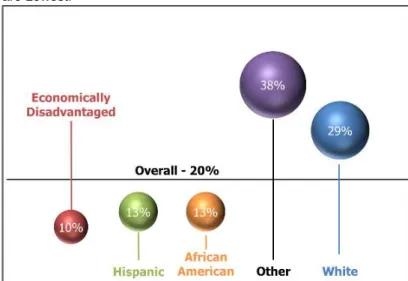
Among the poorest eighth grade students in Texas, only roughly 10 percent attain a postsecondary credential when tracked for 11 years.6 Without focused action
and attention to these economically
disadvantaged students, Texas cannot remain Figure 1.Completion for Economically Disadvantaged Students are Lowest.
3 competitive. Even beyond ethnicity,
economic disadvantage is the greatest indicator in determining an individual’s chance of attaining education past high school. If the state is to remain competitive in a constantly changing world, higher education in Texas will need to make huge efforts to reach out to a range of students.
According to Anthony Carnevale, Director and Research Professor of the Georgetown University Center on
Education and the Workforce, a majority of future jobs in the nation and in the state will require a postsecondary credential. He asserts that as early as 2020, “fewer jobs will be available to people with less than high school or only a high school diploma.”7
This is particularly important
because of the demographic shift in Texas to a largely Hispanic population, projected to comprise 70 percent of the net growth through 2050. Although the state has made some strides among this population, poverty has increased among those with lower levels of income and education. Without bold action, this trend is expected to continue.8
Texas must continue to build aggressively upon its successes in
implementing changes in higher education. Otherwise, workers possessing only high school education or below will likely increase from 48 percent in 2010 to 53 percent in 2050.9 As noted by experts, this less educated population likely will lead to more pronounced and long-term workforce shortages.10
Decrease in Global Ranking
The population and geographic size of Texas is greater than that of many countries. Placing the state’s educational attainment in this context highlights the relative decline over time. Texans who were 55 to 64 in 2013 achieved associate and higher degrees in numbers that placed them between the 3rd
and 4th highest-ranking OECD nations. Although 25- to 34-year-old Texans attained associate and higher degrees at increased rates during 2013, they did not keep pace with the rest of the world. As a result, this age group fell between the 23rd and 24th highest-ranking OECD nations in educational
attainment – a relative and notable decline in the state. Demographic shifts and the
underrepresentation of minorities and economically disadvantaged students in the state’s higher education system – in
proportion to the population – contributed to Texas losing ground globally.
Re-imagining College
To address this situation, bold action will be required. Texas must continue to re-imagine “college” and “college going” in broader terms to meet the state’s workforce needs, ensure the economic viability of its future, and remain competitive in a global marketplace. Increasingly, college will mean much more than attaining a four-year baccalaureate.
For some students, “college’ will mean earning a certificate in a yearlong program. For other students, college will mean earning an associate or bachelor’s degree by attending traditional classes or by participating in competency-based programs. For others still, college may mean earning an associate degree
Texas must
continue to
re-imagine college
and college going
in broader terms
to meet the state’s
workforce needs.
Figure 2.Educational Levels of Younger Texans Drop While International Peers See Gains.
4 through dual credit or early college high
school programs.
College may take place on a brick-and-mortar campus or on a device in a student’s
living room. Regardless of the credential or method used to attain it, however, a “college” education translates into greater prosperity for individuals, which in turn translates into greater economic prosperity for the state.
Some Benefits of Higher Education
Despite negative headlines about student loan debt that often fail to acknowledge the skills gained in college, higher education is a boon for the state’s economy. Texas, in fact, has seen a boost from the previous higher education plan. A report by the group Economic Modeling Specialists International (EMSI) for Fiscal Year 2013 found that money spent by institutions and students on higher education in Texas boosted the state’s economy in a one-year period equal to $143.9 billion or 11 percent of the gross state product. This dollar amount equates to the creation of 2,258,077 jobs.11
While these numbers confirm the recent achievements of higher education in the state, much more needs to be done to reduce reliance on the state budget for public expenditures such as Medicaid and corrections. Higher education, by its nature, increases knowledge and skills and results in greater individual marketability, wealth, and self-reliance, as well as reduces
dependence on public programs.
Individual Return on Investment
The individual return on
investment from higher education is well documented. Experts from the Brookings Institution’s Hamilton Project contend, “on average, the benefits of a four-year degree are equivalent to an investment that returns 15.2 percent per year.”12 The EMSI report supports this claim and asserts thathigher lifetime incomes resulting from Texas students attaining degrees will account for $524.9 billion in added income during their working lives.13
$0 $1 $2 $3 $4 $5 2016 2018 2020 2022 2024 2026 2028 2030 BI LL IONS
State Tax Revenues State Savings State Expense Additional state revenues ($25 Billion) are projected to exceed additional state expenditures ($20 Billion) by 25 percent over the 15 years of the plan.
Sources: U.S. Census Bureau American Community Survey Public Use Microdata Samples (2001-2013); National Association of State Budget Offices. State Expenditures Report. Fiscal Year 2009 Figure 4.Project Additional State Revenues (in Current Dollars) Increase if Completion Goal is Reached.
Figure 3.Cumulative Increases in Personal Income Grow if Texas Reaches 550,000 Completions by 2030.
5 Savings in public assistance and
corrections means more money for the state and ultimately, for Texas citizens. The nationally focused College Board report Education Pays found that 12 percent of high school graduates lived in households that relied on SNAP (Supplemental Nutritional
Assistance Program) benefits in 2011, compared to only 2 percent of bachelor’s graduates.14 Higher education benefits the state, the individual, and society in
measurable and specific ways that must be encouraged and strengthened.
To Higher Education and Through Completion
The overarching goal of this plantargets 25-34 year olds in Texas as the population to achieve 60 percent
postsecondary attainment by 2030. Tracking their completion rates and educational attainment will provide an indicator of the state’s economic future and possible workforce deficits for areas requiring
postsecondary training over the next several decades.
Texas community and technical colleges, public and independent colleges and universities, health-related institutions, and private career colleges will play a crucial role in meeting the 60x30 overarching goal. Aligning postsecondary programs with the state’s workforce needs will require a
thoughtful process that not only acknowledges the value of workforce demands, but that also acknowledges the creativity, diversity, and varied strengths of students. Many of those workforce skills will include soft skills and knowledge not easily aligned to a specific job or industry. Liberal arts studies, for example, often hone these skills and over time create flexibility and resourcefulness for individuals, allowing them to adapt nimbly to the jobs of the future while meeting current needs.
Matching Credentials to Workforce Needs
When matching credentials to
workforce needs, the role of higher education is essential, as is coordinating efforts with businesses and communities. Jeff Strohl, Director of Research for Georgetown University’s Center on Education and the Workforce, states that, “Without this
[collaboration], increased education can just mean increased unemployment and higher levels of mismatch.”15
To achieve workforce success for students, institutions in the state will need to reconnect with the reason that most students go to college. In a recent UCLA study, 88 percent of surveyed students identified “getting a better job” as the most important reason for attending college.16 This statement is not to suggest that institutions hold the only key to workforce success in Texas, but they will play a critical role. Some workforce success will depend on external factors, such as a strong economy to retain graduates from Texas institutions and to attract graduates from other states.
K-12, Two-year, and Four-year Alignment
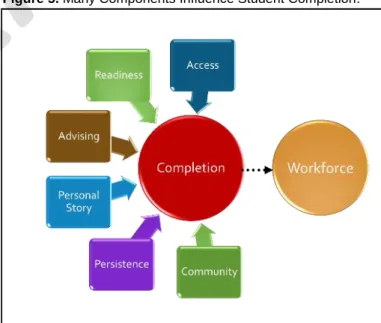
The state will achieve its goals for higher education through many strategies, and several factors will influence students to complete certificates and degrees.
Higher levels of cooperation among higher education, K-12 education, and workforce leadership will be required to
6 create pathways to careers and high-demand
jobs. Two-year and four-year institutions will need to collaborate and align lower-division curricula so that students receive a coherent and rigorous general education, while being assured that their courses will transfer and count toward degrees. Texas will need more online education and more innovation, such as applied baccalaureates offered through
community colleges, as well as competency-based programs. Institutions of higher education will need to work together more closely on such issues as teacher training, professional development, and college
readiness. All of these strategies will combine to hit the targets of this plan and produce the best outcome for Texas and its students.
7
Vision
The 2030 Higher Education Goals for Texas
This section contains the goals, targets, and strategies of the next Texas higher education plan. The goals contain broad language to provide latitude in achieving them. Although
measurable, each goal’s design allows institutions to respond according to their needs and environment. The result of many meetings and discussions, the goals of this plan rest on the careful assessment of the possible.18
The plan’s targets are key to achieving each goal. Additional targets might have been included in the plan, but input from many stakeholders deemed the ones that appear critical for the state’s future workforce needs and prosperity. One plan cannot respond to every educational aspiration in the state, but it can drive success through focused goals and targets. If the state and its institutions of higher education implement successful strategies to reach each target, the state will reach each goal.
Implementing strategies for reaching each target will require both top-down and bottom-up approaches at institutions of higher education and both public and private partnerships. Institutions should collaborate with state agencies such as the Texas Higher Education Coordinating Board, Texas Workforce Commission, and Texas Education Agency, as well as with local, regional, state, and national companies that extend far beyond the institutions themselves. The challenge will be to develop fluid solutions that produce changes over time. The strategies in this plan represent only some of the solutions that will help institutions reach the targets and overall goals for higher education in Texas and educate the necessary workforce to remain globally competitive and economically diverse.
Draft Vision for the 60x30TX Higher Education Strategic Plan Higher education is attainable for all Texans through challenging and diverse learning environments that foster individual potential and
8 Overarching Goal
This goal takes into account not only graduates of Texas institutions but also the in-migration of new residents who hold postsecondary credentials. Achieving this ambitious goal means improving at a higher rate of attainment than Texas has done during the average of the five best years since 1998. Retaining graduates from Texas institutions also will be necessary to reach this goal, as will attracting graduates from other states.
Big State, Bold Numbers
To reach this goal, 2.7 million Texans ages 25-34 will need to have attained a postsecondary credential by 2030. According to 2013 data, only an estimated 1.3 million residents in this age group had attained a postsecondary credential.19 The same data show that Texans ages 25-34 lag the U.S. average in attainment of associate and bachelor’s degrees by 234,004 completers. The outcome of continuing this trend will be a poorer and significantly less competitive state. Achieving the 60x30
goal is critical for Texas to remain globally competitive.
Strategies to Achieve This Goal
To achieve 60 percent attainment among 25 to 34 year olds, community and technical colleges, which tend to focus
more closely on local school districts and local or regional
government, will need to continue strengthening connections and partnerships with school districts. Four-year institutions, which tend to focus more on state and national issues, may need to build and strengthen their connections to local or regional independent school districts. P-16 councils, adult education learning programs, dual-credit programs, early college high school programs, and affordable baccalaureates – to name a few – will help to connect institutions to local and regional communities and support educational attainment in Texas. Two-year and four-year institutions working together can also support each other in reaching this goal.
Matching the 60x30 Goal to Demographics
Educational attainment for Hispanics and African Americans will have a major impact on the state’s future economic development and competitiveness. Already these two populations make up more than 60 percent of the K-12 pipeline for higher education in Texas20 – cause for
60x30
By 2030, at least 60 percent of Texans ages 25-34 will have a postsecondary credential or degree.
Scope
Measures the percent of the Texas population with a postsecondary credential and counts each individual once, including
o those who migrate into Texas with credentials o those who receive
credentials in-state Targets 25-34 year olds
Includes credentials earned over multiple years
Includes professional/doctoral degrees
Focuses on the percentage of credentials needed to supply workforce demand and remain globally competitive
Achieving this
ambitious goal means
doing better in
attainment than Texas
has done during the
average of the five
best years since 1998.
9 government, institutions, community
organizations, and business leaders to rally around the common cause of ensuring all Texans have access to higher education and the means to pursue it.
Encouraging and supporting economically disadvantaged students also will play a tremendous role in helping the state reach its 60x30 goal. More than 60 percent of high school graduates in Texas are economically disadvantaged, so the state cannot hope to
reach this goal without them. Positively affecting the life of one economically disadvantaged student through higher education can improve the prospects for an entire family. The attainment of higher education for those individuals through degree and credential attainment translates into stronger communities and greater
capacity for workforce success – the key to the continued prosperity of the state and its residents.
Goal and Interim Benchmarks 2020 2025 2030
Increase the percent of Texans ages 25-34 with a postsecondary credential to at least …
48% 54% 60%
These benchmarks ensures progressive improvement of state educational attainment throughout the plan years.
Possible Strategies
1. Provide high-quality adult education programs to improve educational attainment for educationally underserved adults.
2. Increase efforts to promote college attainment to students and parents prior to high school, including collaboration with existing organizations to ensure consistent
messaging.
3. Improve opportunities for students to pursue and complete higher education, including developing practices to encourage stop-outs with more than 50 semester credit hours to return and complete a degree or certificate.
10 Unlike the 60x30 goal, this goal pertains solely to credentials produced at Texas
institutions of higher education. To meet the future workforce needs of Texas, the state’s public colleges and universities will need 550,000 completions
by students in the year 2030, a significant increase in the number of postsecondary awards. All total, during the 15 years this goal is measured, Texas will award 6.4 million certificates and degrees by reaching this goal.
The Target Populations for This Goal
These numbers take into account a growth rate of roughly 4 percent for certificate and degree completions. This rate of growth may not seem very aggressive until the targets for this goal are examined; this goal calls for significant increases among African Americans, Hispanics, males from these and other groups, and
economically disadvantaged students. The aim of this goal is not only to achieve a large number of completers from Texas institutions, but also to achieve parity for
underrepresented populations in Texas higher education. Viewed through this lens, this goal is bold and very Texan.
In addition to the populations mentioned in this goal’s targets, institutions will need to target female STEM students, veterans, adults who have completed and left but never
completed their degrees, and students in adult basic education programs, among others. Reaching this goal also will require greater numbers of college-ready high school graduates and will mean directing more participants in the state GED and adult basic education programs toward certification and other postsecondary programs. Reaching, enrolling, and
graduating students who are at risk of foregoing or “stopping out” of higher education without a degree because of economic factors will be particularly important and may be addressed through institutional innovation. Although overlaps exists for the targets that will help to achieve this goal (e.g., a student may be both Hispanic and
economically disadvantaged), all of the targets will make a difference in the state’s future and move Texas toward greater prosperity.
Time-to-Degree Factors
Substantial evidence suggests that institutions need to be more prescriptive in their efforts to help students narrow their choices as they navigate higher education. An analysis of students who had “stopped out” of higher education between 2008 and 2012, for example, revealed 48,000 university students had stopped out with 90 or more semester credit hours, and 161,000 two-year college students had stopped out with 55 or more semester credit hours.21
Scope Measures the number of
credentials Texas institutions of higher education produce each year
Targets students of all ages in higher education
Breaks down the number of credentials needed to reach this goal into completions by ethnicity, gender, and economic
disadvantage
All total, during the
15 years this goal is
measured, Texas
will award 6.4
million certificates
or degrees by
reaching this goal.
COMPLETION
Goal: By 2030, at least 550,000 students in that year will complete a certificate, associate, bachelor’s, or master’s from a Texas public, independent, or for-profit college or university.
11 Since 2000, Texas has made measurable
progress in improving graduation rates, but it must sustain and strengthen these efforts for the state to compete successfully with other states and countries. As of 2014, the state’s six-year graduation rate was 60.5 percent for public, four-year institutions, but if the two most selective public universities in the state are extracted from the data, the state’s overall graduation rate falls to around 53 percent. For two-year institutions, the current six-year graduation rate for associate degrees is about 28 percent.22
Strategies to Achieve This Goal
To reach the Completion goal,
institutions of higher education in Texas will need to support students early to help them persist in their higher education pursuits. This may include expanding co-requisite class opportunities for developmental education students, which allow students to take credit-bearing courses at the same time they are taking courses to improve their skills. Institutions also may need to consider competency-based programs that allow adult students to move through blocks of classes based on what they know for a fixed semester cost, regardless of the number of courses a student is able to complete successfully in one semester.
Using assessments, such as the Texas Success Initiative Assessment, will enable institutions to accurately determine students’ strengths and weaknesses and give advisors the ability to provide better counseling to students based on this information. Electronic degree plans that allow students to type in majors and receive a list of the required courses needed to complete a specific degree in four years could greatly help students. They
could avoid taking classes unnecessarily and avoid prolonging the time to a degree. Studies show that achieving 30 semester credit hours (SCH) in Texas during the first year of college is critical for students to persist and complete. Achieving 30 SCH in the first year might happen in a number of ways, including (1) by students taking two semesters of 15 SCH during the traditional academic year, or (2) by students taking two semesters of 12 SCH during the traditional academic year and one session of 6 SCH during the summer.
Reducing the time to a degree will help students persist in completing postsecondary credentials, which will increase the number of graduates and help reach this goal.
Inherent in this goal also will be strengthening guided pathways between two- and four-year institutions and aligning lower-division curricula across institutions and degree programs so that students receive a coherent and rigorous education that will transfer between colleges and count toward degrees.
How the Completion and 60x30 Goals Differ
This goal closely relates to, but differs from, the 60x30 goal. The Completion goal tracks annual awards earned; the 60x30 goal tracks the level of education of the state’s 25- to 34-year-old population. The Completion goal contains targets that build toward 550,000 degrees awarded solely by Texas institutions in 2030 with the understanding that growth in degree production will be critical to reach 60 percent in the 60x30 goal. The Completion goal helps ensure that
growing numbers of Texans, and the state as a whole, reap the personal and societal benefits that come from completing high-quality degrees and certificates.
12
Goal and Interim Benchmarks 2020 2025 2030 Increase the number of students completing
a certificate, associate, bachelor’s, or master’s from a Texas public, independent, or for-profit college or university to
at least …
376,000 455,000 550,000
The first four targets are directly related to the Completion goal. To reach this goal, Texas will need to maintain the strong degree production increases that it has experienced in recent years.
Targets to Reach the Goal 2020 2025 2030
Increase the number of Hispanic students completing a certificate or degree to at least …
138,000 198,000 285,000
This target and the next one will help increase parity across
completers for groups that have traditionally been underrepresented.
Increase the number of African American students completing a certificate or degree to at least …
48,000 59,000 76,000
Increase the number of male students completing a certificate or degree to at least …
168,000 215,000 275,000
The percentage of women enrolled in and graduating from higher education institutions has grown and men are not keeping pace.
This target provides a means to monitor progress toward gender parity.
Increase the number of economically disadvantaged undergraduate students (PELL Recipients) completing a certificate or degree to at least …
146,000 190,000 246,000
Economically disadvantaged students are less likely to succeed in higher education than their non-economically disadvantaged peers. This target emphasizes the importance of improving completion rates for this subgroup.
Increase the percentage of all Texas public high school graduates enrolling in a Texas public, independent, or for-profit college or university by the first fall after their high school graduation to at least …
58% 61% 65%
Students who enroll directly from high school into college are much
more likely to be college ready. This target helps to ensure high school graduates enroll in higher education at rates that support the Completion goal.
13
Possible Strategies
Support the completion pipeline by ensuring student access “to” higher education 1. Scale up and share practices that support academic preparation of students for
postsecondary education.
2. Scale up and share practices that guide students to higher education (for example, encourage a college-going culture, improve advising, and simplify the enrollment process).
3. Increase participation by economically disadvantaged high school students in dual credit and other college-level courses.
Increase completion by improving student progress “through” higher education 4. Use innovative approaches for content delivery and assessment to improve
completion and reduce student cost, e.g., guided pathways, prior learning assessments, and competency-based education models.
5. Employ High-Impact Practices (HIPs) such as first-year seminars and experiences, common intellectual experiences, learning communities, writing-intensive courses, collaborative assignments and projects, undergraduate research, diversity/global learning, service and community-based learning, internships, and capstone courses and projects.
6. Increase use of predictive analytics to identify and assist students at risk of not completing.
7. Scale up and share practices that support underprepared students to increase persistence and completion and reduce time-to-degree. These practices may include pathways to English proficiency for second language learners and the use of co-requisite courses.
8. Structure programs and support services in a manner that reflects an
14
Market This higher education plan defines marketable skills as “those valued by employers that can be applied in a variety of work settings, including interpersonal, cognitive, and applied skill areas. These skills can be either primary or complementary to a major and are acquired by students through education, including curricular, co-curricular, and extracurricular activities.” In this era of global competitiveness, questions sometimes arise about
how best to meet workforce needs, e.g., “Are colleges and universities graduating too many English and philosophy majors for the job market?” The assumption is that some programs of study lead to graduates who lack marketable skills. In 2014, more than 90 percent of employers who participated in a national survey identified the following skills and abilities as important for new hires:
Capacity to think critically, communicate clearly, and solve complex problems
Ability to demonstrate ethical judgment and integrity Intercultural skills
Capacity for continued new learning23
This list makes it clear that liberal arts and other majors have much to contribute to the workforce, but regardless of the major, students acquire marketable skills within their
programs. So how can the state ensure that all graduates not only gain marketable skills but also can articulate them? This goal addresses this question by enabling institutions to think more explicitly about the programs they offer.
Thinking Explicitly about Skills
The programs at many Texas institutions already include learning outcomes within the framework of their courses. This goal goes a step further and asks institutions to think explicitly about the job skills students learn within programs. This goal also asks institutions to consider the educational experiences within each program they offer and the functional value of those experiences in the workplace. In other words, this goal asks institutions to think about how students succeed in the workplace.
This change in thinking will result in students being able to articulate their acquired skills to potential employers on a resumé or in a job interview. The capacity to articulate
acquired skills will help students to succeed in greater numbers in the marketplace and will help Texas meet its workforce needs. This goal may incentivize students to complete their degrees as they take courses and help them see how their programs connect to the workplace. In this way, this goal complements the Completion goal and helps supply the skilled workforce implied by the 60x30 goal.
Marketable Skills for All Programs, All Types of Degrees
Identifying marketable skills for each program of study might seem daunting, but this task strikes at the heart of why many students pursue higher education. As mentioned earlier in
MARKETABLE SKILLS
Goal: By 2030, all graduates from Texas public institutions of higher education will have completed programs with identified marketable skills.
In a recent study, 88
percent of surveyed
students identified
“getting a better
job” as the most
important reason for
attending college.
15 this plan, 88 percent of surveyed students in a
2012 study said a better job was the
motivation for going to college.24 Given the desires of students to gain a better job and the desires of employers to hire the best workers, identifying marketable skills gained through higher education is essential for both students and employers.
For this goal, all program types will undergo the process of creating, identifying, and updating marketable skills. This goal also recognizes the complex and diverse nature of the state’s workforce. As such, the list of marketable skills that institutions of higher education develop for their programs will be varied and extensive and may require frequent updates.
Reaching the 60x30 goal of 60
percent, however, will be a great achievement only if the skills attained by students meet the demands of the state’s workforce. If most students, for example, hold an associate, but the available jobs require bachelor’s degrees, Texas won’t meet market demand. For this reason, the types of awards held by Texans will be monitored to ensure that the supply of degrees aligns with workforce demand.
Benefits for Institutions, Students, Employers
Mapping marketable skills within individual programs of study is central to this goal. This process will help students be aware of the skills and knowledge they are learning. It will help institutions identify the skills and knowledge that accompany programmatic
learning outcomes. It will help employers understand how those skills align with prospective jobs. To achieve this goal, Texas institutions of higher education will need to forge and maintain close partnerships with the business community to get feedback about the skills needed in specific fields by
prospective employers.
Strategies to Achieve This Goal
Institutions also will need to implement strategies such as building a network of paid internships that count as college credit for students. Additionally, institutions may need to consult chambers of commerce, workforce development boards, and other workforce-related organizations to identify marketable skills for particular jobs and industries.
Connection to the 60x30 Goal
This goal connects to the overarching goal of educational attainment because aligning higher education with workforce needs will give students a clearer picture of the jobs for which they qualify after
graduation and will encourage them to persist toward degree completion. In addition, the goal will create new lines of communication between institutions and employers that will open doors to student opportunity and employer satisfaction and innovation, while also creating greater institutional awareness of unique program offerings and
opportunities.
Targets to Reach the Goal 2020 2025 2030 By 2020, institutions will have created and
implemented a process to identify and regularly update marketable skills for each of their programs, in collaboration with business and other stakeholders.
100% Implemented
Continuously Updated
Students need to be aware of the marketable skills affiliated with their programs. The targets above ensure that institutions document, update, and communicate to students the skills acquired in their programs so that students can communicate those skills to potential employers.
16
Maintain the percentage of students who are found working or enrolled within one year of earning a degree or certificate.
80% 80% 80%
It is important to the state that a substantial portion of Texas completers remain in the state and are employed or pursuing additional education.
Possible Strategies
1. Convene a statewide advisory group to identify general characteristics of
institutional and program quality. This advisory group should include representatives from institutions, industry, and other relevant stakeholders.
2. Establish collaborations among institutions, state, regional, and local employers to define desirable skills, and identify programs and courses in demand that offer those skills.
3. Increase the quality and availability of information targeted to students about the
transition from higher education to the workforce, including information about the transferability and alignment of skills. This information should be available through academic and career advising strategies.
4. Ensure marketable skills are integrated into curricula such that there are established mechanisms for students to demonstrate those skills.
5. Leverage existing efforts to ensure that marketable skills are addressed in every program, such as Liberal Education and America’s Promise (LEAP) and Degree Qualification Profile (DQP).
17 PlaceCollege affordability impacts student debt load, and unchecked student debt impacts life choices such as buying a house, raising a family, and saving for retirement. The health of Texas depends on a population that is economically healthy and has discretionary income. As with other states, most of the Texas budget comes from taxes, and between 20 and 30 percent of the state’s revenue originates from sales taxes.25 The more discretionary income that is available to an individual, the greater the individual’s purchasing power and the greater the state’s potential revenues from sales taxes. Individual purchasing power also affects local governments that heavily depend on property taxes for their operating budgets. A population that can contribute to these tax bases is vital to the economic health of Texas, and students saddled with
unreasonable loan debt cannot contribute to the state’s revenue stream.
Texas Student Debt on the Rise
Although Texas student debt has not reached national levels, it is on the rise at a rate of 8 to 9 percent annually. At this pace, student debt will become a deterrent to much larger
numbers of Texans making decisions about pursuing higher education. To help students avoid debilitating debt after graduation, Texas public institutions of higher education will need to
examine the affordability of attaining postsecondary credentials. The less affordable a higher education is, the more debt students will accrue and the more access will be denied for those with the greatest financial need. This goal focuses on student loan debt in relation to first-year earnings with the understanding that college affordability is critical to achieving this goal and the other higher education goals in this plan.
Students with Debt but No Degree
This goal also considers default rates in maintaining a health balance between debt levels and earning power. Data from Texas Guaranteed, which are included in the State of Student Aid and Higher Education in Texas report, indicate default rates have risen in the last 10 years and that a larger share of students with small loans default when compared to students with large loans. For students who borrow and do not complete their degrees, the average default rate is higher. About one-quarter of Texas student borrowers borrow less than $5,000 and leave college without a degree; of those, one in four defaults.26
This issue highlights the connection between the Student Debt and Completion goals in this plan. Because loan debt jeopardizes financial stability, it can undermine the perceived return on investment in higher education. This issue, in turn, affects the decisions of potential students about pursuing a postsecondary credential, which has long-term repercussions for students’ earning power and the state’s workforce needs. Given the higher income and tax base associated with education past high school, the state’s revenues will suffer if some students perceive that higher education is an option reserved only for some Texans.
Strategies to Achieve This Goal
To achieve this goal, institutions will need to steer students toward degree plans early in their postsecondary careers. Evidence suggests that institutions of higher education need to be
STUDENT DEBT
Goal: By 2030, undergraduate student loan debt will not exceed 60 percent of first-year wage for graduates of Texas public institutions.
For students who
borrow and do
not complete their
degrees, the
average default rate
is higher.
18 more prescriptive in helping students
narrow their choices when navigating through higher education. 27 Emphasis in this area will help students avoid taking excessive SCH, which lead to greater costs and more debt in pursuit of an associate or bachelor’s degree. As of 2014, students in Texas averaged 98 SCH to complete a two-year degree and 145 SCH to complete a four-year degree, while most programs of study require only 60 and 120 SCH, respectively.28 Excessive semester credit hours for degree completion in Texas contribute to student debt and less than timely completions.
Continued institutional emphasis on on-time completion will be integral to helping students avoid the higher costs associated with attending college for a fifth or sixth year in pursuit of a degree. Many studies have shown that the costs associated with the fifth and sixth years of study among six-year graduates are much higher than the first four years and produce much greater student debt. Returning to an expectation that students graduate in four years will help to reduce student debt.
Student Choices Based on Talent, Interests
Another intention of this goal is to balance costs relative to areas of study so that students can choose programs based on their talents and aspirations and not solely based on the needs of the job market or the starting salary for a particular field. Loan debt, for example, might discourage some students from pursuing a career in K-12 teaching because teachers’ starting salaries are generally lower than the mean for all starting salaries of four-year graduates. The same is true for social workers, journalists, artists, and community workers. As a result, the state could experience greater shortages
in important fields, such as teaching and social work, if student loan debt spikes to the point where a majority of students choose programs based entirely on their potential income.
Roles of Student, Institutions, and State in Making College Affordable
College affordability is key, and three groups directly influence college affordability:
Students can make an impact by maintaining the lowest possible debt levels and making good decisions about their time and finances during and after college, by maintaining an affordable college lifestyle, and by understanding the total cost of borrowing money.
Colleges and universities can affect affordability by striving to reduce expenses, while maintaining quality and ensuring that students know what they are buying and where their educational choices will lead them after college.
The state can influence affordability by adequately funding higher education.
Connection to the 60x30 Goal
These actions increase access and persistence, expand students’ options for majors and careers after graduation, and advance other life choices. Helping students complete credentials and balance debt levels will help the state reach the 60x30 goal in this plan and will lead to healthier
individual finances and a stronger state economy.
19
Goal and Interim Benchmarks 2020 2025 2030 Maintain undergraduate student loan debt at
or below 60 percent of first-year wage for graduates of Texas public institutions.
60% 60% 60%
These benchmarks ensure student loan debt levels stay in balance with the earning potential of the credential.
Targets to Reach the Goal 2020 2025 2030 Decrease the excess semester credit hours
(SCH) that students attempt when completing an associate or a bachelor’s degree.
12 6 3
This target focuses on decreasing the total SCH to degree to reduce costs and debt.
Work to limit debt so that no more than half of all students who earn an undergraduate degree or certificate will have debt.
50% 50% 50%
This target focuses on decreasing the overall number of students who have student loan debt.
Possible Strategies
1. Fundamentally redesign higher education funding for the betterment of students. 2. Convene a statewide advisory group to determine ways to better advise students and
parents on financial aid options and impacts before and during their college careers. 3. Make higher education more affordable and accessible to students by optimizing state
and other funding sources and fully funding grants for eligible students. 4. Support experiments for more affordable baccalaureate initiatives.
20
The Challenge for Higher Education in Texas
The purpose of the 60x30TX plan is to set goals for higher education in Texas for the next 15 years to help the state meet the needs of its workforce, communities, and citizens. To compete and remain relevant in the future, Texas workers must attain quality
postsecondary credentials, and they must complete those credentials and exit their programs with skills employers need. If those workers are to provide the state with sufficient revenue, they also must exit their programs with no debt or reasonable debt, given their incomes. This plan addresses each of these areas through higher education goals aimed at the continued progress of Texas.
By design, this plan is Texas-bold because it is Texas-achievable. As President John F. Kennedy once said about going to the moon, “We choose to go to the moon … and do other things, not because they are easy, but because they are hard, because that goal will serve to organize and measure the best of our energies and skills, because that challenge is one that we are willing to accept, one we are unwilling to postpone, and one which we intend to win.”17
(For more information about how this plan was developed, see Appendix A.)
21
End Notes
1. 2012 OECD data.
2. 2008-2012 American Community Survey (ACS) data from the U.S. Census Bureau.
3. Texas Higher Education Accountability System.
4. Social mobility index: http://www. socialmobilityindex.org/.
5. Raymund Paredes, Commissioner’s State of Higher Ed address, November 2014.
6. Graduation Report 2003-2013. 7. Anthony P. Carnavale, Nicole Smith,
and Jeff Strohl, Recovery: Job Growth And Education Requirements
Through 2020, p. 18.
8. Steve H. Murdock, Michael E. Cline, Mary Zey, P. Wilner Jeanty, and Deborah Perez, Changing Texas, p. 73-74, 211.
9. Ibid, p. 65. 10. Ibid.
11. Demonstrating the Collective Economic Value in Texas Added by Colleges and Universities Represented by Three Statewide Higher Education Associations, 2015. Economic
Modeling Specialist International (EMSI), January 2015, p. 1.
12. Where is the best place to invest
$102,000 — In stocks, bonds, or a
college degree? Washington, DC:
Hamilton Project, The Brookings Institution, 2011.
13. EMSI, p. 1.
14. Sandy Baum, Jennifer Ma, and
Kathleen Payea, Education Pays 2013, College Board, p. 26.
15. Jeff Strohl, International benchmarking for what??,
presentation to Texas Higher Education Strategic Planning Committee, May 22, 2014. Slide 12. 16. Kathy Wyer, Survey: More freshmen
than ever say they go to college to make more money, get better jobs, UCLA Newsroom, January 23, 2013. 17. “John F. Kennedy Address at Rice
University on the Space Effort,” Rice University website.
18. Dr. Larry Faulkner’s report to the Board Members of the Coordinating Board on March 15, 2015.
19. 2008-2012 ACS Data.
20. Texas Education Agency (TEA) data 21. CBM001 student report - students not
returning the next year, sum of all hours reported.
22. Graduation rates, Accountability System, CBM001 to establish the cohort of students and CBM009 to determine graduations.
23. Hart Research Associates, It takes more than a major: Employer priorities for college learning and student success.
24. Kathy Wyer, ibid.
25. http://www.texastransparency.org/St ate_Finance/Budget_Finance/Reports /Revenue_by_Source/
26. https://bi.cpa.state.tx.us/OpenDocum ent/opendoc/openDocument.jsp (link not working) - to follow.
27. Stan Jones, Complete College America, “The Game Changers,” presentation to the Texas Higher Education Strategic Planning Committee, Aug. 19, 2014. Slide 4.
28. http://www.tgslc.org/research/sosa.cf
22
References
Abele, L. (2014, Nov. 13). Academic maps: A core element of guided pathways. Meeting of Texas Higher Education Strategic Planning Committee. Presentation conducted from Austin, TX.
Baum, S., Ma J., and Payea, K. (2013). Education pays 2013: The benefits of higher education for individuals and society. New York, NY: The College Board.
Carnevale, A. (2013). Recovery: Job growth and education requirements through 2020. Center on Education and the Workforce. Georgetown University: Washington, DC. Jones, S. (2014, Aug. 19). The game changers. Complete College America. Meeting of Texas Higher Education Strategic Planning Committee. Presentation conducted from Austin, TX. CollegeNet (2015). Social Mobility Index. http://www. socialmobilityindex.org/. Economic Modeling Specialist International (EMSI). (Jan. 2015).
Demonstrating the Collective Economic Value in Texas Added by Colleges and
Universities Represented by Three Statewide Higher Education Associations, Moscow, ID. Executive Summary.
Greenstone, M., and Looney, A. (2011). Where is the best place to invest $102,000 – in stocks, bonds, or a college degree? Washington, D.C: Hamilton Project, The Brookings Institution. Hart Research Associates. (April 2014). It takes more than a major: Employer priorities for college learning and student success.
Murdock, S., Cline, M. C., Zey, M., Jeanty, P. W., and Perez, D. (2014). Changing Texas: Implications of addressing or ignoring the Texas challenge. Texas A&M University Press: College Station, TX.
Perna, L. W., and Finney, J. E. (2014). The attainment agenda: State policy leadership in higher education. Baltimore, MD: Johns Hopkins University Press.
Schleicher, A. (Director) (2014, May 22). Global trends in higher education. Meeting of Texas Higher Education Strategic
Planning Committee.
Presentation conducted from Austin, TX.
Strohl, J. (2014, May 22). International benchmarking for what??. Meeting of Texas Higher Education Strategic Planning Committee.
Presentation conducted from Austin, TX.
Texas Education Agency. (2014). Enrollment in Texas public schools, 2013-14. (Document No. GE15 601 03). Austin TX: Author Texas Higher Education Coordinating Board. Higher Education Accountability System. Austin, TX: Author. Texas Higher Education Coordinating Board. (2014). Closing the gaps: Strategies that shaped improvements in Texas higher education. Austin, TX: Author.
U.S. Census Bureau. (2014). American Communities Surveys 2008-2012. Retrieved from http://www.census.gov/acs/ www/. Wyer, K. (2013). Survey: More freshmen than ever say they go to college to make more money, get better jobs. UCLA Newsroom.
23
Appendix A: History of the Texas Higher Education
Strategic Planning Committee for the
60x30TX
Plan
On Dec. 9, 2013, Texas Higher
Education Coordinating Board (THECB) staff distributed a memorandum requesting
nominations for advisory committee members to all the chancellors and presidents of Texas institutions of higher education. The Texas Higher Education Coordinating Board (THECB) sought (1) former governing board members of Texas institutions of higher education, or (2) former presidents and chancellors of higher education institutions. THECB staff also sent requests to the business community and asked for nominations of business representatives who would be willing and able to contribute meaningfully to the work of the committee. The deadline for all nominations was Jan. 10, 2014.
After THECB staff received
nominations, they reviewed them to ensure statewide coverage and even representation for of all stakeholders. THECB staff then verified nominees were willing to serve and recruited members from unrepresented areas.
On Jan. 6, 2014, the 30-day from comment period for the new rules concerning the establishment of the Higher Education Strategic Planning Committee ended with no comments received.
At the quarterly meeting of the THECB on Jan. 23, 2014, the THECB: (1) adopted the rules for the Higher Education Strategic Planning Committee (TxHESPC) and (2) voted to authorize the Board Chair and the Chair of the Board Committee on
Affordability, Accountability and Planning to approve the membership of the Higher Education Strategic Planning Committee.
Final membership of the Higher Education Strategic Planning Committee was approved in late Feb. 2014, with formal invitation letters sent to Strategic Planning Committee members on Feb. 21.
With the exception of July and
December, members of the 2014-15 TxHESPC met monthly from March 2014 through June 2015. The election of the chair and vice chair and charge to the committee occurred at the first meeting. Every meeting included presentations by one or two guest speakers and THECB staff, followed by substantial committee discussion. Speakers included both regional and national experts on topics related to the goals. These discussions led to the goals, targets, and strategies of this plan.
Characteristics of the 60x30TX Plan
The TxHESPC focused on these characteristics for the next long-range higher education plan for Texas. It needed to:
Be concise and focused Contain two to five goals Set measurable targets Contain broad strategies Respond to statewide needs Respond to regional needs Stimulate creativity and
adaptability
Members of the 2014-15 Texas Higher Education Strategic Planning Committee
Woody Hunt, Chair Larry R. Faulkner, Ph.D., Vice ChairJames R. Anderson, Ph.D. Martin Basaldua, M.D. Jerry Bawcom, Ph.D. Laurie Bricker
James Dickerson Ramon Dovalina, Ph.D. Bernie Francis Robert Furgason, Ph.D. E. D. “Doug” Hodo, Ph.D. Wright Lassiter, Jr., Ph.D. Steve Lyle Donald “Dee” Margo Jerry Massey Cathy Obriotti Green Shirley (Neeley) Richardson, Ed.D.
Terry Seufert Lionel Sosa Jerry Turner
24
Appendix B: Definitions
Adult degree completer: Any student who has several years of life and/or work experience and previous college coursework who returns to an institution of higher education and
completes a postsecondary credential.
Affordable baccalaureate: The Texas Affordable Baccalaureate (TAB) program is a lower-cost affordable degree. As of 2015, the TAB program offers one program of study, Organizational Leadership. Tuition for this degree is $750 per term. Students are able to accelerate through as many courses per term as possible, provided they demonstrate mastery of the subjects. A student entering the program with no prior college credit should be able to complete the degree in three years for between $13,000 and $15,000.
Competency-based education: Competency-based education is a flexible way for students to get credit for what they know; build on their knowledge and skills by learning more at their own pace; and earn high-quality degrees, certificates, and other credentials that help them in their lives and careers. Students in these programs show what they know and how well they know it through multiple ways of evaluating their learning. This is another choice for learning offered at some institutions, through a variety of programs, with full support to help students when
needed.
Co-requisite courses: Courses required to be taken at the same time
Economically disadvantaged: High school students are identified as economically
disadvantaged if they receive free or reduced lunch while attending high school. College students are identified as economically disadvantaged if they receive PELL at any time while earning their degree.
Guided pathways: A structured plan that clearly delineates the requirements and sequence of a program of study.
Marketable skills (as used in this plan): Those [skills] valued by employers that can be applied in a variety of work settings, including interpersonal, cognitive, and applied skill areas. These skills can be either primary or complementary to a major and are acquired by students through education, including curricular, co-curricular, and extracurricular activities.