1952
The social and occupational
adjustment of psychoneurotic
veterans: a study of twenty-five
psychoneurotic veterans referred
to the Social Service Unit, Boston
Regional Office Veterans
Administration, January 1, 1949 to
June 30, 1950.
https://hdl.handle.net/2144/13343 Boston University
~
~;;--~-BOSTONT UL'iiTVERSIT"St
SCHOOL OF SOCIAL WORK
THE SOCIAL A15ID OCCUPATIONAL AJ:)J;USTlVJEliLT OF PSYCHONEUROTIC VETERANS
A STUDY OF TWENTif-FT'iJ.E PSYCEDNEUROTIC ilETERANS
REFERRED TO THE SOCIAL, SERVICE '(]NIT,
BOSTON REGIO!NAL OFFICE \JETE:RA.NS ADMINISTRATION,
JANUARY JL, 1.949,
t.o
cJj'(JNE 30, JL950A THESIS
Submd. ttedt by
William. Jioseplm Del.a:ney,
Jr·.(A.B., St. J3om:naventu.:t."e. University, 1.950).
In PaFuaJL Fu:ll.:eill..nren.t
o:r·
Req_uirements
:forthe Degree of Master of Science
iaSocial Service
l9S2.
BOSTON UNIVERSITY SCHOOL OF SOCIAL WORK
!··-·· - --- II--
-TABLE OF CONTENTS
PAGE
List of Tables . . . ,. . . . i i iCHAPTErt
I.
II.
Introduction ••..••••••••••••••••••••••
Psychoneuroses and the Psychoses and
Their Incid.ence in World War II •••••••
1
5
III. Social Service in the Boston Regional
Office and the Function of the Social
Worker in Referrals from the Adjudication
Division •••••••••••••••••••••••••••••• ll
IV.
General Description of the Veterans
Studied.. . . . . . . . . . . . 17
V.
Case Studies... • • • • • • • • • • • • • • • •
27
VI.
Summary and Conclusions •••••••••••••••
43
Bibliography ••••••.••••••••.•.••••••••••••••
49
Appendix ••••••.••..••••••.••••••••.••••••••• 51 A~:. Schedule •...•.• · . . . • . • . . • • • 52 ,., \ " I \'6
j J \ 11LIST OF TABLES
TABLE
PAGE
I. Age of the Veterans Studied ••••• 17 II. Length of Service of the
Veterans Studied~ ••••••••••••••• 18
III. Branch of Service of the
Veterans Studied •••••••••••••••• 19
IV. Education of the Veterans
Studied ••••••••••••••.••••.••.•• 20
v.
Marital Status of theVeterans Studied •••••••••••••••• 24
VI. Diagnosis and Disability Rating
Chapter I
INTRODlJCT ION:
Modern warfare with its ramifications of deatht destruc-tion, and misery not. only sapped the strength of this coun-try1s resources, but, more important, left a deep-seated im-print on. the minds and bodies of the veterans of World War II. Generally speaking, these men were taken from a peace loving environment and transformed into hard fighting soldiers, sail-ors, and marines with but one objective, to kill, destroy, and subdue the enemy.
The transition from civilian life to life in the military forces where killing one's fellow men was acceptable, and the return to civilian life with its different. set of mores,
constituted a serious interruption in the lives of some ten million men in our country. Fortunately, most of these men were able to effect these transitions and readjustments
satis-factorily. Others, howe\Ter, who may or may not have been
well-adjusted as civilians before their entrance into military service, failed to make satisfying military adjustments and readjustments in the post-war era.
A conservative analysis of available statistics indicates that at the end of World War II, neuropsychiatric discharges from all branches of the armed forces totaled between 500,000
and 700,00.
Of these, less than ten per cent were psychotics;
three-fourths of the remainder were psychoneurotics--a total
of at least 500,000. 1
The purpose of this thesis is to disclose some of the
socio-psychological factors contributing to the neurotic break
down and recurrent symptoms are influencing their post-war
and occupational adjustment.
In particular, the writer will take into consideration
such factors as family relationships, childhood neurotic
traits, pre-service social and occupational, precipitating
military stresses, and post-war social and occupational
fac-tors, and show adjustments of the veterans studied.
The data used in this study was selected from the closed
cases of the files of the General Section of the Social
Ser-vice Unit, Boston Regional Office of the VeteranS· Administra
tion. The writer selected from the master card files the
names of all psychoneurotics referred by the Adjudication
Division for social and industrial survey during the period
of January l, 1949, to June 30, 1950.
Each of these veterans
had a diagnosis of psychoneurosis at time of separation from
service and was in receipt of disability rating of ten per
cent or more for a psychoneurotic condition.
l
Lawrence
s.
Kubie,
11A
Program of Training in
Psy-chiatry to Break the Bottleneck in Rehabilitation," American
Journal of Orthopsychiatry, 16:448, July, 1946.
The writer then arranged a schedule to secure the neces-sary information from the veterans' social service folders, which would indicate the socio-psychological factors contri-buting to their post-war social and occupational adjustment. The writer selected the twenty-five cases which contained the most pertinent and complete information for this study. These twenty-five cases g·ive a representative sampling of the total number of cases referred to Social Service between January 1, 1949, and June 30, 1950. In those cases where necessary data was lacking, the veterans' claims folders and medical treat-ment folders were requested by the writer. These claims folders contain military information and other informa,tion which was used by the Adjudication Division in rating the percentage of disability merited.
Due to inconclusive data in some of the records, and the fact that most of the referrals were for post-war social and occupational adjustment, the value and/or applicability of this study was limited. Therefore, the scope of this study will be limited to the social and occupational adjustments that the veterans studied were making at the time their cases were referred to Social Service by the Adjudication Division.
The writer is presenting in this study eight cases for description and analysis. These eight cases were selected from the twenty-five studied because they contained the most adequate information for an understanding and evaluation of
the social and occupational adjustment of the veterans studied. The other cases will be included in the tables for statistical purposes.
Chapter II
PSYCHONEU£tOSES AND THE PSYCHOSES AND THEIR INCIDENCE IN WORLD WAR II
The psychoneuroses are composed of a relatively benign group of pers·onality disturbances that may be thought of as being intermediate or serving as a link between the various adjustmental devices unconsciously used by the average mind on the one hand and the extreme, often discouraging methods
observed in the psychotic on the other.1
Specifically, in the psychoses the distortion or disorg-anization of the personality is severe. Generally speaking, in the psychoneurosis the personality remains socially organ-ized. Inner experiences in the psychoneuroses do not disturb external behavior to the extent or in the abnormal manner that occurs in the psychoses. For the psychotic, the ability to discriminate between subjective experiences and reality may be greatly retarded. In the psychoneurotic, there is no
serious interference with reality testing. The part of the personality which Freud calls the ego remains intact. The neurotic person does not deny the existence of reality; he
l Arthur P. Noyes, Modern Clinical Psychiatry, p. 270.
tries to ignore i t . The psychotic person denies the reality situation and attempts to substitute something for i t . A new environment is created by the psychotic, to which he imputes the forces and properties of reality. For the psychotic, reality is falsified by hallucinations and delusions. Social relations may be so misunderstood that social adjustment is completely destroyed. The environment of the psychoneurotic remains the same, although certain elements may be invested with abnormal affective values. The thinking of the psychotic may be dereistic; this type of thinking is not associat~d with the psychoneurotic. Depression in the psychoneurotic is based more on the environment than is the case with the psychotic. A main difference between the psychotic and the psychoneurotic is that generally speaking, the psychotic does not recognize that he is i l l and therefore has no desire to change his situ-ation. The psychoneurotic, on the other hand, feels that he
is i l l and consciously wants to get well, although i t is known that his unconscious desire is to the contrary.
It must be emphasized that there is no sharp line between the psychoneuroses and the major psychoses~ but rather, they merge into one another by intermediate, scarcely perceptible stages. Given psychogenic factors may in one person lead to defenses and reactions characterized as psychoneurotic and in another person to those classified as psychotic. 2
In the Army, the psychoses constituted a small but
trou-blesome percentage of the total neuropsychiatric case load.
These are illnesses whose varied symptoms represent a
distor-tion of reality or of the patient
1s relation to reality.
These symptoms are easily diagnosed and often are manifested
in bizarre behavior, delusions, hallucinations, illusions,
and disorientation.
It is to this group of illnesses that
the legal term
11insanitytt refers.3
The only available figures on the incidence of
psycho-neurotic reactions in the Army are those which can be obtaine
from the records of hospital admissions.
From January, 1942,
to June 1945, there were about fifteen million admissions to
Army hospitals all over the world for all types of medical
problems.
Of these, six per cent (918,961) were on
neuro-psychiatric services. About two-thirds of these neuro-psychiatric
4
admissions were listed as psychoneuroses.
From the foregoing discussion one can see some of the
dii'ferences between the psychoses and the psychoneuroses.
Also, the writer felt it sisnificant to indicate that by and
large the psychoneuroses were much more common in World War I
3
Francis J. Braceland, uPsychiatric Lessons from
World War II,
rtThe American Journal of Psychiatry,
103:587-593, March, 1947.
4
War Department Circular 391, December 21, 1945.
than were the psychoses.
The main characteristic of the psychoneuroses is anxiety. Many ractors contributed to the psychoneuroses of war. Fear
and inability to repress fear reactions was a most common factor in producing anxiety. Loss of morale or an attitude of defeatism within the combat unit increased psychological strain and precipitated anxiety. Long periods of enforced inactivity during which men were exposed to danger predisposed them to an anxiety reaction. Repeated narrow escapes and
high combat losses increased fear and stimulated anxiety. Other factors conducive to anxiety reactions were disease,
extreme fatigue, exposure to heat and cold, fear of being a coward or of losing one's selr-control, hunger, malnutrition, and an insufficient understanding of war.
Guilt feelings also produced anxiety. Some soldiers felt that they have been responsible for the death of someone else, perhaps civilians as well as an enemy. The death of a comrade whom the soldier has had some ambivalent feelings toward or whom he identified with a sibling rival created guilt feelings, with anxiety and depression. The death of a close 11buddyn caused some men to develop guilt feelings. It is interesting to note that guilt feelings were very common in the .Air Forces. The death of a respected officer or 11buddy
created the feeling that the soldier was being left abne,
helpless, deserted. This feeling deprived the soldier of emotional support and created a great deal of anxiety.5
Grinker and Spiegal6 point out three groups of men as being particularly predisposed to breakdown in combat. The men in the first group show neurotic symptoms of every type, which are related to intrapsychic conflict between their
underlying insecurity and their sense of duty, and as a result are usually distinguished by large quantities of anxiety,
which is invariably accompanied by depression. The second group consists of men whose underlying insecurity and weak ego likewise lead to the early appearance of anxiety, but who lack a conscious reaction to their failures. They have little or no sense of duty or loyalty, and therefore have a minimal or no internal con!"lict. Their conflict is between their egos and reality. In the last group, the disability consists of difficulties in behavior which are not related to anxiety but in which the stress of combat has intensified a longstanding inability to adjust to groups, to work in teams, and to yield to authority.
Combat was not only the stress that built up emotions and
5 Noyes, ..212. cit., p. 319.
p. 56. 6 Ray R. Grinker and John P~ Spiegal, Men Under Stres£., 9
led to the psychoneuroses of war. Many men tolerated combat but broke under the discipline, separation from home, loss of buddies, or family problems.. It was the men with the problems of guilt, anxiety, and hostility who were prone to a neurotic breakdown in combat.
Chapt.er III
SOCIAL SERVICE IN THE BOSTON REGIONAL OFFICE
AND THE FUNCTION OF THE SOCIAL WORKER
IN REFERRALS FROM THE ADJUDICATION DIVISION
The Social Service Unit of the Boston Regional Office is
a section within the professional services of the Medical
Division.
The staff consists of thirty full-time workers
under the direction of the Chief Social Worker.
The unit is
divided into the General Section and the Mental Hygiene
Sec-tion. The General Section consists of ten workers in the
Boston Regional Office, two workers in the Springfield office,
two workers in the Worcester office, and one worker in the
Lowell office. The Mental Hygiene Section consists of eleven
workers in Boston and three workers in
Lowel~.There are eighteen student social W?rkers from four
accredited graduate schools of social work, Boston University,
Simmons College, Boston College, and Smith College.
Of these
students, six are assigned to the General Section, ten to the
Mental Hygiene Section in Boston, and two to the .Mental Hygiene
Clinic in Lowell.
Eight of these students are assigned under
the provisions of Veterans Administration Technical Bulletin
10-A-185, which provides part-time paid field work placements
to meet the needs of the Veterans Administration in supplying
a well trained social service staff.
The main function of social service in the Boston Region-al Office is to provide effective case work services for the veteran and to aid him in a more realistic understanding of his problems. The social worker helps the veteran to help himself make the best possible adjustment and solutions, so that he may re-establish himself in his home, occupation, and community. The social worker tries to enable the ~eteran to cope with those factors and interrelationships which are destructive and to develop those which will be constructive, in his effort to recover from illness, lessen handicaps, and adjust to the remaining disability.
In general, social service assumes responsibility for continuing case work services to those veterans who have a service connected disability, are entitled to out-patient treatment, are hospitali~ed or are being processed for hospi-talization. By service connected disability is meant a disa-bility which has been determined by the Adjudication Division on the basis of a veteran's claim, to have been incurred in or aggravated by military service. Social Service is limited to brief services or disposition service to those veterans who have not established a service connected disability; such referrals are accepted for clarification of the problem and are referred to thepproper community resource for assistance.
Social Service receives referrals from community social agencies, both public and private, and from other Veterans
Administration installations and divisions with the Regional Office. The Social Service Unit in referrals from other Veterans Administration installations provides case work services in the following areas; pre-trial visit case work with relatives and families of veterans to be discharged from veterans Administration neuropsychiatric hospitals, su-pervision of veterans with neuropsychiatric disabilities while they are on trial visit, follow-up care for tubercular veterans and social studies to assist the physicians in
facil-itating the establishment of a differential diagnoses and plan of treatment at out-patient clinics or in hospitals.
Referrals from divisions within the ~aston Regional Offic~
to the Social Service Unit come from the Contact Division, Legal Division, Medical Division, Neuropsychiatric Unit,
Mental Hygiene Unit, Vocational Rehabilitation and Education Division, and the Adjudication Division. Since this study is concerned with the case material compiled as a result of referrals from the Adjudication Division, the writer will con-fine his attention to the function of that division and the social service program c:onnected to i t .
One of the main functions of the Adjudication Division is to adjudicate and rate all claims for disability pensions and
compensation. The major responsibility for the review of the veteran's claim and substantiating evidence rests with the rating boards. Each board is composed of three rating
alists, medical, legal, and occupational. Each rating speci-alist reviews all evidence on file and records his decision within his specialized field. In the processing of claims i t is the responsibility of the rating board to request such medical examinations as may be indicated. This is true both in the processing of new claims and in conjunction with the legally required periodic review of previously rated claims. At the same time on a selected basis the rating boards often
submit a request to social service for a survey of the veterarl adjustment in the major areas of his life, of prewar and/or post-war social and occupational adjustment.
Many veterans discharged with psychoses and psycho-neuroses have borderline conditions necessitating a
careful differential diagnosis. Specific information as to the onset or the nature of the disease or defect, and the degree of social and industrial disability involved is important to both the examining physician and the rating board. It is because certain symptoms of mental and nervous diseases are revealed in the veteran's be-havior in relation to other persons, and in the details
of personal, social, and occupational adjustment, that comprehensive social surveys by social workers trained for this type of work are important. These social sur-verys serve three important purposes:
1.) To assist the physician examining the veteran to arrive at the proper diagnosis for report to the
rating board and to plan proper medical and social treat-ment. Thus, this provides the opportunity for planning
therapeutic resources for assisting him with the person-al problems of readjustment and the overcoming of the disability.
2.) To aid the rating board in evaluating the dis-ability for rating purposes.
3.) To guide the Chief Attorney in deterpi~ing the need for instituting guardianship proceedings.
Particular case work skills are required by the eocial worker in working with veterans for these reports. The vetera has not seen any problem which has motivated him to seeks
social service·help. He is requested to come in by the social wQrker in conjunction with his medical examination for rating or re-rating purposes. The veteran may see the social worker, representing the Veterans Administration, as a threat to his compensation. It is necessary for the social worker to clarif his or her role to the veteran, so that the latter may under-stand that the decision will not be made by the eocial worker, but rather by the rating board which needs help in making a decision. The social worker must also clarify with the vetera that for objectiv!ty in the surveys, the Veterans Administra-tion is interested in all phases of his adjustment which might affect his disability or be affected fuy his disability and that i t is necessary to contact others, such as his family, doctor, employer, or school.
In the course of completing these surveys, it is the responsibility of the social worker to recognize and provide
1 Veterans Administration, Social Service Reports for Medical Examination and Rating Procedure, Circular No.
73,
March 27, 1946. p. 1.
15
.
help, or arrange for help with social.problems which are affecting the disabled veteran's medical and vocational rehabilitation.
Chapter IV
GENERAL DESCRIPTION OF THE VETEMNS STUDIED
All the cases in this study are male, white veterans who
were discharged from World War II with a diagnosis of
psycho-neurosis. All were referred by the Adjudication Officer to
the Social Service Unit within two to four years after
dis-charge.
Out of the total number of twenty-five cases, twenty-three
of the veterans were born in the United States, one in Russia,
and one in Canada.
Age frequencies are show in Table
I.
TABLE I.
AGE OF VE.TF..:RANS STUDIED
Years
21-23
24-26
27-29
30-32
33-35
36-38
39-41
42-44
Total
Numher
1 4 84
15
0 225
17
Seventeen, or sixty-eight per cent of the veterans
re-ferred for survey, were between the ages of twenty-four and
thirty-five years.
The youngest veteran was twenty-three
years old; the oldest, forty-four.
TABLE II.
LENG.TH
OF
SERVICE
OF
VETERANS STUDIED
Number of Mos.
Number
6 mos. or less
l
7-12
3
13-18
l19-24
3
25-30
231-36
8
37-42
2
43 and over
~Total
25
Five, or twenty per cent of the veterans studied, had
less than eighteen months service, while seventeen, or
sixty-eight per cent, served over twenty-five months.
Of the five
veterans serving over forty-two months, one served
seventy-two months; one, fifty-nine months; one, fifty-six months; one
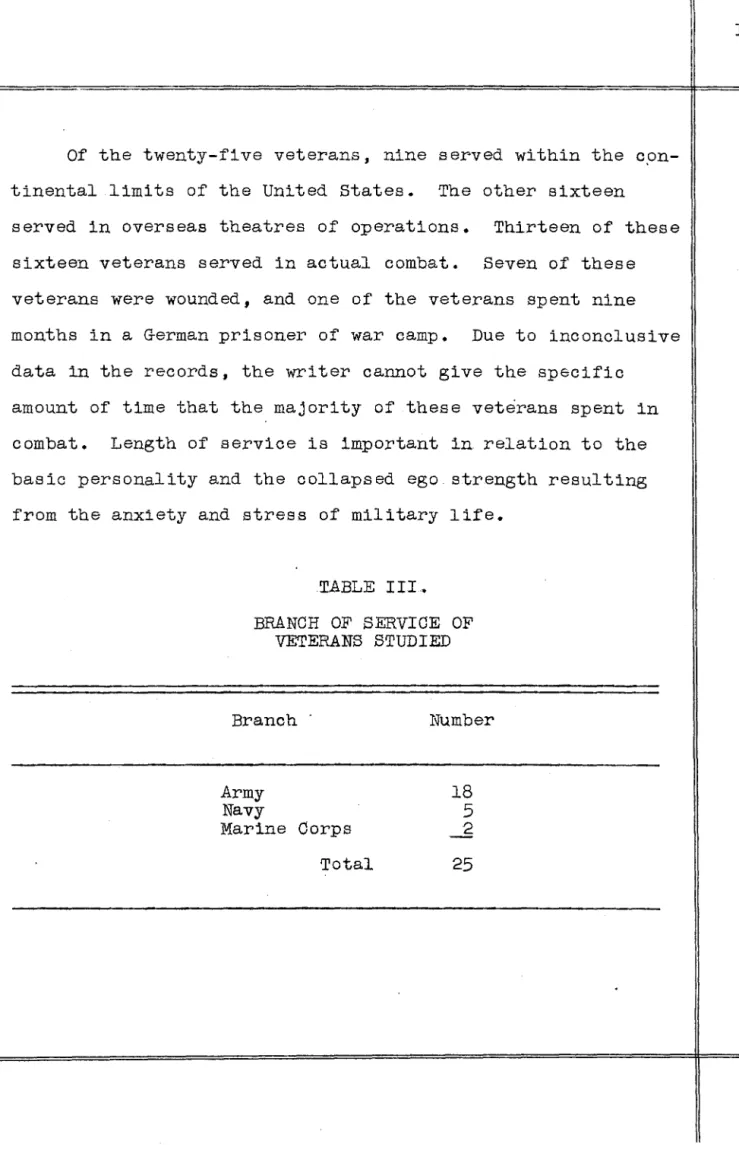
Of the twenty-five veterans, nine served within the
cpn-tinental limits of the United States. The other sixteen
served in overseas theatres of operations.
Thirteen of these
sixteen veterans served in actual combat.
Seven of these
veterans were wounded, and one of the veterans spent nine
months in a German prisoner of war camp.
Due to inconclusive
data
inthe records, the writer cannot give the specific
amount of time that the majority of these veterans spent in
combat.
Length of service is important in relation to the
basic personality and the collapsed ego strength resulting
from the anxiety and stress of military life.
TABLE III.
BRANCH OF SERVICE OF
VETERANS STUDIEDBranch ·
Army
Navy
Marine Corps
Total
Number
18
5
:225
19
It is not unusual that eighteen, or seventy-two per cent
of the veterans, served in the Army, as the greatest component
of psychoneurotic discharges were members of the
Arm~.The
percentage of Army personnel was higher than that of any other
branch of the services.
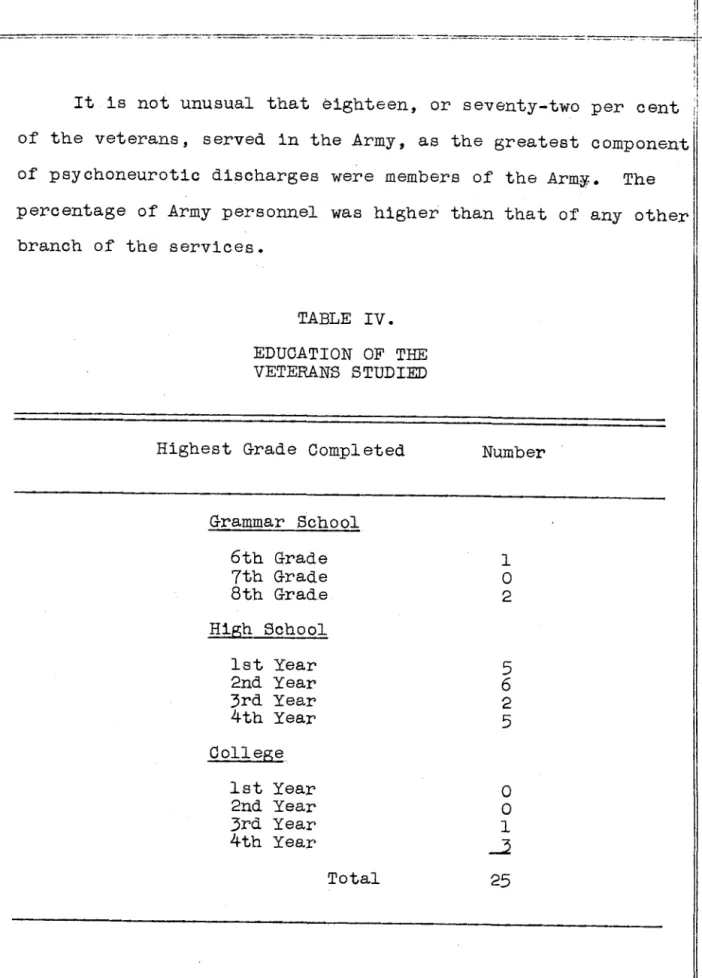
TABLE IV.
EDUCATION OF THE
VETERANS STUDIED
Highest Grade Completed
Grammar School
6th Grade
7th Grade
8th Grade
High School
lst Year
2nd Year
3rd Year
4th Year
College
1st Year
2nd Year
3rd Year
4th Year
Total
Number
1 02
5
6
2
5
0 0 1 _:225
Of the twenty-five cases, three were college graduates. One completed three years of college. Five were graduated from high school, thirteen left school during the high school grades, and three left school during the grammar school grades! The small number of cases used in this study cannot indicate
conc~usive data. Some of the reasons that most of these
veterans did not further their education were lack of oppor-tunity, difficulties in adjusting in school, poor motivation, or family economic stress.
When seen for survey, sixteen of the twenty-five veterans were employed, two were employed part-time, and aev.en were unemployed. Three of the veterans had returned to their prewar jobs.
The following factors will be used as criteria in evalua-ting the veteran's social and occupational adjustment;l
Satisfactory:
Social Adjustment
Unsatisfactory:
a.) Veteran accepted by his a.) Home broken or excesaiv
family (if single). friction between parents (if
single).
1 Florence B. Thompson, 11
Predicting the Adjustment of Psychoneurotic Veterans," Smith College Studies in Social Work, 22:10-12, October, 1951.
Satisfactory: (Cont.)
b.) Adequate relationships in community, well liked, many friends.
c.) Recreation largely social.
d.) Social attitudes out-going.
e.) Satisfying
hetero-sexual life; dating if single. f.) Satisfying marital rela-tionship and happy home life.
Unsatisfactory (Cont.) b.) Veteran overprotected and/or rejected in family.
c.) Limited relationships in community; few friends.
d.) Recreation largely solitary.
e.) Seclusive social atti-tude.
f.) Divorce or separation or friction in marriage.
Occupational Adjustment Satisfactory:
a.) Veteran meeting his economic responsibilities through earnings.
b.) Job stability.
c.) Good reasons for changing jobs.
Unsatisfactory:
a.) Unable to meet economic responsibilities through earnings.
b.) Unstable, frequent job changes.
c.) Reason for changing jobs; i.e., fight with employer, etc.
Using the criteria stated above for evaluating the veter-an's social and occupational adjustment, the writer found that
twenty, or eighty per cent of the veterans studied, were making an unsatisfactory post-war social and occupational adjustment.
It is significant to note that of the five veterans whose post-war adjustments were satisfactory, all had had positive and satisfying family relationships in their forma-tive years. Four of the five were high school graduates. None were known to have had any childhood neurotic traits. In each of these five cases the prewar social and occupationa adjustment was satisfactory. Three of these veterans had been in combat and two had been wounded. Each of these veterans was meeting his economic responsibilities through his earnings. Two had changed jobs since discharge because new employment offered greater security and higher earnings.
Eleven of the sixteen veterans who were employed were not able to meet their economic responsibility through their
earnings. Most of these veterans had frequently changed
jobs, due to dislike of the work, inability to get along with their fellow workers and employers, and nervousness. The seven eveterans who were unemployed stated in one way or an-other that their unemployment was due to their nervous condi-tions.
Six of the veterans studied had satisfactory social and recreational interestsj the other nineteen had few i f any social or recreational interests.
By and large, most of the veterans studied were still bothered by their somatic complaints. These predominating complaints were nervousness, headaches, recurrent battle dreams, fatigue, dizzy spells, irritability, and excessive perspiration.
TABLE }1.
MARITAL STATUS OF THE VETERANS STUDIED
Status Married Single Divorced Separated TotaL NUmber 12
9
3
._125
Twelve, or forty-eight per cent of the veterans, were married. As the majority of the veterans were of marriageabl age when inducted, this fact is not particularly significant. One of the veterans was previously divorced and had remarried. Eight of the married veterans had children. All were living with their families.
Of the nine single veterans, seven were living with parents or relatives and two were living alone.
•
TABLE VI •DIAGNOSIS AND DISABILITY RATING OF THE VETERANS STUDIED
Diagnosis Number Disability
Conversion hysteria
5
30%
Obsessive compulsion state0
40%
Anxiety reaction16
Neuresthenia3
50%
Reactive depression1
Total Total.25
Number10
2
12
25
The fact that sixteen of the veterans studied were diag-nosed as having anxiety reaction is not indicative that the largest percentage of psychoneurotic discharges were of anxiety reactions. The above diagnostic labels were given at the time that the veterans' cases were reviewed by the Adjudication Division for rerating purposes. As part of thei total disability compensation, seven of these veterans were being compensated for a physical disability resulting from combat wounds. Also, a certain percentage of their total compensation was awarded for their psychoneurotic conditions. When these twenty-five cases were closed by the Social Servic Unit, ten of the veterans were in receipt of a thirty per cent disability rating, two were receiving a forty per cent disabil
~~=======================================-=-=-=-==--=-====~=-~~·--'=-=-=--=--=--~
l
ity rating and thirteen were in receipt of a fifty per cent
disability rating.
These figures are only representative of
the group for descriptive purposes, and no conclusions can be
given from them.
j I
;I
I
! 1,1_1 II
i
_j
Chapter
VCASE STUDIES
ijli
27
!I
,I:!
II
II
II
q ' ' 'Iii
:I •iThe eight cases presented in this chapter were selected
il
'I
because they revealed the most complete and accurate informa-
il
'I
tion concerning the social and occupational adjustment of the
11veterans used
inthis study.
The purpose of this chapter
wil~be to indicate some of the socio-psychological factors that
'I
L
i
have had a profound effect on these veterans and to indicate
how these factors have contributed to their neurotic
break-I
down.
These factors will include family relationships, early
I
.I
childhood neurotic traits, pre-military service social and
I
occupational adjustments, and precipitating military stresses.!
I
Using the criteria stated in Chapter IV, the writer will
I
evaluate the veteran's post-war social and occupational
adjust!-!
ment at the time their cases were referred t·o Social Service
jby the Adjudication Officer.
To be in a better pos1tion to
understand the adjustment of these veterans, "the social,
emotional, and industrial aspects of their lives cannot be
isolated. These factors must be viewed as interrelated
be-cause each one influences any and all the others.
In general, these cases produce information that has beej
found by other writers who completed post-war follow-up
studies will be summarized in the following chapter.
Case A
Veteran is thirty years old, white, Catholic, and married. He was inducted into the Army on October 2, 1942, and discharged on December 4, 1943.
Veteran was the youngest of three siblings. The fa-ther never lived at home and finally divorced the mofa-ther. The mother was psychotic and was treated in several
mental hospitals. She remarried and rejected veteran. He left school at the age of fourteen, when he was in the eighth grade. Veteran lived in foster homes and with relatives prior to his entrance into military service. At the age of eighteen, he married an illegitimately . pregnant girl out of sympathy for her. He did not cause the pregnancy and the marriage lasted only two weeks. His prewar occupational adjustment was unsatisfactory because he could not take orders in his work.
The veteran served in the Tank Corps for ten months and diq not go overseas. In the service he could not follow commands, quarrelled frequently and threw things at his superior officers. For a while he was a jeep driver, but he had so many accidents, he had to be re-lieved of this duty. He complained of dizziness, faint-ing spells, headaches, and general nervousness. He was given a diagnosis of conversion hysteria and a medical discharge. At the time he was seen for survey, veteran was receiving a thirty per cent disability award from the Veterans Administration.
Following discharge, he lived for two months with his mother, stepfather, and stepbrother, but he left the home because of family friction. He married in 1944, and at the time of survey he had a son eight months old. His wife stated that he was a devoted father to his son and a good provider, although he was always in debt. He had had ten jobs following discharge and was unemployed at the time of survey. Veteran is enuretic, sleeps alone, and does not seek sexual relations with his wife. He has few friends, and his social life is limited to going to dare-devil auto races.
In
this case we see a father who never lived in the home and a psychotic mother. The veterants early childhood was replete with many neurotic traits. It is evident that the veteran lacked warmth and affection from his parents. As he grew up he became emotionally unstable and lacked judgment, as seen by his marriage to a pregnant girl out of sympathy for her.His Army life followed a patt.ern of insecurity, failure to comply with the discipline of military life, hostility and aggressiveness toward. those in command. Although the veteran did not serve overseas, the stress and strains of the military service, coupled with his insecure preservice status, was too much for him. to adjust to in a normal and healthy
manner.
The veteran's post-war social adjustment was marked by further rejection by his mother, stepfather, and stepbrother. In his marriage the veteran was.a devoted and overprotective father to his son, no doubt to compensate for the love and affection that be was deprived of in his youth. He was enu-retic and did not have or seek sexual relations with his wife. The veteran had few friends and be did not participate in
any social or recreational activities with his wife or others. His occupational adjustment was unsatisfactory, as is indicated by the ten different jobs he had held following discharge. He was always in debt and when seen for survey was
unemployed.
Case B:i
Veteran is thirty-seven years old, white, and di-vorced. He was inducted into the Army on May
6, 1942;
he served as a Private First Class and was discharged on May4,
1945.
Veteran, of Jewish parentage, was the oldest of ~our
siblings. His father died of influenza when veteran was five years old. When veteran was ten years ol.d~c his mother remarried. He had. a pos.itive relationship with his stepfather, but was in constant conflict with one
stepbrother. His mother consi.deredhim her "favorite child11
• As a child he used to bite his fingernails, but
there seem to be no other childhood neurotic traits. There is no history in the family of any serious nervous or mental disorder. Veteran completed two.years of high school at. the age of sixteen.. He lef_t. because of lack o~
interest. Prior to entering the military service he had a satisfactory occupational history as a bus and electric train operator.
The veteran volunteered for military service and served two years in the Aleutians. Although he was under constant bombings, he was in no actual combat. He
developed compulsive acts and could not fire on the rifle range because he heard his mother say, nDon't fire11• In January,
1945,
he was returned to the Unit.ed States. His compulsive acts became worse. He had to put his watch and shoes in a certain place or he was afraid something would happen to his mother. Sometimes he had fantasies that he would throw himself under a tractor or cut of~a finger. He became increasingly despondent and worried over his masturbating. He was.medically discharged With a diagnosis of compulsion neurosis. When seen for sur-vey, veteran was in receipt of a thirty per cent disabil-ity award from the Veterans Administration.
After discharge, veteran returned home to live with his parents. He was unable to ret~rn to his prewar
occupation because of headaches, excessive perspiration, dizziness, and irritability. Veteran was married in 1947, and was divorced by his wife in June, 1949, on the grounds of cruelty. There were no children by this
marriage. At the time of the survey he was living with his· stepfather and a younger sister. His mother bad died in 1948. He was working as a general helper for his step· father, who owns a retail meat market. He stated that
j
during the year he loses about a month from work because of his somatic complaints. Socially, he goes out on a date about once a week. He enjoys television, the movies and considers himself a "good mixer".In this case, the death of the father, when the veteran was five years old, was a severe blow to .. his emo.tional well-being. The veteran was his mother's 11favoriteu and may have
unconsciously resented the fact that she remarried,. thus havine· had to share her love.and affection with his stepfather and stepbrother. The veteran was able to make a satisfactory prewar occupational adjustment.
After two years servic.e in the Aleutians, the veteran developed thoughts and fantasies about his mother. These per-sisted to such an extent that he. could no longer perform his military duties and .he was returned to the United States.
Following discharge, the veteran was so preoccupied with his mother that he was not able to form a positive relationshiJ with his wife and the marriage ended in a divorce.
His social adjustment following his divorce seems to be satisfactory. However, his occupational adjustment seems to be unsatisfactory, in that his somatic complaints are prevent-ing his resumprevent-ing his prewar occupation. It is interesting to note in this case that the examining psychiatrist felt that veteran's psychic and somatic complaint.s did not appear to be
'·
severe enough in nature to prevent him from making a much better occupational adjustment.
Case C
Veteran is twenty-e.ight years old, white, and mar-ried. He was inducted into the Army on August
16, 1942,
served as a sergeant, and was discharged on September
19,
1945.
The veteran was the second of four siblings. The father was an alcoholic and deserted the family when veteran was nine years old. The veteran resented the father because of the misery he caused the mother. The mother \'VaS described as a highly neurotic 1ndividual. The veteran was enuretic and as a child he was afraid of the dark, was quite seclusive, and cried a great deal. He also felt that his mother rejected him. A month
before veteran was to have graduated from high school, he left school to join the C.C.C., because 11I wanted
money for my mother and jobs were hard to find. 11
When vet.eran was twenty, he married a girl whom he had courted for two years. He stated, 11I really was not
in love with her a:t: first. I wanted someone to cling to. I could never do anything; everything went wrong. I
wanted someone who woul.d. care. f.or me."
At the age of twenty-one, veteran was inducted into the Army. From his service records, he appeared to have made a good adjustment. After two years overseas duty working on planes., the veteran became tense, tremulous., depressed, and could not concentrate on his work. He was medically discharged from the service with a diagno-sis of psychoneurodiagno-sis, mixed, severe, manifested by
conversion and anxiety symptoms. At the time of survey, he was in receipt of a fifty per cent disability rating from the Veterans Administration.
After discharge, the veteran returned to live with his wife, who ~ater gave birth to a deformed child. The veteran attempted to start an appliance business, but this failed after a few months because he could not get the material. He then entered training as a carpenter
under Public Law 16, but had to give this up because i t
made him nervous. At the time of the survey, he was
work-ing in a leather factory, but felt very insecure in this
job.
He stated that he could not take the competition for
work in this country and was considering overseas work as
a civilian.
The veteran
1s wife described him as being preoccupied
with his thoughts and feelings, and confused.
He had
great difficulty in remembering things.
He felt he had
let his family down.
He seldom particpated in any social
or recreational activities.
Family relationships in this case show a
neurot~cmother,
and an alcoholic. father who deserted his family when the
veteran was nine years old.
Hls fear of the dark and crying
spells were overt tnethods of asking for attention, love, and
kindness.
The veteran was not exposed to any dangerous or traumatic
combat experience while overseas.
However, his early
depriva-tions from a drunken father and a neurotic mother may have
been the reasons for his neurotic breakdown.
The veteran's social ad.justment is unsatisfactory.
He
does not participate in any social or recreational events.
Early dependency needs were never fully met and he is
carry-ing these needs into his marriage by feelcarry-ing very inferior
and dependent on his wife.
Concerning his occupational adjustment, the veteran has
had to give up many jobs because of his somatic complaints.
Although he was employed at tne time he was seen for survey,
he felt insecure about this position and was thinking of over-seas employment.to escape the competition that he found in the employment fields in this country.
Case D
Veteran is twenty-eight years old, white, and marrie< • He was inducted into the Army Air Corps on April
19, 1943!
served as a Staff Sergeant, and was discharged on November 2,
1945.
. The veteran, second youngest of five siblings, statec, that he was the product of a broken home. His father
divorced his mother when he was thirteen. He was arrest-ed once br larceny when was thirteen or fourteen. Veter-an completed one year of high school at seventeen years of age. He was a poor student and left because of a
forced marriage. This marriage lasted only a few months. As a welder, he had a fair prewar occupational and
economic history.
Veteran enlisted in the Army Air Corps and spent twelve months in the European Theater of Operations as a gunner on a B-24. On his fourth mission over Germany, his pl.ane was shot down. He was captured and spent nine months in a prisoner-of-war camp, suffering many
trauma-tic experiences, both mental and physical. Shortly after his liberation, nervousness, restlessness, tense-ness, insomnia, and anorexia. He was medically
dis-charged from the service with a diagnosis of psychoneuro-sis, anxiety state, chronic, severe. When seen by the social worker, veteran was in receipt of fifty per cent disability compensation from the Veterans Administration.
After discharge, veteran worked as a laborer for a railroad company. He engaged in a great deal of sexual promiscuity and entered into another forced marriage. At the time of survey, veteran was living with his second wife and two children. Veteran's marriage was never happy. He has had numerous extra-marital relationships and was thinking of divorcing his second wife. Socially, veteran spent most of his time outside the home drinking beer and he was arrested several times for intoxication.
·u
His post-war occupational adjustment was unsatisfactory because of his hostile attitude toward his superiors and his poor work performance.
Veteran's formative years were characterized by insecur-ity, frustration, and deprivation. The absence of the father from the home when the veteran was in his early adolescence left him without a male figure to identify with.
His experience o.f being shot.down and the subsequent nine months in a German prisoner-of-war camp were unquestion-ably very traumatic to his already weakened ego.
Factors following discharge which were symptomatic of hie unsatisfactory social adJustment were his entrance into a
second forced marriage, frequent extra-marital relationships, excessive friction in his marriage, few friends, and his
heavy drinking. .Although veteran was steadily employed, his occupational adjustment was unsatisfactory. He was in constar~ trouble with his employer and fellow workers and his work
performance left much to be desired.
Case E
Veteran is thirty years old, white, single. He en-listed in the Army on September
6,
1943, served as a Private, and was discharged. on February 21, 1944.The veteran was the older of two siblings. There was no information concerning the personality of the parents. His mother and father died within seven days
of each other when veteran was thirteen was thirteen
years old. The veteran then lived with his grandparents, and his sister went to live with an aunt. His grandfath-er was a fishgrandfath-erman ~nd was out of the home a great deal. According to veteran, the grandmother neglected her home and was abusive to him. He ran away several times, but was brought back each time by the police.
In school, veteran was a poor student and repeated the seventh grade three times. He left school in the first year of high school when was sixteen years old. After leaving school he worked about nine months as a stock clerk in a hardware store and left because he did not like the work. Following this, he did odd jobs, went back to high school for a few months, and then quit this because he became restless.
The veteran was firstrejected by the Army because of bad eyes, but in 1943, he was accepted for limited service in this country. After basic training the
veteran was assigned as a drill. instructor. A few months later he complained that his work was getting on-his
nerves. Food nauseated him and he could not eat. One day he fainted twice on the drill field and was hospital-ized. Following various periods of hospitalization, veteran was given a medical discharge from the service with a diagnosis of psychoneurosis, mixed type. At the time of the survey, veteran was receiving thirty per cent disability compensation from.the Veterans Administration.
Following discharge, veteran tried many jobs. He made a poor occupational adjustment, always got into trouble and felt that his employers mistreated him. At time of survey, the veteran was employed as a soda foun-tain clerk. His employer described him as t1sarcastic and undiplomatic". He is often absent from work and claims to have sinus trouble. The veteran explained to the social worker that he was a seclusive and asocial individual •
The death of the veteran's parents within the same week was understandably traumatic for him. His grandmother's rejecting and punishing attitude toward veteran left him very secure and frustrated.
Poor school and pre.service work history is exhibited by the veteran's repeating grades and working at various odd
jobs.
An unsatisfactory post-war occupational and social ad-justment is evident. He has few friends and participates in no social or recreational activities. His many different
jobs and the fact that his present work is not acceptable to his employer are reflections of his insecurity from early
childhood.
Case F
Veteran is twenty-.five years old, whitet and single He was inducted into the Army on December 15, 1941, llj
served
as
a Corporal, and was discharged on July 23,1946~ Veteran is of French parentage, was the sixth o.f nine siblings. The father was a stable, hardworking man who.had been employed in the .same job for thirty-five years. The mother died of a heart disease when the veteran was seven years old. The veteran enjoyed a normal childhood, achieved good grades.in school and was never a disciplinary problem. He left school at the age of sixteen, while in the second year of high school, because he felt that he should work to help his father support the large family. He was steadily employed until he was inducted into the Army.While in combat, veteran was rendered unconscious by an artillery shell, and at the same time one of his buddies was killed. He was in an Army hospital for several montha, during which time he underwent several amytal interviews. He displayed a great deal of anxiety and tension and had severe tremors. After discharge from the hospital, he was assigned to MP duty. He
gradually became restless and seclusive. He had intense feelings of hostility toward the Germans. He had
quent battle dreams~ startle reaction, fatigue, and loss of appetite. At time of discharge, he was given a diag-nosis of psychoneurosis, anxiety reaction. When seen by the social worker, veteran was receiving fifty per cent disability compensation from the Veterans Administra-tion.
After discharge, the veteran returned to his pre-service aob as a metal worker with the railroad, where he was employed at the time of survey. His foreman
reported that veteran was absent from work often, due to nervousness, and has frequent argum.ents. with the fore-man and employees. veteran was concerned about losing his job because of his frequent absences from work, but the foreman was not alarmed about this.· He realized and understood. the veteran's problems •.
At the time of survey veteran was living with his father and a younger sister. He spent most of his. leisure time in a neighborhood tavern, but his father and sister stated. that he had never drunk to excess. The veteran felt that he was too.restless and irritabl~ to stay at home and read. He had been going steady with a girl, but had broken up their friendship because he could not see marriage because of his condition. His chief complaints were heacaches, fatigue, battle dreams, and insomnia.
The family relationships in this cas.e appear normal. The death of the mother, during the veteran's latency period, was traumatic to him. He was able to make a satisfactory social and occupational adjustment prior to military service.
The traumatic experience of being rendered unconscious by an exploding shell which killed his buddy, was the precipi-tating factor in the breakdown of this veteran.
Although the veteran was accepted by his family in both prewar and post-war periods, his lack of friends, solitary leisure time activities, and in~bility to make a satisfying
heterosexual adjustment.were indications that the veteran's social adjustment was unsatisfactory.
The frequent .. recurrence of his. somatic complaints~ which caused him to miss much time from work, and his.inability to form positive relationships with his empl.oyer and fellow
workers indicated his unsatisfactory occupational adjustment.
Case G
veteran is twenty-seven years old, white, and marrim. He was inducted into military service on February
5,1943,
and was. discharged on February 10, 1946.
Veteran is the third of four siblings. There were no known psychiatric determinants in the family history. Family relationships were satisfactory. The father was a tailor and the veteran was described as being very close to him. Veteran did poorly in school, repeating the fifth and sixth grades. He left school in the tenth grade at.the age of seventeen to enlist in the Navy. He was rejected because of his teeth and was ashamed to
return to school. Prior to service, veteran apparently m made a satisfactory social andoccupational adjustment. He worked as a truck driver and mechanic. He engaged in sports and normal heterosexual. activities.
Veteran served in the Airborne Engineers and was in the Southwest Pacific for thirty-five months~ spending twenty months in combat. Veteran was hospitalized in Septeber,
1948,
for malaria. Following thishospital-ization he complained of weakness, nhot and cold sensa-tions, and he was again hospitalized. During this
period he had poor emotional control, would shake violent ly when startled, was irritable and antagonistic. He wasl diagnosed anxiety state, severe, and was evacuated to the! Zone of the Interior, where he was admitted to an Army general hospital in December, 1945. Veteran received a medical discharge from the service for a diagnosis of psychoneurosis, anxiety state. When seen for survey, he was receiving fifty per cent disability compensation from the Veterans Administration.
II
After discharge, veteran returned home to live with his parents. He married a widow with two children and has a child of his own in this marriage. He states his marriage is congenial. At time of survey, veteran had been employed for a year and a half. For diversion he goes to the movies, visit.s friends, plays cards with neighbors, goes to dances with his wife on special occa-sions, and takes the children out.walking.
His present complaints are nervousness, fear of the dark, hot flashes, headaches, and irritability.
In this case, there is no evidence of conflict or dis-harmony in the family relationships. He made a poor school adjustment, but his preservice social and industrial adjust-menta were adequate.
Veteran's long and arduous overseas duty--twenty months of which he was in combat--was the precipitating stress of his breakdown.
His post-war social adjustment appears to be sa.tisfactorn this is substantiated by his happy marriage, his many friends, and his positive leisure time outlets. However, an unsatis-factory occupational adjustment is clearly in evidence. He shifted from job to job because of his somatic complaints and at the time he was seen for survey was unemployed.
Case H
Veteran is twenty-three years old, white, and mar-ried. He ·enlisted in the Navy on February 2, 1943, served as a Fireman Third Class, ~nd was discharged on January 25, 1945.
The veteran is the younger of two siblings~ his older brother also having served in the Navy. During the veteran's childhood both parents enjoyed excellent health. There seemed to be no family history indica-tive of nervousness, insanity, or related difficulties. At the age of fifteen, he was treated by a psychiatrist after stealing a motor. The psychiatrist felt that the veteran was fascinated by mechanical things and that the stealing was a prank and not serious. Veteran was graduated from high school with above average grades, although he was aggressive and played truant a good deal. As for hobbies and recreation, veteran was al-ways interested in anything mechanical, tinkering with radios and working on all the motors and engines he
could find. Prior to service he worked as an automotive mechanic and truck driver.
In service, veteran did not serve overseas. He was hospitalized twice for a gland strain and for catarrahal fever. He had several court martials for AWOL and was placed on overseas shipment. These orders were revoked and he was sent for extensive amphibious training. Af-ter nineteen months service, he was again hospitalized, complaining of fatiguability, tension, restlessness, and dissatisfaction with Navy assignments. He was medically discharged from the Navy with a diagnosis of psychoneuro-sis, mixed type. When seen by the social worker, veter-an was receiving thirty per cent disability compensation from the Veterans Administration.
Veteran married shortly after his discharge and returned to his prewar Job as truck driver. When seen for survey, he was employed as a fireman, a position he had held for eighteen months. His superior stated that veteran had a good attendance record, was obedient to
orders, and got along well with his fellow workers.
Veteran's marriage was compatible and his wife sta-ted that he was a devosta-ted father. Socially, he was a member of the Elks and he and his wife had many friends
in the neighborhood. His hobby was radio repair work anc he has repaired many of his friends' sets. His principa] complaints were stiffness in arms and legs, occasional heartburn, with nausea occurin g three or four times
since discharge.
There are no indications in the case of strained family relationships. Although veteran was aggressive and played truant a great deal, he enjoyed a normal and satisfying adolescence.
Veteran's positive marital relationship, his many friend , and his radio repair work were the main factors in the satis-factory social adjustment that .. he was making.
Through his occupation as a fireman, veteran is meet-ing his financialresponsibilities. He feels secure in this employment and his good attendance record indicates that his occupational adjustment is satBfactory.
·
... ('
~
:~_,-·:·'·
Chapter VI
SUMMARY AND CONCLUSIONS
For a more valid understanding of psychoneurotic veterans and the social and occupational adjustments they are making in the post-war world, the writer found that many factors had a profound influence on their adjustments. Family rela-tionships, childhood neurotic traits, prewar social and occu-pational adjustments, and precipitating military stress are ,dynamically interrelated in the kinds of adjustments these
veterans are making.
In the eight. cases discussed and analyzed in this study, none of the veterans was an only child. In siz cases, the size of the famili.es was composed of four to nine children. Seven of the cases showed that divorce, separation or death of one or both parents disrupted the home life of the
veterans.
The precipitating military stresses cannot be minimized. Many were able to adjust to the discipline, deprivations, and loss of individuality common to military life until the
stresses and frustrations increased their anxieties and in-security to a point where their egos were overwhelmed.
The writer also found in the post-war period, the recur-rent symptoms of the veterans are detrimental to their social
and occupational adjustments. These veterans are eligible for out-patient treatment at the Veterans .Administration Mental Hygiene Clinic. Some have availed themselves of this
opportunity; the others should, for might benefit from it. In general, no definite or final conclusions can be
given concerning the psychoneurotic veterans from the findings of this study, because of the small number of cases used.
Due to :the common findings in the cases presented, many
points appear significant .. and the trends might have been high-er if a larghigh-er numbhigh-er of cases whigh-ere studied.
It is interesting to note that. the findings of th1s stuqy compare favorably with those of Grinkler and others,l who
found that men who developed war neuroses were characterized by the following predispositions:
1. Parental discord, broken homes, unhappy childhood, and difficulties in sibling rivalry.
2. Parental alcoholism, parental inconsistency, and insincerety in instilling ego ideals.
3.
Earlier age of independent work; frequent changes of jobs.4.
Greater dependence upon,the home, especially upon the mother, who in turn was dependent on the son.5.
Greater frequency of overt neuroses and neurotic trends, enuresis, phobias, sleep disturbances, and nail biting.1 :rtoy Grinker and others, 11.A Study of Psychological
Predisposition· to the Development of Operational Fatigue tl,