Iterative and Incremental Service-Oriented Service Management
Implementation
Ahmad K. Shuja Shuja & Co. Inc., USA
www.shuja.info
Embarking upon an ITIL implementation journey is more about cultural transformation than any other single factor. Organizations have been struggling to leverage ITIL guidelines and achieve such transformations to realize highly anticipated effectiveness/efficiency and business/IT integration benefits. ‘Transformation’ does not happen overnight. It requires consistent, steady, incremental, and ongoing improvements. ITILv3 is more than just infrastructure–it is about integrating IT with the business and ensuring traceability right from business services, business process to IT services and all the way down to individual infrastructure components. Implementing service management will impact each and every aspect of organization. Depending upon organizational baseline maturity level, implementing service management may even be revolutionary and may take longer before the undertaking organizations starts realizing benefits. To make the matters worse, organizational tolerances to sit tight and wait for these transformational benefits to come have been declining. Some of the questions that IT managers have asked me over the years mostly pertain to how do we implement this and achieve results before our next management ‘shuffle’. Under such business and organizational pressures, faster turn-around coupled with effective and efficient Continual Service Improvement may be the answer. We will discuss how companies can go about delivering incremental and iterative value to the customer through steady and ongoing improvements in an agile fashion.
I. INTRODUCTION
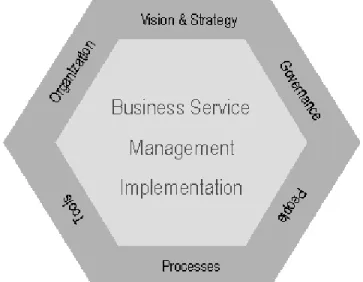
Depending upon the role that IT plays in enabling the core business processes, the rate of IT evolution may be critical to the overall business success and profitability. For some organizations, implementing service management may be transformational and embarking upon such a journey may sometimes be more about cultural transformation than any other single factor. It may need major shift in how people think about and manage IT. These shifts may include 1) IT is for the business and IT is not for IT, 2) targeted technology capabilities investments to maximize business profitability, 3) fire-fighting is not rewarded, pro-active fire-prevention is rewarded, 3) we will thrive not just survive, and so on. Cultural transformation, an aggregate of small behavioral transformations overtime, is achieved through well-aligned business and IT vision & strategies, clear definition of enterprise architecture standards and governance policies, thoughtful management of changes in people’s attitudes and ways of thinking, careful planning, management and incremental implementations of a range of continual service and service management process improvements, and business-IT organizational re-alignments. These critical aspects of implementing Business Service Management are graphically represented in Figure I.
Cultural transformation is therefore easier said than done. Organizations have been struggling to leverage IT Infrastructure Library (ITIL) guidelines to achieve such transformations to realize the highly anticipated effectiveness
and efficiency and business-IT integration benefits. ‘Transformation’ does not happen overnight and requires consistent, steady, incremental, and ongoing improvements. Service management implementation, especially in case of lesser mature organizations, is no exception. What makes such transformations even riskier is the lack of organizational knowledge about all that is necessary to make these efforts successful.
It is absolutely critical to realize that ITILv3 is more than just infrastructure and that service management sometime means a major shift in the way IT has been managed and operated and the manner in which it has been delivering its services to the customers. ITILv3 and business service management are —————————
Digital Object Identifier inserted by IEEE
about integrating IT with the business and ensuring traceability and management right from business processes, business services to technical services and all the way down to individual technology (infrastructure, application, software, hardware, databases, middleware and others) components. Implementing IT Service Management will very likely impact each and every aspect of the organization. In fact, depending upon organizational baseline maturity level, implementing service management may even be revolutionary and may take longer before the undertaking organizations starts realizing benefits. To make the matters worse, organizational tolerances to sit tight and wait for these transformational benefits to come through have been declining. Some of the questions that IT managers have asked me over the years mostly pertain to how do we implement IT Service Management and demonstrate the value-add before our next management ‘shuffle’. In order to keep the senior management sponsorship alive that survives management shuffles and in order to ‘excite’ the larger organization to embrace this transformational change,
We must demonstrate the business value created as early as possible and help the senior management and the larger organization see a small ‘slice’ of our business service management vision at a time.
Faster turn-around coupled with effective and efficient management of continual improvement efforts is essential. How can IT organizations go about delivering incremental improvements and iterative value to the business customers through steady and ongoing improvements in an agile fashion? In this paper, we will review how this can be achieved in the most effective and efficient manner.
II. DIFFICULTIES ASSOCIATED WITH IMPLEMENTING
SERVICE MANAGEMENT
Let’s now briefly discuss some of the challenges that organizations have been facing with implementing service management. This will build further appreciation of why it is critical to iteratively and incrementally build slices of our business service management vision at a time. Note that the extent of difficulties associated with implementing business service management depends upon the current state maturity of the business enterprise and IT organizations. For those that are at lower maturity levels, this may mean a
fundamental shift in the ways in which business enterprises and IT organizations operate. Major difficulties may include:
A. Cultural Shift and Organizational Change
For organizations that may have lower maturity levels, Business Service Management implementation may actually lead to a fundamental shift in the way in which IT delivers its services to the customers and how customers engage IT in providing the specific services.
1) Technology Management vs. Business Management
In many established organizations (not necessarily mature), IT is still viewed and managed as a back-office cost center. According to the ITILv3 Organizational Maturity Model [1], shown in Figure II, those IT organizations that operate at the technology management level are Maturity Level 1
organizations.
In most cases, such technology management cultures
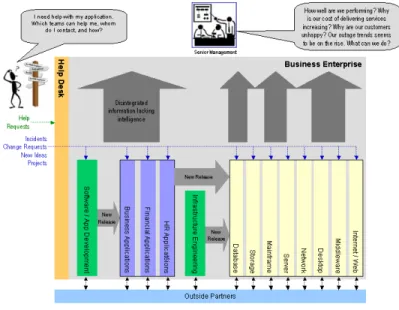
encourage teams and departments within an IT organization to operate in silos (silo-ed engineering and development, silo-ed technology management, silo-ed request management, silo-ed reporting and communication, silo-ed visions and leadership, and silo-ed supplier management). Figure III shows how a silo-ed organization may look like.
Maturity Level 4 IT organizations manage their respective technologies in order to integrate with the business needs. Such a shift from being a technology management Maturity Level 1 organization to a business management Maturity
Level 4 organization usually is a major one and requires transformations in the way that IT thinks, plans, and delivers its services to its customers.
Figure II: ITILv3 Organizational Maturity
2) Service Management vs. Technology Management
IT components (software, hardware, applications, network, servers, etc) need to be managed to ensure that the respective services that these components support are appropriately managed to meet the business needs. You need one weak link to break the value-chain. One weak component, as depicted in Figure IV, is all you need to cause
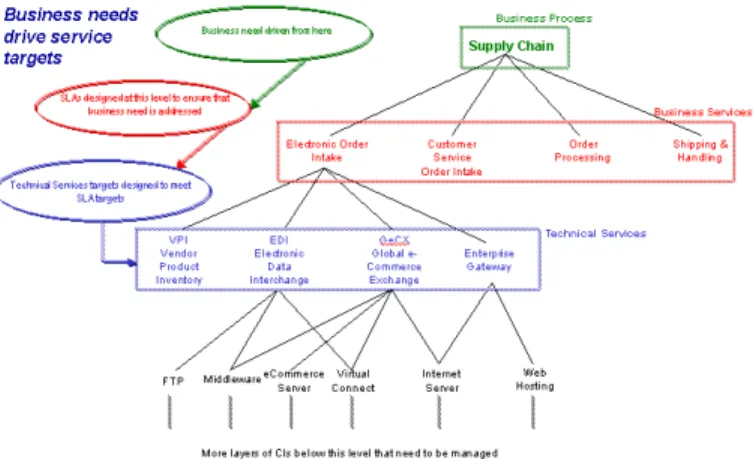
an outage to a business critical service. To relate this idea to Business Service Management, lets look at the Service Tree shown in Figure V. Business Processes are enabled by one or more Business Services. Business Services are realized by one or more Technical Services. Technical Services are implemented by one or more Technology Components. In a lesser mature organization, these components are managed in silos as shown in Figure III. The end result is that each of the
components that make up a given Business Service are managed in silos. Break in one component breaks the entire service chain. Real-world service chain example, using the Service Tree concept is shown in Figure VI. Supply Chain Business Process is enabled by four Business Services namely
Electronic Order Intake, Customer Service Order Intake, Order Processing, and Shipping & Handling. Business Services in turn are implemented by one or more Technical Services and so on. In order to ensure that Supply Chain
Business Process is available as agreed with the customers, it is absolutely critical that IT organization is able to manage all components that make up the Supply Chain Business Process.
End-to-end service management is the only effective and efficient way to guarantee that all components that implement a given business service are managed consistently to ensure that business services are managed such that related business process needs are met.
When teams and departments within a lower maturity level IT organization do technology management, they do so in silos and that may lead to a creation of a potential weak link. For IT organizations to migrate from being a technology management organization to one that manages business services is a major shift and is likely to be a challenging task.
B. Balancing resources between “fighting fires” and “new developments”
The chances are that if you are a lower maturity level organization that majority of your resources are engaged in fighting fires most of the time. When initiatives like service management implementation are undertaken, special attention should be given to the number of additional resources that may be necessary to successfully deliver on new initiatives. In most cases, consultants may be an appropriate option. Higher maturity levels will enable organizations to dedicate more resources to new developments and to have fewer resources needed to keeping the lights on.
C. Lack of in-house IT Service Management and ITIL Expertise
Whenever transformational efforts are undertaken, it is critical to have subject matter experts advise and assist in
implementing related components. For effective and efficient implementation of service management, it is critical that ITIL experts are appropriately engaged. It is recommended that appropriate ITIL training is designed and delivered to the internal resources as the service management implementation program progresses. This will enable the organization to build in-house expertise that will be very much needed when it is time to operate service management.
D. Multiple Independent Silos & Varying Maturity Levels
As shown in Figure VII, in most medium-to-large size organizations, there may be multiple independent business-aligned IT organizations and each may be at a different maturity level. How should Business Service Management Figure V: The Service Tree
Figure VI: Service Chain for Supply Chain Business Process
Figure IV: One Weak Link
implementation be planned and executed to ensure that associated complexities and risks are appropriately managed and that focused business service improvements are
implemented?
E. Efforts required to improve Service Management Processes
Mature service management processes provide the necessary foundation required to ensure that Business Services are managed effectively. Improving service management processes may mean major impacts on the way people and teams within an IT organization perform their day-to-day jobs in managing technologies. Figure I graphically shows the different aspects that need to be managed in order to ensure successful implementation of Business Service Management.
F. Longer turn-around times
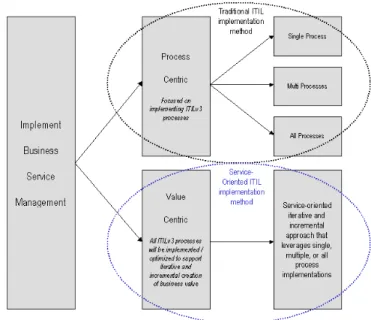
In ITILv3, there are over 18 service management processes. Traditional service management implementation practices offer process-centric approaches as shown in Figure VIII. Service management process improvement focus may take longer times to mature from Process Maturity Level 1 to Level 3 or 4 thereby pushing the anticipated business service management driven business benefits further down; business benefits require that service chains for business processes are managed end-to-end as shown in Figure VI. Imagine maturing Service Asset & Configuration Management to Maturity Level 4. For medium-to-large size organizations, just that part may take years and millions of dollars. If it is done in a traditional non-targeted manner, it will be like boiling an ocean. There are obviously some more critical configuration items (CIs) than others; some support more critical business services than others. Pareto analysis must be performed and targeted business-value service-oriented improvements must be implemented in an iterative and incremental fashion.
Otherwise, the risks to the initiative are significant. My experience in working with a variety of clients across industries has taught me that if it takes longer turn-around to demonstrate the business value of making any significant investments in improving IT, the sponsorship will likely to dry out and between management shuffles, the entire
transformation will be at risk. We need a more innovative approach to deal with these challenges.
III. ITERATIVE & INCREMENTAL SERVICE-ORIENTED SERVICE
MANAGEMENT IMPLEMENTATION A. Purpose
Iterative and Incremental Service-Oriented Service Management Implementation (i2-SOSMI) method aims to:
• Address the challenges that organizations face in implementing business service management
• Ensure that targeted service management process improvements are made
• Deliver continual and incremental business value in a consistent, steady and ongoing manner
• Effectively manage risks associated with
implementing business service management. These include organizational, architecture, integration, and process related risks.
• Ensure that service management process
improvements are targeted on improving the business bottom-line by integrating these improvements with improving and effectively managing the businesses services.
Figure VII: Varying Maturity Levels
Figure VIII: Service Management Implementation Approaches
B. Implementing a ‘slice’ of Business Service Management
At the core of the i2-SOSMI is the focus on enabling the undertaking organization to implement a ‘slice’ of the vision in the first six months of embarking on this transformation endeavor thereby further ensuring that the momentum, support and sponsorship are kept alive. Let’s first understand what it really means to implement a ‘slice’ of business service management vision. Figure IX depicts close to a real world
situation whereby less mature organizations are divided into clear silos, there are situations (Business Process A, Business Service A, and Technical Service E) where even IT is not clear about responsibilities, and each silo is managing its own components without much visibility on how their respective areas impact or not impact the business profitability. In other words, because of this lack of visibility, there is lack of understanding on which components are more critical to the business. When it is time to prioritize where to make improvements, such decisions are mostly made in a vacuum leading to obvious impacts on potential returns on those investments.
The i2-SOSMI provides guidelines to enable organizations to improve service management processes and to leverage these improvements to effectively and efficiently enable the core business processes. Targeted investments are made to improve those components of the service chain that enable the business critical business processes. Parallel service management process as well as service improvements are implemented to not only improve IT management capabilities but to
demonstrate how these improvements in IT management impact the business profitability. Figure X shows a business service management ‘slice’ implemented for business-prioritized Business Process B. Underneath Business Process B, all service management components, as shown in Figure I are improved for both service management processes as well as business services.
C. High-level i2-SOSMI Activities
Figure XI shows the high-level activities carried out within each iteration of Business Service Management
implementation program. Note that each iteration ends up with the delivery of tangible business-value. Also, note the
importance of alignment with business and IT vision and strategy at the top and development of the service management foundation at the base. Let’s now these key activities in detail:
1) Align with Vision & Strategy
Towards the top of Figure XI, you will see “Align IT Vision / Strategy with Business Vision / Strategy”. This means that there needs to be a continual alignment with larger business and IT visions and strategies. Each iteration begins by revisiting and ensuring that a continual alignment between deliverable of the given iteration and the business / IT strategy exists. If executed appropriately, Business Service
Figure IX: Low maturity organization
Figure X: A ‘slice’ of BSM Vision
Management strategy should further refine the larger IT strategy.
2) Establish Service Management Foundation
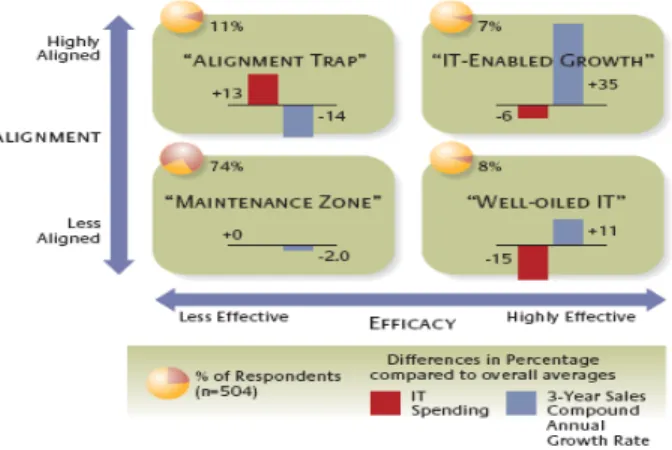
As the name suggests, this foundation is absolutely critical to effective and efficient implementation and management of business services. As shown in Figure XII [2], alignment and efficacy are both required to achieve “IT-Enabled Growth”. The i2-SOSMI iteration ensures that improvements in both directions are implemented to achieve the “IT-Enabled Growth” for a business critical business process or a business service (depending upon organizational priorities and situations).
Assuming that the subject organization is presently operating at Organizational Maturity Level 1, Service Management Foundation development will consist of four core service management processes. These include Incident Management, Problem Management, Change Management, Service Asset and Configuration Management, and Service Catalog Management. Let’s try to understand what it means to establish this foundation.
a) Incident Management, Problem Management, &
Change Management
Establishing Incident, Problem and Change Management processes will include the following:
• Common, consistent, and standard processes defined for the organization
• Clear roles and responsibilities established
• Process operational and management organizations defined (process operational organization executes the process and process management organization –
likely to be part of Continual Service Improvement – managing ongoing process performance monitoring and improvements).
• Tools implemented
• Appropriate trainings provided and support materials produced
• Well defined process KPIs (Key Performance Indicators) established
• Processes re-baselined
b) Service Asset & Configuration Management Establishing Service Asset and Configuration Management will include the following:
• Consistent and standard Service Asset and Configuration Management process defined.
• Depending upon the organization, establish a common Configuration Management Database (CMDB). It may be a single repository or a federated environment.
• Known CI records created / migrated and auto discovery performed
• Clear roles and responsibilities established
• Process operational and management organizations defined (process operational organization executes the process and process management organization –
likely to be part of Continual Service Improvement – managing ongoing process performance monitoring and improvements).
• Appropriate trainings provided and support materials produced
• Well defined process KPIs (Key Performance Indicators) established
• CMDB baselined and brought under Change Management
c) Service Catalog Management
Service Catalog plays an important role in providing the foundation to implement business service management on. Service Catalog serves the function that a Menu serves in case of a Restaurant.
How can Kitchen plan what ingredients to have, what recipe scripts to produce, what resources to acquire, what
expectations to manage, what economies to plan and so on. Without a Service Catalog, how can an IT organization Figure XII: Alignment & Efficacy
identify the IT capabilities to develop, the targets to establish, and the expectations to manage? Service Catalog provides a single source of all the operational (as well as soon to be operational) services that are provided by the IT organization. Service Catalog will drive how business process and / or business services are prioritized and will drive how specific improvements are implemented across a range of service management processes such as Service Level Management, Capacity Management, Availability Management, Request Fulfillment, Service Asset and Configuration Management, and others. As shown in Figure XIV, key related uses of the Service Catalog may include the following:
• Customer may use Service Catalog to Place Request for Service, Check Status, Report Problems, and
Submit New Ideas.
• IT may use Service Catalog to Establish Service Level Management, Plan Service Desk Support, Identify Technology Needs, and Build and Manage Relationships between Service Level Agreements, Operational Level Agreements, and Underpinning Contracts.
3) Core Repeatable Activities
The following core activities are performed in each iteration: a) Analyze
Each iteration focuses on specific business needs. In order to ensure that needs are understood and addressed objectively, key associated business processes are prioritized and enabling business services are identified. Note that Service Catalog needs to be established as part of the service management foundation. This Service Catalog is then used to identify and prioritize the business services and / or technical services that need to be improved. In order to maximize business benefits, it is recommended that prioritization should be carried out at business services level and technical services should be
improved to improve the selected business services. In almost all cases, there may be one or more technical services required in order to realize a given business service and each technical service may be shared by one or more business services. These business service and technical service relationships are shown at a high-level in the Service Tree discussed earlier and shown in Figure V. In order to improve a given business service, improvements will be implemented within the underpinning technical services.
b) Design
Quantifiable improvement opportunities are identified that will be delivered by the end of that iteration at business process as well as business service levels. Service Level Requirements (SLRs) are understood and associated Service Level Agreements (SLAs) are established and agreed upon.
c) Implement
As per the SLRs and SLAs, business services and technical services are improved to ensure that agreed targets are met. In order to improve the quality of business and technical services, IT Service Management Processes will need to be improved.
Each iteration will result in service as well as service management process improvements. Quality of CI that support the prioritized business service is optimized and CI inter-relationships are established. This ensure that optimizing repository like CMDB does not become an ‘ocean-boiling’ task and is performed in a targeted fashion that will ensure achievement of concrete business results.
D. The i2-SOSMI Architecture
The i2-SOSMI provides a set of comprehensive guidelines that the subject organization will need to successfully implement business service management based on ITILv3. The i2-SOSMI-v1 consists of four disciplines and four phases. Content is represented in disciplines and lifecycle is
represented in phases. Each phase consists of three iterations i.e., Visualize, Architect and Realize. Each iteration executes same activities (as discussed – Analyze, Design and
Implement) with different focus.
Let’s briefly discuss each of the disciplines and phases.
1) Disciplines
There are the following four disciplines in the i2-SOSMI-v1:
a) Project Management
It is based on guidelines provided by Project Management Institute’s Project Management Body Of Knowledge (PMBOK). It specifically focuses on project management activities that are required to be carried out to implement Business Service Management.
b) Service Improvement
It is based on ITILv3 service improvement guidelines. It enables organizations to implement service management on existing services. It also provides comprehensive guidelines Figure XIV: Uses of Service Catalog
on planning and establishing Continual Service Improvement practices.
c) Service Management Process Improvement
It is based on ITILv3 service management process guidelines. It enables organizations to improve existing service
management processes or to develop new processes. It leverages industry process development and improvement best practices and provides ITILv3 process-specific work
breakdown structure.
d) Architecture & Integration
It ensures that architecture and integration standards are established for business service management implementation. It is based on process-integration needs to support Business Service Management.
2) Phases
There are the following four phases in the i2-SOSMI-v1: a) Foundation
Foundation phase aims to establish the foundation required to achieve business-IT integration.
b) Design
Design phase aims to architect, design, and prototype business service management.
c) Align
Align phase enables organization to achieve business-IT alignment.
d) Integrate
Integrate phase achieve the envisioned business-IT integration and delivers business service management for the
organization.
E. The i2-SOSMI Patterns
Depending upon the key drivers for implementing the business service management, a specific pattern may be leveraged. Each pattern lays out a specific sequence in which ITILv3 processes should be implemented. Note that these are just patterns and aim to provide a starting point for the subject organization.
There are the following patterns developed for i2-SOSMI-v1:
1) The i2-SOSMI Pattern: Business-Value Creation
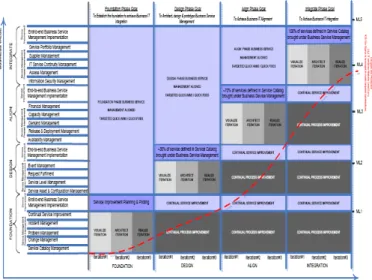
If the key driver is to mature IT organization to become a business-value partner, then Business-Value Creation pattern will provide an appropriate starting point. Figure XV shows the business-value creation graph for business-value driven service management process and business service
improvements. The recommended lifecycle for this pattern is shown in Figure XVI.
2) The i2-SOSMI Pattern: Compliance & Regulation Improvement
This pattern provides guidelines around implementing / improving the processes that enable organization to address any pressing compliance related concerns. This pattern recommends a different sequence in which ITILv3 processes are implemented / improved.
Please note that at the core of i2-SOSMI is the incremental implementation of Business Service Management.
IV. CONCLUSION
Implementing Business Service Management may mean a fundamental shift in the way in which IT is managed and IT services are delivered. Such a shift may require transformation for most lesser mature organizations. Increasing pressures on IT from the customers and / or businesses to deliver value sooner means that such transformations must deliver business-value sooner in order to ensure that the momentum is
maintained and sponsorship stays alive. Traditional process-centric service management implementation mostly comes with delayed value creation and in-effective risk management. An iterative and incremental approach to implementing business service management will enable organizations to improve service management processes as well as to create immediate business value through incremental implementation Figure XV: Business-Value Creation Pattern
of Business Service Management. This will positively impact the business bottom-line profitability.
Comprehensive details of the i2-SOSMI methodology will be provided in my forthcoming book – ITIL: Service
Management Implementation & Operation
REFERENCES
[1] V. Lloyd and C. Rudd, “Service Design”, Office of Government Commerce, The Stationary Office, UK, 2007.
[2] D. Shpilberg, S. Berez, R. Puryear, and S. Shah, “Avoiding the Alignment Trap in Information Technology,” MIT Sloan Management Review, MA, vol. 49 no. 1, Fall, 2007.
Ahmad K. Shuja, www.shuja.info, is an accomplished IT manager and a professional who has worked at some of the major financial services, pharmaceutical and management consulting organizations globally. He has a proven track record of successfully enabling organizations to build and manage high-quality, software-intensive products and services efficiently and effectively. Ahmad provides advisory and consulting services in IT strategy and planning, IT Service Management (ITSM) and governance, program and project management (PMO) transformation and operations, software engineering processes and agile software development, enterprise architecture, and business process management. Ahmad holds Master of Science in Management of Technology from Massachusetts Institute of Technology (MIT), Master of Science in Computation from Oxford University and Master of Information Systems from University of Toronto. He also holds numerous professional certifications, including Project Management Institute PMP, SEI Certificate in CMMI, ITIL Service Manager and Certified RUP Specialist, to name a few. Ahmad is the author of “IBM RUP Reference and Certification Guide – IBM Press” (ISBN#0131562924) and is currently working on his second book “ITIL: Service Management Implementation & Operation – Taylor & Francis” (ISBN#1420089390). He can be reached at