WHISTLEBLOWER
PROTECTION
PROGRAM
Better Data and
Improved Oversight
Would Help Ensure
Program Quality and
Consistency
What GAO Found
Why GAO Did This Study
Workers who “blow the whistle” on prohibited practices play a role in enforcing federal laws, but these workers risk reprisals from their employers. The Whistleblower Protection Program at the Department of Labor’s (Labor) Occupational Safety and Health Administration (OSHA) is responsible for investigating whistleblowers’ complaints.OSHA’s decisions generally may be appealed to the Office of Administrative Law Judges (OALJ) and, ultimately, the Administrative Review Board (ARB). GAO examined (1) what is known about processing times for complaints and what affects these times, (2) what outcomes resulted, and (3) what challenges OSHA faces in administering the program. To answer these questions, GAO analyzed electronic data files from OSHA, OALJ, and ARB; visited five OSHA regional offices; reviewed case files; conducted a Web-based survey of investigators; and interviewed key officials.
What GAO Recommends
GAO recommends that Labor take a number of steps to improve the accuracy of its data and enhance program oversight. OSHA questioned the need for the recommendation to ensure that audits of the program are completed. GAO clarified the recommendation to focus on developing interim milestones to ensure timely completion. ARB agreed with the need for accurate appeals data, and commented that it appreciates GAO’s recommendation for improving the data. However, it did not provide specific information on the steps it would take in response.
Labor lacks reliable information on processing times and, as a result, cannot accurately report how long it takes to investigate and close a case or decide on certain appeals. OSHA does not have an effective mechanism to ensure that the data are accurately recorded in its database, and GAO’s file reviews revealed that the key dates are often inaccurately recorded in the database or cannot be verified due to a lack of supporting documentation. For example, in one region visited, none of the case closed dates matched the documentation in case files. At the appeals level, the reliability of information on the processing times is mixed. Timeliness data at the OALJ level are reliable, and the OALJ completed appealed cases in an average of about 9 months in fiscal year 2007. In contrast, ARB data are unreliable, and the agency lacks sufficient oversight of data quality. GAO’s file review found that ARB processing times ranged from 30 days to over 5 years. At all levels of the whistleblower program, GAO found that increasing caseloads, case complexity, and accommodating requests from the parties’ legal counsel affect case processing times.
Whistleblowers received a favorable outcome in a minority of cases that were closed in fiscal year 2007, both at initial decision and on appeal, but the actual proportion may be somewhat lower than Labor’s data show. OSHA’s data show that whistleblowers received a favorable outcome in 21 percent of complaints— nearly all settled through a separate agreement involving the whistleblower and the employer, rather than through a decision rendered by OSHA. However, GAO found several problems in the way settlements were being recorded in OSHA’s database, and a review of settlement agreements suggests that the proportion of cases found to have merit may actually be about 19 percent. As with
investigations, when whistleblower complaints were appealed, decisions favored the whistleblower in a minority of the cases—one-third or less of outcomes favored the whistleblower.
With respect to administering the whistleblower program, OSHA faces two key challenges—it lacks a mechanism to adequately ensure the quality and consistency of investigations, and many investigators said they lack certain resources they need to do their jobs, including equipment, training, and legal assistance. OSHA does not routinely conduct independent audits of the program to ensure consistent application of its policies and procedures. OSHA’s new field audit program has begun to address this need but is lacking in several key areas. For example, the current audit processes do not
adequately provide for independence, an important aspect of an effective audit program. Moreover, OSHA is challenged to ensure that investigators in all regions have the resources they need to address their large and complex caseloads. OSHA has not established minimum equipment standards for its investigators, and nearly half of the whistleblower investigators reported that the equipment they have does not meet the needs of their jobs. Furthermore, investigators often cite the need for more training and legal assistance on the complex federal statutes that OSHA administers.
Letter
1Results in Brief 4
Background 7 Labor Lacks Reliable Data on Processing Times for the
Whistleblower Program 15
Whistleblowers Received a Favorable Outcome in a Minority of
Cases, but OSHA’s Data Somewhat Overstate the Outcomes 23
OSHA Faces Challenges in Ensuring the Quality and Consistency of
the Program 32
Conclusion 40
Recommendations for Executive Action 41
Agency Comments and Our Evaluation 42
Appendix I
Objectives, Scope, and Methodology
45Appendix II
OSHA’s 17 Statutes and Their Provisions
50Labor’s Investigation and Findings Process 50
Administrative Appeals Process for Whistleblower Complaints 53
Litigation Process through the U.S. Courts 56
Whistleblowers’ Available Remedies 61
Appendix III
Anti-Retaliation Provisions Enforced by Labor
Agencies Other Than OSHA
63Appendix IV
Comments from the U.S. Department of Labor
66Appendix V
GAO Contact and Staff Acknowledgments
71Tables
Table 1: Statutes Included in OSHA’s Whistleblower Protection
Program 8
Table 2: Processing Times for 20 Selected Cases We Reviewed 17
Table 3: Processing Times of OALJ Cases Closed in Fiscal Year
2007 by Statute 21
Table 4: Processing Times for 109 of 120 Cases the ARB Closed in
Fiscal Year 2007 23
Table 5: Adjusted Outcomes of Investigations by Statute, Fiscal
Year 2007 26
Table 6: Number of Settlement Agreement Payments and Selected Amounts by Statute, Complaints Settled in Fiscal Year
2007 27
Table 7: Fiscal Year 2007 Investigated and Closed Cases and
Screen-Outs for Five Regional Offices 29
Table 8: Key and Useful Equipment for Investigators and Examples
of Their Functions for Investigating Whistleblower Claims 38
Table 9: Initial Filing of the Complaint 51
Table 10: Secretary’s Actions After the Complaint is Made 52
Table 11: Administrative Law Judge Appeals Process 53
Table 12: Administrative Review Board Appeals Process 55
Table 13: Parties Bringing an Action in U.S. District Court 58
Table 14: Actions Brought by the Secretary in U.S. District Court
and by the Parties to Review the ARB Decision 60
Table 15: Whistleblowers’ Available Remedies 61
Table 16: Labor Agencies With Anti-Retaliation Provisions 63
Figures
Figure 1: OSHA’s 10 Regions 9
Figure 2: OSHA’s Whistleblower Investigation Process 11
Figure 3: Hearing Process at OALJ 13
Figure 4: Review Process at ARB 14
Figure 5: Range of Days for Each Phase of Nine Selected Case
Studies 18 Figure 6: Certain Factors Hinder Investigators’ Ability to Complete
Investigations within Required Time frames 19
Figure 7: Outcomes for OSHA’s Whistleblower Investigations
Closed in Fiscal Year 2007 25
Figure 8: Outcomes for Cases Appealed to the OSHA Appeals
Figure 9: Outcomes for Cases Appealed to OALJ and Closed in
Fiscal Year 2007 31
Figure 10: Outcomes for Cases Appealed to the ARB and Closed in
Fiscal Year 2007 32
Figure 11: Key and Useful Equipment Investigators Report They Do
Not Have, but Need 37
Abbreviations
AHERA Asbestos Hazard Emergency Response Act
ALJ Administrative Law Judge
ARB Administrative Review Board
Aviation Investment Wendell H. Ford Aviation Investment and Reform and Reform Act Act for the 21st Century
CFR Code of Federal Regulations
CPSIA Consumer Product Safety Improvement Act of 2008
Environmental Consists of Clean Air Act; Comprehensive protection statutes Environmental Response, Compensation, and
Liability Act; Federal Water Pollution Control Act; Safe Drinking Water Act; Solid Waste Disposal Act; and Toxic Substances Control Act.
FRSA Federal Railroad Safety Act of 1970
Labor Department of Labor
NTSSA National Transit Systems Security Act of 2007
OALJ Office of Administrative Law Judges
OIS OSHA Information System
OSH Act Occupational Safety and Health Act
OSHA Occupational Safety and Health Administration
Secretary Secretary of Labor
STAA Surface Transportation Assistance Act
USC United States Code
This is a work of the U.S. government and is not subject to copyright protection in the United States. The published product may be reproduced and distributed in its entirety without further permission from GAO. However, because this work may contain copyrighted images or other material, permission from the copyright holder may be necessary if you wish to reproduce this material separately.
January 27, 2009
The Honorable Patty Murray Chairman
Subcommittee on Employment and Workplace Safety Committee on Health, Education, Labor, and Pensions United States Senate
The Honorable George Miller Chairman
Committee on Education and Labor House of Representatives
The Honorable Lynn Woolsey Chairwoman
Subcommittee on Workforce Protections Committee on Education and Labor House of Representatives
Workers who “blow the whistle” on prohibited or unlawful practices they discover during their employment can play an important role in enforcing federal laws. However, these whistleblowers also risk reprisals from their employers, sometimes being demoted, reassigned, or fired. Many federal laws and regulations establish a whistleblower protection process, whereby workers who feel they have faced retaliation for blowing the whistle can report their allegations to the appropriate federal agency, which then determines the merit of their claims. The Whistleblower Protection Program at the Department of Labor’s Occupational Safety and Health Administration (OSHA) is responsible for receiving and
investigating most whistleblower complaints. Since the whistleblower program began in 1970, the number of statutes for which OSHA is
responsible for enforcing whistleblower provisions has increased—recent additions in 2008 bring the total to 17 such statutes. With the exception of the Occupational Safety and Health Act, the basic provisions of these statutes are administered by agencies other than the Department of Labor (Labor).1
All of the whistleblower provisions are intended to protect
1
Throughout this report, unless specifically stated otherwise, “statute,” “whistleblower statute,” “OSHA statute,” “DOL statute,” and similar language refer only to the
non-federal workers2
in a range of industries, including nuclear power, transportation, pipeline infrastructure, consumer product safety, and securities industries, as well as in several environmental areas. The Whistleblower Protection Program does not have its own budget, but shares resources with OSHA’s other enforcement programs--the exact distribution of resources for investigations is decided by each of the 10 regional administrators. Since 2003, the number of investigators has remained relatively steady; currently, OSHA has 69 investigators, 8 supervisory investigators, and 1 program manager assigned to the whistleblower program. During fiscal year 2007, OSHA investigated and closed over 1,800 whistleblower complaints covering 13 statutes.3
To receive protection under the program, a whistleblower must file a complaint with OSHA. Under the whistleblower provisions, OSHA has between 30 and 90 days, depending on the statute, to complete its investigation and make its initial findings. After OSHA completes its investigation and issues its decision, the whistleblower and his or her employer generally have the right to appeal the decision within Labor—for many of the statutes, to the Office of Administrative Law Judges (OALJ) and, ultimately, the Administrative Review Board (ARB). After this
administrative appeals process, either party may, in certain circumstances, bring a legal action in a U.S. District Court or a U.S. Court of Appeals.
When we last reviewed the whistleblower program in 1988, we found that OSHA had not focused sufficient management attention on the program, and that criteria and standards for handling complaints were not
consistently followed. In addition, we found that many investigations under the statute we reviewed were not completed within statutory time frames.4
In 2001, Labor’s Inspector General similarly found that OSHA was not completing its whistleblower investigations under two other statutes
2
Federal workers who become whistleblowers are protected through the Whistleblower Protection Act. Generally, claims for whistleblower protections for federal employees may be raised before the Merit Systems Protection Board or the Office of Special Counsel.
3
OSHA did not complete any cases in fiscal year 2007 under the Federal Railroad Safety Act of 1970, the National Transit Systems Security Act of 2007, or the Consumer Product Safety Improvement Act of 2008 because these whistleblower provisions were recently enacted. It also did not receive any complaints under the International Safe Container Act.
4
This report focused solely on protections for whistleblowers under the Surface Transportation Assistance Act of 1982. See GAO, Whistleblowers: Management of the
Program to Protect Trucking Company Employees Against Reprisal, GAO/GGD-88-123
within statutory time frames.5
Moreover, with the addition of new statutes to the program, caseloads are increasing at all levels. Within this context, we addressed the following objectives: (1) What is known about the processing times for claims under the whistleblower statutes that OSHA administers and what factors affect processing times? (2) What are the outcomes from complaints filed with the Whistleblower Protection
Program? (3) What are the key challenges OSHA faces in administering the whistleblower program?
To answer these questions, we obtained and tested the reliability of databases on key information about whistleblowers’ cases from OSHA, OALJ, and ARB. We found that the OSHA and ARB data on processing times were not reliable, so we conducted case file reviews in 5 of the 10 OSHA regions to provide examples of processing times for investigating these cases. We selected these regions to give us a mix of case volumes (high and low) and to provide geographic dispersion.6
In addition, we requested case file documents on all cases the ARB closed in fiscal year 2007 and were able to obtain and analyze 109 of the 120 cases that were closed. With regard to outcomes, we found that elements in OSHA’s database related to cases dismissed and withdrawn were sufficiently reliable for our purposes, but the data related to settlements were not; therefore, we reviewed and analyzed all available settlement documents completed in fiscal year 2007. The OALJ and the ARB databases did not contain outcome information. Because we had to rely largely on reviewing whistleblower case decisions to gather these data, we focused our efforts on cases closed in fiscal year 2007. We also reviewed pertinent documents and interviewed agency officials from OSHA, OALJ, and ARB. In addition, we surveyed all OSHA investigators to gather information about their views of the whistleblower program, and we received an 86 percent response rate. During our site visits to the five OSHA regional offices, we interviewed key officials and, to supplement these site visits, we interviewed officials in the other five regions by phone to obtain their views of the whistleblower program7
. In our work, we did not review the adequacy of Labor’s human capital strategies for meeting its current and future investigation workload. In addition, we did not assess the quality of the investigations or the
appropriateness of whistleblower outcomes because these aspects were
5
Department of Labor, Office of Inspector General, Evaluation of OSHA’s ERA and EPA Whistleblower Investigations, Report No. 2E-10-105-001 (Washington, D.C.: Mar. 16, 2001).
6
The regional offices we visited were Atlanta, Denver, New York, Philadelphia, and Seattle.
7
In this document, the term “whistleblower program” refers to OSHA’s Whistleblower Protection Program.
beyond the scope of the engagement. Appendix I contains a detailed discussion of our objectives, scope, and methodology. We conducted this performance audit from October 2007 to January 2009, in accordance with generally accepted government auditing standards. Those standards require that we plan and perform the audit to obtain sufficient, appropriate evidence to provide a reasonable basis for our findings and conclusions based on our audit objectives. We believe that the evidence obtained provides a reasonable basis for our findings and conclusions based on our audit objectives.
Labor lacks reliable information on processing times and, as a result, cannot accurately report how long it takes to investigate and close a case or decide on certain appeals. OSHA does not have an effective mechanism to ensure that the data are accurately recorded in its database, and our file reviews revealed that the key dates are often inaccurately recorded in the database or cannot be verified due to a lack of supporting documentation. For example, in one region we visited, none of the case closed dates matched the documentation in case files. Furthermore, we found that completion of any one phase of an investigation—opening, information gathering, or closing—sometimes took longer than the overall statutory or regulatory time frame for the entire investigation. At the appeals level, the reliability of information on the processing times is mixed. We determined that the timeliness of data at the OALJ level are reliable, with the data showing that the OALJ completed cases in fiscal year 2007 in an average of about 9 months. However, these times varied widely, ranging from 10 days to about 3 years. In contrast, we found that ARB data are unreliable and that the agency lacks sufficient oversight of data quality. Although we cannot report overall processing times for ARB, in our file review of cases closed in fiscal year 2007, we found that processing times ranged from 30 days to over 5 years. At all levels of the whistleblower program, we found that increasing caseloads, case complexity, and involvement of the parties’ legal counsel affect case processing times.
Results in Brief
Whistleblowers received a favorable outcome in a relatively small proportion of the 1,800 complaints that were closed in fiscal year 2007, both in terms of initial decisions and on appeal, but the actual proportion may be somewhat lower than Labor’s data indicate because some
decisions were inaccurately recorded in OSHA’s database. OSHA’s data show investigations resulted in a favorable outcome for whistleblowers in about 21 percent of complaints; nearly all of these were settled through a separate agreement involving the whistleblower and the employer. However, we found several problems in the way settlements were being recorded in OSHA’s database, and our review of settlement documents
suggests that the proportion of complaints found in favor of the
whistleblower may actually be somewhat lower than OSHA’s data indicate. For example, several complaints recorded as settled were actually
dismissed by OSHA or withdrawn by the whistleblower, while other complaints reported as settled lacked sufficient documentation to be able to determine the actual outcome of the complaint. When complaints were settled, most often whistleblowers received a monetary payment.
Moreover, many complaints filed by whistleblowers were not investigated or recorded in OSHA’s database. For certain statutes—including the one with the most complaints, the Occupational Safety and Health Act—OSHA permits investigators to screen out complaints without recording them in its database if they are not filed on a timely basis or if they do not meet the criteria to open an investigation. Because these complaints are never recorded in its database, OSHA does not have a complete picture of its overall investigator workload or of the outcomes of all complaints received. Overall, based on information from the five regions we visited, investigators screened out a large portion of complaints they received, but the proportion varied widely across the regions. Two of the five regions screened out very few complaints; two others screened out more than they investigated. When whistleblower complaints were appealed,
whistleblowers similarly received a favorable decision in a minority of cases. Depending on the statute, whistleblowers may appeal to OSHA’s Appeals Committee, or whistleblowers or their employers may appeal to OALJ and, ultimately, ARB. While there were some differences in
outcomes from the two different appeals processes, most appeals were dismissed or denied in fiscal year 2007, most often due to insufficient evidence. Regardless of the appeals process, about one-third or fewer of outcomes favored the whistleblower.
With respect to administering the whistleblower program, OSHA faces two key challenges—it lacks a mechanism to adequately ensure the quality and consistency of investigations, and many investigators have said they lack some of the resources they need to do their jobs, including equipment, training, and legal assistance. OSHA does not routinely conduct independent audits of the program to ensure consistent application of its policies and procedures. OSHA’s new field audit program has begun to address this need but is lacking in several key areas. For example, due to a lack of clarity in the current audit guidance, officials cannot ensure that every region’s
whistleblower program is audited using the same criteria. In addition, the current audit processes do not adequately provide for independence, an important aspect of an effective audit program, and the regions are not held accountable for audit findings. All phases of OSHA’s current audit process are controlled by the regional administrator whose programs are being audited.
Moreover, OSHA also faces the challenge of ensuring that investigators in all ten regions have the resources they need to address their large and complex caseloads. Nearly half of the whistleblower investigators reported on our survey that the equipment they have does not meet the needs of their jobs, and some report lacking at least some essential equipment, such as a portable printer or a laptop computer. OSHA has not established minimum equipment standards for its investigators, and regional administrators must make key management decisions for the whistleblower program in their region, including how to allocate resources among many different OSHA priorities. Furthermore, the majority of investigators told us that they need more training to effectively address cases from some of the complex federal statutes that OSHA administers. For example, between third and one-half of investigators responding to our survey reported that they have not received any specific training on two of the statutes that OSHA considers most complex—Sarbanes-Oxley and the Aviation Investment and Reform Act . OSHA officials have developed and begun to implement a national mandatory training program that would address these needs but does not centrally control the training budget for investigators. Regional budget constraints may, therefore, make it difficult for all investigators to receive this training. Additionally, while investigators in some OSHA regions are able to draw on the legal expertise of their region’s Solicitor’s Office over the course of an investigation, neither the regional Solicitors’ Offices nor the national whistleblower program office have specialized legal experts available to assist investigators with cases involving complex legal matters, such as those that are frequently encountered when investigating Sarbanes-Oxley cases.
We are making several recommendations to improve Labor’s management and oversight of the program. We are recommending that the Secretary of Labor direct OSHA to establish a mechanism to ensure the accuracy of the data in its management information system and to ensure that the planned new system includes information on screened out cases. We are also recommending that the Secretary direct OSHA to revise its audit directive to ensure independence and accountability, and to take steps to ensure that regions conduct these audits within specified time frames.
Furthermore, we are recommending that the Secretary direct OSHA to establish minimum standards for equipment and materials needed by whistleblower investigators. Finally, we are recommending that the Secretary direct ARB to improve the database it uses to track appeals. In its comments, OSHA generally agreed with our findings, but expressed concerns that we did not take into account the program’s resource constraints when developing our findings and recommendations. In our report, we note that, due to the addition of several new statutes,
that the program has no budget of its own, decisions on how to allocate staffing or other resources among the various OSHA programs are within the agency’s control and discretion. Evaluating these resource allocation issues was beyond the scope of this engagement. OSHA disagreed with the need for our draft recommendation to ensure that audits are completed, citing its expectation that all 10 regional offices will have completed on-site audits during fiscal year 2009. Because we found that audits of the whistleblower program have not been routinely conducted, we are retaining the recommendation while clarifying that the agency should focus its efforts on developing interim milestones to ensure that audits of the program are completed within time frames. ARB agreed that the data in its tracking system should be accurate and acknowledged that there is always room for improvement; however, officials contend that the existing internal controls are appropriate for managing the board’s docket. We disagree and continue to stress the need for ARB to take action to ensure the data it uses to track cases are accurate. ARB also commented that it appreciates our recommendations for continued improvements to the tracking system, but did not provide information on the specific steps it would take in response. The OALJ provided only technical comments which we incorporated where appropriate.
OSHA was established after the passage of the Occupational Safety and Health Act in 1970. In the broadest sense, OSHA was mandated to ensure safe and healthy working conditions for working men and women. Section 11(c) of that act prohibits anyone from discharging or discriminating against any private sector employee because that employee filed a
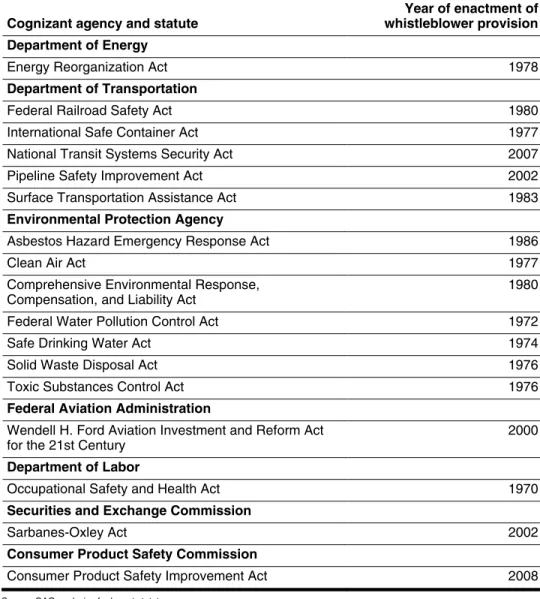
complaint related to the act. Section 11(c) also allows these employees to file a complaint with the Secretary of Labor alleging such discrimination. OSHA was initially responsible for investigating whistleblower allegations under only the Occupational Safety and Health Act. In 1983, OSHA began investigating whistleblower complaints from trucking employees and, since that time, OSHA has been assigned whistleblower provisions under 15 other statutes related to airline, nuclear power, pipeline, environmental, rail, consumer product safety, and securities industries. Currently, under OSHA’s whistleblower program, the agency is responsible for investigating discrimination complaints under 17 statutes, the basic provisions of which are administered by a number of different federal agencies (see table 1). Other Labor agencies, such as the Mine Safety and Health Administration and the Employment Standards Administration, are responsible for enforcing anti-retaliation provisions for several other statutes for which Labor is substantively responsible. (App. II provides details on the whistleblower provisions OSHA enforces, including statutory and
regulatory time frames. App. III provides information on the anti-retaliation provisions that other Labor agencies administer.)
Table 1: Statutes Included in OSHA’s Whistleblower Protection Program
Cognizant agency and statute
Year of enactment of whistleblower provision Department of Energy
Energy Reorganization Act 1978
Department of Transportation
Federal Railroad Safety Act 1980
International Safe Container Act 1977
National Transit Systems Security Act 2007
Pipeline Safety Improvement Act 2002
Surface Transportation Assistance Act 1983
Environmental Protection Agency
Asbestos Hazard Emergency Response Act 1986
Clean Air Act 1977
Comprehensive Environmental Response, Compensation, and Liability Act
1980
Federal Water Pollution Control Act 1972
Safe Drinking Water Act 1974
Solid Waste Disposal Act 1976
Toxic Substances Control Act 1976
Federal Aviation Administration
Wendell H. Ford Aviation Investment and Reform Act for the 21st Century
2000 Department of Labor
Occupational Safety and Health Act 1970
Securities and Exchange Commission
Sarbanes-Oxley Act 2002
Consumer Product Safety Commission
Consumer Product Safety Improvement Act 2008
Source: GAO analysis of relevant statutes
Note: These years represent the date that the whistleblower provisions were added to the relevant statutes, and not necessarily the date of the original enactment of the statutes themselves, or the date that OSHA was given responsibility for enforcement for such provisions. For example, the Energy Reorganization Act was enacted in 1974, but the whistleblower provisions were not added until 1978. The program was originally assigned to the Wage and Hour Division of the Employment Standards Administration, but was reassigned to OSHA in 1997.
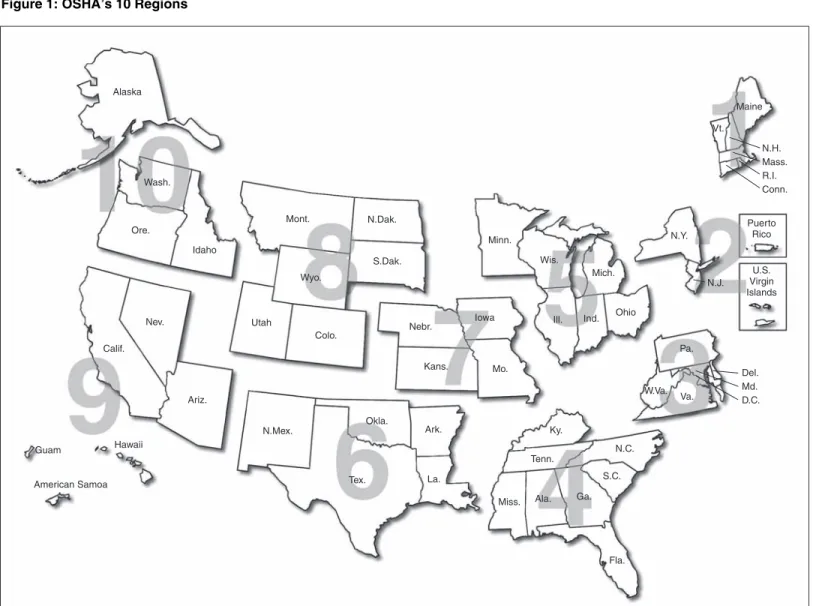
As with OSHA’s enforcement programs, the whistleblower program operates within the decentralized structure of the agency’s regional and area offices, and the 10 regional administrators are responsible for administering the program in their regions (see fig. 1). Each region generally employs a supervisory investigator or program manager and a number of investigators to review claims filed under the whistleblower program. The program’s national director, located in Washington, D.C., is responsible for developing policy and procedures, providing training, and offering technical assistance and guidance.
Figure 1: OSHA’s 10 Regions
Source: OSHA.
Alaska
Hawaii
Pa. Ore.
Nev.
Idaho
Mont.
Wyo.
Utah
Ariz.
N.Mex. Colo.
N.Dak.
S.Dak.
Nebr.
Tex.
Kans.
Okla.
Minn.
Iowa
Mo.
Ark.
La.
Ill.
Miss.
Ind.
Ky. Tenn.
Ala.
Fla. Ga.
S.C. N.C.
Va. Ohio
N.H. Mass. R.I. Conn. Del. Md. D.C. N.J. Mich.
Calif. Wash.
Wis.
N.Y.
Maine Vt.
W.Va.
American Samoa Guam
U.S. Virgin Islands Puerto Rico
A whistleblower’s claim begins when he or she contacts OSHA with an allegation of discrimination for engaging in a protected activity, such as reporting a workplace health violation to OSHA or a Clean Air Act violation to the Environmental Protection Agency. According to Labor, the
whistleblower—or complainant—should address the prima facie elements of a violation: the employer knew about the protected activity, that the
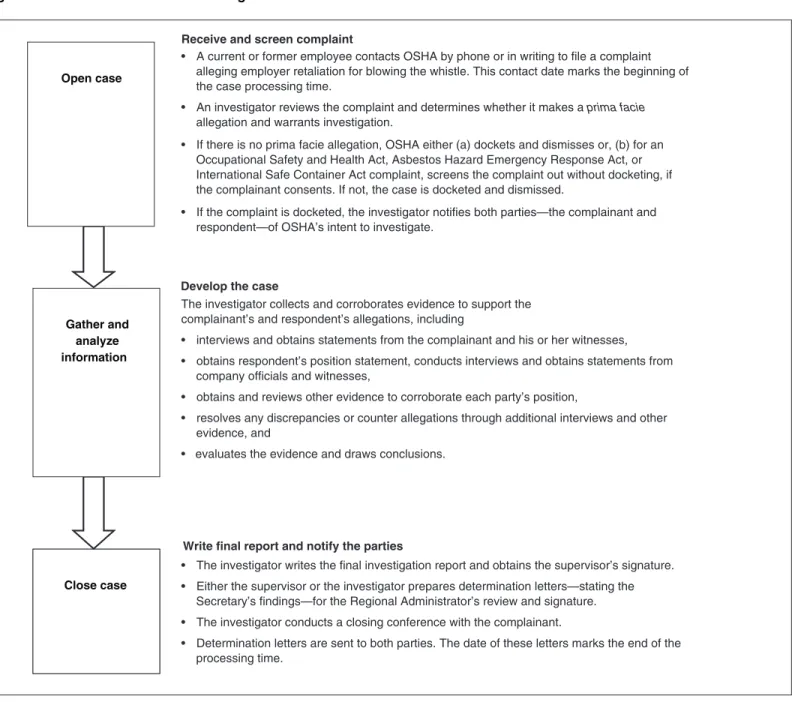
employer—or respondent—subjected the whistleblower to an adverse action (such as being fired), and the protected activity contributed to the adverse action. Investigators screen complaints for these prima facie elements and, if warranted, conduct an investigation (see fig. 2).
Figure 2: OSHA’s Whistleblower Investigation Process
Close case Gather and
analyze information Open case
• A current or former employee contacts OSHA by phone or in writing to file a complaint alleging employer retaliation for blowing the whistle. This contact date marks the beginning of the case processing time.
• An investigator reviews the complaint and determines whether it makesa prima facie
allegation and warrants investigation.
• If there is no prima facie allegation, OSHA either (a) docketsand dismisses or, (b) for an Occupational Safety and Health Act, Asbestos Hazard Emergency Response Act, or International Safe Container Act complaint, screens the complaint out without docketing, if the complainant consents. If not, the case is docketed and dismissed.
• If the complaint is docketed, the investigator notifiesboth parties—the complainant and respondent—of OSHA’s intent to investigate.
The investigator collectsand corroborates evidence to support the complainant’sand respondent’sallegations, including
• interviewsand obtainsstatements from the complainant and his or her witnesses, • obtains respondent’s position statement, conducts interviewsand obtainsstatements from
company officialsand witnesses,
• obtainsand reviews other evidence to corroborate each party’s position,
• resolvesany discrepancies or counter allegations through additional interviewsand other evidence, and
• evaluates the evidence and draws conclusions.
• The investigator writes the final investigation report and obtains the supervisor’ssignature. • Either the supervisor or the investigator prepares determination letters—stating the
Secretary’s findings—for the Regional Administrator’s review and signature. • The investigator conductsa closing conference with the complainant.
• Determination lettersare sent to both parties. The date of these letters marks the end of the processing time.
Source: GAO analysis of whistleblower investigation process.
Receive and screen complaint
Develop the case
Write final report and notify the parties
If the investigation results in a finding of nonmerit, the case is dismissed. If the investigation leads to a Secretary’s finding of merit, OSHA generally issues a preliminary order, which may include reinstatement to the employee’s previous position and back pay. If neither party files an
objection within the required time frames, the preliminary order becomes final. (See app. II for information on each statute’s time frames.) If either party objects to the Secretary’s findings or preliminary order, the objecting party may generally request a review of the case.
For complaints under the Occupational Safety and Health Act, Asbestos Hazard Emergency Response Act, and International Safe Container Act, the whistleblower may request that the Appeals Committee review OSHA’s decision. This committee will review the file and any other documentation supplied by the complainant or the regional administrator, and may (1) return the case for additional investigation, or (2) deny the appeal.
Under the other 14 statutes, either party may generally file an objection to the Secretary’s findings or preliminary order by requesting a hearing with Labor’s Office of Administrative Law Judges (see fig. 3). This review is de novo—it does not take into account the Secretary’s findings from the OSHA investigation.
Figure 3: Hearing Process at OALJ
• The OALJ receivesa request for hearing from one of the parties involved in an OSHA whistleblower investigation.
• The case isassigned to one of the Administrative Law Judges (ALJ), who reviews it for jurisdiction and timeliness.
• The ALJ issuesa notice of hearing that provides detailed instructions to the partiesand sets an initial hearing date.
• The partiesusually request additional time for discovery, so the ALJ establishesa new hearing
schedule that extends the time for discovery.
• Whistleblower hearings can take up to several weeks.
• The hearing transcript is released to the ALJ and both partiesabout 30 daysafter the hearing. • Each party submits written closing argumentsand briefs30-60 daysafter receipt of the
transcript.
• The ALJ generally issuesa decision within several monthsafter receiving the hearing transcript and briefs.
• The decision date marks the case closed date.
• The discovery process involves collecting and exchanging evidence from the opposing party
and third parties. This process varies in length but can be as long as 6 months or even longer for complex cases.
• Simultaneously with the discovery process, the parties may file motions with the presiding ALJ. For example, a party may submit a motion for summary judgment. If so, the opposing party is given adequate time to respond, generally at least 20 days.
• After the motions deadline, which isusually at least 30 days prior to the hearing, the ALJ rules
on any pending prehearing motions.
Source: GAO analysis of OALJ appeals process.
Hearing
Decision and close case Discovery and motions process
Docket (Open) case
Schedule hearing
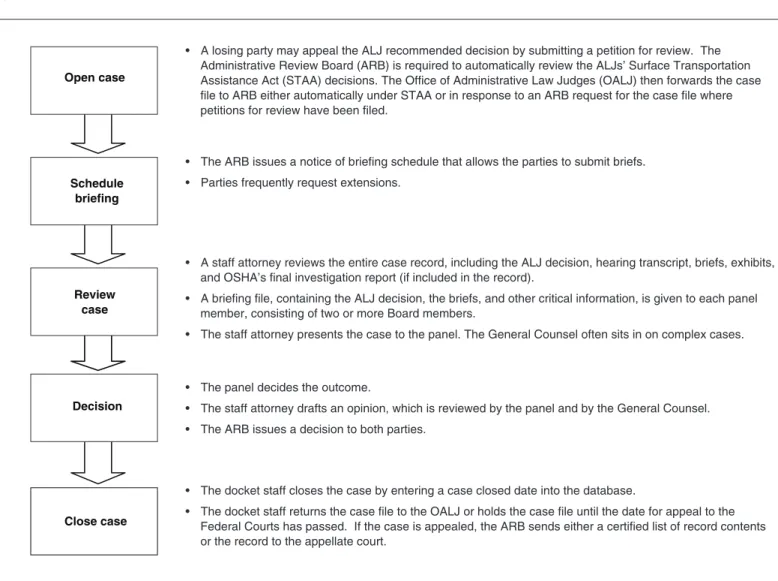
Either party may generally appeal the ALJ’s decision to the Administrative Review Board (ARB). In 1996, the Secretary of Labor delegated authority to ARB to issue final decisions on whistleblower and other types of cases. The Secretary’s final decision may, in specific circumstances, be appealed to the federal courts (see fig. 4).
Figure 4: Review Process at ARB
• A losing party may appeal the ALJ recommended decision by submitting a petition for review. The Administrative Review Board (ARB) is required to automatically review the ALJs’ Surface Transportation Assistance Act (STAA) decisions. The Office of Administrative Law Judges (OALJ) then forwards the case file to ARB either automatically under STAA or in response to an ARB request for the case file where petitions for review have been filed.
• The ARB issuesa notice of briefing schedule that allows the parties to submit briefs. • Parties frequently request extensions.
• The panel decides the outcome.
• The staff attorney draftsan opinion, which is reviewed by the panel and by the General Counsel. • The ARB issuesa decision to both parties.
• The docket staff closes the case by entering a case closed date into the database.
• The docket staff returns the case file to the OALJ or holds the case file until the date for appeal to the Federal Courts has passed. If the case isappealed, the ARB sends either a certified list of record contents or the record to the appellate court.
• A staff attorney reviews the entire case record, including the ALJ decision, hearing transcript, briefs, exhibits, and OSHA’s final investigation report (if included in the record).
• A briefing file, containing the ALJ decision, the briefs, and other critical information, is given to each panel member, consisting of two or more Board members.
• The staff attorney presents the case to the panel. The General Counsel often sits in on complex cases.
Source: GAO analysis of ARB appeals/review process.
Close case Review
case
Decision Open case
Schedule briefing
A whistleblower may potentially obtain relief in many forms. One possible remedy is an order for reinstatement of the whistleblower to his or her former position, or an equivalent position. The whistleblower may also be awarded back pay to make up for the money he or she would have earned in the absence of retaliation. Additionally, at any time in the whistleblower complaint process, the whistleblower and his or her employer may enter into a settlement agreement which ends the process.
Labor lacks reliable information on processing times and, as a result, cannot accurately report how long it takes to investigate and close a case or decide on certain appeals. Processing times reflected in both the OSHA and the ARB databases differ from actual processing times, and neither office has systematically verified the accuracy of its data. Moreover, case files we reviewed showed that some cases exceeded their statutory or regulatory time frames. Only the OALJ data were reliable, enabling us to report that the average processing time at the OALJ for cases closed in fiscal year 2007 was about 9 months. At all three agencies, certain factors, such as heavy caseloads, case complexity, and accommodating requests from the parties’ legal counsel, negatively affect case processing times.
OSHA is unable to accurately track and report information on complaint processing times because the data it collects are unreliable. Specifically, the dates used to measure processing times are often inaccurately recorded in OSHA’s database or cannot be verified due to a lack of supporting documentation in the case files.8
We found a large number of errors in four of the five regions where we reviewed randomly selected case files. For example, in at least one-sixth of the cases we reviewed in three regions, documentation for the dates the cases were opened did not match information in the database or was missing from files. In one region, none of the documentation for the dates that the cases were closed
matched the information in the database because this region does not follow agency policy for determining when the case is closed. In this region, the case closed date reflects an interim step—the date the
supervisor signed the investigator’s report. However, according to OSHA’s guidance, the case closed date should match the date OSHA sends a letter describing the outcome of the investigation to the whistleblower and the employer.
Labor Lacks Reliable
Data on Processing
Times for the
Whistleblower
Program
OSHA Lacks Reliable Data
on Timeliness
Moreover, the processing times that some regions reported were appreciably different than the actual processing times for several of the cases we reviewed—in some cases, actual processing times were longer and in others, shorter than they appeared in the database. Cases that had actual processing times that were longer than they appeared in the database had case open dates that were as much as 50 days later than the actual date they were opened or case closed dates as much as 27 days
8
Throughout this report, when we refer to OSHA’s database we mean the Integrated Management Information System.
earlier than the actual dates the cases were closed. Conversely, cases for which the actual processing times were shorter than they appeared had case closed dates in the database that were as much as 121 days later than the actual dates the cases were closed.
These unreliable data undermine OSHA’s efforts to manage the whistleblower program and ensure the completion of cases within statutory and regulatory time frames. The Office of Management and Budget requires that federal agencies establish and maintain internal controls, in part, to ensure the agency’s compliance with laws and regulations.9
As part of this process, agencies are required to ensure that transactions are processed accurately in their information systems and that the data are valid and complete. Furthermore, according to the Government Auditing Standards, managers are responsible for providing reliable, useful, and timely information for accountability of government programs and their operations.10
OSHA does not have an effective
mechanism to ensure that the data are accurately recorded in the system. There is no requirement that data entered in OSHA’s database be
validated—the decision to do so is left to the regions. And, although OSHA has an internal audit program11
that could help focus efforts on the data quality, some regions have not conducted audits of their
whistleblower program in recent years. Even when they have, we found their timeliness data to be unreliable.
Although we cannot report overall processing times for OSHA’s
investigations, in our review of case files we found cases that exceeded their statutory or regulatory time frames.12
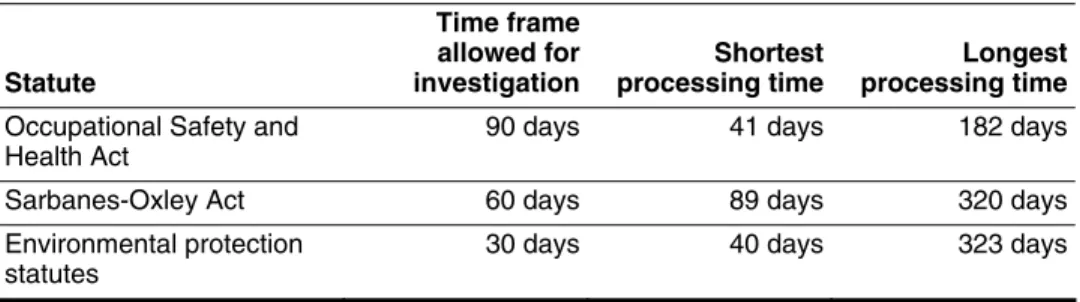
Furthermore, cases under each statute revealed a wide range of processing times, regardless of their statutory or regulatory requirements. Table 2 presents illustrative case
9
Office of Management and Budget OMB Circular A-123, Management’s Responsibility for Internal Control (Washington, D.C.: Dec. 21, 2004.)
10
GAO, Government Auditing Standards, January 2007 Revision, GAO-07-162G, Section 1.02 (Washington, D.C.: Jan. 31, 2007).
11
This audit program requires regions to evaluate some aspect of operations every year and conduct comprehensive audits every 4 years.
12
OSHA officials report that the agency evaluates performance based on a 90-day overall average processing time for all investigations, regardless of the statutory or regulatory time frame. OSHA considers 90 days to be the most reasonable of the various statutory and regulatory time frames, for how long investigations should take, given the exigencies of the investigative process as well as the need to provide employers with reasonable time frames for responding. Moreover, two-thirds of OSHA’s cases fall under a 90-day deadline.
processing times for the files we reviewed under statutes that had 30-, 60-, or 90-day time frames.
Table 2: Processing Times for 20 Selected Cases We Reviewed
Statute
Time frame allowed for investigation
Shortest processing time
Longest processing time Occupational Safety and
Health Act
90 days 41 days 182 days
Sarbanes-Oxley Act 60 days 89 days 320 days
Environmental protection statutes
30 days 40 days 323 days
Source: GAO analysis of case files in three regions.
Note: The 20 cases included in this analysis were investigated under the Occupational Safety and Health Act, six environmental protection statutes (Clean Air Act; Comprehensive Environmental Response, Compensation, and Liability Act; Federal Water Pollution Control Act; Safe Drinking Water Act; Solid Waste Disposal Act; and Toxic Substances Control Act), and the Sarbanes-Oxley Act. We selected these statutes because they represent a range of required time frames (30, 60, or 90 days). During site visits to three of OSHA’s 10 regions, we randomly selected for review at least three cases under each statute or type of statute (i.e., environmental protection) that were closed in fiscal year 2007 and represented short, medium, and long processing times, as reported in OSHA’s database. In total, we reviewed 30 cases: 9 Occupational Safety and Health cases, 12 environmental protection cases, and 9 Sarbanes-Oxley cases. However, we could not determine processing times for some of these cases due to incomplete case file documentation, so table 2 reflects data from 20 cases: 6 Occupational Safety and Health cases, 7 environmental protection cases, and 7 Sarbanes-Oxley cases.
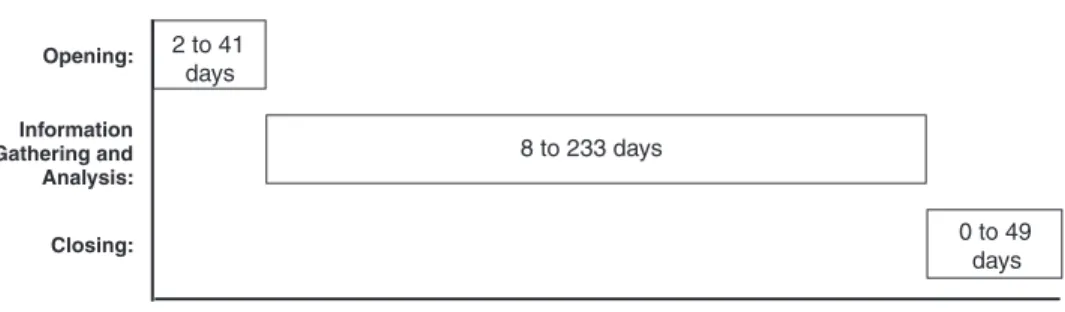
Completion of any one of the three phases of an investigation—opening, information gathering, or closing—sometimes took longer than the overall statutory or regulatory time frame for the entire investigation. Figure 5 illustrates the range of days each phase took among the randomly selected cases we reviewed. In general, investigators who responded to our survey believe that 30 or 60 days are not sufficient to conduct an investigation. For example, for cases under the environmental protection statutes and the Energy Reorganization Act of 1974, the employer is permitted 20 days after receiving notice of the complaint to submit a written statement. At this point, the case has nearly reached the 30-day time frame, but the information gathering and analysis phase has just begun.
Figure 5: Range of Days for Each Phase of Nine Selected Case Studies
Source: GAO review of selected case files. Closing:
Information Gathering and Analysis:
Opening: 2 to 41 days
0 to 49 days 8 to 233 days
Note: The 9 cases included in this analysis are a subset of the 20 cases used in the analysis for table 2. To report the range of phase lengths, we reviewed the short and long cases from each of three statutes in each region—18 cases in total—but we could not determine the lengths of all phases for 9 of these cases. Consequently, figure 5 reflects data from 2 short and 1 long Occupational Safety and Health cases, 2 short Sarbanes-Oxley cases, and 3 short and 1 long environmental protection cases.
OSHA officials also commented that the differences in allowable
processing times between the statutes can undermine efficiency because investigators are often forced to place a higher priority on completing the 30-day cases, instead of treating each case in the order it is received.
Caseload Size, Case
Complexity, and
Involvement of the Parties’
Legal Counsels Hinder
Investigators’ Ability to
Complete Cases within
Required Time Frames
Overall caseload, the amount and complexity of information to gather and analyze, and involvement of the parties’ counsel affect investigators’ ability to complete whistleblower investigations within statutory or regulatory time frames, according to survey respondents. Four-fifths of investigators who completed our survey reported that the size of their caseloads at least moderately hindered their ability to complete investigations within these time frames (see fig 6). In addition, many regional officials we interviewed confirmed that the caseload affects the timeliness of investigations, citing the increased number and complexity of statutes and associated training needs as contributing factors. In general, they reported that investigators can reasonably manage between 5 and 12 open investigations
concurrently, depending on the types of cases. However, the national average was 16 open cases per investigator, as of October 2008, with individual regions ranging from 6 to 35 cases per investigator.
Figure 6: Certain Factors Hinder Investigators’ Ability to Complete Investigations within Required Time Frames
0 10 20 30 40 50 60 70 80 90 100
Involvement of claimant's counsel The number of witnesses Respondent's cooperation or responsiveness Involvement of respondent's counsel Overall caseload The amount of information that must be gathered The complexity of the data that has to be analyzed
Percentage of survey respondents
Source: GAO survey of OSHA whistleblower investigators.
Note: Percentages in figure reflect responses by investigators who reported that these factors either hindered their ability to complete investigations within time frames to a moderate extent or to a great extent.
About three-fourths or more of investigators also reported that the amount and complexity of information that must be collected and the involvement of the employer’s counsel at least moderately hindered their ability to complete investigations within statutory or regulatory time frames. In particular, cases filed under the Sarbanes-Oxley Act, Energy Reorganization Act, the environmental protection statutes,13
and the Wendell H. Ford Aviation Investment and Reform Act for the 21st Century (Aviation
Investment and Reform Act)—all of which have 30-or 60-day statutory time frames—tend to involve especially complex data and require interviewing numerous witnesses. In our interviews, officials and investigators cited Sarbanes-Oxley cases as particularly complex and time-consuming, with different officials equating the work required for one Sarbanes-Oxley case to the work required for two to six cases under the Occupational Safety and Health Act. One official explained that Sarbanes-Oxley cases take the longest to investigate for several reasons: investigators must learn financial
13
The environmental statutes we refer to do not include the Asbestos Hazard Emergency Response Act, which has a 90-day time frame.
terminology; the cases tend to require more detailed, often legal, research with little case precedent; and the employers are often large corporations that engage a larger contingent of attorneys than do employers in other types of whistleblower cases. Attorney involvement and settlement negotiations—which are especially common with Sarbanes-Oxley cases— involve substantial paperwork and processing at various points, such as for requests for extensions to allow attorneys to conduct their own
investigations. While nearly three-quarters of survey respondents said that the involvement of the employers’ legal counsel is a factor that hinders processing times, over half also identified the employee’s counsel as a factor.
Reliability of Timeliness
Data for Appeals Is Mixed
Depending on the particular appeals process, the available data may not be reliable enough to allow an assessment of how long the appeals process takes. Whistleblower appeals may follow two different paths. For three statutes—the Occupational Safety and Health Act, the Asbestos Hazard Emergency Response Act of 1986, and the International Safe Container Act—the whistleblower may request that the OSHA Appeals Committee review the case. For the other statutes, the whistleblower or the employer may generally appeal to the OALJ and, ultimately, to ARB.
Appeals to the OSHA Appeals Committee. In contrast to the investigations processing times data maintained in OSHA’s database, OSHA’s information about appeals filed with the Appeals Committee is reliable. Processing times for the 69 appeals completed in fiscal year 2007—all of which were Occupational Safety and Health cases—ranged from about 2 to 9 months, with an average of 4 months.
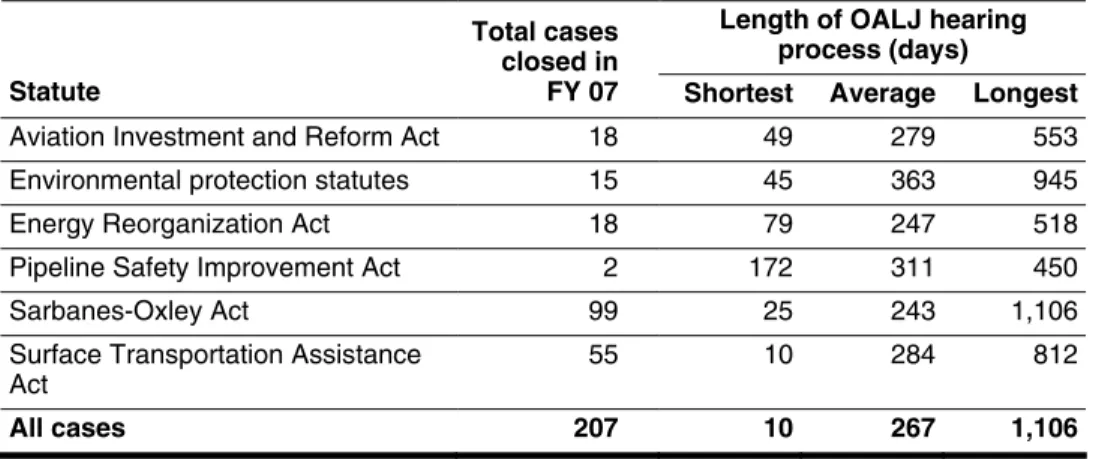
Appeals to the OALJ. Data on the timeliness of OALJ decisions, which were reliable, showed that OALJ completed 207 cases in fiscal year 2007 with an average of about 9 months per case.14
Processing times varied widely across statutes, ranging from as little as 10 days to about 3 years (see table 3).15
14
Cases under statutes other than the Occupational Safety and Health Act, Asbestos Hazard Emergency Response Act, and the International Safe Container Act generally may be heard at the Office of Administrative Law Judges.
15
Only cases under one statute—the Surface Transportation Assistance Act—have a time frame for the OALJ hearing process. The OALJ completed only 4 of the 55 trucking cases closed in fiscal year 2007 within this 60-day time frame.
Table 3: Processing Times of OALJ Cases Closed in Fiscal Year 2007 by Statute Length of OALJ hearing
process (days) Statute
Total cases closed in
FY 07 Shortest Average Longest
Aviation Investment and Reform Act 18 49 279 553
Environmental protection statutes 15 45 363 945
Energy Reorganization Act 18 79 247 518
Pipeline Safety Improvement Act 2 172 311 450
Sarbanes-Oxley Act 99 25 243 1,106
Surface Transportation Assistance Act
55 10 284 812
All cases 207 10 267 1,106
Source: GAO analysis of Labor data.
Note: The OALJ database contains 220 records of cases closed in fiscal year 2007. Thirteen of these 220 cases are considered “companion” cases because one of the parties included more than one person or entity. Consequently, the Administrative Law Judge issued one decision letter, addressed to all participants in the case. We have combined these companion cases in reporting processing times because using all 220 case records would skew the average processing time for one statute’s cases.
The factors that affect the timeliness of OSHA investigations also affect the length of the OALJ appeals process: the amount and complexity of evidence, involvement of the parties’ legal counsel, and the judge’s overall caseload. According to the judges we interviewed, in complex cases, such as those under Sarbanes-Oxley, Energy Reorganization, and Aviation Investment and Reform, the discovery and motions phase can last 6 months or more due to the complexity and volume of documents involved. During the discovery process, at least one party typically requests
extensions, usually to review and respond to the other party’s submitted documents and to take depositions of witnesses—requiring more time when lawyers are involved. This phase also involves disputes over evidence to be entered, and sometimes the judges will have to write lengthy discovery orders or motions to require opposing parties or outside parties to cooperate. According to one judge, such disputes occur more often in whistleblower cases than other types of cases that they hear. Usually toward the end of the discovery process, parties sometimes submit a motion for summary judgment—typically requiring a complex and lengthy motion decision by the judge. If the case is not resolved
through the motions process, the resulting hearing may last a few days or a few weeks, depending on the number of witnesses and the complexity of evidence. For example, Sarbanes-Oxley cases typically require expert witnesses to explain evidence. Judges report that their overall caseload
may increase processing times, especially during the decision phase of the process. While writing the decision for a complex case may require 1 month of work, it spans several months because of other, ongoing cases. The judges we interviewed each had from 61 to 115 open cases at the time of the interview and, although whistleblower cases represent a minority of the OALJ’s overall caseload, judges report that they take longer to
adjudicate than cases under other statutes.
Appeals to the ARB. In contrast to the OALJ, ARB does not maintain reliable timeliness data and thus is unable to accurately track and report information on its processing times. For example, according to ARB officials, the case closed date in the case tracking database should match the date of the letter ARB sends to the parties, describing the outcome of its review. However, for 84 percent of the cases closed in fiscal year 2007, database information for the case closed date did not match the date of the letter. Moreover, the case open date is also unreliable because documentation was either missing or inaccurately recorded in at least 13 percent of the cases. Agency officials noted that the agency lacks written guidance on recording processing time data and also lacks a database manager in charge of data integrity. Although ARB tracks processing times and, according to officials, is working toward shortening them, the agency cannot accurately report progress on this goal.
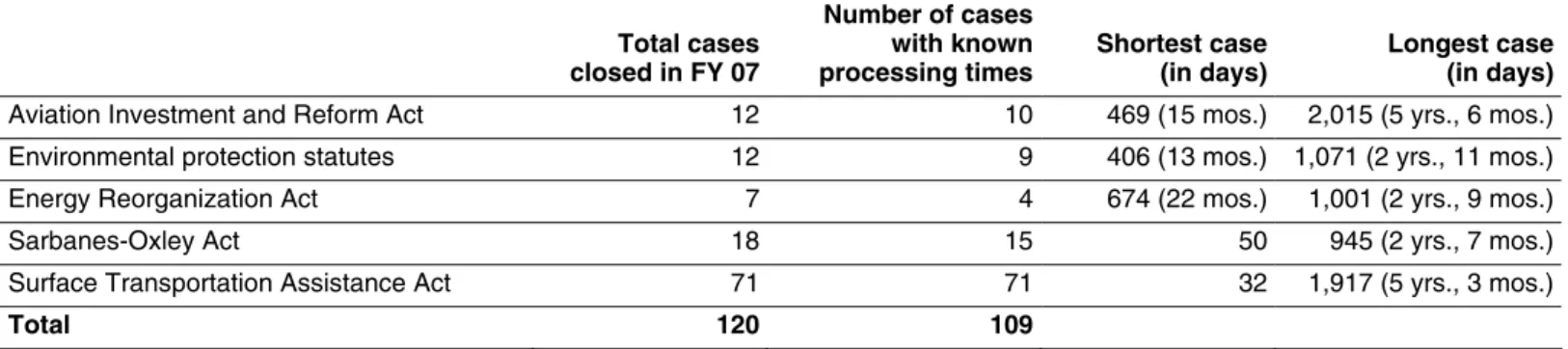
Although we cannot report overall processing times for ARB, our case file review showed that processing times for 109 of the 120 cases closed in fiscal year 2007 ranged from 1 month to over 5 years (see table 4).16
While at least 84 percent of these 109 cases exceeded the statutory or regulatory time frames,17
officials explained that a more realistic processing time would be 6 to 8 months, citing the same factors that affect processing times at OSHA and the OALJ: caseload, case complexity, and involvement of the parties’ legal counsel.
16
The remaining 11 case files lacked documentation about when the case was opened.
17
We were unable to determine if four cases met the statutory time frames because we lacked information about the date of the OALJ hearing. These four cases all fell under the Sarbanes-Oxley Act.
Table 4: Processing Times for 109 of 120 Cases the ARB Closed in Fiscal Year 2007
Total cases closed in FY 07
Number of cases with known processing times
Shortest case (in days)
Longest case (in days)
Aviation Investment and Reform Act 12 10 469 (15 mos.) 2,015 (5 yrs., 6 mos.)
Environmental protection statutes 12 9 406 (13 mos.) 1,071 (2 yrs., 11 mos.)
Energy Reorganization Act 7 4 674 (22 mos.) 1,001 (2 yrs., 9 mos.)
Sarbanes-Oxley Act 18 15 50 945 (2 yrs., 7 mos.)
Surface Transportation Assistance Act 71 71 32 1,917 (5 yrs., 3 mos.)
Total 120 109
Source: GAO analysis of case files.
Whistleblowers received a favorable outcome in a small proportion of the complaints that were closed in fiscal year 2007, both in terms of initial decisions and on appeal, but the actual proportion may be slightly lower than Labor’s data show. Investigations resulted in a favorable outcome for whistleblowers in about 21 percent of complaints, according to OSHA’s data; nearly all of these were settled through a separate settlement agreement involving the whistleblower and the employer.18
However, we found several problems in the way settlements were being recorded in OSHA’s database—several cases recorded as settled were actually dismissed by OSHA or withdrawn by the whistleblower and, therefore, should not have been classified as favoring the whistleblower. When cases were settled, most often the whistleblower received a monetary payment. Moreover, many complaints filed by whistleblowers were not investigated, but were screened out because they were not filed within time frames or they did not meet the criteria for opening a case. Because these
complaints were never recorded in OSHA’s database, OSHA does not have a complete picture of its overall investigator workload or the outcomes of all complaints received. At the appeals level, whistleblowers similarly won a minority of the cases closed in fiscal year 2007—not more than one-third of outcomes favored the whistleblower.
Whistleblowers
Received a Favorable
Outcome in a Minority
of Cases, but OSHA’s
Data Somewhat
Overstate the
Outcomes
18
In this report, we counted settlements that provided a remedy for the whistleblower as a favorable decision or outcome.
Whistleblowers received a favorable outcome in about 21 percent of complaints closed in fiscal year 2007, according to OSHA’s data. Out of more than 1,800 complaints that were closed, most were dismissed by OSHA or withdrawn by the whistleblower. About two-thirds of all complaints closed in 2007 were dismissed, and another 14 percent were withdrawn by whistleblowers. When OSHA dismissed complaints, information from five regions suggests that it was often because the available evidence did not show that the employer had violated the whistleblower provisions. OSHA’s data show that about 21 percent of the complaints resulted in dispositions favorable to the whistleblower—OSHA refers to the case as “having merit”— and nearly all of them were settled through a separate agreement involving the whistleblower and the employer.19
OSHA’s policy is to seek settlement of all complaints
determined to have merit prior to referring them for litigation, and about 95 percent of the complaints with merit were settled. Of the remaining 5 percent, or 19 complaints, 12 were sent to Labor’s Solicitor’s Office for litigation. According to an OSHA official, none of these complaints were actually litigated, all were dismissed. In the remaining 7 complaints, OSHA sent Secretary’s findings and orders to the whistleblower and the
employer describing the corrective action that the employer needed to take.
OSHA’s Data Show That
the Whistleblower
Received a Favorable
Outcome in About
One-in-Five Complaints, but the
Actual Proportion May Be
Slightly Lower
While OSHA’s data show that 371 complaints were settled in fiscal year 2007, the actual number of complaints settled may be 323. We found several problems in the way complaints were being recorded in OSHA’s database. According to OSHA’s procedures, all complaints recorded as settled should have a written settlement agreement on file signed by the whistleblower and the employer. However, in 58 of the complaints, OSHA was unable to provide a signed agreement and, instead, provided the final OSHA summary report, memoranda to the file, or final decision letters sent to the whistleblower. In our review of these documents, we found that several of the complaints that were recorded as settled should have been recorded as dismissed by OSHA or withdrawn by the whistleblower. In addition, we were unable to determine the actual outcome of another 25 complaints from the documentation OSHA provided. While these errors occurred in four different regions, the vast majority came from one region. (See fig. 7 for a summary of actual outcomes.)
19
According to agency officials, about seven of every 10 of these settlements were settled with the direct involvement of OSHA. The remainder were settled by the parties alone, without OSHA involvement.
Figure 7: Outcomes for OSHA’s Whistleblower Investigations Closed in Fiscal Year 2007
Whistleblower files complaint
Complaint screened out without opening
Whistleblower complaint is entered in OSHA’s database and Investigated
Case settles or investigation concludes complaint has merit
Go forward for litigation
Settled
Could not determine Litigated
Dismissed
OSHA sent merit letter
Whistleblower withdraws complaint
Actually dismissed Actually withdrawn Actually settled
371 323 5
18
25 7
OSHA sent merit
letter 7
12 0
12
390
1,221 253
Source: GAO analysis of OSHA database and file documentation.
Investigation concludes complaint has no merit and dismisses
1,864
Merit cases according to evidence As reflected in OSHA’s database
Numbers reflect individual outcomes.
When we adjusted the overall totals from OSHA’s database to account for these errors, we found that the percentage of cases in which the
whistleblower received a favorable outcome declined slightly, from 21 percent to 19 percent (see table 5). Most of this decline occurred in the Occupational Safety and Health Act cases.
Table 5: Adjusted Outcomes of Investigations by Statute, Fiscal Year 2007
Dismissed Withdrawn Merit Total
Statute Number Percentage Number Percentage Number Percentage Number Percentage Asbestos
Hazard Emergency
Response Act 1 100% 0 0% 0 0% 1 100%
Aviation Investment and
Reform Act 31 65 8 17 9 19 48 100
Environmental protection
statutes 44 69 7 11 13 20 64 100
Energy Reorganization
Act 20 77 3 12 3 12 26 100
Occupational Safety and
Health Act 786 65 190 16 229 19 1,205 100
Pipeline Safety Improvement
Act 2 100 0 0 0 0 2 100
Sarbanes-Oxley
Act 171 70 31 13 42 17 244 100
Surface Transportation
Assistance Act 183 67 32 12 59 22 274 100
Total 1,238 66% 271 15% 355 19% 1,864 100%
Source: GAO analysis of OSHA’s Integrated Management Information System and document review.
Note: Percentages may not total 100 due to rounding. Numbers listed have been adjusted to exclude cases litigated that were dismissed and cases for which errors were found during our review of settlement agreements.
Most Settlement
Agreements Contained
Monetary Payments
Most of the signed settlement agreements we reviewed contained provisions requiring the employer to provide a payment to the
whistleblower. About 90 percent of the 288 settlement agreements we reviewed contained some type of payment, including back pay, front pay (often given in lieu of reinstatement), or other type of payment, such as compensatory damages or accrued leave. These payments ranged from an average of $5,288 for Occupational Safety and Health Act complaints to $133,575 for Sarbanes-Oxley complaints (see table 6).
Table 6: Number of Settlement Agreement Payments and Selected Amounts by Statute, Complaints Settled in Fiscal Year 2007
Statute
Number of agreements with monetary payments
Average amount
Minimum amount
Maximum amount Aviation Investment and
Reform Act
6 $10,083 $1,000 $22,500
Environmental protection statutes
5 41,821 2,000 99,920
Energy Reorganization Act
2 70,176 8,000 132,352
Occupational Safety and Health Act
172 5,288 65 94,500
Sarbanes-Oxley Act 35 133,575 5,000 775,000
Surface Transportation Assistance Act
38 6,617 176 81,500
Overall 258 $23,604 $65 $ 775,000
Source: GAO analysis of settlement agreements, 2007.
Many Whistleblower
Complaints Were Not
Investigated or Centrally
Recorded
While OSHA investigated and closed over 1,800 complaints in fiscal year 2007, many other complaints were dismissed—or “screened out”—without conducting a full investigation. OSHA procedures provide that complaints filed under three statutes—the Occupational Safety and Health Act, Asbestos Hazard Emergency Response Act, and International Safe Container Act—will be screened out without being docketed for
investigation if they do not meet certain criteria and if the whistleblower agrees.20
These criteria are: (1) the complaint was not filed within statutory time limits; (2) the case was not within OSHA’s jurisdiction,21
or
20
OSHA procedures provide that complaints filed under the other statutes it administers may not be closed administratively. Rather, complaints that are untimely or do not present a prima facie case will be docketed and a written determination issued (unless the complainant withdraws the complaint).
21
A review of jurisdictional issues might include determining that wages not paid is under the purview of Labor’s Wage and Hour Division, rather than OSHA’s whistleblower provisions.