Contact Person:
Francois du Toit
T: +27 21 526 6950
F: +27 21 526 9500
Prepared by:
Aurecon South Africa (Pty) Ltd
Submission date: : : : 11 January 2013
STORMWATER MANAGEMENT PLAN
TOKAI ESTATE (DRAFT 1)
Submitted to:
City of Cape Town
Catchment, Stormwater and River Management
Prepared for:
Contact Person:
Mr Abdulla Parker
Head : Catchment Planning (North)
T: +27 21 400 1385
May 2013
APPROVAL
Signature Date
Compiled by: F du Toit
Approved by : N van Zyl
AMENDMENT HISTORY
Issue Date Amendment Section/Chapter/Page Checked By:
Name and Initial
TABLE OF CONTENTS
1. INTRODUCTION ... 1
1.1 Background to Report ... 1
1.2 Location of Development ... 1
1.3 Objective of Report ... 1
1.4 Scope of Work ... 2
2. FUTURE DEVELOPMENT SCENARIO... 3
2.1 Future Development ... 3
2.2 Calculation of storm water runoff ... 4
2.3 Proposed storm water control measures ... 4
3. OPERATION AND MAINTENANCE ... 7
3.1 Responsibilities ... 7
3.2 Maintenance requirements ... 7
May 2013
1.
Introduction
1.1
Background to Report
The Faircape Group is in the process of developing erf 13730, situated in Tokai within the Southern Suburbs of Cape Town. The property, formerly referred to as Erf 4116 (Portion 14 of Cape Farm 1133), formed part of a number of properties which were rezoned from “Single Residential” to “General Residential Purposes” in 1975. Erf 13730 is a recent subdivision of Cape Farm 1133 and is owned by Dreyersdal Farms (Pty) Ltd. The
majority of the area to be developed is zoned for “General Residential” purposes.
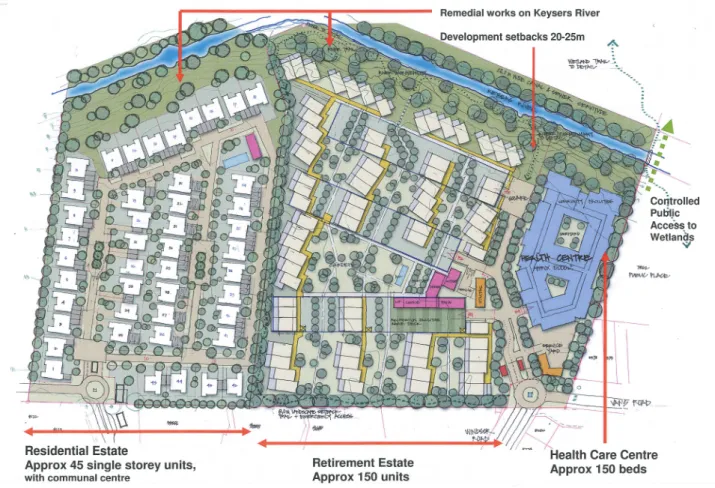
The proposed Tokai Estate development on erf 13730 will consist of two development components. There will be a residential estate consisting of approximately 45 single storey units a retirement estate consisting of approximately 150 units with a health care centre. The two components will be developed as individual developments.
Aurecon was appointed to design roads and services for the proposed residential subdivision, which includes the necessary infrastructure to collect and control stormwater runoff. The development is subject to the CoCT’s stormwater policy (Management of Urban Stormwater Impacts Policy – C58/05/09). The strategy of managing stormwater on the site will be similar for both sites and will be reported on in the stormwater management plan.
1.2
Location of Development
Erf 13730 is situated to the north of the Blue Route Mall and east of the Simon van der Stel Road (M3) in Tokai within the southern suburbs of Cape Town in the Western Cape. It falls under the jurisdiction of the City of Cape Town: South Peninsula Administration.
The property is 8,4 hectares in size and falls within the existing urban edge. It borders existing residential property to the south and the west, open land to the north and the existing Keyser River to the north east. The surrounding context of mixed urban development is farm remnants and wetland areas.
The site locality plan is presented in Figure 1 below.
1.3
Objective of Report
The objective of this statement is to:
• Identify measures to comply with the CoCT’s Management of Urban Stormwater Impacts Policy
(C58/05/09);
• Propose methods (structural controls) for removing, reducing, or retarding runoff flows, and preventing
Figure 1: Site Locality Plan
1.4
Scope of Work
The scope of work entails the following:
• Calculate the expected future stormwater runoff for the catchment area of the development;
• Recommend treatment and control measures for the development that will enable compliance with the
CoCT requirements.
• Recommend remedial works on the Keyser River adjacent to the development.
May 2013
2.
FUTURE DEVELOPMENT SCENARIO
2.1
Future Development
Erf 13730 is currently undeveloped and was previously used for agricultural activities. The surrounding area has mixed urban developments, farm remnants and wetland areas.
The existing erf 13730 is approximately 8.4 hactares in size and it is the intention of the developer to subdivide the property prior to development. The proposed land-uses within the development will consist of a residential estate with approximately 50 single residential units, a retirement estate with approximately 180 to 200 units and a health care (frail care) centre which will make provision for approximately 150 beds. The following breakdown is proposed per land-use:
• Single residential units: 3.3 ha
• Retirement Village: 4.1 ha
• Health Care Centre: 0.9 ha
• Public Roads: 0.8 ha
The density of the proposed development is considered to be compatible with the existing densities of the surrounding area whilst appropriately dense to address the City and Provincial drive to develop at higher densities. It is important to note that the proposed development is at a lower density than what would be possible if the site had to be developed with flats, as allowed in terms of the zoning. The development is accordingly considered to be a very appropriate compromise between exercising existing rights and considering community response to high density development.
The proposed site development plan is presented in Figure 2 below.
2.2
Calculation of storm water runoff
The development of Erf 13730 is categorized as a “Greenfields Development”. Therefore, the development of the site is expected to increase the stormwater runoff due to the fact that new hard surfaces will be created. According to guidelines laid down by CoCT, and to support Water Sensitive Urban Design Principles, all runoff from new hard surfaces created shall be treated to improve the quality of runoff and the quantity and rate of runoff shall be controlled.
Preliminary stormwater run-off calculations indicate that the predevelopment runoff amounts to approximately 135 l/s for the 1:2 year storm recurrence period and 355 l/s for the 1:50 year storm recurrence period. The post development runoff will amount to approximately 650 l/s for the 1:2 year storm recurrence period and 1700 l/s for the 1:50 year storm recurrence period.
The City of Cape Town’s Management of Urban Stormwater Impacts Policy requires that all new developments shall be planned and designed to incorporate sustainable urban drainage systems in accordance with the City’s Stormwater Management Planning and Design Guidelines for New Developments as well as with local and international best practice. It is therefore required from the developer to improve the quality of the post development runoff by removing pollutants before discharging it into the existing drainage system or natural water course. This can be achieved through Best Management Practice (BMP) and includes systems like swales and permeable paving. Pollutants that need to be removed are classified as Suspended Solids (SS) and Total Phosphorous (TP). The pollutant removal target for post-development discharge from a new development can either be to reduce the SS and TP pollutant levels to the undeveloped catchment levels, or achieve an 80% SS reduction and a 45% TP reduction.
2.3
Proposed storm water control measures
2.3.1 CoCT requirements
According to the CoCT’s “Management of Urban Stormwater Impacts Policy” all stormwater management systems shall be planned and designed in accordance with best practice criteria and guidelines laid down by Council, to support Water Sensitive Urban Design principles and the following specific sustainable urban drainage system objectives:
• Improve quality of stormwater runoff;
• Control quantity and rate of stormwater runoff;
• Encourage natural groundwater recharge.
To achieve abovementioned objectives, the CoCT recommends the following criteria for an Existing Development Site (Greenfields Development):
Improve quality of runoff - Design storm event: ½ year RI, 24 hour storm
Pollutant removal target: SS – 80% ; TP – 45% or reduced to undeveloped catchment levels.
Control quantity and rate of runoff - 1 year RI, 24 hour storm – 24 hour extended detention
10 year RI peak flow reduced to pre-development level 50 year RI peak flow reduced to pre-development level
May 2013
2.3.2 Proposed Solution
The City requires that the amount of post-developed runoff which is discharged into the existing system cannot exceed the pre-developed discharge in a major storm event as to prevent flooding of the natural water courses. It is therefore required that excess discharge be managed on site by temporarily storing the runoff on site until it can discharge into the existing system once the peak storm event have passed. This can be achieved by supplying stormwater detention facilities on site. It is calculated at this stage that approximately 2650m³ of stormwater runoff water will have to be made provision for on-site.
The removal of pollutants and the storage of the post development runoff can be managed through integrated systems which can enhance the appearance of the development and can be made part of the landscaping of the development.
After considering the different options presented by the Structural Best Management Practices (BMP)
Screening in the Municipal Stormwater Management book (Table 13-15, Source: Georgia Stormwater
Manual, 2001), it was determined that for the specific site layout and topography as well as the Client’s requirements, permeable paving will be introduced to all roads with a combination of swales for overland stormwater drainage would be best suited to control the quantity and quality of runoff.
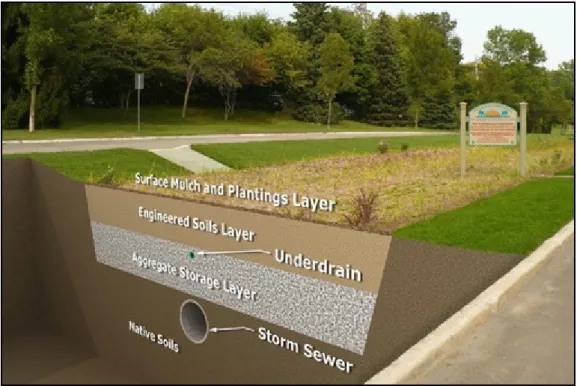
Permeable paving is a range of sustainable materials which consist of permeable clay brick pavers and a base and subbase that allow the movement of stormwater through the surface. In addition to reducing runoff, this effectively traps suspended solids and filters pollutants from the water. It also serves as a detention facility to reduce the post development runoff. Permeable clay brick pavements are fired clay brick units with open, permeable spaces between the units. Clay pavers provide a durable surface that allows stormwater runoff to permeate through the joints. Permeable paving surfaces keep the pollutants in place in the soil or other material underlying the roadway, and allow water seepage to groundwater recharge while preventing the stream erosion problems. They capture the heavy metals that fall on them, preventing them from washing downstream and accumulating inadvertently in the environment. In the void spaces, naturally occurring micro-organisms digest car oils, leaving little but carbon dioxide and water.
Figure 3: Image of a Typical Section through Permeable Paving Layer
Swales capture stormwater in a long gently sloped vegetated drainage channel, which slows the flow rate, allowing the water to infiltrate down thorough the garden bed where it is filtered and cleaned by natural environmental processes. Bio retention swales treat the stormwater through a naturally process called bio filtration. Stormwater flows through the surface vegetation which slows the flow rate and filters out the large sediments. As the stormwater flows along the swale, it slowly filters vertically through the soil or filter media.
As the water flows through the soil, a combination of physical and, chemical and biological processes allow the contaminants to be filtered out. The clean water then flows into the natural water ways and into the Keyser River.
Figure 4: Image of a Typical Section through a Biofiltration Swale
It is proposed that remedial work will be done to the Keyser River adjacent to the proposed development. These remedial measures will aim to reduce the flow rate of the river and promote the natural flow thereof as well as prevent erosion. This will be achieved by introducing gabion weir structures in the river channel which would assist in achieving the reduction of the flow rate. The gabion structures are a natural product which would also be acceptable to the natural surroundings.
May 2013
3.
OPERATION AND MAINTENANCE
3.1
Responsibilities
Once the stormwater facilities have been completed, the maintenance and monitoring thereof will remain the sole responsibility of the developer until the establishment of a Home Owners’ Association, which will take financial responsibility for the operation and maintenance of the stormwater.
Initial planting will be carried out by an experienced horticulturist or landscaper. The maintenance requirements are discussed below.
3.2
Maintenance requirements
3.2.1 Irrigation System
It is estimated that it will take up to two years before the system and it’s vegetation is fully established. In most part it is intended that the swales will be seasonally wet with dry intervals. Sufficient irrigation (as decided by the landscaper) must be provided in the areas that are dry during summer months. This should continue until the vegetation is suitably established to survive a dry season. The irrigation system must be checked on a monthly basis during times of operation for leaks, breaks and blocked nozzles/sprayers.
3.2.2 Litter clearing
A litter clean-up is to take place once every four weeks or as required.
3.2.3 Alien and problem vegetation
The swales must be inspected for invasive alien vegetation once per month by the appointed landscaper. As far as possible all alien vegetation will be manually removed (pulled out). Where manual removal is not possible, alien vegetation will be treated with an appropriate herbicide using the correct application method and to the manufacturer’s directions and specifications. Herbicides shall not be applied when conditions are windy, so as to avoid spray drift. No herbicides shall be applied when rain is forecast within 2 days. Colour dyes must be used with the herbicides to clearly mark areas that have been treated, taking exceptional care when working near water. It must be recognized that under certain conditions some indigenous vegetation may become problematic and may require intervention. Typha reeds have a strong potential to smother the system. The appointed landscaper will ensure that any areas being overrun by Typha to the detriment of vegetation diversity must be cleared and controlled to allow for the intended and planted species to remain established.
3.2.4 Cleaning of siltation traps
The stormwater catcpits must be inspected every six months, with one of the inspections taking place just before the first seasonal rains. These will be inspected for a build-up of silt, dirt, mud and similar material. All silt and other material will be removed and disposed of at a suitable landfill site. Care must be taken to ensure that no silt enters the stormwater system during the cleaning process.
3.2.5 Fertilizer
It is the intention to create a system that will remove unwanted nutrients and inputs in the stormwater system, therefore the use of fertilizer will be in conflict with the swale’s goals. No fertilizer will be used.
Should a situation arise where there are persistent or recurring problems such as poor water quality, problems with vegetation and similar issues an aquatic specialist will be consulted for input and advice on the matter. If required or requested by the specialist water sampling will be undertaken.
4.
Conclusion
The proposed development of of Erf 13730 is subject to the stormwater management requirements of the City of Cape Town. On-site treatment and attenuation facilities have been proposed to comply with the Management of Urban Stormwater Impacts Policy (C58/05/09).