Florida Institute of Technology’s green and white canoe, Tropical Storm, was inspired by the tropical location of its Melbourne campus. In addition, Florida Institute of Technology’s
Concrete Canoe Team plans to STORM the National Concrete Canoe Competition for the fourth consecutive year. Tropical Storm has the following characteristics:
• Weight: 45.4 kg (100 lbs)
• Length: 6.25 m (20.5 ft)
• Maximum beam width: 0.68 m (2.2 ft)
• Maximum depth: 0.31 m (1.0 ft)
• Wall thickness: 9.5 mm (0.38 in.)
This year’s canoe combines a V-shaped rocker and a long slender body to achieve speed, tracking and maneuverability. Its cross-section is composed of moderately strong, lightweight concrete with two layers of bi-directional carbon fiber reinforcement placed in the tensile zones to create a stiff and resilient canoe.
Florida Institute of Technology (FIT) was founded in 1958 as a private technological university to provide continuing education to professionals working in the space program at what is now Kennedy Space Center. Located in Melbourne, Florida, FIT offers 120 degree programs with 4200 graduate and undergraduate students. FIT’s Civil Engineering program has approximately 65 students with 50 active ASCE student members. Team Tropical Storm has dedicated much hard work towards the design and construction of the 2000 canoe.
FIT is a member of the Southeast Region, encompassing five states and over twenty universities. The Southeast Region has a strong history of performing well at the national competition. FIT began their canoe program in 1992, finishing sixth at the regional competition. FIT made their first visit to the national canoe competition in 1997, finishing first and returned the following year to finish fourth. FIT showed its enthusiasm for the competition by not only hosting, but also competing in the 1999 National Canoe Competition. Team Tropical Storm hopes to continue this level of excellence into the first canoe competition of the new millennium.
3.1 Objective
A winning hull must be fast in the straight-aways and maneuverable enough to negotiate both the slalom and the 180-degree turns with both two and four paddlers. To meet this challenge,
Tropical Storm optimized the following:
• Straight-line speed
• Maneuverability
• Tracking
• Initial and secondary stability
3.2 Background Literature
Naval architecture literature[1] was used to conduct research on racing canoe hull characteristics. This revealed that straight-line speed is improved by creating a long and slender hull. This characteristic makes the canoe more streamlined, providing additional length at the water line
2.0 INTRODUCTION 1.0 EXECUTIVE SUMMARY
and greater hull speed. Tracking is achieved by adding a V-shaped bottom along the keel. Curvature in the longitudinal direction of the canoe, or rocker, increases maneuverability, but sacrifices tracking and stability. A sharp bow entry, or cutwater, improves tracking by providing a smooth cutting edge through the water. The transition from bow to beam to stern must be as smooth as possible in order to maintain laminar flow, thereby maximizing hull speed. Initial stability is the stability when the canoe is at rest with paddlers on board. Lowering the
metacenter, or focal point of the canoe, can increase initial stability. Secondary stability is the stability of the canoe in motion. Flat bottom canoes have better secondary stability in
comparison to canoes with rocker.
3.3 Design
Research was conducted using FIT’s concrete canoes over the past four years:
• Prestressed-Out (1996 Southeast Region, 2nd place)
• Chip off the Old Block (1997 NCCC, 1st place)
• Making Waves (the 1998 NCCC, 4th place)
• Ramming Speed (the 1999 NCCC, 6th place)
The criteria used to evaluate the hulls were speed, tracking, stability and maneuverability. In order to evaluate the performance of each canoe, competition videotapes were studied and the prototype hulls were raced. The past FIT canoes were extremely fast in a straight-line, but lacked turning ability, therefore, a special emphasis on maneuverability was made.
Prestressed-Out had an asymmetrical shape with very little rocker and a very large stern, which contributed to poor tracking. Chip off the Old Block had a flat-bottom with no rocker in the central portion of the canoe, which prevented maneuverability. Making Waves had a V-shaped rocker that ran the entire length of the canoe, which allowed for greater turning ability.
Ramming Speed also had a V-shaped rocker, but a larger beam width at its center hampering its turning performance. The conclusion from this evaluation was that Making Waves had the best combination of speed, tracking, stability and maneuverability.
A hull for the 2000 competition must maximize speed, tracking, and most importantly maneuverability. Three alternatives were considered: (1) the original 1998 Making Waves design, (2) an Olympic hull design, and (3) a combination of the two. An Olympic hull design has a round bottom and a large rocker that runs the entire length of the canoe. Preliminary analysis revealed that the large rocker gives the Olympic hull greater maneuverability, but lacks initial stability. Although Olympic hulls are the fastest in the water, they lack initial stability. Consultations with a former Olympic paddling coach[2] revealed that Olympic paddlers spend close to 35 hours per week training, while the FIT paddlers spend only 10 hours per week training. Therefore, an Olympic design would not be practical because the time required for mastering an Olympic hull is beyond the training scope of Team Tropical Storm.
Taking the positive attributes of Making Waves and an Olympic hull, a prototype was constructed out of styrofoam and drafted on AutoCAD 2000. The curves were modified to ensure that the canoe had smooth transitions for a streamlined design (Figure 1). The result was Tropical Storm, a 6.25 m (20.5 ft) long, 0.67 m (2.2 ft) wide world class racing canoe.
Figure 1. Three Dimensional Wire Frame Model of Tropical Storm 3.4 Analysis
Tropical Storm was analyzed using General Hydrostatics, GHS,[3] and was compared to Making Waves and a hypothetical Olympic hull design. Based on consultation with a Naval Architecture professor[4] from the FIT Department of Ocean Engineering, the coordinates of Tropical Storm and Making Waves were entered into GHSand the hydrostatic properties were calculated. The hydrostatic properties for the Olympic hull were obtained from a canoeing journal.[5] The results were manually analyzed to determine which hull shape performed the best.
Table 1 shows three hydrostatic properties: draft, waterplane area and block coefficient. The waterplane area is the cross-sectional area of the canoe under water. Draft is the vertical depth of the canoe below the waterline, measured from the lowest part of the hull. The draft and the waterplane area are used to determine the submerged surface area and are directly related to the resistance on the boat, commonly known as drag. Decreasing the submerged surface area of the canoe reduces drag. The block coefficient is the ratio of the underwater volume of a hull to the volume of a rectangular block of the same length, width and depth. A small block coefficient produces a hull that is streamlined and is therefore more efficient.
Table 1. Hydrostatic Properties
Hydrostatic Properties
(2 person) (4 person) (2 person) (4 person) (2 person) (4 person)
Draft, m (ft) 0.10 (0.34) 0.15 (0.49) 0.11 (0.37) 0.16 (0.54) 0.11 (0.35) 0.14 (0.47)
Waterplane Area, m2 (ft2) 2.88 (31.0) 2.93 (31.5) 2.95 (31.8) 3.02 (32.5) 2.83 (30.4) 3.29 (35.4)
Block Coefficient 0.43 0.46 0.44 0.49 0.39 0.42
Tropical Storm Making Waves Olympic Hull
The results presented in Table 1 were estimated using the canoe weight with both two and four paddlers. Table 1 shows that the draft was very similar for all three canoes analyzed. Tropical Storm moved more efficiently through the water, when compared to Making Waves, because it had a lower block coefficient. Less drag was produced by Tropical Storm because it projected a smaller submerged surface area. Therefore, Tropical Storm was selected as the better design. Although the Olympic hull was already eliminated as an option, the hydrostatic properties were compared to Tropical Storm. The Olympic hull was slightly more efficient because it had a lower block coefficient, but produced the same, if not larger, submerged surface area. Therefore, Tropical Storm was considered competitive with an Olympic hull.
In addition to the hydrostatic properties, the stability curves for each hull were analyzed.
Stability was an important parameter since the FIT concrete canoes were designed to be leaned at an angle around a turn, thereby decreasing the submerged surface area to produce a faster turn.
6.25 m (20.5 ft) 0.67 m (2.2 ft)
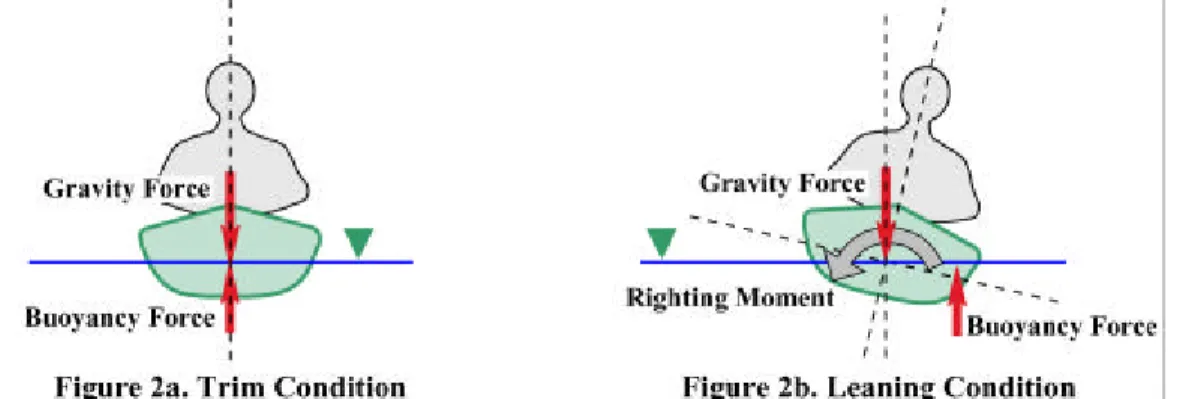
The stability was determined for different angles of heel. The angle of heel is the angle at which the canoe is rotated about its center axis. Figures 2a and 2b show the forces on a canoe under trim and leaning conditions.
Under the trim condition, the buoyancy force and the gravity force act along the vertical
centerline of the hull. When the boat is leaned, the buoyancy force and the gravity force are no longer concurrent, resulting in a righting moment. The righting moment is the moment
generated by the offset of the center of buoyancy force to re-right the boat. The righting moments of both Tropical Storm and Making Waves were calculated using the GHS software, while the righting moments for the Olympic hull were obtained from a canoeing journal.[5] Since all three canoes swamp when leaned past an angle of thirty degrees, the righting moments were only calculated up to thirty degrees. Figure 3 shows that Tropical Storm and Making Waves had almost identical stability curves and were significantly more stable than the Olympic hull. In addition, steeper curves indicated better initial stability; therefore, Tropical Storm and Making Waves had better initial stability than the Olympic hull design.
0 100 200 300 400 500
0 10 20 30
Angle of Heel (degrees)
Righting Moment (m-N)
Righting
Moment (in-lbs)
3540
2655
1770
885 4425
Figure 3. Comparison of Stability Curves Making Waves
(4 person)
Olympic Hull
(4 person)
Olympic Hull
(2 person) Tropical Storm
(2 person)
Tropical Storm (4 person)
Making Waves
(2 person)
Since a competitive racing canoe must be a compromise between speed and stability, Tropical Storm was determined to be the best alternative.
4.1 Objective
A competitive mix for the 2000 competition must be lightweight, flexible, and workable with a high finish quality. The ultimate goal of the mix design team was to create the lightest mix used by an FIT Concrete Canoe Team. To attain this goal, 45.4 kg (100 lbs) was set as the canoe design weight. Observing that the past FIT concrete mixes were very strong, a maximum dry unit weight of 800 kg/m3 (50 pcf), a 14-day compressive strength of at least 3.4 MPa (500 psi), and a composite section flexural strength of 6.2 MPa (900 psi) were set as the design goals.
4.2 Background
Team Tropical Storm investigated many lightweight aggregates for the concrete mix. Past FIT canoes incorporated Microlite, perlite, and Cenospheres® with specific gravities of 0.40, 0.70, and 0.67, respectively. These three lightweight aggregates are a result of high temperature processes. Perlite and Microlite are expanded clay shales, while Cenospheres are hollow fly ash spheres. Past history indicated perlite caused problems during concrete mixing and
finishing. During mixing, SSD water was driven out of the perlite, producing a very wet mix. Extra finishing was required because individual grains popped out of the finished concrete and produced a pitted surface. Also, wet sanding caused the perlite to absorb over 20% of its weight in water, increasing the canoe weight. Therefore, perlite was eliminated and only Microlite® and Cenospheres® were tested for use in Tropical Storm’s concrete mix.
Team Tropical Storm also investigated two admixtures: silica fume and superplasticizer. Silica fume is a reactive pozzolan, which produces durable, high strength concrete. It is most
commonly used in high-rise buildings. Superplasticizer is a high-range water reducing agent. Past experience revealed that superplasticizer increased the curing rate, thereby decreasing the workability time to approximately 90 minutes. Since Team Tropical Storm needed several hours for concrete placement, superplasticizer was eliminated and only silica fume was tested for use in Tropical Storm’s concrete mix.
4.3 Design and Analysis
Several mixes were prepared using various proportions of Type I Portland Cement, silica fume, Microlite®, Cenospheres® and water, and were designed with the aid of Design and Control of Concrete Mixtures by the Portland Cement Association. [6] For each mix, one design parameter was varied, such as water to cement ratio or cement to aggregate ratio, while all other parameters were held constant. Visual inspection of all test plates and cylinders showed evidence of severe shrinkage cracks. After consulting with members of the concrete industry,[7] it was determined that the silica fume was probably responsible for producing these cracks. To examine this, cylinders and test plates were constructed using similar mixes without silica fume.
Re-examination proved that the new cylinders and test plates had a significant decrease in shrinkage cracks; therefore, silica fume was eliminated from the mix design.
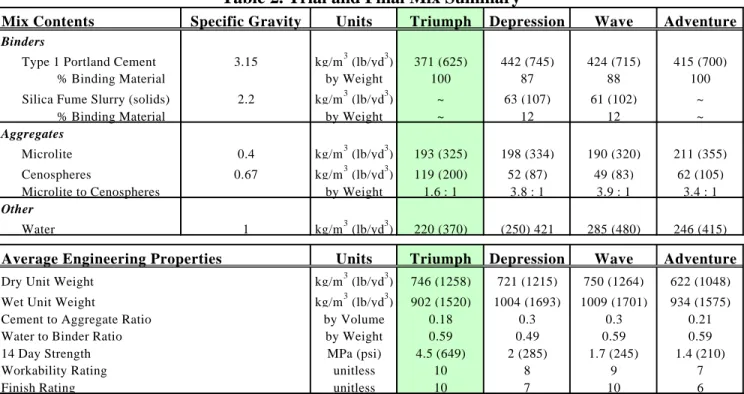
The mix proportions and average engineering properties of the four most desirable mixes are displayed (Table 2). All lightweight aggregates were tested for absorption so that SSD
conditions could be achieved prior to adding hydration water in each mix. The water to cement
ratio shown in Table 2 included water for both hydration and SSD. Each mix had good workability, however the degree of satisfaction of the finish improved with the decrease of the Microlite® to Cenospheres® ratio. This was because the Cenospheres® smaller grain size filled the voids more completely than the larger Microlite® grains. Upon evaluating the four mixes in Table 2, it can be seen that “Triumph” displayed the most desirable combination of
characteristics, such as unit weight, compressive strength, flexural strength, workability and finish. “Triumph” has a dry unit weight of 746 kg/m3 (1258 lb/yd3) and a 14-day compressive strength of 4.5 MPa (649 psi).
To determine the acceptability of a mix, the compressive strength test was used in accordance with ASTM C39-93a, “Standard Test Method for Compressive Strength of Cylindrical Concrete Specimens”.[8] Eight 7.62 cm x 15.24 cm (3 in. x 6 in.) cylinders were prepared for each trial batch and tested accordingly. The 14-day compressive strength of the final four mixes is displayed in Table 2.
Table 2. Trial and Final Mix Summary
Mix Contents Specific Gravity Units Triumph Depression Wave Adventure
Binders
Type 1 Portland Cement 3.15 kg/m3 (lb/yd3) 371 (625) 442 (745) 424 (715) 415 (700)
% Binding Material by Weight 100 87 88 100
Silica Fume Slurry (solids) 2.2 kg/m3 (lb/yd3) ~ 63 (107) 61 (102) ~
% Binding Material by Weight ~ 12 12 ~
Aggregates
Microlite 0.4 kg/m3 (lb/yd3) 193 (325) 198 (334) 190 (320) 211 (355) Cenospheres 0.67 kg/m3 (lb/yd3) 119 (200) 52 (87) 49 (83) 62 (105) Microlite to Cenospheres by Weight 1.6 : 1 3.8 : 1 3.9 : 1 3.4 : 1 Other
Water 1 kg/m3 (lb/yd3) 220 (370) (250) 421 285 (480) 246 (415) Average Engineering Properties Units Triumph Depression Wave Adventure Dry Unit Weight kg/m3 (lb/yd3) 746 (1258) 721 (1215) 750 (1264) 622 (1048) Wet Unit Weight kg/m3 (lb/yd3) 902 (1520) 1004 (1693) 1009 (1701) 934 (1575)
Cement to Aggregate Ratio by Volume 0.18 0.3 0.3 0.21
Water to Binder Ratio by Weight 0.59 0.49 0.59 0.59
14 Day Strength MPa (psi) 4.5 (649) 2 (285) 1.7 (245) 1.4 (210)
Workability Rating unitless 10 8 9 7
Finish Rating unitless 10 7 10 6
** See Appendix A for the technical specification sheets for each of the materials in the concrete mix design, as well as the summary for the mixture proportions of “Triumph”.
5.1 Objective
A winning reinforcement design must include state-of-the-art testing procedures in order to produce a canoe capable of withstanding the stresses induced during racing and transporting. Last year’s canoe, Ramming Speed, had an unfinished flexural strength of 12.4 MPa (1800 psi) with a weight that exceeded this year’s goal by 22.7 kg (50 lbs). Ramming Speed was examined one year after construction and observation revealed that it exhibited no signs of structural damage. Therefore, Team Tropical Storm determined that a more efficient, simpler and cost-effective reinforcement scheme could be used. Team Tropical Storm set the minimum
Figure 4. Weave Pattern
unfinished design flexural strength of 6.2 MPa (900 psi) to achieve the desired weight, while preventing spawling, fracture, or delamination due to the flexural stresses induced on the hull.
5.2 Background
Two different reinforcing materials were considered for Tropical Storm: carbon fiber mesh and galvanized steel wire mesh. Carbon fiber had a lower weight and achieved a high tensile strength at low strain. High strength carbon fiber had a reported tensile strength of 3800 MPa (551 ksi).[9] Galvanized steel wire mesh (ASTM A615 grade 60 steel) had a tensile strength of only 620 MPa (90 ksi). Therefore, carbon fiber was selected as the preferred reinforcement.
5.3 Design and Analysis
The carbon fiber used to create the composite sections for testing was a woven, bi-directional mesh (Figure 4). This bi-directional mesh consisted of an alternating under-over weave pattern every two longitudinal strands of carbon fiber. The resulting grid openings were 0.5 cm x 1 cm (0.2 in. x 0.4 in.). Since the canoe would experience tensile stresses in more than one direction, the bi-directional mesh would distribute those stresses in the lateral and transverse directions.
To determine if the bond between the reinforcement and concrete was acceptable, pullout tests were conducted according to a modified ASTM C900-87 “Standard Test Method for Pullout Strength of Hardened Concrete.”[8] If carbon fibers fractured rather than pulled out of the concrete, a sufficient bond strength between the concrete and the reinforcement had been achieved. All mixes tested had adequate bond strength with the carbon fiber.
The final reinforcement scheme evaluated, included two layers of woven bi-directional carbon fiber placed in the tensile zones with a solid concrete core. The induced section stresses due to the three-point loading condition are shown in Figure 5. As can be seen from this figure, the maximum tensile zones occurred at the outer edges. The reinforcement is placed in the tensile zones to provide adequate composite strength.
Several plates of 30.5 cm x 10.2 cm x 0.64 cm (12 in. x 4 in. x 0.25 in.) were made for testing and visually inspected for signs of delamination. Since no delamination was observed, the weave opening and concrete bond strength were deemed acceptable. The plates were then tested by conducting three-point flexural tests according to ASTM C 78-94, “Standard Test Method for Flexural Strength of Concrete (Using Simple Beam with Third-Point Loading)”[8] . The test results, displayed in Figure 6, showed the outcome of the three point loading test for the top four mixes. Since the 2000 Concrete Canoe rules required an unpainted band to circumscribe the
Figure 5. Reinforcement Scheme with Stresses
Solid Concrete Core Bi-Directional
Carbon Fiber
canoe, several test plates were sanded, primed and painted on one side. This would allow Team Tropical Storm to further understand the structural differences between the painted hull and the unpainted band. Once more, the composite section using the “Triumph” mix dominated by attaining a 14-day unfinished average flexural strength of 6.9 MPa (1000 psi). On the other hand, the finished plate exhibited an average flexural strength of 9.9 MPa (1434 psi), which was a 40% increase compared to the unfinished section. Therefore, the finished sections of the canoe were significantly stronger. Strain gauges were attached to the finished plates to evaluate the stress-strain properties. An average modulus of elasticity for the composite plate was estimated at 27.6 GPa (4 x 10⁶ psi).
0 2 4 6 8 10 12
0 0.1 0.2 0.3 0.4 0.5 0.6 0.7 0.8 0.9 1
D e f l e c t i o n ( c m )
0 . 0 8
D e f l e c t i o n ( i n )
0 . 1 5 0 . 2 4 0 . 3 2 0 . 3 9 0 . 4 7 0 . 5 5 0 . 6 3 0 . 7 1 0 . 7 9
290 1 4 5 0
1 1 6 0
870
580 1 7 4 0
" T r i u m p h " w i t h 1 c o a t p r i m e r & 2 c o a t s p a i n t
" A d v e n t u r e " U n f i n i s h e d
" D e p r e s s i o n " U n f i n i s h e d " W a v e "
U n f i n i s h e d
" T r i u m p h " U n f i n i s h e d
0
Figure 6. Flexural Test Results on Finished and Unfinished Test Plates (14 Day)
6.1 Mold Construction
This year, the canoe team decided to radically change the procedure for constructing their mold. Rather than build a wooden mold, a male mold was constructed from thin plywood ribs with a Styrofoam® core. The male mold allowed for ease of concrete and reinforcement placement, while the Styrofoam® enabled quicker, more accurate construction. In past years, tensile cracks developed when lifting the canoe off the wooden mold. By using a Styrofoam® core, the mold could be removed without damaging the canoe, resulting in a hull with little or no cracks. The rib sections from the selected hull were drawn on AutoCAD 2000 and imported to the computer that controls a CNC Milling Machine, which cut the ribs to an accuracy of 0.0254 mm
every 0.15 m (0.5 ft) near the more critical ends of the canoe and every 0.31 m (1.0 ft) at the center of the canoe. Once the plywood was attached to the mold, Styrofoam® was placed between the ribs and the foam edges were cut using a hot wire. Drywall compound was placed over the Styrofoam® to ensure smooth transitions over the body of the canoe. A low heat, low cure epoxy was placed over the drywall to seal and strengthen the outer surface of the mold. Two foam plugs were temporarily attached to the last two feet of the mold. These pieces remained permanently inside the canoe to provide the required buoyancy. The completed mold was wrapped with shrink-wrap and coated with a mold-release agent to assure canoe removal.
6.2 Reinforcement Preparation
The bi-directional carbon fiber reinforcement was created by manually weaving strands of carbon fiber in the longitudinal direction. Prior to concrete placement, the woven carbon fiber mesh was placed on the mold, to allow the construction team to practice its placement and to ensure the reinforcement fit properly over the mold. Large composite plate sections of approximately 0.91 m x 0.91 m (3 ft x 3 ft) were also constructed to practice placing the reinforcement with the correct thickness during the actual canoe construction.
6.3 Canoe Construction
The concrete for the canoe was batched with a mortar mixer to ensure uniformity. All concrete was placed by hand. A 2 mm (0.08 in.) layer of concrete was first placed onto the mold, followed by the first layer of carbon fiber. The carbon fiber was worked into the concrete to ensure complete bonding and uniform thickness. A 4 mm (0.15 in.) layer of concrete was added on top of the first layer of carbon fiber. To guarantee that the thickness between the carbon fiber layers was uniform, students pushed depth gauges through the wet concrete to check the
thickness. Following that, a second layer of carbon fiber was worked into the wet concrete. Finally, a second 2 mm (0.08 in.) layer of concrete was placed. Trowels were used to create a smooth surface finish approximately 30 minutes after the concrete began to cure.
Tropical Storm was cured in an environment close to 50% relative humidity for two weeks. The canoe was covered with plastic sheets for the first seven days to slow the hydration process. Sanding began on the hull exterior after seven days of curing. The canoe mold was removed after 14 days and interior sanding began.
The planning process of Tropical Storm began in August 1999. By assessing the 1999 concrete canoe, decisions regarding this year’s schedule, management techniques and personnel were made. An autonomous body for the canoe was created in the FIT student chapter of ASCE in order to manage the canoe. The FIT concrete canoe team is a volunteer activity, and since the Civil Engineering department is relatively small, the project was divided into major components. By dividing the project, a more aggressive schedule could be undertaken and more students could be involved in all aspects of the project. In addition, the canoe team recruited many new students to join the team, in order to ensure a proper learning cycle.
The paddling team was recruited early, to build a sense of unity among the paddlers. A paddling schedule was devised to allow for training during the academic year. The team was created to allow for alternates in case of injury during the races. All personnel involved with the canoe were encouraged to paddle, resulting in practice session of 10 paddlers or more.
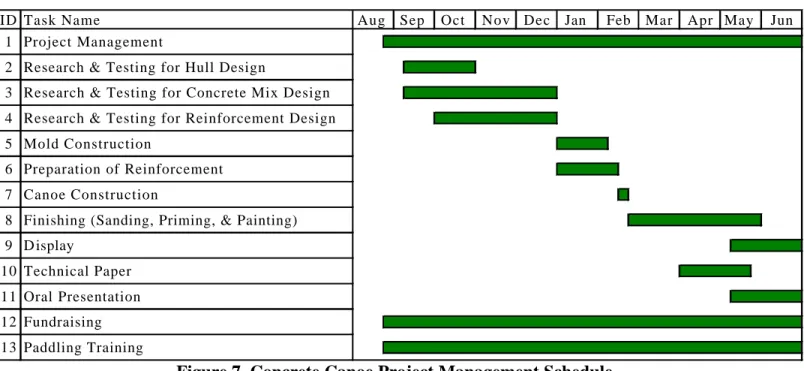
Figure 7 shows the actual schedule of the canoe project. The management schedule was created using Microsoft Project, a project management program. The key design tasks were 2, 3 and 4 while the key construction tasks were 5, 6 and 7. These key tasks directly affect the team’s ability to complete the display, technical paper, oral presentation and paddling. Since this is a volunteer activity, the majority of the work on the project was scheduled for Saturdays and school vacations.
Figure 7. Concrete Canoe Project Management Schedule
The costs accrued for the 2000 canoe were determined according to the rates specified in
Sections III.E and III.F of 2000 Rules and Regulations. Market values were used for all material used, but not listed in those sections. The cost associated with labor included a total billable direct labor rate that incorporated raw labor rates, direct and indirect employee costs with simplified multipliers, as well as a profit multiplier. All of the labor hours, materials and resources were carefully monitored and recorded by the project managers so that amendments could be made to the predicted project schedule. A detailed cost assessment can be viewed in Appendix B.
The research and development of Tropical Storm demanded a total of 388 person-hours, costing $37,978. Project managers, principal engineers and professional engineers performed the
majority of the tasks involved in the design and development stage, which contributed to the high cost. However, by keeping the concrete mix and reinforcement scheme simple, a more cost-effective final product was produced with 305 person-hours for $15,157. Technicians and
drafters performed the majority of the tasks in the final product, which explains why the cost was lower than that of the research and development. The combination of the labor and expenses resulted in a total cost of $60,647, which included the 10% markup. However, with the fundraising efforts for material and monetary donations and volunteer services of the students,
ID Task Name Apr May Jun
Project Management
Dec Jan Feb Mar Aug Sep Oct Nov
1 2 3 4 5
Research & Testing for Hull Design
Research & Testing for Concrete Mix Design Research & Testing for Reinforcement Design Mold Construction
Preparation of Reinforcement 6
Canoe Construction 7
Finishing (Sanding, Priming, & Painting) 8
D isplay 9
Technical Paper 10
11 Oral Presentation 12 Fundraising
Paddling Training 13
Tropical Storm allowed FIT students to have a creative outlet for classroom knowledge. The success of this year’s concrete canoe team can be attributed to FIT student participation. Since FIT is a small school, finding 15 to 20 dedicated students necessary to compete at such a high level requires innovative measures. By highly publicizing canoe events, more FIT students were reached and a sense of unity was built amongst the team members. The innovative features of Tropical Storm are:
• Hull design
• Mold construction procedure
• Concrete mixing and testing program
Tropical Storm is the fastest turning hull ever produced by FIT. It can be considered competitive with an Olympic hull, while retaining the stability of the past FIT canoes. Mold innovation was achieved through Team Tropical Storm’s new mold fabrication process. The Styrofoam® core allowed removal of the canoe from the mold without any damage. Also, a CNC Milling Machine was used to cut precision ribs. In addition to mold and hull innovation, the concrete mixing and testing programs made significant advancements. First, Team Tropical Storm produced the lightest concrete mix ever incorporated into an FIT concrete canoe. Second, flexural tests, compression tests and pullout tests were all incorporated into the testing program so that FIT students could better understand the concrete/reinforcement interaction. The
reinforcement team also conducted flexural tests on composite sections with and without paint to better understand how the unpainted band affected the canoe strength. Strain gauges were also attached to the plates to determine the composite elastic properties. By producing a more effective and simpler composite section, Team Tropical Storm pushed the envelope on reinforcement design.
FIT presents Tropical Storm as proof of its dedication to learning from past experiences. Team Tropical Storm was successful in reaching the goal of producing a competitive, lightweight and cost-effective racing canoe. The successful design and construction of this year’s canoe was attributed to vast student participation and intensive fundraising. The completion of a project of this caliber, with the extreme budget constraints of the chapter, served as a testament to the hard work and dedication of the FIT ASCE Student Chapter.
Tropical Storm is a 6.25 m (20.5 ft) symbol of excellence. The design procedure for the concrete produced the lightest mix ever in an FIT canoe yielding a dry unit weight of 746 kg/m3 (46.6 pcf) for an overall canoe weight of 45.36 kg (100 lb). Bi-directional carbon fiber reinforcement was used to produce a strong composite section with a flexural strength of 6.9 MPa (1000 psi), capable of withstanding the stresses developed during transportation and racing. The hull was designed to optimize speed, stability and maneuverability, producing the most competitive FIT canoe ever. These features make Tropical Storm a champion ASCE racing canoe.
9.0 INNOVATIVE FEATURES