2014 Trends to Watch: Cloud
Services
Focus moves to hybrid cloud management and leveraging cloud
for transformation
Reference Code: IT019-003310 Publication Date: 24 Jan 2014 Author: John Madden
SUMMARY
Catalyst
In 2013, we declared the debate over cloud services’ role in the enterprise largely over, and our resolve on that point has not budged. In fact, if anything, we are even more resolved. Adoption of cloud services is part of virtually every conversation we have with customers, and vendors report that on average one-third of all RFPs for new engagements contain some cloud elements. That figure is only accelerating. At this point in the cloud services market, the tone and tenor of the debate has shifted away from proving whether cloud services belong within enterprise IT. Rather, the conversation is now about how cloud can more precisely prove its business value once actually implemented within an enterprise – beyond providing near-term return on investment (ROI) and cost savings. In 2014, customers who want to make their first cloud services investment will look to build business cases that encompass longer-term IT and business value. Vendors will also need to work with customers grappling with issues related to proper management and support of hybrid cloud environments, and the
continuing quest to leverage the connections between cloud, mobility, and data/analytics.
Ovum view
Adoption of cloud services has moved from a nice-to-have component of corporate IT to a strategic imperative. As reflected in our interactions with enterprise and public sector customers, contract activity in the market, and our own data (including our Ovum Cloud Services Business Trends Survey), the rate of cloud adoption is quickly accelerating; cloud breaks through in virtually every customer conversation. This accelerated activity applies not only to private or virtual private cloud models, which remain the dominant method of deployment, but increasingly public and hybrid cloud management models. What’s more, in an effort to differentiate in a fast-moving competitive landscape, cloud services vendors are acquiring cloud-specific assets and intellectual property at a rapid rate.
Even with these factors, we should not overstate the current market conditions. It would be too much to declare cloud completely mainstream, as cloud remains the exception – not the rule – in large
distributed enterprise IT environments. It’s true that the level of hype is not nearly as pronounced as in past years, but certainly some lingers. As a result, some customer segments, especially those in the public sector, remain skeptical of cloud because of concerns over security, governance, and business value. However, even with these caveats, there is no denying that more customers, in all regions, are taking first steps toward broader cloud services investments, usually with initial forays into
infrastructure-as-a-service (IaaS) or software-as-a-service (SaaS) with an eye toward other projects if successful. All signs point to an even more accelerated investment timeline for customers throughout 2014.
Cost continues to be the main catalyst for initial cloud services investments, but increasingly cloud is being used as a first step toward transformation – whether it is shorter-term and tactical, or longer-term and strategic. Discussion around how cloud can affect application workloads and business processes opens the door to broader discussions about how cloud can be used to take advantage of newer technology trends in mobility, social media, and analytics – or how cloud can help a company enter new markets or be more competitive. Put simply, cloud based solely on cost will in the long run deliver limited benefits for corporate customers, and cloud services investments in 2014 need to be built on a solid bedrock of business value going forward. This cloud-based transformation is increasingly occurring hand-in-hand with changes in how enterprise customers want to engage with IT services providers, as customers in all industries are looking to consolidate the number of strategic suppliers they work with.
There was a noticeable uptick in cloud-based acquisitions, partnerships, and alliances throughout 2013, specifically in the latter half of the year, and we expect similar levels of activity in 2014. Some of these deals and partnerships have focused on traditional IT services and outsourcing firms acquiring more data center capacity for an anticipated spike in cloud-based infrastructure outsourcing deals, with many coming up for re-bid in the next three years. Others have focused on outsourcers acquiring niche or start-up cloud players to provide management of hybrid cloud environments, where customers access a variety of cloud services from private (in-house and off-site) and public cloud providers. In fact, the area of hybrid cloud management, which has ties to governance and automation, has emerged as something of a competitive battleground among IT services providers, as each attempts to leverage and improve its hybrid management capabilities as a competitive differentiator.
When it comes to differentiation, outsourcers and providers want to demonstrate innovative thinking and prove that they have the intellectual property (IP) that can deliver cost and business benefits by
leveraging cloud. To that end, continuing the trend from 2013, we expect more investments and acquisitions from outsourcers in mobility, analytics, and social, increased commitment to ecosystems and standards such as OpenStack, and an increased emphasis from vendors on how customers can and should improve their cloud security, governance, and compliance procedures.
Key messages
• How vendors support cloud services deployments is emerging as an important decision-making
factor for customers.
• Customers lagging behind on well-defined strategies for cloud management, governance, and
compliance procedures need to make investments or face failure in meeting the business's expectations.
• Hybrid cloud management and service integration will emerge as major differentiators for IT
services and outsourcing providers.
BUSINESS TRENDS AND TECHNOLOGY ENABLERS
Economic and business pressures will impact the cloud services market
Table 1: Cloud services trends to watch
Monitor the business environment Economic factors continue to put pressure on enterprise customers and how they manage and deliver IT services to their organizations. Customers want to look at how cloud can be transformative on a short- and long-term basis, not just a cost-driven decision.
Create the technology portfolio Cost brings customers to the table when it comes to cloud services deployments, but these discussions quickly evolve into exploring the connections between cloud, mobility, social, and analytics. Select solutions and services As more customers start to investigate public cloud options,
customers will want to work with providers that can provide secure and stable management and governance of hybrid cloud
environments.
Manage deployment outcomes Better cloud strategies, especially in the areas of governance and compliance, are needed for customers to fully leverage all of the potential benefits of cloud services.
Source: Ovum
BUSINESS VALUE AND TRANSFORMATION TAKE HIGHER
PRIORITY
Accelerated adoption of cloud services expected
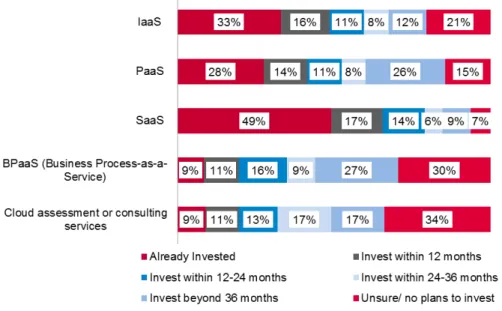
Among the many findings from our 2013 Cloud Services Business Trends Survey, two points come through loud and clear: the pace of cloud services adoption is accelerating, and cost is still the issue that brings many customers to the cloud table. As seen in Figure 1, a majority of respondents indicated that they will make investments in IaaS and SaaS within 12–24 months, if they have not already invested. This marks a change from previous surveys, when a greater number of respondents indicated they would wait 36 months or more before making such investments. This accelerated investment cycle holds true for PaaS and BPaaS as well, although when compared to other cloud services, those remain mid- to long-term investments. Use of cloud consulting and assessment services to map out and plan cloud investments remains limited, although such activity has ticked up compared to previous surveys.
Figure 1: Plans for cloud services investment
Source: Ovum Cloud Services Business Trends Survey, n=200
SaaS remains the most active area of investment for our survey respondents across all four surveyed countries (US, UK, France, and Germany). The same holds true across verticals. For example, among financial services and manufacturing customers, the two largest vertical industries from our survey, almost 70% of respondents indicated they have already invested in SaaS. Investment in IaaS, meanwhile, remained relatively consistent compared to previous surveys, while PaaS investment remains the highest in the US compared to the other surveyed countries.
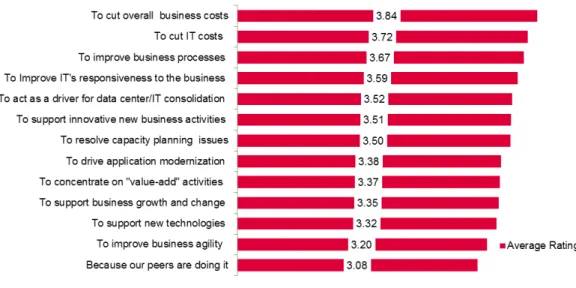
As with past surveys, cost reduction was the top driver for cloud services investments, as seen in Figure 2. However, other factors grew in importance on average (on our 1–5 scale, with 5 being the most important) compared to previous surveys. For example, improving business processes, improving IT’s responsiveness to business, and supporting innovative new business activities all rated higher on average compared to previous surveys.
Figure 2: Drivers for cloud services investment
Source: Ovum Cloud Services Business Trends Survey, n=200
The rising importance of business outcomes from cloud services, other than cost-related issues, is tied to broader conversations happening at the corporate level about leveraging technology for business transformation. Such a transformation could be shorter term and project based (improve customer satisfaction, bring a product to market more quickly), while others could be longer term and more strategic (enable new channels to market, become more competitive against rivals)
The bottom line is that it’s more important than ever that those customers making investments in cloud in 2014 build the business case on a solid bedrock of business outcomes, beyond what can be
achieved in immediate cost savings. We are not downplaying the importance or magnitude of such savings, as they can be substantial, when part of a holistic plan for IT transformation. However, CIOs and line-of-business leaders that view the move to cloud as critical will have greater success if they can link it with business outcomes and ultimately some form of transformation in how their company
operates. The exact business outcomes will depend on each company’s strategic goals, growth plans and competitive situations, but in the end services delivered via the cloud computing model can deliver degrees of flexibility, improved management, and innovation to address a wide swath of strategic corporate imperatives.
SECURITY AND SUPPORT EMERGE AS CRITICAL FACTORS
Customer concerns about security are higher than ever
As with previous surveys, current respondents show they remain extremely sensitive to security when it comes to cloud services investments. As seen in Figure 3, respondents in our 2013 survey on average rated trust and security expertise as the top characteristics when selecting a cloud services provider.
“Trust” in a provider can be highly subjective. It could mean customers want to work with an established IT services brand with decades of experience and longevity, it could be a provider with whom the customer has previous experience, or it could mean that a provider has convinced a customer that it has the expertise and talent necessary to effectively deliver enterprise-class services, regardless of how long they have been in the industry. Some customers have told us about previous experiences where they invested with a cloud services provider, only to have that provider go out of business or fail when it comes to cloud security and support. While trust may be in the eyes of the beholder, there are many ways for vendors to establish the levels of confidence needed to convince customers to invest.
Security, meanwhile, is a clearer concept for a customer to grasp: can a provider securely and reliably deliver cloud services without risk of data breaches or exposures, and what procedures and assurances are in place when such events occur? It is not a coincidence that vendors throughout 2013 made some security-related acquisitions, created separate security or managed security units within their
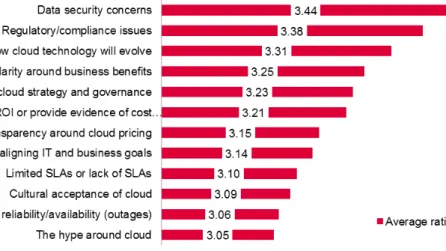
organizations, or aggressively marketed their security expertise (and some vendors did all three). We would expect this level of activity to continue in 2014 as customer concerns around cloud security remain paramount, as seen in Figure 4.
Figure 3: Factors when selecting a cloud services provider
Figure 4: Barriers to cloud services adoption
Source: Ovum Cloud Services Business Trends Survey, n=200
Support procedures and proper SLAs grow in importance among respondents
We noticed an uptick in our 2013 cloud services survey on the importance of support/resolution procedures, clear and robust SLAs and data management expertise. Respondents on average rated those three factors just below trust in provider and security expertise, as seen in Figure 3.
The rising level of importance of those areas is not altogether surprising, especially as the cloud services market matures and cloud adoption accelerates. Years ago, when cloud hype was at its zenith and customers were dazzled by the concept of flexible pay-as-you-go IT, some customers failed to consider the implications of the model for SLAs, support, and overall management. Customers were so attracted by the potential short-term cost savings that they neglected to consider how shifting to cloud services would or should impact their support and management expectations of their providers. However, customers are quickly catching up as cloud services become more prevalent in the market. An increasing number of customers have relayed to us tales of disappointing experiences with cloud providers where support and management simply wasn’t to an acceptable standard.
To that end, we see customers in 2014 becoming slightly savvier and certainly more diligent when it comes to negotiating cloud services deals to ensure that solid support and management procedures are built into their SLAs, and that those SLAs are as transparent and as detailed as possible. For many customers, put simply, if a vendor can clearly spell out who takes responsibility when a problem occurs, how long will it take to correct the issue, and what steps will be taken to make sure such an event never occurs again, customers will be satisfied. Customers are realizing that support and management in many ways needs to be more not less robust than in traditional outsourcing agreements.
To some extent, this development might slow customers’ adoption of cloud services as they engage in this kind of due diligence. Customers with previous experience negotiating outsourcing agreements
should be able to meet this challenge; others with no or limited experience will find the exercise a daunting one (as several customers have told us, especially those with limited legal and compliance resources). However, unlike the days when cloud services support may have been “glossed over” or downplayed in the rush to save costs, support will take a much higher profile in 2014, and vendors and customers need to prepare for it.
CUSTOMERS LAGGING IN CLOUD GOVERNANCE NEED TO MAKE
PROGRESS IN 2014
Only half of our survey respondents say they have a cloud services strategy
in place
Many customers talk about the need for a solid cloud services strategy, with proper governance, integration, and compliance procedures in place. However, our survey data repeatedly shows that many respondents still lack an overall strategy even while acknowledging its importance – and our 2013 survey was no different than previous years.
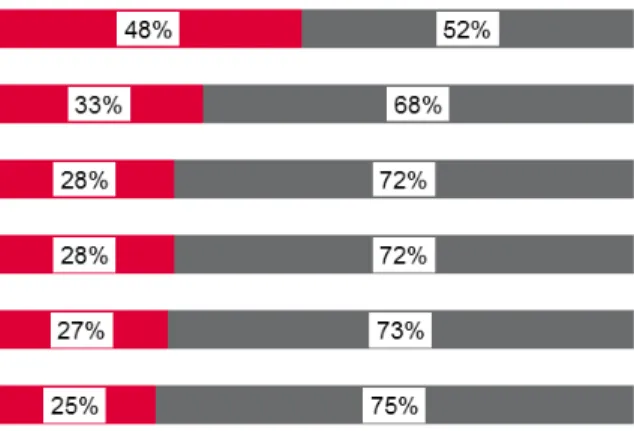
As seen in Figure 5, almost 50% of respondents said they have an overall cloud strategy in place, an increase of almost 10% on the previous year’s survey. However, only one-third or less of respondents said they have governance, integration, or compliance strategies in place – all of which we see as important elements for an effective cloud services strategy. It is possible that some respondents were simply unaware whether their organization’s cloud strategy included those elements – but that is an even more troubling thought, as governance and compliance specifically relate to legal, data access, privacy, and security issues.
Figure 5: Cloud services strategy
Governance will be essential for overall benefits and transformation
We have advocated for years that as cloud services adoption accelerates, customers need a proper cloud strategy in place – one with proper governance and compliance elements to oversee how cloud services are managed, governed, and ultimately integrated with existing IT assets and services. These issues are increasingly important if customers want to move beyond private cloud and embrace a hybrid model where they can access an orchestrated set of services in traditional, private, and public cloud models – and we see customers heading in that direction. Customers that have yet to make progress on this front should make this a priority in 2014, if only to get a sense of what application workloads and business processes could benefit effectively from a transition to cloud, or what improvements could be made to those that remain in-house. Based on our survey data, this represents a potential area of opportunity for cloud services providers, which is why we would expect them to continue making investments in cloud assessment and consulting services. Our current survey shows relatively little uptake in such services, although we have seen incremental growth in this area during the last several years.
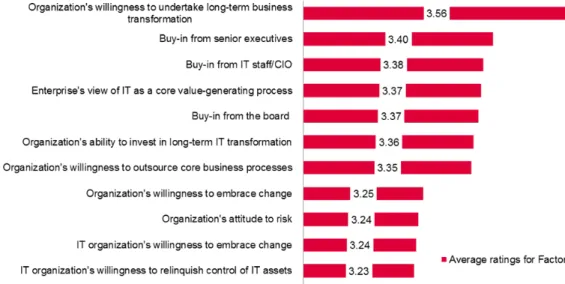
A well thought-out and effective cloud services strategy can be a critical element if customers want to leverage cloud for more transformative purposes as described earlier in this report. Such a strategy can unite IT and business leaders around a set of common goals and objectives, helping to prioritize cloud services investments around business outcomes that can ultimately lead to more effective IT operations and greater business growth. For what it’s worth, our respondents seem to already recognize the importance of a cloud strategy for transformation (or at the very least, that cloud must play a part in a broader IT investment strategy), even if they are not at such a point within their own organizations. As seen in Figure 6, when asked to rate factors important to the development of a cloud services strategy, on average respondents rated the organization’s willingness to take on long-term business
transformation as the top criteria, above buy-in from senior executives and CIO/IT staff. Cloud services could be a focal point that helps organizations reach the "nirvana" of aligned IT and business goals if customers use a cloud services strategy as a framework.
Figure 6: Elements of an effective cloud services strategy
Source: Ovum Cloud Services Business Trends Survey, n=200
HYBRID CLOUD MANAGEMENT WILL BE IMPORTANT VENDOR
DIFFERENTIATORS
Land grab for cloud services IP will continue
Our Business Trends survey data shows that private and virtual private are still the more common deployment models for cloud services, but the use of public cloud is on the rise, especially among public sector clients in some regions and countries. This indicates that over time more enterprise customers will be looking to deploy hybrid cloud models – combining private and public clouds potentially from multiple providers – within their organization. Simply put, such a scenario requires different levels of orchestration and management that are beyond many customers' internal IT expertise.
To address this trend, many traditional outsourcing vendors in 2013 made several acquisitions to boost their hybrid management capabilities, or began to aggressively market their hybrid management and orchestration capabilities, all in an attempt to competitively blunt moves by each other and cloud services market giants (notably Amazon Web Services, which continues to encroach on outsourcers’ established client base). For the former trend, IBM with its SoftLayer acquisition and CSC with its year-end deal for ServiceMesh are two of the more prominent examples, but they are by far not the only ones. For the latter trend, IBM, HP, CSC, Dell, Verizon, AWS and increasingly Google and Microsoft, to name a few, have stepped up their hybrid management marketing, often highlighting their ability to handle multiple hypervisors and their “agnostic” approach based on customer workloads and business
With few exceptions, outsourcers – even those that dedicated years to building out their own IP around hybrid cloud management and orchestration – have decided that acquiring IP is the best approach, given the speed by which the cloud services market is accelerating and the competitive landscape. This land grab for cloud services IP will continue into 2014, although the pool of potential acquisition targets continues to shrink.
Vendors seek to improve their innovation profile
The push for hybrid management IP is not just a practical reaction to the competitiveness in the market. Providers want to be viewed by customers as long-term thought-leaders and/or ecosystem anchors in the cloud services market, as innovation will continue to be touted as an important differentiator in 2014. To that end, in addition to management investments, there will also be a push around acquiring IP on technology trends related to mobility, social, and data/analytics, through direct deals or partnerships and alliances. We have seen in the past how IT services vendors stepped up their marketing efforts that link the cloud/mobile/social/data parts of their portfolios, and we expect that activity will increase throughout 2014. Providers have executed a long list of acquisitions in these areas (IBM, Accenture, CSC,
Capgemini, telecoms providers etc.) with no doubt more on the horizon. The challenge will be to integrate these offerings into a cohesive portfolio for customers.
RECOMMENDATIONS
Recommendations for enterprises
Customers that view cloud services as transformational, not just tactical or short-term, will ultimately reap greater benefits for their organization. Our survey data shows that cloud services adoption is accelerating, and while cost is a great way to start the conversation, cost should not be the sole motivator. Any short-term operational savings derived from a cloud services investment will in the end be less meaningful if the investment does not impact or improve business outcomes and performance. To that end, we advocate that a strong cloud services strategy that takes into account both IT and business needs is more important than ever. Survey data shows that customers realize a strong strategy can help unit IT and business leaders in common goals, and be a first step toward a
longer-term organizational transformational that will result in a leaner and more agile company. From a practical perspective, customers need an overarching strategy if only to ensure proper governance and compliance controls are in place, to ensure that data is being securely accessed and that the cloud services are achieving their desired outcomes. Ensuring that proper cloud services support procedures, backed by robust SLAs, will also be critical, as the shift to cloud will affect how customers contract with cloud services providers.
Recommendations for vendors
Vendors are on a hunt for differentiation within the cloud services market. Many vendors are making investments in hybrid cloud management, cloud services IP, and linking cloud to transformational themes that encompass connected trends such as mobility, social, and analytics. The end result is a
degree of sameness in terms of how providers package and market their cloud services portfolio to customers. This means differentiation will be critical.
There are potentially two strong methods of providing differentiation. One is to actively engage with customers in the planning and execution of their cloud services strategy, providing a roadmap for cloud services investments. This would allow vendors to get in on the “ground floor” of cloud services
deployments, demonstrate their industry and security expertise, and establish themselves as a strategic provider of cloud services. Of course, many vendors seek a “bottom-up” approach, where they sell one IaaS or SaaS offering, and then build the strategic relationship from there. However, customers are in desperate need for cloud strategy planning and deployment, especially in areas of governance and compliance, and vendors can prove themselves much more indispensible if they can assist customers at the early stages of their journey. This will also be important as customers want to look at leveraging cloud services in a more transformative role.
Another strong point of differentiation for providers is demonstrating innovation, through cloud ecosystems, integration of cloud services IP through acquisition, and centers of excellence to
demonstrate proof that cloud can have real-life IT and business benefits. The importance of innovation will vary from customer to customer, but providers will need this lever in order to stand out from the crowd in this increasingly hyper-competitive market.
APPENDIX
Further reading
2014 Trends to Watch: Enterprise Data Centers, IT019-003281 (November 2013)
Cloud Services Business Trends Survey 2013: European Results, EI022-000004 (August 2013)
Cloud Services Business Trends Survey: US Results, IT019-003242 (July 2013)
The Debate is Over: Cloud Services Belong in Corporate IT,IT019-003228 (June 2013)
"Dell, now a private company, leans on partners and innovation for differentiation" IT019-003299 (December 2013)
"CSC continues acquisition track with ServiceMesh deal" IT019-003280 (November 2013) "CSC buys Infochimps to help build its Big Data business" IT014-002779 (August 2013) "Differentiation and go-to-market critical for CSC–AT&T alliance" IT019-003252 (August 2013)
Methodology
• Survey work, including our Cloud Services Business Trends survey, and primary research on
adoption of cloud services by enterprise customers.
• Ongoing research into cloud services portfolios of major IT services, outsourcing, and telecoms
firms.
• Ovum Market Trends and forecasts.
Author
John Madden, Practice Leader, IT Services
Ovum Consulting
We hope that this analysis will help you make informed and imaginative business decisions. If you have further requirements, Ovum’s consulting team may be able to help you. For more information about Ovum’s consulting capabilities, please contact us directly at [email protected].
Disclaimer
All Rights Reserved.
No part of this publication may be reproduced, stored in a retrieval system or transmitted in any form by any means, electronic, mechanical, photocopying, recording or otherwise, without the prior permission of the publisher, Ovum (an Informa business).
The facts of this report are believed to be correct at the time of publication but cannot be guaranteed. Please note that the findings, conclusions and recommendations that Ovum delivers will be based on information gathered in good faith from both primary and secondary sources, whose accuracy we are not always in a position to guarantee. As such Ovum can accept no liability whatever for actions taken based on any information that may subsequently prove to be incorrect.