V
AGUENESS INA
CTIONLuke Elson
A dissertation submitted to the faculty of the University of North Carolina at
Chapel Hill in partial fulfillment of the requirements for the degree of Doctor of
Philosophy in the Department of Philosophy in the College of Arts and Sciences.
Chapel Hill
2014
Approved by:
Geoffrey Sayre-McCord
Simon Blackburn
Ram Neta
Keith Simmons
c
⃝
2014
Luke Elson
ABSTRACT
LUKE ELSON: Vagueness in Action.
(Under the direction of Geoffrey Sayre-McCord)
In the papers which compose this dissertation, I defend a distinctive role for evaluative
vagueness: (i) I argue that value incommensurability is best understood as vagueness; (ii)
I defend an expectation-maximising account of rational action under indeterminacy; and
(iii) I argue that Warren Quinn’s notorious
Puzzle of the Self-Torturer
is an instance the
Paradox of the Sorites.
I argue that when two options are incommensurate (or incomparable) with respect to
some value, it is—depending on one’s account of vagueness—either unknown or
indeterminate which option is better. I criticise Ruth Chang’s ‘Chaining Argument’ for
her parity view of incommensurability, and I argue that John Broome’s ‘collapsing
principle’ leads to contradictions.
Ignorance doesn’t present such a distinctive challenge, but how can we choose under
indeterminacy
? I develop an account of rational choice in such situations. I vindicate the
intuition that in some cases of incommensurability, it is permissible to simply flip a coin. I
also argue that—as in some other expectation-maximising contexts—sometimes we ought
to choose what is not the best: sometimes, under indeterminacy, we ought choose such
that there is determinately a better option.
ACKNOWLEDGMENTS
Many people have offered me help—and support, argument, encouragement, criticism,
and patience—in the writing of this this ‘multi-paper’ dissertation. I reiterate my
gratitude to those mentioned at the beginning of each paper, and I offer my apologies to
those I have inevitably forgotten to mention.
I have been extremely lucky to count myself a junior member of the UNC intellectual
community. Of course my greatest debt is to my chair and advisor, Geoffrey
Sayre-McCord. I remain in awe of his facility with philosophical argument, and indebted
to him for trusting me with the freedom to pursue my rather inchoate interests. I’m
extremely grateful to the rest of my committee: Simon Blackburn, Ram Neta, Keith
Simmons (who, along with Jesse Prinz, introduced me to vagueness), and Walter
Sinnott-Armstrong. I hope that this dissertation is worthy of their support.
Many others have provided invaluable comments on drafts, including Patrick
Connolly, Matthew Kotzen, Marc Lange, John Lawless, Daniel Layman, Douglas
MacLean, Julia Nefsky, John Roberts, Nathaniel Sharadin, and Susan Wolf. Many
philosophers outside UNC have taken the time to meet with me and discuss my (often
ill-formed) ideas or work. In this connection, I am particularly grateful to John Broome,
Ruth Chang, Joseph Raz, Miriam Schoenfield, and Walter Sinnott-Armstrong.
I remain grateful to Antony Eagle for guiding and supporting me through the
graduate-school admissions process, and to Marilyn McCord Adams, for her
encouragement at a low point.
Now I turn to a pair of incommensurate goods. For funding, I am extremely grateful
to the Philosophy Department and Graduate School, and the Richard Brooke Scholarship,
all at UNC. For friendship, I am many-times lucky in this department, but I must mention
Patrick Connolly, my first and best friend in Chapel Hill and the United States.
TABLE OF CONTENTS
1 Why not Incommensurability as Vagueness? . . . .
1
1.1 Incommensurability, and the View to be Defended . . . .
4
1.2 Evaluative Comparative Borderlineness . . . 10
1.3 Chang’s Challenge . . . 13
1.4 Against Hybrid Views: Raz’s Challenge . . . 21
1.5 Conclusion . . . 23
2 Heaps and Chains: is the Chaining Argument for Parity a Sorites? . . . 25
2.1 The Terrain . . . 26
2.2 The Chaining Argument . . . 30
2.3 Is the Chaining Argument a Sorites?. . . 32
2.4 Fuzzy Hard Incomparabilism . . . 35
2.5 An Error Theory for the Difference Principle . . . 39
2.6 Can Chang’s Strategy be Generalised? . . . 40
2.7 Conclusion . . . 42
3 Borderline Cases and the Collapsing Principle. . . 44
3.1 Broome’s argument and Carlson’s counterexamples . . . 45
3.2 A new counterexample to the collapsing principle . . . 49
3.3 Defence of the counterexample . . . 50
3.4 What about intransigence or scope restriction? . . . 52
3.5 Conclusion . . . 55
4 ‘Ought’ and Indeterminacy . . . 56
4.1 Introduction . . . 56
4.3 Indeterminate-permissibility . . . 63
4.4 Caprice and Randomize . . . 69
4.5 Comparative Capricious Views . . . 72
4.6 Compromise and Hyperexpectation . . . 75
4.7 Bleaching Objections . . . 81
4.8 Incommensurability . . . 85
4.9 Conclusion . . . 87
5 The Self-Torturer is a Sorites . . . 90
5.1 Introduction . . . 90
5.2 The Puzzle for Orthodox Rational Choice Theory . . . 92
5.3 Arguments that the Self-Torturer is not a Sorites . . . 97
5.4 An Example of a Vague Project that Clearly is a Sorites . . . 99
5.5 Binary and Essentially Comparative Desires . . . 104
5.6 The Self-Torturer as a Sorites . . . 105
5.7 Objections Perceptibility, and Second-Order Vagueness . . . 108
5.8 How the Sorites Undermines Heterodox Views . . . 111
5.9 Conclusion . . . 114
1
Why not Incommensurability as Vagueness?
Abstract
. Two options are said to be ‘incommensurate’ when neither is better
than the other, but they are not equally good, with respect to some value.
Typically, we will say that one option is better in some ways, and the other in
others, but neither is better ‘all things considered’. I argue that when two
options are incommensurate, it is vague—that is, indeterminate or
unknowable—which is better. Vagueness can explain the formal structure of
incommensurability, and this presents an unmet explanatory burden for
competing views. I resist arguments by Ruth Chang and Joseph Raz that
incommensurability is not vagueness, or not entirely vagueness. This
burden-shifting strategy avoids the problems that have afflicted previous
arguments for incommensurability as vagueness, including a reliance on
controversial premises.
1Churchill, in Northern Canada, is one of the best places in the world to see polar bears.
But—I’ll assume that you do not live in or near Churchill—it is an uncomfortable and
expensive trip, not least because the roads do not go that far north. A holiday closer to
home might be much cheaper, but less exciting and spectacular. If each is better in some
ways but worse in others, which is better
all things considered?
The holidays are
incommensurate
(or ‘incomparable’ or ‘incommensurable’) when there
is apparently no positive answer to that question. It seems that neither is better, but they
are not precisely equally good. The last claim—that they are not equally good—might
need some justification. If the trip to Churchill and one to a nearby destination were
precisely equally good (as a holiday for you), then reducing the price of the Churchill trip
by an arbitrarily small amount would make it clearly better for you than the nearby
destination. But this seems absurd.
2Though no overall comparison seems to apply, the question was not a silly one. We
implicitly compare holidays when we choose and book (even in the present case, the
incommensurate two are each likely better than many others, such as holidays that are
both expensive and uninteresting). Incommensurability is ubiquitous, and threatens to
arise in almost any choice situation involving several virtues or ‘dimensions’ of goodness.
Who is more creative, Mozart or Michelangelo? Which is more impressive, Stonehenge or
Salisbury Cathedral? Which is a better career, law or music? We may agree with Joseph
Raz that incommensurability is one of the ‘universal features of human thought’.
3Typically, we’ll suppress mention of the value or standard in question, unless required
for clarity, and talk in terms of ‘better’ and ‘worse’. Incommensurability often arises
when each option is better in some ways, and worse in others. Let’s say that such options
are
Pareto-mixed
. Pareto-mixing is closely tied to incommensurability, but not sufficient
for it. For example, suppose that the Churchill trip was only $5 more expensive than
another holiday, but markedly superior in every other way; we should not hesitate to say
that the Churchill trip is clearly superior.
But incommensurability is also deeply puzzling. When some a and b are
incommensurate, none of the ‘trichotomous’ comparisons obtains: a is not better than b, b
is not better than a, and they are not equally good. So how
do
they compare, if at all?
The most popular view—Trichotomous Incomparabilism—is that determinately, none
of the trichotomous comparisons holds:
2This is a ‘Small-Improvement Argument’; this feature is also known as known as ‘inertia’ and ‘insensi-tivity to sweetening’. See De Sousa (1974), Sinnott-Armstrong (1985), Raz (1985-86), Blackburn (2010) and Schoenfield (2012).
3Raz (1985-86), p. 133. The examples are due to Broome (1997), Chang (2002), and Raz (1985-86),
Trichotomous Incomparabilism (rough formulation).
When a and b are
incommensurate, it is false that a is better than b, false that b is better than a,
and false that a and b are equally good. None of the trichotomous
comparisons applies.
In this paper, I’ll instead argue that incommensurability is vagueness:
Incommensurability as Vagueness (rough formulation).
When a and b are
incommensurate, it is vague whether a is better than b, or b is better than a, or
a and b are equally good. One of the trichotomous comparisons applies, but it
is indeterminate or unknowable which.
Rather than a
sui generis
phenomenon affecting evaluative comparisons,
incommensurability is simply an evaluative manifestation of the everyday phenomenon
of vagueness.
This view has been defended by John Broome, but his argument is unsound: it relies
on a controversial ‘Collapsing Principle’ which is not widely accepted, and which I have
argued elsewhere is false. But the thesis that incommensurability is vagueness is not
dependent on the Collapsing Principle; if the view is correct, then it should be possible to
argue for it in some other way. The Collapsing Principle imports some implausible
consequences—that Broome himself finds ‘hard to believe’—into the view that
incommensurability is vagueness, so by arguing for the view without appeal to that
Principle, I aim to reach a more plausible formulation.
4Vagueness offers a complete, parsimonious, and explanatorily superior account of
incommensurability, or so I’ll argue. It can explain incommensurability in terms of a
well-known albeit puzzling phenomenon—vagueness—without resorting to the
sui
generis
.
Seeing that incommensurability is vagueness sheds light on issues of rational choice in
4See Broome (1997) for his argument and the Collapsing Principle. The quote is from p. 85. See Chapter
the face of incommensurability, since it assimilates that phenomenon to one of rational
choice in the face of vagueness: when we choose between incommensurate options, it is
vague which option is better. I argue elsewhere that standard theories of rational choice
can be extended to cover this case.
5In the next section, I present more precisely the thesis that incommensurability is
vagueness. I’ll then argue that evaluative vagueness is pervasive, and that vagueness
engenders incommensurability. This presents an explanatory burden for those who
defend other views: vagueness should be the ‘default’ explanation of incommensurability.
I’ll then consider several influential arguments that vagueness could not ground some or
all incommensurability; I argue that such arguments rest on mischaracterisations of either
incommensurability or of vagueness. The vagueness explanation is more parsimonious
than that provided by trichotomous incomparabilism, so we would need some reason to
prefer the latter; but no such reason seems forthcoming. I’ll conclude by sketching some
implications of the thesis for rational choice between incommensurate options.
1.1
Incommensurability, and the View to be Defended
But why accept the existence of incommensurability at all? One might instead think
that if two options are properly compared with respect to some value, then one of the
trichotomous comparisons always determinately holds between those options, relative to
that value: that all putative cases of incommensurability simply rest on ignorance.
6If my arguments below are successful, then they refute this debunking view, since I’ll
show that evaluative vagueness generates incommensurability. But this does engender a
taxonomic complication: what if we think that incommensurability is vagueness, but also
think that vagueness is ignorance? I don’t think that this should count as a debunking
view, since epistemic accounts of vagueness typically posit rather radical sources of
ignorance, such as ignorance of the use-meaning relation. To mark the difference, let’s say
that debunking incommensurability amounts to claiming that one of the trichotomous
5See Chapter 4.
comparisons always obtains determinately, but it is unknown which. By contrast,
epistemic accounts of vagueness will typically hold that the relevant claims are
unknowable
, not merely unknown.
With that in mind, we can formulate a definition of incommensurability:
Incommensurability.
Two objects or options a and b are
incommensurate
with
respect to some value V if and only if:
(i) it is not knowably true that a is Ver than b;
(ii) it is not knowably true that b is Ver than a;
(iii) it is not knowably true that a and b are equally V;
(iv) the comparison is not silly or malformed.
Clause (iv) sets aside cases of ‘noncomparability’, such as that implied by the question
“what’s louder, my chair or this paragraph?” This definition is neutral between all
non-debunking accounts of incommensurability: compatibly with this definition, the
trichotomous comparisons might be determinately false, determinately true but
unknowable, or indeterminate. Giving a theory of incommensurability amounts to saying
what relation (if any) holds between incommensurate objects.
As I have mentioned, the standard view of incommensurability is that each
trichotomous comparison is determinately false:
Trichotomous Incomparabilism.
In incommensurate cases, it is determinate
that none of the trichotomous comparisons applies. If a and b are
incommensurate with respect to V, then it is false that a is Ver than b, false that
b is Ver than a, and false that a and b are equally V.
Trichotomous Incomparabilism encompasses several quite different views. Joseph Raz
argues that
no
comparison applies (in most cases, as we’ll see below). Ruth Chang thinks
that the trichotomous comparisons are not exhaustive, and that a fourth
comparison—parity—holds at least sometimes.
7These views have radically differing
implications for rational choice and the nature of comparison, but for our purposes they
agree on a crucial point: in at least some cases, when a and b are incommensurate, it is
false that a is better than b, false that b is better than a, and false that a and b are equally
good.
The main thesis of this paper is that when a and b are incommensurate, it is vague
whether a is better than b, or b is better than a, or they are are equally good. To state this
more precisely, I’ll say a little about vagueness. Vagueness is associated with two main
phenomena: borderline-cases and Sorites-embeddability. In borderline-cases, the
predicate in question neither clearly applies nor clearly fails to apply. Consider the classic
example of a vague predicate (‘is a heap’): amongst piles of sand, there are clear heaps,
clear non-heaps, and borderline-cases, which seem to be ‘neither a heap nor not a heap’.
This predicate is also vulnerable to the paradox of the sorites, or heap, because the
tolerance
principle ‘if
n
grains of sand form a heap, then
(
n
−
1
)
grains of sand form a
heap’ seems undeniable.
8Together with the claim that a million grains form a heap, and
repeated applications of modus ponens, this tolerance principle implies that three grains
form a heap, even in contexts where that is plainly false. Similarly, the vagueness of ‘is
bald’ allows us to argue that if a man with fifty head hairs is bald, then so is a man with
fifty thousand. Borderline-cases may arise in other ways (such as, perhaps, the open
future), but tolerance is plausibly the distinctive mark of vagueness. I’ll argue that
incommensurability rests on borderline-cases, but it is plausible that tolerance can explain
the puzzling phenomenon of incommensurate
value-pumping
, which I discuss briefly
below.
Theories of vagueness come in two main flavours. On indeterminist views, it is
indeterminate how many grains are required for a heap, and it is indeterminate whether a
given borderline-heap is a heap. This may be put in terms of ‘neither true nor false’. In
this camp, metaphysical indeterminists hold that there is a real property of heapiness
with an indeterminate extension. Semantic indeterminists have it that vagueness is a
matter of semantic indecision: perhaps meaning supervenes on use, but our use of ‘heap’
does not determine a precise extension for that term.
9Epistemic views deny the existence of such indeterminacy: ‘is a heap’ has a precise
extension—there is a number k such that k grains determinately do not form a heap, and
(k+1) grains determinately do—but this extension is unknowable. Epistemicists
characterise borderline-cases in terms of ignorance.
10But on all mainstream accounts of vagueness, tolerance principles are false; it is
simply indeterminate or unknowable
which instances
of a particular tolerance principle
are false. It is false that for all
n
, if
n
grains of sand form a heap, then
(
n
−
1
)
grains of
sand form a heap; similarly, it is true that there is a precise minimum number of grains of
sand required for a heap, and that there is a precise minimum number of hairs required to
be non-bald. But these numbers are indeterminate or unknowable. From now on, we’ll
use terms like ‘borderline’, ‘borderline-case’, and ‘vague’ neutrally between the main
accounts of vagueness.
What I’ll call ‘categorical’ borderline-cases are familiar. Some pile of sand is neither a
clear heap nor a clear non-heap. A 15 year-old is neither a clear child nor a clear
non-child. And so on. In such cases, we have a predicate F (‘is a child’), and an object a
(some 15 year-old) such that the question ‘is a F?’ has no clear answer. The answer is
indeterminate or unknowable.
In
comparative
borderline cases, the relevant question is instead ‘is a Fer than b?’ If
Hank has fewer thin hairs widely distributed over his head, and Henry has more thick
hairs concentrated in a ring around his scalp, then it may be indeterminate or
unknowable whether Hank is balder, or Henry is balder, or they are precisely equally
bald. Hank and Henry form a comparative borderline-case of ‘balder’.
As we’ll see, comparative borderline-cases are ubiquitous, but their significance has
not been appreciated. When theorising about vagueness, they do not represent a
9For semantic indeterminism, see Fine (1975), Keefe (2000), and Dorr (2003). Metaphysical indeterminism has recently been defended by Barnes (2010).
substantially distinct phenomenon, since any theory of ordinary or categorical vagueness
is likely to extend trivially to the comparative sort. But once we appreciate its source and
structure, we’ll see that it can ground incommensurability.
Comparative borderlineness arises in two main ways (I can’t think of any others). The
first is tied to
multidimensionality
, or the dependence of the application of a predicate on
multiple contributory factors. Those factors need to be weighed against each other, and it
may be vague what the their relative weighting is. Just as ‘is bald’ does not knowably fix
the precise number of hairs required to count as bald, so it does not knowably fix the
precise relative weighting of hair numbers and hair distribution. So there are both
categorical and comparative borderline-cases of that predicate. Similarly, there are several
dimensions relevant to whether a vessel is a ship or a boat, or whether a dwelling is a tent
or a teepee, and it is plausible that the relative weights of those dimensions are vague.
When we are required to score something along multiple dimensions, we might
assign precise weights to those dimensions for calculative purposes, but this is often an
arbitrary exercise. When comparing philosophy papers, should clarity count for twenty
or twenty-one percent of a paper’s overall quality? There seems to be no knowable
answer to this question. Similarly, when grouping men as ‘tall’ or ‘not-tall’, we might
have to fix an arbitrary threshold.
Second, comparative borderlineness may be parasitic on (or derivative of) categorical
borderlineness. Consider the artificial predicate ‘is militarily effective’, and stipulate that
one of its dimensions is being tall: all else being equal, the tall are more militarily effective
than the not-tall. Consider two men, Hank and Herbert. The other dimensions—whatever
they are—are such that Hank has a very slight advantage. Hank is not tall. So far, we
have not introduced any vagueness. Suppose that Herbert is borderline-tall (a case of
ordinary categorical vagueness). The other factors tip slightly in Hank’s favour, so: if
Herbert is tall, then he is more militarily effective than Hank; if Herbert is not tall, then he
is less militarily effective than Hank. It is borderline whether whether Herbert is tall, so it
is borderline whether Herbert is more or less militarily effective than Hank.
multidimensionality. Say that a is ‘heap-richer’ than b if a owns more heaps than b. Sarah
has twenty clear heaps, and no other piles of sand. Sally has fifteen clear heaps, ten
borderline-heaps, and no other piles of sand. It is vague how many heaps Sally has, and
so it is vague which of them is heap-richer: if Sally has less than twenty heaps, then Sarah
is heap-richer than Sally; if Sally has twenty heaps, then Sarah and Sally are equally
heap-rich; if Sally has more than twenty heaps, then Sally is heap-richer than Sarah.
Something similar might apply when measuring the relative economic potential of
countries in terms of usable farmland, if ‘usable’ is vague.
So vague relative weightings are one way that comparative borderlineness can arise,
but they are not the only way. Even if the dimensions are precisely weighted, it might be
vague how one option ‘scores’ along one of those dimensions. This can apply even in
cases where there is only one dimension. It is thus not tenable to accept categorical
vagueness but deny the existence of comparative vagueness, since the former engenders
the latter. (As we’ll see later, Joseph Raz seems to imply that vagueness is typically
associated with the unidimensional).
To recap, comparative borderlineness is the phenomenon whereby for some predicate
F and two objects a and b, at least two of ‘a is Fer than b’, ‘b is Fer than a’, and ‘a and b are
equally F’ are not all false, but none is knowably true (remaining neutral between
epistemicism and indeterminism about vagueness).
Comparative borderlineness does not require that each of the three possible verdicts
(Fer, less F, equally F) is vague; one may be known to be false. We saw this in the case of
Hank and Herbert, where it is vague who is more militarily effective, but certain that they
are not equally so.
We can now state precisely the main thesis of this paper, that incommensurability is
vagueness:
true.
Value incommensurability is simply the evaluative instance of a broader semantic (or
metaphysical, or epistemic) phenomenon. In the next sections, I’ll argue that there are
comparative borderline-cases of evaluative predicates, and that these can explain
incommensurability in a parsimonious way. This will present a burden for those who
favour trichotomous incomparabilism: why
not
think that incommensurability is
vagueness?
1.2
Evaluative Comparative Borderlineness
Consider comparative borderlineness of an evaluative predicate:
Evaluative Comparative Borderlineness.
The pair a and b are a case of
evaluative comparative borderlineness of V when: (i) a and b are a
comparative borderline-case of V; and, (ii) V is an evaluative predicate.
In general, evaluative comparative borderlineness may arise in each of the ways
discussed above. Evaluative comparisons are typically made relative to an implicit or
explicit background consideration—what Ruth Chang calls a ‘covering value’
11—and if
this value is multidimensional, it may be vague what the relative weights of its
dimensions are: who would be so bold as to assign a precise numerical weight to insight
versus rigour?
It might be thought that evaluative predicates are not susceptible to vagueness. But
this is not plausible: just as vagueness is ubiquitous in the non-evaluative, so it seems to
be in the evaluative: consider the concept of cowardice.
12Is it more cowardly to run from
a single man armed with a shotgun, or from a dozen men armed with just their fists?
What is the precise minimum number of men I must be prepared to fight in order to be a
non-coward? Vagueness is typically demonstrated with such a ‘know it when I see it’
presentation of borderlineness and tolerance. There is no more reason to think that ‘is a
11See Chang (2004).
coward’ is wholly sharp (lacking vagueness) than there is that any other (evaluative or
nonevaluative) concept is.
It is hard to deny that our evaluative concepts have at least some vagueness. The
vagueness-threshold is low: according to David Braun and Ted Sider, ‘an expression is
vague if it can be unclear to a speaker informed of all relevant facts whether the
expression correctly applies’.
13Now, it would clearly be question-begging to argue along
these lines that
incommensurability
is vagueness, but I am making a less tendentious point:
by the standards that are used in discussions of non-evaluative vagueness, there are
clearly instances of evaluative vagueness. This is strong (but defeasible) evidence that
there is evaluative vagueness.
Perhaps it might be worried that even if the broadly evaluative is subject to
vagueness, specifically
moral
notions must be sharp. But as TK Seung and Daniel Bonevac
argue, every plausible moral theory seems to involve some degree of imprecision.
Compare even Kant on imperfect duties, such as that to give aid to those in need. There is
no precise, determinate minimum provision of aid that is required.
14I argue elsewhere
that ‘satisficing’ versions of consequentialism are most plausible when the threshold of
right action is vague.
15Morality is not like income tax, with precise thresholds (and even
income tax is beset by legal vagueness).
It might be worried in particular that vagueness is incompatible with certain plausible
principles concerning the moral and evaluative, such as that ‘ought’ implies ‘can’, or that
there are no unknowable moral obligations. But such issues are complicated, and do not
obviously undermine vagueness. I discuss the application of the ought-reasons
platitude—that one ought to do what one has most reason to do—elsewhere.
1613Braun and Sider (2007), p. 133.
14Seung and Bonevac (1992), pp. 805-806.
15See Elson (Manuscript[b]).
Evaluative comparative borderlineness begets incommensurability. Take any
evaluative notion V, such as goodness or creativity, which has with comparative
borderline-cases. Suppose that a and b are a comparative borderline-case of V. This is a
case of evaluative comparative borderlineness. Then comparing definitions of evaluative
comparative borderlineness and incommensurability, we see that a and b are thereby
incommensurate with respect to V. This is how vagueness engenders incommensurability.
Even a small dose of such vagueness can generate widespread incommensurability:
Wealth Comparison.
Sarah has a lot of property (real estate), and not much
cash; Sheila has more cash but less property. Thanks to vagueness in how
property is to be weighed against cash, it is vague whether Sarah is richer than
Sheila, or Sheila is richer than Sarah, or they are equally rich.
Sarah and Sheila are a comparative borderline-case of ‘richer’. This borderlineness
rests on a relatively small dose of comparative vagueness: how much are cash and
property worth, relative to each other? We did not assume any vagueness in what is to
count as cash or as property, for example. Nevertheless, this vague weighting will ground
many more comparative borderline-cases. Any other pairs with similar ratios of cash to
property will also form comparative borderline-cases of ‘is richer than’ (at least, assuming
that this predicate has a relatively simple linear structure). This vagueness will also infect
any concept which has comparative richness as a dimension or component such as,
plausibly, socio-economic status.
I have argued that there is evaluative comparative borderlineness, and such instances
meet the formal definition of incommensurability: none of the trichotomous comparisons
knowably obtain.
Vagueness naturally and parsimoniously explains incommensurability in terms of an
existing phenomenon. Now, I’ll consider two influential challenges to the thesis that
incommensurability is vagueness. Both seek to undermine the claim that
incommensurability could be entirely explained by vagueness. Since my claim is that
these challenges fail, it is important to consider them carefully.
1.3
Chang’s Challenge
Ruth Chang has argued that incommensurability
could not
be rooted in
borderline-cases. If she is correct, then incommensurability is a distinct phenomenon, not
explained by vagueness. Chang calls incommensurate comparisons
superhard
. This
terminology is in some ways preferable, since it does not stipulatively rule out a
debunking account.
She concedes that superhardness and incommensurability share some formal
similarities, but argues that they differ in several ways—phenomenologically, in
resolution conditions, and particularly in
moral
resolution conditions. I’ll reject each of
these arguments: none marks a genuine distinction between the vague and the
superhard.
17Her first argument is that the phenomenology of superhard cases differs from that of
borderline-cases:
In borderline cases, insofar as we are willing to judge that the predicate
applies, we are also willing to judge that it does not apply. [. . . ] in a superhard
case, insofar as we are willing to judge that ‘better than with respect to V’ does
not apply, we are not also willing to judge that it does apply. In the absence of
any explanation for why the phenomenology should be different, there is
good reason to think that superhard cases are not cases of vagueness.
18Chang does not mean that ‘in a borderline case one cannot favor one judgement more
than another’.
19Instead, we may illustrate her claim with an example. Consider a
borderline-red ball. If we are willing to judge that it is not-red, we are also willing to
judge that it is red. This tension seems characteristic of borderlineness: we fluctuate
between both verdicts. But incommensurability, it seems, lacks this tension: we judge that
some A is
not
better than some B, without also being willing to judge that it
is
better.
But this argument fails in both directions, so to speak. First, the relevant judgements
of comparative borderlineness are less provisional than Chang implies. On the view I am
defending, to judge that a pair form a superhard case is to judge that the pair is a
comparative borderline-case of the relevant value. This is to make a metalinguistic (or
epistemic, or metaphysical) judgement, and such judgements do not seem to have the
degree of instability that Chang claims. There are paradigm borderline-cases of predicates
like ‘is red’, and ‘is more militarily effective’. It is perfectly possible to judge that we are
dealing with a borderline-case, without also being willing to judge that it is
not
a
borderline-case. Indeed, this grounds the puzzle of higher-order vagueness, which is the
phenomenon where some cases seem to be ‘clearly borderline’ and others
‘borderline-borderline’. There do seem to be clear cases of borderlineness.
Second, judgements of superhardness are more provisional than Chang claims—as
Simon Blackburn notes, it is very hard to know whether a quandary grounded in
incommensurability will be stable in the long-run, and a judgement that it
is
stable may
always be defeasible
20—and often have the same air of paradox and revisability as
judgements of borderlineness. Here we are trading intuitions, and I will report my own:
judgements that some pair is incommensurate with respect to some value do have a
18Chang (2002), p. 682.
19Chang (2002), p. 682 fn. 26.
phenomenal instability to them, as do judgements that something is a borderline-case of a
vague predicate. Phenomenology does not separate the vague from the superhard.
Chang’s next argument is more threatening. She argues that vagueness and
incommensurability have different
resolution conditions
—that whilst disagreement in the
face of the superhard is subject to substantive dispute, disagreement in the face of
vagueness can be stipulated away:
in borderline cases, it is perfectly permissible to resolve the indeterminacy in
favour of application or not by arbitrary stipulation, but in superhard cases,
resolution of the perplexity in context-free cases is not permissibly given by
arbitrary stipulation.
21Chang introduces a thought experiment, to abstract from contextual factors. Jack is
playing a game, wherein he must sort people into a ‘bald’ or a ‘non-bald’ pile. Players of
the game are fully informed; Herbert is borderline-bald, and Jack must choose a pile; Jack
sorts Herbert into the ‘bald’ pile. Then:
What is crucial is that the sorting decision is perfectly arbitrary; he could just
as well have flipped a coin to determine how Herbert was to be sorted [. . . ] if
we add another player, Jill, who happens to sort Herbert into the ‘not bald’
pile, Jack and Jill have no real disagreement; their ‘disagreement’ is simply a
clash of arbitrary stipulations in the face of indeterminate application. Of
course, this is not to say that the answer to the question, Is Herbert bald, is
given by a coin flip, for the answer to that question is that it is indeterminate
whether he is. The point here is only that a resolution of this indeterminacy
can be appropriately given by a coin flip. In general, the resolution of
borderline-cases can always be a matter of arbitrary stipulation.
2221Chang (2002), pp. 679-688.
I agree with almost everything in this paragraph, provided that ‘resolution’ is
interpreted in terms of deciding what to
do
: if it is indeterminate which pile Herbert must
go into, but determinate that he must go into one, then what is there to do, but stipulate
arbitrarily? By hypothesis, there is no determinate, knowable reason to choose one over
the other.
Note that here ‘arbitrary stipulation’ need not be limited to random picking, such as
coin flips. One can adopt a general policy to deal with borderline cases, such as putting
the tall borderline-bald men into one pile, and the not-tall in another. The point is just that
the rules of the game do not specify into which pile Herbert should go, so we must appeal
to something ‘outside the rules’, so to speak. This will be arbitrary from the perspective of
the rules.
Chang claims that superhard cases lack such arbitrariness:
The resolution of perplexity in superhard cases is very different in nature.
Suppose that Jack is confronted with the superhard case involving Mozart and
Michelangelo. The rules of the game require him to put the ordered pair in
one pile or the other . . . what is crucial is that his decision is not properly
arbitrary; it is not true that the could just as well have a flipped a coin to
resolve the perplexity. If Jill puts the pair in (the other pile), Jack and Jill have
a genuine disagreement over whether Mozart has the greater creativity—this
is no clash of arbitrary decisions but a substantive disagreement in which
arguments can be brought to bear.
23If the Mozart/Michelangelo comparison really is superhard, then this disagreement
could not be substantive in the way Chang claims. If Mozart and Michelangelo are
incommensurate, then how could a dispute between two fully-informed players about
how to classify them be substantive? Since they are fully-informed, Jack and Jill agree that
the comparison is superhard: they agree that it is not (knowably) true that Mozart is more
creative, or that Michelangelo is more creative, or that they are equally creative.
Since this is common knowledge between the players, it is hard to see how resolution
could be a matter of substantive debate between them. Suppose that Jack thinks that it
would be better to choose Mozart, solely on the grounds of creativity: does that not imply
that he thinks that Mozart is more creative? It is incoherent to think that Mozart and
Michelangelo are paradigmatically incommensurate with respect to creativity, but that on
substantive grounds of creativity, Mozart should be put in the ‘more creative’ pile.
Interestingly Simon Blackburn, who has no stake in the debate over
incommensurability as vagueness, agrees that incommensurability often demands
arbitrary stipulation, and that ‘both common sense and high theory tell us how to handle
it. The agent has to
plump
for one alternative.’
24Blackburn may be wrong about this, of
course, but this does show that Chang’s claim—that the resolution of superhard cases
must be substantive—is at the very least, far from obvious.
But what about a phenomenal claim, that it
feels
substantive? It is true that there is
more room for debate about
whether
the Mozart/Michelangelo pair is superhard than
there is in the baldness case. There is more at work in creativity than in the largely
observational ‘is bald’.
As Cristian Constantinescu and others have pointed out, there are many differences
between the cases.
25Here are some. Whereas ‘is bald’ is a monadic predicate that applies
to individuals, ‘is more creative than’ is a dyadic comparative predicate that applies to
pairs. The application of ‘is bald’ is determined by perhaps a few dimensions—hair
number, distribution, colour, thickness—where the first and second are by far the most
important; the application of ‘is more creative than’ is certainly determined by many
more dimensions (there may not even be a determinate list, if the predicate has ‘open
texture’). And whilst ‘is bald’ is normally a nonevaluative predicate, ‘is more creative
than’ is straightforwardly evaluative.
24Blackburn (2010), p. 50.
The cases share little in common, other than that Jack and Jill face perplexity about the
application of a predicate. This is not a good test for whether superhardness introduces
substance. Consider another, which avoids these potential distortions. We can press into
service a nice example discussed by Seung and Bonevac: university admissions.
26In the
United States, admission to most undergraduate programmes is determined by several
dimensions, including exam scores, essays, money, letters of recommendation, sports and
extracurriculars, and ethnic or racial category. Suppose that Jess and John are paid to play
a game: they must select candidates for a given university. They must put candidates into
one of two piles: accept, or reject.
They have one slot left, and two remaining candidates, a and b. a and b are roughly
equal in most respects, but for the following differences: a has test scores about 5% better
than b’s; b has done several more sporting activities than a. So a is better in one way, and
b is better in another.
Consider two ways that Jess and John’s game might be run:
Admissions as Superhard.
Jess and John are under instructions to ‘admit the
best candidates’. They are working to decide who is the better candidate,
which is a plainly evaluative task. The choice between a and b is superhard.
Admissions as Vague.
Jess and John working from an instruction sheet; the
new management has excised individual judgement from the process as much
as possible. The sheet contains the following vague instruction: ‘admit
candidates with higher test scores, unless they have done substantially less
sport’. The a/b pair is a comparative borderline-case of this criterion: a has
better scores, but it is vague whether she has done
substantially
less sport than
b. It is vague what the instructions require.
The two cases are exactly parallel, except that one is superhardness, and the other is
vagueness. If Chang’s argument were correct, we would find the difference she
describes—that in one case resolution is arbitrary and stipulative, in the other case
substantive—here too. Yet in both versions, arbitrary choice is permissible, even required.
What other way is there to proceed? In both cases, the admissions officers Jess and John
agree that the rules of the game do not determine which candidate to admit. How are they
to fill the slot if they do not go ‘beyond the rules’ by choosing arbitrarily in some sense?
If there were a striking difference in acceptable resolution methods between the
superhard and the borderline, then it would manifest in this case, but it doesn’t. The best
explanation is that resolution in the Mozart/Michelangelo case must also be arbitrary,
and any appearance to the contrary can be explained by special features of that case.
Chang has not shown that the arbitrariness implied by vagueness undermines
incommensurability as vagueness.
If I am right that in cases of incommensurability, arbitrary stipulation
is
required, then
Chang’s argument actually strengthens the case for incommensurability as vagueness:
Chang is right that vagueness mandates arbitrary stipulation, and if incommensurability
is vagueness, then this neatly explains why incommensurability mandates arbitrary
stipulation.
Chang’s final argument is a moral application of the resolution argument:
Consider a superhard case involving comparison of a particular act of promise
keeping and a particular act of bringing about great happiness with respect to
moral goodness [. . . ] Could the resolution of the case be an arbitrary
matter—could the perplexity concerning which is morally better be answered
by the flip of a coin? Clearly, the resolution of this superhard case cannot be a
matter of arbitrary stipulation but is a substantive matter concerning which is
better.
27But again—how could this
not
be a matter of arbitrary stipulation? Remember that
arbitrary stipulation
here might include choice on non-moral grounds. By hypothesis, the
case is ‘morally incommensurate’: neither option is morally better, but nor are they
morally equipreferred. To talk in terms of moral reasons, there is no overall moral reason
to prefer one or the other, and no overall moral reason to equiprefer them. What is there
to do but choose arbitrarily (from the point of view of morality)? We are in a similar
position to the admissions officers: moral guidance has run out.
If evaluative incommensurability is vagueness, as I argue, then ‘moral
incommensurabilities’ are also vagueness. This is not a bullet to be bitten, but a natural
consequence of the view. As we have noted, many plausible normative ethical views
incorporate a degree of indeterminacy or vagueness. Here, I simply invite you to share
the judgement that in a suitably fleshed-out moral case (along the lines that Chang
describes), there may be no alternative to arbitrary choice. This is not to rule out the
possibility of moral dilemmas: that arbitrary choice is permitted does not undermine the
possibility of conflicting non-overridden moral requirements, since we may be in the
unfortunate position of arbitrarily stipulating which conflicting moral obligation to
meet.
28Now, there might be more ‘broadly pragmatic’ reasons to be wary of coin-flipping
when the moral stakes are so high. Perhaps coin-flipping would fail to show due
deference to morality, or in the case of legal vagueness, to the law.
29But it doesn’t follow
that there is a non-arbitrary way to proceed. As Blackburn notes, some such arbitrary
picking methods—such as cards, or drawing straws—do carry an air of seriousness.
30We
should not confuse the culturally-contingent connotations of some methods of arbitrary
stipulation with evidence that arbitrary stipulation
per se
is inappropriate.
Chang has offered three arguments that superhard cases could not be vagueness. But
each fails; given the argument of the precious section, we may tentatively conclude that at
least some incommensurability is evaluative comparative borderlineness. But we have
yet to defend the more tendentious thesis of this paper: that
all
incommensurability is
28Sinnott-Armstrong (1988) frames moral dilemmas in terms of such requirements.
29See Endicott (2000).
vagueness.
1.4
Against Hybrid Views: Raz’s Challenge
A ‘hybrid’ view holds that though some incommensurability is vagueness, there are
also instances of another kind:
Hard-incommensurability.
a and b are hard-incommensurate when it is false
that a is better than b, and false that b is better than a, and false that a and b
are equally good.
Joseph Raz claims that there are widespread instances of hard-incommensurability,
and some (less dramatic) instances of incommensurability grounded in vagueness. I’ll
argue that this view is consistent and coherent, but that it is unmotivated, and faces an
unmet explanatory burden.
Raz claims that vagueness is ‘a less dramatic case’ of incommensurability:
The most important source of incomparability is ‘incomplete’ definition of the
contribution of the criteria to value. [. . . ] It is possible that our way of
weighting the different criteria does not establish a different ranking of all
possible combinations. [. . . ] There are at least two other sources of
incomparability. First, indeterminacy results from vagueness and the absence
of sharp boundaries which infects language generally and therefore apply to
value measured by a single criterion as well. These apply even in cases in
which a single descriptive criterion determines the value of options. . .
31But as we have seen, this ‘incomplete definition’ or balancing is easily (and most
naturally) characterised as vagueness. The argument might be that since
incommensurability arises mainly in cases of multiple balancing considerations, and
vagueness is also found in ‘value measured by a single criterion’, there must be
something besides vagueness underlying incommensurability. But then the argument
fails, since vagueness can explain why incommensurability typically arises from multiple
balancing considerations: they must be weighted against each other, which is a locus for
vagueness in their weights, and thus for widespread comparative vagueness. We
illustrated this phenomenon above.
Vagueness can also explain some of the specifics about the connection between
multidimensionality and incommensurability. When options are Pareto-mixed, the
relative weights of the dimensions come into play: are the ways in which the first option
is better weightier than those in which the second is better? In close calls, the answer to
this may be vague, generating comparative borderlineness; but as with all vagueness,
there are some clear cases. Pareto-mixing does not guarantee incommensurability.
Incommensurability as vagueness strikes the right balance: it explains Pareto-mixing’s
close connection to, but insufficiency for, incommensurability.
Raz seems to imply that because vagueness can occur even in unidimensional cases,
this counts against the view that incommensurability is vagueness. We have however
seen that this argument fails, though it is initially plausible. Comparative borderlineness
is more closely tied to multidimensionality, but it can also (rarely) arise in unidimensional
cases. This can be seen most plainly in our discussion of the comparative heap-wealth of
Sally and Sarah, above. If it is better to be heap-richer, then there is no principled reason
to exclude Sally and Sarah as a case of incommensurability, purely on the grounds of
unidimensionality. Incommensurability as vagueness can explain why
multidimensionality grounds the central cases of incommensurability.
It might be thought (and Raz seems to argue) that any incommensurability due to
vagueness would be essentially marginal, and that it could not be the central
1.5
Conclusion
Raz and Chang argue in different ways that incommensurability could not be
vagueness, or not entirely so. But they fail to appreciate the resources available to the
vagueness view. Vagueness need neither be marginal, nor unidimensional, nor
problematically arbitrary.
Incommensurability as vagueness and its rivals can each capture the formal structure
of incommensurability: that none of the three trichotomous comparisons is knowably
true. So we must then turn to the virtues of the competing explanations. (Which in some
cases, though not here, itself generates a kind of explanatory incommensurability.)
Incommensurability as vagueness offers a complete, parsimonious explanation of the
phenomenon of incommensurability. Hard-incommensurability is explanatorily
superfluous; arguments to the contrary mischaracterise either incommensurability or
vagueness.
Moreover, there is a general question for the Trichotomous Incomparabilist who
nevertheless accepts that there is widespread evaluative comparative borderlineness:
where is it all? If Chang is right that it does not manifest as incommensurability, then how
does it manifest? And if Raz is right that some incommensurability is grounded in
vagueness, but the main part is hard-incommensurability, then why can we not identify
clear cases of the two different phenomena? This has proceeded at a very general level,
but there is another way of pressing the point: for any case of incommensurability, we can
locate a source of vagueness that plausibly generates it. I can only report my own
experience, but I cannot think of any instances of incommensurability that cannot be
given a plausible analysis in terms of vagueness.
This is a burden-shifting argument.
32As such, we cannot rule out the possibility of an
as-yet unseen argument that some or all incommensurability could not be comparative
borderlineness. But the prospects for this are not promising: vagueness seems able to
explain the structure of incommensurability, its connection to multidimensionality and
especially Pareto-mixing, and why incommensurability requires arbitrary choice or
stipulation.
Incommensurability is a puzzle. But the thesis that incommensurability is vagueness
has far-reaching consequences for the nature of rational choice and action. If choice in the
face of incommensurability is choice in the face of vagueness, then it is often (at best)
borderline whether we choose the most valuable option. I think that this, along with
vague credences in epistemology, are manifestations of a broader phenomenon of
vague
reasons
, which fail to pick out one class of actions as uniquely justified. As I argue
elsewhere, the ought-reasons platitude—that one ought to do what one has most reason
to do—must be modified in the face of vagueness, since it cannot cope with the claim that
whichever way we plump, we have done as we ought.
33Incommensurability as vagueness also promises to explain the troublesome
phenomenon of
value-pumping
: by exchanging incommensurate objects—apparently
permitted on every account of incommensurability—repeatedly, we find ourselves
determinately, clearly worse off. This also arises in (what I argue are) other manifestations
of vague reasons, such as Warren Quinn’s Puzzle of the Self-Torturer, and sequences of
bets that exploit vague credences.
34Assimilating incommensurability to vague reasons
promises an explanation of the impermissibility of some sequential choices, in terms of
tolerance. It is far from clear whether other accounts have the resources to do so.
35But
this is an issue for another day, and here I merely offer a promissory note on the
value-pumping front.
Today’s more modest conclusions are that incommensurability is vagueness—at least,
we haven’t seen any reason to think that it isn’t—and that it is vague which holiday is
better.
33See Chapter 4.
34See Quinn (1990), Elga (2010), and Tenenbaum and Raffman (2012).
2
Heaps and Chains: is the Chaining Argument for Parity a Sorites?
Abstract
. I argue that the Ruth Chang’s Chaining Argument for her
parity
view of value incomparability trades illicitly on the vagueness of the predicate
‘is comparable with’. Chang is alert to this danger, and argues that the
predicate is not vague, but this defence does not succeed. The Chaining
Argument also faces a dilemma. The predicate is either vague or precise. If it
is vague, then the Argument is most plausibly a Sorites. If it is precise, then
the Argument is either question-begging or dialectically ineffective. I argue
that no Chaining-type argument can succeed.
1Ruth Chang defends the strikingly original claim that there is a fourth value relation
of
parity
, instantiated in some cases of value incomparability (also called
‘incommensurability’). The Parity view is that in at least some evaluative comparisons
between two options, neither is better than the other, and they are not equally good, but
the options are nevertheless comparable: they are
on a par.
Parity is a fourth comparative
relation, besides the ‘trichotomous’ three of betterness, worseness, and equality.
A central argument for this view is the Chaining Argument.
2But, I shall argue, it has
not been noticed that the Chaining Argument illicitly trades on the vagueness of its key
predicate, namely ‘is comparable with’. Chang is alert to the danger of vagueness, but her
defence against it applies to only one of the two ways vagueness could undermine the
Argument, and there is no clear way to generalise this defence.
1I am indebted to Ruth Chang, Geoffrey Sayre-McCord, Keith Simmons, and three anonymous reviewers
forEthics, for extensive discussion and comments. This paper appears inEthicsVol. 124, No. 3 (April 2014), pp. 557–571.
In section 1, I sketch the terrain. In section 2, I describe the Chaining Argument.
Section 3 shows how the Chaining Argument is structurally similar to a Sorites fallacy,
and describes Chang’s defence against this. Section 4 shows that this defence is
ineffective against another, overlooked way in which the Chaining Argument could be a
Sorites. In section 5, I argue that this possibility explains the intuitive plausibility of the
argument’s central premise. In section 6, I argue that Chang’s defence cannot be extended
to cover this possibility without question-begging. Section 7 concludes with an argument
that no Chaining-type argument is likely to be effective in defence of Parity.
2.1
The Terrain
In this dialectic, we are concerned with cases of Trichotomous Incomparability:
Trichotomous Incomparability.
Two objects A and B are
trichotomously
incomparable
just in case it is not true that A is better than B, not true that B is
better than A, and not true that A and B are equally good.
This definition of trichotomous incomparability rules out ‘epistemic’ views, according
to which, relative to a given comparison, it is always the case that one option is better or
they are equally good, though we are frequently ignorant of which. Chang argues
convincingly against such views.
3Let’s follow Chang in two ways. First, ‘good’ and ‘better’ are often placeholders for
some more specific evaluative term. We will be especially concerned with the evaluative
predicate ‘creative’ and its comparatives. Second, we use the names ‘Mozart’ and
‘Michelangelo’ somewhat stipulatively: (i) they are trichotomously incomparable, with
respect to creativity; (ii) they are the most favourable case for the Parity view—if parity
exists, then Mozart and Michelangelo are creatively on a par.
Following John Broome,
4such cases of incomparability are usefully represented as a
standard configuration
. Here is how we might represent the comparison of various
sculptors to Mozart, with respect to artistic creativity:
3For discussion, see the discussion at Chang, “The Possibility of Parity” 668ff, and the works cited there.
Mozart
SuperMichaelangelo (hypothetical)
Michaelangelo
Talentlessi (an awful sculptor)
Zone of betterness
Zone of trichotomous incomparability
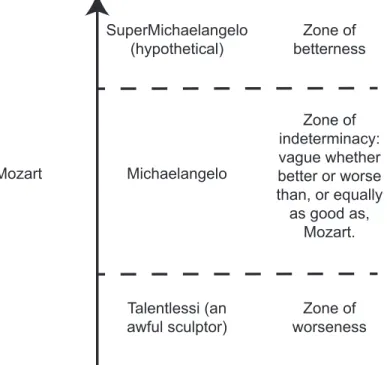
Zone of worseness
Figure 2.1: A standard configuration with trichotomous incomparability.
Here Mozart is the ‘standard’ in question, against which the sculptors will be
compared. The arrow indicates sculptors of increasing creativity; the dashed lines
indicate that the nature of the zonal boundaries is unspecified. For clarity, I have included
a region of (perhaps merely possible) sculptors who are more creative than Mozart.
Finally, the precise relative positions of Mozart and Michelangelo should be ignored; they
are artefacts of diagramming.
The question at hand is, what’s going on in the zone of trichotomous incomparability?
It is natural to think that if A and B are trichotomously incomparable, then they are
incomparable full stop:
Hard Incomparabilism.
In cases of Trichotomous Incomparability, it is false
that A is better than B, and false that B is better than A, and false that A and B
are equally good. In virtue of this, A and B are not evaluatively comparable.
5To say that A and B are evaluatively comparable is to say that there is a true
comparison that holds between them.
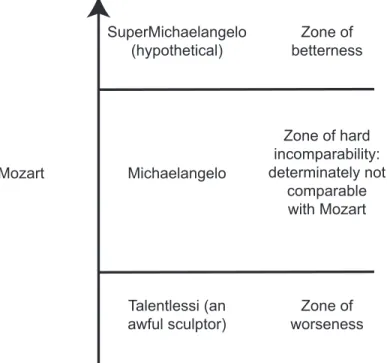
6If Hard Incomparabilism is right, then Mozart and
Michelangelo are trichotomously incomparable, and incomparable full stop:
Mozart
SuperMichaelangelo (hypothetical)
Michaelangelo
Talentlessi (an awful sculptor)
Zone of betterness
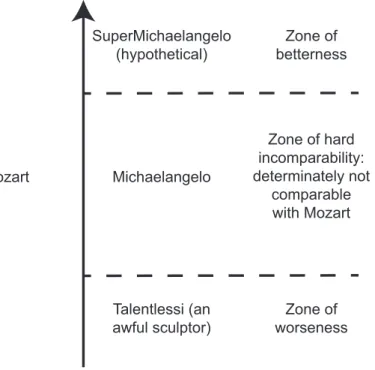
Zone of hard incomparability: determinately not
comparable with Mozart
Zone of worseness
Figure 2.2: Hard incomparabilism.
After all, what other comparison
could
hold? This intuition is what grounds the
Trichotomy Thesis:
Trichotomy Thesis.
‘[If] two items A and B are evaluatively comparable, then
A must be better or worse than B, or A and B must be equally good.’
7If the Trichotomy Thesis is right, then the only such relations are the classic three.
Chang denies this trichotomous orthodoxy:
Parity view.
There are some cases of trichotomous incomparability which are
nevertheless cases of evaluative comparability. In these cases, the
6In particular, ‘comparable’ does not meanmore or less equal, as sometimes in everyday use.
trichotomous relations determinately do not hold, and the fourth relation of
parity determinately holds.
On this view, parity is not derivative or otherwise second-class. It is as respectable as
betterness, worseness, and equality. So even though Mozart and Michelangelo are
trichotomously incomparable, they are comparable. There is a fourth comparative which
applies. Mozart and Michelangelo are on a par:
Mozart
SuperMichaelangelo (hypothetical)
Michaelangelo
Talentlessi (an awful sculptor)
Zone of betterness
Zone of parity: comparable (on
a par) but trichotomously
incomparable with Mozart
Zone of worseness
Figure 2.3: Parity
So the locus of disagreement between Hard Incomparabilism and Parity amounts to
this: are there such a Mozart and Michelangelo, comparable yet not trichotomously
comparable? Hard Incomparabilism stands or falls with the Trichotomy Thesis.
Trichotomy is true just in case there is no such pair, and in that case Hard
Incomparabilism is the right view.
Ruth Chang offers an existence proof for parity, and thus an argument that
2.2
The Chaining Argument
The Chaining Argument has two uncontroversial premises, and two crucial and
nonobvious premises. The first uncontroversial premise follows from our stipulations:
(CA1) Mozart and Michelangelo are trichotomously incomparable: it’s not
true that Mozart is more creative, and not true that Michelangelo is more
creative, and not true that they are equally creative.
8The second uncontroversial premise is that Mozart is comparable with Talentlessi, an
awful sculptor—Mozart is much better.
9Let’s call Talentlessi S0 (sculptor-zero), and
Michelangelo Sn (sculptor-n) for reasons that will shortly become clear. Then:
(CA2) Mozart is comparable with S0.
The nonobvious premises are the
Existence Claim
and the
Small Unidimensional
Difference Principle
.
The Existence Claim is that Talentlessi is connected to Michelangelo via a series of
‘small unidimensional differences’.
10By repeatedly improving Talentlessi in single small
ways, we could make him as creative as Michelangelo. Put another way, there exists a
chain of (in most cases) merely possible sculptors
S0 (Talentlessi), S1 (a sculptor slightly more creative in one respect than S0),
S2, . . . , Sn (Michelangelo)
such that between any two adjacent members of the chain there is only a small
unidimensional quality difference. Let’s extend our numbering in the obvious way:
(CA3)
Existence Claim.
The chain S0, S1, . . . Sn exists, and between any two
adjacent members there is just a small unidimensional difference.
8Remember that we are ruling out epistemicism, and using these names somewhat stipulatively.
9See Chang (2002), p. 672 fn. 18.