Contents lists available atScienceDirect
Earth
and
Planetary
Science
Letters
www.elsevier.com/locate/epsl
Seismicity
and
state
of
stress
in
the
central
and
southern
Peruvian
flat
slab
Abhash Kumar
a,
∗
,
Lara
S. Wagner
b,
Susan
L. Beck
c,
Maureen
D. Long
d,
George Zandt
c,
Bissett Young
a,
1,
Hernando Tavera
e,
Estella Minaya
faDepartmentofGeologicalSciences,UniversityofNorthCarolinaatChapelHill,104SouthRd.,MitchellHall,CB#3315,ChapelHill,NC27599-3315,USA bDepartmentofTerrestrialMagnetism,CarnegieInstitutionforScience,5241BroadBranchRoad,NW,Washington,DC20015-1305,USA
cDepartmentofGeosciences,UniversityofArizona,1040E.4thStreet,Tucson,AZ85721,USA
dDepartmentofGeologyandGeophysics,YaleUniversity,210WhitneyAvenue,NewHaven,CT06511,USA eInstitutoGeofisicodelPeru,CalleBadajoNo.169,Urb.MayorazgoIVEtapa,Lima,Peru
fElObservatorioSanCalixto,CalleIndaburo944,Casilla12656,LaPaz,Bolivia
a
r
t
i
c
l
e
i
n
f
o
a
b
s
t
r
a
c
t
Articlehistory:
Received5August2015
Receivedinrevisedform9February2016 Accepted11February2016
Editor:P.Shearer
Keywords:
Nazcaplate Peru ridgebuoyancy subductiongeometry flatslab
WehavedeterminedtheWadati–BenioffZoneseismicityandstateofstressofthesubductingNazcaslab
beneathcentralandsouthernPeruusingdatafromthreerecentlydeployedlocalseismicnetworks.Our
relocatedhypocentersareconsistentwithaflatslabgeometrythatisshallowestneartheNazcaRidge,
andchangesfromsteeptonormalwithouttearingtothesouth.Theselocationsalsoindicatenumerous
abrupt along-strikechanges in seismicity,most notably an absenceof seismicity along the projected
locationofsubductingNazca Ridge.Thisstandsinstark contrasttothe veryhighseismicityobserved
along theJuanFernandez ridge beneathcentral Chilewhere,asimilar flatslabgeometry isobserved.
We interpretthisasindicative ofanabsenceofwater inthemantlebeneath theoverthickenedcrust
oftheNazcaRidge.Thismayprovideimportantnewconstraintsontheconditionsrequiredtoproduce
intermediate depthseismicity.Ourfocalmechanismsand stress tensorinversions indicatedominantly
down-dipextension,consistentwithslabpull,withminorvariationsthatarelikelyduetothevariable
slabgeometryandstressfromadjacentregions.WeobservesignificantlygreatervariabilityintheP-axis
orientationsandmaximumcompressive stressdirections.Thealongstrikechangeintheorientationof
maximumcompressivestressis likelyrelatedtoslabbendingandunbendingsouthoftheNazcaRidge.
©2016ElsevierB.V.All rights reserved.
1. Introduction
Theterm“flatslabsubduction”isoftenusedtorefertothe sub-ductionofanoceanicplatethatentersthetrenchatanormaldip angle(
∼
30◦),continuessubductionupto100kmdepth,andthen abruptlybendstotravelhorizontally(∼
0◦ dip)forseveralhundred kilometersbeforeresumingitsdescent(HasegawaandSacks,1981; CahillandIsacks,1992).Thedepthofflatteningandinboardextent ofthehorizontalsegmentvariesbetweendifferentregions offlat slabsubduction,forreasonsthatare stillunderinvestigation(e.g. Maneaand Gurnis, 2007; Geryaet al., 2009; Maneaetal., 2011; Hu et al., 2016). Flat slab subduction is of particular interest because it has often been causally linked to unusual tectonic processes such as the cessation of arc volcanism, inboardthick-*
Correspondingauthor.E-mailaddress:[email protected](A. Kumar). 1 NowatDonskojandCO,Kingston,NY.
skinneddeformation ofthe overridingplate andtheevolution of high plateaus (e.g. Isacks and Barazangi, 1977; Jordan and All-mendinger, 1986). Inparticular, the Laramide uplift ofthe Rocky Mountains and subsequent ignimbrite flare-up in the western United Stateshavebeenattributedto a periodof flatsubduction oftheFarallonplate(80–55Ma)(e.g.DickinsonandSnyder,1978; Humphreysetal.,2003).
Inthisstudy,weinvestigatethesouthern portionofthe Peru-vianflatslab(Fig. 1).ThewesternmarginofPerubetween2◦and 15◦S ischaracterizedby theflat subduction oftheoceanicNazca platebeneaththecontinentalSouthAmericanplate(e.g.Hasegawa and Sacks, 1981; Cahill and Isacks, 1992; Hayes et al., 2012; Dougherty and Clayton, 2014). The Peruvian flat slab is associ-atedwiththe markedabsence ofanyknownQuaternary arc vol-canism andwith generally low surface heat flow measurements (HenryandPollack,1988).Whilethecausesofflatslabsubduction are still controversial (e.g. Gerya et al., 2009; Skinner and Clay-ton, 2013), one possible contributing factor beneath Peru is the subduction of the lessdense oceanic lithosphereassociated with
Fig. 1.MapshowingthePeruvianflatslabregion,ourstudyarea(yellowbox),and thelocationsofseismicstationsusedinthisstudy.DarkpinkcirclesarePULSE sta-tions.DarkbluediamondsareCAUGHTstationsandlightbluecirclesarePERUSE stationsusedinthisstudy.LargepurplecirclesrepresentGSNstationsatLima,Peru andLaPaz,Bolivia.Yellowstarsarethelocationofimportantcities.Redtrianglesare Holocenevolcanoes(INGEMMET,
www.ingemmet.gob.pe
).Solidlinesareslab con-toursfromAntonijevic
etal. (2015).DashedlinesareslabcontoursfromCahill
and Isacks (1992).TheNazcaRidge,IquiqueRidgeandNazcaFractureZoneareshaded grayoffshore.TheblackarrowoffshorerepresentstheplatemotionoftheNazca platefromHS3-NUVEL1A(GrippandGordon,2002).(Forinterpretationofthe ref-erencestocolorinthisfigurelegend,thereaderisreferredtothewebversionof thisarticle.)the Nazca Ridge (e.g. Hu et al., 2016). The crust of the Nazca Ridge is unusually thick (
∼
17 km) and was formed at the Pa-cificNazcaspreadingcenteralongwithitsconjugateonthePacific Plate,the TuamotoPlateau,in theearly Cenozoic(Hampel,2002; Hampeletal.,2004).ThetrackoftheNazcaRidgeandthe conver-gencedirectionare not parallel (Fig. 1), resultingin asouthward migration of theridge relative to the overridingcontinent. Since itfirstbegansubducting∼
11.2Maat∼
11◦S(Hampel,2002),the ridge has migrated∼
480 km south relative to the South Amer-ican margin (Hampel, 2002; Hampel etal., 2004). The timing of slabflatteningiswell constrainedbyradiometric agesofthe ces-sationof arcvolcanism,episodes of intense metallogenicactivity (Rosenbaum etal., 2005) andbasement involvedthrust deforma-tion (Shira uplift) on the overriding South American plate. The spatio-temporal pattern of these indicators seems to follow the southwardmigrationoftheNazcaRidge(Rosenbaumetal.,2005; Bissigetal.,2008).PreviousstudieshaveanalyzedtheWadati–Benioffzone(WBZ) seismicity in Peru,primarily using datafromstations at teleseis-micdistancesorlocaldatacollectedfromsmallseismicnetworks (Hasegawa andSacks, 1981; CahillandIsacks,1992; Hayesetal., 2012). Herewe presentestimatesofearthquakelocationsand fo-calmechanismsforslabeventsbetween10◦and18.5◦Susingdata fromthree co-deployedlocalseismic networks. Wealso estimate theregionalstressfieldtensorsouthoftheNazcaRidgeinorderto betterunderstandthecurrentstateofstressofthesubductingslab inthis regionof complexsubduction geometry.We note a num-berof strikingseismicity patternsthat mayindicate variationsin slabhydrationanddehydrationprocessesalongstrike.Ourregional stress field estimatesshow significant changes over short spatial scales,consistentwiththerapidlychangingslabgeometry.Forthe most part, our results are consistent with previous work show-ing down-dip extension below 60 kmdepth (Marot etal., 2013; Rontogianniet al., 2011), withslight variations likely dueto the regionaltectonicsettingandcomplexslabgeometry.
2. Data
We usedatacollected fromthe temporarybroadband stations of three independent seismic arrays (Fig. 1). The CAUGHT (Cen-tral Andean Uplifts and the Geodynamics of High Topography) experiment comprised 50 broadband seismometers deployed for 21monthsbetweenNovember2010andJuly2012between13◦S to 18◦S across the northern Altiplano. Thirty stations were de-ployed in Bolivia and 20 stations in Peru with a higher density lineacrossthe cordillerathatspannedboth PeruandBolivia. The “PULSE” (PerU Lithosphere and Slab Experiment) network (e.g., Antonijevic et al., 2015) was deployed from May 2011 to June 2013andconsistedof40broadbandseismometers.ThePULSE net-work was located above the southern part of the Peruvian flat slabroughlyalongthreetransects.Thesoutherntransectextended northandeastfromthecityofNazcatobeyondCusco.Themiddle and northern transects were located between Pisco and Ayacu-cho, andLimaandSatipo,respectively.The northerntransectwas situatedabovethepaleo-locationofthesubductedNazcaRidge be-tween10–8Ma(Rosenbaumetal.,2005).Thesouthernandmiddle transectsstraddletheprojectedcurrentlocationofthesubducted NazcaRidge. WealsousedatafromthePERUSEprojectdeployed by the California Institute of Technology and UCLAbetween July 2008andJune2012(e.g.,PhillipsandClayton,2014).Weusedata for 8 stations from this deployment located along the coast in southern Peruandalong thesouthern transect ofthePULSE net-work.
3. Methods
3.1. Eventlocationsanderroranalyses
We identifypossibleearthquakesrecordedby ourthreearrays using the dbdetect tool that is part of the ANTELOPE software package (http://www.brtt.com).This methodisbased ona short-termaverage(STA)versuslong-termaverage(LTA) trigger mecha-nism.AneventisdetectediftheratioofenergybetweenSTAand LTAwindowsexceedsauser-definedthreshold.Weuseanenergy thresholdratio of5andSTA andLTAmovingtime windows of1 second and10 secondsrespectively. Of the 3000possible events identified,weselected952earthquakesafterindividualinspection oftheseismicwaveformsforeachevent.
Wecalculateabsoluteeventhypocenterlocationsusingthe sin-gle event location algorithm HYP, incorporated into the SEISAN softwarepackage(HavskovandOttemoller,1999).HYPdetermines earthquake locations using an iterative linearized least squares inversion of travel time data (Aki and Lee, 1976). We use a modified version of the P-wave velocity model of Dorbath and Granet (1996) that takesinto account the 65km average crustal thickness in our study area as determined from recent analy-ses ofteleseismic receiver functions (Phillips and Clayton, 2014; Bishop et al., 2014). S-wave velocities are determined using a Vp/Vsratioof1.75(DorbathandGranet,1996).
Weaddtothislistbyinvestigatingthose114eventswherethe range of eventdepths determined with different starting depths was
>
10km.We dividethislistof 114eventsintotwo sets de-pendingonthenumberofsimilardepthsrecoveredfromourfour starting depths. The first set of events includes 45 earthquakes for which three of the four original hypocentral locations differ in depth by less than 10 km. We calculate travel time residuals correspondingto eachofthe threestarting depthsandselectthe location withthe minimumtravel time residual asourpreferred hypocenter.Iftraveltimeresidualsarethesameformorethanone startingdepththenthelocationwhosestarting depthisclosestto thehypocentral depthis selected. We recalculateeventlocations foreacheventinthefirst setusingtheir beststarting depthand obtain16 robust eventlocations followingthe same cutoff crite-riaasusedpreviously(depth>
50km,azimuthalgap<
270◦,with lessthan15kmerrorindepth).Thesecondsubsetofeventsincludes68earthquakesforwhich thehypocenters correspondingto thefourstarting depths (5 km, 100km,200kmandtheinitialhypocentraldepthfromdbdetect) have two or fewer final depths that are within 10 km of each other. We test several other starting depths at 25 km intervals foreach of these events and calculate travel time residuals cor-respondingto each starting depth.We look foratleast3 similar depths(
<
10kmdifference)recoveredfrominversionswiththree adjacentstarting depths, andtravel time residuals of lessthan 3 seconds.Usingthese criteria, weobtain hypocentrallocationsfor 36 events. We recalculate event locations for each event using theirbeststarting depths andobtain7eventlocationsthat satis-fiedtheadditionalaforementionedcutoffcriteria(depth>
50km, azimuthalgap<
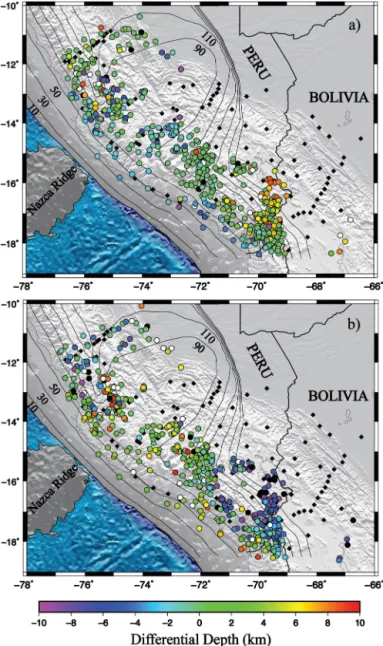
270◦,withlessthan15kmerrorindepth).We fi-nallyadd these23robusteventlocations(16fromthefirstgroup and7fromthesecond) tothe568 eventsdescribed earlierfora totalof 591robust event hypocenters (Fig. 2a; see Supplemental Table T1). South of the Nazca Ridge the error in event depth is smallandvariesbetween2.6–14.9 km. NorthoftheNazcaRidge, deptherrorvariesbetween2.3–25 km,with10moreevents hav-ingdeptherrorintherangeof25–32.4.We test the sensitivity of our event hypocenters to velocity models by subtracting and adding5% to both the P andS wave velocitiesofeachlayerinourvelocity model.Theresultsofthese testsareshownin Figs.3a andb.The averagedepth forthefast modelis 0.86km deeper than our preferredmodel, andthe av-erage depth for the slow model is 0.79 km shallower than our preferredmodel.Theaveragespreadinthedepthsofhypocenters fora given eventbetweenvelocity modelsis 7 km witha stan-darddeviationof6km.The mostsignificantdifferencesare seen forthe deepesteventswiththelongesttravelpaths, asexpected. Whileindividualeventshaveslightdifferencesindepthdepending onthevelocity modelused,theoverall patternsobservedremain robust.
Werelocate our 591events usingthe double difference tech-niqueofWaldhauserandEllsworth (2000).Thismethodtakes ad-vantage of the nearly identical ray paths of two nearby events recorded at a common station. HypoDD uses both absolute and relativetravel timedataforeach pairofeventstodetermine rel-ative eventlocations that are independent of regional structural variations.Wecalculatedifferentialtimesbetweencommonphases recorded at a common station for all events pairs separated by
≤
40 km.Eacheventisgroupedto amaximumof10neighboring eventswithinter-eventdistances≤
40 km,eachofwhichwere re-quiredtohaveat leasteightdifferential traveltime observations. Ofthe591eventslocatedusingHYP,wewereabletorelocate508 eventswithHypoDD(Fig. 2b;SupplementalTableT2).The remain-ing 83events didnot have sufficient neighboringearthquakes at smallinter-event distances(≤
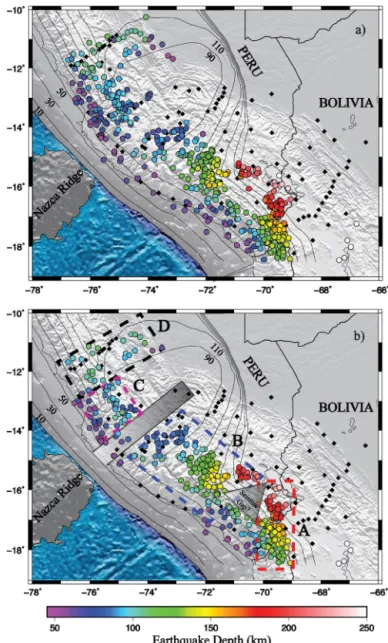
40 km)fora stablerelative reloca-tion.Fig. 2.Earthquakehypocenterscalculatedusing(a)singleeventlocation method (b)relativerelocationmethod. Thehypocentersarecolorcoded bydepth.Black diamondsarethestationsusedinthelocationprocess.Solidlinesareslabcontours from
Antonijevic
etal. (2015).Dashedboxesoutlinetheregionsofvariousclusters (A–D)ofeventsidentifiedinthestudyarea.Shadedtrianglerepresentstheseismic gapbetweenclusterAandBat depth≤120km.Notetheabsenceofseismicity (shadedrectangle)alongtheprojectedlocationofthesubductingNazcaRidge.3.2. Focalmechanismsandstresstensorcalculation
Fig. 3.Earthquakehypocenterscalculatedusingsingleeventlocationmethod (a) bysubtracting5%(b)byadding5% toourvelocitymodel.The hypocentersare colorcodedbycalculatingthedifferencebetweenhypocentraldepthforour veloc-itymodelandthemodified(slowandfast)velocitymodel.Eventswithcoolcolors (lefthalfofthecolorscale)representdownwardshiftedeventsandeventsshown inwarmcolors(righthalfofthecolorscale)areupwardshiftedevents.Black di-amondsarethestationsusedinthelocationprocess.Solidlinesareslabcontours from
Antonijevic
etal. (2015).variance by assumingthat the misfitis normallydistributed.The errorineachmodelparameter(e.g.strike,dip,andrake)is deter-minedwithrespecttotheminimummisfitvalue (Reasenbergand Oppenheimer,1985).Wedonotincludesolutionswithsparse po-larityreadingsandthoseforwhichallreadingsareclosetonodal planesinfurtheranalyses.Additionally,weusethefollowing crite-riatoselectthebestavailablefocalmechanismsolutions:atleast 10 polarity readings, a maximum of 2 incorrect polarities anda maximum10◦ errorinstrike anddip and20◦ errorinrake.This producesatotalof173robustfocalmechanismsolutions.
We use our observed focal mechanisms, including strike and dipofthefaultplaneandthesenseofrelativemotion(rake)along those faults,to calculate theregional stress field tensor(Delvaux andSperner,2003).Thestress tensorinversionminimizesthe an-gular misfit betweenthe observed and predicted slip directions. Tocalculatetheerroronstrikeanddipofstress axes(
σ
1,
σ
2,
σ
3),theinversionalgorithmtestwiderangeoforientationsofthethree
stress axesbyperformingaseriesofrotation,successivelyaround sigma1,sigma2,andsigma3axes(DelvauxandSperner,2003).It findstherangeofrotationangleforwhichthevalueofangular de-viationbetweentheobservedandtheoreticalslipislessthanuser definedthreshold.Theerroronstrikeanddipofthestressaxesis thereforerelatedtotheangularaperture (rangeofrotationangle) ofaconecenteredonthestressaxes.
Giventhe likelihoodthat the state ofstress inthe subducting plate varies depending on the changing slab geometry, we per-formindependentstressanalysesonfoursub-regionssouthofthe Nazca Ridge that comprise areas withconsistent slab dip angles insideBox1,2(2Sand2N),and3,southoftheNazcaRidge(black rectangles, Fig. 8) andcalculate the regional stress field foreach subregion individually. We do not include the area north of the NazcaRidgeforstresstensorinversionduetothesparsityoffocal mechanism observationsand complexslab geometry(Antonijevic et al., 2015). In Box 1, we choose the central portion for stress tensor inversion, wherethe slab dipis constant. We exclude the southernmostportion ofBox 1,wherethedirectionofslabdipis differentthanthemajorityofT-axesmeasurements inthecentral portionofBox1.InBox2,theslabdipdirectionvariesfromNEin thesouthtoSEinthenorth(Fig. 8). Wechoosetwosmall subre-gions2Sand2NinBox2forstressinversions,onethatliessouth of thebend andone tothe northof thebend (Fig. 8). InBox 3, the slightdowndip directionof nearly horizontalslab isdirected towardsSEandweselectedalltheeventswithknownfocal mech-anismforstresscalculationinBox3(Fig. 8).
4. Results
4.1. Earthquakelocations
Theresultsofoursingleeventlocationsandrelativerelocations areshowninFigs. 2aandbrespectively.Adirectcomparisonofthe relativeandabsolutelocationsisshowninFig.S1.Crosssectionsof ourrelativerelocationsareshowninFig. 5andinFigs.S2andS3 ofthesupplementarymaterial.Weobserveanumberofdistinctive patternsacrossourstudyarea,includingregionsofdenseseismic activity,regionswithsparseseismicity,andsomeregionsinwhich wewereabletofindnowell-locatedevents.
Our southernmostcluster (labeled“A” inFig. 2b) comprises a linear, northwardtrendingband ofseismicity between69◦Wand 70◦W.Thedistincteastern marginofthisclusteriswell resolved, andisvisibleinprevious catalogsofseismicity,albeitlessclearly. The north–southtrendofthiscluster doesnot correspondto the local dip direction of the slab, the convergence direction of the plates, or any known structure within the subducted plate. The seismicity inthisregion generallydefines a slabdescending at a constant dipof
∼
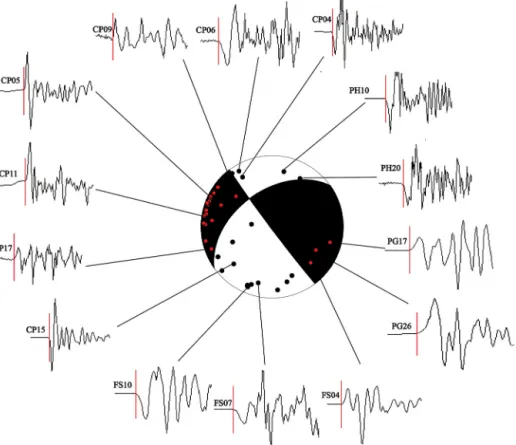
30◦ (measuredorthogonallytothetrench)toat least 200kmdepth(Figs. 5candS3of thesupplementary mate-rial).Fig. 4.Anexampleofhigh-qualityfocalmechanismsolution(lowerhemisphereprojection)determinedfromfirstmotionpolarityat37stations.Reddotsindicate compres-sional(up)arrivalandblackdotstensional(down)arrival.P-waveformusedtodeterminethissolutionisshownwithmarkedpositionoffirstarrival(redverticalline).(For interpretationofthereferencestocolorinthisfigurelegend,thereaderisreferredtothewebversionofthisarticle.)
continuousincreaseineventdepthswithin thisclusterbothfrom northto south as well as from west to east, showing a smooth contortionofthe slab.Ourobservedseismicity (crosssection CC, Fig.S3)inthiscontortedregionisingoodagreementwiththe pre-viousstudyofBoydetal. (1984),whoalsoproposedcontortionas opposedtotearingintheslab,wherethegeometryofsubduction changesfromflattonormal.
Between clusters B and C, along the projected location of the subducted Nazca ridge, seismicity is anomalously absent at depths below 80 km (shaded rectangle, Fig. 2b; dotted ellipse, Fig. 5b). Thisobservationis distinctly differentthan thereported seismicity along the Juan Fernandez ridge track in central Chile whereseismicity is particularly abundant (Anderson etal., 2007; Hayesetal.,2012).The trenchparallelcluster C(Fig. 2b)beneath theWesternCordillera,northoftheNazcaridge,isconfinedtothe westernmostmarginofthehorizontalportionoftheflatslab.This definesitsownlinearclusterofevents,connectingthediffuse seis-micityalongthenorthernedgeofPULSEnetworkandseismicgap alongtheprojectedlocationofthesubductedNazcaridge.Wefind veryfeweventsinboardofthisclusterexceptforasmallnumber ofrelativelyshalloweventswithdepthsbetween50and70kmfor whichweareunabletodeterminerelativerelocations(Fig. 2a).
Along the northernmost end of our study area, the observed slabseismicity (denoted ascluster DinFig. 2b) hasa maximum inboard extent of over 400 km from the trench. The events in thisclusteraregenerallydiffuseandrangeindepthfrom
∼
100to 120km,significantlydeeperthaneventsfoundclosertotheNazca Ridgefurthersouth.4.2.Focalmechanismsandstressanalyses
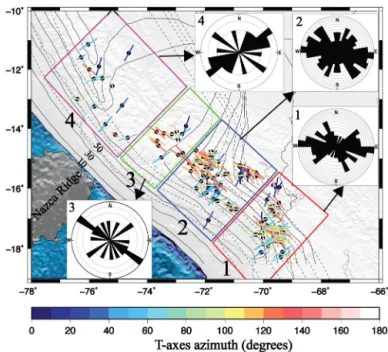
Ourfull focal mechanismsolutions are showninmapview in Fig. 6andinFigs.S4andS5ofthesupplementarymaterial.T-axis
orientations areshown inFig. 7.The resultsof ourfocal mecha-nism analyses indicate a predominanceof normalfaulting across ourstudyarea(Fig. 6,TableT3inthesupplementary material).In our southernmost region (Box 1,Fig. 7), the T-axes have slightly variable orientations, but are oriented dominantly E–W to ENE– WSW(inset1,Fig. 7).WefindthattheT-axesaregenerallyparallel to the slab in Box 1, but rotated
∼
30–40◦ clockwise from the down-dip direction(black squares, Fig. 9a). Our stress tensor so-lution shows a similar pattern with the least compressive stress (σ
3,redarrowinFig. 9a)orientedparalleltothedippingslabjustnorthofE–W(strike
=
83◦anddip=
35◦,with1-sigmastandard errorof20.4◦). Themaximumcompressive stress(σ
1,bluearrowinFig. 9a)isnearlyhorizontalandorientedN–S.
InBox2,weseeawell-distributedrangeofT-axisorientations atsignificantlydifferentazimuths(inset2,Fig. 7).Thisistobe ex-pected,giventherangeinslabdipdirectionsinthisregion.Ifwe focusonthetwoboxesusedtocalculatethestresstensors,within whichslab orientation isrelatively constant(Box 2SandBox 2N, Fig. 8)weseedistinctdifferencesbetweenthetwo.InBox2S,the T-axesshow agenerallyslabparallel orientation(Fig. 9b).The
σ
3axisisdirectedENEatstrike
=
64◦ anddip=
12◦,with1-sigma standarderrorof17.6◦,indicatingaslabparallel,down-dip orien-tationwithasimilarslightclockwiserotationasisobservedinBox 1.However, unlikeBox1,themaximumcompressivestress(σ
1)isnearly perpendicularto theslabsurface (solidred circle,Fig. 9b). InBox2N,theT-axesagainliewithintheslabandaredominantly orienteddown-dip (black squares,Fig. 9c).The leastcompressive stress (
σ
3) is also generally parallel to the shallow downdipdi-rection(redarrowinFig. 9c).Specifically,
σ
3 isorientedESEwitha strike
=
114◦,dip=
12◦,and1-sigma standard errorof21.1◦. Themaximumcompressivestress(σ
1)isnearlyhorizontalandFig. 5.Mapshowinglocationsof(a)trench-parallel(BB)andtrench-perpendicular (P1,P2,P3,andP7)transectsusedtoplotseismicitycross-sections.Redtickmarks onBBrepresentsdistanceintervalof100km.(b)Seismicitycross-sectionsBB, par-alleltothetrench.Dottedellipsemarktheabsenceofseismicityalongtheprojected locationofthesubductedNazcaridgetrack.Redarrowsmarktheintersectionwith trench-perpendicularcrosssections.(c)Seismicitycross-sections(P1,P2,P3,and P7)perpendiculartothetrench.Earthquakeswithin±35kmareprojectedonto eachcross-section.Thesolidlineineachcrosssection istheslabcontourfrom Antonijevicetal. (2015).Redstarineachtrench-perpendicularcrosssectionmarks theintersectionwithBBcrosssection.SeeFigs.S2andS3ofthesupplementary materialfortheremainingsetoftrench-parallelandtrench-perpendicular seismic-itycross-sections.(Forinterpretationofthereferencestocolorinthisfigurelegend, thereaderisreferredtothewebversionofthisarticle.)
Fig. 6.Mapoffirstmotionfocalmechanismsplottedinlowerhemisphere projec-tion.Mechanismsarecolorcodedbyearthquake depthandmainlyshownormal faultingacrossthestudyarea.Solidlinesareslabcontoursfrom
Antonijevic
etal. (2015).SeeFigs.S4andS5ofthesupplementarymaterialforzoom-inmapoffocal mechanismforeventsinsidetheredandblueboxrespectively.(Forinterpretation ofthereferencestocolorinthisfigurelegend,thereaderisreferredtotheweb versionofthisarticle.)Fig. 8.Mapshowingtheorientationsofslabdipvectors(colorsticks).Colorofthe vectorsisproportionaltothedipoftheslab.Slabcontours(solidblacklines)are from
Antonijevic
etal. (2015).Coloredboxesdividethestudyareaintofour differ-entregions,similarasFig. 7
.BlackrectanglessouthoftheNazcaRidgecoversthe smallerregionofconstantdipforwhichstressaxesorientations(smallerinsets)are determined.Areddiagonallineineachblackrectangleisthelocationofcross sec-tionsusedtocomparetheT-axesandstressaxisinFig. 10
.(Forinterpretationofthe referencestocolorinthisfigurelegend,thereaderisreferredtothewebversionof thisarticle.)Fig. 9.(a–d)StresstensororientationsforblackrectangularregioninsideBox1,2 (2Sand2N)and3,respectively,shownin
Fig. 8
.Redandbluearrowsshowthe az-imuthofminimum(σ3)andmaximum(σ1)compressivestress,respectively.Black circlesandsquaresoneachstereonetshowthePandT-axesorientationsassociated witheachearthquake,respectively.Agreatcircle(greencolor)oneachstereonet representstheaverageslaborientationintheregion.(Forinterpretationofthe ref-erencestocolorinthisfigurelegend,thereaderisreferredtothewebversionof thisarticle.)isverydifferenttoBox2Swherethemaximumcompressivestress (
σ
1)isslabperpendicular.The flat slab region just south of the Nazca Ridge (Box 3, Figs. 7 and8) is characterized by comparatively few focal
mech-anisms. The T-axes have variable orientations, all of which are essentially horizontal andnearly parallel to the flat slab surface (black squares, Fig. 9d). The least compressive stress (
σ
3) ishor-izontal and parallel to very slight downdip directionof the slab (redarrowinFig. 9d).Specifically,
σ
3 isdirectedNW–SEatstrike=
301◦ anddip=
8◦,with1-sigma standard errorof17.4◦.The maximumcompressive stress (σ
1,solid red circlein Fig. 9d)andP-axes(blackcircles,Fig. 9d)arenearlyverticalandorthogonalto theslab,similartoBox2S,butdifferentfromtheadjacentBox2N. In Box 4, north of the Nazca Ridge, the T-axes have variable orientations (Fig. 7). This variable state of stress of the subduct-ingslabisperhaps affectedbythepresenceofproposedtearand complex slab geometry north of the NazcaRidge (Antonijevic et al.,2015).Wedonotperformstresstensorinversioninthisregion duetothelikelynon-uniformityinthestressfieldandsparsity of focalmechanismsolutions.
5. Discussion
5.1. AbruptvariationsinseismicitywithinthesubductedNazcaplate
The earthquake locations presented here show abrupt spatial changes in seismic activity across our study area. Most of the patterns we observeare also visiblein eventlocations from ear-lier studies (e.g. Cahill andIsacks, 1992; Hayeset al., 2012) and global catalogs (e.g. International Seismological Center (ISC) and AdvancedNationalSeismicSystem(ANSS))buthavenotpreviously been discussed in any detail. While many of these patterns are difficult to explain, we propose that one in particular may pro-vide clues into processes involvedin the genesis ofintermediate depthearthquakes.Specifically,alongtheprojectedlocationofthe NazcaRidge,weobserveamarkedgapinseismicitywithintheflat slab(shadedrectangleinFig.2banddottedellipseinFig. 5b).The correlationbetweenthisgapinseismicityandtheprojected loca-tionoftheNazcaRidgehaspreviouslybeennoted(Hampel,2002), butnoexplanationforthecauseofthiscorrelationhasbeen pre-sented.Giventhatotherfactorssuchastemperature,plateage,and pressure donot varyoverthese smalllengthscales, one possible explanationforthischangeinseismicitycouldberelatedto differ-encesin crustalthicknessofthe downgoingplateandthe causes ofintermediatedepthseismicity.
While the causes of intermediate depth seismicity remain a subjectofongoingresearch,dehydrationembrittlementcouldplay asignificantroleinthegenesisoftheseeventsinsubductionzones worldwide.Astheoceanicplatestartstosubduct,itundergoes sig-nificant bending seaward of the trench axis and produce outer rise normal faults (Peacock, 2001). Previous studies have found evidence for seawater infiltration through these outer rise faults (Hussong et al., 1988). This seawater infiltration results in the formation of hydrous minerals (e.g. lawsonite, chlorite, and am-phibole in the crust; serpentinite and talc in the mantle) along thesefaultplanestodepthsof15–20kmormore(Peacock,2001; Raneroetal.,2003).Thebreakdownofhydrousmineralsat appro-priate P–T conditions canlead to increasesin pore pressurethat decrease hydrostatic pressure and hence promote brittle failure requiredfor intermediatedepth seismicity (RaleighandPaterson, 1965).
Fig. 10.(a–d)Crosssectionsshowingtheorientationofleastcompressivestress(red arrow)andT-axesvectors(smallbluesticks)forfourblackrectangularregions in-sideBox1,2(2Sand2N),and 3,respectively,shownin
Fig. 8
.Locationofeach crosssectionisshownasreddiagonallineintheboxesshowninFig. 8
.Eachcross sectionisorientedparalleltotheaveragedipdirectionoftheslab.Thesolidblack lineineachcrosssectionistheslabcontourfromAntonijevic
etal. (2015).T-axes vectorswithineachblackrectangleareprojectedontoeachcross-section.(For in-terpretationofthereferencestocolorinthisfigurelegend,thereaderisreferredto thewebversionofthisarticle.)oftypical mantlehydrous phases(e.g. serpentinite, talc). In con-trast, the outer rise faults in the normaloceanic plateon either sideoftheridgewouldcontainbothcrustalanduppermantle hy-drousphases.Seismicityupto
∼
80kmdepth,closetothetrench, isrelativelycontinuouslydistributedalongstrike(Fig. 2a).Asmall breakinseismiccontinuity(trenchwardedgeofclusterB,Fig. 2b), justsouthoftheridgeprojection,isduetothelossofeventsafter relativerelocation.Wehypothesizethatthisalongstrikecontinuity inseismicity,up-dipfromthehorizontalportionoftheflatslab,is relatedtothedehydrationofhydrousmineralsintheoceaniccrust bothwithin theridgeandinthenormalcrust oneitherside.We furtherproposethatwhentheslabreaches80kmdepth,thecrust iseitherdehydratedortheremaininghydrousphasesarestableat theexistingP/Tconditionsalongtheflatslabandthereforedonot producesufficientporepressuretoinduceseismicity.Earthquakes thatdo occurnorthandsouthofthe ridgealong theflatportion oftheslabarethencausedbythedehydrationofhydratedmantle lithosphere,notcrust.Thesedehydrationreactionsintheoceaniccrustanduppermost mantle of the subducting plate are mainly temperature depen-dent(Babeyko andSobolev,2008).Intheflatslabregion,thermal structureofthesubduction zoneisaffectedby thetimingofslab flattening (English et al., 2003), asthe overriding plate in a flat subductionzoneisnolongerincontactwithasthenosphericupper mantle.Forsimilarsubduction parameters(plateage,convergence velocity, etc.), a relatively older flat slab will therefore tend to havecolder thermalstructurethanaslabregionthathasrecently flattened. In southern Peru, the slab flattening eventis fairly re-cent(
∼
4Ma ago;Rosenbaumetal.,2005)atthecurrentlocation ofridgesubduction(∼
15◦S), makingsteadystatethermalmodels (e.g.English etal., 2003) inappropriate forthisarea.The existingdynamic model (Manea etal., 2011) forthe thermalstructure of the Chilean flat slab, whichexperienced flattening fora compar-ativelylonger periodoftime(
∼
8.6Ma;Ramosetal., 2002),may not be completely applicable forsouthern Peru. Further work to better constrain the likely temperatures across the Peruvian flat slabandtheeffectofthesetemperaturesondehydrationreactions areneededtotestthesehypothesesandbetterunderstandthe un-usual patternsofobserved seismicity acrossthesubducted Nazca Ridge.The triangular seismic gap(shaded triangle,Fig. 2b) observed between cluster AandB is also noticeablein the previous stud-ies(CahillandIsacks,1992),butneverreportedexplicitly.Because we note an excellent spatial correlation betweenthe subducting NazcaRidge(bathymetricfeature) andseismicgapalongthe pro-jected continuation of the ridge, we looked for evidence of any equivalent subducting bathymetricfeature that can be correlated tothistriangularseismicgap.Onesuchbathymetricfeatureisthe NazcaFracture Zone,a narrow (25–50kmwide)oceanic fracture zoneimmediatelysouthoftheNazcaRidge(Robinsonetal.,2006), whichiscurrentlysubducting alongthenorthernedgeofthis tri-angular seismic gap (Fig. 1). The projected location of this ridge wouldlikelybelocatednearthenorthernmostcornerofthisgap, making its association withthisabsence ofseismicity difficult to explain.Anotherbathymetricfeaturelocatedfurthertothesouthis IquiqueRidge(Fig. 1).Kinematicreconstructions(Rosenbaumetal., 2005) suggestthatthesubductionofIquiqueridgestartedvery re-cently(
<
2Ma).Itisthereforeunlikelythatthisridgehasreached a sufficientdepth toaffecttheseismicity inthisarea. Itis possi-blethatourobservedgapinseismicity isrelatedtoan unknown, fullysubductedheterogeneity inthesubductingplate, butwe are unabletoimageanysuchstructureatthistime.5.2. StateofstressoftheNazcaslab
We haveanalyzed thestate ofstress fortheNazcaslab south of theNazcaridge wherethe plateundergoes adramatic change indipangle.Recentstudieshaveshownthatthistransitioninslab dipisaccommodated notbya tear,butbyalong-strike stretching of the Nazcaplate(PhillipsandClayton, 2014). This extension is pervasiveenoughtohavealteredthefabricofthedowngoingslab (Eakinetal.,2016).
We observesome variabilityinthe T-axisorientations relative to the downdip direction(Fig. 9), butour stress tensor orienta-tionsshowthattheslabisexperiencingdown-dipextensioninall fourareasinwhichwehadsufficientdatatocalculatetheregional stress field (Figs. 8 and 9). Differences between T-axis orienta-tions andslabdipvectorsareobservedinother subductionzones (Andersonetal., 2007) andcould berelatedtostrainpartitioning along preexisting planesofweaknessesthat are variablyoriented withrespecttothedowndipdirection. Theregionalstressfield is more reliable indicator of ambient stress (Angelier et al., 1982). We note that the azimuth of the downdip direction variesfrom NNE toSW,butthe
σ
3 axisisalways paralleltotheslabsurface,andinthe downdipdirection(Fig. 10). Theonly minorexception isasubtleclockwiserotationinthesouthernmostsegmentsofthe normallydippingslab(Fig. 9a).Thisrotationin
σ
3 axisisperhapsisthoughttobeduetoslabpull,adominantdrivingforceforplate subduction(ForsythandUyeda,1975).
While the direction of maximum extension is uniformly downdip,there isanalternating patterninthedirectionof maxi-mumcompression(
σ
1)fromsouthtonorth.InBox1andBox2N(Fig. 9aandc),maximumcompressionisorientednearly horizon-tally,paralleltotheslabsurfaceinthealong-strikedirectionofthe slab(i.e.orthogonal tothedowndipdirection).InBox2SandBox 3(Fig. 9b andd),the maximumcompressive stressis orthogonal to theslab surface. This variability inthe direction ofmaximum compressionisseeninothersubductionzones(e.g.Bohnhoffetal., 2005; Rontogiannietal.,2011),andmaybe attributabletoforces associated with the along-strike bending and unbending of the slab(“table-clotheffect”)(Creageretal.,1995).Theexactpatterns ofalongstrikecompressionor(relative)extensionwilldependon thedepthoftheearthquakes relativetothe slabsurface,andthe precise geometry of the slab over relatively small spatial scales. Moredatawouldbeneededforthislevelofdetail,andwouldbe helpfulforfuturemodelingstudies.
6. Conclusions
Weusenewdatacollected aspartofthree separate but tem-porally and spatially overlapping deployments to studythe WBZ seismicity andstateof stressof theNazcaplateunderneath cen-tralandsouthernPeru.Weobserveamarkedabsenceofseismicity alongthe projected location ofthe subductingNazca ridge track. Thisobservedvariation inseismicity islikelyrelatedto the over-thickened crust (
∼
17 km) of the Nazca Ridge, compared to the normaloceaniccrustoneithersideoftheridge.Itispossiblethat the depth of hydration of the outer rise faults along the Nazca Ridgeislessthanthecrustal thicknessoftheridge,whichwould implythat onlythecrustalong theridgeishydratedandthe un-derlyingmantlelithosphereisdry.Incontrast,theouterrisefaults inthenormaloceanicslaboneithersideoftheridgewould con-tainboththecrustanduppermantlehydrousphases.We hypoth-esizethat thealongstrikecontinuityinseismicity upto∼
80km depthisrelatedtothedehydrationofcrustalhydrousphasesboth along the ridge as well as north and south of the ridge. Earth-quakesthatdooccur northandsouthoftheridge,beyond80km depth,arelikelyduetothedehydrationofhydratedmantle litho-sphereattheselocations. ThecurrentstateofstressintheNazca slabsouth ofthe NazcaRidgesuggestsa dominanteffect ofslab pullactinginthedowndipdirection.Thealongstrikevariationin theorientationofmaximumcompressivestressislikelyrelatedto bendingorunbendingoftheslabduetochangesintheslab’s cur-vature.Acknowledgements
We are thankful to the Incorporated Research Institutions for Seismology(IRIS)andpersonnelatthePASSCALInstrumentCenter fortheirhelpandsupportthroughouttheCAUGHTandPULSE de-ployment.The seismicinstrumentswereprovided byUNC-Chapel Hill, Yale University, and IRIS through the PASSCAL Instrument Center. Thiswork was supported by National ScienceFoundation awards EAR-0908777, EAR-0907880, EAR-0944184, EAR-0943991, andEAR-0943962.WearethankfultoRobClaytonandPaulDavis forsharingdatafrom 8stations ofthePERUSE network.We sin-cerelythank C.Condori Quispeand thestaff atthe Instituto Ge-ofísicodel Perú,Lima, Peru,and thestaff atthe San Calixto Ob-servatoryinBoliviafortheirhelpandlogisticalsupportin deploy-mentand demobilization efforts,as well asMike Fort (PASSCAL) forhisinvaluableassistanceinthefield.SpecialthankstoC.Berk Biryol and S. Knezevic Antonijevic for helpful discussions. Maps
were created using the Generic Mapping Tools (GMT) software (WesselandSmith,1991).
Appendix A. Supplementarymaterial
Supplementarymaterialrelatedtothisarticlecanbefound on-lineathttp://dx.doi.org/10.1016/j.epsl.2016.02.023.
References
Aki,K.,Lee,W.H.K.,1976.Determinationofthree-dimensionalvelocityanomalies underaseismicarrayusingfirstParrivaltimesfromlocalearthquakes:1. A ho-mogeneous initial model. J. Geophys. Res. 81, 4381–4399. http://dx.doi.org/ 10.1029/JB081i023p04381.
Anderson,M., Alvarado,P.,Zandt,G.,Beck,S.,2007. Geometryandbrittle defor-mationofthesubductingNazcaPlate,CentralChileandArgentina.Geophys.J. Int. 171,419–434.
http://dx.doi.org/10.1111/j.1365-246X.2007.03483.x
. Angelier,J.,Tarantola,A.,Valette,B.,Manoussis,S.,1982.Inversionoffielddatainfaulttectonicstoobtaintheregionalstress,I. Singlephasefaultpopulations,a newmethodofcomputingthestresstensor.Geophys.J.Int. 69,607–621.
http://
dx.doi.org/10.1111/j.1365-246X.1982.tb02766.Antonijevic,S.K.,Wagner,L.S.,Kumar,A.,Beck,S.L.,Long,M.D.,Zandt,G.,Tavera,H., Condori,C.,2015.Theroleofridgesintheformationandlongevityofflatslabs. Nature 524(7564),212–215.
http://dx.doi.org/10.1038/nature14648
.Babeyko, A.Y., Sobolev,S.V.,2008. High-resolution numerical modelling ofstress distribution in visco-elasto-plasticsubducting slabs. Lithos 103, 1–2. http:// dx.doi.org/10.1016/j.lithos.2007.09.015.
Bishop,B.,Beck,S.L.,Zandt,G.,Scire,A.,Wagner,L.S.,Long,M.D.,Tavera,H.,2014. PeruviantrenchtoAndeanthrustfront:evidenceforcouplingofthePeruvian flatslabtotheover-ridingSouthAmericanPlate.In:AGUFallMeeting.San Fran-cisco,California.
Bissig,T.,Ullrich,T.D.,Tosdal,R.M.,Friedman,R.,Ebert,S.,2008.Thetime–space dis-tributionofEocenetoMiocenemagmatisminthecentralPeruvianpolymetallic provinceanditsmetallogeneticimplications.J.SouthAm.EarthSci. 26,16–35. http://dx.doi.org/10.1016/j.jsames.2008.03.004.
Bohnhoff,M.,Harjes,H.P.,Meier, T.,2005.Deformationandstressregimesinthe Hellenicsubductionzonefromfocalmechanisms.J.Seismol. 9,341–366. Boyd,T.M.,Snoke,J.A.,Sacks,I.S.,Rodriguez,A.,1984.High-resolutiondetermination
oftheBenioffzonegeometrybeneathsouthernPeru.Bull.Seismol.Soc.Am. 74, 559–568.
Brudzinski,M.R.,Chen,W.-P.,2005.Earthquakesandstraininsubhorizontalslabs. J. Geophys.Res. 110,B08303.
http://dx.doi.org/10.1029/2004JB003470
. Cahill, T.,Isacks, B.L., 1992.Seismicity andshapeofthe subductedNazcaplate.J. Geophys.Res. 97,17,503–17,529.
http://dx.doi.org/10.1029/92JB00493
. Creager, K.C.,Chiao, L.-Y., Winchester,J.P., Engdahl, E.R.,1995. Membrane strainratesinthesubductingplatebeneath,SouthAmerica.Geophys.Res.Lett. 22, 2321–2324.
http://dx.doi.org/10.1029/95GL02321
.Delouis, B., Cisternas, A., Dorbath, L., Rivera, L., Kausel, E., 1996. The Andean subduction zone between22◦ and 25◦S(northern Chile): precise geometry andstateofstress.Tectonophysics 259,81–100.
http://dx.doi.org/10.1016/0040-195(95)00065-8.
Delvaux,D.,Sperner,B.,2003.Stresstensorinversionfromfaultkinematicindicators andfocalmechanismdata:theTENSORprogram.In:Nieuwland,D.(Ed.),New Insights intoStructural Interpretationand Modelling.Geol.Soc.(Lond.)Spec. Publ. 212,75–100.
Dickinson,W.,Snyder,W.S.,1978.PlatetectonicsoftheLaramideorogeny.In:Geol. Soc.Am.Mem.,vol. 151,pp. 355–366.
Dorbath,C.,Granet,M.,1996. Localearthquaketomography oftheAltiplanoand Eastern Cordillera of northern Bolivia. Tectonophysics 259, 117–136. http:// dx.doi.org/10.1016/0040-1951(95)00052-6.
Dougherty,S.L.,Clayton,R.W.,2014.SeismicstructureinsouthernPeru:evidence forasmoothcontortionbetweenflatandnormalsubductionoftheNazcaPlate. Geophys.J.Int. 200,534–555.
http://dx.doi.org/10.1093/gji/ggu415
.Eakin,C.M.,Maureen,M.D.,Scire,A.,Beck,S.L.,Wagner,L.S.,Zandt,G.,Tavera,H., 2016.InternaldeformationofthesubductedNazcaslabinferredfromseismic anisotropy.Nat.Geosci. 9,56–60.
http://dx.doi.org/10.1038/NGEO2592
. English, J.M.,Johnston,S.T., Wang,K.,2003. Thermalmodellingofthe LaramideOrogeny:testingtheflat-slabsubductionhypothesis.EarthPlanet.Sci.Lett. 214, 619–632.
http://dx.doi.org/10.1016/S0012-821X(03)00399-6
.Forsyth, D., Uyeda, S., 1975. On the relative importance ofthe driving forces of plate motion. Geophys. J. R. Astron. Soc. 43, 163–200. http://dx.doi.org/ 10.1111/j.1365-246X.1975.tb00631.
Gerya, T.V.,Fossati, D., Cantieni,C., Seward, D., 2009. Dynamiceffectsof aseis-micridgesubduction:numericalmodelling.Eur.J.Mineral. 21,649–661.
http://
dx.doi.org/10.1127/0935-1221/2009/0021-1931.Hampel,A.,2002. Themigration historyofthe NazcaRidge alongthe Peruvian activemargin: are-evaluation. EarthPlanet. Sci.Lett. 203, 665–679. http:// dx.doi.org/10.1016/S0012-821X(02)00859-2.
Hampel,A.,Kukowski,N.,Bialas,J.,Huebscher,C.,Heinbockel,R.,2004.Ridge sub-ductionatanerosivemargin:thecollisionzoneoftheNazcaRidgeinsouthern Peru.J.Geophys.Res. 109(2).
http://dx.doi.org/10.1029/2003JB002593
. Hasegawa,A.,Sacks,I.S.,1981.SubductionoftheNazcaPlatebeneathPeruasde-terminedfrom seismicobservations. J.Geophys. Res. 86,4971–4980. http:// dx.doi.org/10.1029/JB086iB06p04971.
Havskov,J.,Ottemoller,L.,1999.SeisAnearthquakeanalysissoftware.Seismol.Res. Lett. 70,532–534.
http://dx.doi.org/10.1785/gssrl.70.5.532
.Hayes,G.P.,Wald,D.J.,Johnson,R.L.,2012.Slab1.0:anewthree-dimensionalmodel ofglobalsubductioninterfacegeometry.J.Geophys.Res. 117,B01302.
http://
dx.doi.org/10.1029/2011JB008524.Henry,S.G.,Pollack,H.N.,1988.TerrestrialheatflowabovetheAndeansubduction zoneinBoliviaandPeru.J.Geophys.Res. 93,15,153–15,162.
http://dx.doi.org/
10.1029/JB093iB12p15153.Hu,J.,Liu,L.,Hermosillo,A.,Zhou,Q.,2016.SimulationoflateCenozoicSouth Amer-icanflat-slabsubductionusinggeodynamicmodelswithdataassimilation.Earth Planet.Sci.Lett. 438.
http://dx.doi.org/10.1016/j.epsl.2016.01.011
.Humphreys,E.,Hessler,E.,Dueker,K.,Farmer,G.L.,Erslev,E.,Atwater,T.,2003.How laramide-agehydrationofNorthAmericanLithospherebytheFarallonSlab con-trolledsubsequentactivityintheWesternUnitedStates.Int.Geol.Rev. 45(7), 575–595.
http://dx.doi.org/10.2747/0020-6814.45.7.575
.Hussong,D.M., Reed, T.B., Bartlett,W.A., 1988.SEA-MARC II sonar imageryand bathymetryofthe Nazca plateand forearc,ODPLeg 112.In:Suess, E.,von Huene,R.,et al.(Eds.),ProceedingsoftheOcean DrillingProgram, Scientific Results,vol. 112.OceanDrillingProgram,CollegeStation,Texas,pp. 125–130. Isacks,B.L.,Barazangi,M., 1977.GeometryofBenioffzones:lateralsegmentation
anddownwardsbendingof’thesubductedlithosphere.In:Talwani,M.,Pitman, W.C.(Eds.),IslandArcs,DeepSeaTrenchesandBackarcBasins.American Geo-physical,Union,Washington,pp. 99–114.
Isacks,B.,Molnar,P.,1971. Distributionofstressesinthedescendinglithosphere fromaglobalsurveyoffocal-mechanismsolutionsofmantleearthquakes.Rev. Geophys. 9,103–174.
http://dx.doi.org/10.1029/RG009i001p00103
.Jordan,T.E.,Allmendinger,R.W.,1986.TheSierrasPampeanasofArgentina:a mod-ernanalogueofRockyMountainforelanddeformation.Am.J.Sci. 286,737–764. Manea,V.C.,Gurnis,M.,2007.Subductionzoneevolutionandlowviscositywedges and channels. Earth Planet. Sci. Lett. 264 (1–2), 22–45. http://dx.doi.org/ 10.1016/j.epsl.2007.08.030.
Manea,V.C.,Pérez-Gussinyé,Marta,Manea,M.,2011.Chileanflatslabsubduction controlledbyoverridingplatethicknessandtrenchrollback.Geology 40,35–38. http://dx.doi.org/10.1130/G32543.1.
Marot,M.,Monfret,T.,Pardo,M.,Ranalli,G.,Nolet,G.,2013.Adoubleseismiczone inthesubductingJuanFernandezRidgeoftheNazcaPlate(32◦S)centralChile. J.Geophys.Res. 118,3462–3475.
http://dx.doi.org/10.1002/jgrb.50240
. Peacock,S.M.,2001.Arethelowerplanesofdoubleseismiczonescausedbyserpen-tinedehydrationinsubductingoceanicmantle?Geology 29,299–302.
http://
dx.doi.org/10.1130/0091-7613(2001)029.Phillips,K.,Clayton,R.W.,2014.Structureofthesubductiontransitionregionfrom seismicarraydatainsouthern Peru.Geophys.J.Int. 196,1889–1905.
http://
dx.doi.org/10.1093/gji/ggt504.Raleigh,C.B., Paterson,M.S.,1965.Experimental deformationofserpentinite and its tectonic implications. J. Geophys. Res. 70, 3965–3985. http://dx.doi.org/ 10.1029/JZ070i016p03965.
Ramos, V.A.,Cristallini,E., Perez,D.J., 2002. ThePampean flat-slabofthe Cen-tral Andes. J. South Am. Earth Sci. 15, 59–78. http://dx.doi.org/10.1016/ S0895-9811(02)00006-8.
Ranero, C.R., PhippsMorgan,J., McIntosh, K.,Reichert,C., 2003.Bending-related faultingandmantleserpentinizationattheMiddleAmericatrench.Nature 425, 367–373.
http://dx.doi.org/10.1038/nature01961
.Reasenberg,P.,Oppenheimer,D.,1985.FPFIT,FPPLOTandFPPAGE:FORTRAN com-puterprogramsforcalculatinganddisplayingearthquakefault-planesolutions. In:USGSOpenFileRept.,pp. 85–739.
Robinson,D.P.,Das,S.,Watts,A.,2006.Earthquakerupturestalledbya subduct-ing fracture zone. Science 312, 1203–1205. http://dx.doi.org/10.1126/science. 1125771.
Rontogianni, S., Konstantinou, K.I., Melis, N.S., Evangelidis, C.P., 2011. Slab stress field in the Hellenic subduction zone as inferred from intermedi-ate depth earthquakes. Earth Planets Space 63, 139–144. http://dx.doi.org/ 10.5047/eps.2010.11.011.
Rosenbaum,G.,Giles,D.,Saxon,M.,Betts,P.G.,Weinberg,R.F.,Duboz,C.,2005. Sub-ductionoftheNazcaRidgeandtheIncaPlateau:insightsintotheformation oforedepositsinPeru.EarthPlanet.Sci.Lett. 239,18–32.
http://dx.doi.org/
10.1016/j.epsl.2005.08.003.Skinner, S.M.,Clayton,R.W.,2013.Thelackofcorrelationbetweenflatslabsand bathymetricimpactorsinSouthAmerica.EarthPlanet.Sci.Lett. 371–372,1–5. http://dx.doi.org/10.1016/j.epsl.2013.04.013.
Wada, I.,Mazzotti,S.,Wang,K.,2010.Intraslab stressesinthe Cascadia subduc-tionzonefrominversionofearthquakefocalmechanisms.Bull.Seismol. Soc. Am. 100,2002–2013.
http://dx.doi.org/10.1785/0120090349
.Waldhauser,F.,Ellsworth,W.L.,2000.Adouble-differenceearthquakelocation algo-rithm:MethodandapplicationtotheNorthernHaywardFault,California.Bull. Seismol.Soc.Am. 90,1353–1368.