Nine-Year Effects of 3.7 Years
of Intensive Glycemic Control
on Cardiovascular Outcomes
Diabetes Care 2016;39:701–708|DOI: 10.2337/dc15-2283
OBJECTIVE
In the Action to Control Cardiovascular Risk in Diabetes (ACCORD) trial,∼4 years of intensive versus standard glycemic control in participants with type 2 diabetes and other cardiovascular risk factors had a neutral effect on the composite car-diovascular outcome, increased carcar-diovascular and total mortality, and reduced nonfatal myocardial infarction. Effects of the intervention during prolonged follow-up were analyzed.
RESEARCH DESIGN AND METHODS
All surviving ACCORD participants were invited to participate in the ACCORD Follow-on (ACCORDION) study, during which participants were treated according to their health care provider’s judgment. Cardiovascular and other health-related outcomes were prospectively collected and analyzed using an intention-to-treat approach according to the group to which participants were originally allocated.
RESULTS
A total of 8,601 people, representing 98% of those who did not suffer a primary outcome or death during the ACCORD trial, were monitored for a median of 8.8 years and a mean of 7.7 years from randomization. Intensive glucose lowering for a mean of 3.7 years had a neutral long-term effect on the primary composite outcome (nonfatal myocardial infarction, nonfatal stroke, or cardiovascular death), death from any cause, and an expanded composite outcome that included all-cause death. Moreover, the risk of cardiovascular mortality noted during the active phase (hazard ratio 1.49; 95% CI 1.19, 1.87;P<0.0001) decreased (HR 1.20; 95% CI 1.03, 1.39;P= 0.02).
CONCLUSIONS
In high-risk people with type 2 diabetes monitored for 9 years, a mean of 3.7 years of intensive glycemic control had a neutral effect on death and nonfatal cardio-vascular events but increased cardiocardio-vascular-related death.
Type 2 diabetes is a strong risk factor for cardiovascular outcomes, and the incidence of these outcomes rises with the degree of hyperglycemia (1). These clear relation-ships support the hypothesis that glucose lowering may reduce these outcomes. However, large randomized controlled trials have yielded mixedfindings with re-spect to the cardiovascular effects of glucose lowering. Four of these trials explicitly tested the effect of intensive versus standard glucose lowering on cardiovascular outcomes in people with type 2 diabetes (2–5). A meta-analysis of these four trials suggested a beneficial or neutral effect on one or more cardiovascular outcomes (6).
Corresponding author: Hertzel C. Gerstein, [email protected].
Received 19 October 2015 and accepted 22 December 2015.
Clinical trial reg. no. NCT00000620, clinicaltrials .gov.
This article contains Supplementary Data online at http://care.diabetesjournals.org/lookup/ suppl/doi:10.2337/dc15-2283/-/DC1.
*A list of the members of the ACCORD Study Group Writing Committee can be found in the
APPENDIX. A list of the members of the ACCORD
Data Safety Monitoring Board and members of the ACCORDION Observational Study Monitoring Board can be found in theACKNOWLEDGMENTS.
© 2016 by the American Diabetes Association. Readers may use this article as long as the work is properly cited, the use is educational and not for profit, and the work is not altered.
See accompanying articles, pp. 664, 668, 677, 686, 694, 709, 717, 726, 735, and 738.
The ACCORD Study Group*
AS
CUL
A
R
DIS
EA
SE
A
N
D
D
IABE
T
E
However, one of these, the Action to Control Cardiovascular Risk in Diabetes (ACCORD) trial reported both increased total and cardiovascular mortality and reduced nonfatal myocardial infarction in the intensive glucose-lowering group during a mean follow-up period of 3.7 years (2). The reasons for these dis-crepantfindings remain unknown de-spite many analyses. Also not known is whether the effect on mortality or myocardial infarctions was sustained or limited by time. This uncertainty was addressed by the ACCORD Follow-on (ACCORDION) study, which cFollow-onsented and monitored ACCORD participants for up to 7 years after the intensive glycemic intervention was stopped.
RESEARCH DESIGN AND METHODS
The design of the ACCORD trial and the effect of intensive versus standard glucose-lowering approaches on cardiovas-cular outcomes have been previously reported (2,7,8). Briefly, ACCORD enrolled 10,251 people whose mean age was 62 years, who had type 2 diabetes for a median duration of 10 years with a mean glycated hemoglobin (HbA1c) level of 8.3%, and who had previous cardio-vascular disease or cardiocardio-vascular dis-ease risk factors. Participants in 77 sites in the U.S. and Canada were randomly assigned to intensive glucose-lowering approaches targeting a glycated hemo-globin level,6% or to standard glucose-lowering approaches targeting a level of 7–7.9%. Participants in both groups ceived education and lifestyle advice re-garding diabetes management and were provided with glucose-lowering drugs at no cost from a common formulary. Achieved levels of glycated hemoglobin, adverse effects of glucose-lowering drugs, and rates of hypoglycemia were recorded regularly throughout the trial, and glucose-lowering therapies were adjusted according to each participant’s randomly assigned treatment group and glycemic response to therapy. At the time of allocation to the glycemic strategy,;4,733 ACCORD participants (54%) were also enrolled in a blood pressure trial and randomized to inten-sive versus standard blood pressure lowering (9). The remaining 5,518 (46%) were enrolled in a lipid trial comprising LDL lowering with a statin plus fenofibrate or placebo (10). Details regarding the
findings of these trials have been reported separately (2,7–10).
ACCORD participants were recruited between June 2001 and October 2005, managed according to their allocated strategy, and monitored for occurrence of cardiovascular and other health out-comes. The active glycemic treatment period ended on 5 February 2008 after a mean follow-up period of 3.7 years, when the National Heart, Lung, and Blood Institute accepted the inde-pendent Data and Safety Monitoring Board’s recommendation to stop the glycemia trial because of excess mortal-ity in the intensive glucose-lowering group. Subsequently, all participants were managed according to the stan-dard glucose-lowering approach and monitored for an additional 17 months until the active lipid and active blood pressure treatment periods ended.
All surviving ACCORD participants from participating sites who could be contacted were subsequently offered the opportunity to participate in the ACCORDION study, during which car-diovascular and other health-related outcomes and measurements were collected and analyzed according to the group to which participants were originally allocated. No active thera-pies were provided by the study during this follow-up period. All participants gave written, informed consent to par-ticipate in ACCORDION.
Outcome Ascertainment
The glycemic portion of the ACCORDION study was designed to assess the effect of 3.7 years of exposure to the ACCORD intensive versus the standard glycemic glucose-lowering approach on the long-term incidence of cardiovascular out-comes. Consenting participants were seen or called by 72 sites in the U.S. and Canada on up to seven occasions between May 2011 (;1.5 years after the conclusion of the ACCORD trial) and October 2014. During four telephone and three clinic visits, the occurrence of car-diovascular outcomes, deaths, dialysis, all hospitalizations, severe hypoglycemia, medication usage, and related informa-tion was ascertained. Documentainforma-tion supporting the diagnosis of myocardial in-farction, unstable angina, strokes, and deaths was sought and verified by the site. Weight, height, waist circumference, blood pressure, pulse, and a neuropathy
examination were conducted at each clinic visit. Glycated hemoglobin, a lipid profile, serum creatinine, alanine amino-transferase level, and a spot urine albumin-to-creatinine ratio were centrally measured at thefirst and third visits, during which an electrocardiogram and data con-cerning health-related quality of life were also collected. Deaths in the U.S. were also ascertained using the Na-tional Death Index.
As in ACCORD, the primary outcome was the composite of cardiovascular death, nonfatal myocardial infarction, or nonfatal stroke. Prespecified second-ary outcomes included an expanded composite outcome comprising the pri-mary end point, any revascularization, or hospitalization for heart failure; a composite outcome comprising the primary end point or death from any cause; a coronary heart disease com-posite comprising fatal or nonfatal myo-cardial infarction, death occurring unexpectedly or after a cardiovascular procedure or noncardiovascular sur-gery, or unstable angina; nonfatal myo-cardial infarction; stroke; nonfatal stroke; all-cause mortality; cardiovascu-lar mortality; and heart failure death or hospitalization.
All of the reported cardiovascular outcomes during the ACCORD trial were adjudicated by a masked, inde-pendent committee. Conversely, in light of evidence showing that adjudi-cation does not materially affect the estimate of the effect size in random-ized trials (11,12), only a randomly se-lected 10% of the reported outcomes were similarly adjudicated during the ACCORDION follow-up phase (to en-sure quality control). Analyses in ACCORDION were conducted on all of the cardiovascular outcomes that oc-curred after randomization and that were reported by the sites during the active or follow-up period, regardless of thefinal adjudication status. Out-come definitions were identical to those used in ACCORD and are avail-able online (13).
Statistical Analysis
ofP ,0.05 was used for all analyses without adjustment for multiple testing. Baseline characteristics of people ran-domized to the ACCORD trial and the subset that consented to subsequent passive follow-up were summarized us-ing means, SDs, and percentages. The use of glucose-lowering drugs was sum-marized as the number of participants who reported taking medication at the last contact with the participant. The ef-fect of the interventions on glycated hemoglobin levels during the active treatment phase and subsequent follow-up was estimated by calculating the median glycated hemoglobin at each follow-up visit by treatment group in monthly intervals from randomization. Follow-up for each patient was defined as the time from randomization until an outcome occurred or the last date for which the participant’s health status was available.
The incidence rate and number of participants at risk for events dur-ing follow-up was determined usdur-ing Kaplan-Meier estimates. Cox propor-tional hazards regression analyses were used to estimate the long-term effect of allocation to intensive versus standard glycemic control on the pri-mary and secondary outcomes using a
x2
statistic from a likelihood ratio test obtained from proportional hazards models with and without the term for intervention arm. Hazard ratios and 95% CIs were calculated using models that included independent variables that were prespecified in prior ACCORD analyses. Primary outcome model co-variates included1) assignment to the blood pressure or lipid trials;2) assign-ment to the intensive versus standard blood pressure intervention;3) assign-ment tofibrate versus placebo;4) the presence or absence of previous car-diovascular disease; and5) the clinical center network within which the partic-ipant was monitored. Secondary out-comes were analyzed using the same list of covariates, with the exception of clinical center networks, because of the reduced number of anticipated events. All outcomes were censored on the date of the last available infor-mation, and all comparisons of interven-tion groups were performed according to the intention-to-treat principle. The consistency of the effect of the study group assignment on the primary outcome
and mortality within prespecified sub-groups (previous cardiovascular event vs. none, men vs. women, randomiza-tion age,65 or$65 years, randomi-zation glycated hemoglobin#8% or .8%, white vs. nonwhite, and blood pressure trial vs. lipid trial) was as-sessed with the use of statistical tests of interactions between the treatment effect and the subgroup within the Cox models.
RESULTS
Supplementary Figure 1 displays partic-ipant follow-up during and after the ACCORD trial. Ninety percent (n= 8,601) of these living individuals, representing 98% of the 8,777 individuals without a primary outcome event during the ac-tive phase of the ACCORD trial, con-sented to further, posttrial follow-up.
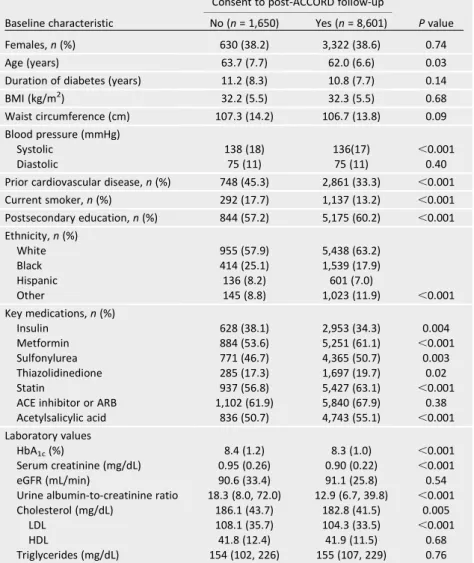
Of 10,251 randomized ACCORD partici-pants, 9,533 (93%) were known to be alive at the end of the full ACCORD trial (when both the lipid and blood pressure interventions were discontinued), and 8,777 remained free of a myocardial in-farction of stroke (i.e., thefirst occur-rence of a nonfatal component of the primary outcome) at that time. Partici-pants who agreed to ongoing follow-up were younger and at the time of ran-domization had lower serum creatinine and LDL levels, had a lower prevalence of smoking and prior cardiovascular events, were less likely to be on insulin, and were more likely to be taking metformin, sta-tins, and aspirin than the 1,650 ACCORD participants who had died or did not agree to further follow-up (Table 1).
The between-group difference in gly-cated hemoglobin (Supplementary Fig. 2)
Table 1—Baseline characteristics according to follow-up
Consent to post-ACCORD follow-up
Baseline characteristic No (n= 1,650) Yes (n= 8,601) Pvalue
Females,n(%) 630 (38.2) 3,322 (38.6) 0.74
Age (years) 63.7 (7.7) 62.0 (6.6) 0.03
Duration of diabetes (years) 11.2 (8.3) 10.8 (7.7) 0.14
BMI (kg/m2) 32.2 (5.5) 32.3 (5.5) 0.68
Waist circumference (cm) 107.3 (14.2) 106.7 (13.8) 0.09
Blood pressure (mmHg)
Systolic 138 (18) 136(17) ,0.001
Diastolic 75 (11) 75 (11) 0.40
Prior cardiovascular disease,n(%) 748 (45.3) 2,861 (33.3) ,0.001
Current smoker,n(%) 292 (17.7) 1,137 (13.2) ,0.001
Postsecondary education,n(%) 844 (57.2) 5,175 (60.2) ,0.001
Ethnicity,n(%)
White 955 (57.9) 5,438 (63.2)
Black 414 (25.1) 1,539 (17.9)
Hispanic 136 (8.2) 601 (7.0)
Other 145 (8.8) 1,023 (11.9) ,0.001
Key medications,n(%)
Insulin 628 (38.1) 2,953 (34.3) 0.004
Metformin 884 (53.6) 5,251 (61.1) ,0.001
Sulfonylurea 771 (46.7) 4,365 (50.7) 0.003 Thiazolidinedione 285 (17.3) 1,697 (19.7) 0.02
Statin 937 (56.8) 5,427 (63.1) ,0.001
ACE inhibitor or ARB 1,102 (61.9) 5,840 (67.9) 0.38 Acetylsalicylic acid 836 (50.7) 4,743 (55.1) ,0.001
Laboratory values
HbA1c(%) 8.4 (1.2) 8.3 (1.0) ,0.001
Serum creatinine (mg/dL) 0.95 (0.26) 0.90 (0.22) ,0.001 eGFR (mL/min) 90.6 (33.4) 91.1 (25.8) 0.54 Urine albumin-to-creatinine ratio 18.3 (8.0, 72.0) 12.9 (6.7, 39.8) ,0.001 Cholesterol (mg/dL) 186.1 (43.7) 182.8 (41.5) 0.005
LDL 108.1 (35.7) 104.3 (33.5) ,0.001
HDL 41.8 (12.4) 41.9 (11.5) 0.68
Triglycerides (mg/dL) 154 (102, 226) 155 (107, 229) 0.76
achieved during a mean active treat-ment period of 3.7 years was clearly smaller but persisted well after transi-tion of all participants to the standard glycemic treatment strategy. Thus, a mean of 1.2 years after transition (i.e., when the ACCORD trial ended), the mean (SD) glycated hemoglobin level was 7.4% (1.2%) in the intensive group and 7.8% (1.3%) in the standard group (P , 0.001), and at the end of the ACCORDION follow-up, these levels were 7.8% (1.4%) and 8.0% (1.4%), respec-tively (P= 0.005). This HbA1cdifference persisted during the ACCORDION follow-up period despite similar reported glucose-lowering regimens (Supplementary Table 1) and similar weights of 91.8 (20.4) kg and 91.2 (20.4) kg (P= 0.4) in people who had been allocated to the intensive and standard groups, respectively.
During the ACCORDION phase of the study, there were similar rates of severe hypoglycemia requiring medical assis-tance or any severe hypoglycemia in each allocated group (Supplementary Table 2).
The incidence of reported clinical outcomes and the hazard of allocation to the intensive versus the standard glucose-lowering regimen during the ACCORD trial and the full ACCORDION median follow-up period of 8.8 years are shown in Fig. 1 and listed in Table 2. Allocation to an intensive glucose-lowering regimen for a mean of 3.7 years had a neutral long-term effect on the
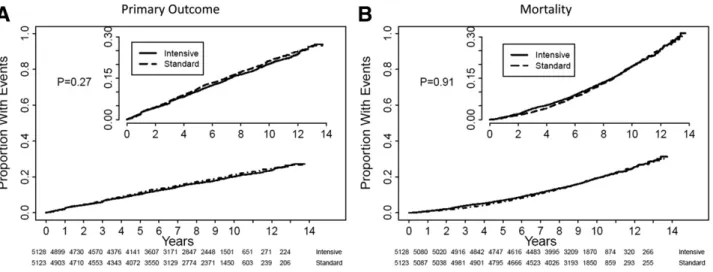
first occurrence of the primary com-posite outcome comprising nonfatal myocardial infarction, nonfatal stroke, or cardiovascular death; death from any cause; an expanded composite of nonfatal myocardial infarction, nonfa-tal stroke, or any death; a composite of fatal coronary heart disease, nonfa-tal myocardial infarction, or unstable angina; and heart failure hospitaliza-tions. Conversely, the increase in death from cardiovascular causes that was noted at the end of the active treat-ment period persisted. However, as a result of similar rates after the inter-vention, the hazard ratio was attenu-ated to 1.20 (95% CI 1.03, 1.39;P = 0.02). Product-limit estimates of time to event for the primary outcome, death (Fig. 2), and for the three components of the primary outcome (Fig. 3) suggested that any differences in incidence were
confined to the active treatment period. No differences in the long-term effect of the intervention on the primary out-come or mortality were noted for
prede-fined subgroups (Supplementary Figs. 3 and 4).
CONCLUSIONS
Intensive glycemic control may have long-term effects on serious health out-comes in people with type 2 diabetes. Such“legacy”effects may be beneficial or harmful and may emerge, be attenu-ated, or become magnified with time. These data from the long-term follow-up of the ACCORD trial show that intensive glycemic control for a median of 3.7 years had a prolonged effect on HbA1clevels, possibly due to some effect on b-cell function (14). At the same time, it had a neutral effect on the primary cardiovas-cular composite outcome of nonfatal myocardial infarction, nonfatal stroke, or cardiovascular death during a me-dian follow-up period of 8.8 years. It also had a neutral effect on an ex-panded composite outcome that in-cluded death from any cause and the individual outcomes of nonfatal myo-cardial infarction, nonfatal stroke, and/or congestive heart failure.
Intensive glycemic control had a neu-tral long-term effect on all-cause mor-tality during this 8.8-year period, despite the higher mortality during the 3.7-year active phase of the ACCORD
trial. Scrutiny of the product-limit curves (Fig. 2) and accrued data (Table 2) show that this was apparently due to cluster-ing of the excess of cardiovascular deaths between 2 and 3 years after ran-domization and subsequent attenuation or reversal of this pattern. The reduction in nonfatal myocardial infarction noted during the active phase of the trial was also attenuated over the entire follow-up period.
The excess of cardiovascular-specific mortality accompanying intensive ther-apy that was noted during the active phase of the trial remains unexplained despite many analyses. Possible expla-nations that have not been supported include severe hypoglycemia (15); weight gain (R.P. Byington, unpublished analysis); the specific therapies used to lower glucose, including insulin (16) or other glucose-lowering drugs (unpub-lished analysis); or the differential ef-fects of intensive control in people with underlying cardiac autonomic neu-ropathy (17). The degree of glucose lowering that was achieved in the inten-sive group was also not responsible for the mortality signal (18). Indeed, two ACCORD analyses found that the excess mortality in the intensive group was most apparent in participants whose HbA1clevels remained high despite allo-cation to the intensive group and use of therapeutic strategies seeking nearly normal glucose levels (18,19). Other
analyses have suggested that the excess of mortality may have been due to a harmful effect of the intervention in subgroups of individuals with periph-eral neuropathy, aspirin use, or HbA1c $8.5% at baseline (20), or in the sub-group with the highest discrepancy be-tween baseline HbA1c and the HbA1c
levels that would be predicted from fasting plasma glucose levels (due to higher protein glycation, higher prandial glucose levels, or other reasons) (21). Finally, that the excess mortality during ACCORD may have been a rare chance occurrence has been suggested (22). The absence of excess mortality in the
active phase of the three other trials of intensive glucose control (6), the concom-itant reduction in nonfatal myocardial in-farction and various indices of ischemic heart disease during this phase (6,23), and attenuation of the mortality signal during the full 9 years of follow-up pro-vide some support for this possibility.
Figure 2—The Kaplan-Meier curves display the time to event for the primary outcome (A) and total mortality (B) during follow-up from random-ization until the end of ACCORDION. The inset for each graph displays the same curve with a magnifiedy-axis. The numbers of individuals at risk are shown for each time point.
Table 2—First occurrence of outcomes during different study phases
During ACCORD Post-ACCORD alone Full follow-up from randomization
Intensive (n= 5,128)
Standard (n= 5,123)
Intensive (n= 4,270)
Standard (n= 4,331)
Intensive (n= 5,128)
Standard (n= 5,123)
Outcome n % n % n % n % n % n %
Primary outcome 546 10.6 582 11.4 350 8.2 348 8.0 896 17.3 930 18.3
Death 391 7.6 327 6.4 589 13.8 651 15.0 980 19.1 978 19.1
Nonfatal MI 303 5.9 360 7.0 141 3.3 132 3.0 444 8.7 492 9.6
Nonfatal stroke 119 2.3 142 2.8 108 2.5 119 2.7 227 4.4 261 5.1
CVD 185 3.6 125 2.4 179 4.2 180 4.2 364 7.1 305 6.0
Primary outcome or death 722 14.1 753 14.7 685 16.0 719 16.6 1,407 27.4 1,472 28.7
Primary outcome, Revasc, CHF 1,210 23.6 1,269 24.8 490 11.5 523 12.1 1,700 33.2 1,792 35.0
Fatal CHD, MI, UA 606 11.8 647 12.6 292 6.8 314 7.3 898 17.5 961 18.8
Any stroke 128 2.5 150 2.9 114 2.7 124 2.9 242 4.7 274 5.4
CHF hospitalization 233 4.5 203 4.0 107 2.5 153 3.5 340 6.6 356 7.0
Causes of death
Fatal MI 29 7.4 14 4.3 11 1.9 7 1.1 40 4.1 21 2.2
Fatal stroke 8 2.1 8 2.5 5 0.9 5 0.8 13 1.3 13 1.3
Unexpected, presumed CVD 82 21.0 65 19.9 47 8.0 45 6.9 129 13.2 110 11.3
CHF 22 5.6 9 2.8 21 3.6 19 2.9 43 4.4 28 2.9
Documented arrhythmia 4 1.0 3 0.9 4 0.7 2 0.3 8 0.8 5 0.5
Other cardiovascular 40 10.2 26 8.0 91 15.5 102 15.7 131 13.4 128 13.1
Cancer 95 24.3 89 27.2 68 11.5 77 11.8 163 16.6 166 17.0
Non-CVD/noncancer 95 24.3 95 29.1 0 0.0 0 0.0 95 9.7 95 9.7
Other non-CVD or unknown 10 2.6 17 5.2 227 38.5 251 38.6 237 24.2 268 27.4
Uncertain* 6 1.5 1 0.3 115 19.5 143 22.0 121 12.4 144 14.7
The 10- to 20-year effect of up to 6 years of intensive glycemic control on cardiovascular outcomes has also been reported in the three other large out-comes trials of intensive glucose control. In the UK Prospective Diabetes Study (UKPDS), 10 years of active therapy achieving a median HbA1c difference of 0.9% reduced the 18-year incidence of myocardial infarction by 15% and death by 13% in people with newly di-agnosed type 2 diabetes (24). Similarly, 6 years of active therapy achieving an HbA1cdifference of 1.5% reduced the 10-year incidence of cardiovascular outcomes by 17% in male veterans who participated in the Veterans Af-fairs Diabetes Trial (VADT) (25). The Ac-tion in Diabetes and Vascular Disease: Preterax and Diamicron MR Controlled Evaluation (ADVANCE) trial, with a lesser glycemic difference, reported that 5 years of intensive glycemic control had a neutral effect on cardiovascular outcomes during 10 years of follow-up (26). Two of these posttrial intention-to-treat follow-up analyses reported a neutral effect on mortality, and one reported a reduction. A meta-analysis
of the odds ratios for death from ACCORDION and these other three stud-ies using afixed-effects variance estimate (27) with heterogeneity assessed using the I2 statistic (28) (Supplementary Table 3) yields an overall mortality odds ratio of 0.98 (95% CI 0.92, 1.04). Taken together, the findings of ACCORDION demonstrate neither a beneficial legacy effect of 3.7 years of intensive glucose-lowering therapy on cardiovascular end points nor a contin-ued excess of all-cause mortality. The unexplained 20% higher relative risk of cardiovascular death in ACCORDION corresponds to an absolute risk differ-ence of ;0.13%/year or 1.3% over 10 years. When deciding on therapy for an individual patient, thesefindings need to be balanced against a neutral effect on overall mortality and a large reduction in eye disease in response to intensive glucose lowering (29). These
findings suggest that for people with type 2 diabetes and additional cardio-vascular risk factors, the main benefits of intensive glycemic control are non-cardiovascular. They also support cur-rent recommendations (30,31) to
tailor the degree of glucose control to the overall health status of individual patients, taking their overall frailty and burden of other illnesses into account.
Appendix
Members of the ACCORD Study Group who con-tributed to this article are Hertzel C. Gerstein (Department of Medicine and Population Health Research Institute, McMaster University and Hamilton Health Sciences, Hamilton, Ontario, Canada), Daniel P. Beavers (Department of Biostatistical Sciences, Wake Forest School of Medicine, Winston-Salem, NC), Alain G. Bertoni (Department of Epidemiology and Prevention, Wake Forest School of Medicine, Winston-Salem, NC), J. Thomas Bigger (Columbia Univer-sity College of Physicians and Surgeons, New York, NY), John B. Buse (University of North Carolina School of Medicine, Chapel Hill, NC), Timothy E. Craven (Department of Biostatistical Sciences, Wake Forest School of Medicine, Winston-Salem, NC), William C. Cushman (Veterans Affairs Medical Center, Memphis, TN), Vivian Fonseca (Tulane University Health Sciences Center, New Orleans, LA), Nancy L. Geller (National Heart, Lung, and Blood Institute, Bethesda, MD), Stephen J. Giddings (VA St. Louis Health Care Sys-tem, St. Louis, MO), Richard H. Grimm Jr. (Berman Center for Outcomes and Clinical Research, Uni-versity of Minnesota, Minneapolis, MN), Saul Genuth (Case Western Reserve University,
Cleveland, OH), Irene Hramiak (St. Joseph’s Health Care, Western University, London, Ontario, Canada), Faramarz Ismail-Beigi (Case Western Reserve University and VA Medical Center, Cleveland, OH), Carlos R. Lopez Jimenez (Columbia University College of Physicians and Surgeons, New York, NY), Ruth Kirby (Division of Cardiovascular Sciences, National Heart, Lung, and Blood Institute, Bethesda, MD), Jeffrey Probstfield (Department of Medicine, Univer-sity of Washington, Seattle, WA), Matthew C. Riddle (Division of Endocrinology, Diabetes, and Clinical Nutrition, Oregon Health & Science University, Portland, OR), Elizabeth R. Seaquist (Division of Diabetes and Endocrinology, De-partment of Medicine, University of Minnesota, Minneapolis, MN), and William T. Friedewald (Columbia University, New York, NY).
Acknowledgments.Members of the ACCORD Data Safety Monitoring Board were Antonio M. Gotto Jr. (Chair), Weill Cornell Medical College; Kent R. Bailey, Mayo Clinic; Dorothy M. Gohdes, Albuquerque; Steven Haffner, University of Texas Health Sciences Center; Roland G. Hiss, Ann Arbor; Kenneth A. Jamerson, University of Michigan Health System; Kerry L. Lee, Duke Clinical Research Institute; David M. Nathan, Massachusetts General Hospital; James R. Sowers, University of Missouri-Columbia; and LeRoy Walters, Georgetown University. Members of the ACCORDION Observational Study Monitor-ing Board were Barbara V. Howard (Chair), Georgetown University School of Medicine; Kent R. Bailey, Mayo Clinic; Richard F. Hamman, Colorado School of Public Health; William H. Herman, University of Michigan; Kenneth A. Jamerson, University of Michigan Health Sys-tem; David M. Nathan, Massachusetts General Hospital; Alan Shuldiner, University of Maryland. Funding.ACCORD was supported by National Heart, Lung, and Blood Institute contracts N01-HC-95178, N01-HC-95179, N01-HC-95180, N01-HC-95181, N01-HC-95182, N01-HC-95183, N01-HC-95184; IAA #Y1-HC-9035; and IAA #Y1-HC-1010. Other components of the National Institutes of Health, including the National In-stitute of Diabetes and Digestive and Kidney Diseases, the National Institute on Aging, and the National Eye Institute, contributed funding. The Centers for Disease Control and Preven-tion funded substudies within ACCORD on cost-effectiveness and health-related quality of life. General Clinical Research Centers pro-vided support at many sites. This material is also the result of work supported with re-sources and the use of facilities at the Veterans Affairs medical centers, as listed previously. ACCORDION activities were supported by Na-tional Heart, Lung, and Blood Institute contract HHSN268201100027C. The contents do not re-present the views of the National Institutes of Health, the U.S. Department of Veterans Af-fairs, or the U.S. Government.
During ACCORD, the following companies provided study medications, equipment, or supplies: Abbott Laboratories (Abbott Park, IL), Amylin Pharmaceutical (San Diego, CA), AstraZeneca Pharmaceuticals LP (Wilmington, DE), Bayer HealthCare LLC (Tarrytown, NY), Closer Healthcare, Inc. (Tequesta, FL), GlaxoSmithKline Pharmaceuticals (Philadelphia, PA), King
Pharmaceuticals, Inc. (Bristol, TN), Merck & Co., Inc. (Whitehouse Station, NJ), Novartis Pharmaceuticals, Inc. (East Hanover, NJ), Novo Nordisk, Inc. (Princeton, NJ), Omron Healthcare, Inc. (Schaumburg, IL), SanofiU.S. (Bridgewater, NJ), Schering-Plough Corporation (Kenilworth, NJ), and Takeda Pharmaceuticals (Deerfield, IL).
Duality of Interest.H.C.G. has received grant support from Sanofi, Lilly, AstraZeneca, and Merck; honoraria for speaking from Sanofi, Novo Nordisk, AstraZeneca, and Berlin-Chemie; and consulting fees from Sanofi, Lilly, AstraZeneca, Merck, Novo Nordisk, Abbott, Amgen, Boehringer Ingelheim, and Kaneq Bio-science. D.P.B. has received grant support from Medifast. J.B.B. has received grant support from Lilly, Bristol-Myers Squibb, GI Dynamics, Amylin, Orexigen, Merck, Novo Nordisk, AstraZeneca, Takeda, Medtronic Minimed, Sanofi, Tolerex, Osiris, Halozyme, Pfizer, Johnson & Johnson, Andromeda, Boehringer Ingelheim, GlaxoSmithKline, Astellas, MacroGenics and travel and accommodation for activities contracted and paid to his institution from Lilly, Hoffmann-La Roche, Bristol-Myers Squibb, Liposcience, GI Dynamics, Amylin, Orexigen, Elcylex, Merck, Novo Nordisk, Metavention, vTv Pharma (formerly Transtech Pharma), PhaseBio, AstraZeneca, Dance Biopharm, Takeda, Quest, Sanofi, and Lexicon. W.C.C. has received grant support from Merck and Lilly and consulting fees from Takeda and Janssen. V.F. has received grant support from Asahi, Lilly, Boehringer Ingelheim, and Merck and consulting fees from Asahi, Lilly, Boehringer Ingelheim, Merck, Intarcia, Sanofi, Novo Nordisk, GlaxoSmithKline, Takeda, AstraZeneca, and Janssen. I.H. has received grant support from Sanofi, Lilly, AstraZeneca, Bristol-Myers Squibb, Merck, GlaxoSmithKline, Novo Nordisk, and Lexicon and has received consulting fees from Sanofi, Lilly, AstraZeneca, Bristol-Myers Squibb, Merck, GlaxoSmithKline, Novo Nordisk, and Roche. F.I.-B. has received grant support from Novo Nordisk and consulting fees from Lilly and Covance and holds shares in Ther-malin Diabetes. J.P. has received grant sup-port and consulting fees from Sanofi. M.C.R. has received grant support from Sanofi, Lilly, AstraZeneca, and Novo Nordisk and consulting fees from Sanofi, AstraZeneca, Biodel, Elcelyx, and Valeritas. E.R.S. has received grant support from Lilly and Locemia and consulting fees from Novo Nordisk, Sanofi, and Locemia. No other potential conflicts of interest relevant to this article were reported.
Author Contributions.H.C.G., A.G.B., J.T.B., J.B.B., W.C.C., R.H.G., S.G., F.I.-B., J.P., and W.T.F. designed and led the study, researched the data, contributed to the discussion, and re-viewed and edited the manuscript. V.F., N.L.G., S.J.G., I.H., C.R.L.J., R.K., M.C.R., and E.R.S. researched the data, contributed to the dis-cussion, and reviewed and edited the manu-script. D.P.B. and T.E.C. did the statistical analyses. H.C.G. is the guarantor of this work and, as such, had full access to all the data in the study and takes responsibility for the integrity of the data and the accuracy of the data analysis. Prior Presentation.Parts of this study were presented in a symposium at the International
Diabetes Federation World Diabetes Congress, Vancouver, British Columbia, Canada, 30 November–4 December 2015.
References
1. Gerstein HC, Werstuck GH. Dysglycaemia, vasculopenia, and the chronic consequences of di-abetes. Lancet Diabetes Endocrinol 2013;1:71–78 2. Gerstein HC, Miller ME, Genuth S, et al.; ACCORD Study Group. Long-term effects of intensive glucose lowering on cardiovascular outcomes. N Engl J Med 2011;364:818–828 3. ADVANCE Collaborative Group, Patel A, MacMahon S, Chalmers J, et al. Intensive blood glucose control and vascular outcomes in pa-tients with type 2 diabetes. N Engl J Med 2008;358:2560–2572
4. Duckworth W, Abraira C, Moritz T, et al.; VADT Investigators. Glucose control and vascu-lar complications in veterans with type 2 diabe-tes. N Engl J Med 2009;360:129–139
5. UK Prospective Diabetes Study (UKPDS) Group. Intensive blood-glucose control with sulphonylureas or insulin compared with conven-tional treatment and risk of complications in pa-tients with type 2 diabetes (UKPDS 33). Lancet 1998;352:837–853
6. Turnbull FM, Abraira C, Anderson RJ, et al.; Control Group. Intensive glucose control and macrovascular outcomes in type 2 diabetes. Diabetologia 2009;52:2288–2298
7. Buse JB, Bigger JT, Byington RP, et al.; ACCORD Study Group. Action to Control Cardio-vascular Risk in Diabetes (ACCORD) trial: design and methods. Am J Cardiol 2007;99(12A):21i–33i 8. Action to Control Cardiovascular Risk in Di-abetes Study Group, Gerstein HC, Miller ME, Byington RP, et al. Effects of intensive glucose lowering in type 2 diabetes. N Engl J Med 2008; 358:2545–2559
9. Cushman WC, Evans GW, Byington RP, et al.; ACCORD Study Group. Effects of intensive blood-pressure control in type 2 diabetes mellitus. N Engl J Med 2010;362:1575–1585 10. Ginsberg HN, Elam MB, Lovato LC, et al.; ACCORD Study Group. Effects of combination lipid therapy in type 2 diabetes mellitus. N Engl J Med 2010;362:1563–1574
11. Pogue J, Walter SD, Yusuf S. Evaluating the benefit of event adjudication of cardiovascular outcomes in large simple RCTs. Clin Trials 2009; 6:239–251
12. Granger CB, Vogel V, Cummings SR, et al. Do we need to adjudicate major clinical events? Clin Trials 2008;5:56–60
13. ACCORDIAN (ACCORD Trial Follow-Up Study). What is the ACCORDIAN study? [article online], 2015. Available from https://accordionstudy.org/ public/dspHome.cfm. Accessed 15 September 2015
cardiovascular mortality in the ACCORD trial. Di-abetes Care 2015;38:2000–2008
17. Pop-Busui R, Evans GW, Gerstein HC, et al.; Action to Control Cardiovascular Risk in Diabetes Study Group. Effects of cardiac autonomic dys-function on mortality risk in the Action to Control Cardiovascular Risk in Diabetes (ACCORD) trial. Diabetes Care 2010;33:1578–1584
18. Riddle MC, Ambrosius WT, Brillon DJ, et al.; Action to Control Cardiovascular Risk in Diabetes Investigators. Epidemiologic relationships be-tween A1C and all-cause mortality during a me-dian 3.4-year follow-up of glycemic treatment in the ACCORD trial. Diabetes Care 2010;33:983–990 19. Miller ME, Williamson JD, Gerstein HC, et al. Effects of randomization to intensive glucose control on adverse events, cardiovascular dis-ease and mortality in older versus younger adults in the ACCORD trial. Diabetes Care 2014;37:634–643
20. Calles-Escand ´on J, Lovato LC, Simons-Morton DG, et al. Effect of intensive compared with standard glycemia treatment strategies on mortality by baseline subgroup characteristics: the Action to Control Cardiovascular Risk in
Diabetes (ACCORD) trial. Diabetes Care 2010; 33:721–727
21. Hempe JM, Liu S, Myers L, McCarter RJ, Buse JB, Fonseca V. The hemoglobin glycation index identifies subpopulations with harms or benefits from intensive treatment in the ACCORD trial. Diabetes Care 2015;38:1067– 1074
22. Lachin JM. Point: intensive glycemic control and mortality in ACCORD–a chancefinding? Diabetes Care 2010;33:2719–2721
23. Gerstein HC, Miller ME, Ismail-Beigi F, et al.; ACCORD Study Group. Effects of inten-sive glycaemic control on ischaemic heart dis-ease: analysis of data from the randomised, controlled ACCORD trial. Lancet 2014;384: 1936–1941
24. Holman RR, Paul SK, Bethel MA, Matthews DR, Neil HA. 10-year follow-up of intensive glu-cose control in type 2 diabetes. N Engl J Med 2008;359:1577–1589
25. Hayward RA, Reaven PD, Wiitala WL, et al.; VADT Investigators. Follow-up of glycemic con-trol and cardiovascular outcomes in type 2 diabetes. N Engl J Med 2015;372:2197–2206
26. Zoungas S, Chalmers J, Neal B, et al.; ADVANCE-ON Collaborative Group. Follow-up of blood-pressure lowering and glucose control in type 2 diabetes. N Engl J Med 2014;371:1392– 1406
27. DerSimonian R, Laird N. Meta-analysis in clinical trials. Control Clin Trials 1986;7:177–188 28. Higgins JP, Thompson SG. Quantifying het-erogeneity in a meta-analysis. Stat Med 2002; 21:1539–1558
29. Chew EY, Ambrosius WT, Davis MD, et al.; ACCORD Study Group; ACCORD Eye Study Group. Effects of medical therapies on retinop-athy progression in type 2 diabetes. N Engl J Med 2010;363:233–244
30. American Diabetes Association. Standards of medical care in diabetesd2015. Diabetes
Care 2015;38(Suppl. 1):S1–S93