LASSO based Resample Model Averaging for
Genetic Association Studies
Jeremy A. Sabourin
A dissertation submitted to the faculty of the University of North Carolina at Chapel Hill in partial fulfillment of the requirements for the degree of Doctor of Philosophy in the Department of Statistics and Operations Research.
Chapel Hill 2013
Approved by:
Andrew B. Nobel
William Valdar
Yufeng Liu
J.S. Marron
c
Abstract
JEREMY A. SABOURIN: LASSO based Resample Model Averaging for Genetic Association Studies.
(Under the direction of Andrew B. Nobel and William Valdar.)
Significance testing one SNP at a time has proven useful for identifying genomic
regions that harbor variants affecting human disease. In theory, simultaneous modeling
of multiple loci should help when considering complex diseases affected by multiple
predictors. However, they are typically applied in an ad hoc fashion: conditioning
on the top SNPs, with limited exploration of the model space and no assessment of
how sensitive model choice was to sampling variability. Formal alternatives exist but
are seldom used. When considering complex traits in humans, the genetic model is
most often assumed to be additive only SNP effects. When non-additive effects such as
dominance or overdominance are present, additive only models can be underpowered.
We first present LLARRMA, a resample model averaging based method using the
LASSO that allows for additive. It estimates for each SNP, the probability that it
would be included in a multiple SNP model in alternative realizations of the data. We
show that under simulations based on real GWAS data, that LLARRMA identifies a
set of candidates that is enriched for causal loci relative to single locus analysis.
We next generalize the resample model averaging framework and present
LLARRMA-dawg, a generalized resample model averaging based method using the group LASSO
that allows for additive and non-additive SNP effects. We show that under simulations
is enriched for causal loci relative to LLARRMA in the presence of non-additive
ef-fects. We examine how the framework for LLARRMA-dawg can be extended to other
problems where multiple model predictors are required to model the effects of a single
variable.
The final portion of this dissertation describes additional information that one may
explore from resample model averaging. Specifically, we examine how one can identify
response specific variable relationships based on the models selected under resampling.
This give the researcher further information about the predictors than the standard
Acknowledgments
Much of the work described in this dissertation is collaborative, and I am very grateful
for all of the help I have received. In particular, I would like to thank:
• My advisors Andrew Nobel and William Valdar, for their patience, dedication,
and many insightful comments.
• My committee members Yufeng Liu, Steve Marron and Michael Wu, for their
helpful criticism and suggestions.
• Ethan Lange and Leslie Lange for providing data and patiently explaining
scien-tific questions and concepts.
• Andrey Shabalin, Jeff Roach and many others for their additional helpful
com-ments.
Table of Contents
List of Figures . . . xiii
List of Tables . . . 1
1 Introduction . . . 1
1.1 Basic genetic background . . . 2
1.1.1 DNA structure and SNPs . . . 2
1.1.2 Genetic models for phenotypic effects . . . 4
1.1.3 Linkage disequilibrium . . . 10
1.2 Overview of standard statistical methods for Human GWAS . . . 15
1.2.1 Statistical analyses for hit regions . . . 16
1.2.2 Stability selection . . . 19
1.3 Model Organisms and Association Mapping . . . 27
1.3.1 Historical Overview of Model Organisms in Biomedical Sciences 29 1.3.2 Analysis of Outbreed populations . . . 33
1.4 Coding of alleles, and modeling effects . . . 39
1.4.1 SNP effects . . . 39
1.4.2 Haplotype effects . . . 41
1.5 Overview of method comparison with ROC curves . . . 42
2 Resample Model Averaging with the LASSO: LLARRMA . . . 45
2.1 Motivation . . . 46
2.2 Methods . . . 48
2.2.1 General Framework . . . 49
2.2.2 Implementation for genetic association studies . . . 54
2.3 Simulation Framework . . . 58
2.3.1 Simulation study 1: 5 loci in Cancer data . . . 58
2.3.2 Simulation study 2: 1-7 loci in ‘58 data . . . 60
2.3.3 Computation . . . 60
2.3.4 Competing methods . . . 61
2.4 Simulation Results . . . 66
2.4.1 Simulation study 1A: moderate LD, moderate effects . . . 66
2.4.2 Simulation study 1B: moderate LD, small effects . . . 70
2.4.3 Simulation study 2: strong LD, small effects . . . 72
2.5 Discussion . . . 73
3 Generalization of Resample Model Averaging . . . 77
3.1 Introduction . . . 77
3.2 Methods . . . 80
3.2.1 Assumptions and Statistical Model . . . 80
3.2.2 Generalized resample model averaging . . . 83
3.2.3 Competing methods . . . 87
3.2.4 Terminology used . . . 88
3.3 Simulation framework . . . 89
3.3.2 Simulation study 1: preliminary model comparisons . . . 90
3.3.3 Simulation study 2: general predictors . . . 92
3.3.4 Computation . . . 92
3.4 Results . . . 92
3.4.1 Calibrating the randomization penalty . . . 92
3.4.2 An Example Simulation . . . 93
3.4.3 Simulation study 1: individual effect types . . . 94
3.4.4 Simulation study 2: general effects . . . 98
3.5 Theory: Bounds on false positives . . . 101
3.6 Discussion . . . 106
4 Adjusting Generalized RMA for model organisms . . . 110
4.1 Introduction . . . 111
4.2 Methods . . . 114
4.2.1 Diplotype Probability Models . . . 114
4.2.2 LLARRMA-haplo Framework . . . 116
4.2.3 Completing Methods . . . 117
4.3 Simulation Framework . . . 119
4.3.1 Heterogeneous Stock: Population A . . . 119
4.3.2 Heterogeneous Stock: Population B . . . 120
4.4 Simulation Results . . . 120
4.4.1 Results from 100 simulations in HS population A . . . 120
4.4.2 Results from 100 simulations in HS population B . . . 122
5 Applications of Generalized RMA . . . 127
5.1 Human GWAS data . . . 127
5.1.1 Atherosclerosis Risk in Communities Study (ARIC) . . . 127
5.1.2 Multi-ethnic Study of Atherosclerosis (MESA) . . . 128
5.1.3 IBC genotyping . . . 128
5.1.4 Zoom Locus plots . . . 128
5.1.5 Cardiovascular Disease Risk analyses . . . 129
5.2 Model Organism data . . . 135
5.2.1 Heterogeneous Stock (HS) Mice . . . 135
6 Higher dimensional RMA - 2D-RMIPs . . . 137
6.1 Response relevant predictor relationships . . . 137
6.1.1 Motivating toy example . . . 138
6.1.2 Real Data application . . . 139
6.2 Discussion . . . 142
7 Conclusions . . . 144
A Appendix . . . 146
A.1 Proofs for subsampling-based RMA Error Bound . . . 146
List of Figures
1.1 Displays the structure of DNA from (Ansari, 2001). . . 2
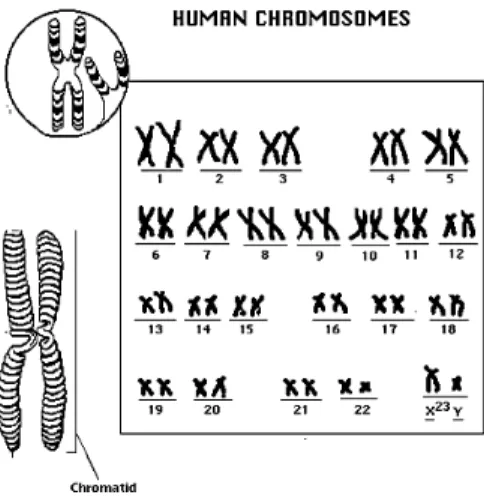
1.2 Representation of the 23 paired chromosomes of the human male;
modified from (Access Excellence, 2009). . . 3
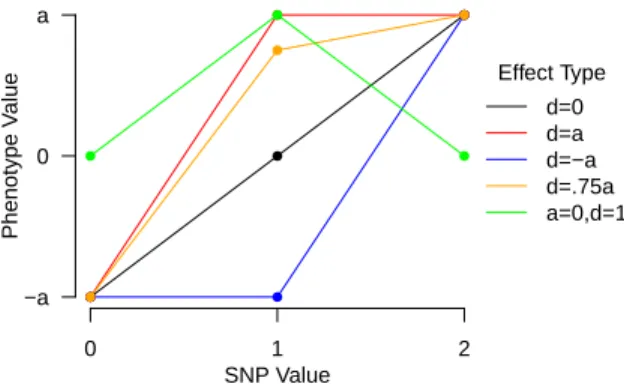
1.3 Comparison of dominant effects to the additive model. . . 8
1.4 An example of the resulting −log10(p-values) from a single locus
regression in a region of high LD from Strange et al. (2010) . . . 11
1.5 An illustration of a crossover adapted from Morgan et al. (1915). . . 12
2.1 LD structure of the two genotype datasets used in the simulations. Shading indicates pairwise LD between SNPs, ranging from white
(r2 = 0) to black (r2 = 1). . . 59
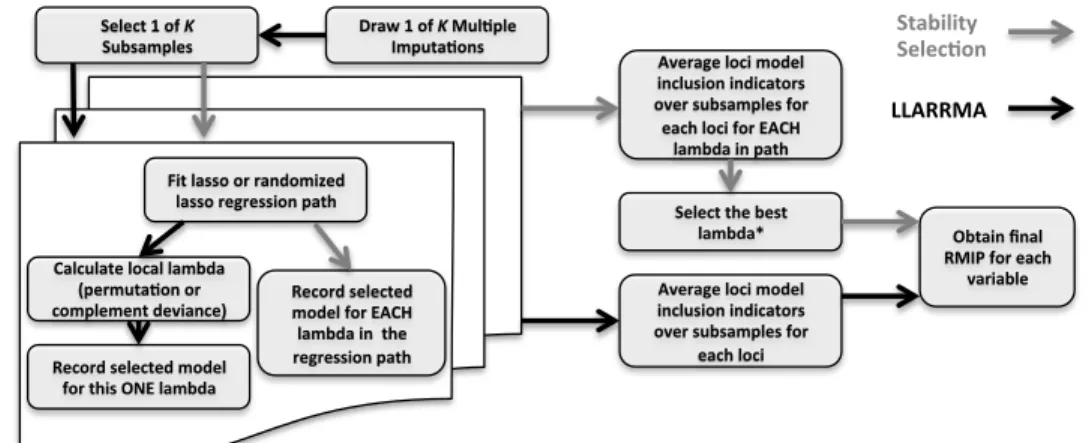
2.2 A comparison of LLARRMA and stability selection. . . 64
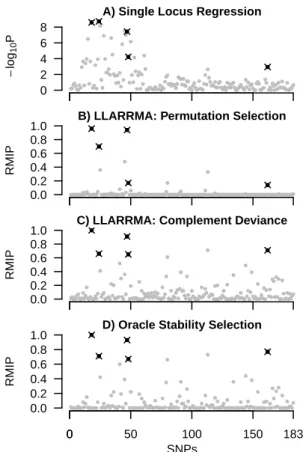
2.3 Results for seven procedures applied to an example case-control data set from simulation study 1A. Plots show SNP score (logP or RMIP) against SNP location in the cancer data, with causal SNPs in black
and non-causal SNPs in gray. . . 67
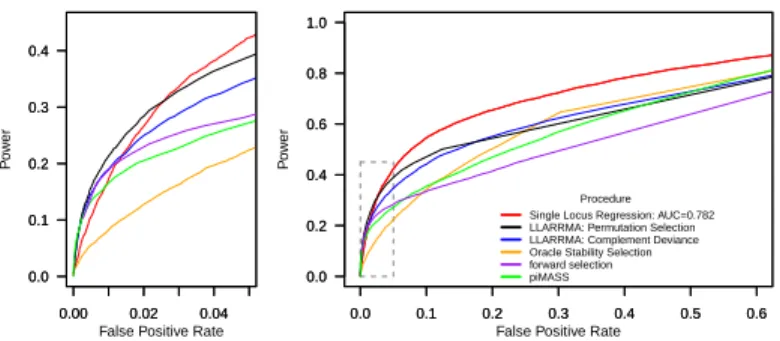
2.4 ROC curves for simulation study 1A: moderate SNP effects in a hit region of moderate LD. Curves compare the ability of seven methods to discriminate causal from non-causal loci in 1000 simulated case-control data sets. Right plot shows the full ROC curve; left plot
shows a zoomed section focusing on the top-scoring SNPs of each method. 68
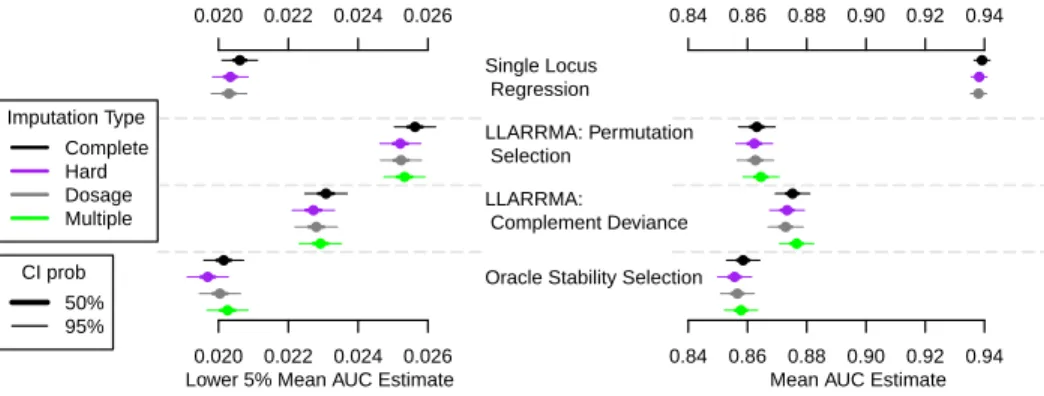
2.5 Area under the ROC curve (AUC) for seven methods applied to four types of imputed genotype data in simulation study 1A: moderate SNP effects in a hit region of moderate LD. Each AUC estimate is based on 1000 simulations and is plotted as mean (dot), 50% CI and
2.6 ROC curves for simulation study 1B: small SNP effects in a hit region of moderate LD. Curves compare the ability of the methods to discriminate causal from non-causal loci in 1000 simulated case-control data sets. Right plot shows the full ROC curve; left plot
shows a zoomed section focusing on the top-scoring SNPs of each method. 70
2.7 Area under the ROC curve (AUC) for the methods applied to four types of imputed genotype data in simulation study 1A: moderate SNP effects in a hit region of moderate LD. Each AUC estimate is based on 1000 simulations and is plotted as mean (dot), 50% CI
(thick bar) and 95% CI (thin bar). . . 70
2.8 Global choice of penalty parameter λ by oracle stability selection (black pluses) versus local, per-subsample, choice by LLARRMA complement deviance selection (gray crosses) in 50 representative
simulation trials out of 1000 performed for simulation study 1B. . . 71
2.9 ROC curves for simulation study 2 with 5 loci: small SNP effects in a hit region of strong LD. Curves compare the ability of seven methods to discriminate causal from non-causal loci in 100 simulated case-control data sets. Right plot shows the full ROC curve; left plot
shows a zoomed section focusing on the top-scoring SNPs of each method. 72
2.10 Area under the ROC curve (AUC) for 7 methods applied to simu-lated case-control influenced by 1-7 causal loci in simulation study 2: small SNP effects in a hit region of strong LD. Each AUC estimate is based on 1000 simulations and is plotted as mean (dot), 50% CI
and 95% CI. . . 72
3.1 LD structure of the HAPGEN2 data sets used in the simulations. Shading indicates pairwise LD between SNPs, ranging from white
(r2 = 0) to black (r2 = 1). . . 90
3.2 Results of four methods applied to an example dataset from sim-ulation study 2B. Plots show SNP score (logP or RMIP) against SNP location in the Hapgen2 data, with true signal SNPs in black (additive effect) and red (non-additive effect) and background SNPs
in gray. . . 94
3.3 Initial and full ROC curves for simulations study 1’s 5 sub-studies. We observe an overwhelming difference between the single locus and multiple locus methods in all situations. We observe consis-tently that LLARRMA-w procedures perform at least as well as
3.4 Ranking of 2500 true signals from study 1E by single locus regression (SL) vs by LLARRMA-based method (RMA). Colors based on SL significance; genome wide significant (logP ≥ 8; green), marginal
significance (orange), not significant ( logP ≤4; red). . . 98
3.5 The average number of SNPs that must be examined to find the first, second, third, fourth, and fifth true signal in simulation 1E.
Dotted gray line indicates 5% of the SNPs in the hit region. . . 99
3.6 Initial and full ROC curves for simulations study 2A (pa = 0.6, pd=
0.3, and ph = 0.1) and 2B (pa = 0.3, pd = 0.6, ph = 0.1). All
LLARRMA procedures are using their randomized penalties. . . 100
4.1 ROC curves for the additive model based on 100 simulations on HS population A. We observe a clear advantage to methods with either multiple locus modeling (LLARRMA-haplo) or mixed effect models
(EMMA and QTLrel). . . 121
4.2 ROC curves for the full model based on 100 simulations on HS popu-lation A. With the increase to the full model, we observe a advantage
to LLARRMA-haplo over mixed effect models (EMMA and QTLrel). . 122
4.3 ROC curves for the additive model based on 100 simulations on HS population B. We observe a clear advantage to methods with either multiple locus modeling (LLARRMA-haplo) or mixed effect models
(EMMA and QTLrel) with LLARRMA-haplo performing slightly worse. 123
4.4 ROC curves for the full model based on 100 simulations on HS popu-lation A. With the increase to the full model, we observe a advantage
to LLARRMA-haplo over mixed effect models (EMMA and QTLrel). . 123
5.1 Single locus regression and LLARRMA outputs for ARIC African American GWAS data hit region on chromosome 1 for CRP. We observe a large set of significant SNPs in the single locus approach are hard to distinguish between, while the LLARRMA output has
a smaller set of defined SNPs with high RMIPs. . . 131
5.2 Single locus regression and LLARRMA outputs for ARIC African American GWAS data hit region on chromosome 13 for factor 7 levels. We observer both single locus and LLARRMA selecting the same top SNP, but LLARRMA highlights the importance of a
5.3 LLARRMA and LLARRMA-dawg outputs for ARIC European
Amer-icans hit region for HDL on chr 8. . . 133
5.4 Single locus regression and LLARRMA outputs for MESA European
Americans hit region for CRP on chr 1. . . 134
5.5 LLARRMA-haplo output for HS mice for Mean Adrenal Weight. . . 136
6.1 (Left) displays the LD between SNPs that had RMIPs of at least 0.25. (Right) displays the 2D-RMIP of the same variables. Red lines indicate true SNPs in the model. We observe that the 2D-RMIP does well identifying pairs of variables which have true effects with
the response. . . 139
6.2 RMA based analyses of TCGA breast cancer. (Top) displays the LLARRMA output. (Bottom right) displays ther2 of variables with RMIPs above 0.25. (Bottom left) displays the 2D-RMIP for the
same set of variables. . . 141
6.3 RMA based analyses of TCGA breast cancer luminal subtypes. (Top) displays the LLARRMA output. (Bottom right) displays the
r2 of variables with RMIPs above 0.25. (Bottom left) displays the
List of Tables
1.1 The base pairs of an individual at 7 loci; we observe that 4 of the 7 loci we have different alleles on each chromatid and the remaining
3 have the same allele. . . 3
1.2 Displays how one models different levels of dominance under the a,
d notation. . . 8
1.3 The base pairs of an individual at 7 loci. The lower half of the table displays the genotypes and phased genotypes of the individual at each loci. The allele sequence of each chromatid are examples of haplotypes. While the genotype row give no indication of the underling haplotypes, in the phased genotypes we notice that the first allele in the phased genotype always corresponds to chromatid 1. This means that the sequence given by the first allele in the
phased genotypes forms the haplotype from chromatid 1. . . 10
3.1 Nomenclature for modeling and resampling procedures used in the
paper. . . 89
3.2 Summary of the sub-simulation models whereβ?q ∼N(1.35(−1)νj,0.022) withνj ∼Bernoulli(0.5),αis chosen randomly from{0.5,0.75,1,1.25},
and υj ∼Bernoulli(0.5). . . 91
3.3 Mean percent of maximum initial AUC for simulation study 1. All standard errors are less than 0.94. Bold indicates the best method for each model and any methods statistically the same as the best method. Underlined indicates the best method excluding random-ized procedures and any methods statistically the same as the best
non-radomized method. . . 97
3.4 Mean percent of total initial AUC for simulation study 2, where in 2A the true signals effect types are sampled from a Multinomial(5, pa=
0.6, pd= 0.3, ph = 0.1) and 2B from a Multinomial(5, pa = 0.3, pd=
0.6, ph = 0.1) distribution. All standard errors are less than 0.92.
Bold indicates the best method for each model and any methods statistically the same as the best method. Underlined indicates the best method excluding randomized procedures and any methods
Chapter 1
Introduction
This Dissertation consist of seven chapters. Each chapter addresses a problem or
appli-cation in statistical genetics. Each is related to the general problem of how to identify
genetic variants affecting a given disease trait. This is also commonly known as a
“genetic associations” study.
This chapter provides the necessary genetics background (methods and terminology)
to understand the research problems discussed in the later chapters. The chapter is
laid out as follows. Section 1.1 describes the basic genetics topics that are important
to genetic association studies. Section 1.2 describes the statistical literature on the
human related research problems discussed. Section 1.3 describes the terminology and
literature related to the use of model organisms. Section 1.4 describes how genetic
information is commonly incorporated into a statistical model of association with a
disease trait. Section 1.5 gives an overview of how receiver operator characteristic
(ROC) curves are used to compare methods. The chapter ends with an overview of the
research questions addressed in the dissertation (Section 1.6).
1.1 Basic genetic background
In order to understand fully the statistical modeling of genetic diseases, one needs a
predictors for a genetic association study, followed by other genetic complications that
often arise within genetic association studies.
1.1.1
DNA structure and SNPs
In the simplest models of association, a single outcome is predicted by a variable
rep-resenting the genetic state of the individual. A common scenario models the state of
individuals differing at a particular variant in their DNA (deoxyribonucleic acid). DNA
carries the genetic instructions used for the development and functioning of all known
living organisms (with the exception of RNA viruses). The information in DNA is
stored as code consisting of four chemical bases: adenine (A), cytosine (C), guanine
(G), and thymine (T). These bases are often referred to as nucleotides, and appear in
pairs. Figure 1.1 displays the structure of the DNA molecule. The pairs come in one of
two forms, A with T or C with G, and form units called base pairs. The DNA molecule
is a long chain of these base pairs separated into long structures called chromosomes.
Figure 1.1: Displays the structure of DNA from (Ansari, 2001).
Human DNA comprises of about 3 billion base pairs split over 23 chromosomes, one
of which is our sex chromosome. Figure 1.2 displays the chromosomes of a human male.
More than 99 percent of these bases are the same in all humans. The locations that
differ among individuals are the source of heritable variation in humans (eg. height,
eye color, etc.). Each such location, generically referred to as a locus (plural loci),
potentially harbors variation that affects a trait or disease (often called a phenotype),
and is a candidate predictor for genetic associations. Along with many other organisms,
Figure 1.2: Representation of the 23 paired chromosomes of the human male; modified from (Access Excellence, 2009).
Locus 1 Locus 2 Locus 3 Locus 4 Locus 5 Locus 6 Locus 7
Chromatid 1 A T C A A G T
Chromatid 2 T T T G A A T
Table 1.1: The base pairs of an individual at 7 loci; we observe that 4 of the 7 loci we have different alleles on each chromatid and the remaining 3 have the same allele.
as homologues chromatids), a paternal copy passed down from our father and a maternal
copy from our mother. As all humans contain two versions of their DNA, each locus
contains two chemical bases (possibly the same). Table 1.1 displays the base pairs of an
individual at 7 loci. Observe that 4 of the 7 loci have different alleles on each chromatid
and the remaining 3 have the same allele. Each chemical base that is observed at a
given location is referred to as an allele. The alleles at a given locus are the predictors
we will consider for genetic association with a phenotype.
The information encoded in one chromatid is called a haplotype. It is often
conve-nient to consider both haplotypes at once. The combination of the two haplotypes at
a single locus is referred to as a genotype. It is most common that a locus where two
individuals’ DNA differs will has only two possible alleles, or nucleotides. Such loci are
loci that are SNPs. [We will investigate loci that are not SNPs in Chapter 4.] As a SNP
contains only two possible alleles, it is common practice to call the less common allele
in the population the “minor allele”, Q, and the more common allele, q, the “major
allele”.
Given that we know the allele present on each haplotype at a given locus, we can
determine the possible genotypes. The possible genotypes that can be observed are
homozygous minor, QQ, heterozygous, Qq or qQ, and homozygous major, qq. At
present, most techniques for identifying alleles are not capable of resolving haplotypes
of an individual, but merely return the two alleles present at each loci. Thus, it is
common practice to not distinguish between the heterozygous genotypes, Qq and qQ.
With this simplification, the standard additive effect SNP predictor is defined as the
count of the minor allele at a given locus, i.e., we code the unordered genotypes {qq, qQ, QQ} as {0, 1, 2}. With this representation of a SNP, one can begin to see how we may look to statistically model a phenotype as a function of the SNP to detect if
the SNP has a significant additive effect on the phenotype. We consider more general
predictors in Section 1.4.
1.1.2
Genetic models for phenotypic effects
With an understanding of the loci considered for causal variants, one must ask how
these loci affect a phenotype. The underlying genetic models have been disputed, and
exist in many different varieties. The most detailed model would explain phenotypic
variations by including genetic variants, environmental effects, and potential
interac-tions between and within these effects. Models with this level of detail are usually
impractical to estimate and are rarely considered. Simpler models are easier to
under-stand, collect data for, and model statistically. Below describes some of the historically
relevant models that have been used, leading up to the model commonly used in today’s
Single variant mutations - Mendelian diseases
The origins of genetic association studies come from family based studies of Mendelian
diseases, or diseases resulting from a single mutation in the structure of DNA, which
cause a single basic defect with pathologic consequences. There are thousands of genetic
diseases caused by a single mutation, but discovering which locus is the culprit is still a
daunting task. As Mendelian diseases result from a single mutation, studying the DNA
for multiple generations of a family infected by a disease allows for the identification
of loci that potentially directly results in the disease. While family based studies have
been successful for Mendelian disorders, there remained many diseases for which family
designs were unsuccessful in identifying the underling genetic variants. These diseases
became known as common diseases and their analysis erupted with the introduction of
the genome wide association study (GWAS; WTCCC, 2007).
Simple single locus model - GWAS for common diseases
The simple single locus GWAS model assumes that there is a single SNP variant that
has a causal effect on the phenotype. Unlike the Mendelian model, it is not assumed
that the presence of a single allele determines the disease status of the individual, but
rather it is assumed that the effect of the allele’s count is additive, i.e., the effect of
having two copies of the minor allele is double of that of having a single copy of it. The
effect of locus xi on phenotype y may be modeled as
yi =µ+xi,jβj +i
whereµis the phenotypic mean,βj is the effect of locusxj ony, andi is a normal error.
This simplistic model was one that was assumed in many analyses, and is consistent
with many common diseases. This model is not often considered in today’s literature,
and potentially interactions of loci and environmental effects. Studies have shown that
phenotypes for complex diseases require multiple variants to explain the differences of
the phenotype (Su, Marchini and Donnelly, 2011). Even though it has become common
practice to assume a more complicated model for complex diseases, it is still common
that studies report only a single locus in their findings.
Simple multiple locus model - complex trait models
As studies have shown that the mendelian model is not valid for complex traits, many
now assume a similar model with contains multiple loci. This model has multiple causal
loci, but for mathematical convenience each locus acts with an independent additive
effect. This may be represented by the the model
yi =µ+
X
j∈J
xi,jβj+i
where J is the set of SNPs with true signals. This model has allowed researchers to account for a much larger amount of variability in complex phenotypes than that
accounted for by the Mendelian model. Even though we assume a multiple locus model,
it is still common practice to test loci one at a time. When considering the simple
multiple locus model, we assume that there exists only a few loci that are truly causal.
This means in statistical terms that we are assuming the model to be sparse.
Genetic dominance in the model
The simple models that we have considered thus far assumed that the SNPs have an
additive effect on the phenotype. Unfortunately, not all genetic effects follow additive
models. By only modeling additive effects, potential causal variants may be missed.
To extend the model further, we remove the assumption of an additive effect to allow
for dominant effects. A dominant effect, in its simplest form, means that having one
Under this definition, one may also consider recessive effects, meaning having one copy
of the minor allele having the same effect as not having a copy (one may think of a
recessive effect as the major allele is dominant). We will consider a more general notion
of dominance, where by dominance we mean any deviation from an additive model.
The general notion of dominance can be harder to detect, but allows for models
that more closely resembles observed effects. The common genetic dominance model
for an individual SNP is to assign two values a and d for the additive and dominant
effect aspects respectively. We assume that the homogeneous minor allele state, QQ,
will have an effect with a value ofa, and the homogeneous major allele state, qq, will
have an effect of −a, and the heterogeneous state, Qq or qQ, will have an effect of d. Under this setting, the coding of the genotypes would differ from the standard 0, 1,
2 coding but be coded as -1, 0, and 1 for qq, qQ, and QQ respectively. This can be
represented in a single locus regression model for locusj as
yi =µ+ajxi,j +djI(xi,j = 0) +i.
Table 1.2 displays how one would write out several models under this notation. This
notation generalizes the additive model to allow a dominant model; it is easily
observ-able that when there is no dominant effect, ie. d= 0, that it simplifies to the standard
additive effects centered at the heterogeneous state. It is also observable that if d=a
(d = −a) that this modeling simplifies to the simplistic definition of a dominant (re-cessive) effect. To illustrate how different dominant effects can be from the standard
additive effects, Figure 1.3 displays the non-additive dominance type effects which the
Additive Dominant Recessive General Dominance
d 0 a -a a×α ∈R
qq -a -a -a -a
qQ 0 a -a αa
QQ a a a a
Table 1.2: Displays how one models different levels of dominance under the a, d nota-tion.
0 1 2
−a 0 a
SNP Value
Phenotype V
alue
●
●
●
●
● ●
● ●
●
●
●
●
●
●
●
Effect Type
d=0 d=a d=−a d=.75a a=0,d=1
Figure 1.3: Comparison of dominant effects to the additive model.
More general models
As previously mentioned, the most detailed model considered would contain both
ge-netic variants, environmental effects, and interactions between and within these effect.
To account for as detailed of a model containing only genetic effects, one may extend
the multiple locus model to include not only the dominance predictors, but also
inter-actions. Models with interactions are sometimes considered, but are harder to model
statistically; even assuming a sparse model with only considering pairwise interactions,
a very large number of interactions are possible leading to a very large number of
pre-dictors in the model (Balding, 2006). Given the sparse set of causal variants we could fit
a model to include interactions easily, but in this setting it would be more common to
perform a haplotype analysis. A haplotype analysis examines the unique combinations
of each loci, as a haplotype, for association with the phenotype rather than individual
Locus 1 Locus 2 Locus 3 Locus 4 Locus 5 Locus 6 Locus 7
Chromatid 1 A T C A A G T
Chromatid 2 T T T G A A T
Genotype AT TT CT AG AA AG TT
Phased Genotype A/T T/T C/T A/G A/A G/A T/T
Table 1.3: The base pairs of an individual at 7 loci. The lower half of the table displays the genotypes and phased genotypes of the individual at each loci. The allele sequence of each chromatid are examples of haplotypes. While the genotype row give no indication of the underling haplotypes, in the phased genotypes we notice that the first allele in the phased genotype always corresponds to chromatid 1. This means that the sequence given by the first allele in the phased genotypes forms the haplotype from chromatid 1.
When the contributing loci in a genetic model have been identified, rather than
examine the interactions of the loci, it is more common to phase the data and examine
the individual haplotypes created by the set of loci. By phasing the data, we mean to
analyze the haplotypes in the population and use this information to reconstruct
hap-lotypes from the genotype information. Table 1.3 revisits the data from Table 1.1 and
displays the standard genotype information along with the phased genotypes obtained
after reconstructing the individual haplotypes. As none of the research presented here
is directly related to the use of haplotype phasing, no more details are given here (see
Browning (2008) for further details). With the haplotypes reconstructed, a haplotype
model would assume that each observed haplotype has its own effect. This leads to
a model which can easily be modeled statistically, assuming that you can identify the
proper loci to include in a haplotype. When selecting the loci to include in the
haplo-type model, one needs to consider how fast the size of the model grows, i.e., includingp
SNPs results in 2p possible haplotypes in the model. For this reason, haplotype models
are most often considered for small regions where it is suspected that there are multiple
causal loci, which may not have been validated. This model may include spurious loci
1.1.3
Linkage disequilibrium
One of the largest hindrances to a genetic association study is the pattern of correlation,
or linkage disequilibrium (LD), between SNPs. LD is considered a measurement of how
likely combinations of alleles would be under the assumption of random formation of
haplotypes. A common measure of LD is the square of the correlation (Balding, 2006).
SNPs that are close together are often in high LD, and this causes a confounding
relationship between the SNPs close to a causal SNP and the phenotype. This often
results in a set of SNPs that form a “cloud” of statistically significant SNPs when
modeled based on single locus methods, as displayed in Figure 1.4. Many standard
statistical methods are unable to distinguish which SNP is the causal SNP within a
set of SNPs in high LD as they fail to incorporate LD information into the analysis
(Balding, 2006).
L E T T E R S
rs27524 at
ERAP1
) generated strong evidence for interaction in the
discovery, replication and combined data (discovery
P
= 2.45 × 10
−5,
replication
P
= 0.027, combined
P
= 6.95
× 10
−6) (
Supplementary
Table 5
).
Figure 3
shows that when stratified by genotypes at the two
loci, the
ERAP1
SNP only has an effect in individuals carrying at least
one copy of the risk allele at rs10484554.
Very few convincing examples of interactions between complex
disease loci have been reported in humans
24–26, perhaps because the
power to detect these interactions is limited unless the causal SNPs
or very good surrogates have been typed
27. The finding that variation
at the
ERAP1
locus is only associated with disease in individuals
carrying the
HLA-C
risk allele is particularly interesting biologically
because of the role of
ERAP1
in class I peptide presentation.
It is also noteworthy that the odds ratio for rs27524 is 1.43 (95%
CI 1.21–1.69) in the
HLA-C
–positive subgroup as compared to the
estimate of 1.27 (95% CI 1.18–1.38) from the GWAS of the entire
dataset (in the replication data these estimates were 1.23 (1.09–1.39)
and 1.13 (94% CI 1.05–1.22), respectively). Were this phenomenon
to be more widespread, it would affect the proportion of broad-sense
heritability explained by the GWAS findings.
10 10 8 8 1.0 0 r 2 0.2 0.4 0.6 0.8 6 6 4 4 rs4649203 rs702873 rs17716942 rs6809854 rs280519 rs8016947 rs240993 rs27524 rs458017 rs12720356 rs2278442 rs13014803
LOC284632 REL GCA
GCG
NFKBIA SLC16A10
ERAP1 CAST
KIAA1919 REV3L TRAF3IP2
IFIH1 KCNH7 FAP PEX13C2orf7 KIAA1841 PUS10 IL28RA
1p36 2p16 2q24 3p24
19p13 14q13 6q21 5q15 2 2 0 0 0 0
60.7 61.2 162.6 163.0 163.4 18.6 18.8 19.0 19.2
10.1 35.4 35.2 35.0 34.8 34.6 112.1 111.9 111.7 111.5 96.3 96.2 96.1
96.0 10.3 10.5 10.7
61.1 61.0 60.9 60.8 cM/Mb cM/Mb –log 10 P –log 10 P 10 8 6 4 2 –log 10 P 10 8 6 4 2 –log 10 P 50 50 40 40 30 30 20 20 10 10 0 0 cM/Mb 50 40 30 20 10 0 0 cM/Mb 50 40 30 20 10 10 8 6 4 2 –log 10 P 0 0 cM/Mb 50 40 30 20 10 10 8 6 4 2 –log 10 P 0 0 cM/Mb 50 40 30 20 10 10 10 12 14 8 8 6 6 4 4 2 2 –log 10 P –log 10 P 0 0 0 cM/Mb 50 40 30 20 10 0 cM/Mb 50 40 30 20 10
24.25 24.35 24.45 24.55
Chromosomal position (Mb) Chromosomal position (Mb) Chromosomal position (Mb) Chromosomal position (Mb)
Chromosomal position (Mb) Chromosomal position (Mb)
Chromosomal position (Mb) Chromosomal position (Mb)
Figure 2 Regional association plots. The −log10 P values for the SNPs at eight new loci are shown on the upper part of each plot. SNPs are colored based on their r2 with the labeled hit SNP which has the smallest P value in the region. r2 is calculated from the 58C control data. Where more than one
SNP is labeled, there is evidence for multiple signals at the locus (see main text). The bottom section of each plot shows the fine scale recombination rates estimated from individuals in the HapMap population, and genes are marked by horizontal blue lines. Genes within the recombination region of the hit SNPs are labeled, except for 19p13, where the genes are GLP-1, FDX1L, RAVER1, ICAM3, TKY2, CDC37, PDE4A, KEAP1 and S1PR5.
Table 2 Newly associated loci identified in this study
Chr. rsID Positiona Gene of interestb alleleRisk
RAFc Discovery sample Replication sample Combined
Cases Controls Pscan OR (95% CI) Prepl OR (95% CI) Pcomb
1p36 rs4649203 24,392,507 IL28RA (2) A 0.77 0.73 6.46 × 10⁻⁶ 1.22 (1.12–1.32) 1.36 × 10⁻³ 1.13 (1.05–1.22) 6.89 × 10⁻⁸
2p16 rs702873 60,935,046 REL (5) G 0.62 0.56 1.32 × 10⁻⁷ 1.23 (1.14–1.32) 1.41 × 10⁻³ 1.12 (1.04–1.20) 3.59 × 10⁻⁹
2q24 rs17716942 162,968,937 IFIH1 (5) A 0.90 0.86 4.05 × 10⁻⁸ 1.38 (1.23–1.54) 3.82 × 10⁻⁷ 1.29 (1.17–1.43) 1.06 × 10⁻¹³
3p24 rs6809854d 18,759,427 None G 0.23 0.19 3.09 × 10⁻⁶ 1.24 (1.14–1.36) 4.92 × 10⁻³ 1.14 (1.04–1.26) 1.12 × 10⁻⁷
5q15 rs27524 96,127,700 ERAP1 (2) A 0.40 0.36 6.81 × 10−101.27 (1.18–1.38) 7.96 × 10⁻⁴ 1.13 (1.05–1.22) 2.56 × 10⁻¹¹
6q21 rs240993e 111,780,407 TRAF3IP2 (4) A 0.30 0.25 8.71 × 10−131.36 (1.25–1.48) 3.37 × 10⁻⁹ 1.25 (1.16–1.34) 5.29 × 10⁻²⁰
rs458017e,f 111,802,784 G 0.09 0.06 8.11 × 10−111.62 (1.40–1.88) 9.59 × 10⁻⁸ 1.37 (1.22–1.54) 2.16 × 10⁻¹⁶
14q13 rs8016947 34,902,417 NFKBIA (1) C 0.61 0.57 4.26 × 10⁻⁶ 1.19 (1.11–1.29) 7.89 × 10⁻⁷ 1.19 (1.11–1.27) 1.52 × 10⁻¹¹
19p13 rs12720356g 10,330,975 TYK2 (9) A 0.93 0.90 9.25 × 10⁻⁶ 1.34 (1.18–1.52) 8.82 × 10⁻⁷ 1.40 (1.23–1.61) 4.04 × 10⁻¹¹
rs280519g 10,333,933 A 0.51 0.47 8.51 × 10⁻⁷ 1.20 (1.12–1.30) 5.93 × 10⁻⁴ 1.13 (1.05–1.21) 4.42 × 10⁻⁹
Evidence for association at loci reported in this study. Chr., chromosome; Pscan, scan stage P; Prepl, replication stage P; Pcomb, combined P.
aNCBI human genome build 36 coordinates. bThe number in brackets shows the number of genes between recombination hotspots. cRisk allele frequency. dThis SNP failed Sequenom
geno-typing, so replication genotyping for this locus was at rs7428395, which had r2 = 0.97 as calculated from 58C (HapMap CEU r2 = 1). eSeparate signals within the same locus, where the
marginal P values and ORs are reported. For further discussion and details of joint models, see text. fThis SNP failed Sequenom genotyping, so replication genotyping for this locus was at
rs465969, which had r2 = 0.73 as calculated from 58C (HapMap CEU r2 = 0.82). gSeparate signals within the same locus, where the marginal P values and OR are reported.
© 20
10 Nat
ur
e
Amer
ica,
Inc.
All r
ights r
eser
ved.
Figure 1.4: An example of the resulting−log10(p-values) from a single locus regression in a region of high LD from Strange et al. (2010)
However LD can also aid genetic analyses, particularly for the imputation of missing
genetic data. But before we discuss how LD can be used here, we will first review the
causes of LD.
LD is the occurrence of some combinations of alleles in a population more or less
often than one would expect from a random formation of haplotypes from alleles based
on their frequencies under Hardy-Weinburg (HW) equilibrium. HW equilibrium states
that both allele and genotype frequencies in a population remain constant, that is, they
are in equilibrium, from generation to generation unless specific disturbing influences
are introduced. In the simplest case of HW equilibrium, we observe a single locus with
two alleles. The minor allele is denoted A and the major allele a; their frequencies
are denoted by p and q respectively. If the population is in equilibrium, then the
homozygote genotypesAAandaaare observed with frequencyp2 andq2 respectively in
the population, and the unphased heterozygote genotypeaAis observed with frequency
2pq.
The combinations of alleles that result in LD can most easily be explained by the
process of how our DNA is passed down from our parents. Each copy of a chromosome
was obtained from one of our parents, but this copy is not an exact copy of one of their
chromosome. Rather, it is a combination of their chromosomes. When producing sex
cells, the process of meiosis creates a new copy of each chromosome that is a mixture
of their two copies. The new chromosomes are not highly mixed, but rather a crossover
event occurs a few times per chromatid. In 1919, J. B. S. Haldane proposed a
statis-tical model for genetic recombination, the stochastic process that occurs during cell
meiosis whereby the paternal and maternal chromatids (the chromatids obtained from
their mother and father) of each chromosome exchange some of their genetic material
to form recombinant chromatids; the resulting set of chromatids being used to form
(the point of genetic exchange; also known as recombination breakpoints) occur along
the chromosome as a Poisson process. In the simplest theoretical representation, the
expected number of crossovers for a chromosome is 1, that is, one point of exchange
between the maternal and paternal chromatids. In fact, Haldane realized that some
chromosomes undergo more crossovers than others. He therefore defined the unit of
genetic distance, the Morgan, as the expected number of crossovers between two loci.
Specifically, if genetic distance is measured in Morgans (M), then the rate of the Poisson
process is 1 for a 1M chromosome, and 1.5 for a 1.5M chromosome.
Figure 1.5: An illustration of a crossover adapted from Morgan et al. (1915).
As crossover events are not numerous in meiosis, we pass along long sequences of
DNA that are the same as our previous generation which results in some correlation or
LD. As a population ages, the level of LD slowly weakens due to the random process of
crossovers. As the human population is still relatively young, our DNA exhibits strong
LD in areas that crossover events are less common.
Now to get back to how we can use LD. With an understanding of the crossover
(Tanaka, 2009) or 1000genomes (Siva, 2008) projects, one can phase an individuals
haplotype. This is done by using the neighboring loci to infer the probability of the
haplotype that is present at a given location based on comparison to the reference
haplotypes and using the knowledge of recombination rates from LD to estimate the
probability of a recombination at this location. The ability to model this information
through the use of Hidden Markov models provides an accurate method to estimate
phased haplotypes (Scheet and Stephens, 2006). These phasing methods also provide
the basis for estimating the information needed to impute, or fill in, missing values in
genotype or haplotype data.
Missing data and imputation
SNP data within a GWAS will most always include combinations of loci and individuals
where the genotype is unknown or uncertain. To avoid a potentially wasteful complete
cases analysis, it is common to impute the missing genotypes using a program such as
MACH (Li et al., 2010), IMPUTE (Howie, Donnelly and Marchini, 2009) or fastPHASE
(Scheet and Stephens, 2006), and analyze the partly-imputed data as if it were fully
observed. Imputation methods are typically based on reconstruction and phasing of
inferred haplotypes. Let us consider the SNP matrixX which may be divided into its
missing and observed elements asX={Xmis,Xobs}.
In this setting, imputation methods such as fastPHASE (Scheet and Stephens, 2006)
model the joint distribution of the missing genotypesp(Xmis|Xobs,ω), whereω includes
additional information used in the imputation (e.g., priors or additional haplotype data
from HapMap (Tanaka, 2009) or 1000Genomes (Siva, 2008)). However, most GWAS
studies do not use this joint distribution directly. In most GWAS, they replace Xmis
with an element by element point estimate of Xbmis that is constructed based on the
marginal conditional distributions of individual missing elements. The standard
elements are defined as the expectation of the minor allele count ˆxij = E(xij|Xobs,ω);
or by a “hard” imputation, Xbmishard, whose elements are imputed as the genotype with the maximum posteriori probability
ˆ
xij = argmax g∈{0,1,2}
p(xij =g|Xobs,ω).
The simplest approach to modeling missing genotypes within GWAS is to estimate
Xmisas eitherXbmisdoseorXbmishard and then assume thatXb ={Xbmis,Xobs}was complete. This
plug-in approach underestimates variability as it fails to incorporate uncertainty about
the imputation (Little and Rubin, 2002). Zheng et al. (2011) show that when modeling
effects at a single locus, using these plug-in approaches reduces the power to detect
causal SNPs a negligible amount when the imputation accuracy is reasonably high.
Nonetheless, ignoring imputation uncertainty could be more problematic in multiple
locus settings. An example of this is if the joint posterior distribution of haplotypes
p(Xmis|Xobs,ω) differs substantially from joint distribution implied by the product of
marginal posteriorsQ
ij∈Xmisp(xij|Xobs,ω) (eg, Servin and Stephens, 2007). A natural
way to incorporate imputation uncertainty is through multiple imputation (Little and
Rubin, 2002).
By multiple imputation we mean a method that calculates the joint posterior
dis-tribution of the data and randomly draws the values of the missing data from this
distribution to create a version of the imputed data. This random draw would be
re-peated K times to create K different version of the imputed data, rather than simply
plugging in a single value like the plug-in imputation methods had. When using
mul-tiple imputation to draw inference about a parameter θ, it is most common that the
desired statistic, ˆθ, would be computed for each imputed version of the data providing
ˆ
and Rubin (2002) show that the combined analyses of the different imputed versions
of the data can be used to account for the uncertainty of the unobserved data.
1.2 Overview of standard statistical methods for
Hu-man GWAS
A genome wide association study (GWAS) has become the most common experiment
for understanding the genetics of diseases. Recent GWASs have investigated hundreds
of thousands of single nucleotide polymorphisms (SNPs) for associations with a
pheno-type. Proper statistical modeling of the data is important when identifying SNPs that
are associated with a phenotype. When analyzing the GWAS data it is important to
consider the underlying genetic model in order to obtain the best possible results.
Re-gression modeling has become the most commonly used statistical tool used in GWAS
studies. The specific regression technique that has been used is single locus regression
models that fit a model for each SNP in the data set individually. The−log10P values (hereafter referred to as “logP”) of the individual regressions are used to identify loci
of significant association with a phenotype. These single locus regression methods have
allowed researchers to investigates genetic association studies with large numbers of
loci in a single study (WTCCC, 2007).
The single locus regression approach to GWAS analyses have allowed researchers
to analyze large amounts of data quickly. Unfortunately, performing these single locus
based analyses on each SNP assumes that the SNPs are independent, but LD has
shown that SNPs are often highly dependent. Ignoring the LD often has negative
effects on the single locus regression models. In regions of high LD, they often find
large quantities of SNPs to be statistically significant even though there are likely only
one or a few SNPs in the region that have a true association with the phenotype.
These large clouds of significant loci, referred to as “hit regions”, are often hard to
there are many proposed methods for analyzing GWAS data, single locus regressions
are essentially the only method used in practice, and many practitioners who use it
do not like the overall performance in regions of localized LD. Researchers often ask
for the development of methods that better handle the localized LD which hinders the
single locus method. There is thus great value in developing principled approaches to
discriminate true from false associations in hit regions. This is further emphasized by
sure independence screening (SIS) (Fan and Lv, 2008), where it is theoretically shown
that prescreening the data for the set of most correlated predictors, or hit regions, and
performing more detailed analysis on the selected set of predictors still selects the true
set of predictors with probability tending to one.
1.2.1
Statistical analyses for hit regions
Statistical analyses run after selecting hit regions of top SNPs are often of an ad hoc
nature. They typically involve fitting further regressions that condition on “top” locus
that appear to be most strongly associated. The conditioning is used in order to rule
out correlated neighbors of the top locus or rule in suspicions of an independent second
signal. In ad hoc conditioning, rarely are there formal considerations of the fact that the
association of the top locus is often insignificantly different from that of its correlated
neighbors, and that while its association with the phenotype is probably stable to
sampling error, its superiority in association over its neighbors is probably not. This
inherent instability of the relative strengths of association between confounding loci
makes such strategies extremely high risk: a slightly different sampling of individuals
could demote the conditioning locus, resulting in an alternative conditioning locus
and potentially lead to drastically altered conclusions. This approach becomes more
precarious still when some of the loci are themselves known with varying certainty,
the weakness of association is now also a function of imputation uncertainty unrelated
to the phenotype (eg, Servin and Stephens, 2007).
Joint modeling of all loci through multiple regression seems like an attractive
al-ternative to the single locus regressions because it accounts for the LD of the data
(Balding, 2006). However, standard multiple regression is often unsuitable because
even when the number of loci p is much less than the number of individuals n, LD
creates multicollinearity that prevents meaningful estimation of locus effects. Stepwise
multiple regression techniques can be used to fit such models, formalizing the ad hoc
conditioning approach, and thus also inheriting its weaknesses. Further, a model
selec-tion procedure that selects a single set of active loci typically provides no indicaselec-tion of
the sensitivity of the set of loci with respect to, for example, sampling variability and
imputation. This makes the set of selected loci form stepwise procedures a statistic that
is obscure at best and misleading at worst. Bayesian approaches offer a coherent
per-spective by formally accounting for uncertainty in the model choice, the estimation of
effects, and imputation uncertainty (Stephens and Balding, 2009). However, these are
often computationally intensive, and require formal statements of prior belief relating
to the number of causal variants and their effects that many analysts are unprepared
or unwilling to specify.
Penalized regression models provide an alternative that does not require a
commit-ment to Bayesian learning. Placing a penalty on the size of coefficients in the multiple
regression objective leads to moderated estimates of coefficient effects. This allows for
stable estimation when many predictors are in the model. In particular, the LASSO
(Tibshirani, 1996) penalizes the absolute value of each coefficient subject to a penalty
parameter λ, resulting in some effects being shrunk to exactly zero. This results in
a “sparse” model in which only a subset of effects are active. Increasing the level of
parameter. Recent computational advances in the fitting of LASSO-type models have
made them more practical for analysis of large scale genetic data (eg, Wu et al., 2009).
Nonetheless, as a tool for modeling effects at multiple loci, the LASSO leaves important
questions unanswered. One problem is how to select λ. This is typically approached
by criteria-based methods (Zhou et al., 2010; Wu et al., 2009), such as AIC and BIC,
empirical measures of predictive accuracy (such as cross validation; Friedman, Hastie
and Tibshirani, 2010), and criteria aiming to control type I error (such as
permuta-tion; Ayers and Cordell, 2010). Another issue is how to characterize uncertainty in the
model choice given parameterλ. Although LASSO moderates estimated effects through
shrinkage, it is no better than stepwise methods in that it ultimately selects a single
model (or single “path” of models, when λ is varied), and thus states with absolute
confidence a statistic that could in fact be highly sensitive to sampling variability.
One intuitive way to characterize variability of model choice is to estimate a model
inclusion probability (MIP) for each locus. Whereas a Bayesian approach would
formu-late this as a posterior probability that conditions on both the observed data and prior
uncertainty in model choice, a frequentist alternative is to formulate the MIP as the
probability a locus would be included in a sparse model under an alternative realization
of the data. Valdar et al. (2009) proposed an approach that applied forward selection
of genetic loci to resamples of the data and defined the resample MIP (RMIP) as the
proportion of resampled datasets for which a locus was selected. This resample model
averaging (RMA) approach used either bootstrapping (ie, “bagging”) or subsampling
(ie, “subagging”), and followed an earlier application to genome wide association in
Valdar et al. (2006) and work on general aggregation methods by Breiman (1996) and
B¨uhlmann and Yu (2002). Independently, Meinshausen and B¨uhlmann (2010) proposed
“stability selection”, which powerfully combines subagging with LASSO shrinkage to
1.2.2
Stability selection
Stability selection (Meinshausen and B¨uhlmann, 2010) combines the use of subsampling
and LASSO penalized regression in order to account for sampling uncertainty in the
problem of model selection. The use of stability selection has been widespread do to
its generality, and has proved to be useful in many areas.
The idea behind stability selection is not to apply the LASSO to a data set and
take the selected model (or path of models) to be the true model. Rather, stability
selections seeks to apply the LASSO to many subsamples (of half of the data) and
select the variables which are selected within a large percent of the data over a user
determined set of penalty parameters. The variables which have a high MIP (above
some threshold) are considered stable variables and should be included in your final set
of variables. Under some reasonable assumptions (see further discussion in the next
subsection), Meinshausen and B¨uhlmann (2010) establish a bound on the expected
number of noise variables with MIPs above a threshold (between .5 and 1) based on
the expected number of variables included on each subsample. This bound can be
useful in helping the user decide on the set of penalty parameters to be used and/or
the threshold for stable variables.
Recently, stability selection has been revisited by Shah and Samworth (2011), who
restate stability selection in a more general framework. They also made minor
mod-ifications to the stability selection procedure. The changes to the procedure along
with some distributional observations on the inclusions probabilities have resulted an
analogous version of the bound on the number of falsely selected variables for their
setting.
Shah and Samworth (2011) modified the subsampling scheme of stability selection to
includeK/2 complementary pair subsamples rather thanK subsamples as used by
1, . . . , K/2) where N(2j−1)T
N(2j) =∅. They refer to the modified method as
comple-mentary pairs stability selection (CPSS). This modification falls into the setting of the
original setup, thus all theory from stability selection (Meinshausen and B¨uhlmann,
2010) still holds.
Shah and Samworth’s motivation for the complement pairs comes from the the
proofs on stability selection. The proofs directly use simultaneous selection
probabili-ties for complementary pairs, even though stability selection does not sample the
com-plementary pair. Another large distinction from Meinshausen and B¨uhlmann (2010)
is that rather than use false (or noise) variables Shah and Samworth consider ”low
selection probability” variables, where the set of low probability selection is defined as
Lθ ={k :pk,bn/2c ≤θ}
wherepk,n is the selection probability of variablek under the considered variable
selec-tion procedure based on n individuals. By considering Lθ rather than the set of noise
variables, Shah and Samworth are able to reduce the number of assumptions for their
theorem for the number of falsely selected low selection probability variables. Shah and
Samworth argue that one can consider a noise variable as a low selection probability
variable to obtain a bound on false discoveries. While this may be appropriate in some
settings, it may not hold in the setting of a GWAS hit region. This is because a SNP
that is in high LD with the causal SNP may have a selection probability higher than
the threshold used to define a low selection; while you can raise the threshold to
ad-dress this, a causal SNP with a low MAF may then fall into the set of low selection
Detailed overview of stability selection
To best understand the procedure of stability selection, let us consider dataD ={y,X}
withy={y1, . . . , yn;yi ∈R}being a function ofX= [Xi, . . . , Xn], Xi ∈Rp and indices
N ={1, . . . , n}. We assume that the relationship between Xand ycan be modeled by
a regression model, such as a linear model
y=µ+XTβ+
whereµ is the intercept,β = (β1, . . . , βp) are the effects of thep variables of (X), and
∼N(0, σ2). Assume that of the pvariables in X, only a subset are ’true’ predictors,
i.e., non-zero coefficients. If we define the set S = {k :βk6= 0} as the set of true
predictors, out goal is to useD to select the set S. Meinshausen and B¨uhlmann define a selection probability as follows:
Let D(k) be a random subsample, drawn with replacement, of D of size |N(k)| = bn/2c, such that N(k) ⊂ N, k = 1, . . . , K. For every set J, the probability of being
selected in the set ˆS(D(k)) is given by
ˆ
ΠJ =P?{J ⊂Sˆ(D(k))}
where the probabilityP? is with respect to random subsampling.
Model selection for stability selection is performed on each subsample k by the use
of the LASSO penalty (Tibshirani, 1996) which gives estimates
ˆ
β(λ;D(k)) = argmin
β
(
−`(β;D(k)) +λ
m
X
j=1 |βj|
)
, (1.1)
where`(β;D(k)) is the log-likelihood ofβ for dataD(k), and λ is a penalty parameter.
From these estimates we can define the set of selected predictors ˆSλ
ˆ
β(λ;D(k))6= 0}. Aggregating over K subsamples, we obtain the estimate of ˆπ
J as
ˆ
πJλ = 1
K
K
X
k=1
I(J ∈Sˆλ(D(k))).
To select a final set of variables to include, Meinshausen and B¨uhlmann select the stable
variables for a cut-off πthr with 0< πthr < 1 and a set of regularization parameters Λ.
The set of stable variables is defined as
ˆ
Sstable={j : max
λ∈Λ(ˆπ
λ
j)≥πthr},
that is we include the set of variables which were included in a proportion of the
subsample models higher then πthr. Note that in practice Λ is most often chosen to be
a single value of λ, but the selection of this value is a difficult problem.
Meinshausen and B¨uhlmann provide theoretical properties for stability selection.
These include a bound for the number of falsely selected stable variables and results on
consistent variable selection. Theorem 1.1 states the bound for the number of falsely
selected null variables. DefineqΛ=E(|∪λ∈ΛSˆλ|), i.e., the expected number of variables
selected over λ∈Λ.
Theorem 1.1. Theorem 1 (Meinshausen and B¨uhlmann, 2010) Let qΛ be as above,
and define N = {k : βk 6= 0}. Let V = |N ∩Sˆstable| be the number of falsely selected
variables with stability selection.
Assume that the joint distribution the null variables, {I(k ∈ Sˆλ), k ∈ N} is
ex-changeable for all λ∈Λ. Also assume that the original selection procedure is no worse
than random guessing for all λ ∈ Λ. Then, the expected number of falsely selected
variables for πthr∈(0.5,1)is bounded by
E(V)≤ 1 q
Theorem 1.1 can be useful in practice for the often difficult choice of the best value
of λ, or λ ∈ Λ if considering a range of values. Unfortunately, when it comes to the use of genetic data, the exchangeability assumption will be violated by LD. This makes
the use of this bound for selecting λ when applying stability selection to a hit region
potentially ambiguous.
Meinshausen and B¨uhlmann continue their theoretical work by showing that under
some assumptions that stability selection has consistent variable selection, ie. P( ˆS =
S) → 1 as n → ∞. The assumptions of the consistent variable selection are rather strong. In order to obtain consistent variable selection in a less restrictive setting,
Meinshausen and B¨uhlmann (2010) introduce the randomized LASSO.
The randomized LASSO (Meinshausen and B¨uhlmann, 2010) is a new generalization
of the LASSO. Rather than penalizing each variable by its coefficients absolute value,
|β|, by a weight proportional to λ, the randomized LASSO changes the penalty λ to
a randomly chosen value in [λ, λ/α] where α is a weakness parameter withα ∈(0,1]. The randomized LASSO estimator ˆβ(λ, α;D) is
ˆ
β(λ, α;D) = argmin
β
(
−`(β;D) +λ
m
X
j=1 |βj|
Wj
)
,
whereWj ∼U(α,1) is the weighting parameter with α∈[0,1]. While we have defined
the randomized LASSO estimator for the entire data set, it is most appropriately used
for multiple resamples of the data. This is because it would not make sense to apply the
penalty a single time to the full data set asW randomly down-weights some predictors
relative to others.
Since the random penalties are regenerated for each subsample, this produces a
randomized re-weighting that can help deal with the shortcoming of the LASSO when
correlated, the LASSO tends to select just a single variable, or favors the one variable,
and ignores the others by setting them equal to zero. Thus, the use of the randomized
LASSO allows for the identity of favored predictors to shift within correlated groups
between subsamples, thus counteracting the favoritism of the LASSO. Meinshausen
and B¨uhlmann (2010) advocate choosing α ∈ [0.2,0.8] with lower values producing a more sparse set of stable variables.
Stability selection in genetics
Recently, stability selection has been applied to genetic data. Alexander and Lange
(2011) implement a standard version of stability selection for genome-wide associations
studies. They found that stability selection lacks power to detect true associations
when compared to the standard single locus regression models on a standard set of
GWAS data from WTCCC (2007) and simulated data sets. While stability selection
was underpowered, there are many aspects of the implementation of stability selection
that makes one suspect that the use of stability selection for genetic association is ‘sold
short’ by the results of Alexander and Lange (2011). Before going into details of why
one may feel this way, lets examine what was done in the paper.
Alexander and Lange (2011) produce two versions of stability selection, the first
was a rather standard implementation of stability selection that uses Theorem 1.1 to
select the value of λ. While Alexander and Lange do address the fact that LD will
violate the exchangeability condition of the theorem, they mention that Meinshausen
and B¨uhlmann (2010) speculate that the Theorem 1.1 may hold under more general
conditions. Although they do perform a permutation test to validate that the false
discovery bound obtained from SS theorem 1 is reasonable, they performed only one
permutation per data set. Alexander and Lange (2011) also use the Theorem 1.1 in
a non standard manor due to their misconseption about the algorithm used to fit the
use Theorem 1.1 to find the average number of variables that should be included,q. For
the first 10 subsamples, they find the λ that includes q predictors. The lambda that is
then used for stability selection is the average of theλs from the first 10 subsamples.
The setting which Alexander and Lange tested stability selection was not a setting
that would motivate the use of a multiple locus method. Specifically, the simulations
run by Alexander and Lange should favor single locus methods as the true signals are
simulated on separate chromosomes, essentially making each of them single independent
signals. With the relatively large sample size and very large effect sizes that are used in
the simulations, single locus methods would perform well unless the true variables were
to be in an area of extremely high LD. Unfortunately, we do not have any information
about the LD within the independent regions where the true SNPs were located, and
thus are unable to accurately evaluate if stability selection is even being compared to
single locus regression in a fair setting.
While the standard implementation of stability selection in Alexander and Lange
(2011) was found to lack power in GWAS analyses, He and Lin (2011) were more
suc-cessful in incorporating stability selection for GWAS data. He and Lin (2011) propose
to use stability selection for case/control data with the LASSO model selection
proce-dure replaced by a three stage iterated sure independence screening (ISIS) (Fan and Lv,
2008) procedure, which they refer to as GWASelect. The first iteration is a marginal
SIS procedure and the second and third iterations are conditional SIS procedures to
ensure no variables may have been missed in the first screening.
GWASelect performs well in their simulation studies. But, one may argue that the
simulation settings are too easy to detect true signals. Specifically, the SNPs in the
simulations were chosen so that they have a minor allele frequency (MAF) of 0.3. As
for a GWAS study a MAF of 0.05 or higher is considered a common allele, He and Lin
of the true SNPs in the simulations, the effect sizes are also chosen to be much larger
than one would expect to see in real data. The effect sizes for their three simulations
were 0.35, 0.3, and 0.5 for their first, second, and third simulation sets respectively. To
compare these effect sizes, consider that the effect sizes used in the research presented
in this dissertation run between 0.13 and 0.25 with a mean of 0.22.
He and Lin also define a true positive as any SNP within 50SNPs of the true SNP
with r2 >0.05, and a false negative cluster as any set of SNPs within 10SNPs of each
other; each false positive cluster counts as only 1 false positive. This allows us to see
that GWASelect does a good job of selecting regions close to the true SNP, but does
not actually give any information about the methods ability to select the correct SNP.
While it may not be clear how well stability selection or modifications of it will truly
perform on genetic hit regions from GWASs, it is clear that it is a legitimate competing
method for multiple locus methods. Thus, stability selection is an important competing
method for the multiple locus methods discussed in the later chapters.
1.3 Model Organisms and Association Mapping
Although the main focus of this dissertation is on human genetics, we have adapted
the methods presented for use with model organisms. Model organisms are non-human
species that are studied with the goal of better understanding biological phenomena,
including biological mechanisms relevant to human disease (Palmer and de Wit, 2011).
They are studied with the hope that the data and theories generated will be
applica-ble to other organisms (Ankeny and Leonelli, 2011). The use of model organisms has
played a vital roll in much of our understanding of heredity, development, and molecular
processes that are required to understand phenotypic diversity in humans and other
or-ganisms (M¨uller and Grossniklaus, 2010). Much of the success of model organisms has