Margaret Elizabeth Edwards. “What’s Going on in There?”: How Users Are Using Resources for Collaboration in Reservable Group Study Rooms in the University Libraries at The University of North Carolina at Chapel Hill. A Master’s Paper for the M.S. in L.S degree. April, 2019. 57 pages. Advisor: Rebecca Vargha
In an era where students rely on the academic library much more often for study space and services than for locating books, libraries have had to increase focus on what students need to successfully study. With a rise in collaborative assignments, one thing students need is collaborative group study space, but it is often difficult for library staff to discern what exactly students need from these necessarily private areas. This study sent surveys to group study room users at The University Libraries at The University of North Carolina at Chapel Hill and observed group study room sessions to learn how students use the resources in these spaces. Findings indicate that convenience is an important factor for resource use, remote collaboration and interviews occur in the spaces, and Google Documents are important parts of the student collaboration process. Use based on factors such as department affiliation is also discussed.
Headings:
UNIVERSITY LIBRARIES AT THE UNIVERSITY OF NORTH CAROLINA AT CHAPEL HILL
by
Margaret Elizabeth Edwards
A Master’s paper submitted to the faculty of the School of Information and Library Science of the University of North Carolina at Chapel Hill
in partial fulfillment of the requirements for the degree of Master of Science in
Library Science.
Chapel Hill, North Carolina April 2019
Approved by
Table of Contents
Table of Contents ... 1
Introduction ... 3
1.1 Background ... 3
1.2 Description of Reservable Group Study Rooms in the University Libraries at the University of North Carolina at Chapel Hill ... 4
1.2.1 Davis Library Stacks ... 5
1.2.2 Davis Library Cubes ... 6
1.2.3 Health Sciences Library ... 7
1.2.4 Kenan Science Library ... 8
1.2.5 House Undergraduate Library... 9
Literature Review... 10
2.1 Changing Needs for Academic Library Spaces ... 10
2.2 Assignment of Group Work ... 11
2.3 Student Needs in Academic Group Work Spaces ... 12
2.3.1 Availability ... 12
2.3.2 Soundproofing... 13
2.3.3 Resources ... 14
Methods... 16
3.1 Research Question ... 16
3.3 Survey Data ... 17
3.4 Observational Data ... 18
3.5 Gap Filled ... 20
3.6 Biases and Limitations ... 20
Results ... 22
4.1 Survey Results ... 22
4.1.1 Quantitative Results ... 22
4.1.2 Qualitative Data ... 27
4.2 Observation Results... 29
4.2.1 Findings... 30
Discussion ... 33
5.1 Convenience ... 33
5.1.1 Resources ... 33
5.1.2 Location ... 36
5.2 Digital Resources ... 37
5.3 Remote Collaboration ... 39
5.3.1 Interviews and Conferencing ... 39
5.3.2 Google Drive Documents ... 40
Conclusion ... 41
Bibliography ... 43
Appendix A: Survey of Group Study Room Users ... 49
Introduction
1.1
Background
Modern academic library users expect libraries to meet many more needs than access to books and journals necessary for research. Students expect university libraries to provide space, technology, and services to fit a variety of needs (Borgman, 2000). They need an area to use the myriad of personal devices they bring to campus in order to complete their coursework (Manuel, 2002; Merritt, 2002; Straumsheim). Some students still need quiet space to study for a test, find articles for their research, write a paper, read for class, or complete other types of individual work, and academic libraries are still providing space to meet quiet study needs. However, many areas of the library are no longer silent. Now, spaces are being set aside where students can meet with one another to work together on endeavors such as group presentations, joint coding assignments, and collaborative research assignments, among many other projects (Howe & Strauss, 2000; Hillman et al, 2017). This is reflective of an increasing trend among college professors to include collaborative assignments in their coursework in order to better prepare students to create deliverables alongside future colleagues in the workforce. Professors may also use group projects to offset the effects of rising class sizes by both requiring students to interact with one another and to lessen the burden of grading large numbers of
beginning to set aside space to meet students’ needs for places to meet with groups, research still needs to be done to understand how students are actually using these spaces and the resources provided in them to collaborate.
1.2
Description of Reservable Group Study Rooms in the University
Libraries at the University of North Carolina at Chapel Hill
are in them and how they are using the resources provided in them (The University Libraries).
For the purpose of this study, the group study rooms have been broken down into five groups based on location. These groups include Davis Library Stacks, Davis Library Cubes, the Health Sciences Libraries, Kenan Science Library, and the House
Undergraduate Library. Each group is described below.
1.2.1 Davis Library Stacks
In the Walter Royal Davis Library, the campus’s main library, there are thirty-six reservable group study rooms that are located around the perimeter of the book stacks on floors three through eight. Each room holds up to five students, and most are equipped with dry erase boards. Most require students to swipe their University identification cards to enter the rooms (The University Libraries).
1.2.2 Davis Library Cubes
On the second floor of Davis Library, there are seven reservable cubicles. Five cubicles hold four people and two hold eight people. The cubicle walls are five feet high, and they are equipped with sliding doors. All have dry erase boards, some of which are opaque and some of which are transparent to allow more light into the cubes (The University Libraries).
1.2.3 Health Sciences Library
The Health Sciences Library is located near the medical buildings on campus and serves departments such as the School of Medicine, the School of Nursing, and the School of Public health, among other users. The Health Sciences Library has six
reservable group study rooms, all of which are on the first floor. They each can seat five students and have both dry-erase boards and plasma display screens (The University Libraries).
1.2.4 Kenan Science Library
Image 4: A reservable group study room in the Kenan Science Library, with a writable surface and retractable projection screen.
1.2.5 House Undergraduate Library
Finally, the House Undergraduate Library has a total of ten group study rooms, spread between the first and second floors. This library focuses primarily on providing resources and services to the campus’s undergraduate population. Five rooms seat
between six and eight people and have wall mounted displays and large dry erase boards. Four more seat between six and ten people and have writable walls. Finally, one more room can seat fifteen people and has a large wall-mounted display (The University Libraries).
Literature Review
2.1
Changing Needs for Academic Library Spaces
Space use and prioritization in academic libraries has changed drastically in the last twenty years. Libraries are ever concerned with meeting the needs of their patrons, which in an academic library space primarily consist of students, faculty, and staff. In the 1990s, the proliferation of the Internet led many academic libraries to install computer labs, which provided patrons with access to information in ways that they had never had before. It was therefore still often necessary for patrons to enter the physical library space to access information from library resources, even while much of that information was switching from physical to digital (Borgman, 2000; Waters, 2001). However, as libraries transitioned into the 2000s, students increasingly had access to the Internet – and
therefore information resources – outside of library spaces, and, more and more, students had access to their own laptops or personal computers. While some students might still prefer using library computers to avoid carrying around still-clunky laptops, the trend was clear; students were depending less and less on physically entering the library space in order to gather information (Bennett, 2003; Bailin, 2011; Kocevar-Weidinger et al., 2007; Straumsheim; Villanueva & Wong, 2007, Waters, 2001). Academic libraries were left with a question: Will students still need physical library space, and if so, what will that space look like?
libraries did not need to put too much effort into justifying why they needed a physical presence on campuses. To do research, students, faculty, and staff would have to retrieve physical materials from the library. Physical materials, of course, require physical space, and while a researcher was there, they would probably need even more space to read those materials they retrieved. And it clearly made sense for that space to be central to campus activities, as most people on campus needed libraries’ physical resources (Kocevar-Weidinger et al., 2007). However, dissociating the necessity of gathering information with the act of walking into the library changed that (Borgman, 2000). The concept of “library as place” came into conversation in order to deal with the issue of how libraries can use their space to better serve patrons in a modern era of information retrieval, and what users need to make libraries a destination. Space use had to some degree always been user-centric, but now the user’s needs were much less obvious, and library as place came in to address those (Freeman, 2005; Montgomery and Miller, 2011; Mathews, 2016). The idea of thinking of a library as a “third-space” - an idea also applied to areas like coffee shops and restaurants – seeks to address why people seek out spaces outside of work and home (Bailin, 2011; Kocevar-Weidinger et al., 2007; Oldenburg, 1989).
2.2
Assignment of Group Work
soaring higher-education class sizes; working with small groups outside of class allows students to form connections in an otherwise overwhelmingly large class (Gameson, 1994). With this rise in collaborative learning, some academic libraries were beginning to see that groups wanted to work together in the library, and that, unfortunately, these groups were in some cases disturbing those who still needed the library to provide a quiet space for individual study (Asher et al., 2017; Khoo et al., 2016; Kim Wu & Lanclos, 2011; Massis, 2012; Villanueva & Wong, 2007; Walton, 2006). Many students also wanted a place to study socially, even if they were working on completely different projects. Modern students often want space to be able to work both collaboratively and simply alongside one another while talking and eating with friends and classmates without fear of disturbing others (Bennet, 2003; Howe & Strauss, 2000). Realizing that they may be able to downsize the amount of space devoted to desktop computers, libraries began to use this new-found floorspace to provide group study rooms (Bennet, 2003; Kim Wu & Lanclos, 2011; Villanueva & Wong, 2007).
2.3
Student Needs in Academic Group Work Spaces
2.3.1 Availability
Most research into group study rooms in academic libraries has come in the form of case studies of individual libraries. Research is usually conducted for the purpose of evaluating existing group study rooms or gathering information to prepare for
found that students wanted more rooms to be available and for smaller groups of students to be allowed to reserve the rooms. Their usage statistics support this need (Villanueva & Wong, 2007). At the University of New South Wales, interviews also suggested that students wanted more group room availability (Bailin, 2011). Focus groups at Concordia University Library found that students want more group study rooms (Hall and Kapa, 2015). Penn State University even found that students could benefit from private rooms that are reserved for religious practices, such as prayer (Mross and Riehman-Murphy, 2018). A general space-use observational study at Grand Valley State University found that users move white boards and furniture around to create “rooms-on-the-fly” when group rooms are not available, and that during peak times the library is crowded enough that study room usage must be limited to large groups (Gullikson, 2016). Texas A&M also has high demand for their group spaces, so much so that they piloted the use of restaurant-style pagers to manage wait times (González, 2012). However, it is important to know that these demands are not universal. A 2017 survey of users of the Kenneth Dike Library at the University of Ibadan in Nigeria found that students wanted more quiet study spaces and were ambivalent about group work areas (Adeyemi, 2017). At St. John Fisher College, researchers found that, while users want group work space, they also want spaces completely devoted to independent study, a finding also evident at UNC Charlotte (Hillman et. al, 2017; Kim Wu & Lanclos, 2011).
2.3.2 Soundproofing
libraries have added real soundproofing to their group study rooms (Primary Research Group, 2015). Researchers at the University of Wisconsin-Whitewater found this request from students (Villanueva & Wong, 2007). At Columbus State Community College Library, it was found that providing areas where silent study could be conducted is important, and therefore noise containment is critical (Massis, 2012). Group study room users at Loughborough University were concerned both about their noise distracting others and noise filtering into the room distracting the group (Walton, 2006). At St. John Fisher College, researchers found that students prefer to use spaces very clearly
delimitated as either noisy space or silent space, and avoid spaces where that discrepancy is not clear (Hillman et. al, 2017).
2.3.3 Resources
Efforts have been made to include resources that promote collaboration in group study spaces. Studies are mixed about the use of resources provided to students in the group study rooms. Generally, when asked, students like and want more features like display screens. Students usually also want more access to power outlets (Primary Research Group, 2015). When the University of Wisconsin-Whitewater opened their “collaboratory” group rooms in 2006, they included interactive SMART boards,
projectors, a computer workstation, and Wi-Fi access. Researchers at the university claim that students value the technology inside of study rooms (Villanueva & Wong, 2007). In fact, a 2015 study of forty-three colleges showed that most study rooms have at the very least whiteboards and internet access, and around 36 percent have display screens
study rooms, and even fewer use the DVD players provided. The researcher speculated that instructional signage might improve these numbers (Bailin, 2011). A study from NC State University suggests that technology might not be the biggest factor that students consider when selecting study rooms (Group Study Room Usage Patterns, 2011), and a study completed for a master’s paper showed that students at NC State often use their own personal devices, such as laptops, in group study rooms (Johns, 2012). The University of Central Missouri found in a survey that, while students appreciated whiteboards in group study rooms, they did not use webcams and microphones also included in the space (Ruleman and Kaiser, 2017). As mentioned above, Gullikson found that students at Grand Valley State University use rolling white boards to create
Methods
3.1
Research Question
The purpose of this study is to discover how students are using library space, specifically reservable group study rooms, to facilitate collaborative learning. How are students utilizing resources, such as display screens, projectors, and white boards,
provided to them in reservable group study spaces in the University Libraries at UNC, to collaborate with one another, and how are they integrating their own personal
technological devices with these resources? If they are not using these resources, are there clear reasons why they are not using them? This study will aim to learn what students need from the study rooms in order to help the University Libraries make decisions in the future about what students need and expect from these rooms.
3.2
Overview
weighted towards qualitative data. The bulk of the quantitative data therefore came from the surveys, but these surveys also contained qualitative data in the form of free-response questions.
3.3
Survey Data
Because the quantity of observations was limited by the responsiveness of
students to being observed, the length of the observations, and the timeframe of the study, observational data was augmented with a Qualtrics survey distributed via email to all of those who reserve rooms during the research period before their session began that asked them to describe the last experience they had in a group study room. These surveys do not give a full picture of how a reservation session unfolds and only illuminate behaviors that group study room users are aware of. However, they do provide a larger dataset of qualitative and quantitative information that aid in developing an understanding of what resources students are using in the group study rooms and how they are using them. In addition, they allow for comparison of the researcher’s personal observations to the thoughts of the user set.
Users who reserved the group study rooms in the study period from February 21st, 2019 to March 8th, 2019 were sent a link to the Qualtrics study. This time frame captures a portion of the busy midterm season, when the group study rooms get a large volume of usage. The survey first asked students questions about what they were working on the last time they used a group study room, such as whether they were working on a group work assignment or studying for a class, how many people were present for that room booking, and which study room they booked. It also asked what resources in the room they
or why they did not use them. The survey also asked what resources of their own they used, such as laptops or cell phones. Finally, the survey asked if they think items are missing from the rooms that could potentially help them with collaboration and provided an invitation to participate in observation sessions, described below.
This information was aggregated in an Excel spreadsheet. Qualitative information obtained through free response questions was hand-coded and assessed for patterns. Quantitative information was aggregated and assessed in conjunction with the qualitative information to look for patterns in usage. Finally, this information was compared to that obtained in the observational data.
3.4
Observational Data
This study obtained both observational and survey data. Observational data allowed the researcher to see how exactly students are using the resources in the study rooms, how and if these resources allow them to collaborate, how and if they integrate their own personal devices into the room, and how and if they have issues doing so. Being present and observing allowed the researcher to pick up on behaviors that study room users might not be aware that they are doing. In order to fully understand how students are using the space throughout the study room reservation period, the researcher was present in the room for entirety of the group study sessions. The researcher began the sessions by reading a script explaining the project and asking the users for consent, but otherwise the researcher did not modify the group study session in any way.
looked those provided emails addresses up in the LibCal system to see when their next study session was, and then attended those sessions if possible. The observations began in late February and continued through late March in order to capture data from users working on group projects and midterms. From those who consent to being observed, efforts were made to ensure that all study room locations were included, and that data was captured from users studying as many different topics as possible. The topic of study was obtained from the reservation form. During each observation session, the researcher filled out a form that asks what, generally, the students are working on, such as studying for a class or working on a group assignment, and how many people are present. The form also asked what resources are available in each room, if users used them, at what point in the session they started using them, at what point they stopped using them, and how they use them. Similar information was filled in about what resources of their own users are bringing in to the room. The observer also made notes about how and if the users use the two types of resources in conjunction with one another. The observer also noted any general observations about how and if the students are collaborating with one another and using resources.
The quantitative data from these observations, such as which resources get used and what types of work students are doing, was aggregated into an Excel spreadsheet and analyzed for general patterns. The qualitative data, such as how the resources are being used, was hand coded and explored for trends. Both types of information were examined in tandem to try to discern any additional trends. Finally, information from the
3.5
Gap Filled
Unlike past studies on university group study rooms, which primarily focus on amount and type of use of the room or on things that users want added to the rooms (Adeyemi, 2017; Bailin, 2011; González, 2012; Group Study Room Usage Patterns, 2011; Gullikson, 2016; Hall and Kapa, 2015; Johns, 2012; Villanueva & Wong, 2007), this study focuses on how users are using the resources provided to them in these rooms. In addition, it examines what resources students are bringing into the rooms themselves. What little observational data that has been done in the past in this area has been brief observation of activity in study rooms or areas of the libraries in general. Researchers would walk by study rooms at regular intervals and relatively quickly assess from the outside what students are doing in those study rooms (Andrews et al., Gullikson, 2016; Johns, 2012). Research that takes an in-depth ethnographic approach to understanding student behavior has focused on the library as a whole rather than specifically group study rooms (Asher et al., 2017; Kim Wu & Lanclos, 2011). This study’s approach to observing a full reservation session gives insight into what actually goes on in the course of a reserved session in a study room. In addition, observational data has rarely been paired with surveys about study room resources, which potentially results in a larger understanding of how the user-base perceives and uses resources in the group study rooms.
3.6
Biases and Limitations
minimize that bias. Students could have also been influenced to be more likely to use resources or stay on task during the observation sessions because of the presence of the researcher in the room. The study is also limited in that the number of observations must be small compared to the number of uses the group study rooms get because of time constraints and the willingness of students to participate. It is was also not possible to monitor changes in the use of the resources throughout the semester due to time constraints placed on the research project.
Results
4.1
Survey Results
The survey was emailed via Qualtrics to 2055 group study room users between February 24, 2019 and March 7, 2019 in eleven segments. In total, 199 responses were collected between February 24, 2019 and March 13, 2019. Three respondents indicated that they had never used a group study room before, and thirty-four users did not complete enough of the survey to produce usable data, leaving 162 total usable survey responses.
4.1.1 Quantitative Results
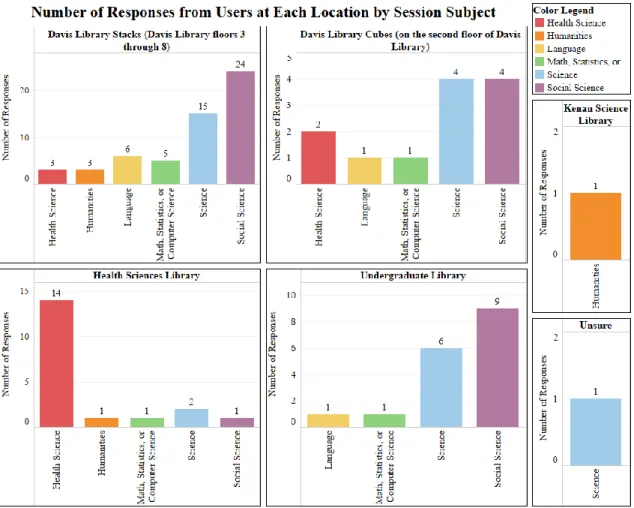
The survey results indicated that the majority of group study room users are undergraduates, with 111 responses from undergraduates, forty-four responses from graduate students, five responses from staff, and two responses from other users. No respondents reported being faculty members. This indicates that an undergraduate is slightly more likely to respond as a group room user than a graduate student, as the University reports having 18,862 undergraduates and 11,049 graduate students in 2019 (UNC-Chapel Hill, 2019). Group study rooms in the Davis Library stacks were the last rooms used by eighty-one respondents, and those in the Health Sciences Library were the last used by thirty-four respondents. Thirty-one responses came from those in the
room location. Graduate students were the most likely users of the Health Science Library Group study rooms, while undergraduates were the most common users of the other spaces, as shown in Figure 1.
ten users reported using the room for interviews. Eighty percent of respondents reported using the rooms at least a few times a month, and thirty-six percent reported using the rooms at least once a week. Twenty-one respondents reported using the room alone, but twenty-four reported there being two people in the room during their last session. Fifty-one respondents reported three people in the room, twenty-five respondents reported four, twenty-six respondents reported five, and eight respondents reported there being six people in the room during their last session. A total of one group reported there being seven people in the room, two groups reported eight people in the room, and one group reported ten people in the room.
Users from the School of Public Health reported using the rooms more than any other department; twenty-six respondents indicated that the School of Public Health was their primary affiliation. Of these twenty-six, twenty used the Health Sciences Library, which is intuitive, as the Health Sciences Library is across the street from the School of Public Health. Biology and Business were the next-most reported departments, with fourteen respondents from each of these departments. One-hundred and six respondents reported working on something for a specific class while using the group study rooms; these classes were able to be coded into six categories: Health Science; Humanities; Language; Math, Statistics, or Computer Science; Science; and Social Science. The most use came from the Social Science group, which is a broad category containing
The most used resources in the rooms were Wi-Fi and power outlets, with 143 users reporting using the power outlets during their sessions and 133 users using Wi-Fi during their sessions. Dry-erase boards were used by more than half of the respondents – ninety-five users reported utilizing that resource. That is sixty-five percent of the 144
users who remember dry-erase boards being present in the room they used. Only eight users utilized the display screens – twenty-seven percent of the twenty-nine users who indicated that display screens were present in their rooms. Only one user reported using the projector out of the three who remembered there being one present in their room.
with one student saying “white boards are useful”. Twenty-six of the Science users also reported utilizing the whiteboards, while eighteen Social Science patrons used the whiteboards. Science users were the most likely not to use WiFi, with nine users not utilizing the resource.
4.1.2 Qualitative Data
Of the eighty people who explained how they used the dry erase boards, twelve reported using them for brainstorming, outlining, or in other ways planning for group projects. Five reported using them to practicing writing words or characters for foreign language classes. The remaining sixty-three utilized them to work out problem sets and equations for science or math classes such as biology, chemistry, math, or economics. Among the forty people who gave a reason for why they did not use the white boards, twelve users cited the fact that they did not have markers available in their rooms. The other students felt that they did not need the boards. Some stated that all of their work was done on their laptops, and one respondent explained that they would use the white boards when studying for exams to test themselves and practice, but not for completing homework.
Of the 123 students who commented on their power outlet usage, twenty-three users reported using the power outlets to charge their phones, and all reported using them to charge computers. One student reported charging a tablet. Some students pointed that this outlet usage was due to the length of time they were on campus and the need to access notes, class materials on the internet, or word-processing software on their laptops. Of the nineteen users who gave reasons as to why they did not use the outlets, eight users simply said that they did not need them, while eleven specified that all of their devices were charged that day. Of the 116 students who reported on how they used Wi-Fi in their rooms, twenty-five specifically mentioned accessing Google Documents or Google Drive. One student mentioned accessing OneDrive, a cloud service to which the University subscribes. Four students mentioned using Zoom or Google Hangouts to collaborate remotely or complete interviews. Other students mentioned accessing homework or textbooks, and some students mentioned researching. Two students admitted to using social media during breaks. The three students who did not use Wi-Fi mentioned not needing their laptops for their session, suggesting that to some degree users are assuming that if they need their laptops at all they will need access to the internet.
that they would have liked to have had displays available to them in the rooms, which suggests that students who need the displays are unable to identify or use the displays that are in rooms for some reason. Two students wanted adapters for these monitors. As adapters are available already for checkout in the Libraries, this suggests that students either do not know that they can check out adapters or are unwilling to spend valuable group study time go check one out. Two students requested more dry-erase board availability, and eight people requested better marker availability in the study rooms, often citing the frustration with having to go downstairs to circulation in Davis Library to get markers or frustration with the three-hour checkout period for marker kits, as students are often upstairs studying for longer than that. Four more respondents requested better marker quality. This group wanted both more markers that were not dried up and markers in a wider variety of colors for making diagrams. Two users requested remote
collaboration tools such as cameras for video calls or phone lines. One user suggested installing a device that could scan white board information into a digital file, and another wanted a flip chart for taking group notes. Six other requests pertained to environmental factors, such as better lighting, seating, or ventilation, and came from users of the rooms in the Davis Library stacks, most of which contain some of the oldest furniture in the group study spaces.
4.2
Observation Results
working on a variety of projects; one group was studying for an upcoming humanities exam, one group was studying for an upcoming science exam, one group was working on a group project and conducting an interview for a social science class, and the final group was an extracurricular group working together on creating a shared document.
4.2.1 Findings
Generally, the observations echoed evidence from the surveys, but they also revealed some behaviors that the users may not be aware of. As the surveys suggested, many users are utilizing laptops and cellphones; almost all of those observed used their laptops throughout the observation sessions. More than three-quarters had their
network, highlighting the fact that students remain connected to the wireless network on campus throughout the day. All groups at some point used the power outlets to charge their laptops or phones.
Three of the four rooms had access to either a TV display or projector, but the only group that attempted to use it was the social science group; however, they quickly abandoned the attempt when they realized it would take them some time to figure it out. No one suggested getting an adapter from circulation to make the display work. In general, the groups did not have a need to use the displays anyway, as they all had access to all of the documents that they were using, either through Sakai or Google Documents. In the cases where someone did want to show others what was on their screen, they would rotate their laptop around on the table, a behavior exhibited in every group.
A few more observations pertained to behaviors that students were not necessarily cognizant of. Group members came in and out of the study room during the reservation periods. As mentioned above, students often had some trouble locating the correct room, and users often had to ask the previous users of the room to leave before they could use the space, especially during the afternoon sessions. One student mentioned that having a display screen that let students know what groups were in what rooms when could be useful. In addition, many students bring large backpacks into the spaces, which can make some of the smaller rooms more difficult to move around in. Finally, in the Kenan
Discussion
With the findings now examined, the research question can be addressed: How are students utilizing resources, such as display screens, projectors, and white boards, provided to them in reservable group study spaces in the University Libraries at UNC, to collaborate with one another, and how are they integrating their own personal technological devices with these resources? If they are not using these resources, are there clear reasons why they are not using them? Students are more likely to use resources provided to them when they are available at the point of need and are unlikely to use resources if they feel they will take too much time out of their time together to figure out. Inconvenience frustrates students quickly.
Convenience also plays an important role in which rooms students are likely to choose. In addition, much of the material and resources that students need are digital, and so efforts should be made to determine if there are ways that the library can help facilitate digital collaboration. Finally, students are using the group study rooms to find a private place to participate in remote collaboration efforts, both in the form of video or voice calling and in the form of shared Google Documents.
5.1
Convenience
5.1.1 Resources
equation for a peer may be to use the whiteboards, but if the student must leave the study room - and current floor – to obtain dry-erase markers, they will likely simply
demonstrate on a piece of paper instead. Students also fret about the three-hour checkout period for the markers, as groups that use the room for longer would have to remember to return them in the middle of a study session. The same was true for those users who needed to see each other’s laptop screens; using a display screen is ideally the best way for all users to be able to view one screen, but, most of the time, it is much easier for students to simply turn their screens around to show others. As group study room users typically all have laptops out and are frequently working on the same documents, users are often able to view the same documents on their individual screens.
5.1.2 Location
Convenience also plays a role in where students chose to use the group study rooms. This is evidenced by the fact that mostly graduate students use the group study rooms in the Health Sciences Library, while other group study rooms are more skewed towards undergraduate use. The Health Sciences Library is located towards the south side of UNC Chapel Hill’s campus and is surrounded by departments primarily home to graduate students, such as the School of Public Health, the School of Pharmacy, the School of Nursing, the School of Medicine, and the School of Dentistry. While certainly some undergraduates take classes in these buildings, they are much more likely to spend time on the north side of campus, where the other library locations that are part of this research are located. This also explains why the majority of Health Science use occurred in the Health Sciences Libraries. Knowing that a certain user group is likely to use rooms in a certain location could help to customize the rooms for the needs of that user group.
Library, who usually meet until 8:30pm, but the other reservable group study rooms that were big enough to fit them were booked. Indeed, it seems that students often like to meet later after most classes are over and group members are more likely to be available.
5.2
Digital Resources
This research also points to the proliferation of students using digital resources in group study rooms. This is emphasized by the eighty-eight percent of users who reported using Wi-Fi in the rooms and the seventy-six users who reported bringing laptops into the space. This follows known patterns of users carrying around personal computing devices throughout the day (Bennett, 2003; Bailin, 2011; Kocevar-Weidinger et al., 2007;
Straumsheim; Villanueva & Wong, 2007, Waters, 2001). This research found that students use these devices to collaborate on shared documents, access course materials, complete assignments, conduct research, and take some social breaks. As mentioned above, this points to the ease with which students are able to integrate their own devices with Wi-Fi and power in the study rooms. However, more could be done to determine if there are other digital tools that could aid students in collaboration and whether or not the University Libraries could help students to better utilize these sources. For example, only a few students report using Microsoft 365 software, a service that UNC-Chapel Hill subscribes to that could potentially make collaboration simpler for some students, and the Libraries could help students learn how to use this software. As Google Drive is the clear leading way that students are sharing documents, a workshop or web resource
With this proliferation of utilizing digital resources, it seems that display screens could be important resources for students to effectively collaborate in group study spaces, as they allow students to view digital documents at the same time. However, these
5.3
Remote Collaboration
5.3.1 Interviews and Conferencing
One of the interesting findings of this study is that users are utilizing the group study rooms to both conduct interviews and to be interviewed, remotely and in person. This makes some sense, as the rooms are relatively quiet spaces with neutral backgrounds and reliable internet connections, which allows students to feel confident that there will be no technical issues when participating in remote interviews and eliminates worries that something embarrassing might be present in the background of video interviews. The reservation aspect is also important here, as it allows students to be sure that they will have the space to themselves at the appointed interview time. It also is intuitive that students would occasionally use the room to video conference with other group members who could not be present to meet with everyone else.
Libraries could help students facilitate this use of the group study rooms in several ways. Some reservable rooms in the library could be specifically designated for interviews, which could both allow the resources in the rooms to be more targeted and to lessen the cases of single users taking space designed for use by larger groups. These rooms could be smaller, as often only one person is being interviewed, and would ideally be placed in a quiet location in the library. Hardware such as web cameras and
5.3.2 Google Drive Documents
One other area of remote collaboration is, once again, the use of Google
Documents. Students use these resources to work with group members in the same room as them, but, as observational data shows, they also use them to collaboratively work with users not present. For example, students studying for an exam may create a study guide in a Google document during their group study reservation session that others outside the room may also be contributing to simultaneously. Interestingly, while this is an example of synchronous remote collaboration occurring in the group study room, students may also use these resources to work together asynchronously and extend collaboration past the group study reservation period. Students may start a study guide in a group study session that they expect others to add to as the exam time approaches, or they may start a folder for a group project that they assign other users to contribute to later.
Conclusion
The reservable group study rooms in the University Libraries at the University of North Carolina at Chapel Hill are clearly filling a need for students to have a semi-private area in the libraries where they can collaborate with others without disrupting other library users. Students are using laptops and the internet to collaborate with each other and therefore commonly integrate their own personal devices with the provided sources of Wi-Fi and power outlets. Students have few complaints about these two resources in group study rooms. Many students utilize the writable surfaces in the spaces to
demonstrate problem solving to others, collaboratively structure ideas, and practice exercises, and some find need for the displays and projectors to more easily collaborate with digital tools, but more could be done to make these resources easier for students to use.
pinpoint resources that are especially useful to users studying specific disciplines, and those resources can be concentrated closely to where those students often go on campus.
Students expect group study rooms in academic libraries to provide a space to collaborate with others and also expect that the resources provided in those rooms will aid them in this endeavor. This is especially important as more professors assign
Bibliography
Adeyemi, Bolariwa. “Assessment of Study Space Usage in the Kenneth Dike Library.” Library Philosophy and Practice (e-Journal), Jan. 2017,
http://digitalcommons.unl.edu/libphilprac/1634.
Andrews, Camille, et al. “Library Learning Spaces: Investigating Libraries and Investing in Student Feedback.” Journal of Library Administration, vol. 56, no. 6, Aug. 2016, pp. 647–72. Crossref, doi:10.1080/01930826.2015.1105556.
Asher, A.., Amaral, J., Couture, J., Fister, B., Lanclos, D., Lowe, M. S., Smale, M. A. (2017). Mapping Student Days: Collaborative Ethnography and the Student Experience. Collaborative Librarianship, 9(4), 293–317.
Bailin, Kylie. “Changes in Academic Library Space: A Case Study at The University of New South Wales.” Australian Academic & Research Libraries, vol. 42, no. 4, Dec. 2011, pp. 342–59. Crossref, doi:10.1080/00048623.2011.10722245. Borgman, Christine. From Gutenberg to the Global Information Infrastructure : Access
to Information in the Networked World. MIT Press, 2000.
Bennett, Scott. Libraries Designed for Learning. Council on Library and Information Resources, 2003.
Gamson, Zelda F. “Collaborative Learning Comes of Age.” Change, vol. 26, Oct. 1994, pp. 44–49.
Gardner, Susan, and Susanna Eng. “What Students Want: Generation Y and the
Changing Function of the Academic Library.” Portal: Libraries and the Academy, vol. 5, no. 3, July 2005, pp. 405–20. Project MUSE, doi:10.1353/pla.2005.0034. González, Adriana. “Effective Management of High-Use/High-Demand Space Using
Restaurant-Style Pagers.” Journal of Access Services, vol. 9, no. 2, Apr. 2012, pp. 51–65. Taylor and Francis+NEJM, doi:10.1080/15367967.2012.658714.
Group Study Room Usage Patterns: Visualizing Library Data. 2011.
http://www.lib.ncsu.edu/dli/projects/dataviz/visgroupstudy. Accessed 1 Oct. 2018. Gullikson, Shelley; Meyer. “Collecting Space Use Data to Improve the UX of Library
Space.” Weave: Journal of Library User Experience, vol. 1, no. 5, 2016, doi:http://dx.doi.org/10.3998/weave.12535642.0001.502.
Hall, Katharine, and Dubravka Kapa. “Silent and Independent: Student Use of Academic Library Study Space.” Partnership : The Canadian Journal of Library and Information Practice and Research; Toronto, vol. 10, no. 1, 2015, pp. 1–38.
ProQuest,
doi:http://dx.doi.org.libproxy.lib.unc.edu/10.21083/partnership.v10i1.3338. Hillman, Christina, et al. “User-Focused, User-Led: Space Assessment to Transform a
Small Academic Library.” Evidence Based Library and Information Practice, vol. 12, no. 4, Dec. 2017, pp. 41–61.
Howe, Neil, and William Strauss. Millennials Rising: The next Great Generation Vintage Books, 2000.
Johns, Elizabeth M. Technology, Collaboration, and Services in an Academic Library: And Assessment of the Collaborative Learning Spaces in the North Carolina State
University Libraries, MS Paper, The University of North Carolina at Chapel Hill,
2012.
Khoo, Michael J., et al. “‘A Really Nice Spot’: Evaluating Place, Space, and Technology in Academic Libraries.” College & Research Libraries.
crl-acrl-org.libproxy.lib.unc.edu,
doi:https://doi-org.libproxy.lib.unc.edu/10.5860/crl.77.1.51. Accessed 1 Oct. 2018.
Kim Wu, S., & Lanclos, D. (2011). Re‐imagining the users’ experience: An ethnographic approach to web usability and space design. Reference Services Review, 39(3), 369–389. https://doi.org/10.1108/00907321111161386
Kocevar-Weidinger, Elizabeth, et al. “Case Study: The Inch and the Mile: Luck,
Opportunity, and Planning Innovative Learning Spaces.” Library Administration & Management, vol. 21, no. 1, Winter 2007, pp. 29–34.
MacWhinnie, Laurie A. “The Information Commons: The Academic Library of The Future.” Portal: Libraries and the Academy, vol. 3, no. 2, May 2003, pp. 241–57. Project MUSE, doi:10.1353/pla.2003.0040.
Maxim, Paul S. “Data Collection Methods and Measurement Errors.” In Qualitative Research Methods in the Social Sciences. Oxford University Press, 1999, pp.
279-300.
Massis, Bruce E. “In the Library: Quiet Space Endures.” New Library World, vol. 113, no. 7/8, July 2012, pp. 396–99. emeraldinsight.com (Atypon),
doi:10.1108/03074801211245084.
Mathews, Brian, et al. Encoding Space : Shaping Learning Environments That Unlock Human Potential. ACRL, 2016.
Merritt, Stephen R., and Shelley Neville Editor. “Generation Y.” The Serials Librarian, vol. 42, no. 1–2, June 2002, pp. 41–50. Taylor and Francis+NEJM,
doi:10.1300/J123v42n01_06.
Manuel, Kate. “Teaching Information Literacy to Generation.” Journal of Library Administration, vol. 36, no. 1–2, Jan. 2002, pp. 195–217. Taylor and
Francis+NEJM, doi:10.1300/J111v36n01_12.
Montgomery, Susan E., and Jonathan Miller. “The Third Place: The Library as
Collaborative and Community Space in a Time of Fiscal Restraint.” College & Undergraduate Libraries, vol. 18, no. 2/3, Apr. 2011, pp. 228–38. EBSCOhost,
doi:10.1080/10691316.2011.577683.
Mross, Emily, and Christina Riehman-Murphy. A Place to Study, a Place to Pray: Supporting Student Spiritual Needs in Academic Libraries | Mross | College &
Research Libraries News. crln.acrl.org,
Oldenburg, Ray. The Great Good Place : Cafés, Coffee Shops, Community Centers, Beauty Parlors, General Stores, Bars, Hangouts, and How They Get You through
the Day. 1st ed., Paragon House, 1989.
Primary Research Group. Survey of Academic Library Plans for Group Study Rooms and Space. Primary Research Group Inc., 2015.
Ruleman, Alice B., and Anthony Kaiser. “Identifying the Needs and Usage Habits of University Study Room Users.” Performance Measurement and Metrics, vol. 18, no. 2, July 2017, pp. 137–47. www-emeraldinsight-com.libproxy.lib.unc.edu (Atypon), doi:10.1108/PMM-06-2017-0029.
Steiner, H. M., & Holley, R. P. (2009). The Past, Present, and Possibilities of Commons in the Academic Library. Reference Librarian, 50(4), 309–332.
https://doi.org/10.1080/02763870903103645
Straumsheim, Carl. “Beyond Counting Books: Ithaka S+R, OCLC Research to Examine How Universities, Libraries Are Changing.” Inside Higher Ed, 11 April, 2017. https://www.insidehighered.com/news/2017/04/11/ithaka-sr-oclc-research-examine-how-universities-libraries-are-changing.
The University Libraries. “Book a Study Room.” n.d. accessed via https://library.unc.edu/places/book-a-study-room/
UNC-Chapel Hill. By the Numbers. 2019. accessed via https://www.unc.edu/about/by-the-numbers/
Conference on User Services - SIGUCCS ’07, ACM Press, 2007, pp. 345–51.
Crossref, doi:10.1145/1294046.1294128.
Walton, Graham. “Learners’ Demands and Expectations for Space in a University Library: Outcomes from a Survey at Loughborough University.” New Review of Academic Librarianship, vol. 12, no. 2, Nov. 2006, pp. 133–49.
Appendix A: Survey of Group Study Room Users
University of North Carolina at Chapel Hill Research Information Sheet
IRB Study #: 19-0150
Principal Investigator: Ellie Edwards
The purpose of this research study is to see how people are using reservable group study rooms to facilitate collaborative learning in the University Libraries at UNC Chapel Hill. Specifically, the study aims to learn more about how resources are being used in these spaces for collaboration. You are being asked to take part in a research study because you recently reserved a group study room in the University Libraries.
Being in a research study is completely voluntary. You can choose not to be in this research study. You can also say yes now and change your mind later.
If you agree to take part in this research, you will be asked to answer a few survey questions about your experience using group study rooms in the University Libraries. Your participation in this study will take about 10 minutes.
You can choose not to answer any question you do not wish to answer. You can also choose to stop taking the survey at any time. You must be at least 18 years old to participate. If you are younger than 18 years old, please stop now. Your choice to participate or not participate will in no way effect your employment, access to UNC resources, or grades.
The possible risks to you in taking part in this research are:
In the event of a data breach, others finding out that you have completed this survey and viewing your responses.
The possible benefits to you for taking part in this research are:
Contributing to a greater understanding of how group study rooms are being used in the University Libraries.
To protect your identity as a research subject, the researcher will not share your information with anyone. In any publication about this research, your name or other private information will not be used.
Screening Question
1. Have you used a reservable group study room in a library on UNC’s campus before? (If no, end survey)
Part 1: Session information
1. What is your affiliation with the University? a. Undergraduate Student
b. Graduate Student c. Faculty
d. Staff e. Other:
2. What University department are you affiliated with (if you are an undergraduate, what is your major)?
3. On average, how often do you use group study rooms in the University Libraries? a. Every day
b. A few times per week c. Once per week d. A few times a month e. Once a month
f. A few times a semester g. Once a semester h. Almost never
4. Approximately when was the last time you used a reservable group study room in a library on campus?
a. Today b. This week c. Last week d. A few weeks ago e. Last month f. A few months ago g. Last semester h. A few semesters ago i. Last year
j. A few years ago
When answering questions 5-9, please recall the last time you used a reservable group study room on campus.
5. Where was the group study room you used during that session located? a. Davis Library stacks (Davis Library floors three-eight)
b. Davis Library cubes (on the second floor of Davis Library) c. Undergraduate Library
g. Unsure
6. How many people were using the group study room during that session? 7. What was your purpose for reserving the room? Please select all that apply.
a. Working on a group project
b. Studying for the same class with friends/classmates c. Studying for different classes with friends/classmates d. Socializing
e. Independent quiet study f. Other (please explain):
8. If you were working on a project or studying for a specific class, please specify the course department.
9. Which best describes that session?
a. I reserved the group study room myself.
b. Someone else in my group reserved the group study room. c. My group used the study room without making a reservation.
Part 2: Resources Used
When answering questions 10-15, please recall the last time you used a reservable group study room on campus.
10. During your last session in a group study room, which of the following resources do you remember being in the room? Select all that apply.
a. Display screen/monitor b. Projector
c. Wi-fi
d. Dry-Erase Board e. Power Outlets
11. During your last session in a group study room, which of these resources did you use, and what did you use them for?
a. Display screen/monitor: b. Projector:
c. Wi-fi:
d. Dry-Erase Board: e. Power Outlets:
12. Why did you choose not to use these resources in your last session? a. (list of resources not selected in last question)
13. Where there any resources that you or a group member checked out of the library to use in the group study room during your last session (e.g. marker kits, display port adaptors, laptop chargers, etc.)
a. What did you use these resources for? (will display if they indicate yes to question 13)
a. What did you use these resources for? (will display if they indicate yes to question 14)
15. Was there a method that you used to keep common notes as group during your last session? If so, how did you share them among the group members (e.g. common Google or Office 365 document, writing notes on whiteboard and taking photographs, etc.).
16. Are there any resources missing from the group study room that you used that could help you collaborate better with group members? If so, how would you use these resources if you had access to them?
Part 3: Invitation to participate in observation session
Appendix B: Observation Guide
Observation Number ____
Consent Script (to be read before beginning the observation)
University of North Carolina at Chapel Hill Research Information Sheet
IRB Study #: 19-0150
Principal Investigator: Ellie Edwards
The purpose of this research study is to see how people are using reservable group study rooms to facilitate collaborative learning in the University Libraries at UNC Chapel Hill. Specifically, the study aims to learn more about how resources are being used in these spaces for collaboration. You are being asked to take part in a research study because you are using a reservable group study room in the University Libraries.
Being in a research study is completely voluntary. You can choose not to be in this research study. You can also say yes now and change your mind later. Your choice to participate or not participate will in no way effect your employment, access to UNC resources, or grades.
If you agree to take part in this research, you will be asked to allow the investigator to observe your group study room reservation session and take notes on how you use resources for collaboration during the session. You will not be asked to modify the way you use the room in any way. Your participation in this study will take as long as you plan to use the group study room. We expect that about 60 people will take part in this research study.
You can choose to stop the observation session at any point by indicating to the researcher that you would like to withdraw from the study. At that point, the research would leave the room and delete any records of the observation session. You must be at least 18 years old to participate. If you are younger than 18 years old, please indicate that the observation session should end now.
The possible risks to you in taking part in this research are as follows:
In the event of a data breach, others finding out that you have taken part in this observation session and the researcher’s observation notes.
Contributing to a greater understanding of how group study rooms are being used in the University Libraries.
To protect your identity as a research subject, the researcher will not share your information with anyone. In any publication about this research, your name or other private information will not be used.
If you have any questions about this research, please contact the Investigator present by calling 704-533-0311 or [email protected]. If you have questions or concerns about your rights as a research subject, you may contact the UNC Institutional Review Board at 919-966-3113 or by email to [email protected].
Part 1: General Session Information
1. What is the location of the study session? a. Davis Library Stacks
b. Davis Library Cubes c. Undergraduate Library d. Kenan Science Library e. Health Science Library
2. How many people are using the room?
a. If this number changes over time, please note this. 3. How long did the session last?
a. Does this differ from how long the room was reserved for?
4. In general terms, what is the subject of the meeting? (e.g. biology, history, standardized test prep)
5. Which of the following describes this meeting? a. This is a group project meeting.
b. This is a group study session with all users studying the same topic. c. This is a group study session with all users studying/working on different
topics.
d. This is a social session. e. This is individual quiet study. f. Other (describe):
6. Do the users appear to be: a. Undergraduate Students b. Graduate Students c. Faculty
d. Staff
e. Other (describe):
7. Which of the following are available in the room? Note number available if applicable and anything notable (e.g. any broken equipment).
a. Wi-Fi
d. Writable Surfaces e. Projectors
Part 2: User Behavior Descriptions
8. Of these items available, list those that the users utilize in this session and describe how they use them.
9. Of these items available that were not utilized in this room, describe any reasons that users did not have use them, if discernable.
10. Did users appear to bring any objects into the room that were checked out from/provided by the library? If so, how and when did they use them? Was there anything notable about the items themselves? (e.g. marker kits or port adapters) 11. Did users utilize any resources of their own in this session? If so, did they
integrate them with the resources provided in the room? If so, how? Were there any issues with this process? Answer these questions for any items used.
12. Are users communicating with each other? If so, how? Note any changes over time.
13. Are notes being taken in any way? If so, describe how.