Does Volunteerism Shape Adolescent Attitude and Behavior?
By Blake O’Connor
Honors Thesis Department of Public Policy
University of North Carolina at Chapel Hill
April 2014
ABSTRACT
Driven by schools’ need and professional demand, both the academy and society have
become preoccupied with how to teach social and emotional skills. This study examines the relationship between adolescent volunteerism and outcomes of attitude and behavior. Data were selected from the National Longitudinal Survey of Youth (NLSY79) Child and Young Adults surveys for adolescents from 10 to 14 years old. Four hypotheses were crafted and tested using contemporaneous analyses of 2004 and 2006 data, and by controlling for 2004 volunteering in the analyses of 2006 outcomes. A negative relationship between volunteering and indicators for problematic behavior and depressive symptoms was supported in at least one series of
ACKNOWLEDGEMENT
I would like to thank Dr. Christine Durrance, my advisor, who has given me her
guidance, encouragement, and patience over the past year. Her critical eye and teaching ability have produced some of the most positive and constructive feedback I have received from a
professor in college. I would also like to thank Dr. Joel Rosch, my second reader, for coaching me on how to communicate my research. Acknowledgement is due to Dr. Krista Perreira, Mary Leigh Creedon, and Molly Smith for their optimism and logistical support during this process. I have been very fortunate to have my dear friend, Brendan Yorke, provide me with endless advice, inspiration, coffee, and editing during the most difficult hours. And, finally, I would like to thank my parents, Mary Goodrow and Michael O’Connor, for never doubting that I would
TABLE OF CONTENTS
CHAPTER I: SIGNIFICANCE ... 5
CHAPTER II: LITERATURE REVIEW ... 11
CHAPTER III: METHODS ... 18
CHAPTER IV: RESULTS ... 28
CHAPTER V: CONCLUSIONS ... 38
REFERENCES ... 49
CHAPTER I: SIGNIFICANCE
Introduction
Educational and psychological research has demonstrated that positive outcomes are associated with college student participation in service-learning, or school-sponsored activities that tie classroom learning with practical experiences outside of the classroom (Eyler, Giles, & Schmeide, 1996). Program evaluations and studies of service-learning programs have shown enhanced academic achievement through hands-on learning and increased civic responsibility through engagement with a community and participants. At the core of service-learning theory are two facets: application-based learning and community service. The former has drawn attention from educators and researchers as an effective pedagogy; however, volunteerism is less prominently studied for its effects and association with adolescent attitude and behavior.
Adolescence is a developmental period of fluctuation and variation in terms of the physical, cognitive, social, and emotional aspects of a child. For decades renowned psychologists such as Piaget, Vygotsky, Bandura, Erikson, and Dewey have each contributed significantly to the modern day conceptualization of how children learn and develop. The predominant mindset in psychology, education, and public policy views behavior as an effect or result of some genetic, experiential, or even epigenetic cocktail. However, this study investigates the relationship between adolescent engagement in volunteerism – a form of prosocial behavior – and several behavioral and attitudinal outcomes.
Statement of the problem
the be-all-end-all in any selection process. There is a desire for proficiency in perceiving, understanding, regulating, and using social and emotional information (Bracket, Mayer, & Warner, 2004).
On the other hand, there is a need to support those with social and emotional deficiencies. Disorders such as Autism Spectrum Disorder and Social Anxiety Disorder have increased in prevalence. And one does not need to be “on the spectrum” or have a diagnosis in order for social and emotional dysfunction to affect his or her life or proximal persons. The negative effects of these deficiencies are compounded in school settings where symptomatic behaviors interfere with learning and social functioning. In combination with bullying and school violence, children with cognitive, social, and emotional differences struggle with mood and mental illness. Generally, adolescents experience challenges in school that wear down the mental condition and disposition of the child, especially those with existing social and emotional deficiencies.
These desires and needs are driving educators and school leaders to create programs and policies designed to foster socially and emotionally competent children. From social-emotional learning curricula in elementary school to high school leadership programs, attitude and behavioral skills are recognized and sought within school.
Purpose of the study
Abecedarian Project and Perry Preschool, are resource-intensive and less generalizable. In effort to identify dynamic predictors of healthy attitude and behavior, this study investigates the relationship between volunteerism – a prosocial behavior – and behavioral and attitudinal indicators. Findings may offer further direction or policy implications for schools aiming to build socially and emotionally competent adolescents.
Justification for study
While the psychology literature is filled with statistical analyses and experiments concerning behavior and social emotional development, there is a lack of large randomly assigned surveys of youth that can inform educational policy and practice to improve student attitude and behavior. Using the Child portion of the National Longitudinal Survey of Youth (NLSY79) this study examines the relationship between volunteerism and social-emotional development using two cross-section snapshots of adolescents in 2004 and 2006. The study also examines how participating in volunteerism in 2004 and 2006 relates to the attitude and behavior of the same sample of adolescents in 2006. Because these analyses are mainly correlational, the results alone will not support specific policy recommendations, but may inform the formation of relevant educational policies. Like most large databases, the NLSY79 is a well-known and utilized dataset, and consists of a wealth of underutilized data that is suited for demographic and public policy research.
Theoretical framework
Much like those whose study abroad experience changes how they view the world or those who work afterschool at a homeless shelter and subsequently become dedicated to the eradication of poverty, this theory holds that an adolescent’s exposure to volunteerism or doing for others promotes social consciousness and self-efficacy. In turn, this social consciousness and self-efficacy is reflected by attitude and behavior. Motivation for charitable behavior is a topic of interest in many disciplines and has even led to the collaboration of academics from the fields of economics, neuroscience, and philosophy. The theoretical framework here does not include an explanation for charitable behavior. Instead, the theory here postulates that adolescents exposed to charitable behavior through volunteerism and/or community service develop empathy and self-efficacy. In turn, these developed traits are reflected in temperament and behavior. In turn, positive attitude and behavior may reinforce participation in volunteerism or other forms of prosocial activity. Over time, participation in volunteerism may correspond with less problematic behavior, improved self-perception, and healthy disposition. Figure 2 includes an illustrative representation of this theory.
Research questions addressed in this study
Research Question 1: What is the relationship between adolescent exposure to volunteering and behavioral indicators such as the Behavior Problems Index (BPI)?
Hypothesis: Adolescents with volunteer experience have fewer behavioral issues, indicated by lower BPI scores, contemporaneously and in the future.
Research Question 2: What are the relationships between adolescent exposure to volunteering and their self-perception of scholastic ability and self-worth?
Research Question 3: What is the relationship between adolescent exposure to volunteering and adolescent risky behavior?
Hypothesis: Adolescents who participate in volunteering are less likely to engage in risky behavior.
Research Question 4: What is the relationship between adolescent exposure volunteering and an adolescent’s mood or depressive symptoms?
Hypothesis: Adolescents who participate in volunteering or community service are less depressed or identify with fewer depressive symptoms.
Summary
compelling line of reasoning for the association of volunteerism and positive attitude and behaviors.
In this study, the relationship between volunteerism and indicators of attitude and behavior will be explored contemporaneously and longitudinally over two years. Adolescents are uniquely susceptible to social pressures and opportunities to demonstrate self-efficacy. Volunteerism provides such an opportunity. By identifying predictors over which schools have control, educational programs and policies can be designed to foster socially competent and emotionally intelligent adolescents.
A review of research literature related to volunteerism, adolescence, attitudes, and behavior was conducted. Findings and background information relevant to this study are included in this chapter. The consideration of whether or not to include a particular study was based on several critical criteria. For literature reviews, articles were evaluated based on the year of publication; comprehensiveness of literature reviewed, and number works citing the source. Empirical studies were considered based on the sample or data studied, variables assessed, research design and methodology, data analyses, and location of study. The significance of the findings was judged by the strengths and limitations of the study.
Overview of adolescent development
Adolescence is a transformative period in human development. During this period, individuals explore themselves and their environment. Adolescents explore civic, social, and professional aspects of their lives, making middle schools a developmentally appropriate period for students to engage in service and volunteerism. Service-learning programs are most common in college and high school; however, adolescence is a critical period for cognitive, social, and emotional development. Research on the developmental context of adolescence is further explained in the following sections.
Psychosocial development
According to Erikson’s psychosocial theory, adolescents struggle with the basic conflict
of identity versus role confusion. A stronger sense of independence, initiative, and competence is foundational for healthy development of an adolescent’s identity, and social relationships serve a
relationships, academic performance, and other areas (Schwartz, 2008). Adolescents begin to test goals, values, and beliefs at this stage (Waterman, 1984). Adolescents who encounter and
complete this stage most successfully resolve identity confusion, are more connected to their surroundings, and are better able to foresee and plan out their futures.
Positive youth development theory suggests that adolescents who contribute to their community are more likely to thrive developmentally. This theory offers that children live and develop within a system of bidirectional processes between individual behavior and
developmental context (Lerner, Dowling, & Anderson, 2003). At the core of this theory is relative plasticity and developmental regulation. In order for a developing individual to thrive, Lerner and colleagues claim:
“…that structurally invariant (universal) bidirectional person-context relations create in individual’s development a sense of self (an identity) that integrate moral and civic actions and possesses the ‘virtue’ of spirituality. Spirituality is an emotional orientation to
self and context that involves the transcendence of self and “fuels” (motivates) the development of a commitment to contributing to others and institutions beyond self in time and place (2003).”
Finally, Csikszentmihalyi and Rathune assert that individuals who contribute to community over a period of time in turn thrive developmentally (1998). Developmental
Cognitive development
With respect to cognition, adolescents begin to incorporate greater logic, deductive reasoning, and abstract ideas into their thought processes (Piaget, 1997). Piaget (1972) theorized that children entering the formal operational stage – the final stage of his cognitive development model – are able to mentally manipulate information, think creatively, and make inferences. Naturally, adolescents begin to think systematically, adjusting one variable at a time and employing trial and error (Nurmi, 1991; Piaget, 1972). While Piaget estimated this cognitive transition begins around age eleven, Robert Siegler (1981) observed this type of systematic and abstract reasoning to occur between ages 13 and 17. Both scholars estimate this cognitive transition occurs during adolescence.
Social development
Social learning theory posits that children learn from the people around them – their parents, peers, and teachers (Bandura 1977). Montgomery (2005) found that as adolescents transition into early adulthood, they engage in more passionate and intensely emotional
relationships. Increasing significantly in early adolescence, these relationships remain prominent through adolescence. Flanagan (2004) found that opportunities for adolescents to exercise leadership skills promotes communal feelings among peers and propels performance outcomes for teams.
Prosocial behavior and its effects on development
in their communities as adults (Johnson, Beebe, Mortimer, & Snyder, 1998). Richards and colleagues claim abstract thinking allows one to comprehend the importance of service and how their service may impact the community (Richards et al., 2013). According to Eyler (2002), reflection allows students to “evaluate themselves, their roles in schools, neighborhoods, and
communities, and their relationship to community issues and societal problems.” Feelings of solidarity have also been associated with commitments to public interest goals as seen in community service or public service work (Flanagan, Bowes, Jonsson, Csapo, & Sheblanova, 1998). Service has been shown to expose students to a variety of different people, situations, and issues in a community, as well as, strengthen the value for accountability (Flanagan, 2005). Service experiences provide a context for students to learn cooperation and teamwork skills (Jarrett, 1998). Others have linked service to forming peer relationships and group social skills (Dworkin, Larson, & Hansen, 2003). Uggen and Janikula (1999) analyzed administrative data to find that there is a robust negative relationship between volunteering and criminal arrest during late adolescence.
Effects on prosocial behavior
Parent warmth, sensitivity, and responsiveness have been positively correlated with empathic traits in childhood (Zahn-Waxler, Radke-Yarrow, & King, 1979). Chase-Landsale and colleagues (1995) theorize that children model the care and prosocial behavior they observe from their parents. Soenens, Duriez, and Goossens (2007) found that perspective-taking in
demonstrated a greater concern for others. These opportunities and how parents reinforce the behavior influence the extent to which a child displays that behavior (Bandura, 1965).
Other effects on development
Low income and family instability are two familial and childhood characteristics that have been connected to negative outcomes such as poor academic achievement and problematic behavior. Poverty is most notoriously attributed to poor child outcomes; however, there is no consensus on the pathway of effect on child outcomes and behavior (Duncan and Brooks-Gunn, 1997). Despite the number of studies that find significant associations between income and family structure, the number of confounding variables makes causal claims controversial (Cherlin et al., 1991; Shea, 2000).
The research literature often uses poverty indicators and proxies to measure how much a child is likely to be impacted by poverty. The suspected mechanism behind the negative effects and associations of poverty is stress, which can be experienced by the parents and the children depending on the severity. For example, divorce is particularly influential because stress is inherent to the shifting of roles and responsibilities in parenting and because children have to adjust themselves. Parental stress from divorce can manifest itself as less time spent with the child and irregular emotional and social functioning (Bandy & Wilhelm, 2007). Other parenting practices affected by poverty are represented as low maternal education, lack of supervision and feelings of affection, and single parent households (Korenman, Miller, & Sjaastad, 1995;
Menaghan, Kowaleski-Jones, & Mott, 1997; Lichter, Shanahan, & Gardner, 2002).
The NLSY79 child survey and research on volunteerism, behavior, and attitude
Using the Young Adult surveys of the NLSY79 and a large sample of young adults between the ages of 18 and 25, Brown and Litcher (2006) analyzed the influence of a young adult’s history of poverty and social disadvantage on adolescent development behaviors – such as those explored in this study – and on volunteerism as an adult.
Lichter, Shanahan and Gardner (2002) examined the associations between NLSY Young Adult respondents’ experience with poverty and family structure on volunteer work in adulthood. Like Brown & Lichter (2006), conditions of the subjects’ upbringing were hypothesized to affect their behavioral tendencies many years later. In order to determine and operationalize poverty, Lichter and colleagues created a “life course risk index,” consisting of the following indicators:
how many years the child spent in a female-headed household, proportion of childhood spent in poverty, whether or not the child was born to a single teenage mother, the number of moves outside the county during childhood and maternal education (Lichter, Shanahan, and Gardner, 2002). This analysis considered both distal and proximal indicators of disadvantage and assumed their effect was mediated by the current circumstances of the child as postulates the “contextual model” of volunteering (Rosenthal et al., 1998). In addition to the early life experience index,
Lichter and colleagues considered religiosity, a self-efficacy scale, future aspiration, and competing time-intensive responsibilities in their regression model. In summary, Litcher and colleagues conceptual model held that early life experiences influence social and emotional development, which determines priorities and prosocial behavior.
Summary
Unlike previous research conducted on prosocial behavior and social and emotional
adolescence. The expectations of educational policies have shifted. Educational polices are no longer designed to increase high school graduation rates; they are designed to produce high school graduates that are college and career readiness. Arguably, social and emotional functioning just as much as academic credentials determine college and career success.
CHAPTER III: METHODS Introduction
This research study explores associations between exposure to volunteer experiences and adolescent attitude and behavior. This chapter describes the methodology for examining the relationship between afterschool volunteering and indexes that measure problematic behavior, self-perception, depression, and risky behavior contemporaneously and two year later. Data from two cross-sections were applied to the following regression model:
The background of the dataset and the methods for acquiring and learning about the data will be discussed. The research questions tested and the hypotheses developed are also presented.
The Data: The National Longitudinal Survey of Youth (NLSY79) and the NLSY79 Child
survey
The NLSY79 cohort is a federally funded, longitudinal survey project that samples cohorts of American youth born between 1957 and 1964. Originally, 12,686 respondents aged 14 to 21 formed the first cohorts that were interviewed in 1979, including oversamples of African American, Hispanic, and low-income Whites, and military youth. Later, these latter two oversamples were dropped from the NLSY79 based on eligibility. This left a total of 9,964 respondents in the NLSY79 sample for continued evaluation. There are currently 24 rounds of data available between 1979 and 2010. Multistage stratified sampling was used for random selection.
those children born in 1986 with the eighth round of the NLSY79. Approximately 11,504 total children have been born to NLSY79 mothers and about 10,000 had been interviewed by 2010. This opportunity to collect data from the children of the NLSY79 mothers affords researchers a distinct opportunity to study health and development outcomes from birth through teenage years. Each child’s identification or reference number in the data is determined by the mother’s position
in the NLSY79 data, which allows researchers to make intergenerational links. Perhaps the most advantageous aspect of the NLSY79 Child for this study is the inclusion of several empirically-based child assessments within the survey instruments that evaluate social, cognitive, and psychological aspects of the respondent’s development (Boardman, Powers, Padilla, & Hummer,
2002). The assessments used in this study were administered within the Child Self-Administered Survey, and include the Behavioral Problems Index (BPI) and the Self-Perception Profile for Children (SPPC).
This research study uses NLSY79 Child survey data from 2004 and 2006. The purpose of this study is to analyze the relationship between young adolescents who have engaged in volunteer experiences and their social-emotional development outcomes contemporaneously. In 1996, children between 10 and 14 years old were asked whether or not they volunteer or perform community service afterschool. In 1998, this dichotomous response variable was converted into a 3-point scale of frequency: (1) often (2) sometimes (3) almost never. By 2004, the volunteer question was phrased, “Between the time school lets out and dinner time, how often do you do volunteer work or community service.” Respondents were to respond using a 5-point Likert scale
decreased (n = 719) because the respondents that were 13 and 14 years old in 2004 were then 15 and 16 years old and now too old for the Child survey. For statistical analyses, the sample was drawn from an age check variable given to those filling out this portion of the Child survey, which coded respondents as 9, 10, 11, 12, 13, or 14 years old. The 9 year olds did not answer the volunteer question. For regression analyses, a new binary volunteer variable was generated where those with any volunteer experience (Likert scores “1” through “4”) were coded as 1 and those who had never volunteered (Likert score of “0”) were coded as “0.”
Studies using the NLSY79 Young Adult have controlled for age, sex, race, and ethnicity (Brown & Lichter, 2006; Lichter, Shanahan & Gardner, 2002). These factors were similarly controlled for in this study using dummy variables for race, ethnicity, sex, and age. The variable “Black” was created where African American respondents were coded “1,” and all others “0.” The variable “Hispanic” was created, where respondents identifying as “Hispanic” were coded “1,” and all others “0.” The variable “Female” was created, where females were coded “1” and males as “0.” Dummy variables were individually created for ages 11 through 14 to control for
age. Age 10 was used as a reference variable. These control variables were universally included in all regression analyses.
and for if the child feeing “very” or “quite” close to his or her mother. A “1” was coded for a “yes” or affirmation of each of these characteristics individually.
NLSY Child instruments used and analyses performed
As mentioned, the NLSY79-Child and Young Adult surveys include several developmentally appropriate cognitive, socio-emotional, and physiological assessments for children. These assessments are administered biennially along with the rest of the survey. This study utilizes the Behavior Problems Index (BPI) as a behavioral indicator and the What I Am Like/Self-Perception Profile for Children (SPPC) as an indicator of the child’s sense of self.
Behavior Problems Index (BPI). A derivation of the Achenbach Behavior Problems Checklist, Peterson & Zill (1986) developed the BPI to measure the frequency, range, and type of behavioral issues for children aged four and over. Completed by the mother of a child respondent over four years old, the BPI generates scales of problem behavior in the form of hyperactivity, anxiety, dependency, aggressiveness, and peer conflict using 28 questions within the Mother Supplement (Zill, 1990). Mothers were asked to answer the questions based on the behavior of their child over the previous 3 months and were given three response categories: (1) “often true” (2) “sometimes true” (3) “not true” (NLSY79 Child). In order to create the six subscales, the “often true” and “sometimes true” answers were assigned a value of one and the “not true” responses were assigned a value of zero. Thus, higher scores signify more behavioral
Each index score of the BPI is in the dataset as a raw score, percentile, or standardized score. In 1981, norms were identified for the BPI using the National Health Interview Survey (NHIS). Girls are more likely to have lower BPI scores or “better” behavior. Using the normalized data from previous disseminations of the BPI, percentile and standard scores, with a mean of 100 and a standard deviation of 15, are generated for each year of the NLSY79 Child survey. This study only uses the BPI standardized scores for total BPI, total trichotomous BPI, internalizing behavior, externalizing behavior, antisocial behavior, anxious/depressed behavior, headstrong behavior, hyperactivity, and peer conflict/withdraw.
In regards to the validity and the reliability of the BPI, this measure is among the most robust, frequently used, and consistent measures of child attitudes and behaviors (Bopkova, 2005). The mean BPI scores of the NLSY79 Child were 102.2 in 2004 and 99.8 in 2006, which are almost equal to the normalized average score of 100. The overall scale is considered to be predicted by the family background and parenting and has been used to test the reliability and validity of other attitude and behavior scales such as the temperament scale (Baydar, 1995). The trichotomous externalizing and internalizing scores have been used in at least four other studies and the subscales are often used as the main outcome of interest (NLSY79 Child Survey Topical Guide).
the phrases are structured so that they child may identify with one phrase more than the other. For example, the interview would read, “Some kids often forget what they learn. Other kids can
remember things easily.” Then the interviewer asks the child which child is more like him/her and whether or not it is “really true” or “sort of true” for the child. The global self-worth score
and the scholastic competence score are each constructed by summing the six “even-numbered” items and the six “odd-numbered” items, respectively. Higher scores indicate greater levels of
confidence. These are raw scores because there are no national normalized scores available for this questionnaire.
Risk Behavior. Within the Child Self-Administered Supplement (CSAS), there are six questions of propensity for risk-taking (“feelings toward yourself”) adopted from Section F (Social-Psychology) of the American Teenage Study. Answer options include: (1) Strongly Agree, (2) Agree, (3) Disagree, and (4) Strongly Disagree. Across all six questions, the higher magnitude answer indicates a lower perception of risky behavior. For example, “I often get in a jam because I do things without thinking” (NLSY79 Child Survey Topical Guide). Thus, the
responses could be easily summed into an index with a range of 0 to 6, where higher scores are representative of riskier behavior. The NLSY79 Child data does include such an index; however, one was created for the current study. Each question item was converted into a dichotomous variable of “0” and “1.” Agreeable responses were assigned a value of one, while disagree
Child depression or “moods.” These nine question items were adopted from the National
Commission on Children (NCC) 1990 Survey of Parents and Children for the CSAS portion of the survey. Two of these questions are phrased to inquire about the child’s frequency of feeling “happy” or “excited about something” whereas the other seven questions inquire about the frequency of feeling “sad and blue” and “too busy to get everything done” and other negatively
phrased scenarios. Response options include: (1) Often, (2) Sometimes, and (3) Hardly ever. For the seven negative affect questions (i.e., feels lonely/sad/nervous/bored/tired/too busy/pressured), the “2” for “Sometimes” and the “3” for “Hardly ever” were converted into a zero value, while “Often” maintained a “1” value. For the two positive affect questions, the one value for “Often” was converted to a zero value, while the “2” for “Sometimes” and “3” for “Hardly ever” were
converted into values of one. The variables were then summed to form an index. This higher index scores indicated greater symptoms of depression, while lower scores indicated less depressive symptoms.
Research questions and hypotheses
Research Question 1: What is the relationship between adolescent exposure to volunteering and behavioral indicators (i.e., Behavior Problem Index)?
Hypothesis: Adolescents with volunteer experience have fewer behavioral issues indicated by lower BPI scores, contemporaneously and in the future.
Data analysis: The broad afterschool-volunteering variable was treated as an independent variable in several regressions where various BPI indices were used as dependent variables. The following standardized versions of the BPI were used: total, externalizing trichotomous, internalizing trichotomous, and individual indices for hyperactivity, anxiety, headstrong behavior, antisocial behavior, and peer conflict/withdraw. The index for dependency was not included because the data were incomplete. The first regression analysis looked at the relationship between volunteerism and outcomes using respondents’ data from 2004. The second
considered the same relationships, but utilized respondents’ data from 2006. The third set of regressions looked at the relationship volunteerism and outcomes in 2006, controlling for volunteerism in 2004. For each outcome variable regression analyses were carried out in a stepwise fashion, where the four potential confounding variables were added to regression one at a time to be controlled. The tables in the appendix, however, include only the coefficients and significance levels from the regression that controlled for all the independent variables simultaneously. Results determine statistical significance in terms of the how the independent variables relate to behavior problems contemporaneously, and how volunteering exposure from two years prior may predict behavioral problems.
Hypothesis: Adolescents with volunteer experience have positive self-perception as measured by the Self-Perception Profile for Children.
Data analysis: Regression analyses are run with each subscore of the Self-Perception Profile for Children – scholastic ability and self-worth – as a dependent variable. The relationships between the independent variables and child self-perception contemporaneously were analyzed for 2004 and 2006. A last series of regressions used 2006 data, but controlled for 2004 volunteer participation in order to investigate how it predicts attitudinal and behavioral outcomes two years later. As in the BPI regressions, the afterschool volunteering serves as the independent variable of interest in addition to the controls. An additional regression series was run for each subscore with both 2004 and 2006 exposure to volunteerism included as independent variables.
Research Question 3: What is the relationship between adolescent exposure to volunteering and adolescent risky behavior?
Hypothesis: Adolescents who participate in volunteering are less likely to engage in risky behavior.
Data analysis: The same three regression models were used: one with 2004 data, one with 2006 data, and the last with 2006 data while controlling for 2004 volunteering. The outcome variable for risky behavior is an index created from the six question items that ask adolescents in about their risky-taking behavior in the self-administered supplement.
Research Question 4: What is the relationship between adolescent exposure to volunteering and an adolescent’s mood or depressive symptoms?
CHAPTER IV: RESULTS Introduction
Descriptive statistics were calculated for control variables across the sample. Those who skipped questions, refused to answer, answered “I don’t know,” or were not given the questions
used for this study were coded as missing using Stata. Across two points of data collection, four regression analyses were run to test each of the four research questions.
The volunteer participation question of interest was administered to children between the ages of 10 and 14 years. In order to include the same sample of children in the analyses of 2004 data and analyses of 2006 data, children who were 10, 11, 12, and 13 years old in 2004 were included, while those who were 14 were dropped because they would not be included in the survey questions of interest in 2006, the second year analyzed. Thus, only children with complete data for both 2004 and 2006 were examined.
Descriptive Statistics
of the overall child sample for 2004. On average, the study samples’ mothers finished at least
one year of college (M = 13.4), while the average for the entire 2004 child sample graduated high school (M = 12.5). Children reported feeling relatively close (“very” or “quite” close) to their mothers at a rate of 89%, whereas 11% felt otherwise in 2004.
Correlations between variables
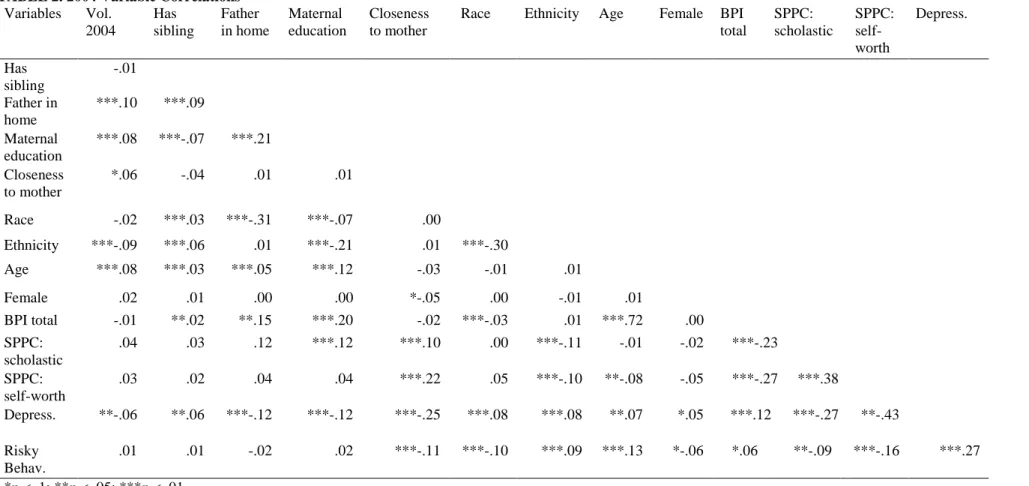
There were several correlational relationships with demographic and family characteristics as displayed in Table 2. Ethnicity (or being Hispanic) is negatively correlated with race (r = -0.30, p < 0.01) and level of maternal educational attainment (r = -0.21, p < 0.01). Ethnicity has a statistically significant positive relationship with having at least one sibling (r = 0.06, p < 0.01). There is a statistically significant negative relationship between race (or being Black) and father living in the maternal household (r = -0.31, p < 0.01) and level of mother’s educational attainment (r = -0.07, p < 0.01). There is a statistically significant positive relationship between race and having a sibling (r = 0.03, p < 0.01). Age had a statistically significant positive relationship with volunteering (r = 0.08, p < 0.01), having a siblings (r = 0.03, p < 0.01), having a father in the home (r = 0.05, p < 0.01), and level of maternal education (r = 0.12, p < 0.01). A statistically significant negative relationship exists between being female and feeling close to mother (r = -0.05, p < 0.1). An adolescent’s having at least one sibling has a statistically significant positive correlation with having a father at home (r = 0.09, p < 0.01) and a negative relationship with level of maternal education (r = -0.07, p < 0.01). An adolescent’s having a father at home has a statistically significant positive relationship with level of mother’s
education (r = 0.21, p < 0.01).
had a statistically significant negative relationship with both SPPC raw scores: scholastic (r = -0.23, p < 0.01) and self-worth (r = -0.27, p < 0.01). The BPI total had a statistically significant positive relationship with the depression index (r = 0.12, p < 0.01) and with the risky behavior index (r = 0.06, p < 0.1). The two raw scores of the SPPC had a statistically significant positive relationship (r = 0.38, p < 0.01). The scholastic score had statistically significant negative relationships with depression (r = -0.27, p < 0.01) and with risky behavior (r = -0.09, p < 0.05). The self-worth score also had negative relationships with depression (r = -0.43, p < 0.05) and risky behavior (r = -0.16, p <0.01). Finally, the created indices for risky behavior and for depression were positively correlated (r = 0.27, p < 0.01).
Variables correlated with 2004 volunteering are presented in Table 2. A statistically significant positive relationship existed between volunteering 2004 and having a father living in the maternal household (r = 0.10, p < 0.01), a child feeling close to his or her mother (r = 0.06, p < 0.01) level of maternal education (r = 0.08, p < 0.01), and age (r = 0.08, p < 0.01). Volunteering in 2004 has a statistically significant negative relationship with depression (r = -0.06, p < 0.05) and ethnicity (r = -0.09, p < 0.01).
Being female had positive relationship with depression (r = .05, p < 0.1) and a negative relationship with risky behavior (r = -0.06, p < 0.1). Level of maternal education had a positive relationship with total BPI score (r = 0.20, p < 0.01) and self-perceived scholastic ability (r = 0.12, p < 0.01), and a negative relationship with depression (r = -0.12, p < 0.01). Adolescent’s feelings of closeness to his or her mother had a positive relationship with self-perceived scholastic ability (r = 0.10, p < 0.01) and self-worth (r = 0.22, p < 0.01), and negative relationship with depression (r = -0.25, p < 0.01) and risky behavior (r = -0.11, p < 0.01). An adolescent’s having a sibling was positively correlated with depression (r = 0.06, p < 0.05) and
with BPI total score (r = 0.02, p < 05). Finally, an adolescent’s having a father in the maternal household was negatively correlated with depression (r = -0.12, p < 0.01) and positively correlated with BPI total score (r = 0.15, p < 0.05).
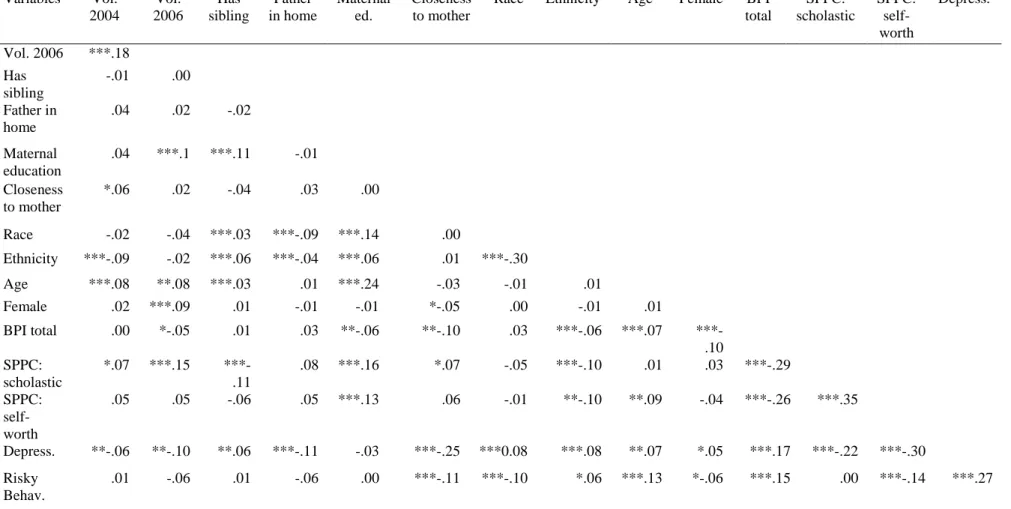
Presented in Table 3, the correlation matrix of dependent variables from 2006 displayed similar patterns as the 2004 data. BPI is negatively correlated with SPPC scholastic score (r = -0.29, p < 0.01) and self-worth score (r = -0.26, p < 0.01), while it is positively correlated with depression (r = 0.17, p < 0.01) and risky behavior (r = 0.15, p < 0.01). The SPPC scores were positively correlated as well (r = 0.35, p < 0.01). Scholastic self-perception was negatively correlated with depression (r = -0.22, p < 0.01), as was self-worth with depression (r = -0.30, p < 0.01) and risky behavior (r = -0.14, p < 0.01). Again, depression and risky behavior had a statistically significant positive relationship (r = 0.27, p < 0.01).
volunteering in 2006 (r = 0.18, p < 0.01). Volunteering in 2006 had a statistically significant positive relationship with being female (r = 0.09, p < 0.01), age (r = 0.08, p < 0.05), maternal educational attainment (r = 0.1, p < 0.01), and self-perceived scholastic ability (r = 0.15, p < 0.01). Volunteering in 2006 is negatively correlated with BPI total score (r = -0.05, p < 0.1) and depression (r = -0.10, p < 0.05). Volunteering in 2004 also had statistically significant correlations with 2006 data. Volunteering in 2004 was positively correlated with age (r = 0.08, p < 0.01), self-perceived scholastic ability (r = 0.07, p < 0.1), and adolescent’s feeling of closeness toward mother (r = 0.06, p < 0.1). Volunteering in 2004 was negatively correlated with ethnicity (r = -0.09, p < 0.01) and depression (r = -0.06, p < 0.05).
Regression analyses
close the child feels to his or her mother. The stepwise regression analyses were individually applied to each of the thirteen dependent variables across the three regression series (i.e. 2004, 2006, and 2006 with 2004 volunteer measure). In total, there were either control variables in addition to the afterschool volunteer participation variable, which was the main independent variable of interest. A total of 196 individual regressions were run.
Research Question 1: What is the relationship between adolescent exposure to volunteer experience and behavioral indicators (i.e., Behavior Problem Index)?
Hypothesis: Adolescents with volunteer experience have fewer behavioral issues, indicated by lower BPI scores, contemporaneously and in the future.
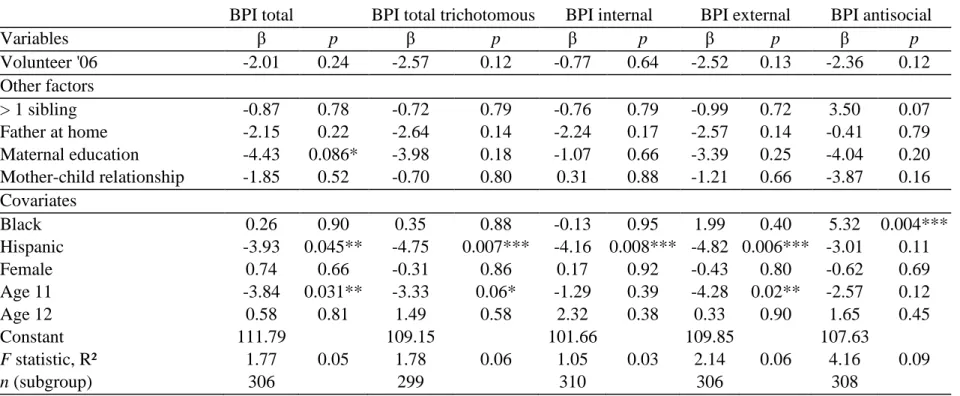
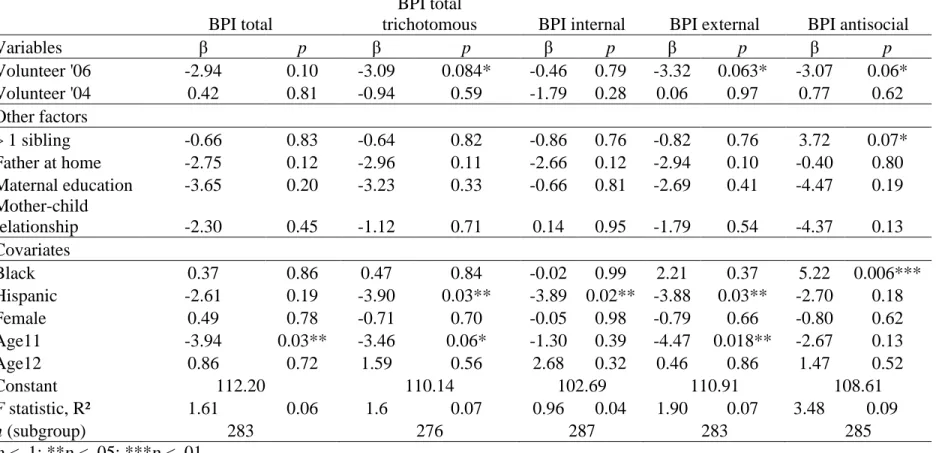
Findings: This question was approached using nine index scores provided by the Behavior Problems Index, which is designed to measure the frequency, range, and type of behavioral issues for children four years and older. The standard score versions of the following nine indexes were used because they have been normalized to adolescents living in the United States: total score, total trichotomous, internal, external, antisocial, anxious/depression, headstrong, hyperactive, and peer conflict. A higher score for each index indicates greater frequency of that problematic behavior. Regression findings for volunteerism and behavior can be found in Table 4 for 2004 contemporaneous, Table 6 for 2006 contemporaneous, and in Table 8 for 2006 with 2004 volunteering controlled.
In 2004, volunteerism was negatively associated with the internalizing behavior BPI subscore (β = -2.13, p < 0.1) as shown in Table 4a. Although not presented in Tables 4a and 4b,
antisocial behavior (β = -3.43, p < 0.05), and hyperactive behavior (β = -5.09, p < 0.01) as seen
in Table 4a and 4b. Maternal educational attainment and how close the child felt to the mother had statistically significant negative relationships with BPI subscores in 2004 as well.
Unlike in 2004, internalizing behavior did not have a statistically significant relationship with volunteering in 2006 with or without controlling for 2004 volunteering as displayed in Table 6a and Table 8a, respectively. Although, volunteering in 2006 did have a statistically significant negative relationship with hyperactive behavior (β = -2.60, p < 0.1) and with peer conflict/withdraw (β = -3.54, p <0.01) as presented in Table 6b. When all variables were
controlled, having a father in the maternal household also had negative relationships with hyperactive behavior (β = -3.23, p < 0.05) and with peer conflict/withdraw (β = -3.42, p < 0.01).
In summary, contemporaneous accounts of volunteering had negative associations with internalizing behavior in 2004, and hyperactivity and peer conflict/withdraw in 2006. When volunteering in 2004 was controlled, volunteering in 2006 had negative associations with BPI total trichotomous score (β = -3.09, p < 0.1), BPI externalizing behavior score (β = -3.32, p <
0.1), and BPI antisocial behavior score (β = -3.07, p < 0.1) as shown in Table 8a. Volunteering in 2006 also maintained negative associations with hyperactivity (β = -3.89, p < 0.5) and peer conflict (β = -3.26, p < 0.5) with 2004 volunteering controlled as shown in Table 8b. Table 8 also
shows that 2004 volunteering never had a significant relationship when controlled for in the 2006 data.
Research Question 2: What are the relationships between adolescent exposure to volunteerism and their self-perception of scholastic ability and self-worth?
Findings: The dependent variable is a twelve-question survey designed to measure how 12 to 14 year olds perceive their scholastic ability and self-worth. Two dependent variables, one for each subscale, were used to test the hypothesis. The independent variables were the same. Findings contemporaneous 2004 data and contemporaneous 2006 data can be found in Table 5 and Table 7, respectively. Table 9 includes findings for 2006 with 2004 controlled.
As shown in Table 5, contemporaneous volunteering in 2004 demonstrated a positive relationship with adolescent self-worth (β = 6.75, p < 0.05). Maternal education (β = 13.25, p < 0.05) and child’s closeness with mother (β = 25.52, p < 0.01) also had positive relationships with
worth in 2004. Being a female (β = -5.94, p < 0.05) had a negative relationship with self-worth in 2004. Also, self-perceived scholastic ability had positive relationships with having a father at home (β = 10.23, p < 0.01) and mother-child relationship (β = 15.28, p < 0.01).
In 2006, there was a contemporaneous positive relationship between volunteering and scholastic ability (β = 15.12, p < 0.01) as shown in Table 7. Maternal education (β = 26.67, p < 0.01) and having a father living in the maternal household (β = 9.30, p < 0.1) had positive
relationships with adolescent self-perceived scholastic ability. Adolescent self-worth scores were positively associated with having a father living in the maternal household (β = 7.78, p < 0.05) and negatively associated with being a female (β = -7.07, p <0.1) as shown in Table 7.
There was also a statistically significant positive relationship between volunteering in 2004 with scores of scholastic ability in 2006 (β = 8.78, p < 0.1) as displayed in Table 9. This
Research Question 3: What is the relationship between adolescent exposure to volunteering and adolescent risky behavior?
Hypothesis: Adolescents who participate in volunteering are less likely to engage in risky behavior.
Findings: This hypothesis was not supported by statistically significant evidence. None of the three regression series included a statistically significant relationship between volunteering and the risky behavior index created for this study. In 2004, being a female (β = -0.29, p < 0.05), child’s closeness with mother (β = -0.39, p < 0.1), race (β = -0.36, p < 0.01), and ethnicity (β =
0.26, p < 0.1) displayed an association with risky behavior as presented in Table 5. The risky behavior index had no statistically significant relationships with other variables in 2006 even when controlling for 2004.
Research Question 4: What is the relationship between adolescent exposure to volunteering and an adolescent’s mood or depressive symptoms?
Hypothesis: Adolescents who participate in volunteering or community service are less depressed or identify with fewer depressive symptoms.
Findings: This hypothesis was supported only by a contemporaneous negative relationship with volunteering in 2004 (β = -0.30, p < 0.01) as shown in Table 5. Depressive
symptoms were also negatively associated with mother-child closeness in 2004 (β = -1.25, p < 0.01) and with level of maternal education in 2006 (β = -0.95, p < 0.01). No statistically
remained negatively correlated with depressive symptoms when 2004 volunteering was controlled as shown in Table 9.
Summary
This chapter presented the results of the statistical analyses conducted to test the four hypotheses concerning the relationship between volunteering and attitude or behavior in adolescence. Descriptive statistics provided a background on the demographic characteristics of the sample. Intercorrelations between dependent and independent variables across each individual regression series were revealed using correlation matrices. Three hypotheses were supported to some extent, while the hypothesis concerning risky behavior was refuted.
CHAPTER V: CONCLUSIONS Introduction
This final chapter contextualizes findings and discusses strengths and weaknesses of the study. Suggestions for future research and policy implications are also provided.
Discussion
This research study explored the relationship between participation in volunteering or community service and adolescent attitude and behavior. Four research questions investigating the relationship between volunteer experience and adolescent problematic behavior, self-perception, depression, and risky behavior were offered. Collectively, the hypotheses predicted that adolescents who participate in volunteer activities would display a lower level of problematic behavior, fewer depressive symptoms, and a lower tendency toward risky behavior, and would have a higher sense of scholastic ability and self-worth. Each hypothesis was tested using regressions consisting of three combinations of data from 2004 and 2006 samples of the NLSY79 Child survey. Each regression series incorporated empirically-based control variables in a stepwise fashion, whereby potential confounding variables were added to the regression model individually. The three approaches to regression analysis were used in effort to produce consistent results and conclusions. The empirical findings suggest the following implications.
high school diploma is roughly equivalent to the 2010 estimate that 87.6% of females graduate high school (U.S. Census Bureau). The average maternal education is also roughly equivalent to the 2012 estimate that women on average complete some college in the United States (U.S. Census Bureau). Although the NLSY79 original sample was taken in 1979, the sample examined in this study is roughly similar to current demographics.
The bulk of research around prosocial behavior analyzes its relationship with family and childhood characteristics contemporaneously and occasionally over a short period of time. Lichter, Shanahan, and Gardner (2002) found that poverty has a stronger effect on volunteerism of females than males in late adolescence as mediated by effects on social and emotional develop and life experience during adolescence. Given those findings, this study explored whether the relationship between social and emotional development and volunteerism is bidirectional within adolescence. In other words, it examined how experiences in volunteerism or community service influence the attitudes and behavior of adolescents in a short longitudinal period. This study was not designed to rule out that social and emotional conditions of children in early adolescence do not influence volunteerism and other forms of prosocial behavior. Previous research suggests that there is a relationship between prosocial behavior and having siblings, parenting, maternal education, and living with a single parent. Those variables were considered here in addition to volunteer participation.
and depressive symptoms in at least one of the regression series. Of the 13 unique dependent variables regressed, ten demonstrated a statistically significant relationship with volunteerism in at least one regression series. Only the scholastic ability subscale of the SPPC was found to have a statistically significant relationship with volunteerism in more than one of the regression series; a positive relationship existed in the contemporaneous regression of 2006 data and in the third regression series when 2004-volunteering was included as a predictor of scholastic ability two years later. The other nine dependent variables were found to have statistically significant relationship with volunteerism in only one of the three regression series. The greater consistency of statistically significant relationships between volunteering and self-perceived scholastic ability suggests that positive attitude and behavior may more connected to volunteerism than negative attitude and behaviors. The theoretical framework of this study (see Figure 2) offered that adolescent volunteer experiences might influence the development of self-efficacy, which is likely to be reflected in the SPPC assessment more than in the BPI, depression index, or risky behavior index.
In 2004, contemporaneous volunteerism was negatively related to the internalizing behavior index of the BPI and with the depressive symptoms index. Participation in volunteering afterschool is associated with less frequent internalizing behavior and fewer symptoms of depression. Volunteering in 2004 had a statistically significant positive relationship with the SPPC self-worth subscale. That is, volunteering is associated with a greater sense of self-worth in adolescents.
problematic behavior. Once the child’s emotional relationship (“closeness”) with the mother was
controlled, the statistically significant relationship with these disappeared. This is likely because positive maternal relationships have been positively correlated with prosocial behavior (Zahn-Waxler, Radke-Yarrow, & King, 1979; Chase-Landsdale et al., 1995; Soenens, Duriez, Vansteenkiste, & Goosens, 2007). This suggests that a child’s maternal relationship mediates the relationship between volunteerism and these facets of problematic behavior. Peer conflict/withdraw, however, has a statistically significant negative relationship with volunteerism when all previous literature based controls are included and with only race, ethnicity, age, and sex controlled. When dummy variable for having a father in the maternal household is controlled, the significance level and the coefficient for volunteerism increase with or without the other controls. The Pearson correlation between volunteering and having a father in the maternal household is low. Lastly, the 2006 data demonstrated that those who participate in volunteerism identify as having greater academic or scholastic ability.
The regression series of only 2006 data produced the greatest number of statistically significant findings between volunteerism and dependent variables including six of the nine BPI scales. Although 2004 volunteerism did not display statistical significance as a predictor of 2006 problematic behavior, the statistical significance of volunteering contemporaneously (in 2006) remained. There may be several explanations for this inconsistency between 2004 and 2006. First, there is a difference between the sample sizes of children that answered the volunteer question in 2004 (n = 1,212) and in 2006 (n = 719). This is because children that were 13 and 14 years old in 2004 were not included in the analyses for 2006 in effort to keep the sample tested the same. If those older children were included, statistical significance may have been diluted. Also, the relationship between volunteering and problematic behavior in 10 to 12 year olds may be more statistically significant than in 13 to 14 year olds. This could be because younger adolescents are more susceptible to the influence of volunteerism on behavior.
In summary, the results collectively support three of the four research hypotheses, while others failed to reject that there is no relationship between volunteerism and indicators of attitude and behavior. As stated in the literature review, other scholars have theorized that prosocial behavior is in part linked to self-efficacy via a reverse mechanism than the one hypothesized in this study; self-efficacy influences children to participate in volunteerism (Lichter et al. 2002).
Limitations of the study and data
outcomes force the researcher to construct hypotheses and design analyses with regard for the variables in the dataset. A more severe limitation of the NLSY79 Child survey data in comparison to the NLSY79 is that the former is derived from the female NLSY79 respondents, which is only half of the total NLSY79 sample at best. As a result, the NLSY Child sample is less representative of the national population. (Chase-Lansdale, Mott, Brooks-Gunn, & Phillips, 1991).
A natural weakness of any extensive longitudinal cohort survey is that the sample size is demographically constant throughout, thereby undermining the representational quality of the sample with increasing time and shifts in national demographics (Zagorsky & Gardecki, 1998). Zagorsky reports that lower-income respondents have higher attrition rates (1998). The 90% retention rate of the NLSY79 after the low-income whites subsample was dropped may mollify the resulting skewed representation (Bopkova, 2005).
Lastly, the independent variables of main interest in this study were vague. How often a child participates in volunteering afterschool does not account for the type of volunteering, reason for volunteering, and the quality of the volunteering, which could modify the experience. There is likely variance in these three factors within the sample assessed in this study.
Strengths of the study and data
At the expense of deteriorating representativeness, the longitudinal design allows researchers to study changes across the developmental spectrum and over the lifespan of children. The sheer size of the sample, however, moderates the extent to which representation is lost and increases the probability of producing statistically significant results. Generally, the NLSY79 data is only representative of the time period during which it was collected; however, the similarity between the demographics of the sample and the recent estimates of U.S. demographics enhances the generalizability of the findings. This is because the subpopulations that were originally oversampled are now proportionally representative of the current (2012 to 2013) national population demographics.
For studies examining outcomes related to cognitive, social, and emotional development, the assessments administered enhance the validity of findings. Although not investigated here, the NLSY79 Child provides a unique opportunity for researchers to connect maternal and family characteristics to child development outcomes of children surveyed in by the NLSY Child. The behavioral and social-emotional assessments of this study are empirically based and distributed to developmentally appropriate ages.
explore the same research questions using longitudinal data. While statistical methods of this study are common in research, the attempt to explore the predictive relationship of volunteer experience on outcomes recorded two years later is less common in secondary data analyses aiming to inform educational policy and practice.
Future research
As discussed, the relationships between volunteering and later indicators of adolescent attitude, behavior, and well-being have been far from exhausted. The theoretical framework offered here and in positive youth development theory is to be further explored. While existing research examines relationships of early life experiences, social-emotional development, and prosocial behavior, there is use in further researching how volunteerism and community service experiences could be used as a form of social-emotional learning or an intervention for problematic behavior (much like in restorative justice).
of volunteering and the respondents’ reasons for engagement. Because these adolescents would be older than 15 the next time they were surveyed, longitudinal social-emotional outcomes of these adolescents would need to be collected from the Young Adult survey.
Aside from the NLSY79, additional research is needed to better understand the complexity of how an adolescent experiences inside and outside the classroom chapter their social and emotional development including their attitudes and behavior. Adolescence is a dynamic period of development; thus, a more frequently administered survey would provide a more continuous model for the interaction between prosocial behavior and social-emotional indicators. Expanding outcome measures to include administrative data that is less subjective than mother’s observations and the child’s self-assessment would bring reliability and credibility
to the research literature.
In order to better understand how schools and educators can shape policy and practice to support the social and emotional development process of the child, school-based service-learning or volunteer programs must be designed and evaluated.
Policy implications
outstanding participation. Such an incentive system could be implemented at the state, district, or school level. For example, some states award scholarships to high school graduates who complete a certain amount of community service.
Schools could also enhance student access to and the likelihood of participation in volunteering and community service through school-organized community partnerships, days of service, or other volunteering opportunities. Incentives such as corporate sponsored community problem-solving competitions, raffles, and in-school/campus benefits could be incorporated into these opportunities as well.
Schools could also require participation in volunteering or community service. This could take the form of tying a minimum number of service hours or internship-type placement to a graduation track, a required class, or senior project. Service-learning courses are an example of how a school may make available or require volunteering to students. Studies of service-learning show that meaningful learning occurs through the application of knowledge outside the classroom and the reflection on experience inside the classroom.
Outside of educational policy, government agencies could incentivize public service by requiring it for the receipt of another publically provided service or good such as student loans, tax deductions, or social security.
Summary
attempts to expand the research literature. In relation to current theory and research literature, the findings were discussed. In closing, suggestions for future research and policy implications were offered. Certainly, additional research is needed to better understand how to foster healthy social and emotional functioning in children and adolescents.
REFERENCES
Atkins, R., Hart, D., & Donnelly, T. M. (2005). The association of childhood personality type
with volunteering during adolescence. Merrill-Palmer Quarterly, 51(2), 145-162.
Bandura, A. (1965). Influence of models' reinforcement contingencies on the acquisition of
imitative responses. Journal of Personality and Social Psychology, 1(6), 589.
Bandura, A. (1977). Self-efficacy: toward a unifying theory of behavioral change. Psychological Review, 84(2), 191.
Bandy, R., & Wilhelm, M. O. (2007). Family structure and income during childhood and subsequent prosocial behavior in young adulthood. Working paper, Department of Economics, IUPUI and The Center on Philanthropy at Indiana University.
Baydar, N. (1995). Reliability and validity of temperament scales of the NLSY child assessments. Journal of Applied Developmental Psychology, 16(3), 339-370.
Boardman, J. D., Powers, D. A., Padilla, Y. C., & Hummer, R. A. (2002). Low birth weight, social factors, and developmental outcomes among children in the United States. Demography, 39(2), 353-368.
Bopkova, V. (2005). Social and Emotional Development of Children 0 to 36 Months in Poverty. Brackett, M. A., Mayer, J. D., & Warner, R. M. (2004). Emotional intelligence and its relation to
everyday behaviour. Personality and Individual Differences, 36(6), 1387-1402.
Brian Brown, J., & Lichter, D. T. (2006). Childhood disadvantage, adolescent development, and
pro-social behavior in early adulthood. Advances in Life Course Research, 11, 149-170. Bronfenbrenner, U. (1992). Ecological Systems Theory. Jessica Kingsley Publishers.
Chase-Lansdale, P. L., Mott, F. L., Brooks-Gunn, J., & Phillips, D. A. (1991). Children of the National Longitudinal Survey of Youth: a unique research opportunity. Developmental Psychology, 27(6), 918.
Chase-Lansdale, P. L., Wakschlag, L. S., & Brooks-Gunn, J. (1995). A psychological
perspective on the development of caring in children and youth: The role of the family. Journal of Adolescence, 18(5), 515-556.
Cherlin, A. J., Furstenberg Jr, F. F., Chase-Lansdale, L., Kiernan, K. E., Robins, P. K., Morrison,
D. R., & Teitler, J. O. (1991). Longitudinal studies of effects of divorce on children in Great Britain and the United States. Science, 252(5011), 1386-1389.
Csikszentmihalyi, M., & Rathunde, K. (1998). The development of the person: An experiential perspective on the ontogenesis of psychological complexity.
DeRosier, M. E., Kupersmidt, J. B., & Patterson, C. J. (1994). Children's academic and
behavioral adjustment as a function of the chronicity and proximity of peer rejection. Child Development, 65(6), 1799-1813.
Dworkin, J. B., Larson, R., & Hansen, D. (2003). Adolescents' accounts of growth experiences in youth activities. Journal of Youth and Adolescence, 32(1), 17-26.
Eisenberg, N., Miller, P. A., Shell, R., McNalley, S., & Shea, C. (1991). Prosocial development
in adolescence: A longitudinal study. Developmental Psychology, 27(5), 849.
Eisenberg, N., Fabes, R. A., & Spinrad, T. L. (1998). Prosocial development. Handbook of Child
Psychology.
Eyler, J., Giles, D. E., & Schmeide, A. (1996). A practitioner's guide to reflection in service-learning: Student voices & reflections. Vanderbilt University.
Erikson, E. H. (1968). Identity: Youth and crisis (No. 7). WW Norton & Company.
Flanagan, C. A. (2004). Volunteerism, leadership, political socialization, and civic engagement.
Handbook of Adolescent Psychology, 2, 721-745.
Flanagan, C. A., Bowes, J. M., Jonsson, B., Csapo, B., & Sheblanova, E. (1998). Ties that bind. Journal of Social Issues, 54(3), 457-475.
Flanagan, C. A., Gill, S., & Gallay, L. S. (2005). Social participation and social trust in adolescence: The importance of heterogeneous encounters. Processes of Community Change and Social Action, 149, 166.
Fox, C. L., & Boulton, M. J. (2005). The social skills problems of victims of bullying: Self, peer and teacher perceptions. British Journal of Educational Psychology, 75(2), 313-328.
Glew, G. M., Fan, M. Y., Katon, W., Rivara, F. P., & Kernic, M. A. (2005). Bullying, psychosocial adjustment, and academic performance in elementary school. Archives of Pediatrics & Adolescent Medicine, 159(11), 1026-1031.
Greenberg, M. T., Weissberg, R. P., O'Brien, M. U., Zins, J. E., Fredericks, L., Resnik, H., & Elias, M. J. (2003). Enhancing school-based prevention and youth development through
coordinated social, emotional, and academic learning. American Psychologist, 58(6-7), 466.
Hamilton, S. F., & Fenzel, L. M. (1988). The impact of volunteer experience on adolescent social development: Evidence of program effects. Journal of Adolescent Research, 3(1), 65-80.
Harter, S. (1982). The perceived competence scale for children. Child Development, 87-97.
Harter, S. (1985). Manual for the self-perception profile for children. University of Denver. Jarrett, R. L. (1998). African American children, families, and neighborhoods: Qualitative
contributions to understanding developmental pathways. Applied Developmental Science,
2(1), 2-16.
Johnson, M. K., Beebe, T., Mortimer, J. T., & Snyder, M. (1998). Volunteerism in adolescence:
A process perspective. Journal of Research on Adolescence, 8(3), 309-332.
Kaltiala-Heino, R., Rimpelä, M., Rantanen, P., & Rimpelä, A. (2000). Bullying at school—an indicator of adolescents at risk for mental disorders. Journal of Adolescence, 23(6),
661-674.
Korenman, S., Miller, J. E., & Sjaastad, J. E. (1995). Long-term poverty and child development
in the United States: Results from the NLSY. Children and Youth Services Review, 17(1), 127-155.
Lerner, R. M., Dowling, E. M., & Anderson, P. M. (2003). Positive youth development: Thriving
as the basis of personhood and civil society. Applied Developmental Science, 7(3), 172-180.