A Case of “Pill-takers”: Understanding Perceptions and Stigmas surrounding Medication Usage
By: Nupur Jain
Senior Honors Thesis Health Policy & Management Gillings School of Global Public Health University of North Carolina at Chapel Hill
May 2nd 2018
Abstract:
BACKGROUND: Over half of all Americans take prescription medications regularly, and commentators have noted that modern society has become overly reliant on “pill-taking.” OBJECTIVES: The primary objective of this study was to better understand how healthy individuals’ perceive the identity of a “pill-taker,” using Phase I trial participants as a proxy for healthy individuals.
METHODS: This was a mixed methods study that utilized qualitative and quantitative analysis. The data source was semi-structured interview transcripts and demographic data (n = 131) from the HealthyVOICES project, a 5-year study in the UNC Department of Social Medicine and Center for Bioethics. Two sets of interviews were investigated for each participant (n = 261), and participants were evaluated as “pill-takers,” “not-pill-takers,” or “ambivalent” based on their responses to questions about medications. Secondary coding was conducted on interview
transcripts to reveal broader themes. Chi-square analyses were conducted to test the relationships between sociodemographic factors (age, race, socioeconomic status, and gender) and “pill-taking” status.
RESULTS: Chi-square analysis revealed no statistically significant relationship between sociodemographic factors and “pill-taking” status. Qualitative analysis revealed four broad themes, particularly for not pill-takers and those who were ambivalent: (1) natural/herbal
remedies are preferable alternatives to pill-taking; (2) pills are dangerous chemicals and harmful to the body; (3) healthy individuals can be ambivalent about medications; and (4) pill-taking is related to the flawed medication culture in the U.S.
pill-taking status. The qualitative findings indicate that there are strong negative views of pill-pill-taking among some healthy volunteers, which could have important implications for adherence to medication regimens. When studying healthy individuals in the future, it will be important to consider that these individuals may not have fully formed opinions on medications because they have infrequent need to take them. Further research should be done in order to assess the
relationship between pill-taking status and sociodemographic variables. Additionally, a more randomized sample of general Americans should be studied to further understand healthy individuals’ perceptions of medications.
Introduction
relationships, self-esteem, willingness to seek opportunities, and adherence to medical services (Kranke et al., n.d.).
People may avoid taking medications for several reasons that are associated with stigmas. First, people may feel negatively towards “over-medicating” since the over-medicalization of health is a significant issue in the United States (U.S.), wherein medical practices with no clear benefits are promoted (Parens, 2013; Polak, 2017). Second, some people would rather make lifestyle or behavioral changes to improve their health, rather than be reliant on medication. These issues further perpetuate a tension for pill-takers between embracing medical
advancements and maintaining a “natural” lifestyle by resisting medicalization. Both public and self-stigma associated with having a pill-taker identity may prevent people from seeking or adhering to effective treatment options (Kranke, Floersch, Kranke, & Munson, 2011; Kranke et al., n.d.).
such as a BMI range or a blood cell count (“Clinical Trials and Screening: What You Need to Know,” 2015). As a result, they often place a large value on and have more knowledge about their own health when compared to others (Monahan & Fisher, 2015).
Medications play an essential role in the lives of both sick and well people, but studies surrounding the healthier subset of the population are lacking. Currently, much of the scholarly literature focuses on stigmas for specific classes of medications or treatments. A gap in the literature exists for how generally healthy individuals perceive pharmaceuticals and the pill-taker identity. This study will explore how Phase I trial participants’ perceptions of medications differ across several sociodemographic factors and how the role of a Phase I clinical trial participant interacts with the pill-taker identity. Thus, the proposed research project will aim to investigate the following questions:
• What can we learn about the identity of being a pill-taker from healthy Phase I trial
participants who are paid to take pharmaceuticals?
o How does the identity of being a pill-taker differ across gender, race, age, and socioeconomic status?
• How does the Phase I trial participant’s overall concern for their health correlate with
their views of pill-takers?
Literature Review
by insurance companies and the government (Busfield, 2010). The pharmaceutical industry has been a large driver of prescription drug usage; promoting pill-taking has been seen as a way to solve medical problems “as if by magic” (Busfield, 2006, p.310). Perceptions of medications across demographic groups are important to consider in the growing landscape of
pharmaceuticals in the U.S., a multibillion-dollar industry making up over 10% of U.S. healthcare spending (CMS.gov, 2015).
The act of pill-taking has become common in modern culture; however, many patients choose to reject the pill-taker identity. One study found that patients regularly taking statins, drugs that reduce levels of fats, tend to reject from the pill-taker identity (Polak, 2017). The Drugs and Therapeutics Bulletin also uses this language with negative connotations to describe how the United Kingdom has become a nation of pill-takers after 50% of women and 43% of men reported taking at least one prescribed medication in the past week (“The UK: a nation of pill takers?,” 2015). While the explicit “pill-taker identity” has been relatively unexplored in literature, concepts related to the stigmas of pill-taking are commonly discussed.
Literature describes two forms of stigma surrounding taking medication that can
asthma/allergy drug compliance study found that stigma associated with medication usage
involved the idea that medicine “damages your body and your identity” without curing the illness (Hansson Scherman & Löwhagen, 2004).
First, both public and self-stigmas are further perpetuated when individuals are hesitant to contribute to the over-medicalization of health. As described by the previously mentioned study regarding statins, pill-takers are often balancing conflicting moral dilemmas: deferring to
medical expertise, but not being overly deferential, as well as being concerned with one’s health, but not too concerned (Polak, 2017). Polak describes this phenomenon as “reflecting a broader tension between rival tropes: embracing medical progress and resisting medicalization” (Polak, 2017, p.608)
Second, both public and self-stigmas can depict the notion that lifestyle changes are valued over medication treatments. This type of conflict is presented in literature comparing pharmacotherapies and behavioral interventions for specific diseases. For example, in the treatment of adolescents with opioid use disorder, many patients and families believe that
medications should be used as a last resort following other forms of treatment (Bagley, Hadland, Carney, & Saitz, 2017). On the other hand, the American Academic of Pediatrics believes that adolescent opioid use disorder should primarily be treated with pharmacotherapies. These
reasons why pill-taker labels are avoided exemplify how forms of stigma can alter perceptions of medications.
This study will aim to further understand stigmas and the healthy individual’s experience with medication in the context of the culture of medication usage.
Methods
Data Source
This qualitative study was conducted in order to investigate healthy Phase I trial participants’ perceptions of over-the-counter or prescription medications and the pill-taker identity. The data utilized in this study is from the larger five-year project beginning in 2013, Healthy Voices On their Involvement and Clinical Experiences in Studies, also known as
“HealthyVOICES,” that aims to understand experiences of healthy volunteers in Phase I clinical trials (Edelblute & Fisher, 2015). Participants were recruited from seven Phase I clinics across the Eastern, Midwestern, and Western regions of the U.S., with 180 participants enrolling in the study (Cottingham & Fisher, 2016; Edelblute & Fisher, 2015). Equal numbers of participants were recruited from each of these regions in the U.S. Each participant needed to have completed or screened for at least one Phase I clinical trial prior in order to qualify for the HealthyVOICES study.
of the National Institutes of Health (NIH) and underwent an ethics review by the University of North Carolina at Chapel Hill Biomedical Institutional Review Board.
An in-person “baseline” interview was conducted after initial enrollment of participants. The remaining four waves of interviews were conducted via telephone. Following the baseline interview, the participant group was randomly split into a 20% “control arm” and an 80% “full-participation arm.” The control participants completed only baseline and 3-year interviews while having only limited contact with the study team throughout the study duration. The control arm allowed us to measure unintended intervention effects on the clinical trial participants. Data collection for the HealthyVOICES project has been completed, and preliminary findings have been published (Edelblute & Fisher, 2015). Out of the original 180 participants, 34 were randomized to the control arm. We retained 91.1% of the participants. Of those not completing the study, 3 self-withdrew, 2 were withdrawn by the study team, and 11 were lost in follow-up.
Sample
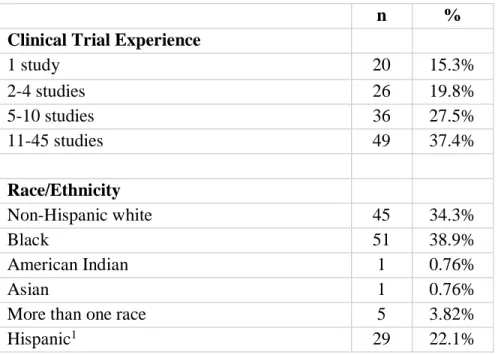
This study utilizes data collected surrounding medication usage that was collected from the 1-year and 2-year interviews of the full-participation arm and includes interviews from 131 participants (there were 261 interviews total1). Our sample reflects the typical age, race, and socioeconomic status of Phase I clinical trial participants that are found in similar studies (Fisher & Kalbaugh, 2011) [Table 2]. Further demographic information was collected, including
education, employment status, and household income. The sample was not randomly generated but sought a diverse group of healthy volunteers across geographic regions and clinic types (academic, pharmaceutical-owned, privately owned, and contract research organizations).
Although several demographic factors, such as household income or employment status, may have changed modestly between the 1-year and 2-year interviews, the initial 1-year
demographic data was used in the analysis for this study. The racial/ethnic breakdown of the study population is as follows: 39% Black or African-American, 27% Non-Hispanic White, 22% Hispanic, and 10% More than one race. The majority of the study population falls between the ages of 30-49, but all participants ranged from ages 18-64. The breakdown of the participants’ highest attained educational level is as follows: 22% Bachelor’s degree or higher, 29% Some college, 12% Trade/technical/vocational training, and 20% High school or GED. The majority of the sample had a household income of $25,000 or higher (60%). In terms of employment status, participants were employed full-time (36%), self-employed (25%), or not employed (21%). The number of clinical trials that study participants had enrolled in is noted under the category of “Clinical Trial Experience.” The majority of study participants (65%) had completed at least 5 studies at the 1-year interview mark.
Table 2. Demographic Breakdown of Study Participants (N = 131)
n %
Clinical Trial Experience
1 study 20 15.3%
2-4 studies 26 19.8%
5-10 studies 36 27.5%
11-45 studies 49 37.4%
Race/Ethnicity
Non-Hispanic white 45 34.3%
Black 51 38.9%
American Indian 1 0.76%
Asian 1 0.76%
More than one race 5 3.82%
Age
18-21 3 2.3%
22-29 22 16.8%
30-39 47 38.9%
40-49 39 29.8%
50+ 20 15.3%
Educational Attainment
Less than high school 9 6.87%
High school or GED 26 19.8%
Some college 38 29.0%
Trade/Technical/Vocational training 17 12.9%
Associates degree 11 8.39%
Bachelor degree 27 20.6%
Graduate degree 3 2.29%
Employment Status2
Employed full-time 47 35.9%
Employed part-time 22 16.8%
Not employed 28 21.3%
Retired 1 0.76%
Self-employed 33 25.2%
Household Income
Less than $10,000 15 11.5%
$10,000 to $24,999 37 28.2%
$25,000 to $49,999 57 43.5%
$50,000 to $74,999 11 8.39%
$75,000 to $99,999 4 3.05%
$100,000 or more 6 4.58%
1The category Hispanic includes all racial groups, of which we have those that identify as white, more
than one race, and American Indian in our sample.
2These data are based on consolidated definitions of each employment category that we used to
Measures
Qualitative data analyzed for this study was prompted by questions from the interview guide [Table 1] related to pill-taking and medication usage that were asked to participants during their 1-year and 2-year semi-structured interviews. I categorized participants as: pill-takers, not pill-takers, or ambivalent, based on their self-identification and responses to interview questions [Table 1]. For example, participants who were categorized as not pill-takers claimed that they rarely, if ever, took medications, even when unwell. Those categorized as pill-takers described taking medications regularly or feeling comfortable taking pills when unwell. Themes
surrounding medication usage were found based on categories of gender, race, age,
socioeconomic status, and overall health investment. The measure of overall health investment is derived from qualitative data but is used to categorize the level of involvement that participants describe regarding their health2. Participant sociodemographic data from the 1-year interviews were used to conduct significance testing between the pill-taker identity and demographic
variables. However, no statistically significant relationships were identified through this analysis. This could be due to small sample size, or due to the lack of true differences. Therefore, this paper primarily explores the qualitative data.
Table 1. Interview Guide Questions pertaining to Pill-Taking
One-Year Interview
• How often do you take prescription medications?
• How appropriate do you think these medications are for treating minor problems, like headaches, indigestion, gas, etc.?
o [For participants who claim never to use these products] How long have you avoided using them? Why do you avoid these products?
Two-Year Interview
• What do you typically do when you get sick?
• When you were growing up, what was your family’s typical response when you or someone else was sick?
• Now that you have participated in clinical trials, how does this shape your view of medications? [Safer? Riskier? How much research do you do?]
Data Analysis
Qualitative data collected from all interviews was transcribed in full by an independent transcription company. Following transcription, a research team member verified the transcript to ensure that it sufficiently matched the original audio and made corrections as necessary. The transcripts were then preliminarily coded by at least two members of the research team according to a predetermined coding structure that was developed using clinical trial literature, research conducted on healthy volunteers, and the specific themes probed as part of the two interview guides. These coded excerpts became the raw data for the current study.
To complete the first wave of analysis on this data, we identified participants’ responses to interview questions that pertained to pill-taking and medication usage [Table 2]. These responses had been given the parent code “Health/Mental Health” with the child code
“Information/Orientation,” which has been defined by the research team as: health information or perceptions of pharmaceuticals, OTC medications, drug consumption, and attitudes/responses to sickness. In the second wave of analysis, I evaluated participants as pill-takers, not pill-takers, or ambivalent.The ambivalent category was created during the second-wave coding process
and interview (one-year or two-year) of the participant whose quote is presented are also included.
Results
Participating in Phase I clinical trials gave study participants unique perspectives on pill-taking. Since these participants are healthy individuals, their perceptions of the pill-taker identity were likely to be less biased towards a particular drug or treatment and more representative of the general U.S. population. However, Phase I trial participants are more likely to be part of underrepresented minority groups, which poses another element to consider for this analysis. The quantitative data showed no significant relationships between pill-taker status and age, race, socioeconomic status, or gender. Nonetheless, qualitative data reflected broader themes for pill-takers overall and their perceptions of medications. Narratives regarding pill-taking were reflective of national trends of medication usage seen in the literature, but further described the complexity of this issue.
study participants, pseudonyms are used to describe the quotes below. I highlight here four critical themes about pill-taking that were particularly prevalent for these Phase I trial
participants: (1) natural/herbal remedies are preferable alternatives to pill-taking; (2) pills are dangerous chemicals and harmful to the body; (3) healthy individuals can be ambivalent about medications; and (4) pill-taking is related to the flawed medication culture in the U.S.
Table 3. Pill-taking status determined for study participants (n=131) Pill-taker Identity Number of participants (percent)
Yes 41 (31%)
No 54 (41%)
Ambivalent 14 (11%)
Missing data 22 (17%)
Natural/herbal remedies are preferable to pill-taking
Out of the 54 study participants that were considered not pill-takers, 33 (61%) discussed preferring natural or herbal alternatives to taking medications. This narrative was prevalent for participants across all demographic factors. For example, Tracy, an African-American woman in her 20s, felt that medications are not effective in curing diseases, but rather in treating related symptoms. In her opinion, a more natural method of healing would actually treat the root cause of the illness:
At the same time, I’m a firm believer in more natural ways of healing. I think
you’re taking these pills, you mute your system or your symptoms. “Congratulations. They’re not making you any better.” (Two-year)
This idea – that holistic or natural treatments are superior to all other pill-taking remedies – was consistent throughout many narratives. While many people cited natural methods as being safer, healthier, and more effective, other participants preferred these methods because they were accustomed to them through their upbringings or cultural backgrounds. Gilbert, a white Hispanic participant in his 40s, talked about how he has never really used medications much, but he puts more stock in the efficacy of home remedies:
I don’t take any for even like a headache, not even Tylenol for my head, not even for that because I don’t like to (laughs). I don’t like them. I thought about it and I have never used medications much. Here is something extra that I recommend to you: For example, yesterday I was really tired and my head hurt, and what I did was smell a lemon, and if you do that, your headache quickly goes away. It is much more effective than a pill. (One-year)
Among participants, similar home remedies were very commonly discussed, such as using lemons, potatoes, peppers, and sodas to get rid of headaches or fevers. Andy, a white man in his 40s who grew up in Romania, discussed the natural tricks his mother used for getting rid of illnesses when he was growing up:
be fine and usually it works. Because there was so much belief in it, it usually just worked. So there were a lot of home remedies available. (Two-year)
Andy stated that “there was so much belief in it, it usually just worked,” indicating that these forms of healing were widely known and accepted by his family. He seems to acknowledge some elements of the placebo effect when discussing these remedies as well. In particular, similar types of home remedies were often discussed among Spanish-speaking participants. Overall, the most common reason for participants choosing to not take pills was because they preferred to take natural/herbal remedies.
Pills are dangerous chemicals and harmful to the body
Many participants discussed how they did not take pills because they did not want to contaminate their bodies with unnatural substances. This notion that pills and medications are foreign and dangerous for the body is an idea that is closely tied to the previously discussed theme of natural and herbal remedies. However, these quotes exemplify one of the many negative connotations of being a pill-taker. For example, Harry, a multiracial man in his 20s, discussed how he prefers methods that do not involve chemicals:
I just, I don’t know. I like natural remedies better. I just think the human body can really overcome most things without resorting to drugs. Those are just bad (laughs) for you, you know. You’re just messing with the chemicals. (One-year)
effectiveness of medications. Jesse, a white Hispanic man in his 30s, neither trusts prescription drugs nor the way they are regulated overall:
Like I’m not really for medication, like the FDA or shit like that. I know medication doesn’t help people, especially like prescription medication. They do a lot more harm than good. So, I mean, I’m pretty sure you know about like prescription overdoses and stuff like that, how there’s more, more prescription overdose deaths than there are, you know, say other things going on. So like I don’t really think medication helps people… If I had a choice to like help people and heal people, I would rather do it naturally and holistically rather than them take medication. (Two-year)
Omar, a multiracial Hispanic man in his 30s, added a different perspective on this narrative. He discussed how drugs can lose their efficacy if taken too often:
I generally don’t like chemicals. (laughs) That’s really what it boils down to... Usually, when people offer me Ibuprofen, it’s minor discomfort, you know. I feel like I’d rather just tough it out than do that.One day, I might be really in some pain and I want that Ibuprofen to work like gangbusters. You know what I’m saying? Or that Tylenol or that Nyquil, I want it to work like really well, so I don’t want to build any kind of tolerance to it. (One-year)
Healthy individuals can be ambivalent about medications
In the initial analysis, participants were considered to be pill-takers or not pill-takers. However, further data analysis revealed that healthy participants were more complex than this. Because these participants are considered healthy, several patients did not have strong opinions on pill-taking since they have no need to take medication in their everyday lives. These opinions about taking medications were considered ambivalent, or in two minds about medications; they would take pills if necessary but would not do so generally. Out of all participants, 14 (11%) of the sample were considered ambivalent about pill-taking. For example, Zach, a white man in his 30s, was critical yet understanding of people taking medications:
I’m cynical of it because, partially because I’m-I’m a healthy person. I don’t have any crazy diseases or conditions. I stay in shape. I try to eat well. I’ve always tried to be, you know, I’m gonna try to not get sick or get that condition in the first place by living a healthy life. Now I realize there are plenty of people that no matter how healthy they are, they’re still gonna have a disease or get some condition and they can’t help it. And so I understand. I mean, I’m not totally condemning modern medicine—you know what I mean?—of being some shady enterprise. But I think that I’m a, I’m a big believer in not going straight to the pharmaceutical drug when you have an issue. (Two-year)
Similarly to Zach, Michael, an African-American man in his 30s, expressed both elements of a pill-taker and not a pill-taker in his responses. In particular, Michael seemed averse to being labeled as a pill-taker:
gonna just sit there and make myself suffer…if I really feel like I really need to take something for like my allergies, if I happen to have some allergy, I may take something then. (One-year)
Michael wanted to ensure that we know that taking pills is not his first line of defense when feeling unwell, but he will if necessary.
Pill-taking is related to a flawed medication culture
One reason many people avoid the pill-taker label is because of the medicalization of health that is seen in the U.S. Even as Phase I trial study participants who earn income by taking medications, they are often critical of medication culture for many reasons. According to Roscoe, an African-American man in his 40s, dependence on medication is common and that is one reason why he identified as not a pill-taker:
I just know there’s a lot of people that I know that become dependent on, on medication, and I’d say a majority of the world pretty much that, you know, there’s doctors, doctors prescribe something every time and the people just live on that and I don’t, I don’t like that. (One-year)
Overprescribing habits were commonly cited as reasons for flawed medication culture. Chad, a white man in his 50s, described how surprised he was that his brother was taking so many
medications and was still able to function normally. Similar to Roscoe, he discussed the issues of over-prescription:
Participants knew people who are addicted to medications, and they attributed this to the “pill-popping” culture, where pharmaceutical drugs are always the first line of defense. Theresa, an African-American woman in her 50s, had similar opinions but described a personal example of why she chose to not take pills:
Well, I mean, I would, I’ve seen, just looking at people, and how they become so dependent on a pill for this, a pill for that, and what made me just start looking for more being more healthy was because of my mother passing at such a young age. So I wanted to make sure that I took care, you know, really good care of myself. But at the same time, I would see people where they were just so dependent on pills and knowing that it was just a bandage instead of getting to the whatever the actual problem was. So that’s what was just always been a turnoff for me. (One-year)
Theresa also talks about how being dependent on pills is “just a bandage” on the problem, and about how it is not truly solving anything. This is a common theme that people who preferred natural methods over medications also discussed, but Theresa goes a step further by criticizing the medical system for the way it treats diseases or illnesses. Many participant responses claimed that natural methods are more comprehensive and superior to medications, but they do not give evidence or reasoning to support these ideas. Beyond a dependence on medications, Zoe, a white woman in her 30s, brought up the environmental issues that follow the pharmaceutical industry’s actions:
just pain or whatever. And also in terms of just the amount of contamination and just disposing of drugs that’s affecting water and soil and stuff for people. (Two-year) Zoe expressed how pill-taking can result in even more negative consequences for the world around us. This narrative is indicative of the fact that participants recognized that the pill-taking culture has much larger societal effects beyond individual health.
Discussion
Prescription and over-the-counter drug usage in the U.S. continues to increase, and healthy participants’ opinions reflected this dynamic climate. The original intent of this study was to understand how medication usage differs across several sociodemographic factors for healthy people: age, race, socioeconomic status, and gender. However, through this study, broader trends in medication usage for healthy Phase I trial participants were found, which will contribute to the currently limited literature on pill-taking. While no statistically significant differences were found within this sample of participants between pill-taking status and sociodemographic factors, it is likely that when looking at the larger U.S. population, these trends in pill-taking may be more evident. For example, the national opioid epidemic
disproportionately affects white, poor, and rural populations, and black patients are half as likely to be prescribed medications when compared to white patients (Clarke, Skoufalos, & Scranton, 2016), (Holpuch, 2016). It may also be possible that there are no true differences across
sociodemographic factors and pill-taking status. The U.S. as a whole is experiencing a cultural phenomenon with regards to increased medication usage, and it is likely that different
I identified major themes related to stigmas surrounding medication usage that
contributed to existing literature. The first three themes discussed were previously unexplored ideas in taking literature: (1) natural/herbal remedies are preferable alternatives to pill-taking; (2) pills are dangerous chemicals and harmful to the body; and (3) healthy individuals can be ambivalent about medications. The final theme discussed, (4) pill-taking is related to a flawed medication culture, built upon previous literature about medication culture and the over-medicalization of health.
Overall, participants largely felt that natural or herbal remedies were more effective alternatives to taking medications, and many thought that by taking pills, they were
contaminating their bodies. Reasons that are indicative of why people may choose to avoid the pill-taker identity were largely based in both public stigma and self-stigma. Particularly relating to self-stigma, many of the participants implied that taking pills would affect their self-image or self-worth (Kranke et al., 2011). Issues relating to public stigma are prevalent when looking at the fourth theme of the flawed medication culture, as participants often blamed addiction and physicians’ overprescribing habits for contributing to the negative “pill-popping” culture that exists in current society.
The idea that everyone is taking pills and that they are not truly getting at the root cause of medical issues was a common attitude that contributed to public stigma surrounding those who are pill-takers as well. This theme is also related to the previously discussed
to build up a tolerance to the medication. This shows that the over-medicalization of health idea supports not pill-takers’ narratives in different ways. They are supported by those who think medications are ineffective, as well as by those who think they are effective but can lose efficacy through overconsumption.
This study found that it is difficult to categorize individuals as takers or not pill-takers. That participants are healthy makes the process of categorizing them even more difficult, because at times it was difficult to know what they would do if they became ill. Moreover, study participants had varying opinions on medications, and because they were typically healthier, they oftentimes had not formed strong opinions on medications. While completing the secondary analysis, a third category of “ambivalence” was created, which made up a significant percentage of the sample. The creation of the ambivalent category contributes to the pill-taking literature because it demonstrates the complexity of this issue is in the U.S. Many factors contribute to whether a person chooses to take pills or not, and these factors can change over time or by circumstance.
As Phase I trial participants who are being paid to take pharmaceuticals, the plurality of the sample was categorized as not pill-takers. Many participants reflected mistrust in the pharmaceutical industry and separated the pill-taking they do in trials from pill-taking for personal reasons. Some even noted that pill-taking could potentially diminish their chances for qualifying for Phase I trials, so they choose to refrain from consuming all unnecessary pills. While being not a pill-taker may seem contradictory to their role as healthy volunteers, it makes sense as to why they may be cautious about the long-lasting effects of pills. This presents an interesting paradox for healthy volunteers as they often alter their perceptions of pill-taking for the purpose of their roles in Phase I studies.
Limitations
The primary limitation of this study is that the data is self-reported from unprompted responses. This means that our characterization of the participant as a pill-taker, not a pill-taker, or ambivalent may not have been fully reflective of the participants’ true behaviors or opinions on medications. This data was collected as part of a secondary analysis of the HealthyVOICES project, which did not have the original intent of investigating the research questions that I posed. There were approximately 22 (17%) participants that did not have sufficient qualifying data in their responses to categorize their pill-taker identity. This even further limited the data that the study utilized in order to draw associations between demographic factors and pill-taking status.
Clinical trial participants are a unique and small population of individuals that might be unusually focused on their health or reflective about what it means to take pills. A more representative group would include a random sample of healthy adults in the U.S.
Conclusion
This project creates implications for further research studies associated with demographic trends and increased drug usage in the U.S. It is possible that pill-taking culture affects
Works Cited
Bagley, S. M., Hadland, S. E., Carney, B. L., & Saitz, R. (2017). Addressing Stigma in Medication Treatment of Adolescents With Opioid Use Disorder. Journal of Addiction Medicine. https://doi.org/10.1097/ADM.0000000000000348
Busfield, J. (2006). Pills, Power, People: Sociological Understandings of the Pharmaceutical Industry. Sociology, 40(2), 297–314. https://doi.org/10.1177/0038038506062034 Busfield, J. (2010). “A pill for every ill”: Explaining the expansion in medicine use. Social
Science and Medicine, 70(6), 934–941. https://doi.org/10.1016/j.socscimed.2009.10.068 Clarke, J. L., Skoufalos, A., & Scranton, R. (2016). The American Opioid Epidemic: Population
Health Implications and Potential Solutions. Report from the National Stakeholder Panel. Population Health Management, 19(S1), S-1-S-10. https://doi.org/10.1089/pop.2015.0144 Clinical Trials and Screening: What You Need to Know. (2015). Retrieved from
http://www.radiologyinfo.org/en/info.cfm?pg=safety-xray
CMS.gov. (2015). National Health Expenditures 2015 Highlights. Center for Medicaid and Medicare Services, 2014–2016. https://doi.org/https://www.cms.gov/Research-Statistics-
Data-and-Systems/Statistics-Trends-and-Reports/NationalHealthExpendData/downloads/highlights.pdf
Cottingham, M. D., & Fisher, J. A. (2016). Risk and Emotion Among Healthy Volunteers in Clinical Trials. Social Psychology Quarterly, 79(3), 222–242.
https://doi.org/10.1177/0190272516657655
Dennis, B. (2015). Nearly 60 percent of Americans — the highest ever — are taking prescription drugs - The Washington Post. The Washington Post.
Participation for Serial Healthy Volunteers in U.S. Phase I Studies. Journal of Empirical Research on Human Research Ethics, 10(1), 65–75.
https://doi.org/10.1177/1556264614568280
Fisher, J. A. (2015). Feeding and Bleeding. Science, Technology, & Human Values, 40(2), 199– 226. https://doi.org/10.1177/0162243914554838
Fisher, J. A., & Kalbaugh, C. A. (2011). Challenging assumptions about minority participation in US clinical research. American Journal of Public Health, 101(12), 2217–22.
https://doi.org/10.2105/AJPH.2011.300279
Hansson Scherman, M., & Löwhagen, O. (2004). Drug compliance and identity: Reasons for non-compliance: Experiences of medication from persons with asthma/allergy. Patient Education and Counseling, 54(1), 3–9. https://doi.org/10.1016/S0738-3991(03)00199-X Holpuch, A. (2016). Black patients half as likely to receive pain medication as white patients,
study finds | Science | The Guardian. Retrieved April 1, 2018, from
https://www.theguardian.com/science/2016/aug/10/black-patients-bias-prescriptions-pain-management-medicine-opioids
Kranke, D. a, Floersch, J., Kranke, B. O., & Munson, M. R. (2011). A qualitative investigation of self-stigma among adolescents taking psychiatric medication. Psychiatric Services
(Washington, D.C.), 62(8), 893–899. https://doi.org/10.1176/appi.ps.62.8.893 Kranke, D., Floersch, J., Townsend, L., & Munson, M. (n.d.). Stigma experience among
adolescents taking psychiatric medication. Retrieved from
http://www.sciencedirect.com/science/article/pii/S0190740909003120
patients with schizophrenia. European Archives of Psychiatry and Clinical Neuroscience. https://doi.org/10.1007/s00406-017-0829-3
Martinez, L. R., Xu, S., & Hebl, M. (2017). Utilizing Education and Perspective Taking to Remediate the Stigma of Taking Antidepressants. Community Mental Health Journal. https://doi.org/10.1007/s10597-017-0174-z
Monahan, T., & Fisher, J. A. (2015). “I”m still a hustler’: entrepreneurial responses to precarity by participants in phase I clinical trials. Economy and Society, 44(4), 545–566.
https://doi.org/10.1080/03085147.2015.1113703
Parens, E. (2013). On good and bad forms of medicalization. Bioethics, 27(1), 28–35. https://doi.org/10.1111/j.1467-8519.2011.01885.x
Pattyn, E., Verhaeghe, M., Sercu, C., & Bracke, P. (2014). Public Stigma and Self-Stigma: Differential Association With Attitudes Toward Formal and Informal Help Seeking. Psychiatric Services, 65(2), 232–238. https://doi.org/10.1176/appi.ps.201200561
Polak, L. (2017). What is wrong with “being a pill-taker”? The special case of statins. Sociology of Health and Illness, 39(4), 599–613. https://doi.org/10.1111/1467-9566.12509
Robert Wood Johnson Foundation. (n.d.). Semi-structured Interviews. Robert Wood Johnson Foundation. Retrieved from http://www.qualres.org/HomeSemi-3629.html
Sirey, J. A., Bruce, M. L., Alexopoulos, G. S., Perlick, D. A., Friedman, S. J., & Meyers, B. S. (2001). Stigma as a Barrier to Recovery: Perceived Stigma and Patient-Rated Severity of Illness as Predictors of Antidepressant Drug Adherence. Psychiatric Services, 52(12), 1615–1620. https://doi.org/10.1176/appi.ps.52.12.1615
https://www.cancer.org/treatment/treatments-and-side-effects/clinical-trials/what-you-need-to-know/phases-of-clinical-trials.html
The Placebo Effect: What Is It? (2018). Retrieved April 4, 2018, from
https://www.webmd.com/pain-management/what-is-the-placebo-effect#1 The UK: a nation of pill takers? (2015). Drug and Therapeutics Bulletin, 53(3), 25.