ESSAYS ON FOREIGN AID AND GOVERNANCE
James Mitchell Watkins
A dissertation submitted to the faculty at the University of North Carolina at Chapel Hill in partial fulfillment of the requirements for the degree of Doctor of Philosophy in Political Science.
Chapel Hill 2019
Approved by:
Layna Mosley
Cameron Ballard Rosa
Lucy Martin
Brigitte Seim
c 2019
ABSTRACT
James Mitchell Watkins, Essays on Foreign Aid and Governance (Under the direction of Layna Mosley)
This dissertation is comprised of three distinct essays that generally examine the impact of foreign
aid on political and economic governance in recipient countries. The first essay of the dissertation
develops a game-theoretic model that predicts that Chinese development assistance has a negative
effect on recipient country compliance with Western aid conditionality. Using project-level data
from 42 Sub-Saharan African countries, I find strong empirical evidence that increased Chinese aid
within a recipient country decreases the likelihood of compliance with conditions specified in World
Bank project agreements. The second essay of the dissertation examines the effect of foreign aid
on the incidence of political budget cycles in expenditures and taxation in developing countries.
I theorize that aid increases the likelihood of political budget cycles by increasing the value of
holding office, obscuring fiscal transparency, and creating a soft budget constraint that discourages
fiscal discipline. Using panel data for 70+ developing democracies from 1990-2012, the empirical
analysis finds that political budget cycles in expenditures are statistically and substantively larger
as foreign aid within a country increases. Contrary to my hypothesis, the analysis reveals no
significant relationship between aid and tax revenue prior to elections. The third essay of the
dissertation investigates the effect of foreign aid projects on institutional trust using geolocated
data on aid projects and Afrobarometer survey results from Nigeria, Senegal, and Uganda. Drawing
from institutional theories of trust, I theorize that foreign aid projects harm institutional trust by
lowering citizens’ evaluations of government performance and administrative competence. Using
a spatial difference-in-difference strategy, the empirical results find that active aid projects are
associated with decreased trust in the president, parliament, and local government council. The
results also indicate that completed aid projects are associated with declines in institutional trust,
although the effect size constitutes a statistically and substantively smaller change compared to
ACKNOWLEDGMENTS
My profound thanks to my advisor, Layna Mosley, who was supportive of me and my research
throughout my graduate career. In addition, I would like to express my immense gratitude to
TABLE OF CONTENTS
LIST OF TABLES . . . .viii
LIST OF FIGURES . . . x
LIST OF ABBREVIATIONS. . . xi
CHAPTER 1: INTRODUCTION. . . 1
CHAPTER 2: THE EFFECT OF CHINESE DEVELOPMENT ASSISTANCE ON COMPLIANCE WITH WESTERN AID CONDITIONALITY . . . 5
Introduction . . . 6
Determinants of Compliance with Conditionality . . . 9
Chinese Aid and Compliance with Conditionality . . . 10
Data . . . 15
Empirical Strategy . . . 20
Results . . . 21
Conclusion . . . 29
CHAPTER 3: FOREIGN AID AND PRE-ELECTORAL FISCAL MANIPULA-TION IN DEVELOPING COUNTRIES . . . 31
Introduction . . . 32
Aid and Political Budget Cycles . . . 35
Illustrative Case: Ghana . . . 40
Data . . . 44
Empirical Strategy . . . 46
Conclusion . . . 57
CHAPTER 4: FOREIGN AID AND TRUST IN POLITICAL INSTITUTIONS. 59 Introduction . . . 60
Aid and Trust in Political Institutions . . . 63
Data . . . 68
Empirical Strategy . . . 70
Results . . . 72
Conclusion . . . 79
CHAPTER 5: CONCLUSION . . . 81
APPENDIX A: SUPPORTING INFORMATION FOR CHAPTER 2. . . 84
Incorporating Chinese Aid into the Aid-for-Policy Model Framework . . . 84
Data sources and Descriptive Statistics . . . 90
Robustness Checks . . . 95
APPENDIX B: SUPPORTING INFORMATION FOR CHAPTER 3 . . . .100
Descriptive Statistics . . . 100
Fixed Effects Estimation Robustness Checks . . . 102
System-GMM Estimation Robustness Checks . . . 108
APPENDIX C: SUPPORTING INFORMATION FOR CHAPTER 4 . . . .116
Descriptive Statistics . . . 116
Robustness Checks . . . 118
Location of Afrobarometer Respondents and Aid Projects . . . 121
LIST OF TABLES
2.1 Conditional logit estimations (average semi-elasticities) . . . 22
2.2 Instrumental variable estimation results . . . 26
3.1 Fiscal outcomes by ODA/GDP grouping and election year . . . 48
3.2 Foreign aid and political budget cycles . . . 49
4.1 Foreign aid projects and institutional trust . . . 73
4.2 Foreign aid projects and government performance . . . 77
4.3 Foreign aid projects and corruption . . . 78
A.1 Descriptive statistics . . . 90
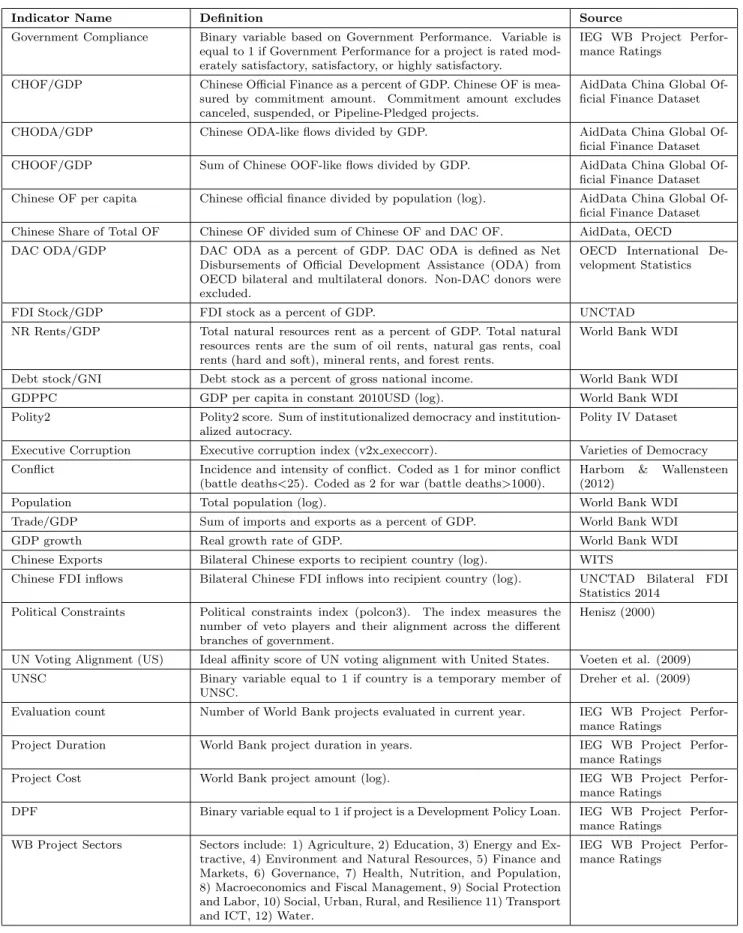
A.2 Data sources . . . 91
A.3 Government compliance summary . . . 92
A.4 Top 10 recipients of Chinese development assistance . . . 93
A.5 Conditional logit estimation results (change in log odds coefficients) . . . 95
A.6 Conditional logit specifications with additional economic controls . . . 96
A.7 Conditional logit specifications with additional political and project controls . . . 97
A.8 Instrumental variable analysis robustness checks . . . 98
A.9 Heterogenous treatment effects . . . 99
B.1 Descriptive statistics . . . 100
B.2 Countries included in sample . . . 101
B.3 Alternative measures of foreign aid . . . 102
B.4 Additional controls for Expenditures/GDP model . . . 103
B.5 Additional controls for Tax/GDP model . . . 104
B.6 Addressing outlier concerns . . . 105
B.7 Alternative election year adjustments . . . 106
B.8 Alternative explanations . . . 107
B.9 System-GMM estimation results . . . 108
B.10 System-GMM robustness checks- Alternative specifications . . . 109
B.11 System-GMM robustness Checks- Alternative measures of foreign aid . . . 110
B.13 System-GMM robustness checks- additional controls for Tax/GDP model . . . 112
B.14 System-GMM robustness checks- Addressing outlier concerns . . . 113
B.15 System-GMM robustness checks- Alternative election year adjustments . . . 114
B.16 System-GMM robustness checks- Alternative explanations . . . 115
C.1 Descriptive statistics . . . 116
C.2 Trust in political institutions by country . . . 117
C.3 Foreign aid projects and institutional trust (region-round fixed effects) . . . 118
C.4 Foreign aid projects and institutional trust by country . . . 119
LIST OF FIGURES
2.1 Predicted probability of compliance as the proportion of Chinese OF to GDP increases 23
2.2 Heterogenous treatment effects across institutional and economic environments . . . . 29
3.1 Political budget cycles in Ghana . . . 41
3.2 Marginal effects of ODA/GDP on Expenditures/GDP and Tax Revenue/GDP in elec-tion and non-elecelec-tion years . . . 50
3.3 Marginal effect of Elections on Expenditures/GDP by level of ODA/GDP . . . 50
3.4 Marginal effect of Elections on Tax Revenue/GDP by level of ODA/GDP . . . 51
3.5 Marginal effect of ODA/GDP on Expenditures/GDP controlling for alternative expla-nations . . . 56
3.6 Marginal effect of ODA/GDP on Tax Revenue/GDP controlling for alternative expla-nations . . . 56
4.1 Conceptual model of the relationship between aid projects and political trust . . . 64
4.2 Difference in Active and Inactive coefficients with 95% CIs across cutoff distances . . . 75
4.3 Difference in Completed and Inactive coefficients with 95% CIs across cutoff distances 75 A.1 Single shot game matrix . . . 86
A.2 Chinese Official Finance to Sub-Saharan Africa . . . 94
A.3 Government Performance in Sub-Saharan Africa (% projects rated moderately satis-factory and above) . . . 94
C.1 Nigeria Afrobarometer clusters and aid project locations . . . 121
C.2 Senegal Afrobarometer clusters and aid project locations . . . 121
LIST OF ABBREVIATIONS
DAC Development Assistance Committee
DPF Development Policy Finance
FDI Foreign Direct Investment
IFI International Financial Institution
IMF International Monetary Fund
NGO Non-governmental organization
ODA Official Development Assistance
OECD Organization for Cooperation and Development
OF Official Finance
OOF Other Official Flows
PBC Political Budget Cycles
CHAPTER 1: INTRODUCTION
Two decades after becoming a buzzword on the development agenda, governance remains a top
priority for the international donor community (Gisselquist and Resnick 2014). Good governance is
essential to ensure that foreign aid supports long-term capacity development and poverty alleviation
in recipient countries. Governance refers to the institutions and processes by which authority in
a country is exercised. Governance encompasses “the process by which governments are selected,
monitored and replaced; the capacity of the government to effectively formulate and implement
sound policies; and the respect of citizens and the state for the institutions that govern economic
and social interactions among them” (Kaufman et al. 2011). Governance has a range of different
components including accountability, political stability, government capacity, control of corruption,
sound economic policies, and rule of law.
This dissertation is comprised of three essays that examine how foreign aid impacts political and
economic governance in developing countries. The dissertation aims to explore new research paths
in the field of the political economy of aid and important questions that have yet to be sufficiently
addressed in the literature. The three essays in this dissertation examine the impact of Chinese
development assistance on recipient country compliance with Western aid conditionality (Chapter
2), the effect of foreign aid on pre-electoral fiscal manipulation of expenditures and taxation in
developing democracies (Chapter 3), and the impact of foreign aid projects on citizens’ trust in
political institutions and actors (Chapter 4). The dissertation aims to contribute generally to the
literature on aid effectiveness and governance in recipient countries. Individually, the essays also
aim to contribute to research on emerging donors, political budget cycles, and institutional trust.
The first essay of the dissertation, “Undermining Conditionality? The Effect of Chinese
De-velopment Assistance on Compliance with World Bank Aid Agreements” examines how the rise of
China as an international donor impacts recipient country compliance with traditional Development
Assistance Committee (DAC) donor conditionality. Aid conditionality has been a standard tool
of policy conditions to the disbursement of aid. Conditionality is intended to induce policy reform
and deter the misappropriation of aid by threatening to withdraw future transfers if the recipient
country fails to comply with the conditions of the aid agreement. Donors commonly condition aid
on institutional reform, fiscal transparency, and economic policy to limit rent-seeking and improve
the effectiveness of foreign aid. The recent emergence of China as a prominent donor has introduced
competitive pressures into the international development finance system that have implications for
compliance with conditionality and the effectiveness of aid from traditional donors.
In Chapter 2, I theorize that Chinese development assistance, which does not utilize
condi-tionality, weakens the incentives of recipient countries to comply with the conditions attached to
aid from traditional donors. I argue that Chinese aid reduces compliance incentives by providing
an alternative source of development assistance that does not require policy reform and marginally
displaces the importance of future aid transfers from traditional donors. I formalize the theoretical
argument by incorporating unconditional aid from China into the existing aid-for-policy framework
commonly used to model aid conditionality. In an infinitely-repeated and simultaneous
aid-for-policy game, the model predicts that Chinese development assistance limits the conditions under
which recipient countries are willing to comply with conditionality. The empirical analysis focuses
on the impact of Chinese aid on recipient country compliance with World Bank conditionality in
Sub-Saharan Africa. Using data on government compliance with World Bank project agreements
for 42 African countries from 2000-2014, I find strong and robust evidence that increased Chinese
development assistance within a recipient country is associated with decreased compliance with
World Bank conditionality. To address concerns about the potential endogeneity of Chinese
devel-opment assistance to recipient compliance, I also employ an instrumental variable strategy that uses
Chinese steel production and cross-sectional variation in a country’s tendency to receive Chinese aid
to instrument for Chinese development assistance. The findings of the essay suggest that China’s
emergence as a significant donor may deter recipient policy reform in the areas of macroeconomic
policy, transparency, and governance aimed at enhancing the effectiveness of traditional aid.
The second essay of the dissertation, “Enabling PBCs? Foreign Aid and Pre-Electoral Fiscal
Manipulation in Developing Countries”, shifts its focus to economic governance and examines the
effect of foreign aid on political budget cycles in expenditures and taxation in developing countries.
and sound policies are implemented. In this essay, I examine the effect of aid on economic
gover-nance in recipient countries prior to elections. Elections are an important source of fiscal volatility
in developing countries that can potentially have harmful effects on long-term economic stability
(Collier and Chauvet 2010; Fatas and Mihov 2013). Prior to elections, incumbent politicians have
powerful incentives to manipulate fiscal policy in order to affect voter behavior. The basic intuition
of political budget cycles is that incumbents will increase public spending and/or decrease taxation
before elections in order to improve their chances of reelection.
In Chapter 3, I argue that foreign aid is a fungible source of revenue that incentivizes
incum-bents to manipulate fiscal policy for electoral purposes. Specifically, I theorize that aid increases
the likelihood of political budget cycles by increasing the value of holding office, obscuring fiscal
transparency, and creating a soft budget constraint that discourages fiscal discipline. I
hypothe-size that pre-electoral fiscal manipulation of expenditures and taxation is more likely to occur as
foreign aid within a country increases. Using panel data for over 70 developing democracies from
1990-2012, the empirical analysis finds that political budget cycles in expenditures are statistically
and substantively larger as foreign aid within a country increases. Contrary to my hypothesis,
the analysis reveals no significant relationship between aid and tax revenue before elections. The
primary results hold for a host of robustness checks that address concerns related to alternative
ex-planations of political budget cycles, potential sources of omitted variable bias, estimation strategy,
and outliers in the data. The findings of the essay suggest that the structure of public finance in
developing countries may impact incumbents’ choice of pre-electoral fiscal manipulation strategy.
The third essay of the dissertation, “Foreign Aid and Trust in Political Institutions”,
exam-ines how foreign aid projects impact citizens’ trust in political institutions and actors. Trust in
political institutions is a central element of good governance and political stability-it enhances
government legitimacy and encourages citizens to comply with rules and regulations (Levi, Sacks,
and Tyler 2009). The ability of governments and the international community to reduce poverty,
ensure security, and promote human rights depends on people’s trust in their government (Cheema
2010). However, building trust is a difficult task in developing countries, where governments
of-ten lack the capacity to provide basic public goods and social services to all of their citizens. In
many Sub-Saharan African and South Asian countries, donors and non-governmental organizations
infrastructure (Batley and McLoughlin 2010; Moran 2006).
In Chapter 4, I theorize that foreign aid projects harm institutional trust by lowering citizens’
evaluations of government performance and administrative competence. When citizens observe
that public goods and services are being provided by external actors, they may reevaluate their
beliefs about their government’s ability to manage the economy, address poverty, and deliver
pub-lic goods and social services. Additionally, aid projects can incentivize rent-seeking behavior and
have an adverse effect on citizens’ perceptions of political corruption. To analyze the impact of aid
on trust, this essay utilizes geolocated survey data on citizens’ trust in political institutions from
Afrobarometer Rounds 2-5 (2003-2012) and data on the location of foreign aid projects from
Aid-Data’s Aid Information Management Systems (AIMS) datasets for Nigeria, Senegal, and Uganda.
Using a spatial difference-in-difference strategy, the empirical results find that active aid projects
are associated with decreased trust in the president, parliament, and local government council. The
results also indicate that completed aid projects are associated with declines in institutional trust,
although the effect size constitutes a statistically and substantively smaller change compared to
CHAPTER 2: THE EFFECT OF CHINESE DEVELOPMENT ASSISTANCE ON COMPLIANCE WITH WESTERN AID CONDITIONALITY
ABSTRACT
This study investigates the effect of Chinese development assistance on recipient country compliance
with aid conditionality in Sub-Saharan Africa. I argue that the presence of a significant
non-traditional donor, which does not utilize conditionality, weakens the material incentives of recipient
countries to comply with conditions attached to foreign aid from traditional donors. I formalize the
theoretical argument by incorporating unconditional aid from China into the existing aid-for-policy
framework commonly used to model aid conditionality. In an infinitely-repeated and simultaneous
aid-for-policy game, the model predicts that Chinese development assistance limits the conditions
under which recipient countries are willing to comply with conditionality. I test the theoretical
predictions using project-level data on government compliance with World Bank project agreements
for a sample of 42 Sub-Saharan African countries from 2000-2014. The empirical analysis finds
strong support for the hypothesis that Chinese development assistance decreases the likelihood of
recipient country compliance with conditions in World Bank project agreements. The results are
robust to a number of alternative specifications, measures of Chinese development assistance, and
Introduction
Non-traditional donors, including China, India, Brazil, Saudi Arabia, and the United Arab
Emi-rates, are quickly becoming a significant force in the international development finance landscape.
In 2015, development assistance from non-traditional donors accounted for 15 percent of global
official development assistance (ODA) (OECD 2018).1 Non-traditional donors operate outside of the Organization for Economic Cooperation and Development’s (OECD) Donor Assistance
Com-mittee (DAC) and do not adhere to the norms and practices pertaining to the delivery of foreign
aid established by traditional donors.2 China is by far the most prominent non-traditional donor and has emerged as one of the most important sources of finance in Sub-Saharan Africa. From
2000-2014, Chinese development assistance to Sub-Saharan Africa is estimated to have totaled over
$120 billion (2014 USD), rivaling the World Bank and United States (Dreher et al. 2017).3 China’s
approach to development assistance fundamentally differs from that of traditional donors and is
guided by the principles of mutual benefit and non-interference (Dreher et al. 2017; State
Coun-cil 2011). In stark contrast with the practice of traditional DAC donors, China does not attach
conditions to its aid and does not interfere in the domestic politics of recipient countries.
The rapid rise of China as a prominent donor has introduced competitive pressures into the
international development finance system and ignited a debate among scholars and development
practitioners about the implications for the effectiveness of Western aid in promoting development
(Br¨autigam 2011; Greenhill et al. 2016; Swedlund 2017; Welle-Strand and Kjøllesdal 2010; Woods
2008). Recent studies provide some initial evidence that Chinese development assistance adversely
affects political, economic, and environmental reforms in recipient countries (Benyishay et al. 2016;
Brazys. et al 2017; Brazys and Vadlamannati 2018; Li 2017). However, the nascent literature on
1
The OECD estimate of non-DAC share of total ODA includes reported flows for 20 non-DAC reporting countries and estimates for the top ten non-reporting non-DAC countries.
2
DAC is an international forum created to discuss and promote cooperation on issues surrounding development assistance practices in developing countries. The forum is comprised of the 30 Western donor countries with the World Bank, International Monetary Fund (IMF), United Nations Development Program (UNDP), and regional development banks participating as observers.
3
Chinese development assistance has not yet sufficiently examined the causal mechanisms through
which Chinese aid deters policy reform. One notable exception is research by Hernandez (2017),
which examines the effect of Chinese development assistance on the bargaining power of Western
donors in aid negotiations. Hernandez (2017) finds that competition from Chinese aid reduces the
number of policy concessions that donors request in exchange for aid. This paper proposes an
additional causal mechanism through which Chinese aid deters policy reform in recipient countries:
reduced compliance with aid conditionality.
Aid conditionality is the attachment of policy conditions to the disbursement of aid. DAC
donors commonly condition aid on institutional reform, fiscal transparency, and economic policy
in order to limit rent-seeking and improve the effectiveness of foreign aid. I theorize that Chinese
development assistance, which does not utilize conditionality, weakens the incentives of recipient
countries to comply with the conditions attached to aid from traditional donors. I argue that
unconditional Chinese aid is a less costly form of development finance that encourages recipient
countries to resist policy reform pressures from traditional donors. By marginally decreasing the
importance of future aid flows from traditional donors, the availability of aid from China weakens
the impact of punishment by traditional donors on recipient countries’ fiscal position. I formalize
the theoretical argument by incorporating unconditional aid from China into the aid-for-policy
framework commonly used to model aid conditionality (Bermeo 2016; Bueno de Mesquita and
Smith 2007, 2009). The model is used in an infinitely-repeated simultaneous game to analyze
the impact of Chinese development assistance on recipient-donor cooperation under a grim trigger
strategy. The model predicts that Chinese development assistance limits the conditions, specifically
the recipient’s discount rate and acceptable policy reform cost, under which the recipient country
is willing to comply with the policy reform requested by the traditional donor.
To test the empirical implications of the model, I examine the effect of Chinese development
assistance on recipient compliance with World Bank project agreements in Sub-Saharan Africa. To
my knowledge, the World Bank is the only multilateral or bilateral donor that publicly reports
eval-uations of compliance with aid agreements. The focus on Sub-Saharan Africa reflects the intuition
that the effect of Chinese aid on compliance should be empirically observable in the region where
competition between traditional donors and China is most intense, aid conditionality is widely
compliance with World Bank agreements for a sample of 42 Sub-Saharan African countries from
2000-2014, the empirical analysis finds strong and robust evidence that increased Chinese
devel-opment assistance within a recipient country is associated with decreased compliance with World
Bank conditionality. For an otherwise typical project and recipient country, a one percent increase
in Chinese official finance as a percent of GDP over a project’s duration decreases the likelihood
of recipient compliance with the project agreement by 14 percent. The findings are robust to
al-ternative measures of Chinese development assistance and potential sources of omitted variable
bias. To address concerns about the potential endogeneity of Chinese development assistance to
recipient compliance, I also employ an instrumental variable strategy that uses Chinese steel
pro-duction and cross-sectional variation in a country’s tendency to receive Chinese aid to instrument
for Chinese development assistance (Dreher et al. 2017). An extension of the primary analysis
explores heterogeneous treatment effects and finds that the negative effect of Chinese development
assistance on compliance with World Bank conditions is most pronounced in environments with
autocratic regimes and high natural resource rents. The findings of the extension have meaningful
implications for the success of governance and transparency reforms in these environments aimed
at enhancing the effectiveness of aid.
This paper contributes to the literature on compliance with aid conditionality by demonstrating
that donor competition is an additional determinant of recipient country compliance. To the best of
my knowledge, this study is the first to directly examine the effect of aid from non-traditional donors
on compliance with conditionality. This paper also contributes to the quickly growing literature
on the effect of Chinese development assistance on political, social and environmental reforms in
recipient countries by identifying a causal mechanism, reduced compliance with conditionality, that
links Chinese development assistance with policy outcomes.
The next section summarizes the extant literature on compliance with aid conditionality.
Sec-tion 2 presents the theoretical argument, an overview of the formal model, and two illustrative
cases. Sections 4, 5, and 6 present the data, empirical strategy, and results. The final section
Determinants of Compliance with Conditionality
Aid conditionality has been a standard tool used by international financial institutions (IFI) and
DAC donors to improve aid effectiveness and prevent the misappropriation of resources.
Condition-ality aims to solve principal-agent and credible commitment problems in donor-recipient relations.
The basic idea behind conditionality is that donors provide aid to recipient countries as an incentive
for the recipients to adopt policies or to restrict the way aid is spent (Collier et al. 1997). The
threat of withdrawal of future aid is expected to induce recipient compliance with conditionality. In
the 1980s and 1990s, the IMF and World Bank conditioned the disbursement of aid on structural
adjustment policies including fiscal austerity, privatization, trade openness, and capital account
liberalization. In the 1990 and 2000s, major bilateral DAC donors began to utilize political
condi-tionality to promote democratization, the rule of law, and human rights protection. Since the early
2000s, major multilateral donors have shifted away from structural adjustment policies and now
commonly condition aid on sector-specific policy reforms, governance and transparency reforms,
project reporting and auditing requirements, and progress towards development goals.
Despite the extensive use of conditionality by donors, recipient country compliance with
con-ditionality has been relatively poor (Dollar and Svensson 2000; Easterly 2005; Ivanova et al. 2001).
One explanation of poor recipient compliance is weak enforcement of conditionality by donors
(Kilby 2009; Swedlund 2017; Vreeland 2006). Weak enforcement is most often attributed to the
strategic interests of donors including military alliances, voting in the United Nations, and strong
economic ties (Dreher et al. 2009; Kilby 2009; Stone 2004). Agency and moral hazard problems
in donor-recipient relations, which stem from donor agencies’ desire to maximize their aid budgets
(Martens et al. 2002; Svensson 2006) and concerns of organizational performance and reputation
(Swedlund 2017), are additional explanations of weak enforcement by donors.
Poor compliance with conditionality has also been attributed to domestic political factors and
structural impediments in recipient countries such as regime type (Joyce 2006; Montinola 2010) and
powerful interest groups and veto players (Drazen 2002; Ianova et al. 2001; Mayer and Mourmouras
2002). Variation in recipient country compliance can also be explained by examining the effect of
conditionality on revenue sources in recipient countries. Girod and Tobin (2016) theorize that the
with conditionality due to the expectation that compliance will maintain or increase future revenue
from FDI. In contrast, the authors argue that dependence on natural resource rents is associated
with decreased compliance due to the negative impact of policy reforms on the revenue source. I
contend that development assistance from non-traditional donors is an additional revenue source
that explains variation in compliance behavior. Specifically, I argue that Chinese aid reduces
recipients’ compliance incentives by providing an alternative source of development assistance that
does not require policy reform and marginally displaces the importance of future aid transfers from
traditional donors.
Chinese Aid and Compliance with Conditionality
Following decades of limited engagement, China revitalized its development assistance program
to Africa in 2000 following the first Forum on China-Africa Cooperation (FOCAC) and quickly
established itself as one of the largest bilateral donors to the continent by the end of the decade.
From 2000-2014, Sub-Saharan Africa accounted for 35 percent of global Chinese official finance
commitments or some $120 billion (2014 USD) in official finance (Dreher et al. 2017). Over
this period, Chinese official finance to Sub-Saharan Africa is estimated to have exceeded bilateral
commitments from the United States (Dreher et al. 2017, OECD 2018).4 The composition of Chinese development assistance differs dramatically from the composition of aid from DAC donors:
only 39 percent of Chinese flows to Sub-Saharan Africa from 2000 to 2014 can be classified as official
development assistance.5 37 percent of Chinese development assistance does not qualify as ODA
and instead comes in the form of Other Official Flows (OOF), a less concessional form of official
finance that does not meet the DAC requirements for ODA (Strange et al. 2017).6 The remaining 24 percent of Chinese development assistance to Sub-Saharan Africa cannot be classified as ODA
4
United States commitments of official finance to Sub-Saharan Africa totaled $106 billion (2016USD) from 2000-2014 (OECD 2018). Despite being the same relative size, China and the United States have very different development finance portfolios. The United States’ portfolio is almost entirely comprised of ODA (over 90 percent).
5Official development assistance is defined by the DAC as flows of official financing that are administered to promote the economic development and welfare of developing countries that are concessional in character with a grant element of at least 25 percent (OECD 2002).
6
or OOF due to insufficient information.
Several unique characteristics further differentiate Chinese development assistance from aid
from traditional donors. Chinese aid is characterized by the principles of mutual respect of
sovereignty and non-interference in internal affairs, equality and mutual benefit, and efficiency
(State Council 2011, 2014).7 First, China adheres to the principle non-interference and has stated that it “never uses foreign aid as a means to interfere in recipient countries’ internal affairs” (State
Council 2011). Chinese development assistance does not utilize conditionality and has few or no
strings attached. The only notable political condition that China places on development assistance
is support for the One-China Policy, which prohibits recognition of Taiwan.8 China’s principle of non-interference fundamentally differs from the use of conditionality on macroeconomic policies,
governance, political and legal reform, and human rights protection by traditional donors. The
absence of political and governance conditionality makes Chinese aid attractive to leaders who fear
that reform might undermine their political survival by impacting domestic support, increasing
po-litical competition, or decreasing access to rents. Second, China approaches development assistance
under a principle of equality and mutual benefit and offers an alternative development model that
differs from the Washington Consensus. Chinese aid prioritizes infrastructure, energy generation
and supply, industrial and mining activities, and communications and is highly tied to Chinese
contractors (Br¨autigam 2009; Dreher et al. 2018). Third, Chinese development assistance is
char-acterized as being more efficient and quicker to materialize than aid from DAC donors. China is
able to negotiate, disburse funds, and complete projects quickly due to bilateral negotiation,
pro-curement requirements that are highly tied to Chinese contractors, and less stringent requirements
for environmental and social impact studies.
Due to its characteristics, Chinese development assistance has become an attractive alternative
to aid from traditional donors and introduced competitive pressures into the international aid
system (Greenhill et al. 2016; Kilama 2016). Chinese development assistance represents an outside
option that reduces recipient country dependence on traditional donors and weakens the bargaining
7
China’s approach to aid was first outlined in “Eight Principles for Economic Aid and Technical Assistance to Other Countries” (1964) and reiterated in the 2011 and 2014 White Papers on Foreign Aid issued by the State Council of the People’s Republic of China (State Council 2011, 2014).
power of DAC donors in aid negotiations with recipient countries (Bueno de Mesquita and Smith
2016). Empirical evidence from Hernandez (2017) finds that the World Bank imposes significantly
fewer conditions on aid recipients in Sub-Saharan Africa that also receive Chinese aid. In addition
to altering the bargaining power of traditional donors during the negotiation of aid deals, Chinese
development assistance has the potential to undermine recipient compliance with aid conditionality.
I theorize that conditionality is less effective in a competitive international aid environment with
multiple donor types. Specifically, I consider competition between bilateral and multilateral DAC
donors, who utilize aid conditionality, and China, who does not adhere to DAC norms and practices.
I argue that Chinese development assistance, which does not contain conditionality, alters the
material incentives of recipient countries and limits the conditions under which recipients are willing
to comply with conditionality attached to traditional aid. By marginally decreasing the importance
of future aid transfers from traditional donors, the availability of aid from China weakens the impact
of punishment by traditional donors on recipient countries’ fiscal position. I predict that increased
Chinese development assistance within a country will be associated with decreased compliance with
conditionality. In recipient countries where the cost of compliance is sufficiently high, I predict
that the availability of Chinese aid allows recipient governments to completely disengage with DAC
donors.
I formalize the theoretical argument on the effect of Chinese development assistance on
condi-tionality using the aid-for-policy model framework, which examines aid transfers from a potential
donor to a recipient country in exchange for policy reform (Bermeo 2016; Bueno de Mesquita and
Smith 2007, 2009; Svensson 2000).9 The framework describes a simultaneous stage game between a donor and a recipient government. The donor decides between the actions of disbursing aid to the
recipient country and withholding aid. The donor’s decision to provide aid is based on the relative
utility of policy reform in the recipient country compared to the loss of revenue from disbursing
aid. The recipient decides between the actions of implementing policy reform and no reform. The
recipient’s compliance decision is based on the relative utility from aid compared to the cost of
policy reform. The central assumption of the model is that Chinese aid does not impose a policy
9
reform cost on the recipient country.10
In an infinitely-repeated and simultaneous aid-for-policy game, the model is used to analyze
the effect of unconditional aid from China on the conditions under which cooperation between
the recipient and the traditional donor is sustainable under a grim trigger strategy. In a grim
trigger strategy, the traditional donor and recipient begin the game by cooperating and continue to
cooperate as long as the other has cooperated in their previous action. The cooperative equilibrium
in the game is such that the traditional donor disburses aid to the recipient country, and the recipient
government implements the policy reforms requested by the donor. I derive observable implications
from the comparative statics of the cooperative equilibrium. The model predicts that Chinese aid
decreases the range of the recipient’s discount factor in which a cooperative equilibrium strategy
under a grim trigger strategy is a subgame perfect equilibrium. The discount factor determines
the present value of future aid flows to the recipient government. By decreasing the range of
the recipient’s discount factor, the presence of Chinese aid limits the conditions under which the
recipient is expected to comply with the policy reform requested by the traditional donor. The
model framework can also provide insight on the effect of Chinese development assistance on the
maximum policy reform cost the recipient country is willing to accept in exchange for aid from
traditional donors. The model predicts that as the amount of Chinese aid the recipient receives
increases, the maximum reform cost the recipient is willing to pay for aid from the traditional donor
decreases. From the theoretical argument and formal model, I derive the following hypothesis:
H1: Increased Chinese development assistance within a recipient country decreases the likelihood of compliance with conditionality attached to aid from traditional donors.
Illustrative Cases
Uganda and Zimbabwe offer two illustrative cases of the theoretical argument. Uganda has
tradi-tionally been one of the largest recipients of foreign aid from DAC donors. Despite having a
long-standing relationship, Uganda has maintained a contentious relationship with traditional donors
in recent years. In 2012, numerous European donors suspended foreign aid in response to a major
corruption scandal involving the office of the Prime Minister. In 2014, the passage of the legislation
outlawing homosexuality also led to widespread condemnation by traditional donors. Norway and
Denmark withheld disbursements of aid, and the United Kingdom redirected aid away from the
government to non-governmental organizations. In response to the backlash by donors, a Ugandan
government spokesperson stated that “the West can keep their aid... we shall develop without
it”(The Telegraph 2014). In light of this increased tension with traditional donors, Uganda looked
to China for development assistance and secured $10 billion in semi-concessional loans to fund
infrastructure projects (Financial Times 2014). When asked if development assistance from China
was preferable to assistance from the World Bank, Ugandan President Yoweri Museveni replied, “I
was a bit embarrassed when I was talking to the World Bank. They talked about a lot of things like
structural adjustment, but they don’t understand the basics. How can you have structural
adjust-ment without electricity?... The Chinese understand the basics”(Financial Times 2014). In 2018,
when asked about the importance of Uganda’s growing relationship with China, Museveni replied,
“They [the Chinese] do it without conditionalities, without interfering in our politics”(New Vision
2018). Despite public criticisms of their interference in domestic politics, Uganda remains deeply
engaged with traditional donors. However, Uganda’s compliance with World Bank
conditional-ity has declined substantially. From 2000-2009, government compliance with World Bank project
agreements averaged 91 percent across 37 evaluated projects (IEG 2017). In contrast, government
compliance from 2010-2016 averaged just 51 percent for 19 evaluated projects (IEG 2017).
A second illustrative case from Zimbabwe demonstrates that the availability of an alternative
aid source without conditionality can allow recipients to disengage with traditional donors when
the cost of implementing policy reform is high. In 2000, the adoption of a land reform policy by the
Zimbabwe African National Union-Patriot Front (ZANU-PF) government drew intense criticism
from the international community. The United States and European Union imposed sanctions on
Zimbabwe for human rights violations and undermining the rule of law (Chun 2014, 9). Additionally,
Zimbabwe was prohibited from obtaining assistance from the International Monetary Fund (IMF)
and the World Bank (Chun 2014). In response, the ZANU-PF government turned to China for
finance in 2003. Since that time, Chinese development assistance has been a major source of
al. 2017). The availability of Chinese aid allowed the ZANU-PF to pivot away from traditional
donors and avoid pressure from aid conditionality. Facing an economic crisis in 2015, Zimbabwe,
resumed negotiations with the IMF for the first time in over a decade. In the negotiations, the
IMF immediately requested structural reforms focused on fiscal discipline as well as reforms on
governance, human rights, and property rights (IMF 2017).
Data
To test the theoretical implications of the model, a project-level dataset is constructed for 42 African
countries for the 2000-2014 period. The dataset is constructed around data from the World Bank’s
Independent Evaluation Group (IEG) Project Performance Ratings and AidData’s China Official
Finance datasets.
Dependent Variable: World Bank Project Compliance
The empirical analysis focuses on compliance with conditions in World Bank project agreements
in Sub-Saharan Africa. The World Bank is the largest and most influential multilateral donor and
is representative of the development goals of the major DAC donors. The Independent
Evalua-tion Group, a semi-autonomous branch of the World Bank, conducts performance evaluaEvalua-tions of
all projects funded by the World Bank and reports the results in the IEG Project Performance
Ratings dataset. For the study period 2000-2014, the IEG dataset covers 1,112 projects across
49 Sub-Saharan African countries. The dataset contains assessments of government performance,
which have been used to measure recipient government compliance with conditions in World Bank
project agreements in previous research (Girod and Tobin 2016; Smets et al. 2012). Government
performance is defined as “the extent to which the borrower ensured quality of preparation and
implementation, and complied with covenants and agreements, towards the achievement of
devel-opment outcomes”(IEG 2015). The assessment considers “government ownership and commitment
to achieving objectives, adequacy of stakeholder involvement, timely resolution of implementation
issues, adequacy of M&E (Monitoring and Evaluation) arrangements, and relationship with donors”
(Smets et al. 2012, 34).
Government performance is reported on a 6-point scale (highly unsatisfactory, unsatisfactory,
2006-2014 time period and on a 4-point scale (highly satisfactory, satisfactory, unsatisfactory, and highly
unsatisfactory) from 1997-2006. Due to the inconsistent measurement over the study period, the
government performance rating is used to create a binary measure of government compliance.11 Government compliance is coded as 1 if the project is rated as moderately satisfactory,
satisfac-tory, or highly satisfactory and 0 otherwise.12 66 percent of projects evaluated during the study period received a government performance rating of moderately satisfactory or above. A detailed
breakdown of project compliance by country is provided in the appendix.
To further justify the measure of compliance, I will briefly summarize the conditions attached
to two typical projects in the natural resources and agriculture sectors to highlight the types
of conditions included in World Bank project agreements and demonstrate that conditionality is
routinely employed outside of the economic policy and governance sectors. The first illustrative
example is drawn from a 2010 natural resource sector project agreement in Ghana (IEG 2013). The
project agreement included conditions for improvements in revenue collection and transparency for
the mining and forestry sectors (IEG 2013). The second example is from a 2013 agriculture sector
project in Nigeria. The project agreement required a reduction in agricultural subsidies, further
privatization, and new regulations in the agriculture sector (IEG 2016).
One potential concern with the use of the IEG government performance measure is that the
number and type of conditions attached to World Bank projects may vary substantially by country
(Girod and Tobin 2016). To address this concern, Girod and Tobin (2016) analyzed the content of
a random sample of 100 project agreements and found no evidence of bias in the number or type
of conditions attached to World Bank projects across countries. Instead, Girod and Tobin found
that the conditions attached to projects primarily reflected the needs of the project sector (221).
Concerns over variation in the number or type of conditions across countries or sectors are further
addressed in the empirical analysis of this study by the inclusion of country fixed effects and project
sector dummy variables.
A second related concern with the IEG measure of government performance is that the World
11
The use of binary measure is consistent with extant research that utilizes IEG outcome ratings (Denizer et al. 2015; Dreher et al. 2013; Kilby 2015; Girod and Tobin 2016).
12
Bank has altered its use of conditionality over time in response to competition from non-traditional
donors (Hernandez 2017).13 Fewer conditions attached to World Bank projects should lower the cost of compliance for recipients and have a positive effect on government compliance. Therefore, a
competitive reduction in the number of conditions by the World Bank should have a positive bias
on the estimated effect of the Chinese development assistance on government compliance, which is
hypothesized to be negative.
Independent Variable: Chinese Development Assistance
Data on Chinese development finance commitments to Sub-Saharan Africa from 2000-2014 is
col-lected from AidData’s Global Chinese Official Finance Dataset (Dreher et al. 2017). The Chinese
AidData dataset is based on AidData’s Tracking Underreported Financial Flows (TUFF)
method-ology (Strange et al. 2017). The TUFF methodmethod-ology is a data collection technique that utilizes
information from secondary sources including news reports in multiple languages, Chinese ministry
documents, national aid and debt information management systems, and research undertaken by
scholars and NGOs (Strange et al. 2017). The AidData dataset covers 2,390 projects in
Sub-Saharan Africa but does not have full coverage of project amounts. For Sub-Sub-Saharan Africa, 40%
of the Chinese projects in the dataset are missing project amount values. Technical assistance
and scholarship projects account for a sizable portion of missing project amount values and are
typically small in scale (Dreher et al. 2017). In contrast, the dataset has 95 percent coverage of
project amount data for loans, which are the largest flows. Due to the patterns in the coverage
of project amount data, the missing data should not present a significant problem for researchers
interested in the aggregate effects of Chinese development assistance (Dreher et al. 2017, 10).
De-spite its shortcomings, AidData’s China Development Finance dataset is the most comprehensive
and transparent source of information on Chinese development assistance available and has been
used by scholars to examine the economic and political effects of Chinese aid (Dreher et al. 2017,
2018; Brazys et al. 2017; Brazys and Vadlamannati 2018; Hernandez 2017; Isaksson and Kotsadam
2018).
Data on Chinese development assistance is categorized by AidData into three types of official
finance: ODA-like flows, OOF-like flows, and Vague Official Finance. ODA-like flows meet the
definition for ODA specified by the OECD DAC (Strange et al. 2017). As previously noted, OOF
is defined as other official financing that does not meet the DAC definition of ODA, because it
lacks a significant grant element or an explicit development purpose. Vague Official Finance is
defined as any flow that constitutes official financing but for which there is not enough information
to confidently classify as ODA or OOF (Strange et al. 2017). Due to the classification challenges, I
employ the broader measure of Chinese official finance commitments, which is the sum of ODA-like,
OOF-like, and Vague Official Finance flows.14 Chinese official finance is measured as a percent of GDP in order to measure its importance as a source of finance to the recipient government. Chinese
official finance per capita and Chinese share of total official finance are also used as alternative
measures of Chinese development assistance. In order to test the effect of Chinese official finance
on compliance over the duration of an aid project, the five-year average of Chinese official finance
as a percent of GDP prior to the completion of the World Bank project is used as the primary
explanatory variable. A five-year average aligns with the average World Bank project duration of
5.25 years for the sample during the study period.15 A summary table of the top 10 recipients of
Chinese development assistance in Sub-Saharan Africa is reported in the appendix.
Control Variables
Control variables for alternative sources of revenue, economic conditions, institutional quality, and
project characteristics are included in the analysis to account for determinants of compliance with
project agreements identified in previous research. All country-level control variables are measured
as five-year averages prior to project completion. Variables for DAC ODA, natural resource rents,
foreign direct investment, and debt burden are included to control for alternative sources of revenue
that may affect compliance. Data on official development assistance disbursements by OECD DAC
countries and multilateral organizations is collected from the OECD International Development
Statistics database and measured as a percent of recipient country GDP. Data on natural resource
rents as a percent of GDP is collected from the World Bank’s World Development Indicators (WDI)
database, and data on FDI stock as a percent of GDP is collected from the UNCTADstat database.
Natural resource rents and FDI stocks have been found to influence compliance through recipients’
revenue maximization considerations (Girod and Tobin 2016). Data on debt stock as a percent of
Gross National Income (GNI) is collected from the WDI database. Debt stock is a measure of a
country’s ability to access credit from private sources.16 Sub-Saharan African countries with high levels of debt are less able to access private credit and, therefore, more likely to comply with aid
conditionality in order to secure access to concessional finance in the future.
Economic and institutional controls are included for GDP per capita, executive corruption, and
the incidence of conflict. Data on GDP per capita data is collected from the WDI database. GDP
per capita is a measure of state capacity and is expected to have a positive effect on compliance.
Data on corruption is drawn from the executive corruption index in the Varieties of Democracy
(VDEM) dataset (Coppedge et al. 2017). Executive corruption is defined as the frequency in
which members of the executive: 1) grant favors in exchange for bribes and 2) steal, embezzle, or
misappropriate state resources for personal use. Executive corruption is expected to have a strong
negative effect on compliance with conditionality. Conditionality in high corruption environments
often contains governance and transparency reforms aimed at reducing rent-seeking behavior. A
control variable for the incidence and intensity of conflict is also included from the Uppsala Conflict
Data Program (UCPD) Monadic Conflict Onset and Incidence Dataset (Pettersson and Wallensteen
2014). The conflict variable measures the average intensity level of conflict over the five-year period
prior to project exit.17
Previous research has found that project-level factors account for a significant portion of
vari-ation in project outcomes (Denizer et al. 2013). Project-level control variables are included for
project duration, project cost, project sector, and the number of projects evaluated in the current
year. Project duration is the number of years from project approval to completion. Project cost
is measured as the log of project cost. A control variable for the number of evaluated projects
in current country-year is included to control for recipients’ overall level of engagement with the
16
External debt service/GNI is utilized in robustness checks to address concerns over multicollinearity with Chinese and DAC development assistance.
17
World Bank and the total cost of policy reform across projects. Project sector dummy variables
are included for governance, economic policy, energy and extractive, environment and natural
re-sources, agriculture, and other sectors. Other sectors include health, education, transportation,
and poverty reduction sectors. Descriptive statistics of the variables are reported in Appendix A.
Empirical Strategy
The empirical model aims to test the hypothesis that increased Chinese development assistance
within a recipient country over the duration of a World Bank project decreases the likelihood of
recipient compliance with the conditions specified in the project agreement. The baseline empirical
model is of the following form:
Complianceijt=βCHOF/GDPijt+γXijt+αj+φt+ijt (1)
where Complianceijt denotes the dichotomous indicator of recipient compliance for project i in
countryj in period t. CHOF/GDPijt is the primary explanatory variable of interest and refers to
the five-year average of Chinese official finance as a percent of GDP prior to project completion.
Xijt denotes a matrix of country and project control variables. Country controls are measured as
averages over the five-year period prior to project completion, and project controls are measured
at project completion. αj refers to a country fixed effect,φtrefers to a year fixed effect, and ijt is
the error term. Standard errors are clustered at the country level in all estimations to account for
within-country correlations including serial autocorrelation in the data.
The model is estimated with a conditional (fixed effects) logit estimator to control for any
un-observed, time-invariant confounding variables. Conditional logit regression estimates the
within-group relationship between the explanatory variables and the dependent variable. In contrast to
the fixed effects estimator, the conditional logit estimator controls for country effects by
eliminat-ing aj from the estimating equation by conditioning on the “minimum sufficient statistic” for aj
(Chamberlain 1980). Hausman and likelihood ratio tests confirm that the conditional logit model is
a more appropriate choice than random effects or pooled logit models.18 The use of the conditional
18
logit model is also aligned with the aid-for-policy model framework, which focuses on the effect of
within-country variation in Chinese development assistance on compliance.
Results
The empirical results consistently support the hypothesis that increased Chinese development
as-sistance within a country is associated with a decline in recipient compliance with World Bank
project agreements. Table 2.1 presents the primary conditional logit estimations of equation (1)
using several different measures of Chinese development assistance. For ease of interpretation,
co-efficients are reported as average semi-elasticities.19 Regression results that report the coefficients as the change in log odds are also provided in Appendix Table A.5.
Model 1 utilizes the primary dependent variable, Chinese Official Finance/GDP. Chinese
Of-ficial Finance/GDP is estimated to have a negative and statistically significant effect on the
prob-ability that a recipient country complies with World Bank aid project agreements. Recall that
the average probability of compliance in the sample is 66 percent. A one percent increase in the
average level of Chinese Official Finance/GDP over the five-year period prior to project completion
is associated with a 14.3 percent decrease in the probability of satisfactory government compliance
with the conditions attached to a World Bank project.
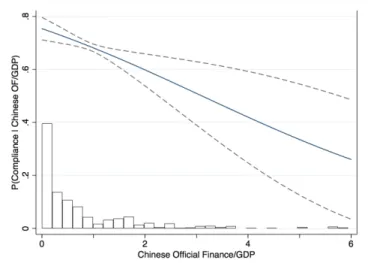
To further give a sense of the magnitude of effect size, Figure 2.1 presents the predicted
probability of compliance with an aid agreement as the proportion of Chinese Official Finance/GDP
increases within a country. The figure includes a histogram that indicates the distribution of the
five-year average of Chinese Official Finance/GDP in the sample. For reference, the five-year
average of Chinese Official Finance/GDP has a mean of 0.9 percent and a standard deviation
of 0.8 percent within countries. For an average project in a recipient country that receives the
mean level of Chinese Official Finance/GDP over the project’s duration, the predicted probability
of satisfactory government compliance with the project agreement is 69 percent. For the same
project and recipient, a one standard deviation increase in Chinese Official Finance/GDP lowers
logit model. The Hausman test evaluating between conditional and random effects logit model rejects the null hypothesis that the coefficients from the models are not systematically different but reports a non-positive definite VCE matrix.
19
Table 2.1: Conditional logit estimations (average semi-elasticities)
Dependent variable:
Government Compliance
(1) (2) (3) (4)
Chinese Official Finance/GDP -0.143*** (0.041)
Chinese ODA/GDP -0.158***
(0.055)
Chinese OOF/GDP -0.210**
(0.094)
Chinese Official Finance per capita (log) -0.180** (0.071)
Chinese Share of Total OF -0.019***
(0.005)
DAC ODA/GDP 0.012 0.018 0.017 -0.000
(0.024) (0.023) (0.023) (0.023)
NR Rents/GDP 0.009 0.010 0.013 0.010
(0.008) (0.008) (0.011) (0.007) FDI Stock/GDP -0.003 -0.002 -0.003 -0.006* (0.003) (0.003) (0.004) (0.003)
Debt/GNI 0.001 0.001 0.001 0.001
(0.002) (0.002) (0.002) (0.002)
GDPPC (log) 0.653 0.438 0.508 0.369
(0.643) (0.584) (0.534) (0.522) Executive Corruption -2.584** -2.531*** -2.273** -2.557***
(1.008) (0.951) (0.964) (0.904)
Conflict -0.178 -0.200 -0.110 -0.138
(0.273) (0.278) (0.242) (0.283) Project Duration -0.049*** -0.048*** -0.048*** -0.051***
(0.015) (0.015) (0.012) (0.015) Project Amount (log) -0.007 -0.009 -0.010 -0.011
(0.033) (0.031) (0.027) (0.032) Evaluation Count -0.061** -0.061** -0.065*** -0.063**
(0.026) (0.027) (0.023) (0.027) Energy & Natural Resources Sector -0.311** -0.331** -0.317*** -0.327**
(0.125) (0.131) (0.097) (0.127) Governance Sector -0.380*** -0.381*** -0.367*** -0.384***
(0.131) (0.134) (0.114) (0.131) Economic Policy Sector -0.175* -0.169 -0.172* -0.189* (0.103) (0.104) (0.088) (0.105) Agriculture Sector -0.168 -0.167 -0.168 -0.177
(0.118) (0.118) (0.114) (0.120)
Observations 736 736 736 736
Countries 35 35 35 35
Note: Coefficients are reported as average semi-elasticities and correspond with the percentage change in compli-ance associated with a one unit change in the explanatory variables. All specifications include year fixed effects. Country controls are 5-year lagged averages. Project controls are measured at exit year. Standard errors are clustered at the country level.∗p<0.1;∗∗p<0.05;∗∗∗p<0.01.
the predicted probability of compliance to 61 percent. The predicted probability of compliance
further decreases to 52 percent if the level of Chinese Official Finance/GDP is increased above
the mean by two standard deviations. In contrast, for the same project in a recipient country
that receives no Chinese official finance, the predicted probability of satisfactory compliance is 77
percent.
Figure 2.1: Predicted probability of compliance as the proportion of Chinese OF to GDP increases
Note: Marginal effects are based on the regressions shown in Model 1 of Table 2.1. Margins are estimated using simulation from an unconditional logit estimation with country dummy variables. The dotted lines represent 95%
confidence intervals.
Count are estimated to have a negative effect on recipient compliance with World Bank conditions.
Executive Corruption ranges from 0 to 1 with a sample average of 0.60 and within-country
stan-dard deviation of 0.05. Higher values of the corruption index correspond with greater executive
corruption. Based on Model 1, a one standard deviation increase in Executive Corruption within
a country over the five-year period prior to project completion is associated with a 12.9 percent
decrease in the probability of satisfactory compliance. Longer projects are also associated with
decreased compliance: a one year increase in project duration is associated with a 4.9 percent
decrease in the probability of satisfactory compliance. Similarly, an increase in the number of
projects evaluated in a given year is associated with decreased compliance. Consistent with
previ-ous research, project sectors are an important source of variation in project outcomes. Relative to
poverty reduction sectors, Economic Policy, Governance, and Energy & Natural Resources project
sectors are associated with lower recipient compliance.
Models 2-4 of Table 2.1 introduce alternative measures of Chinese development assistance.
Model 2 disaggregates Chinese Official Finance/GDP into Chinese ODA/GDP and Chinese OOF/GDP.20 The coefficient estimates for Chinese ODA/GDP and Chinese OOF/GDP are both negative and
statistically significant. Although the estimated effect size of Chinese OOF/GDP is larger, the two
coefficient estimates are not statistically different. Model 3 utilizes Chinese Official Finance per
capita (log) as the measure of Chinese development assistance. The coefficient on Chinese Official
Finance per capita is also estimated to be negative and statistically significant. Lastly, Model
4 utilizes a third alternative measure, Chinese Share of Total Official Finance. This measure is
calculated by dividing Chinese Official Finance by the sum of Chinese and DAC Official Finance.
The five-year average of Chinese Share of Total OF has a mean of 10.1 percent and a standard
deviation of 8.0 percent within countries. Based on Model 4, a one percent increase in the share of
Chinese Official Finance over the five-year period prior to project completion is associated with a
1.9 percent decrease in the probability of satisfactory government compliance with the conditions
attached to a World Bank project.
Robustness Checks
A number of robustness checks are performed to address concerns of omitted variable bias in the
model specification. First, I introduce additional economic controls that may impact the allocation
of Chinese aid and compliance with conditionality including population, GDP growth, trade
open-ness, and economic crisis (Denizer et al. 2013; Girod Tobin 2016; Kilby 2015).21 Second, to address concerns that the findings may be driven by Chinese investment or trade flows, I also control for
bilateral Chinese exports and FDI inflows to recipient countries (WITS 2017; UNCTAD 2014).22 Third, I consider additional political and strategic controls for political regime (Mashall et al. 2018),
political constraints (Henisz 2000), voting alignment with the United States in the United Nations
(Voeten et al. 2009), and temporary UNSC membership (Dreher et al. 2013). I also control for
whether a project was financed a development policy finance (DPF) loan or an investment loan.
To receive DPF projects, recipients are required to maintain an adequate macroeconomic policy
framework, make satisfactory progress in their overall reform program, and complete of a set of
critical policy and institutional actions (World Bank 2015). Appendix Tables A.6 and A.7 report
the results from alternative specifications that introduce the additional economic and political
vari-21Economic crisis is measured as the proportion of the five-year period prior to project completion that a country experienced an economic recession.
ables into the baseline specification. The primary results do not substantively change across the
specifications and increase confidence in the primary empirical findings.
Instrumental Variable Analysis
To address concerns that Chinese development assistance may be endogenously determined in the
model, I employ an instrumental variable analysis to supplement the primary analysis. Although
Chinese aid may influence recipient government willingness to comply with aid project agreements,
it could also be that compliance with aid conditionality influences the allocation of Chinese aid. To
address this concern, I use a two-stage least squares instrumental variable estimator with country
fixed effects. Following Dreher et al. (2017), I instrument for Chinese development assistance using
the interaction of logged and lagged Chinese steel production and the probability of a recipient
country receiving Chinese aid over the study period, iv = [151 P15
1 pi ∗ln(Chinesesteel)t−1].23
Specifically, I use the five-year average of the interaction to instrument for the five-year average
of Chinese official finance as a percent of GDP and Chinese official finance per capita. Data on
Chinese steel production is collected from the World Steel Association’s 2017 Statistical Yearbook.
As part of its industrial strategy, China has maintained a surplus in steel production (Zheng et al.
2009). A portion of China’s steel surplus is used as inputs for its development projects, particularly
in the transport, industry, mining, and construction sectors (Dreher et al. 2017, 4).
The instrumental variable strategy examines the “differential effect of Chinese steel production
on the amount of aid to countries with a high (compared to a low) probability of receiving Chinese
aid”(Dreher et al. 2017, 13). The identifying assumption is that compliance with World Bank
project agreements in recipient countries with differing probabilities of receiving Chinese aid will
not be affected differently by changes in Chinese steel production other than through the impact
of Chinese aid (Dreher et al. 2017, 5). The inclusion of country fixed effects controls for the effect
of the probability of receiving aid on compliance. For the analysis to be valid, the excluded
instru-ment must only affect compliance with aid agreeinstru-ments through an impact on Chinese developinstru-ment
assistance. To address concerns that the differential effects of the Chinese steel production on
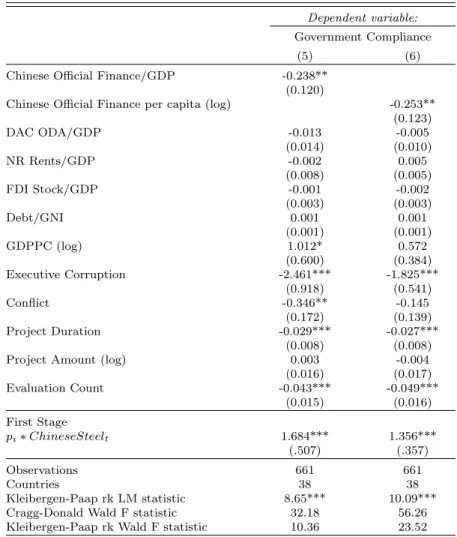
compliance could be a result of growth, investment, or trade, I control for GDP growth, FDI stock,