MIC4426/4427/4428
Dual 1.5A-Peak Low-Side MOSFET Driver
General Description
The MIC4426/4427/4428 family are highly-reliable dual low-side MOSFET drivers fabricated on a BiCMOS/DMOS process for low power consumption and high efficiency. These drivers translate TTL or CMOS input logic levels to output voltage levels that swing within 25mV of the positive supply or ground. Comparable bipolar devices are capable of swinging only to within 1V of the supply. The MIC4426/7/8 is available in three configurations: dual inverting, dual noninverting, and one inverting plus one noninverting output.
The MIC4426/4427/4428 are pin-compatible replacements for the MIC426/427/428 and MIC1426/1427/1428 with im-proved electrical performance and rugged design (Refer to the Device Replacement lists on the following page). They can withstand up to 500mA of reverse current (either polarity) without latching and up to 5V noise spikes (either polarity) on ground pins.
Primarily intended for driving power MOSFETs, MIC4426/7/8 drivers are suitable for driving other loads (capacitive, resistive, or inductive) which require low-impedance, high peak current, and fast switching time. Other applications include driving heavily loaded clock lines, coaxial cables, or piezoelectric transducers. The only load limitation is that total driver power dissipation must not exceed the limits of the package. Note See MIC4126/4127/4128 for high power and narrow pulse applications.
Functional Diagram
INA
OUTA INVERTING
NONINVERTING
0.1mA 0.6mA
2kΩ
INB
OUTB INVERTING
NONINVERTING
0.1mA 0.6mA
2kΩ
VS
Features
• Bipolar/CMOS/DMOS construction
• Latch-up protection to >500mA reverse current • 1.5A-peak output current
• 4.5V to 18V operating range • Low quiescent supply current 4mA at logic 1 input
400µA at logic 0 input • Switches 1000pF in 25ns • Matched rise and rall times • 7Ω output impedance • <40ns typical delay
• Logic-input threshold independent of supply voltage • Logic-input protection to –5V
• 6pF typical equivalent input capacitance • 25mV max. output offset from supply or ground • Replaces MIC426/427/428 and MIC1426/1427/1428 • Dual inverting, dual noninverting, and inverting/
noninverting configurations • ESD protection
Applications
• MOSFET driver • Clock line driver • Coax cable driverM9999-042108 2 April 2008
Ordering Information
Part Number Temperature
Standard Pb-Free Range Package Configuration
MIC4426BM MIC4426YM –40ºC to +85ºC 8-Pin SOIC Dual Inverting
MIC4426CM MIC4426ZM –0ºC to +70ºC 8-Pin SOIC Dual Inverting
MIC4426BMM MIC4426YMM –40ºC to +85ºC 8-Pin MSOP Dual Inverting
MIC4426BN MIC4426YN –40ºC to +85ºC 8-Pin PDIP Dual Inverting
MIC4426CN MIC4426ZN –0ºC to +70ºC 8-Pin PDIP Dual Inverting
MIC4427BM MIC4427YM –40ºC to +85ºC 8-Pin SOIC Dual Non-Inverting
MIC4427CM MIC4427ZM –0ºC to +70ºC 8-Pin SOIC Dual Non-Inverting
MIC4427BMM MIC4427YMM –40ºC to +85ºC 8-Pin MSOP Dual Non-Inverting
MIC4427BN MIC4427YN –40ºC to +85ºC 8-Pin PDIP Dual Non-Inverting
MIC4427CN MIC4427ZN –0ºC to +70ºC 8-Pin PDIP Dual Non-Inverting
MIC4428BM MIC4428YM –40ºC TO +85ºC 8-Pin SOIC Inverting + Non-Inverting
MIC4428CM MIC4428ZM –0ºC to +70ºC 8-Pin SOIC Inverting + Non-Inverting
MIC4428BMM MIC4428YMM –40ºC to +85ºC 8-Pin MSOP Inverting + Non-Inverting
MIC4428BN MIC4428YN –40ºC to +85ºC 8-Pin PDIP Inverting + Non-Inverting
MIC4428CN MIC4428ZN –0ºC to +70ºC 8-Pin PDIP Inverting + Non-Inverting
Note
DESC standard military drawing 5962-88503 available;
MIC4426, CERDIP 8-Pin SMD#: 5962-8850307PA Micrel Part Number: 5952-8850307PA MIC4427, CERDIP 8-Pin SMD#: 5962-8850308PA Micrel Part Number: 5952-8850308PA MIC4428, CERDIP 8-Pin SMD#: 5962-8850309PA Micrel Part Number: 5952-8850309PA
MIC426/427/428 Device Replacement
Discontinued Number Replacement
MIC426CM MIC4426BM
MIC426BM MIC4426BM
MIC426CN MIC4426BN
MIC426BN MIC4426BN
MIC427CM MIC4427BM
MIC427BM MIC4427BM
MIC427CN MIC4427BN
MIC427BN MIC4427BN
MIC428CM MIC4428BM
MIC428BM MIC4428BM
MIC428CN MIC4428BN
MIC428BN MIC4428BN
MIC1426/1427/1428 Device Replacement
Discontinued Number Replacement
MIC1426CM MIC4426BM
MIC1426BM MIC4426BM
MIC1426CN MIC4426BN
MIC1426BN MIC4426BN
MIC1427CM MIC4427BM
MIC1427BM MIC4427BM
MIC1427CN MIC4427BN
MIC1427BN MIC4427BN
MIC1428CM MIC4428BM
MIC1428BM MIC4428BM
MIC1428CN MIC4428BN
Pin Configuration
12 3 4
8 7 6 5 NC
INA GND INB
NC OUTA VS
OUTB
MIC4426
Dual Inverting
A B
7 5 2
4
MIC4426 MIC4427 MIC4428
A B
7 5 2
4
A B
7 5 2
4 1
2 3 4
8 7 6 5 NC
INA GND INB
NC OUTA VS
OUTB
MIC4427
Dual Noninverting
1 2 3 4
8 7 6 5 NC
INA GND INB
NC OUTA VS
OUTB
MIC4428
Inverting+ Noninverting
Pin Description
Pin Number Pin Name Pin Function
1, 8 NC not internally connected
2 INA Control Input A: TTL/CMOS compatible logic input.
3 GND Ground
4 INB Control Input B: TTL/CMOS compatible logic input.
5 OUTB Output B: CMOS totem-pole output.
6 VS Supply Input: +4.5V to +18V
M9999-042108 4 April 2008
Absolute Maximum Ratings
(1)Supply Voltage (VS) ...+22V Input Voltage (VIN) ... VS + 0.3V to GND – 5V Junction Temperature (TJ) ... 150°C Storage Temperature ... –65°C to +150°C Lead Temperature (10 sec.) ... 300°C ESD Rating(3)
Operating Ratings
(2)Supply Voltage (VS) ... +4.5V to +18V Temperature Range (TA)
(A) ... –55°C to +125°C (B) ... –40°C to +85°C Package Thermal Resistance
PDIP θJA ...130°C/W PDIP θJC ...42°C/W SOIC θJA ...120°C/W SOIC θJC ...75°C/W MSOP θJA ...250°C/W
Electrical Characteristics
(4)4.5V ≤ Vs ≤ 18V; TA = 25°C, bold values indicate full specified temperature range; unless noted.
Symbol Parameter Condition Min Typ Max Units
Input
VIH Logic 1 Input Voltage 2.4 1.4 V
2.4 1.5 V
VIL Logic 0 Input Voltage 1.1 0.8 V
1.0 0.8 V
IIN Input Current 0 ≤ VIN ≤ VS –1 1 µA
Output
VOH High Output Voltage VS–0.025 V
VOL Low Output Voltage 0.025 V
RO Output Resistance IOUT = 10mA, VS = 18V 6 10 Ω
8 12 Ω
IPK Peak Output Current 1.5 A
I Latch-Up Protection withstand reverse current >500 mA
Switching Time
tR Rise Time test Figure 1 18 30 ns
20 40 ns
tF Fall Time test Figure 1 15 20 ns
29 40 ns
tD1 Delay Tlme test Flgure 1 17 30 ns
19 40 ns
tD2 Delay Time test Figure 1 23 50 ns
27 60 ns
tPW Pulse Width test Figure 1 400 ns
Power Supply
IS Power Supply Current VINA = VINB = 3.0V 0.6 1.4 4.5 mA
1.5 8 mA
IS Power Supply Current VINA = VINB = 0.0V 0.18 0.4 mA
0.19 0.6 mA
Notes:
1. Exceeding the absolute maximum rating may damage the device. 2. The device is not guaranteed to function outside its operating rating. 3. Devices are ESD sensitive. Handling precautions recommended. 4. Specification for packaged product only.
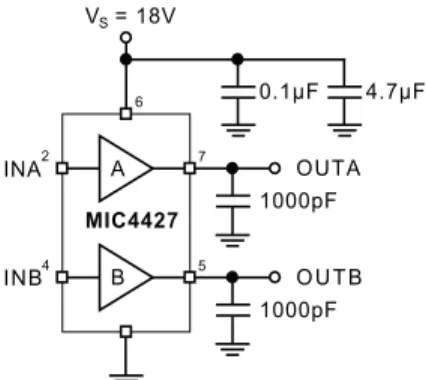
Test Circuits
A
B INA
INB
2
4
MIC4427
5 7
OUTA 1000pF
6
VS = 18V
0.1µF 4.7µF
OUTB 1000pF
Figure 2a. Noninverting Configuration
90% 10%
tR
10% 0V 5V
tF
VS
OUTPUT INPUT90%
0V
tD1 tD2
tPW
2.5V
Figure 2b. Noninverting Timing
A
B INA
INB
2
4
MIC4426
5 7
OUTA 1000pF
6
VS = 18V
0.1µF 4.7µF
OUTB 1000pF
Figure 1a. Inverting Configuration
tD1
90% 10%
tF
10% 0V 5V
tD2 tR
VS
OUTPUT INPUT90%
0V
2.5V tPW
M9999-042108 6 April 2008
Electrical Characteristics
Rise and Fall Time vs.
0 5 10 15 20
tF
SUPPLY VOLTAGE (V) 70 60 50 40 10 0 TIME (ns) 20 30
0 5 10 15 20
SUPPLY VOLTAGE (V) 35 30 25 20 5 0 TIME (ns) 10 15 40 30 10 TIME (ns) 20
-25 0 25 50 150
TEMPERATURE (°C) 75 100 125
35 30 25 20 5 0 TIME (ns) 10 15
-25 0 25 50 150
TEMPERATURE (°C)75 100 125 tD1 80 70 60 50 20 0 SUPP LY CURREN T (mA ) 30 40 10 400kHz 200 kHz 20kHz
10 100 10000
CAPACITIVE LOAD (pF)1000
1k 100 10 1 TIME (ns)
10 100 10000
CAPACITIVE LOAD (pF)1000 tR
tF
Supply Current vs. Frequency V = 18VS
10 V 5 V 20 0 SUPP LY CURREN T (mA ) 30 10
1 10 1000
FREQUENCY (kHz)100
High Output vs. Current
| V – V | (V)S
OU
T
CURRENT SOURCED (mA)
Low Output vs. Current 1.20 0.96 0 0.48 0.72 0.24 0 10
CURRENT SUNK (mA) 20 30 40 50 60 70 80 90 100
10 V
15 V
OUTPU
T VO
L
T AGE (V
) 1.20 0.96 0 0.48 0.72 0.24
0 10 20 30 40 50 60 70 80 90 100 10 V 15 V -50 tR -50 -75 tR tF -75 tD2 tD1 tD2
C = 1000pF T = 25°CAL
C = 1000pF T = 25°CAL
C = 1000pF V = 18VSL
C = 1000pF V = 18VSL
T = 25°C V = 18VSA
T = 25°C V = 18VAS
T = 25°C
C = 1000pFAL T = 25°CA V = 5VC T = 25°CA V = 5VS
25 50 75 100 150
AMBIENT TEMPERATURE (°C) 1000 750 250 0 500 0 0.5 2.5 1.0 1.5 SUPP LY CURREN T (mA ) 20 15 5 0
SUPPLY VOLTAGE (V) 10 2.0 125 SUPP LY CURREN T (A ) 15 10 0 5 0 50 100 150 200 300 400 20 SUPPLY VOLTAGE (V)
MAXIMUM
PACKAG
E
POWER DISSI
P
A TION (mW
)1250
NO LOAD
BOTH INPUTS LOGIC "1" T = 25°CA
NO LOAD
BOTH INPUTS LOGIC "0" T = 25°CA
SOIC
PDIP
Supply Voltage Supply VoltageDelay Time vs. Rise and Fall Time vs.Temperature
Rise and Fall Time vs. Capacitive Load Supply Current vs.
Capacitive Load Delay Time vs.
Temperature
Quiescent Power Supply Current
Applications Information
Supply Bypassing
Large currents are required to charge and discharge large capacitive loads quickly. For example, changing a 1000pF load by 16V in 25ns requires 0.8A from the supply input. To guarantee low supply impedance over a wide frequency range, parallel capacitors are recommended for power supply bypassing. Low-inductance ceramic MLC capacitors with short lead lengths (< 0.5”) should be used. A 1.0µF film capacitor in parallel with one or two 0.1µF ceramic MLC capacitors normally provides adequate bypassing.
Grounding
When using the inverting drivers in the MIC4426 or MIC4428, individual ground returns for the input and output circuits or a ground plane are recommended for optimum switching speed. The voltage drop that occurs between the driver’s ground and the input signal ground, during normal high-cur-rent switching, will behave as negative feedback and degrade switching speed.
Control Input
Unused driver inputs must be connected to logic high (which can be VS) or ground. For the lowest quiescent current (< 500µA) , connect unused inputs to ground. A logic-high signal will cause the driver to draw up to 9mA.
The drivers are designed with 100mV of control input hys-teresis. This provides clean transitions and minimizes output stage current spikes when changing states. The control input voltage threshold is approximately 1.5V. The control input recognizes 1.5V up to VS as a logic high and draws less than 1µA within this range.
The MIC4426/7/8 drives the TL494, SG1526/7, MIC38C42, TSC170 and similar switch-mode power supply integrated circuits.
Power Dissipation
Power dissipation should be calculated to make sure that the driver is not operated beyond its thermal ratings. Quiescent power dissipation is negligible. A practical value for total power dissipation is the sum of the dissipation caused by the load and the transition power dissipation (PL + PT).
Load Dissipation
Power dissipation caused by continuous load current (when driving a resistive load) through the driver’s output resistance is:
PL = IL2 R O
For capacitive loads, the dissipation in the driver is: PL = f CL VS2
Transition Dissipation
In applications switching at a high frequency, transition power dissipation can be significant. This occurs during switching transitions when the P-channel and N-channel output FETs are both conducting for the brief moment when one is turning on and the other is turning off.
PT = 2 f VS Q
Charge (Q) is read from the following graph:
1×10⁻⁸
8×10⁻⁹
4×10⁻⁹
3×10⁻⁹
2×10⁻⁹
6×10⁻⁹
1×10⁻⁹
4 6 8 10 12 14 16 18
SUPPLY VOLTAGE (V)
CHARGE (Q)
M9999-042108 8 April 2008
Package Information
45°
0°–8°
0.228 (5.79) 0.189 (4.8)
PLANE MAX)
0.010 (0.25) 0.007 (0.18)
0.045 (1.14)
0.0040 (0.102) 0.013 (0.33) 0.150 (3.81)
TYP
PIN 1
INCHES (MM)
0.016 (0.40)
8-Pin SOIC (M)
0.004 (0.10)
0.035 (0.89) 0.021 (0.53)
0.012 (0.03) R 0.0256 (0.65) TYP
0.012 (0.30) R
5°
0° MIN 0.112 (2.84)
0.116 (2.95)
0.012 (0.03)
0.007 (0.18) 0.005 (0.13) 0.038 (0.97)
0.032 (0.81)
INCH (MM) 0.187 (4.74)
8-Pin MM8™ MSOP (MM)
MICREL INC. 2180 FORTUNE DRIVE SAN JOSE, CA 95131 USA
TEL + 1 (408) 944-0800 FAX + 1 (408) 474-1000 WEB http://www.micrel.com