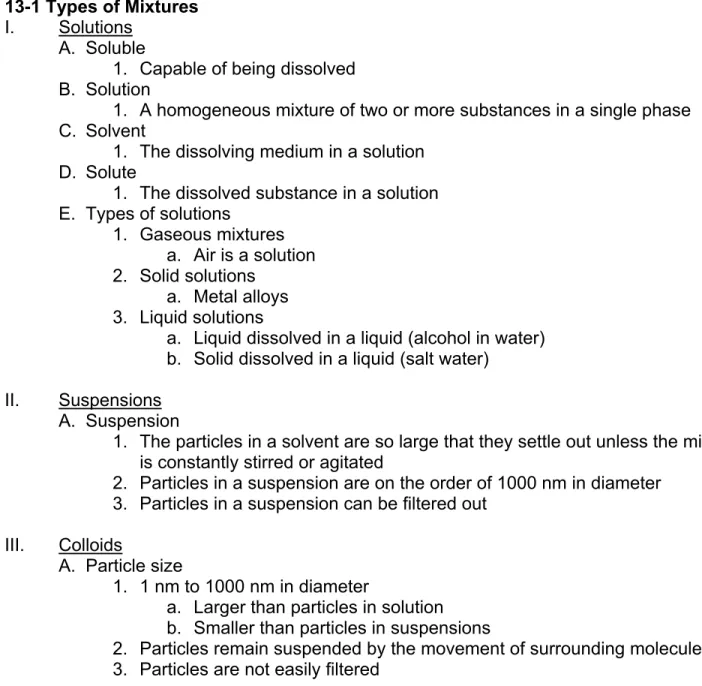
Chapter 13 - Solutions 13-1 Types of Mixtures
I. Solutions A. Soluble
1. Capable of being dissolved B. Solution
1. A homogeneous mixture of two or more substances in a single phase C. Solvent
1. The dissolving medium in a solution D. Solute
1. The dissolved substance in a solution E. Types of solutions
1. Gaseous mixtures a. Air is a solution 2. Solid solutions
a. Metal alloys 3. Liquid solutions
a. Liquid dissolved in a liquid (alcohol in water) b. Solid dissolved in a liquid (salt water)
II. Suspensions A. Suspension
1. The particles in a solvent are so large that they settle out unless the mixture is constantly stirred or agitated
2. Particles in a suspension are on the order of 1000 nm in diameter 3. Particles in a suspension can be filtered out
III. Colloids
A. Particle size
1. 1 nm to 1000 nm in diameter
a. Larger than particles in solution b. Smaller than particles in suspensions
2. Particles remain suspended by the movement of surrounding molecules 3. Particles are not easily filtered
Table 13-2 Classes of Colloids Class of Colloid Phases
Sol Solid dispersed in liquid
Gel Solid network extending throughout liquid Liquid emulsion Liquid dispersed in a liquid
B. Tyndall Effect
1. LIght is scattered when passing through a colloid IV. Solutes: Electrolytes vs. Nonelectrolytes
A. Electrolyte
1. A substance that dissolves in water to give a solution that conducts electric current
B. Nonelectrolyte
1. A substance that dissolves in water to give a solution that does not conduct an electric current
C. Measuring Conductivity 1. Good conductors
a. Lamp glows brightly
b. Ammeter registers a substantial current 2. Moderate conductors
a. Lamp is dull
b. Ammeter registers a small current 3. Nonconductors
a. Lamp does not glow
b. Ammeter may not register a current at all 13-2 The Solution Process
I. Factors Affecting the Rate of Dissolution A. Increasing the Surface Area of the Solute
1. Finely divided substances dissolve more rapidly B. Agitating a Solution
1. Stirring or shaking brings solvent into contact with more solute particles 2. Added energy temporarily increases solubility
C. Heating
1. Heating always increasing the rate of dissolution of solids in liquids
II. Solubility
A. Solution Equilibrium
1. The physical state in which the opposing processes of dissolution and crystallization of a solute occur at equal rates
B. Saturation Levels
1. Saturated solution
a. A solution that contains the maximum amount of dissolved solute 2. Unsaturated solutions
a. A solution that contains less solute than a saturated solution under the existing conditions
3. Supersaturated Solutions
a. A solution that contains more dissolved solute than a saturated solution contains under the same conditions
C. Solubility Values
1. The solubility of a substance is the amount of that substance required to form a saturated solution with a specific amount of solvent at a specified temperature
2. The rate at which a substance dissolves does not alter the substances solubility
III. Solute-Solvent Interactions A. "Like dissolves like"
1. Polar substances dissolve in polar solvents
2. Nonpolar substances dissolve in nonpolar solvents B. Dissolving Ionic Compounds in Aqueous Solutions
1. Electropositive hydrogen of the water molecule is attracted to negatively charged ions
2. Electronegative oxygen of the water molecule is attracted to positively charged ions
3. Hydration
1. The solution process with water as the solvent 4. Hydrates
1. Ionic substances that incorporate water molecules into their structure during the recrystallization process
CuSO4•5H2O
a. the ” •" means that the water is loosely attached C. Nonpolar Solvents
1. Polar and ionic compounds are not soluble in nonpolar solvents
2. Fats, oils and many petroleum products are soluble in nonpolar solvents 3. Nonpolar solvents include CCl4 and toluene (methyl benzene), C6H5CH3 D. Liquid Solutes and Solvents
E. Effects of Pressure on Solubility
1. Pressure has no real effect on the solubilities of liquids and solids in liquid solvents
2. Increasing pressure increases the solubility of gases in liquids a. Henry's Law
(1) The solubility of a gas in a liquid is directly proportional to the partial pressure of that gas on the surface of the liquid
b. Effervescence
(1) The rapid escape of a gas from a liquid in which it is dissolved F. Effects of Temperature on Solubility
1. Solubility of solids increases with temperature 2. Solubility of gases decreases with temperature
IV. Heats of Solution A. Heat of Solution
1. The amount of heat energy absorbed or released when a specific amount of solute dissolves in a solvent
B. Measuring Heats of Solution 1. Negative heats of formation
a. Energy is released (exothermic) b. The container will feel warm 2. Positive heats of formation
a. Energy is absorbed (endothermic) b. The container will feel cold
13-3 Concentration of Solutions
Concentration - A measure of the amount of solute in a given amount of solvent or solution I. Molarity(M)
A. Molarity
1. The concentration of a solution expressed in moles of solute per liter of solution
B. Calculations Involving Molarity
1. Determining the molarity of a solution
solution of Liters solute of Moles M
Molarity( )=
2. Determining the mass of solute required to make a particular volume of solution
= Volume of solution Molarity of Solution Formula Weight of Solute g
Mass( )
II. Molality(m) A. Molality
1. The concentration of a solution expressed in moles of solute per kilogram of solvent
B. Calculations Involving Molality
1. Determining the molality of a solution
) ( ) ( kg solvent of mass solute of moles m Molality =