Powerful WaveTest Traffic Generator / Analyzers are capable of generating thousands of independent client sessions, each representing a unique user of the network. Traffic can be accurately, repeatedly, and precisely created to assess performance in real-world conditions at scale.
WaveTest delivers unique insight into the functionality, quality and performance of the network, or network component, under test. The solution features native IEEE 802.11 a/b/g/n/ac interfaces as well as 10/100/1000 Mbps Ethernet interfaces.
Figure 1: WaveTest 92 and 20
WaveTest Multi-client Traffic Generator/
Performance Analyzer
Highlights
Automation – 10x more efficient
Cost of ownership minimized Repeatability equals
confidence
Goes beyond conformance and interoperability
Page 2
Key Features
Automation –10x More Efficient
o Hundreds of tests run unattended
o Uninterrupted operation for extended periods of time
o Complete control over large scale deployment scenarios Cost of Ownership Minimized
o Test time reduced from days to minutes
o Test coverage increased
o Bugs revealed early in the QA cycle Repeatability = Confidence
o Get to the root cause & solve problems faster
o Avoid pitfalls when testing with off-the-shelf clients Goes Beyond Conformance & Interoperability
o Scales to thousands of stateful and independent clients
o Quantifies real world deployment scenarios
o Stress tests a complete Wireless LAN (WLAN) network
IxVeriWave Master Test Plan
The IxVeriWave Master Test Plan for WLANs establishes guidelines, best practices, and baseline evaluation criteria for testing the performance and scalability of wireless equipment. The plan outlines the goals, procedures, and expected results for thousands of unique test cases while offering insight into the behavior and performance of wireless LANs. The Master Test Plan offers the flexibility of selectively choosing the most appropriate individual tests needed to verify the functionality and performance of each unique system under test. The guide addresses every aspect of required network testing, from functional verification, performance measurement, and network capacity assessment to system testing and stress testing.
Large-scale Testing
WaveTest is a chassis-based test system that utilizes individual WaveBlades for traffic generation and analysis: Each WaveBlade supports up to 4 independent traffic generator / performance analyzers
Each WaveBlade traffic generator / performance analyzer emulates up to 500 WLAN or 1,000 Ethernet clients across single or multiple subnets
Gigabit Ethernet traffic generation and analysis at full wire-speed
Each WaveTest 92 supports up to 8 WaveBlades with an Ethernet Blades providing a combined capacity of 16,000 individual WLAN clients (STAs)
Traffic generated and analyzed between WLAN clients and Ethernet clients / servers or mobile WLAN clients Multiple traffic flows per client supported with each flow offering stateful traffic at layers 1 or 2 through 7 Real-time port statistics, per flow statistics, packet filters, triggers, and capture capabilities for precise analysis Built-in client mobility allows precise roaming of each and every client between any access points (APs) at
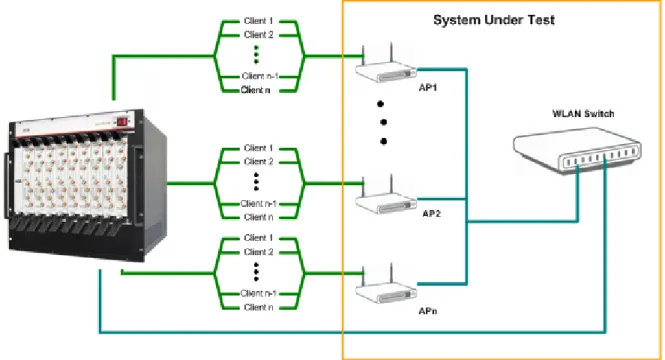
Figure 2: Typical setup supports testing of tens of access points and multiple WLAN switches
Real-World Stateful WLAN Client Traffic Generation
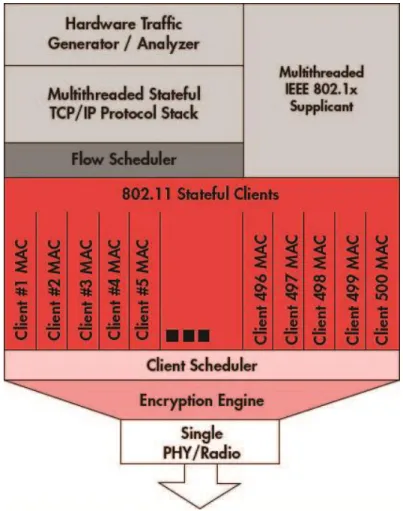
The WaveBlade traffic scheduler offers fully interleaved traffic flows, creating real mobile clients contending for the shared medium
The traffic scheduler dynamically adjusts offered load to approximate intended load with load resolution of better than 0.5%
Client contention can be precisely emulated, guaranteeing real-world behavior in every test iteration Client behavior is individually controlled providing accurate control of 802.11, 802.3, and IP characteristics,
Page 4 Figure 3: Scheduler interleaves traffic flows contending for the shared mediums
Anatomy of an IxVeriWave Stateful Client
Each client supports the full MAC per 802.11 standard 802.1X supplicant supports full EAP stack per client
Upper layer protocols (e.g., DHCP and TCP) are implemented using independent protocol state machines All state machines for all clients run concurrently
Every client independently updates its state based on channel conditions e.g. 802.11n clients using protected -mode when .802.11g is detected
Each Stateful client implements:
o Carrier deference
o Collision sensing
o Random back-off
o Retransmission
o Collision emulation
Multi-level scheduler enables optimum channel utilization, multiple traffic flows per client, and mixing of Constant Bit Rate voice/video traffic with Best Effort data traffic
Stateful Behavior of Every Client
Layer 2 - 802.11o Fully stateful MAC implementation as per IEEE 802.11 Layer 4 - TCP/IP
o Fully stateful implementation as per IETF 793, with TCP Congestion Control (as per IETF RFC-2581), including slow start, congestion avoidance, fast retransmit, and fast recovery
o Line / air rate TCP traffic generation / analysis on every WaveBlade port
o Per flow / client independent state machine
o 1,000 stateful TCP flows maintained, per WaveBlade port Comprehensive set of TCP connection stats
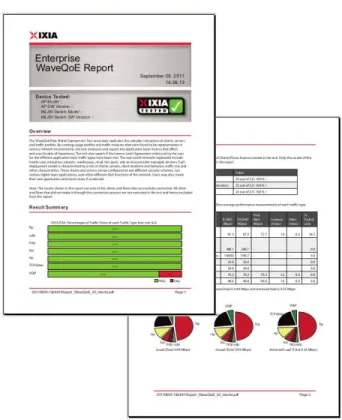
WaveQoE: Real-world vertical industry deployment scenarios; pre-configured and easy to model real-world deployment scenarios enable assessment of end-user QoE (Quality of Experience)
Advantages
Exercise and stress AP client state table with various client connection speeds and RSSI levels at unprecedented scales
Verify AP’s ability to handle concurrent 802.1x port authentications and 802.11i key handshakes for high client loads
Qualify effectiveness of IDS/IPS and DoS security policies and their impact on AP performance Evaluate AP’s 802.11e/802.1D/VLAN/SSID based QoS mechanisms to prioritize different traffic types Assess robustness of AP’s buffer management and load balancing schemes with clients at different power
management, FER levels, data rates
Quantify AP’s data plane performance using flow packets of different sizes, protocol types, encryptions, and rates
Page 6
Ease of use
WaveTest offers fully-integrated use-models:
o WaveDynamix – A user interface offering comprehensive, real-time control and results for functional testing
o WaveApps - Fully automated tests offering rapid benchmarking and roaming analysis of Network Under Test
o WaveQoE – End-user Quality of Experience measurements for typical network deployments: corporate office, healthcare, retail, warehouse, hospitality, hot-spot, etc.
Configuration data, test control, and results are all seamlessly transferable between all use models
Test results are collected and displayed using an extensive set of predefined counters, user-defined counters, triggers and filters, as well as a 256 MB capture buffer per WaveBlade port
Comprehensive, management level reports are created automatically in PDF format at the conclusion of each test, and include:
o Test details; date, version numbers, etc.
o Measured results
o Expected results
o Explanation of how to interpret results
Testing Issues that Matter Most
Data Plane Test Applications
Unicast Throughput Unicast Forwarding Rate Unicast Packet Loss Unicast Latency
Multicast Forwarding Rate TCP Goodput
Power Save Throughput
Control Plane/ Security Applications
Roaming Benchmark Roaming Stress
Client Association Database Capacity AP Load Balancing
Connection Stress Test Concurrent Connections Test Thin AP Failover Test
802.11 Frame Generator / Attack Generator AAA / RADIUS Server Authentication capacity Multicast Roaming
TCP Goodput
Power Save Throughput
End-User QoE (Quality of Experience)
Including Voice and Video
WaveQoE – Real-world deployment scenarios & measurement of end-user QoE VoIP Call Capacity and Performance
Video Capacity and Performance QoS Service Differentiation
Roaming Service Quality (VoIP Roaming)
WLAN Client Functionality & Performance
Mobile WLAN client device operation in ideal conditions
Mobile client device operation in real world conditions with ecosystem traffic present Expected end-user experience
Roaming/mobility impact on end-user experience
Interoperability Testing
Interoperability of mobile WLAN clients with various access points Wide range of WLAN-enabled client devices supported
o Laptops
o VoWLAN Handsets
o PDAs
o Scanners
o WLAN enabled medical monitoring systems
o WLAN enabled video gateways
Page 8
Specifications
Physical Specifications
WaveTest 92
WaveTest 20
Size Height: 17.5 inches (44.5 cm) Width: 19.0 inches (48.3 cm) Depth: 21.5 inches (54.5 cm)
Height: 13.5 inches (34.3 cm) Width: 5.6 inches (14.2 cm) Depth: 21.5 inches (54.0 cm)
Weight Empty: 50.0 lbs (22.7 kg) Fully loaded: 75.0 lbs (34.0 kg)
Empty: 20.0 lbs (9.1 kg) Fully loaded: 27.5 lbs (12.5 kg)
Environmental Specifications
Temperature Operating; 0o C to +40o C Storage: -20o C to +70o C
Operating; 0o C to +40o C Storage: -20o C to +70o C
Humidity Operating: 20 % to 80% relative humidity
Storage: +40o C at 95% relative humidity, non-condensing
Operating: 20 % to 80% relative humidity
Storage: +40o C at 95% relative humidity, non-condensing
Altitude Operating: -1000 ft. to +6500 ft. (2000 meters)
Non-operating: +40,000 ft.
Operating: -1000 ft. to +6500 ft. (2000 meters)
Non-operating:+40,000 ft.
Vibration, random Operating: 5 Hz to 500 Hz, 0.27 Grms Non-operating: 5 Hz to 500 Hz, 2.3G
Operating: 5 Hz to 500 Hz, 0.27 Grms Non-operating: 5 Hz to 500 Hz, 2.3G
Shock 20 G shock tolerance 20 G shock tolerance
Operational Specifications
WaveBlade Capacity
WaveBlade Management: One WaveBlade Management (WB1000) required in the management slot. (Left most slot in chassis)
Traffic generator / RF WaveBlades: Up to 9 traffic generator WaveBlades
WaveBlade Management: One WaveBlade Management (WB1000) required in the management slot. (Left most slot in chassis)
Traffic generator / RF WaveBlades: Up to 2 traffic generator WaveBlades
Power 100/120/230 VAC, 18/14.9/7.7 A, 50/60 Hz
Automatic line voltage selection
100/120/230 VAC, 4/3/2 A, 50/60 Hz Automatic line voltage selection
AirFlow Cool air enters at the bottom front and bottom sides
Exhaust air exits the top rear
Cool air enters at the base Exhaust air exits at the top
Physical Specifications
WaveTest 92
WaveTest 20
Connectors Network: Ethernet, RJ-45, 10/100/1000 Base-T LAN Sync In and Sync Out: RJ-45
connectors (Ixia Sync cable required) Off load ports (9) RJ45 Connectors,
to back plane at each slot
AC Power: IEC standard power cord connection
External Connections: Other than mains power, all external connections are intended to be to non-hazardous circuits per the requirements of IEC 61010-1
Network: Ethernet, RJ-45, 10/100/1000 Base-T LAN
Sync In and Sync Out: RJ-45
connectors (Ixia Sync cable required) Off load ports (2) RJ45 Connectors, to
back plane at each slot
AC Power: IEC standard power cord connection
External Connections: Other than mains power, all external connections are intended to be to non-hazardous circuits per the requirements of IEC 61010-1
Certifications
Product Safety Compliance
Listed TUV-USA and TUV-Canada Low Voltage Direction EN6101-1:2010
Electromagnetic EU EMC Directive 89/336/ECC, as amended
o EN 61000-6-2:2001: Class B Radiated Emissions
o EN 55011(AMD. A1:199) Class B Conducted Emissions
o EN 61000-3-2:2000: Current Harmonics
o EN 61000-3-3:2001: Voltage Fluctuations
o EN61000 -6-2:2001: Immunity
Class A part 15 FCC Standards for Radiated and Conducted Emissions
Ordering Information
980-1004-01
IxVeriWave WaveTest 92 Chassis, 9 slots, 19" rack-mountable; includes: 25meter Sync Cable, 5meter Cat5e cable, RJ45 connectors, Power Cord, Installation Guide
980-1002-01
IxVeriWave WaveTest 20 Multi-client Traffic Generator / Performance Analyzer, 2-slot chassis, portable; includes: 25meter Sync Cable, 5meter Cat5e cable, RJ45 connectors, Power Cord, Installation Guide
980-1003-01
IxVeriWave VW10-0011-00 WB1000, WaveBlade Management required for both WT92 1004 & WT20 980-1002 chassis