Changes in the Arctic:
Background and Issues for Congress
Ronald O'Rourke, Coordinator
Specialist in Naval Affairs
March 17, 2015
Congressional Research Service
7-5700 www.crs.gov R41153
Summary
The diminishment of Arctic sea ice has led to increased human activities in the Arctic, and has
heightened interest in, and concerns about, the region’s future. The United States, by virtue of
Alaska, is an Arctic country and has substantial interests in the region. On January 21, 2015,
President Obama issued an executive order for enhancing coordination of national efforts in the
Arctic. The United States will assume the chairmanship of the Arctic Council in April 2015 and
will serve in that capacity for two years.
Record low extents of Arctic sea ice over the past decade have focused scientific and policy
attention on links to global climate change and projected ice-free seasons in the Arctic within
decades. These changes have potential consequences for weather in the United States, access to
mineral and biological resources in the Arctic, the economies and cultures of peoples in the
region, and national security.
The five Arctic coastal states—the United States, Canada, Russia, Norway, and Denmark (of
which Greenland is a territory)—are in the process of preparing Arctic territorial claims for
submission to the Commission on the Limits of the Continental Shelf. The Russian claim to the
enormous underwater Lomonosov Ridge, if accepted, would reportedly grant Russia nearly
one-half of the Arctic area. There are also four other unresolved Arctic territorial disputes.
The diminishment of Arctic ice could lead in coming years to increased commercial shipping on
two trans-Arctic sea routes—the Northern Sea Route and the Northwest Passage. Current
international guidelines for ships operating in Arctic waters are being updated.
Changes to the Arctic brought about by warming temperatures will likely allow more exploration
for oil, gas, and minerals. Warming that causes permafrost to melt could pose challenges to
onshore exploration activities. Increased oil and gas exploration and tourism (cruise ships) in the
Arctic increase the risk of pollution in the region. Cleaning up oil spills in ice-covered waters will
be more difficult than in other areas, primarily because effective strategies have yet to be
developed.
Large commercial fisheries exist in the Arctic. The United States is currently meeting with other
countries regarding the management of Arctic fish stocks. Changes in the Arctic could affect
threatened and endangered species. Under the Endangered Species Act, the polar bear was listed
as threatened on May 15, 2008. Arctic climate change is also expected to affect the economies,
health, and cultures of Arctic indigenous peoples.
Two of the Coast Guard’s three polar icebreakers—Polar Star and Polar Sea—have exceeded
their intended 30-year service lives, and Polar Sea is not operational. On May 12, 2011,
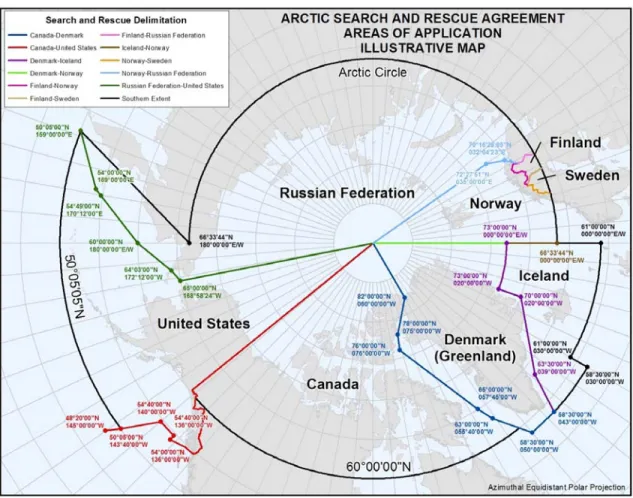
representatives from the member states of the Arctic Council signed an agreement on cooperation
on search and rescue in the Arctic.
Although there is significant international cooperation on Arctic issues, the Arctic is increasingly
being viewed by some observers as a potential emerging security issue. Some of the Arctic
coastal states, particularly Russia, have announced an intention or taken actions to enhance their
military presences in the high north. U.S. military forces, particularly the Navy and Coast Guard,
have begun to pay more attention to the region in their planning and operations.
Contents
Introduction ... 1
Background ... 1
Definitions of the Arctic ... 1
Arctic Circle Definition and Resulting Arctic Countries ... 1
Definition in Arctic Research and Policy Act (ARPA) of 1984 ... 2
Other Definitions ... 4
U.S. Arctic Research ... 5
Arctic Research and Policy Act (ARPA) of 1984, As Amended ... 5
FY2016 NSF Budget Request for Arctic Research ... 6
Major U.S. Policy Documents Relating to the Arctic ... 7
January 2009 Arctic Policy Directive (NSPD 66/HSPD 25) ... 7
May 2010 National Security Strategy ... 8
May 2013 National Strategy for Arctic Region ... 8
January 2014 Implementation Plan for National Strategy for Arctic Region ... 9
January 2015 Executive Order for Enhancing Coordination of Arctic Efforts ... 11
U.S. Special Representative for the Arctic ... 12
U.S. Chairmanship of Arctic Council in 2015-2017... 12
The Arctic and the U.N. Convention on Law of the Sea (UNCLOS) ... 15
Background to UNCLOS ... 15
Part VI of UNCLOS and Commission on Limits of Continental Shelf ... 15
U.S. Activities As a Non-Party to UNCLOS ... 16
Senate Arctic Caucus ... 17
Issues for Congress ... 17
Climate Change and Loss of Arctic Sea Ice ... 17
Territorial Claims and Sovereignty Issues ... 21
Commercial Sea Transportation ... 23
Background ... 23
Regulation of Arctic Shipping ... 26
Oil, Gas, and Mineral Exploration... 28
Oil and Gas ... 30
Extent of the Continental Margin ... 31
Minerals ... 33
Oil Pollution and Pollution Response ... 34
Oil Pollution Implications of Arctic Change ... 34
Response and Cleanup Challenges in the Arctic Region... 36
Fisheries ... 38
Protected Species ... 39
Indigenous People Living in the Arctic ... 40
Background ... 40
Effects of Climate Change ... 42
Polar Icebreaking ... 45
Search and Rescue ... 47
General ... 47
Coast Guard Statements ... 49
State Department Statement ... 50
Geopolitical Environment ... 54
Multilateral Political Cooperation ... 55
Security Issues ... 62
U.S. Military Forces and Operations ... 67
DOD in General ... 68
Navy and Coast Guard in General ... 80
Navy ... 81
Coast Guard ... 92
January 2009 Arctic Policy Directive (NSPD 66/HSPD 25) ... 98
May 2013 Arctic Strategy and January 2014 Implementation Plan ... 99
CRS Reports on Specific Arctic-Related Issues ... 100
Figures
Figure 1. Arctic Area of Alaska as Defined by ARPA ... 3
Figure 2. Entire Arctic Area as Defined by ARPA ... 4
Figure 3. Arctic Sea Ice Extent in September 2008, Compared with Prospective Shipping
Routes and Oil and Gas Resources ... 20
Figure 4. Illustrative Map of Arctic SAR Areas in Arctic SAR Agreement ... 53
Appendixes
Appendix A. Arctic Research and Policy Act (ARPA) of 1984 (Title I of P.L. 98-373) ... 102
Appendix B. P.L. 101-609 of 1990, Amending Arctic Research and Policy Act (ARPA) of
1984 ... 110
Appendix C. January 2009 Arctic Policy Directive (NSPD 66/HSPD 25) ... 112
Appendix D. May 2013 National Strategy for Arctic Region ... 121
Contacts
Author Contact Information... 128
Introduction
The diminishment of Arctic sea ice has led to increased human activities in the Arctic, and has
heightened interest in, and concerns about, the region’s future. Issues such as Arctic sovereignty
claims; commercial shipping through the Arctic; Arctic oil, gas, and mineral exploration;
endangered Arctic species; and increased military operations in the Arctic could cause the region
in coming years to become an arena of international cooperation or competition. The United
States, by virtue of Alaska, is an Arctic country and has substantial political, economic, energy,
environmental, and other interests in the region. Decisions that Congress, the executive branch,
foreign governments, international organizations, and commercial firms make on Arctic-related
issues could significantly affect these interests.
This report provides an overview of Arctic-related issues for Congress, and refers readers to more
in-depth CRS reports on specific Arctic-related issues. Congressional readers with questions
about an issue discussed in this report should contact the author or authors of the section
discussing that issue. The authors are identified by footnote at the start of each section.
This report does not track legislation on specific Arctic-related issues. For tracking of legislative
activity, see the CRS reports relating to specific Arctic-related issues that are listed at the end of
this report, just prior to
Appendix A
.
Background
1
Definitions of the Arctic
There are multiple definitions of the Arctic that result in differing descriptions of the land and sea
areas encompassed by the term. Policy discussions of the Arctic can employ varying definitions
of the region, and readers should bear in mind that the definition used in one discussion may
differ from that used in another. This CRS report does not rely on any one definition.
Arctic Circle Definition and Resulting Arctic Countries
The most common and basic definition of the Arctic defines the region as the land and sea area
north of the Arctic Circle (a circle of latitude at about 66.34
oNorth). For surface locations within
this zone, the sun is generally above the horizon for 24 continuous hours at least once per year (at
the summer solstice) and below the horizon for 24 continuous hours at least once per year (at the
winter solstice).
The Arctic Circle definition includes the northernmost third or so of Alaska, as well as the
Chukchi Sea, which separates that part of Alaska from Russia, and U.S. territorial and Exclusive
Economic Zone (EEZ) waters north of Alaska. It does not include the lower two-thirds or so of
Alaska or the Bering Sea, which separates that lower part of the state from Russia.
1 Except for the subsection on the Arctic and the U.N. Convention on the Law of the Sea, this section was prepared by
Eight countries have territory north of the Arctic Circle: the United States (Alaska), Canada,
Russia, Norway, Denmark (by virtue of Greenland, a member country of the Kingdom of
Denmark), Finland, Sweden, and Iceland.
2These eight countries are often referred to as the Arctic
countries, and they are the member states of the Arctic Council, an intergovernmental forum
established in 1996.
3A subset of the eight Arctic countries are the five countries that are
considered Arctic coastal states: the United States, Canada, Russia, Norway, and Denmark (by
virtue of Greenland).
Definition in Arctic Research and Policy Act (ARPA) of 1984
Section 112 of the Arctic Research and Policy Act (ARPA) of 1984 (Title I of P.L. 98-373 of July
31, 1984)
4defines the Arctic as follows:
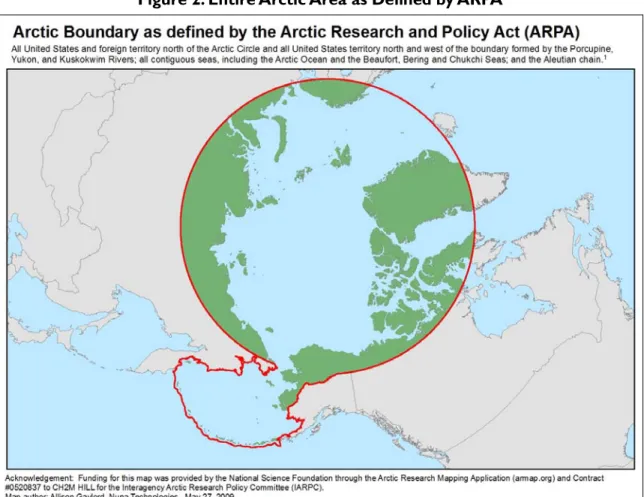
As used in this title, the term “Arctic” means all United States and foreign territory north of the Arctic Circle and all United States territory north and west of the boundary formed by the Porcupine, Yukon, and Kuskokwim Rivers [in Alaska]; all contiguous seas, including the Arctic Ocean and the Beaufort, Bering, and Chukchi Seas; and the Aleutian chain.
This definition, which is codified at 15 U.S.C. 4111,
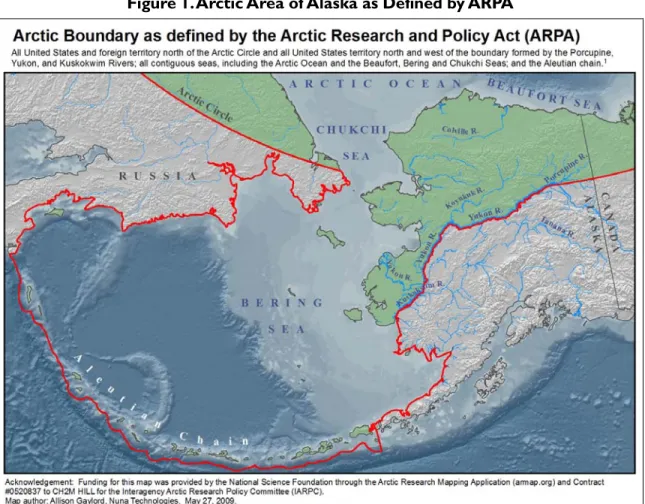
5includes certain parts of Alaska below the
Arctic Circle, including the Aleutian Islands and portions of central and western mainland Alaska,
such as the Seward Peninsula and the Yukon Delta.
Figure 1
below shows the Arctic area of Alaska as defined by ARPA.
2 On November 25, 2008, voters in Greenland approved a referendum for greater autonomy that some observers view
as a step toward eventual independence from Denmark. (Alan Cowell, “Greenland Vote Favors Independence,” New York Times, November 26, 2008.)
3 For more on the Arctic Council see “The Arctic Council” in “Geopolitical Environment”. See also
http://www.arctic-council.org/.
4 Title II of P.L. 98-373 is the National Critical Materials Act of 1984. 5 As codified, the definition reads, “As used in this chapter.... ”
Figure 1. Arctic Area of Alaska as Defined by ARPA
Source: U.S. Arctic Research Commission (http://www.arctic.gov/maps/ARPA_Alaska_only_150dpi.jpg, accessed on December 23, 2011).
Figure 2. Entire Arctic Area as Defined by ARPA
Source: U.S. Arctic Research Commission (http://www.arctic.gov/maps/ARPA_Polar_150dpi.jpg, accessed on December 23, 2011).
Other Definitions
Other definitions of the Arctic are based on factors such as average temperature, the northern tree
line, the extent of permafrost on land, the extent of sea ice on the ocean, or jurisdictional or
administrative boundaries.
6A definition based on a climate-related factor could circumscribe
differing areas over time as a result of climate change.
The 10
oC isotherm definition of the Arctic defines the region as the land and sea area in the
northern hemisphere where the average temperature for the warmest month (July) is below 10
oCelsius, or 50
oFahrenheit. This definition results in an irregularly shaped Arctic region that
excludes some land and sea areas north of the Arctic Circle but includes some land and sea areas
south of the Arctic Circle. This definition currently excludes all of Finland and Sweden, as well as
6 For discussions and (in some cases) maps, see Susan Joy Hassol, Impacts of a Warming Arctic [Executive Summary].
Cambridge, Cambridge University Press, 2004, p. 4, available at http://amap.no/acia/; Oran R. Yong and Niels Einarsson, Arctic Human Development Report, Stefansson Arctic Institute, Akureyri, Iceland, 2004, pp. 17-18, available at http://www.svs.is/AHDR/AHDR%20chapters/English%20version/Chapters%20PDF.htm; and Hugo Ahlenius, editor in chief et al. Vital Arctic Graphics, People and Global Heritage on Our Last Wild Shores, UNEP/GRID-Arendal, Arendal, Norway, p. 6, available at http://www.grida.no/publications/vg/arctic/.
some of Alaska above the Arctic Circle, while including virtually all of the Bering Sea and
Alaska’s Aleutian Islands.
7The definition of the Arctic adopted by the Arctic Monitoring and Assessment Programme
(AMAP)—a working group of the Arctic Council—“essentially includes the terrestrial and
marine areas north of the Arctic Circle (66°32’ N), and north of 62° N in Asia and 60° N in North
America, modified to include the marine areas north of the Aleutian chain, Hudson Bay, and parts
of the North Atlantic, including the Labrador Sea.”
8The AMAP website includes a map showing
the Arctic Circle, 10
oC isotherm, tree line, and AMAP definitions of the Arctic.
9Some observers use the term “high north” as a way of referring to the Arctic. Some observers
make a distinction between the “high Arctic”—meaning, in general, the colder portions of the
Arctic that are closer to the North Pole—and other areas of the Arctic that are generally less cold
and further away from the North Pole, which are sometimes described as the low Arctic or the
subarctic.
U.S. Arctic Research
Arctic Research and Policy Act (ARPA) of 1984, As Amended
The Arctic Research and Policy Act (ARPA) of 1984 (Title I of P.L. 98-373 of July 31, 1984)
10“provide[s] for a comprehensive national policy dealing with national research needs and
objectives in the Arctic.”
11The act, among other things
•
made a series of findings concerning the importance of the Arctic and Arctic
research;
•
established the U.S. Arctic Research Commission (USARC) to promote Arctic
research and recommend Arctic research policy;
•
designated the National Science Foundation (NSF) as the lead federal agency for
implementing Arctic research policy;
•
established the Interagency Arctic Research Policy Committee (IARPC) to
develop a national Arctic research policy and a five-year plan to implement that
policy, and designated the NSF representative on the IARPC as its chairperson;
12and
7 A map showing the line that results from 10o isotherm definition is available at https://www.cia.gov/library/
publications/the-world-factbook/reference_maps/pdf/arctic.pdf.
8 Discussion entitled “Geographical Coverage,” available at http://www.amap.no/ (click on “About AMAP” and then
the tab “Geographical coverage.”)
9 Discussion entitled “Geographical Coverage,” available at http://www.amap.no/ (click on “About AMAP” and then
the tab “Geographical coverage.”)
10 Title II of P.L. 98-373 is the National Critical Materials Act of 1984.
11 These words are taken from the official title of P.L. 98-373. (Arctic Research and Policy Act of 1984 is the short title
of Title I of P.L. 98-373.) The remainder of P.L. 98-373’s official title relates to Title II of the act, the short title of which is the National Critical Materials Act of 1984.)
12 The IARPC currently includes more than a dozen federal agencies, departments, and offices. Additional information
•
defined the term “Arctic” for purposes of the act.
The Arctic Research and Policy Act of 1984 was amended by P.L. 101-609 of November 16,
1990. For the texts of the Arctic Research and Policy Act of 1984 and P.L. 101-609, see
Appendix A
and
Appendix B
, respectively.
FY2016 NSF Budget Request for Arctic Research
NSF—the lead federal agency for implementing Arctic research policy (see “Arctic Research and
Policy Act (ARPA) of 1984, As Amended”)—carries out Arctic research activities through its
Division of Polar Programs (PLR), which is part of its Directorate for Geosciences (GEO). NSF
is requesting a total of $449.51 million for PLR for FY2016 (an increase of 3.0% over the
estimated FY2015 level), including $130.95 million for research in both the Arctic and Antarctic
(an increase of 4.4% over the estimated FY2015 level) and $40.27 million for Arctic research
support and logistics (an increase of 4.2% over the estimated FY2015 level).
13NSF states in its FY2016 overview of GEO that
As the primary U.S. supporter of fundamental research in the polar regions, GEO provides interagency leadership for U.S. polar activities. In the Arctic, NSF helps coordinate research planning as directed by the Arctic Research Policy Act of 1984. The NSF Director chairs the Interagency Arctic Research Policy Committee created for this purpose, which is now a component of the President’s National Science and Technology Council (NSTC).14
NSF states in its FY2016 overview of PLR that
The Division of Polar Programs (PLR) is the primary U.S. supporter of, and has NSF interagency leadership responsibilities for, fundamental research in the polar regions. Arctic Sciences supports research in social, earth systems, and a broad range of natural sciences; its Research Support & Logistics program responds to research by assisting researchers with access to the Arctic and the planning and sharing of results with local Arctic communities.... PLR’s FY 2016 Request reflects three key priorities: (1) maintaining strong disciplinary programs that provide a basis for investments in cross-disciplinary science programs; (2) focusing basic research on cross-foundation (e.g., INFEWS)15 and interagency priorities; and
(3) supporting and improving the efficiency of critical facilities that enable research in both polar regions.... For the Arctic, shared cross-directorate basic research objectives, the Interagency Arctic Research Policy Committee’s (IARPC) Arctic Research Plan: FY 2013-2017,16 and the National Ocean Policy Implementation Strategy17 inform science investment
priorities.
13 National Science Foundation, FY 2016 Budget Request to Congress, February 2, 2015, p. GEO-16 (pdf page 140 of
518). Accessed March 17, 2015, at http://www.nsf.gov/about/budget/fy2016/pdf/fy2016budget.pdf.
14 National Science Foundation, FY 2016 Budget Request to Congress, February 2, 2015, p. GEO-1 (pdf page 125 of
518).
15 INFEWS is an acronym for Innovations at the Nexus of Food, Energy, and Water Systems. 16 The passage at this point contains a footnote that provides the following Internet address:
www.nsf.gov/od/opp/arctic/iarpc/arc_res_plan_index.jsp.
17 The passage at this point contains a footnote that provides the following Internet address:
As with most GEO divisions, PLR funds both research and the necessary research support in the form of logistics and infrastructure. The research budget is approximately 30 percent of the total division budget. Of this amount for research, 50 percent is available for new grants each year. The supporting logistics and infrastructure budget is 70 percent of the overall budget.18
Regarding its FY2016 request for $40.27 million for Arctic research support and logistics within
PLR, NSF states:
This program provides support for Arctic researchers, including airplanes, helicopters, access to icebreakers, and field camps for approximately 150 projects in remote sites in Alaska, Canada, Arctic Scandinavia, Russia, and the Arctic Ocean. Summit Station on the Greenland ice cap operates as a year-round international site for a variety of atmospheric and geophysical measurements. An increase of $1.63 million, to a total of $40.27 million, enables increased use of marine platforms, such as the newly available Sikuliaq, for oceanographic research.19
Major U.S. Policy Documents Relating to the Arctic
January 2009 Arctic Policy Directive (NSPD 66/HSPD 25)
On January 12, 2009, the George W. Bush Administration released a presidential directive
establishing a new U.S. policy for the Arctic region. The directive, dated January 9, 2009, was
issued as National Security Presidential Directive 66/Homeland Security Presidential Directive 25
(NSPD 66/HSPD 25). The directive was the result of an interagency review, and it superseded for
the Arctic (but not the Antarctic) a 1994 presidential directive on Arctic and Antarctic policy. The
directive, among other things,
•
states that the United States is an Arctic nation, with varied and compelling
interests in the region;
•
sets forth a six-element overall U.S. policy for the region;
•
describes U.S. national security and homeland security interests in the Arctic; and
•
discusses a number of issues as they relate to the Arctic, including international
governance; the extended continental shelf and boundary issues; promotion of
international scientific cooperation; maritime transportation; economic issues,
including energy; and environmental protection and conservation of natural
resources.
The Obama Administration has not issued a new directive superseding NSPD 66/HSPD 25; it is
currently operating under the Bush Administration’s policy directive.
20For the text of NSPD
66/HSPD 25, see
Appendix C
.
18 National Science Foundation, FY 2016 Budget Request to Congress, February 2, 2015, pp. GEO-16 and GEO-17 (pdf
pages 140-141 of 518).
19 National Science Foundation, FY 2016 Budget Request to Congress, February 2, 2015, p. GEO-17 (pdf page 141 of
518).
May 2010 National Security Strategy
In May 2010, the Obama Administration released a national security strategy document that
states:
The United States is an Arctic Nation with broad and fundamental interests in the Arctic region, where we seek to meet our national security needs, protect the environment, responsibly manage resources, account for indigenous communities, support scientific research, and strengthen international cooperation on a wide range of issues.21
May 2013 National Strategy for Arctic Region
On May 10, 2013, the Obama Administration released a document entitled National Strategy for
the Arctic Region.
22The document appears to supplement rather than supersede the January 2009
Arctic policy directive (NSPD 66/HSPD 25) discussed above.
23The executive summary of
National Strategy for the Arctic Region begins by quoting the above statement from the May 2010
national security strategy document, and then states:
The National Strategy for the Arctic Region sets forth the United States Government’s strategic priorities for the Arctic region. This strategy is intended to position the United States to respond effectively to challenges and emerging opportunities arising from significant increases in Arctic activity due to the diminishment of sea ice and the emergence of a new Arctic environment. It defines U.S. national security interests in the Arctic region and identifies prioritized lines of effort, building upon existing initiatives by Federal, state, local, and tribal authorities, the private sector, and international partners, and aims to focus efforts where opportunities exist and action is needed. It is designed to meet the reality of a changing Arctic environment, while we simultaneously pursue our global objective of combating the climatic changes that are driving these environmental conditions. Our strategy is built on three lines of effort:
1. Advance United States Security Interests – We will enable our vessels and aircraft to operate, consistent with international law, through, under, and over the airspace and waters of the Arctic, support lawful commerce, achieve a greater awareness of activity in the region, and intelligently evolve our Arctic infrastructure and capabilities, including ice-capable platforms as needed. U.S. security in the Arctic encompasses a broad spectrum of activities, ranging from those supporting safe commercial and scientific operations to national defense. 2. Pursue Responsible Arctic Region Stewardship – We will continue to protect the Arctic environment and conserve its resources; establish and institutionalize an integrated Arctic
21National Security Strategy, Washington, May 2010, p. 50. The quoted sentence constitutes the entirety of the
document’s comments specifically on the Arctic. It is the final sentence of a section on “sustain[ing] broad cooperation on key global challenges” that includes longer discussions on climate change, peacekeeping and armed conflict, pandemics and infectious disease, transnational criminal threats and threats to governance, and safeguarding the global commons.
22National Strategy for the Arctic Region, May 2013, 11 pp.; accessed May 14, 2013, at http://www.whitehouse.gov/
sites/default/files/docs/nat_arctic_strategy.pdf. The document includes a cover letter from President Obama dated May 10, 2013.
23National Strategy for the Arctic Region states on page 6 that the “lines of effort” it describes are to be undertaken
“[t]o meet the challenges and opportunities in the Arctic region, and in furtherance of established Arctic Region Policy,” at which point there is a footnote referencing the January 2009 Arctic policy directive.
management framework; chart the Arctic region; and employ scientific research and traditional knowledge to increase understanding of the Arctic.
3. Strengthen International Cooperation – Working through bilateral relationships and multilateral bodies, including the Arctic Council, we will pursue arrangements that advance collective interests, promote shared Arctic state prosperity, protect the Arctic environment, and enhance regional security, and we will work toward U.S. accession to the United Nations Convention on the Law of the Sea (Law of the Sea Convention).
Our approach will be informed by the following guiding principles:
• Safeguard Peace and Stability – Seek to maintain and preserve the Arctic region as an area free of conflict, acting in concert with allies, partners, and other interested parties. Support and preserve: international legal principles of freedom of navigation and overflight and other uses of the sea and airspace related to these freedoms, unimpeded lawful commerce, and the peaceful resolution of disputes for all nations.
• Make Decisions Using the Best Available Information – Across all lines of effort, decisions need to be based on the most current science and traditional knowledge.24
• Pursue Innovative Arrangements – Foster partnerships with the state of Alaska, Arctic states, other international partners, and the private sector to more efficiently develop, resource, and manage capabilities, where appropriate and feasible, to better advance our strategic priorities in this austere fiscal environment.
• Consult and Coordinate with Alaska Natives – Engage in a consultation process with Alaska Natives, recognizing tribal governments’ unique legal relationship with the United States and providing for meaningful and timely opportunity to inform Federal policy affecting Alaskan Native communities.25
For the main text of the document, see
Appendix D
.
January 2014 Implementation Plan for National Strategy for Arctic Region
On January 30, 2014, the Obama Administration released an implementation plan for the May
2013 national strategy for the Arctic region.
26The plan states that it
complements and builds upon existing initiatives by Federal, State, local, and tribal authorities, the private sector, and international partners, and focuses efforts where opportunities exist and action is most needed. The Implementation Plan reflects the reality of a changing Arctic environment and upholds national interests in safety, security, and environmental protection, and works with international partners to pursue global objectives of addressing climatic changes.
24 A footnote in the document at this point states: “Traditional knowledge refers to a body of evolving practical
knowledge based on observations and personal experience of indigenous communities over an extensive, multigenerational time period. (BOEM Ocean Science, Vol. 9, Issue 2, May/April/June 2012, page 4).”
25National Strategy for the Arctic Region, May 2013, pp. 2-3.
26Implementation Plan for The National Strategy for the Arctic Region, January 2014, 32 pp. The news release
anouncing the implementation plan is posted at http://www.whitehouse.gov/blog/2014/01/30/white-house-releases-implementation-plan-national-strategy-arctic-region. The document itself is posted at http://www.whitehouse.gov/sites/ default/files/docs/implementation_plan_for_the_national_strategy_for_the_arctic_region_-_fi.... pdf.
This Implementation Plan follows the structure and objectives of the Strategy’s three lines of effort and is consistent with the guiding principles. The lines of effort of the Strategy and the Implementation Plan are as follows:
• Advance United States Security Interests • Pursue Responsible Arctic Region Stewardship • Strengthen International Cooperation
These lines of effort and guiding principles are meant to be implemented as a coherent whole.27
The plan also states:
Climate change is already affecting the entire global population, and Alaska residents are experiencing the impacts in the Arctic. To ensure a cohesive Federal approach, implementation activities must be aligned with the Executive Order on Preparing the United States for the Impacts of Climate Change28 while executing the Strategy. In addition to the
guiding principles, the following approaches are important in implementing the activities across all of the lines of effort:
• Foster Partnerships with Arctic Stakeholders. As outlined in the Strategy, all lines of effort must involve Arctic partners, particularly the State of Alaska and Alaska Natives in the Arctic region. Federal agencies, the State of Alaska, tribal communities, local governments, and academia will work with other nations, industry stakeholders, non-governmental organizations, and research partners to address emerging challenges and opportunities in the Arctic environment. The Federal Government should strive to maintain the free flow of communication and cooperation with the State of Alaska to support national priorities.
• Coordinate and Integrate Activities across the Federal Government. Multiple Federal bodies currently have authority for Arctic policy (e.g., the National Ocean Council (NOC), Arctic Policy Group, and Interagency Arctic Research Policy Committee (IARPC)). The National Security Council Staff will develop an Executive Order through the interagency process to maximize efficiency, align interagency initiatives, and create unity of effort among all Federal entities conducting activities in the Arctic.29
The plan outlines about 36 specific initiatives. For each, it presents a brief statement of the
objective, a list of next steps to be taken, a brief statement about measuring progress in achieving
the objective, and the names of the lead and supporting federal agencies to be involved.
27Implementation Plan for The National Strategy for the Arctic Region, January 2014, p. 1.
28 The passage contains a footnote at this point stating that this executive order was signed by the President on
November 1, 2013. It is Executive Order 13653. The text of the order is posted at http://www.gpo.gov/fdsys/pkg/FR-2013-11-06/pdf/2013-26785.pdf and office/2013/11/01/executive-order-preparing-united-states-impacts-climate-change. A fact sheet about it is posted at http://www.whitehouse.gov/the-press-office/2013/11/01/fact-sheet-executive-order-climate-preparedness.
January 2015 Executive Order for Enhancing Coordination of Arctic Efforts
On January 21, 2015, President Obama issued an executive order entitled “Enhancing
Coordination of National Efforts in the Arctic.” The order states in part:
As the United States assumes the Chairmanship of the Arctic Council, it is more important than ever that we have a coordinated national effort that takes advantage of our combined expertise and efforts in the Arctic region to promote our shared values and priorities. As the Arctic has changed, the number of Federal working groups created to address the growing strategic importance and accessibility of this critical region has increased. Although these groups have made significant progress and achieved important milestones, managing the broad range of interagency activity in the Arctic requires coordinated planning by the Federal Government, with input by partners and stakeholders, to facilitate Federal, State, local, and Alaska Native tribal government and similar Alaska Native organization, as well as private and nonprofit sector, efforts in the Arctic....
There is established an Arctic Executive Steering Committee (Steering Committee), which shall provide guidance to executive departments and agencies (agencies) and enhance coordination of Federal Arctic policies across agencies and offices, and, where applicable, with State, local, and Alaska Native tribal governments and similar Alaska Native organizations, academic and research institutions, and the private and nonprofit sectors.... ... the Steering Committee will meet quarterly, or as appropriate, to shape priorities, establish strategic direction, oversee implementation, and ensure coordination of Federal activities in the Arctic....
The Steering Committee, in coordination with the heads of relevant agencies and under the direction of the Chair, shall:
(a) provide guidance and coordinate efforts to implement the priorities, objectives, activities, and responsibilities identified in National Security Presidential Directive 66/Homeland Security Presidential Directive 25, Arctic Region Policy, the National Strategy for the Arctic Region and its Implementation Plan, and related agency plans;
(b) provide guidance on prioritizing Federal activities, consistent with agency authorities, while the United States is Chair of the Arctic Council, including, where appropriate, recommendations for resources to use in carrying out those activities; and
(c) establish a working group to provide a report to the Steering Committee by May 1, 2015, that:
(i) identifies potential areas of overlap between and within agencies with respect to implementation of Arctic policy and strategic priorities and provides recommendations to increase coordination and reduce any duplication of effort, which may include ways to increase the effectiveness of existing groups; and
(ii) provides recommendations to address any potential gaps in implementation.... It is in the best interest of the Nation for the Federal Government to maximize transparency and promote collaboration where possible with the State of Alaska, Alaska Native tribal governments and similar Alaska Native organizations, and local, private-sector, and nonprofit-sector stakeholders. To facilitate consultation and partnerships with the State of
Alaska and Alaska Native tribal governments and similar Alaska Native organizations, the Steering Committee shall:
(a) develop a process to improve coordination and the sharing of information and knowledge among Federal, State, local, and Alaska Native tribal governments and similar Alaska Native organizations, and private-sector and nonprofit-sector groups on Arctic issues;
(b) establish a process to ensure tribal consultation and collaboration, consistent with my memorandum of November 5, 2009 (Tribal Consultation). This process shall ensure meaningful consultation and collaboration with Alaska Native tribal governments and similar Alaska Native organizations in the development of Federal policies that have Alaska Native implications, as applicable, and provide feedback and recommendations to the Steering Committee;
(c) identify an appropriate Federal entity to be the point of contact for Arctic matters with the State of Alaska and with Alaska Native tribal governments and similar Alaska Native organizations to support collaboration and communication; and
(d) invite members of State, local, and Alaska Native tribal governments and similar Alaska Native organizations, and academic and research institutions to consult on issues or participate in discussions, as appropriate and consistent with applicable law.30
U.S. Special Representative for the Arctic
On July 16, 2014, Secretary of State John Kerry announced the appointment of retired Coast
Guard Admiral Robert J. Papp, Jr., who served as Commandant of the Coast Guard from May
2010 to May 2014, as the first U.S. Special Representative for the Arctic.
31The duties of this
position involve, among other things, interacting with ambassadors to the Arctic region from
other countries.
U.S. Chairmanship of Arctic Council in 2015-2017
As discussed later in greater detail (see “The Arctic Council” in “Geopolitical Environment”), the
main international forum for cooperation in the high north is the eight-nation Arctic Council, of
which the United States is an active member.
32The Council has a two-year chairmanship that
rotates among the eight member states. The United States will assume the chairmanship in April
2015 and will serve in that capacity for two years—a period that will begin during the Obama
Administration and end in 2017, during the first year of the administration of the President
elected in November 2016. The United States last held the chairmanship from 1998 to 2000, and
following the 2015-2017 term, will next hold it in 2031-2033.
30 Executive order, “Enhancing Coordination of National Efforts in the Arctic,” January 21, 2015, accessed January 21,
2015, at http://www.whitehouse.gov/the-press-office/2015/01/21/executive-order-enhancing-coordination-national-efforts-arctic.
31 See “Retired Admiral Robert Papp to Serve as U.S. Special Representative for the Arctic,” Press Statement, John
Kerry, Secretary of State, Washington, DC, July 16, 2014, accessed July 17, 2014, at http://www.state.gov/secretary/ remarks/2014/07/229317.htm.
At a March 5, 2015, hearing on Arctic opportunities before the Senate Energy and Natural
Resources Committee, Admiral Robert J. Papp, Jr., the Special Representative for the Arctic,
testified as follows regarding the U.S. chairmanship of the Arctic Council in 2015-2017:
The United States will assume the rotating two-year chairmanship of the Arctic Council in April 2015. We have developed a robust proposed work program for our chairmanship in line with the priorities laid out in the National Strategy for the Arctic Region and its subsequent Implementation Plan. We continue to hone the proposed program through regular meetings with federal interagency counterparts, the State of Alaska, Alaska Native groups, NGOs and other interested stakeholders. In my capacity as the Special Representative for the Arctic, I have traveled twice to Alaska to consult with local experts and residents. I heard positive feedback on our proposed chairmanship program, as well as concerns about some aspects. The State Department has also received feedback from numerous stakeholders, mostly supportive. Where we have heard concerns, we are discussing ways forward. We are also actively consulting with our fellow Arctic Council members and “Permanent Participants” (representatives of Arctic indigenous groups) so that we can reach agreement on our chairmanship program by the time we assume the Chairmanship in April. The Council operates on the basis of consensus, so we need the support of all the Arctic States. The United States is assuming the chair of the Arctic Council at a critical time. The Arctic Council has proven itself to be an effective and cooperative forum in which the eight Arctic States and Permanent Participants can come together to develop effective ways for managing this relatively pristine region of the world. We would like to continue strengthening the Arctic Council by moving it toward more practical, on-the-ground activities that will improve the environment and contribute to sustainable economic development for the people who live there.
The areas we are proposing to highlight during the U.S. Chairmanship are:
● Arctic Ocean Safety, Security, and Stewardship
● Improving Economic and Living Conditions
● Addressing the Impacts of Climate Change
Climate-related changes in the Arctic are already profoundly impacting the United States and the rest of the planet. Reductions in sea ice are positioning the Arctic Ocean to be increasingly accessible in the short and long terms. The Arctic Ocean is becoming more navigable as evidenced by an increase in shipping through the Northern Sea Route over Russia. We have also seen an increase in shipping through the Bering Strait, a potential future chokepoint for trans-Arctic shipping traffic. In addition, the ice-diminished maritime environment is attracting resource exploration in areas previously inaccessible.
We plan to prioritize collaborative search and rescue and oil pollution preparedness and response exercises, ideally within the new Arctic Coast Guard Forum. To ensure that future maritime development avoids areas of ecological and cultural significance, we will prioritize the Arctic Council’s on-going development of a network of existing marine protected areas, and possibly identify new marine protected areas. To address other challenges in the Arctic Ocean, we are looking to improve international coordination through a regional seas program similar to regional seas programs in other oceans. In the coming months we will work closely with domestic and international stakeholders to determine the specific nature and direction of this initiative.
During the U.S. chairmanship, we will strive to bring tangible benefits to communities across the Arctic. In particular, we will seek to assist remote Arctic communities with adapting to the rapid changes that are altering traditional ways of life. The U.S. aims to increase energy and water security for remote Arctic communities by working toward better and more secure access to renewable energy sources, improving water and sanitation access, and reducing dependence on diesel generators while at the same time reducing emissions of black carbon in the Arctic. The U.S. also plans to continue advancing suicide intervention and awareness programs to reverse disturbing trends that disproportionately affect Arctic communities. Suicide rates across the entire Arctic region are much higher than in most other areas of the world. Men and boys are particularly at risk.
In addition, as indicated in the Implementation Plan for the National Strategy for the Arctic Region, the U.S. hopes to see an Arctic telecommunications infrastructure assessment that would serve as the basis for the eventual build-out of the telecommunications infrastructure necessary to support ever-increasing human activity throughout the Arctic region. Building telecommunications infrastructure across the Arctic will provide critical support to navigation, offshore development activities, search and rescue operations, environmental and humanitarian emergencies, and will make online tools for Arctic communities, such as telemedicine, education, and adaptation, more accessible and useful.
Our chairmanship will continue the on-going high-level focus on the impacts of climate change, especially the drivers of change and the ways and means of addressing on-the-ground impacts. To minimize the prospect of irreparable long-term harm to the Arctic – and the globe, as changes in the Arctic reverberate around the world – we need to take sustained, quantifiable measures to reduce greenhouse gas emissions and increase community resilience and preparedness. During the last Administration, the United States initiated efforts within the Arctic Council to mitigate so-called “short-lived climate pollutants” such as black carbon and methane that have direct impacts in the Arctic. During our chairmanship, we will press for full implementation of a new, voluntary arrangement to be completed by the end of the current chairmanship that will include development of national black carbon emission inventories, national reporting on domestic mitigation efforts, and data collection efforts. Another path forward is to examine key industrial practices, such as oil and gas flaring, to share best practices, policies and technologies among technical experts, industry and policymakers. The Department of State aims to lead the Arctic Council through an assessment of how we can improve emissions estimates of black carbon and other air pollutants from gas flares. We hope to be joined by other Arctic States in efforts that build climate resilience into national policies and promote community- and ecosystem-based climate adaptation. Without the natural sea ice barrier, coastal communities in Alaska are now battered by storm events that damage the permafrost upon which critical infrastructure depends, leaving houses and other buildings literally falling into the Bering Sea. Policymakers and communities need decision-informing tools to enable prioritization of adaptation efforts and more climate-resilient decision-making.33
33 Statement of Admiral Robert J. Papp, Jr., Special Representative for the Arctic, U.S. Department of State, before the
Committee on Energy and Natural Resources, U.S. Senate, March 5, 2015, pp. 4-6. See also briefing entitled “Virtual Stakeholder Outreach Forum,” December 2, 2014, accessed December 24, 2014, at http://arctic.gov/publications/ presentations/Arctic_Council/US_Chairmanship_for_stakeholders.pdf.
The Arctic and the U.N. Convention on Law of the Sea (UNCLOS)
34Background to UNCLOS
In November 1994, the United Nations Convention on the Law of the Sea (UNCLOS) entered
into force. This convention establishes a treaty regime to govern activities on, over, and under the
world’s oceans. It builds on the four 1958 law of the sea conventions and sets forth a framework
for future activities in parts of the oceans that are beyond national jurisdiction.
35The 1982
Convention and its 1994 Agreement relating to Implementation of Part XI of the Convention were
transmitted to the Senate on October 6, 1994.
36In the absence of Senate advice and consent to
adherence, the United States is not a party to the convention and agreement.
Part VI of UNCLOS and Commission on Limits of Continental Shelf
Part VI of the convention, dealing with the Continental Shelf, and Annex II, which established a
Commission on the Limits of the Continental Shelf, are most pertinent to the Arctic as it becomes
more accessible ocean space, bordered by five coastal states.
37The convention gives the coastal
state sovereign jurisdiction over the resources, including oil and gas, of its continental shelf.
38Under Article 76 of the convention, a coastal state with a broad continental margin may establish
a shelf limit beyond 200 nautical miles. This jurisdiction is subject to the submission of the
particulars of the intended limit and supporting scientific and technical data by the coastal state to
the commission for review and recommendation.
39The commission reviews the documentation
and, by a two-thirds majority, approves its recommendations to the submitting state. Coastal
states agree to establish the outer limits of their continental shelf, in accordance with this process
and with their national laws. In instances of disagreement with the commission’s
recommendations, the coastal state may make a revised or new submission. The actions of the
commission “shall not prejudice matters relating to delimitation of boundaries between States
34 This section prepared by Marjorie Ann Browne, Specialist in International Relations, Foreign Affairs, Defense, and
Trade Division.
35 The United States is party to the four conventions adopted in 1958: Convention on the Territorial Sea and the
Contiguous Zone, Convention on the High Seas, Convention on the Continental Shelf, and Convention on Fishing and Conservation of the Living Resources of the High Seas.
36 Treaty Document 103-39.
37 Other relevant provisions of the Convention, applicable depending on the extent of Arctic melting, relate to
navigation, high seas freedoms, fisheries, and exclusive economic zones.
38 The continental shelf is the under-sea extension of a coastal state’s land territory. Article 76 of the Convention
defines the continental shelf, inter alia, as “the seabed and subsoil of the submarine areas that extend beyond its [coastal state’s] territorial sea throughout the natural prolongation of its land territory to the outer edge of the continental margin.”
39 A coastal State party has 10 years from the entry into force of the Convention for submission of information on its
proposed limits. In May 2001, the Meeting of States Parties to the Convention decided that for any State for which the Convention entered into force before May 13, 1999, the date of commencement of the 10-year time period for making submissions to the commission is May 13, 1999.
with opposite or adjacent coasts.”
40The “limits established by a coastal State on the basis of these
recommendations shall be final and binding.”
41U.S. Activities As a Non-Party to UNCLOS
As a non-party to the convention, the United States cannot participate as a member of the
commission; it cannot submit a claim under Article 76. Over the years, however, it has submitted
observations on submissions made by other states, requesting that those observations be made
available online and to the commission. In addition, since 2001, the United States has gathered
and analyzed data to determine the outer limits of its extended continental shelf. Starting in 2007,
this effort became the Extended Continental Shelf Project, directed by an interagency task force
under the lead of the Department of State.
42Some observers have suggested that a separate regime be negotiated to address the changing
circumstances in the Arctic. They maintain that this phenomenon was not envisioned at the time
the Law of the Sea Convention was negotiated. Still others suggest that the Arctic region above a
certain parallel be designated a wilderness area, and they cite as precedent Article 4 of The
Antarctic Treaty, under which any current claims to sovereign territory are frozen and
No acts or activities taking place while the present Treaty is in force shall constitute a basis for asserting, supporting or denying a claim to territorial sovereignty in Antarctica or create any rights of sovereignty in Antarctica. No new claim, or enlargement of an existing claim, to territorial sovereignty in Antarctica shall be asserted while the present Treaty is in force.
Supporters of the Law of the Sea Convention maintain that changing circumstances in the Arctic
strengthen their argument that the United States should become a party to the convention. In this
way, they argue, the United States can be best situated to protect and serve its national interests,
under both Article 76 and other parts of the convention.
The Administration’s January 2014 implementation plan for its national strategy for the Arctic
region (see discussion above) includes, as one of its 36 or so initiatives, one entitled “Accede to
the Law of the Sea Convention.” Under this initiative, the State Department and other federal
agencies are to “Continue to seek the Senate’s advice and consent to accede to the Law of the Sea
Convention.” The document states, “The Administration is committed, like the last three
Administrations, to pursuing accession to the Convention on the Law of the Sea and will continue
to place a priority on attaining Senate advice and consent to accession.”
43The Administration’s January 2014 implementation plan for its national strategy for the Arctic
region (see discussion above) includes, as one of its 36 or so initiatives, one entitled “Accede to
the Law of the Sea Convention.” Under this initiative, the State Department and other federal
agencies are to “continue to seek the Senate’s advice and consent to accede to the Law of the Sea
Convention.” The document states that “the Administration is committed, like the last three
40 Annex II, Article 9. Article 83 of the Convention provides that questions relating to these boundary delimitation
disputes shall be resolved by agreement between the States or by the Dispute Settlement options set forth in Part XV of the Convention.
41 Article 76, para. 8.
42 For more information, see http://www.state.gov/g/oes/continentalshelf/index.htm. 43Implementation Plan for The National Strategy for the Arctic Region, January 2014, p. 29.
Administrations, to pursuing accession to the Convention on the Law of the Sea and will continue
to place a priority on attaining Senate advice and consent to accession.”
44Senate Arctic Caucus
On March 4 and 5, 2015, Senator Lisa Murkowski and Senator Angus King announced the
formation of a Senate Arctic Caucus “to spotlight this region and open up a wider conversation
about the nation’s future in the region as America prepares to accede to the Chair of the Arctic
Council.”
45Issues for Congress
Climate Change and Loss of Arctic Sea Ice
46Record low extents of Arctic sea ice in 2012 and 2007 have focused scientific and policy attention
on climate changes in the high north, and to the implications of projected ice-free
47seasons in the
Arctic within decades. The Arctic has been projected by several scientists to be ice-free in most
late summers as soon as the 2030s.
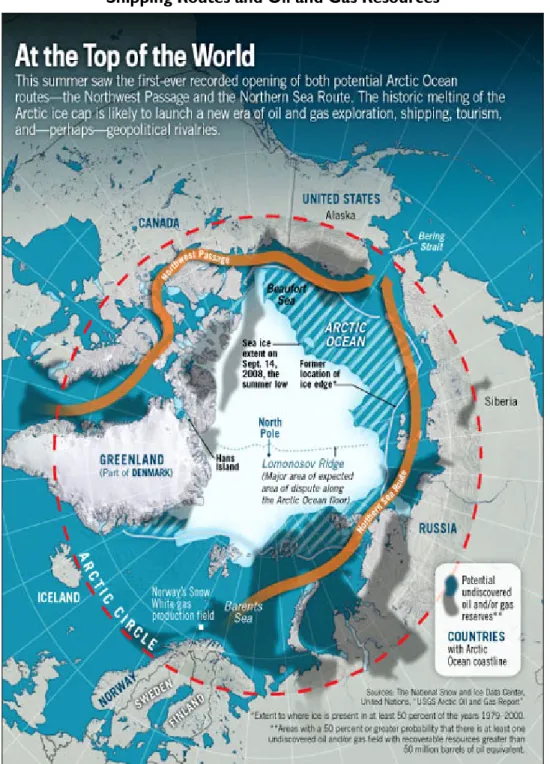
48This opens opportunities for transport through the Northwest
Passage and the Northern Sea Route, extraction of potential oil and gas resources, and expanded
fishing and tourism (
Figure 3
).
More broadly, physical changes in the Arctic include warming ocean, soil, and air temperatures;
melting permafrost; shifting vegetation and animal abundances; and altered characteristics of
Arctic cyclones. All these changes are expected to affect traditional livelihoods and cultures in the
region and survival of polar bear and other animal populations, and raise risks of pollution, food
supply, safety, cultural losses, and national security. Moreover, linkages (“teleconnections”)
between warming Arctic conditions and extreme events in the mid-latitude continents are
44Implementation Plan for The National Strategy for the Arctic Region, January 2014, p. 29.
45 Press release from the office of Senator Angus King, “King, Murkowski Announce U.S. Senate Arctic Caucus,”
March 4, 2015, accessed March 17, 2015, at http://www.king.senate.gov/newsroom/press-releases/king-murkowski-announce-us-senate-arctic-caucus. See also press release from the office of Senator Lisa Murkowski, “Senators Murkowski, King Announce U.S. Senate Arctic Caucus,” March 5, 2015, accessed March 17, 2015, at
http://www.murkowski.senate.gov/public/index.cfm/pressreleases?ID=1ce5edcb-540d-4c43-b264-56bdbb570755, which includes a similar phrase.
46 This section prepared by Jane Leggett, Specialist in Energy and Environmental Policy, Resources, Science, and
Industry Division.
47 In scientific analyses, “ice-free” does not necessarily mean “no ice.” The definition of “ice-free” or sea ice “extent”
or “area” varies across studies. Sea ice “extent” is one common measure, equal to the sum of the area of grid cells that have ice concentration of less than a set percentage—frequently 15%. For more information, see the National Snow and Ice Data Center, http://nsidc.org/seaice/data/terminology.html.
48 Muyin Wang and James E. Overland, “A Sea Ice Free Summer Arctic within 30 Years?,” Geophysical Research
Letters 36, no. L07502 (April 3, 2009): 10.1029/2009GL037820; Marika Holland, Cecilia M. Bitz, and Bruno Tremblay, “Future abrupt reductions in the summer Arctic sea ice,” Geophysical Research Letters 33, no. L23503 (2006); But see also Julien Boé, Alex Hall, and Xin Qu, “Sources of spread in simulations of Arctic sea ice loss over the twenty-first century,” Climatic Change 99, no. 3 (April 1, 2010): 637-645; I. Eisenman and J. S. Wettlaufer, “Nonlinear threshold behavior during the loss of Arctic sea ice,” Proceedings of the National Academy of Sciences 106, no. 1 (January 6, 2009): 28-32; Dirk Notz, “The Future of Ice Sheets and Sea Ice: Between Reversible Retreat and Unstoppable Loss,” Proceedings of the National Academy of Sciences 106, no. 49 (December 8, 2009): 20590-20595.
increasingly evident, identified in such extreme events as the heat waves and fires in Russia in
2010; severe winters in the eastern United States and Europe in 2009/2010 and in Europe in
2011/2012;
49and Indian summer monsoons and droughts. Hence, changing climate in the Arctic
suggests important implications both locally and across the Hemisphere.
Like the rest of the globe, temperatures in the Arctic have varied
50but show a significant warming
trend since the 1970s, and particularly since 1995.
51The annual average temperature for the
Arctic region (from 60
oto 90
oN) is now about 1.8
oF warmer than the “climate normal” (the
average from 1961 to 1990). Temperatures in October-November are now about 9
oF above the
seasonal normal. Scientists have concluded that most of the global warming of the last three
decades is very likely caused by human-related emissions of greenhouse gases (GHG, mostly
carbon dioxide); they expect the GHG-induced warming to continue for decades, even if, and
after, GHG concentrations in the atmosphere have been stabilized. The extra heat in the Arctic is
amplified by processes there (the “polar amplification”) and may result in irreversible changes on
human timescales.
The observed warmer temperatures along with rising cyclone size and strength in the Arctic have
reduced sea ice extent, thickness, and ice that persists year-round (“perennial ice”); natural
climate variability has likely contributed to the record low ice extents of 2007 and 2012. The
2007 minimum sea ice extent was influenced by warm Arctic temperatures and warm, moist
winds blowing from the North Pacific into the central Arctic, contributing to melting and pushing
ice toward and into the Atlantic past Greenland. Warm winds did not account for the near-record
sea ice minimum in 2008.
52In early August 2012, an unusually large storm with low pressure
developed over the Arctic, helping to disperse the already weak ice into warmer waters and
accelerating its melt rate. By August 24, 2012, sea ice extent had shrunk below the previous
observed minimum of late September 2007.
53Modeling of GHG-induced climate change is particularly challenging for the Arctic, but it
consistently projects warming through the 21
stcentury, with annual average Arctic temperature
49 Overland et al. state that “a warm Arctic-cold continent pattern represents a paradox of recent global warming: there
is not a uniform pattern of temperature increases” due to a set of newly recognized processes described in Overland, J. E, K. R Wood, and M. Wang. “Warm Arctic-cold Continents: Climate Impacts of the Newly Open Arctic Sea.” Polar Research 30 (2011). The authors raise a critical, unanswered question, “Is the observed severe mid-latitude weather in two adjacent years simply due to an extreme in chaotic processes alone, or do they included a partial but important Arctic forcing and connection due to recent changing conditions?” In other words, are recent patterns random anomalies, or might we expect more of the same?; among other examples, see also Lim, Young-Kwon, and Siegfried D. Schubert. “The Impact of ENSO and the Arctic Oscillation on Winter Temperature Extremes in the Southeast United States.” Geophysical Research Letters 38, no. 15 (August 11, 2011): L15706.
50 There was a regionally warm period in the Arctic from the mid-1920s to around 1940, which scientists have assessed
to have been driven by natural climate variability. They have found that period to be distinctly different from the recent multi-decadal warming, in part because the early 20th century warming was concentrated in the northern high latitudes.
See, for example, Figure 2, upper left graphic, in Geophysical Fluid Dynamics Laboratory, “Simulatoin of Early 20th
Century Warming,” at http://www.gfdl.noaa.gov/early-20th-century-global-warming.
51 Steele, Michael, Wendy Ermold, and Jinlun Zhang. “Arctic Ocean Surface Warming Trends over the Past 100
Years.” Geophysical Research Letters 35, no. 2 (January 29, 2008): L02614.
52 J. Overland, J. Walsh, and M. Wang, Arctic Report Card - Atmosphere (NOAA Arctic Research Program, October 6,
2008), http://www.arctic.noaa.gov/reportcard/atmosphere.html.
53 National Snow and Ice Data Center, “Arctic sea ice extent breaks 2007 record low” (August 27, 2012); Japanese
Aerospace Exploration Agency, “A new record minimum of the Arctic sea ice extent was set on 24 August 2012”; Arctic ROOS (Norway), “Daily Updated Time series of Arctic sea ice area and extent derived from SSMI data provided by NERSC,” at http://arctic-roos.org/observations/satellite-data/sea-ice/ice-area-and-extent-in-arctic.
increases ranging from +1° to +9.0° C (+2° to +19.0° F), depending on the GHG scenario and
model used. While such warming is projected by most models throughout the Arctic, some
models project slight cooling localized in the North Atlantic Ocean just south of Greenland and
Iceland. Most warming would occur in autumn and winter, “with very little temperature change
projected over the Arctic Ocean” in summer months.
54Due to observed and projected climate change, scientists have concluded that the Arctic will have
changed from an ice-covered environment to a recurrent ice-free
55ocean (in summers) as soon as
the late 2030s. The character of ice cover is expected to change as well, with the ice being
thinner, more fragile, and more regionally variable. The variability in recent years of both ice
quantity and location could be expected to continue.
54 William L. Chapman and John E. Walsh, “Simulations of Arctic Temperature and Pressure by Global Coupled
Models,” Journal of Climate 20, no. 4 (February 1, 2007): 609-632.
55 See footnote 47. Also, although one Canadian scientist has predicted that recurrent ice-free summers may begin
Figure 3. Arctic Sea Ice Extent in September 2008, Compared with Prospective
Shipping Routes and Oil and Gas Resources
Source: Graphic by Stephen Rountree at U.S. News and World Report, http://www.usnews.com/articles/news/ world/2008/10/09/global-warming-triggers-an-international-race-for-the-artic/photos/#1.
Territorial Claims and Sovereignty Issues
56Motivated in part by a desire to exercise sovereign control over the Arctic region’s increasingly
accessible oil and gas reserves (see “Oil, Gas, and Mineral Exploration”), the four Arctic coastal
states other than the United States—Canada, Russia, Norway, and Denmark (of which Greenland
is a territory)—are in the process of preparing territorial claims in the Arctic, including claims for
expanded Exclusive Economic Zones (EEZs), for submission to the Commission on the Limits of
the Continental Shelf. (As mentioned earlier—see “U.S. Activities As a Non-Party to
UNCLOS”—the United States, as a non-party to UNCLOS, cannot participate as a member of the
commission; it cannot submit a claim under Article 76. Over the years, however, it has submitted
observations on submissions made by other states, requesting that those observations be made
available online and to the commission. In addition, since 2001, the United States has gathered
and analyzed data to determine the outer limits of its extended continental shelf.)
Russia has been attempting to chart the Arctic Ocean’s enormous underwater Lomonosov Ridge
in an attempt to show that it is an extension of Russia’s continental margin. The Russian claim to
this ridge, if accepted, would reportedly grant Russia nearly one-half of the Arctic area; a 2001
claim submitted by Russia was rejected as insufficiently documented. Canada also claims a
portion of the Lomonosov Ridge as part of its own underwater continental shelf.
57In August
2007, a Russian submersible on a research expedition deposited an encased Russian Federation
flag on the seabed of the presumed site of the North Pole. The action captured worldwide
attention, but analysts note that it did not constitute an official claim to the territory and was
therefore a purely symbolic act.
At a May 2008 meeting in Ilulissat, Greenland, the five Arctic coastal states reaffirmed their
commitment to the UNCLOS legal framework for the establishment of extended continental shelf
limits in the Arctic.
58(For further discussion, see “Extent of the Continental Margin” in “Oil, Gas,
and Mineral Exploration.”)
In addition to this process, there are four unresolved Arctic territorial disputes:
•
Scientists have forecast that in coming decades, global warming will reduce the
ice pack in Canada’s northern archipelago sufficiently to permit ships to use the
trans-Arctic shipping route known as the Northwest Passage during the summer
months (see “Commercial Sea Transportation”). The prospect of such traffic
raises a major jurisdictional question. Ottawa maintains that such a passage
would be an inland waterway, and would therefore be sovereign Canadian
territory subject to Ottawa’s surveillance, regulation, and control. The United
States, the European Union, and others assert that the passage would constitute
an international strait between two high seas.
•
The United States and Canada are negotiating over a binational boundary in the
Beaufort Sea.
56 This section was prepared by Carl Ek, who was a Specialist in International Relations, Foreign Affairs, Defense, and
Trade Division, until his retirement on April 30, 2014. For questions relating to this section, contact Derek E. Mix, Analyst in European Affairs, Foreign Affairs, Defense, and Trade Division.
57 “Russia, Canada Make Competing Claims To Arctic Resources,” The Canadian Press, September 16, 2010. 58 “5 Countries Agree To Talk, Not Compete, Over the Arctic,” New York Times, May 29, 2008.