"
With their effort and one opportunity
":
Alleviating extreme poverty in Chile
Emanuela Galasso*
Development Research Group, World Bank
March 2006
Abstract: This paper evaluates the effect of an anti-poverty program, Chile Solidario, during its
first two years of operation. We exploit the exogenous geographic variation in the assignment of the program to estimate the impact of the program on a large array of socio-economic outcomes. Program impact is estimated under different empirical methods. We find that the program tends to improve education and health outcomes of the participating households, increases significantly their take-up of cash assistance programs and of social programs for housing and employment. There is no evidence that the participation to employment program translates into improved employment or income outcomes in the short term. Finally, we provide suggestive evidence of the key role that the psycho-social support had in enabling this change, by increasing awareness of social services in the community as well as households’ orientation towards the future.
* The work reported in this paper is part of the technical assistance of the World Bank’s Social Protection Sector Adjustment Loan in Chile. The work has been done in close collaboration with Evaluation Office in the Ministry of Planning (MIDEPLAN), Government of Chile, and in particular to Rodrigo Montero and Paula Baeza. Special thanks go to Martin Ravallion, who participated to the first identification mission in April 2003 and contributed to the design of the evaluation methodology, and to the Bank’s Manager for the project, Polly Jones, for her continuing support of the evaluation effort, and many useful discussions. The author also wishes to thank Verónica Silva and Patricia Hara from FOSIS, the program implementation agency for the Puente program, for insightful discussions on the design and the implementation of the program. Research assistance by Cesar Calvo and Enestor dos Santos Junior is gratefully acknowledged. These are the views of the author, and do not necessarily reflect those of the Government of Chile or the World Bank.
Correspondence: Emanuela Galasso, World Bank, 1818 H Street NW, Washington DC, 20433 USA; e-mail address: [email protected].
Keywords: program evaluation, matching estimators, regression discontinuity design, extreme poverty, Chile.
“We cannot be content, when we know that 6% of the population lives in conditions of indigence. (..) We are going to go where they live. We want not only to provide subsidies, we want their children to study, to have health assistance, and we want to include them into social networks and into the society in its entirety. We are going to build a bridge between them and their rights, so that they can exercise them to defeat their conditions of extreme poverty”.
Ricardo Lagos, President of the Republic of Chile. Presidential address, May 2002.
1. Introduction
The latest World Development Report has brought poverty traps back to the central stage of the development agenda. The dynamic processes through which different groups in society experience persistently diverging income levels are complex. There is a general agreement that household in extreme poverty are deprived along multiple dimensions, which reinforce each other to jointly lock them into indigence. In Appadurai’s words (2004): “Poverty is many things, all of them bad. It is material deprivation and desperation. It is lack of security and dignity. It is exposure to risk and high costs for thin comforts. It is inequality materialized. (..) The challenge today is how
to bring the politics of dignity and the politics of poverty into a single framework.” Yet there are
very few examples of policy interventions that take this multi-dimensionality seriously, so as to help the extreme poor to escape deprivation in a sustained way by simultaneously addressing different structural constraints.
An important exception approach might come from a new program aimed at tackling extreme poverty in Chile. The country has experienced years of sustained income growth during the 1990s, with an average per capita GDP growth of 4.5 per cent between 1990 and 2002. As a result, in the context of a stable income distribution (Ferreira, Litchfield 1999)1, economic growth
has translated into a reduction in the incidence of overall poverty in the country (from 33 per cent to around 15 per cent), but without much changes in extreme poverty (stable at around 5.6 per cent) over the same period (World Bank 2001)2. The benefits from growth did not trickle down to
the poorest segments of the population despite a large array of social services, targeted to the poor3. The poorest segments are often unaware of their eligibility to certain programs or do not
know how to activate the process of accessing them. As a response, the government of Chile has proactively introduced in 2002 a program, Chile Solidario, which aims reaching households in
1 Between 1987 and 1994, the shape of the income distribution has only slightly changed, with a small
compression at the bottom and a small increase in the upper tail (Ferreira, Litchfield 1999, Litchfield (2001). 2
Poverty and indigence (extreme poverty) rates used in Chile are computed on the basis of an upper-bound and a lower-bound poverty lines used by MIDEPLAN. The poverty lines are derived from a standard food basket chosen as to provide a minimal recommended caloric intake, taking into account the demographic composition of the population. The monthly cost of such basket has been used to identify the ‘indigence’ line, used to identify those households and individuals whose income does not allow them to purchase this
minimum diet. (Litchfield 2001).
3 As of 1998, the first five ventiles of household income were receiving 54% of all cash assistance programs,
‘indigence’ in the country with an approach that goes beyond improving the targeting performance of public programs or simply providing recipients with cash assistance. The innovative approach involves a two-pronged strategy, working on both the demand as well as the supply side of public services.
The first component of the program reaches households in extreme poverty (through a proxy means testing) and provides them with a two year period of psycho-social support through a local social worker. During this period, the social worker works with the household to assess their needs and to help them devise a strategy to exit extreme poverty in the short run, by providing direct cash transfers at a decreasing rate over time and by connecting households to various social programs. After the two year intensive period, households are ensured a direct cash transfer and preferential access to assistance programs for an additional period of three years. At the same time, the program aims at helping households to progressively sustain their exit from extreme poverty in the long run by improving their human capital assets, their housing and their income generation capacity.
The second component works on the supply side, by ensuring coordination among different programs. The rational comes from the recognition that an approach with isolated and sectoral programs does not lend itself to face the multiple and interrelated material as well as psycho-emotional deprivation of the extreme poor. The objective in the long term is to move away from an approach based on single programs towards a “system” of social protection, where the supply side provides bundles of programs that are tailored to meet the specific needs of households that are hard to reach.
The program scaled up and expanded a pilot program called Puente, previously operating in 4 provinces. The program was phased in four waves, from 2002 to 2005 to cover a target population of 225,000 households, the estimated number of households in indigence in the country.
This paper provides the first quantitative assessment of the impact of Chile Solidario on various socio-economic outcomes, on the basis of a large non-experimental dataset.
Such a complex and comprehensive intervention poses important challenges in terms of assessing its impact. The comprehensiveness of the intervention implies that there is a large array of final and intermediate outcomes that might be affected by the program. The estimated effect on final outcomes will capture the joint impact of the offer of the psycho-social component together with the effect of the take-up of a bundle of programs that the participating households receive as a result of the program. Moreover, since the bundle of programs is tailored to the specific needs of participating households, the average effects may mask large variations depending on initial conditions. In order to provide a comprehensive picture of the program effects, it is therefore
important to describe how the estimated impacts are complementary among different welfare dimensions, as well as explore the heterogeneity of the results for different socio-economic groups.
As it is often the case with ex-post evaluations, the questions that can be addressed quantitatively are necessarily a subset of the potential channels of impact. First, family dynamics (one welfare dimension that is the object of the joint work with the social worker) does not lend itself to be measured with hard data. Second, the importance of the psychological component can be captured only marginally in a quantitative setting, although by looking at subjective questions on well-being and perceptions about the future, we can nonetheless provide a stylized set of results that can complement the evidence from qualitative work. Finally, with limited information on the characteristics of the supply side, we cannot infer much of the changes in the process of delivering services at the local level, nor measure how the quality of the services provided. To this end, process evaluation and more qualitative work need to complement the current analysis to provide a comprehensive picture of the program effects.
The data used in this paper for the purpose of the evaluation uses a subset of participating households and matched non-participants interviewed in the nationwide socio-economic survey (CASEN) in 2003 and followed up longitudinally in 2004. The results of the evaluation cover only the short term impact for the first three waves of the beneficiaries as of 2004, the majority of whom are still part of the two-year phase of psycho-social support by the social worker.
The scope for identification comes from the design features of the program. The program assignment is based on a proxy-means score (CAS), related to unsatisfied basic needs. In the empirical analysis, we will exploit the exogenous geographic variation in the distribution of the CAS score, as well as in eligibility to estimate the effect of the program on a wide array of outcomes.
The results from the first two years of intervention of the program show gains along different dimensions of education (preschool enrolment, enrollment into school for 6-15, adult literacy) and health (enrolment in the public health system, as well as preventive health visits for children under 6 and women). The results show also a strong take-up of employment programs, though this participation is not (yet) translated into employment effects. There are no significant effects on household income per capita, though participating households are significantly more likely to be receiving social assistance transfers. There is also evidence that on average Chile Solidario participants have increased their awareness of social services in the community and are more likely to be more optimistic about their future socio-economic situation.
The structure of the paper is follows. We start in section 2 with a detailed description of
the Chile Solidario program and its assignment mechanism. Section 3 presents the methodology we
presents the results. Section 6 will explore the extent to which the program effects are correlated with each other and with some key socio-economic characteristics of the participating households. Concluding comments will be provided in section 7.
2. Background on the program
The Chile Solidario program presents two main axes of intervention, centered around the demand and on the supply side of public services.
The first component of the intervention involves “working directly with the households”.
In order to do so, participating households undergo a period of psycho-social support during which they are visited regularly by a social worker, at a decreasing rate over a two year period.4 The
two-year time limit is set in advance to avoid that the households become dependent of the social worker and of their assistance. The psycho-social support has been recognized by law as an integral component of the intervention5 and represents the key distinctive feature of this approach. There is
a rich and insightful body of qualitative evidence6 highlighting the importance of this psychological
component in restoring confidence and self-concept/image of the participating households, extending their orientation towards the future, as well as reconnecting them to the network of public services.
The multidimensional aspect of deprivation is operationalized in terms of defining a set of minimal critical conditions, which aim at measuring a minimally acceptable level of well-being along different dimensions (identification/legal documentation, family dynamics, education, health, housing, employment, income). These intermediate objectives are not seen as final outcomes per se, but as important pre-conditions to achieve a ‘decent’ standard of living and instrumental to escape extreme poverty in the long term. The families then commit to put their effort in meeting those unmet priority conditions, by signing ‘partial contracts’ with the social worker.
The program includes also a small cash transfer (‘bono de protección’), which is transferred to participating households after having signed their partial contracts. The ‘bono’’s value is tapered over time, with the idea that households should progressively improve their standards of living as a
4 The social workers are either professionals hired by FOSIS, the social fund in charge of the implementation,
or local municipal employee (specialized in the area of education or health, social services in general) who allocate a part of their time to the program (FOSIS, 2004a). Their selection is done by public ‘concursos’, according to clear eligibility criteria, in conjunction with the local municipalities. Starting in 2005, the work of social workers is also monitored each year through a self-reported beneficiary assessment of a representative sample of families. The social workers and all key actors of the program are linked to each other through various modalities of individual and collective learning, such as discussions (‘circle practice analysis’) as well as training and courses in social work.
5
Ley Chile Solidario http://www.chilesolidario.gov.cl/admin/documentos/admin/descargas/ley_chs.pdf
6
See for instance the study on the psychosocial effect of the program on women (U. Chile 2004b) as well as the study on needs and aspirations of families that just exited the two-year period of psycho-social support (Asesorias para el Desarrollo, 2005).
result of the program.7 The value of the bono is independent of family size or composition. As in
many of the conditional cash transfers popular in the rest of the Latin American region, the direct cash transfer represents the large share of the cost of the intervention8. The short-term income
support in the case of Chile Solidario besides the ‘bono’ takes the form of accessing existing cash assistance program to which participating households were already eligible to. Contrary to the approach of many conditional cash transfer, however, the emphasis here is shifted from the transfer itself towards bridging the demand and the supply side of social services.9 The transfer is not
conditional on any behavioral requirement on school enrolment or health visits, though it is terminated if households interrupt their participation to the program. The drop-out rate is estimated to be very low, around 3 per cent of all the households invited to participate. The conditionality relates to the partial contracts that households signed during the intensive phase: households are expected to show efforts in working on those conditions that are recognized by the family itself as structural bottlenecks and to which they have committed to. After the two years of psycho-social support, households receive an unconditional exit bonus (‘bono de egreso’) for additional three years, of an amount comparable to the last transfer of the ‘bono de proteccion’.
Ensuring access to public services and programs is instrumental to improve standards of livings of participating households. In their conceptualization, Puente and Chile Solidario
recognized that many of households in indigence were unable to formulate and activate their demand for social services. The barriers to take-up of social programs are well documented in the US labor literature (Currie 2004), which highlights a combination of high transaction costs associated with the application process, lack of information about eligibility and program rules, and stigma. The same barriers in terms of transaction and psychological costs (lack of information, feeling of helplessness and discrimination) are compounded in the households facing deprivations in many dimensions. During the phase of psycho-social support, and three additional years thereafter, participating households are ensured ‘preferential access’ to a set of public transfers and services.
7
The direct transfer is set at Ch$10,500 per month for the first six months of the Puente program; decreases to Ch$8,000 in the second six months of the program. In the second year it decreases to Ch$5,500 and finally
to Ch$3,500 for the last six months, an amount equivalent to the family allowance (SUF), one of the main
cash assistance transfers.
8
The direct cost per family to access the Chile Solidario System (via the Puente Program) is estimated to be around US$ 330, of which US$ 275 (about 80%) correspond to the transfer itself. The social worker accounts for about 10% of the direct cost. It is estimated that the total program spending in 2003 accounted for 0.3% of social protection spending, or 0.08% of GDP (Lindert, Skoufias, Shapiro, 2005).
9 The median transfer amounts to 2% of the total income of the participating households. In our 2003
sample, the median share increases to about a 6-7%, when restricting the analysis only to those participating households receiving the transfer. This compares to about 25% in conditional cash transfers program in Nicaragua and Honduras (Rawlings, Rubio 2005), and to 22% for Progresa families in Mexico (de Janvry, Sadoulet 2005). In terms of PPP-adjusted US$, the average transfer per month per family amounts to 22.1$, compared to 82.9$ in the case of Progresa (Mexico) and 85.5$ in Nicaragua (combined education and health/nutrition, source: World Bank 2003).
The social worker conveys information and elicits this unexpressed demand for those public programs that meet their needs.
At the same time the social worker assists the households in realizing what their needs and priorities are helps them devise a strategy (their ‘life-time project’), by developing a set of endowments (assets, skills, abilities, information, autonomy and self-efficacy) that allow them to autonomously sustain their exit from extreme poverty in the long-run.
The second component of the intervention focuses on reorganizing the supply side of public
services. Public programs and services were previously available for their respective eligible population upon demand. Chile Solidario works directly with the municipalities, which are the local providers of public services, by making sure that the supply side is locally organized to attend the needs of this specific target population and ‘bridge’ the demand gap.
Meeting several minimal conditions for the same household may require that different actors in the municipality coordinate their interventions, and institute new practices that are receptive to the demands and the needs of target population. The concept of ‘preferential access’ to public services for the families of Chile Solidario means making this specific group “visible” to public services.
The existence of different dimensions of deprivation, and their complementarities, implies that different households will have to simultaneously tackle different interrelated minimum conditions (‘soluciones integrales’). Just to give an example, meeting the condition “at least one of the household members has a regular job and a stable source of income” for a given household might imply having a female head of the household to work (FOSIS, 2005a). This will depend not only on the existence of job opportunities, but also on the fact the individual is registered at the local unemployment office. She might need to upgrade her skills to increase their likelihood of finding employment, ensure that her children are taken care of while she is working, etc. Attaining all these objectives will require coordination with different institutional actors involved in the provision of services in the municipality (such as providers of training or adult literacy programs, the local unemployment office, the public pre-schools). This process is facilitated by the fact that the activities of the social workers are institutionally grounded in each municipality (UIF, Unidad
de Intervención Familiar). Their work and performance is supervised and coordinated by a
municipal employee (head of the UIF).
During the first three years of implementation of the program, the role of these UIFs has been critical in ensuring the necessary change in practices and the coordination within the existing institutional supply. Over time, the capacity of such units to provide solutions to meet the needs of the participating households should improve: some of these local units are creating new programs where the existing supply was not sufficient or not existent. These structural transformations of the
supply side are unlikely to have occurred in the timeline of the current analysis and might complicate inference in the future. We will discuss the implications of such changes for the results of the evaluation in Section 6.
3. Methodology
3.1 The assignment mechanism
As in other examples of social programs and conditional cash transfers programs in developing countries, the program is assigned on the basis of a proxy-means score calculated on the basis of a card (CAS ficha).10 The assignment mechanism to the program works as follows:
• All households whose scores are below a predetermined threshold are considered eligible to participate.
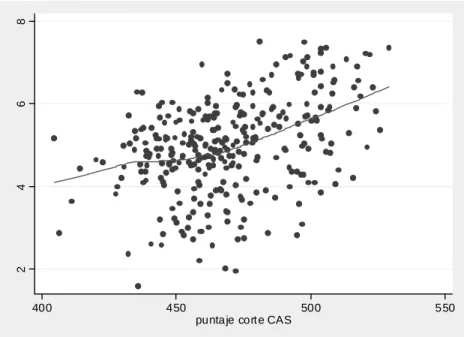
• The program was allocated geographically to all areas proportionally to the target population. i.e. households below a predetermined CAS threshold (see fig. 1)
• The thresholds (or CAS cut-offs) are not the same nationally. In order to ensure a wide geographical coverage of the program, a decision was made to allow thresholds to vary across communes and regions, with the aim of reflecting differences in the poverty rates across different geographic areas.
• Households within municipalities are sequentially invited to participate to the program, by starting from the bottom up of their CAS distribution.11
These design features are such that two potentially eligible and observationally equivalent households can potentially have been differentially exposed to the program.
Let the participation to the program be denoted by
D
i, a binary indicator for family i. For each household, there are two potential outcomes. The outcomeY
i(
1
)
if the household participated in the program, andY
i(
0
)
, the outcome that would realize in the absence of the program. The impact of the program is defined as the difference between outcomes with the program and in the absence of the program. Since households can either participate or not participate, only one of these potential outcomes can be observed ex-post, while the other needs to be estimated. We apply two different estimation methods to estimate such counterfactual.10 The score is a summary index of unsatisfied basic needs that is used as pre-requisite for participation to
Chile Solidario and a wide-array of other social programs in Chile, from income transfers (e.g. family
allowance SUF, old age public pension PASIS) as well as subsidies to health utilization(FONASA), water subsidies SAP, access to public housing and childcare centers.
11 Even though in principle households could refuse the invitation to participate, in practice, the proportion
3.2. Matching on the CAS score
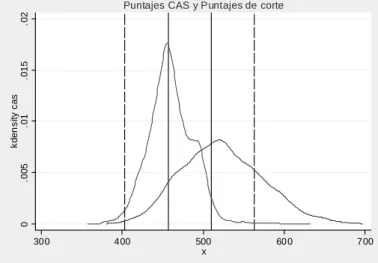
The source of exogenous variation comes from the fact that the range of support and the distribution of the CAS, and the cut-off points vary across municipalities and regions (see figure 2). Two households with similar levels of the scores, but living in different areas have different probabilities of participation for two reasons. First, because of the different range and distribution of the CAS score across communes, two equally eligible households with the same score might be located in different parts of the distribution within their respective communes. Second, because of the different thresholds across communes, households with the same score face different probabilities of being below the thresholds in different locations.
We will explore the first source of exogenous variation by applying the method of matching
to estimate the counterfactual of no-program outcomes and estimate the impact of the program. This method estimates the counterfactual of no-program outcomes by matching on the observable characteristics used in practice during the assignment mechanism, i.e. the CAS score. This means identifying households that resemble as ‘closely’ as possible the participating households, where the closeness depends on the matching metric.
Let the CAS score be denoted by,
S
(
X
i)
, which is an index function of (a subset of) covariatesX
i.Households are assigned to participate in strict ordering depending on their score. Moreover, given that households are invited to participate, they are assumed not to self-select into the program based on the expected gains. In this setting, participation (‘treatment’ in the evaluation literature), is assumed to be independent of the outcomes of interest, conditional on the score, i.e.
D
i┴Y
i(
0
),
Y
i(
1
)
|
S
(
X
i)
. In other words, conditioning on the score is assumed to eliminateall the selection bias (ex-ante unobserved heterogeneity).
Second, there is a concern of being able to construct a valid comparison group among the non-participants, if the program successfully reached the target population of indigents in the country (with universal coverage of the poorest segment of the population in the entire country). The fact that the households were ranked within municipalities makes it possible to achieve a sufficient ‘overlap’, common support in the distribution of the CAS scores, in that there exists intervals of the score for which we can observe both participants and non-participants at the same time.
Under both assumptions, we can identify the gains from the program for participating households with the following parameter:
]
),
(
,
1
|
)
0
(
)
1
(
[
)
(
x
E
Y
Y
D
S
x
X
x
T
=
−
=
=
We follow Abadie and Imbens (2006) to estimate the effect of the program on participants (1), by matching on the CAS score. We also estimate the effect by matching on the CAS score and adjusting the difference within the matches in their covariates. 12
First, estimate the potential outcome for non-participants by:
0
)
)
(
ˆ
)
(
ˆ
(
1
)
0
(
ˆ
0
0
−
=
+
=
∑
∈
i J
l
l i
l i
i
Y
X
X
if
D
J
Y
i
µ
µ
where
J
i is the number of households matched to household i,µ
ˆ
0(
x
)
=
α
ˆ
0+
β
ˆ
0x
is the regression imputation estimated for non-participants in the matched sample, and x includes a set of (pre-determined) household characteristics. We perform separate estimations for rural and urban areas: the incidence of poverty13, the infrastructure, the supply side of public services and the labormarkets faced by households living in rural and urban areas are very different.
Note that this identification strategy compares participating and non-participating households with similar scores (and household characteristics) across regions. One potential concern is that it assumes that the effect of the treatment does not vary across regions and/or municipalities, which might be a strong assumption in the context of the program, which gives such an important role to municipalities. Different municipalities might face a different supply of social services. While the premise of the intervention lies on the existence of an excess supply of social services, there is a possibility that for some of the specific dimensions (and among them most likely housing) there might be have been some rationing of the supply side. We address these concerns by presenting the results with an additional specification where we allow for community effects, in addition to household characteristics. This will control for any time-invariant differences in the initial conditions of the supply side, as well as for unobserved characteristics of the local labor market.14
Then the estimator corresponding to (1) is given by:
∑
=
−
=
1 1
)]
0
(
ˆ
[
1
)
(
ˆ
i
D
i i T
Y
Y
N
x
τ
12
The bias-correction introduced by Abadie and Imbens (2006) removes the conditional bias that arises when matching is performed on more than two variables are used. In our framework, only one matching variable is used (i.e. the CAS score). We use their approach to estimate the conditional treatment effect on the treated.
13 The incidence of rural poverty was found to be double the incidence of urban poverty in 1987, although the
differences across urban and rural areas have converged over time, especially for the incidence of extreme poverty (Litchfield 2001).
14
The underlying assumption behind this specification is that the supply side is given at any given point in time. The assumption seems relevant in the first two years of operation of the program. Over time, to the extent that the supply side responds differentially depending on the local unsatisfied demand, this approach will need to be modified to ensure identification.
i.e. the difference in these (conditional) outcomes between participating and matched non-participating households in a neighborhood of their CAS score. Intuitively, this approach means purging household and/or community characteristics using a regression approach (or linear covariate adjustment), but avoiding to impose any functional form on the treatment effect, by modeling it non-parametrically.
3.2. Regression discontinuity approach
The second source of exogenous variation comes from the application of thresholds for eligibility. The choice of the cut-offs is across regions was exogenous, and based the estimated poverty incidence estimated from the nation-wide household survey in 2000. Households just below and just above the threshold will have a different probability of participation. In principle, under the identifying assumptions of selection on the score, there should not be omitted factors correlated with participation. We apply this second method to check robustness of the results.
We follow van der Klaaw (2002) and Chay, McEwan, and Urquiola (2005), and apply a parametric regression-discontinuity design to estimate the impact of the program around the thresholds. Figure 4 shows that there are sharp changes in the probability of participation close to the threshold. The effect of the program is estimated by comparing a large set of outcomes for households just above and below the cutoffs, within increasingly narrow bands around the cut-offs for eligibility.
Note that the estimated gains using this approach apply only to households close to the cutoff. Given that all municipalities started from the bottom-up of their CAS distribution, the bulk of the distribution of participants is concentrated to the left of the graph, away from the cut-offs (see fig. 3a and 3b). To the extent that there is heterogeneity in impact along the socio-economic characteristics (as proxied by the CAS score, with households with relatively higher scores having larger/smaller impacts), the estimated gains using the RD approach will be interpreted as ‘local’, i.e. applying only in the neighborhood of those thresholds.
4. Data
The analysis is taken from the nationally representative household survey —the
Caracterización Socioeconómica Nacional — CASEN — the main source of information on household
welfare in Chile. The survey is multi-topic, ranging from questions on demographics, employment, income, education, health status and utilization of services to access to public subsidies and transfers. MIDEPLAN, the ministry in charge of the survey as well as of the program, planned to add a few questions on program participation to the CASEN administered in 2003. The sample size
has been augmented to over-sample Chile Solidario beneficiaries. About 5,000 beneficiary households from the 2002 and 2003 cohorts were interviewed (out of a total of 71,000 households).
Given the large sample size of the CASEN 2003 survey (about 73,000 households) and the scale of the program, some of the households located in the CASEN 2003 became subsequently program participants (2004 and 2005 cohorts). Their identity has been subsequently identified in the list of households interviewed in November 2003, by cross-checking names and addresses from the CASEN 2003 data with those from the administrative list of participants. Thus all four cohorts of the program participants could and were identified in the CASEN 2003.
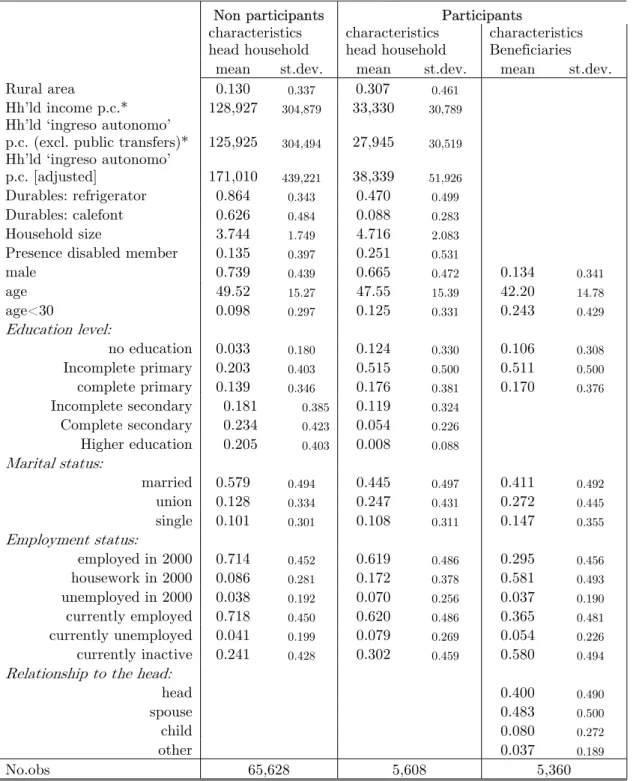
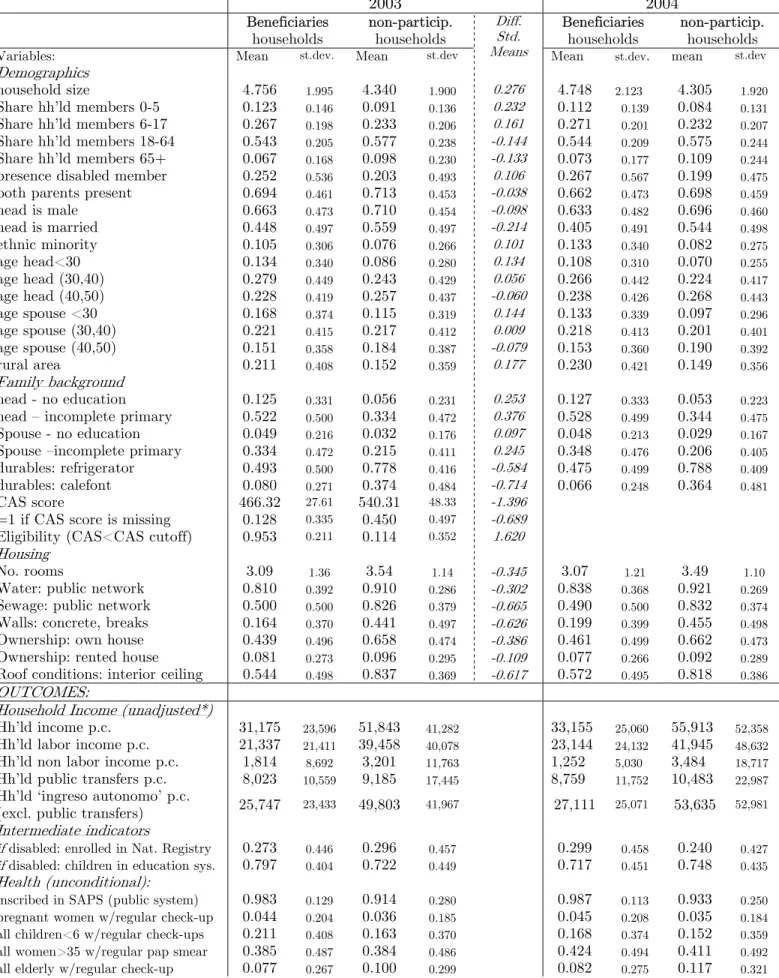
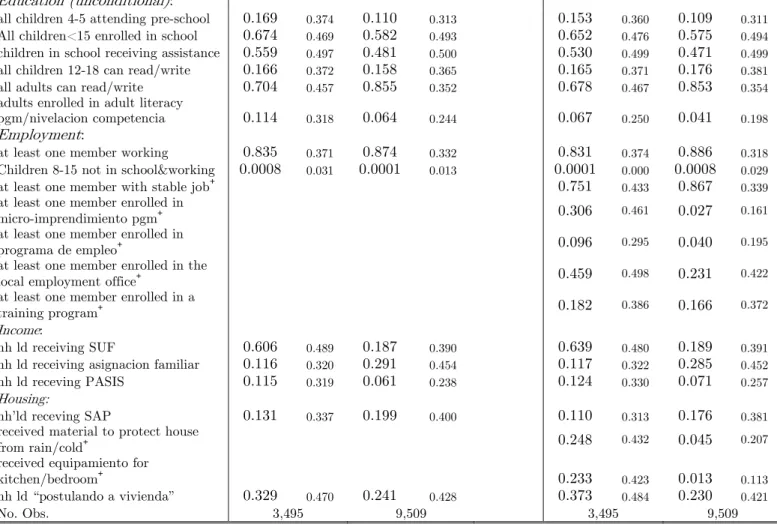
What are the characteristics of the participants and non-participants households? In tables 1 we report weighted means for demographic, socio-economic characteristics, household income and intermediate indicators used in the analysis. The characteristics are presented separately by participation status, as reported in the CASEN 2003 (table 1a). The descriptive statistics confirm that program has indeed been well targeted. Participants households come from larger households, where both the head and the spouse have lower educational attainments (about 2/3 have not completed primary education), have lower labor force attachment, and lower assets (durables). They are also more likely to come from rural areas, and from ethnic minorities. Participants are twice more likely than non-participants to have at least one member with disabilities. The direct cash transfer is preferably given to a female in the household (close to 90% of them), whether head or spouse, echoing the design features of conditional cash transfers in other Latin American countries.
In order to allow for the possibility of following up the impact of the program over time, while keeping low the survey cost, MIDEPLAN agreed to nterviewed only a subset of participants together their ‘matched’ comparison one year apart (November 2004). A third round of the longitudinal survey, initially planned for November 2005, is scheduled for 2006, to eventually form a three-year longitudinal panel.
The planned sample for the follow-up survey in 2004 was to re-interview a representative sample of participants together with the sample of matched only those households with similar propensity scores of participation. (Details on how the panel was constructed are available in the Appendix. The structure of the panel is summarized in fig. A1 in the Appendix). For practical reasons, however, the selection of the matched group of non-participants was forced to be done within the same regions and zones (rural/urban). This sampling strategy caused the characteristics of sample of non-participants in the panel to deviate from the participants’ sample. As one can see from the descriptive statistics in tables 1a-1b, the final sample of non-participants improves relative to the entire population of non-participants surveyed in 2003. However, it is evident that the selected sample of non-participants is still composed of households that are better off along various
dimensions of economic well-being (for instance, income, education levels, assets and housing conditions).
The 2004 questionnaire has newly added questions on participation to various social programs. It has also new modules on intergenerational mobility (with questions on the education and background of the parents), subjective welfare, as well as a short module on perceptions (problem solving, perceived social support and expectations about the future). The descriptive statistics, by participation status, on the intergenerational and the perception questions are suggestive. These underlying differences in the socio-economic conditions of participants and non-participants are also reflected in their subjective measures of well-being. More than 2/3 of the participants consider themselves to belong to the lower ladder of socio-economic well-being (along a 5-ladder scale: low, medium-low, medium, medium-high, high), compared to 1/2 of the non-participants. It is also interesting to note that the spouses of the head have more positive perceptions of well-being, independently of participation status.
Finally, our identification strategy requires that we observe the actual CAS (proxy means) score used to select households into the program. The score could be retrieved in the 2003 only for participating households, for which the identity numbers were collected to be merged with project data. One key innovation of the 2004 survey to overcome this problem was to collect information on the identity numbers of all household members, allowing us to match individuals with administrative data with their actual CAS score for both participants as well as non-participants15.
As a consequence, we will make use of the 2003-2004 panel sample for the rest of the analysis. We were successful in finding corresponding matches for about 2/3 of the sample: about 90% of those households in the participants’ sample, and about 60% among the non-participants. As shown in figure 3a, the distribution of CAS scores for participation is strictly to the left of that of non-participants. Participants are much more likely to be eligible (having their CAS below the relevant threshold). These persistent differences in socio-economic characteristics due to the deviation of the panel sample from the planned one imply that we cannot simply compare outcomes between participants and non-participants in the panel sample. Next section will provide the results obtained by applying the empirical methods outlined in section 3.
15
The CAS data for participants is their CAS score at the entry of the program, as recorded in the
administrative data of the program Puente. The CAS score for non-participants could be obtained by using the identity numbers (RUT) to find their CAS score from the entire CAS database at the national level (consolidado CAS). For non-participants, the CAS from the December 2003 database was used (and only if the score was missing, later scores measured in June 2004 and December 2004 were used for the imputation).
5. Results
Table 2 describes how the program was allocated across different geographic areas. The results confirm that the program was assigned to communes in proportion to the target population of eligible families. Population and CAS thresholds explain around 70% of the variance in the geographic allocation of the program to communes.
5.1: Income and employment effects
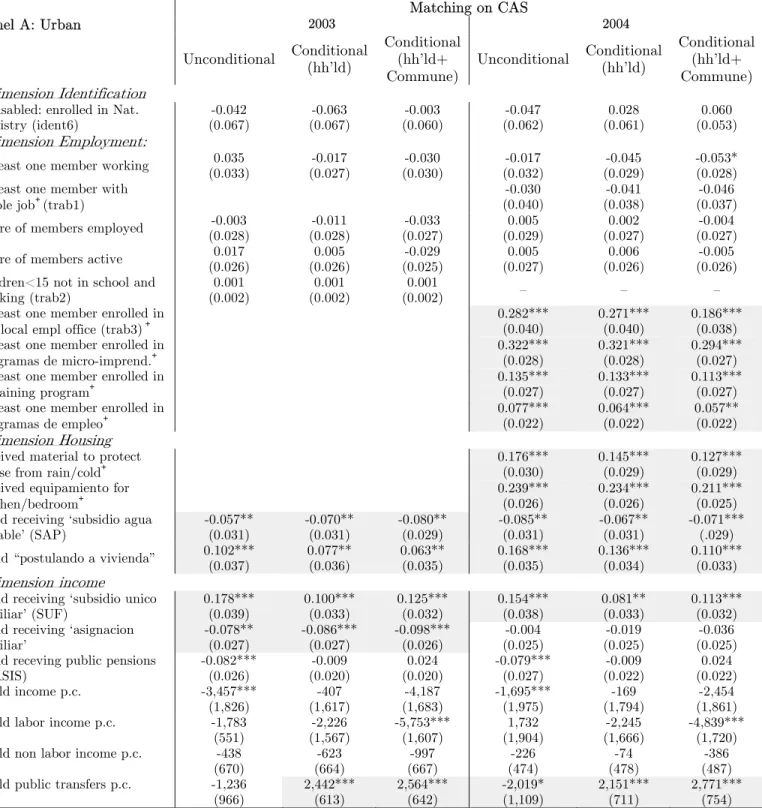
Results on the income and employment dimension are reported in table 3, using the estimated program effects on the CAS score, separately by urban and rural and by year. For each outcome of interest, outcomes are based on matching on the CAS score, unconditionally, conditionally on a large set of household characteristics (family composition, age, sex marital status and education of the head of the household, presence/age of the spouse, indicators for ethnic minority and indicators of basic asset ownership), and finally conditioning on both household characteristics as well as on municipality fixed effects.
Income effects: The short impact of the program on total income and labor income is overall small and mainly non significant across alternative specifications. Participating households are on average more likely to be receiving some public transfers, with a relatively stronger effect in urban areas. Participating households have a ‘preferential access’ to public transfers such as the family allowance (SUF, Subsidio Unico Familiar), the old age and disability pension (PASIS) and the potable water subsidy (SAP). These are generally well targeted social assistance transfers (Clert, Wodon 2001, MIDEPLAN 2002, 2004, Lindert et al. 2005), though their targeting performance with respect to households in extreme poverty was limited by the inability to elicit their demand/take-up. The results in table 3 suggest that households in Chile Solidario are more likely to have received the SUF, especially in urban areas, but less likely to be receiving the water subsidy, the old-age pension and another form of family allowance (in urban areas). The negative sign cannot be interpreted as a negative impact. These programs are assigned strictly on the basis of the within commune ranking of the CAS score among the applicant households. The fact that we observe negative effects might simply reflect the fact that participating households lagged behind in activating their demand even before the program (which is not controlled for by the observed covariates), and that Chile Solidario did not help bridge such differences in take-up for such programs.
On the opposite extreme, some of the positive impact, when observed, (for example in the case of the SUF) might be coming from a negative externality to non-participating households. Once Chile Solidario participants activate their demand, the social transfers are assigned in strict order of the CAS within municipalities. Should the municipal supply of such programs not be sufficient to meet the new total demand, then the estimated effect will overestimate the true effect
of the program (i.e. it would be a composite effect of a positive impact on participants and a substitution effect away from current recipients (‘focalización intra-pobreza’)). An indirect way of testing for this is to compare the conditional results controlling for household characteristics, to those that include both household controls and municipality fixed effects. The latter results allow for local re-ranking of households, as well as control for possible rationing on the local supply. The results do not change substantially when controlling for community effects, though we have indirect sign in urban areas that the estimated effect is slightly higher. Again, this lends weak indirect evidence of the substitution/displacement hypothesis.16
Labor Supply effects:Chile Solidario households exhibit very strong take-up of labor market programs: they are more likely to be participating to programs aimed at supporting self-employed and more likely to be participating to public employment/labor re-insertion and training programs. Participation rates increase by around 30 percentage points in urban areas, and about 14 percentage points in rural areas for self-employment programs. The same pattern is observed for public employment program (increased by about 6% points in urban areas, and 4% points in rural areas), while the effect on take-up training programs is significant only in urban areas. There is also a very strong effect in increasing the likelihood of household members to be enrolled in the local employment office (OMIL), one of the minimum conditions previewed by the Chile Solidario
program for unemployed members. Being enrolled in such offices not only should facilitate the process of looking for a job, but also represents a pre-condition for eligibility to various public training programs.
While the program activated a significant take-up on programs that might increase the employment prospects for the participating households in the medium term, the results do not translate into current gains in their labor supply. There is no sign of improvements of the share of members who are employed, nor on the share of members who have a stable employment (self-reported). The only positive and significant effects on labor force participation are observed in rural areas, with gains in the share of members who are active.
On the one hand, the inconclusive evidence leaves pending important questions on the ability of the program in helping households achieve a sustained exit from extreme poverty. Qualitative work17 clearly suggests that improvements in employment (especially those related to
having a stable source of income in the household) and housing are among the most important
16 Testing for indirect effects has been very limited in the treatment literature, and would require modeling
them directly in a general equilibrium model. This goes beyond the focus and the interest of this paper. The presence of this negative externality on program effects on non-participants (the so-called Stable Unit Treatment Value Assumption, or SUTVA) is usually not testable. A recent study based on the Progresa experimental trial (Angelucci, De Giorgi, 2006) is able to isolate positive indirect effects on the non-participants, because of the spillover effects due to the large cash injection in the local treated areas.
17
aspirations of participating families and those conditions that are perceived as structural factors preventing households to escape extreme poverty. In this light, they are also perceived as the most difficult minimal conditions to meet.
On the other hand, the short term horizon of the current analysis might not be sufficient to observe any impact along these dimensions. In principle, the employment and earnings trajectories of those households who have participated to self-employment/public works/training programs and/or those members who had adult literacy program might improve in the medium run. This short term effects are potentially consistent with the logic of the program to satisfy some basic needs in the short term, while at the same time building the assets to allow households to improve their welfare in a sustained way in the medium-long run. However, the evidence on the effectiveness of active labor market program in the North American and European studies is mixed, with modest impact on increasing employment rates, though not much impact on earnings (Heckman, Lalonde, Smith, 1999). If any, the literature shows that some of the estimated gains are not sustained over time when longer follow-up data are available. The same evidence has also emphasized how the empirical results from the evaluation of such programs mask substantial heterogeneity: the lack of impact on the aggregate universe of participants might hide important effects on specific subgroups depending on the initial conditions (among others age/life cycle, education, local labor markets, labor market experience), or depending on the specific features of the program. In the case of Chile Solidario, the fact that some of these labor market programs are tailored to specific sub-populations rather than being a homogenous program is encouraging. For instance, there are programs focusing as women at home who would be willing to activate themselves to enter the labor market, (programa PRODEMU), and others who target beneficiaries who are planning to initiate/strengthen their self-employment activity (programa microemprendimiento FOSIS). One might expect that such a customized and tailored approach will bring about benefits for at least some subgroups of participants in the future. For the moment being, given the short time horizon of the current analysis, we will provide in section 6 only an indirect inference of how the results may vary according to some key socio-economic characteristics of the participating households.
5.2: Housing effects
Having their own house (‘casa propria’) and improving its basic infrastructure also feature as a very important dimension among the aspirations of participating families (Asesoria 2005, U. Chile 2004b,c, FOSIS 2004b).18 Owning a house reinforces the identity of the household as an
18 Textual analysis of the ‘life projects’ of those households exiting the two-years period of psycho-social
independent unit, represents a capital that can be bequeathed to their children, together with the investment in human capital. Besides the ownership status, basic sanitary and housing infrastructure are important correlates of household welfare (FOSIS 2004a): having basic infrastructure has potential complementarities with health outcomes (access to safe water and sanitation) as well as family dynamics (in terms of a space that allows for better roles and interactions among different household members).
The results in table 3 show significant effects on the enrollment in housing programs in urban areas. The estimated effect ranges from 7% in 2003 to double to 14% in 2004. Compared to an average take-up of 24% of non-participants (stable over time), this amounts to an estimated sizable increase ranging between 30 to 60%. Enrolment in such public programs requires that the households have set some minimum amount of savings to be eligible. Possibly part the cash received through public transfers (either though the bono or through the Subsidio Unico Familiar) has allowed the participating households to save towards this objective.
Housing is one of the dimensions along which there might have been some rationing of the supply side. The results with municipality fixed effects, which control for time-invariant differences in the initial availability of housing, seem to rule out the rationing explanation. The results with community effects do not differ significantly from the other specifications within areas (rural/urban), (though it might still be possible that the rationing applies uniformly to all rural areas).
Table 3 also shows significant effects of the program on the receipt of basic housing equipment (of about 23 percentage points) as well as basic material to protect the house from rain/cold (ranging from 10-15 percentage points). These results are also robust to controlling for community effects. Overall, the results provide evidence that participating households are more likely to activate themselves to connect to the social protection network to bridge the initial gaps in their housing situation.
5.3: Impact on human capital outcomes
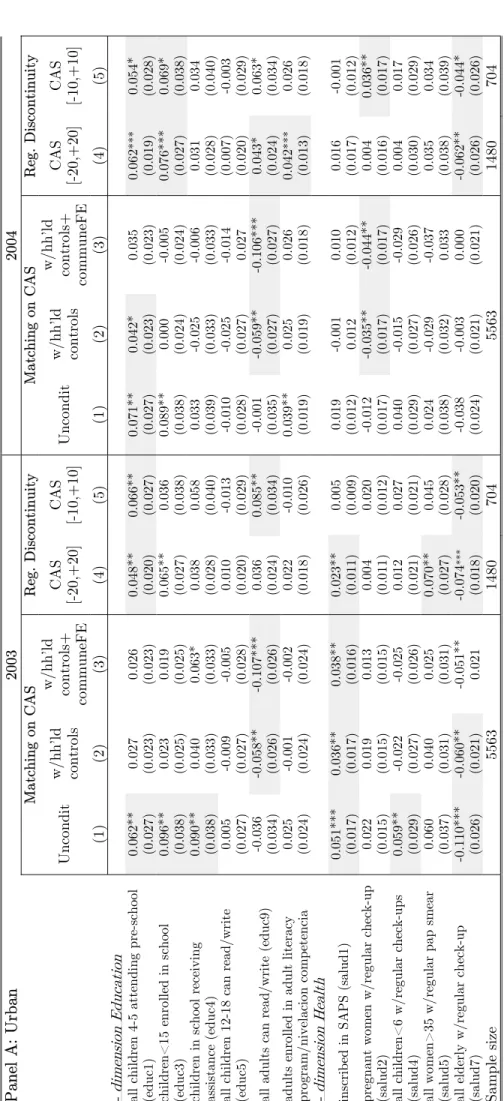
Table 4 reports all the results that relate to various dimensions of health and education. The choice of the outcomes of interest follows the list of intermediate indicators that are set by the program as minimum conditions to be achieved by participating households and that can be measured in the CASEN survey. All variables are computed as averages of individual outcomes at the household level (independently of whether the condition apply to specific subgroups of households or not), having in mind the objective to obtain an average effect of the program on the
participating households relates to ‘having their own house’, as well ‘improving their own house’ (V. Silva’s presentation at MIDEPLAN, October 2005).
overall population of participating households. The only exception is given by outcomes that refer to households with disabled members, for whom the baseline characteristics and the expected behavioral response are expected to be substantially different.
Education effects: Overall, the results suggest significant and consistent increases in the likelihood of having all children aged 4-5 year olds enrolled in a school. The effects for pre-school enrolment are in the range of 4-6 percentage points, consistently found in both urban and rural areas, as well as across different methods. Availability of preschools or financial constraints are not perceived to be an issue: cultural perceptions that the child is too young, or that he/she is better off taken care at home account for 90% of the self-reported reasons for non-enrolment (MIDEPLAN, analysis CASEN 2003). The gains are partly a result of the intense work with the social worker, who during the session emphasizes of the importance of being enrolled in pre-school for the cognitive and behavioral development of the children. This dimension is by its nature inter-related to the willingness and ability of the mother to work, and therefore interinter-related to outcomes in the employment dimension. From the supply side, there are different pre-school programs that have been adapted to reach the target population by providing free access as well as flexible hours to meet the needs of working mothers, even with temporary jobs or households where the head of the household is unemployed and the mother is looking for work.
School enrolment of children from 6 to 15 has improved between 7-9%, relative to non-participation to the program. The results are significant (unconditional, RD), although not robust across all matching specifications, with more robust evidence from the regression discontinuity results. Intuitively, the matching regressions do control for age composition of the household, but do not control for initial conditions and other characteristics of household members other than the head of the household. Household in urban areas are also more likely to have taken-up complementary programs of school materials, meals, and dental care directed to subsidize direct costs of schooling for households with lower socio-economic conditions. There are no fees for public schools in Chile, so most of costs of enrolment are indirect (opportunity cost of the child’s time). There are no significant differences in terms of literacy of children aged 12-18.
As part of its comprehensive strategy, the program also targets illiterate adults or adults that would like to complete their elementary middle school levels. On the benefit side, literacy or improvements in the educational attainment can increase the adults’ self-esteem, and help process information about services/jobs and be instrumental to supporting the children in their educational learning. Existing estimates of the returns to completed education in Chile in the labor market range from a 30-40% income gain from completing primary education to 70% gains to completing secondary education (World Bank 2003). The costs of participation are not only measured in terms of opportunity cost of their leisure time after work, but also in terms of psychological costs. In this
respect, the psycho-social support by the social worker is instrumental to discuss the potential benefits of such programs, and to encourage the potential participants to feel motivated and capable of attaining such an objective. The results show a statistically significant take-up of adult literacy and education completion programs in rural areas of around 4% in urban areas and 5 percentage points in rural areas. This take-up translates into improved adult literacy in the range of 5-8% in urban areas and 7-10% in rural areas (RD results). 19
Health effects: The impact of the program on health outcomes is more muted than the one on educational outcomes. The only consistent result is that participating households are more likely to be enrolled in the public health system (SAPS) (2-3% in urban areas, 3% in rural areas). The impact on health visits for preventive care is found for health visits for children below six years of age (of the order of 4-6 percentage points, only in rural areas) and for women aged 35 or older for their pap smear (of the order of 6-7%, mostly in 2004 for rural areas and in 2003 in urban areas). The results on elderly are not significant in urban areas and often negative in rural areas. We believe that the negative effects are more of a reflection of the differences in the composition of the elderly population in our sample and of the lack of sufficient covariates that are specific to this age group20 rather than credible negative estimates of impact.
5.4. Evidence on perceptions and orientation towards the future
The 2004 questionnaire includes some basic perception questions administered to the head of the household and/or her spouse. We will use some of these perception questions as intermediate outcomes of the analysis, to measure, however crudely, some of the effects of the psycho-social support. We realize that these differences might be capturing underlying differences in personality traits and personal attitudes and preferences. Still, one might expect that the distribution of these unobserved characteristics is uniformly distributed across households with similar socio-economic characteristics and is unrelated to program participation under our identification assumptions.
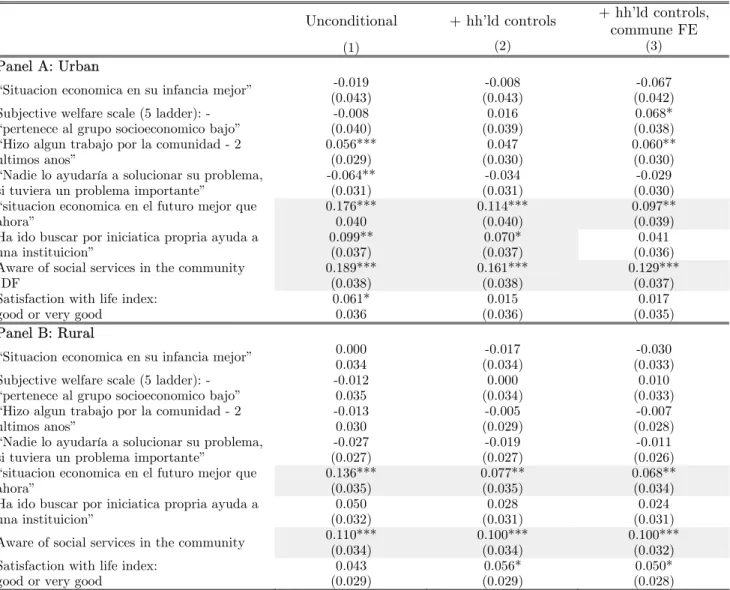
Results are presented in table 5. There are no systematic differences between participating and non-participating households in the subjective perception that they belong to the lowest socio-economic ladder (subjective welfare) nor in their perception of their socio-economic status relative to their childhood. These results provide an indirect support towards our empirical strategy that households are well matched not only along objective measures of welfare but also on some
19 Note that the regression discontinuity results are preferred estimates for the adult literacy indicators. The
matching regressions control for education levels of the head of the household, and not for all initial
differences in education attainments of all adult members. This explains why some of the negative results on adult literacy and enrolment are reversed in sign and significance when going from matching estimates to the RD results.
20 Namely we control for the share of male and female elderly in the households but fail to account for their
important subjective dimensions. The short time horizon of the survey and the fact that there are no income effects of the program are consistent with this picture.
What comes out consistently is the fact that households in Chile Solidario are more likely to be aware of social services in the community (10 percentage points in rural areas and 13-16 percentage points in urban areas, corresponding to an increase of the order of 20-30% relative to the non-participants). This result is important, given that it was one of the main objectives of the program was to ‘bridge’ such demand gap. Households in urban areas are also reporting to be more likely to proactively look for help from local institutions (7 percentage points).
Finally, households seem to be more optimistic about their future socio-economic status (7-8 percentage points in rural areas and 10-11 percentage points in urban areas, corresponding to an increase of about 15-20% relative to non-participation). This improved outlook, even if measures with a basic perception question, is likely to be correlated towards their orientation towards the future, and their willingness to invest in assets that improve their likelihood to eventually escape extreme poverty over time.
6. Unpacking the evidence: complementarities and heterogeneity of impact
In this section, we first provide evidence of the strength of association of impact across some key outcomes. The large array of final and intermediate outcomes reflects the comprehensiveness of the program approach, but makes it harder to summarize them in a consistent way. The strength of the correlation of impact can indicate of how complementary or substitutes such outcomes are in improving the socio-economic conditions of participating households. Second, we describe how these impact estimates correlate to some key socio-economic conditions of the participating households, namely their index of unsatisfied basic needs as well as the age of the head of household.
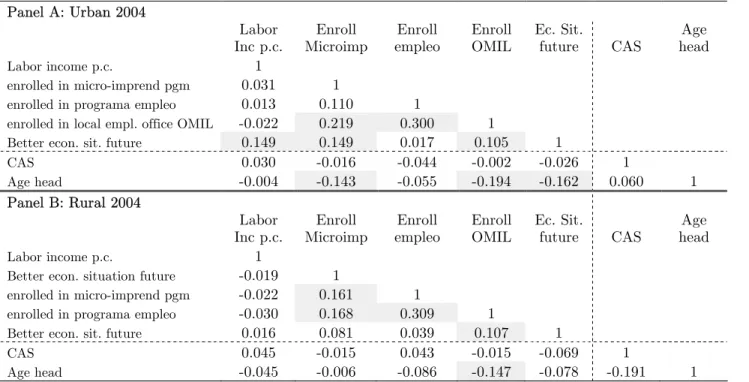
Table 6a provides a simple correlation table among the unit-level impact estimates for the different employment programs, as well as labor income and expectations about the future. The correlations confirm that enrolment in the local employment office is an important eligibility vehicle for enrolling in self-employment as well as public employment programs. More importantly, the correlations show that there is a strong connection between improved expectations about the future for those households in urban areas who had higher labor income gains as well as those who are enrolled in self-employment programs. It is also worth noting that employment program gains are stronger for younger households (as measured by the age of the head)21, even though they have
21 The same results would obtain if the age of the spouse is chosen as an indicator of the life-cycle of the
not materialized (yet) in labor income gain. The self-projection into better standards of living does not seem to be operating through the labor/employment program nexus in rural areas.
Table 6b presents an analogue table that describes complementarities among different dimensions of welfare gains in the program with respect to human capital outcomes. Younger households are the ones who exhibit education and health gains (enrollment in pre-school as well as health visits for children younger than 6) as well as those who are more likely to enroll to obtain public housing. Education and health gains for the younger children are positively correlated, especially in urban areas. Another interesting pattern is that the perception of a better economic situation in the future is positively related to education and health gains both in rural and in urban areas. The self-projection into better standards of living is correlated with enrolment for public housing in rural areas, contrary to the income/employment pattern noted above for urban areas.
7. Conclusions
This paper provides the first estimates of the welfare effects of an innovative program targeting households in extreme poverty in Chile. The evaluation exploits exogenous variation in geographic assignment of household to the program to estimate the short term effect of the intervention on a large array of household outcomes. The first overall theme coming out of the results, is a significant and substantial effect on the take-up of a cash assistance and social services, which was one of the main objectives of the program in its inception. Households in extreme poverty were previously observed to be disconnected from the public network of social services, and the program seemed to have bridged some of this gap. Second, we find that the program, in its two first years of operations, improves educational and some health outcomes of the participating households, though there are effects on labor supply or income. Finally, we describe suggestive evidence of the key role that the psycho-social support had in enabling this change, by increasing awareness of social services in the community as well as households’ orientation towards the future.
The comparison with other conditional transfers programs comes naturally to mind, though it should be exercised with extreme caution. The scope of the program (reaching 5% of the
population), the institutional strength of local municipalities and the vast array of social services available in Chile makes it hard to extrapolate the results to other countries in the Latin American region. Nonetheless, the methodological approach that works jointly on the demand and supply side of social services is an innovation with respect to traditional conditional cash transfers and has already attracted attention from other countries in Central America (such as Guatemala,
the high share of single parent households among the participants (about 30%), using the age of the head allows to retain a larger number of observations.
Honduras, and Colombia). Both types of approaches show gains in human capital indicators with increased health and education visits.22 In the case of Chile Solidario, the intervention covers other
complementary dimensions of welfare (housing, employment, income), and we could measure the effect of the program on these outcomes as well as measure the complementarities among these effects. Yet for both type of approaches, the jury is still out to understand whether participating households will be able to be self-reliant and sustain their exit from poverty.
The current analysis leaves many important questions unanswered. I suggest two promising areas for future work. The first set of issues to explore relates to dynamics and medium term impacts. The third round of data planned to be in the field in November 2006 will be the first time where a significant portion of beneficiary households will have left the phase of psycho-social support. This will allow addressing the following questions: What are the medium-longer term impacts of the program? How sustainable is the effect and for which types of households? What happens to households when they leave the first two years of psychosocial support? Gertler et al (2005) provide preliminary evidence that some of the substantial cash transfer received by Mexican families in the context of Progresa (now Oportunidades) has been saved and used to finance in micro-enterprise activities and increased investments in farm assets and agricultural activities. Further analysis of impact of Chile Solidario beyond the short term might provide more insights about whether the income and employment gains are going to be achieved through a different strategy of intervention.
Second, one of the crucial innovations of the program is to bring the psychological dimension at the center of a large scale poverty intervention. The paramount importance of the psycho-social support, well documented in beneficiaries’ assessments and in the qualitative work, has been only touched upon in the current analysis by looking at a few isolated perception questions. There is scope for improving our understanding on such important dimensions by enriching the quality of instruments for measurement. Moreover, it will be important to study how interrelated are changes in the psychological dimension with changes in socio-economic conditions. Are the positive impacts on future orientation going to be sustained over time, once households are not supported by the social worker? Do these positive outlooks get dissipated if the improvements in material conditions and economic well being fail to materialize? Providing answers to such questions are important not only for Chile, but also for the design of social protection programs in other countries.
22
In addition, the extensive literature that has originated from the Mexican program has shown gains in nutrition and other health outcomes (such as illnesses, anemia, height (Gertler and Boyce 2001, Gertler 2004), indirectly act as a partial safety net, by protecting beneficiary households from the risk of shocks that might induce them to take their children out of school (Finan et al, 2005). The compact nature of the CASEN questionnaire does not allow to measure gains along such dimensions.
References
Appadurai, Arjun (2004), “The Capacity to Aspire: Culture and the Terms of Recognition”, Chapter 3
in Culture and Public Action, Vijayendra Rao and Michael Walton eds., Stanford University Press,
Stanford.
Abadie, Alberto and Guido Imbens (2006), “Large Sample Properties of Matching Estimators for Average Treatment Effects,” Econometrica, 74(1), pp. 235-67.
Angelucci, Manuela and Giacomo Di Giorgi (2006), “Indirect Effects of an Aid Program: the case of Progresa and Consumption”, processed, University College of London, Department of Economics. Asesorias para el Desarrollo (2005) “Necesidades y Aspiraciones Prioritarias de las Familias que
han finalizado la etapa de apoyo psicosocial del sistema de protección social Chile Solidario”, Santiago, Chile.
Bourguignon, Francois, and Satya Chakravarty (2003), “The measurement of multidimensional poverty”, Journal of Economic Inequality, 1, pp. 25-49.
Blundell, Richard, Monica Costa Dias, Costas Meghir and John Van Reenen (2004) “Evaluating the Employment Impact of a Mandatory Job Search Program”, Journal of the European
Economic Association, 2(4): 569-606.
Clert, Carine and Quentin Wodon (2001) “The Targeting of Government Programs in Chile”, Background Paper for “Poverty and Income Distribution in a High Growth Economy -- The Case of Chile 1987-98”, The World Bank.
Chay, Kenneth, Patrick McEwan and Miquel Urquiola (2005), “The Central Role of Noise in Evaluating Interventions that use Test Scores to Rank Schools”, American Economic Review, 95(4), pp. 1237-58.
Currie, Janet (2004), “The Take Up of Social Benefits”, NBER Working Papers 10488, National Bureau of Economic Research, Inc.
De Janvry, Alain and Elisabeth Sadoulet (2005), “Making Conditional Cash Transfer Programs More Efficient: Designing for Maximum Effect of the Conditionality”, processed, University of California at Berkeley, Department of Agricultural Economics.
Finan, Frederico Alain De Janvry, Elisabeth Sadoulet, and Renos Vakis (2005), “Can Conditional Cash Transfers Serve as Safety Nets to Keep Children at School and Out of the Labor Market?”, processed, University of California at Berkeley, Department of Agricultural Economics. Forthcoming in Journal of Development Economics
Gertler, Paul, and Simone Boyce (2001), “An experiment in incentive-based welfare: The impact of PROGRESA on health in Mexico.” Mimeo, University of California, Berkeley.