DEPARTMENT OF HEALTH AND HUMAN SERVICES
Centers for Medicare & Medicaid Services
R
Evaluation and
PREFACE
This guide is offered as a reference tool and does not replace content found in the “1995 Documentation Guidelines for Evaluation and Management Services”and the “1997 Documentation Guidelines for Evaluation and Management Services.” These publications are available in the Reference Section of this guide and at http:// www.cms.gov/MLNProducts/Downloads/1995dg.pdfand http://www.cms.gov/ MLNProducts/Downloads/MASTER1.pdf on the Centers for Medicare & Medicaid Services website.
Note: Either version of the documentation guidelines, not a combination of the two, may be used by the provider for a patient encounter.
This publication was current at the time it was published or uploaded onto the web. Medicare policy changes frequently so links to the source documents have been provided within the document for your reference. This publication is a general summary that explains certain aspects of the Medicare Program; however, this is not a legal document and does not grant rights or impose obligations. The Centers for Medicare & Medicaid Services (CMS) will not bear any responsibility or liability for the results or consequences of using this summary guide. This document was current as of the date of publication; nevertheless, we encourage readers to review the specific laws, regulations and rulings for up-to-date detailed information. Providers are responsible for the correct submission of claims and response to any remittance advice in accordance with current laws, regulations and standards.
CPT only copyright 2014 American Medical Association. All rights reserved. CPT is a registered trademark of the American Medical Association. Applicable FARS/DFARS Restrictions Apply to Government Use. Fee schedules, relative value units, conversion factors, and/or related components are not assigned by the AMA, are not part of CPT, and the AMA is not recommending their use. The AMA does not directly or indirectly practice medicine or dispense medical services. The AMA assumes no liability for data contained or not contained herein.
TABLE OF CONTENTS
MEDICAL RECORD DOCUMENTATION ...3
General Principles of Evaluation and Management Documentation ...3
Common Sets of Codes Used to Bill for Evaluation and Management Services ...4
Evaluation and Management Service Providers ...6
EVALUATION AND MANAGEMENT BILLING AND CODING CONSIDERATIONS…….7
Selecting the Code That Best Represents the Service Furnished ...7
Other Considerations ...21
REFERENCE SECTION ... 22
Resources ...22
“1995 Documentation Guidelines for Evaluation and Management Services” ...23
MEDICAL RECORD
DOCUMENTATION
This chapter provides information about the general principles of evaluation andmanagement (E/M) documentation, common sets of codes used to bill for E/M services, and E/M service providers.
GENERAL PRINCIPLES OF EVALUATION AND MANAGEMENT DOCUMENTATION
“If it isn’t documented, it hasn’t been done” is an adage that is frequently heard in the health care setting.
Clear and concise medical record documentation is critical to providing patients with quality care and is required in order for providers to receive accurate and timely payment for furnished services. Medical records chronologically report the care a
patient received and are used to record pertinent facts, findings, and observations about the patient’s health history. Medical record documentation assists physicians and other health care professionals in evaluating and planning the patient’s immediate treatment and monitoring the patient’s health care over time.
Health care payers may require reasonable documentation to ensure that a service is consistent with the patient’s insurance coverage and to validate:
❖ The site of service;
❖ The medical necessity and appropriateness of the diagnostic and/or therapeutic services provided; and/or
❖ That services furnished have been accurately reported.
There are general principles of medical record documentation that are applicable to all types of medical and surgical services in all settings. While E/M services vary in several ways, such as the nature and amount of physician work required, the following general
principles help ensure that medical record documentation for all E/M services is appropriate:
❖ The medical record should be complete and legible;
❖ The documentation of each patient encounter should include:
• Reason for the encounter and relevant history, physical examination findings, and prior diagnostic test results;
• Assessment, clinical impression, or diagnosis; • Medical plan of care; and
• Date and legible identity of the observer.
❖ If not documented, the rationale for ordering diagnostic and other ancillary services should be easily inferred;
❖ Past and present diagnoses should be accessible to the treating and/or consulting physician;
❖ Appropriate health risk factors should be identified;
❖ The patient’s progress, response to and changes in treatment, and revision of diagnosis should be documented; and
❖ The diagnosis and treatment codes reported on the health insurance claim form or billing statement should be supported by the documentation in the medical record. In order to maintain an accurate medical record, services should be documented during the encounter or as soon as practicable after the encounter.
COMMON SETS OF CODES USED TO BILL
FOR EVALUATION AND MANAGEMENT SERVICES
When billing for a patient’s visit, select codes that best represent the services furnished during the visit. A billing specialist or alternate source may review the provider’s
documented services before the claim is submitted to a payer. These reviewers may assist with selecting codes that best reflect the provider’s furnished services. However, it is the provider’s responsibility to ensure that the submitted claim accurately reflects the services provided.
The provider must ensure that medical record documentation supports the level of service reported to a payer. The volume of documentation should not be used to determine which specific level of service is billed.
code, in order to receive payment from Medicare for a service, the service must also be considered reasonable and necessary. Therefore, the service must be:
❖ Furnished for the diagnosis, direct care, and treatment of the beneficiary’s
medical condition (that is, not provided mainly for the convenience of the beneficiary, provider, or supplier); and
❖ Compliant with the standards of good medical practice.
The two common sets of codes that are currently used for billing are: Current
Procedural Terminology (CPT) codes and International Classification of Diseases (ICD) diagnosis and procedure codes.
CURRENT PROCEDURAL TERMINOLOGY CODES
Physicians, qualified non-physician practitioners (NPP), outpatient facilities, and hospital outpatient departments report CPT codes to identify procedures furnished in an encounter. CPT codes are used to bill for services furnished to patients other than inpatients and for services being billed on claims other than inpatient claims. Therefore, CPT codes should be used to bill for E/M services provided in the outpatient facility setting and in the office setting.
INTERNATIONAL CLASSIFICATION OF
DISEASES DIAGNOSIS AND PROCEDURE CODES
The use of ICD-9-Clinical Modification (CM) diagnosis and procedure codes is limited to billing for inpatient E/M services on inpatient claims. All other provider types should continue to use CPT codes to bill for E/M services.
The compliance date for implementation of the International Classification of
Diseases, 10th Revision, Clinical Modification/Procedure Coding System (ICD-10-CM/ PCS) is for services provided on or after October 1, 2015, for all Health Insurance Portability and Accountability Act covered entities. ICD-10-CM/PCS is a replacement for ICD-9-CM diagnosis and procedure codes. The implementation of ICD-10-CM/PCS will not impact the use of CPT and alpha-numeric Healthcare Common Procedure Coding System codes.
All providers billing for inpatient services provided to inpatient beneficiaries will use ICD-10-CM diagnosis codes instead of ICD-9-CM diagnosis codes for services furnished on or after October 1, 2015.
ICD-10-CM/PCS will enhance accurate payment for services rendered and facilitate evaluation of medical processes and outcomes. The new classification system provides significant improvements through greater detailed information and the ability to expand in order to capture additional advancements in
ICD-10-CM/PCS consists of two parts:
❖ ICD-10-CM – The diagnosis classification system developed by the Centers for Disease Control and Prevention for use in all U.S. health care treatment settings. Diagnosis coding under this system uses 3 – 7 alpha and numeric digits and full code titles, but the format is very much the same as ICD-9-CM; and
❖ ICD-10-PCS – The procedure classification system developed by the Centers for Medicare & Medicaid Services for use in the U.S. for billing inpatient hospital claims for inpatient services ONLY. The new procedure coding system uses 7 alpha or numeric digits while the ICD-9-CM coding system uses 3 or 4 numeric digits.
EVALUATION AND MANAGEMENT SERVICE PROVIDERS
E/M services refer to visits and consultations furnished by physicians and the following qualified NPPs:
❖ Nurse practitioners; ❖ Clinical nurse specialists; ❖ Certified nurse midwives; and ❖ Physician assistants.
A NPP’s Medicare benefit must permit him or her to bill for E/M services, and the services must be furnished within the scope of practice in the State in which the NPP practices in order to receive payment from Medicare.
EVALUATION
AND MANAGEMENT
BILLING AND CODING
CONSIDERATIONS
This chapter discusses selecting the code that best represents the service furnished and other evaluation and management (E/M) considerations.
SELECTING THE CODE THAT BEST REPRESENTS THE SERVICE FURNISHED
Billing Medicare for an E/M service requires the selection of a Current Procedural Terminology (CPT) code that best represents:
❖ Patient type;
❖ Setting of service; and
❖ Level of E/M service performed. PATIENT TYPE
For purposes of billing for E/M services, patients are identified as either new or established, depending on previous encounters with the provider.
A new patient is defined as an individual who has not received any professional
services from the physician/non-physician practitioner (NPP) or another physician of the same specialty who belongs to the same group practice within the previous three years. An established patient is an individual who has received professional services from the physician/NPP or another physician of the same specialty who belongs to the same group practice within the previous three years.
SETTING OF SERVICE
E/M services are categorized into different settings depending on where the service is furnished. Examples of settings include:
❖ Office or other outpatient setting; ❖ Hospital inpatient;
❖ Emergency department (ED); and ❖ Nursing facility (NF).
LEVEL OF EVALUATION AND MANAGEMENT SERVICE PERFORMED
The code sets used to bill for E/M services are organized into various categories and levels. In general, the more complex the visit, the higher the level of code the physician or NPP may bill within the appropriate category. In order to bill any code, the services furnished must meet the definition of the code. It is the physician’s or NPP’s responsibility to ensure that the codes selected reflect the services furnished.
There are three key components when selecting the appropriate level of E/M service provided: history, examination, and medical decision making. Visits that consist predominately of counseling and/or coordination of care are an exception to this rule. For these visits, time is the key or controlling factor to qualify for a particular level of E/M services.
History
The elements required for each type of history are depicted in the table below. Further discussion of the activities comprising each of these elements is included below the table. To qualify for a given type of history, all four elements indicated in the row must be met. Note that as the type of history becomes more intensive, the elements required to perform that type of history also increase in intensity. For example, a problem focused history requires the documentation of the chief complaint (CC) and a brief history of present illness (HPI) while a detailed history requires the documentation of a CC, an extended HPI, plus an extended review of systems (ROS), and pertinent past, family, and/or social history (PFSH).
TYPE OF
HISTORY COMPLAINTCHIEF
HISTORY OF PRESENT
ILLNESS
REVIEW OF SYSTEMS
PAST, FAMILY, AND/OR SOCIAL
HISTORY Problem
Focused Required Brief N/A N/A
Expanded Problem
Focused Required Brief
Problem
Pertinent N/A
Detailed Required Extended Extended Pertinent
Comprehensive Required Extended Complete Complete
While documentation of the CC is required for all levels, the extent of information gathered for the remaining elements related to a patient’s history is dependent upon clinical judgment and the nature of the presenting problem.
Chief Complaint
A CC is a concise statement that describes the symptom, problem, condition, diagnosis, or reason for the patient encounter. The CC is usually stated in the patient’s own words. For example, patient complains of upset stomach, aching joints, and fatigue. The
medical record should clearly reflect the CC. History of Present Illness
HPI is a chronological description of the development of the patient’s present illness from the first sign and/or symptom or from the previous encounter to the present. HPI elements are:
❖ Location (example: left leg);
❖ Quality (example: aching, burning, radiating pain); ❖ Severity (example: 10 on a scale of 1 to 10); ❖ Duration (example: started three days ago); ❖ Timing (example: constant or comes and goes); ❖ Context (example: lifted large object at work);
❖ Modifying factors (example: better when heat is applied); and ❖ Associated signs and symptoms (example: numbness in toes). There are two types of HPIs: brief and extended.
A brief HPI includes documentation of one to three HPI elements.
In the following example, three HPI elements – location, quality, and duration – are documented:
❖ CC: Patient complains of earache.
❖ Brief HPI: Dull ache in left ear over the past 24 hours. An extended HPI:
❖ 1995 documentation guidelines – Should describe four or more elements of the present HPI or associated comorbidities.
❖ 1997 documentation guidelines – Should describe at least four elements of the present HPI or the status of at least three chronic or inactive conditions.
In the following example, five HPI elements – location, quality, duration, context, and modifying factors – are documented:
❖ CC: Patient complains of earache.
❖ Extended HPI: Patient complains of dull ache in left ear over the past 24 hours. Patient states he went swimming two days ago. Symptoms somewhat relieved by warm compress and ibuprofen.
Review of Systems
ROS is an inventory of body systems obtained by asking a series of questions in order to identify signs and/or symptoms that the patient may be experiencing or has experienced. The following systems are recognized for ROS purposes:
❖ Constitutional Symptoms (for example, fever, weight loss); ❖ Eyes;
❖ Ears, Nose, Mouth, Throat; ❖ Cardiovascular;
❖ Respiratory; ❖ Gastrointestinal; ❖ Genitourinary; ❖ Musculoskeletal;
❖ Integumentary (skin and/or breast); ❖ Neurological;
❖ Psychiatric; ❖ Endocrine;
❖ Hematologic/Lymphatic; and ❖ Allergic/Immunologic.
There are three types of ROS: problem pertinent, extended, and complete.
A problem pertinentROS inquires about the system directly related to the problem identified in the HPI.
An extendedROS inquires about the system directly related to the problem(s) identified in the HPI and a limited number (two to nine) of additional systems.
In the following example, two systems – cardiovascular and respiratory – are reviewed: ❖ CC: Follow up visit in office after cardiac catheterization. Patient states “I feel great.” ❖ ROS: Patient states he feels great and denies chest pain, syncope, palpitations, and
shortness of breath. Relates occasional unilateral, asymptomatic edema of left leg. A completeROS inquires about the system(s) directly related to the problem(s) identified in the HPI plus all additional (minimum of ten) organ systems. Those systems with positive or pertinent negative responses must be individually documented. For the remaining systems, a notation indicating all other systems are negative is permissible. In the absence of such a notation, at least ten systems must be individually documented. In the following example, ten signs and symptoms are reviewed:
❖ CC: Patient complains of “fainting spell.” ❖ ROS:
• Constitutional: Weight stable, + fatigue. • Eyes: + loss of peripheral vision.
• Ear, Nose, Mouth, Throat: No complaints.
• Cardiovascular: + palpitations; denies chest pain; denies calf pain, pressure, or edema.
• Respiratory: + shortness of breath on exertion.
• Gastrointestinal: Appetite good, denies heartburn and indigestion. + episodes of nausea. Bowel movement daily; denies constipation or loose stools.
• Urinary: Denies incontinence, frequency, urgency, nocturia, pain, or discomfort.
• Skin: + clammy, moist skin.
• Neurological: + fainting; denies numbness, tingling, and tremors. • Psychiatric: Denies memory loss or depression. Mood pleasant. Past, Family, and/or Social History
PFSH consists of a review of three areas:
❖ Past history including experiences with illnesses, operations, injuries, and treatments; ❖ Family history including a review of medical events, diseases, and hereditary
❖ Social history including an age appropriate review of past and current activities. The two types of PFSH are: pertinent and complete.
A pertinent PFSH is a review of the history areas directly related to the problem(s) identified in the HPI. The pertinent PFSH must document at least one item from any of the three history areas.
In the following example, the patient’s past surgical history is reviewed as it relates to the identified HPI:
❖ HPI: Coronary artery disease.
❖ PFSH: Patient returns to office for follow up of coronary artery bypass graft in 1992. Recent cardiac catheterization demonstrates 50 percent occlusion of vein graft to obtuse marginal artery.
A complete PFSH is a review of two or all three of the areas, depending on the category of E/M service. A complete PFSH requires a review of all three history areas for services that, by their nature, include a comprehensive assessment or reassessment of the patient. A review of two history areas is sufficient for other services.
At least one specific item from two of the three history areas must be documented for a complete PFSH for the following categories of E/M services:
❖ Office or other outpatient services, established patient;
❖ ED;
❖ Domiciliary care, established patient;
❖ Subsequent NF care (if following the 1995 documentation guidelines); and ❖ Home care, established patient.
At least one specific item from each of the history areas must be documented for the following categories of E/M services:
❖ Office or other outpatient services, new patient; ❖ Hospital observation services;
❖ Hospital inpatient services, initial care; ❖ Comprehensive NF assessments; ❖ Domiciliary care, new patient; and
In the following example, the patient’s genetic history is reviewed as it relates to the current HPI:
❖ HPI: Coronary artery disease.
❖ PFSH: Family history reveals the following:
• Maternal grandparents – Both + for coronary artery disease; grandfather: deceased at age 69; grandmother: still living.
• Paternal grandparents – Grandmother: + diabetes, hypertension; grandfather: + heart attack at age 55.
• Parents – Mother: + obesity, diabetes; father: + heart attack at age 51, deceased at age 57 of heart attack.
• Siblings – Sister: + diabetes, obesity, hypertension, age 39; brother: + heart attack at age 45, living.
Notes on the Documentation of History
❖ The CC, ROS, and PFSH may be listed as separate elements of history or they may be included in the description of the history of the present illness.
❖ A ROS and/or a PFSH obtained during an earlier encounter does not need to be re-recorded if there is evidence that the physician reviewed and updated the previous information. This may occur when a physician updates his or her own record or in an institutional setting or group practice where many physicians use a common record. The review and update may be documented by:
• Describing any new ROS and/or PFSH information or noting there has been no change in the information; and
• Noting the date and location of the earlier ROS and/or PFSH.
❖ The ROS and/or PFSH may be recorded by ancillary staff or on a form completed by the patient. To document that the physician reviewed the information, there must be a notation supplementing or confirming the information recorded by others.
❖ If the physician is unable to obtain a history from the patient or other source, the record should describe the patient’s condition or other circumstance which precludes obtaining a history.
Examination
As stated previously, there are two versions of the documentation guidelines – the 1995 version and the 1997 version. The most substantial differences between the two versions occur in the examination documentation section. Either version of the documentation guidelines, not a combination of the two, may be used by the provider for a patient encounter.
The levels of E/M services are based on four types of examination:
❖ Problem Focused – A limited examination of the affected body area or organ system; ❖ Expanded Problem Focused – A limited examination of the affected body area or
organ system and any other symptomatic or related body area(s) or organ system(s); ❖ Detailed – An extended examination of the affected body area(s) or organ system(s)
and any other symptomatic or related body area(s) or organ system(s); and
❖ Comprehensive – A general multi-system examination or complete examination of a single organ system (and other symptomatic or related body area(s) or organ system(s) – 1997 documentation guidelines).
An examination may involve several organ systems or a single organ system. The type and extent of the examination performed is based upon clinical judgment, the patient’s history, and nature of the presenting problem(s).
The 1997 documentation guidelines describe two types of comprehensive examinations that can be performed during a patient’s visit: general multi-system examination and single organ examination.
A general multi-system examination involves the examination of one or more organ systems or body areas, as depicted in the chart below.
TYPE OF EXAMINATION DESCRIPTION
Problem Focused Include performance and documentation of one to five elements identified by a bullet in one or more organ system(s) or body area(s).
Expanded Problem Focused Include performance and documentation of at least six elements identified by a bullet in one or more organ system(s) or body area(s).
Detailed
Include at least six organ systems or body areas. For each system/area selected, performance and documentation of at least two elements identified by a bullet is expected. Alternatively, may include performance and documentation of at least twelve elements identified by a bullet in two or more organ systems or body areas. Comprehensive
Include at least nine organ systems or body areas. For each system/area selected, all elements of the examination identified by a bullet should be performed, unless specific directions limit the content of the
examination. For each area/system, documentation of at least two elements identified by bullet is expected.*
A single organ system examination involves a more extensive examination of a specific organ system, as depicted in the chart below.
TYPE OF EXAMINATION DESCRIPTION
Problem Focused Include performance and documentation of one to five elements identified by a bullet, whether in a box with a shaded or unshaded border.
Expanded Problem Focused Include performance and documentation of at least six elements identified by a bullet, whether in a box with a shaded or unshaded border.
Detailed
Examinations other than the eye and psychiatric exami-nations should include performance and documentation of at least twelve elements identified by a bullet, whether in a box with a shaded or unshaded border.
Eye and psychiatric examinations include the perfor-mance and documentation of at least nine elements identified by a bullet, whether in a box with a shaded or unshaded border.
Comprehensive
Include performance of all elements identified by a bullet, whether in a shaded or unshaded box.
Documentation of every element in each box with a shaded border and at least one element in a box with an unshaded border is expected.
Both types of examinations may be performed by any physician, regardless of specialty. Some important points that should be kept in mind when documenting general
multi-system and single organ system examinations (in both the 1995 and the 1997 documentation guidelines) are:
❖ Specific abnormal and relevant negative findings of the examination of the
affected or symptomatic body area(s) or organ system(s) should be documented. A notation of “abnormal” without elaboration is not sufficient.
❖ Abnormal or unexpected findings of the examination of any asymptomatic body area(s) or organ system(s) should be described.
❖ A brief statement or notation indicating “negative” or “normal” is sufficient to document normal findings related to unaffected area(s) or asymptomatic organ system(s).
Medical Decision Making
Medical decision making refers to the complexity of establishing a diagnosis and/or selecting a management option, which is determined by considering the following factors:
❖ The number of possible diagnoses and/or the number of management options that must be considered;
❖ The amount and/or complexity of medical records, diagnostic tests, and/or other information that must be obtained, reviewed, and analyzed; and
❖ The risk of significant complications, morbidity, and/or mortality as well as
comorbidities associated with the patient’s presenting problem(s), the diagnostic procedure(s), and/or the possible management options.
The chart below depicts the elements for each level of medical decision making. Note that to qualify for a given type of medical decision making, two of the three elements must either be met or exceeded.
TYPE OF DECISION MAKING
NUMBER OF DIAGNOSES OR
MANAGEMENT OPTIONS
AMOUNT AND/ OR COMPLEXITY
OF DATA TO BE REVIEWED
RISK OF SIGNIFICANT COMPLICATIONS, MORBIDITY, AND/OR
MORTALITY
Straightforward Minimal Minimal or None Minimal
Low Complexity Limited Limited Low
Moderate Complexity Multiple Moderate Moderate
High Complexity Extensive Extensive High
Number of Diagnoses and/or Management Options
The number of possible diagnoses and/or the number of management options that must be considered is based on:
❖ The number and types of problems addressed during the encounter; ❖ The complexity of establishing a diagnosis; and
In general, decision making with respect to a diagnosed problem is easier than that for an identified but undiagnosed problem. The number and type of diagnosed tests performed may be an indicator of the number of possible diagnoses. Problems that are improving or resolving are less complex than those problems that are worsening or failing to change as expected. Another indicator of the complexity of diagnostic or management problems is the need to seek advice from other health care professionals. Some important points that should be kept in mind when documenting the number of diagnoses or management options are:
❖ For each encounter, an assessment, clinical impression, or diagnosis should be documented which may be explicitly stated or implied in documented decisions regarding management plans and/or further evaluation:
• For a presenting problem with an established diagnosis, the record should reflect whether the problem is:
- Improved, well controlled, resolving, or resolved; or
- Inadequately controlled, worsening, or failing to change as expected. • For a presenting problem without an established diagnosis, the
assessment or clinical impression may be stated in the form of differential diagnoses or as a “possible,” “probable,” or “rule out” diagnosis.
❖ The initiation of, or changes in, treatment should be documented. Treatment includes a wide range of management options including patient instructions, nursing instructions, therapies, and medications.
❖ If referrals are made, consultations requested, or advice sought, the record should indicate to whom or where the referral or consultation is made or from whom advice is requested.
Amount and/or Complexity of Data to be Reviewed
The amount and/or complexity of data to be reviewed is based on the types of
diagnostic testing ordered or reviewed. Indications of the amount and/or complexity of data being reviewed include:
❖ A decision to obtain and review old medical records and/or obtain history from sources other than the patient (increases the amount and complexity of data to be reviewed);
❖ Discussion of contradictory or unexpected test results with the physician who performed or interpreted the test (indicates the complexity of data to be reviewed); and
❖ The physician who ordered a test personally reviews the image, tracing, or specimen to supplement information from the physician who prepared the test report or interpretation (indicates the complexity of data to be reviewed).
Some important points that should be kept in mind when documenting amount and/or complexity of data to be reviewed include:
❖ If a diagnostic service is ordered, planned, scheduled, or performed at the time of the E/M encounter, the type of service should be documented.
❖ The review of laboratory, radiology, and/or other diagnostic tests should be documented. A simple notation such as “WBC elevated” or “Chest x-ray unremarkable” is acceptable. Alternatively, the review may be documented by initialing and dating the report that contains the test results.
❖ A decision to obtain old records or obtain additional history from the family, caretaker, or other source to supplement information obtained from the patient should be documented.
❖ Relevant findings from the review of old records and/or the receipt of additional history from the family, caretaker, or other source to supplement information obtained from the patient should be documented. If there is no relevant information beyond that already obtained, this fact should be documented. A notation of “Old records reviewed” or “Additional history obtained from family” without elaboration is not sufficient.
❖ Discussion about results of laboratory, radiology, or other diagnostic tests with the physician who performed or interpreted the study should be documented. ❖ The direct visualization and independent interpretation of animage, tracing, or
specimen previously or subsequently interpreted by another physician should be documented.
Risk of Significant Complications, Morbidity, and/or Mortality
The risk of significant complications, morbidity, and/or mortality is based on the risks associated with the following categories:
❖ Presenting problem(s); ❖ Diagnostic procedure(s); and ❖ Possible management options. The assessment of risk of the
presenting problem(s) is based on the risk related to the disease process anticipated between the present encounter and the next encounter.
The assessment of risk of selecting diagnostic procedures and management options is based on the risk during and immediately following any procedures or treatment. The highest level of risk in any one category determines the overall risk.
The level of risk of significant complications, morbidity, and/or mortality can be: ❖ Minimal;
❖ Low;
❖ Moderate; or ❖ High.
Some important points that should be kept in mind when documenting level of risk are: ❖ Comorbidities/underlying diseases or other factors that increase the complexity of
medical decision making by increasing the risk of complications, morbidity, and/or mortality should be documented;
❖ If a surgical or invasive diagnostic procedure is ordered, planned, or scheduled at the time of the E/M encounter, the type of procedure should be documented;
❖ If a surgical or invasive diagnostic procedure is performed at the time of the E/M encounter, the specific procedure should be documented; and
❖ The referral for or decision to perform a surgical or invasive diagnostic procedure on an urgent basis should be documented or implied.
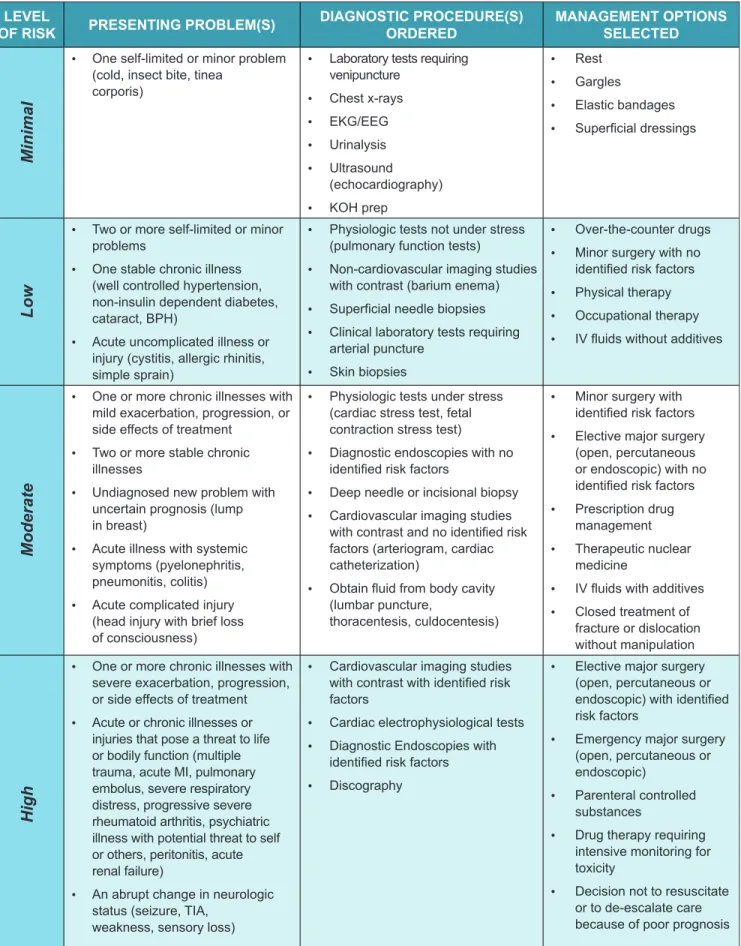
The table on the next page may be used to assist in determining whether the level of risk of significant complications, morbidity, and/or mortality is minimal, low, moderate, or high. Because determination of risk is complex and not readily quantifiable, the table includes common clinical examples rather than absolute measures of risk.
Table of Risk LEVEL
OF RISK PRESENTING PROBLEM(S) DIAGNOSTICORDERED PROCEDURE(S) MANAGEMENT OPTIONS SELECTED
Minimal
• One self-limited or minor problem (cold, insect bite, tinea
corporis)
• Laboratory tests requiring venipuncture
• Chest x-rays • EKG/EEG • Urinalysis • Ultrasound
(echocardiography) • KOH prep
• Rest • Gargles • Elastic bandages • Superficial dressings
Low
• Two or more self-limited or minor problems
• One stable chronic illness (well controlled hypertension, non-insulin dependent diabetes, cataract, BPH)
• Acute uncomplicated illness or injury (cystitis, allergic rhinitis, simple sprain)
• Physiologic tests not under stress (pulmonary function tests)
• Non-cardiovascular imaging studies with contrast (barium enema) • Superficial needle biopsies • Clinical laboratory tests requiring
arterial puncture • Skin biopsies
• Over-the-counter drugs • Minor surgery with no
identified risk factors • Physical therapy • Occupational therapy • IV fluids without additives
Moderate
• One or more chronic illnesses with mild exacerbation, progression, or side effects of treatment
• Two or more stable chronic illnesses
• Undiagnosed new problem with uncertain prognosis (lump in breast)
• Acute illness with systemic symptoms (pyelonephritis, pneumonitis, colitis) • Acute complicated injury
(head injury with brief loss of consciousness)
• Physiologic tests under stress (cardiac stress test, fetal contraction stress test)
• Diagnostic endoscopies with no identified risk factors
• Deep needle or incisional biopsy • Cardiovascular imaging studies
with contrast and no identified risk factors (arteriogram, cardiac catheterization)
• Obtain fluid from body cavity (lumbar puncture,
thoracentesis, culdocentesis)
• Minor surgery with identified risk factors • Elective major surgery
(open, percutaneous or endoscopic) with no identified risk factors • Prescription drug
management • Therapeutic nuclear
medicine
• IV fluids with additives • Closed treatment of
fracture or dislocation without manipulation
High
• One or more chronic illnesses with severe exacerbation, progression, or side effects of treatment • Acute or chronic illnesses or
injuries that pose a threat to life or bodily function (multiple trauma, acute MI, pulmonary embolus, severe respiratory distress, progressive severe rheumatoid arthritis, psychiatric illness with potential threat to self or others, peritonitis, acute renal failure)
• An abrupt change in neurologic
• Cardiovascular imaging studies with contrast with identified risk factors
• Cardiac electrophysiological tests • Diagnostic Endoscopies with
identified risk factors • Discography
• Elective major surgery (open, percutaneous or endoscopic) with identified risk factors
• Emergency major surgery (open, percutaneous or endoscopic)
• Parenteral controlled substances
• Drug therapy requiring intensive monitoring for toxicity
Documentation of an Encounter Dominated by Counseling and/or Coordination of Care When counseling and/or coordination of care dominates (more than 50 percent of) the physician/patient and/or family encounter (face-to-face time in the office or other outpatient setting, floor/unit time in the hospital, or NF), time is considered the key or controlling factor to qualify for a particular level of E/M services. If the level of service is reported based on counseling and/or coordination of care, the total length of time of the encounter should be documented and the record should describe the counseling and/or activities to coordinate care.
The Level I and Level II CPT® books, which are available from the American Medical Association, list average time guidelines for a variety of E/M services. These times include work done before, during, and after the encounter. The specific times expressed in the code descriptors are averages and, therefore, represent a range of times that may be higher or lower depending on actual clinical circumstances.
OTHER CONSIDERATIONS SPLIT/SHARED SERVICES
A split/shared service is an encounter where a physician and a NPP each personally perform a portion of an E/M visit. Below are the rules for reporting split/shared E/M services between physicians and NPPs:
❖ Office/clinic setting:
• For encounters with established patients that meet incident to requirements, report the using the physician’s National Provider Identifier (NPI); and
• For encounters that do not meet incident to requirements, report using the NPP’s NPI.
❖ Hospital inpatient, outpatient, and ED setting encounters shared between a physician and a NPP from the same group practice:
• When the physician provides any face-to-face portion of the encounter, report using either provider’s NPI; and
• When the physician does not provide a face-to-face encounter, report using the NPP’s NPI.
CONSULTATION SERVICES
Effective for services furnished on or after January 1, 2010, inpatient consultation codes (CPT codes 99251 – 99255) and office and other outpatient consultation codes (CPT codes 99241 – 99245) are no longer recognized by Medicare for Part B payment purposes. However, telehealth consultation codes (Healthcare Common Procedure Coding System G0406 – G0408 and G0425 – G0427) continue to be recognized for Medicare payment. Physicians and NPPs who furnish services that, prior to January 1, 2010, would have been reported as CPT consultation codes should report the
appropriate E/M visit code in order to bill for these services beginning January 1, 2010. CPT only copyright 2014 American Medical Association. All rights reserved.
REFERENCE
SECTION
RESOURCESAdditional information about evaluation and management services is available as follows: ❖ The publication titled “1995 Documentation Guidelines for Evaluation and
Management Services” can be accessed beginning on page 23 of this guide and at http://www.cms.gov/MLNProducts/Downloads/1995dg.pdf on the Centers for Medicare & Medicaid Services (CMS) website;
❖ The publication titled “1997 Documentation Guidelines for Evaluation and Management Services” can be accessed beginning on page 39 of this guide and at http://www.cms.gov/MLNProducts/Downloads/MASTER1.pdf on the CMS website;
❖ The “Medicare Benefit Policy Manual” (Pub. 100-02) and the “Medicare Claims Processing Manual” (Pub. 100-04) can be accessed at http://www.cms.gov/ Manuals/IOM/list.asp on the CMS website;
❖ International Classification of Diseases, 9th Revision, Clinical
Modification (ICD-9-CM) resources are available at http://www.cms.gov/ ICD9ProviderDiagnosticCodes and International Classification of Diseases, 10th Revision, Clinical Modification/Procedure Coding System (ICD-10-CM/PCS) resources are available at http://www.cms.gov/ICD10 on the CMS website; and ❖ CPT® books are available from the American Medical Association at
1995 DOCUMENTATION GUIDELINES
FOR EVALUATION AND MANAGEMENT SERVICES
F R EVA UATION AN MANAGE
1995 DOCUMEN
I. INTRODUCTION
WHAT IS DOCUMENTATION AND WHY IS IT IMPORTANT?
Medical record documentation is required to record pertinent facts, findings, and observations about an individual's health history including past and present illnesses, examinations, tests, treatments, and outcomes. The medical record chronologically documents the care of the patient and is an important element contributing to high quality care. The medical record facilitates:
the ability of the physician and other healthcare professionals to evaluate and
plan the patient’s immediate treatment, and to monitor his/her healthcare over
time;
communication and continuity of care among physicians and other healthcare professionals involved in the patient's care;
accurate and timely claims review and payment;
appropriate utilization review and quality of care evaluations; and collection of data that may be useful for research and education.
An appropriately documented medical record can reduce many of the "hassles"
associated with claims processing and may serve as a legal document to verify the care provided, if necessary.
WHAT DO PAYERS WANT AND WHY?
Because payers have a contractual obligation to enrollees, they may require reasonable documentation that services are consistent with the insurance coverage provided. They may request information to validate:
the site of service;
the medical necessity and appropriateness of the diagnostic and/or therapeutic services provided; and/or
that services provided have been accurately reported.
II. GENERAL PRINCIPLES OF MEDICAL RECORD DOCUMENTATION
The principles of documentation listed below are applicable to all types of medical and surgical services in all settings. For Evaluation and Management (E/M) services, the nature and amount of physician work and documentation varies by type of service, place of service and the patient's status. The general principles listed below may be modified to account for these variable circumstances in providing E/M services.
1. The medical record should be complete and legible.
2. The documentation of each patient encounter should include:
reason for the encounter and relevant history, physical examination findings, and prior diagnostic test results;
assessment, clinical impression, or diagnosis; plan for care; and
date and legible identity of the observer.
3. If not documented, the rationale for ordering diagnostic and other ancillary services should be easily inferred.
4. Past and present diagnoses should be accessible to the treating and/or consulting physician.
5. Appropriate health risk factors should be identified.
6. The patient's progress, response to and changes in treatment, and revision of diagnosis should be documented.
7. The CPT and ICD-9-CM codes reported on the health insurance claim form or billing statement should be supported by the documentation in the medical record.
II. DOCUMENTATION OF E/M SERVICES
This publication provides definitions and documentation guidelines for the three key
components of E/M services and for visits which consist predominately of counseling or coordination of care. The three key components--history, examination, and medical decision making--appear in the descriptors for office and other outpatient services, hospital observation services, hospital inpatient services, consultations, emergency department services, nursing facility services, domiciliary care services, and home services. While some of the text of CPT has been repeated in this publication, the reader should refer to CPT for the complete descriptors for E/M services and
instructions for selecting a level of service. Documentation guidelines are identified by the symbol • DG.
The descriptors for the levels of E/M services recognize seven components which are used in defining the levels of E/M services. These components are:
history; examination;
medical decision making; counseling;
coordination of care;
nature of presenting problem; and time.
The first three of these components (i.e., history, examination and medical decision making) are the key components in selecting the level of E/M services. An exception to this rule is the case of visits which consist predominantly of counseling or coordination of care; for these services time is the key or controlling factor to qualify for a particular level of E/M service.
For certain groups of patients, the recorded information may vary slightly from that described here. Specifically, the medical records of infants, children, adolescents and pregnant women may have additional or modified information recorded in each history and examination area.
As an example, newborn records may include under history of the present illness (HPI)
the details of mother’s pregnancy and the infant's status at birth; social history will focus
on family structure; family history will focus on congenital anomalies and hereditary disorders in the family. In addition, information on growth and development and/or nutrition will be recorded. Although not specifically defined in these documentation guidelines, these patient group variations on history and examination are appropriate.
A. DOCUMENTATION OF HISTORY
The levels of E/M services are based on four types of history (Problem Focused, Expanded Problem Focused, Detailed, and Comprehensive). Each type of history includes some or all of the following elements:
Chief complaint (CC);
History of present illness (HPI); Review of systems (ROS); and
Past, family and/or social history (PFSH).
The extent of history of present illness, review of systems, and past, family and/or social history that is obtained and documented is dependent upon clinical judgment and the nature of the presenting problem(s).
The chart below shows the progression of the elements required for each type of history. To qualify for a given type of history, all three elements in the table must be met. (A chief complaint is indicated at all levels.)
History of Present Illness
(HPI)
Review of Systems
(ROS) and/or Social Past, Family, History (PFSH)
Type of History
Brief N/A N/A Problem
Focused
Brief Problem Pertinent N/A Expanded Problem Focused
Extended Extended Pertinent Detailed
Extended Complete Complete Comprehensive
DG: The CC, ROS and PFSH may be listed as separate elements of history, or they may be included in the description of the history of the present illness. DG: A ROS and/or a PFSH obtained during an earlier encounter does not need to be re-recorded if there is evidence that the physician reviewed and updated the previous information. This may occur when a physician updates his/her own record or in an institutional setting or group practice where many physicians use a common record. The review and update may be documented by:
o describing any new ROS and/or PFSH information or noting there has been no change in the information; and
o noting the date and location of the earlier ROS and/or PFSH.
DG: The ROS and/or PFSH may be recorded by ancillary staff or on a form completed by the patient. To document that the physician reviewed the information, there must be a notation supplementing or confirming the information recorded by others.
DG: If the physician is unable to obtain a history from the patient or other source, the record should describe the patient's condition or other circumstance which precludes obtaining a history.
Definitions and specific documentation guidelines for each of the elements of history are listed below.
CHIEF COMPLAINT (CC)
The CC is a concise statement describing the symptom, problem, condition, diagnosis, physician recommended return, or other factor that is the reason for the encounter.
DG: The medical record should clearly reflect the chief complaint.
HISTORY OF PRESENT ILLNESS (HPI)
The HPI is a chronological description of the development of the patient's present illness from the first sign and/or symptom or from the previous encounter to the present. It includes the following elements:
location; quality; severity; duration; timing; context;
modifying factors; and
associated signs and symptoms.
Brief and extended HPIs are distinguished by the amount of detail needed to accurately characterize the clinical problem(s).
A brief HPI consists of one to three elements of the HPI.
DG: The medical record should describe one to three elements of the present illness (HPI).
An extended HPI consists of four or more elements of the HPI.
DG: The medical record should describe four or more elements of the present illness (HPI) or associated comorbidities.
REVIEW OF SYSTEMS (ROS)
A ROS is an inventory of body systems obtained through a series of questions seeking to identify signs and/or symptoms which the patient may be experiencing or has
experienced.
For purposes of ROS, the following systems are recognized: Constitutional symptoms (e.g., fever, weight loss) Eyes
Ears, Nose, Mouth, Throat Cardiovascular
Respiratory Gastrointestinal Genitourinary Musculoskeletal
Integumentary (skin and/or breast) Neurological
Psychiatric Endocrine
Hematologic/Lymphatic Allergic/Immunologic
A problem pertinent ROS inquires about the system directly related to the problem(s) identified in the HPI.
DG: The patient's positive responses and pertinent negatives for the system related to the problem should be documented.
An extended ROS inquires about the system directly related to the problem(s) identified in the HPI and a limited number of additional systems.
DG: The patient's positive responses and pertinent negatives for two to nine systems should be documented.
A complete ROS inquires about the system(s) directly related to the problem(s) identified in the HPI plus all additional body systems.
DG: At least ten organ systems must be reviewed. Those systems with positive or pertinent negative responses must be individually documented. For the remaining systems, a notation indicating all other systems are negative is permissible. In the absence of such a notation, at least ten systems must be individually documented.
PAST, FAMILY, AND/OR SOCIAL HISTORY (PFSH)
The PFSH consists of a review of three areas:
past history (the patient's past experiences with illnesses, operations, injuries and treatments);
family history (a review of medical events in the patient's family, including diseases which may be hereditary or place the patient at risk); and
social history (an age appropriate review of past and current activities).
For the categories of subsequent hospital care, follow-up inpatient consultations and subsequent nursing facility care, CPT requires only an "interval" history. It is not necessary to record information about the PFSH.
A pertinent PFSH is a review of the history area(s) directly related to the problem(s) identified in the HPI.
DG: At least one specific item from any of the three history areas must be documented for a pertinent PFSH.
A complete PFSH is of a review of two or all three of the PFSH history areas, depending on the category of the E/M service. A review of all three history areas is required for services that by their nature include a comprehensive assessment or reassessment of the patient. A review of two of the three history areas is sufficient for other services.
DG: At least one specific item from two of the three history areas must be documented for a complete PFSH for the following categories of E/M services: office or other outpatient services, established patient; emergency department; subsequent nursing facility care; domiciliary care, established patient; and home care, established patient.
DG: At least one specific item from each of the three history areas must be documented for a complete PFSH for the following categories of E/M services: office or other outpatient services, new patient; hospital observation services; hospital inpatient services, initial care; consultations; comprehensive nursing facility assessments; domiciliary care, new patient; and homecare, new patient.
B. DOCUMENTATION OF EXAMINATION
The levels of E/M services are based on four types of examination that are defined as follows:
Problem Focused -- a limited examination of the affected body area or organ system.
Expanded Problem Focused -- a limited examination of the affected body area or organ system and other symptomatic or related organ system(s).
Detailed -- an extended examination of the affected body area(s) and other symptomatic or related organ system(s).
Comprehensive -- a general multi-system examination or complete examination of a single organ system.
For purposes of examination, the following body areas are recognized: Head, including the face
Neck
Chest, including breasts and axillae Abdomen
Genitalia, groin, buttocks Back, including spine Each extremity
For purposes of examination, the following organ systems are recognized: Constitutional (e.g., vital signs, general appearance)
Eyes
Ears, nose, mouth, and throat Cardiovascular
Respiratory Gastrointestinal Genitourinary Musculoskeletal Skin
Neurologic Psychiatric
Hematologic/lymphatic/immunologic
The extent of examinations performed and documented is dependent upon clinical judgment and the nature of the presenting problem(s). They range from limited examinations of single body areas to general multi-system or complete single organ system examinations.
DG: Specific abnormal and relevant negative findings of the examination of the affected or symptomatic body area(s) or organ system(s) should be documented.
A notation of "abnormal” without elaboration is insufficient.
DG: Abnormal or unexpected findings of the examination of the unaffected or asymptomatic body area(s) or organ system(s) should be described.
DG: A brief statement or notation indicating "negative" or "normal" is sufficient to document normal findings related to unaffected area(s) or asymptomatic organ system(s).
DG: The medical record for a general multi-system examination should include findings about 8 or more of the 12 organ systems.
C. DOCUMENTATION OF THE COMPLEXITY OF MEDICAL DECISION MAKING
The levels of E/M services recognize four types of medical decision making (straight-forward, low complexity, moderate complexity, and high complexity). Medical decision making refers to the complexity of establishing a diagnosis and/or selecting a
management option as measured by:
the number of possible diagnoses and/or the number of management options that must be considered;
the amount and/or complexity of medical records, diagnostic tests, and/or other information that must be obtained, reviewed, and analyzed; and
the risk of significant complications, morbidity, and/or mortality, as well as
comorbidities associated with the patient's presenting problem(s), the diagnostic procedure(s) and/or the possible management options.
The chart below shows the progression of the elements required for each level of medical decision making. To qualify for a given type of decision making, two of the three elements in the table must be either met or exceeded.
Number of diagnoses or management
options
Amount and/or complexity of data
to be reviewed
Risk of complications and/or morbidity
or mortality
Type of decision making
Minimal Minimal or None Minimal Straightforward
Limited Limited Low Low Complexity
Multiple Moderate Moderate Moderate Complexity
Extensive Extensive High High Complexity
Each of the elements of medical decision making is described on the following page.
NUMBER OF DIAGNOSES OR MANAGEMENT OPTIONS
The number of possible diagnoses and/or the number of management options that must be considered is based on the number and types of problems addressed during the encounter, the complexity of establishing a diagnosis and the management decisions that are made by the physician.
Generally, decision making with respect to a diagnosed problem is easier than that for an identified but undiagnosed problem. The number and type of diagnostic tests employed may be an indicator of the number of possible diagnoses. Problems which are improving or resolving are less complex than those which are worsening or failing to change as expected. The need to seek advice from others is another indicator of
complexity of diagnostic or management problems.
DG:For each encounter, an assessment, clinical impression, or diagnosis should be documented. It may be explicitly stated or implied in documented decisions regarding management plans and/or further evaluation.
For a presenting problem with an established diagnosis the record should reflect whether the problem is: a) improved, well controlled, resolving or resolved; or, b) inadequately controlled, worsening, or failing to change as expected.
For a presenting problem without an established diagnosis, the assessment or clinical impression may be stated in the form of a differential diagnoses or
as "possible,” "probable,” or "rule out” (R/O) diagnoses.
DG:The initiation of, or changes in, treatment should be documented. Treatment includes a wide range of management options including patient instructions, nursing instructions, therapies, and medications.
DG:If referrals are made, consultations requested or advice sought, the record should indicate to whom or where the referral or consultation is made or from whom the advice is requested.
AMOUNT AND/OR COMPLEXITY OF DATA TO BE REVIEWED
The amount and complexity of data to be reviewed is based on the types of diagnostic testing ordered or reviewed. A decision to obtain and review old medical records and/or obtain history from sources other than the patient increases the amount and complexity of data to be reviewed.
Discussion of contradictory or unexpected test results with the physician who performed or interpreted the test is an indication of the complexity of data being reviewed. On
occasion the physician who ordered a test may personally review the image, tracing or specimen to supplement information from the physician who
prepared the test report or interpretation; this is another indication of the complexity of data being reviewed.
DG: If a diagnostic service (test or procedure) is ordered, planned, scheduled, or performed at the time of the E/M encounter, the type of service, eg, lab or x-ray, should be documented.
DG: The review of lab, radiology and/or other diagnostic tests should be documented. An entry in a progress note such as "WBC elevated" or "chest x-ray unremarkable" is acceptable. Alternatively, the review may be documented by initialing and dating the report containing the test results.
DG: A decision to obtain old records or decision to obtain additional history from the family, caretaker or other source to supplement that obtained from the patient should be documented.
DG: Relevant finding from the review of old records, and/or the receipt of additional history from the family, caretaker or other source should be
documented. If there is no relevant information beyond that already obtained, that fact should be documented. A notation of "Old records reviewed” or "additional history obtained from family” without elaboration is insufficient.
DG: The results of discussion of laboratory, radiology or other diagnostic tests with the physician who performed or interpreted the study should be
documented.
DG: The direct visualization and independent interpretation of an image, tracing, or specimen previously or subsequently interpreted by another physician should be documented.
RISK OF SIGNIFICANT COMPLICATIONS, MORBIDITY, AND/OR MORTALITY
The risk of significant complications, morbidity, and/or mortality is based on the risks associated with the presenting problem(s), the diagnostic procedure(s), and the possible management options.
DG: Comorbidities/underlying diseases or other factors that increase the complexity of medical decision making by increasing the risk of complications, morbidity, and/or mortality should be documented.
DG: If a surgical or invasive diagnostic procedure is ordered, planned, or scheduled at the time of the E/M encounter, the type of procedure eg, laparoscopy, should be documented.
DG: If a surgical or invasive diagnostic procedure is performed at the time of the E/M encounter, the specific procedure should be documented.
DG: The referral for or decision to perform a surgical or invasive diagnostic procedure on an urgent basis should be documented or implied.
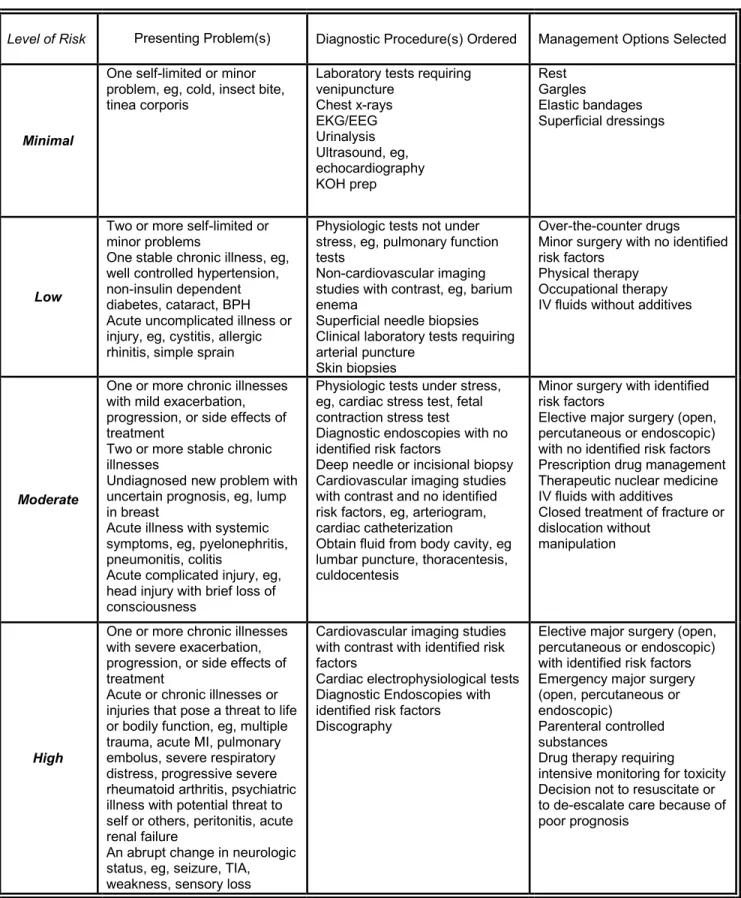
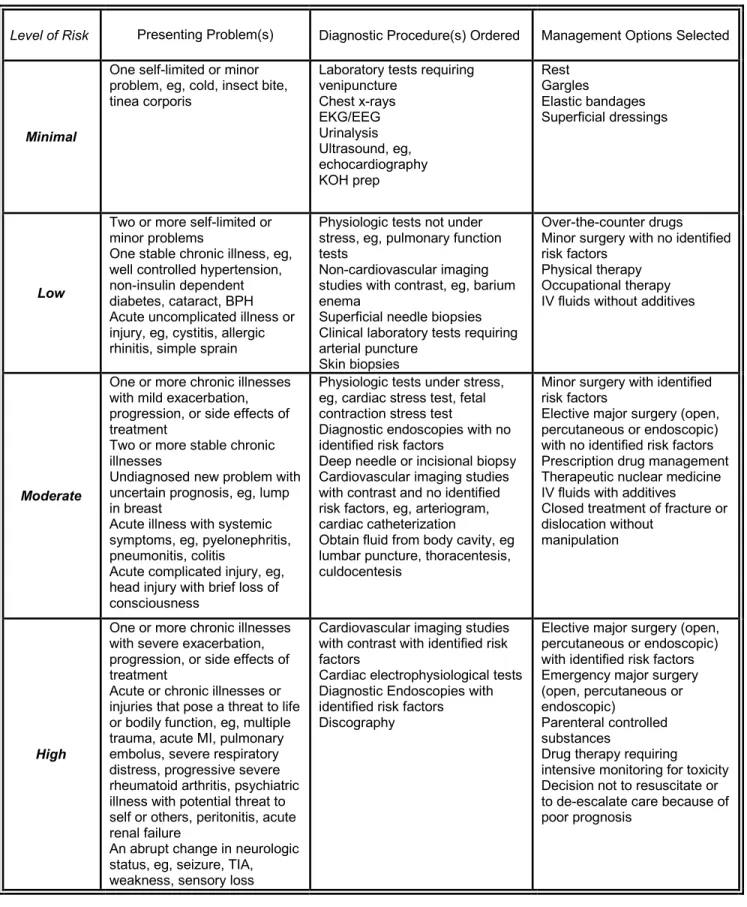
The following table may be used to help determine whether the risk of significant
complications, morbidity, and/or mortality is minimal, low, moderate, or high. Because the determination of risk is complex and not readily quantifiable, the table includes common clinical examples rather than absolute measures of risk. The assessment of risk of the presenting problem(s) is based on the risk related to the disease process anticipated between the present encounter and the next one. The assessment of risk of selecting diagnostic procedures and management options is based on the risk during and immediately following any procedures or treatment. The highest level of risk in any one category (presenting problem(s), diagnostic procedure(s), or management options) determines the overall risk.
Level of Risk Presenting Problem(s) Diagnostic Procedure(s) Ordered Management Options Selected
Minimal
One self-limited or minor problem, eg, cold, insect bite, tinea corporis
Laboratory tests requiring venipuncture Chest x-rays EKG/EEG Urinalysis Ultrasound, eg, echocardiography KOH prep Rest Gargles Elastic bandages Superficial dressings Low
Two or more self-limited or minor problems
One stable chronic illness, eg, well controlled hypertension, non-insulin dependent diabetes, cataract, BPH Acute uncomplicated illness or injury, eg, cystitis, allergic rhinitis, simple sprain
Physiologic tests not under stress, eg, pulmonary function tests
Non-cardiovascular imaging studies with contrast, eg, barium enema
Superficial needle biopsies Clinical laboratory tests requiring arterial puncture
Skin biopsies
Over-the-counter drugs Minor surgery with no identified risk factors
Physical therapy Occupational therapy IV fluids without additives
One or more chronic illnesses with mild exacerbation, progression, or side effects of treatment
Two or more stable chronic
Physiologic tests under stress, eg, cardiac stress test, fetal contraction stress test
Diagnostic endoscopies with no identified risk factors
Minor surgery with identified risk factors
Elective major surgery (open, percutaneous or endoscopic) with no identified risk factors
Moderate
illnesses
Undiagnosed new problem with uncertain prognosis, eg, lump in breast
Acute illness with systemic symptoms, eg, pyelonephritis, pneumonitis, colitis
Acute complicated injury, eg, head injury with brief loss of consciousness
Deep needle or incisional biopsy Cardiovascular imaging studies with contrast and no identified risk factors, eg, arteriogram, cardiac catheterization
Obtain fluid from body cavity, eg lumbar puncture, thoracentesis, culdocentesis
Prescription drug management Therapeutic nuclear medicine IV fluids with additives Closed treatment of fracture or dislocation without
manipulation
High
One or more chronic illnesses with severe exacerbation, progression, or side effects of treatment
Acute or chronic illnesses or injuries that pose a threat to life or bodily function, eg, multiple trauma, acute MI, pulmonary embolus, severe respiratory distress, progressive severe rheumatoid arthritis, psychiatric illness with potential threat to self or others, peritonitis, acute renal failure
Cardiovascular imaging studies with contrast with identified risk factors
Cardiac electrophysiological tests Diagnostic Endoscopies with identified risk factors Discography
Elective major surgery (open, percutaneous or endoscopic) with identified risk factors Emergency major surgery (open, percutaneous or endoscopic)
Parenteral controlled substances
Drug therapy requiring
intensive monitoring for toxicity Decision not to resuscitate or to de-escalate care because of poor prognosis
An abrupt change in neurologic status, eg, seizure, TIA, weakness, sensory loss
15
D. DOCUMENTATION OF AN ENCOUNTER DOMINATED BY COUNSELING OR COORDINATION OF CARE
In the case where counseling and/or coordination of care dominates (more than 50%) of the physician/patient and/or family encounter (face-to-face time in the office or other outpatient setting or floor/unit time in the hospital or nursing facility), time is considered the key or controlling factor to qualify for a particular level of E/M services.
DG: If the physician elects to report the level of service based on counseling and/or coordination of care, the total length of time of the encounter (face-to-face or floor time, as appropriate) should be documented and the record should describe the counseling and/or activities to coordinate care.
1997 DOCUMENTATION GUIDELINES
FOR EVALUATION AND MANAGEMENT SERVICES
TABLE OF CONTENTS
Introduction ...…… 2 What Is Documentation and Why Is it Important?...………. 2 What Do Payers Want and Why? ...……… 2 General Principles of Medical Record Documentation ... 3 Documentation of E/M Services... 4 Documentation of History ... 5 Chief Complaint (CC) ... 6 History of Present Illness (HPI) ... 7 Review of Systems (ROS) ... 8 Past, Family and/or Social History (PFSH) ... 9 Documentation of Examination ... 10
General Multi-System Examinations ... 11 Single Organ System Examinations ... 12 Content and Documentation Requirements ... 13 General Multi-System Examination ………... 13 Cardiovascular Examination ... 18 Ear, Nose and Throat Examination ... 20 Eye Examination ... 23 Genitourinary Examination ... 25 Hematologic/Lymphatic/Immunologic Examination ... 29 Musculoskeletal Examination ... 31 Neurological Examination ... 34 Psychiatric Examination ... 37 Respiratory Examination ... 39 Skin Examination ... 41
Documentation of the Complexity of Medical Decision Making ... 43 Number of Diagnoses or Management Options ... 44 Amount and/or Complexity of Data to Be Reviewed ... 45 Risk of Significant Complications, Morbidity, and/or Mortality ... 46 Table of Risk ... 47 Documentation of an Encounter Dominated by Counseling or Coordination of Care ………... 48