m
Mathematical tasks that give students the opportunity to use reasoning skills while thinking are the most difficult for teachers to implement well. Research by Stein and colleagues (Henningsen and Stein 1997; Stein and Lane 1996; Stein, Grover, and Henningsen 1996) makes the case resoundingly that cog-nitively challenging tasks that promote thinking, reasoning, and problem solving often decline duringimplemen-Successfully Implementing High-Level Tasks
Margaret S. Smith, Victoria Bill, and Elizabeth K. Hughes
Margaret S. Smith, [email protected], is an associate professor of mathematicseduca-tion at the University of Pittsburgh in Pennsylvania. Over the past decade, she has been developing research-based materials for use in the professional development of math-ematics teachers and studying what teachers learn from their professional development. Victoria Bill, [email protected], is a fellow at the Institute for Learning at the University of Pittsburgh. She provides professional development to coaches and other instructional leaders who are supporting mathematics education reform in urban school districts. Elizabeth K. Hughes, [email protected], is an assistant professor at the Univer-sity of Northern Iowa in Cedar Falls. Her areas of interest include preservice secondary mathematics teacher education and the use of practice-based materials in developing teachers’ understanding of what it means to teach and learn mathematics.
132 MatHEMaticS tEacHing in tHE MiddlE ScHool ● Vol. 14, No. 3, October 2008
thinking through a lesson:
Br
UCE
L
ONN
gr
EN
/ISt
OCKPHO
tO
tation as a result of various classroom factors. When this occurs, students must apply previously learned rules and procedures with no connection to meaning or understanding, and the op-portunities for thinking and reasoning are lost. Why are such tasks so difficult to implement in ways that maintain the rigor of the activity? Stein and Kim (2006, p. 11) contend that lessons based on high-level (i.e., cognitively chal-lenging) tasks “are less intellectually ‘controllable’ from the teacher’s point of view.” They argue that since procedures for solving high-level tasks are often not specified in advance, students must draw on their relevant knowledge and experiences to find a solution path. Take, for example, the Bag of Marbles task shown in figure 1. Using their knowledge of fractions, ratios, and percents, students can solve the task in a number of different ways:
• Determine the fraction of each bag that is blue marbles, decide which of the three fractions is largest, then select the bag with the largest fraction of blue marbles
• Determine the fraction of each bag that is blue marbles, change each fraction to a percent, then select the bag with the largest percent of blue marbles
• Determine the unit rate of red to blue marbles for each bag and decide which bag has the fewest red marbles for every 1 blue marble • Scale up the ratios representing
each bag so that the number of blue marbles in each bag is the same, then select the bag that has the fewest red marbles for the fixed number of blue marbles
• Compare bags that have the same number of blue marbles, eliminate the bag that has more red marbles, and compare the remaining two bags using one of the other methods • Determine the difference
be-tween the number of red and blue
marbles in each bag and select the bag that has the smallest difference between red and blue (not correct) The lack of a specific solution path is an important component of what makes this task worthwhile. It also challenges teachers to understand the wide range of methods that a student might use to solve a task and think about how the different methods are related, as well as how to connect students’ diverse ways of thinking to important disciplinary ideas.
One way to both control teaching with high-level tasks and promote suc-cess is through detailed planning prior to the lesson. The remainder of this article focuses on TTLP: the Thinking Through a Lesson Protocol. TTLP is a process that is intended to further the use of cognitively challenging tasks (Smith and Stein 1998). We begin by discussing the key features of the TTLP, suggest ways in which it can be used with collaborative lesson plan-ning, and conclude with a discussion of the potential benefits of using it.
Exploring tHE lESSon planning protocol
The TTLP, shown in figure 2, provides a framework for developing lessons that use students’ mathemati-cal thinking as the critimathemati-cal ingredient in developing their understanding of key disciplinary ideas. As such, it is intended to promote the type of careful and detailed planning that is characteristic of Japanese lesson study (Stigler and Hiebert 1999) by helping teachers anticipate what students will do and generate questions teachers can ask that will promote student learning prior to a lesson being taught.
The TTLP is divided into three sections: Part 1: Selecting and Set-ting Up a Mathematical Task, Part 2: Supporting Students’ Exploration of the Task, and Part 3: Sharing and Discussing the Task. Part 1 lays the groundwork for subsequent planning by asking the teacher to identify the mathematical goals for the lesson and set expectations regarding how students will work. The mathemati-cal ideas to be learned through work Ms. rhee’s mathematics class was studying statistics. She brought in three bags containing red and blue marbles. the three bags were labeled as shown below:
75 red 40 red 100 red
25 blue 20 blue 25 blue
Bag X Bag Y Bag Z
total = 100 marbles total = 60 marbles total = 125 marbles Ms. rhee shook each bag. She asked the class, “If you close your eyes, reach into a bag, and remove 1 marble, which bag would give you the best chance of picking a blue marble?”
Which bag would you choose?
Explain why this bag gives you the best chance of picking a blue marble. You may use the diagram above in your explanation.
on a specific task provide direction for all decision making during the lesson. The intent of the TTLP is to help teachers keep “an eye on the
mathematical horizon” (Ball 1993) and never lose sight of what they are trying to accomplish mathematically. Part 2 focuses on monitoring students
as they explore the task (individu-ally or in small groups). Students are asked questions based on the solution method used to assess what they
part 1: SElEcting and SEtting up a MatHEMatical taSK
What are your mathematical goals for the lesson (i.e., what do you want students to know and understand about math-ematics as a result of this lesson)?
In what ways does the task build on students’ previous knowl-edge, life experiences, and culture? What definitions, concepts, or ideas do students need to know to begin to work on the task? What questions will you ask to help students access their prior knowledge and relevant life and cultural experiences? What are all the ways the task can be solved?
• Which of these methods do you think your students will use?
• What misconceptions might students have?
• What errors might students make?
What particular challenges might the task present to strug-gling students or students who are English Language Learners (ELL)? How will you address these challenges?
What are your expectations for students as they work on and complete this task?
• What resources or tools will students have to use in their work that will give them entry into, and help them reason through, the task?
• How will the students work—independently, in small groups, or in pairs—to explore this task? How long will they work individually or in small groups or pairs? Will stu-dents be partnered in a specific way? If so, in what way?
• How will students record and report their work?
How will you introduce students to the activity so as to provide access to all students while maintaining the cognitive demands of the task? How will you ensure that students understand the context of the problem? What will you hear that lets you know students understand what the task is asking them to do?
part 2: Supporting StudEntS’ Exploration oF tHE taSK
As students work independently or in small groups, what questions will you ask to—
• help a group get started or make progress on the task?
• focus students’ thinking on the key mathematical ideas in the task?
• assess students’ understanding of key mathematical ideas, problem-solving strategies, or the representations?
• advance students’ understanding of the mathematical ideas?
• encourage all students to share their thinking with others or to assess their understanding of their peers’ ideas? How will you ensure that students remain engaged in the task?
• What assistance will you give or what questions will you ask a student (or group) who becomes quickly frustrated and requests more direction and guidance in solving the task?
• What will you do if a student (or group) finishes the task almost immediately? How will you extend the task so as to provide additional challenge?
• What will you do if a student (or group) focuses on non-mathematical aspects of the activity (e.g., spends most of his or her (or their) time making a poster of their work)?
part 3: SHaring and diScuSSing tHE taSK
How will you orchestrate the class discussion so that you accomplish your mathematical goals?
• Which solution paths do you want to have shared during the class discussion? In what order will the solutions be presented? Why?
• In what ways will the order in which solutions are presented help develop students’ understanding of the mathematical ideas that are the focus of your lesson?
• What specific questions will you ask so that students will— 1. make sense of the mathematical ideas that you want
them to learn?
2. expand on, debate, and question the solutions being shared?
3. make connections among the different strategies that are presented?
4. look for patterns?
5. begin to form generalizations?
How will you ensure that, over time, each student has the oppor-tunity to share his or her thinking and reasoning with their peers? What will you see or hear that lets you know that all students in the class understand the mathematical ideas that you intended for them to learn?
What will you do tomorrow that will build on this lesson?
currently understand so as to move them toward the mathematical goal of the lesson. Part 3 focuses on orches-trating a whole-group discussion of the task that uses the different solu-tion strategies produced by students to highlight the mathematical ideas that are the focus of the lesson.
uSing tHE ttlp aS a tool For collaBoratiVE planning
Many teachers’ first reaction to the TTLP may be this: “It is overwhelm-ing; no one could use this to plan les-sons every day!” It was never intended that a teacher would write out answers to all these questions everyday. Rather, teachers have used the TTLP periodi-cally (and collaboratively) to prepare lessons so that, over time, a repertoire of carefully designed lessons grows. In addition, as teachers become more familiar with the TTLP, they begin to ask themselves questions from the protocol as they plan lessons without explicit reference to the protocol. This sentiment is echoed in the comment made by one middle school teacher: “I follow this model when planning my lessons. Certainly not to the extent of writing down this detailed lesson plan, but in my mind I go through its progression. Internalizing what it stands for really makes you a better fa-cilitator.” Hence, the main purpose of the TTLP is to change the way that teachers think about and plan lessons. In the remainder of this section, we provide some suggestions on how you, the teacher, might use the TTLP as a tool to structure conversations with colleagues about teaching.
Getting Started
The Bag of Marbles task (shown in fig. 1) is used to ground our discussion of lesson planning. This task would be classified as high level. Since no pre-dictable pathway is explicitly suggested or implied by the task, students must
the whole up or down to a common amount, or converting a part-to-whole fraction to a percent). By being clear on exactly what students will learn, you will be better positioned to capi-talize on opportunities to advance the mathematics in the lesson and make decisions about what to emphasize and de-emphasize. Discussion with col-leagues will give you the opportunity to broaden your view regarding the mathematical potential of the task and the “residue” (Hiebert et al. 1997) that is likely to remain after the task. Anticipating Student
Responses to the Task
The third question in part 1—What are all the ways the task can be solved?—invites teachers to move beyond their own way of solving a problem and consider the correct and incorrect approaches that students are likely to use. You and your colleagues can brainstorm various approaches for solving the task (including wrong answers) and identify a subset of the solution methods that would be useful in reaching the mathematical goals for the lesson. This helps make a
“Coming up with
good questions
before the lesson
helps me keep a
high-level task at a
high level, instead of
pushing kids toward
a particular solution
path and giving them
an opportunity to
practice procedures”
access relevant knowledge andexperi-ences, use them appropriately while working through the task, and explain why they made a particular selection. Therefore, this task has the potential to engage students in high-level think-ing and reasonthink-ing. However, it also has the greatest chance of declining during implementation in ways that limit high-level thinking and reasoning (Henningsen and Stein 1997).
You and your colleagues may want to select a high-level task from the cur-riculum used in your school or find a task from another source that is aligned with your instructional goals (see Task Resources at the end of the article for suggested sources of high-level tasks). It is helpful to begin your collaborative work by focusing on a subset of TTLP questions rather than attempting to respond to all the questions in one sitting. Here are some suggestions on how to begin collaborative planning. Articulating the Goal for the Lesson The first question in part 1—What are your mathematical goals for the lesson?—is a critical starting point for planning. Using a selected task, you can begin to discuss what you are trying to accomplish through the use of this particular task. The challenge is to be clear about what mathematical ideas students are to learn and under-stand from their work on the task, not just what they will do. For example, teachers implementing the Bag of Marbles task may want students to be able to determine that bag Y will give the best chance of picking a blue mar-ble and to present a correct explana-tion why. Although this is a reasonable expectation, it present no detail on what students understand about ratios, the different comparisons that can be made with a ratio (i.e., part to part, part to whole, two different measures), or the different ways that ratios can be compared (e.g., scaling the parts up or down to a common amount, scaling
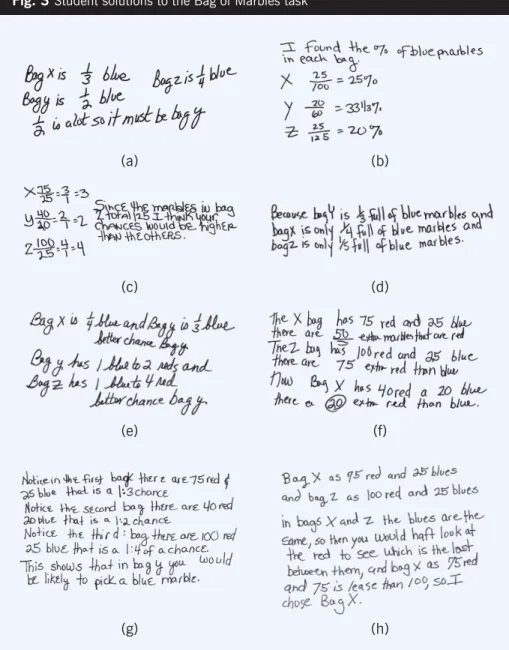
lesson more “intellectually control-lable” (Stein and Kim 2006) by encouraging you to think through the possibilities in advance of the lesson and hence requiring fewer improvi-sational moves during the lesson. If actual student work is available for the task being discussed, it can help you anticipate how students will proceed. For example, reviewing the student work in figure 3 can provide insight into a range of approaches, such as comparing fractions in figure 3d, finding and comparing percents in figure 3b, or comparing part-to-part
ratios in figure 3g. Student work will also present opportunities to discuss incorrect or incomplete solutions such as treating the ratio 1/3 as a fraction in figure 3a, comparing differences rather than finding a common basis for comparison in figure 3f, and cor-rectly comparing x and z but failing to then compare x and y in figure 3h. In addition, there should also be op-portunities to discuss which strategies might be most helpful in meeting the goals for the lesson. Although it is impossible to predict everything that students might do, by working with
colleagues, you can anticipate what may occur.
Creating Questions That Assess and Advance Students’ Thinking
The main point of part 2 of the TTLP is to create questions to ask students that will help them focus on the mathematical ideas that are at the heart of the lesson as they ex-plore the task. The questions you ask during instruction determine what students learn and understand about mathematics. Several studies point to both the importance of asking good questions during instruction and the difficulty that teachers have in doing so (e.g., Weiss and Pasley 2004).
You and your colleagues can use the solutions you anticipated and create questions that can as-sess what students understand about the problem (e.g., clarify what the student has done and what the stu-dent understands) and help stustu-dents advance toward the mathematical goals of the lesson. Teachers can extend students beyond their current thinking by pressing them to extend what they know to a new situation or think about something they are not currently thinking about. If student responses for the task are available, you might generate assessing and advancing questions for each antici-pated student response. Consider, for example, the responses shown in fig-ure 3 to the Bag of Marbles problem. If you, as the teacher, approached the student who produced response (c) during the lesson, you would notice that the student compared red marbles to blue marbles, reduced these ratios to unit rates (number of red marbles to one blue marble), and then wrote the whole numbers (3, 2, and 4). However, the student did not use these calculations to deter-mine that in bag Y the number of red marbles was only twice the number of blue marbles, whereas in bag X and Z
(a) (b)
(c) (d)
(e) (f)
(g) (h)
the number of red marbles were 3 and 4 times, respectively, the number of blue marbles. You might want to ask the student who produced response (c) a series of questions that will help you assess what the student currently understands:
• What quantities did you compare and why?
• What did the numbers 3, 2, and 4 mean in terms of the problem? • How could the mathematical work
you are doing, making comparisons, help you answer the question? Determining what a student under-stands about the comparisons that he or she makes can open a window into the student’s thinking. Once you have a clear sense of how the student is thinking about the task, you are better positioned to ask questions that will advance his or her understanding and help the student build a sound argu-ment based on the mathematical work.
potEntial BEnEFitS oF uSing tHE ttlp
Over the last several years, the TTLP has been used by numerous elementary and secondary teachers with vary-ing levels of teachvary-ing experience who wanted to implement high-level tasks in their classrooms. The cumulative experiences of these teachers suggests that the TTLP can be a useful tool in planning, teaching, and reflecting on lessons and can lead to improved teach-ing. Several teachers have commented, in particular, on the value of solving the task in multiple ways before the lesson begins and devising questions to ask that are based on anticipated approach-es. For example, one teacher indicated, “I often come up with great questions because I am exploring the task deeper and developing ‘what if ’ questions.” Another participant suggested that pre-paring questions in advance helps her support students without taking over
the challenging aspects of the problem for them:
Coming up with good questions before the lesson helps me keep a high-level task at a high level, instead of pushing kids toward a particular solution path and giving them an opportunity to practice procedures. When kids call me over and say they don’t know how to do something (which they often do), it helps if I have a ready-made response that gives them structure to keep working on the problem without doing it for them. This way all kids have a point of entry to the problem.
The TTLP has also been a useful tool for beginning teachers. In an interview about lesson planning conducted at the end of the first semester of her year-long internship (and nearly six months after she first encountered the TTLP), another preservice teacher offered the following explanation about how the TTLP had influenced her planning:
I may not have it sitting on my desk, going point to point with it, but I think: What are the misconceptions? How am I going to organize work? What are my questions? Those are the three big things that I’ve taken from the TTLP, and those are the three big things that I think about when planning a lesson. So, no, I’m not matching it up point for point but those three concepts are pretty much in every lesson, essentially.
Although this teacher does not follow the TTLP in its entirety each time she plans a lesson, she has taken key aspects of the TTLP and made them part of her daily lesson planning.
concluSion
The purpose of the Thinking Through a Lesson Protocol is to prompt teachers to think deeply
about a specific lesson that they will be teaching. The goal is to move beyond the structural components often associated with lesson plan-ning to a deeper consideration of how to advance students’ mathematical understanding during the lesson. By shifting the emphasis from what the teacher is doing to what students are thinking, the teacher will be better positioned to help students make sense of mathematics. One mathe-matics teacher summed up the poten-tial of the TTLP in this statement:
Sometimes it’s very time-consuming, trying to write these lesson plans, but it’s very helpful. It really helps the lesson go a lot smoother and even not having it front of me, I think it really helps me focus my thinking, which then [it] kind of helps me focus my students’ thinking, which helps us get to an objective and leads to a better lesson.
In addition to helping you create indi-vidual lessons, the TTLP can also help you consider your teaching practice over time. As another teacher pointed out, “The usefulness of the TTLP is in accepting that [your practice] evolves over time. Growth occurs as the proto-col is continually revisited and as you reflect on successes and failures.”
taSK rESourcES
Bright, George W., Dargan Frierson Jr., James E. Tarr, and Cynthia Thomas.
Navigating through Probability in Grades 6–8. Reston, VA: National Council of Teachers of Mathematics, 2003. Bright, George W., Wallece Brewer, Kay
McClain, and Edward S. Mooney. Nav-igating through Data Analysis in Grades 6-8. Reston, VA: National Council of Teachers of Mathematics, 2003. Bright, George W., Patricia Lamphere
Jor-dan, Carol Malloy, and Tad Watanabe.
Navigating through Measurement in Grades 6-8. Reston, VA: National Coun-cil of Teachers of Mathematics, 2005.
Brown, Catherine A., and Lynn V. Clark, eds. Learning from NAEP: Professional De-velopment Materials for Teachers of Math-ematics. Reston, VA: National Council of Teachers of Mathematics, 2006. Friel, Susan, Sid Rachlin, and Dot Doyle.
Navigating through Algebra in Grades 6–8. Reston, VA: National Council of Teachers of Mathematics, 2001. Illuminations. illuminations.nctm.org/
Lessons.aspx.
Parke, Carol S., Suzanne Lane, Edward A. Silver, and Maria E. Magone. Using Assessment to Improve Middle-Grades Mathematics Teaching and Learning: Suggested Activities Using QUASAR Tasks, Scoring Criteria, and Students’ Work. Reston, VA: National Council of Teachers of Mathematics, 2003. Pugalee, David K., Jeffrey Frykholm,
Art Johnson, Hannah Slovin, Carol Malloy, and Ron Preston. Navigating through Geometry in Grades 6–8. Res-ton, VA: National Council of Teachers
of Mathematics, 2002.
Rachlin, Sid, Kathy Cramer, Connie Fins-eth, Linda Cooper Foreman, Dorothy Geary, Seth Leavitt, and Margaret Schwan Smith. Navigating through Number and Operations in Grades 6–8. Reston, VA: National Council of Teachers of Mathematics, 2006.
rEFErEncES
Ball, Deborah L. “With an Eye on the Mathematical Horizon: Dilemmas of Teaching Elementary School Math-ematics.” The Elementary School Journal
93 (1993): 373–97.
Boaler, Jo, and Karin Brodie. “The Im-portance of Depth and Breadth in the Analysis of Teaching: A Framework for Analyzing Teacher Questions.” In the Proceedings of the 26th Annual Meeting of the North American Chapter of the International Group for the Psy-chology of Mathematics Education, pp. 773–80. Toronto, ON: PME, 2004.
Henningsen, Marjorie, and Mary Kay Stein. “Mathematical Tasks and Student Cognition: Classroom-Based Factors that Support and Inhibit High-Level Mathematical Thinking and Reasoning.” Journal for Research in Mathematics Education 29 (November 1997): 524–49.
Hiebert, James, Thomas P. Carpenter, Elizabeth Fennema, Karen C. Fuson, Diana Wearne, Hanlie Murray, Alwyn Olivier, and Piet Human. Making Sense: Teaching and Learning Math-ematics with Understanding. Ports-mouth, NH: Heinemann, 1997. Smith, Margaret Schwan, and Mary Kay
Stein. “Selecting and Creating Math-ematical Tasks: From Research to Prac-tice. Mathematics Teaching in the Middle School 3 (February 1998): 344–50. Stein, Mary Kay, and Susanne Lane.
“Instructional Tasks and the Develop-ment of Student Capacity to Think and Reason: An Analysis of the Relationship between Teaching and Learning in a Re-form Mathematics Project.” Educational Research and Evaluation 2 (1996): 50–80. Stein, Mary Kay, Barbara W. Grover,
and Marjorie Henningsen. “Building Student Capacity for Mathematical Thinking and Reasoning: An Analy-sis of Mathematical Tasks Used in Reform Classrooms.” American Edu-cational Research Journal 33 (Summer 1996): 455–88.
Stein, Mary Kay, and Gooyeon Kim. “The Role of Mathematics Curriculum in Large-Scale Urban Reform: An Anal-ysis of Demands and Opportunities for Teacher Learning.” Paper presented at the annual meeting of the American Educational Research Association, San Francisco, California, April 2006. Stigler, James W., and James Hiebert.
The Teaching Gap: Best Ideas from the World’s Teachers for Improving Educa-tion in the Classroom. New York: The Free Press, 1999.
Weiss, Iris, and Joan D. Pasley. “What Is High-Quality Instruction?” Educational Leadership 61 (February 2004): 24–28. ●