and Optimization for Multi-Core
Platforms
Rebecca L. Collins
Submitted in partial fulfillment of the requirements for the degree
of Doctor of Philosophy
in the Graduate School of Arts and Sciences
COLUMBIA UNIVERSITY
c 2011 Rebecca L. Collins All Rights Reserved
Data-Driven Programming Abstractions
and Optimization for Multi-Core
Platforms
Rebecca L. Collins
Multi-core platforms have spread to all corners of the computing industry, and trends in design and power indicate that the shift to multi-core will become even wider-spread in the future. As the number of cores on a chip rises, the complexity of memory systems and on-chip interconnects increases drastically. The programmer inherits this complexity in the form of new responsibilities for task decomposition, synchronization, and data movement within an application, which hitherto have been concealed by complex processing pipelines or deemed unimportant since tasks were largely executed sequentially. To some extent, the need for explicit parallel pro-gramming is inevitable, due to limits in the instruction-level parallelism that can be automatically extracted from a program. However, these challenges create a great opportunity for the development of new programming abstractions which hide the low-level architectural complexity while exposing intuitive high-level mechanisms for expressing parallelism.
Many models of parallel programming fall into the category of data-centric models, where the structure of an application depends on the role of data and communication in the relationships between tasks. The utilization of the inter-core communication networks and effective scaling to large data sets are decidedly important in designing efficient implementations of parallel applications. The questions ofhow many low-level architectural details should be exposed to the programmer, and how much parallelism
in an application a programmer should expose to the compiler remain open-ended, with different answers depending on the architecture and the application in ques-tion. I propose that the key to unlocking the capabilities of multi-core platforms is the development of abstractions and optimizations which match the patterns of data movement in applications with the inter-core communication capabilities of the platforms.
After a comparative analysis that confirms and stresses the importance of finding a good match between the programming abstraction, the application, and the archi-tecture, this dissertation proposes two techniques that showcase the power of leverag-ing data dependency patterns in parallel performance optimizations. Flexible Filters
dynamically balance load in stream programs by creating flexibility in the runtime data flow through the addition of redundant stream filters. This technique combines a static mapping with dynamic flow control to achieve light-weight, distributed and scal-able throughput optimization. The properties of stream communication, i.e., FIFO pipes, enable flexible filters by exposing the backpressure dependencies between tasks. Next, I presentHuckleberry, a novel recursive programming abstraction developed in order to allow programmers to expose data locality in divide-and-conquer algorithms at a high level of abstraction. Huckleberry automatically converts sequential recur-sive functions with explicit data partitioning into parallel implementations that can be ported across changes in the underlying architecture including the number of cores and the amount of on-chip memory. I then present a performance model for multi-core applications which provides an efficient means to evaluate the trade-offs between the computational and communication requirements of applications together with the hardware resources of a target multi-core architecture. The model encompasses all data-driven abstractions that can be reduced to a task graph representation and is extensible to performance techniques such as Flexible Filters that alter an applica-tion’s original task graph. Flexible Filters and Huckleberry address the challenges of parallel programming on multi-core architectures by taking advantage of properties
cations. Combined, these contributions demonstrate that specialization with respect to communication patterns enhances the ability of parallel programming abstractions and optimizations to harvest the power of multi-core platforms.
Table of Contents
1 Introduction 1 1.1 Terminology . . . 2 1.2 Problem Statement . . . 3 1.3 Requirements . . . 5 1.4 Hypothesis . . . 6 1.5 Thesis Outline . . . 7 2 Background 10 2.1 Multi-Core Platforms . . . 102.1.1 Heterogeneous Architectures: IBM/Sony/Toshiba Cell BE . . 11
2.1.2 Graphics Processing Units: NVidia GeForce 8800 GTX . . . . 13
2.1.3 Tiled Architectures: Tilera TILE64 . . . 15
2.1.4 General-Purpose Architectures: Intel Core i7 . . . 16
2.2 Parallel Programming Models . . . 17
2.2.1 Threads . . . 19
2.2.2 Message Passing . . . 20
2.2.3 Graphics Languages . . . 21
2.2.4 SPMD . . . 21
2.2.5 Stream Programming . . . 23
2.2.6 Recursive Parallel Programming . . . 24
2.2.7 Map-Reduce . . . 25
3 An Empirical Comparison of Two Multi-Core Architectures 29
3.1 Benchmark Applications . . . 31
3.1.1 Option Pricing . . . 31
3.1.2 Fast-Fourier Transform (FFT) . . . 34
3.1.3 Bitonic Sort . . . 35
3.1.4 Smith-Waterman Sequence Alignment . . . 36
3.2 Experiments . . . 38
3.2.1 Option Pricing . . . 39
3.2.2 Fast-Fourier Transform (FFT) . . . 42
3.2.3 Bitonic Sort . . . 43
3.2.4 Smith-Waterman Sequence Alignment . . . 45
3.2.5 Discussion . . . 47
3.3 Related Works . . . 49
3.4 Summary . . . 50
4 Flexible Filters: Load Balancing through Backpressure in Streams 53 4.1 Flexible Filters . . . 57
4.1.1 Pipeline-Aware Mapping . . . 60
4.2 Implementation of Flex Split and Flex Merge . . . 61
4.2.1 Multi-Channel Flexible Filters . . . 64
4.2.2 Example . . . 66
4.2.3 Practical Implementation Concerns . . . 70
4.3 Experiments . . . 71
4.3.1 Benchmarks . . . 71
4.3.2 Results . . . 76
4.3.3 Balance of Communication vs. Computation . . . 79
4.3.4 Adapting to Data Dependent Flow . . . 80
4.4 Related Works . . . 81
4.5 Summary . . . 83
5 Huckleberry: A Data Partition Abstraction 85 5.1 Huckleberry Programming Interface . . . 89
5.1.1 Partition Library . . . 90
5.1.2 Example . . . 91
5.1.3 Optimized Local Code . . . 93
5.2 Huckleberry Parallel Code Generator . . . 94
5.2.1 Machine Model . . . 94
5.2.2 Stages of Execution . . . 95
5.2.3 Example: Traversing the R-Tree . . . 100
5.3 Experiments . . . 102
5.3.1 Scalability . . . 104
5.3.2 Problem Granularity . . . 106
5.3.3 Throughput and the Role of Local Memory . . . 108
5.4 Related Works . . . 108
5.5 Summary . . . 110
6 A Performance Model for Multi-Core Applications 111 6.1 Petri Nets . . . 113
6.2 Compositional Multi-Core Performance Model . . . 114
6.2.1 Tasks . . . 115
6.2.2 Task Composition . . . 115
6.2.3 Architecture . . . 117
6.2.4 Mutual Exclusion . . . 118
6.2.5 Data Buffering in Pipeline Communication . . . 118
6.2.6 Communication Latency . . . 119
6.2.7 Flexibility . . . 121
6.4 Experiments . . . 128
6.4.1 Mutual Exclusion . . . 128
6.4.2 Communication Latency . . . 130
6.4.3 Flexibility . . . 132
6.5 Composing Different Abstractions . . . 135
6.6 Related Works . . . 136
6.7 Summary/Future Avenues of Research . . . 137
7 Conclusions 138 7.1 Contributions . . . 138
7.2 Future Directions . . . 140
7.2.1 Parallel Index Function . . . 141
Bibliography 144
List of Figures
2.1 Cell BE architecture. . . 12
2.2 GeForce 8800 architecture. . . 14
3.1 Dependency structure of the binomial option pricing algorithm. . . . 34
3.2 FFT computation on eight input signals. . . 35
3.3 Structure of the bitonic sort algorithm. . . 36
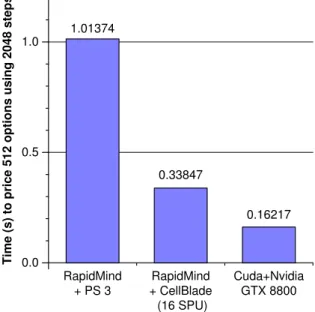
3.4 Performance comparison of Monte Carlo simulations for Black-Scholes option pricing. . . 40
3.5 Binomial option pricing. . . 41
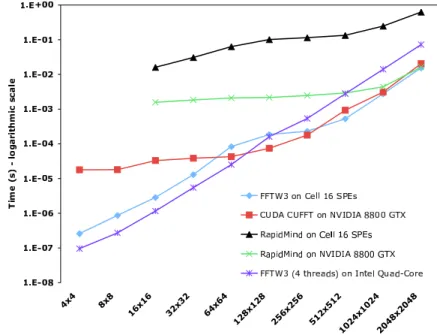
3.6 Performance comparison of single-precision 2-D FFT. . . 42
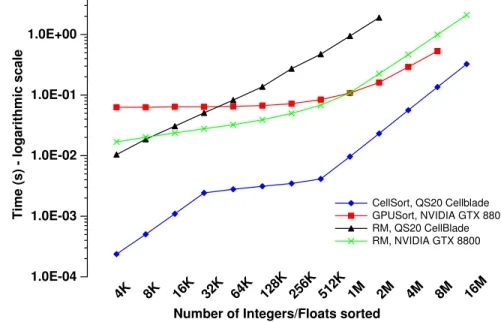
3.7 Performance comparison of bitonic sort. . . 44
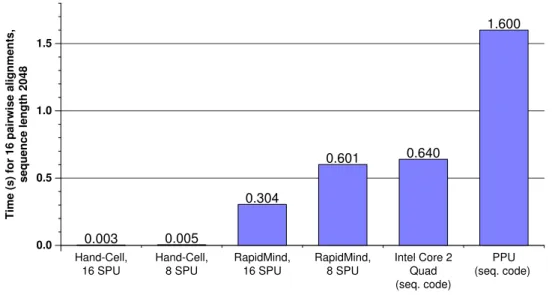
3.8 Performance comparison of Smith-Waterman sequence alignment. . . 46
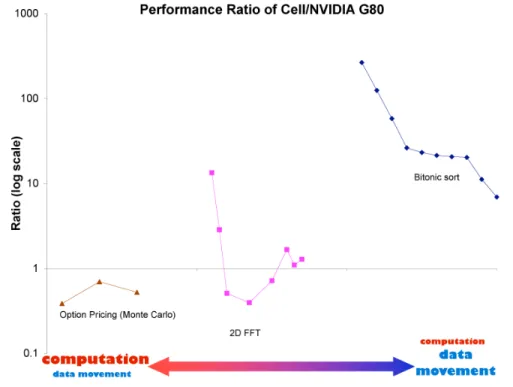
3.9 Performance comparison of Cell vs. NVIDIA 8800 GTX. The x-axis shows the spectrum of computation and communication patterns. Data points toward the left side are more computation bound; data points on the right are more communication bound. . . 47
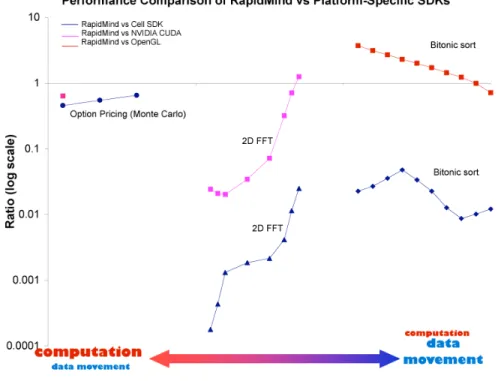
3.10 Performance comparison of RapidMind vs. platform-specific SDKs. . 49
4.1 Stream graph of the Dedup benchmark application. . . 54
4.2 Histogram of execution times for Dedup’s Compress filter. . . 54
4.3 Flexible filter design flow. . . 56
4.4 Example stream program structure. . . 57
4.7 Example stream graph. . . 60
4.8 Relationship of flex splitand flex merge. . . 61
4.9 Block diagram of a flexible filter with noutput channels. . . 65
4.10 Two alternatives of a flexible filter with ninput channels. . . 65
4.11 Flexible filter timelines. . . 67
4.12 Time-line when filter C has a granularity of two tokens per block. . . 69
4.13 Block diagrams of benchmarks used together with their mapping on the IBM Cell multi-core processor (the non-flexible case). . . 72
4.14 Profile of tasks for each benchmark. . . 73
4.15 Gedae trace tables of the VAR benchmark. A core’s timeline is black when it is busy working on a task. Green and red marks show send and receive events. . . 76
4.16 Speedup as the relative cost of a bottleneck filter increases with respect to the cost of communication. . . 79
4.17 Histogram of workload per 114 cells, % targets/workload = 7/32µs. . 81
5.1 Wave-front dependency pattern. . . 86
5.2 Recursive quadrant dependency pattern. . . 87
5.3 Huckleberry design flow. . . 88
5.4 Patterns of recursively applied partition methods. . . 91
5.5 Nested dependencies between bitonic sort recursive functions from Al-gorithms 3 and 5 (programmer view). . . 94
5.6 Abstract machine model. . . 95
5.7 Stages in a Huckleberry-generated parallel application. . . 96
5.8 The R-Tree of bitonic sort recursive functions (code generator view), unrolled until the data partition size is two data blocks. . . 100
5.9 Subset of bitonic sort R-Tree visited by the locality wrapper. . . 101
5.10 One subset of the bitonic sort R-Tree visited by the concurrency wrap-per, when there are two cores with a memory capacity of two blocks. 102 5.11 One subset of the bitonic sort R-Tree as visited by the concurrency
wrapper, when there are four cores, each with a memory capacity of
two blocks. . . 103
5.12 Scaling cores: Speedup when D and mi are fixed and the number N of available cores scales up. . . 105
5.13 Scaling task granularity: Speedup when I is constant, butmi is scaled down, forcing more cores to work on the problem. . . 106
5.14 Scaling data size: mi remains fixed, whileIscales up, normalized w.r.t. the highest throughput instance in that benchmark. . . 107
6.1 Example task graph. . . 115
6.2 Task graph represented as a Petri net. . . 116
6.3 Modeling mutual exclusion. . . 119
6.4 Modeling backpressure. . . 119
6.5 Modeling communication overhead. . . 120
6.6 Modeling flex splitand flex merge. . . 121
6.7 Incorporating flexibility into the CMCP model. . . 122
6.8 Modeling flex splitand flex mergewith multiple channels. . . 123
6.9 Overall Petri net performance model representation of a stream program.123 6.10 Task graph tree of the Smith-Waterman benchmark. . . 124
6.11 Row and column stripe mappings on two cores. . . 125
6.12 Different mappings on four cores. . . 126
6.13 Multiple stages of the Smith-Waterman benchmark. The feedback loop ensures that only one data set is active at a time (pipelining the stages is not the goal in this case). . . 127
6.14 Estimated vs. actual throughput testing mutual exclusion. . . 129 6.15 Estimated vs. actual throughput testing alternative mapping options. 130
6.18 Estimated vs. actual speedup across several benchmarks. . . 133
6.19 Estimated vs. actual throughput for CFAR. . . 133
6.20 Estimated vs. actual throughput for JPEG. . . 134
6.21 Estimated vs. actual latency of the CMCP model for Smith-Waterman on four cores. . . 134
6.22 Performance comparison of three mappings of a 4x4 task array on four cores. . . 135
7.1 Composition with SPMD task blocks. . . 142
7.2 Composition with reduction task blocks. . . 143
7.3 Composition with stream task blocks. . . 143
List of Tables
2.1 Cell BE details. . . 12
2.2 GeForce 8800 GTX details. . . 14
2.3 TILE64 details. . . 15
2.4 Core i7 details. . . 16
4.1 Baseline pipeline mapping timeline. . . 66
4.2 Summary of speedup results for benchmarks where one bottleneck filter is made flexible. . . 78
6.1 CMCP graph size compared to original task graph. . . 129
First, I would like to give my sincere thanks to my advisor, Luca Carloni, for his guidance and support through this journey. His amazing energy and optimism are an example I will forever endeavor to follow. I would also like to thank my committee members, Keren Bergman, Nadya Bliss, Stephen Edwards, and Martha Kim, for their time and helpful feedback.
The hardest part about not being a student anymore is that I have to leave the community that I have belonged to for the last five and a half years and move on to a new one. Many thanks to all the the members of the CSL who I have worked with, and who have been there to listen to my practice presentations (sometimes more than once) and offer feedback. In particular, I would like to thank Cheng-Hong Li, who worked closely with me on benchmarking multi-cores, Bharadwaj Vellore, who bravely became the first user and co-developer of Huckleberry, and Nishant Shah, who worked with me developing Stream applications for the flexible filter project. I would also like to thank Eugen Schenfeld, my IBM mentor in 2007, who set me up with training at Gedae, which was essential to the development of flexible filters. I am also very thankful for the opportunity to participate in WICS, which has been a wonderful source of moral support, professional development, and great friends.
Finally, and most of all, I would like to thank my family; my parents, for support-ing me from the beginnsupport-ing in every endeavor that I have attempted, my mother-in-law for encouraging me to pursue a PhD, my husband Seva, for helping me keep things in perspective, and my daughter Helen, for being my biggest supporter and for pointing out that Petri nets are actually many-eyed monsters.
To Seva and Helen
Chapter 1
Introduction
Since the invention of the integrated circuit, the semiconductor industry has succeeded in doubling the number of transistors on a single chip approximately every two years, a trend known as Moore’s law [111]. As more resources have been added to the chip, the processing core has become faster through rising clock rates, deeper pipelines, and larger caches. However, it is becoming apparent that chasing Moore’s law into the future will not guarantee continued performance improvements as it has in the past [1; 105]. The strategies that traditionally led to faster cores now offer diminishing returns at the current scale of technology. For example, deep instruction pipelines that extract instruction-level parallelism (ILP) are one of the primary innovations that have been responsible for improved performance as the number of resources on a chip increases. However, after a certain depth, control flow interferes with the ability to overlap the execution of different instructions, hindering performance gains. Additional trends such as the complexity of design verification and power constraints also contribute obstacles to continuing to design faster cores. To sidestep these challenges, the focus for improving performance is shifting: rather than make one task run twice as quickly on a faster core, the goal instead is to run twice as many tasks in the same time on two cores [6].
CHAPTER 1. INTRODUCTION 2
Thus, in last ten years multi-core chip architectures have gained in popularity, and today multi-core platforms permeate the computer industry from high-performance supercomputers to personal computers and even embedded devices such as smart-phones [8; 36; 92; 114; 124]. Duplicating a core (or cores) versus making a single core faster defers the problem of improving program performance to the software designer by exposing parallelism in the hardware, thus enabling more kinds of parallelism including task, data, and coarse-grained pipeline parallelism.
1.1
Terminology
This section defines terms used throughout the dissertation.
The terms multi-core architecture, multi-core platformand multi-core system are used somewhat interchangeably. I distinguish them as follows: a multi-core architec-ture is a chip which hosts more than one processing core; a multi-core platform, or multi-core system, is the multi-core chip together with off-chip resources on a single board (e.g., memory, or even other chips such as the CellBlade Server boards).
Aprogram, orapplication, represents an algorithm in a programming language and is part of the implementation. A parallel program is a program separated into tasks that may be executed concurrently at runtime. The complete implementation of a parallel program also includes the mapping (or mapping strategy when the mapping is dynamic) of tasks to cores on the target architecture.
A programming model, orprogramming abstraction, is a simplification or template that a programmer can follow in order to create a parallel program. The interface between the programmer and the model may be implemented, for example, as a library or language.
A task is equivalent to a function; in other words, a sequence of operations that work together to accomplish a particular goal. A task may be hierarchical, comprising severalsubtasks. There is no hard requirement about how large a task should be and
when a task should be split up into subtasks. This decision is part of the overall set of design decisions for an application, and task granularity may be tuned to suit a specific target architecture. The process of parallelization aims to split an application into independent tasks that can be executed concurrently and that equally distribute the workload. I consider only finite tasks and sets of tasks.
1.2
Problem Statement
The move to multi-core chip design exposes the parallelism of hardware resources to the programmer rather than hiding it in deep instruction pipelines, leaving the responsibility to extract parallelism (beyond ILP) to the software. In order to deliver the performance promised by multi-core design, it is essential that software tools and techniques are developed that provide this capability.
Unfortunately, many challenges hamper the design of high-performance parallel code for multi-core architectures. While a linear sequence of tasks performed one after another may represent a sequential program, a parallel program includes more than one sequence of tasks that operate in parallel and at times must synchronize and share data. This change significantly increases the complexity of program design for communication, memory management, scheduling and algorithms.
Communication. Communication complexity includes ensuring correctness in inter-task synchronization (e.g., avoiding deadlocks and maintaining a correct order-ing of events). The tedious job of managorder-ing lower-level synchronization primitives such as mutex locks and condition variables often proves prone to human errors. In addition to ensuring correctness with respect to communication events, the software must expose the communication structure between tasks and create a task schedule that balances communication and computation. Situations of imbalance and poor scheduling result in idle cores and lost performance.
CHAPTER 1. INTRODUCTION 4
Memory Management. Multi-core architectures often distribute memory across the chip together with the cores and expose many of the memory details to the soft-ware designer. In some cases, the hardsoft-ware maintains cache-coherency among the distributed memory banks, while other cases promote flexibility in how programs use the memory by leaving coherency optional. In either case, non-uniform mem-ory access across the chip seems likely in future architectures due to the increasing latency of sending a signal from one end of the chip to another with respect to the clock frequency. As with communication, the exposure of lower-level memory details (e.g., data alignment, direct memory access (DMA) operations, limited local memory capacity) to the programmer increases the difficulty of creating correct and efficient programs.
Scheduling. With many cores and many tasks, it is important to schedule the tasks across the cores so that the load is balanced and the dependencies between tasks do not cause some cores to be idle frequently. The mapping from program to multi-core architecture includes not only tasks to cores, but also the mapping of the communication between tasks to the on-chip communication infrastructure, and the mapping of data to the memory (in the case of a distributed memory architecture). Mappings which increase data locality between tasks minimize inter-core data move-ment and improve communication overhead. However, increased locality sometimes comes at the cost of decreased concurrency, and vice versa.
Algorithms. Algorithm design must reflect the new constraints, and also break an application up into tasks that can be executed concurrently. Furthermore, it is not enough to design an algorithm with a good theoretical complexity. Because of the additional design constraints, optimizations and design decisions chosen for the sequential version of an algorithm may not be ideal in a parallel setting. For example, even though Bitonic Sort’s O(n log2n) complexity is less than ideal for sorting, the algorithm is often used for parallel sorting because the order of its compare-and-swap
operations is not data-dependent, and tasks are evenly sized. Thus, algorithm design must exercise an awareness of the parallel resources on which software will run.
Additionally, extremely large data sets frequently drive the need for increased performance over what single core architectures can offer. Algorithms must scale, both in terms of data size and the number of cores. Often, some parallel algorithms perform better for smaller data sets while others perform better for larger data sets. For example, the Fast Fourier Transform libraries written for the Cell SDK switch between different algorithms depending on the input data size.
1.3
Requirements
Performance, scalability, and programmer productivity are the three necessary com-ponents of any multi-core programming tool. The search for better performance, e.g., more floating-point operations per second, motivates the design of multi-core chips. Second, each generation of microprocessors increases the number of cores on a single chip. While most of the commercially available multi-cores today host only tens of cores or fewer, industry forecasts anticipate that future designs will include hundreds of cores [6]. Parallel programs must be able to continue to offer improved perfor-mance and scale with the number of cores, or they will obsolesce in a very short time. Finally, the complexity of designing a parallel program cannot scale linearly with the number of cores, or it will quickly become unmanageable. In particular, as the number of cores approaches the hundreds and thousands, most programmers will be unable to explicitly manage hundreds of independent tasks. However, programming tools can reduce this complexity, e.g., by letting a programmer write one task that is automatically expanded to hundreds.
CHAPTER 1. INTRODUCTION 6
1.4
Hypothesis
My hypothesis is that the right level of abstraction can simplify the challenges of pro-gramming multi-core systems, while still providing an acceptable level of performance and scalability. A programming abstraction supplies a simplification or template that a programmer can follow in order to create a parallel program. An abstraction can be defined by (1) what it requires of the programmer, (2) what it exposes to the programmer about the underlying multi-core platform, and (3) what it hides. High-level abstractions, which hide more and expose less, are easier for the programmer, and thus improve design time and productivity, but offer less flexibility. In contrast, low-level abstractions, which hide less and expose more, provide a greater amount of flexibility and potentially better performance, but at the cost of the programmer’s time. A good abstraction hides details that the compiler handles better than humans and exposes details that humans handle better than compilers to enable a productive collaboration that creates high-performance programs rapidly.
The question: What can be reasonably asked of a programmer? depends on the context of the application being written, and also on the experience and skill set of the programmer. In my experience as a programmer, I believe that reasonable expectations include an understanding of the structure and dependencies of an al-gorithm, what kind of data is used, and what role the data plays in the algorithm. Essentially, the programmer must master all of the application-dependent details. Details that are platform-dependent, such as explicit memory management and data alignment, are better left to compilers as well as issues that are common to all or many parallel programs such as mutual exclusion locks. Automated tools may also mitigate algorithm-specific aspects of the implementation when those aspects can be abstracted into patterns common to more than one algorithm, for example, a pattern for breaking an application up into independent subtasks. However, note that task granularity, i.e., the size of an application’s subtasks, differs from the decomposition
pattern of an algorithm because task granularity depends on platform features such as the number of cores and their communication infrastructure.
1.5
Thesis Outline
This dissertation presents techniques to enhance throughput performance on appli-cations for multi-core platforms. These approaches make it easier to write parallel programs and to optimize them once they are written. I use a variety of programming abstractions throughout the dissertation, and endeavor to uncover the needs of appli-cations by including many benchmarks implemented on real systems with the tools that I have developed. What unifies the different programming techniques and ab-stractions is that they expose the role of data in applications. While this might seem like a very general statement, the utilization of the on-chip interconnect and memory systems is very important in creating efficient programs. Moreover, the chips them-selves are collections of computational, communication and memory units. At some level (perhaps not the level of the programming abstraction, but as a later result of a compilation) every program is converted to a collection of computational tasks, communication events and pieces of data in order to be mapped to the chips. The different abstractions expose this in different ways to the programmer. My thesis is that the key to unlocking the capabilities of multi-core platforms is the development of abstractions and optimizations which match the patterns of data movement in the applications with the inter-core communication capabilities of the platforms.
The rest of this section summarizes the chapters of the dissertation.
Chapter 2 surveys the landscape of multi-core hardware platforms, parallel pro-gramming models and parallel application design patterns, and shows that there is great diversity in each space. An efficient implementation of a program on a multi-core platform requires a synergy between these three areas, and application design is challenging since there are so many choices.
CHAPTER 1. INTRODUCTION 8
Chapter 3 measures a suite of five benchmarks on two high-end multi-core plat-forms, the Cell Broadband Engine processor and the NVIDIA GeForce 8800 GTX GPU. The benchmark tests make comparisons along two lines: first, they compare the two architectures; and second, they compare the performance of low-level vs. high-level programming abstractions. In particular, I compare platform-specific toolkits to RapidMind, a portable single program multiple data (SPMD) language. No plat-form emerges the winner; instead, each demonstrates strengths in certain areas and is found to be more suitable for certain benchmarks. Similarly, the SPMD abstrac-tion proves very effective for some benchmarks and platforms, but less beneficial for others.
Chapter 4 presents flexible filters, a load-balancing optimization technique for stream programs. Flexible filters utilize the programmability of the cores in order to improve throughput of individual bottleneck tasks by “borrowing” resources from neighbors in the stream. An application-independent implementation of flexible filters is empirically evaluated on several stream benchmarks. The strength of flexible filters is in their simplicity. Their basic function is very straightforward, and they do not introduce heavy-weight runtime systems. Rather, all runtime load-balancing decisions are distributed among the cores and based on pipeline backpressure which is already present to prevent buffer overflows.
Chapter 5 proposesHuckleberry, a novel recursive programming abstraction based on data partitioning. Huckleberry abstracts the problem of breaking a program up into independent tasks, and instead requires explicit data partitioning with the Huck-leberry partition library. Unlike stream programs, where all dependencies are the result of the stream structure (i.e., waiting to send or receive data along a com-munication channel), in recursive Huckleberry programs dependencies are detected dynamically at runtime and data movement is the result of the dependencies that are detected. Huckleberry’s parallel code generator automatically parallelizes and
distributes recursive tasks which can locally detect dependencies between each other and synchronize accordingly.
Chapter 6 proposes a unifying task graph framework for all data-driven program-ming abstractions together with a Petri net performance model that captures the behavior of programs. A task graph separates a program into tasks and the commu-nication dependencies between those tasks.
CHAPTER 2. BACKGROUND 10
Chapter 2
Background
In order to effectively harness the resources of a multi-core system, there must be synergy among the architectural platform, the programming model and the applica-tion being executed. Great diversity characterizes all three of these key components. This chapter provides a survey of various platforms, programming models and bench-mark applications in use today, several of which will be revisited in the experiments presented in later chapters.
2.1
Multi-Core Platforms
There are a wide range of multi-core platforms available both commercially and in research. These platforms vary based on the following architectural features:
• Cores. Homogeneous platforms replicate the same core across the chip, which reduces design time since architects only need to design the core once. Hetero-geneous platforms specialize different cores to different types of tasks in order to optimize performance. The complexity of the cores is another facet of the design. Some platforms include a very large number of simple computing units, organizing them to accomplish complicated tasks; for example, GPUs and poly-morphous platforms [35; 110].
• Memory Model. A multi-core platform’s memory model may physically dis-tribute level-1 caches and private scratch-pad memory banks to the cores, and the cores may share lower-level caches as well. Some multi-cores provide cache coherency while others leave coherency up to the software.
• Interconnect. The communication infrastructure on the chip is gaining impor-tance in chip design as more computational units are added to the chip and need to communicate with each other. One example is a tiled packet-switched network; when one core wants to communicate with another, that core may route data across the chip through one of several possible paths depending on the current network traffic. Shared network resources maximize the use of over-all bandwidth while reducing the space taken up by wires. There are many other interconnect possibilities. Compared to the communication networks of distributed parallel systems (e.g., clusters), on-chip interconnects have higher throughput and lower latency.
• Purpose. The degree to which a platform suits different application spaces also varies. At one extreme, general-purpose multi-cores can be used with the widest range of applications; however, multi-cores with a more narrow scope designed for a particular application space provide better performance in that space (e.g., Anton is specialized for large scale molecular dynamics simulations [114]).
The rest of this section examines four multi-core architectures representing het-erogeneous architectures, graphics processing units, tiled architectures and general-purpose architectures.
2.1.1
Heterogeneous Architectures: IBM/Sony/Toshiba Cell
BE
The Cell Broadband Engine architecture is a heterogeneous multi-core system-on-chip originally designed for high-performance embedded applications [71; 74; 98; 104]. Originally designed for the PlayStation 3 game console, Cell processors currently
CHAPTER 2. BACKGROUND 12
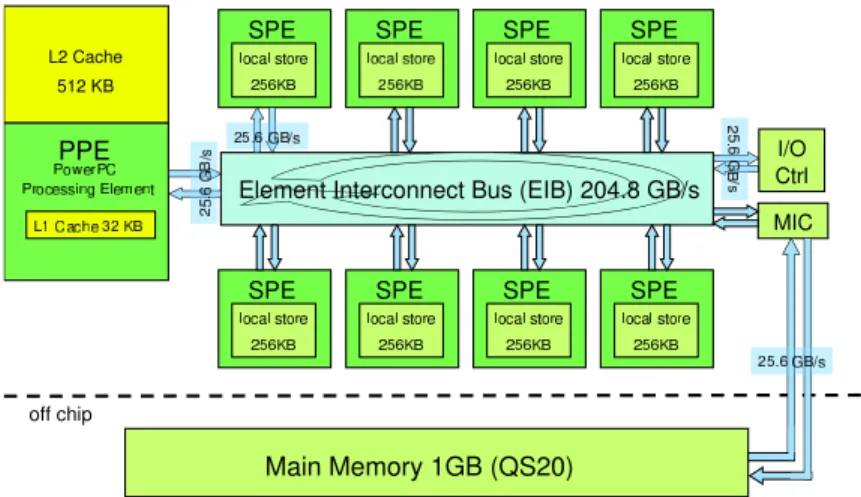
Figure 2.1: Cell BE architecture.
Cores 1 PowerPC, 8 SIMD
Memory Model 256KB private local memory per core; 512 L2 shared Interconnect 4 circuit-switched rings
Purpose gaming, high-performance computing
Table 2.1: Cell BE details.
compose two thirds of the processors in IBM Roadrunner, the fastest supercomputer in the Top500’s list in 2008 [8]. Both IBM and Mercury Computer Systems developed high-performance servers to host Cell chips, which are used for a wide variety of applications, from physics to finance [2; 85; 118]. Cell also shares many architectural similarities with chips used in Anton, including: 128-bit registers, SIMD operations, local scratch-pad memories and DMA transfers [114].
The Cell BE features eight synergistic processing elements (SPE) and one dual-threaded 64-bit PowerPC processor (PPE). Heterogeneous architectures specialize different cores to different tasks. In this case, the Cell architecture specializes the PPE
for sequential code, and the SPEs for vector operations. Each SPE contains a single instruction multiple data (SIMD) processor operating on entries of 128-bit registers; an operation may, for instance, organize a register as a vector of four 32-bit integers. Each SPE core operates on a local store memory of 256KB. Each core’s local store holds both application data and code. The hardware does not supply cache coherency between the local stores; rather, software must manage data transfers between cores and to main memory via direct memory access (DMA) operations.
The Cell BE has a powerful on-chip network for inter-core communication, called the Element Interconnect Bus (EIB), made up of four circuit-switched rings [4; 79]. Two rings transfer data in one direction and two transfer data in the opposite direction, and the data arbiter only schedules data transfer circuits which take up half of a ring or less. Each ring supports up to three concurrent, non-overlapping data transfers. The EIB supports an on-chip communication bandwidth of over 200 GB/s, and the main memory uses an XDR RAM interface with a 25.6 GB/s bandwidth.
Much of the underlying architecture of Cell is exposed to the programmer, in-cluding the SIMD vector operations of the SPEs, the non-shared memory model, and the DMA data-transfer mechanisms. These features have made it notoriously difficult to program, but popular with programmers who seek extremely high perfor-mance because they can tune and optimize its resources at a very low level. I use the Cell in many of my experiments. In addition to being very flexible and tunable, the platform provides predictable performance results, in part because of the lack of hardware cache coherency operations and because the SPEs do not have complex branch prediction mechanisms.
2.1.2
Graphics Processing Units: NVidia GeForce 8800 GTX
Graphics Processing Units are specialized for graphics applications and have massive floating-point computation performance. Though originally intended for applications such as 3D image rendering, GPUs are now programmable and able to be applied
CHAPTER 2. BACKGROUND 14
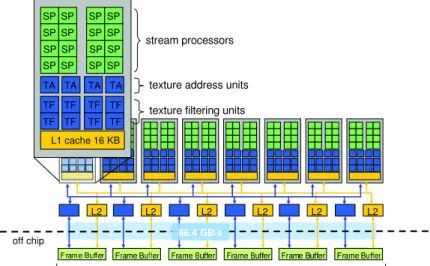
Figure 2.2: GeForce 8800 architecture.
Cores 128 “stream” processors clustered in 8 multiprocessors Memory Model 16KB L1 per multiprocessor, L2 shared (size unknown) Interconnect communicate through shared memory
Purpose graphics processing
Table 2.2: GeForce 8800 GTX details.
to any application that would benefit from their powerful computational abilities. Programming support (e.g., CUDA and OpenCL) is simultaneously being developed to open these platforms up to programmers who are not graphics specialists [33; 78], and general-purpose programming on GPUs (GPGPU) is gaining in popularity [84; 101]. The NVidia GeForce 8800 GTX is an example of a high-end programmable GPU with massive floating-point computation performance [35].
Figure 2.2 shows the high-level architecture of the GeForce 8800 GPU. It has 128 programmable processing units, called stream processors (SP), running at a clock rate of 1.5GHz. The GeForce 8800 architecture connects 768 MB of external memory
Cores 64, tiled homogeneous
Memory Model local L1 and L2 caches, virtual L3 combines L2 caches (5MB on-chip cache total)
Interconnect routed packet-switched network
Purpose stream processing, networking, multimedia
Table 2.3: TILE64 details.
to the SPs by several links with an aggregated maximum bandwidth of 86.4 GB/sec. The architecture divides the SPs into 16 groups, called multiprocessors, each with 8 SPs. The SPs in one group execute instructions in a SIMD fashion, i.e., at every clock cycle they execute the same instruction on different data. If a branch instruction changes the fetch direction of some, but not all of the SPs of the same group, the execution of instructions of the two different basic blocks will be serialized (leading some SPs to stall). The SPs of the same multiprocessor communicate with each other through on-chip shared memory. Global communication between processing units across multiprocessor boundaries is only possible through a shared location in the external memory. This limits the performance of applications that present complex communication patterns.
The large number of floating point units on GPUs offer massive parallelism and enable unconventional parallelization strategies. For example, the GPU thread man-ager (not shown in Fig. 2.2) may aggressively speculate by forking a separate thread for each branch, and then running them in parallel until it is known which branch is the correct one.
2.1.3
Tiled Architectures: Tilera TILE64
Tilera’s TILE64 architecture is an example of a tiled multi-core architecture. The Tilera Corporation descends from MIT’s RAW processor project [36; 120]. Each tile
CHAPTER 2. BACKGROUND 16
Cores 2-8, homogeneous
Memory Model 32KB L1 instr, 32KB L1 data, 256KB L2 per core; 4-8MB L3 shared
Interconnect point-to-point Purpose general-purpose
Table 2.4: Core i7 details.
includes a processor, L1 and L2 caches, and a network switch. The tiled design and routed network interconnect simplify the design complexity (since the tiles which each include a core and network are replicas) and guarantee hardware scalability (since the percent of the chip devoted to the network scales linearly with the number of tiles). The RAW processor, an academic research platform, does not support hardware cache coherency, and can be programmed with C, Fortran and StreamIt [121]. The TILE64, in contrast, does provide hardware cache coherency and supports object-oriented C++ in addition to C. WaveScalar is another example of a tiled architecture [117].
2.1.4
General-Purpose Architectures: Intel Core i7
General-purpose multi-core architectures build on single core general-purpose archi-tectures, and include all of the platform features that are customarily available in their single core counterparts, including deeply pipelined cores, and multi-level caches with hardware cache coherency [92; 93]. These architectures support widely used thread libraries such as POSIX threads. In addition, though they tend to have fewer cores in comparison with GPUs and tiled architectures, the cores they do have are more powerful, performing very well on the sequential parts of applications.
2.2
Parallel Programming Models
Programming models (also called programming abstractions) for multi-core platforms exhibit as much variation as the architectures. Parallel programming has been used for many years in supercomputers, clusters, and multithreaded processors. What is different about multi-cores is the high-performance inter-core communication avail-able to them. Inter-core communication achieves extremely low latency and high throughput compared to more traditional parallel systems, and thus parallel pro-gramming must be reconsidered with respect to the new balance of communica-tion and computacommunica-tion present in these newer systems. Programming models may be realized as either a separate programming language (such as StreamIt [121]) or as a library or extension on top of an existing language (often C [14; 29; 47; 90]). As noted in the Chapter 1, I distinguish a programming model based on (1) what it requires of the programmer, (2) what its abstraction exposes to the program-mer, and (3) what it hides.
A programming model might hide or expose aspects of the underlying architecture such as the number of cores, the memory model, and properties of the interconnect. More conceptually, the model may either hide or expose different kinds of parallelism.
Dataparallelism applies the same operation to many different data instances concur-rently with no dependencies between them. Pipeline parallelism splits an operation into a sequence of pipelined tasks which may work at the same time on different data as the data passes through the pipeline. Last, task parallelism splits an operation into a data flow of tasks which may include complex control flow such as splits, joins, and feedback loops. Two tasks may work separately on different data that will later be joined in the final result.
Generally, high-level abstractions optimize programmer productivity, since they enable faster design and debugging of an application. But lower-level abstractions optimize performance, since they expose more of the capabilities of the underlying resources and are more flexible. However, although low-level abstractions may
pro-CHAPTER 2. BACKGROUND 18
vide the potential for the best performance, that potential will remain untapped if programmers cannot manage the burden of orchestrating all of the lower-level details of an architecture. Thus, higher levels of abstraction may alleviate the increasing complexity of multi-core architectures. And high-level abstractions do not neces-sarily preclude high performance. In particular, the restrictions of domain-specific abstractions correspond exactly to the capabilities and resources that arenotneeded within the target domain. As a bonus, if the communication structure of an ap-plication from another domain does match that of an apap-plication within the target domain, then it may work equally well in that setting (e.g., GPUs for non-graphics applications [101]). A given parallel programming model will often match up well to a particular hardware platform (or family of platforms). Likewise, models also match better to certain applications than others, so that an implementation of an application is a three-way match between the application, the programming model, and the hardware architecture.
Each section below describes a general programming model, including languages and libraries that utilize that model. I do not attempt to be fully inclusive of the extensive literature on this topic, but to hit the main points, with an emphasis on data-driven models. That is, models that capture the data movement within an appli-cation. The prevalence across many applications of a focus on inter-task dependencies, the balance of communication and computation, and throughput-based performance metrics underscores the importance of data movement. Focussing on how models handle data movement also highlights similarities in the different models.
This survey of parallel programming models will begin with lower-level parallel-programming abstractions: threads and message passing, which are well developed, having been used for many years on parallel platforms other than multi-cores. I categorize them as “low-level” because they expose tools for composing concurrent tasks (mutex locks, messages, etc.) without providing abstraction to the programmer outside of the memory model: threads typically imply shared memory, while message
passing typically implies distributed memory. Higher-level parallel abstractions are sometimes built on top of these models.
2.2.1
Threads
Many mainstream programming languages support threads, which provide one of the more expressive parallel programming models. Threads communicate through shared data structures, which abstract the underlying memory architecture from the pro-grammer and work well for architectures with hardware cache coherency, but may not match well to other architectures. Threads traditionally require the program-mer to explicitly program each parallel thread separately and to manage their syn-chronization, which can be cumbersome and error-prone. Synchronization primitives include locks, condition variables and semaphores. Many systems support POSIX threads (pthreads), the IEEE threads standard [19]. Several newer threading lan-guages (Cilk, CUDA and Intel Threading Building Blocks) for multi-cores retain the parallel model of threads while abstracting away locks, synchronization, and other low-level details [14; 30; 66].
Cilk is a language specialized for dynamic, asynchronous parallelism [14]. The Cilk model expects the programmer to expose parallelism in an application while the compiler and run-time system manage performance details such as load balancing and managing the memory and inter-task communication. Cilk adds thread keywords such as cilk, spawn and sink to the C language. These keywords annotate C functions to expose parallelism. For example, the cilk keyword identifies parallelizable functions and the spawn keyword identifies subroutines that may potentially be forked off as separate threads. Removing all Cilk keywords produces aC elision of the code, i.e., a valid sequential C program. Thus, the programmer may annotate where the code may be forked as separate threads, but the runtime system manages the forking, joining and synchronization of threads.
CHAPTER 2. BACKGROUND 20
TheCompute Unified Device Architecture (CUDA)is a thread-based programming interface and environment developed by NVIDIA for general-purpose programming of its own GPUs [66]. The CUDA language abstracts the GPU hardware so that language features do not rely on a particular hardware configuration, and software may be easily ported to new GPU architectures. Programmers do not explicitly manage threads in a CUDA application; instead, they write with parallel operations through the CUDA API and the hardware thread manager handles the threading aspect of the program, which may reach thousands of threads. By handling the low level synchronization, the hardware guarantees that there are no deadlocks. For example, the SPMD CUDA operationSAXPY performs ax+y on two arrays x and
y, with constanta. CUDA does expose tunability to programmers over the number of threads to be created and their division within and across the multiprocessor groups.
2.2.2
Message Passing
Message passing is another widespread general-purpose approach, where parallel tasks communicate through messages which can act like communication pipes; this matches well to distributed memory architectures. Like threads, message passing also requires the programmer to be responsible for explicitly programming the parallel tasks. The Message Passing Interface (MPI) is a widely accepted standard for message pass-ing that supports both point-to-point and collective communication operations [68]. The Cell Software Development Kit (SDK) supports Cell-specific message passing operations, and work has been done to implement the MPI standard on the Cell BE [100]; however the standard MPI library is not readily available on all multi-core architectures, for instance, on GPUs.
SHIM provides a deterministic concurrency message passing model which has been implemented for both shared memory and distributed memory multi-cores [43; 125]. SHIM’s model guarantees that communication events between tasks occur in a
deterministic order, eliminating data races and simplifying the debugging of concur-rency errors such as deadlocks.
2.2.3
Graphics Languages
The Open Graphics Library (OpenGL) is a language specification for programming graphics hardware [112]. It is specialized to graphics functions, in particular, render-ing into a framebuffer, and many of its function calls enable the programmer to draw different types of 2D and 3D objects such as lines and polygons.
The Open Computing Language (OpenCL) is a general-purpose language intended to help programmers take advantage of the impressive computing capabilities of GPUs for non-graphics applications [78]. Unlike CUDA, which only supports the family of NVIDIA GPUs, OpenCL provides an open standard, and supports a variety of heterogeneous systems, including non-GPU systems. In OpenCL, the programmer creates kernels, programs portable across OpenCL devices and host programs that run on a specific host. Before a kernel executes, the OpenCL runtime model defines the index space of a data set for each kernel instance, and breaks the index space up into separate work-groups. At runtime, the host executes a variety of operations, including kernel operations on work-groups, memory operations and synchronization operations. The flexibility of the programming model allows for different types of parallelism including data parallelism as well as task parallelism.
2.2.4
SPMD
Single Program Multiple Data (SPMD) programming exploits the data-parallelism of an application by applying the same code in parallel on separate data, for example, the elements of an array. A pure SPMD operation involves no inter-core commu-nication. Therefore this style of parallel programming has been applied to many parallel systems that do not have low latency inter-core communication, including wide-area distributed ones like SETI@home. Several startup ventures have designed
CHAPTER 2. BACKGROUND 22
commercial SPMD programming languages in recent years for multi-core platforms (e.g., RapidMind [90] and PeakStream, acquired by Intel and Google, respectively).
RapidMind grew out of Sh, a tool for programming GPUs intended to both unify shader programs with their host programs and provide a more general-purpose pro-gramming platform for GPUs than was previously available [89]. RapidMind provides C++ libraries that add a few new types: Array,Value, andProgram. A programmer may invoke a RapidMind program with a RapidMind array as input, and the program will execute separately on each array element. For example, consider the following snippet of C++ code:
main {
float a[N], b[N];
// ... initialize a[] and b[] ... for(int i=0; i<N; i++) {
a[i] *= b[i]; }
}
The code above is rewritten in RapidMind by first creating a RapidMind Program, that can be called as a subroutine:
Program vector_mult = BEGIN { In<Value1f>a;
In<Value1f>b; a = a*b; }
whereValue1findicates that a and b are each floats (Value4fwould indicate a vector of four floats). Next,vector multreplaces theforloop, and a[]and b[]are defined with RapidMind types.
main { Array<1,Value1f> A(N); Array<1,Value1f> B(N); // ... initialize values ... A = vector_mult(A,B); }
RapidMind automatically parallelizes and distributes the program over the target platform, hiding platform-specific thread management and data-transfer operations from the programmer. RapidMind also supports reduction functions, multi-dimensional
Array types, and data views such as shifting or striping for manipulating the arrays.
2.2.5
Stream Programming
Stream processing captures the data flow model of computation, and applies to a wide range of applications including high-performance embedded applications, signal processing, image compression, and continuous database queries [20; 42; 113]. The stream processing abstraction decomposes an application into a sequence of data items (tokens) and a collection of tasks (referred to as filters orkernels) that operate upon the stream of tokens as they pass through them. Filters communicate with each other explicitly by exchanging the tokens through point-to-point communication channels. Stream programs expose pipeline, data and task parallelism. StreamIt, a language from the research community, and Gedae, a commercial language, are described below. StreamIt is a stream language and compiler developed at MIT [121]. A StreamIt program comprises stream tasks, called filters, which accommodate a single input and a single output and use push, pop, and peek operations to interact with the input and output data streams. The language also provides control flow filters to allow for splits and joins in the stream. StreamIt has been used as a foundation for research in compiler analysis and optimizations [3; 58; 122]. Other research stream
CHAPTER 2. BACKGROUND 24
projects include the Brook stream language and the Imagine stream processor and programming model [18; 76].
Gedae [54] is a commercial stream language specialized for embedded signal pro-cessing applications. Similar to StreamIt, a Gedae application also comprises stream tasks, called blocks in Gedae, which communicate with each other through commu-nication pipes. Gedae supports blocks that have more than one input and output stream. During runtime, a typical Gedae block will fire, consuming a fixed number of data tokens from its input and producing a fixed number on its output. The language also provides support for nondeterministic and dynamic streams where the number of tokens consumed or produced may vary.
Chapter 4 explores the stream abstraction further with flexible filters, a load-balancing optimization method for stream programs.
2.2.6
Recursive Parallel Programming
Recursive parallel programming models utilize the divide-and-conquer aspect of re-cursive functions to break a problem up into concurrent tasks, leveraging the hier-archical nature of the memory hierarchy as well as locality in the application [12; 47; 80; 94]. Many parallel programming systems have used recursive models of par-allelism because recursion concisely captures patterns of dependencies and exposes temporal and data locality and is a natural fit for exposing concurrency in a program. A recursive function corresponds to a hierarchical task graph with a tree topology, which conveniently separates an application up into a set of balanced tasks. Working on tasks under one branch of the task graph at a time promotes data locality between concurrently executing tasks. Furthermore, increasing or decreasing the depth of the tree can tune the task granularity by adjusting the size of leaf tasks.
Recursive parallel programming models for vector processors were developed in the late 1980s and early 1990s [12; 59]. Unlike multi-core architectures today, these systems presented relatively high inter-node communication costs (throughput around
1 Gbps and application-level latency at 40-100 microseconds), and the implementation of the model on such a system reflected these constraints. For example, the divide-and-conquer Algorithmic Skeleton is implemented with SPMD parallelization based on the powerlist data structure [24; 94].
More recent works that target multi-core architectures typically rely on compil-ers for parallelization. For example, compilcompil-ers can parallelize divide-and-conquer programs by analyzing memory references to detect dependencies [64; 109]. Some parallel languages also explicitly expose divide-and-conquer patterns to the compiler. Cilk also includes support for recursion [14]. The Sequoia programming language uses hierarchical program design to leverage data locality in the memory hierarchy of parallel system [47; 80]. In Sequoia, different layers of the hierarchical tree are associated with different levels of memory. Sequoia isolates concurrent tasks so that they do not synchronize, but communicate through their parent task (which may be mapped to the same core).
Chapter 5 presents Huckleberry, a new recursive programming model developed as part of my research, and its library and code generator [29]. Huckleberry paral-lelization relies on explicit data partitioning through Huckleberry’s partition library, but abstracts the decomposition of algorithms up into concurrent threads.
2.2.7
Map-Reduce
Map-Reduce separates an application into data-parallel map and reduce steps [39]. Google developed the Map-Reduce model for applications which process very large data sets. The map step breaks the data set up and distributes it among pro-cessing nodes performing the map operation. The map step produces intermediate
<key,value> pairs and then passes them to the reduce step according to the keys. The reduce step merges all data with the same key together. The Map-Reduce model could also be used in multiple map and reduce stages. Phoenix implements Map-Reduce for shared-memory multi-core platforms [108]. Phoenix creates parallel tasks
CHAPTER 2. BACKGROUND 26
for the map and reduce steps and manages dynamic load balancing across the cores. The stages of map and reduce execute separately. Phoenix includes built-in fault recovery for faulty tasks, which are detected through timeouts.
2.3
Programming Patterns
A parallel application is an application made up of more than one task such that some or all of the tasks are capable of being executed in parallel. Each parallel ap-plication exhibits a distinct pattern of dependencies among its tasks. Some works classify applications according to a taxonomy based on their computational require-ments, communication dependencies, and memory access patterns [6; 24; 88]. These classifications are called programming patterns. For example, Asonovicet al.’s report,
A View from Berkeley, identifies a number of programming patterns related to the structure of applications, called “dwarfs” in the report (for example, dense and sparse linear algebra, N-body methods, map-reduce, graph traversal, dynamic programming, etc.). In theory, all applications which fall into a category share common properties and constraints which might be exploited by tools specific to that category. Thus, the reuse of programming tools optimized for a specific class of applications may mitigate the task of designing parallel software. The taxonomy of patterns continues to expand as researchers consider more applications. Indeed, within five years of the original Berkeley report, the set of seven “dwarfs” grew to thirteen.
The problem of choosing a generalized application classification resembles that of choosing a programming model. However, an important distinction between the classification of an application and a programming abstraction is that the same ap-plication may be implemented using different programming models. For example, the tools presented in later chapters implement the bitonic sort benchmark both with the SPMD abstraction and with the recursive programming abstraction.
• Graph Traversal. Graph traversal algorithms work with graph data structures and require indirect table lookups through memory pointers. Some examples of graph traversal applications are router lookup in a network, decision trees, and many graph theory algorithms such as shortest path, vertex cover, etc.
• Dynamic Programming. Dynamic programming problems often favor a bottom-up approach, which first solves subproblems, saving the results in a table, and builds up an overall solution from the subproblems. This approach befits problems that have the optimal substructure property, i.e., an optimal solution to a problem includes optimal solutions to all of its subproblems as well [32].
• Dense Linear Algebra. The class of dense linear algebra captures MATLAB-like functions, where data is densely packed into matrices or vectors. Regular data access patterns typically characterize dense linear algebra.
• Sparse Linear Algebra. Sparse linear algebra packs data sparsely into ma-trices and vectors with many zero value elements. The data is often then stored with compression over blocks of the matrix, and data is accessed through in-dexed loads and stores.
• Spectral Methods. Spectral methods include functions that operate in the spectral domain (e.g., FFT converts data to a sum of frequencies, and DCT converts data to a sum of cosine functions). Transformation to and from the spectral domain from space and time domains requires all-to-all communication, often organized in “butterfly” stages where data sharing is symmetric between two tasks.
• MapReduce (originally Monte Carlo). MapReduce parallel functions com-prise many independent tasks and little or no inter-task communication. “Em-barrassingly parallel” workloads fit into this pattern. This pattern captures the
CHAPTER 2. BACKGROUND 28
applications supported by the SPMD model (Sec. 2.2.4), and also the Map-Reduce model (Sec. 2.2.7), since the tasks within a map or reduce step are independent from one another.
The categories above correspond to the overall classification of an application (or function). In an alternative approach to programming patterns, Mattson et al. iden-tify recurring patterns at several stages along the design flow of a parallel application. The design space is separated into patterns for (1) finding concurrency, (2) algorithm structure, (3) supporting structures, and (4) implementation mechanisms. For exam-ple, the supporting structures design space includes the SPMD, master/worker, loop parallelism, fork/join, shared data, shared queue, and distributed array patterns.
Chapter 3
An Empirical Comparison of Two
Multi-Core Architectures
Given the diverse range of multi-core architectures (Chapter 2), the question arises: which one is the best? It is unclear whether there can be a general-purpose multi-core architecture, i.e., a single architecture that is able to perform reasonably in all application domains. In particular, no architecture outperforms all others in gaming, image processing, dense linear programming, and so on. Although parallel bench-marks are being developed, they typically support different standards; e.g., the PAR-SEC benchmark suite employs pthreads and OpenMP, while SPEC MPI2007 requires MPI support [10; 96]. The lack of standardized programming tools at this point in time prevents a complete head-to-head comparison of two architectures. The reason there are no standardized programming tools across all platforms is both because the architectures are relatively new and quickly changing and also because tools are often designed with a particular architecture and application domain in mind. Because of these two issues – the diversity of multi-core architectures, and the lack of standard-ized tools – the evaluation of different platforms is analogous to comparing apples and oranges.
CHAPTER 3. AN EMPIRICAL COMPARISON OF TWO MULTI-CORE
ARCHITECTURES 30
The diversity of on-chip interconnects further complicates the evaluation of per-formance on multi-core architectures. For example, the Cell architecture uses circuit switched rings to connect the cores with very high bandwidth, while NVIDIA GPUs use small shared memory as the only way for two cores to communicate on-chip. Given some application, the application’s subtasks will have a dependency structure. The synchronizations from dependencies and communication between tasks needs to take place through the interconnect. Because application performance depends on the efficiency of communication over the network, not just the speed of computation for individual tasks, finding a good match between the network and the application dependencies is critical.
Mapping application dependencies down to the interconnect involves two steps. First, the programmer implements the algorithm with the abstraction provided by the programming model. Next, the compiler maps the programming abstraction representation of the application to the available hardware resources. Programming abstractions that mirror hardware support for different concurrency features are de-sirable. For example, a model with a shared memory abstraction may be implemented on either an architecture that provides hardware cache coherency or one that provides only scratchpad local memories. In either case, an inefficient mapping will result in lost performance, but an efficient mapping of shared memory will likely be easier for the compiler when hardware cache coherency is available.
Despite the challenges of comparing multi-core architectures and programming models, it is nonetheless beneficial to quantify performance so that it is possible to identify the ideal platform and programming abstraction for a specific application. Once a successful match between model and application has been made, other ap-plications of the same programming pattern may also be matched to the model [6; 88].
This chapter presents experiments that compare several benchmarks on two lead-ing multi-core processors: the Cell BE and NVIDIA GeForce 8800 GTX GPU (GeForce
8800), using several programming tools [25]. The benchmark suite includes applica-tions which range from computation intensive (e.g., option pricing) to communication intensive (e.g., sorting). I compare RapidMind, a high-level portable SPMD language, to low-level architecture-specific software development kits in order to better under-stand how much performance (if any) is lost when switching from a low-level to a high-level programming abstraction. The comparison of the Cell versus the GeForce 8800 is a complementary goal since the programming tools must expose and utilize the features of the platforms. This chapter also provides a detailed description of sev-eral benchmarks and illustrates the possible range of dependency structures across multiple applications. The results imply that the Cell BE suits communication-rich applications, while the GeForce 8800 is stronger for computation-rich applications. Moreover, the SPMD abstraction works better with GPU architectures than with streaming architectures like the Cell.
3.1
Benchmark Applications
This section introduces five benchmark applications.
3.1.1
Option Pricing
An option is a right to sell or buy a financial asset at a predetermined price on a future date. The price of an option is determined by factors such as the current price of the underlying financial asset, that asset’s volatility, and the timespan between the current and future date. An option itself can be traded and its price is the discounted profit made by exercising the option. Two kinds of options are described below: Black-Scholes options and binomial options. The main difference between the two is that time is continuous for the Black-Scholes model and discrete for binomial model, although in some cases, the two models converge (e.g., when there are no dividends). Black-Scholes options are typically used to price European options, where the option
CHAPTER 3. AN EMPIRICAL COMPARISON OF TWO MULTI-CORE
ARCHITECTURES 32
to buy or sell may only be exercised on the expiration date; binomial options, on the other hand, are more commonly used to price American options, which may be exercised at any time up until the expiration date.
Black-Scholes Option Pricing. The Black-Scholes option pricing model as-sumes that the price fluctuations of the underlying financial asset can be modeled as geometrical Brownian motion [11; 91]:
dSt =µStdt+vStdWt (3.1)
where St is the asset price at time t, Wt is a Wiener random process, and µ (drift)
and v (volatility) are two constants. Based on Eq. 3.1, the asset price at time T is:
ST =S0e((µ
−0.5v2)T+vT1/2N(0,1))
(3.2)
where N(0,1) is a normally-distributed random number between 0 and 1.
Based on Eq. 3.2, Monte Carlo simulations can be applied to estimate the expected value ofST at a future time T1. Each simulation consists of the following two steps:
1. generate a normally distributed random number x;
2. replace N(0,1) in Eq. 3.2 with x to get one price S′
T.
The average of all the S′
T’s obtained at Step 2 is an estimation of the expected value
of ST in Eq. 3.2. For the estimation of the expected ST to converge, a sufficient
number of simulations must be performed. Since all simulations are independent from each other, they can be exercised by parallel processes between which there is little communication. Hence, this is an embarrassingly parallel workload that can be tackled by distributing the various simulations evenly across the processing elements
1
The standard Black-Scholes equation is actually closed-form, and does not require simulation. However, if any underlying assumptions to the equation are altered, then it may no longer be closed-form. Other financial benchmarks, such as VAR in Chapter 4, also require normally distributed random numbers.