FACULTY OF ENGINEERING
Thesis submitted in partial fulfilment of the requirements for the Master of Science in Applied Sciences and Engineering: Applied Computer Science
Extension with Digital Library
Technology of UNESCO’s J-ISIS
Database Software
By: Helen Hagos Berhe
Promoter: Prof. dr. Eddy Vandijck
Co-promoter: Prof. dr. Egbert de Smet
i
Acknowledgement
First of all I would like to thank my promoter Prof. dr. Eddy Vandijck for his support, encouragement and patience and my co-promoter Prof. dr. Egbert de Smet for his guidance, precious support and comments. I would like also to extend my gratitude to Mr. Jean-Claude Dauphin (UNESCO, Paris) who assisted me in working with J-ISIS, Prof. dr. Jacques Tiberghien for his concern, support and encouragements, and Mrs. Irene Raadschelders for her support and encouragements for finishing my study program. Last but not least, I would like to thank my family, especially my father, and my friends who supported and motivated me for the completion of my thesis.
ii
Table of Contents
Acknowledgement ... i
Acronyms ... v
List of Figures ... vii
List of Tables... vii
Abstract ... viii
Chapter One: Introduction and Problem Statement ... 1
-1.1. Introduction ... - 1 -
1.2. The Digital Library Concept ... - 1 -
1.3. Web Information Systems ... - 4 -
1.4. Some Technological Requirements for Digital Libraries ... - 6 -
1.5. ISIS and ABCD for Digital Library Applications ... - 6 -
1.6. Objective of the Study ... - 8 -
1.7. Significance of the Study ... - 9 -
1.8. Methodology ... - 9 -
Chapter Two: Discussion of Some Technical Requirements of Digital Libraries ... 10
-2.1. WWW-based Retrieval ... - 10 -
2.2. Diversity of Document Formats ... - 11 -
2.3. Diversity of Metadata Formats ... - 12 -
2.4. Full-text Search and Ranking ... - 13 -
2.4.1. Full-text Search ... - 13 -
2.4.2. Ranking ... - 14 -
2.5. Unicode ... - 14 -
2.6. Open Archives Initiative-Protocol for Metadata Harvesting (OAI-PMH) ... - 16 -
2.7. Interactivity ... - 20 -
Chapter Three: History and Technical Concepts of the Classical ISIS Technology and ABCD Software .... - 21 -3.1. Introduction on ISIS ... - 21 -
iii
3.2. Brief History of the ISIS Technology ... - 21 -
3.3. Technical Concepts of ISIS as a Semi-Structured NoSQL Database... - 28 -
3.3.1. The ISIS Master File (MST) ... - 30 -
3.3.2. The ISIS Cross-Reference File (XRF) ... - 32 -
3.3.3. The ISIS Inverted File (IF) ... - 32 -
3.3.4. The ISIS Query Language ... - 32 -
3.3.5. The ISIS Formatting Language ... - 33 -
Chapter Four: Technical Concepts of the New Generation ISIS Software (JISIS) ... 36
-4.1. Introduction ... - 36 -
4.2. Java Integrated Set for Information Services (J-ISIS): The Client-Server Java Implementation of ISIS - 36 - 4.3. Web-JISIS ... - 37 -
4.4. NoSQL Database Technologies ... - 39 -
4.5. Berkeley DB... - 43 -
4.5.1. Berkeley DB Product Family Overview ... - 44 -
4.5.2. Comparison among the Berkeley DB Family Products ... - 44 -
4.5.3. How Berkeley DB is Used ... - 46 -
4.6. Lucene ... - 49 -
4.7. Comparison between ISIS and J-ISIS ... - 51 -
Chapter Five: Implementing and Testing Digital Library Technology into JISIS ... 54
-5.1. Testing Available Digital Library Features in J-ISIS ... - 54 -
5.1.1. WWW Based Retrieval: Web-JISIS ... - 54 -
5.1.2. Diversity of Metadata Formats ... - 56 -
5.1.3. Full-text Indexing ... - 57 -
5.1.4. Unicode ... - 71 -
5.2. Implementation of the Digital Library Feature ... - 74 -
5.2.1. Presentation of the Newly Added Digital Library Feature ... - 74 -
iv
5.2.3. Testing J-ISIS Performance ... - 95 -
5.3. The OAI-PMH ... - 98 -
5.4. Interactivity ... - 99 -
Chapter Six: Conclusions and Recommendations... 100
-v
Acronyms
ABCD Automation of liBraries and Centers for Documentation ACID Atomicity, Consistency, Isolation, Durability
AJAX Asynchronous JavaScript and XML ANSI American National Standard Institute API Application Programming Interface
ASCII American Standard Code for Information Interchange
BDB Berkeley Database
Bsearch Binary search
CCF Common Communication Format CDS Computerized Documentation Service
CDS/ISIS Computerzide Documentation Service/Integrated Set for Information Services
CEPAL (Bibliographic standard of the) Comision Economica para America Latina
CGI Common Gateway Interface
CISIS ISIS programmed in C (Brazil) CMS Content Management System
DBA Documentazione, le Biblioteche e gli Archivi: (Italian association for documentalists and librarians)
Dbm Database Manager
DC Dublin Core
DL Digital Library
DLL Dynamically Linked Library DOS Disk Operating Systems
FOSS Free and Open Source Software FST Field Selection Table
FTS Full-text Search
GSDL GreenStone Digital Library Gdbm GNU database manager
GMOD Global Modifications in ISIS databases
GNU GNU's Not Unix
HP Hewlett-Packard
HTML HyperText Markup Language HTTP Hypertext Transfer Protocol IBM International Business Machine
IDRC International Development Research Centre
IF Inverted File
ILO International Labour Organization
IM Instant Messaging
IP Internet Protocol
IR Information Retrieval
ISIS Integrated Set for Information Services ISO International Organization for Standardization ISRS Information Storage and Retrieval Systems
ISISDLL Integrated Set for Information Services Dynamically linked Library ISIS-NBP ISIS Network Based Platform .
vi
JAVAISIS JAVA Integrated Set of Information Services J-ISIS Java- Integrated Set for Information Services JSON Java Script Object Notation
JSP Java Server pages
MINISIS ISIS for Minicomputers (Canada) MARC MAchine-Readable Cataloging MARC 21 MAchine-Readable Cataloging MFN Master File Number
MST ISIS Master File
MVC Model-View-Controller
Mx Master/Cross-reference files utility for ISIS NCSA National Center for Supercomputing Applications Ndbm New database manager
NoSQL Not only SQL
NIO New Input Output
OAI-PMH Open Archives Initiative-Protocol for Metadata Harvesting OPAC Online Public Access Catalogue
OpenIsis Open source ISIS (Germany)
PDF Portable Document Format
PFT Print Format Table PHP Hypertext Pre-processor RIA Rich Internet Application RSS Really Simple Syndication
RTF Rich Text Format
SQL Structured Query Language
TCP/IP Transmission Control Protocol/Internet Protocol TXT/HTML Text/ HyperText Markup Language
UN United Nations
UNESCO United Nations Education, Science and Culture Organization Unicode Universal coding
UNIMARC UNIversal MAchine-Readable Cataloging
UNISIST Bibliographic standard developed by UN (France) URL Universal Resource Locator
UTF Unicode Transformation Format VAX Virtual Address eXtension
VLIR/UOS Vlaamse Interuniversitaire Raad/ Universitaire Ontwikkelings samenwerking VMS Virtual Memory System
Web-JISIS Web-Java Integrated Set for Information Services WHO World Health Organisation
WINISIS Windows Integrated Set for Information Services
WIS Web Information Systems
WWW World Wide Web
WWWISIS World Wide Web Integrated Set for Information Services Wxis Web and XML enabled ISIS Server
XHTML Extensible HyperText Markup Language XML Extensible Markup Language
XPath XML Path
XQuery XML Query
vii
List of Figures
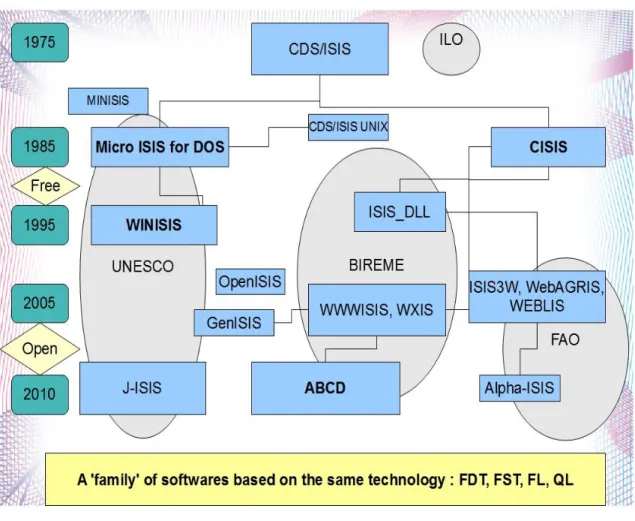
Figure 1: ISIS Software Family ... - 24 -
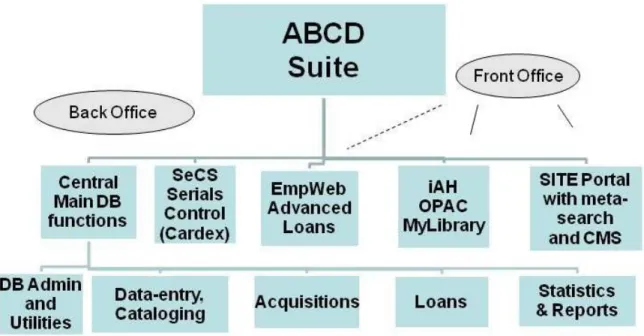
Figure 2: ABCD Suite ... - 27 -
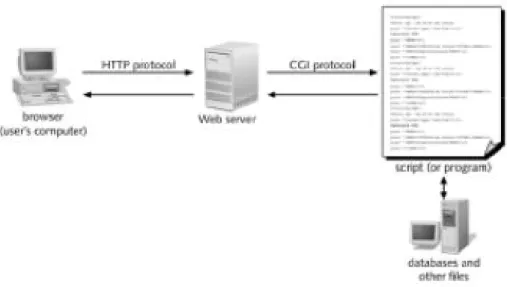
Figure 3: CGI Protocol Architecture ... - 28 -
Figure 4: ISIS Master File Record Structure... - 30 -
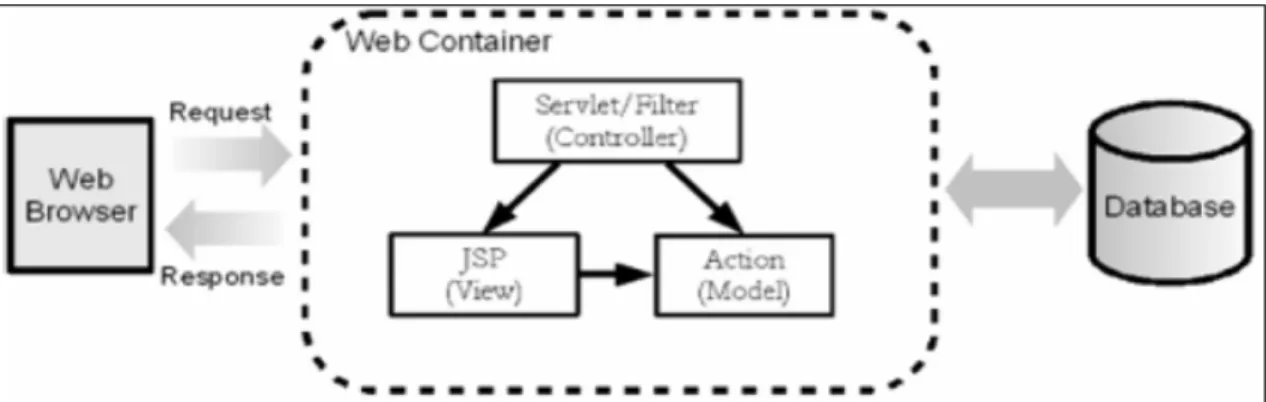
Figure 5: Web-JISIS Three Tier Architecture ... - 38 -
Figure 6: How use of NoSQL Flattens the Total System Cost and the Asymptotic Degredation of the Performance ... - 41 -
Figure 7: Summary of Indexing Process in Lucene ... - 50 -
Figure 8: Web-JISIS Login Form ... - 55 -
Figure 9: List of Database Displayed from Web-JISIS ... - 55 -
Figure 10: Database Record Display from Web-JISIS ... - 56 -
Figure 11: Ethiopian PDF Loaded in J-ISIS, seen from the Data Viewer of Web-JISIS ... - 72 -
Figure 12: Chinese PDF Loaded in J-ISIS, Seen from the Data Viewer of Web-JISIS ... - 72 -
Figure 13: Chinese Document in Web-JISIS after Having Done a Search with Highlighted Search-keys - 73 - Figure 14: Illustration of J-ISIS Capable of Handling Mixing Scripts: Case of Amharic and English ... - 73 -
Figure 15: Illustration of the New Added Field Types ... - 78 -
Figure 16: J-ISIS Field Definition Table Contains Both Normal and Digital Library Field Types ... - 79 -
Figure 17: J-ISIS Data Entry Worksheet Definition ... - 79 -
Figure 18: Selection of Fields in J-ISIS Field Selection Table ... - 80 -
Figure 19: Integration of the New Digital Library Feature and J-ISIS ... - 81 -
Figure 20: Illustration of the Resulting Interface for Traditional and Digital Library Creation ... - 81 -
Figure 21: File Browser for Uploading a Document into J-ISIS Worksheet ... - 82 -
Figure 22: Document Content Loaded into J-ISIS Worksheet... - 83 -
Figure 23: Entering a Search Key into J-ISIS Search Interface ... - 84 -
Figure 24: Illustration of the Search Result from J-ISIS Interface ... - 84 -
Figure 25: J-ISIS with Menu Building Problem Figure 26: J-ISIS with Correct Menu ... - 86 -
Figure 27: J-UNIT Related Error Reported in Netbeans ... - 86 -
List of Tables
Table 1: ISIS Family Comparison ... - 53 -Table 2: Original vs Parsed Document Size Analysis ... - 93 -
viii
Abstract
J-ISIS is UNESCO’s new information storage and retrieval database software. It uses Berkeley DB for providing unlimited storage capability; Lucene for searching and retrieval of documentary resources; and Web-JISIS to provide web-based access to resources of the library. It is also Unicode compatible. Though it could be a good candidate for digital library applications, there was no any assessment regarding its capability and power for the use of digital library applications. In addition, there were no any digital library concepts and functionalities integrated with J-ISIS. In this study all technologies involved, including the limitations of the classic ISIS-technology for digital libraries, are discussed. An effort is made to test the already available features such as Web-based accessing of resources, full-text indexing, unlimited storage capability of the software and its Unicode compatibility. Moreover, a new interface that integrates Tika into J-ISIS is implemented, which allows to easily build digital library collections with the text content extracted and full-text indexed in the database and a hyperlink to the original document automatically provided. A comparison between J-ISIS and a well established digital library software, i.e. Greenstone, has been made. J-ISIS is found to be more efficient in terms of storage space and indexing speed. Finally, as a result of the tests conducted and the feature implemented, our conclusion is that J-ISIS can deal very well with digital library applications and UNESCO is strongly recommended to elaborate and promote this new approach.
- 1 -
Chapter One: Introduction and Problem Statement
1.1.
Introduction
In this first chapter, we will present the background of the study focusing on the concepts and application of digital libraries. Moreover, we will define the problem statement; describe the general and specific objectives of this paper, its significance and the methodology that will be used to address the problem.
1.2.
The Digital Library Concept
One of the crucial advances in the field of information technology and library systems is the digital library (DL) technology. It is a relatively new field in computer science, but there are many dynamics and continuous innovations in this area to improve the way information is accessed, collected and accumulated.
A digital library is a software system, mostly based on web-technology, which is used for storing and retrieving electronic documents giving access to the original documents, which in turn could be digital representations of artefacts of any nature or format, such as manuscripts, object images or native electronic documents e.g. website. These electronic documents can be stored in a wide variety of formats such as PDF, word-processor documents, XML, HTML, and multimedia materials (de Smet, 2011).
Digital library stores information as digital objects. These objects represent the content of a digital library and associated data which are called metadata. Due to this fact, digital objects are the building blocks of a digital library. In order to represent useful information, contents must have associated types such as text, image, audio, etc. In addition, each object in a digital library must have a unique identifier and it may also contain some additional information such as rights associated with the digital object, access methods and properties which indicates whether the digital object is mutable or not. For instance, if the object is mutable then it means the object can be changed after it is stored in a repository; also digital objects may have a digital signature which evaluates whether the object has been changed or not (Arms, 1995).
- 2 -
The digital library concept follows the principle of “what you store is not what you get”. This means, the digital contents available in the world are organized in many different ways and have to be accessed through a variety of mechanisms such as executing simple and complex programs on these objects. As a result, the underlying architecture must distinguish carefully digital objects created by the original creator, stored in a repository and digital objects as disseminated to the end user (Arms, 1995; Vijayakumar & Jeevan, 2001).
The digital library development process is quite an expensive task and it requires a lot of resources. Due to this fact, it will be important to consider some principles which should be followed in the design, implementation and maintenance stage of any digital library. The digital library which is designed with those principles in mind will benefit as it will be more usable and easily adaptable in a long term changes. The principles are mentioned as follows:
knowing the content; involving the right people; designing usable systems; ensuring open access; be aware of data rights; automating whenever possible; adopting and adhering to standards; ensuring the quality;
concerning about persistence (McCray and Gallagher, 2001).
According to Candela et al. (2007), digital libraries represent a multidisciplinary field, including data management, information retrieval, library science, document management, information systems, the web, image processing, artificial intelligence, human-computer interaction, and digital curation. The evolution of digital library as a system provides an opportunity to digitized books and other text documents.
Lee et al. (2005) summarized the following major advantages of digital libraries over traditional libraries:
- 3 -
computer technology is used for searching and browsing; information can be shared;
information is always available;
new forms of information become possible.
The scope of digital libraries has expanded from basic storage and retrieval of information functions into much wider applications such as facilitation of communication, collaboration, and other forms of dynamic interaction among scientists, researchers, or the general public on themes that are related to the information stored in the digital library. Moreover, the capabilities of digital libraries are getting being advanced, serving from handling mostly centrally located text to synthesizing distributed multimedia document collections, sensor data, mobile information, and pervasive computing services (Candela et al, 2007).
We consider digital libraries as a complex concept, reaching from digitally accessible classic document collections to interactive collaborative information resources, bringing libraries fully into the modern computer age.
The main reason why libraries prefer digital collections are the following:
digital journals can be linked from and to indexing and abstracting databases;
access can be from the user’s home, office, or dormitory whether or not the physical library is open;
the library can get usage statistics that are not available for print collections; and digital collections save space and are relatively easy to maintain;
when total processing and space costs are taken into account, electronic collections may also result in some overall reductions in library costs
(Tenopir, 2003).
Whereas the best known digital libraries, such as Europeana (http://www.europeana.eu/portal/) and Google Books (http://books.google.com/), are huge projects, in this thesis we focus on the technology for local smaller digital library applications.
- 4 -
1.3.
Web Information Systems
Besides searching and accessing resources, digital libraries have much wider functions than the web search engines. These functions include establishing context around those resources, enriching them with new information, and relationships that express the usage patterns and knowledge of the library community. That is, they will become a context for information collaboration and accumulation (Lagoze et al., 2005).
Digital libraries are becoming more web-oriented and sophisticated based on Web information Systems (WIS) technology.WIS are information systems which use Internet web technologies to deliver information and services to users or other information system applications. It is a software system of which the main purpose is to publish and maintain data by using hypertext-based principles.
Barna et al. (2003) identified the most important difference between WIS and traditional (non-web) information systems as the large amount of information organized in a web structure realized via (hyper) links available to a large number of potentially heterogeneous end-users. Thus, WIS needs solid approaches for conceptual structuring the information space and its access (often referred to as authoring) and for engineering and implementing the required access services. The need for fast and effective authoring and the increasing complexity of the systems ask for a rigorous and systematic design process.
According to Dempsey (2006), there are three important issues as far as the new web-oriented environment is concerned. These are: 1) Flat Applications and Liquid Content, 2) New Social and Service Affordances, and 3) New Business and Organizational Patterns. He also explained these three characteristics as follows:
The world is moving to a flatter network world, where the gap between the Web and business applications is narrowing. Applications are working over the Web. Data are flowing more readily into user environments. Web services and RSS are important parts of a spreading connective tissue which allows users to compose services in different environments. In this context, workflows and business processes are being further automated, data are more accessible and malleable, and applications may be more flexibly built and reconfigured from components.
- 5 -
Flat applications and liquid content create new opportunities:
1) Workflow and process standardization allows organizations to think about how best to source activities, perhaps outsourcing some activities so as to concentrate on where they most add value;
2) flatter applications and liquid data allow greater collaborative working, maybe through sharing of components, collaboratively sourcing shared activities, or working on shared problems; and
3) great upsurge in social networking services, where a flat connective tissue is based on blogs, wikis, IM (Instant Messaging) and other tools to create social and communication spaces in which new services are being built.
Finally, Business models and organizational structures are co-evolving with the technical developments and new services that they allow. This includes the way in which information resources are flowing onto the network, free at the point of use or available for a small fee; On-demand and platform services supported by automated workflows and process standardization are becoming more viable options; and this continued interdependence in a flatter world means that services are increasingly co-created, and this co-creation is extending to the relationship between a service provider and its users. Moreover, the web environment has characteristics of comprehensive, integrated D2D, making data work hard, horizontal platforms and interfaces, and a co-created experience.
The benefits of Web Information Systems are immense and multi-dimensional. It is used in almost every sector, provided that there is the necessary technology infrastructure.
According to Meyer et al (2007), WIS are extensively used in managing and disseminating cultural heritage data. Safeguarding and exploiting cultural heritage induces the production of numerous and heterogeneous data. The management of these data is an essential task for the use and the diffusion of the information gathered on the field. Previously, the data handling was a handmade task done thanks to efficient and experienced methods. Until the growth of computer science, other methods have been carried out for the digital preservation and
- 6 -
treatment of cultural heritage information. The development of computerized data management systems to store and make use of archaeological datasets is then a significant task nowadays. Especially for sites that have been excavated and worked without computerized means, it is now necessary to put all the data produced on computer. It allows preserving the information digitally (in addition with the paper documents) and offers new exploitation possibilities, like the immediate connection of different kinds of data for analyses, or the digital documentation of the site for its improvement.
1.4.
Some Technological Requirements for Digital Libraries
In order to accomplish the function that we have seen above, digital libraries need some typical technical requirements such as a multitude of meta-data sets, full-text retrieval, and compatibility with the Open Archives Initiative standards.
Digital libraries are special information systems, due to their efforts to create added-value (like traditional libraries do) by describing the documents in the collections with more or less standardized sets of attributes ('fields'), called 'meta-data', which are in fact indeed very similar to bibliographic structures of the classic library approach. Another typical requirement for digital libraries is the capability to allow retrieval of
documents based on full-text, meaning not only the added meta-data act as entry-points for searching and retrieval, but all words within text-documents also are indexed and act as search keys.
Technical compatibility with OAI-PMH is an important characteristic of digital libraries. The Open Archives Initiative develops and promotes interoperability standards that aim to facilitate the efficient dissemination of content. The work of OAI-PMH has expanded to promote broad access to digital resources for eScholarship, eLearning, and eScience (de Smet, 2010).
1.5.
ISIS and ABCD for Digital Library Applications
The ABCD integrated library system is one example of a software which is fully based on ISIS-database technology. This ISIS technology has suitable technical characteristics required for the application of digital library functions, although with real limits. We will investigate in detail to this ISIS technology as part of this paper.
- 7 -
According to de Smet (2010), these technical characteristics, relevant for digital library applications include among others 1) freedom of database structure; 2) full-text indexing; Since ABCD is based on ISIS for the data-storage and -retrieval on the one hand, and PHP for the web-interface creation on the other hand, it benefits from both technologies. E.g some nice PHP-tools are embedded, allowing editing of full-text content within the records with the FCKEditor-tool; However, the classic ISIS-technology has some limitations such as Unicode compatibility, and record- and field-size limitations.
To solve these limitations, an initiative is envisaged to update the ABCD integrated library system based on J-ISIS. J-ISIS is developed by UNESCO in 2008 as a Java-based graphical interface and it uses Java technology and the embedded Berkeley DB for the storage layer. As with all ISIS-related software, this project is a fully Free and Open Source Software (FOSS)-oriented project. It is the result of continuous effort to improve the data storage capacities and consistency with the modern technology of the ISIS family (de Smet, 2009).
According to Dauphin (2008), J-ISIS is a successor of WinISIS. He stressed that it is being developed thanks to collaboration with the University of Antwerp, and that UNESCO maintains its position with the worldwide user community and the continuity of support to libraries in developing countries. J-ISIS was developed from the beginning with Unicode in mind and under the Open Source philosophy. J-ISIS has adopted technologies based on Berkeley DB for the management of records of variable length, as well as Lucene for indexing and data retrieval, while maintaining the typical ISIS-family formatting language (a parser to select data from the databases and present them in different formats). He also commented that UNESCO is working on an agreement with SUN Micro Systems for further development and financing for the project.
In general, de Smet (2009) has summarized the advantages of this new ISIS-technology as follows:
It will have a flexible architecture in which 'ISIS-cells' will communicate through known protocols with several platforms and interfaces; ISIS-cells will also allow to use different storage models as these will be contained within the cells but they behave in the same standardized way towards the external technology used;
- 8 -
The new ISIS generation will avoid the limitations related to database-, record- and field-sizes;
ISIS databases will be Unicode compatible; and
It will use Lucene, a FOSS software from Apache Software Foundation for full-text indexing.
The new products of the ISIS family, and UNESCO's commitment to apply the same license to the new generation of ISIS, will affect the evolution of habits and roles of actors in the ISIS environment (UNESCO, BIREME, National Distributors, application developers and final users).
The ISIS Software family has a unique technological concept and developmental mission to cope with Information Storage and Retrieval Systems (ISRS), particularly for developing countries where the technology is widely known and used. The new developments led by UNESCO (especially the J-ISIS project showing renewed commitment) and BIREME (especially the Network Based Platform and the integrated library management software ABCD) represent important advancements toward the updating of the ISIS platform according to the state of the art in software development as applied to information storage and retrieval systems (BIREME, 2008).
Though J-ISIS was introduced in 2008, there have not been practical tests made to ensure the reconciliation with new technology and modernization, its compatibility with previous programs, and its storage capacity and user friendly advantages. Therefore, the aim of this study is to test the new ISIS environment for digital library capabilities with attention to both User Interface Design and system performance. An experimental implementation as a Web Information System using JSP and Struts, i.e. ‘Web-JISIS’, will also need to be tested and described.
1.6.
Objective of the Study
The general objective of this study is to test the hypothesis that the new ISIS technology indeed allows full implementation of digital library technology by analyzing the feasibility of a prototype implementation of such digital library functions into the J-ISIS-based information system.
- 9 -
The specific objectives include:
Describe the classic ISIS database technology from a technical point of view; Describe the NoSQL database philosophy as implemented by Berkeley DB; Assess Lucene full-text indexing;
Assess the current J-ISIS (Java based ISIS) and Web-JISIS implementations;
Implement some features, such as easy use of multiple document formats and their conversion to TXT/HTML for inclusion into the databases;
Digital library technology will be tested in ISIS by loading large documents into J-ISIS records, and some performance measurements on indexing and retrieval will be done, also in comparison with a well-known dedicated digital library software (Greenstone).
1.7.
Significance of the Study
Since there are no practical tests made yet in this area, the study will be a first attempt to cover this problem. Moreover, the result of the study could be used as a report to UNESCO about the possibilities and requirements for further development of J-ISIS by adding digital library functions.
Such report could give input to the discussion on the interest in and importance of digital libraries, especially as seen by UNESCO in view of its mandate to defend local information production/management and cultural heritages, and some technological requirements for software supporting these goals.
1.8.
Methodology
The methodology used in this thesis to address the problem is very similar to the 'Design Science Research' approach which is well accepted in Information Systems research (Koechler, 2011). We have analyzed the problem and design a prototype solution for it, which we have tested and evaluated. This is based on the constructivist principle of 'learning through building' with an emphasis on relevance to practice. Therefore, all elements of the problem (the technological requirements for digital libraries as we see them) are discussed and the solutions are tested accordingly; and build a new one where the solution was missing (an interface for building a digital library collection) with practical application.
- 10 -
Chapter Two: Discussion of Some Technical Requirements
of Digital Libraries
In this chapter, a brief discussion on some of the technical requirements of digital library technology will be presented. To be specific, the discussion will focus on web-based retrieval, the diversity of document formats, the diversity of metadata formats, full-text indexing and ranking, Unicode support, and as additional desired features: OAI-PMH and interactivity.
2.1.
WWW-based Retrieval
One of the technical requirements of digital libraries is web-based retrieval of digital library resources. This makes digital libraries more interactive and accessible. As a result, users of digital libraries can interact with the system efficiently and access the system at anytime from anywhere.
“Information Retrieval (IR) is the area of study concerned with searching for documents, for information within documents, and for metadata about documents, as well as of searching databases in the WWW. There is overlap in the usage of the terms regarding data retrieval, document retrieval, information retrieval, and text retrieval, but each also has its own body of literature, theory, praxis, and technologies” (Wikipedia, 2011).
Internet analogy of public libraries i.e. reliable, high-quality community services have only recently begun to appear. This is because digital libraries are expensive to create and maintain. A serious obstacle to their creation is the provision of appropriate cataloguing information. Without a database of titles, authors and subjects, it is hard to offer the searching and browsing facilities normally available in physical libraries. Full-text retrieval provides a way of approximating these services without a concomitant investment of human resources (Witten et al., 1998).
According to de Smet (2011), the web-based environment has enabled full-text retrieval of documents as a standard feature. A digital library software, therefore, will not only offer the resulting descriptive data (the meta-data records) from a search, but also the full documents themselves from which search keys might also have been used for retrieval. This full-text retrieval feature of digital library software offers major advantages to physical libraries (and
- 11 -
their software) which are mostly only indexed by their bibliographic (or meta-data) descriptive data.
2.2.
Diversity of Document Formats
The term [electronic] document is used to denote any information bearing a message in electronically recorded form. In a digital library, a document is a particular electronic encoding of what in library science is called a “work” (Witten et al., 2002).
According to FAO and UNESCO (2005), an electronic document is a digital representation of ideas or creative or intellectual works which are logically complete and can exist on their own as an independent unit of work. Generally, electronic document formats can be grouped into three types: text based formats, image formats, and audio and video (multimedia) formats. The usability of electronic documents depends on several factors, e.g.: the document format and related mark-up codes (procedural mark-up, presentational mark-up or descriptive mark-up). Document formats have many characteristics that need to be considered when deciding on the suitability of any format. Electronic documents consist of a combination of text and images. Text is encoded using a variety of conventions, now converging towards the Unicode system.
Witten et al (2002) summarized the four principal styles of format in which electronic documents are expressed as follows:
The first comprises in web oriented formats such as HTML, XHTML and XML document manifestations such as the Text Encoding Initiative and Open eBook format. The principal difficulty here is that such documents are not always self-contained: they frequently include explicit links to other resources such as images or other documents.
The second style of expression comprises word-processor formats such as Microsoft Word or RTF (“rich text format”). RTF is designed to allow word-processor documents to be transferred between applications, and uses ASCII text to describe page-based documents that contain a mixture of formatted text and graphics. In contrast, the native Word format is intended for use by a single word processor. Strictly speaking, it is inappropriate to use this format to convey documents to digital libraries; nevertheless, users often want to do that.
- 12 -
The third style of expression for documents comprises page description languages like PostScript and PDF. These combine text and graphics by treating the glyphs that express text as little pictures in their own right, and allowing them to be described, denoted, and placed on an electronic “page” alongside conventional illustrations. They portray finished documents, ones that are not intended to be edited, and are therefore more akin to traditional library documents than word-processor formats. Most of the time digital libraries can treat documents in these languages by processing them using standard “black boxes”: generate this report in a particular page description language, display it here, transfer it there, and print. However, to build coherent collections out of the documents, it is beneficial to be able to extract the text for indexing purposes and some elements of document structure for browsing purposes, and these are challenging problems.
The fourth style of expression is media-rich documents such as sound, pictures and video. When accompanied by textual descriptions (the view taken here), their treatment becomes one of associating metadata with documents. This provides a baseline approach that unifies the different media types and permits all the metadata methods discussed below for the general case to be applied.
2.3.
Diversity of Metadata Formats
The term ‘metadata’ is used to represent structured data that describes a resource in the collection of a library, manages rights about the resources, identify and discover resource in a collection and also it provides preservation of a digital resource. In addition, the use of metadata standards in a digital library enhances interoperability (Singh, 2003).
Metadata is very important to ensure that resources will survive and continue to be accessible into the feature. It also facilitates an easy way of searching and retrieving of resources. For instance: it provide data about data, time and date of creation, creator or author of data, placement on a computer network where the data was created, and standards used (NISO, 2001).
Digital libraries describe all the documents in a collection using a set of standardized attributes i.e. metadata. One can say that digital libraries are more than just information systems, due to their efforts to create added-value (like normal libraries do) by describing the
- 13 -
documents in the collections with more or less standardized sets of attributes ('fields'), called 'meta-data', which are in fact indeed very similar to bibliographic structures of the classic library approach (de Smet, 2010).
The best-known standard for metadata is the Dublin Core (see http://dublincore.org), suggesting only a core set of crucial fields to describe a very wide variety of information objects. Many other standards are based on this or derived from it, but all follow the same idea, i.e.: characterizing the collection objects by content, creation, responsibility but e.g. also, and interestingly, by management aspects like technical requirements for access and preservation.
The capability to deal with different metadata formats, or ‘metadata openness’, is a very important technical requirement for digital libraries. Openness in metadata definition implies that there can be different data structure specifications to be used based on the need of the application going to use the metadata, without imposing a fixed structure on the real-world objects.
2.4.
Full-text Search and Ranking
Another crucial technical requirement for digital libraries is the capability to allow resources retrieval based on full-text of the document, meaning not only the added meta-data act as entry-points for searching and retrieval, but all words within text-documents also are indexed and act as search keys. The internet-world dominated by Google has made such things obvious and enabled such functions easily while such functions were uncommon until recently (de Smet, 2010).
2.4.1. Full-text Search
Full-text Search (FTS) is a search for the documents, which satisfy a query statement specifying a word to be present in the document and, optionally, return them in some order. It finds the documents containing all query terms and returns them in order of their similarity to the query. This is the most usual case of FTS functions. These notions of query and similarity are very flexible and depend on specific applications. The simplest search machine consider query as a set of words and similarity - e.g. how frequent are query words in the document (Bartunov and Sigaev, 2007).
- 14 -
According to de Smet (2010), the full-text retrieval feature of digital library software offers a major advantage to physical libraries (and their software) which mostly is only indexed by their bibliographic (or meta-data) descriptive data. Thus, a digital library software offers not only the resulting descriptive data (the meta-data records) from a search, but also the full documents themselves from which search keys might also have been used for retrieval. Moreover, Bartunov and Sigaev (2007) stressed the fact that modern information systems are all database-driven and there is a need in IR-style full-text search inside databases with full conformance to the database principles ACID (Atomicity, Consistency, Isolation, Durability). That’s why many databases have built-in full-text search engines, which allow combining text searching and additional metadata, stored in various tables and available through powerful and the classic SQL language.
2.4.2. Ranking
Ranking is about presenting search results with most relevant documents first, which can only be offered in digital libraries, not classical libraries, because there is control of the full-text. E.g. page ranking of Google adds ‘social usage’ parameters (the number of times users have followed a link to the document) to the statistical parameters simply counting the frequency of words occurrence. Especially in large collections where typically many results are given, ranking is a useful feature.
2.5.
Unicode
Unicode was developed to provide a single encoding for all of the world’s major language scripts or alphabets. It provides a unique number for every character (Oracle, 2009). It is an encoding scheme which is developed by the Unicode Consortium (incorporated under the name Unicode, inc. in 1991) and the ISO (International Organisation for Standardization). The Unicode Consortium is backed by most of the major players in the IS game, including Adobe Systems, Apple Computer, Compaq Computer, etc. In 1992, the Unicode Consortium and ISO agreed to merge their character encoding standard, so the character sets map exactly. Thus, in addition to assigning names and bit-pattern mapping to characters (in conjunction with the ISO) the Unicode standard also provides implementation algorithms, properties and semantic information. The basic original premise was to use 16-bits for every character which allows for 64K unique patters (65,536) and maintains the compatibility with as many already existing standards as possible (Comstok, 2006).
- 15 -
The old standard code pages have the following disadvantages: each covers only a subset of all characters used;
incompatibility between different code pages; and only restricted data exchange possible.
However, Unicode solves all these problems. Thus, Unicode is an important technical requirement of digital libraries since it provides one code page for all scripts. Using Unicode, more language scripts can be supported easily without the need for new code pages or other new methods (Hansen, 2005).
According to Hansen (2005), the Unicode Standard was adopted by IBM and several other companies including Apple, HP, JustSystem, Microsoft®, Oracle, Sun™, Sybase, and Unisys. Moreover, Unicode is required by modern standards such as XML, Java™, ECMAScript (JavaScript™), LDAP, CORBA 3.0, and WML. Unicode is also the official way to implement ISO/IEC 10646 and is supported in many operating systems and all modern browsers.
Comstock (2006) has summarized the three alternative ways of representing Unicode characters as follows:
1. UTF-16-the basic 16-bit encoding scheme: two bytes used for every Unicode character.
But version 3.0 of the Unicode standard introduced a concept called surrogate pairs that allows some Unicode characters to be represented by a pair of two-byte values. 2. UTF-8- an algorithm for converting Unicode characters to a string of characters that
are one, two, three, or four bytes in length, and back.
3. UTF-32- a 32-bit encoding, the basis for the ultimate character encoding, allowing for 1,114,112 character assignments (note: the leftmost 11 of the 32 bits must be all binary zeros)
This encoding was made an official part of the Unicode standard in version 3.1 in May, 2001.
- 16 -
In general, due to the fact that digital library needs to handle different types of resources such as documents, cultural heritages, artefacts written in different local languages, making the digital library to support Unicode plays an important role.
2.6.
Open Archives Initiative-Protocol for Metadata Harvesting
(OAI-PMH)
There are a lot of efforts made by many educational institutions and international organizations such as UNESCO to avail their documents, theses, dissertations, articles, artefacts and other cultural heritages through digital library technology. However, there is a lack of interoperability between these libraries.
The critical importance of OAI-PMH here is to develop and promote interoperability standards that aim to facilitate the dissemination of content. One key project is the Open Archives Initiative Protocol for Metadata Harvesting (OAI-PMH, http://www.openarchives.org/pmh/) which provides a “low-barrier mechanism for repository interoperability" for archives (institutional repositories) containing digital content (digital libraries). OAI-PMH allows people (service providers, such as the ones registered with the OAI, listed on http://www.openarchives.org/service/listproviders.html) to harvest metadata (from data providers, such as the ones registered with and validated by the OAI listed on
http://www.openarchives.org/Register/BrowseSites/). While Data Providers administer systems that support the OAI-PMH as a means of exposing metadata, Service Providers use metadata harvested via the OAI-PMH as a basis for building value-added services (Hornik, 2009).
The OAI-PMH protocol enables digital libraries to provide access to the documents stored to external users, which allows accessing of digital library resources without entering into the proper system and search software. Thus, the technical compatibility with OAI is an important characteristic for digital libraries in order to provide a server which can receive and understand the limited set of agreed requests (GetRecord, Identify, ListIdentifiers, ListMetadataFormats, ListRecords and ListSets) and to be able to return XML-formatted responses based on the OAI-PMH Scheme (de Smet, 2010).
- 17 -
The main goal of OAI-PMH is to develop a low-barrier, lightweight framework to facilitate the discovery of content in distributed archives which supports data providers (repositories, archives) and service providers. The service providers develop value-added services based on the information collected from data providers whereas data providers are simply collections of harvestable metadata that may or may not contain additional services and content (Sathish et al., 2009).
There are a lot of characteristics which makes OAI-PMH to be used widely. These characteristics include the fact that OAI-PMH is harvest-oriented, hence its focus is on the transfer of metadata between participants, and common services like searching are outside its scope. Services that add value to the metadata may be implemented by Service Providers. There are two harvesting criteria: by date stamps (for creation, deletion or modification) and sets, collections of records defined by the provider. Another characteristic is its simplicity, the requests are simple HTTP GETs or POSTs and the responses are given in an XML format defined by the OAI. It supports multiple formats, but Dublin Core is mandatory for interoperability. It is scalable because there is no processing of metadata and access to the data is asynchronous (Reis and Freire, 2008).
The development of OAI-PMH is driven by several factors. Some of these factors include the fast growth of the Internet, the slow traditional publishing model for the scholarly fields, the transfer of rights from author to publisher blocking the dissemination of results, the peer-review working as a barrier to new ideas as articles from prestigious institutions are favoured and subscription prices to publications become too high for libraries. The initial OAI target repositories were e-print archives, where author-submitted research papers are stored. The first prototype of OAI-PMH resulted from the Santa Fe Convention held to discuss and try to solve the problems described above (Reis and Freire, 2008).
There are some terminologies that need to be defined in relation to OAI-PMH. Reis and Freire (2008) have summarized these terminologies as follows:
1. Participant Types:
As intended in the Santa Fe Convention, two participant types were defined: Data Providers, which are entities that support the OAI-PMH as a means of exposing
- 18 -
metadata; and Service Providers, which use the harvested metadata to build value-added services. Some systems may act as both.
Data Providers: Data Providers refer to entities who possess metadata and are willing to share this with others. These entities provide free access to metadata, and may offer free access to full-texts or other resources (but that will be out of the scope of the protocol). One of the goals of OAI-PMH is to provide an easy way to implement a low barrier solution for Data Providers.
Service Providers: Service Providers are entities who harvest data from Data Providers in order to provide higher-level services to users. Typical services are searching, browsing, etc. An interesting scenario is when Service Providers can process the data and use it to provide services as Data Providers (such as, for example, harvesting all the records from a group of libraries and provide them again regrouped in new sets mixing records from more than one source).
2. The OAI-PMH Software
Harvester: A harvester is a client application that sends OAI-PMH requests. It is operated by a Service Provider as a means of collecting metadata from repositories. It is the mechanism Service Providers have to retrieve data from Data Providers.
Repository: A repository is a server accessible in a network, able to process OAI-PMH requests. It is managed by a Data Provider to expose metadata with the purpose of being harvested. To explain what is the Repository there are three concepts that must be described as well:
Resource – what the metadata refers to, the nature of which is outside the scope of the OAI-PMH.
Item – a constituent of a repository from which metadata about a resource can be disseminated.
Record – metadata from an item, in a specific metadata format, encoded in XML.
- 19 -
Metadata Formats: OAI-PMH makes use of the metadata of resources (ex: a PDF file), and not resources themselves. Below the resources are items, the most abstract entity in OAI-PMH. An item has a unique identifier and is the entry point for all the resource metadata. Below the item are records. Records have unique identifiers and contain the metadata in a specific format in XML: MARC, Dublin Core, Qualified Dublin Core, MODS, METS, the European Library application profile for objects (TEL-AP), etc.
Identifiers: An identifier in OAI-PMH must be unique so it can unambiguously identify an item within a repository. The unique identifier maps to an item, and all possible records available from a single item share the same unique identifier. The format of the unique identifier must correspond to that of the URI (Uniform Resource Identifier) syntax. The scheme component of the unique identifiers must not correspond to that of a recognized URI scheme unless the identifiers conform to that scheme. Unique identifiers play two roles in the protocol: in the response for the verbs ListIdentifiers and ListRecords to identify each record; and to request a specific record in the request GetRecord.
Repository Sets: Sets are an OAI-PMH mechanism to allow for harvesting of sub-collections, whose semantics are defined outside of the protocol. Sets are defined by conventions established between Data and Service Providers, or just by the Data Provider. They may be several logic aggregations, like: Journal issues, Institutional Repositories, EPrint Archives and Collections with some kind of associated semantics. In The European Library an OAI Set will be available in the portal as a collection. As such, it will have a collection description in the portal.
Finally, it is important to say something about the OAI-PMH related tools that can be used either to build a digital library from scratch or customize an existing digital library. While on the data provider side, application packages (e.g. Dspace) provide a complete software for building a data provider with an integrated OAI-PMH module, on the service provider side, the off-the-shelf application packages (e.g. CDSware) and development frameworks can be used. An existing digital library can be made OAI-PMH compliant by adding a software layer, which receives OAI-PMH requests over HTTP, interacts with the digital library to
- 20 -
fetch the requested information and sends out the results. Typically, this interaction involves fetching the required metadata from the underlying storage scheme followed by mapping of the metadata to mandatory Dublin Core (DC) format required by OAI-PMH before sending it out. As this software layer needs to understand the underlying DL implementation, it tends to become specific for a DL. Large organizations can possibly use development frameworks such as NCSA Cocoa since the development of such software is not a large investment. However, small organizations would prefer a common tool that can be configured to make their small collection OAI-PMH compliant. For creating a new OAI-PMH library from scratch, one can use application packages like EPrint from Southampton. However the EPrint software, because of its installation and maintenance complexity, is suitable mostly for large organizations (Sathish et al., 2009).
2.7.
Interactivity
Another technical requirement that has been identified as relevant for digital libraries is interactivity. This technical requirement has been ignored in the previous works whereas it is a quite interesting phenomena and benefit as it creates an open space for discussion, giving feedback on the resources and improving the content quality of resources of a digital library. Implementing interactivity operation on digital libraries enables users to build knowledge on top of others’ knowledge by sharing their knowledge. In this case, users will not be only readers of the resources published by someone but also can be publisher (e.g. giving a comment on the available resource). As a result, users will have a power of participation on the contribution of their knowledge to the content of existing resource. In traditional libraries ‘reader evenings’ are organized to discuss the readers opinions about a specific book or topic and share views: the library becomes also a social agent in knowledge sharing and creation. In the digital library this role could be performed by the interactivity feature of the system.
- 21 -
Chapter Three: History and Technical Concepts of the
Classical ISIS Technology and ABCD Software
3.1.
Introduction on ISIS
In this chapter, the history and technical concepts of the classical ISIS technology and the overview of ABCD (as the most advanced representative of classical ISIS-technology) will be discussed. In the first part a brief discussion of the historical background of the ISIS-generations will be presented. In the second section an overview of the ABCD software will be discussed. Finally, four technical concepts related to ISIS technology and ABCD software will be presented: the database storage engine and ISO 2709, the ISIS B-Tree Inverted File; the ISIS-Query language; and the ISIS-Formatting Language.
3.2.
Brief History of the ISIS Technology
CDS/ISIS is a “generalized information storage and retrieval system” software package which is used for creating and manipulating textual databases (Jayakanth, 2001), which are ideal to use for the catalogues in small and medium sized libraries as textual databases are well suited for bibliographic applications (Buxton, 2002). CDS/ISIS is the name of the ‘text-retrieval database’ software which was originally developed at ILO (Geneva) in the seventies and taken over for wider support and free distribution by UNESCO since 1985 (de Smet, 2008b).
According to de Smet (2010), the ISIS software family is a set of textual database softwares, based on the same data formats, to which a very strong retrieval engine (for searching information) and an even more powerful formatting language (for displaying/output of information) is applied. These data formats allow textual information of the ‘semi-structured’ type to be stored in a highly economical and organized way. All texts are stored in ‘fields’, and fields can have an undefined number of occurrences (zero, one or more), an undefined length (between the limits of - depending on the ISIS-member - about 8 to 64 KB, with one special version allowing up to 1MB), and can be further subdivided into subfields. Moreover, the ISIS software can accommodate for the international information formats MARC, CCF and other ISO 2709 based formats, characterized by large numbers of fields and special ideas
- 22 -
like subfields, which are most widely used in libraries, documentation and information centres.
When we trace back the history of CDS/ISIS software, it was created for the Central Library of the ILO in Geneva to process the abstracts of documents and was adapted further for library services within the ILO (Hopkinson, 1996). ILO decided to make the software and the source code available to other organizations in 1975. Accordingly, UNESCO and the International Development Research Centre (IDRC) in Canada adopted the software. Moreover, UNESCO developed the ISIS software further for its Computerized Documentation Service (CDS) to meet its own needs (Rodriguez, 1995). The product of this development was the first version of CDS/ISIS designed for an IBM mainframe computer which was released in 1975. Later on ISIS was developed into MINISIS by the IDRC (International Development Research Centre, see http://www.idrc.ca) which was designed for Hewlett-Packard minicomputers and distributed freely to developing countries (Mishra, 2006; Rodriguez, 1995).
In 1985 UNESCO released the Micro CDS/ISIS version which was designed to be used on the IBM Personal Computer. UNESCO has also been distributing the software freely to developing countries (Mahmood, 1998:23; Rodriguez, 1995:227). UNESCO’s intention in developing CDS/ISIS was to benefit developing countries and hence promote the exchange of information between similar sectors or agencies (Hopkinson, 1996). With the launch of the Windows version, commonly called WINISIS, in 1998, the DOS version was suspended. The latest Windows version 1.5 appeared in 2003 (Abboy and Hoskins, 2008).
UNESCO not only provided the very successful ‘Micro CDS/ISIS’ version for DOS/PC but also the ‘WinISIS’ version for Windows (from 1997) with tens of thousands of (institutional and individual) users all over the world, mainly in developing countries. New versions and applications based on the ISIS-standard(s) such as a graphical development library ISIS_DLL and web server software (WWWISIS and WXIS) have been developed in the environment of other UN-organizations such as FAO (e.g. with the WEBAGRIS and WEBLIS software) and WHO/BIREME (de Smet, 2008b).
- 23 -
As several institutions and individuals have programmed new variants of ISIS based on these same standards (with only minor deviations), de Smet (2008b) has summarized them as a ‘family’ of softwares: the ISIS-software family.
Thus, many applications have been developed based on these variants of ISIS which range from the ‘old-fashioned’ but very robust DOS- and UNIX-applications to rich graphical (Windows-based) end-user applications and powerful web-based applications (e.g. the earlier mentioned WEBLIS system as an integrated web-based library management software). These applications, along with the basic software, are widely used, especially in Latin America, but also in non-profit environments in Europe and the South (Asia, Africa) in general (de Smet, 2008b).
3.2.1. The ‘ISIS-software family’ in Four Generations
Software applications associated with CDS/ISIS are so varied and numerous that it is sometimes referred to as a “family of software” (Matovelo and de Smet, 2005).
According to de Smet (1999), ISIS software comes with different versions:
CDS/ISIS, a menu-based character-mode system on different computer platforms : - Micro CDS/ISIS for PC (MSDOS)
- CDS/ISIS for UNIX (Intel based UNIX: SCO, Linux, Free BSD…) - CDS/ISIS for VAX (not maintained anymore)
- CDS/ISIS comes with a built-in Pascal programming language.
WINISIS, the Windows-based release of CDS/ISIS with multimedia extensions
CISIS, a set of command-line tools for database maintenance, available for most UNIX-environments and DOS
WWWISIS, a server software allowing for WWW based access to ISIS-databases on UNIX, NT (as a DLL) and DOS/Win95
ISISDLL, a programming library to develop graphical interfaces and applications based on the ISIS-formats for data storage, retrieval and formatting
JAVAISIS, a Client-Server software which allows you to browse any CDS/ISIS databases through a JAVA interface.
- 24 -
The first two family members are developed and maintained by the General Information Programme of UNESCO (Paris) for which the distribution is for free through accredited national distributors. The subsequent three software categories are developed and maintained by BIREME, Sao Paulo (Brazil), of which the distribution is either for free or for a moderate fee (which entitles for support) through the Internet. The last member, JAVAISIS, was developed by the Documentazione le Biblioteche e gli Archivi (DBA), Italy; this software allowed client-server database access using Java but is now out of use and has nothing to do with the new J-ISIS except of using ISIS in a Java-context. All ISIS-softwares are deliberately multi-lingual (or rather: language-independent) and adaptable in nature, allowing several ‘profiles’ and interface-types (de Smet, 1999).
Source: de Smet (2009)
- 25 -
As can be seen from the above figure, for simplicity, the family is organized into five generations the involvement of some UN organizations is indicated with two main streams: the UNESCO stream leading to the new J-ISIS and the BIREME stream leading to ABCD and the new ‘Network Based Platform’.
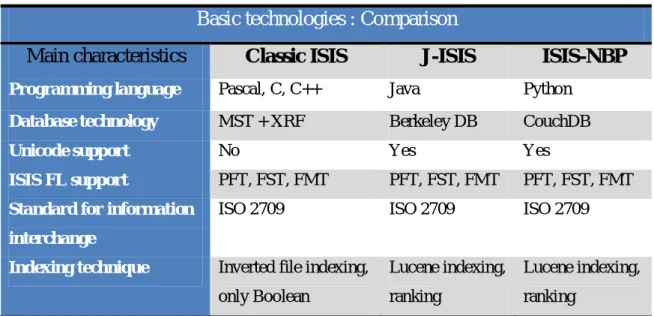
According to de Smet (2008a), the new generation which can be termed as the fifth generation is characterized by the use of new technologies in data storage (Berkley DB in J-ISIS, Couch DB in ISIS-NBP, MySQL in Alpha_ISIS), as well as by the full incorporation of Web technologies (such as PHP and JavaScript in ABCD, Plone CMS in ISIS-NBP), while everything is conceived in the spirit of FOSS development. As a consequence of all this, the ISIS master file (MST) and Cross Reference File (XRF) file architecture of previous generations will tend to disappear, while the formatting language will still be available for data management.
De Smet (2008a) considered that future developments of ISIS will no longer be classified simply as Database Management Systems, but will become the de facto standards for the management of textual, semi-structured databases. This new generation will maintain ISO 2709 as a common data exchange format and will be enriched with XML as a storage and exchange format. They will all use Lucene indexing and will all support Unicode.
3.2.2 The ABCD System Based on Classic ISIS Technology
Following the substantial international development effort lead by BIREME (WHO, Brazil) and the Flemish-Belgian VLIR/UOS (inter-university development co-operation body), the first release of ABCD as an integrated library automation software based on ISIS-technology was published in December 2009. The software is provided as a 'FOSS', i.e. 'free and open source software', keeping the 'free' nature which has always been the case for ISIS which is now driven by officially adopted 'open source' philosophy in the United Nations, particularly UNESCO and BIREME (the two institutions where most of the ISIS-programming development is done) (de Smet, 2010).
The software entails, as a 'software suite' like e.g. Microsoft Office, typical library oriented modules for database administration (definitions of storage and indexing structures,