1 Page 1-10 © MAT Journals 2019. All Rights Reserved
Disease Predictive Diagnostics Using Machine Learning
1Muthamil P, 2S.Lalitha 1
M.E Student, 2Assistant Professor
Department of Computer Science and Engineering
Gnanamani College of Technology, Namakkal, Tamil Nadu, India
Email:[email protected], [email protected]
DOI:http://doi.org/10.5281/zenodo.2525589 Abstract
Big Data is collecting large amounts of data. That's big. What is Uncontrollable with the Conventional Method It is difficult to process this large amount of data in a conventional way. So there are many techniques to handle and analyze this huge amount of data. The challenge we face when storing this huge amount of data is analysis, sharing, storage, etc. Big data is difficult to master with the traditional approach, so there are different methods. Clustering and classification have played a significant role in countless applications such as cognitive services, image recognition and processing, business and law, text and speech, medicine, weather forecasting, genetics, bioinformatics and so on. Some as of late settled machine learning approaches are introduced here, with the point of passing on vital ideas to order and grouping specialists.For this purpose, record the hospital data of a particular region. For missing data, use a latent factor model to obtain the incomplete data.The previous work on disease prediction uses the CNN-UDRP (Convolutional Neural Network Based Unimodel Disease Prediction) algorithm.The prediction of the CNN-MDRP algorithm is more accurate than in the previous prediction algorithm.
Index Terms: Big data analytics, Machine Learning, Healthcare.
INTRODUCTION
Concept of the big data is not a new concept it is constantly changing. Big data is collection of data. There are three characteristics of big data that is velocity, volume and variety. Healthcare is a best example of big data. The healthcare data is spread among the multiple medical systems, healthcare sectors, and government hospitals with the benefits of a big data more attention is paid to the Disease Prediction. Number of researches has been conducted to selecting the characteristics of a disease prediction from a large volume of a data.
The majority of the current work depends on an organized information. For the unstructured information one can utilize a Convolutional Neural Network. Convolutional Neural Network are comprised of a neurons, every neuron gets
a few information sources and performs activities and the entire system communicates a solitary differentiable score capacities. The exactness of an ailment expectation can be diminished on the grounds that there is a more distinction in a different provincial malady in view of atmosphere and living propensities for the people groups in their specific locales.However there are more challenges remain that are: How should missing data is collected. How certain regional characteristic of disease should be determined. By what means ought to conquer the atmosphere and living propensities issues. To decrease this difficulties join both the organized and unstructured information to precisely foresee the sickness defeat the issue of an absent and fragmented information utilize a dormant factor demonstrate. In the previous work only structured data can be
2 Page 1-10 © MAT Journals 2019. All Rights Reserved used but for the accurate results to use the
unstructured data.
This algorithm uses both the structured and unstructured data of ahospital. None of the existing algorithm can work both the type of structured and unstructured data. Its accuracy is about 94.8%.In this paper, the researchers present how artificial intelligence applied to medical field for the efficient diagnosis. For that purpose they use a k nearest neighbors algorithm and they check the accuracy of the algorithm with the help of UCI machine learning repository datasets. To generate patients input and test data for diagnosis. They use a real patient data. To add a additional training sets allow more medical conditions to be classified with the minimal no of changes to the algorithm. Disease prediction by Machine learning Profound Neural Network calculation can accomplish ideal outcomes by utilizing a lesser measure of patient information than contrasted with the GDBT calculation. Appropriated registering condition preparing the substantial volume of information is done dependent on Map Reduce. To discover the exactness of patient information the order is utilized. The center is to discover the closest exactness of classifiers.
The CART model and random forest is built for the data and accuracy of the classifier is found. By using the random predict algorithm to found the more nearest accuracy of the prediction. The forecast investigation serves to the specialists to distinguish the patient's confirmations on to the doctor's facility. Prescient model utilizing versatile arbitrary timberland.
Arrangement which can precisely give the outcome rate of hazard. Coronary illness forecast they utilize a Naive Bayesian and Decision tree calculation. Utilizing PCA to
diminish the quantity of qualities, subsequent to decreasing the extent of the datasets; Support Vector Machine can outflank a Naive Bayesian and Decision tree. SVM can likewise be utilized for expectation of hearts ailment.Information mining and the enormous information in the social insurance part is presented. Machine learning calculation has been utilized to examine the human services information consistent increment of information in a social insurance. A few nations are spending a great deal of assets, researcher prompts settle the issue of capacity and association of information the information mining will help misuse multifaceted nature of the information and discover the new outcome this paper depends on the utilization of information mining and huge information in the social insurance part. Conventional wearable gadgets have different weaknesses, for example, agreeableness for long haul wearing, and inadequate exactness, and so forth. Accordingly, wellbeing observing through conventional Wearable gadgets is difficult to be practical. So as to get medicinal services enormous information by manageable wellbeing checking, we configuration Smart Clothing, encouraging unpretentious gathering of different physiological pointers of human body. To give unavoidable insight to shrewd attire framework, portable human services cloud stage is developed by the utilization of versatile web, distributed computing and huge information examination.
To present structure subtleties, key advancements and commonsense execution strategies for keen apparel framework. Average applications fueled by keen attire and huge information mists are displayed, for example, therapeutic crisis reaction, feeling care, ailment determination, and continuous material cooperation. Particularly, electrocardiograph signals gathered by shrewd apparel are utilized for inclination
3 Page 1-10 © MAT Journals 2019. All Rights Reserved checking and feeling recognition. At last,
to feature a portion of the structure difficulties and open issues that still should be routed to make savvy attire universal for an extensive variety of uses CNN-MDRP calculation for both the information types.
LITERATURE SURVEY
Disease Prediction by Machine Learning over Big Data from Healthcare Communities
Authors: Lu Wang, and Lin Wang
With enormous information development in biomedical and human services networks, exact examination of therapeutic information benefits early ailment recognition, persistent consideration and network administrations. Be that as it may, the examination exactness is diminished when the nature of medicinal information is deficient. In addition, distinctive districts display extraordinary attributes of certain territorial maladies, which may debilitate the expectation of illness episodes. In this paper, we streamline machine learning calculations for successful forecast of unending malady flare-up in illness visit communities.We try the adjusted expectation models over genuine healing facility information gathered from focal China in 2013-2015. To defeat the trouble of fragmented information, we utilize an idle factor model to recreate the missing information. We investigate a provincial perpetual illness of cerebral localized necrosis. Contrasted with a few commonplace forecast calculations, the expectation exactness of our proposed calculation achieves 94.8% with an intermingling speed which is quicker than that of the CNN-based unimodal infection hazard expectation (CNN-UDRP) calculation. Toward Predicting Med-ical Conditions Using k-Nearest Neighbours.
Authors: Johann Sun1, Kaylee Hall1, Andrew Chang1
As the human services industry turns out to be increasingly dependent upon electronic records, the measure of restorative information accessible for investigation increments exponentially. While this data contains important measurements, the sheer volume makes it hard to break down without proficient calculations. By utilizing machine figuring out how to characterize restorative information, judgments can turn out to be progressively effective, precise, and available for people in general.
Comparing Deep Neural Network and Other Machine Learning Algorithms for Stroke Prediction in a Large-Scale Population-Based Electronic Medical Claims Database.
Authors: Wei-Chen Chen, Po-Tsun Lai, Ching-Heng Lin
Electronic therapeutic cases (EMCs) can be utilized to precisely anticipate the event of an assortment of sicknesses, which can add to exact medicinal mediations. While there is a developing enthusiasm for the use of machine learning (ML) systems to address clinical issues, the utilization of profound learning in medicinal services have quite recently picked up consideration as of late. Profound adapting, for example, profound neural system (DNN), has accomplished great outcomes in the zones of discourse acknowledgment, PC vision, and regular dialect handling as of late. Be that as it may, profound learning is regularly hard to grasp because of the complexities in its structure. Moreover, this technique has not yet been shown to accomplish a superior execution contrasting with other customary ML calculations in ailment forecast errands utilizing EMCs. In this examination, we use an expansive populace based EMC database of around 800,000 patients to contrast DNN and three other ML approaches for anticipating 5-year stroke event. The outcome demonstrates that DNN and slope boosting
4 Page 1-10 © MAT Journals 2019. All Rights Reserved choice tree (GBDT) can result in
correspondingly high expectation correctnesses that are better contrasted with strategic relapse (LR) and bolster vector machine (SVM) approaches. In the interim, DNN accomplishes ideal outcomes by utilizing lesser measures of patient information when contrasting with GBDT strategy.
Predicting the Risk of Diabetes in Big Data Electronic Health Records by using Scalable Random Forest Classification Algorithm.
Authors: Botswana
Electronic Health Records (EHR) is developing at an exponential rate that is being put away in big business databases or cloud stockpiles. These records have now become called as Big Data. A large portion of these information are unstructured. The information can be productively handled on cloud for bringing down the preparing costs. Prescient examination encourage the doctors, specialists to distinguish the patient admission to healing center at beginning time. To perform prescient examination different variables with statistic information, clinic parameters, quiet previous history and different markers for an explicit ailment. Be that as it may, distinguishing the solid markers for exact forecast is a testing undertaking. From the components being considered for prescient investigation different models and calculations should be contemplated. Characterization calculations like Naive Bayes, Linear Regression; summed up added substance demonstrate, Random Forest, Logistic Regression, Hidden Markov Models must be considered for building up a prescient models. In this paper we propose a prescient model utilizing versatile Random timberland grouping calculation which can precisely distinguish the classifier rate for danger of diabetes.
Study of Machine Learning Algorithms for Special Disease Prediction using Principal ofComponentAnalysis.
Authors:Prof. DhomseKanchan B. Assistant Professor of IT department METS BKC IOE
The overall examination on reasons for death because of coronary illness/disorder has been seen that it is the real reason for death. On the off chance that ongoing patterns are permitted to proceed, 23.6 million individuals will pass on from coronary illness in coming 2030. The human services industry gathers a lot of coronary illness information which sadly are not "mined" to find concealed data for compelling basic leadership. In this paper, investigation of PCA has been done which finds the base number of ascribes required to upgrade the accuracy of different regulated machine learning calculations. The motivation behind this exploration is to examine administered machine learning calculations to anticipate coronary illness. Information mining has number of critical strategies like order, preprocessing. Diabetic is a hazardous sickness which forestall in a few urbanized and developing nations like India. The information classification is diabetic patients datasets which is produced by gathering information from healing center storehouse comprises of 1865 cases with divergent qualities. The models in the dataset are two classes of blood tests, pee tests. In this exploration paper we examine an assortment of calculation methodologies of information mining that have been used for diabetic sickness forecast. Information mining is an outstanding practice utilized by wellbeing associations for order of ailments, for example, diabetes and malignant growth in bioinformatics look into.
MODULES
Disease Risk Prediction
The primary perpetual illness in this locale. The objective of this examination is
5 Page 1-10 © MAT Journals 2019. All Rights Reserved to foresee whether a patient is among the
cerebral dead tissue high-hazard populace as per their restorative history. All the more formally, we respect the hazard forecast demonstrate for cerebral dead tissue as the regulated learning techniques for machine learning, i.e., the information esteem is the characteristic estimation of the patient, X = (x ) which incorporates the patient's close to home data, for example, age, sexual orientation, the commonness of side effects, and living propensities (smoking or not) and other organized information and unstructured information. Support Vector Machine
Bolster Vector Machine takes a gander at the extraordinary of the datasets and draws a choice limit otherwise called hyper plane. It is a system which best isolates the two classes. Both example order and nonlinear relapse can be actualized utilizing Support Vector Machine (SVM). The fundamental thought behind the Support Vector Machine is to create a multidimensional plane. This hyper-plane can additionally be utilized to segregate between two classes. At the point when the measure of information factors is bigger relative to the accessible perceptions, at that point Support Vector Machine (SVM) can actualized without hardly lifting a finger than the other characterization calculations.
Used machine learning algorithm: - Naive Bayes
It is an order procedure dependent on a Bayes hypothesis. Javier Bayes calculation is anything but difficult to fabricate and mostly helpful for a lot of informational indexes. In a guileless Bayes it can change over the informational collection in a recurrence table and after that make a probability table by finding the probabilities like cloudy likelihood. In our paper we are utilizing the credulous Bayes calculation for the exact result of forecast
from the substantial volume of a restorative data.Bayes hypothesis gives a method for figuring the back likelihood, P(c—x), from P(c), P(x), and P(x—c). Gullible Bayes classifier expect that the impact of the estimation of an indicator (x) on a given class (c) is autonomous of the estimations of different indicators.
Data Set:
a) Healing facility information a huge volume of datasets of a patient can be given by a doctor's facility and the information can be put away in the server farm to ensure the patient protection and security of put away information, we make a security get to system.
b) Organized information The organized information is only the research facility information, patients essential data like patients age, sexual orientation, life propensities, tallness, weight and so forth. c) Unstructured Data Unstructured Data is an information of patients restorative history, patients sickness, and specialists cross examination and finding.
The 20 healing centers datasets comprising 20,000 records and information of patients. The 20 clinic dataset is a famous dataset for trials in utilization of a machine learning system.
Model-based clustering Technique Growth of model-based calculation is to suit the information and beforehand defined scientific model. Expecting the information age through blend of Probability Distributions in this way empowering to decide the quantum of bunches naturally utilizing factual models by bookkeeping clamor (anomalies) prompting solid grouping technique. One of the model-based calculations desire augmentation (EM) is taken for examination. Benefits: Different and propelled models arrangement to portray the information successfully. Bad mark: More time multifaceted nature.
6 Page 1-10 © MAT Journals 2019. All Rights Reserved SCREEN SHOTS
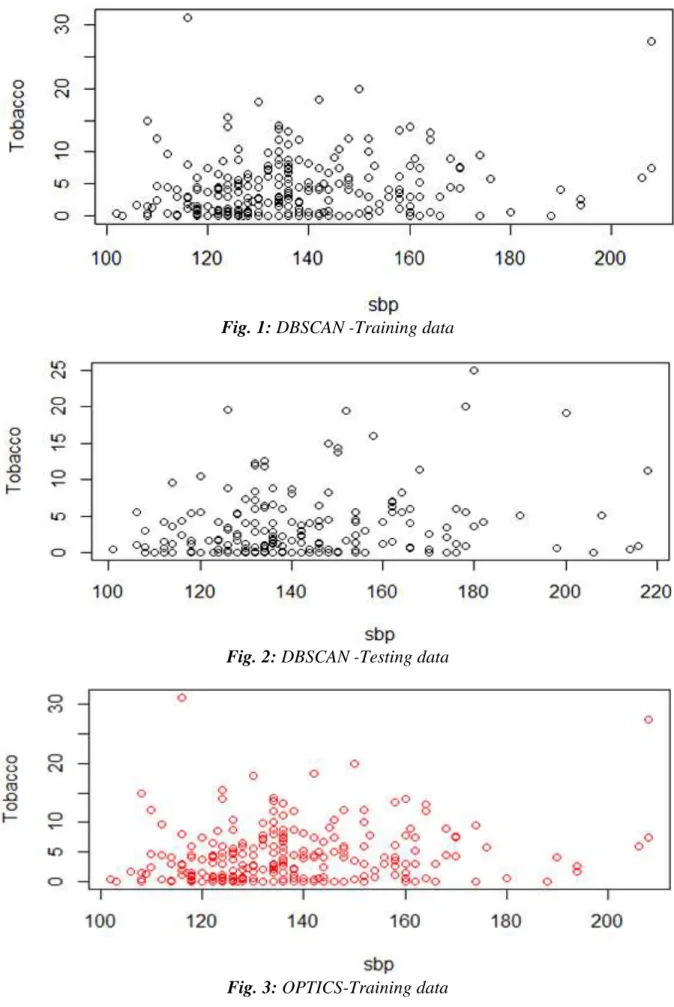
Fig. 1: DBSCAN -Training data
Fig. 2: DBSCAN -Testing data
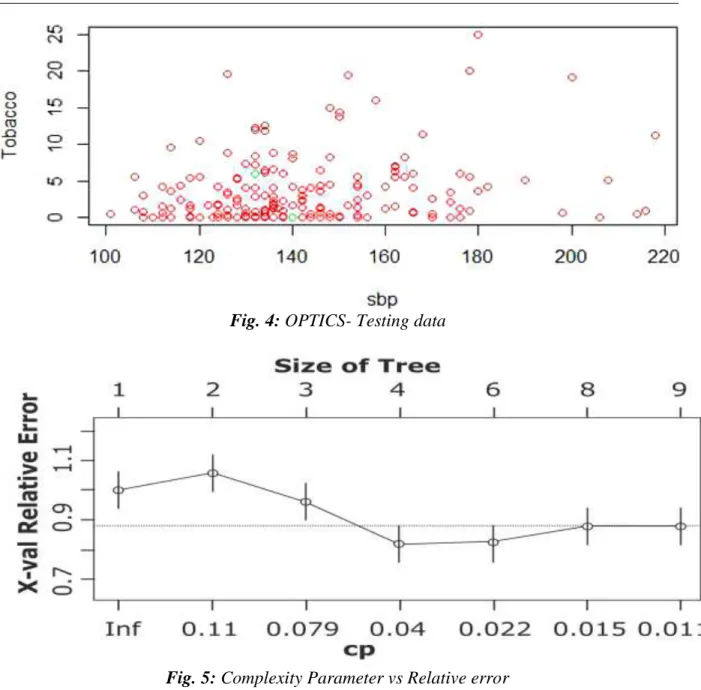
7 Page 1-10 © MAT Journals 2019. All Rights Reserved Fig. 4: OPTICS- Testing data
Fig. 5: Complexity Parameter vs Relative error
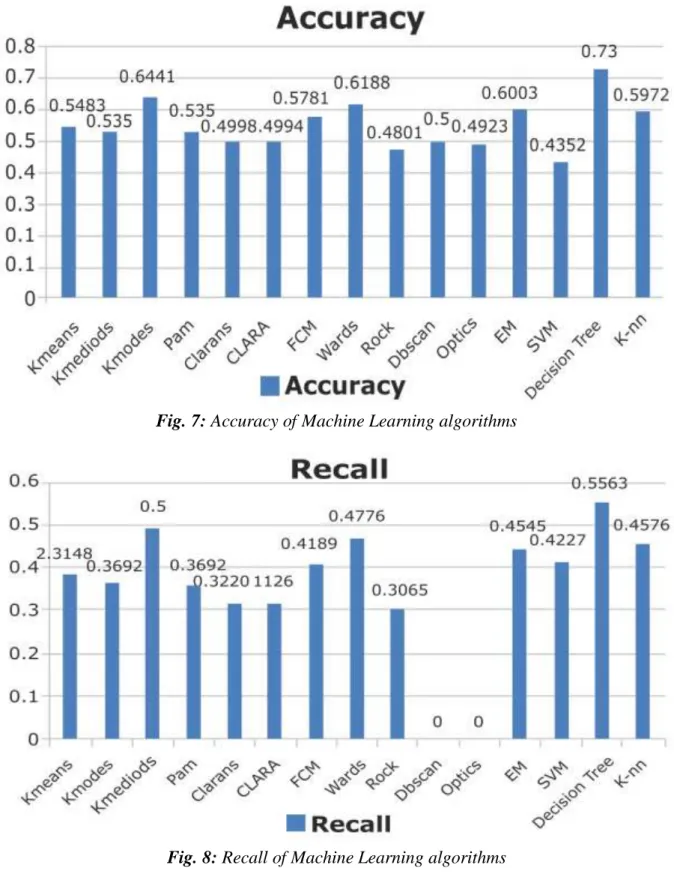
8 Page 1-10 © MAT Journals 2019. All Rights Reserved Fig. 7: Accuracy of Machine Learning algorithms
Fig. 8: Recall of Machine Learning algorithms
EXISTING SYSTEM
Machine learning calculation is utilized for compelling expectation of interminable infection episode in ailment visit networks. To test the demonstrated expectation
models over genuine healing facility information gathered from focal China in 2013-2015. To beat the trouble of fragmented information, utilize an idle factor model to reproduce the missing
9 Page 1-10 © MAT Journals 2019. All Rights Reserved information. New Convolutional Neural
Network based Multimodal Disease Risk Prediction (CNN-MDRP) calculation utilizing organized and unstructured information from healing facility. Contrasted with a few run of the mill expectation calculations, the forecast precision of our proposed calculation achieves 94.8% with an assembly speed which is quicker than that of the CNN-based Unimodal Disease Risk Prediction (CNN-UDRP) calculation.
LIMITATIONS OF EXISTING SYSTEM
Using UDRP algorithm accuracy of hospital data is low compare than MDRP algorithm.
Data speed is low and also disease prediction is slow.
In existing work the healthcare system result is inconsistency.
PROPOSED SYSTEM
In a proposed framework first to get the huge volume of a medicinal services huge information, at that point that information is considered as preparing information.
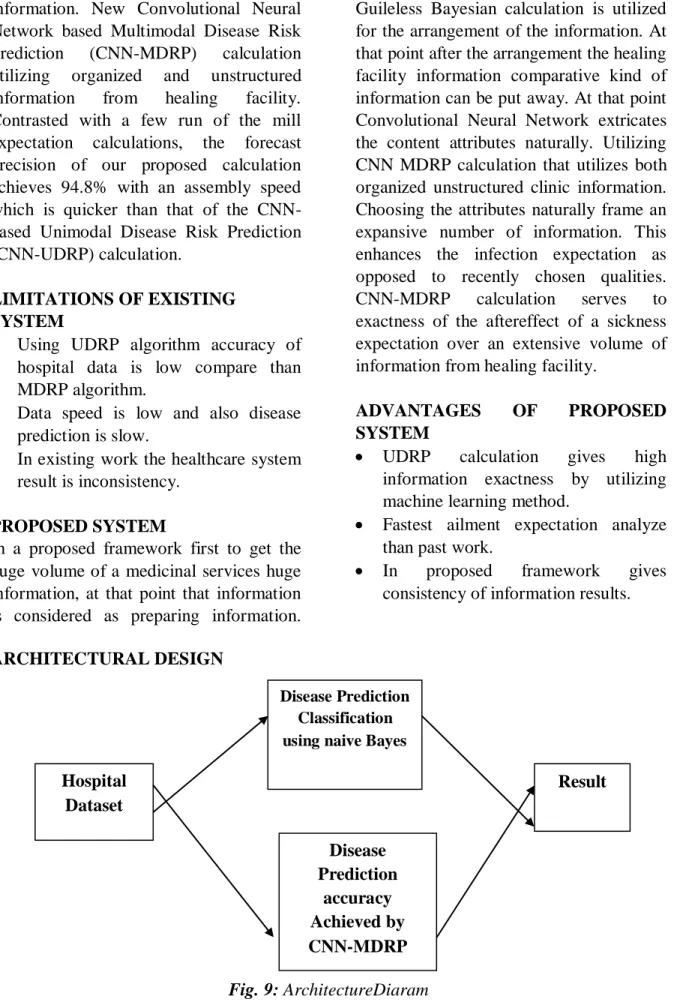
Guileless Bayesian calculation is utilized for the arrangement of the information. At that point after the arrangement the healing facility information comparative kind of information can be put away. At that point Convolutional Neural Network extricates the content attributes naturally. Utilizing CNN MDRP calculation that utilizes both organized unstructured clinic information. Choosing the attributes naturally frame an expansive number of information. This enhances the infection expectation as opposed to recently chosen qualities. CNN-MDRP calculation serves to exactness of the aftereffect of a sickness expectation over an extensive volume of information from healing facility.
ADVANTAGES OF PROPOSED
SYSTEM
UDRP calculation gives high information exactness by utilizing machine learning method.
Fastest ailment expectation analyze than past work.
In proposed framework gives consistency of information results.
ARCHITECTURAL DESIGN
Fig. 9: ArchitectureDiaram
Disease Prediction Classification using naive Bayes
Result Hospital Dataset Disease Prediction accuracy Achieved by CNN-MDRP
10 Page 1-10 © MAT Journals 2019. All Rights Reserved CONCLUSION
CNN-MDRP calculation for an illness forecast from a substantial volume of doctor's facility's organized and unstructured information. Utilizing a machine learning calculation (Naive-Bayesian) Existing calculation CNN-UDRP just uses an organized information yet in CNN-MDRP center around both organized and unstructured information the precision of sickness forecast is more and quick when contrasted with the CNN-UDRP. By joining the organized and unstructured information the exactness rate can be reach to 94.80%.
REFERENCES
1. BasuRoy.S, Teredesai.A, Zolfaghar.K, Liu.R, Hazel.D, Newman.S,and Marinez.A, (2015) ―Dynamic hierarchical classification for patient risk-ofreadmission,‖ in Proceeding of the 21th ACM SIGKDD international conference on knowledge discovery and data mining. ACM, pp.1691– 1700.
2. Bates.D.W, Saria.S, Ohno-Machado.L, Shah.A, and Escobar.G, (2014)―Big data in health care: using analytics to identify and manage high-risk and high-cost patients,‖ Health Affairs, vol. 33, no. 7, pp. 1123–1131.
3. Chen.H, Chiang.R.H, and Storey V.C,(2012) ―Business intelligence and analytics: From big data to big impact.‖ MIS quarterly, vol. 36, no. 4,pp. 1165–1188.
4. Chen.M, Ma.Y, Li.Y, Wu.D, Zhang.Y, Youn.C,(2017) ―Wearable 2.0: Enable Human-Cloud Integration in Next Generation Healthcare System,‖ IEEE Communications, Vol. 55, No. 1, pp. 54–61.
5. Chen.M, Mao.S, and Liu.Y, (2014)―Big data: A survey,‖ Mobile Networks and Applications, vol. 19, no. 2, pp. 171–209.
6. Groves.P, Kayyali.B, Knott.D, and KuikenS.V,(2016)
―The’bigdata’revolution in healthcare: Accelerating value and innovation,‖. 7. Hwang.K, Chen.M,(2017) ―Big Data
Analytics for Cloud/IoT and Cognitive Computing,‖ Wiley, U.K., ISBN: 9781119247029.
8. Jensen.P.B, JensenL.J, and Brunak.S,(2012) ―Mining electronic health records: towards better research applications and clinical care,‖ Nature Reviews Genetics, vol. 13, no. 6, pp. 395–405.
9. Lin.K, Chen.M, Deng.J, Hassan.M.M, and Fortino.G, (2016)―Enhanced fingerprinting and trajectory prediction for iot localization in smart buildings,‖ IEEE Transactions on Automation Science and Engineering, vol. 13, no. 3, pp. 1294–1307.
10.Marcoon.S, Chang.A.M, Lee.B,
Salhi.R, and
Hollander.J.E,(2013)―Heart score to further risk stratify patients with low timi scores,‖ Critical pathways in cardiology, vol. 12, no. 1, pp. 1–5. 11.Nori.N, Kashima.K, Yamashita.K,
Ikai.H, and Imanaka.Y, (2015)―Simultaneous modeling of multiple diseases for mortality prediction in acute hospital care,‖ in Proceedings of the 21th ACM SIGKDD International Conference on Knowledge Discovery and Data Mining.
12.Oliver.D, Daly.F, Martin.F.C, and McMurdo.M.E, (2004)―Risk factors and risk assessment tools for falls in hospital in-patients: a systematic review,‖ Age and ageing, vol. 33, no. 2, pp. 122–130.
Cite this article as: Muthamil P, & S.Lalitha. (2018). Disease Predictive Diagnostics Using Machine Learning. Journal of Data Mining and Management, 4(1), 1–10. http://doi.org/10.5281/zenodo.252558 9