POUR L'OBTENTION DU GRADE DE DOCTEUR ÈS SCIENCES
acceptée sur proposition du jury: Prof. K. Aberer, président du jury
Prof. H. Bourlard, Dr A. Popescu-Belis, directeurs de thèse Dr S. Bengio, rapporteur
Dr J.-C. Chappelier, rapporteur Prof. A. Krause, rapporteur
Similarity Learning Over Large Collaborative Networks
THÈSE N
O5696 (2013)
ÉCOLE POLYTECHNIQUE FÉDÉRALE DE LAUSANNE
PRÉSENTÉE LE 6 JUIN 2013À LA FACULTÉ DES SCIENCES ET TECHNIQUES DE L'INGÉNIEUR LABORATOIRE DE L'IDIAP
PROGRAMME DOCTORAL EN INFORMATIQUE, COMMUNICATIONS ET INFORMATION
Suisse
PAR
Acknowledgements
I would like to thank my advisers Andrei Popescu-belis and Herve Bourlard, for giving me the opportunity to work on this interesting topic. I would especially thank Andrei for his support, help and availability during the past four years.
I also would like to thank Ronan Collobert. I learned many machine learning concepts from him, and also he has made himself available for research discussions consistently. Many ideas in this thesis have their roots in these discussions.
I am thankful to my thesis committee - Karl Aberer, Samy Bengio, Jean-Cedric Chappelier, and Andreas Krause - for being part of my thesis and providing constructive feedbacks to improve it.
Interaction and discussion with Kate, Afsaneh, Gelareh, Marc, Gokul, Nikos, Darshan, Dinesh, Tatiana, Marco, Francesco, Nikolae, Leo, Mathew and many other Idiapers, was a great source of learning. I would like to thank Remi and Kenneth for making ICC a great experience. I thank Alex, Thomas and CC for making work more enjoyable.
Thanks to Maryam, Hassan and Mehdi who shared generously many good times with me. I would like to thank Samira for her consistent support and understanding that helped me to keep high standards alive inside me.
I would like to thank Marjan specially. Her constant encouragement, positive thinking and kindness over years brought life to my life and shaped my personality, and I am thankful for that. I also thank my parents who always supported my education, mentally and financially, and respected my choices.
I would like to thank my lifelong friend Mohsen Hosseini. Interaction with him over the years played a great role in shaping my critical thinking and research spirit.
I also would like to acknowledge my funding source, the Swiss National Center of Competence in Research (NCCR) on Interactive Multimodal Information Management (IM2).
Abstract
In this thesis, we propose novel solutions to similarity learning problems on collaborative networks. Similarity learning is essential for modeling and predicting the evolution of collabo-rative networks. In addition, similarity learning is used to perform ranking, which is the main component of recommender systems. Due to the the low cost of developing such collaborative networks, they grow very quickly, and therefore, our objective is to develop models that scale well to large networks.
The similarity measures proposed in this thesis make use of the global link structure of the network and of the attributes of the nodes in a complementary way. We first define a random walk model, named Visiting Probability (VP), to measure proximity between two nodes in a graph.VPconsiders all the paths between two nodes collectively and thus reduces the effect of potentially unreliable individual links. Moreover, usingVPand the structural characteristics of small-world networks (a frequent type of networks), we design scalable algorithms based on
VPsimilarity. We then model the link structure of a graph within a similarity learning frame-work, in which the transformation of nodes to a latent space is trained using a discriminative model. When trained overVPscores, the model is able to better predict the relations in a graph in comparison to models learned directly from the network’s links.
Using theVPapproach, we explain how to transfer knowledge from a hypertext encyclopedia to text analysis tasks. We consider the graph of Wikipedia articles with two types of links between them: hyperlinks and content similarity ones. To transfer the knowledge learned from the Wikipedia network to text analysis tasks, we propose and test two shared repre-sentation methods. In the first one, a given text is mapped to the corresponding concepts in the network. Then, to compute similarity between two texts,VPsimilarity is applied to compute the distance between the two sets of nodes. The second method uses the latent space model for representation, by training a transformation from words to the latent space overVPscores. We test our proposals on several benchmark tasks: word similarity, docu-ment similarity / clustering / classification, information retrieval, and learning to rank. The results are most often competitive compared to state-of-the-art task-specific methods, thus demonstrating the generality of our proposal. These results also support the hypothesis that both types of links over Wikipedia are useful, as the improvement is higher when both are used. In many collaborative networks, different link types can be used in a complementary way.
Therefore, we propose two joint similarity learning models over the nodes’ attributes, to be used for link prediction in networks with multiple link types. The first model learns a similarity metric that consists of two parts: the general part, which is shared between all link types, and the specific part, which is trained specifically for each type of link. The second model consists of two layers: the first layer, which is shared between all link types, embeds the objects of the network into a new space, and then a similarity is learned specifically for each link type in this new space. Our experiments show that the proposed joint modeling and training frameworks improve link prediction performance significantly for each link type in comparison to multiple baselines. The two-layer similarity model outperforms the first one, as expected, due to its capability of modeling negative correlations among different link types.
Finally, we propose a learning to rank algorithm on network data, which uses both the at-tributes of the nodes and the structure of the links for learning and inference. Link structure is used in training through a neighbor-aware ranker which considers both node attributes and scores of neighbor nodes. The global link structure of the network is used in inference through an original propagation method called the Iterative Ranking Algorithm. This propagates the predicted scores in the graph on condition that they are above a given threshold. Thresholding improves performance, and makes a time-efficient implementation possible, for application to large scale graphs. The observed improvements are explained considering the structural properties of small-world networks.
Keywords:Distance Metric Learning, Similarity Learning, Social Network Analysis, Collabora-tive Network Analysis, Learning to Rank, Link Prediction, Text Semantic Similarity, Random Walk, Transfer Learning, Classification, Clustering.
Résumé
Apprentissage de mesures similarité sur des graphes collaboratifs de grande taille
Dans cette thèse, nous proposons de nouvelles solutions au problème de l’apprentissage automatique de mesures de similarité appliquées aux réseaux ou graphes collaboratifs. L’ap-prentissage des mesures de similarité est essentiel pour modéliser et prédire l’évolution des réseaux collaboratifs. De plus, ces mesures sont utilisées pour des tâches de classement qui sont la composante principale des systèmes de recommandation. Le faible coût de création de ces réseaux collaboratifs fait qu’ils croissent très vite. C’est pourquoi un de nos objectifs est de proposer des modèles applicables à des réseaux de grande taille.
Les mesures de similarité proposées dans cette thèse utilisent la structure globale des liens du graphe et les attributs des nœuds d’une façon complémentaire. Nous définissons d’abord un modèle de marche aléatoire appelé Probabilité de Visite (VPen anglais) pour mesurer la proximité de deux nœuds dans un graphe. Le modèle considère l’ensemble des chemins entre deux nœuds, ce qui réduit l’effet des liens individuels, potentiellement peu fiables. De plus, partant de laVP et des caractéristiques des réseaux de type “petit monde” (un type relativement fréquent), nous proposons des algorithmes adaptés aux graphes de grande taille. Nous modélisons ensuite la structure de liens dans un cadre permettant l’apprentissage discri-minatif de la similarité, qui projette les nœuds dans un espace latent. Lorsqu’il est entraîné sur les valeurs deVP, ce modèle fait de meilleurs prédictions sur les liens qu’un modèle entraîné directement sur les liens du graphe.
Utilisant toujours l’approcheVP, nous expliquons comment transférer les informations conte-nues dans une encyclopédie hypertexte pour les appliquer à des tâches d’analyse de textes. Nous utilisons le graphe de Wikipedia avec deux types de liens entre articles : les hyperliens d’origine et des liens construits à partir de la similarité lexicale. Afin de transférer l’information acquise à partir de Wikipedia vers les tâches d’analyse de texte, nous proposons deux modèles de représentation. Dans le premier, un texte est mis en correspondance avec les concepts les plus pertinents du graphe, puis, pour calculer la similarité entre deux textes, nous utilisons laVPentre les ensembles de concepts. Dans le second modèle, un espace latent sert de re-présentation commune, et une fonction de transformation entre les mots et l’espace latent est entraînée avec laVPcomme critère. Ces propositions sont testées sur plusieurs tâches : similarité de mots, similarité de documents, partitionnement de documents, classification de
documents, recherche d’information, et apprendre à classer. Les résultats sont le plus souvent comparables aux meilleurs résultats des méthodes conçues spécifiquement pour chaque tâche, ce qui démontre la généralité de notre modèle. De plus, les résultats montrent que les deux types de liens sont utiles.
Les différents types de liens existant dans les graphes collaboratifs peuvent souvent être utili-sés de manière complémentaire. Nous proposons deux modèles pour l’apprentissage de la similarité sur les attributs des nœuds, à utiliser pour la prédiction de liens dans les graphes avec plusieurs types de liens. Le premier modèle apprend une mesure de similarité avec deux composants : la partie générale, partagée par tous les types de liens, et la partie spécifique, entraînée de manière séparée sur chaque type. Le second modèle comprend deux couches : la première (partagée par tous les types de liens) projette les nœuds dans un nouvel espace, puis une fonction de similarité est entraînée pour chaque type de liens dans cet espace. Nos expériences montrent que ces modèles améliorent la prédiction de liens pour chaque type. Le modèle à deux couches est, comme prévu, meilleur que le premier, grâce à sa capacité à utiliser aussi des corrélations négatives entre types de liens.
Nous proposons, en final, un algorithme pour apprendre à classer les nœuds, qui utilise à la fois les attributs des nœuds et la structure des liens. Cette dernière est utilisée grâce à une méthode de propagation originale appelée Algorithme Itératif de Classement. Cette méthode propage les scores prédits à travers le graphe, à condition qu’ils dépassent un certain seuil. L’utilisation d’un seul améliore les scores et aboutit à un algorithme rapide pouvant être appliqué aux graphes de grande taille. Les améliorations observées sont analysées dans la perspective des propriétés structurelles des graphes du type “petit monde”.
Mots-clés :Apprentissage de distances sur les graphes, Apprentissage de mesures de similarité, Analyse des réseaux sociaux, Analyse de réseaux collaboratifs, Apprendre à classer, Prédic-tion de liens, Similarité sémantique de textes, Marche aléatoire, Transfert de l’apprentissage, Classification, Partitionnement.
Contents
Acknowledgements iii
Abstract (English / Français) v
List of figures xi
List of tables xiv
1 Introduction 1
2 Related work 7
2.1 Distance Metric Learning and Learning to Rank . . . 8
2.2 Supervised Link Prediction . . . 9
2.3 Ranking and Distance Based on Link Structure . . . 10
2.4 Word Semantic Relatedness using Graphs: WordNet and Wikipedia . . . 11
2.5 Text Semantic Relatedness . . . 13
3 Symmetric Random Walk on Large Graphs 17 3.1 Visiting Probability . . . 17
3.1.1 Notations . . . 18
3.1.2 Definition of Visiting Probability (VP) . . . 18
3.1.3 Importance of a Symmetric Measure: Visiting Probability‘to’vs.‘from’ . 19 3.1.4 Properties ofVP . . . 21
3.1.5 Relation to other Random Walk Models . . . 22
3.2 Approximations: Epsilon-Truncated Visiting Probability . . . 24
3.2.1 Path Insensitive Epsilon-Truncated Visiting Probability . . . 25
3.2.2 Path Sensitive Epsilon-Truncated Visiting Probability . . . 25
3.2.3 Truncated Visiting Probability Between all Vertices and a Query . . . 25
3.3 Fast Computing of Nearest Neighbors of a Query Node . . . 29
3.3.1 Fast K-Nearest Neighbors of a Query Node . . . 30
3.3.2 Community of the Query Node . . . 31
3.3.3 Experimental Results on Link Prediction . . . 34
3.4 Learning Embeddings for Latent Space Model of Networks . . . 36
3.4.1 Learning Embeddings . . . 37
3.4.3 Experimental Results using Latent Space Model . . . 40
4 Transfer Learning from Hypertext Encyclopedia to Text Analysis Tasks 43 4.1 Introduction to Text Similarity . . . 44
4.2 Semantic Relatedness: Definitions and Issues . . . 44
4.2.1 Nature of Semantic Relations for Words and Texts . . . 45
4.2.2 Use of Encyclopedic Knowledge for Semantic Relatedness . . . 46
4.3 Wikipedia as a Network of Concepts . . . 46
4.3.1 Concepts = Nodes = Vertices . . . 46
4.3.2 Relations = Links = Edges . . . 47
4.3.3 Properties of the Resulting Network . . . 48
4.4 Common Representation Space for Transfer Learning . . . 50
4.4.1 Mapping Text Fragments to Concepts in the Network . . . 50
4.4.2 Learning Embeddings to Latent Space . . . 54
4.5 Empirical Analyses ofVPand Approximations . . . 56
4.5.1 Convergence of the path insensitive Epsilon-TruncatedVPover Wikipedia 57 4.5.2 Convergence of path sensitive Epsilon-TruncatedVPover Wikipedia . . 57
4.5.3 Differences between the Random Walk Model over Content Links and Direct Lexical Similarity between Articles . . . 58
4.6 Word Similarity . . . 59
4.7 Document Similarity . . . 62
4.8 Document Clustering . . . 64
4.8.1 Setup of Experiment on 20 Newsgroups . . . 64
4.8.2 Comparison ofVPand Cosine Similarity . . . 67
4.9 Text Classification . . . 68
4.9.1 Distance Learning Classifier . . . 68
4.9.2 20 Newsgroups Classification . . . 69
4.10 Information Retrieval . . . 70
4.11 Learning to Rank by UsingVPSimilarities . . . 71
4.12 Application to Just-in-Time Retrieval . . . 73
4.13 Perspectives: Two-Stage Random Walks . . . 74
5 Joint Similarity Learning for Predicting Links in Multi-Link Networks 77 5.1 Motivations . . . 78
5.2 Joint Similarity for Multiple-Type Link Prediction . . . 78
5.2.1 Similarity Learning Framework . . . 79
5.2.2 Shared Similarity Model . . . 79
5.2.3 Two-layer Similarity . . . 80
5.2.4 Training the Joint Models . . . 81
5.2.5 Generalization for Related Problems . . . 85
5.3 Experimental Results . . . 87
5.3.1 Network of TED Talks . . . 87
5.3.3 Prediction Performance . . . 89
5.3.4 Effect of Low-rank Factorization Dimension . . . 93
5.4 Convergence of the Training Shared Similarity Model . . . 93
5.5 Conclusion . . . 94
6 Similarity Learning for Collective Ranking on Networks 97 6.1 Introduction to Ranking on Relational Data . . . 97
6.2 Motivation of the Model . . . 98
6.3 Learning to Rank on a Network . . . 99
6.3.1 Neighbors-aware Ranker . . . 100
6.3.2 Collective Inference . . . 102
6.3.3 Training the Neighbors-aware Ranker . . . 104
6.4 Experimental Setup and Results . . . 106
6.4.1 Effect of Threshold . . . 108
6.5 Conclusion and Future Perspectives . . . 109
7 Conclusion and Perspectives 113
Bibliography 129
List of Figures
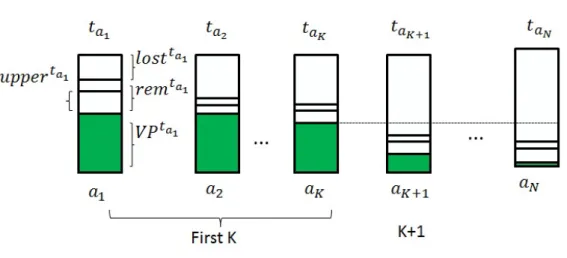
3.1 Fast KNN algorithm: schematic representation of the situation in which theVPt
of the node at the positionKis larger than the upper bound of all the nodes after it. The notations are those from Algorithm 5. . . 30 3.2 AverageVPfor the top 50 not-linked closest nodes on Cora, CiteSeer, WebKB,
Amazon Products and Wikipedia networks. TheVPvalues decrease rapidly after the first few nodes. . . 33 3.3 Two latent space models . . . 38 4.1 Distribution of community sizes for a sample of 1000 nodes (see text for the
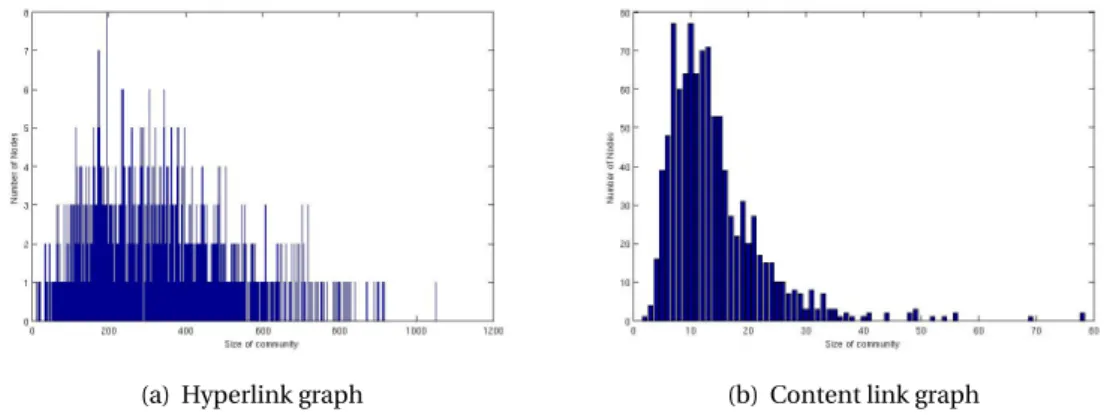
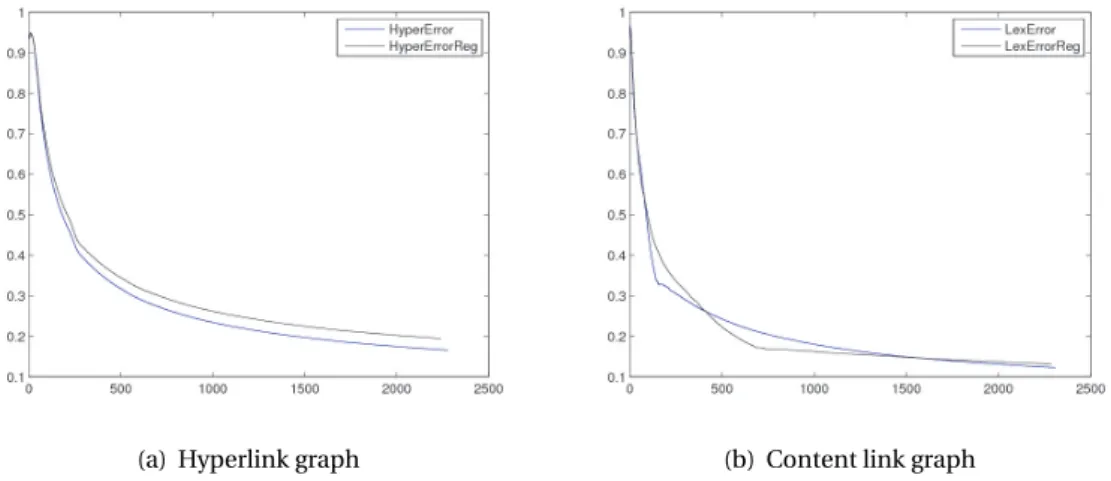
definition of a community). For each community size (x-axis) the graphs show the number of nodes (y-axis) having a community of that size, for each of the two graphs built from Wikipedia. Both graphs have a tendency towards clustering, i.e. a non-uniform distribution of links, with an average cluster size of 150–400 for hyperlinks and 7–14 for content links. . . 49 4.2 Average training error for learning embeddings, measured every 1000 iterations,
with and without using regularization. . . 55 4.3 VPsum(T) as an “averageVP” for content links (a) and hyperlinks (b) over the
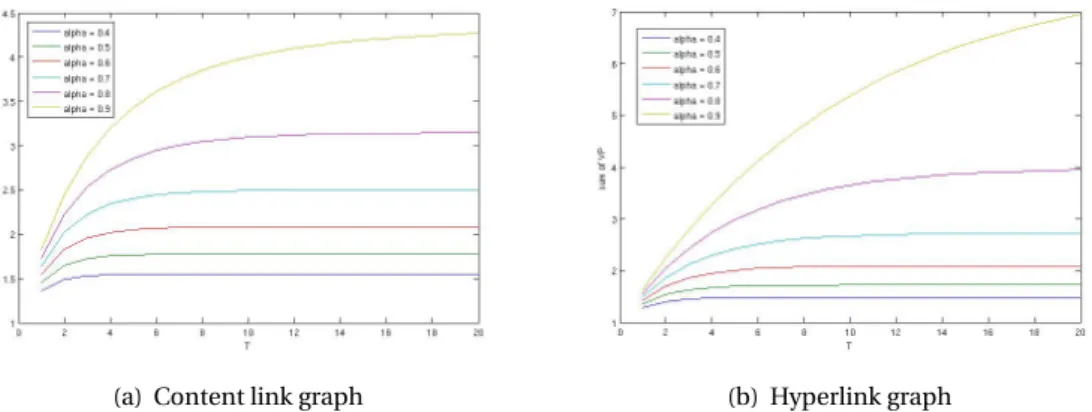
Wikipedia graph, depending onT, forαvarying from 0.4 to 0.9 (by 0.1, bottom to top). The shape of the curves indicates the values ofT leading to an acceptable approximation of the exact, non-truncated value: α=0.8 andT =10 were chosen in the subsequent experiments. . . 57 4.4 Sum ofε-TruncatedVPdepending on 1/εfor the Wikipedia graph with content
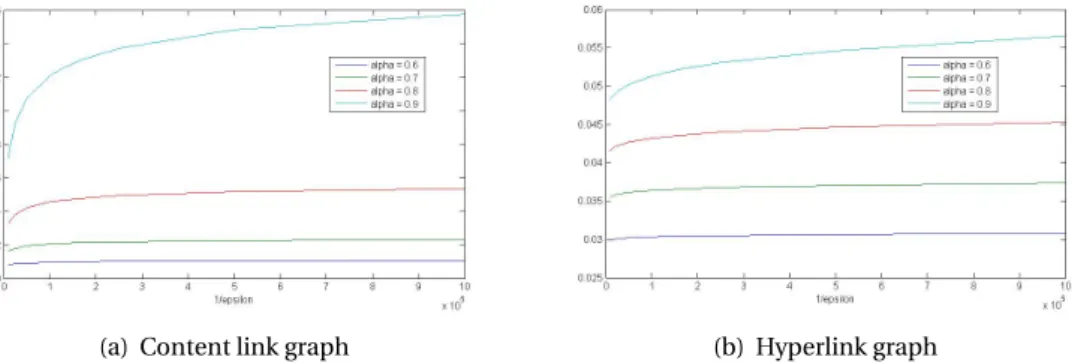
links (a) or hyperlinks (b), forαfrom 0.6 to 0.9 (bottom to top). The shape of the curves indicates the values ofεleading to an acceptable approximation of the non-truncated value:ε=10−5andα=0.8 were chosen for subsequent experiments. . . 58 4.5 Average proportion of identical nodes amongKclosest neighbors using cosine
similarity vs. averageT-truncatedVP, for varying sizesKof the neighborhood and various values ofα(which have little influence on the result). The proportion decreases for larger neighborhoods, i.e. the two metrics give quite different results for smaller relatedness values. . . 59
4.6 Spearman rank correlationρbetween automatic and human judgments of word similarity on the WordSimilarity-353 data set, depending on the weight of con-tent links in the random walk (the weight of hyperlinks is the complement to 1). The best scores,ρ= 0.70, are reached when content links have more weight than hyperlinks (0.7–0.8 vs. 0.3–0.2). The result of LSA,ρ = 0.56, is quoted from Gabrilovich and Markovitch [2007], and is outperformed by other scores in the literature. . . 60 4.7 Average frequency of the path lengths contributing toVPon the
WordSimilarity-353 data set, in three configurations (left to right for each integer value): hyper-links only, equal weights, content hyper-links only. . . 63 4.8 Pearson correlation coefficientr betweenVPresults and human judgments on
document similarity, depending on the weight of the hyperlinks in the combina-tion (the weight of the content links is the complement to 1). The best score of
r = 0.676 is reached when hyperlinks have less weight than content links, but are still used. The result of LSA,r= 0.60, is quoted from Lee et al. [2005]. . . 64 4.9 Frequencies of the path lengths contributing toVP, averaged over the document
similarity data set, in three configurations of the system (left to right for each integer value): hyperlinks only, content links only, and equal weights for both types. . . 65 4.10 Values ofk-purity (vertical axis) averaged over all documents, for
neighbor-hoods of different sizesk. The horizontal axis indicates the weightwof visiting probability vs. cosine lexical similarity in the formula:w×VPC omb+(1−w)×LS. 68 5.1 A schematic representation of the two-layer similarity model. MatrixAembeds
the objects in the network to aK-dimensional space. MatrixMicomputes the similarity between objects for link typei. . . 81 6.1 Precision at 10, as a percentage, for the eight rankers listed in the text. The
pro-portion of known prior relations of the query objects in the network is increased from 0 to 0.7. From left to right, the data sets are WebKB, Cora, and CiteSeer. . . 109 6.2 Recall at 10, as a percentage, for the eight rankers listed in the text. The
propor-tion of known prior relapropor-tions of the query objects in the network is increased from 0 to 0.7. From left to right, the data sets are WebKB, Cora, and CiteSeer. . . 110 6.3 Precision at 10, as a percentage, when increasing the thresholdcof the IRA from
0.2 to 0.95 on the three data sets. In each graph, the curves correspond to 0.2, 0.4 and 0.8 of prior relations known. . . 110 6.4 Recall at 10, as a percentage, when increasing the thresholdcof the IRA from 0.2
to 0.95 on the three data sets. In each graph, the curves correspond to 0.2, 0.4 and 0.8 of prior relations known. . . 111 6.5 Inference time of the IRA when increasing the thresholdcfrom 0.2 to 0.95 on
the three data sets. In each graph, the curves correspond to 0.2, 0.4 and 0.8 of prior relations known. . . 111
List of Tables
2.1 Comparison of the present proposal (last line) with previous work cited in this section, in terms of resources, algorithms, NLP tasks, and data sets. The abbre-viations for the data sets in the rightmost column are explained in Section 4.6 . The methods are abbreviated as follows: ESA for Explicit Semantic sis [Gabrilovich and Markovitch, 2007, 2009], LSA for Latent Semantic Analy-sis [Deerwester et al., 1990], IC for Information Content [Resnik, 1995, 1999], PMI-IR pointwise mutual information using data collected by information re-trieval [Turney, 2001, Mihalcea et al., 2006], and PPR for the Personalized PageR-ank algorithm [Haveliwala, 2003, Berkhin, 2005]. . . 15 3.1 Average recall at 50 (in percentage) for 1000 randomly chosen nodes on two
networks: Amazon Products and Wikipedia articles . . . 23 3.2 Average recall at 10 (in percentage) for 1000 randomly chosen nodes on two
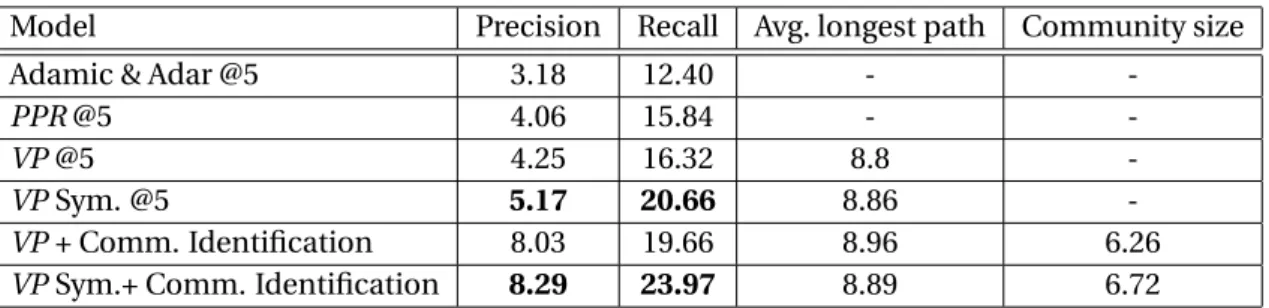
networks: Facebook and Wikipedia articles . . . 24 3.3 Number of edges and attributes of the data sets. . . 35 3.4 Average precision and recall on the Cora network for the link prediction task
described in Section 3.3.3 . . . 36 3.5 Average precision and recall on the CiteSeer network for the link prediction task
described in Section 3.3.3 . . . 36 3.6 Average precision and recall on the WEBKB network for the link prediction task
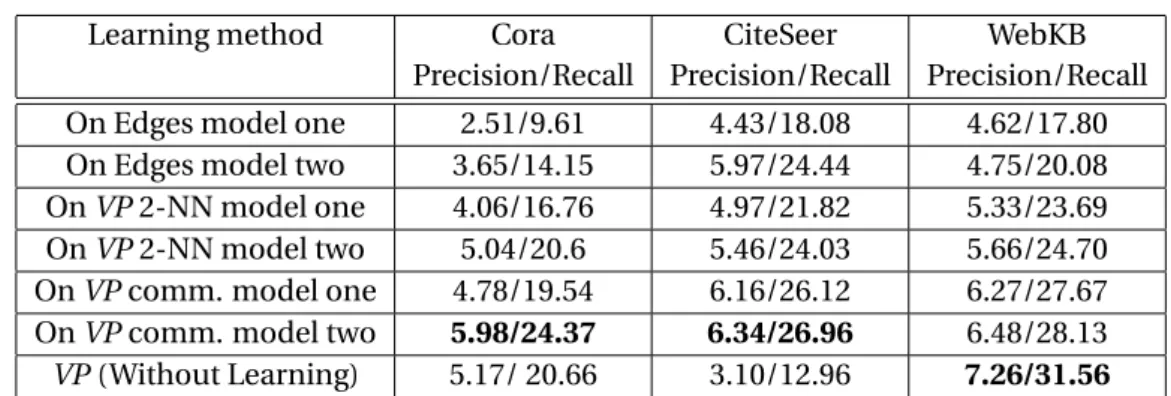
described in Section 3.3.3 . . . 36 3.7 Precision and recall for the two latent space models trained on networks’ edges:
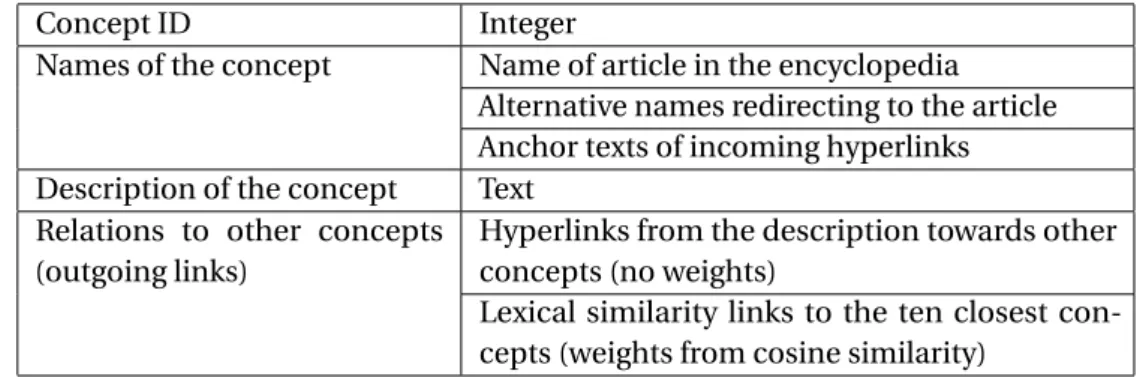
VP-based community andVP-basedK-Nearest Neighbors; the highest scores are in bold . . . 41 4.1 Logical structure of each node in the network resulting from the English Wikipedia. 48 4.2 Accuracy of embeddings learned over four different training sets. The error
(percentage) is computed for 50,000 triples of articles from a separate test set, as the number of triples that do not respect the ordering ofVPsimilarities. . . 56
4.3 A comparison of several word similarity scores, in terms of Spearman rank corre-lationρand Pearson correlationr, on two data sets: WordSimilarity-353 [Finkel-stein et al., 2002] and M&C [Miller and Charles, 1991]. Our scores forVPappear in the last line, and are for WordSimilarity-353 in the upper range, though not above state-of-the-art ones. . . 62 4.4 Rand Index (RI), precision, recall and F-score of different clustering methods.
VPCombstands forVPover a combination of content links (weighted 0.6) and hyperlinks (0.4). Scores in bold are significantly higher than LSA, the one in italics significantly lower (t-test,p<0.001). . . 66 4.5 Classification accuracy for different sizes of the training set over the 20
News-groups data set. The accuracy is the average of 10 times run on a randomly divided data set. ‘DL’ is distance learning classifier, ‘CL’ is the embedding learned over the content links graph and ‘HL’ the embedding learned over hyperlinks, ‘REG’ stands for regularization of the matrix. The numbers in italics are signifi-cantly better than the accuracy of the SVM (t-test,p<0.001) . . . 69 4.6 Precision at 10 for different ranking algorithms when training size varies. As
in Table 4.5, ‘RL’ is the ranking learner, ‘CL’ is the embedding learned over the content links graph and ‘HL’ the embedding learned over hyperlinks, and ‘REG’ stands for regularization of the matrix. . . 72
4.7 Spearman rank correlation coefficientρbetween automatic and human word
similarity when two-stage random walk is used forVP. In parentheses the re-spective weights of hyperlinks and content links. The best result,ρ= 0.714 is found when both hyperlinks and content links are used for the first three stages (with weights 0.7 vs. 0.3), but only content links are used for latter stages. . . 75 4.8 Pearson correlation coefficientr between two-stageVPresults and human
judg-ments on document similarity. The best result (0.680) is found when for the first three stages both hyperlinks (0.8) and content links (0.2) are used, but only content links are used for latter stages. . . 75
5.1 Average Mean Average Precision (MAP) for predictingco-purchase linksbetween Amazon products, when the size of co-purchase training set varies from 30% to 80% of the entire network. The joint model uses both co-purchase and category links (training set for the latter is always 80% of the network). Bold results are significantly better (t-test,p<0.001). . . 90 5.2 Average Mean Average Precision (MAP) for predictingcategory linksbetween
Amazon products, when the size of category training set varies from 30% to 80% of the entire network. The joint model uses both co-purchase and category links (training set for the former is always 80% of the network). Bold results are significantly better (t-test,p<0.001). . . 90
5.3 Average Mean Average Precision (MAP) ofcontent linksin TED when the size of content train set is changed. The joint model uses both content and co-liked links, the size of co-liked links is 0.8. Bold results are significantly better (t-test,
p<0.001). . . 92 5.4 Average Mean Average Precision (MAP) ofco-likedlinks in TED when the size of
co-liked train set is changed. The joint model uses both content and co-liked links, the size of content links is 0.8. Bold results are significantly better (t-test,
p<0.001). . . 92 5.5 Average Mean Average Precision (MAP) for predicting links between Amazon
products. . . 93 5.6 Average Mean Average Precision (MAP) for predicting links between TED videos. 94
1
Introduction
Collaborative online systems make it easy to generate large public networks of data objects. The cost of creating a new object or a new link between two objects is very small, and is usually contributed by users. This low cost explains that such collaborative networks grow very quickly, easily reaching networks of millions of objects based on the collaboration of as many users. The Web, Wikipedia, social bookmarks, product preference networks, research articles with citations, and online social networks are examples of such collaborative networks which shape our daily life.
Moreover, new networks can be inferred from original collaborative ones. For example, con-sider the network of product preferences in an online store, in which the preference of a customer for a product is represented by a link, with its strength being coded by the links’ weight. We can infer from this network how much two products are co-preferred and therefore, the network showing the co-preferred relations between the products in the store can be built from the original network. Co-authorship is another network of this type. We call this type of networks collaborative networks as well, because they are inferred directly from collaborative networks and evolve similarly.
In such collaborative systems, there is usually no central editing authority. Every user acts autonomously when creating new content. Therefore, not all content in these networks is equally reliable. The content related to less popular objects is likely to be less reliable. Conversely, content becomes more and more reliable as it is shaped by the collaboration of more and more users.
Hence, designing robust methods to perform prediction and analysis of such networked systems is a valuable focus of interest. Prediction of a system’s evolution can be used to make recommendations, which canfacilitateand alsoimprovethe formation of the network. For example, consider a network with scientific papers and citations. A recommender system can facilitate the identification of related articles by authors, which is known to be a difficult and time-consuming task when writing research articles. Moreover, such a system can help
authors to find articles that would have been missed otherwise. This can happen for various reasons such as the low popularity of an article, recency, or lack of knowledge of the authors. In the latter case, a recommender system would not only facilitate the formation of the network, but also improve it.
The main component of a recommender system is its ranking functionality. Recommender systems, given either an implicit or an explicit query, rank all objects, and almost always return only the top ranked ones. For example, in an online store, a recommender system would recommend top co-preferred items with respect to a specific item (an implicit query) and thus help customers to find the most suitable item for their needs and preferences. Besides, a different recommender system could return top ranked items for a keyword entered by a customer (explicit query). In both cases, for explicit or implicit queries, the main task is to rank objects from a network with respect to the query object.
Ranking objects based on a query can be performed by defining a distance measure between objects and sorting them based on their distance to the query object. Similarly, link for-mation in social networks is more likely if two nodes have similar social characteristics – a phenomenon known as homophily in social networks [McPherson et al., 2001]. Therefore, the problem of ranking, or even more generally the modeling of collaborative networks, can be transformed into the problem of finding a distance or similarity measure over the networks. Several sources of information should be considered when building a distance measure over a collaborative network. The first important source of information is the global link structure of the network. Collaborative networks typically contain many spurious links, or are incomplete, making a proximity measure based on local link structure unreliable. Therefore, a robust proximity measure based on global link structure needs to be designed, in particular so that it can be applied to large networks. The link structure might consist of multiple link types. Also, the links can be weighted: for example, in a network of product co-preference, weighted links indicate how much two products are co-preferred. Therefore, similarity learning over collaborative networks should be able to consider in a robust way these additional sources of information.
Another source of information are the attributes of the objects. These can be used to model the networks’ evolution and consequently the distance between objects. For example, in a paper/citations network, the similarity of the articles can be modeled by their content words. Content words can improve the accuracy of the model, especially when the link structure is not very rich, for example in case of missing citations, low-popularity papers, or either very new or very old papers.
In addition to the prediction task in collaborative networks, the analysis of the evolution of a network with respect to node attributes, provides valuable insights that can be used in designing methods which aim to maximize another utility function. For example, consider the hypothetical situation in which an online store manager wants to choose a title for her new product among some different candidate titles. A model that relates the keywords in the
In general, the attributes of the nodes are not sufficient to model the network. For instance, let us consider a product co-preference network in which the products’ attributes are derived from the title of each product along with category information. The title is a short description of the product that only makes sense when interpreted by humans and would likely not be sufficient to model the network. Moreover, feature selection methods are not loss free. For example in the case of a papers/citations network, if the content of a paper is represented by a bag of keywords, these cannot grasp the entire content of the paper. Besides, usually some attributes are missing. For example in the case of online social networks, people tend not to fill in all the information fields in their profile. Hence, nodes’ attributes and global network structure (relational attributes) should be used in a complementary way.
The overall contribution of this thesis is two-fold. First, we propose distance learning meth-ods overlargeandcollaborativenetworks withhigh-dimensionalfeatures, to be used for prediction tasks which make use of the global structure of a network and the attributes of its nodes. Second, we show how to leverage reliable content in these networks to perform text analysis tasks, improving the state-of-the-art performance in situations when only a small quantity of labeled data is available. The following sections of this introduction summarize the achievements corresponding to the diffeent chapters of the thesis.
Symmetric Random Walk on Large Graphs: Approximation
Algorithms and Similarity Learning
This chapter consists of two main parts, in the first part we define a random walk model, Visiting Probability (VP), to measure proximity between two nodes in a graph.VPconsiders all the paths between two nodes collectively and thus reduces the effect of unreliable links. We define symmetricVPsimilarity measure and show that using the symmetricVPimproves the prediction performance of the distance.
Moreover, we show how to make use ofVPdefinition and design approximation algorithm to perform ranking based onVPon large graphs. Besides, we define community of a node according toVPand bring experimental evidences that the community definition is effective. Fast algorithms are designed to solve K-nearest neighbors and community identification over large graphs based on symmetricVPproximity.
A small-world network is a type of graph in which most nodes are not neighbors of one another, but most nodes can be reached from every other by a small number of hops or steps. It has been shown that many real-world complex systems can be modeled by small-world networks including but not limited to neuronal networks, food webs, social networks, scientific-collaboration networks and World Wide Web. We make use of this structural property to design fast algorithms on collaborative networks, we use this structural property again in Chapter 6.
In the second part of this chapter, we show that any relation between two nodes in a graph can be interpreted as the proximity between those two nodes in a latent space. Therefore, the link structure of a graph can be modeled by a similarity learning framework in which the transformation of nodes to the latent space is trained using a discriminative model. We show how to apply this framework to learn the similarity between two nodes based on the node’s attributes over large graphs. Moreover, we show that similarity learning on attributes from random walk scores, specificallyVPscores here, can model and predict better the relations in the graph in comparison to learning on the network’s links directly. Therefore, we use both global network structure (through usingVPscores) and node attributes to learn a reliable similarity measure. At the end we evaluate the effectiveness of the proposed models on link prediction task on various networks. We show experimentally that if the node attributes are not predictive enough, ignoring the global link structure for inference can reduce the prediction performance, we address this issue in Chapter 6.
Transfer Learning from Hypertext Encyclopedia to Text Analysis Tasks
In this chapter, we explain how to transfer knowledge from a hypertext encyclopedia to text analysis tasks. TheVPproximity is used in this chapter to compute semantic relatedness between words or texts (sets of words), by taking advantage of content-based and link-based knowledge from hypertext encyclopedias such as Wikipedia.
A network of concepts is first constructed by filtering the encyclopedia’s articles, each concept corresponding to an article. Two types of weighted links between concepts are considered: one based on hyperlinks between articles, and another one based on the lexical similarity between them. A given text is mapped to the corresponding concepts in this network and then to compute similarity between two textsVPsimilarity is applied to compute the distance between sets of nodes.
Moreover, we analyze the convergence of the approximation methods proposed in chapter 3, over the English Wikipedia data set, and measure various characteristics of the network to help understanding its usefulness for text analysis tasks.
Finally, to make the algorithm tractable and also make transfer learning possible to other machine learning tasks and algorithms, we use the latent space model which we explained in the chapter 3 to train a transformation from words to a latent space overVPscores. Therefore, we can add one layer to other text analysis tasks which applies this transformation to the words and insert Wikipedia knowledge to the task.
To evaluate the proposed distance, we apply our method to four important tasks in natural language processing: word similarity, document similarity, document clustering, and docu-ment classification, along with a ranking task for information retrieval. The performance of our method is state-of-the-art or close to it for all the tasks, thus demonstrating the generality of the method and the accompanying knowledge resource. Moreover, we show that using
only one of them, because hyperlinks bring additional real-world knowledge not captured by lexical similarity. In Chapter 5 we design algorithms to make use of different link types more formally.
Additionally, the proposed method is applied to Idiap’s just-in-time information retrieval system (ACLD), and brings improvement in terms of the relevance of results.
Joint Similarity Learning for Predicting Links in Multi Links Networks
This chapter addresses the problem of link prediction on large multi-link networks (i.e. with links of multiple types) by proposing two joint similarity learning architectures over the attributes of the nodes. The first model is a similarity metric that consists of two parts: a general part, which is shared between all link types, and a specific part, which learns the similarity for each link type specifically.
The second model consists of two layers: the first one, which is shared between all link types, embeds the objects of the network into a new space, while the second one learns the similarity between objects for each link type in this new space. The similarity metrics are optimized using a large-margin optimization criterion in which connected objects should be closer than non-connected ones by a certain margin. A stochastic training algorithm is proposed, which makes the training applicable to large networks with high-dimensional feature spaces. The models are tested on link prediction for two data sets with two types of links each: TED talks and Amazon products. The experiments show that jointly modeling of the links given our frameworks improve link prediction performance significantly for each link type. The improvement is particularly higher when there are fewer links available from one link type in the network. Moreover, we show that transfer learning from one link type to another one is possible using the above frameworks.
At the end, we show how this model can be generalized to similar but different tasks, in-cluding joint classification and link prediction, and transfer learning between networks with (approximately) the same set of attributes.
Similarity Learning for Collective Ranking on Networks: Application
to Link Prediction
Traditionally in learning to rank approaches data points are assumed to be independent. Although this assumption leads to acceptable results in many applications, it is quite ques-tionable when dealing with network data. Moreover, methods based on the link structure including methods based on common neighbors and random walk models are ignorant about the nodes’ attributes in the networks.
In this chapter, a method is proposed for learning to rank on network (relational) data, which makes use of the features of the nodes as well as the existing links between them. First, a neighbors-aware ranker is trained using a pairwise loss function. Then, collective inference is performed using a sparse iterative ranking algorithm, which propagates the results of rankers over the network.
The method is applied to three data sets with papers/citations and webpages/hyperlinks. The results show that the proposed algorithm, using both link structure and node attributes, outperforms several other methods: a content-only ranker, a link-only one, an unsupervised random walk method, a relational topic model, and a method based on the weighted numbers of common neighbors. In addition, the propagation algorithm improves results even when no prior link structure is known, and scales efficiently to large networks.
Conclusion and Future Work
In the final chapter, we first summarize the achievements of the previous chapters, mainly in designing distance learning methods over large collaborative networks with high-dimensional features, and demonstrating their relevance on a significant number of prediction tasks. Moreover, we summarize the achievement of leveraging reliable content from these networks to text analysis tasks, which has improved the state-of-the-art performance in situations when only a small quantity of labeled data is available.
The focus of this work was on learning a similarity function between two objects. But almost always in recommender systems a set of top items are shown as a result and therefore, one should rather aim at an objective function that assigns a score to sets of retrieved objects as a whole. In preparation for future work, we define formally the concepts ofconsistency
anddiversity, and relate them to the models we presented in this thesis. The main desirable properties of such a global objective function are: first, it should give a higher score to a set of items that arerelatedto the query object, and second, it should emphasize either thediversity
or theconsistencyof the items. For large data sets, finding a set with a maximal score is not tractable, but we have found that greedy algorithms may help to overcome this problem, and we foresee further investigations on this topic.
2
Related work
The overall focus of this thesis, as presented earlier in the introduction, is two-fold. The first contribution consists of new distance learning methods overlargeandcollaborativenetworks withhigh-dimensionalfeatures, to be used for prediction tasks that use the global network structure and the node attributes. As mentioned, distance metric learning usually happens in a ranking framework. Traditionally, distance metric learning and learning to rank methods were designed for non-relational data sets. In this thesis, we generalize these methods to be applicable to large relational data sets. We also discuss in this chapter and the following ones, previous methods which are using only the link structure of a network to infer the distance, and thus ranking. We show how the methods in this manuscript evolved in comparison to those methods.
Therefore, the related work corresponding to the first contribution of the thesis falls into several categories: (1) learning to rank and distance metric learning; (2) link prediction; (3) distance and ranking based on link structure in networks. In this chapter, we discuss each category.
Moreover, we show how to leverage reliable content in hypertext encyclopedias (mainly Wikipedia in this thesis) to achieve better text semantic similarity measures, which are an essential part of many text analysis tasks. Therefore, related work for this part spans a large number of domains and approaches, and can be divided mainly into: (1) previous methods for computing semantic relatedness, including uses of Wikipedia or other networked resources, for one or more tasks in common with the tasks discussed here; (2) state-of-the-art methods and scores for each of the targeted tasks. In fact, many combinations of tasks, methods and resources may share one or more elements with our work. In this chapter, we will focus on the first type of previous work, while for the other one, performance comparisons with state-of-the-art methods will be made in each of the application sections of the subsequent chapters.
2.1 Distance Metric Learning and Learning to Rank
Many methods for learning to rank have been proposed, with different leaning abilities. We discuss here some of the main works in this field and show how the proposals in this thesis relate to them.
Perception Ranking [Crammer and Singer, 2001] is an online algorithm for ordinal classifica-tion. The algorithm can be employed for ranking as a pointwise method. The main idea is to learn several parallel perceptron models which make classification between the neighboring grades. Following a pointwise approach, the ranker is trained based on the grade of each object, whereas in a pairwise method the ranker is trained on the order (rank) of the pair of objects. In our work, we always use a pairwise training method, which was shown to be more effective than pointwise methods [Li, 2011].
IR SVM [Cao et al., 2006] is a pairwise method which formulates the ranking problem as an SVM classification, and adapts this to the document retrieval problem. The feature selection that transforms the ranking problem into a classification one – building features for classification from the query and each target document – is not effective on all data sets. This is especially problematic for a task such as link prediction, where we have many non-linked examples. Similarly, SVMRank [Joachims, 2002] is a pairwise ranking algorithm which transforms the pairwise ranking to SVM binary classification. For SVMRank, batch optimization on large graphs is not possible considering the number of non-connected pairs. In comparison to these approaches, we adapt the training algorithm to be applicable to large graphs with high-dimensional features. Moreover, we generalize the methods in a way that can use the network’s structural features, and can efficiently model multi edge networks.
Grangier and Bengio [2008] introduce a discriminative model for the retrieval of images from text queries using a learning procedure optimizing a ranking criterion. The proposed model addresses the retrieval problem directly and does not rely on an intermediate image annota-tion, and the training procedure is based on the online learning of kernel-based classifiers, and therefore is scalable to large data sets.
RankNet [Burges et al., 2005] is a feed forward neural network which is trained by back propa-gation to learn the scores of each training example. In a similar vein, Bai et al. [2010] perform supervised training of a nonlinear model over vectors of words, to preserve a pairwise ranking between documents. Their approach scales well to large data sets with a large number of words. Similarly, Shaw et al. [2011] train a distance metric by stochastic gradient descent over a hinge loss function that preserves the network structure. Weston et al. [2011] propose a faster training algorithm to learn a low-dimensional joint embedding space for both images and annotations which optimizes precision at the top of the ranked list of annotations for a given image. We will follow the same general line to build our ranking methods based on similarity learning, by keeping in mind that the framework should be applicable to large graphs. A large margin nearest neighbor classifier is built by training a Mahalanobis distance metric by
Weinberger et al. [2006]. Similarly, in Section 4.9, we build a distance learning classifier which learns, given a training set, a similarity measure in a latent space so that for each data point in the training set, its similarity to data points with the same label (or class) is higher than the similarity to data points with different labels. We show that prior knowledge leaned from the Wikipedia network can be successfully transferred to this classifier.
In summary, in comparison to the conventional learning to rank approaches which assume that data points are independent, we consider dependency between network’s objects by using neighborhood information as well as object features in the ranker (Chapter 6 and Section 3.4). In addition, we allow different link-type rankers sharing information among them and model more accurately the networks’ structure (Chapter 5).
2.2 Supervised Link Prediction
Link prediction can be formulated as a supervised learning task in which the goal is to predict new link formation. Backstrom and Leskovec [2011] describe the problem of link prediction as a supervised learning task and illustrate how a method known as supervised random walks can address the link prediction task. This overcomes one of the main shortcomings of the link-based previous works by using attribute information to make predictions. However, this method requires to compute the gradient iteratively in each iteration, which makes the training inefficient. Supervised random walk (similarly to link-based methods) is not able to perform ranking when the query object is not part of the network, whereas our pairwise approaches, trained on the query and target nodes’ attributes, can perform ranking in this situation.
Similarly, Agarwal et al. [2006] propose a supervised learning method for ranking the objects in a graph. Their method uses a random walk model and learns the transition probabilities from the ordered pairs of objects in the training data. A transition probability is learned for each link, which makes overfitting likely and is not effective for large-scale graphs with many edges, given that there are many parameters to learn. Similarly to supervised random walk, this method is not applicable when the query object is not part of the network.
Miller et al. [2009] adopt a generative Bayesian nonparametric approach to simultaneously infer the number of latent features and to learn which entities have each feature. The method is difficult to train, and inference for large scale graphs is time-consuming, whereas we consider designing methods applicable to large networks.
Relational Topic Models (RTM) [Chang, 2009] consider both the documents and the links between them. For each pair of documents, an RTM models their link as a binary random variable that is conditioned on their contents. The model can be used to predict links between documents and is used as one of our baselines (see Section 6.4). The inference and learning algorithms are based on variational methods. Our proposed method in Chapter 6 outperforms RTM on the studied networks by a large margin. The neighborhood information is not modeled
explicitly in RTM in comparison to our method.
Menon and Elkan [2011] propose a link prediction algorithm based on the matrix factorization. The algorithm essentially is similar to the latent space model which we explain in Section 3.4. We show in Section 3.4 that learning over random walk scores, instead of networks’ edges, improve the predictability of the model.
In the case of multi-preference data, also called multiple link type or multi-link networks, Paccanaro and Hinton [2000] proposed Linear Relational Embeddings in which entities are embedded in a latent space and relations in this latent space are modeled by linear operations. This idea has been further improved in the Structured Embeddings (SE) framework proposed by Bordes et al. [2011]. We follow the same path and investigate further the modeling of multi preference data in Chapter 5 of this thesis.
In summary, we transform link prediction problem to a ranking problem in which given the query node, other nodes are ranked based on the likelihood of forming a link with the query. We will propose methods using the objects’ attributes and the relations between objects in a network in an effective way to perform ranking, applicable to large networks. In comparison to supervised generalizations of random walk models [Backstrom and Leskovec, 2011, Agarwal et al., 2006], our model can be applied even when the query object does not have any known links in the network. In this case, the performance can be improved by modeling the links between the rest of the objects in the network, as we propose with the model described in Chapter 6.
2.3 Ranking and Distance Based on Link Structure
The link prediction task can be formulated as a ranking task of pairs of nodes, using link structure similarity metrics, for example random walk metrics or metrics using the common neighborhood. The Adamic and Adar [2001] similarity measure, which is based on com-mon neighborhood, yields relatively high performance in link prediction [Liben-Nowell and Kleinberg, 2003].
It is well-known that estimating proximity in networks as the length of shortest path does not take into account the relative importance of these paths with respect to the overall properties of the network, such as the number and length of all possible paths between two nodes. The length of the shortest path is quite sensitive to spurious links. It has been shown that aggregated measures based on random walks are more effective for link prediction than individual links and paths [Brand, 2005, Sarkar and Moore, 2007, Liben-Nowell and Kleinberg, 2003].
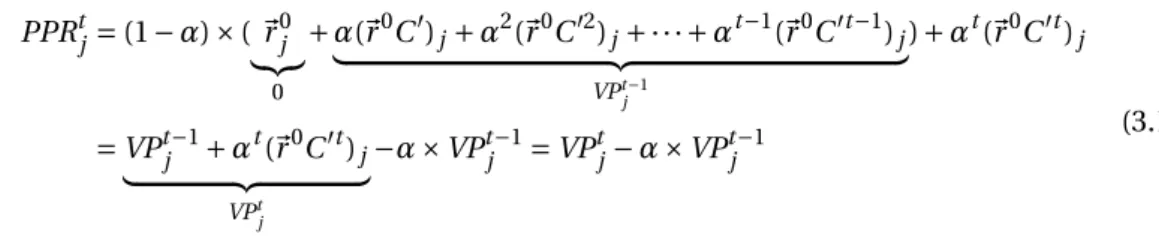
Two popular random walk measures which are well studied in the previous works are hitting time, a standard notion in graph theory, and Personalized PageRank (PPR) [Haveliwala, 2003], surveyed by Berkhin [2005].
Hitting time has been used in several studies as a distance measure in graphs, e.g. for di-mensionality reduction [Saerens et al., 2004] or for collaborative filtering in a recommender system [Brand, 2005]. Hitting time has also been used for link prediction in social networks along with other graph-based distances [Liben-Nowell and Kleinberg, 2003], or for semantic query suggestion using a query/URL bipartite graph [Mei et al., 2008]. A branch-and-bound approximation algorithm has been proposed to compute a node neighborhood for hitting time in large graphs [Sarkar and Moore, 2007, Sarkar et al., 2008].
We will develop a random walk model to measure the proximity between two nodes based on the networks’ link structure in Chapter 3. We explain the relation between the popular random walk models above and the proposed random walk in Section 3.1.5. Moreover, we show how to use the definition of our measure to design fast algorithms applicable to large networks in Sections 3.2, 3.3.1 and 3.3.2.
A shortcoming of the state-of-the-art methods cited above is that they are not trained on node and edge attributes. Therefore, if the prior link structure around a query node is not known, then these methods can not perform well in finding similar nodes, e.g. candidates for linking. For example, in the case of paper citation, unless the paper contains already many citations, these methods can not perform well. To overcome this problem, we make a connection between random walk scores and a latent space model learned on the nodes’ attributes in Chapter 3. Moreover, in Chapter 6, our proposed model overcomes this issue by using nodes’ attributes in addition to the link structure to learn and infer a similarity function.
2.4 Word Semantic Relatedness using Graphs: WordNet and Wikipedia
Many graph-based methods have been applied to NLP problems and were recently surveyed by Navigli and Lapata [2010] with an application to word sense disambiguation. For instance, Navigli [2008] defined a method for truncating a graph of WordNet senses built from input text, while Navigli and Lapata [2010] focused on measures of connectivity and centrality of a graph built on purpose from the sentences to disambiguate, and are therefore close in spirit to the ones used to analyze our large Wikipedia-based network in Section 4.3.3.
PageRank has been used for word sense disambiguation over a graph derived from the candi-date text by Navigli and Lapata [2010]. As for Personalized Page Rank (PPR), the measure has been used for word sense disambiguation by Agirre and Soroa [2009] over a graph derived from WordNet, with up to 120,000 nodes and 650,000 edges. PPR has also been used for measuring lexical relatedness of words in a graph built from WordNet by Hughes and Ramage [2007]. Many other attempts have been made in the past to define word and text similarity distances, for various applications to language technology. One approach is to construct – manually or semi-automatically – a taxonomy of word senses or of concepts, with various types of relations, and to map the text fragments to be compared onto the taxonomy. For instance, WordNet [Fell-baum, 1998] and Cyc [Lenat, 1995] are two well-known knowledge bases, respectively of word
senses and concepts, which can be used for overcoming the strong limitations of pure lexical matching. A thesaurus such as Roget’s can also be used for similar purposes [Jarmasz, 2003, Jarmasz and Szpakowicz, 2003]. This approach makes use of explicit senses or concepts that humans can understand and reason about, but the granularity of knowledge representation is limited by the taxonomy. Building and maintaining these knowledge bases requires a lot of time and effort from experts. Moreover, they may cover only a fraction of the vocabulary of a language, and usually include few proper names, conversational words, or technical terms. Several methods for computing lexical semantic relatedness exploit the paths in semantic networks or in WordNet, as surveyed by Budanitsky and Hirst [2006, Section 2]. Distance in the network is one of the obvious criteria for similarity, which can be modulated by the type of links [Rada et al., 1989] or by local context, when applied to word sense identification [Leacock and Chodorow, 1998]. Resnik [1995, 1999] improved over distance-based similarity by defining the information content of a concept as a measure of its specificity, and applied the measure to word sense disambiguation in short phrases. An information-theoretic definition of similarity, applicable to any entities that can be framed into a probabilistic model, was proposed by Lin [1998] and was applied to word and concept similarity. This work and ours share a similar concern – the quest for a generic similarity or relatedness measure – albeit in different conceptual frameworks – probabilistic vs. hypertext encyclopedia.
Other approaches make use of unsupervised methods to construct a semantic representation of words or of documents by analyzing mainly co-occurrence relationships between words in a corpus (see e.g. Chappelier [2012] for a review). Latent Semantic Analysis [Deerwester et al., 1990] offers a vector-space representation of words, which is grounded statistically and is applied to document representation in terms of topics using Probabilistic LSA [Hofmann, 1999] or Latent Dirichlet Allocation [Blei et al., 2003]. These unsupervised methods construct a low-dimensional feature representation, or concept space, in which words are no longer supposed to be independent. The methods offer large vocabulary coverage, but the resulting “concepts” are difficult for humans to interpret [Chang et al., 2009].
Mihalcea et al. [2006] compared several knowledge-based and corpus-based methods (in-cluding for instance [Leacock and Chodorow, 1998]) and then used word similarity and word specificity to define one general measure of text semantic similarity. Results of several methods and combinations are reported in their paper. Because it computes word similarity values between all word pairs, the proposed measure appears to be suitable mainly for computing similarity between short fragments – otherwise, the computation becomes quickly intractable. One of the first methods to use a graph-based approach to compute word relatedness was proposed by Hughes and Ramage [2007], using Personalized PageRank (PPR) [Haveliwala, 2003] over a graph built from WordNet, with about 400,000 nodes and 5 million links. Their goal (as ours) was to exploit all possible links between two words in the graph, and not only the shortest path. They illustrated the merits of this approach on three frequently-used data sets of word pairs – which will be also used in this thesis, see Section 4.6 – using several
standard correlation metrics as well as an original one, and their scores were close to human inter-annotator agreement values.
In recent years, Wikipedia has appeared as a promising conceptual network, in which the relative noise and incompleteness due to its collaborative origin is compensated for by its large size and a certain redundancy, along with availability and alignment in several languages. Several large semantic resources were derived from it, such as a relational knowledge base (DBpedia [Bizer et al., 2009]), two concept networks (BabelNet [Navigli and Ponzetto, 2010] and WikiNet [Nastase et al., 2010]) and an ontology derived from both Wikipedia and WordNet (Yago [Suchanek et al., 2008]).
WikiRelate! [Strube and Ponzetto, 2006] is a method for computing semantic relatedness between two words by using Wikipedia. Each word is mapped to the corresponding Wikipedia article by using the titles. To compute relatedness, several methods are proposed, namely, using paths in the Wikipedia category structure, or using the contents of the articles. Our method, by comparison, also uses the knowledge embedded in the hyperlinks between arti-cles, along with the entire contents of articles. Recently, the category structure exploited by WikiRelate! was also applied to computing semantic similarity between words [Ponzetto and Strube, 2011]. Overall, however, WikiRelate! measures relatedness between two words and is not applicable to similarity of longer fragments, unlike our method described in Chapter 4. Another method to compute word similarity was proposed by Milne and Witten [2008a] using similarity of hyperlinks between Wikipedia pages.
2.5 Text Semantic Relatedness
Several studies have measured relatedness of sentences or entire texts (a summary appears in Table 2.1 on page 15). In a study by Syed et al. [2008], Wikipedia was used as an ontology in three different ways to associate keywords or topic names to input documents: either (1) by cosine similarity retrieval of Wikipedia pages, or (2) by spreading activation through the Wikipedia categories of these pages, or (3) by spreading activation through the pages hyperlinked with them. The evaluation was first performed on three articles for which related Wikipedia pages could be validated by hand, and then on 100 Wikipedia pages, for which the task was to restore links and categories (similarly to [Milne and Witten, 2008b]). The use of a private test set makes comparisons with other work uneasy. In another text labeling task, Coursey et al. [2009] have used the entire English Wikipedia as a graph (5.8 million nodes, 65 million edges) with a version of Personalized PageRank [Haveliwala, 2003] that was initialized with the Wikipedia pages found to be related to the input text using Wikify! [Mihalcea and Csomai, 2007]. The method was tested on a random selection of 150 Wikipedia pages, with the goal of retrieving automatically their manually-assigned categories.
Ramage et al. [2009] have used Personalized PageRank over a WordNet-based graph to detect paraphrases and textual entailment. They formulated a theoretical assumption similar to ours: “the stationary distribution of the graph [random] walk forms a ‘semantic signature’ that can
be compared to another such distribution to get a relatedness score for texts.”
Explicit Semantic Analysis (ESA), proposed by Gabrilovich and Markovitch [2007, 2009], in-stead of mapping a text to a node or a small group of nodes in a taxonomy, maps the text to the entire collection of available concepts, by computing the degree of affinity of each concept to the input text. ESA uses Wikipedia articles as a collection of concepts, and maps texts to this collection of concepts using a term/document affinity matrix. Similarity is measured in the new concept space. Unlike our method, ESA does not use the link structure or other structured knowledge from Wikipedia. Our method, by walking over a content similarity graph, benefits in addition from a non-linear distance measure according to word co-occurrences.
ESA has been used as a semantic representation (sometimes with modifications) in other studies of word similarity, such as a cross-lingual experiment with several Wikipedias by Hassan and Mihalcea [2009], evaluated over translated versions of English data sets (see Section 4.6 below). In a study by Zesch et al. [2008], concept vectors akin to ESA and path length were evaluated for WordNet, Wikipedia and the Wiktionary, showing that the Wiktionary improved over previous methods. ESA also provided semantic representations for a higher-end application to cross-lingual question answering [Cimiano et al., 2009], and was used by Yeh et al. [2009], to which we now turn.
Probably the closest antecedent to our study is the WikiWalk approach [Yeh et al., 2009]. A graph of documents and hyperlinks was constructed from Wikipedia, then the Personalized PageRank (PPR) [Haveliwala, 2003] was computed for each text fragment, with the teleport vector being the one resulting from ESA. A dictionary-based initialization of the PPR algorithm was studied as well. To compute semantic similarity between two texts, Yeh et al. simply compared their PPR vectors. Their scores for word similarity were slightly higher than those obtained by ESA [Gabrilovich and Markovitch, 2009], while the scores on document similarity (Lee data set, see Section 4.7 below) were “well below state of the art, and show that initializing the random walk with all words in the document does not characterize the documents well.” By comparison, in our method, we also consider in addition to hyperlinks the effect of word co-occurrence between article contents, and use a different random walk and initialization methods.
Mihalcea and Csomai [2007] and Milne and Witten [2008b] discussed enriching a document with Wikipedia articles. Their methods can be used to add explanatory links to news stories or educational documents, and more generally to enrich any unstructured text fragment (or bag-of-words) with structured knowledge from Wikipedia. Both perform disambiguation for all n-grams, which requires a time-consuming computation of relatedness of all senses to the context articles. The first method detects linkable phrases and then associates them to the relevant article, using a probabilistic approach. The second one learns the associations and then uses the results to search for linkable phrases.
Article Resource Algorithm Task Data set
Jarmasz [2003], Jarmasz and Szpakowicz [2003]
Roget Shortest path Word sim. M&C, R&G, Syn-onyms
Mihalcea et al. [2006], corpus-based
Web / BNC PMI-IR / LSA Paraphrase Microsoft
Mihalcea et al. [2006], six knowledge-based
WordNet Shortest path, IC, etc.
= =
Hughes and Ramage [2007]
WordNet PPR Word sim. M&C, R&G, WS-353
Gabrilovich and Markovitch [2007]
Wikipedia ESA: TF-IDF + Cosine sim.
Word sim., Doc. sim.
WS-353, Lee
Agirre and Soroa [2009] ∼WordNet PPR WSD Senseval-2, 3 Zesch et al. [2008] WordNet,
Wikipedia, Wiktionary
Path length, concept vec-tors
Word sim. M&C, R&G, WS-353 + German
Strube and Ponzetto [2006]
Wikipedia Shortest path, categories, text overlap Word sim., coreference resolution M&C, R&G, WS-353
Milne and Witten [2008a] Wikipedia Similarity of hy-perlinks
Word sim. M&C, R&G, WS-353
Hassan and Mihalcea [2009]
Wikipedia Modified ESA Cross-lingual word sim.
Translated M&C, WS-353
Syed et al. [2008] Wikipedia Cosine sim., spreading activation
Doc. classif. 3–100 handpicked docs
Coursey et al. [2009] Wikipedia PPR Doc. classif. 150 WP articles Ramage et al. [2009] WordNet PPR Paraphrase,
en-tailment
Microsoft, RTE
Gabrilovich and Markovitch [2009]
Wikipedia ESA: TF-IDF + Cosine sim.
Doc. clustering Reuters, 20NG, OHSUMED, short docs
Yeh et al. [2009] Wikipedia PPR Word sim., Doc. sim.
M&C, WS-353, Lee
Present proposal Wikipedia Visiting Proba-bility (VP)
Word sim., Doc. sim. and clustering, Classification, IR
See Sections 4.6– 4.10.
Table 2.1: Comparison of the present proposal (last line) with previous work cited in this section, in terms of resources, algorithms, NLP tasks, and data sets. The abbreviations for the data sets in the rightmost column are explained in Section 4.6 . The methods are abbreviated as follows: ESA for Explicit Semantic Analysis [Gabrilovich and Markovitch, 2007, 2009], LSA for Latent Semantic Analysis [Deerwester et al., 1990], IC for Information Content [Resnik, 1995, 1999], PMI-IR pointwise mutual information using data collected by information retrieval [Tur-ney, 2001, Mihalcea et al., 2006], and PPR for the Personalized PageRank algorithm [Haveliwala, 2003, Berkhin, 2005].
3
Symmetric Random Walk on Large
Graphs: Approximation Algorithms
and Similarity Learning
In this chapter we define a random walk model, Visiting Probability (VP), to measure proximity between two nodes in a graph. We show that using a symmetric proximity measure based on the defined random walk improves the prediction performance of the proximity measure. Moreover, we show how to apply the definition ofVPwithin approximation algorithms in order to perform ranking based onVPfor large graphs. Besides, we define community of a node according toVPsimilarity. Fast algorithms are designed to find the K-nearest neighbors and identify communities over large graphs using symmetricVPproximity . We demonstrate the effectiveness of the definitions and algorithms by evaluating them on a link prediction task over various networks.
In the second part of this chapter, we show that any relation between two nodes in a graph can be interpreted as the proximity between those two nodes in a latent space. Therefore, the link structure of a graph can be modeled within a similarity learning framework, in which the transformation of nodes to the latent space is trained using a discriminative model. We show how to apply this framework to learn the similarity between two nodes based on the attributes of the nodes, over large graphs. Moreover, we show that similarity learning on attributes derived from random walk scores, specificallyVPscores here, can model and predict better the relations in the graph in comparison to learning on the network’s links directly. At the end, we evaluate again the effectiveness of these models on link prediction task on various networks.
3.1 Visiting Probability
In this section, we describe our method for computing proximity between two nodes in a network. The goal is to estimate a distance between two nodes by taking into account the global connectivity of the network, and without being biased by local properties.
Indeed, the use of individual links and paths, e.g. when estimating proximity as the length of shortest path, does not take into account their relative importance with respect to the overall