Contents lists available atScienceDirect
Theoretical Computer Science
journal homepage:www.elsevier.com/locate/tcsConditional matching preclusion for hypercube-like interconnection
networks
I,IIJung-Heum Park
a,∗, Sang Hyuk Son
baSchool of Computer Science and Information Engineering, The Catholic University of Korea, Bucheon 420-743, Republic of Korea bDepartment of Computer Science, University of Virginia, Charlottesville, VA 22904, United States
a r t i c l e i n f o
Article history:
Received 8 December 2008
Received in revised form 25 February 2009 Accepted 27 February 2009
Communicated by D.-Z. Du
Keywords:
Perfect matching Almost perfect matching Fault tolerance Edge fault Conditional fault HL-graphs Restricted HL-graphs a b s t r a c t
Theconditional matching preclusion numberof a graph withnvertices is the minimum number of edges whose deletion results in a graph without an isolated vertex that does not have a perfect matching if n is even, or an almost perfect matching if nis odd. We develop some general properties on conditional matching preclusion and then analyze the conditional matching preclusion numbers for some HL-graphs, hypercube-like interconnection networks.
©2009 Elsevier B.V. All rights reserved.
1. Introduction
Given a graphG, a matchingMinGis a set of pairwise non-adjacent edges; that is, no two edges share a common vertex. We say that a vertex ismatchedif it is incident to an edge in the matching. Otherwise the vertex isunmatched. A matching MofGwithnvertices is called aperfect matchingand analmost perfect matchingif its size
|
M|
is equal ton/
2 and(
n−
1)/
2, respectively. A setFof edges inGis called amatching preclusion setifG\
Fhas neither a perfect matching nor an almost perfect matching. The matching preclusion number ofG, denoted bymp(
G)
, is the cardinality of a minimum matching preclusion set inG. IfGhas neither a perfect matching nor an almost perfect matching, thenmp(
G)
=
0.The matching preclusion problem was introduced by Brigham et al. in [1], and its application and related problems were addressed as follows. Ifmp
(
G)
is large, networks for which it is essential to have each node possess at any time a special partner will be robust in the event of link failures. Furthermore, the problem is related to two areas of study initiated by Harary: ‘general and conditional connectivity’ and ‘changing and unchanging of invariants’. For details and references, refer to [1].The matching preclusion numbers and the minimum matching preclusion sets were characterized for Petersen graph, complete graphs, complete bipartite graphs, and hypercubes in [1]. Cheng et al. in [3] found matching preclusion numbers and classified all the minimum matching preclusion sets for Cayley graphs generated by transpositions and
(
n,
k)
-star graphs. The same works for hypercube-like interconnection networks such as restricted HL-graphs and recursive circulant G(
2m,
4)
were done by Park in [6].IThis work was done when the first author was visiting Department of Computer Science, University of Virginia. IIThis work was supported by the Catholic University of Korea, Research Fund, 2008.
∗Corresponding author. Tel.: +82 2 2164 4366.
E-mail addresses:[email protected](J.-H. Park),[email protected](S.H. Son). 0304-3975/$ – see front matter©2009 Elsevier B.V. All rights reserved.
In a graphGwith even number of vertices, the set of all edges incident to a single vertex forms a matching preclusion set, and thusmp
(
G)
≤
δ(
G)
, whereδ(
G)
is the minimum degree ofG. In the event of a random link failure, it is very unlikely that all of the links incident to a single vertex fail simultaneously. According to this motivation, Cheng et al. in [4] defined the conditional matching preclusion numberof a graphG, denoted bymp1(
G)
, as the minimum number of edges whose deletion leaves the resulting graph with no isolated vertices and without a perfect matching or an almost perfect matching. It was definedmp1(
G)
=
0 ifGhas neither a perfect matching nor an almost perfect matching, or ifGhas no conditional matching preclusion set.The conditional matching preclusion numbers and the minimum conditional matching preclusion sets for complete graphs, complete bipartite graphs, and hypercubes were studied in [4]. In this paper, we will develop some general properties on (conditional) matching preclusion and then analyze the conditional matching preclusion numbers for some HL-graphs [8], a class of hypercube-like interconnection networks. We will use standard terminology in graphs (see [2]). Throughout the paper, we deal with graphs having nonempty conditional matching preclusion sets, that is, graphs whose conditional matching preclusion numbers are nonzero.
When we are concerned with existence of a perfect matching or an almost perfect matching inG
\
Fwith some edge set Fdeleted fromG, we will refer to the edge setFas anedge fault setor just as afault sethereafter. Furthermore, ifF does not contain all the edges incident to a single vertex, thenFis said to be aconditionaledge fault set or aconditionalfault set. A conditional fault setFwill be a conditional matching preclusion set ifG\
Fhas neither a perfect matching nor an almost perfect matching.Thelengthof a path refers to the number of vertices in the path. A path is called aneven pathif its length is even. Otherwise, it is called anodd path. We begin with a matching from a different standpoint. The matching, which is a set of pairwise non-adjacent edges, can be defined as a set of pairwise (vertex-)disjoint paths of length two. Furthermore, in view of vertex partition of a graph, the matching can be considered as a partition of the graph into pairwise disjoint paths having lengths of either two or one. Of course, an unmatched vertex corresponds to a path of length one.
We can observe that if a graph can be partitioned into all even paths, then the even paths can be further partitioned into paths of length two and thus the graph has a perfect matching. In a similar way, if a graph can be partitioned into even paths with only one exceptional odd path, then it has an almost perfect matching. For any edge fault setFwith
|
F| ≤
f in a graphG, if the resultant graphG\
Fcan be partitioned into even paths with at most one exceptional odd path, then the matching preclusion number ofGis at leastf+
1. If all the fault setsFare taken from conditional fault sets, we can say that the conditional matching preclusion number ofGis at leastf+
1. It can be summarized as follows.Proposition 1. For any fault set (resp. conditional fault set) F with
|
F| ≤
f in a graph G, if G\
F can be partitioned into even paths with at most one exceptional odd path, then G\
F has a perfect matching or an almost perfect matching and mp(
G)
≥
f+
1(resp. mp1(
G)
≥
f+
1).It was observed in [4] that a basic obstruction to a perfect matching under conditional fault situation in a graph with an even number of vertices is the existence of a path
(
u, w, v)
of length three where the degrees ofuandv
are both one. This observation directly leads to the following proposition. For basic obstructions to an almost perfect matching in a graph with an odd number of vertices, refer to [4].Proposition 2 ([4]).Let G be a graph with an even number of vertices. Suppose every vertex in G has degree at least three. Then mp1
(
G)
is at most the minimum of d(
u)
+
d(v)
−
2−
g(
u, v)
over all pairs of vertices u andv
joined by a path of length three, where d(
·
)
is the degree function and g(
u, v)
=
1if u andv
are adjacent and0otherwise.Anindependent setof a graphGis a set of pairwise non-adjacent vertices. Theindependence number
α(
G)
ofGis the size of a largest independent set ofG. Obviously, it holds that if a graphGwithnvertices has a perfect matching or an almost perfect matching, thenα(
G)
≤ d
n/
2e
. It can be used to obtain an upper bound on the matching preclusion number in such a way that for some fault setF, if the independence number ofG\
Fis greater thand
n/
2e
, thenG\
Fhas no (almost) perfect matching, and thus the matching preclusion number ofGis at most the cardinality ofF. Similarly, we can also get an upper bound on the conditional matching preclusion number.Proposition 3. For some fault set F of a graph G with n vertices, if the independence number
α(
G\
F) >
d
n/
2e
, then F is a matching preclusion set and mp(
G)
≤ |
F|
. Furthermore, if F is a conditional fault set, then F is a conditional matching preclusion set and mp1(
G)
≤ |
F|
.In the next section, we will investigate conditional matching preclusion for hypercube-like interconnection networks, especially restricted HL-graphs and bipartite HL-graphs. Concluding remarks on our problem for general HL-graphs will be addressed in Section3.
2. Hypercube-like interconnection networks
Given two graphsG0andG1withnvertices each, we denote byVjandEjthe vertex set and edge set ofGj,j
=
0,
1, respectively. LetV0= {
v
1, v
2, . . . , v
n}
andV1= {
w
1, w
2, . . . , w
n}
. With respect to a permutationP=
(
i1,
i2, . . . ,
in)
of{
1,
2, . . . ,
n}
, we can ‘‘merge’’ the two graphs into a graphG0⊕
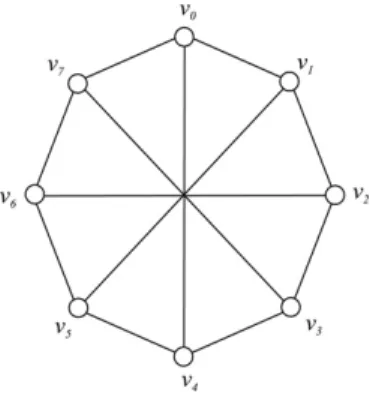
P G1with 2nvertices in such a way that the vertex setFig. 1.Recursive circulantG(8,4).
V
=
V0∪
V1and the edge setE=
E0∪
E1∪
E2, whereE2= {
(v
j, w
ij)
|
1≤
j≤
n}
. We denote byG0⊕
G1a graph obtained by mergingG0andG1w.r.t. an arbitrary permutationP. Here,G0andG1are calledcomponentsofG0⊕
G1.Vaidya et al. [8] introduced a class of hypercube-like interconnection networks, calledHL-graphs, which can be defined by applying the
⊕
operation repeatedly as follows:HL0= {
K1}
; form≥
1,HLm= {
G0⊕
G1|
G0,
G1∈
HLm−1}
. Then, HL1= {
K2}
;HL2= {
C4}
;HL3= {
Q3,
G(
8,
4)
}
. Here,C4is a cycle graph with 4 vertices,Q3is a 3-dimensional hypercube, andG(
8,
4)
is a recursive circulant shown inFig. 1, which is defined as follows: the vertex set is{
v
i|
0≤
i≤
7}
and the edge set is{
(v
i, v
j)
|
i+
1 ori+
4≡
j(
mod 8)
}
. An arbitrary graph which belongs toHLmis called anm-dimensional HL-graph. Definition 1. A graphGis said to bef -edge-fault perfectly matchableif for any edge fault setF with|
F| ≤
f,G\
F has a perfect matching. A graphGis said to beconditional f -edge-fault perfectly matchableif for any conditional edge fault setF with|
F| ≤
f,G\
Fhas a perfect matching.By the definition of anm-dimensional HL-graph, its edge set can be partitioned intomsubsets, where each subset forms a perfect matching. This leads to the following proposition.
Proposition 4. (a)Every m-dimensional HL-graph is m
−
1-edge-fault perfectly matchable. Its matching preclusion number is equal to the degree m.(b) Everym-dimensional HL-graph is conditional m
−
1-edge-fault perfectly matchable. Its conditional matching preclusion number is at least m.Throughout this paper, a path in a graph is represented as a sequence of vertices. For a vertex
v
inG0⊕
G1, we denote by¯
v
themateofv
, the vertex adjacent tov
which is in a component different from the component in whichv
is contained. Let Fbe the set of faulty edges inG0⊕
G1.F0andF1denote the sets of faulty edges inG0andG1, respectively, andF2denotes the set of faulty edges joining vertices inG0and vertices inG1, so thatF=
F0∪
F1∪
F2. Letf0= |
F0|
,f1= |
F1|
, andf2= |
F2|
. 2.1. Restricted HL-graphsIn [7], a subclass of nonbipartite HL-graphs, calledrestricted HL-graphs, was introduced and defined recursively as follows: RHLm
=
HLmfor 0≤
m≤
2;RHL3=
HL3\
Q3= {
G(
8,
4)
}
;RHLm= {
G0⊕
G1|
G0,
G1∈
RHLm−1}
form≥
4. A graph which belongs toRHLmis called anm-dimensional restricted HL-graph.Many of the nonbipartite hypercube-like interconnection networks such as crossed cube, Möbius cube, twisted cube, multiply twisted cube, Mcube, generalized twisted cube, etc. proposed in the literature are restricted HL-graphs.A graphGis calledf -fault hamiltonian(resp.f -fault hamiltonian-connected) if there exists a hamiltonian cycle (resp. if each pair of vertices are joined by a hamiltonian path) inG
\
Ffor any setFof faulty elements (vertices and/or edges) with|
F| ≤
f. Fault-hamiltonicity of restricted HL-graphs was studied in [7] as follows.Lemma 1 ([7]). Every m-dimensional restricted HL-graph, m
≥
3, is m−
3-fault hamiltonian-connected and m−
2-fault hamiltonian.In this subsection, we will show that the conditional matching preclusion numbers ofm-dimensional restricted HL-graphs are all 2m
−
2 ifm≥
5, and will characterize 4-dimensional restricted HL-graphs whose conditional matching preclusion numbers are 6. We begin with conditional matching preclusion of the 3-dimensional restricted HL-graphG(
8,
4)
shown inFig. 1.Lemma 2. mp1
(
G(
8,
4))
=
3. Furthermore, all of the eight minimum conditional matching preclusion sets are symmetric to{
(v
0, v
4), (v
0, v
1), (v
3, v
4)
}
.Proof. It was shown in [6] that the minimum matching preclusion sets ofG
(
8,
4)
are either the sets of edges incident to a single vertex or the sets symmetric to{
(v
0, v
4), (v
0, v
1), (v
3, v
4)
}
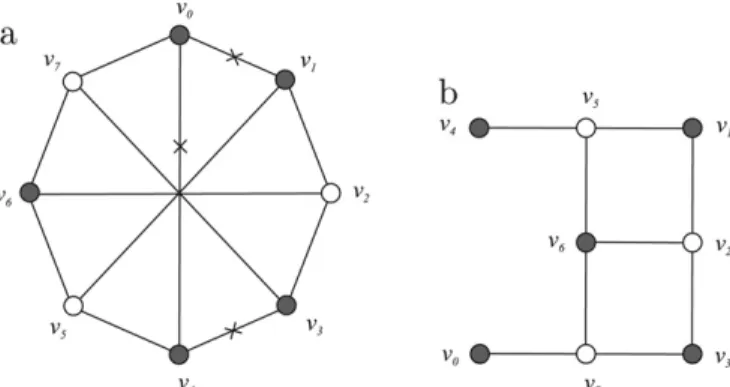
. The latter are conditional, and thus we have theFig. 2.G(8,4)with the minimum conditional matching preclusion set.
The graphG
(
8,
4)
with the minimum conditional matching preclusion setF= {
(v
0, v
4), (v
0, v
1), (v
3, v
4)
}
is shown inFig. 2(a) and (b). The symbol
×
on an edge in figure (a) indicates that the edge is faulty, and the faulty edges are not shown in figure (b).G(
8,
4)
\
Fbecomes a bipartite graph with a set{
v
0, v
1, v
3, v
4, v
6}
of five black vertices and a set{
v
2, v
5, v
7}
of three white vertices as shown in the figure. It is straightforward to check that if we remove an arbitrary pair of black vertices inG(
8,
4)
\
F, then the resultant graph always has a perfect matching.Now, we investigate conditional matching preclusion sets of 4-dimensional restricted HL-graphsG
(
8,
4)
⊕
G(
8,
4)
and of higher-dimensional restricted HL-graphs.Theorem 1.(a)Every4-dimensional restricted HL-graph with a conditional fault set F with
|
F| ≤
5has a perfect matching unless one component contains three faulty edges forming a conditional matching preclusion set of the component, the other component contains one faulty edge, and there is a single faulty edge between the two components.(b)Every m-dimensional restricted HL-graph with m
≥
5is conditional2m−
3-edge-fault perfectly matchable.Proof. We letGbe anm-dimensional restricted HL-graph withm
≥
4, which is isomorphic toG0⊕
G1for somem−
1-dimensional restricted HL-graphsG0andG1. The proof is by induction onm. LetFbe a conditional fault set of size at most 2m−
3. It suffices to consider the case|
F| =
2m−
3. Iff2=
0, we are done since the set of edges joiningV(
G0)
andV(
G1)
forms a perfect matching. Hereafter in this proof, we assumef2≥
1. Furthermore, we assume w.l.o.g.f0≥
f1. Then, we have f1≤
m−
2 andF1is a conditional fault set ofG1. There are two cases.Case1:f0
≤
2m−
5.Let us first consider the subcase when there exists a vertexxinG0such that all the edges inG0incident toxare faulty. We havef0
≥
m−
1 andf1≤
m−
3. LetF00=
F0∪{
x}\{
(
x, v)
|
v
∈
V(
G0)
}
. Since|
F00| ≤
(
2m−
5)
+
1−
(
m−
1)
=
m−
3, byLemma 1, there exists a hamiltonian cycleC0inG0\
F00. Moreover,G1\
F1also has a hamiltonian cycleC1. Let the hamiltonian cycleC1be(w
1, w
2, . . . , w
2m−1)
withw
1= ¯
x. There exists a vertexw
2i, 1≤
i≤
2m−2, such that(w
2i,
w
¯
2i)
is fault-free. The existence is due to the fact that there are 2m−2candidates and at mostm−
2 blocking elements (f2faulty edges). Note that 2m−2
>
m−
2 for anym≥
4. Then, we have two even paths(
x, w
1, w
2, . . . , w
2i−1)
of length 2iand(
C0, w
2i, w
2i+1, . . . , w
2m−1)
of length2m
−
2i, which partitionV(
G)
. Here,(
x,
x¯
)
is fault-free sinceFis a conditional fault set. Thus, byProposition 1,G\
Fhas a perfect matching.Now, we assume that no such vertexxexists inG0, which implies thatF0is a conditional fault set ofG0. Notice that F1is also a conditional fault set ofG1. If eitherm
≥
6 orm=
5 andG0(which is a 4-dimensional restricted HL-graph) withF0satisfies the sufficiency of (a), then, by induction hypothesis,G0\
F0andG1\
F1have perfect matchingsM0andM1, respectively. The unionM0∪
M1is a desired perfect matching.Letm
=
4 first. If eitherf0≤
2 orf0=
3 andF0is not a conditional matching preclusion set ofG0, then bothG0andG1 have perfect matchings and we are done. Assumef0=
3 andF0is a conditional matching preclusion set ofG0as shown inFig. 2. We assume w.l.o.g.F0
= {
(v
0, v
4), (v
0, v
1), (v
3, v
4)
}
. Remember that if we delete an arbitrary pair of black vertices in G0, the resultant graph has a perfect matching. Iff1=
0, for some two black verticesxandyinG0such that(
x,
x¯
)
and(
y,
y¯
)
are fault-free, we have an even path(
x,
P1,
y)
, whereP1is a hamiltonian path inG1joiningx¯
and¯
y. ByLemma 1,P1exists. G0\
(
F0∪ {
x,
y}
)
has a perfect matching, and thus a perfect matching ofG\
Fcan be finished by dividing the even path into paths of length two. This completes the construction of perfect matchings whenGwithFsatisfies the sufficiency of (a).Finally, we assume thatm
=
5 andG0withF0does not satisfy the sufficiency of (a). Note thatG0is a 4-dimensional restricted HL-graph andG0\
F0may not have a perfect matching. LetG0be isomorphic toG00⊕
G01, whereG00andG01are 3-dimensional restricted HL-graphs. We assume thatG00has three faulty edges which form a conditional matching preclusion set ofG00. The construction of a perfect matching can be obtained similar to the previous casem=
4. There exist two black verticesxandyinG00such that(
x,
x¯
)
and(
y,
y¯
)
are fault-free. Excludingxandy,G00\
F0has a perfect matching.G01\
F0also has a perfect matching. The union of two perfect matchings forms a perfecting matching ofG0\
(
F0∪ {
x,
y}
)
. Sincef1≤
1, there exists a hamiltonian pathP1inG1\
F1joining¯
xandy. The even path¯
(
x,
P1,
y)
can be partitioned into paths of length two, thus the construction is completed.Case2:f0
=
2m−
4 andf2=
1 (f1=
0).We are going to pick up a faulty edge
(
x,
y)
inG0which satisfies the following two conditions simultaneously:(i) If
(
x,
y)
is regarded as a virtualfault-free edge,G0\
F0has a perfect matching. In precise words,G0\
F00 has a perfect matching, whereF00=
F0\
(
x,
y)
.(ii) Both
(
x,
¯
x)
and(
y,
y¯
)
are fault-free.If such a faulty edge
(
x,
y)
exists, a perfect matching inG\
Fcan be constructed in a simple manner as follows. When(
x,
y)
is not contained in the perfect matchingM0ofG0\
F00, the union ofM0and a perfect matchingM1ofG1will do. Otherwise, we construct an even path(
x,
P1,
y)
, whereP1is a hamiltonian path inG1joiningx¯
andy, and then divide it into a set¯
M0of pairwise disjoint paths of length two. Obviously,(
M0\
(
x,
y))
∪
M0is a desired perfect matching.It remains to show that there exists a faulty edge
(
x,
y)
which satisfies both conditions (i) and (ii). Letm≥
6 first. If there exists a vertexzsuch that all the edges inG0incident tozare faulty, let(
x,
y)
be an edge incident tozwhich satisfies the condition (ii). The edge(
x,
y)
exists sincef2=
1 and(
z,
z¯
)
is fault-free. RememberF is a conditional fault set. If no such vertexzexists, let(
x,
y)
be an arbitrary faulty edge satisfying the condition (ii). Then, lettingF00=
F0\
(
x,
y)
,F00is a conditional fault set inG0of size 2m−
5. Notice that every vertex other thanzhas a fault-free edge incident to it; suppose otherwise,f0should be at least 2m−
3, which is a contradiction. By induction hypothesis,G0\
F00has a perfect matching and thus the condition (i) is also satisfied.Form
=
4 or 5, it is not sufficient to show thatF00is a conditional fault set. Letm=
4 (f0=
4) now. If there exists a vertex zsuch that all the edges inG0incident tozare faulty, sayz=
v
0and(v
0, v
1)
,(v
0, v
4)
, and(v
0, v
7)
are faulty, let(
x,
y)
=
(
(v
0
, v
4)
if(v
4,
v
¯
4)
is fault-free;
(v
0, v
1)
if(v
4,
v
¯
4)
is faulty and(v
3, v
4)
is faulty;
(v
0, v
7)
otherwise.
ThenF00
=
F0\
(
x,
y)
is a conditional fault set and not a conditional matching preclusion set. Thus,G0\
F00 has a perfect matching and the two conditions are satisfied. When there exists no such vertexz, we claim that among the four subsets with cardinality three ofF0, at most one is a conditional matching preclusion set ofG0. The proof is direct from the fact that f0=
4 and any two conditional matching preclusion sets of cardinality three share at most one edge. If there exists a subset forming a conditional matching preclusion set, then let(
x,
y)
be an edge in the subset satisfying the condition (ii); otherwise, let(
x,
y)
be an arbitrary faulty edge satisfying the condition (ii). Then,(
x,
y)
is a faulty edge satisfying both conditions (i) and (ii).Finally, letm
=
5 (f0=
6). LetG0be isomorphic toG00⊕
G01for 3-dimensional restricted HL-graphsG00andG01. Letf00 andf01denote the numbers of faulty edges inG00andG01, respectively. Assume w.l.o.g.f00≥
f01. Iff00=
4, we pick up a faulty edge(
x,
y)
inG00for two subcases depending on whether or not there exists a vertexzsuch that all the edges inG0 incident tozare faulty, in the same way as the above casem=
4 so that, lettingF00be the set of faulty edges inG00,F00\
(
x,
y)
is a conditional fault set and not a conditional matching preclusion set ofG00. Obviously,F00=
F0\
(
x,
y)
is a conditional fault set ofG0, too. Thus,G0\
F00has a perfect matching. Hereafter in this proof, we assumef006=
4. If there exists a vertexz(inG00) such that all the edges inG0incident tozare faulty, we pick up an edge(
x,
y)
incident tozwhich satisfies the condition (ii). Then,F00=
F0\
(
x,
y)
is a conditional fault set ofG0. Moreover, it is straightforward to check thatG0with fault setF00satisfies the sufficiency of (a). By induction hypothesis,G0\
F00has a perfect matching. We assume no such vertexzexists from now on, and thus we need not check ifF00is a conditional fault set. Iff00
=
3 andF00forms a conditional matching preclusion set ofG00, we pick up a faulty edge(
x,
y)
inG00satisfying the condition (ii). For all the other cases, we pick up an arbitrary faulty edge(
x,
y)
satisfying the condition (ii). It is easy to see thatG0with fault setF00satisfies the sufficiency of (a). Thus, G0\
F00has a perfect matching. This completes the proof.Due toProposition 2and the fact that no HL-graph contains a cycle of length three, we have the following. Corollary 1. For any m-dimensional restricted HL-graph G with m
≥
5, mp1(
G)
=
2m−
2.It would be a natural question to ask if the sufficient condition given inTheorem 1(a) is also a necessary one. The rest of this subsection is devoted to characterizing the minimum conditional matching preclusion sets of 4-dimensional restricted HL-graphsG
(
8,
4)
⊕
G(
8,
4)
. As a result, it will be noticed later that some 4-dimensional restricted HL-graphs have conditional matching preclusion number 6 while the others have 5.We begin with a hamiltonian property ofG
(
8,
4)
with a single faulty edge, which will be utilized later.Lemma 3. For any single edge fault
(
x,
y)
in G(
8,
4)
, G(
8,
4)
\
(
x,
y)
has a hamiltonian path between every pair of vertices s∈ {
x,
y}
and t(
6=
s)
.Proof. The proof is by an immediate inspection.
LetGbe a 4-dimensional restricted HL-graph isomorphic toG0
⊕
G1, whereG0andG1are isomorphic toG(
8,
4)
. To represent which component a vertex is contained in, we assumeV(
G0)
= {
v
0, v
1, . . . , v
7}
andV(
G1)
= {
w
0, w
1, . . . , w
7}
. Furthermore, we assume thatv
iis adjacent tov
i+1andv
i+4, andw
iis adjacent tow
i+1andw
i+4for every 0≤
i<
8. Here, all arithmetic on the indices of vertices will be assumed to be done modulo 8.We assume thatGwith a conditional fault setF of cardinality five does not satisfy the sufficiency ofTheorem 1(a), that is,F0is a minimum conditional matching preclusion set ofG0,f1
=
1, andf2=
1. Without loss of generality, let F0= {
(v
0, v
4), (v
0, v
1), (v
3, v
4)
}
. We denote byB0the set of five black vertices{
v
0, v
1, v
3, v
4, v
6}
inG0and byW0the set of three white vertices{
v
2, v
5, v
7}
as shown inFig. 2. Remember that for any pair of black verticesxandyinG0,G0\
(
F0∪ {
x,
y}
)
has a perfect matching. Let us consider the case first when the faulty edge inG1is adiagonaledge(w
i, w
i+4)
for somei, say(w
0, w
4)
.Lemma 4. If F1
= {
(w
0, w
4)
}
, G\
F is perfectly matchable.Proof. First, if for some black vertexxinG0,
(
x,
¯
x)
is fault-free andx¯
is eitherw
0orw
4, then for some black vertexyinG0 such that(
y,
¯
y)
is fault-free, there exists a hamiltonian pathP1inG1\
F1joining¯
xandy¯
byLemma 3. From a perfect matching inG0\
(
F0∪ {
x,
y}
)
and an even path(
x,
P1,
y)
, a perfect matching inG\
Fcan be obtained. Second, if for some pair of black verticesxandy, both(
x,
x¯
)
and(
y,
y¯
)
are fault-free and¯
x=
w
iandy¯
=
w
i+1for some 0≤
i<
8, then a perfect matching ofG\
Fcan be constructed similarly by using a hamiltonian pathP1inG1\
F1joiningw
iandw
i+1. Notice thatP1is obtained from a hamiltonian cycle(w
0, w
1, . . . , w
7)
by deleting an edge(w
i, w
i+1)
. Finally, for the remaining case, there exists a black vertexxsuch that(
x,
x¯
)
is faulty, and{¯
y|
y∈
B0\
x} = {
w
1, w
3, w
5, w
7}
. We observe thatG1\
(
F1∪ {
w
1, w
3}
)
has a perfect matchingM1= {
(w
0, w
7), (w
2, w
6), (w
4, w
5)
}
. Then, lettingM0be a perfect matching inG0\
(
F0∪ { ¯
w
1,
w
¯
3}
)
, the union M0∪
M1∪ {
(w
1,
w
¯
1), (w
3,
w
¯
3)
}
is a perfect matching ofG\
F. Therefore, we conclude thatG\
Fis perfectly matchable.Now, let the faulty edge inG1be aboundaryedge
(w
i, w
i+1)
for somei, say(w
0, w
7)
.Lemma 5. If F1
= {
(w
0, w
7)
}
, G\
F is perfectly matchable unless there exists a black vertex x in G0such that(
x,
¯
x)
is faulty and{¯
y|
y∈
B0\
x} = {
w
1, w
3, w
4, w
6}
.Proof. If there exists a black vertexxsuch that
(
x,
x¯
)
is fault-free and¯
xis eitherw
0orw
7, then there exists a hamiltonian path inG1\
F1fromx¯
to any other vertex byLemma 3. In a very similar way to the first case ofLemma 4, we can construct a perfect matching inG\
F. Suppose otherwise. There exists a hamiltonian cycleC1=
(w
0, w
1, w
2, w
3, w
7, w
6, w
5, w
4)
in G1\
F1, and thus between any pair of verticesaandbsuch that(
a,
b)
is an edge ofC1, there exists a hamiltonian path inG1\
F1 joining the pair. If there exists a pair of black verticesxandyinG0such that both(
x,
x¯
)
and(
y,
y¯
)
are fault-free and(
¯
x,
y¯
)
is an edge ofC1, then we have an even path(
x,
P1,
y)
, whereP1=
C1\
(
x¯
,
y¯
)
. Thus, a perfect matching can be obtained from a perfect matching ofG0\
(
F0∪ {
x,
y}
)
and the even path. It remains the case exactly when the sufficiency of the lemma is not satisfied. Thus, the proof is completed.SupposeF1
= {
(w
0, w
7)
}
and the sufficiency ofLemma 5is not satisfied. For convenience, we will refer to the vertices{
w
1, w
3, w
4, w
6}
as white vertices and the vertices{
w
0, w
2, w
5, w
7}
as black vertices. Then,G1\
F1has a unique edge joining vertices of the same color,(w
3, w
4)
. Since{¯
y|
y∈
B0\
x} = {
w
1, w
3, w
4, w
6}
for the unique black vertexxinG0such that(
x,
x¯
)
is faulty, we have{¯
z|
z∈
W0} ⊂ {
w
0, w
2, w
5, w
7}
. Thus, all the fault-free edges betweenG0andG1join pairs of vertices with different colors each other. Therefore,G\
(
F∪ {
(w
3, w
4)
}
)
is a bipartite graph. The set of black vertices inG\
Fforms an independent set of size nine, which implies, byProposition 3,G\
Fhas no perfect matching. Eventually, we reach a necessary and sufficient condition. It is summarized in the following.Lemma 6. Given a4-dimensional restricted HL-graph G and a conditional fault set F of G with
|
F| ≤
5, G\
F has no perfect matching if and only if F0= {
(v
i, v
i+4), (v
i, v
i+1), (v
i+3, v
i+4)
}
for some i, F1= {
(w
j, w
j−1)
}
for some j, and there exists a vertex x in B0= {
v
i, v
i+1, v
i+3, v
i+4, v
i+6}
such that(
x,
x¯
)
∈
F2and{¯
y|
y∈
B0\
x} = {
w
j+1, w
j+3, w
j+4, w
j+6}
.Next step will be characterization of 4-dimensional restricted HL-graphs which are conditional 5-edge-fault perfectly matchable. It can be derived directly fromLemma 6as follows.
Theorem 2.A4-dimensional restricted HL-graph G is conditional5-edge-fault perfectly matchable if and only if for any i and any vertex x in Bi
0
= {
v
i, v
i+1, v
i+3, v
i+4, v
i+6}
, the set{¯
y|
y∈
Bi0\
x}
is not equal to{
w
j+1, w
j+3, w
j+4, w
j+6}
for any j.Of course, there exists a 4-dimensional restricted HL-graph which does not satisfy the condition ofTheorem 2and thus is not conditional 5-edge-fault perfectly matchable. The graphG0
⊕
IG1for an identity permutationI=
(
0,
1,
2,
3,
4,
5,
6,
7)
, which is shown inFig. 3(a), is such a graph. It can be defined as the productG(
8,
4)
×
K2, whereK2is a complete graph with two vertices. Discover a conditional matching preclusion setF= {
(v
0, v
4), (v
0, v
1), (v
3, v
4), (w
0, w
7), (v
0, w
0)
}
of size five. Also, there exists a 4-dimensional restricted HL-graph which satisfies the condition ofTheorem 2and thus is conditional 5-edge-fault perfectly matchable. For example, the graphG0⊕
PG1forP=
(
0,
2,
1,
4,
3,
5,
6,
7)
shown inFig. 3(b) is such a graph. For anyi,{¯
y|
y∈
B0i}
is symmetric to either{
w
0, w
1, w
2, w
4, w
5}
or{
w
0, w
1, w
2, w
4, w
6}
, and thus no such vertex xinBi0exists.
2.2. Bipartite HL-graphs
A bipartite graph is calledequitableif it has a proper bicoloring such that both color sets have the same cardinality. Every bipartite HL-graph is equitable. It can be proved easily by induction. We assume that anm-dimensional bipartite HL-graph has 2m−1black and 2m−1white vertices and no pair of black and white vertices are joined by an edge. In this subsection, we will show that everym-dimensional bipartite HL-graph withm
≥
2 is conditional 2m−
3-edge-fault perfectly matchable.(a)G0⊕IG1. (b)G0⊕PG1.
Fig. 3.4-dimensional restricted HL-graphs.
For our purpose, we first construct a perfect matching in anm-dimensional bipartite HL-graph with at mostmfaults, whereas the fault set contains a pair of black and white vertices.
Lemma 7. Let G be an m-dimensional bipartite HL-graph with m
≥
2. Then, for any hybrid fault set F0containing a single blackvertex, single white vertex, and at most m
−
2edges, G\
F0has a perfect matching.Proof. We denote byuand
v
the black and white faulty vertices inG, respectively. It is assumed w.l.o.g. that the number of faulty edges inGism−
2. The proof is by induction onm. Form=
2,Gis isomorphic toC4and the lemma holds true. Assumem≥
3. There exist twom−
1-dimensional bipartite HL-graphsG0andG1such thatGis isomorphic toG0⊕
G1. As usual,Fidenotes theedgefault set ofGi,i=
0,
1, andfi= |
Fi|
. There are two cases.Case1:f0
,
f1≤
m−
3.When bothuand
v
are contained in one component, sayG0, the union of a perfect matchingM0ofG0\
(
F0∪ {
u, v
}
)
and a perfect matchingM1inG1\
F1is a desired matching. The existence ofM0is due to induction hypothesis and the existence of M1is due toProposition 4. Whenuis contained in one component, sayG0, andv
is contained in the other componentG1, we first pick up an edge(
x,
x¯
)
such thatxis a vertex inG0having a different color fromuand(
x,
¯
x)
is fault-free. The picking up is always possible since we have 2m−2candidates and at mostm−
2 blocking elements (faulty edges). Obviously, 2m−2>
m−
2 for anym≥
3. Then, we find a perfect matchingM0inG0\
(
F0∪ {
u,
x}
)
and a perfect matchingM1inG1\
(
F1∪ {
v,
x¯
}
)
. We have a perfect matchingM0∪
M1∪ {
(
x,
x¯
)
}
inG\
F.Case2:f0
=
m−
2.There is no faulty edge outsideG0. When bothuand
v
are contained inG0, we pick up a faulty edge(
x,
y)
inG0. Letting(
x,
y)
be avirtualfault-free edge, we find a perfect matchingM0inG0\
(
F00∪ {
u, v
}
)
, whereF0
0
=
F0\
(
x,
y)
. If(
x,
y)
6∈
M0, the union ofM0and a perfect matchingM1inG1is a desired matching. Otherwise, lettingM1be a perfect matching inG1\{¯
x,
y¯
}
, we have a desired matching(
M0\
(
x,
y))
∪
M1∪ {
(
x,
x¯
), (
y,
y¯
)
}
. When one ofuandv
, sayu, is contained inG0andv
is contained inG1, for some faulty edge(
x,
y)
inG0withxbeing different in color fromu, we find a perfect matchingM0inG0\
(
F00∪{
u,
x}
)
, whereF00
=
F0\
(
x,
y)
. LettingM1be a perfect matching inG1\{
v,
¯
x}
, we have a desired matchingM0∪
M1∪ {
(
x,
¯
x)
}
. Finally when bothuandv
are contained inG1, the union of a perfect matchingM0inG0\
F0and a perfect matchingM1inG1\{
u, v
}
is a desired matching.Now, we are ready to consider conditional matching preclusion of bipartite HL-graphs.
Theorem 3. Every m-dimensional bipartite HL-graph with m
≥
2is conditional2m−
3-edge-fault perfectly matchable. Proof. The proof is by induction onm. Form=
2, the theorem clearly holds. Letm≥
3 andGdenote anm-dimensional bipartite HL-graph isomorphic toG0⊕
G1for somem−
1-dimensional bipartite HL-graphs G0and G1. LetF denote a conditional edge fault set with|
F| ≤
2m−
3. We will showG\
Fhas a perfect matching. For our purpose, it is assumed|
F| =
2m−
3. Iff2=
0, we are done since the set of edges betweenG0andG1forms a perfect matching. Thus, we assume f2≥
1 hereafter. Furthermore, we assume w.l.o.g.f0≥
f1. Then,f1≤
m−
2.Case1:f0
≤
2m−
5.If F0 is a conditional fault set ofG0, the union of perfect matchings M0 ofG0
\
F0 and M1 of G1\
F1 is indeed a perfect matching ofG\
F. Suppose otherwise, there exists a vertexxinG0such that all the edges inG0 incident toxare faulty. We assume w.l.o.g.xis a white vertex. There exists a black vertexyinG0such that(
y,
y¯
)
is fault-free, since the number 2m−2of candidates is greater than the upper boundm−
2 on the number of blocking elements for anym≥
3. Then, byLemma 7, there exists a perfect matchingM0inG0
\
(
F00∪ {
x,
y}
)
, whereF 00
=
F0\{
(
x, v)
|
v
∈
V(
G0)
}
. Note thatF00has at most(
2m−
5)
−
(
m−
1)
=
m−
4 faulty edges. Furthermore, a perfect matchingM1ofG1\
(
F1∪ {¯
x,
¯
y}
)
also exists byLemma 7 sincef1=
f−
f0−
f2≤
(
2m−
3)
−
(
m−
1)
−
1=
m−
3. The unionM0∪
M1∪ {
(
x,
¯
x), (
y,
y¯
)
}
is a desired perfect matching.Case2:f0
=
2m−
4 andf2=
1 (f1=
0).We are to pick up a faulty edge
(
x,
y)
inG0such that (i)F00≡
F0\
(
x,
y)
is a conditional fault set and (ii) both(
x,
¯
x)
and(
y,
y¯
)
are fault-free. If there exists a vertexzsuch that all the edges inG0incident tozare faulty,(
x,
y)
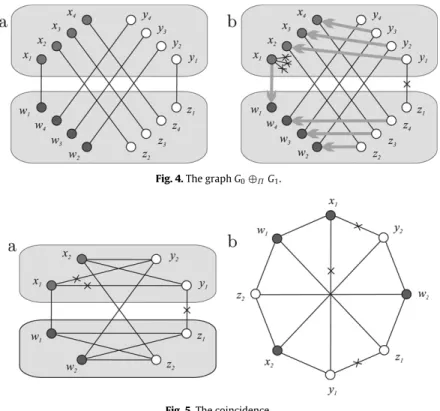
will be an arbitraryFig. 4.The graphG0⊕ΠG1.
Fig. 5.The coincidence.
edge incident tozsatisfying condition (ii). Such a vertexzis unique, if any. Otherwise,
(
x,
y)
will be an arbitrary faulty edge inG0satisfying condition (ii). By induction hypothesis,G0\
F00has a perfect matchingM0. If(
x,
y)
6∈
M0, the union ofM0 and a perfect matchingM1inG1 will do. If(
x,
y)
∈
M0, lettingM1 be a perfect matching ofG1\{¯
x,
y¯
}
, the union(
M0\
(
x,
y))
∪
M1∪{
(
x,
¯
x), (
y,
y¯
)
}
is a desired matching. The existence ofM1is due toLemma 7. Thus, we have the theorem. Corollary 2. For any m-dimensional bipartite HL-graph G with m≥
3, mp1(
G)
=
2m−
2.3. Concluding remarks
In this paper, the conditional matching preclusion numbers for bothm-dimensional restricted HL-graphs withm
≥
5 andm-dimensional bipartite HL-graphs withm≥
3 were determined to be 2m−
2. Everym-dimensional HL-graph, by definition, has an edge partition intomperfect matchings. Thus, one might expect thatTheorem 1andTheorem 3can be extended to general HL-graphs so that for some constantm0, everym-dimensional HL-graph withm≥
m0is conditional 2m−
3-edge-fault perfectly matchable.Unfortunately, this is not the case as shown below. LetG0andG1be arbitrarym
−
1-dimensional bipartite HL-graphs form≥
3. We let{
x1,
x2, . . . ,
xq}
and{
y1,
y2, . . . ,
yq}
be the sets of black and white vertices inG0, respectively, and let{
w
1, w
2, . . . , w
q}
and{
z1,
z2, . . . ,
zq}
be the sets of black and white vertices inG1, whereq=
2m−2. There exists a permutationΠbetweenV(
G0)
andV(
G1)
such that in the graphG0⊕
ΠG1,x¯
1=
w
1,x¯
i=
zifor every 2≤
i≤
q,y¯
1=
z1, andy¯
j=
w
jfor every 2≤
j≤
q. SeeFig. 4(a). The graphG0⊕
ΠG1is ‘near’ bipartite in a sense that if we delete two edges(
x1, w
1)
and(
y1,
z1)
, then the resultant graph becomes bipartite. In other words, itsbipartization number[5] is only two. Observation 1. For any m≥
3, the m-dimensional HL-graph G0⊕
ΠG1is not conditional m-edge-fault perfectly matchable. Proof. We denote byGthe graphG0⊕
ΠG1and letFbe a conditional fault set of sizemthat contains all the edges inG0 incident tox1and the edge(
y1,
z1)
. SeeFig. 4(b). Suppose, for a contradiction,G\
F has a perfect matchingM. The edge(
x1, w
1)
is included inM. Since(
y1,
z1)
is not included inM,y1should be matched to a black vertex inG0, sayx2. Then, since(
x2,
z2) /
∈
M,z2should be matched to a black vertex inG1, sayw
2. And then, since(w
2,
y2) /
∈
M,y2should be matched to a black vertex inG0, sayx3. This process continues until we find a vertexv
to whichyqis matched. At that time, however,w
q and all the black vertices inG0were already matched. Thus, no such vertexv
exists. This is a contradiction.The aboveObservation 1indicates that the lower boundmon the conditional matching preclusion number of an m-dimensional HL-graph given inProposition 4(b) is the best possible. It seems worth pointing out that the conditional matching preclusion setF presented inObservation 1form
=
3 coincides with the set given inLemma 2, as shown inFig. 5. The conditional matching preclusion number of the graphG0
⊕
Π G1ism, which is not greater than and equal to its matching preclusion number. This motivates the study of conditional matching preclusion for general HL-graphs and study of graphsGwithmp1(
G)
=
mp(
G) >
0 and their relationship to something like bipartization.References
[1] R.C. Brigham, F. Harary, E.C. Violin, J. Yellen, Perfect-matching preclusion, Congressus Numerantium 174 (2005) 185–192. [2] J.A. Bondy, U.S.R. Murty, Graph Theory with Applications, 5th printing, American Elsevier Publishing Co., Inc, 1976. [3] E. Cheng, L. Lipták, Matching preclusion for some interconnection networks, Networks 50 (2) (2007) 173–180.
[4] E. Cheng, L. Lesniak, M.J. Lipman, L. Lipták, Conditional matching preclusion sets, Information Sciences 179 (8) (2009) 1092–1101. [5] H.-A. Choi, K. Nakajima, C.S. Rim, Graph bipartization and via minimization, SIAM Journal of Discrete Mathematics 2 (1) (1989) 38–47. [6] J.-H. Park, Matching preclusion problem in restricted HL-graphs and recursive circulantG(2m,4), Journal of KIISE 35 (2) (2008) 60–65.
[7] J.-H. Park, H.-C. Kim, H.-S. Lim, Fault-hamiltonicity of hypercube-like interconnection networks, in: Proc. IEEE International Parallel and Distributed Processing Symposium IPDPS 2005, Denver, Apr. 2005.
[8] A.S. Vaidya, P.S.N. Rao, S.R. Shankar, A class of hypercube-like networks, in Proc. of the 5th IEEE Symposium on Parallel and Distributed Processing SPDP 1993, Dec. 1993, pp. 800–803.