Evaluation of classification algorithms for intrusion detection in MANETs
Sergio Pastrana
a,⇑, Aikaterini Mitrokotsa
b, Agustin Orfila
a, Pedro Peris-Lopez
aa
Computer Science Department, Carlos III University of Madrid, Leganes, Spain b
Security and Cryptography Laboratory (LASEC), School of Computer and Communication Sciences, EPFL, Switzerland
a r t i c l e
i n f o
Article history:
Received 28 February 2012
Received in revised form 26 May 2012 Accepted 28 June 2012 Available online xxxx Keywords: MANET Intrusion detection Genetic Programming Classification algorithms Support Vector Machines
a b s t r a c t
Mobile Ad hoc Networks (MANETs) are wireless networks without fixed infrastructure based on the cooperation of independent mobile nodes. The proliferation of these networks and their use in critical scenarios (like battlefield communications or vehicular networks) require new security mechanisms and policies to guarantee the integrity, confidentiality and availability of the data transmitted. Intrusion Detection Systems used in wired networks are inappropriate in this kind of networks since different vul-nerabilities may appear due to resource constraints of the participating nodes and the nature of the com-munication. This article presents a comparison of the effectiveness of six different classifiers to detect malicious activities in MANETs. Results show that Genetic Programming and Support Vector Machines may help considerably in detecting malicious activities in MANETs.
Ó2012 Elsevier B.V. All rights reserved.
1. Introduction
Due to the inherent vulnerabilities of wireless networks, new security measures need to be developed to efficiently safeguard them. This work focuses on the detection of malicious activities in MANETs. Proposed ideas for intrusion detection in these net-works are required to achieve a trade-off between accurate detec-tion and limited consumpdetec-tion of resources[1]or the lack of central management and mobility of nodes [2]. This article presents a comparison of different classification algorithms applied to detect intrusions in MANETs. These algorithms can help to discriminate ‘‘normal’’ against ‘‘intrusive’’ behaviour effectively. We use six well-known classification algorithms, using labelled datasets ob-tained from a simulated environment. The comparison is fairly per-formed as several hyper-parameters were tuned and the experiments have been performed with datasets generated under various traffic conditions regarding the network mobility and the number of malicious nodes. We focus on detecting four different types of attacks: Black Hole [3], Forging [4], Packet Dropping[5] andFlooding[6].
In Section2we present the motivation of our work. Section3 introduces a review of the state of the art on intrusion detection in MANETs. Section 4 explains the details of the experimental setup and Section 5 presents the results obtained. Finally, we conclude in Section6.
1.1. Contribution
This article extends a previous work [7] that compares how effective intrusions in MANETs are detected by different classifica-tion algorithms, namely, Naïve Bayes, Gaussian Mixture Model (GMM), Multilayer Perceptron (MLP), Linear Model and Support Vector Machines (SVMs). Accordingly, two main contributions are presented. First, we analyse the promising behaviour of a new method based on Genetic Programming. Second, different probabil-ities of attacks are considered tackling a wide set of scenarios.
2. Motivation
2.1. Wireless technology
Wireless networks use the open air medium as communication channel and electromagnetic waves to send information between participants. Nodes in wireless networks can communicate with every other node located within a specific distance, called trans-mission range. When a node wants to send a packet to another node that does not belong in its one-hop neighbourhood then it has to rely to intermediate nodes to forward the packets to the final destination. Thus, efficient routing protocols are required in order to optimise the communication paths. Security issues in wireless communication may also have a serious impact in other types of network architectures since several network architectures use wireless channels. For instance, an architecture using the 802.11 standard (usually referred as WIFI or WLAN networks) uses a fixed infrastructure that communicates with other networks 0950-7051/$ - see front matterÓ2012 Elsevier B.V. All rights reserved.
http://dx.doi.org/10.1016/j.knosys.2012.06.016
⇑ Corresponding author. Tel.: +34 91 624 6260.
E-mail addresses: [email protected] (S. Pastrana), katerina.mitrokot-sa@epfl.ch(A. Mitrokotsa),[email protected](A. Orfila),[email protected](P. Peris-Lopez).
Contents lists available atSciVerse ScienceDirect
Knowledge-Based Systems
j o u r n a l h o m e p a g e : w w w . e l s e v i e r . c o m / l o c a t e / k n o s y s
using a wired communication, but communicates with the nodes of its own network using a wireless channel. This architecture re-quires all the nodes to be placed within the transmission range of the fixed infrastructure (access point), and any problem regard-ing this central point may affect the entire network.
Wireless ad hoc networks or Mobile Ad hoc Networks (MANETs) do not use a fixed infrastructure and all the nodes belonging to the network may be mobile. There is no central node acting as an ac-cess point, and mobile nodes share the responsibility of the proper functionality of the network, since a collaborative behaviour is required.
2.2. Security in MANETs
The intrinsic nature of MANETs provokes the emergence of new security risks, while some existing vulnerabilities in wired net-works are accentuated. The use of security technologies developed for wired networks in order to safeguard wireless networks is nei-ther direct nor easy to perform. In the absence of a wire connecting the nodes, any malicious node may access the network without physical restrictions. In order to prevent fraudulent outsiders entering the network, cryptographic algorithms can be used to authenticate the nodes. However, more complicated problems arise when an internal benign node is compromised, that is, if any attacker impersonates the identity of a node that is authorised in the network. Since the functionality of the network is typically based on a complete confidence between the participants, a mali-cious node impersonating a trusted node may cause a serious secu-rity bridge. Most of the attacks in mobile environments focus on routing protocols. These protocols were firstly designed to be effi-cient without taking into account the security issues. They usually need the cooperation between the participants and assume confi-dence between them. Nevertheless, a malicious node may modify its supposed benign functionality disturbing the overall behaviour of the protocol. Below, we present a list of attacks that we have considered in order to evaluate the effectiveness of the employed algorithms for the problem of intrusion detection.
Packet Droppingattack: In this attack, the attacker rejectsRoute Errorpackets leading legitimate nodes to forward packets in broken links[5].
Flooding attack: The malicious node broadcasts forged Route Request packets randomly to all nodes every 100 ms in order to overload the network[6].
Black Holeattack[3]: In this attack a malicious node advertises itself as having the shortest path to other nodes of the network. Nevertheless, as soon as it receives packets destined for other nodes, it drops them instead of forwarding to the final destina-tion. In our simulation scenario, each time a malicious black-hole node receives aRoute Requestpacket it sends aRoute Reply
packet to the destination without checking if it really has a path towards the selected destination. Thus, the black-hole node is always the first node that responds to aRoute Requestpacket. Moreover, the malicious node drops all Route Replyand Data
packets it receives if the packets are destined to other nodes. Forgingattack[4]: A malicious node modifies and broadcasts to
the victim node Route Error packets leading to repeated link features.
3. State of the art
3.1. Intrusion detection in MANETs
Intrusion Detection Systems (IDSs) are software or hardware tools (even a combination of both) that automatically scan and
monitor events in a computer or network, looking for intrusive evidence[8]. When designing an IDS to be used in a MANET, some considerations must be taken into account. There are several differ-ences in the way the detection engine must behave with respect to a wired network IDS. A rather complete survey about this topic can be found in[2], where Anjum et al. present the main challenges to secure wireless mobile networks. More recently, Sen and Clark[9] have presented a survey about existing intrusion detection ap-proaches for MANETs.
Traditional anomaly-based IDSs use predefined ‘‘normality’’ models to detect anomalies in the network. This is an approach that cannot be easily deployed in MANETs, since the mobility and flexibility of MANET nodes, make hard the definition of ‘‘nor-mal’’ and ‘‘malicious’’ behaviour. Furthermore, the mobility of nodes leads to changes of the network topology, increasing the complexity of the detection process. Additionally, since the MANET nodes have no fixed location, there is no central management and/ or monitoring point where an IDS could be placed. This implies that the detection process may be distributed into several nodes, as well as the collection and analysis of data. Consequently IDS are classified into collaborative or independent (non-collaborative) [9]. Independent IDSs are composed of IDS agents placed into the nodes of the network and being responsible for monitoring their neighbours and sending alarms whenever they detect any suspi-cious activity. The major problem of this architecture is deciding the location of the IDS agents, since nodes are mobile, and some zones of the network may not be monitored (for example, if the node hosting an IDS agent of one zone moves to another, the first remains uncovered). Another problem is that some resources such as bandwidth, CPU and/or power are scarce in these environments. Therefore, nodes hosting the IDS agents should be those having more resources and moreover, a larger transmission range. Maxi-mising the detection rate subject to resource limitation is an NP-complete problem and some algorithms have been proposed to approximate the solution[2].
Several IDS architectures have been proposed to be used in mo-bile networks. Zhang et al., initially in 2000[10], and later in 2003 [11], proposed a distributed and collaborative detection architec-ture. Every node in the network monitors their local neighbours, locally and independently, to detect any sign of intrusion. The key idea is that they may share information to perform this intru-sion search. Each IDS agent is structured in several pieces or mod-ules. Initially a data collection module gathers audit traces and activity logs. Then, a local detection engine analyses the data to look for local anomalies. Two modules are responsible for perform-ing the response actions: the local and global response modules. To share information, an extra secure communication module is used to provide trusted communications. In these approaches [10,?], Zhang et al. use classifiers to detect anomalies. They use entropy and conditional entropy to describe the characteristics of ‘‘normal’’ traffic and classification algorithms to build models of ‘‘normal’’ behaviour. Therefore classifiers are trained using ‘‘normal’’ data, to predict what is normally the next event given the previousn events. If a detector node monitors an event which is not what the classifier has predicted, an alarm is triggered.
Huang and Lee[12]presented a cluster-based IDS, in order to combat the resource constraints of MANETs. The authors use a set of statistical features obtained from routing tables and apply a classification decision tree algorithm, the C4.5, in order to discriminate ‘‘anomalous’’ against ‘‘normal’’ traffic. This approach allows the identification of the source of the attack, if the attack occurs within one-hop. Later, in 2004 [13] they proposed a hybrid system where they use both specification-based and anomaly-based detection, by using a taxonomy of anomalous activities and a finite state machine, which represents the correct
behaviour of the Ad hoc On Demand Distance Vector (AODV)[14] protocol.
In 2003 Karchirski and Guha[15]proposed the use of multiple collaborative sensors, where each sensor acts as a lightweight mo-bile agent. Each agent has a different role: network monitoring, host monitoring, decision-making and action-taking. The nodes are divided into clusters, and each cluster has a head node which monitors packets. Nodes vote to select their cluster head, based on the connectivity data received after a broadcast step. Karchirski and Guha focus on minimising the use of resources by the nodes in the network. However, they do not give details about how the detection process is performed.
Sun et al.[16]have also dealt with the problem of cooperative-ness between nodes and presented a non-overlapping zone-based IDS. In their approach, the nodes of the network are grouped into zones, such that some of the internal nodes of a zone act as gate-ways to other zones. The nodes of the network use Markov Chains to detect intrusions and they send alarms to their corresponding gateway when they detect some abnormal activity, using the pro-posed MANET Intrusion Detection Message Exchange Format (MIDMEF).
Recently, Su[17] has proposed a cooperative intrusion detec-tion system where some nodes monitor their neighbours in order to detect packets that are suspicious of being part of aBlack Hole
attack. When the number of such suspicious packets sent by a node exceeds a threshold, the detector node broadcasts a block message to all the nodes in the network. This block message is firstly authenticated with the ID of the detector node, and carries infor-mation indicating that the packets sent by the malicious node should be ignored. Our approach is different since we do not detect
Black Holeattacks with a specific threshold, but we study the use of classifiers.
Sen and Clark[18]has presented different evolutive approaches to detect intrusions. More precisely, the authors use simulated net-works to obtain the data they use to evolve the programs, imple-menting different attacks. First, in[18] a grammatical approach is used to detectPacket Dropping,FloodingandRoute Disruption tacks. They achieve good detection rates for the three types of at-tacks, but with a rather high false positive rate in the Packet DroppingandFloodingattack. They argue that this is due to packet losses that usually occurs in these networks, and differentiating packet losses from malicious droppings is not an easy task. Sec-ondly, in[19]they use Genetic Programming with a multi-objec-tive approach to obtain programs that maximise the detection rate and minimise both the false positive rate and the energy con-sumption, which is one of the main constraints in MANETs. They evaluate their approach for two types of attacks, theFloodingattack and theRoute Disruptionattack. In both works, different intrusion detection approaches are employed for each kind of attack and again almost all the attacks are detected. Our work is different in several ways. First, although the attacks are similar, the behaviour of malicious nodes in our experiments is different. For instance, in their Packet Dropping attack, malicious nodes drop Data packets whereas our malicious nodes dropRoute Error packets, that is a more general situation that reflects how cheating nodes maintain broken links. Second, Sen et al. work evolve one classifier for each attack (resulting in 3 different programs), while in our work we only generate one classifier to detect all the attacks studied, which entails a lesser consume of resources and better performance for constrained devices. Third, some experimental settings used in our work are different. For example, we use the GlomoSim simula-tor program whereas they used NS-2, the pause time between movements of nodes is different (5, 20 and 40 vs. 0, 20, 400 and 700), etc.
3.2. Classification models
The classification models we have considered are six well known classifiers i.e., the MultiLayer Perceptron (MLP), the Linear classifier, the Gaussian Mixture Model (GMM), the Naïve Bayes classifier, Support Vector Machine (SVM) model and Genetic Pro-gramming (GP) algorithms employed as classifiers.
An instance of an MLP can be considered as a function g:X ! Y, wheregcan be defined as a composition of other func-tions zi:X ! Z. This decomposition can be written as
g(x) =Kw0z(x) wherex2 X,wis a parameter vector andKdenotes a kernel and the function z(x) = [z1(x),z2(x),. . .] is called hidden
layer. For each of those hidden layers, it holdsziðxÞ ¼Ki
v
0ix
where each
v
iis a parameter vector,V= [v
1,v
2,. . .] denotes the parametermatrix of the hidden layer andKidenotes an arbitrary kernel. For
the problem of intrusion detection we use an MLPm, as a model for the conditional probability given the observations i.e.,:
PðY ¼yjX ¼x;M ¼mÞ; y¼gðxÞ:
If there is no hidden layer then it holdszi=xiand the modelm
cor-responds to the Linear model.
The GMM model is used to model the conditional observation density of each classyi.e.,:
PðX ¼xjY ¼y;M ¼mÞ:
This is achieved by using a separate set of mixturesUyfor modeling
the observation density of each classy. Thus, for a given classythe density at each pointxis calculated by marginalizing over the mix-ture componentsu2 Uy, for the class, i.e.,:
PðX ¼xjY ¼yÞ ¼X
u
PðX ¼xjU ¼uÞPðU ¼ujY ¼yÞ:
The likelihood functionPðX ¼xjU ¼uÞhas a Gaussian form with parameters the covariance matrixPuand the mean vector
l
u, whilethe termPðU ¼ujY ¼yÞrepresents the component weight. Finally, by estimatingPðY ¼yÞfrom the data, we obtain the conditional probability given the observations, i.e.,:
PðY ¼yjX ¼yÞ ¼1
ZPðX ¼xjY ¼yÞPðY ¼yÞ
whereZ ¼Py2 YPðX ¼xjY ¼yÞPðY ¼yÞdoes not depend ony.
The Naïve Bayes model can be derived from the GMM model when there is only one Gaussian Mixture.
We have also used the Support Vector Machine (SVM) [20] model that uses Lagrangian methods to minimise a regularised function of the empirical classification error. The SVM algorithm finds a linear hyperplane separation with a maximal margin in this hyperspace. The points that are lying on the margin are called sup-port vectors. The main parameters of the algorithm iscwhich rep-resents the trade-off between the size of the margin and the number of violated constraints and the kernelK(xi,xj). More
pre-cisely, we use SVMs with a gaussian kernel of the form Kðxi;xjÞ ¼pffiffiffiffi21prexp
kxixjk2
r2
,8xi;xj2 X, whereXis the observation
space.
Given a problem, Genetic Programming (GP) performs a heuris-tic search for an optimal solution over a big exploration space[21]. It manages a population of individuals (programs), randomly ini-tialized, which are evolved regarding natural selection procedures. Each program (individual) has a tree structure where the root and intermediate nodes are functions and leafs are terminals. In each step or generation of the algorithm, programs are evaluated using a fitness function that tests the individuals, thus establishing an order of the individuals. At each generation a new population is
obtained by selecting the best individuals from the previous gener-ation (the first genergener-ation is randomly established). Some individ-uals are mutated (changing an internal subtree by any other) or crossed (interchanging subtrees from two different individuals). After a given number of generations the algorithm stops, and the best individual of the last generation is given as the optimal solution.
Genetic Programming has been proven to be a good paradigm in the scenario of Network Intrusion Detection Systems (NIDSs) development[22–24]. The main reason is that the functions used by GP can be defined ad hoc for a particular scenario and then the algorithm selects and combines them in order to optimise the solution to the given problem. Accordingly, it is appropriate for the complex intrusion detection domain. For instance, in a re-cent work Kavitha et al.[25]use GP along with Neutrosophic Logic (a generalisation of fuzzy logics) to generate intrusion detection rules. GP has also been used to model the internal behaviour of a NIDS considered as a black box[26].
4. Experimental setup
The main goal of this work is to analyse the performance of six classifiers when trying to detect fraudulent actions that may occur in a MANET. These classification models can be used in an indepen-dent detection engine, where nodes hosting the IDS engine (agent), work independently to detect malicious activities.
4.1. Dataset
We have simulated a Mobile Ad hoc Network (MANET) using the Glomosim[27]library. We assume that the network has no pre-existing infrastructure and that the employed ad hoc routing protocol is the Ad hoc On Demand Distance Vector (AODV) [14]. We have simulated a network of 50 nodes placed randomly within a 850850 m2area. These conditions are similar to those used by
Sen and Clark [18]. Each node has a radio propagation range of 250 m and the channel capacity is equal to 2 Mbps. The nodes move according to the ‘random way point model’. The minimum and maximum speed is set to 0 and 20 m/s, respectively and the pause times at 0, 200, 400 and 700 s. The simulation time of the experiments was 700 s, thus a pause time equal to 0 s corresponds to the continuous motion of the node and a pause time of 700 s corresponds to the time that the node is stationary. Each node gen-erates Constant Bit Rate (CBR) network traffic while the size of the packets varies from 128 to 1024 bytes what simulates a demand-ing and realistic case scenario. Additionally, we have generated dif-ferent datasets depending on the number of malicious nodes that exist in the network 5, 15 or 25 malicious nodes while the sam-pling interval (i.e., time period after which data are collected from each node of the network) is 15 s.
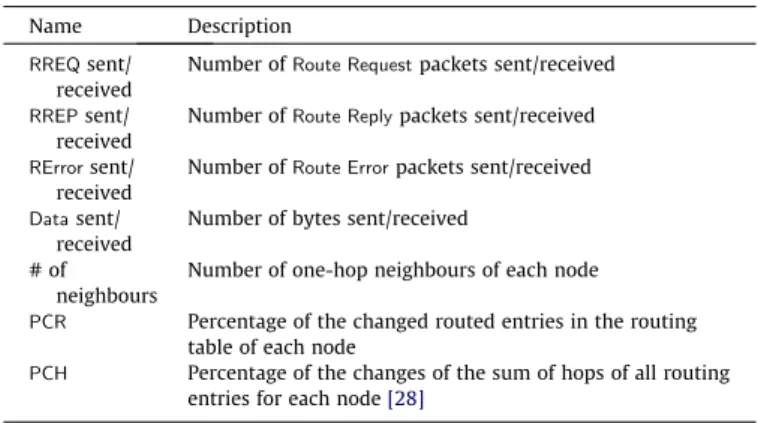
Finally, in order to discriminate ‘‘normal’’ and ‘‘attack’’ network activity we have used the features described inTable 1.
In intrusion detection, the prevalence of attacks, defined as the number of traces belonging to one class divided by the total num-ber of traces, is critical to compare the effectiveness of different proposals. The original generated dataset had 80% of attacks, which means that 80 out of 100 events in the network are hostile. Although the possibilities of being attacked in mobile networks are considerably greater than in wired networks[18], this is a pes-simistic view, as most of the events are malicious. In order to study our approach in different environments, we have modified the ori-ginal dataset by reducing the prevalence. We have run the experi-ments three times to study different scenarios with different prevalence of attacks (both in training and testing subsets): 80% (the original dataset), 4% and 1%. Although these environments
are simulated, they represent real situations where different secu-rity measures may be applied. On the one hand, a MANET can be physically accessible by everyone. In this case, several attackers can access the network and perform a huge number of attacks thus raising the prevalence of the attacks. On the other hand, if the ac-cess to the network is restricted with some authentication method or access control, fewer attackers may access it. This could be the case of a private MANET inside a corporation. In such a case, fewer number of attacks would be expected with respect to the total number of events in the network.
4.2. Two-class classification
Fig. 1shows a schematic view of the different datasets used. The original dataset contains labelled packets; labels may be normal (non-malicious behaviour) or any of the four attacks performed in the simulated network. In order to study two-class classification (normal or attack), we have modified the dataset by representing any attack with the label 1 (malicious trace) and the remainder, non-malicious, with the label 0. With this dataset our aim is to identify hostile actions in the network without identifying the spe-cific type of attacks. Summarizing, we have studied four different scenarios, one in which we have to identify the exact type of attack (multiclass classification) when the percentage of attacks in the dataset is 80%, and three scenarios where the classifiers may detect attacks without identifying the exact type of them (i.e. binary clas-sification) when the percentage of attacks in the dataset is 80%, 4% and 1%.
4.2.1. Performance comparison metrics
When comparing algorithms, it is important to use the same measure of quality. We make the comparison of the different clas-sifiers in terms of two different measures: theclassification error (CE) and theintrusion detection capability(Cid).
For a given classification algorithmf:X ! Y, whereX is the observation space andYis the set of classes, theclassification error (CE) measured over an independent setDis given by:
b
EðCEjDÞ ¼ 1 jDj
X
d2DCEðfðxdÞ;ydÞ
wherexdis the observation of example dandyd is its class and
CE(y0,y) = 0 wheny=y0and 1 otherwise.
Theintrusion detection capability(Cid) is a novel measure used in the intrusion detection domain[29]. It measures the amount of uncertainty of the input resolved once the IDS output is obtained, and takes into account the attack prevalence in the dataset besides theDetection rate(DR) and theFalse Alarm(FA) rate[30].
Table 1
Features of the dataset. Name Description RREQsent/
received
Number ofRoute Requestpackets sent/received RREPsent/
received
Number ofRoute Replypackets sent/received RErrorsent/
received
Number ofRoute Errorpackets sent/received Datasent/
received
Number of bytes sent/received # of
neighbours
Number of one-hop neighbours of each node PCR Percentage of the changed routed entries in the routing
table of each node
PCH Percentage of the changes of the sum of hops of all routing entries for each node[28]
This measure takes also into consideration the effect of an imbalanced distribution. It is defined as:
Cid¼ BDRlog BDR BDRþDRFABð1DRÞ log Bð1DRÞ Bð1DRÞ þ ð1BÞð1FAÞ ð1BÞð1FAÞ log ð1BÞð1FAÞ ð1BÞð1FAÞ þBð1FAÞ ð1 BÞFAlog ð1BÞFA ð1BÞFAþBDR
whereBis the prevalence of attacks,DRthedetection rateandFA
thefalse alarm rate, defined as:
DR¼ TP
TPþFN; FA¼ FP
TNþFP ð1Þ
whereTP,TN,FP,FN, denote the number of true (TP,TN) and false (FP,FN) positives and negatives respectively.
4.3. Multiclass classification
As previously stated, a GP execution produces programs that are intended to solve a specific problem. As the problem faced in this work is to classify instances, GP has been set up to behave as a clas-sification algorithm. A two-class clasclas-sification problem, where there are only two classes, is typically less complex than a multi-class multi-classification, where the program must multi-classify more than two-classes. In addition, using GP for two-class classification ben-efits from the use of boolean functions (see the operators inTable 3). In order to optimise the effectiveness of GP regarding the mul-ticlass classification, we have slightly modified the detection algo-rithm. In the following section we give details on this modification. 4.3.1. Modification of the GP algorithm
Algorithm 1. Return the class oftrace
output Program_0 (trace) ifoutputis 0then
return0 end if
output Program_1 (trace) ifoutputis 0then
return1 end if
output Program_2 (trace) ifoutputis 0
return2 end if
output Program_3 (trace) ifoutputis 0then
return3 end if return4
In the multiclass scenario there are five different classes: nor-mal (label 0), and each of the four different attacks (labels 1, 2, 3 and 4). In order to reduce the complexity of the problem, the five-class problem is translated into four two-class problems fol-lowing the idea presented in[31]. Thus, four different programs were employed, each one specialised in detecting one specific class from the remainder, but which are intended to be executed to-gether (thus, it is a unique intrusion detection module):
Program_0: determines whether the trace is class 0 (it returns 0) or 1, 2, 3 or 4 (it returns 1).
Program_1: determines whether the trace is class 1 (it returns 0) or 2, 3 or 4 (it returns 1).
Program_2: determines whether the trace is class 2 (it returns 0) or 3 or 4 (it returns 1).
Program_3: determines whether the trace is class 3 (it returns 0) or 4 (it returns 1).
Programs may return 0 (if they detect the specific class) or 1 (the trace belongs to any other of the remainder classes). At first, theProgram_0 is run, if it outputs a 0, a 0 is returned, otherwise the Program_1 is executed. If this outputs a 0, that means that the trace belongs to class 1, so a 1 is returned, otherwise, the Pro-gram_2 is executed, and so on (see theAlgorithm 1).
4.3.2. Performance comparison metrics
As in the multi-classification problem, the dataset is composed of traces of four different attacks, it does not make sense to talk about a single attack prevalence. Therefore, in multiclass problems theintrusion detection capability(Cid) is not an appropriate metric (as originally presented in[29]). To compare the classification algo-rithms we use thefalse alarmrate (FA), thedetection rate(DR) and theclassification error(CE). In a multiclass scenario, thedetection rate and thefalse alarm rate are computed differently from the two-class case (Eq.(1)).
More precisely these metrics are calculated using composed probabilities and given by the equations below.
DR0 ¼ Pn i¼1PðAi &IiÞ Pn i¼0 Pn j¼1PðAi&IjÞ FA0 ¼X n i¼1 Xn j¼0;j–i PðAi&IjÞ
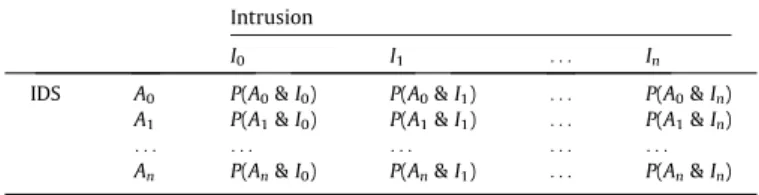
In these equations, eachP(Ai&Ij) represent the number of traces of
the classjclassified asiby the detector (thus, wheni=j, is a cor-rectly classified trace), divided by the total number of traces (n). Ta-ble 2shows a description of contingency matrix for this case. 4.4. Algorithmic technical details
Our analysis is an extension of a previous work[7], where five different classifiers were used to detect malicious activity. In that work, it was stated that the best classifier was the Support Vector Machine (SVM), which uses Lagrangian methods to minimise a reg-ularized function of the empirical classification error. In this work, we extend the comparison with a new classifier, based on Genetic Programming. In addition, we study new different simulated envi-ronments (with a lower prevalence of attacks) and use new perfor-mance comparison metrics (i.e., theCid).
In order to tune the classification models, we have performed 10-fold cross validation[32]on the training datasets, which were created with random sampling. For each of the 10 folds we selected 1/10th of the dataset for evaluation and the remaining for training. Finally, we use the selected parameters for each classification algo-rithm to train each model.
More precisely, for the MLP we tuned three parameters, i.e., the learning rate (
g
) and the number of iterations (T) used in the sto-chastic gradient descent optimisation as well as the number of hid-den units (nh). We keptnhequal to 0 and selected the appropriateg
among values that range between 0.0001 and 0.1 with step 0.1 and the appropriate T was selected among 10, 100, 500 and 1000. After selecting the appropriateg
and the appropriateT, we examined various values in order to select the appropriate nh. We selected the best among 10, 20, 40, 60, 80, 100, 120, 140, 160 Please cite this article in press as: S. Pastrana et al., Evaluation of classification algorithms for intrusion detection in MANETs, Knowl. Based Syst. (2012),and 320. For theLinearmodel we used the MLP model with no hid-den units.
For the GMM, we tuned three parameters, i.e., the threshold (h), the number of iterations (T) and the number of Gaussian Mixtures (ng). Keepingngequal to 20, we selected thehamong values that range between 0.0001 and 0.1 with range 0.1 and the most suitable Tamong 25, 100, 500 and 1000. Finally, in order to selectng, after selecting the appropriatehand the appropriateTwe selected the best value for ng among 10, 20, 40, 60, 80, 100, 120, 140, 160 and 320.
For the SVM algorithm we tuned two parameters, i.e., the stan-dard deviation (
r
) for the gaussian kernel and the regularisation parameterc which represents the trade-off between the size of the margin and the number of misclassified examples. For the selection of the appropriate combination ofr
andc, we examined various values for ther
(1, 10, 100, 1000) and thec(1, 10, 100, 1000) and selected the best.For the Genetic Programming algorithm we tuned the following parameters:
Crossover rate:Percentage of individuals on the population to be crossed. We examined any possible decimal value between 0 and 100.
Mutation rate:Percentage of individuals on the population to be mutated. We have investigated possible values between 0 and 50.
Size of the population:Number of individuals in the population. Values are restricted to be greater than 500 and lower than 1300.
Number of generations:Normally, the larger the better, but if the evolution remains stagnant, using high values may be ineffi-cient. The range of possible values given is from 60 to 200.
Tournament size:It is the number of individuals selected to per-form the tournament selection (see[21]for more information). We accept integer values between 3 and 8.
We have run 140 experiments, with 140 different configura-tions.Table 3 shows the parameters obtained that finally were used in the experiments. and the list of functions (internal nodes of the trees) used. The list of terminals, described inTable 1, corre-sponds to the set of features in the dataset. As mentioned above, the fitness function is a critical component as it defines the way the individuals must evolve to solve the problem. The experiments were performed using two different fitness functions, i.e. minimis-ing theclassification error(CE) and maximising theintrusion detec-tion capability(Cid).
Table 2
Contingency matrix showing the joint probabilities for a multiclass classifier. Columns (Ii) represent intrusion events of typei(0 denotes a normal event) and
rows (Aj) correspond to the alarms of typeigenerated by the IDS (0 denotes the
absence of an alarm).
Intrusion
I0 I1 . . . In
IDS A0 P(A0&I0) P(A0&I1) . . . P(A0&In) A1 P(A1&I0) P(A1&I1) . . . P(A1&In) . . . . An P(An&I0) P(An&I1) . . . P(An&In)
Table 3
GP parameters and operators used in the experiments. Number of generations 193 Size of population 942 Size of tournament 7 Crossover rate 13% Mutation rate 49%
Operators ADD, AND, DIV, GREATER, LEAST, MULT, OR, MAX, MIN, ROTATE_LEFT, NOT
Fig. 2.Results achieved for the original two-class dataset with an attack prevalence
of 80%.
Fig. 1.Setup of the datasets.
5. Results
SVM was the best classifier of the five studied previously (excluding GP)[7]. Therefore, the comparison regarding the two-class two-classification is made between SVM and the new two-classifier we are analysing, i.e., the one based on GP.Fig. 2shows the com-parison of SVM with the two GP individuals obtained using the ori-ginal dataset with an attack prevalence of 80%. From now on, we
denote as GP1 to the model obtained trying to maximise theCid, and GP2 the model obtained minimising the classification error (CE). GP improves the results obtained with SVM, as the classifica-tion error(CE) of both models are lower than the SVM and theCidis quite higher.
When the number of attacks in the dataset is reduced, we can see in bothFig. 3(4% of attack prevalence) andFig. 4(1% of attack prevalence) that theclassification error(CE) is lower when the GP algorithm is employed. Regarding theCid, when using the dataset with a 1% of prevalence (Fig. 4), theCidis better for both GP mod-els. The GP1 model maximises theCid, so it obviously achieves the best value (0.29 approximately). The GP2 model accomplishes the lowerclassification error(CE) in all cases. However, as we can ob-serve inFig. 3, regarding theCidthe SVM model has slightly better performance than the GP algorithm.
Regarding the multiclass dataset, as stated in the Section4.3the comparison is done in terms ofdetection rate(DR), thefalse alarm rate(FA) and theclassification error(CE).Fig. 5andTable 4show the performance results for all the classifiers studied. It can be seen that the best performance is achieved by the MultiLayer Percep-tron (MLP) and the SVM, with nearly equal performance. The GP classifier has a lower detection rate (DR), but also a lowerfalse alarm rate(FA), so theclassification error(CE) is quite high, as the multiclass dataset has a high prevalence (80%). Therefore, if the GP algorithm detects an attack, it is known with a higher certainty that this attack is actually happening, since the probability of giv-ing false alarms (FA) is one of the lowest for all the classifiers.Fig. 6
Fig. 3.Results achieved for the modified two-class dataset with an attack prevalence of 4%.
Fig. 4.Results achieved for the modified two-class dataset with an attack
prevalence of 1%.
Fig. 5.Graphical comparison of the classifiers regarding the multiclass dataset.
shows thedetection rate(DR) for all the classifiers and for each at-tack. The attack with the highest detection rate for the GP algo-rithm is theFlooding attack. It can be seen that, although GP is not a good multiclass classifier, it has better performance than other classifiers for some attacks. For instance, it detects aForging
attack better than the MLP, the Linear and Naïve Bayes classifier, and presents almost equal performance with the SVM classifier. This implies that the technique of dividing a multi-classification problem into several two-class classification problems may work under certain conditions or attacks. This is a further line to inves-tigate in the future.
6. Conclusions
Detecting malicious activities in MANETs is a complex task be-cause of the inherent features of these networks, such as the mobility of the nodes, the lack of a fixed architecture as well as the severe resource constraints. There is an urgent need to safe-guard these communication networks and to propose efficient mechanisms in order to detect malicious behaviour.
In this article we provide a comparison of the effectiveness of different classifiers that can be employed as intrusion detection algorithms in MANETs. Results show that Genetic Programming may be a good paradigm to use when the goal is just to detect an intruder, although if the objective is to indicate which is the particular attack launched then it is better to use a SVM classifier. The evaluation of the classifiers is performed considering that the intrusion detection process is completely distributed and each node of the network hosts an independent intrusion detection agent. As future work we will examine which network architecture is more efficient regarding the placement of the intrusion detection agents in the network.
Acknowledgements
This work has been partially supported by the Marie Curie IEF, Project ‘‘PPIDR: Privacy-Preserving Intrusion Detection and
Re-sponse in Wireless Communications’’, Grant No. 252323, and also by the Comunidad de Madrid and Carlos III University of Madrid, Project EVADIR CCG10-UC3M/TIC-5570.
References
[1] B.-C. Cheng, R.-Y. Tseng, A context adaptive intrusion detection system for MANET, Computer Communications 34 (2011) 310–318.
[2] F. Anjum, P. Mouchtaris, Security for Wireless Ad Hoc Networks, Wiley-Interscience, 2007.
[3] M. Al-Shurman, S.-M. Yoo, S. Park, Black-hole attack in mobile ad hoc networks, in: Proceedings of the 42nd Annual Southeast Regional Conference, ACM-SE 42, ACM, New York, NY, USA, 2004, pp. 96–97. [4] P. Ning, K. Sun, How to misuse AODV: a case study of insider attacks against
mobile ad-hoc routing protocols, Ad Hoc Networks 3 (2005) 795–819. [5] D. Djenouri, O. Mahmoudi, M. Bouamama, D. Llewellyn-Jones, M. Merabti, On
securing MANET routing protocol against control packet dropping, in: Proceedings of the International Conference on Pervasive Services, IEEE Computer Society, CA, USA, 2007, pp. 100–108.
[6] P. Yi, Y.F. Hou, Y. Zhong, S. Zhang, Z. Dai, Flooding attack and defence in ad hoc networks, Journal of Systems Engineering and Electronics 17 (2006) 410–416. [7] A. Mitrokotsa, M. Tsagkaris, C. Douligeris, Intrusion detection in mobile ad hoc networks using classification algorithms, in: Proceedings of the Seventh Annual Mediterranean Ad Hoc Networking Workshop, Springer, Palma de Mallorca, Spain, 2008, pp. 133–144.
[8] R. Bace, P. Mell, NIST Special Publication on Intrusion Detection Systems, Technical Report, National Institute of Standards and Technologies, 2001. [9] S. Sen, J.A. Clark, Intrusion Detection in Mobile Ad Hoc Networks, Springer,
2008, pp. 427–454.
[10] Y. Zhang, W. Lee, Intrusion detection in wireless ad-hoc networks, in: Proceedings of the 6th Annual International Conference on Mobile Computing and Networking, MobiCom, ACM, New York, NY, USA, 2000, pp. 275–283.
[11] Y. Zhang, W. Lee, Y. Huang, Intrusion detection techniques for mobile wireless networks, Wireless Networks 9 (2003) 545–556.
[12] Y. Huang, W. Lee, A cooperative intrusion detection system for ad hoc networks, in: Proceedings of the 1st ACM Workshop on Security of Ad hoc and Sensor Networks, SASN ’03, ACM, New York, NY, USA, 2003, pp. 135–147. [13] Y.-a. Huang, W. Lee, Attack analysis and detection for ad hoc routing protocols,
in: E. Jonsson, A. Valdes, M. Almgren (Eds.), Proceedings of the Recent Advances in Intrusion Detection, Lecture Notes in Computer Science, vol. 3224, Springer, Berlin/Heidelberg, 2004, pp. 125–145.
[14] C. Perkins, RFC 3561: Ad hoc On-Demand Distance Vector (AODV) Routing, 2003. Status: EXPERIMENTAL.
[15] O. Kachirski, R. Guha, Effective intrusion detection using multiple sensors in wireless ad hoc networks, in: Proceedings of the 36th Annual Hawaii International Conference on System Sciences, IEEE, 2003, pp. 8–16. [16] B. Sun, K. Wu, U. Pooch, Zone-based intrusion detection system for mobile ad
hoc networks, International Journal of Ad Hoc and Sensor Wireless Networks 2 (2006).
[17] M.-Y. Su, Prevention of selective black hole attacks on mobile ad hoc networks through intrusion detection systems, Computer Communications 34 (2011) 107–117.
[18] S. Sen, J.A. Clark, A grammatical evolution approach to intrusion detection on mobile ad hoc networks, in: Proceedings of the Second ACM Conference on Wireless Network Security, WiSec’09, ACM, NY, USA, 2009, pp. 95–102. [19] S. Sen, J.A. Clark, J.E. Tapiador, Power-aware intrusion detection in mobile ad
hoc networks, in: Proceeding of the Ad Hoc Networks, Lecture Notes of the Institute for Computer Sciences, Social Informatics and Telecommunications Engineering, vol. 28, Springer, Berlin/Heidelberg, 2010, pp. 224–239. [20] C. Burges, A tutorial on support vector machines for pattern recognition, Data
Mining and Knowledge Discovery 2 (1998) 121–167.
[21] J.R. Koza, Genetic Programming: On the Programming of Computers by Means of Natural Selection (Complex Adaptive Systems), The MIT Press, 1992. [22] G.S. Mark Crosbie, Applying genetic programming to intrusion detection, in:
Proceedings of the AAAI Fall Symposium on Artificial Intelligence, COAST Publications, West Lafayette, IN, 1995, pp. 1–8.
[23] A. Orfila, J.M. Estevez-Tapiador, A. Ribagorda, Evolving High-Speed, Easy-to-understand network intrusion detection rules with genetic programming, in: Proceedings of the EvoWorkshops on Applications of Evolutionary Computations, Lectures Notes in Computer Science, 5484, Springer, Berlin/ Heidelberg, 2009, pp. 93–98.
[24] G. Folino, C. Pizzuti, G. Spezzano, GP ensemble for distributed intrusion detection systems, Lecture Notes in Computer Science 3686 (2005) 54. [25] B. Kavitha, D.S. Karthikeyan, P.S. Maybell, An ensemble design of intrusion
detection system for handling uncertainty using neutrosophic logic classifier, Knowledge-Based Systems 28 (2012) 88–96.
[26] S. Pastrana, A. Orfila, A. Ribagorda, A functional framework to evade network IDS, in: Proceedings of the 44th Hawaii International Conference on System Sciences, IEEE, Koloa, Hawaii, USA, 2011, pp. 1–10.
[27] X. Zeng, R. Bagrodia, M. Gerla, GloMoSim: a library for parallel simulation of large-scale wireless networks, in: Proceedings of the 12th Workshop on Parallel and Distributed Simulations, IEEE, Banff, Alberta, Canada, 1998, pp. 154–161.
Table 4
False alarm rate (FA), detection rate (DR) and classification error (CE) incurred by each classifier using the multiclass dataset. Highlighted in bold are the best values achieved for each rate.
FA DR CE GMM 0.08 0.77 0.21 MLP 0.05 0.77 0.18 LINEAR 0.05 0.76 0.19 NAIVE 0.14 0.72 0.26 SVM 0.06 0.77 0.19 GP 0.05 0.73 0.21
Fig. 6.Detection rates of each attack by each classifier regarding the multiclass
dataset.
[28] B. Sun, Intrusion Detection in Mobile Ad Hoc Networks, Ph.D. thesis, Department of Computer Science, Texas University, 2004.
[29] G. Gu, P. Fogla, D. Dagon, W. Lee, B. Skoric´, Measuring intrusion detection capability: an information-theoretic approach, in: Proceedings of the 2006 ACM Symposium on Information, Computer and Communications Security, ACM, New York, NY, USA, 2006, pp. 90–101.
[30] J. Blasco, A. Orfila, A. Ribagorda, Improving network intrusion detection by means of domain-aware genetic programming, in: Proceedings of the 2010
International Conference on Availability, Reliability and Security, IEEE, 2010, pp. 327–332.
[31] J. Fürnkranz, Round robin classification, Journal of Machine Learning Research 2 (2002) 721–747.
[32] R. Kohavi, A study of cross-validation and bootstrap for accuracy estimation and model selection, Proceedings of the International Joint Conferences on Artificial Intelligence, vol. 2, Morgan Kaufmann Publishers Inc., San Francisco, CA, USA, 1995, pp. 1137–1145.