Available at:
http://hdl.handle.net/2078.1/171232
"Efficiency of accelerated coordinate descent
method on structured optimization problems"
Nesterov, Yurii ; Stich, Sebastian
Abstract
In this paper we prove a new complexity bound for a variant of Accelerated
Coordinate Descent Method [7]. We show that this method often outperforms
the standard Fast Gradient Methods (FGM, [3, 6]) on optimization problems with
dense data. In many important situations, the computational expenses of oracle
and method itself at each iteration of our scheme are perfectly balanced (both
depend linearly on dimensions of the problem). As application examples, we
consider unconstrained convex quadratic minimization, and the problems arising
in Smoothing Technique [6]. On some special problem instances, the provable
acceleration factor with respect to FGM can reach the square root of the number
of variables. Our theoretical conclusions are confirmed by numerical experiments.
Document type : Document de travail (Working Paper)
Référence bibliographique
Nesterov, Yurii ; Stich, Sebastian.
Efficiency of accelerated coordinate descent method on
structured optimization problems. CORE Discussion Papers ; 2016/03 (2016) 20 pages
2016/03
!
Efficiency of accelerated coordinate descent method on
structured optimization problems
Yu. Nesterov and S. Stich
February 1, 2016
!
CORE
Voie du Roman Pays 34, L1.03.01
B-1348 Louvain-la-Neuve, Belgium.
Tel (32 10) 47 43 04
Fax (32 10) 47 43 01
CORE DISCUSSION PAPER
2016/03
Efficiency of accelerated coordinate descent method on
structured optimization problems
Yu. Nesterov
1and S. Stich
2February 1, 2016
Abstract
In this paper we prove a new complexity bound for a variant of Accelerated
Coordinate Descent Method [7]. We show that this method often outperforms
the standard Fast Gradient Methods (FGM, [3, 6]) on optimization problems
with dense data. In many important situations, the computational expenses of
oracle and method itself at each iteration of our scheme are perfectly balanced
(both depend linearly on dimensions of the problem). As application examples,
we consider unconstrained convex quadratic minimization, and the problems
arising in Smoothing Technique [6]. On some special problem instances, the
provable acceleration factor with respect to FGM can reach the square root of
the number of variables. Our theoretical conclusions are confirmed by
numerical experiments.
Keywords:
Convex optimization, structural optimization, fast gradient
methods, coordinate descent methods, complexity bounds
1 Center for Operations Research and Econometrics (CORE), Catholic University of Louvain
(UCL), 34 voie du Roman Pays, 1348 Louvain-la-Neuve, Belgium.
2 CORE/ICTEAM (UCL). This research was supported by Swiss Science Foundation (SNF).
The research results presented in this paper have been supported by a grant “Action de recherche concertée ARC 04/09-315” from the “Direction de la recherche scientifique - Communauté française de Belgique”. Scientific responsibility rests with the authors.
1
Introduction
Motivation.
In the last years, coordinate descent methods attract more and more
at-tention of the Optimization Community. Its popularity is based mainly on the fact that
they can be applied to problems of a very big size. Starting from the paper [7], it
be-came possible to provide the randomized variants of these schemes with very attractive
worst-case efficiency guarantees, which take into account a very high sparsity of the data.
Consequently, the further developments of these methods were naturally related to the
needs of Big-Data machinery: parallelization, distributed computing, etc (see, for
exam-ple, [4, 5]). However, in this paper we show that the coordinate descent strategies can be
useful even for the problems of moderate-size when the data is dense.
In [7], there was proposed a variant of Fast Gradient Method [3], where the gradient
step was replaced by a step along coordinate direction (we call this method Accelerated
Co-ordinate Descent Method, ACDM for short). It was suggested to choose the corresponding
active coordinate randomly, in accordance to uniform distribution. The expected
com-plexity of this scheme for finding an
!-solution for unconstrained minimization problem is
of the order
O
!
n !1/2max
1≤i≤nL
i"
(1.1)
iterations, where
L
iis the uniform upper bound on the
ith diagonal element of the Hessian
of the objective function, and
n
is the number of variables. At the same time, in [7] it was
also mentioned that this scheme is not appropriate for Huge-Scale optimization problems
since it needs at least one full-dimensional vector operation at each iteration.
Complexity bound (1.1) was improved in [2] up to the level
O
#$
n ! n%
i=1L
i&
1/2'
(1.2)
iterations. For choosing the active coordinate, the authors suggest to use probabilities
L
i(
n%
k=1L
k)
−1,
i
= 1, . . . , n. Finally, in our paper we get the further improvement in the
complexity of ACDM, up to the level
O
!
1 !1/2 n%
i=1L
1i/2"
(1.3)
iterations. The probabilities we use now are defined as
L
1i/2(
n%
k=1L
1k/2)
−1. This is the first
time when we get the complexity estimate of ACDM, which does not depend explicitly in
the dimension of the space of variables.
Another important result of our paper consists in finding interesting applications,
where the new scheme becomes dominant. We show that in
all
unconstrained convex
optimization problems obtained by Smoothing Technique [6], our method provably
out-performs the standard Fast Gradient Methods. For some classes of problems, the gain in
the computational time reaches the square root of the dimension. This improvement is
mainly achieved due to the fact, that in many situations the computational expenses at
each iteration of our method are perfectly balanced with the computational time spent
for updating the results of matrix-vector products (both depend linearly in the dimension
of the problem). For the standard first-order methods, this is not true even if we apply
them for unconstrained minimization of convex quadratic function with dense matrix.
For the latter problem, the worst-case estimates of computational time of our method
are provably better than the estimates of unbeatable Conjugate Gradients.
1)Note also
that for problems with explicit minimax structure, it is always possible to compute good
bounds for the constants
L
i,
i
= 1
, . . . , n
(see Section 3.3).
Contents.
In Section 2, we present a new version of ACD-method for solving the
prob-lem of unconstrained minimization of strongly convex function with Lipschitz continuous
partial derivatives. The probability of choosing component
i
to be active is define as
L
1i/2!
n"
k=1L
1k/2#
−1, where
L
iis the corresponding Lipschitz constant. Our scheme,
com-plexity analysis, and efficiency estimates are nonstandard since they all are
continuous
in the convexity parameter of the objective function. In order to obtain the efficiency
estimates and the rules of the method just for differentiable convex function, we need to
pass to the limit in the corresponding expressions, tending the convexity parameter to
zero.
2)In Section 3, we present some applications, where the new method has the best known
worst-case bounds for the total computational time. In Section 3.1 we develop a
gen-eral model of the objective function, which allows to update and compute efficiently the
directional derivatives. Our key observation is that in many cases a single directional
derivative can be easily computed, often in linear time. After that, we analyze the
be-havior of the new ACDM on the problems of quadratic minimization (Section 3.2) and in
the framework of Smoothing Technique (Section 3.3)). In both cases, we show that our
method has better worst-case guarantees in computational time, as compared with the
total computational time of the standard FGM.
We conclude the paper by presenting the results of preliminary computational
exper-iments (Section 4). At our class of test problems, new ACDM always outperforms the
standard Fast Gradient Method with automatic adjustment of the Lipschitz constant for
the gradient.
Notation.
In what follows, we assume that the finite-dimensional linear vector space of
variables
E
, dim
E
=
N
, is represented as a direct product of
n
-dimensional spaces
E
(i),
dim
E
(i)=
n
i:
E
=
$
n i=1E
(i),
N
=
"
n i=1n
i.
We denote by
E
(∗i),
i
∈ {
1 :
n
}
, the corresponding dual spaces. Thus,
E
∗=
$
ni=1
E
(i)∗
. Value
1) Of course, this result does not contradict to the well known fact on optimality of conjugate gradient methods. Note that coordinate descent methods belong to another family of optimization schemes, which do notgenerate minimization sequences belonging to Krylov spaces.2)When this paper was already finished, we found a very recent paper [1], where there was analyzed a version of ACDM with the same distribution of probabilities. This version can be also used for minimizing strongly convex functions. However, it becomes inefficient as the convexity parameter goes to zero.
of linear function
s
(i)∈
E
(∗i)at point
x
(i)∈
E
(i)is denoted by
"
s
(i), x
(i)#
. We define
"
s, x
#
def=
!
ni=1
"
s
(i), x
(i)#
,
x
∈
E
, s
∈
E
∗.
We define also the
partition operators
U
i:
E
i→
E
,
i
= 1
, . . . , n
, by identity
x
=
"
x
(1), . . . , x
(n)#
=
!
ni=1
U
ix
(i),
x
(i)∈
E
(i), i
∈ {
1 :
n
}
.
If
E
=
R
N, Then the matrices
U
i
are composed by columns of the unit
N
×
N
-matrix:
I
N= (
U
1, . . . , U
n)
.
For a linear operator
A
, acting from one linear vector space
E
"to another linear vector
space
E
""∗, we define its adjoint operator by identity
"
Au, v
#
=
"
A
∗v, u
#
,
u
∈
E
", v
∈
E
"".
Clearly,
A
∗:
E
""→
E
"∗.
For all spaces
E
(i), we fix self-adjoint positive-definite operators
Bi
:
E
(i)→
E
(∗i)(notation:
B
i=
B
i∗&
0),
i
= 1
, . . . , n
. Using these operators, we can introduce in these
spaces the
scalar products
and
Euclidean norms
:
"
x
(i), y
(i)#
i def
=
"
B
ix
(i), y
(i)#
,
'
x
(i)'
2idef
=
"
B
ix
(i), x
(i)#
,
x
(i), y
(i)∈
E
(i), i
∈ {
1 :
n
}
.
Similarly, for the dual spaces, we have the following definitions:
"
s
(i), v
(i)#
∗ i def=
"
s
(i), B
i−1v
(i)#
,
'
s
(i)'
∗ i def=
"
s
(i), B
i−1s
(i)#
, s
(i), v
(i)∈
E
∗(i), i
∈ {
1 :
n
}
.
Thus, we get valid Cauchy-Schwartz inequalities:
"
s
(i), x
(i)# ≤ '
s
(i)'
∗i
· '
x
(i)'
i,
x
(i)∈
E
(i), s
(i)∈
E
∗(i), i
∈ {
1 :
n
}
.
(1.4)
In order to define the norms for the whole space
E
, we use the scaling coefficients
L
= (
L
1, . . . , L
n) (to be defined later in (2.3)), and the tolerance parameter
α
∈
[0
,
1].
For
x
= (
x
(1), . . . , x
(n))
∈
E
and
s
= (
s
(1), . . . , s
(n))
∈
E
∗denote
"
s, x
#
=
!
n i=1"
s
(i), x
(i)#
,
'
x
'
2[α]=
!
n i=1L
αi'
x
(i)'
2i,
'
s
'
2[α]∗=
!
n i=1L
−i α"
'
s
(i)'
∗i#2
.
(1.5)
Clearly, for all
x
∈
E
and
s
∈
E
∗we have
In the case
E
=
R
N, we have
!
x
!
2[α]=
"
B
αx, x
#
,
!
s
!
2[α]∗=
"
s, B
α−1s
#
, with
B
α=
n!
i=1L
αiU
iB
iU
iT,
B
α−1=
n!
i=1L
−iαU
iB
i−1U
iT.
For a differentiable function
f
(
x
),
x
∈
dom
f
⊆
E
, denote by
∇
f
(
x
)
∈
E
∗its
gradient
.
Then, its
partial derivatives
are defined as follows:
∇
if
(
x
)
def=
U
iT− ∇
f
(
x
)
∈
E
(i)∗
,
i
∈ {
1 :
n
}
.
If function
f
is convex, then for any
x
∈
dom
f
and any partial displacement
h
(i)∈
E
(i)satisfying condition
x
+
U
ih
(i)∈
dom
f
(we call it
feasible
), we have
f
(
x
+
U
ih
(i))
≥
f
(
x
) +
"∇
f
(
x
)
, U
ih
(i)#
=
f
(
x
) +
"
U
iT∇
f
(
x
)
, h
(i)#
=
f
(
x
) +
"∇
if
(
x
)
, h
(i)#
,
i
∈ {
1 :
n
}
.
(1.7)
2
Accelerated Coordinate Descent Method
Consider the following optimization problem:
min
x∈E
f
(
x
)
,
(2.1)
where function
f
is convex and continuously differentiable on
E
. We assume that this
problem is solvable and
x
∗∈
E
is its optimal solution.
Global behavior of function
f
(
·
) is described by the following characteristics.
•
Parameter of strong convexity
σ
α≥
0, such that
f
(
y
)
≥
f
(
x
) +
"∇
f
(
x
)
, y
−
x
#
+
21σ
1−α!
y
−
x
!
2[1−α],
∀
x, y
∈
E
.
(2.2)
•
Lipschitz constants
L
ifor partial derivatives
:
!∇
if
(
x
+
U
ih
(i))
− ∇
if
(
x
)
!
∗i≤
L
i!
h
(i)!
i,
∀
x
∈
E
, h
(i)∈
E
(i), i
∈ {
1 :
n
}
.
(2.3)
These inequalities are equivalent to the following conditions:
f
(
x
+
U
ih
(i))
≤
f
(
x
) +
"∇
if
(
x
)
, h
(i)#
+
12L
i!
h
(i)!
2i,
∀
x
∈
E
, h
(i)∈
E
(i), i
∈ {
1 :
n
}
.
(2.4)
For the sake of simplicity, we assume that parameters
σ
αand
L
def= (
L
1, . . . , L
n) are known.
Let us define now the
partial gradient step
at point
x
∈
E
along the active coordinate
i
∈ {
1 :
n
}
:
h
(i)(
x
)
def=
−
B
−1In view of inequality (2.4), for any stepsize
τ
∈
R
, we have
f
(
x
+
τ U
ih
(i)(
x
))
−
f
(
x
)
≤
τ
$∇
if
(
x
)
, h
(i)(
x
)
&
+
τ 2 2L
i'
h
(i)(
x
)
'
2i=
−
τ
(1
−
12τ L
i)(
'∇
if
(
x
)
'
∗i)
2.
(2.6)
Finally, we need to define a random generator
j
=
R
β(
L
),
β
∈
[0
,
1], which generates
random numbers
j
∈ {
1 :
n
}
with the following probabilities:
π
β[
i
]
≡
Prob (
j
=
i
)
def=
S1βL
βi,
i
∈ {
1 :
n
}
,
(2.7)
where
S
β=
n!
i=1L
βi.
For solving the problem (2.1), consider the following method.
Method
ACDM
α(
x
0)
1
.
Define
v
0=
x
0∈
E
,
A
0= 0,
B
0= 1, and
β
=
α2.
2
.
For
t
≥
0, iterate:
1) Choose active coordinate
i
t=
R
β(
L
).
2) Find parameter
a
t+1>
0 from equation
a
2t+1S
β2=
A
t+1B
t+1,
where
A
t+1=
A
t+
a
t+1and
B
t+1=
B
t+
σ
1−αa
t+1.
3) Define
α
t=
Aatt+1+1,
β
t=
σ1−Bαt+1at+1, and
y
t=
(1−αt)x1t−+ααttβ(1t−βt)vt.
4) Compute
∇
itf
(
y
t). Update
x
t+1=
y
t+
L1itU
ith
(it)(
y
t),
and
v
t+1= (1
−
β
t)
v
t+
β
ty
t+
L1−αat+1 it Bt+1πβ[it]U
ith
(it)(
y
t).
(2.8)
Denote
w
t= (1
−
β
t)
v
t+
β
ty
t. Then
y
t=
(11−−ααtt)βxtt+
α1t−(1α−tββtt)·
wt−1−ββttyt=
(1−α1t−)xαtt+βtαtwt−
1α−tβαttyβtt.
Thus, in method (2.8) we have the following representation:
y
t= (1
−
α
t)
x
t+
α
tw
t.
(2.9)
Method (2.8) generates random output, which depends on particular implementation
of the collection of i.i.d.-variables
I
t=
{
i
0, . . . , i
t}
(define
I
−1=
∅
). In what follows,
notation
E
It(
·
) denotes the expectation of corresponding random variables.
Theorem 1
Let sequences
{
x
t}
t≥0and
{
v
t}
t≥0be generated by method (2.8). Then, for
any
t
≥
0
we have
2
A
tE
It−1(
f
(
x
t)
−
f
(
x
∗)) +
B
tE
It−1(
#
v
t−
x
∗#
2[1−α])
≤ #
x
0−
x
∗#
2[1−α],
(2.10)
where
A
t≥
4σ11−α!
(1 +
γ
)
t−
(1
−
γ
)
t"2
≥
4S12 βt
2,
B
t≥
14!
(1 +
γ
)
t+ (1
−
γ
)
t"2
,
(2.11)
and
γ
=
σ 1/2 1−α 2Sα/2.
Proof:
Denote
r
2 t=
#
v
t−
x
∗#
2[1−α]. Then
#
v
t+1−
x
∗#
2[1−α]=
#
i$=itL
i1−α#
w
t(i)−
x
(∗i)#
2 i+
L
1it−α$
$
$
$
w
t(it)−
x
(it) ∗+
at+1h (it)(yt) L1it−αBt+1πβ[it]$
$
$
$
2 it=
#
w
t−
x
∗#
21−α−
2at+1 Bt+1πβ[it]%∇
itf
(
y
t)
, w
(it) t−
x
(it) ∗'
+
a 2 t+1 L1it−αB2 t+1πβ2[it]%
#∇
itf
(
y
t)
#
∗it&2
.
Since
#
w
t−
x
∗#
12−α≤
(1
−
β
t)
r
t2+
β
t#
y
t−
x
∗#
21−α, we can continue as folows:
B
t+1r
2t+1 (2.6)≤
B
tr
t2+
β
tB
t+1#
y
t−
x
∗#
21−α−
2πaβt[+1it]%∇
itf
(
y
t)
, w
(it) t−
x
(it) ∗'
+
2a 2 t+1Lαit Bt+1πβ2[it](
f
(
y
t)
−
f
(
y
t+
1 LitU
ith
(it)(
y
t))
(2.7)=
B
tr
t2+
β
tB
t+1#
y
t−
x
∗#
21−α−
2πaβt[+1it]%∇
itf
(
y
t)
, w
(it) t−
x
(it) ∗'
+2
a2t+1 Bt+1S
2 β(
f
(
y
t)
−
f
(
y
t+
L1itU
ith
(it)(
y
t))
.
Note that
E
itf
(
x
t+1) = n#
i=1π
β[
i
]
f
(
y
t+
L1iU
ih
(i)(
y
t)). Therefore, taking expectation of the
above inequality in random variable
i
t, we obtain
E
it(
B
t+1r
t2+1)
≤
B
tr
2t+
a
t+1σ
1−α#
y
t−
x
∗#
21−α+ 2
a
t+1%∇
f
(
y
t)
, x
∗−
w
t'
+2
a2t+1 Bt+1S
2 β(
f
(
y
t)
−
E
it(
f
(
x
t+1)))
.
(2.12)
Since
w
t (2.9)=
y
t+
1−ααtt(
y
t−
x
t), we obtain
a
t+1%∇
f
(
y
t)
, x
∗−
w
t'
=
a
t+1%∇
f
(
y
t)
, x
∗−
y
t+
1−αtαt(
x
t−
y
t)
'
(2.2)≤
a
t+1(
f
(
x
∗)
−
f
(
y
t))
−
12a
t+1σ
1−α#
y
t−
x
∗#
21−α+
a
t+11−αtαt(
f
(
x
t)
−
f
(
y
t))
(2.8)2=
a
t+1f
(
x
∗)
−
A
t+1f
(
y
t) +
A
tf
(
x
t)
−
12a
t+1σ
1−α#
y
t−
x
∗#
21−α.
Substituting this inequality in (2.12), we obtain
E
it(B
t+1r
t2+1)
≤
B
tr
2t+ 2A
t(f(x
t)
−
f
(x
∗))
−
2A
t+1(E
it(f
(x
t+1)
−
f(x
∗)).
It remains to take the expectation in
I
t−1and sum up all previous inequalities. We obtain
2A
tE
It−1(f
(x
t)
−
f(x
∗)) +
B
tE
It−1(r
2
t
)
≤
r
02=
#
x
0−
x
∗#2[1−α].
Let us estimate now the growth of coefficients
A
tand
B
t. Note that
B
t= 1 +
σ
1−αA
t.
Therefore, equation for finding parameter
a
t+1in method (2.8) looks as follows:
(A
t+1−
A
t)
2S
β2=
A
t+1(1 +
σ
1−αA
t+1).
Denote
C
t=
σ
11/−2αA
1t/2,
t
≥
0. Then
σ
1−−1αC
t2+1(1 +
C
t2+1) =
σ
1−−2αS
β2(C
t2+1−
C
t2)
2≤
4σ
1−−2αS
β2(C
t+1−
C
t)
2C
t2+1.
Thus,
C
t+1−
C
t≥
γ(1 +
C
t2+1)
1/2≥
C
t+
γ(1 +
C
t2)
1/2with
γ
=
σ11/−2α 2Sβ. Now, by induction
we can easily check that
C
t≥
12!
(1 +
γ
)
t−
(1
−
γ
)
t"
≥
γt
for
t
≥
0. Indeed, in this case,
1 +
C
2 t≥
1 +
14(1 +
γ)
2t+
14(1
−
γ)
2t−
12(1
−
γ
2)
t≥
14!
(1 +
γ)
t+ (1
−
γ
)
t"
2.
Hence,
C
t+1≥
12!
(1 +
γ
)
t−
(1
−
γ)
t"
+
γ2!
(1 +
γ)
t+ (1
−
γ
)
t"
=
12!
(1 +
γ
)
t+1+ (1
−
γ
)
t+1"
.
Thus,
A
t≥
4σ11−α!
(1 +
γ)
t−
(1
−
γ
)
t"
2≥
4S12 βt
2, and
B
t= 1 +
σ
1−αA
t≥
1 +
14!
(1 +
γ)
t−
(1
−
γ
)
t"
2≥
14!
(1 +
γ
)
t+ (1
−
γ)
t"
2.
!
Note that method (2.8) and its efficiency bounds (2.10), (2.11) are continuous in the
convexity parameter
σ
1−α. As
σ
1−α→
0, we get a monotone decrease of values
B
tto one,
and values
A
tgo to their lower bounds
t2
4S2 α/2
.
Remark 1
The first coordinate descent version of method (2.8) with
α
= 0
(uniform
distribution) was suggested in [7]. In [2], this method was extended onto arbitrary values
of
α
∈
[0,
1]
. However, in [2] the authors used another random strategies (
π
i=
L
αi/S
α).
As a result, they get weaker complexity bounds. Indeed, in order to solve problem (2.1)
with accuracy
%
, they need
O
#
√ nSα σ11−/2αln
1 %$
iterations (see Theorem 4 in [2]). Our method
requires
O
#
Sα/2 σ11−/2αln
1 %$
iterations. It is easy to see that we always have
√
nS
α≥
S
α/2,
and sometimes the gain can reach a factor of order
√
n
. We give the corresponding
3
Examples of applications
3.1
Favorable structure of objective function
Let us compare now the complexity bounds of the Accelerated Coordinate Descent Method
(2.8) with complexity bounds of the standard Fast Gradient Methods (e.g. [6]). For the
sake of simplicity, we assume that in problem (2.1) we have dim
E
(i)= 1,
i
∈ {
1 :
n
}
.
Thus, dim
E
=
N
≡
n. Moreover, let us assume that the objective function in (2.1) is
twice continuously differentiable. Therefore,
L
i(f
) = sup
x∈E#∇
2
f
(x)e
i
, e
i%
,
x
∈
E, i
∈ {
1 :
n
}
,
(3.1)
where
e
iis the
ith coordinate vector in
E
.
Let us define also the Lipschitz constant for the gradient of objective function in (2.1):
L(f) = sup
x∈E "
max
h"≤1#∇
2
f
(x)h, h
%
.
(3.2)
Assuming that
&
e
i& ≤
1 for all
i
= 1, . . . , n, we clearly have
L
i(f
)
≤
L(f
),
i
∈ {
1 :
n
}
.
For our comparison, let us choose
α
= 1. Then all distances in
E
≡
R
nare measured
in the standard Euclidean norm, which does not depend on the Lipschitz constants for
the derivatives. For the sake of notation, denote
& · & ≡ & · &[0]
. Denote
R
=
&
x0
−
x
∗&
and
let us assume that
σ
0= 0 (no strong convexity).
In this situation, fast gradient methods solve problem (2.1) up to accuracy
#
in
O
!
I
F GM def=
L1/2(f)
!1/2
R
"
iterations (e.g.
[8]).
At each iteration, they need to update
n-dimensional vectors and to call oracle (a constant number of times). Denoting the
corresponding computational expenses by
T
F GM, we get the following bound for total
computational cost:
C
F GM=
I
F GM·
T
F GM=
L1/2(f)
!1/2
R
·
T
F GM.
Similarly, in view of Theorem 1, for solving problem (2.1) up to accuracy
#, method (2.8)
needs
O
!
I
ACDM def=
S!11//22R
"
iterations. Thus, its total computational cost is
C
ACDM=
I
ACDM·
T
ACDM=
S1/2
!1/2
R
·
T
ACDM.
Note that
S
1/2≤
nL
1/2(f). Therefore, in order to ensure
C
ACDM≤
C
F GM, we need to
find problems, for which
T
ACDM≤
1nT
F GM.
Let the objective function
f
in problem (2.1) has the following structure:
f
(x) =
F
(Ax, x),
(3.3)
where
F
(s, x) :
R
m+n→
R
is a convex differentiable function, and
A
is an
m
×
n-matrix.
Our main structural assumption on function
F
is that the complexity
T
Fof its first-order
oracle is linear:
This time is required for computing the function value
F
(
s, x
) and the gradient
∇
F
(
s, x
) = (
∇
sF
(
s, x
)
,
∇
xF
(
s, x
))
∈
R
m×
R
n.
Note that
∇
f
(
x
) =
∇
xF
(
Ax, x
) +
A
T∇
sF
(
Ax, x
). Let us estimate now the complexity of
one iteration of our methods, assuming that matrix
A
is dense and
m
≥
O
(
n
)
.
(3.5)
For Fast Gradient Method, the most expensive computation at each iteration is the call
of oracle. In accordance of our assumptions, computation of the function value and the
gradient needs
O
(
mn
) arithmetic operations. All other costs (update of
n
-dimensional
vectors, computation of scalar products, etc.) need
O
(
m
+
n
) operations. Thus, we
conclude that
T
F GM=
O
(
mn
)
.
(3.6)
For ACD-method (2.8), at each iteration we need to know only the value of directional
derivative
∇
itf
(
y
t). If the vector
Ay
tis already computed, this needs
O
(
m
+
n
) operations.
Therefore, during the process (2.8) we need to
update recursively
these vectors. For this,
we need to update also the products
Ax
t,
Av
t, and
Aw
t. These operations need just
computation of convex combinations of some already computed vectors with the cost
O
(
n
). Only two operations for computing
Ax
t+1and
Av
t+1need addition of
i
tth column
of matrix
A
with some factors, and their cost is
O
(
m
). Thus, we conclude that in our
case
T
ACDM=
O
(
m
+
n
)
(3.5)
≤
n1T
F GM.
(3.7)
Hence, for all optimization problem (2.1) with above structure we have
C
ACDM≤
C
F GM.
In the next two parts of this section we give examples of objective functions, for which
ACD-method (2.8) can outperform the standard schemes by a dimensionally dependent
factor. For these examples, we can guarantee that
L
i(
f
)
<< L
(
f
),
i
∈ {
1 :
n
}
.
3.2
Unconstrained minimization of quadratic function
Let
A
∈
R
n×nbe a symmetric positive-definite matrix, and
F
(
s, x
) =
12
&
s, x
' − &
b, x
'
.
Then, all structural assumptions of Section 3.1 are satisfied, and we conclude that for
problem
min
x∈Rn
[
f
(
x
) =
1
2
&
Ax, x
' − &
b, x
'
]
(3.8)
we have
C
ACDM≤
C
F GM.
Let us assume now that matrix
A
has positive elements, which have same order of
magnitude:
0
< κ
1≤
A
(i,j)≤
κ
2,
i, j
∈ {
1 :
n
}
,
(3.9)
and
κ
2≤
O
(
κ
1). Then,
S
1/2≤
nκ
12/2.
(3.10)
On the other hand,
where 1
n∈
R
nis the vector of all ones. This implies that
S
1/2≤
!
nκ2κ1
·
L
1/2(
f
)
.
In other words, assumption (3.9) implies
C
ACDM≤
O
"
1 n1/2#
C
F GM.
3.3
Smoothing Technique
Smoothing technique [6] can be applied to objective functions with sufficiently simple dual
representation:
f
(
x
) = max
u∈Q
{#
Ax, u
$ −
φ
(
u
)
}
,
(3.12)
where
Q
⊂
R
mis a closed convex bounded set, and function
φ
is convex on
Q
. Let us
measure distances in
R
mby some norm
' · '
X. We assume that
'
e
i'
X≤
1
,
i
= 1
, . . . , n,
(3.13)
where
e
iis
i
th coordinate vector in
R
n.
Function
f
defined by (3.12) is typically nonsmooth. However, optimization problem
in (3.12) must be simple enough since we assume it solvable in a closed form (otherwise,
the value
f
(
x
) is not computable). In this situation, it is often possible to approximate
f
by a convex function with Lipschitz continuous gradient.
Indeed, let prox-function
d
(
u
) be differentiable and strongly convex on
Q
in some norm
' · '
Uwith convexity parameter one:
#∇
d
(
u
1)
− ∇
d
(
u
2)
, u
1−
u
2$ ≥ '
u
1−
u
2'
2U,
u
1, u
2∈
U.
(3.14)
Assume that
d
(
u
)
≥
0 for all
u
∈
Q
and
d
(
u
0) = 0 at some prox-centeru
0∈
Q
.
Denote
f
µ(
x
) = max
u∈Q
{#
Ax, u
$ −
φ
(
u
)
−
µd
(
u
)
}
,
(3.15)
where
µ >
0 is the smoothness parameter. Then
f
µapproximates
f
with accuracy
O
(
µ
),
and its gradient is Lipschitz continuous with constant
L
(
f
µ) =
µ1'
A
'
2, where
'
A
'
= max
x,u
{#
Ax, u
$
:
'
x
'
X≤
1
,
'
u
'
U≤
1
}
.
Note that
'
A
'
(3≥
.13)max
u
{#
Ae
i, u
$
:
'
u
'
U}
=
'
Ae
i'
∗
U
for all
i
= 1
, . . . , n
. Therefore,
n$
i=1
'
Ae
i'
∗U≤
n
'
A
'
.
(3.16)
Recall that the gradient of function
f
µis defined as
∇
f
µ(
x
) =
A
Tu
µ(
x
)
,
(3.17)
Let us justify now the bounds for
L
i(
f
µ),
i
∈ {
1 :
n
}
. Consider two points
x
1and
x
2=
x
1+
h
, where
h
is an arbitrary direction in
R
n. Denote
u
i=
u
µ(
x
i),
i
= 1
,
2. From
the optimality conditions for optimization problem in (3.15), we have
"
Ax
1− ∇
φ
(
u
1)
−
µ
∇
d
(
u
1)
, u
2−
u
1% ≤
0
,
"
Ax
2− ∇
φ
(
u
2)
−
µ
∇
d
(
u
2)
, u
1−
u
2% ≤
0
.
Adding these two inequalities, we get
µ
'
u
1−
u
2'
2U (3.14)≤
µ
"∇
d
(
u
1)
− ∇
d
(
u
2)
, u
1−
u
2%
≤
"
Ax
1−
Ax
2−
(
∇
φ
(
u
1)
− ∇
φ
(
u
2))
, u
1−
u
2%
≤
"
Ah, u
2−
u
1%
.
Taking now
h
=
τ e
i, where
e
iis the
i
th coordinate vector in
R
n, we obtain:
τ
(
∇
if
µ(
x
2)
− ∇
if
µ(
x
1))
(3.17)=
τ
"
e
i, A
T(
u
2−
u
1)
% ≥
µ
'
u
1−
u
2'
2U≥
(!Aei!µ∗ U)2"
Ae
i, u
1−
u
2%
2=
µ (!Aei!∗ U)2(
∇
if
µ(x
1)
− ∇
if
µ(x
2))
2.
Thus, we can take
L
i(
f
µ) =
µ1(
'
Ae
i'
∗U)
2,
i
∈ {
1 :
n
}
. Consequently,
n!
i=1L
1i/2(
f
µ)
(3.16)≤
nL
1/2(
f
µ)
.
(3.18)
If the set
Q
and function
φ
in (3.15) are simple, then
f
µsatisfies all conditions of
Section 3.1 (in particular, with known product
Ax
, vector
u
µ(
x
) is computable in
O
(
m
)
operations). Therefore, for its unconstrained minimization, efficiency estimates of
ACD-method (2.8) are always not worse than the bounds of any Fast Gradient Method.
Let us present an example, where ACD-method (2.8) is much better than FGM (since
L
i(f
µ)<< L
(
f
µ),i
∈ {
1 :
n
}
). Assume that all elements of matrix
A
are positive and
have the same order of magnitude:
0
< κ
1≤
A
(i,j)≤
κ
2,
i
∈ {
1 :
m
}
, j
∈ {
1 :
n
}
,
(3.19)
and
κ
2≤
O
(
κ
1). Then, clearly
L
i(
f
µ)
≤
mµκ
22. Therefore,
S
1/2≤
nκ
2"
m µ
#
1/2.
On the other hand,
L
(
f
µ) =
1µλ
max(
A
TA
)
≥
1µκ
21mλ
max(1
n1
Tn) =
µ1κ
21mn.
Thus, comparing the bounds
C
ACDM=
O
"
m
·
S1/2R !1/2#
≤
O
"
nm
3/2·
R µ1/2!1/2#
,
and
C
F GM=
O
"
mn
·
L1/!21(/fµ2)R#
≥
O
"
n
3/2m
3/2·
µ1/R2!1/2#
,
4
Preliminary computational experiments
In our computational experiments, we solved the following problem with randomly
gen-erated data:
min
x∈RM!
fµ
(
x
) =
N"
i=1φµ
#
!
ai, x
" −
c
(i)$
%
,
(4.1)
where
φµ
(
τ
) =
&
τ2 2µ,
if
|
τ
| ≤
µ
,
|
τ
| −
1 2µ,
if
τ > µ
.
Coefficients of dense vectors
a
i,
i
= 1
, . . . , N
, are uniformly distributed in the interval
[1
,
2]. Coefficients of vector
c
= (
c
(1), . . . , c
(N))
T∈
R
Nare chosen as
c
(i)=
!
ai,
y
¯
"
, where
the entries of vector ¯
y
∈
R
Mare uniformly distributed in the interval [
−
1
,
1].
Thus, the optimal value of function
f
µis zero. Therefore, for all methods we use the
termination criterion
fµ
(
x
)
≤
#
with
#
= 10
−2. We choose also
µ
=
#
.
Among numerous variants of Fast Gradient Methods, we choose the method with
the maximal adaptivity to the unknown Lipschitz constant for the gradient of objective
function. Its scheme is as follows.
FGM:
Choose
x
0∈
E
and
L
0>
0. Set
v
0=
x
0.
For
t
≥
0 iterate:
1) Find the smallest
i
t≥
0 such that for
a
t,it=
1 2it+1Lt'
1 +
(
1 + 2
it+2L
tA
t)
,
τ
t,it=
at,it at,it+At,
yt,i
t= (1
−
τt,i
t)
xt
+
τt,i
tvt
, and
xt
+1,it=
yt,i
t−
1
2itLt
∇
f
(
yt,i
t)
we have
f
(
y
t,it)
−
f
(
x
t+1,it)
≥
1
2it+1Lt
(∇
f
(
y
t,it)
(
2.
2) Set
x
t+1=
x
t+1,it,
v
t+1=
v
t−
a
t,it∇
f
(
y
t,it),
A
t+1=
A
t+
a
t,it, and
L
t+1= 2
it−1L
t.
(4.2)
On the contrary, for Accelerated Coordinate Descent Method (2.8) with parameters
α
= 1 and
σ
0= 0, we choose the fixed worst-case estimates for the coordinate Lipschitz
constants
L
i(
f
µ) =
µ1(
A
Te
i(2,
i
= 1
, . . . , M,
(4.3)
where
A
= (
a
1, . . . , a
N) and the norm is standard Euclidean. Since we take
β
≡
α/
2 =
12,
we get the following distribution of probabilities:
π
1/2[
i
] =
#A Te i# N ! k=1# ATek#,
i
= 1
, . . . , M.
(4.4)
At the same time,
S
2 1/2=
µ1!
M"
i=1!
A
Te
i!
#
2.
In all our experiments we use the staring point
x
0= 0
∈
R
M. In the method below,
notation
Ax
(or,
Ay
,
Av
) is used for the value of the linear operator in (4.1), computed
at point
x
∈
R
M:
Ax
≡
A
Tx
−
c
∈
R
N.
The scheme of ACD-method for problem (4.1) looks as follows.
ACDM for (4.1):
Define
v
0=
x
0= 0
∈
R
M,
Av
0=
Ax
0=
−
c
, and
A
0= 0.
For
t
≥
0, iterate:
1) Find parameter
a
t+1>
0 from equation
a
2t+1S
β2=
A
t+1+
a
t+1.
Set
A
t+1=
A
t+
a
t+1, and
τ
t=
Aatt+1+1.
2) Define
y
t= (1
−
τ
t)
x
t+
τ
tv
t. Update
Ay
t= (1
−
τ
t)
Ax
t+
τ
tAv
t.
3) Choose
i
tin accordance to distribution (4.4) and compute
∇
itf
(
y
t).4) Update
x
t+1=
y
t−
L1it∇
itf
(
y
t)
e
it,
Ax
t+1=
Ay
t−
1 Lit∇
itf
(
y
t)
A
Te
it,
v
t+1=
v
t−
a
t+1∇
itf
(
y
t)e
it, and
Av
t+1=
Av
t−
at+1 π1/2[it]∇
itf
(
y
t)A
Te
it.
(4.5)
Note that the computational cost of all operations in the above method, including the
computation of directional derivative
∇
if
(
y
t) =
'
A
Te
i,
∇
f
(
y
t)
(
, is
linear
in the dimensions
of problem (4.1).
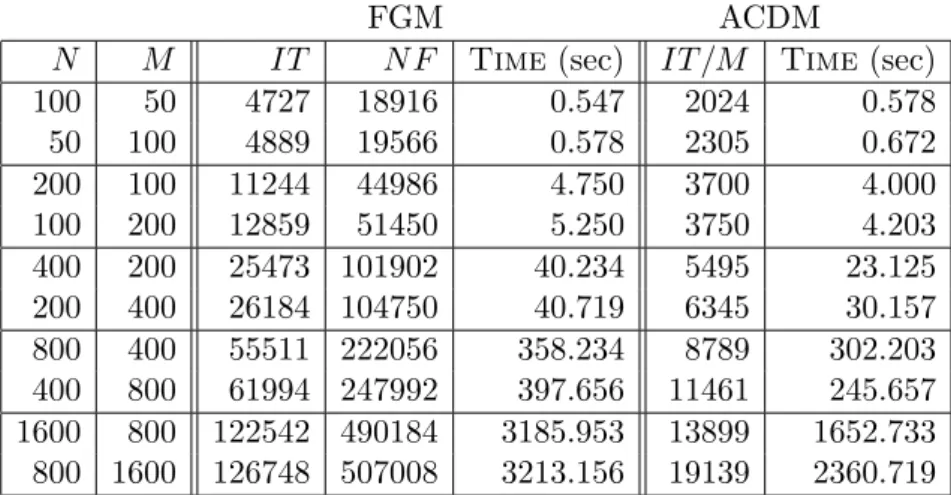
than ACDM. Nevertheless, the computational results are as follows.
FGM
ACDM
N
M
IT
N F
Time
(sec)
IT /M
Time
(sec)
100
50
4727
18916
0
.
547
2024
0
.
578
50
100
4889
19566
0
.
578
2305
0
.
672
200
100
11244
44986
4
.
750
3700
4
.
000
100
200
12859
51450
5
.
250
3750
4
.
203
400
200
25473 101902
40
.
234
5495
23
.
125
200
400
26184 104750
40
.
719
6345
30
.
157
800
400
55511 222056
358
.
234
8789
302
.
203
400
800
61994 247992
397
.
656
11461
245
.
657
1600
800
122542 490184
3185
.
953
13899
1652
.
733
800 1600
126748 507008
3213
.
156
19139
2360
.
719
Table 1. Performance of FGM and ACDM on problem (4.1).
In this table, first two columns display the dimensions of problem (4.1). In all our
tests, the matrix
A
is dense. Therefore, for the largest problem we have more than one
million nonzero coefficients. Columns
IT
and
N F
show the number of iterations and
number of function evaluation of FGM. Column
IT /M
shows the number of blocks of
M
iterations in method ACDM. Finally, the column
Time
displays the total computational
time in seconds.
For us, the main characteristics of complexity of the problem for numerical scheme
is the total computational time. As we can see, ACDM always outperforms FGM. Its
domination is less impressive with respect to the theoretical prediction. However, this
can be explained by the ability of method (4.2) to use much smaller estimate of the
constant
L
(
f
µ) than the worst-case theoretical value.
To conclude, we can see that potentially, ACDM is a promising computational scheme,
which has good chances to outperform FGM on many important real-life problems. At
this moment, as compared with FGM, ACDM has four main drawbacks:
•
absence of version with separable constraints;
•
impossibility to adjust the worst-case estimates for
L
i(
f
) during the minimization
process;
•
absence of a reliable stopping criterion;
•
impossibility to generate good primal-dual solutions.
References
[1] Z. Allen-Zhu, Z. Qu, P. Richt´
arik, and Y. Yuan. Even faster accelerated coordinate
descent using non-uniform sampling. arXiv:1512.09103v2 [math.OC] 13 Jan 2016.
[2] Y.T. Lee and A. Sidford. Efficient accelerated coordinate descent methods and
fastest algorithms for solving linear systems. arXiv: 1305.1922v1, 8 May, 2013.
[3] Yu. Nesterov. A method for unconstrained convex minimization problem with the
rate of convergence
O
(
k12)
.
Doklady AN SSSR
(translated as Soviet Math. Docl.),
1983, v.269, No. 3, 543-547
[4] P. Richtarik and M. Taka˜c. Parallel coordinate descent methods for big data
opti-mization.
Mathematical Programming
, 1-51 (2012)
[5] P. Richtarik and M. Taka˜c. Distributed coordinate descent method for learning with
big data. arXiv: 1310.2059 (2012)
[6] Yu. Nesterov. Smooth minimization of non-smooth functions,
Mathematical
Pro-gramming
(A),
103
(1), 127-152 (2005).
[7] Yu.Nesterov. Efficiency of coordinate-descent methods on huge-scale optimization
problems.
SIOPT
,
22
(2), 341-362 (2012).
[8] Yu. Nesterov. Introductory lectures on Convex Optimization. The basic course.
Kluwer
, Boston (2004).
Recent titles
CORE Discussion Papers
2015/24 Wing Man Wynne LAM. Switching costs in two-sided markets.
2015/25 Philippe DE DONDER, Marie-Louise LEROUX. The political choice of social long term care transfers when family gives time and money.
2015/26 Pierre PESTIEAU and Gregory PONTHIERE. Long-term care and births timing.
2015/27 Pierre PESTIEAU and Gregory PONTHIERE. Longevitiy variations and the welfare State. 2015/28 Mattéo GODIN and Jean HINDRIKS. A review of critical issues on tax design and tax
administration in a global economy and developing countries
2015/29 Michel MOUCHART, Guillaume WUNSCH and Federica RUSSO. The issue of control in multivariate systems, A contribution of structural modelling.
2015/30 Jean J. GABSZEWICZ, Marco A. MARINI and Ornella TAROLA. Alliance formation in a vertically differentiated market.
2015/31 Jens Leth HOUGAARD, Juan D. MORENO-TERNERO, Mich TVEDE and Lars Peter ØSTERDAL. Sharing the proceeds from a hierarchical venture.
2015/32 Arnaud DUFAYS and Jeroen V.K. ROMBOUTS. Spare change-point time series models. 2015/33 Wing Man Wynne LAM. Status in organizations.
2015/34 Wing Man Wynne LAM. Competiton in the market for flexible resources : an application to cloud computing.
2015/35 Yurii NESTEROV and Vladimir SHIKHMAN. Computation of Fisher-Gale equilibrium by auction.
2015/36 Maurice QUEYRANNE and Laurence A. WOLSEY. Thight MIP formulations for bounded up/down tiems and interval-dependent start-ups.
2015/37 Paul BELLEFLAMME and Dimitri PAOLINI. Strategic promotion and release decisions for cultural goods.
2015/38 Nguyen Thang DAO and Julio DAVILA. Gender inequality, technologial progress, and the demographic transition.
2015/39 Thomas DEMUYNCK, Bram DE ROCK and Victor GINSBURGH. The transfer paradox in welfare space.
2015/40 Pierre DEHEZ. On Harsanyi dividends and asymmetric values.
2015/41 Laurence A. WOLSEY. Uncapacitated lot-sizing with stock upper bounds, stock fixed costs, stock overloads and backlogging: A tight formulation.
2015/42 Paul BELLEFLAMME. Monopoly price discrimination and privacy: the hidden cost of hiding. 2015/43 Pierre PESTIEAU and Gregory PONTHIERE. Optimal fertility under age-dependent labor
productivity.
2015/44 Jacques DREZE. Subjective expected utility with state-dependent but action/observation-independent preferences
2015/45 Joniada MILLA, Ernesto SAN MARTÍN and Sébastien VAN BELLEGEM. Higher education value added using multiple outcomes.
2015/46 Helmuth CREMER, Pierre PESTIEAU and Kerstin ROEDER. Social long-term care insurance with two-sided altruism.
2015/47 Per J. AGRELL and Humberto BREA-SOLÍS. Stationarity of heterogeneity in production technology using latent class modelling.
2015/48 Mattéo GODIN et Jean HINDRIKS. Disparités et convergence économiques : Ensemble mais différents.
Recent titles
CORE Discussion Papers
–
continued
2015/50 Benoît DECERF. A new index combining the absolute and relative aspects of income poverty: Theory and application.
2015/51 Pierre COPÉE, Axel GAUTIER and Mélanie LEFÈVRE. Promoting competition at the digital age with an application to Belgium.
2015/52 Mathieu LEFEBVRE, Sergio PERELMAN and Pierre PESTIEAU. Productivity and performance in the public sector.
2015/53 Oswaldo GRESSANI. Endogeneous quantal response equilibrium for normal form games. 2015/54 Wouter VERGOTE. One-to-one matching problems with location restrictions.
2015/55 Marie-Louise LEROUX, Dario MALDONADO and Pierre PESTIEAU. Compliance, informality and contributive pensions.
2015/56 Michel MOUCHART and Renzo ORSI. Building a structural model : Parameterization and structurality.
2016/01 Luc BAUWENS, Manuela BRAIONE, Giuseppe STORTI. A dynamic component model for forecasting high-dimensional realized covariance matrices.
2016/02 Manuela BRAIONE. A time-varying long run HEAVY model.
2016/03 Yurii NESTEROV and Sebastian STICH. Efficiency of accelerated coordinate descent method on structured optimization problems.
Books
W. GAERTNER and E. SCHOKKAERT (2012), Empirical Social Choice. Cambridge University Press. L. BAUWENS, Ch. HAFNER and S. LAURENT (2012), Handbook of Volatility Models and their
Applications. Wiley.
J-C. PRAGER and J. THISSE (2012), Economic Geography and the Unequal Development of Regions. Routledge.
M. FLEURBAEY and F. MANIQUET (2012), Equality of Opportunity: The Economics of Responsibility.
World Scientific.
J. HINDRIKS (2012), Gestion publique. De Boeck.
M. FUJITA and J.F. THISSE (2013), Economics of Agglomeration: Cities, Industrial Location, and Globalization. (2ndedition). Cambridge University Press.
J. HINDRIKS and G.D. MYLES (2013). Intermediate Public Economics.(2ndedition). MIT Press.
J. HINDRIKS, G.D. MYLES and N. HASHIMZADE (2013). Solutions Manual to Accompany Intermediate
Public Economics. (2ndedition). MIT Press.
J. HINDRIKS (2015). Quel avenir pour nos pensions? Les grands défis de la réforme des pensions. De Boeck.
P. BELLEFLAMME and M. PEITZ (2015). Industrial Organization: Markets and Strategies (2ndedition). Cambridge University Press.
CORE Lecture Series R. AMIR (2002), Supermodularity and Complementarity in Economics. R. WEISMANTEL (2006), Lectures on Mixed Nonlinear Programming. A. SHAPIRO (2010), Stochastic Programming: Modeling and Theory.