SUPERVISED DESCRIPTIVE
RULE INDUCTION
Doctoral Dissertation
Joˇzef Stefan International Postgraduate School Ljubljana, Slovenia, March 2009
Supervisor: Prof. Dr. Nada Lavraˇc, Joˇzef Stefan Institute, Ljubljana, Slovenia
Evaluation Board:
Prof. Dr. Saˇso Dˇzeroski, Chairman, Joˇzef Stefan Institute, Ljubljana, Slovenia
Assoc. Prof. Dr. Ljupˇco Todorovski, Member, Faculty of Administration, University of Ljubljana, Slovenia Dr. Igor Mozetiˇc, Member, Joˇzef Stefan Institute, Ljubljana, Slovenia
Petra Kralj Novak
SUPERVISED DESCRIPTIVE
RULE INDUCTION
Doctoral Dissertation
NADZOROVANO U ˇ
CENJE
OPISNIH PRAVIL
Doktorska disertacija
Supervisor:
Prof. Dr. Nada Lavraˇ
c
vii
Contents
Abstract
ix
Povzetek
xi
Abbreviations
xvii
1
Introduction
1
1.1
Background . . . .
1
1.1.1
Machine learning and data mining . . . .
3
1.1.2
Rule induction . . . .
4
1.2
Supervised descriptive rule induction . . . .
6
1.2.1
Motivation
. . . .
6
1.2.2
Supervised descriptive rule induction definition
. . . .
7
1.2.3
Supervised descriptive rule induction areas . . . .
8
1.3
Hypothesis and goals . . . .
11
1.4
Scientific contributions . . . .
12
1.5
Thesis structure . . . .
14
2
Supervised Descriptive Rule Discovery: A Unifying Survey of Contrast Set,
Emerging Pattern and Subgroup Mining
15
3
CSM-SD: Methodology for Contrast Set Mining through Subgroup Discovery 43
4
Closed Sets for Labeled Data
55
5
Results Summary
79
5.1
Methodology
. . . .
79
5.2
Contributions to data mining . . . .
80
5.3
Applications of supervised descriptive rule induction methods . . . .
81
viii
CONTENTS
6
Conclusions and Further Work
85
7
Acknowledgments
87
8
References
89
Appendix 1: Publications Related to this Thesis
97
ix
Abstract
The goal of knowledge discovery in databases is to construct models or
dis-cover interesting patterns in data. Model construction and pattern disdis-covery
are frequently performed by rule learning, as the induced rules are easy to be
interpreted by human experts. The standard classification rule learning task is
to induce classification/prediction models from labeled examples.
In contrast to predictive rule induction where the goal is to induce a model in
the form of a set of rules, the goal of descriptive rule induction is to discover
individual patterns in the data, described in the form of individual rules.
This thesis introduces the term
supervised descriptive rule induction
(SDRI),
as a unification of several areas of machine learning that deal with finding
comprehensible rules from class labeled data. We developed a unifying
frame-work for contrast set mining, emerging pattern mining and subgroup discovery,
as representatives of supervised descriptive rule induction approaches, which
includes the unification of the terminology, definitions and heuristics. By
us-ing our SDRI framework, we overcame some open issues and limitations of
SDRI sub-areas, like presenting the results to end users by visualization and
supporting factors. Applications of SDRI methods to real-life datasets are also
demonstrated. In collaboration with domain experts, this led to new insights in
the analyzed domains and to methodology developments. A new method called
mining of closed sets for labeled data (with the algorithm RelSets) and its
ap-plication in microarray data analysis is also presented. The main algorithms
used in the experiments are available on-line.
xi
Povzetek
Na vseh podroˇ
cjih ˇ
clovekovega delovanja smo priˇ
ca razkoraku med koliˇ
cino
podatkov, ki se shranjujejo na elektronskih medijih, ter ˇ
cloveˇ
sko
sposobnos-tjo interpretiranja teh podatkov. Kot odgovor na izzive analiziranja vse veˇ
cjih
koliˇ
cin podatkov se uveljavlja raziskovalno podroˇ
cje, ki se imenuje
odkrivanje
zakonitosti v podatkih
. V disertaciji obravnavamo posebno podpodroˇ
cje
odkri-vanja zakonitosti v podatkih, ki se ukvarja z avtomatskim uˇ
cenjem pravil, ki so
namenjena ˇ
cloveˇ
ski interpretaciji.
Uvod
Kot odgovor na izzive analiziranja vse veˇ
cjih koliˇ
cin podatkov se v zadnjih letih
uveljavlja raziskovalno podroˇ
cje, ki se imenuje odkrivanje zakonitosti v podatkih
(
ang. knowledge discovery in data(bases)
, s kratico KDD) (Cios
et al.
, 2007;
Frawley
et al.
, 1991). Namen podroˇ
cja je razvoj metodologij, tehnologij in
standardov za odkrivanje novih, veljavnih, netrivialnih, zanimivih in potencialno
uporabnih zakonitosti iz (baz) podatkov. KDD zdruˇ
zuje metode, razvite na
podroˇ
cjih podatkovnih baz, strojnega uˇ
cenja, razpoznavanja vzorcev, statistike,
umetne inteligence in vizualizacije podatkov.
Posebno vlogo v KDD imajo
metode strojnega uˇ
cenja (Michalski
et al.
, 1986; Mitchell, 1997), ki iz podatkov
izluˇ
sˇ
cijo modele in vzorce.
Metode strojnega uˇ
cenja lahko v grobem razdelimo v dve kategoriji:
nad-zorovano uˇ
cenje (Kotsiantis
et al.
, 2006) in nenadzorovano uˇ
cenje
(Ghahra-mani, 2004).
Pri nadzorovanem uˇ
cenju so podatki oznaˇ
ceni s ciljno
spre-menljivko in cilj uˇ
cenja je zgraditi model, ki bo preslikal ostale podatke v
vred-nosti ciljne spremenljivke. Pogosto se nadzorovano uˇ
cenje enaˇ
ci z
napovedno
indukcijo
(
ang. predictive induction
) (Weiss in Indurkhya, 1998), kjer je
na-men uporabiti zgrajen model za napovedovanje vrednosti ciljne sprena-menljivke
pri novih primerih. Pri nenadzorovanem uˇ
cenju ciljna spremenljivka ni dana,
cilj uˇ
cenja pa je odkrivanje sploˇ
sno veljavnih vzorcev, ki so v podatkih.
Nenad-zorovano uˇ
cenje se enaˇ
ci z
opisno indukcijo
(
ang. descriptive induction
), kjer
uporabnika zanima razumevanje podatkov.
xii
POVZETEK
V disertaciji smo osredotoˇ
ceni na situacijo, ko imamo podatke v obliki primerni
za nadzorovano uˇ
cenje, torej imamo dano ciljno spremenljivko, iz njih pa ˇ
zelimo
izluˇ
sˇ
citi opisna pravila, ki naj sluˇ
zijo razumevanju podatkov. Pravila so oblike
“
CE pogoji POTEM ciljna spremenljivka = vrednost”
ˇ
, kar je obiˇ
cajna oblika za
klasifikacijska pravila (Clark in Niblett, 1989), a neobiˇ
cajna za opisna pravila
(Agrawal
et al.
, 1996).
Cilji disertacije
Glavni cilj disertacije je zdruˇ
zitev podroˇ
cij, ki se ukvarjajo z iskanjem opisnih
pravil iz oznaˇ
cenih podatkov, s katero ustvarimo nov poenoten teoretski okvir
z imenom
nadzorovano uˇ
cenje opisnih pravil
(
ang. supervised descriptive rule
induction
, s kratico SDRI). S tem pridobijo posamezna podroˇ
cja (podpodroˇ
cja
nadzorovanega uˇ
cenja opisnih pravil), ki so bila do sedaj loˇ
cena in so se
neod-visno razvijala, saj so doloˇ
ceni problemi ˇ
se nereˇ
seni na enem podroˇ
cju, medtem
ko so reˇ
sitve za isti problem na drugem podroˇ
cju ˇ
ze dobro razvite. Prednosti
razvitega teoretskega okvira demonstriramo z uspeˇ
snimi aplikacijami v medicini
in biologiji.
Nadzorovano uˇ
cenje opisnih pravil
V disertaciji definiramo termin
nadzorovano uˇ
cenje opisnih pravil
(Kralj Novak
et al.
, 2009b), v okvire katerega zdruˇ
zimo odkrivanje podskupin (
ang.
sub-group discovery
) (Lavraˇ
c
et al.
, 2004; Wrobel, 1997), odkrivanje kontrastnih
mnoˇ
zic (
ang. contrast set mining
) (Bay in Pazzani, 2001; Webb
et al.
, 2003),
odkrivanje porajajoˇ
cih se vzorcev (
ang. emerging pattern mining
) (Dong in
Li, 1999) in druga sorodna podroˇ
cja. Naˇ
steta podroˇ
cja se ukvarjajo z uˇ
cenjem
vzorcev v obliki pravil iz oznaˇ
cenih podatkov, uporabljajo pa razliˇ
cne
termi-nologije, definicije ciljev in razliˇ
cne formulacije hevristik. V skupnem teoretskem
okviru poenotimo terminologijo, kar omogoˇ
ci tudi poenotenje definicij.
Kom-patibilnost hevristik dokaˇ
zemo s prevedbami formul in s prikazom izometrik v
ROC (
ang. reciever operator characteristic
) prostoru.
Uporaba poenotenega teoretskega okvira ima veˇ
c prednosti.
Prvi rezultat
uporabe je posploˇ
sitev vizualizacijskih metod, ki so bile razvite za odkrivanje
podskupin (Atzm¨
uller in Puppe, 2005; Gamberger
et al.
, 2002; Kralj
et al.
,
2005; Wettschereck, 2002; Wrobel, 2001), na nadzorovano uˇ
cenje opisnih
xiii
pravil (Kralj Novak
et al.
, 2009b). S tem reˇ
simo odprto vpraˇ
sanje predstavitve
rezultatov uporabnikom s podroˇ
cja odkrivanja kontrastnih mnoˇ
zic, ki so ga
izpostavili Webb
et al.
(2003).
Analiza podatkov o pacientih z moˇ
zgansko kapjo, ki smo jo opravili v tesnem
sodelovanju z ekspertom s tega podroˇ
cja, je privedla do razvoja ustreznejˇ
se
metodologije za odkrivanje kontrastnih mnoˇ
zic in novih spoznanj na podroˇ
cju
problemske domene. Cilj analize je bil odkriti dejavnike tveganja za moˇ
zgansko
kap. Podatki so zajemali tako vsebino kartotek pacientov z moˇ
zgansko kapjo
(razlikovali smo med dvema vrstama moˇ
zganske kapi) kot tudi kartoteke
pa-cientov z drugimi nevroloˇ
skimi motnjami. Problem smo definirali v obliki
od-krivanja kontrastnih mnoˇ
zic med dvema vrstama moˇ
zganske kapi in z uporabo
SDRI teoretiˇ
cnega okvira razvili teoretiˇ
cno korektno transformacijo odkrivanja
kontrastnih mnoˇ
zic z uporabo odkrivanja podskupin (Kralj Novak
et al.
, 2009a).
Diskusija o rezultatih je privedla do drugaˇ
cne, a v danih okoliˇ
sˇ
cinah primernejˇ
se
transformacije problema, ki nas je pripeljala tudi do boljˇ
sih rezultatov. Raziskave
so potekale v veˇ
c iteracijah in v vsaki iteraciji so bile uporabljene tudi
vizual-izacijske metode. Za podkrepitev konˇ
cnih rezultatov smo uporabili podporne
dejavnike (
ang. supporting factors
) (Gamberger
et al.
, 2003), ki smo jih s
pomoˇ
cjo SDRI teoretskega okvira posploˇ
sili iz odkrivanja podskupin na
odkri-vanje kontrastnih mnoˇ
zic (Kralj Novak
et al.
, 2009a).
Razvili smo novo metodo nadzorovanega uˇ
cenja opisnih pravil, ki omogoˇ
ca
prilagoditev metode odkrivanja
zaprtih mnoˇ
zic
(
ang. closed sets
) za delo z
oznaˇ
cenimi podatki. Nova metoda se imenuje
odkrivanje zaprtih mnoˇ
zic za
oznaˇ
cene podatke
(
ang.
mining of closed sets for labeled data
) (Garriga
et al.
, 2008) in ima lepe teoretske lastnosti, kot so zagotavljanje optimalnosti
v ROC prostoru in zagotavljanje neredundantnosti odkritih pravil. To metodo
smo uporabili za analizo podatkov mikromreˇ
z krompirja, kjer smo iskali
raz-like med na virus obˇ
cutljivimi in neobˇ
cutljivimi transgenimi linijami krompirja
(Garriga
et al.
, 2008; Kralj
et al.
, 2006). Za razumevanje problema, pripravo
podatkov in interpretacijo rezultatov smo sodelovali z eksperti, ki so iz
rezul-tatov lahko razbrali, kateri geni vplivajo na obˇ
cutljivost in ˇ
casovni odziv teh
genov (Baebler
et al.
, 2009). Metoda odkrivanje zaprtih mnoˇ
zic za oznaˇ
cene
podatke je primerna za analizo podatkov mikromreˇ
z, ker nima teˇ
zav z
neso-razmerjem med velikim ˇ
stevilom atributov in malim ˇ
stevilom primerov, tipiˇ
cnim
za podatke mikromreˇ
z, kar predstavlja teˇ
zavo pri uporabi drugih metod
nad-zorovanega uˇ
cenja opisnih pravil.
xiv
POVZETEK
V okolju Orange (Demˇ
sar
et al.
, 2004) smo razvili orodje za odkrivanje
pod-skupin
Subgroup Discovery Toolkit for Orange
, dostopno pod GPL licenco na
spletni strani
http://kt.ijs.si/petra˙kralj/SubgroupDiscovery/
.
Oro-dje vkljuˇ
cuje tri algoritme za odkrivanje podskupin: SD (Gamberger in Lavraˇ
c,
2002), CN2-SD (Lavraˇ
c
et al.
, 2004) in Apriori-SD (Kavˇ
sek in Lavraˇ
c, 2006),
dve metodi vizualizacije (paliˇ
cna vizualizacija in vizualizacija v ROC prostoru
(Kralj
et al.
, 2005)) in postopek za evalvacijo podskupin (Kavˇ
sek in Lavraˇ
c,
2006). Algoritem za iskanje zaprtih mnoˇ
zic za oznaˇ
cene podatke
RelSets
je
dostopen na spletni strani
http://kt.ijs.si/petra˙kralj/RelSets/
kot
spletni servis. Ostali algoritmi, uporabljeni v disertaciji (npr. Magnum Opus),
so dostopni pri njihovih avtorjih.
Prispevki k znanosti
V disertaciji so opisani naslednji prispevki k znanosti.
•
Pregled podroˇ
cij odkrivanja podskupin, odkrivanja kontrastnih mnoˇ
zic,
po-rajajoˇ
cih se vzorcev in ostalih sorodnih pristopov (2. poglavje).
•
Razvoj poenotenega teoretskega okvira za odkrivanje podskupin,
odkri-vanje kontrastnih mnoˇ
zic in odkrivanje porajajoˇ
cih se vzorcev z imenom
nadzorovano uˇ
cenje opisnih pravil
. Teoretski okvir poenoti terminologijo,
definicije in hevristike navedenih podroˇ
cij (2. poglavje).
•
Kritiˇ
cni pregled metod za vizualizacijo nadzorovanih opisnih pravil in
nji-hova posploˇ
sitev v sklopu razvitega teoretskega okvira (2. poglavje).
•
Metodologija za
odkrivanje kontrastnih mnoˇ
zic
z
odkrivanjem podskupin
(3. poglavje).
•
Prilagoditev koncepta
podpornih dejavnikov
(supporting factors) iz
odkri-vanja podskupin na odkrivanje kontrastnih mnoˇ
zic (3. poglavje).
•
Praktiˇ
cna aplikacija algoritmov nadzorovanega uˇ
cenja opisnih pravil na
domeni moˇ
zganske kapi. (3. poglavje).
•
Prilagoditev metode za odkrivanje
zaprtih mnoˇ
zic
(closed sets) za delo z
oznaˇ
cenimi podatki. Nova metoda se imenuje
odkrivanje zaprtih mnoˇ
zic
za oznaˇ
cene podatke
(
ang.
mining of closed sets for labeled data
)
(4. poglavje).
xv
•
Aplikacija metode odkrivanja zaprtih mnoˇ
zic za oznaˇ
cene podatke za
anal-izo podatkov mikromreˇ
z. (4. poglavje).
•
Implementacija algoritmov in vizualizacjskih metod za odkrivanje
pod-skupin, odkrivanje kontrastnih mnoˇ
zic in odkrivanje porajajoˇ
cih se vzorcev
(5. poglavje).
Znanstveni prispevki disertacije so bili objavljeni v treh uglednih mednarodnih
revijah s podroˇ
cja strojnega uˇ
cenja (Garriga
et al.
, 2008; Kralj Novak
et al.
,
2009a,b) in na ˇ
stevilnih mednarodnih znanstvenih konferencah. Seznam
pub-likacij je podan na koncu disertacije.
Zakljuˇ
cki in nadaljnje delo
V disertaciji smo z uvedbo enotnega teoretskega okvira za nadzorovano uˇ
cenje
opisnih pravil dosegli zastavljene cilje, kar smo dokazali z uspeˇ
snimi aplikacijami
tega pristopa. Orodja za analizo podatkov, ki smo jih uporabili v disertaciji,
so prosto dostopna na svetovnem spletu v obliki paketa za programsko okolje
Orange (Demˇ
sar
et al.
, 2004).
Ena od smernic za nadaljnje delo je dekompozicija SDRI pristopov na
pred-procesiranje, algoritme same in evalvacijo, in njihova implementacija v obliki
povezljivih spletnih servisov. Z definicijo primernega vmesnika med servisi bi
lahko omogoˇ
cili povezovanje in uporabo kombinacij vseh pristopov, ki so na
voljo.
Podroˇ
cji, ki sta zaenkrat ˇ
se razmeroma neraziskani in jih v disertaciji nismo
obravnavali, sta tudi odkrivanje zakonitosti iz kompleksnih podatkovnih
struk-tur in semantiˇ
cno odkrivanje zakonitosti v podatkih. Na podroˇ
cju odkrivanja
podskupin je Wrobel (1997, 2001) razvil algoritem Midos, Kl¨
osgen in May
(2002) pa sta razvila algoritem SubgroupMiner, ki je prilagojen odkrivanju
za-konitosti v prostorskih podatkih. Na to podroˇ
cje spada tudi algoritem RSD
(
ang. Relational subgroup discovery
) avtorjev ˇ
Zelezn´
y in Lavraˇ
c (2006).
Al-goritem SEGS (
ang. Search for enriched gene sets
) avtorjev Trajkovski
et al.
(2008) predstavlja uspeˇ
sen naˇ
cin semantiˇ
cnega odkrivanja zakonitosti v
po-datkih v obliki opisnih pravil, saj uporablja specializirane bioloˇ
ske ontologije kot
predznanje za gradnjo pravil, ki razlagajo podatke mikromreˇ
z.
Kljub temu, da je disertacija osredotoˇ
cena na metode strojnega uˇ
cenja za
grad-njo razumljivih pravil, so uporaba in ˇ
sirjenje SDRI pristopa ˇ
se kako pomembni.
xvi
POVZETEK
S tem, ko smo naredili algoritme dostopne na svetovnem spletu, smo naredili
prvi korak k pribliˇ
zevanju le teh konˇ
cnim uporabnikom. Objave v
poljudno-znanstvenih medijih in predavanja razliˇ
cnim publikam bi gotovo veliko prispevali
k uporabi metod v praksi.
xvii
Abbreviations
CSM
=
contrast set mining
DBMS
=
data base management system
DM
=
data mining
EPM
=
emerging pattern mining
KDD
=
knowledge discovery in databases
ROC
=
receiver operator characteristics
SD
=
subgroup discovery
1
1
Introduction
This chapter introduces the terminology used in the dissertation, presents the motivation,
the hypothesis and goals of this work, and provides a list of specific scientific contributions
of this thesis.
1.1
Background
Nowadays, computer-based systems are applied in almost every aspect of everyday life.
In various domains, like business, science and medicine, huge amounts of data are being
collected on a daily basis. The data can then be analyzed and the analysis results can
be used to discover market trends, to improve customer service, to gain insights in the
domain and for decision support in general. Data analysis is frequently performed in the
knowledge discovery process (Chapman
et al.
, 1999; Cios
et al.
, 2007; Frawley
et al.
,
1991), which is defined as “the non-trivial extraction of implicit, unknown, and potentially
useful information from data” (Frawley
et al.
, 1991).
The concept
knowledge discovery from databases
(KDD) emerged in 1989 to refer to
the process of finding interesting patterns and models in data. According to Fayyad
et al.
(1996), the KDD process is interactive and iterative (with many decisions made by the
user), involving numerous steps, summarized as:
1. Learning the application domain: includes relevant prior knowledge and the goals of
the application;
2. Creating a target dataset: includes selecting a dataset or focusing on a subset of
variables or data samples on which discovery is to be performed;
3. Data cleaning and preprocessing: includes basic operations, such as removing noise
or outliers if appropriate, collecting the necessary information to model or account
for noise, deciding on strategies for handling missing data fields, and accounting for
time sequence information and known changes, as well as deciding DBMS issues,
such as data types, schema, and mapping of missing and unknown values;
2
INTRODUCTION
4. Data reduction and projection: includes finding useful features to represent the data,
depending on the goal of the task, and using dimensionality reduction or
transfor-mation methods to reduce the effective number of variables under consideration or
to find invariant representations for the data;
5. Choosing the function of data mining: includes deciding the purpose of the model
derived by the data mining algorithm (e.g., summarization, classification, regression
or clustering);
6. Choosing the data mining algorithm(s): includes selecting method(s) to be used for
searching for patterns in the data, such as deciding which models and parameters
may be appropriate (e.g., models for categorical data are different from models on
vectors over reals) and matching a particular data mining method with the overall
criteria of the KDD process (e.g., the user may be more interested in understanding
the model than in its predictive capabilities);
7. Data mining: includes searching for patterns of interest in a particular
representa-tional form or a set of such representations, including classification rules or trees,
regression, clustering, sequence modeling, dependency, and others;
8. Interpretation: includes interpreting the discovered patterns and possibly returning to
any of the previous steps, as well as possible visualization of the extracted patterns,
removing redundant or irrelevant patterns, and translating the useful ones into terms
understandable by the user;
9. Using discovered knowledge: includes incorporating this knowledge into the
perfor-mance system, taking actions based on the knowledge, or simply documenting it
and reporting it to interested parties, as well as checking for and resolving potential
conflicts with previously believed (or extracted) knowledge.
In summary, the knowledge discovery process is an iterative process of searching for
valuable information in large volumes of data. It is a cooperative effort of humans and
computers: humans design databases, describe problems, set goals and interpret results,
while computers search through the data looking for patterns that meet the human-defined
goals. In steps 5, 6 and 7 of the knowledge discovery process, data mining algorithms are
introduced. In this context, data mining can be viewed as an application of particular
algorithms for extracting patterns or models from data.
Data mining is being influenced by many other disciplines like statistics, machine
learn-ing and artificial intelligence, pattern recognition, and data visualization. In the rest of
Background
3
this section, the relation between machine learning and data mining will be clarified
(Sec-tion 1.1.1), and rule learning will be introduced (Sec(Sec-tion 1.1.2).
1.1.1
Machine learning and data mining
Machine learning builds on concepts from the fields of artificial intelligence, statistics,
information theory, and many others. It studies computer programs that automatically
improve with experience (Mitchell, 1997). The main types of machine learning approaches
are supervised learning (Kotsiantis
et al.
, 2006) and unsupervised learning (Ghahramani,
2004), supplemented by semi-supervised learning (Chapelle
et al.
, 2006), reinforcement
learning (Sutton and Barto, 1998), transduction (Vapnik, 1998), meta learning (Vilalta
and Drissi, 2002) and others. Most automatic data mining methods have their origin in
machine learning. However, machine learning can not be seen as a true subset of data
mining as it also encompasses fields not utilized for data mining (e.g., theory of learning,
computational learning theory, and reinforcement learning) (Kononenko and Kukar, 2007).
As a sub-field of artificial intelligence (Michalski
et al.
, 1986), machine learning is
inspired by one of the main properties of intelligent systems: learning.
Consequently,
machine learning terminology is based on human learning terminology. In human supervised
learning, there is a teacher, tutor or supervisor who knows both the questions and the
correct answers and, by giving the answers to the learner, helps him to learn a new skill.
Supervised machine learning
emulates the supervisor by providing the learner with labeled
data for training. The training data consist of pairs of input examples - questions (usually
in the form of vectors of attribute values), and desired outputs - answers (called target
values or labels). The target values are most commonly either categories (in such a case
we talk about classification where each possible category is one class) or numbers. The
supervised learning task is to learn the skill of correctly predicting the value of outputs for
valid inputs after having seen a number of labeled training examples (i.e., pairs of input
and output). To achieve this, the learner has to generalize from the presented data to
unseen situations. In summary, supervised learning is about learning a function that maps
the inputs to the outputs based on given labeled data (Russell and Norvig, 2003). A review
of supervised machine learning techniques is available in Kotsiantis
et al.
(2006).
A special case of supervised learning is
concept learning
, defined by Bruner
et al.
(1956)
as “the search for and listing of attributes that can be used to distinguish exemplars from
non exemplars of various categories.” The learning system aims at determining a
descrip-tion of a given concept from a set of concept examples provided by the teacher. Concept
examples can be either positive or negative. Compared to the general classification setting
where the number of classes between which one aims to distinguish can be greater than
4
INTRODUCTION
two, in concept learning, one class is taken as the target and the goal to find
character-istics that distinguish this class from the others. Some machine learning techniques take
inspiration from concept learning, for example subgroup discovery (Wrobel, 1997).
Compared to supervised learning,
unsupervised learning
is about learning without a
supervisor. To translate this to the machine learning terminology, unsupervised machine
learning is about learning from data where no target values are supplied (Russell and Norvig,
2003). The learner’s goal is to build representations of the input. In a sense, unsupervised
learning can be thought of as finding patterns in the data above and beyond what would
be considered pure unstructured noise (Ghahramani, 2004).
While machine learning focuses on the development of data modeling techniques, data
mining is more application oriented (Kononenko and Kukar, 2007). Each data mining
application has a motivating story that should lead to a problem specification. Supervised
and unsupervised machine learning methods are the most frequently used methods in data
mining.
Predictive data mining
is usually associated with supervised machine learning, since it
uses the data to infer predictions. For predictive data mining, representative examples
with known target values, summarizing past experiences, must be available. The technical
mission of predictive data mining is to induce a model for assigning labels to new unlabeled
cases (Weiss and Indurkhya, 1998).
Descriptive data mining
aims at finding interesting patterns in the data. Descriptive
data mining describes the data in a concise way and presents interesting characteristics
of the data, usually without having any predefined target. The result of descriptive data
mining is a description of a set of data in a concise and summarized manner, the
presen-tation of the general properties of the data as well as the description of local patterns in
the data.
Supervised machine learning is used in predictive data mining and unsupervised machine
learning is used in descriptive data mining. Besides using supervised machine learning,
predictive data mining uses also other methods like sequential prediction and interpolation.
Similarly, besides using unsupervised machine learning, descriptive data mining uses also
other methods like correlation, associations and dependencies. Summarized and simplified,
predictive data mining is supervised machine learning used in practice and descriptive data
mining is unsupervised machine learning used in practice.
1.1.2
Rule induction
Rule induction is an area of machine learning in which formal rules are extracted from a
set of observations. The extracted rules may represent a full model of the data (in the
Background
5
form of a ruleset) like in Clark and Niblett (1989), or represent local patterns in the data
(in the form of individual rules) like in Agrawal
et al.
(1996). The general form of each
rule is an if-then rule:
IF Conditions THEN Conclusion
.
Conditions
contain one or more (conjunction of) attribute tests, i.e., features of the form
A
i=
v
i jfor categorical attributes (where
v
i jis one of the possible values of attribute
A
i),
and
A
i< v
or
A
i≥
v
for numeric attributes (where
v
is a threshold value that does not
need to correspond to a value of the attribute observed in the examples). The form of
the
Conclusion
part of the rule depends on the type of the rule.
In the supervised rule learning setting, rules are induced from labeled data. Since rules
learned in a supervised manner are usually used for classification, supervised rule learning is
usually associated to classification rule learning. The classification rule learning task can be
defined as follows: Given a set of training examples (instances for which the classification
is known), find a set of classification rules that can be used for predicting or classifying
new instances, i.e., cases that have not been presented to the learner before. Classification
rules are of the form:
IF Conditions THEN Class
=
c
i.
In this setting, the
Conc l usi on
consists of the target variable associated with one of the
examples’ labels (classes). Classification rules are not individual rules, but rather parts of
models (rulesets) that work together to classify new instances. Classification rulesets can
either be ordered (in the if-then-else form) or unordered where each rule votes for a class
label. Several classification rule learning algorithms have been developed so far, for example
CN2 (Clark and Boswell, 1991; Clark and Niblett, 1989) and RIPPER (Cohen, 1995). Most
classification rule learning algorithms use heuristic approaches for rule induction.
In the unsupervised rule learning setting, rules are induced from unlabeled data. The
goal of unsupervised rule learning is to discover interesting relations between variables
(attributes). The most famous and well researched unsupervised rule learning method is
association rule learning, which was introduced by Agrawal
et al.
(1996). Association rules
are of the form
IF Conditions THEN Conclusions
,
where both the
Conditions
and the
Conclusions
are conjunctions of attribute values (or
items, depending on the data format). Each rule is an individual local pattern in the
data, not related to other rules. Compared to classification rule learning where heuristic
approaches are commonly used, the approaches used in association rule mining are usually
exhaustive and therefore guarantee optimality of results in terms of support and confidence.
6
INTRODUCTION
Traditional association rule mining produces an abundance of redundant rules, which
is due to their individuality. To overcome this redundancy, association rules based on
closed frequent itemsets were introduced by Pasquier
et al.
(1999). The number of
non-redundant rules produced by the new approach is substantially smaller than the rule set
from the traditional approach, since closed sets provide compacted data representations.
1.2
Supervised descriptive rule induction
In Section 1.1.1, we have introduced, on the one hand, supervised and unsupervised
ma-chine learning, and, on the other hand, predictive and descriptive data mining. If simplified,
it can be summarized as follows:
supervised machine learning
∼
predictive data mining
unsupervised machine learning
∼
descriptive data mining
However, even if the learning setting is supervised (labeled data is given) the goal can be
to build symbolic descriptions intended for human interpretation. This thesis addresses
this less common situation, which is a merge of supervised learning and descriptive data
mining in the context of rule induction, which we have named supervised descriptive rule
induction.
1.2.1
Motivation
A common question is “What is the difference between groups of individuals?”, where
groups are defined by a selected property of the individuals.
For example, one could
specify as the property of interest the gender of patients and ask the question “What
is the difference between males and females affected by a certain disease?”, or, if the
property of interest was the response to a treatment, the question could be “What is
the difference between patients reacting well to the treatment and those who are not?”.
Searching for differences is not limited to any special type of individuals: one can search
for differences between molecules, patients, projects, organizations, etc.
Data mining tasks where the goal is to find comprehensible differences between groups
have been addressed by many researchers from both the descriptive and predictive data
mining side. On the one hand, in descriptive data mining - using the association rule
learning perspective - association rule learners like Apriori by Agrawal
et al.
(1996) were
adapted to perform the tasks named
contrast set mining
(CSM) (Bay and Pazzani, 2001)
Supervised descriptive rule induction
7
and
emerging pattern mining
(EPM) (Dong and Li, 1999). On the other hand, in
pre-dictive data mining, algorithms for building accurate classifiers (Clark and Niblett, 1989;
Cohen, 1995) have been adapted to build individual rules for exploratory data analysis and
interpretation, i.e., to solve the task named
subgroup discovery
(SD) (Lavraˇ
c
et al.
, 2004;
Wrobel, 1997).
Past research in three distinct areas of data mining - contrast set mining, emerging
pattern mining and subgroup discovery - all dealing with finding comprehensible rules for
distinguishing between groups, has been performed independently of each other, using
different frameworks and terminology. Since researchers in these three areas were not
aware of each others’ work, they could not make sufficient use of each others’ discoveries.
The purpose of this dissertation is to unify data mining tasks that deal with finding
differences between groups in a novel unifying framework, named
supervised descriptive
rule induction
(SDRI). By doing so, our aim is to improve individual supervised descriptive
rule induction methods by cross-fertilizing the approaches developed in individual
sub-areas of supervised descriptive rule induction. Furthermore, we aim at developing novel
SDRI methods through component exchange (e.g., enabling the use of subgroup discovery
components like visualization and evaluation in contrast set mining). Finally, we aim at
showing the advantages of this approach in applications in important real life problems in
medicine and biology.
1.2.2
Supervised descriptive rule induction definition
In this dissertation,
supervised descriptive rule induction
is defined as follows. We assume a
set of data exists, described by attributes and their values and a selected nominal attribute
that is of interest (called the target attribute). The goal of supervised descriptive rule
induction (SDRI) is to induce rules in the classification rule form to explain the relation
between the target attribute and the other attributes in the data. In other words, supervised
descriptive rule induction is a process of inducing a set of comprehensible rules in the
classification rule form from class-labeled data. The classification rule format constrains
the conditions part of the rules to be in conjunctive form, and to have the target attribute
and one of its values in the conclusions part of the rules.
The purpose of supervised descriptive rule induction is to allow the user, interested in
the data, to browse through the rules and, by doing so, to gain insight in the data domain.
The final goal of supervised descriptive rule induction is to allow the user to understand
the phenomena underlying the data.
8
INTRODUCTION
1.2.3
Supervised descriptive rule induction areas
We have identified three main supervised descriptive rule induction areas: contrast set
mining, emerging pattern mining and subgroup discovery. Other related approaches
in-clude change mining (Liu
et al.
, 2001), mining of closed sets for labeled data (Garriga
et al.
, 2008), exception rule mining (Daly and Taniar, 2005; Suzuki, 2006), bump hunting
(Friedman and Fisher, 1999), quantitative association rules (Aumann and Lindell, 1999)
and impact rules (Webb, 2001). The first three approaches are outlined in this section.
Contrast set mining
The problem of mining contrast sets was first defined by Bay and Pazzani (2001) as
finding contrast sets as “conjunctions of attributes and values that differ meaningfully in
their distributions across groups.”
The STUCCO algorithm (Search and testing for understandable consistent contrasts)
by Bay and Pazzani (2001) is based on the Max-Miner rule discovery algorithm (Bayardo,
1998). STUCCO discovers a set of contrast sets along with their supports
1on groups.
STUCCO employs a number of pruning mechanisms. A potential contrast set
X
is
dis-carded if it fails a statistical test for independence with respect to the group variable
Y
. It
is also subjected to what Webb (2007) calls a test for
productivity
. Rule
X
→
Y
is
produc-tive iff
∀
Z
⊂
X
:
confidence
(
Z
→
Y
)
<
confidence
(
X
→
Y
) where
confidence
(
X
→
Y
)
is the probability
P
(
Y
|
X
), estimated by the ratio
countcount(X,Y(X)), where
count
(
X, Y
) represents
the number of examples for which both
X
and
Y
are true, and
count
(
X
) represents the
number of examples for which
X
is true. Therefore, a more specific contrast set must
have higher confidence than any of its generalizations. Further tests for minimum counts
and effect sizes may also be imposed.
STUCCO introduced a novel variant of the Bonferroni correction for multiple tests
which applies ever more stringent critical values to the statistical tests employed as the
number of conditions in a contrast set is increased. In comparison, the other techniques
discussed below do not, by default, employ any form of correction for multiple comparisons,
as a result of which they have a high risk of making false discoveries (Webb, 2007).
It was shown by Webb
et al.
(2003) that contrast set mining is a special case of the
more general rule learning task. A contrast set can be interpreted as the antecedent of rule
X
→
Y
, and group
G
ifor which it is characteristic—in contrast with group
G
j—as the rule
consequent, leading to rules of the form
ContrastSet
→
G
i. A standard descriptive rule
1The support of a contrast set ContrastSet with respect to a groupG
i, support(ContrastSet, Gi), is
Supervised descriptive rule induction
9
discovery algorithm, such as an association-rule discovery system (Agrawal
et al.
, 1996),
can be used for the task if the consequent is restricted to a variable whose values denote
group membership.
Other work in the contrast set mining area includes Bay (2000);
Hilderman and Peckham (2005); Lin and Keogh (2006); Wong and Tseng (2005) and
Simeon and Hilderman (2007).
Emerging pattern mining
Emerging patterns were defined by Dong and Li (1999) as itemsets whose support increases
significantly from one data set to another. Emerging patterns are said to capture emerging
trends in time-stamped databases, or to capture differentiating characteristics between
classes of data.
Efficient algorithms for mining emerging patterns were proposed by Dong and Li (1999)
and Fan and Ramamohanarao (2003). When first defined by Dong and Li (1999), the
purpose of emerging patterns was “to capture emerging trends in time-stamped data, or
useful contrasts between data classes”. Subsequent emerging pattern research has largely
focused on the use of the discovered patterns for classification purposes, for example,
classification by emerging patterns (Dong
et al.
, 1999; Li
et al.
, 2000) and classification
by jumping emerging patterns
1(Li
et al.
, 2001). An advanced Bayesian approach (Fan
and Ramamohanara, 2003) and bagging (Fan
et al.
, 2006) were also proposed.
From a semantic point of view, emerging patterns are association rules with an itemset
in rule antecedent, and a fixed consequent:
ItemSet
→
D
1, for given data set
D
1being
compared to another data set
D
2.
The measure of quality of emerging patterns is the
growth rate
(the ratio of the two
supports). It determines, for example, that a pattern with a 10% support in one data set
and 1% in the other is better than a pattern with support 70% in one data set and 10%
in the other (as
101>
7010). From the association rule perspective, growth rate provides an
identical ordering to confidence.
Some researchers have argued that finding all the emerging patterns above a minimum
growth rate constraint generates too many patterns to be analyzed by a domain expert.
Fan and Ramamohanarao (2003) have worked on selecting the interesting emerging
pat-terns, while Soulet
et al.
(2004) have proposed condensed representations of emerging
patterns.
Boulesteix
et al.
(2003) introduced a CART-based approach to discover emerging
pat-terns in microarray data. The method is based on growing decision trees from which the
1Jumping emerging patterns are emerging patterns with support zero in one data set and greater then zero in the other data set.10
INTRODUCTION
emerging patterns are extracted. It combines pattern search with a statistical procedure
based on Fisher’s exact test to assess the significance of each emerging pattern.
Subse-quently, sample classification based on the inferred emerging patterns is performed using
maximum-likelihood linear discriminant analysis.
Subgroup discovery
The task of subgroup discovery was defined by Kl¨
osgen (1996) and Wrobel (1997) as
follows: “Given a population of individuals and a property of those individuals that we are
interested in, find population subgroups that are statistically ‘most interesting’, e.g., are
as large as possible and have the most unusual statistical (distributional) characteristics
with respect to the property of interest”.
Subgroup descriptions are conjunctions of features that are characteristic for a selected
class of individuals (property of interest). A subgroup description can be seen as the
condition part of a rule
SubgroupDescription
→
Class
. Therefore, subgroup discovery can
be seen as a special case of a more general rule learning task.
Subgroup discovery research has evolved in several directions. On the one hand,
exhaus-tive approaches guarantee the optimal solution given the optimization criterion. One
sys-tem that can use both exhaustive and heuristic discovery algorithms is Explora by Kl¨
osgen
(1996). Other algorithms for exhaustive subgroup discovery are the SD-Map method by
Atzm¨
uller and Puppe (2006) and Apriori-SD by Kavˇ
sek and Lavraˇ
c (2006). On the other
hand, adaptations of classification rule learners to perform subgroup discovery, including
algorithm SD by Gamberger and Lavraˇ
c (2002) and algorithm CN2-SD by Lavraˇ
c
et al.
(2004), use heuristic search techniques drawn from classification rule learning coupled with
constraints appropriate for descriptive rules.
Relational subgroup discovery approaches have been proposed by Wrobel (1997, 2001)
with algorithm Midos, by Kl¨
osgen and May (2002) with algorithm SubgroupMiner, which
is designed for spatial data mining in relational spatial databases, and by ˇ
Zelezn´
y and
Lavraˇ
c (2006) with the algorithm RSD (Relational subgroup discovery).
RSD uses a
propositionalization approach to relational subgroup discovery, achieved through
appro-priately adapting rule learning and first-order feature construction. Other non-relational
subgroup discovery algorithms have been developed, including an algorithm for exploiting
background knowledge in subgroup discovery (Atzm¨
uller
et al.
, 2005), and an iterative
ge-netic algorithm SDIGA by del Jesus
et al.
(2007) implementing, a fuzzy system for solving
subgroup discovery tasks.
Different heuristics have been used for subgroup discovery. By definition, the
inter-estingness of a subgroup depends on its unusualness and size, therefore the rule quality
Hypothesis and goals
11
evaluation heuristics needs to combine both factors. Weighted relative accuracy (
WRAcc
)
is used by algorithms CN2-SD, Apriori-SD and RSD and, in a different formulation and in
different variants, also by MIDOS and EXPLORA. The generalization quotient (
q
g) is used
by the SD algorithm, and SubgroupMiner uses the classical binominal test to verify if the
target share is significantly different in a subgroup as compared to the whole population.
Different approaches have been used for eliminating redundant subgroups. Algorithms
CN2-SD, Apriori-SD, SD and RSD use weighted covering (Lavraˇ
c
et al.
, 2004) to achieve
rule diversity. Algorithms Explora and SubgroupMiner use an approach called subgroup
suppression (Kl¨
osgen, 1996).
1.3
Hypothesis and goals
The hypothesis of this thesis is that contrast set mining, emerging pattern mining,
sub-group discovery and other similar data mining approaches can be re-interpreted as special
cases of a general task of supervised descriptive rule induction (SDRI), and that this novel
perspective can help solving current open issues of SDRI sub-areas. Moreover, SDRI
ap-proaches can be interpreted as workflows of individual SDRI algorithmic components and
therefore interchanged, leading to the development of novel SDRI algorithms, possibly
improved due to the cross-fertilization of ideas from the different SDRI sub-areas. Finally,
the applications of SDRI algorithms to problems in selected biomedical domains can lead
to improved problem solutions and novel domain insights.
The individual research goals of this dissertation are as follows:
1. Identification of supervised descriptive rule induction (SDRI) tasks (contrast set
mining, emerging pattern mining, subgroup discovery and other related approaches)
and a survey of past SDRI research;
2. Unification of the SDRI terminology, definitions and heuristics;
3. Selection of SDRI evaluation measures;
4. Experimental comparison of SDRI methods (existing and novel);
5. Avoiding current limitations of SDRI approaches by improving the presentation of
SDRI results to end users, which includes visualization and explanation in terms of
supporting factors;
6. Applications of SDRI algorithms to practical problem domains from medicine and
biology.
12
INTRODUCTION
1.4
Scientific contributions
The contributions of this dissertation to data mining are the following.
•
A state-of-the-art survey of subgroup discovery, contrast set mining, emerging
pat-tern mining and other similar data mining approaches (Chapter 2).
•
The development of a unifying framework for subgroup discovery, contrast set mining
and emerging pattern mining, named supervised descriptive rule induction (SDRI).
The unifying framework includes the unification of the terminology, definitions and
heuristics (Chapter 2).
•
A critical survey of existing supervised descriptive rule visualization methods. The
visualization methods were developed in the subgroup discovery context while
visu-alization and the presentation of results to the end user was considered an open
issue in contrast set mining. By using the SDRI framework, we have analyzed the
visualization methods for general SDRI purposes (Chapter 2).
•
A methodology for contrast set mining though subgroup discovery (Chapter 3).
•
The adaptation of the
supporting factor
concept from subgroup discovery to contrast
set mining, also achieved by using the SDRI unifying framework (Chapter 3).
•
An application of SDRI algorithms in a practical problem domain from medicine:
the real-life dataset of patients with brain ischemia. The analysis of this dataset
and interaction with a domain expert have lead to improved problem definition and
solutions, and novel domain insights (Chapter 3).
•
The adaptation of closed sets mining to classification and discrimination purposes.
The new SDRI method is called
mining of closed sets for labeled data
(Chapter 4).
•
An application of the closed sets for labeled data method in microarray data analysis
(Chapter 4).
•
Implementation of supervised descriptive rule induction approaches and their
avail-ability on the web (Chapter 5).
The main scientific contributions of this work were published in the following journal
and conference papers:
Scientific contributions
13
Journal papers
•
[Kralj Novak
et al.
(2009a)] Kralj Novak, P., Lavraˇ
c, N., Gamberger, D., and Krstaˇ
ci´
c,
A. (2009a).
CSM-SD: Methodology for contrast set mining through subgroup
discovery.
Journal of Biomedical Informatics
,
42
(1), 113–122.
•
[Kralj Novak
et al.
(2009b)] Kralj Novak, P., Lavraˇ
c, N., and Webb, G. I. (2009b).
Supervised descriptive rule discovery: A unifying survey of contrast set, emerging
pattern and subgroup mining.
Journal of Machine Learning Research
,
10
, 377–403.
http://www.jmlr.org/papers/volume10/kralj-novak09a/kralj-novak09a.pdf.
•
[Garriga
et al.
(2008)] Garriga, G. C., Kralj, P., and Lavraˇ
c, N. (2008). Closed sets
for labeled data.
Journal of Machine Learning Research
,
9
, 559–580.
http://www.jmlr.org/papers/volume9/garriga08a/garriga08a.pdf.
•
[Kralj
et al.
(2006)] Kralj, P., Rotter, A., Toplak, N., Gruden, K., Lavraˇ
c, N., and
Garriga, G. C. (2006). Application of closed itemset mining for class labeled data
in functional genomics.
Informatica Medica Slovenica
, (1), 40–45.
Conference papers
•
[Kralj
et al.
(2007a)] Kralj, P., Lavraˇ
c, N., Gamberger, D., and Krstaˇ
ci´
c, A. (2007a).
Contrast set mining for distinguishing between similar diseases. In
Proceedings of the
11th Conference on Artificial Intelligence in Medicine (AIME 2007)
, pages 109–118.
•
[Kralj
et al.
(2007b)] Kralj, P., Lavraˇ
c, N., Gamberger, D., and Krstaˇ
ci´
c, A. (2007b).
Contrast set mining through subgroup discovery applied to brain ischaemia data. In
Proceedings of the 11th Pacific-Asia conference on Knowledge Discovery and Data
Mining (PAKDD 2007)
, pages 579–586.
•
[Lavraˇ
c
et al.
(2007)] Lavraˇ
c, N., Kralj, P., Gamberger, D., and Krstaˇ
ci´
c, A. (2007).
Supporting factors to improve the explanatory potential of contrast set mining:
An-alyzing brain ischaemia data. In
Proceedings of the 11th Mediterranean Conference
on Medical and Biological Engineering and Computing (MEDICON 2007)
, pages
157–161.
•
[Garriga
et al.
(2006)] Garriga, G. C., Kralj, P., and Lavraˇ
c, N. (2006). Closed sets
for labeled data. In
Proceedings of the 10th European Conference on Principles and
Practice of Knowledge Discovery in Databases (PKDD 2006)
, pages 163–174.
14
INTRODUCTION
•
[Kralj
et al.
(2005a)] Kralj, P., Lavraˇ
c, N., Zupan, B., and Gamberger, D. (2005a).
Experimental comparison of three subgroup discovery algorithms: Analysing brain
ischemia data. In
Proceedings of the 8th International Multiconference Information
Society (IS 2005)
, pages 220 – 223.
•
[Kralj
et al.
(2005b)] Kralj, P., Lavraˇ
c, N., and Zupan, B. (2005b).
Subgroup
visualization. In
Proceedings of the 8th International Multiconference Information
Society (IS 2005)
, pages 228–231.
Papers by Petra Kralj (Novak) that are not related to the thesis:
•
[Hren
et al.
(2007)] Hren, M., Boben, J., Rotter, A., Kralj, P., Gruden, K., and
Ravnikar, M. (2007). Real-time PCR detection systems for flavescence dor´
ee and
bois noir phytoplasmas in grapevine: comparison with conventional PCR detection
and application in diagnostics.
Plant Pathology
,
56
, 785–796.
•
[Jenkole
et al.
(2007)] Jenkole, J., Kralj, P., Lavraˇ
c, N., and Sluga, A. (2007). A
data mining experiment on manufacturing shop floor data.
In
Proceedings of the
40th International Seminar on Manufacturing Systems (CIRP 2007)
. 6 pages.
•
[Kralj
et al.
(2007)] Kralj, P., Lavraˇ
c, N., Gruden, K., Rotter, A., ˇ
Stebih, D.,
Moris-set, D., and ˇ
Zel, J. (2007). A prototype decision support system for gmo
traceabil-ity.
In
Proceedings of the 10th International Multiconference Information Society
(IS 2007)
, pages 214–217.
1.5
Thesis structure
This thesis is structured as follows. The background, motivation and definition of
su-pervised descriptive rule induction (SDRI) are provided in Chapter 1, where the main
terminology is also introduced. This chapter includes also a brief survey of three main
ap-proaches to SDRI: contrast set mining, emerging pattern mining and subgroup discovery.
The main part of this thesis are three original research papers on supervised descriptive
rule induction co-authored by the author of this dissertation, which were published in
in-ternationally recognized journals of the machine learning field: Kralj Novak
et al.
(2009b),
Kralj Novak
et al.
(2009a) and Garriga
et al.
(2008), presented in Chapters 2, 3 and
4, respectively. Chapter 5 is dedicated to the methodology used to prove the
disserta-tion’s thesis, the summary and discussion of results, and software availability. Chapter 6
is devoted to conclusions and further work.
15
2
Supervised Descriptive Rule Discovery:
A Unifying Survey of Contrast Set, Emerging
Pattern and Subgroup Mining
In this chapter, the paper (Kralj Novak
et al.
, 2009b) titled “Supervised Descriptive Rule
Discovery: A Unifying Survey of Contrast Set, Emerging Pattern and Subgroup Mining”
by Petra Kralj Novak, Nada Lavraˇ
c and Geoffrey I. Webb is presented. The paper was
published in the Journal of Machine Learning Research in February 2009.
This paper represents the core of the dissertation, since it provides a survey of
super-vised descriptive rule induction approaches, a unifying framework for supersuper-vised descriptive
rule induction, which includes unifications of the terminology, definitions and heuristics,
and a survey of visualization methods. Three representative supervised descriptive rule
induction approaches are discussed in detail (subgroup discovery, emerging pattern and
contrast set mining), while other related approaches are discussed in relation to the
previ-ously mentioned three approaches. The approaches are presented on a very small, artificial
sample dataset, adapted from Quinlan (1986), and the visualization methods are presented
on a real-life coronary heart disease dataset, both aimed at improving the clarity and
un-derstandability of the paper.
All three authors contributed significantly to this paper. Petra Kralj Novak and Nada
Lavraˇ
c conceived the unification of the three supervised descriptive rule induction
ap-proaches and framed the paper, while the brainstorming with Geoffrey I. Webb lead to the
final idea to make the paper a survey. After considering the comments from reviewers, we
have decided to add a section on visualization (Section 4), which was adapted from the
conference paper Kralj
et al.
(2005).
Journal of Machine Learning Research 10 (2009) 377-403 Submitted 1/08; Revised 8/08; Published 2/09
Supervised Descriptive Rule Discovery: A Unifying Survey of
Contrast Set, Emerging Pattern and Subgroup Mining
Petra Kralj Novak [email protected]
Nada Lavraˇc∗ [email protected]
Department of Knowledge Technologies Joˇzef Stefan Institute
Jamova 39, 1000 Ljubljana, Slovenia
Geoffrey I. Webb [email protected] Faculty of Information Technology
Monash University
Building 63, Clayton Campus, Wellington Road, Clayton VIC 3800, Australia
Editor: Stefan Wrobel
Abstract
This paper gives a survey of contrast set mining (CSM), emerging pattern mining (EPM), and sub-group discovery (SD) in a unifying framework named supervised descriptive rule discovery. While all these research areas aim at discovering patterns in the form of rules induced from labeled data, they use different terminology and task definitions, claim to have different goals, claim to use dif-ferent rule learning heuristics, and use difdif-ferent means for selecting subsets of induced patterns. This paper contributes a novel understanding of these subareas of data mining by presenting a uni-fied terminology, by explaining the apparent differences between the learning tasks as variants of a unique supervised descriptive rule discovery task and by exploring the apparent differences be-tween the approaches. It also shows that various rule learning heuristics used in CSM, EPM and SD algorithms all aim at optimizing a trade off between rule coverage and precision. The commonali-ties (and differences) between the approaches are showcased on a selection of best known variants of CSM, EPM and SD algorithms. The paper also provides a critical survey of existing supervised descriptive rule discovery visualization methods.
Keywords: descriptive rules, rule learning, contrast set mining, emerging patterns, subgroup discovery
1. Introduction
Symbolic data analysis techniques aim at discovering comprehensible patterns or models in data. They can be divided into techniques for predictive induction, where models, typically induced from class labeled data, are used to predict the class value of previously unseen examples, and descriptive
induction, where the aim is to find comprehensible patterns, typically induced from unlabeled data.
Until recently, these techniques have been investigated by two different research communities: pre-dictive induction mainly by the machine learning community, and descriptive induction mainly by the data mining community.
∗. Also at University of Nova Gorica, Vipavska 13, 5000 Nova Gorica, Slovenia.
c
KRALJNOVAK, LAVRAC ANDˇ WEBB
Data mining tasks where the goal is to find humanly interpretable differences between groups have been addressed by both communities independently. The groups can be interpreted as class labels, so the data mining community, using the association rule learning perspective, adapted as-sociation rule learners like Apriori by Agrawal et al. (1996) to perform a task named contrast set
mining (Bay and Pazzani, 2001) and emerging pattern mining (Dong and Li, 1999). On the other
hand, the machine learning community, which usually deals with class labeled data, was challenged by, instead of building sets of classification/prediction rules (e.g., Clark and Niblett, 1989; Cohen, 1995), to build individual rules for exploratory data analysis and interpretation, which is the goal of the task named subgroup discovery (Wrobel, 1997).
This paper gives a survey of contrast set mining (CSM), emerging pattern mining (EPM), and subgroup discovery (SD) in a unifying framework, named supervised descriptive rule discovery. Typical applications of supervised descriptive rule discovery include patient risk group detection in medicine, bioinformatics applications like finding sets of overexpressed genes for specific treat-ments in microarray data analysis, and identifying distinguishing features of different customer seg-ments in customer relationship management. The main aim of these applications is to understand the underlying phenomena and not to classify new instances. Take another illustrative example, where a manufacturer wants to know in what circumstances his machines may break down; his intention is not to predict breakdowns, but to understand the factors that lead to them and how to avoid them.
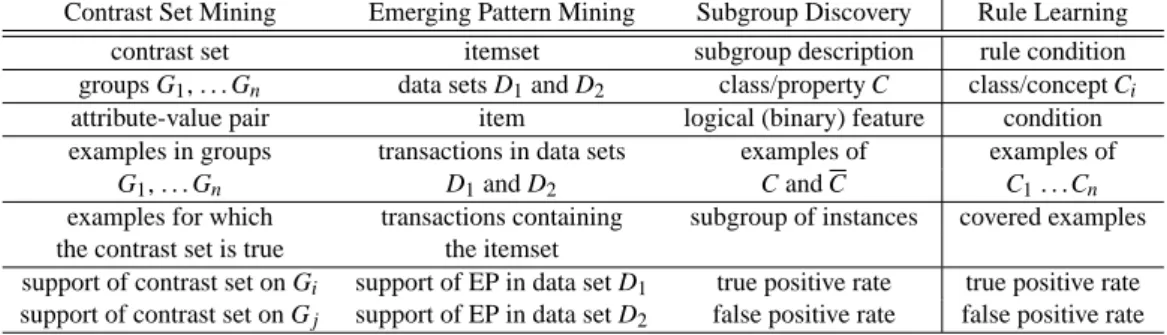
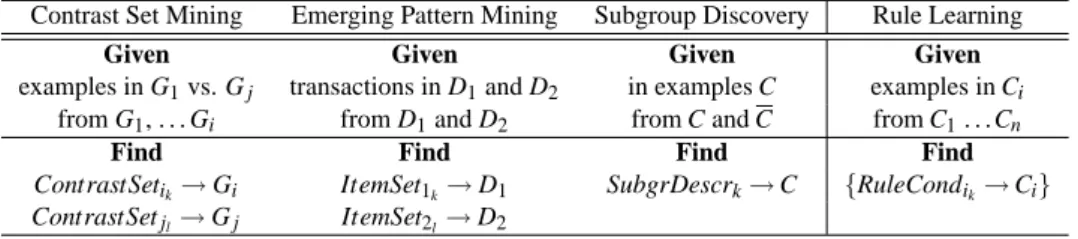
The main contributions of this paper are as follows. It provides a survey of supervised de-scriptive rule discovery approaches addressed in different communities, and proposes a unifying supervised descriptive rule discovery framework, including a critical survey of visualization meth-ods. The paper is organized as follows: Section 2 gives a survey of past research done in the main supervised descriptive rule discovery areas: contrast set mining, emerging pattern mining, subgroup discovery and other related approaches. Section 3 is dedicated to unifying the terminology, defini-tions and the heuristics. Section 4 addresses visualization as an important open issue in supervised descriptive rule discovery. Section 5 provides a short summary.
2. A Survey of Supervised Descriptive Rule Discovery Approaches
Research on finding interesting rules from class labeled data evolved independently in three distinct areas—contrast set mining, mining of emerging patterns and subgroup discovery—each area using different frameworks and terminology. In this section, we provide a survey of these three research areas. We also discuss other related approaches.
2.1 An Illustrative Example
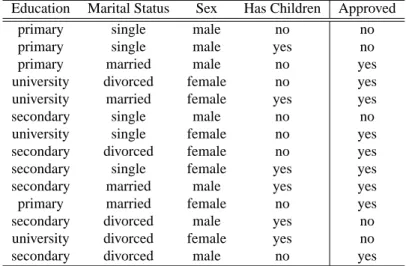
Let us illustrate contrast set mining, emerging pattern mining and subgroup discovery using data from Table 1, a very small, artificial sample data set,1 adapted from Quinlan (1986). The data set contains the results of a survey on 14 individuals, concerning the approval or disapproval of an issue analyzed in the survey. Each individual is characterized by four attributes—Education(with valuesprimaryschool,secondaryschool, oruniversity),MaritalStatus(single,married, or divorced), Sex (male or female), andHasChildren (yes or no)—that encode rudimentary information about the sociodemographic background. The last columnApprovedis the designated
1. Thanks to Johannes F¨urnkranz for providing this data set.