6
Geometry in Design
Why is knowledge of geometry important for so many activities? Think about a concert that you attended. How did geometry infl uence
the band who wrote the music, the craftspeople who made the instruments, the artists who decorated the concert hall, the architect who designed the hall, the engineers who planned the hall’s construction, and the tradespeople whose skills and talents made it all possible?
In this chapter, you will
identify real-world applications of geometric shapes and fi gures, through investigation in a variety of contexts, and explain these applications
represent three-dimensional objects, using concrete materials and design or drawing software, in a variety of ways
create nets, plans, and patterns from physical models arising from a variety of real-world applications, by applying the metric and imperial systems and using design or drawing software
solve design problems that satisfy given constraints, using physical models or drawings, and state any assumptions made
Key Terms
constraint golden ratio golden rectangle isometric perspective drawing net orthographic drawings orthographic projection pattern plan scale model tessellationReasoning and Proving
Reflecting Selecting Tools Connecting Representing Problem Solving Communicating
Arqum studied graphic design at Fanshawe College and now creates signs for companies selling a product or service. He discusses each project with his customers, including size, materials, budget, and regulations, and designs layouts for billboards and business signs. Arqum uses geometric shapes and scale when he creates his designs on the computer.
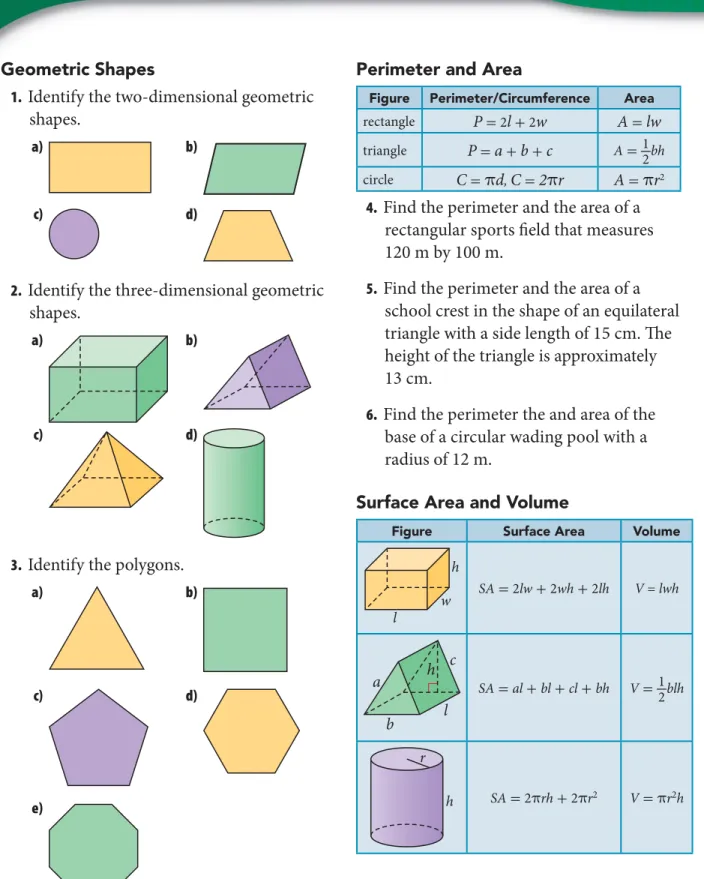
Geometric Shapes
1. Identify the two-dimensional geometric shapes.
a) b)
c) d)
2. Identify the three-dimensional geometric shapes.
a) b)
c) d)
3. Identify the polygons.
a) b)
c) d)
e)
Perimeter and Area
Figure Perimeter/Circumference Area
rectangle P= 2l+ 2w A =lw
triangle P=a+b+c A= _ 1 2 bh circle C=πd, C = 2πr A=πr2
4. Find the perimeter and the area of a rectangular sports fi eld that measures 120 m by 100 m.
5. Find the perimeter and the area of a school crest in the shape of an equilateral triangle with a side length of 15 cm. Th e height of the triangle is approximately 13 cm.
6. Find the perimeter the and area of the base of a circular wading pool with a radius of 12 m.
Surface Area and Volume
Figure Surface Area Volume
l w h SA= 2lw+ 2wh + 2lh V = lwh h b l c a SA=al+bl+cl+bh V= _ 1 2 blh h r SA= 2πrh + 2πr2 V=πr2h
Prerequisite Skills
Chapter Problem
Paul has secured a co-op position for one semester with a fi rm of architects and designers. The fi rm provides customers with designs, drawings, scale models, plans, patterns, and cost estimates for a variety of projects, such as prefabricated outbuildings, houses, and industrial products. Paul will learn how to provide customers with the services that the fi rm offers. As he works through the co-op position, Paul will be given design tasks that will require the knowledge and skills that he has learned during his placement.
7. Wilhelm built a closed room in his garage to use as a paint shop. Th e room measured 8 m by 6 m by 2.5 m.
a) Wilhelm painted the interior walls and ceiling. Find the area that was painted.
b) Wilhelm plans to install a blower to pump fresh air into the room. Th e size of blower required depends on the volume of the room. Find the volume of the room.
8. Sunita built a wheelchair ramp in the shape of a triangular prism, as shown. Each surface of the ramp is to be painted— with the exception of the base. Find the surface area to be painted.
0.9 m 0.6 m
0.1 m
9. A cylindrical water tank a radius of 5 ft and a height of 12 ft . Th e interior is to be painted with waterproof paint. Find the
area to be painted, and the volume of water that the tank can hold.
Angles in a Polygon
10. Th e sum of the angles in a polygon with
n sides, in degrees, is given by the formula
S= 180(n- 2). If the polygon is regular, the measure of each angle is given by the sum divided by n. Find the sum of the angles, and the measure of each angle, for a regular pentagon.
Scale Factors
11. Anil is planning to grow vegetables in a market garden measuring 24 m by 36 m. To plan the garden, he will draw a diagram using a scale of 1 cm to represent 2 m. Find the dimensions of the diagram.
12. Ted has made a scale model of a sailboat that he is planning to build. Th e model has a length of 10 in. Ted used a scale of 1 in. to represent 4 ft . What is the length of the sailboat?
What is the link between the cells that make up a cell phone network and a tesselation pattern? How are the Mona Lisa and the Great Pyramid of Cheops in Egypt related? What is the connection between music and geometry?
In this section, you will investigate some of these relations, and begin to learn how to use geometric principles in art, architecture, and fashion.
Investigate 1
The
Mona Lisa
Tools copy of Leonardo da Vinci’s painting Mona Lisa ruler or computer The Geometer’s Sketchpad®Uncover one of the secrets of the Mona Lisa.
1. Draw a rectangle that encloses the face of the Mona Lisa.
Method 1: Use Pencil and Paper
Use your ruler and pencil to draw the rectangle. Measure the length and width of the rectangle. Divide the length by the width.
Method 2: Use The Geometer’s Sketchpad® Technology Tip
If the picture appears too large or too small, you can resize it using any drawing program, such as Microsoft® Paint.
Open Th e Geometer’s Sketchpad®. Search the Internet for a picture of the Mona Lisa. Right-click on the picture, and select Copy. Return to Th e Geometer’s Sketchpad®. Select Paste Picture from the Edit menu. Draw a rectangle around the face of the Mona Lisa. Measure the length and width of the rectangle. Divide the length by the width.
Investigate Geometric Shapes
and Figures
golden ratio
• the ratio of two lengths is approximately 1.618:1 golden rectangle
• a rectangle that is pleasing to the eye
• the ratio of the length to the width is approximately 1.618:1
2.Th e ratio of the length to the width on the actual painting is 1.618:1. Th is is known as the golden ratio. A rectangle that is drawn using the golden ratiois known as a golden rectangle . Th e proportions of golden rectangles are pleasing to the eye. Th e golden ratio is oft en used in art and architecture.
3. Refl ect Th ink about windows that you have seen on buildings in your neighbourhood. Which windows appear to be golden rectangles? To learn more about the golden ratio in art and architecture, go to www.mcgrawhill.ca/links/foundations11 and follow the links.
Investigate 2
Tessellations
Toolscentimetre grid paper coloured pencils or
markers
pattern block template or pattern blocks tessellation
• a pattern that covers a plane without overlapping or leaving gaps
• also called a tiling pattern
Certain shapes can be used to fi ll a plane completely, with no gaps. Th is is known as a tessellation , or “tiling the plane.” As you can see from a piece of grid paper, a square is one of these shapes. Clothing is oft en made from fabrics with a checkerboard pattern. If colours are carefully chosen and placed, the pattern becomes more attractive.
Method 1: Use Pencil and Paper
1. Draw a square. Th en, draw additional squares identical to the fi rst square such that they form a tessellation. Use at least four diff erent colours to make a pleasing pattern for clothing.
2. Triangles can also be used to form tessellations. Draw a triangle. Th en, draw additional triangles identical to the fi rst triangle such that they form a tessellation. Colour the triangles to create a pleasing pattern.
3. Refl ect Can you use any triangle to tile the plane? Try several examples.
4. You can use a combination of triangles and rectangles to form a tessellation. Find a combination of a rectangle and several triangles that can be used to tile the plane. Draw your tessellation. Colour your pattern to create a pleasing design.
5. You can also use other regular geometric shapes to construct
tessellations. Pattern blocks include many diff erent regular geometric shapes. Use the blocks to experiment with diff erent shapes that can tile the plane. Examine a vertex that is common to several polygons. What is the measure of the angle around the vertex?
Tools
computer
The Geometer’s Sketchpad® pattern block applet
Method 2: Use Computer Software
1. Open Th e Geometer’s Sketchpad®. From the Graph menu, choose
Show Grid. Select both axes, the origin, and the unit point. Choose
Hide Objects from the Display menu.
2. Start in the upper left corner, and draw four points to enclose one of the squares. Select the four points in order. From the Construct
menu, choose Quadrilateral Interior. Select the four points, and the interior. From the Edit menu, choose Copy, and then Paste. Drag the image to another square.
Technology Tip Once you have a basic pattern, you can select all elements of the pattern. Then, use the Copy command from the Edit menu, and Paste it repeatedly. This is a fast way of tiling the plane.
3. Right-click on one of the interiors. Choose Color, and change the colour of the square. You can continue this process to tile the screen with diff erent coloured squares. Use at least four diff erent colours to design a tessellation that would make a pleasing pattern for clothing.
4. Triangles can also be used to form tessellations. Start a new sketch. Draw a triangle. Th en, draw additional triangles identical to the fi rst triangle such that they form a tessellation. Colour the triangles to form a pleasing pattern.
5. Refl ect Can you use any triangle to tile the plane? Try several examples.
6. You can use a combination of triangles and rectangles to form a tessellation. Start with a grid of squares. Find a combination of a rectangle and several triangles that can be used to tile the plane. Draw your tesselation. Colour your pattern to form a pleasing design.
7. You can also use other regular geometric shapes to construct tessellations. Go to www.mcgrawhill.ca/links/foundations11 and follow the links to the Pattern Block Applet. Use the applet to experiment with diff erent shapes that can tile the plane. Examine a vertex that is common to several polygons. What is the measure of the angle around the vertex?
Th e only regular polygons (triangle, square, pentagon, and so on) that can tile the plane are those whose interior angles divide evenly into 360°. Th ese are the triangle (60°), the square (90°), and the hexagon (120°). A pentagon, for example, will not tile a plane because its interior angles (108°) do not divide evenly into 360°.
To learn more about tessellations, go to www.mcgrawhill.ca/links/ foundations11 and follow the links.
Investigate 3
Cell Phone Tower Networks
Cell phones are really small radios that communicate with towers connected to the telephone system. Th e towers in an urban area must be placed close together because cell phones are low-powered, typically about 3 W, and have a limited range. Also, each tower only off ers a limited number of frequencies (about 800), restricting the number of calls that a tower can handle at one time.In an urban area, towers are placed about 5 km apart. Each tower is thought of as the centre of a hexagonal cell, as shown. Consider an urban area that measures 20 km on a side. Draw a tessellation using hexagons, and show how many towers are needed to service the cell phone network. Tools
ruler grid paper
Method 1: Use Pencil and Paper
1. Let 1 cm represent 1 km. Draw a square to represent an area 20 km by 20 km.
2. Lightly draw a hexagon, with a dot in the centre to represent the tower. Draw another hexagon next to the fi rst one, leaving no gaps. Measure the distance between the two towers. If it is not close to 5 cm, adjust your hexagons. Once you think you have the correct size of hexagon, continue your diagram to cover the entire area.
3. How many towers are required to service the urban area?
4. Refl ect What are the similarities between tiling the plane with triangles, designing a pattern for clothing, and ensuring that cell phone users have good service?
Tools
computer
The Geometer’s Sketchpad®
Method 2: Use The Geometer’s Sketchpad®
1. Open Th e Geometer’s Sketchpad®. From the Graph menu, choose
Show Grid. Drag the unit point on the horizontal axis until you can see +10 and -10 on your screen, on both the horizontal and vertical axes. Use the Segment Tool to draw a rectangle measuring 20 squares by 20 squares. Th is will represent an area 20 km by 20 km.
Technology Tip Do not worry if your hexagons look a bit irregular. You will learn how to draw regular geometric shapes accurately later in this chapter.
2. Use the Segment Tool to construct a hexagon in the upper left hand corner of the 20 km by 20 km grid. Draw a point in the centre of your hexagon to represent the tower.
3. Draw another hexagon next to the fi rst one, leaving no gaps. Determine the distance between the two towers. If it is not close to 5 km, adjust your hexagons by dragging vertices. Once you think you have the correct size of hexagon, continue your diagram to cover the entire area.
4. How many towers are required to service the urban area?
5. Refl ect What are the similarities between tiling the plane with triangles, designing a pattern for clothing, and ensuring that cell phone users have good service?
To learn more about cell phones and how they work, go to www.mcgrawhill.ca/links/foundations11 and follow the links.
Example
The Golden Ratio in Ancient Architecture
A cross-section of the Great Pyramid of Cheops on the Giza plateau in Egypt is shown. Find the ratio of the slant height s to half of the base. Express your answer to three decimal places.
s
146.515 m
Solution
Half of the base = 230.363 ÷ 2 115.182
Use the Pythagorean theorem to fi nd the slant height. s2 (115.182)2 + (146.515)2 s2 34 733.538 s √ _________ 34 733.538 s 186.369
Th e slant height is approximately 186.369 m. Slant height:half of the base 186.369:115.182
1.618:1
The number given for the golden ratio, 1.618, is an approximation. The exact value is 1 + √ __5
_
2 . Use a calculator to verify that this expression gives the correct approximation.
Math Connect Th e ratio in the Example is the golden ratio once again. Th e golden ratio
is a connection between the Mona Lisaand the Great Pyramid. A triangle that has this property, such as the cross-section of the Pyramid of Cheops, is known as an Egyptian triangle.
To learn more about the Pyramids, go to www.mcgrawhill.ca/links/ foundations11 and follow the links.
Key Concepts
•
Geometric shapes are used in architecture, art, and fashion. These shapes often use the golden ratio, which is approximately 1.618:1. The golden ratio is used in design because its proportions are pleasing to the eye.•
Some geometric shapes can be used to “tile a plane” such that there are no spaces. These tiling patterns are known as tessellations. Some polygons that tile a plane are squares, rectangles, equilateral triangles, and regular hexagons. Combinations of regular polygons can also tile a plane.Discuss the Concepts
D1. How are geometric shapes used in the construction of your school? Make a list of the shapes that you notice, and where they are used. D2. Can the shape shown be used to tile the plane? Use a sketch to explain.
Practise
A
1. Which of these regular polygons cannot be used to tile a plane?
A triangle B square
C hexagon D octagon
2. Sandor claims that the screen on his new HD television is a golden rectangle. It measures 32 in. by 18 in. Is he correct? Justify your answer.
3. Look at the buildings in your neighbourhood. Identify geometric shapes that you see in the construction of these buildings. In
particular, describe the use of shapes other than squares or rectangles.
4. Th ink about musical instruments that you have seen. Geometric shapes are present in the design of many musical instruments. List several instruments, and identify the geometric fi gures used in their design.
5. Th e old railroad station in Petrolia, ON, is now the public library. Identify the diff erent two-dimensional and three-dimensional geometric fi gures that were used in its design.
Apply
B
Literacy Connect 6. Uploading personal digital pictures to the Internet is a popular activity. If you do this, and identify people in your pictures, the soft ware that operates the posting site can “learn” to identify faces. It uses measurements and ratios similar to those you found for the Mona Lisa in Investigate 1. Once a face is in the database, other users can employ the soft ware to identify individuals in other pictures. Write a short paragraph discussing the advantages and disadvantages of having such a soft ware tool freely available on the Internet.
For help with questions 7 and 8, refer to Investigate A.
7. Sports such as soccer or lacrosse are oft en played on rectangular fi elds. Investigate the dimensions of several of sports fi elds. Find the dimensions of an Olympic swimming pool. Are any dimensions close to a golden rectangle?
Technology Tip You can search for images directly using most search engines, rather than searching for web sites and then looking for images.
8. Use the Internet to fi nd a picture of each of these famous buildings. Copy each picture into Th e Geometer’s Sketchpad®, and use the soft ware to identify any golden rectangles that were used in the design.
a) Th e Parthenon, in Athens, Greece. Use a front view.
b) Th e Taj Mahal, in Agra, India. Use a front view, taken down the refl ecting pool.
c) Th e United Nations building in New York, NY. Use a view from the river.
d) Th e Buddhist Temple in Niagara Falls, ON. Use a front view.
9. Th e actor Drew Barrymore is considered as a classic example of a “round face,” while actor Fred Gwynne (who played a Frankenstein-like character on a popular television show) is considered to be an example of a “long face.” Search for pictures of each actor. Use pencil and paper or Th e Geometer’s Sketchpad® to determine how the actors’ faces compare to the golden ratio.
10. Th e faces of some animals appear to have a greater width than height. One example is a house cat. Use pencil and paper or Th e Geometer’s Sketchpad® to determine the facial ratio of a typical cat.
Chapter Problem 11. Paul has been reading about the history of architecture. Ancient Egyptian builders oft en needed to lay out large right angles for their constructions. Th ey did this using a “12-knot rope.” Obtain a piece of string about 1 m long. Tie 12 knots in the string such that the knots are 5 cm apart. Tie the ends of the string together such that you have 12 equal sections. Arrange the string to form a triangle with sides of 3, 4, and 5 sections.
a) Measure the angle opposite the longest side.
b) Write a short explanation of the mathematics behind this method. Reasoning and Proving
Reflecting Selecting Tools Connecting Representing Problem Solving Communicating
12. Where is the geometry in music? Th e fi rst few bars of the classic hard rock piece “In-A-Gadda-Da-Vida” by Iron Butterfl y, widely acknowledged as the fi rst heavy metal band, are shown.
c
1
a) Notice the groupings of four notes. Draw lines joining adjacent notes in each group, and then a single line returning to the fi rst note. Th e fi rst triangle has been drawn for you. Describe the kinds of triangles that are formed.
b) Triangles are oft en present in music composition. Find two three-note congruent triangles in this short excerpt from the popular holiday song “O Tannenbaum.”
1
3 4
13. A stained glass panel contains several rectangles. Which rectangles are golden rectangles or close to being golden rectangles? Explain how you know.
40 mm 160 mm 68 mm 42 mm 64 mm 32 mm 32 mm 200 mm
Achievement Check
14. Anwar claims that a hexagon does not need to be regular to tile the plane. He says that any hexagon that has opposite sides equal will work.
a) Draw a hexagon with opposite sides equal. Be sure to use three diff erent lengths in your drawing.
b) Determine whether your hexagon can be used to tile the plane. If it can, show how it can be done. If it cannot, explain why not.
Extend
C
15. An architect is designing a window using the golden ratio.
a) Th e longer side measures 2.5 m. To the nearest tenth of a metre, what should be the length of the shorter side?
b) Draw a sketch of the window. Cut the window in half using the midpoints of the lengths. Compare the ratios of sides of one of the smaller rectangles. What do you notice?
16. Many countries use international paper sizes, such as ISO A4. A sheet of A4 paper measures 29.7 cm by 21.0 cm. Th is size is sold in Canada at offi ce supply stores. Obtain a piece of A4 paper, or make one from a larger piece of paper.
a) Find the ratio of the length to the width, and record it.
b) Fold the paper in half across a line joining the midpoints of the lengths. Measure the length and width of the folded paper. Find the ratio of the length to the width.
c) Fold the paper again. Find the ratio of the length to the width of the folded piece. What do you notice?
d) Th e ratio of length to width for the ISO standard is always √
__
2 : 1. Use a calculator to compare this ratio to the ratios that you found.
17. Use pencil and paper or soft ware, such as Th e Geometer’s Sketchpad®, to design fabric with a tessellation print. Th e fabric should appeal to a person with a particular career or hobby, such as a musician, a golfer, a pilot, a nurse, etc. Be sure to use basic geometric shapes to form a more complex shape. Be creative in your selection of colours.
Perspective and Orthographic
Drawings
6.2
scale model • a model that is an enlargement of a small object or a reduction of a large objectHabitat 67 is an apartment complex in Montreal. It was designed by Canadian architect Moshe Safdie for Expo ’67, as an experiment in building apartments that allowed urban dwellers to enjoy both privacy and outdoor space. A scale model was used to represent what the complex would look like when fi nished.
isometric perspective drawing • visual representation of three-dimensional objects in two dimensions orthographic projection
• a set of drawings that show up to six views of an object
• usually front, side, and top views are given orthographic drawing
• a drawing that uses orthographic projection
Another means of representing three-dimensional objects is an isometric perspective drawing , which creates the illusion of three dimensions on a two-dimensional plane. A third representation is a series of orthographic projections , which illustrate front, side, and top views of the object. How could you draw the isometric perspective and the orthographic representations of Habitat 67? How can drawing soft ware be used to create these representations?
To learn more about Habitat 67, go to www.mcgrawhill.ca/links/ foundations11 and follow the links.
Investigate 1
Perspective Drawings of Cubes and Rectangular Prisms
Use a single linking cube or a model of a cube. Turn the cube until an edge is facing you. Th en, tip the cube downwards, as shown. Th is is the perspective that you will draw.Tools
isometric dot paper linking cubes or other
physical models of cubes
ruler
coloured pencils
Method 1: Use Pencil and Paper
1. a) Inspect the isometric dot paper. Find the lines of dots that are vertical. Draw a short vertical line segment in blue.
b) Find the lines of dots that slope down to the right at 30°. Draw a short line segment sloping down to the right at 30° in red.
c) Find the lines of dots that slope down to the left at 30°. Draw a short line segment sloping down to the left at 30° in green.
d) Use the dot pattern to draw the isometric perspective, as shown.
2. Refl ectCompare the isometric perspective drawing with the view of
the cube. On an isometric perspective drawing, the lengths on the drawing are the same as the lengths on the real cube. Check that the sides of the cube on the drawing are of equal length.
The word “isometric” comes from the Greek words “iso,” meaning “the same,” and “metric,” meaning “measure.”
Math Connect 3. Use linking cubes to construct a model of a rectangular prism that
measures 1 cube by 2 cubes by 3 cubes. Draw an isometric perspective drawing of the prism.
Tools
computer
The Geometer’s Sketchpad®
Method 2: Use The Geometer’s Sketchpad®
1. Open Th e Geometer’s Sketchpad®. Choose Open from the File menu. Navigate to the directory that stores Th e Geometer’s Sketchpad®
fi les on your computer. Th is will likely be called Sketchpad, and be located in the Program Files directory. Choose Samples, then
Sketches, and then Geometry. Select and open the fi le Dot Paper.gsp. Select the button Isometric vertical.
Technology Tip You can change the spacing of the dots using the slider marked “dot spacing.”
2. Inspect the isometric vertical dot pattern. Find the lines of dots that are vertical. Find the lines of dots that slope down to the right at 30°. Find the lines of dots that slope down to the left at 30°. Use the dot pattern to create the isometric perspective drawing of the cube, as shown.
3. Refl ect Compare the isometric perspective drawing with the view of the cube. On an isometric perspective drawing, the lengths on the drawing are the same as the lengths on the real cube. Check that the sides of the cube on the drawing are of equal length.
4. Use linking cubes to construct a model of a rectangular prism that measures 1 cube by 2 cubes by 3 cubes. Draw an isometric perspective drawing of the prism.
Investigate 2
Orthographic Drawings of Cubes and Rectangular Prisms
Toolssquare dot paper linking cubes or other
physical models of cubes
ruler
Method 1: Use Pencil and Paper
1. Use a single linking cube or a model of the cube. Turn
Front View
the cube until the front is facing you. Draw the front of the cube. Label the drawing.
2. Turn the cube until the right side is facing you. Draw and label the side view. Similarly, draw and label the top view.
3. Refl ect What do you notice about the three orthographic drawings of the cube? A cube is a simple shape. However, the same method can be used to represent more complex shapes.
4. Use linking cubes to construct a model of a rectangular prism that measures 1 cube by 2 cubes by 3 cubes. Create three orthographic drawings of the prism: front view, side view, and top view.
Tools
computer
The Geometer’s Sketchpad®
Method 2: Use The Geometer’s Sketchpad®
1. Open Th e Geometer’s Sketchpad®. Open the fi le Dot Paper.gsp. Select the button Square dot paper.
2. Use a single linking cube or a model of a cube. Turn the cube until the front is facing you. Draw the front of the cube. Label the drawing.
3. Turn the cube until the side is facing you. Draw and label the side view. Similarly, draw and label the top view. Refer to the diagrams in Method 1.
4. Refl ect What do you notice about the three orthographic drawings of the cube? A cube is a simple shape. However, the same method can be used to represent more complex shapes.
5. Use linking cubes to construct a model of a rectangular prism that measures 1 cube by 2 cubes by 3 cubes. Create three orthographic drawings of the prism: front view, side view, and top view.
You have been using Th e Geometer’s Sketchpad® to draw perspective diagrams. Technical designers use more sophisticated programs, such as AutoCAD®. Th e science-fi ction television series Babylon 5 was created using AutoCAD® to render three-dimensional spaceships, space stations, and even some aliens. Amateur fi lmmakers oft en use commonly available drawing and design soft ware to create inexpensive special eff ects for their productions.
To learn more about drawing soft ware, go to www.mcgrawhill.ca/links/ foundations11 and follow the links.
Example 1
Modelling a Flight of Stairs
a) Use linking cubes to create a model for a fl ight of stairs. Th ere are three steps. Th e steps are 30 cm deep and 120 cm wide. Each riser measures 30 cm. Let the side of a cube represent 30 cm.
b) Draw an isometric perspective drawing of the model.
c) Sketch a set of orthographic drawings of the model. Solution
a) Th e side of a cube represents 30 cm. Th e stairs will be 4 cubes wide, and 3 cubes deep at the bottom layer.
b) Use isometric dot paper or Th e Geometer’s Sketchpad® to create the isometric perspective drawing of the stairs.
c) Use square dot paper or Th e Geometer’s Sketchpad® to draw the orthographic drawings for the stairs.
front view
top view
side view
Example 2
Isometric Drawing of a Square-Based Pyramid
Construct a model of a square-based pyramid using drinking straws and masking tape or other materials. Use isometric dot paper or Th e Geometer’s Sketchpad® to sketch an isometric perspective drawing of the pyramid.
Solution
First, draw the base. Th e base will appear as a diamond shape. Select a point in line with two opposite vertices to be the apex of the pyramid. Complete the pyramid by drawing the sides.
Example 3
Isometric Drawings With Curved Edges
Consider a concrete model of a cylinder, such as a juice or soup can. Use Th e Geometer’s Sketchpad® to sketch an isometric perspective drawing of the can.
Solution
Curved edges are represented by arcs of circles in isometric perspective drawings.
• Open Th e Geometer’s Sketchpad®. Open the fi le Dot Paper.gsp. Press the button Isometric vertical.
• Use the Point Tool to draw three points just to the left of three of the points on the paper, as shown.
Technology Tip The dots in the dot paper sketch in The Geometer’s Sketchpad® are drawn using transformations. If you try to draw an arc through three of these dots, it will not work. Try it!
• Select the three points. Select Arc Th rough 3 Points from the
Construct menu. Drag the arc slightly to the right such that it falls on three points on the dot paper. In a similar manner, construct three more arcs. Th en, use the Segment tool to complete the sides of the cylinder, as shown.
Note: You can also draw an isometric perspective drawing of a cylinder on paper using a ruler and a compass.
Key Concepts
•
A three-dimensional object can be represented in three ways.–
as a scale model using concrete materials–
as an isometric perspective drawing–
as a set of orthographic drawings (usually the front view, side view, and top view)Discuss the Concepts
D1. Consider the isometric perspective drawing shown. Indira claims that all three orthographic drawings of this object will look the same. Laszlo says that only the front and the side will look the same. Soon-Tek says that all three will be diff erent. Who is correct? Give reasons.
D2. Consider the isometric perspective drawing shown. Discuss whether the drawing could represent a real object. Give reasons for your answer.
Practise
A
1. Which of these representations is not suitable for representing a three-dimensional object? Explain why.
A a scale model
B an isometric perspective drawing
C a blueprint showing front and side views
D a set of orthographic drawings
2. Marcie is building a scale model of an offi ce building using linking cubes. Th e building is a rectangular prism with a length of 49 m, a width of 35 m, and a height of 56 m. Suggest a suitable scale, and calculate the dimensions for the model.
3. Farmer Jacques is building a new silo in the shape of a cylinder. To maximize the storage volume, he is planning to make the diameter the same as the height. Which of these diagrams matches the side view?
A B C D
4. Ivanka is using linking cubes to make a scale model of the isometric perspective drawing shown. Describe the physical model in terms of length, width, and height.
Apply
B
Literacy Connect 5. Study the isometric perspective drawing shown. Write a short
paragraph explaining why this drawing cannot represent a real object.
For help with question 6, refer to Example 1.
6. Central courtyards are featured in the architecture of many cultures. Th e Romans oft en built their houses, or villas, with a central open space surrounded by the rooms of the house.
a) Use linking cubes or other concrete materials to build a scale model of a Roman villa. Include a set of rooms surrounding a central open space.
b) Use isometric dot paper or Th e Geometer’s Sketchpad® to create an isometric perspective drawing of the model.
c) Use isometric dot paper or Th e Geometer’s Sketchpad® to create a set of orthographic drawings for the model.
For help with question 7, refer to Examples 2 and 3.
7. Salvatore needs an isometric perspective drawing of a cone such that the height of the cone appears equal to the diameter.
a) Use isometric dot paper or Th e Geometer’s Sketchpad® to create an isometric perspective drawing of a cone that closely matches Salvatore’s requirements.
b) Is it possible to match the height to the diameter exactly, if the diameter and the tip of the cone must land on one of the dots? Explain.
8. Th e artist M. C. Escher oft en used false perspective in his drawings to depict impossible situations. Study the Escher work Convex and Concave carefully to see how the illusions work. Consider the “stairway” at the centre right of the drawing.
a) Approximate the stairway with a triangle (i.e., do not show the individual steps). Create a set of orthographic drawings in which you see this as a stairway going up.
b) Create a set of orthographic drawings in which you see this as the bottom support of an arch.
c) Describe the triangles that occur in your orthographic drawings.
Chapter Problem 9. Paul has been given a set
front view side view top view of orthographic drawings
for an inn, to be built near a tropical beach. Th e design incorporates open spaces throughout
the building for air circulation. Paul’s task is to create a scale model and an isometric perspective drawing of the inn.
a) Use the orthographic drawings to construct a scale model using linking cubes or other concrete materials.
b) Use isometric dot paper or Th e Geometer’s Sketchpad® to make an isometric perspective drawing of the inn.
Achievement Check
10. Sara used linking cubes to build the structure shown in isometric perspective. Which drawing is a possible
orthographic projection of the top view of the structure? Explain.
A B
C D
Reasoning and Proving
Reflecting Selecting Tools Connecting Representing Problem Solving Communicating
Extend
C
11. Use isometric dot paper or Th e Geometer’s Sketchpad® to create an “impossible” isometric perspective drawing diff erent from the ones in question D2 and question 5.
12. In isometric perspective drawings the lengths in the drawing of a cube match the side lengths of the real cube. In real life, the apparent size of an object decreases as the object moves farther away from an observer. Artists use the concept of a “vanishing point” to achieve the eff ect of perspective in their art.
To see how this works, draw a square using square dot paper or Th e Geometer’s Sketchpad®. Select a point far away from the square, as shown. Join the vertices of the square to this “vanishing point.”
Use these lines to draw the rest of the cube in perspective. Th en, hide or erase the parts of the lines that extend outside of the cube.
13. Advertisements for buildings that have not yet been constructed oft en make use of two-point perspective. In the example shown, each street leads to a vanishing point. Th e left side view of the building uses the left vanishing point, while the right side view uses the right vanishing point.
Use square dot paper or Th e Geometer’s Sketchpad® to make a two-point perspective drawing of the model in question 4.
Create Nets, Plans, and Patterns
6.3
Commercial products are packaged in various shapes of containers. Th ese containers are oft en manufactured as a two-dimensional net and then folded or bent into a three-dimensional shape. One example is a cereal box, which is a rectangular prism.
Other three-dimensional objects, such as houses or items of furniture, are constructed from a plan . Plans are usually parts of nets, drawn to scale, that give enough information to construct the three-dimensional object. Clothing is made by using a pattern to cut the cloth. Th e cloth pieces are then sewn together to make the clothing item. A pattern is usually a net that is drawn in separate pieces.
Investigate 1
Design a Box
Toolsempty cereal box scissors
ruler tape
Many products are packaged in rectangular prisms.
1. Measure and record the dimensions
C
ereal
l w
h
of the cereal box.
net
• a two-dimensional diagram that can be cut out, and folded to form a three-dimensional object plan • a scale drawing of a structure or object • a design or arrangement scheme pattern • a form, template, or model from which an object can be created
The fi rst of the modern packaged cereals was toasted corn fl akes, introduced in 1906. To learn more about packaging, go to http://www. mcgrawhill.ca/links/ foundations11 and follow the links.
Math Connect 2. Find the edge on the cereal box that was used to join the cardboard.
Cut along this edge. Cut any other joins that you fi nd.
3. Unfold the cereal box to form a net. Measure the edges of the net. Identify each edge as one of the dimensions of the box.
4. Refl ectCompare the measures of the net to the measures of the cereal box. How are the dimensions of the net found to produce a box of the desired shape and size?
5. Sketch a net for a box that will measure 4 cm by 3 cm by 2 cm. Label the edges. Test your net by cutting it out and folding it into a box. Tape the box together. Measure the dimensions to check that the box matches the dimensions given. Suggest a product that would be suitable for a package of this size.
Investigate 2
Design a Cylinder
Toolsempty tissue roll ruler
tape
Some products are packaged in cylindrical containers.
1. Measure and record the height and diameter of the tissue roll.
d
h
2. Cut the roll along its height, and spread it into a rectangle. Trace the rectangle onto a piece of paper. Measure the dimensions of the rectangle. Which dimension is equal to the height of the roll? What is the name of the other dimension in relation to the cylinder? Divide the other dimension by the diameter of the tissue roll. What do you notice?
3. To draw two congruent circles for the top and bottom of the cylinder, what dimension do you need to consider? Draw two circles for the top and bottom using this dimension. Cut out the net, and bend it to form a cylinder with a top and a bottom.
4. Refl ect Compare the measures of the net to the measures of the cylinder. How are the dimensions of the net related to the height and diameter of the cylinder?
5. Sketch a net that can be bent into a cylinder with a diameter of 6 cm and a height of 10 cm. Test your net by cutting it out and bending it into a cylinder with a top and a bottom. Tape the model together.
Investigate 3
Patterns
Toolssimple item of clothing (old T-shirt, etc.) scissors newsprint
Patterns for clothing are nets that are used to cut cloth. Th e pieces of cloth are sewn to form the three-dimensional garment.
1. Identify the seams on the article of clothing. Use scissors to carefully cut the threads along each seam. Lay out the pieces.
2. Sketch the pattern on newsprint.
3. Refl ect How can clothing manufacturers use a pattern to cut out hundreds of pieces at one time? Research clothing manufacturing on the Internet to help you explain.
4. Sketch a pattern that could be used to cut out the pieces for a bucket hat.
Example Cabin
Plan
a) Draw a fl oor plan for a vacation cabin. Th e cabin will measure 8 m along the side by 6 m across the front. Th ere will be two congruent square bunkrooms at the back, with side length 3 m. Th ere will be a bathroom measuring 2 m by 3 m along the front wall. Th e remaining space will be living area. Label the measurements on your plan.
b) Th e cabin will be of the A-frame type, measuring 5 m tall.
Solution
a) Select a suitable scale. For example, let 1 cm represent 1 m. Draw a rectangle to represent the fl oor of the cabin. Draw walls for the two bunkrooms and the bathroom. Label all dimensions.
6m 3m 3m 8m 5m 2m 3m 3m 3m BunkRoom Bathroom BunkRoom 3m
b) Draw the front, side, and top views of the cabin.
6 m 6 m 6 m
8 m 5 m
5 m
front view side view top view
Key Concepts
•
A three-dimensional object can be constructed by folding or bending a two-dimensional net.•
Parts of a net drawn to scale can be used as a plan to construct a three-dimensional object.•
A net can be separated into pieces to form a pattern. The pattern can be used to make pieces of a three-dimensional object, which can be assembled into the object.Discuss the Concepts
D1. Sketch a net for a cube. Explain how it must be folded to make the cube.
D2. A hobby club builds and fl ies model airplanes. To make such an airplane, would you use a net, a plan, or a pattern? Discuss the advantages and disadvantages of each representation.
Practise
A
1. Consider the net shown. Th e distance between two dots represents 5 cm. When folded, what three-dimensional object will the net make?
A an open box 5 cm high, with a square base with side length 15 cm
B a closed box 5 cm high, with a square base with side length 15 cm
C an open box 15 cm high, with a square base with side length 5 cm
2. Draw a net that can be used to make a cube-shaped box with an open top.
3. Sketch a pattern that could be used to make a mitten.
4. Woodworking magazines oft en include diagrams in their articles about building furniture. If you were writing an article about building a bookcase, would you include a net, a plan, or a pattern? Explain.
Apply
B
For help with question 5, refer to Investigate 1.
Literacy Connect 5. Neela submitted an alternative net for a cube, as shown.
a) Write a short paragraph explaining why Neela’s net will not work.
For help with question 6, refer to Investigate 2.
6. A bakery needs a new cylindrical package for their oatmeal cookies. Each cookie is 1 cm thick and has a diameter of 8 cm. Each package should hold a dozen cookies.
a) Draw a net that can be used to make a model of the package.
b) Cut out your net, and bend it to form the package. Tape the model together.
c) Check the dimensions of the model by measuring. Do they meet the requirements?
7. An imported cheese is sold in the
4 cm
4 cm
4 cm
12 cm shape of a triangular prism. Th e ends
of the prism are congruent equilateral triangles. Each triangle has a side length of 4 cm, and the prism is 12 cm long.
a) Draw a net that can be used to make a model of the package.
b) Cut out your net, and bend it to
form the model. Tape the model together.
c) Check the dimensions of the model by measuring. Do they meet the requirements?
Chapter Problem 8. Paul’s company has been asked to design a grain storage shed that will be exported to developing countries. Th e shed will be made of galvanized sheet metal with four congruent square walls, with side length 3 m. Th e roof will be four congruent equilateral triangles with side length 3 m. Th e bottom will be left open so that the shed can be attached to a poured concrete base. Th e sheds will be shipped as nets to conserve shipping space. Paul’s task is to design the net for the shed, and to estimate the cost of the metal required.
3m
3m
3m 3m
a) Draw a net that can be used to make a model of the shed.
b) Find the total area of sheet metal required.
9. Th e owner of a garden centre needs a pedestal for displaying a prize-winning fl owering plant. Th e pedestal is to be made of painted sheet metal, with dimensions as shown. Th e bottom of the pedestal will be left open. Draw a net that could be used to make the pedestal. Show all measurements.
20 cm 10 cm 10 cm
Achievement Check
10. Refer to question 9.Th e pedestal will be modifi ed. Now, the top will have a circular hole to accommodate a 10-cm diameter metal cylinder. Th e height of the cylinder will be 30 cm. Draw the net for the modifi ed pedestal, and the net for the cylinder. Show all measurements.
Extend
C
11. A regular tetrahedron is a three-dimensional shape with four congruent equilateral triangular faces. Consider a tetrahedron made of equilateral triangles with side length 3 cm.
a) Draw a net that can be used to make the tetrahedron.
b) Cut out your net, and fold it into a tetrahedron. Tape the tetrahedron together.
12. Lydia made a square shape using eight linking cubes, leaving the centre space empty. Draw a net that could be used to make a paper model of the shape. If you think it is not possible to make a net, explain why.
13. A regular octahedron has eight congruent equilateral triangular faces. It looks like two square-based pyramids glued together at their bases. Draw a net that can be used to make a regular octahedron. Cut out your net, and fold it into an octahedron. Tape the octohedron together.
Use The Geometer’s Sketchpad® to Draw Plans With Dynamic Measurements Tools computer The Geometer’s Sketchpad®
Use Th e Geometer’s Sketchpad® to draw a scale fl oor plan for the vacation cabin in Example 1 of section 6.3. Th e cabin will measure 8 m along the side by 6 m across the front. Th ere will be two congruent square bunk rooms at the back, with side length 3 m. Th ere will be a bathroom measuring 2 m by 3 m along the front wall. Th e remaining space will be living area.
1. Start by constructing the fi xed boundaries of the cabin. Open Th e Geometer’s Sketchpad®. Choose Preferences from the Edit menu, and then the Units tab. Choose Show Grid from the Graph menu. Drag the origin to the lower left area of the workspace. If necessary, adjust the unit point until you can see at least 10 gridlines horizontally and 8 gridlines vertically.
2. Choose Plot Points from the Graph menu. Plot the point (8, 6). In the same way, plot the points (0, 6) and (8, 0). Select the origin and the three plotted points, moving clockwise. Choose Segments from the Construct
menu. You now have a rectangle that represents the boundaries of the cabin. Try to move one of the corners. What happens?
3. Use the Segment Tool to sketch the bunk rooms and the bathroom. Select the endpoints of the width of a bunk room. Choose Coordinate Distance from the Graph menu. Move the measurement to a
convenient location. Measure and label dimensions for remaining the rooms. Include the outside dimensions of the cabin. Hide the axes and the grid.
4. Refl ect Select the line segment that forms the wall between
the bunk rooms. Move it up and down. Note how the measurements change as you move the line segment. Try changing the dimensions of the other rooms.
5. Calculate the area of each room. Choose Calculate from the Measure
menu. A calculator will appear. Select the length of one bunk room. Press the * button. Select the width of the bunk room. Move the area measurement to a convenient location. Change the label to Bunk Room #1. Measure the areas of the other rooms. To fi nd the living area, calculate the area of the entire cabin, and subtract the areas of the rooms.
6. Refl ectChange the dimensions of one room by dragging a wall. Notice how the measurements, including the areas, change.
Scale Models
6.4
A scale model of a building, a piece of furniture, or an item of clothing is useful in the planning stages of construction or manufacturing. Th e model can highlight problems that are not obvious in a two-dimensional representation. Th e model can also demonstrate improvements to a plan. Fixing the plan before production can save materials, resources, and time.
Example 1
Design a Cylindrical Tank
An engineer is designing a cylindrical tank for a tanker truck that will hold about 800 ft 3 of liquid. Th e length of the cylinder should be twice
the diameter and should be a whole number of feet.
a) Use the formula for the volume of a cylinder to determine the dimensions of the tank required.
b) Select a suitable scale, and draw a net for a paper model of the tank.
c) Cut out your net, and bend it into the cylindrical shape. Tape the model together.
Solution
a) Th e formula for the volume of a cylinder is V =πr2h. In this case h is
twice the diameter, or four times the radius. Th e volume formula becomes
V =πr2(4r) = 4πr3
Try diff erent values for the radius.
Radius(ft) 1 2 3 4 5 Volume(ft3) 12.6 100.5 339.3 804.2 1570.8
A radius of 4 ft gives a volume of just over 800 ft 3. Using a radius of
4 ft , the diameter is 2 × 4 ft , or 8 ft , and the length is 2 × 8 ft , or 16 ft .
b) One dimension of the rectangle for the net is the length of the cylinder, or 16 ft . Th e other dimension is the circumference of the cylinder.
C =πd
=π(8)
25.1
Th e circumference is approximately 25.1 ft . Select a suitable scale (for example,
1 in. represents 4 ft ). Draw the rectangle for the with a net. Add two circles, each diameter of 2 in., for the ends.
Example 2
Design a Pentagonal House
An architect has designed a house in the shape of a regular pentagonal prism. Th e fl oor forms a pentagon with a side length of 6 m. Th e fi ve walls are congruent squares. Th e peaked roof is made of fi ve congruent equilateral triangles. Select a suitable scale. Draw a net that can be used to make a scale model of this house. Th en, cut out your net and fold it into a model of the house. Tape the model together.
Solution
Method 1: Use Pencil and Paper
• Choose an appropriate scale. For example, 1 cm represents 1 m. Draw a regular pentagon. A regular pentagon consists of fi ve congruent isosceles triangles whose apexes meet at the centre of the pentagon. Th e apex angle for each triangle is 360° ÷ 5 = 72°. Draw a dot for the centre, and a horizontal line segment to the fi rst vertex. Draw an angle of 72° from the horizontal line segment. Use compasses to help you create an isosceles triangle that includes the second vertex. Continue this process until you have 5 vertices. Join the vertices.
• Use a ruler and compasses to draw a square on each side of the pentagon. Th en, draw an equilateral triangle on each square. • Use your net to make a
scale model of the house.
Method 2: Use The Geometer’s Sketchpad®
• Draw the pentagonal base. Turn on automatic labelling of points. Sketch a horizontal line segment AB. Select point A, and choose Mark Center
from the Transform menu. Select the segment and point B. Choose
Rotate from the Transform menu. Change the fi xed angle to 72°. Select Rotate. Continue until you have fi ve vertices. Join the vertices. • Draw the square walls. Select one endpoint of a side. Choose Mark
Center from the Transform menu. Select the segment and the other endpoint. Choose Rotate from the Transform menu. Change the fi xed angle to 90°. Select Rotate. Repeat for each side. Th en, use the other
s t 1 m 1 m 1 m 3 m
endpoint of the side as the centre, and rotate through an angle of 270°. Complete the fi ve squares.
• Draw the triangular roof faces. Select one outside corner of a square. Choose Mark Center from the Transform menu. Select the outside segment and the other endpoint. Choose Rotate from the Transform
menu. Change the fi xed angle to 60°. Select Rotate. Repeat for the other squares. Complete the fi ve triangles. Hide the points and labels.
• Print your net, and use it to make a scale model of the house.
Example 3
Design a Tent
An outfi tting company plans to manufacture a new tent. Orthographic drawings for the tent are shown. Th e distance between pairs of horizontal or vertical dots represents 1 m.
s t
front view side view top view
Use paper or drinking straws and masking tape to construct a scale model of the tent. Select a suitable scale. Make any necessary calculations.
Solution
Let s represent the slant length of the side of the tent and t represent the slant length of the roof. Use the Pythagorean theorem to fi nd the lengths of s and t. s2= 32+ 12 t2= 12+ 12 s2= 10 t2= 2 s = √ ___ 10 t = √ __ 2 s 3.2 t 1.4
Th e side slant length is Th e top slant length is approximately 3.2 m. approximately 1.4 m.
Select a scale that is suitable for your materials. For example, let 4 cm represent 1 m. Th e base of the model will measure 4 × 4 cm, or 16 cm. Th e side slant length will measure 4 × 3.2 cm, or 12.8 cm. Th e top slant length will measure 4 × 1.4 cm, or 5.6 cm.
Key Concepts
•
Scale models can be constructed using nets, orthographic drawings, or isometric perspective drawings.•
Models are useful in the planning stages of a project.•
Models can identify problems in a plan, or suggest improvements.Discuss the Concepts
D1. Can a model of any three-dimensional object be constructed using a net? Explain.
D2. To obtain a building permit for a house, the owner must submit a set of orthographic drawings, known as elevations. Suggest reasons why orthographic drawing are required rather than a scale model or an isometric perspective drawing.
Practise
A
1. Maria is building a scale model of a garden shed. She will let 1 in. represent 2 ft . If the base of the shed measures 10 ft by 12 ft , what measurements will Maria need for the model?
2. Th e most famous Canadian-designed and -built aircraft was the Avro CF-105 Arrow. A number of
_
18 scale models were made for testing in a wind tunnel. Th e length of the model was 10 ft 8 in. What was the
length of the full-size aircraft ?
3. Th e town of Port Colborne is planning to construct a new
recreational centre, including a skating arena and a swimming pool. Suggest reasons why an architect bidding on the contract would provide a scale model in addition to drawings.
4. Freda is planning a new silo for her farm, made of a cylinder topped with a hemisphere. Th e height of the cylinder will form a golden ratio with its diameter. Freda would like to make a scale model of the silo to see if her design works. Describe a procedure and suggest materials that Freda could use to make the scale model.
5. Suleiman plans to construct a “minimalist” chair as shown in the isometric perspective drawing. He will use three pieces of
1 in.-thick plywood. Th e distance between a pair of dots represents 1 ft . Draw plans that show the pieces of wood required, with measurements.
Apply
B
Literacy Connect 6. A standard golf ball has a diameter of 1.68 in. You have been contracted to design a package to hold 12 golf balls. Sketch a set of orthographic drawings for your chosen package. Write a brief explanation of why you selected this design.
7. Draw an isometric perspective drawing for the tent in Example 3.
8. A local artist wants to include a rectangular prism in her newest sculpture. Th e prism should have a length of 1 m, a width of 2 m, and a height of 3 m.
a) Select a suitable scale. Use pencil and paper or Th e Geometer’s Sketchpad® to draw a net that can be used to make a scale model of the prism.
b) Cut out your net and fold it to make the model. Tape the model together.
c) Th e artist has decided to paint all of the sides of the prism except one, which will be placed on the ground. She has not, however, decided which side will be placed on the ground. If paint costs $2/m2, what are the possible costs for painting the prism? For help with question 8, refer to Example 1.
9. A new soup can must hold at least 500 mL of soup. Its height must be equal to its diameter. Th e height and the diameter must be whole numbers of centimetres.
a) Determine the minimum height and width of the can.
b) Select a suitable scale. Draw a net that can be used to make a scale model of the can.
c) Cut out your net and bend it to make a scale model of the can. Tape the model together.
For help with question 9, refer to Example 2. Reasoning and Proving
Reflecting Selecting Tools Connecting Representing Problem Solving Communicating
10. A band council has decided to commission a new community centre to be used for various events such as the annual pow-wow. Th e centre will be in the shape of a regular hexagon with each side measuring 10 m. Each congruent rectangular wall will be 3 m high. Th e building will have a fl at roof.
a) Select a suitable scale. Choose measurements that ensure you have a regular hexagon. Use pencil and paper or Th e Geometer’s Sketchpad® to draw a net that can be used to make a scale model of the centre.
b) Cut out your net and fold it to make the model. Tape the model together.
c) Th e base of the centre will be poured concrete, 10 cm thick. Take measurements from your net to fi nd the area of the hexagonal base. Multiply the area by the thickness to determine how many cubic metres of concrete will be needed.
d) Concrete costs $75/m3, delivered to the site. Estimate the cost of
the concrete for the base.
11. Aft er studying the scale model in question 10, the band council decided to change the fl at roof to one made of six congruent isosceles triangles. Th is will ensure that snow and rain will not accumulate on the roof. It will also make the building more attractive. Th e central peak of the roof will be 5 m above the fl oor.
a) How will this change aff ect your net? Explain.
b) How will this change aff ect the cost of concrete for the base? Explain.
Chapter Problem 12. A customer has seen the post offi ce in Gorrie, ON, and would like a similar building for his business. He has supplied Paul’s company with sample orthographic drawings, as shown. Th e distance between pairs of horizontal or vertical dots represents 2 m.
a) Draw a net that can be used to make a scale model of the building.
b) Cut out the net, and construct the model. Tape the model together.
c) Th e cost of the building is estimated to be $1200/m2 of fl oor area.
Achievement Check
13. A propane storage tank is to be built from the orthographic drawings shown. Th e distance between pairs of horizontal or vertical dots represents 1 m.
Which description best fi ts the propane tank? Explain.
A A cylinder 11 m long, with a hemisphere of radius 2 m at each end.
B A cylinder 7 m long, with a hemisphere of radius 2 m at each end.
C A cylinder 11 m long, with a hemisphere of radius 4 m at each end.
D A cylinder 7 m long, with a hemisphere of radius 4 m at each end.
Extend
C
14. How can you make a net for a cone? Roll a piece of notebook paper to form a horn. Cut the horn to form a cone. Continue cutting until you have the minimum amount of paper necessary to form the cone. Unroll the paper, and sketch the net.
15. Use trial and error to make a net for a cone with a radius of 5 cm and a height of 3 cm. Cut out your net and use it to make the cone. Measure the dimensions to check that they are correct.
Solve Problems With Given
Constraints
6.5
constraint
• a condition that limits the acceptable range of values for a variable
Designers such as architects, engineers, or fashion designers oft en must ensure their designs satisfy given constraints . Examples of constraints include a maximum cost, a minimum or maximum size, or regulations governing safety, energy effi ciency, or performance.
Example 1
Modular House
Orthographic drawings for a modular house are shown.
s t
u
front view side view top view Th e distance between pairs of vertical or horizontal dots represents 5 ft . Th e house will be built in two sections and then transported to the building site for assembly. Highway traffi c rules limit the width of each section to 15 ft or less. Th e centre wall will be located 15 ft from the left front wall. It will be doubly thick, so that each half of the house will have four walls during transport.
a) Select a suitable scale. Draw a net for each section of the house.
b) Cut out your nets, and make scale models for the two sections of the house. Tape your models together. Ensure that the models fi t together properly for assembly.
Solution
a) From the orthographic drawings, the centre wall is 17.5 ft high. Use the Pythagorean theorem to determine the slant lengths of the roof.
s t u 15 ft 5 ft 5 ft 2.5 ft 7.5 ft 5 ft s2= 152+ 7.52 t2= 52+ 2.52 u2= 52+ 52 s2= 281.25 t2= 31.25 u2= 50 s 16.8 t 5.6 u 7.1
Slant length s is Slant length t is Slant length u is approximately 16.8 ft . approximately 5.6 ft . approximately 7.1 ft . Let the distance between pair of horizontal or vertical dots represent
5 ft . Calculate the measures for the scale drawing by dividing each actual measure by 5.
Th e net for the left side of the house.
16.8 ft 10 ft 10 ft 10 ft 17.5 ft 17.5 ft 17.5 ft 40 ft 15 ft
Th e net for the right side of the house. 17.5 ft 17.5 ft 17.5 ft 40 ft 10 ft 15 ft 15 ft 15 ft 7.1 ft 7.1 ft 7.1 ft 5.6 ft 5.6 ft 5.6 ft
b) Use the nets to make scale models of the two halves of the house. To learn more about modular homes, go to www.mcgrawhill.ca/links/
foundations11 and follow the links.
Example
2 Oil
Tank
Sometimes, basic safety considerations depend on understanding nets and volumes. Consider an engineer who needs to design a square-based berm, a shallow container to prevent the spread of oil from a leaking oil tank. Th e cylindrical oil tank is 20 m in diameter, and has a height of 20 m. Th e berm must have a height of 5 m.
a) Make appropriate calculations, and fi nd the minimum dimensions of the berm.
b) Select a suitable scale. Draw a net for the berm and a net for the oil tank. Use your nets to construct a scale model of the arrangement required.
Solution
a) Start by calculating the maximum volume of oil that must be contained if the tank is full.
V =πr2h
=π × 102 × 20 6283
A square-based berm has the shortest side lengths required to contain a given volume. Minimizing the berm’s perimeter cuts down on the cost of materials.
Math Connect Th e berm must be able to hold 6283 m3 of oil.
Let the side length of the square base of the berm be represented by s. Volume of berm = area of base × height
= s2× 5 = 5s2 5s2= 6283 s2=
_
6283 5 s2= 1256.6 s = √ ______ 1256.6 s 35.4It is safer to overestimate. Round 35.4 m up to 40 m. Suitable dimensions for the berm would be 40 m by 40 m by 5 m.
b) Draw a net for the berm. Let the space between pairs of horizontal or vertical dots represents 5 m. Th e base of the berm measures 8 dots by 8 dots, and the height measures 1 dot.
Draw a net for the oil tank. Th e net consists of two circles of diameter 20 m for the top and bottom, plus a rectangle for the wall of the cylinder. One dimension of the rectangle is the same as the height of the tank, or 20 m. Th e other dimension is the same as the circumference of the tank.
C =πd
=π × 20 63
Th e circumference is approximately 63 m.
Use the nets to construct the scale models for the berm and the oil tank.