Universität Mannheim
Fakultät für Mathematik und InformatikLehrstuhl für Softwaretechnik – Prof. Dr. ColinAtkinson
Arbeit zur Erlangung eines Diploms an der Universität Mannheim
im Fach Wirtschaftsinformatik Betreuer: Prof. Dr. Colin Atkinson
A Software Engineering Perspective on Cryptocurrencies
Nicolas
Hofer
Abstract
This work evaluates a digital cash phenomenon, called cryptocurrencies that was started in early 2009 and has created a buzz at the latest in the year 2013, by the virtual explosion of prices incurrencies(e.g. prices in EUR or USD) for certain cryp-tocurrencies, especially forbitcoin. The evaluation is realized from the perspective of a software engineer. The central research question is derived of a claim made by the Bitcoin community: Bitcoin does create “a new kind ofmoney”. The potential implications for existing payment systems would be tremendous if this proves to be substantial. This issue is examined by performing a requirements analysis for pay-ment systemsin general, thereby establishing certain definitions and understandings of terms, including ‘money’. An analysis and evaluation is also done for theBanking Payment System (BPS) and the Cryptocurrency Payment System (CPS) with the target to be able to draw conclusions for the CPS by comparing the two payment systems. Furthermore a detailed evaluation of Bitcoin (first letter capitalized!) and its proposed money called ‘bitcoin’ (non-capitalized!) is carried out by reverse en-gineering parts of the software project using modeling technology that is known in model driven software development.
Preface
For reasons of the main research question and the research approach, this work is interconnecting multiple different fields of research:
• Cryptography • Cryptocurrencies
• Monetary theory and banking • Software engineering
Some of these fields of research are closely interrelated, but that does not make up for the fact that any reader of this work is going to be challenged by the multiple different terminologies that ‘natives’ of each one of these fields readily utilize. In any case it was not deemed reasonable to just assume that every reader of this work is going to be proficient in each one of these different fields’ terminologies. For this reason a glossary was created for this work, even though the ‘natives’ of each of the fields will probably consider ‘their’ terms as trivial and might wonder about their explanatory inclusion in a glossary in a work such as the one at hand.
Glossary I hope that readers are going to make great use of the glossary, especially if terms are hit in the work that are not part of the reader’s day-to-day language. Sometimes terms are used in a very specific way in this work, potentially different from what would be expected from an intuitive stance. The most use of the glossary can certainly be made when this work is read in the portable document format (pdf), since the glossary terms are hyper-linked within the document. Two terms I want to specifically mention here: Bitcoinand bitcoin. While being separated by capitalization only, they have completely different meanings and are used almost all throughout this work. Bitcoin is standing for the whole project and bitcoin is used as the term for themoney of account and themoney properof the Bitcoinproject.
References Due to my aesthetic preference and unlike many publications within natural sci-ences, the bibliography style of this document is set up in a way that citations are consisting only of the last name of the (first) author of any publication and the year of publication. This made it possible to include references to specific pages in reference works in a way I feel aesthetically comfortable with.
Unpublished references were put into the bibliography only if they did provide a distinct date of creation and a specific author. Other references, e.g. wiki pages, are referenced by URL within a footnote only.
Acknowledgements I am so thankful for your unconditional love and support, Carolin. This work would just not exist, if it was not for you. Thank you, I love you!
I want to thank Colin for his valuable inputs on the software engineering perspective. Without Colin’s input I would probably have never taken the approach to look at the research issue at hand form the perspective of a software engineer. Cheers, Colin!
I thank my brother Kai-Simon in helping me with proof reading the work at hand. Thank you!
I want to thank Wolfgang and the community at http://www.dasgelbeforum.net (DGF), who have greatly inspired my perspective on monetary theory in extensive discussions over many years. I’m especially thankful for all the personal exchange with Wolfgang. Thank you DGF and thank you Wolfgang in particular!
I thank Vera for her support in offering me quiet, cool working space when it was most needed. Thank you!
I thank everybody who has supported me consciously and unconsciously in the completion of this work. This includes the German taxpayers and all of their direct and indirect employees providing me with what, I guess, is called an ‘education’. I thank all of you.
I am very thankful for the fact that I was able to do my studies the way I did, being a student antecedent to the so-called ‘Bologna process’ that I personally am rather critical about. So, I guess, I have to be thankful for the year of my birth being early enough. Thank you.
Last, but not least, I thank the creators of the free software and tools, such as TexStudio, UMLet and BibDesk, that helped immensely in the creation of this work. Thanks guys!
CONTENTS CONTENTS
Contents
Abstract ii Preface iv Contents vi List of Figures ix List of Tables x Glossary xi 1 Introduction 1 1.1 Motivation . . . 1 1.2 Research objective . . . 1 1.3 Research approach . . . 1 1.4 Structure . . . 22 Cryptocurrencies - a quick overview 3 2.1 Digital cash . . . 3
2.2 What is a cryptocurrency?. . . 4
3 Cryptography 7 3.1 Symmetric cryptography . . . 7
3.2 Asymmetric cryptography - public key cryptography . . . 7
3.3 Cryptographic hashing . . . 8
3.4 Digital signature algorithms . . . 9
4 Software engineering 10 4.1 Requirements and Design . . . 10
4.2 Software engineering models and methods . . . 12
4.2.1 Modeling . . . 13
4.2.2 Software engineering methods . . . 13
4.2.3 Modeling tools used in this work . . . 13
5 Currency, money, payment systems 14 5.1 Money . . . 14
5.2 Currency . . . 14
5.3 Payment Systems . . . 16
5.4 Synopsis on ‘money’ . . . 17
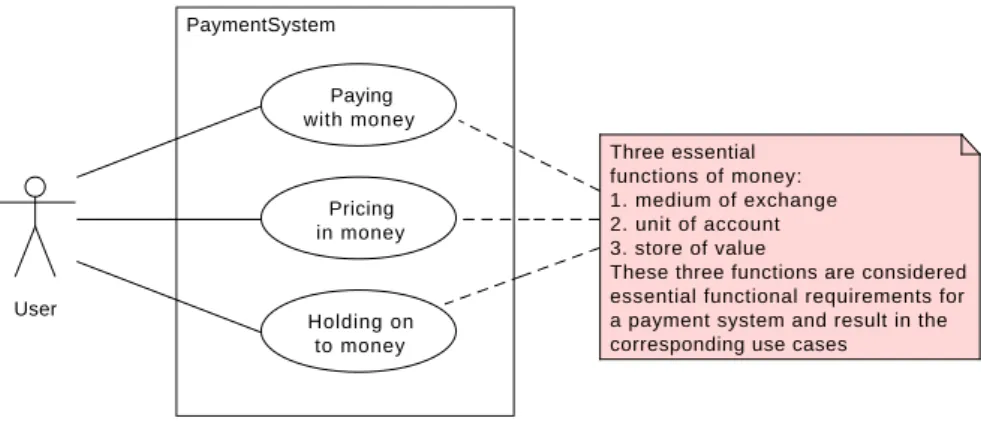
6 Requirements analysis 19 6.1 Basic functions of a payment system . . . 19
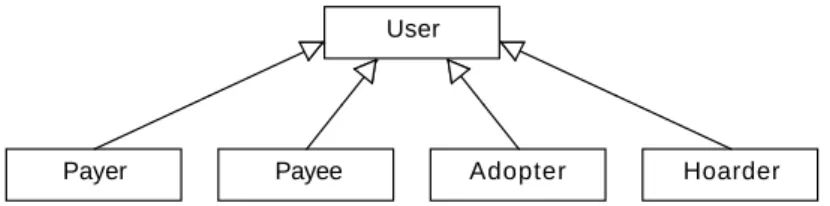
6.1.1 Users of a payment system . . . 20
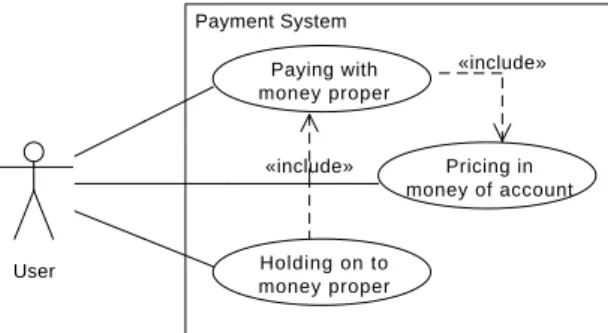
6.1.2 Use case: Paying with money . . . 20
6.1.3 Use case: Pricing in money . . . 22
6.1.4 Use case: Holding on to money . . . 23
6.2 Medium of exchange . . . 24
6.2.1 Barter exchange . . . 24
CONTENTS CONTENTS
6.2.3 Lifting the veil of barter . . . 25
6.2.4 Final settlement of debt . . . 25
6.2.5 Money proper. . . 25
6.3 Unit of account . . . 25
6.3.1 Pricing is voluntary . . . 26
6.3.2 Choosing a unit of account . . . 26
6.3.3 Potential motivations to choose a unit . . . 26
6.3.4 Specification of contracts . . . 27
6.3.5 Credit agreements . . . 27
6.3.6 Discovering the Money Meta Infrastructure . . . 28
6.3.7 Money of account . . . 28 6.4 Store of value . . . 28 6.4.1 Funding liquidity . . . 28 6.4.2 Market liquidity . . . 28 6.4.3 No new requirements. . . 29 6.5 Hierarchy of requirements . . . 29
6.5.1 Pricing first, then payments . . . 29
6.5.2 Hoarding the money proper . . . 29
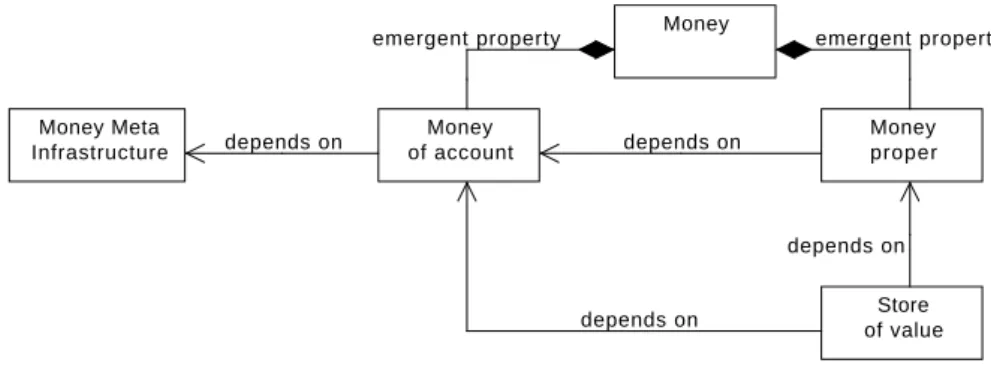
6.5.3 Conclusion on the hierarchy . . . 29
6.5.4 Relevance for Bitcoin . . . 30
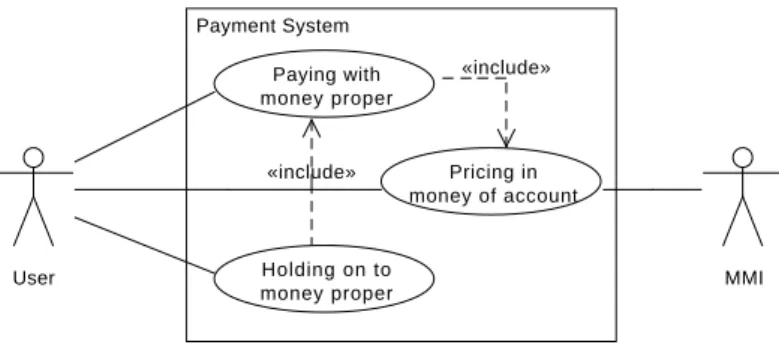
6.6 Money Meta Infrastructure . . . 30
6.6.1 Central hypothesis . . . 30
6.6.2 Credit agreements . . . 31
6.6.3 Interim Conclusion . . . 33
6.6.4 Relevance for Bitcoin . . . 34
6.7 Synopsis . . . 34
7 Bitcoin 37 7.1 Introducing the ‘coin’ . . . 37
7.2 Fundamentals . . . 40
7.2.1 Clients, nodes and wallets . . . 40
7.2.2 Transactions, addresses and transaction points . . . 40
7.2.3 Blocks and the blockchain . . . 43
7.2.4 Mining. . . 45
7.2.5 What a bitcoin is eventually. . . 48
7.3 Cryptocurrency Payment System . . . 50
7.3.1 Use case diagrams . . . 50
7.3.2 Users . . . 53
7.3.3 Use Case: Paying with bitcoin . . . 54
7.3.4 Use Case: Pricing in bitcoin . . . 57
7.3.5 Use Case: Holding on to bitcoin . . . 58
7.4 Bitcoin EcoSystem . . . 59
7.4.1 Including the EcoSystem . . . 59
7.4.2 Use case: ‘Trading in currencies’ . . . 60
7.4.3 Users . . . 61
7.4.4 One nested use case diagram to include it all . . . 61
7.4.5 Specific risks . . . 62
7.5 Beyond a payment system . . . 65
7.5.1 Some preliminary use cases . . . 65
7.5.2 Resembling (parts of) the MMI . . . 66
CONTENTS CONTENTS
8 The money view on actuality 68
8.1 A brief distinction . . . 68
8.1.1 Conventional view on money . . . 68
8.1.2 Applicability of conventional view . . . 69
8.2 Fundamentals of the money view . . . 69
8.2.1 Swap of IOUs . . . 69
8.2.2 Inside money and outside money . . . 72
8.2.3 Money or credit . . . 72
8.3 Banking Payment System . . . 74
8.3.1 How banks create inside money . . . 75
8.3.2 Usage and acceptance of bankmoney . . . 75
9 Conclusion 77 9.1 Recapitulation . . . 77
9.2 On Bitcoin . . . 78
10 Future research 81
Bibliography xviii
LIST OF FIGURES LIST OF FIGURES
List of Figures
1 Object diagram: Requirements . . . 12
2 Object diagram: Creditor pays out loan . . . 16
3 Object diagram: creditor-debtor relationship . . . 16
4 Object diagram: Debtor pays Creditor . . . 17
5 Use case diagram: Functional Requirements . . . 19
6 Object diagram: Users of a payment system . . . 20
7 Domain model: Hierarchy on Requirements . . . 30
8 Activity Diagram: Credit agreement . . . 32
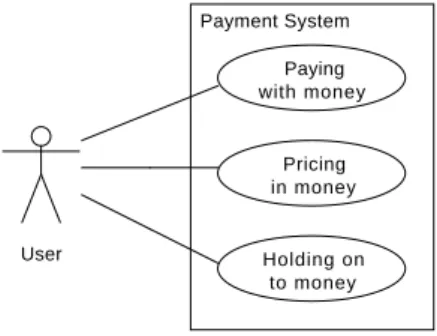
9 Initial use case diagram: Functional Requirements for a Payment System . . . . 34
10 Use case diagram: Including detail on money proper and money of account . . . 34
11 Use case diagram: Including detail on the hierarchy of requirements . . . 35
12 Use case diagram: Including the Money Meta Infrastructure (MMI) . . . 36
13 A coin: a chain of digital signatures . . . 38
14 Communications diagram: single-input/single-output transaction . . . 42
15 Class diagram: Blockchain, Blocks, Transactions . . . 43
16 Class diagram: Blockchain in more detail . . . 43
17 Object Model: Mining . . . 46
18 Coinbase transaction . . . 47
19 Use case diagram: Bitcoin used as a payment system . . . 50
20 Use case diagram: Bitcoin as CPS, including the hierarchy. . . 51
21 Nested systems diagram: Bitcoin as CPS enclosed by Network . . . 52
22 Nested systems diagram: Bitcoin as CPS enclosed by Network including MMI . . 53
23 Nested systems diagram: Bitcoin Network including hierarchy and MMI . . . 54
24 Object Model: payment transaction . . . 56
25 Communications diagram: multi-input/output transaction . . . 57
26 Nested systems diagram: the EcoSystem . . . 60
27 Object diagram: Users of a CPS . . . 61
28 Nested systems diagram . . . 63
29 Diagram on Bitcoin use cases that go beyond Bitcoin as a payment system . . . 65
30 Class diagram showing a creditor-debtor relationship . . . 70
LIST OF TABLES LIST OF TABLES
List of Tables
1 Alice’s and Bob’s stylized balance sheets: Creditclaim . . . 70
2 Alice’s and Bob’s balance sheets: swap of IOUs . . . 71
3 Bank and customer balance sheet: credit agreement . . . 75
4 Bank and customer balance sheet: payment . . . 75
Glossary Glossary
Glossary
address
is the cryptographic hashof the public key of a private/public key-pair; the address con-ceptually ’holds’ bitcoins by providing access to the bitcoins at a transaction point. xi, xvi,xvii,9,41,54,55,59
ASIC
application-specific integrated circuit. 61
asset
is a thing or a right that is priced at the current valuation of expected cash flows (e.g. generated income or potential sale). xiii–xv, 5, 11, 15, 20, 24–30, 34, 44, 51–53, 58, 60, 70–72,79
BaFin
Bundesanstalt für Finanzdienstleistungsaufsicht. 78
bankmoney
is a term used for the money proper created by commercial banks by expanding their balance sheets in an exchange of IOUs with their debtors. 18, 48, 60, 61, 68, 69,71–76, 79,82
Bitcoin
thecryptocurrencyproject that calls itsmoney properand itsmoney of account“bitcoin”; in this work the Bitcoinproject serves as the example forcryptocurrencies in general. iii, iv,ix,xi,xiii,xvi, 1–7,9,12, 14, 19, 27, 30, 34, 35,37, 39, 40, 42–45, 47–54, 56,58–62, 64,65,67–69,74,77–79
bitcoin
refers to the money proper and to the money of account of Bitcoin. iii, iv, xi–xiii, xvi, xvii,2,4,5,9,14,26,30,34,35,37,40–48,50–62,64,65,68,69,74,76,78,79
block
is a file that contains a link to the previousblockand holds a set oftransactionsthat have not been included in any preceding block in the blockchain. xi–xvi, 9,39,42–48, 57, 60, 61
blockchain
is a collection of blocks that are each linked to exactly one other block; the current blockchaincontains allblocks, beginning with thegenesis blockleading to the most recent generated block. xi–xiii,xv,4,39,42–48,54,57,59,65
BPS
Banking Payment System. iii,ix, 1,2, 5,10–12,19,35, 37,49,53, 61,62,64, 66,68,69, 71,74,76,78,79
buyer
is in this work specifically an actor that is buying bitcoinsforcurrencyon exchanges that are part of the Bitcoin EcoSystem. 60,61
ciphertext
is encrypted information. Plaintext becomes ciphertext by encryption. By decryption ciphertext becomesplaintextagain. xi,7
Glossary Glossary
client
is an application that implements all the functions necessary to be able to operate as a nodewithin the Network. xv,xvii,4,40,41,47,55
coinbase
is a name for the first output transaction in a generated block that actually does create brand new bitcoins, which are given to the mineras a reward for successfullyhashingthe block. 44,46–48
CPS
Cryptocurrency Payment System. iii,ix,1, 2,5, 10–12,19,30, 35, 37,44,49–56, 61,62, 64,65,67,69,72,74,78
cryptocurrency
is a recent (since 2009) type of digital cash scheme that does make use of cryptography to prevent its users from double-spending the digital money proper, employing a public ledger file called blockchain. iii, xi–xiii, xv, xvi, 1–5, 7–10, 13–15, 19, 26–28, 37–41, 50, 54,58,62,64,66–69,73,74,76–82
cryptographic hash function
is ahash functionthat is considered to be practically impossible to invert. Meaning there is no practical way to recreate the original data from themessage digest. 8,9
cryptographic protocol
is a protocol that defines what has to be done by what agent and in what sequence to reach a certain goal; in the cryptocurrency context it defines what is required for the cryptocurrency to work properly. 4,6–8,12,48,64,66
cryptography
is the practice and study of techniques for encoding and decoding information, for the purpose of secure communication in the presence of third parties that are to be excluded form the communication. xii,xiii,1,2,6,7,14,15,82
currency
type ofmoneythat is supported by a government or a nation state by declaring it as legal tenderwithin its jurisdiction. iii,xi,xiii,xvi,2,4,5,14–16,18,26,27,29,40,58–61,64, 72,73,76,78,79
debt
is the, potentially intentional, result of the avoidance of a payment; a certain amount of money proper, specified in the money of account, is payable by the debtor at a certain date to the creditor. xiv
deep modeling
is a term coined at the Chair for Software Development of the University of Mannheim, Germany; is a type of modeling that i.a. - contrary to conventional meta-modeling- has a systematic place for domain meta-types and therefore allows their seamless inclusion within the models. 2
difficulty
is the relative measureTmin/TactwithTactbeing thetargetof the block at hand andTmin
the smallest possible target. 47
digital cash
Glossary Glossary
domain
is a research area that has common requirements, functionality and terminology. E.g. the domain of this work iscryptocurrenciesand the terminology of it can be found within this glossary. xiv,2,11,13,40,64,73,77,82
double-spending
is a failure-mode of digital payment systems; if digital money proper can be duplicated the way files can be, its functionality is undermined; if double-spending is possible the whole payment system fails; the way double-spending is prevented in cryptocurrencies using a public ledger called the blockchain by employing cryptography technology is the key innovation of Bitcoin. xii,xiii,3,4,37–39,44–46,48,55,59
ECDSA
Elliptic Curve Digital Signature Algorithm. xvii,9,41
EcoSystem
the most widely conceivable Bitcoin related system that includes the Bitcoin Network as well as businesses and service providers that account for additional use cases, for example allow buyers and sellers of bitcoin to trade in other (foreign) currency. xi,xvi, 4,35,53, 59–62,64,76
fiat money
is a term used to indicate that the money properof apayment system viewed as a simple asset, without the properties that made it money proper, would have a price no different from or very close to zero. As an example may serve the proverbial paper note that itself is just a piece of paper but gains value through the properties that made it money proper as a paper bill. 26,27
funding liquidity
is the ability to put off payments when they come due, by paying someone else to make them. 28
generated block
a blockis generated if it was successfully mined. xi,xii,xvi,43–48
genesis block
is the first block in a blockchain; the genesis block for Bitcoin was created including information about the date of creation (by means of a mainstream media headline related to monetary policy matters of that date), to maintain that no previousminingand thereby creation of bitcoinhad happened. xi,xiii,4,43,44
hash function
is any function that can be fed with arbitrary length inputs, to create fixed length outputs. Receiving slight changes in the input, useful hash functions produce dramatic changes in the output, and allow successful mapping with (almost) no collisions. xii,xiv
hashing
is the creation of amessage digestusing acryptographichash function on data of arbitrary size. xi,xii,xiv–xvi,39,41,42,44–46
inside money
Glossary Glossary
as a means of final settlement of debt, thereby making it money proper. 69, 72, 74, 75, 78,79
IOU
acronym for ‘I owe you’. Indicates a creditor-debtor relationship. x,48,69–71,75
ISO
International Standards Organization. xvii
legal tender
is by law the money proper for alldebts, public and private that are denominated in the accordingmoney of account; legal tender doesnot mean that the correspondingmoney of account must be used to nominate private contracts, butif the corresponding money of account was used, then legal tender must be accepted in settlement of the debt. xii,15, 18,26,58,68,74
market liquidity
is the ability for a holder of an asset to realize positive cash flows from selling the asset before theassetitself would produce positive cash flows of this amount. 28,64,79
message digest
is the ‘hash value’, the result of fixed length by applying a hash function on data of arbitrary length. xii,xiii,xv,xvi,8,9,37,39,41,43,45,56,61
meta-modeling
is the analysis, construction and development of the frames, rules, constraints, models and theories applicable and useful formodelinga system. xii
miner
is anodethat decided to engage inhashingthe currentblock, which is called ‘mining’. xii, xvi,39,42–48,52–54,59,61,62,65
mining
is the hashingof a blockaccording to a specific block hashing algorithm. xiii–xvi, 9,39, 42–48,50,52–54,60–62,64,78
MMI
Money Meta Infrastructure. ix,5,23,28,30,31,33–37,53,54,61,62,64–67,72–74,76–81
model
is an abstract representation of knowledge and of activities ofsystems in a structure that is defined by a consistent set of rules. xiv,12
modeling
is the creation of models; modeling is done within a certain domain, with the goal to facilitate the comprehension of this knowledge and the activities or particular parts of it. xii,xiv, 1,2,13
money
is mentioned in reference to one of its two emergent properties money of account and money proper; depending on the context the reference to money is a reference either to moneyas themoney of accountor as themoney proper. iii,xii,xiv,xv,1–3,14,15,17–21, 23–30,34,35,48,50–52,58,59,61,65,67–69,71–74,77–82
Glossary Glossary
money meta infrastructure
is a term invented particularly for but not limited to the legal, civil and fiscal infrastructure concerning moneythat makes users of a moneyconfident enough to use and accept it at all. This includes working land registers, contract enforcement measures (e.g. bailiff), police, courts, etc. ix,xiv,5,23,28,30,62,77
money of account
is the unit that is voluntarily used to priceassetsand services; e.g. if € 100 in cash is due, the unit of account is ‘€’; in this work amoney of accountis a unit of account that is used entirely voluntarily by virtually all private economic units, because it is embedded within a certain legal and fiscal infrastructure. iv,ix,xi,xii,xiv,xv,11,15,18–20,23–30,33–35, 51–53,58,59,62,64,73,76–79,81,82
money proper
is the actual means of final settlement of debt; the money proper is a means of payment that is accepted without discount; e.g. if € 100 in cash is due, the transfer of a € 100 bill settles this debt, the € 100 bill itself is the money proper. iv,ix, xi–xvii, 3,5, 11,18–20, 25–30,34,35,51–53,55,59,62,68,72–74,76–78,82
MOOC
Massive Open Online Course. 68
Network
is the label for the communication of nodes amongst each other and about transactions and blocks; provides for a multitude of use cases, e.g. ’Pay inXBT’.ix,xii,xiii,xv,4,37, 38,40–48,50,52–55,57,59–62,64–66,72,78,79
node
is a computer, running a cryptocurrencyrelated application called a client. xii,xiv,xv,4, 39,40,42–45,47
nonce
is a random number within the header of a block that is incremented after each hashing of the header to receive a different hash for the block even if the other properties of the header stay exactly the same (even the timestamp may be updated only every couple of seconds). 45,46
orphan
is a blockthat was successfully minedand added to theblockchain, but is no longer part of the longest blockchain and therefore transactions within the orphan block have to be rebroadcast to theNetworkby the client(the standardclientdoes this automatically. xv, 43,44
outside money
is an asset that is no ones liability and that is used and accepted as means of finalsettlement of debt and therefore ismoney proper. 26,69,72,78,79
payment
is the performance of a duty, promise or obligation, in this work we emphasize specifically the settlement of debt. xii,xiii,xvi,3–5,10,11, 15–19,23, 25, 26,28,29, 35,37,42,44, 50–56,58,60,65,67,68,71–76,78–81
Glossary Glossary
payment system
is a system that provides the service of facilitatingpayments for its users. iii,ix,xi–xiii, 1,2,5,10–12,14,16–20,23,25,28–30,33–37,42,44,50–54,61,64,65,67,68,72,74,77, 81
plaintext
is the information that the sender wants a recipient to obtain. For textual information this means that the text is human readable. xi,7,8
property
is aright (not a thing) to possessand use a thing to the exclusion of others. 5,30,33,66, 81
requirement
is defining what a system shall or should do and what it shall not or shouldn’t do.. xvi, 9–12,14,19,29
RUP
Rational Unified Process. 11
satoshi
is the name for the smallest fraction of abitcoin; 1 satoshi = 10−8 bitcoin. xvi,48
seller
is in this work specifically an actor that is sellingbitcoinsforcurrency on exchanges that are part of the Bitcoin EcoSystem. 60,61
settlement of debt
the specified amount of money proper is transferred by the debtor to the creditor at or before the specified point in time. xiv,xv,15,25,34,35,52,72,76
stakeholder
is a person, organisation or role that is significantly affected by a system in any way, thereby able to contributerequirements or help to understand them. 11,19,35
system
in the systems engineering context, a system is an interacting combination of elements to accomplish a defined objective. These include hardware, software, firmware, people, information, techniques, facilities, services and other support elements, as defined by the International Council on Software and Systems Engineering. xiv,xvi,10–12,17, 19
target
is a property of eachblock; if thehash value, created byhashingthe header of the current block, is smaller than the current target that is shared among all miners, the block is successfullymined and therefore becomes agenerated block. xii,xvi,39,45–47
trader
in this work a trader is an actor buying and/or selling (trading) bitcoins on exchanges within theBitcoin EcoSystem. xvi,4,53,61
transaction
in the cryptocurrency context is a form of communication that involves two or more ad-dresses;money proper can be ‘sent’ from one addressto another by atransaction. xi,xii, xv–xvii,4,9,37–48,54–57,59,62,65,67,78–80
Glossary Glossary
transaction point
is a Elliptic Curve Digital Signature Algorithm (ECDSA) private-/public-key-pair that allows to access (by means of the private key) a bitcoinvalue that is stored at theaddress (public key) of the transaction point; used as a simplifying concept to explain a bitcoin transfer by a transaction from oneaddress to another. xi,xvii,40–44, 48, 54–57, 59, 62, 65
UML
Unified Modeling Language. 12,13,52,70
wallet
is a file created by aclientthat contains mainly private-/public-key-pairs calledtransaction points, which provide access to bitcoins (money proper) that are located at addresses; a wallet can be imagined much like a physical wallet containing bills (money proper); sometimes a clientcan be (misleadingly) called ‘wallet’. xvii,40–42,54,55,59,62
XBT
is a (non-official) International Standards Organization (ISO)form for bitcoin; US Dollar in ISOform is USD, Euro is EUR, Gold is XAU andbitcoin inISOform is XBT. xv,35, 47,48
1 INTRODUCTION
1 Introduction
The financial crisis of 2007/2008 was a crisis of financial institutions. In November 2008, shortly after the heydays of the crisis, a white paper was released, claiming that - by combining open source, peer-to-peer technology and cryptography - a payment system could be established that does not require financial institutions or any central agency, service or counterparty (see Nakamoto,2008).
1.1 Motivation
Is it possible that network technology could revolutionize yet another business branch? The inception of E-Mails put pressure on postal services, the utilization of file-sharing systems forced content providers to rethink their business models and while ‘blogging’ is still partly ridiculed by established mass media outlets, hardly one can be found that does not also publish information by using web-logs today (seeFalkvinge,2011).
Could the inception of cryptocurrencies1 mean that “a new kind of money”2 was created? Does it force a redefinition of business models for financial institutions? To what extent could this redefinition be necessary? Could the decentralizedpayment systembased oncryptography, we call the Cryptocurrency Payment System (CPS)change or even replace the currently used Banking Payment System (BPS) that is based on financial institutions and their cooperation worldwide? Could this render financial crisis’ obsolete? These and other questions arise, if cryptocurrencies are a new kind of money. This work’s aim is to contribute to finding an answer to the question ifcryptocurrenciesindeed are a new kind ofmoney.
1.2 Research objective
The work present is generic in nature, and is therefore concerned withcryptocurrenciesand their capabilities in general. However the first and oldest of the cryptocurrency projects, theBitcoin project, which exists publicly since early 2009, is used as the prime example of a cryptocurrency in this work. All specific examples and models that involve a cryptocurrency are based on the properties of the Bitcoin project. The central objective for this work is to examine the claim of the Bitcoin community that with the creation of cryptocurrencies “a new kind of money” was created. To be able to do this kind of examination the Bitcoin project needs to be looked at from an information systems perspective, as well as from a monetary theory perspective.
1.3 Research approach
Since the claim to examine is that the invention of cryptocurrencies created “a new kind of money”, it is necessary to establish an understanding of the termmoney. We approach this issue from a requirements engineering perspective on payment systems in that we ask the question: What does apayment systemhave to be able to provide for it to be used as such by a significantly large share of the population? What indeed are the requirements for apayment system?
In software development projects modeling technology is used to reduce complexity in the development process by being able to strip business logic complexity of the one that the imple-mentation itself comprises. In this way modeling technology facilitates the creation of yet to develop software systems. In this work we use modeling technology to visualize properties of systems that already do exist. In this case the worldwide payment system that is operated by financial institutions, we callBPS, and the decentralized CPS that is claimed to potentially be
1
One of the first indications of the term ‘cryptocurrency’ in a mainstream media outlet can be found on
http://www.forbes.com- accessed May 13th 2014.
2
This is a claim commonly formulated by the Bitcoin community: “Bitcoin is an innovative payment network and a new kind of money” -www.bitcoin.org/en- accessed May 13th 2014.
1.4 Structure 1 INTRODUCTION
able to replace it or parts of it.3 By using modeling technology we hope to be able to show in
detail what the capabilities of theCPS are and then examine and compare these capabilities to those offered by theBPS. We approach thesepayment systemsmainly from the viewpoint of an end-user or customer of these systems.
1.4 Structure
The first part of this work is a very short introduction to the cryptocurrency world and the payment system that operates on cryptocurrency technology in section 2. It is followed by the brief section 3 on cryptography, since cryptographic technology is used in the realization of cryptocurrencies and comprehending certain cryptographic procedures is not avoidable for a concise understanding of the working ofcryptocurrencies. Finishing the basic sections is section 4that is outlining specific areas of software engineering fundamentals that encompass procedures or techniques that were used in this work to further analyse the mentionedpayment systemsand their capabilities. Specifically modeling technology is going to be depicted, including not only conventional or ’shallow’ modeling technology, but alsodeep modelingis going to be delineated. In section5we are trying to find definitions for very key terms: money,currencyandpayment systems.
The approach in section 6 is to further inquire the term money using requirements analysis of a hypothetical payment system. We do this to be able to proceed with the examination of both the currently most widely usedpayment system, we call theBPSand thepayment system based oncryptocurrency technology, we call theCPS.
Section7is an extensive assessment ofBitcoinby going into detail on fundamental principles of cryptocurrencies. Bitcoin thereby serving as our example for a CPS. We are starting with the explanation of important terms that are essential for the understanding ofcryptocurrencies and then outlining the inner workings of Bitcoinusing modelingand requirements engineering approaches.
In section 8 we are examining the BPS after we introduce what we call ‘the money view on actuality’, which is a view effectively developed throughout the course of this work. We are focusing on the BPS, keeping in mind that it is currently the most dominant payment system and therefore must be considered to fulfil the requirements elicited for a payment system in section 6.
We draw a conclusion on our findings of the work, especially for thecryptocurrencyexamined in this work, calledBitcoin, in section9. Finally, we touch upon multiple possibilities for future research in thisdomain that look promising.
3
“Can Bitcoin replace PayPal?” - http://edition.cnn.com/2013/12/10/business/ will-bitcoin-replace-paypal/- accessed May 14th 2014.
2 CRYPTOCURRENCIES - A QUICK OVERVIEW
2 Cryptocurrencies - a quick overview
In this introductory section we want to give a quick overview overdigital cash and the specific type of digital cash that is subsumed under the label ‘cryptocurrency’. We start with some reflections ondigital cash in general and the specific challenges the attempted digitalization of moneyposes. Then we introduce cryptocurrencies that embody a form of digital cashscheme that offers a decentralized solution to the challenges thatdigital cashschemes face. We also give a quick overview on the current state of use of the oldest and most widespreadcryptocurrency that is calledBitcoin.
2.1 Digital cash
At the very first glance the demand fordigital cashseems obvious, since for about twenty years now, we are on the road to ‘the digital economy’ (seeTapscott,1995) and what better way to pay in a digital economy than with digital cash? At second glance however the question arises how exactly ‘digital cash’ would actually work.
Specific challenges for digital cash If Alice is able to pay Bob4 by the transfer of a specific sequence of bits, then what is going to stop Alice from simply copying the sequence and ‘pay’ Carol, too? In fact, what would stop her from copying the bitstring over and over again? Or looking at it from the opposite angle: what would stop a counterfeiter to reproduce the bitstring that actually is Alice’s and thereby steal from her? This is but a small fraction of challenges that revolve around the potential susceptibility of digital cash for fraud, security breaches and counterfeiting. A central issue for digital cash schemes to resolve and that we want to focus on here briefly is the so called issue ofdouble-spending.
Double-spending - a central issue for digital cash Very important yet trivial for successful paymentsin general is the inability for a payer to pay two (or more) payees with the very same money proper5. In other words: if it is possible for a payer to double-spendthe identicalmoney proper, then this type of money proper is not suitable for payments. A money proper that can bedouble-spentwould be immediately rejected in future attempts to pay. Double-spending is a very crucial challenge for digital cash schemes to overcome, since it is very easy to simply copy digital information.
Central authority as solution If a central authority was part of thedigital cashscheme and it was trusted by all participants then thedouble-spendingproblem could be resolved by checking the legitimacy of eachpayment transaction with the central authority. In a scheme of this kind thedigital cashwould be an actual digital token that was completely administered by the central authority, which would therefore act much like a bank. While a perfectly working central party alleviates the problems mentioned, including double-spending, it might be considered a great risk for the entire digital cash scheme to be totally dependent on the soundness of just one central authority. If it failed in any way, the entire system would be affected. In the past the digital cash schemes based on tokens and a central authority have hardly even succeeded as the mere customer loyalty systems they have been so far, let alone succeeding as an actual cash
4
Alice and Bob are commonly used placeholder names, seehttp://en.wikipedia.org/wiki/Alice_and_Bob -accessed June 28th 2014.
5
see section 6.2 to find the definition of this term and why it is used here instead of the more general term money.
2.2 What is a cryptocurrency? 2 CRYPTOCURRENCIES - A QUICK OVERVIEW
equivalent.6 Cryptocurrencies on the other hand are a kind of digital cash scheme that claim
to have resolved the crucial issue of double-spendingcompletely without the need for a trusted central authority or even a central party of any kind.
2.2 What is a cryptocurrency?
In this work we recognize acryptocurrencyas adigital cash scheme that does not need the sup-port of a central server or other trusted central party to prevent its users from ‘double-spending’, but instead relies on a specific cryptographic protocol to do so. Furthermore cryptocurrencies operate on apeer-to-peer basis withnodesrunning clientsoftware that is typicallyopen source. Hereafter we introduce theBitcoinproject by depicting some key features. The detailed descrip-tion and explanadescrip-tion of the underlyingcryptographic protocolhowever follows further below, as it is an essential part of section 7.
Bitcoin - the inception of cryptocurrencies The first and therefore oldest cryptocurrency project started in January of 2009 with the public release of the standardclientsource code and the initial calculation of thegenesis block.7 Its inventor Satoshi Nakamoto8 gave the project the name ‘Bitcoin’ in a white paper that was released in late 2008 (see Nakamoto, 2008). In this work it is thecryptocurrencyproject Bitcointhat is going to be used as the prime example for cryptocurrenciesin general.
Transactions Bitcoin allows payments to be made within the Network by executing transac-tions that are fast, cheap and irreversible.9 An average waiting time of ten minutes for the initial and about 60 minutes for the final confirmation10 of an international payment, sounds very compelling and is indeed very fast compared to the alternative of a standard commercial bank money transfer that can take multiple days in international venues.11 Once thetransaction is finally confirmed it is irreversible. Additionally the transaction costs of a bitcointransaction are - at least so far - nothing but minuscule compared to bank transfers or credit card payments. For more details ontransactionssee section7.2.2.
Bitcoins are traded in traditional currencies On exchanges that formed within the Bitcoin EcoSystem traderscan buy or sellbitcoinsfor traditionalcurrencies, such as USD or EUR. The exchanges are so far the interface between the Network and the traditional monetary system. While the price ofbitcoin in USD has been very volatile all along it has been rising from being essentially zero at inception to about $ 600 per one bitcoin in June of 2014, reaching highs in late November of 2013 of more than $ 1100.
6
One example of a completely failed digital cash scheme of the token and central authority kind is beenz.com. See ‘The greatest defunct Web sites and dotcom disasters’ (June 5th 2008) -http://web.archive.org/web/ 20080607211845/http://crave.cnet.co.uk/0,39029477,49296926-7,00.htm- accessed June 26th 2014.
7This is a reference to the key innovation of Bitcoin: the public ledger calledblockchainthat started on Jan 3rd
2009 with thegenesis block-https://en.bitcoin.it/wiki/Genesis_block- accessed June 28th 2014.
8This name is probably a pseudonym, potentially for a group of people, however there is a claim
by newsweek for it being the real name of one person only: http://www.newsweek.com/2014/03/14/ face-behind-bitcoin-247957.html- accessed June 10th 2014.
9
For a list of these properties, seehttp://www.coindesk.com/information/why-use-bitcoin/- accessed June 10th 2014.
10The first confirmation of atransactionhappens after approximately 10 minutes, a chart that shows confirmation
time can be accessed here: http://blockchain.info/charts/avg-confirmation-time- accessed June 28th 2014.
11
While being limited in the transferable amounts, payments by credit cards are even faster than the confirmation ofBitcoin transactions, since the credit card company is paid by the payee for acting as a fiduciary middleman. Using fiduciary trust in this way is something that can be reproduced forBitcoin transactions, making them potentially equally fast, however obviously introducing a trusted third party in doing so.
2 CRYPTOCURRENCIES - A QUICK OVERVIEW 2.2 What is a cryptocurrency?
No central authority In early 2013 the price increase in USD forbitcoinscoincided with prob-lems in financial stability in Cyprus. Amongst other measures the government of Cyprus decided to lower the allowed cash (money proper) limit to € 1000 per traveler. By various means, includ-ing the levyinclud-ing of special taxes, the government of Cyprus also called on businesses and private households that owned savings accounts with more than a € 100.000 balance in the effort to re-instate financial stability in Cyprus (seeStavárek,2013, pg 316). Recognizing the decentralized cryptocurrency infrastructure, central governments are very limited in their abilities to levy spe-cial taxes of this kind oncryptocurrencies. In the context of central governments trying to levy special fees or taxes, albeit under the guise of general welfare, the conjuncture that there simply is no central point of reference incryptocurrencies can be viewed as an immense advantage for individual users.
Why are cryptocurrencies not prevalent? Most of the above in this section could be construed as advertisement, even though Bitcoin is, after all, not run by a for profit corporation that has a marketing budget. Still, the properties of Bitcoin described so far could be perceived as almost too good to be true (to recap pointedly: “open-source, peer-to-peer, cheap, fast, secure, irreversible, rising prices, safe from arbitrary intervention of governments et cetera”). So thepayment systempowered bycryptocurrencytechnology should be already the most used payment system out there, shouldn’t it? But since it is not, even though the properties sound so compelling, we are confronted with the question “why isn’t it?” Why are private businesses and organizations at large not pricing their assets, goods and services in bitcoin? Why do private households still at large shy away from pricing their propertiesor other assets in some cryptocurrency?
Is it just technically too difficult to use for average households and businesses? Is it possible that the still rare usage is a mere usability issue? Cryptocurrencieswould not be the first on-line technology that was invented years before broad or even mass adoption and usage started for mere improvements in usability.12
Maybe potential users just do not know enough about the new cryptocurrency payment sys-temsand their capabilities. Are potential users just too uninformed about the possibilities that the new cryptocurrencies provide? If this was true, it would be a mere hermeneutical chal-lenge and as soon as the education about cryptocurrencies is advanced and successful enough they would reign supreme in usage amongst the payment systems worldwide, considering the seemingly obvious advantages in velocity and cost of transactions to performpayments.
The working hypothesis Perhaps it is neither simply a usability or an educational issue nor just a combination of both. Potentially there is a deeper reason that has so far prevented the mass adoption ofcryptocurrenciesthat still have not had their march of triumph as ‘a new kind of money’ yet. In fact, it is going to be the working hypothesis for this work that something indeed is prohibiting bitcoin from mass adoption that goes beyond usability or educational issues and it probably has to do with risk avoidance of potential users.13 These considerations concerning risks could be revolving around the volatility in the price of bitcoin compared to other currencies. The potential users most likely have expenses that are nominated in those currenciesand they need to cover these expenses when they are due by transferring the money properof thosecurrencies, they can not rely solely upon the cryptocurrency income.14
12This is an idea fromFalkvinge(2011). 13
Refer to footnote 31forexpedia.comon one hand announcing its willingness to ‘accept’bitcoinsaspayment but at the same time strictly limiting the acceptance to certain use cases and announcing the unwillingness to holdingbitcoins, due to risk avoidance.
14This issue is going to occupy us throughout this work, but for reflections on risk reduction specifically, see section
6.6on theMoney Meta Infrastructure(MMI) thatBitcoin, seen as aCryptocurrency Payment System, shows significant differences in compared to theMMIthat theBanking Payment Systemis embedded in.
2.2 What is a cryptocurrency? 2 CRYPTOCURRENCIES - A QUICK OVERVIEW
Security Bitcoin is designed to prevent the tampering with information, impersonation and outright stealing of others. In this sense Bitcoin is all about making sure the integrity of transactions is always guaranteed. This is a challenge that is generally well known to the physical world, where it is dealt with by signatures, bank vaults, safes and locks of various kind. In the world of bits and bytes this challenge is tackled by employing cryptography and this is exactly what Bitcoin does and this is why it can also be viewed as being a cryptographic protocol.
3 CRYPTOGRAPHY
3 Cryptography
On the one hand it is not necessary, on the other it is way beyond the scope of this work to go into detail about cryptography. However to comprehend the fundamental principles that cryptocurrencieswork on in some detail, it is helpful to understand the basic ideas of certain cryptographic principles. The principles that are specifically relevant for the cryptographic protocol that is implemented by the cryptocurrency project Bitcoin, are going to be briefly explained in this section.
3.1 Symmetric cryptography
Cryptography is the study of technologies that allow secure communication that is the exchange of information unscathed by third party adversaries, who potentially want to intrude, listen to or change the communication. So, if Alice wants to send information to Bob securely, the basic idea is to not just send the information as plaintext - say by E-Mail - from Alice to Bob, but for Alice to use a key to encrypt the information and sending it to Bob asciphertext. The same key can later be used by Bob to decrypt the information to make ithuman readableagain. This way Alice and Bob can send each other messages that cannot be read by third parties as long as Alice and Bob are holding the key exclusively and the encryption cannot be broken.
Alice and Bob obviously have to exchange the key before being able to communicate securely. This can be a problem for multiple reasons. If Alice and Bob are communicating on-line the simple exchange of the key as plaintext undermines the intent to encrypt information at all, since a key that was sent as plaintext via internet communication can be considered the release of this key to the whole world. Using this key still with the intent to communicate securely, even though it was transferred in plaintext between Alice and Bob beforehand, is blatantly imprudent. So for symmetric cryptography to work in the intended way, there needs to be an initial key exchange of at least one secret key. This key exchange needs to besecurein the sense that after the exchange the keys are known by the intended parties (here: Alice and Bob) and stay secret for everybody else.
One possible way to exchange keys securely is to arrange a physical meeting and exchange the keys without third party interference. However the physical meeting to do a key exchange can be problematic in itself and is especially impractical for fast-paced on-line technologies, like cryptocurrencies.
There is a way to overcome this key exchange problem, by using another cryptographic algo-rithm that involves not only a single key, but a key-pair, where one key is released to the public and the other key stays private, the encryption is done with one key, the decryption with the other. This class of algorithms is called ‘public key cryptography’ or ‘asymmetric cryptography’.
3.2 Asymmetric cryptography - public key cryptography
Public key cryptography is a class of cryptographic algorithms that involve two separate keys. The two keys are mathematically linked in such a way that allows the encryption of data with one key and the decryption with the other. The user now has the option to make one of the keys public (so called ‘public key’) and to keep the other one secret (so called ‘private key’). For the sending of encrypted text the encryption is done with the public key and the decryption with the private key. The algorithm makes use of the fact that mathematical problems exist that currently cannot be solved efficiently. While it is necessary for the user to be able to calculate a private and a public key in reasonable time, the calculation of the private key from knowing the public key has to be mathematically infeasible to make the algorithm work (seeKatz & Lindell, 2007, pg. 333ff.).
3.3 Cryptographic hashing 3 CRYPTOGRAPHY
Figuratively speaking we could think of public key cryptography as if it was a system of boxes and padlocks. The public key in this metaphor would consist of a box with an open padlock that could be closed by anyone who is in front of the padlock. To open the box that was locked with the padlock and find out what contents were put in you need the key to the padlock. So if Bob wants to communicate securely with Alice, he needs to create a key-pair and publish his public key. Alice then can use Bob’s public key to encrypt plaintext she wants to send to Bob. In the metaphor this is putting something into the box and locking it with Bob’s padlock. If we assume that the box is unbreakable, the padlock cannot be picked and that only Alice holds a key to her padlock, then indeed only Alice has access to whatever is in the box.
Notably there is no need for an initial secure exchange of a private key, since Alice doesn’t need access to Bob’s private key. She can use his public key to encrypt whatever plaintext she chooses, yet only Bob is going to be able to decrypt the ciphertext back to plaintext using his private key.
Diffie-Hellman handshake One possible use of these types of algorithms is the exchange of a secret key between two parties that initially do not know anything about each other. After the establishment of a common secret key, the two parties can start to communicate securely using symmetric cryptography. This is generally done by the calculation of a shared secret, using mathematical problems that - at current understanding - do not allow for an efficient solu-tion. This process was first described and published by Diffie and Hellman, using a fundamental group in number theory (‘multiplicative group of integers modulo n’) as source for the mathe-matical problem, and is therefore often called ‘Diffie-Hellman key-exchange’ or ‘Diffie-Hellman handshake’ (Diffie & Hellman,1976).
Most relevant insight Generally speaking the most relevant insight about asymmetric cryp-tography is the realization that it is possible for two initially unknown parties who communicate over an unsecured channel to generate a shared secret key that can be subsequently used for secure communication.
Even though the word ‘cryptocurrency’ does signal the use of cryptography, neither symmetric nor asymmetric cryptography is used in the most basiccryptocurrency protocol. For this works purpose asymmetric cryptography is mentioned to facilitate the understanding of cryptographic hashing and digital signature algorithms, which are both heavily used in cryptocurrencies and are explained hereafter.
3.3 Cryptographic hashing
If Alice sends encrypted messages using Bob’s public key for encryption, then Bob can read the message by applying his private key to receive plaintext again. However Bob cannot be sure that the message was not altered on the way to him. To alleviate this problem Alice can use a cryptographic hash functionto create amessage digest(also called ‘hash value’ or ‘digest’) and append it to the message. Bob can then himself use the cryptographic hash function, create a digest himself and compare it with the one he received by Alice attached to the original message. Cryptographic hash functions are designed in a way that they produce fixed length outputs (message digests) off of inputs of variable length. For these functions to be useful they are practically impossible to invert, meaning that someone receiving thehash valuealone cannot create the original message from it (see Katz & Lindell,2007, pg. 278ff.). So if Bob finds the two hash values are the same, he can be (reasonably) sure the message he received remained intact on the way to him.
However there is another challenge for Alice to make sure the message digest got sent to Bob intact, because if the message digest is altered on the way to Bob, then he cannot successfully
3 CRYPTOGRAPHY 3.4 Digital signature algorithms
compare the digest he received with the one he created himself. One way to do this is the inclusion of the message digest in a digital signature.
Most relevant insight Cryptographic hashing is the creation of a message digest(also called hash valueor just hash and sometimesdigest) of fixed length by application of a cryptographic hash functionon a message of variable length. It is used on multiple occasions in cryptocurren-cies, this includes the hashing of the header of a block, which is part ofmining and the hashing ofBitcoin addresses. It is also applied in what is called a Merkle tree, which is a tree structure that hashes the hashes of data until there is only one root hash left (seeNakamoto, 2008, pg. 4).
3.4 Digital signature algorithms
Digital signatures are a class of public key algorithms, and therefore use a mathematically linked key-pair as all public key algorithms do. In the asymmetric cryptography algorithm depicted above however, the encryption was done using the public key and the decryption was done using the private key. Digital signatures are carried out vice versa. Within digital signature algorithms theencryption is done using the private key and thedecryption using the public key (seeKatz & Lindell,2007, pg. 421ff.).
If Bob was Alice’s banker it could be necessary to prevent third party adversaries to imper-sonate Alice and perform actions on her account that she never approved off. So Bob wants to make sure that messages he supposedly got from Alice were actually sent by her. To accomplish thisrequirement, Alice could include a digital signature with her message.
For a digital signature to be created the first step is to create adigestby using acryptographic hash function, as was depicted above in section 3.3. The second step is the encryption of the digest using the private key. Finally this digital signature is attached to the message.
1. Create a message digest
2. Encrypt the digest using the private key 3. Attach encrypted digest to the message
With digital signatures it becomes possible for Bob who has just received a message from Alice to verify that the message indeed was sent by Alice (‘authentication’) that it has not been altered on the way (‘integrity’) and if Alice still maintains that the private key that was used to digitally sign the message, is still private, then Alice cannot shy away from the responsibility that comes with having actually sent the message (‘non-repudiation’).
Most relevant insight Digital signatures are pretty much used like signatures in the physical world. Sophisticated mathematics can make digital signatures potentially as forgery-proof as real world signatures or make them even tougher to forge and therefore more secure. InBitcoin anElliptic Curve Digital Signature Algorithm (ECDSA) is used for the signing oftransactions. The current owner of a sum of bitcoins signs the transfer to the new owner, by including the new owner’s public key as an output in thetransaction and then signing using his private key. This is going to be depicted in much more detail in section7.
4 SOFTWARE ENGINEERING
4 Software engineering
It is way beyond the scope of this work to give a comprehensive introduction to software engi-neering or even a detailed analysis of the multiple different practices, methods and principles of software engineering that reach from rigorously formalized approaches to much more informal and agile methods.
It is the aim of this section to introduce the sub-disciplines of software engineering that include practices that were used to approach the central issue of this work, which is the question if a recently invented open-source peer-to-peer software system, we call theCryptocurrency Payment System(CPS), can in any way change or even replace the already long existingBanking Payment System(BPS). To do this the attempt is to understand these twopayment systemsas profoundly as possible and to achieve this, we employ practices out of software engineering. Essentially we are taking a look at existing systems from a software engineering perspective. The BPS is a complex system that is partly a software system, too, but cannot be reduced to being just that. Therefore the initial starting point of this section could actually even be set to ‘systems engineering’ that software engineering is a part of. But we will start at this point with software engineering, more specifically with the sub-disciplines of it relevant for this work: Requirements, Software design andSoftware engineering models and methods. The whole section is oriented on the ‘Software Engineering Body of Knowledge V3.0’ (Bourque & Fairley,2014) and was inspired by Sommerville(2011).
4.1 Requirements and Design
In software engineering therequirements can be thought of as the bridge between the so called real world and the world of software-intensive systems. They are essentially the translation of real world needs into a form that can be realized as a software artefact. In this sense requirements are a reflection of real world problems that can be read and understood by software engineers, who then again translate requirements into actual software systems.
Typically requirements are defined early on in the software development process. Starting with an analysis of the real world problems and the environment that the system will be later used in, requirements are defined as a specification of what the system is supposed to be doing. Requirements can also put constraints on systems. Either as specification or as constraints, requirements define for the software developer what needs to be implemented and also how the implementation should be executed (see Bourque & Fairley,2014, p. 1-1).
Definition Requirements define what the system should or should not do. This is a very general definition that does not take into account that there are specific types of requirements. An example for a requirement is:
“The system shall provide a service that allows a user (payer) to safelypay another user (payee), within one business day, thereby conforming to all laws applicable.”
The requirements process The requirements process is conceptually split into the activities of elicitation,analysis,specification andverification (see Bourque & Fairley,2014, pg. 1-3). Even though this may sound like a linear process, and it is indeed initiated at the very beginning of a software development endeavour, it is neither linear nor finished up front. The requirements process is a continually running process throughout the software life cycle, while the requirements are constantly analysed, specified and refined.
4 SOFTWARE ENGINEERING 4.1 Requirements and Design
Product and process requirements A requirement may concern the product, meaning the system that is to be developed, or the process of development. An example for a product requirement is:
“The system shall yield amoney properthat allows the users to performpayments.” An example for a process requirement is:
“The system shall be developed according to the Rational Unified Process (RUP).”
Functional requirement Functional requirements describe the features of the system, for ex-ample the ability to execute payments within a certain time. They also may state what the system should not do. It is possible to test for the fulfilment of a functional requirement by a finite set of test steps. In any way functional requirements describe how the system is supposed to react to particular inputs and in particular situations. As functionaluser requirements, they are very high-level statements, just as:
“Themoney of accountof the system shall have properties that lead to the voluntary pricing of assets, goods and services by the users.”
As functionalsystem requirements however they should describe the system services in detail.
Non-functional requirement Non-Functional requirements are the constraints for the system and are sometimes also calledquality requirementsand apply therefore often to the system as a whole rather than to a specific feature or service. They can be classified further into requirements concerning security, reliability, safety, interoperability, performance or any other type of quality characteristic. An example of a non-functional product requirement
Emergent property An emergent property is a type of requirement that is dependent on the collaboration of many components of the system. The above mentioned requirement of pricing assetswith a certainmoney of accountdepends on how all the system components interact under real-life operating conditions. This requirement clearly is an emergent property for a payment system, which is going to be further explored in section 6.3.
Stakeholders It is an important issue for a requirements engineer to appreciate that not only the potential users of a system can and do provide requirements. Various kinds of direct and indirectstakeholders are also able to contribute requirements or facilitate the understanding of requirements that are already elicited. To put it in another way: stakeholders are prone to lose something if the system does not conform to theirrequirements.
Requirements document The requirements document is a desired product of the requirements process. The continuous refinement of requirements through analysis, specification and verifi-cation iteratively improves the requirements document, which therefore is never finished at any one point during the software life cycle. The changes in the requirements document are often so frequent and quick that many agile software engineering methods, consider even creating a requirements document a waste of time. They are instead handling requirements in what is called user stories (seeSommerville,2011, 3.3).
As a side note at this point: In this work there is not going to be an exhaustive requirements document produced for either one of the evaluated payment systems (BPS, CPS and a non-existent hypothetical payment system). The actual creation of a comprehensive requirements document for payment systems could be a field of potential further enquiry. However this could be more difficult than initially thought of. The specifics of the payment systemsdomain
4.2 Software engineering models and methods 4 SOFTWARE ENGINEERING
Non-Functional Requirements Functional
Requirements
translated into SoftwareSystem translated into Requirements
RealWorld problem
Figure 1: Object diagram on requirements, using concepts of theUML.
might cause certain stakeholders that are currently influential in theBPS(potentially particular nation states and other important stakeholders), to refrain from disclosure of all of their actual requirements. This is an example for special challenges that requirements engineers can face during the requirements engineering process. In this case actual requirements are simply not mentioned during requirements elicitation for lack of interest in disclosure of theserequirements by the respective stakeholders.
Conceptual Modeling It is part of the requirements analysis activity within the requirements process to createmodelsof real-world problems.
“[C]onceptual models comprise models of entities from the problem domain, config-ured to reflect their real-world relationships and dependencies.” (Bourque & Fairley, 2014, pg. 1-8)
We will apply modeling technology during the requirements analysis of payment systems in section6 and for the understanding ofBitcoinand the analysis and evaluation of both theCPS andBPS. A very simple example for a graphical model of some of the contents of this section on requirements is shown in figure1, using most basic modeling concepts (including generalization). This structural model is conforming to the general-purpose modeling language UMLthat was defined byBoochet al. (1998).
Design transforms requirements Software design transforms requirements into a description of how to solve the real-world problem at hand and includes the planning of a software solution for this problem. Design encompasses both low-level component and even algorithm design as well as high-level, architecture design (see Bourque & Fairley,2014, pg. 2-1).
Reverse engineering existing designs in this work As we are involved in design activities in this work, we are reverse engineering already existingsystemsthat realize a certain design. It is the task to reveal first the architectural design of the existing systems. We will go into reverse engineering of algorithm design in section 7, when we discuss the inner workings of theBitcoin protocol.
4.2 Software engineering models and methods
The aim of scientific modeling in general is to make the comprehension of a particular part of the world easier. The intention for the use of modeling technology is the very same in software engineering. One key intention in using graphical modeling languages is to facilitate the communication process between the software developers and the other, potentially non-technical, stakeholders of the project.
4 SOFTWARE ENGINEERING 4.2 Software engineering models and methods
4.2.1 Modeling
Modeling technology today is a key activity in virtually all information technology projects. In the software development process modeling is used to separate the complexity that is imple-mentation specific from inevitable business logic complexity. By being able to abstract from complexity that arises during implementation, modeling helps to focus on and intellectually penetrate the business logic at hand. This is precisely the intention in this work, in which the graphical general-purpose modeling language Unified Modeling Language (UML) was used, to help understand thedomainof this work,cryptocurrencies.
4.2.2 Software engineering methods
Facing a real world problem that is supposed to be solved by a software-intensive system and then just staring to write code is a strategy that might be successful for a real world problem that can be tackled by software solutions of limited complexity, but big software-intensive systems demand for another method. This is the reason why concise software engineering methods have been defined, whereby such a method is considered being first and foremost an “organized and systematic approach to developing software [..]” (quoted from Bourque & Fairley, 2014, pg. 9-7).
Method applied in this work There is no specific software development method rigorously applied to the real-world problem that is at the centre of this work. However the heuristic method applied is oriented on object-oriented analysis and design methods and was adapted to domain specific needs. The models created are based on concepts of theUMLthe intent always being to provide as much understanding of thedomainas possible using these types of diagrams. So, sometimes the models are not conforming to UML meta-models in their entirety (see for example the nesting of systems in the diagram in figure28 on page 63).
4.2.3 Modeling tools used in this work
For the creation of the UML models that are shown in this work the free and open-source software UMLet was used.15
15
5 CURRENCY, MONEY, PAYMENT SYSTEMS
5 Currency, money, payment systems
As mentioned in1.2 the chief aim for this work is to find out if thecryptocurrency community has indeed created a new kind of money. It seems obvious that certain basics oncryptography need to be discussed in an introductory section in this work (see section 3). The same is true forcryptocurrencies, employing cryptographictechnologies in a new and potentially sweepingly innovative way (see section 2). Also a very short introduction to software engineering, respec-tively specific sub-areas that provide practices and concepts employed in this work, is given in section 4. But also the terms currency, money and payment systems as concepts are suited to get a section that sets the stage. Not because moneyas a technology is so new, but because we want to start off this investigation as little as presumptuous as possible. First we want to inquire modern macroeconomics what it has to say about money and the functions or requirementsit has to fulfil to be used as such.
5.1 Money
In mainstream macroeconomic textbooks, an example is Mankiw (2007) or Mankiw (2014), another is Hicks (1967), money is explained by the functions it fulfils (see Mankiw, 2007, pg. 22f.). The functions referred to are in brief:
1. medium of exchange 2. unit of account 3. store of value
Having the research objective of this work in mind and looking at these functions it is tempting to merely check if theBitcoinsystem does indeed create something (bitcoins) that is used as a ‘medium of exchange’, as a ‘unit of account’ and as a ‘store of value’. Of course we would have to elaborate on these three functions - we do this extensively in section6 - but let’s assume for sake of the current section that these functions were self explanatory. Our investigation could already end right here and we would just state: “Well, if it was used in a way to fulfil these functions, then it must be money.” Astonishingly, in a way, this is exactly the perspective that is taken on bitcoinby some economists:
“Currency is any agreed upon means of exchanges of goods and services, so you could have some small stones, as used in history, and if it’s accepted by a sufficiently large population, then that’s enough [...]”16
The logic in this reasoning is simple and at first glance seems to be convincing: if it is “accepted by a sufficiently large population”, then it is money. End of story. How apayment systemwould have to be designed however for it to be used “by a sufficiently large population” is exactly what is of interest to us in this work, the assumption here being that Bitcoin is currently not used “by a sufficiently large population” as theirmoney.
5.2 Currency
Since it is our goal to enquire if cryptocurrenciesare “a new kind of money” we need to establish an understanding of what acurrency is. The termcurrencyis defined in Black’s Law Dictionary as follows:
16
Paul Ehling, associate professor in the department of financial economics at the BI Norwegian Business School - cited in ‘Bitcoins Fail Currency Test in Scandinavia’s Richest Nation’ -http://www.bloomberg.com/ news/2013-12-12/bitcoins-fail-real-money-test-in-scandinavia-s-wealthiest-nation.html - ac-cessed May 13th 2014.