Contents lists available atSciVerse ScienceDirect
Science of Computer Programming
journal homepage:www.elsevier.com/locate/scicoA practical solution for achieving language compatibility in scripting
language compilers
Paul Biggar
∗, Edsko de Vries, David Gregg
Lero@TCD, Trinity College Dublin, Dublin 2, Ireland
a r t i c l e i n f o Article history:
Available online 26 February 2011
Keywords:
Compiler Scripting language
a b s t r a c t
Although scripting languages have become very popular, even mature scripting language implementations remain interpreted. Several compilers and reimplementations have been attempted, generally focusing on performance.
Based on our survey of these reimplementations, we determine that there are three important features of scripting languages that are difficult to compile or reimplement. Since scripting languages are defined primarily through the semantics of their original implementations, they often change semantics between releases. They provide C APIs, used both for foreign-function interfaces and to write third-party extensions. These APIs typically have tight integration with the original implementation, and are used to provide large standard libraries, which are difficult to re-use, and costly to reimplement. Finally, they support run-time code generation. These features make it difficult to design a fully compatible compiler.
We present a technique to support these features in an ahead-of-time compiler for PHP. Our technique uses the original PHP implementation through the provided C API, both in our compiler and in our generated code. We support all of these important scripting language features. Additionally, our approach allows us to automatically support limited futurelanguage changes. We present a discussion and performance evaluation of this technique.
©2011 Elsevier B.V. All rights reserved.
1. Motivation
Although scripting languages1 have become very popular [32], most scripting language implementations remain interpreted. Typically, these implementations are slow, between one and two orders of magnitude slower than C. There are a number of reasons for this. Scripting languages have grown up around interpreters, and were generally used to glue together performance sensitive tasks, often consisting of existing code, rather than to write full applications. Hence, the performance of the language itself was traditionally not important. As they have increased in prominence, larger applications are being developed entirely in scripting languages, and performance is increasingly important.
The major strategy for retrofitting performance into an application written in a scripting language is to identify perfor-mance hot-spots, and rewrite them in C using a provided C API. Though this is not a bad strategy and certainly a strong alternative to rewriting the entire application in a lower level language, a stronger strategy still may be tocompilethe entire
∗Corresponding author.
E-mail addresses:[email protected](P. Biggar),[email protected](E. de Vries),[email protected](D. Gregg).
1 It is difficult to give a precise definition of ‘‘scripting language’’. In this paper, we address problems inherent in the compilation of PHP, Perl, Python, Ruby and Lua. We will use the term scripting language specifically to refer to this set of languages. Many other languages can be argued to be scripting languages, but they typically do not present the compilation problems we address in this paper.
0167-6423/$ – see front matter©2011 Elsevier B.V. All rights reserved. doi:10.1016/j.scico.2011.01.004
application. Having a compiler automatically increase the speed of an application is an important performance tool, one that contributes to the current dominance of C, C++ and Java.
However, it is not straightforward to write a scripting language compiler. Scripting languages do not, in general, have standards or detailed specifications.2Rather, they are defined by the behaviour of their initial implementation, which we refer to as their ‘‘canonical implementation’’.3The correctness of a later implementation is determined by its semantic equivalence with this canonical implementation. It is also important to be compatible with large standard libraries, written in C. Both the language and the libraries often change between releases, leading to not one, but multiple implementations with which compatibility must be achieved.
In addition, there exist many third-party extensions and libraries in wide use, written using the language’s built-in C API. These require a compiler to support this API in its generated code, since reimplementing the library may not be practical, especially if it involves proprietary code.
A final challenge is that of run-time code generation. Scripting languages typically support anevalconstruct, which
executes source code at run-time. Even whenevalis not used, the semantics of some common language features (most notablyinclude, Section2.4.2) require some compilation or interpretation to be deferred until run-time. A compiler must
therefore provide a run-time component, with which to execute the code generated at run-time.
Inphc[5], our ahead-of-time compiler for PHP, we are able to deal with the undefined and changing semantics of PHP by tightly coupling our compiler and the existing PHP system. By the term PHP system we mean the PHP source-code compiler, interpreter, run-time system and libraries. At compile-time, we use the PHP system as a language oracle. That is, we call into the PHP system to discover the meaning of constructs, such as the result of adding two constant values. By asking the PHP system, rather than hard-coding the semantics of all PHP language features into our compiler, the code generated by our compiler changes to match certain classes of change in the canonical PHP system. This gives us the ability to automatically adapt to changes in the language, and allows us to avoid the long process of documenting and copying the behaviour of several different versions of the language. We also generate C code which interfaces with the PHP system via its C API. This allows our compiled code to interact with built-in functions and libraries, saving not only the effort of reimplementation of large standard libraries, but also allowing us to interface with both future and proprietary libraries and extensions. Finally, we reuse the existing PHP interpreter instead of attempting to implement run-time code generation. This means we are not required to provide a run-time version of our compiler, which can be a difficult and error-prone process.
Since many of the problems we discuss occur with any reimplementation, whether it is a compiler, interpreter or JIT compiler, we shall generally just use the term ‘compiler’ to refer to any scripting language reimplementation. We believe it is obvious when our discussion only applies to a compiler, as opposed to a reimplementation which is not a compiler.
In Section2.1, we provide a short motivating example, illustrating these three important difficulties: the lack of a defined semantics, emulating C APIs, and supporting run-time code generation. In Section3, we examine a number of previous scripting language compilers, focusing on important compromises made by the compiler authors which prevent them from correctly replicating the scripting languages they compile. Section3.5discusses the complementary approach of using a JIT compiler. Our approach is discussed in Section4, explaining how each important scripting language feature is correctly handled by re-using the canonical implementation. Section5discusses PHP’s memory model. An experimental evaluation of our technique is provided in Section6, including performance results, and supporting evidence that a large number of programs suffer from the problems we solve.
2. Challenges to compilation
There are three major challenges to scripting language compilers: the lack of a defined semantics, emulating C APIs, and supporting run-time code generation. Each presents a significant challenge, and great care is required both in the design and implementation of scripting language compilers as a result. We begin by presenting a motivating example, before describing the three challenges in depth.
2.1. Motivating example
Listing1contains a short program segment demonstrating a number of features which are difficult to compile. The program segment itself is straightforward, loading an encryption library and iterating through files, performing some computation and some encryption on each. The style uses a number of features idiomatic to scripting languages. Though we wrote this program segment as an example, each important feature was derived from actual code we saw in the wild.
Lines 3–6 dynamically load an encryption library; the exact library is decided by the$enginevariable, which may be provided at run-time. Line 9 creates an array of hexadecimal values, to be used later in the encryption process. Lines 12–16 read files from disk. The files contain data serialized by thevar_exportfunction, which converts a data structure into PHP
code which when executed will create a copy of the data structure. The serialized data is read on line 16, and is deserialized
2 This is less true for Python and Lua, which provide reference manuals.
3 A canonical implementation differs subtly from a reference implementation, in that a reference implementation provides an implementation of a specification, while a canonical implementation provides the specification.
1 define(DEBUG, "0"); 2
3 # Create instance of cipher engine 4 include ’Cipher/’ . $engine . ’.php’; 5 $class = ’Cipher_’ . $engine;
6 $cipher = new $class(); 7
8 # Load s_box
9 $s_box = array(0x30fb40d4, ..., 0x9fa0ff0b); 10
11 # Load files
12 $filename = "data_1000"; 13 for($i = 0; $i < 20; $i++) 14 {
15 ^^Iif(DEBUG) echo "read serialized data"; 16 ^^I$serial = file_get_contents($filename); 17 ^^I$deserial = eval("return $serial;"); 18
19 ^^I# Add size suffix
20 ^^I$size =& $deserial["SIZE"]; 21 ^^Iif ($size > 1024 * 1024 * 1024) 22 ^^I^^I$size .= "GB"; 23 ^^Ielseif ($size > 1024 * 1024) 24 ^^I^^I$size .= "MB"; 25 ^^Ielseif ($size > 1024) 26 ^^I^^I$size .= "KB"; 27 ^^Ielse 28 ^^I^^I$size .= "B"; 29 30 ^^I# Encrypt
31 ^^I$out = $cipher->encrypt($deserial, $s_box); 32
33 ^^Iif(DEBUG) echo "reserialize data"; 34 ^^I$serial = var_export($out, 1);
35 ^^Ifile_put_contents($filename, $serialized); 36
37 ^^I$filename++; 38 }
Listing 1.PHP code demonstrating dynamic, changing or unspecified language features.
when line 17 is executed. Lines 20–28 represent some data manipulation, with line 20 performing a hash table lookup. The data is encrypted on line 31, before being re-serialized and written to disk in lines 34 and 35 respectively. Line 37 selects the next file by incrementing the string in$filename.
2.2. Undefined language semantics
A major problem for reimplementations of scripting languages is the languages’ undefined semantics. Jones [15] describes a number of forms of language specification. Scripting languages typically follow the method of a ‘‘production use implementation’’ in his taxonomy. In the case of PHP, Jones says:
The PHP group claims that they have the final say in the specification of PHP. This group’s specification is an implementation, and there is no prose specification or agreed validation suite. There are alternate implementations [...] that claim to be compatible (they do not say what this means) with some version of PHP.
As a result of this lack of abstract semantics, compilers must instead adhere to the concrete semantics of the canonical implementation for correctness. However, different releases of the canonical implementation may have different concrete semantics. In fact, for PHP, changes to the language definition occur as frequently as a new release of the PHP system. In theory, the language would only change due to new features. However, new features frequently build upon older features, occasionally changing the original semantics. Older features are also modified with bug fixes. Naturally, changes to a feature may also introduce new bugs, and there exists no validation suite to prevent these bugs from being considered features. In a number of cases we have observed, a ‘‘bug’’ has been documented in the language manual, and referred to as a feature, until a later release when the bug was fixed. As a result of these changes, even the same feature in different versions of the language may have different semantics.
While in a standardized language like C or C++ the semantics of each feature is generally clearly defined,4in a scripting language the task of determining the semantics can be arduous and time consuming. Even with the source code of the canonical implementation available, it is generally impossible to guarantee that the semantics are copied exactly.
A lack of a semantic specification is perhaps not such a big issue for an end user, who probably only uses a single compiler or interpreter—but it is a very important issue for a compiler writer who wants to provide an alternative compiler and must therefore guarantee compatibility.
2.2.1. Literal parsing
A simple example of a change to the language is a bug fix in PHP version 5.2.3, which changed the value of some integer literals. In previous versions of PHP, integers aboveLONG_MAX,5were converted to floating-point values—unless they were written in hexadecimal notation (e.g. 0x30fb40d4). In this case, as in our example on line 9 of Listing1they were to be truncated to the value ofLONG_MAX. Since version 5.2.3, however, these hexadecimal integers are converted normally to floating-point values.
2.2.2. Built-in operators
PHP’s basic operations such as addition and conditionals are weakly typed and weakly defined. Although the behaviour of any function in the standard library can depend on the types of the operands passed, nowhere is this more true than for the behaviour of the built-in operators.
Addition, for example, is more general in PHP than in C since it converts integers into floats when they overflow.6The full semantics for an operator can only be discovered by reading the source code of the PHP system. There is a significant amount of work in determining the full set of semantics for each permutation of operator and built-in type. What, for example, is the sum of the string ‘‘hello’’ and the boolean valuetrue?7As another example, the two statements$a = $a + 1;and$a++; are not equivalent. The latter will ‘‘increment’’ strings, increasing the ASCII value of the final character, another unlikely language feature, as shown in Listing1on line 37.
Truth is also complicated in PHP, due to its weak-typing rules. Conditional statements implicitly convert values to booleans, and the conversions are not always intuitive. Example of false values are"0","",0,falseand0.0. Examples of true values are"1",1,true,"0x0"and"0.0".
Clearly, the semantics of the operators in PHP is complex. But it is the combination of complex semantics, and the fact that these semantics can only be discovered from reading the source code of the canonical implementation that makes PHP particularly difficult to implement correctly. Furthermore, when new versions of the PHP system are released, the only way to discover subtle changes in the semantics is to again inspect the complex source code dealing with operators.
2.2.3. Language flags
In PHP, the semantics of the language can be tailored through use of thephp.inifile. Certain flags can be set or unset, which affect the behaviour of the language. For example, theinclude_pathflag affects separate compilation, and alters where files can be searched for to include them at compile time. Thecall_time_pass_by_refflag decides whether a caller is permitted to pass its actual parameter to a function by reference, potentially overriding the function’s default of passing by copy.
Although compilers for languages such as C++ also support flags that influence the language behaviour, these flags must be set at compile time. For PHP, however, these flags can be changed when the application is run and in many cases even
whilethe application is running.
2.3. C API and library support
Following Lua [12], we use the term ‘‘C API’’ to refer to the set of data structures and functions that are used within the interpreter to provide the interface between user level PHP code and system level C code. The C API includes the function calling conventions, the runtime representations of the local and global symbol tables (Section4.3), the data structures which represent PHP level data and support memory management through reference counting (Section5), etc. The interpreter uses the C API to call functions written in Candvice versa: C level functions have access to functions written in PHP through the C API. A discussion of the merits of various scripting languages’ C APIs is available [22].
4 Standardized languages also consider some semantics ‘undefined’, meaning an implementation can do anything in this case. Few scripting language features are undefined, since they all dosomethingin the canonical implementation; features that are explicitly ‘‘undefined’’ in the language manual are rare.
5 Constant from the C standard library representing the maximum signed integer representable in a machine word.
6 Feeley discusses [8] a similar problem in Scheme, in that several Scheme compilers incorrectly prevent integers from overflowing intoBignums for performance reasons.
Typically, the C API is the only part of the language with stable behaviour. A change in a particular function or operator is a (relatively) local change, but a change in the C API would require that both the interpreter andallC libraries be adapted. The C API is in such heavy use that regressions and bugs are noticed quickly. We have seen that even when changes to the language and its libraries are frequent, changes to the behaviour of the C API are not.
If (almost) all libraries are written in PHP itself, then a compiler writer can choose to ignore the C API. Unlike the C++ libraries which are mostly written in C++ and the Java libraries which are mostly written in Java, however, the majority of the PHP libraries are not written in PHP but in C. To guarantee compatibility with these libraries,phcmust therefore generate code that uses the C API: we cannot choose our own function calling conventions, use different data structures to represent data, or use a different runtime representation of symbol tables (although in some special cases we do not need a runtime representation of symbol tables at all, see Section4.5.3). In summary, support for the standard libraries implies support for the C API, which severely limits the design space for the compiler.
The alternative to supporting the C API is to reimplement the libraries from scratch to work with the data structures and functions that the generated code uses. However, one of the major attractions of scripting languages is that they come ‘‘batteries included’’, meaning they support a large standard library. Since there is no specification for these libraries, they are liable to change, and new libraries are constantly being added. Reimplementing the standard library is therefore an ongoing and major undertaking. Moreover, there may be third party libraries to which we do not have source code access, which we are unable to reimplement, but which will work because of the C API.
2.4. Run-time code generation
A number of PHP’s dynamic features allow source code, constructed at run-time, to be executed at run-time. Frequently these features are used as quick hacks, and they are also a common vector for security flaws. However, there are a sufficient number of legitimate uses of these features that a compiler must support them.
2.4.1. Eval statements
As demonstrated in Listing1, theevalstatement executes arbitrary fragments of PHP code at run-time. It is passed a string of code, which it parses and executes in the current scope, potentially defining functions or classes, calling functions whose names are passed by the user, or writing to user-named variables.
2.4.2. Include statements
The PHPincludestatement is used to import code into a given script from another source file. Although similar in theory
to theevalstatement, this feature is generally used by programmers to logically separate code into different source files, in
a similar fashion to C’s#includedirective, or Java’simportdeclaration. However, unlike those static approaches, aninclude
statement is executed at run-time, and the included code is only then inserted in place of theincludestatement.
Dynamicincludestatements are commonly used in PHP to provide a plugin facility, or to implement localization. In
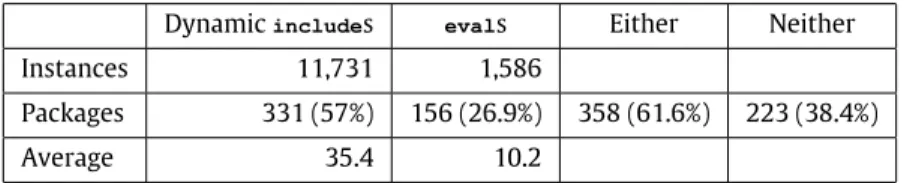
Section6.5, we provide statistics about usage of dynamic and static includes (as well asevalstatements) from a large number of publicly available PHP programs.
2.4.3. Variable–variables
PHP variables are simply a map of strings to values. Variable–variables provide a means to access a variable whose name is known at run-time — for example, one can assign to the variable$xusing a variable containing the string value"x". Access to these variables may be required byevalorincludestatements, and so this feature may take advantage of the infrastructure
used by these functions. Variable functions are also accessible in this way, and Listing1shows a class initialized dynamically in the same manner.
3. Related work
Having discussed the typical scripting language features, we examine previous scripting language compilers, discussing how they handled the challenging features in their implementations. We believe that many of their solutions are sub-optimal, either requiring great engineering or sacrifices which limit the potential speed improvement of their approach.
3.1. Undefined semantics
The most difficult and rarely addressed issue is ensuring that a program is executed correctly by a reimplementation of a scripting language. In particular, it is rarely mentioned that different versions of a scripting language can have different semantics, especially in standard libraries.
Very few scripting language compilers provide any compatibility guarantees for their language. Instead, we very often see laundry lists of features which do not work, and libraries which are not supported. A number of implementations we surveyed chose to rewrite the standard libraries. UCPy [3], a reverse-engineered Python compiler, reports many of the same difficulties that motivated us: a large set of standard libraries, a language in constant flux, and a manual whose contents
surprise its own authors. They chose to rewrite the standard library, even though it was 71,000 lines of code long, risking potential semantic differences with the official distribution.
Both Roadsend [27] and Quercus [25] are PHP compilers, referred to by Jones’s quote in Section2.2. Both of these compilers reimplement a very small portion of the PHP standard libraries. In Shed Skin [6, Sect. 4.3.3], a Python-to-C++ compiler, the authors were unable to analyse or reuse Python’s comprehensive standard library. Instead, library functions they wanted to support were both reimplemented in C++ and separately modelled in Python.
Jython [17] and JRuby [16] are reimplementations of Python and Ruby, respectively, on the JVM. They reimplement their respective standard libraries in their respective host languages, and do not reuse the canonical implementation. A much better approach is employed by Phalanger [4, Sect. 3], a PHP compiler targeting the.NETrun-time. It uses a special manager to emulate the PHP system, through which PHP programs access the standard libraries through the C API. Benda et al. report that their Phalanger system is compatible with the entire set of extensions and standard libraries. However, Phalanger does not use the PHP system’s functions for its built-in operators, instead rewriting them in its host language,C#. As described in Section2.2.2, many of PHP’s most difficult features to compile involve its built-in operators, and we believe that reimplementing them is costly and error-prone.
In terms of language features, none of the compilers discussed has a strategy for automatically adapting to new language semantics. Instead, each provides a list of features with which they are compatible, and the degree to which they are compatible. None mentioned the fact that language features change, or that standard libraries change, and we cannot find any discussion of policies to deal with these changes.
A few, however, mention specific examples where they were unable to be compatible with the canonical implementation of their language. Johnson et al. [14] attempted to reimplement PHP from public specifications, using an existing virtual-machine. They reported problems caused by PHP’s call-by-reference semantics. In their implementation, callee functions are responsible for copying passed arguments, but no means was available to inform the callee that an argument to the called function was passed-by-reference.8Shed Skin [6] deliberately chose to use restricted language semantics, in that it only compiles a statically-typed subset of Python.
However, two approaches stand out as having taken approaches which can guarantee a strong degree of compatibility. The 211 compiler [1] converts Python virtual machine code to C. Similar to the classical algorithm by Pagan et al. [24,29], it works by pasting together code from the Python interpreter, which corresponds to the bytecodes for a program’s hot-spots. The 211 compiler which is very resilient to changes in the language, as its approach is not invalidated by the addition of new opcodes. Its approach is more likely to be correct than any other approach we mention, including our own, though it comes at a cost, which we discuss is Section6.2.
Python2C [28, Section 1.3.1] has a similar approach tophc, and, like bothphcand the 211 compiler, provides great compatibility. Unfortunately, it comes with a similar cost to 211, as detailed in Section6.2.
Pyrex [7] is a domain-specific language for creating Python extensions. It extends a subset of Python with C types and operations, allowing mixed semantics within a function. It is then compiled, in a similar fashion to our approach. Though they omit much of the language, it is easy to see that by following this approach, they have to ability to have a very high degree of compatibility with Python, even as the language changes.
3.2. C API
Very few compilers attempt to emulate the C API. However, Johnson et al. [14] provide a case study, in which they determine that it is not possible in their implementation, claiming that the integration between the PHP system and the extensions was too tight. We have also observed this, as the C API is very closely modelled on the PHP system’s implementation. Phalanger [4] does not emulate the C API, but it does provide a bridge allowing programs to call into extensions and libraries. Instead of a C API, it provides a foreign-function interface through the .NET run-time. Jython [17] and JRuby [16] provide a foreign-function interface through the JVM, in a similar fashion.
3.3. Run-time code generation
A number of compilers [27,14,4,16,17] support run-time code generation using a run-time version of their compiler. Some [6,25] choose not to support it at all. Quercus [25] in particular claims not to support it for security reasons, as run-time code generation can lead to code-injection security vulnerabilities. We show in Section6.5that this results in a large number of PHP programs which could not be run using the Quercus compiler.
Dealing with scripting source code that is generated at run time is easy for a JIT compiler. The PHP compiler translates the source code to bytecode, and the JIT compiler can compile the resulting bytecode to native machine code. A JIT compiler must already be designed to be suitable for execution while the program is running. Most of these systems are not JIT compilers, however, and are instead designed for ahead-of-time compilation. Making a compiler suitable for compiling scripting source code that is generated at run time requires that the implementation be suitable for run-time use; it must
have a small footprint, it cannot leak memory, it must be checked for security issues, and it must generate code which interfaces with the code which has already been generated. These requirements are not trivial, and we believe the approach we outline in Section4affords the same benefits, at much lower engineering cost. We discuss using a JIT compiler in more detail in Section3.5.
3.4. Other approaches
Walker and Griswold’s optimizing compiler for Icon [34] uses the same system for its compiled code as its interpreter used. In addition, since they were in control of both the compiler and the run-time system, they modified the system to generate data to help the compiler make decisions at compile-time. Typically, scripting language implementations do not provide a compiler, and compilers are instead created by separate groups. As a result, it is generally not possible to get this tight integration, though it would be the ideal approach.
3.5. Just-in-time compilers
Just-in-time compilers (JITs) [2] are an alternative to interpreting or ahead-of-time compiling. In recent years, the grow-ing popularity of managed languages runngrow-ing on virtual machines, such as Java’s JVM and the Microsoft .NET framework, has contributed to the growth of JITs.
JIT compilers are generally tightly coupled to the existing interpretation framework, like we propose forphc. Their opti-mizations are not inhibited by dynamic features, such as reflection and run-time code generation. Method specialization [26] compiles methods specifically for the actual run-time types and values. Other techniques can be used to gradually compile hot code paths [10,36].
JITs, however, suffer from great implementation difficulty. They are typically not portable between different architec-tures, one of the great advantages of interpreters. Every modern scripting language’s canonical implementation is an inter-preter, and many implementations sacrifice performance for ease of implementation. The Lua Project [13, Section 2], for example, strongly values portability, and will only use ANSI C, despite potential performance improvement from using less portable C dialects, such as using computedgotos in GNU C.
In addition to being difficult to retarget, JIT compilers are difficult to debug. While it can be difficult to debug generated code in an ahead-of-time compiler, it is much more difficult to debug code generated into memory, especially when the JIT compiles a function multiple times, and replaces the previously generated code in memory. By contrast, our approach of generating C code using the PHP C API is generally very easy to debug, using traditional debugging techniques.
Much of the performance benefit of JIT compilers comes from inlining functions [30]. However, the majority of the PHP standard libraries are written in C rather than in PHP, and so cannot be optimized using the JIT’s inlining heuristics. These problems have been encountered both by JITs written for both Javascript [9] and Lua [20].
Another alternative is to compile to a standard intermediate representation (IR), where a JIT compiler already exists for that IR. Examples, of these include Java bytecode, .NET CIL code and the Low Level Virtual Machine (LLVM) [18]. Lopes [19] explored this idea with a very simple prototype JIT compiler for PHP that compiles to LLVM. The resulting JIT compiled code runs around 21 timesslowerthat the standard PHP interpreter. The main reason is that naive compilation works very poorly for PHP. For performance to even match that of the PHP interpreter, optimizations similar to those described in Section4.5are necessary. The original version of our compiler also produced naive code which was much slower than the PHP interpreter, mostly because of memory allocation and hashing costs.
It is also important to note that simply translating to an IR such as LLVM will not yield the sort of benefits that come from method specialization or trace compilation. It would still be necessary to build a JIT compiler to perform these sort of optimizations on the PHP at run time. However, by allowing the JIT which performs these optimizations to generate bytecode code rather than executable machine code, the implementation would remain portable. Once the PHP JIT had created this IR code, the Java, LLVM or .NET JIT compiler would then have the job of translating it to native machine code on the target machine.
3.6. Is there one good solution?
A common question is whether ahead-of-time compilation or JIT compilation is the best approach for implementing a given language, with perhaps the implicit assumption that interpretation is not a good choice. In fact, interpreters are a popular approach to implementing many languages, and especially dynamic scripting languages. Although interpreters are typically slower than compiled code, they offer huge software engineering advantages. They are easy to construct, and simple enough to make reliable without huge effort. They can be efficiently written in C, so the language implementation can be made portable across architectures. Most interpreters do not interpret the source code directly, but instead interpret bytecode for an abstract virtual machine. This virtual machine code is typically much smaller than executable native machine code. Supporting dynamic language features such as dynamic loading of code, and run-time source-code generation is simple in an interpreter. Finally, developing other tools such as source-level debuggers and profilers is simple in an interpretive system, but very complex for compiled code. These software engineering advantages mean that it is possible to construct and maintain a complete interpretive implementation of a language quite easily. Interpreters are often the appropriate solution
for programming languages where a small teams develops and maintains the implementation, even though execution speed may be slow.
Ahead of time (AOT) compilers offer the possibility of significant speedups over interpreters. AOT compilers have plenty of time for program analysis and optimization. A significant problem with AOT compilation is native code generation, as the compiler may have to target several different instruction sets, and optimize for particular models of processor. A common solution to this problem is to build a source-to-source compiler that compiles to C, rather than executable code. Most machines already have at least one good C compiler. This is the solution we have followed in ourphcsystem, and it allows our generated C code to run on many different architectures. The main disadvantage of AOT compilation for scripting languages is that they contain many dynamic features, such asevaland dynamic typing. The compiler may have time to
perform complex analyses AOT, but analysis is more difficult if some of the code or data types are unknown until run time. A significant advantage of JIT compilation is that compilation is delayed until the program is running, at which point code, data and types may be partially or fully known. The main downside of JIT compilers is the software engineering difficulty of reliably generating correct, optimized executable code with only a very small amount of time for analysis and optimization. JIT compilers are complex systems, but must also be highly efficient, because of the need to generate code quickly. This requirement to be efficient also makes them more difficult to understand and maintain. This is a particular challenge when trying to maintain compatibility with a complex language such as PHP, where the semantics may subtly change from one release to another.
Generally, interpretation, AOT compilation and JIT compilation are all solutions to the problem of implementing pro-gramming languages, each with its own advantages and disadvantages. In the next section we outline our solution to AOT compilation of PHP in our ahead-of-time compiler.
4. Our approach
Nearly all of the approaches discussed in Section3have been deficient in some manner. Most were not resilient to changes in their target language, and instead reimplemented the standard libraries [17,16,27,25,3,14,6]. Those which handled this elegantly still failed to provide the C API [4], and those which achieved a high degree of compatibility [7,28,1] failed to provide a means to achieving good performance.
Inphc, our ahead-of-time compiler for PHP, we are able to correct all of these problems by tightly coupling the PHP system with both our compiler and compiled code. At compile-time, we use the PHP system as a language oracle, allowing us to automatically adapt to changes in the language, and saving us the long process of documenting and copying the behaviour of many different versions of the language. Our generated C code interfaces with the PHP system at run-time, via its C API [11]. This allows our compiled code to interact with built-in functions and libraries and to re-use the existing PHP system to handle run-time code generation.
4.1. Undefined semantics 4.1.1. Language semantics
One option for handling PHP’s volatile semantics is to keep track of changes in the PHP system, with separate functionality for each feature and version. However, our link to the PHP system allows us to resiliently handle both past and future changes.
For built-in operators, we add calls in our generated code to the built-in PHP function for handling the relevant operator. As well as automatically supporting changes to the semantics of the operators, this also helps us avoid the difficulty of documenting the many permutations of types, values and operators, including unusual edge cases.
Note that this strategy makes our approach vulnerable to certain types of changes to the PHP API. For example, if newer versions of PHP were to change the way that operators are implemented, by calling different functions or changing the function interfaces our technique would no longer be robust. However, such changes in the C API have been very rare. The whole purpose of an API is to keep the interface the same, even if the implementation on either side of the interface changes. For this reason, it is not surprising that changes in the API are rare.
We solve the problem of changing literal definitions by parsing the literals with the PHP system’s interpreter, and extracting the value using the C API. If the behaviour of this parsing changes in newer versions, the PHP system’s interpreter will still parse it correctly, and so we can automatically adapt to some language changes which have not yet been made.
We handle language flags by simply querying them via the C API. With this, we can handle the case where the flag is set at configure-time, build-time, or via thephp.inifile. No surveyed compiler handles these scenarios.
4.1.2. Libraries and extensions
One of the largest and most persistent problems in creating a scripting language reimplementation is that of providing access to standard libraries and extensions. We do not reimplement any libraries or extensions, instead re-using the PHP system’s libraries via the C API. This allows us to support proprietary extensions, for which no source code is available, which is not possible without supporting the C API. It also allows support for libraries which have yet to be written, and changing definitions of libraries between versions.
4.2. C API
Naturally, we support the entire C API, as our generated code is a client of it. This goes two ways, as extensions can call into our compiled code in the same manner as the code calls into extensions.
Integrating the PHP system into the compiler is not complicated, as most scripting languages are designed for embedding into other applications [22]. Lua in particular is designed expressly for this purpose [13]. In the case of PHP, it is a simple process [11] of including two lines of C code to initialize and shutdown the PHP system. We then compile our compiler using the PHP ‘‘embed’’ headers, and link our compiler against the ‘‘embed’’ version oflibphp5.so, the shared library containing the PHP system.
Users can choose to upgrade their version of the PHP system, in which casephcwill automatically assume the new behaviour for the generated code. However, compiled binaries may need to be re-compiled, since the language has effectively changed.
The C API is quite complete, in that we have only found one construct9which is difficult to efficiently compile using the C API.
4.3. Run-time code generation
In addition to being important for correctness and reuse, the link between our generated code and the PHP system can be used to deal with PHP’s dynamic features, in particular, the problem of run-time code generation.
Though theincludestatement is semantically a run-time operation,phcsupports a mode in which we attempt to include files at compile-time, for performance. Since the default directories to search for these files can change, we use the C API to access theinclude_pathlanguage flag. If we determine that we are unable to include a file, due to its unavailability at compile-time, or if the correctness of its inclusion is in doubt, we generate code to invoke the interpreter at run-time, which executes the included file. We must therefore accurately maintain the program’s state in a format which the interpreter may alter at run-time. Our generated code registers functions and classes with the PHP system, and keeps variables accessible via the PHP system’s local and global run-time symbol tables. This also allows us to support variable–variables and theeval
statement with little difficulty.
4.4. Compiling with phc
Technically,phcis a source to source compiler: it parses PHP source code into anAbstract Syntax Tree[5], translates this AST into various levels of intermediate representations,10 and finally generates C code which can then be further optimized and compiled into machine code by the C compiler. We perform optimizations at each of these levels: high level optimizations at the AST and increasingly lower level optimizations at the various IRs; we leave the lowest level optimization (such as instruction scheduling) to the C compiler.
The generated code interfaces with the PHP C API, and is compiled into an executable — or a shared library in the case of web applications — by a C compiler. Listings2–5show extracts of code compiled from the example in Listing1. In each case, the example has been edited for brevity and readability, and we omit many low-level details from our discussion. 1 int main (int argc, char *argv[]) {
2 php_embed_init (argc, argv); 3 php_startup_module (&main_module); 4 call_user_function ("__MAIN__"); 5 php_embed_shutdown ();
6 }
Listing 2.phcgenerated code is called via the PHP system.
Listing2shows themain()method for the generated code.phccompiles all top-level code into a function called__MAIN__. All functions compiled byphcare added to the PHP system when the program starts, after which they are treated no differently from PHP library functions. To run the compiled program, we simply start the PHP system, load our compiled functions, and invoke__MAIN__.
Listing3shows a simple assignment. Each value in the PHP system is stored in azvalinstance, which combines type, value and garbage-collection information. We access thezvals by fetching them by name from the local symbol table. We then carefully remove the old value, replacing it with the new value and type. We use the same symbol tables used within the PHP system, with the result that the source of thezval— whether interpreted code, libraries or compiled code — is immaterial.
9 Dynamic inheritance – where a class is defined in multiple places at run-time, using different parent classes each time – is difficult to support because the C API’s class definition API depends on compile-time information, and cannot be altered at run-time. We do not believe this feature is widely used. 10 We do not make any use of the bytecode representation used by the PHP interpreter.
1 zval* p_i;
2 php_hash_find (LOCAL_ST, "i", 5863374, p_i); 3 php_destruct (p_i);
4 php_allocate (p_i); 5 ZVAL_LONG (*p_i, 0);
Listing 3.phcgenerated code for$i = 0;
1 static php_fcall_info fgc_info; 2 php_fcall_info_init ( 3 ^^I"file_get_contents", &fgc_info); 4 5 php_hash_find ( 6 ^^ILOCAL_ST, "f", 5863275, &fgc_info.params); 7 8 php_call_function (&fgc_info);
Listing 4.phcgenerated code forfile_get_contents($f);
Listing4 shows a function call. Compiled functions are accessed identically to library or interpreted functions. The function information is fetched from the PHP system, and the parameters are fetched from the local symbol table. They are passed to the PHP system, which executes the function indirectly.
1 php_file_handle fh;
2 php_stream_open (Z_STRVAL_P (p_TLE0), &fh); 3 php_execute_scripts (PHP_INCLUDE, &fh); 4 php_stream_close (&fh);
Listing 5.phcgenerated code forinclude($TLE0);
Listing5shows anincludestatement. The PHP system is used to open, parse, execute and close the file to be included.
The PHP system’s interpreter uses the same symbol tables, functions and values as our compiled code, so the interface is seamless.11
4.5. Optimizations
The link to the C API also allowsphcto preform a number of optimizations, typically performing computation at compile-time, which would otherwise be computed at run-time.
4.5.1. Constant-folding
The simplest optimization we perform is constant folding. In Listing1, line 23, we would attempt to fold the constant expression1024 * 1024into1048576. PHP has five scalar types: booleans, integers, strings, reals and nulls, and 18 operators, leading to a large number of interactions which need to be accounted for and implemented. By using the PHP system at compile-time, we are able to avoid this duplicated effort, and stay compatible with changes in future versions of PHP. We note that the process of extracting the result of a constant folding does not change if the computation overflows.
Note that PHP is compiled from source code to internal byte code before it is executed. So there is no reason why the source code compiler could not perform constant folding, allowing the interpreted code to benefit from the optimization. In fact, in 2008 a software patch was developed for the PHP system to do exactly this.
4.5.2. Pre-hashing
We can also use the embedded PHP system to help us generate optimized code. Scripting languages generally contain powerful syntax for hash table operations. Listing1demonstrates their use on line 20.
When optimizing our generated code, we determined that 15% of our compiled application’s running time was spent looking up the symbol table and other hash tables, in particular calculating the hashed values of variable names used to index the local symbol table. However, for nearly all variable lookups, this hash value can be calculated at compile-time via the C API, removing the need to calculate the hash value at run-time. This can be seen in Listing3, when the number5863374 is the hashed value of"i", used to lookup the variable$i. This optimization removes nearly all run-time spent calculating hash values in our benchmark.
Note that an interpreted PHP system could also use this optimization, if the source code compiler can distinguish cases where the hash value can be resolved at compile time, and the compiled byte code is able to represent this information to the interpreter.
4.5.3. Symbol table removal
In Section4.3, we discussed keeping variables in PHP’s run-time symbol tables. This is only necessary in the presence of run-time code generation. If we statically guarantee that a particular function never uses run-time code generation — that is to say, in the majority of cases — we remove the local symbol table, and access variables directly in our generated code.
This optimization could, in principle, also be implemented by the source code compiler in an interpreted bytecode system. However, it would require that there be two versions of many of the opcodes in the interpreter—one for where the local variables are in a symbol table, and another for where they are stored elsewhere. In contrast, it is relatively simple to vary the way in which local variables are accessed in code generated by a compiler.
4.5.4. Pass-by-reference optimization
PHP programs tend to make considerable use of functions written in the C API. As these functions are not written in PHP, our source level compiler is unable to determine their signature. Our generated code must therefore check, at run-time, whether each parameter is passed by-copy or by-reference. However, we are able to query the function’s signatures of any function written in the C API, which allows us to calculate these at compile-time, rather than run-time.
Again, this optimization could, in principle, be implemented in a bytecode interpreted system. However, it would require that the interpreter would have multiple versions of the call code, to take advantage of knowing ahead of time whether the parameters should be passed by reference or copy.
4.5.5. Caching function calls
Since PHP is so dynamic, with functions only defined at run-time, we must lookup functions by name before we can call them. Initially, we began by looking up a function each time we called it. However, since functions cannot change their definition after they are first defined, we cache the function lookup after the first time we call it. This speedup from this optimization is significant (around 23% compared with a similar version ofphcwithout this optimization).
This optimization could also be applied in an interpretive bytecode system, and in fact it can be implemented entirely in the interpreter without intervention from the compiler. A common trick in interpreters for Java is to use slow and ‘‘quick’’ versions of interpreter instructions. The source code compiler always generates the ‘‘slow’’ version of the instruction. When the slow instruction is executed for the first time, it resolved the function name looked up. The instruction then replaces itself in the bytecode with the corresponding ‘‘quick’’ instruction, which uses the resolved function pointer, rather than looking up the function by name again.
4.6. Caveats
Our approach allows us to gracefully handle changes in the PHP language, standard libraries and extensions. However, clearly it is not possible to automatically deal with large changes to the language syntax or semantics. When the parser changes — and it already has for the next major version of PHP — we are still required to adapt our compiler for the new version manually. Though we find it difficult to anticipate minor changes to the language, framing these problems to use the PHP system is generally straightforward after the fact. Finally, we are not resilient to changes to the behaviour of the C API; empirically we have noticed that this API is very stable, far more so than any of the features implemented in it. This is not assured, as bugs could creep in, but these tend to be found quickly since the API is in very heavy use, and we have experienced no problems in this regard.
5. Interactions with the PHP memory model
When assessing the performance of a programming language implementation, it is natural to think that most of the execution time is likely to be spent performing computations. In fact, as we discuss in Section6.1, the run-time system often has a major impact on performance. This is particularly true for scripting languages for three main reasons. First, scripting languages generally provide automatic memory management to reclaim objects that are no longer in use. The memory manager adds to execution time, whether it uses a tracing garbage collector, or as in the case of PHP, reference counting. Second, even scalar values in scripting languages are typically implemented with data structures rather than simple C scalars, because additional information such a type and memory management information must be stored along with the value. Third, the main data-structuring feature provided by scripting language is the associative array (referred to as atablein PHP parlance), which is typically implemented using a hash table. Thus, even simple record or array type data structures need a more complicated memory representation, which often consists of more than one single piece of memory. For these reasons, to optimize the performance of a compiler which uses the canonical implementation, it is essential to understand the memory model used by the implementation.
1 for ($i = 0; $i < $N; $i++) 2 {
3 ^^I$str .= "hello";^^I// concat 4 }
Listing 6.String concatenation benchmark.
5.1. The PHP memory model
The primitive unit of data in PHP is thezval, a small structure encompassing a union of values — objects, arrays and scalars — and memory-management counters and flags. A PHP variable is a symbol table entry pointing to azval, and multiple variables can point to the samezval, using reference counting for memory management.
PHP assignment is by copy, meaning that semantically the l-value becomes a copy of the r-value. This is not only true of scalars: PHP arrays are deeply copied during an assignment, and object references are copied to a new run-timezval. As an optimization, the PHP system causes the l-value to share the r-value’szval, increasing its reference count. The variables are said to become part of the samecopy-on-writeset. Thus, even though an assignment is semantically a copy, the assigned value is shared until it is required to be altered.
Assignment can also be by reference, which puts the two variables in the samechange-on-writeset, in a similar fashion. This sets theis_refflag of the sharedzval, indicating that the variables in this set all reference each other. Setting a variable’s value, where that variable is part of a change-on-write set, changes the value of all the other variables in that set.
Variables in a copy-on-write set share the samezval, but are not semantically related. Although this is an optimization applied by the PHP system, it is a feature whichphcmust deal with to interact with the PHP system, and so it reuses it for performance. In order to update the value of a variable in a copy-on-write set, it must first beseparated. A copy of its zvalis created — a deep copy in the case of arrays and strings — and the originalzvalhas its reference count decremented. Variables in a change-on-write set must similarly be separated if they are assigned by copy.
Assignment to a variable in a change-on-write set overwrites thezval’s value field, changing the value of all the variables in that set. Variables with a reference count of one, which are in neither a copy-on-write or change-on-write set—are treated similarly.
The PHP interpreter keeps pointers to a variable’szvalin global and function-local symbol tables—hash tables indexed by the variable’s name. When a function finishes execution, the local symbol table is destroyed, decreasing the reference count of allzvals contained within. The global symbol table is destroyed at the end of the execution of a script.
5.2. Three address code versus copy-on-write
In creatingphc, we came across an interesting pitfall related to PHP’s copy-on-write implementation.12 At first, our naively generated code was around ten times slower than the PHP interpreter. This was primarily due to the fact that our code used significantly more memory than the PHP interpreter. The most important factor in this was our use of three-address code. Note that the source code to bytecode compiler in the canonical PHP implementation does not convert to three address code, so this problem does not arise for that compiler, or for the resulting interpreted bytecode.
In order to simplify our compiler transformations and code generation, we lowered complex expressions into three address code by adding assignment to temporary variables. However, these extra assignments increase the reference count of a zval, meaning not only that a program’s memory remains live for a longer period, but also that there are more separations, leading to extra memory allocations, copying, and subsequent deallocations.
In a simpler language such as C, copying a value has no ramifications for the copied value, so introducing three-address code does not have great performance side-effects. However, in PHP, copying a value will increase its reference count, meaning it must be separated before it can be written to or altered. We removed many of the cases in which we generated poor code simply by being more careful during our conversion to three address code.
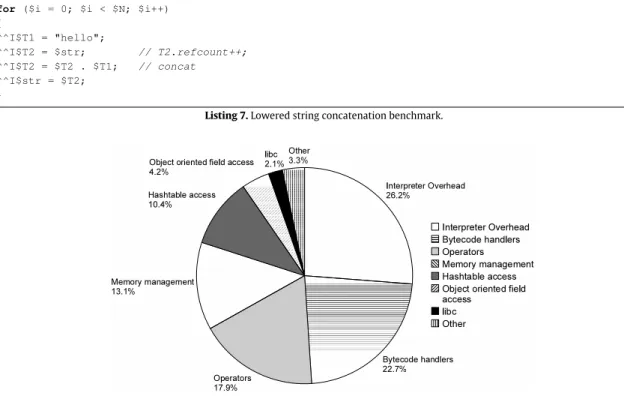
To highlight the magnitude of this problem, consider Listing6. In this example, we accidentally turn anO
(
N)
algorithm into anO(
N2)
one, shown in Listing7. This is a subtle, but interesting problem stemming from the interaction of three address code and copy-on-write implementation. Other scripting languages which use copy-on-write, such as Perl and Tcl, may also experience this problem.Listing6is a string concatenation benchmark, referred to later asstrcat. The.=operator performs in-place concatenation, in this case appending"hello"onto the end of the string in$str. Though this code did not strictly need to be lowered to three address code, our over-zealous lowering algorithm added extra temporaries into this code, resulting in Listing7. Semantically, these perform the same operations. However, thezvalpointed to by$T2has a reference count of two after line 4, meaning the string cannot be concatenated in place. Instead,$T2must be separated, even though it will be freed on line 4 of the next loop iteration.
1 for ($i = 0; $i < $N; $i++) 2 { 3 ^^I$T1 = "hello"; 4 ^^I$T2 = $str; // T2.refcount++; 5 ^^I$T2 = $T2 . $T1; // concat 6 ^^I$str = $T2; 7 }
Listing 7.Lowered string concatenation benchmark.
Fig. 1.Profiling results of the PHP interpreter, using callgrind.
It is interesting to observe the difference in performance between the two similar pieces of code. Listing6takesO
(
N)
time.13By contrast, in Listing7, when$strmust be copied in every iteration due to an increased reference count, the same work takesO
(
N2)
time in total. We note that this problem does not only occur due to three address code. It is not always trivial to determine the reference count of a variable, and problems such as these may appear in user-code by accident. 6. Evaluation6.1. PHP performance profile
Conventional wisdom states that a compiled program should run an order of magnitude faster than an interpreted program. In our experience, however, dynamic scripting languages do not follow this rule of thumb. Instead, a program written in a scripting language spends most of its run-time handling dynamic features, such as dynamic types andzvals. This limits the potential improvement of simply removing the interpreter loop. This is particularly important for a compiler likephcwhich re-uses the PHP system, as many of the code paths executed will be the same, whether the program is interpreted or compiled.
To understand where time is spent in the PHP system, and to determine the potential speedup from optimization, we profiled the PHP system.Fig. 1shows the profile of a number of PHP benchmark applications, interpreted using PHP version 5.2.3, using thecallgrindtool from valgrind 3.4.1 [23]. We compiled PHP usinggccversion 4.4.0, using the options -O3 -g -NDEBUG, targeting the x86-64 instruction set. We analysed the flat profile provided by callgrind, looking at the ‘‘self’’ results (that is, time spent in a function, not including time spent in the function’s callees). We categorized each function in the profile into broad categories, based on our knowledge of the design of the PHP system.
Interpreter overheadincludes time spent parsing, generating bytecode, running the interpreter loop and dispatching to bytecodes.Bytecode handlersare the code blocks dispatched to by the interpreter, which actually execute the desired operation.Operatorsincludes time spent executing arithmetic and logical operators.Memory managementis self explanatory.
Hashtable accessinvolves access to hash tables (which includes arrays, objects and symbol tables), including calculating hash values from string keys.Object oriented field accessesexcludes the actual hash table access, but includes other object oriented overhead such as checking for special object oriented handlers.libcdenotes time spent in the C standard library.
While there is a significant amount of time spent in interpreter overhead (26%), it is not nearly enough to allow for a order-of-magnitude speedup from compilation. This lends support to our approach, as compared to that of 211 and Python2C. Both
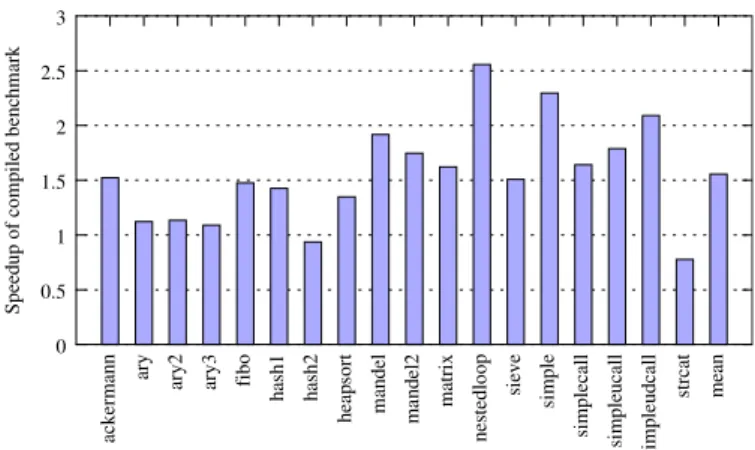
Fig. 2.Speedups ofphccompiled code vs. the PHP interpreter. Results greater than one indicatephc’s generated code is faster than the PHP interpreter. The mean bar showsphc’s speedup of 1.55 over the PHP interpreter.
of these Python compilers take a narrow approach, attempting only to remove interpreter overhead, but they do not allow for higher-level optimizations or static analysis. This means that their techniques cannot achieve a great speedup if they were applied to the PHP system.
Nearly 18% of the run-time is spent performing calculations in theOperatorscategory. This is principally due to PHP’s dynamic typing. PHP uses opcodes which perform significantly more computation than, say, a Java bytecode. For example, anadduses a single opcode, like in Java. However, where a Java add opcode is little more than a machine add and an overflow check, PHP’s add opcode calls an add function. This function, depending on the types of the operands, might merge two arrays, convert strings to integers, or a number of other operations.
We also see a 10% overhead due to hash table accesses. Hash tables are used extensively in PHP, not only as the principal data structure (as both arrays and associative arrays), but also to provide symbol tables and objects. In theory, the PHP system’s interpreter accesses every local variable through the local symbol table. However, it uses an optimization similar to our symbol table removal in Section4.5.3, which prevents this overhead [21]. As a result, all of the hash table overhead comes from array manipulation, accesses to the global symbol table, and accessing fields of objects.
PHP’s dynamic typing cross-cuts all of these categories. Hash tables must be used in PHP’s object orientation, as a result of objects’ dynamic types. A great deal of memory management is due to allocatingzvals for every value in the program, used in PHP to implement dynamic typing. A lot of the overhead of operators are due to checking types before performing the computation, which might be cheap by comparison. Thus dynamic types not only take up time in the PHP system, but also prevent compiling PHP programs to more efficient representations. We expect that static analyses can be developed which can remove many of these type checks and allow more efficient compilation, which we intend to follow up on in future work.
6.2. Performance
The major motivation of this research is to demonstrate that compatibility and performance can co-exist in a scripting language reimplementation. In this section, we demonstrate that we are able to increase the performance of our compiled code, compared to the PHP system’s interpreter.
The PHP designers use a small benchmark [31], consisting of eighteen simple functions, iterated a large number of times, to test the speed of the PHP interpreter.
We compared the generated code fromphcwith the PHP system’s interpreter, version 5.2.3. We used Linux kernel version 2.6.29.2 on an Intel Xeon 5138 with four cores,14rated at 2.13 GHz (clocked at 1.6 GHz), with 12 GB of RAM and a 1 MB cache per CPU. Both our compiled code and the PHP system were compiled withgccversion 4.4.0, using-03 -NDEBUGcompiler flags.
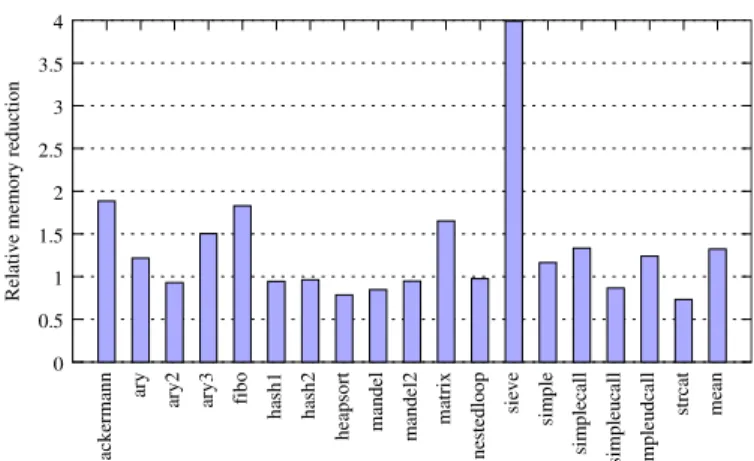
Fig. 2shows the execution time of our generated code relative to the PHP interpreter.phccompiled code performs faster on 16 out of 18 tests. The final column is the arithmetic mean of the speedups, showing that we have achieved an average speedup of 1.55. InFig. 3, our metric is memory usage, measured using thespace–timemeasure of Valgrind’s [23]massiftool (version 3.2). Our graph shows the per-test relative memory usage ofphcand the PHP interpreter. The final column is the arithmetic mean of the reductions in memory usage, showing a reduction of 1.30.
It can be expected that we are able to optimize away the interpreter overhead, as discussed in Section6.1, to achieve a speedup of 1.35. This is in the same league as previous implementations. Python2C [28, Section 1.3.1] is reputed to have a speedup of approximately 1.2, using a similar approach to ours, including some minor optimizations. 211 [1] only achieves
Fig. 3.Relative memory usage ofphccompiled code vs. the PHP interpreter. Results greater than one indicatephc’s generated code uses less memory than the PHP interpreter. The mean bar showsphc’s a memory reduction of 1.30 over the PHP interpreter.
Fig. 4. Hardware simulation results showing the reduction in the number of branches inphccompiled code vs. that of the PHP interpreter. Results are presented as a percentage of the instruction count. Results greater than zero indicatephc’s generated code executes fewer branches.
a speedup of 1.06, the result of removing the interpreter dispatch from the program execution, and performing some local optimizations. It removes Python’s interpreter dispatch overhead, and removes stores to the operand stack which are immediately followed by loads. We do not benefit from 211’s optimization as peephole stack optimization will also not work for PHP, which does not use an operand stack.
However, our speedup is in some cases much greater than that which can be achieved by simply removing the interpreter overhead. In most cases, these are due to the optimizations which we discussed in Section4.5. However, these are mitigated in some cases by poor code generation, especially related to hash tables, for example inary,ary2,ary3andhash2. By contrast, we achieve much better speedups in functions which primarily manipulate loops and integers, in particularnestedloopand mandel.
We expect that traditional data-flow optimizations will also greatly increase our performance improvement, and our approach allows this in the future, which neither 211 nor Python2C allow. Without this ability, it is not clear to us how the performance shortcomings of 211 and Python2C could be resolved, given that the approach used in their construction seems to inherently limit their performance.
We also believe that the PHP system could achieve higher performance with a better implementation. However, the run-time work which slows PHP down also slows down our generated code, and so as PHP is improved, our speedup over PHP will likely remain constant or may even improve as the relative interpretation-specific cost (parsing, bytecode generation, etc.) increases.
6.3. Performance examination
In order to understand why we achieved our performance improvement, we analysed both interpreted and compiled PHP benchmarks using thecachegrindtool from Valgrind 3.4.1, a hardware simulator. We measured a wide range of metrics including instruction counts, level-1 and level-2 data and instruction cache access, and branch behaviour. We use the same benchmarks, tools and program versions as discussed in Section6.2.
Fig. 4shows the change in the number of branches. Results above zero indicate the decrease in branches as a percentage of instructions executed in the compiled program; results below zero indicate an increase. A major difference between
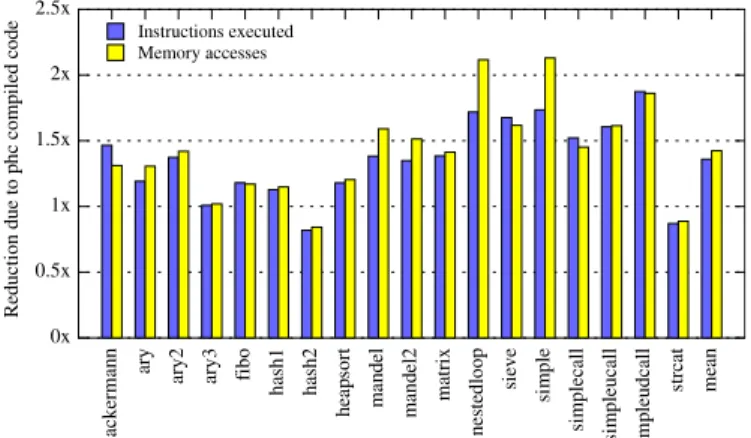
Fig. 5.Hardware simulation results comparing the number of executed instructions and memory accesses inphccompiled code vs. that of the PHP interpreter. Results greater than one indicatephc’s generated code performs better.
interpreters and compilers is that an interpreter loop typically leads to a great number of indirect branches. Our results do not show this expected decrease however. Indeed, they even show a slight increase (approximately 2%), and a larger decrease in conditional branches.
We believe that the cost of the interpreter loop is not great in the PHP interpreter, when compared to the cost of dynamic features. Our generated code heavily uses switch statements in order to handle dynamic typing, and it appears that the reduction in the number of indirect mispredictions due to interpreter overhead is small compared to mispredictions due to type checks.
We also measured changes in level-1 and level-2 cache misses, for both instruction and data caches. The difference in these misses is insignificant (that is, approaching 0%) when compared to instruction count, so we do not present them visually. We would expect to have in increase in instruction cache misses due to essentially inlining the bytecode handlers, but this did not materialize. We believe that with larger benchmarks, this may become more apparent.
It is clear that the speed of the running programs is not greatly affected by cache accesses or branch predictors.Fig. 5 shows the decrease in instruction count and memory accesses due to compilation. Since the number of cache misses is not different, we surmise that the memory accesses removed due to compilation were level-1 cache hits, which have a low cost. Nevertheless, the ebb and flow ofFig. 5matches that of our speedup inFig. 2. It seems clear that the decrease in instruction count is due somewhat to the decrease in conditional branches. Indeed, inFig. 4only two benchmarks (hash2andstrcat) have an increase in conditional branches, and those same benchmarks are the only ones to result in a slowdown instead of a speedup inFig. 2.
As a result, we believe that our speedups come not from removing the cost of mispredictions in the interpreter loop, but instead through a combination of removing the rest of the interpreter overhead, and small optimizations. One of the costs of the interpreter is an extra layer of indirection when accessingzvals. While we store pointers tozvals in registers, the interpreter fetches pointers tozvals from memory, leading to increased memory accesses. While most of our simple optimizations are local, and aimed at reducing the instruction count, removing symbol tables is aimed at reducing memory accesses, at which we appear to have been largely successful.
6.4. Feedback-directed optimization
Our technique is roughly similar to inlining the PHP system’s bytecode handlers. In theory, this could allow the code to be rearranged based on feedback-directed optimization (FDO). This might allow the C compiler to do aggressive optimization, in a similar technique to speculative inlining [8] or trace trees [9]. Ideally, this would mitigate the slowdown of some of PHP’s dynamic features, in particular its dynamic type checks, by moving the most likely code into a straight path, eliding pipeline stalls and branch mispredictions.
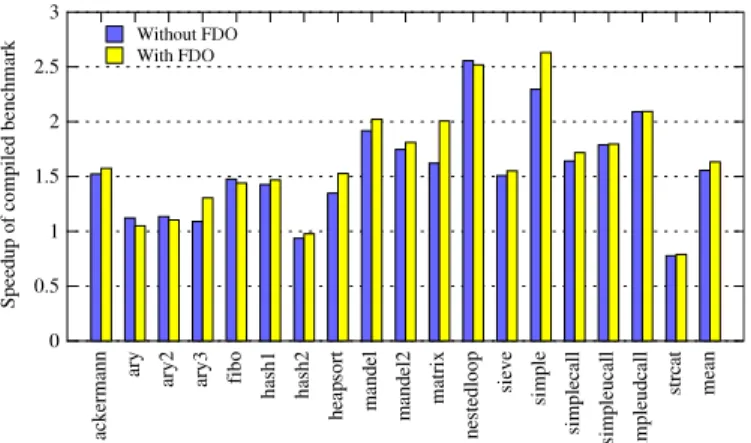
In order to determine whether such profiling has a beneficial effect, we reran our benchmarks using thegcc 4.4’s FDO feature. Fig. 6shows the speed improvements over PHP 5.2.3, when using feedback directed optimization. PHP was configured as discussed above. We compiledphcgenerated code in the same manner as above, with the exception that we used the FDO options from gcc 4.4.0. We compiled the benchmarks initially using the -fprofile-generate flag. After running the generated executable, we compiled the benchmarks again using its feedback, with the -fprofile-use -fprofile-generateflags. Finally, we reused that feedback when compiling the benchmarks again using the-fprofile-useflag only.
InFig. 6, the ‘‘Without FDO’’ bar repeats the data fromFig. 2. The ‘‘With FDO’’ bar shows the speedup over the PHP interpreter, when the code is compiled using FDO. Note that neither the PHP interpreter, nor the PHP system, are compiled using FDO.