Analysis by Synthesis
Spatial Audio Coding
by
I. ]315tri
Submitted for
the Degree of Doctor of Philosophy
from the University of Surrey
UNIVERSITY O F
SURREY
Centre for Vision, Speech and Signal Processing
Faculty of Engineering and Physical Sciences
University of Surrey
February 2013
ProQuest Number: 27558607
All rights reserved INFORMATION TO ALL USERS
The qu ality of this repro d u ctio n is d e p e n d e n t upon the q u ality of the copy subm itted. In the unlikely e v e n t that the a u th o r did not send a c o m p le te m anuscript and there are missing pages, these will be note d . Also, if m aterial had to be rem oved,
a n o te will in d ica te the deletion.
uest
ProQuest 27558607
Published by ProQuest LLO (2019). C op yrig ht of the Dissertation is held by the Author.
All rights reserved.
This work is protected against unauthorized copying under Title 17, United States C o d e M icroform Edition © ProQuest LLO.
ProQuest LLO.
789 East Eisenhower Parkway P.Q. Box 1346
A b stract
Spatial Audio Coding (SAC) is a technique used to encode multichannel audio signals by extracting the spatial parameters and downmixing the audio signals to a mono or stereo audio signal. Recently, various SAC techniques have been proposed to efficiently encode multichannel audio signals. However, all of them operate in open-loop, where the encoder and decoder operate sequentially and independently, and, thus, lack a mechanism for minimising the decoded audio reconstruction error.
This thesis proposes a novel SAC technique th a t utilises the closed-loop system configuration, termed Analysis by Synthesis (AbS), in order to optimise the down- mix signal and the spatial parameters, so as to minimise the decoded signal error. In order to show the effect of the AbS optimisations, the Reverse One-To-Two (R-OTT) module, used in the MPEG Surround (MPS), must first be applied in the frequency domain to recalculate the downmix and residual signals based on the quantised spatial parameters. These parameters show th a t the AbS scheme can minimise the quantisation errors of the spatial parameters. As the full AbS is far too complicated to be applied in practice, a simplified AbS algorithm for finding sub-optimal parameters, based on the adapted R-O TT module, is also proposed.
Subjective tests show th a t the proposed Analysis by Synthesis Spatial Audio Coding (AbS-SAC), encoding 5-channel audio signals at a bitrate of 51.2 k b /s per audio channel, achieves higher Subjective Difference Grade (SDG) scores than the tested Advanced Audio Coding (AAC) technique. Furthermore, the objective test also shows th a t the proposed AbS-SAG method, operating at bitrates of 40 to 96 k b /s per audio channel, significantly outperforms (in terms of Objective Difference Grade (ODG) scores) the tested AAC multichannel technique.
K e y w o rd s: Spatial audio coding, analysis by synthesis, M PEG Surround, ad vanced audio coding.
A cknow ledgem ents
I would like to sincerely thank my supervisor Professor Ahmet M. Kondoz for ev erything he has done to support, motivate and help me during my PhD study. His assistance, and the opportunities th a t he gave me, have been crucial components for me in completing my thesis.
I would also like to thank my co-supervisor. Dr. Xiyu Shi, for his support, guidance and sharing experiences. Additionally, I would like to thank Dr. Banu Gunel, who also supervised me during the first and second years of my PhD study.
I would like to sincerely thank the examiners on my PhD examination. Professor Izzet Kale and Dr. Safak Dogan, for taking time to read my thesis and attending the examination as well as for their constructive and valuable comments and suggestions to improve this thesis.
I would like to thank Dr. Janko Galic for his help and discussion about particular topics too. Finally, I owe many thanks to everyone else in the I-Lab Multimedia Communications Research team for their positivity and motivation. And I owe a special thanks to my family and friends for everything.
C ontents
List of Figures vi
List of Tables vi
1 Introduction 1
1.1 B a c k g ro u n d ... 1
1.2 Research Aim and O b je c tiv e s ... 3
1.3 Outline of T h e s i s ... 4
1.4 Original C o n trib u tio n s ... 6
2 The Fundamentals of Audio Coding 9 2.1 Basics of Digital Audio ... 9
2.1.1 Audio Signal ... 9
2.1.2 Sampling and Quantisation ... 10
2.1.3 Sound Q u a lity ... 11 2.1.4 Audio C om pression... 11 2.1.5 Time-Frequency T ransform ... 12 2.1.6 Perceptual-based C o d in g ... 13 2.1.7 Three-Dimensional (3D) A u d i o ... 13 i
Contents ii
2.2 Compression A r t i f a c t s ... 14
2.3 Evaluation of Audio Codec P e r fo r m a n c e ... 16
2.4 Applications of Audio Coding T e c h n iq u e ... 18
2.5 Standardisation Activities for Speech and Audio Coding Technique 20 2.6 The Principle of Analysis by S y n th e s is ... 21
2.7 C o n c lu sio n s ... 22
3 Spatial Audio Coding 24 3.1 Psychoacoustic B a c k g ro u n d ... 24
3.1.1 Human Auditory S y s te m ... 24
3.1.2 Spatial H e a r in g ... 26
3.2 Spatial Audio P ro cessin g ... 27
3.2.1 Recording, Transmission, and Reproduction . ... 28
3.2.2 Virtual Source P r in c i p l e ... 30
3.3 Multichannel Audio Coding T echniques... 31
3.3.1 Matrixed Surround Sound S y s t e m s ... 31
3.3.2 Discrete Multichannel Audio C o d i n g ... 32
3.3.3 Spatial Audio C o d in g ... 34
3.3.4 Spatial Audio Object C o d i n g ... 38
3.3.5 Other Param etric T e c h n iq u e s ... 40
3.4 Comparison of Coding T echniques... 40
Contents iii
4 Advanced Audio Coding and M PEG Surround 43
4.1 Advanced Audio C o d i n g ... 43 4.1.1 MDCT T ransform ... 49 4.1.2 Quantisation ... 50 4.1.3 Noiseless C o d i n g ... 53 4.2 M PEC S u r r o u n d ... 55 4.2.1 Frequency D e c o m p o s itio n ... 56
4.2.2 Spatial Analysis and S ynthesis... 60
4.2.2.1 The O TT and R-OTT m o d u le s ... 61
4.2.2.2 The T T T and R -TT T m o d u le s ... 63
4.2.2.3 Param eter B a n d ... 65
4.2.3 Quantisation and C o d in g ... 66
4.2.4 Rate-distortion S c a la b ility ... 67
4.3 C o n c lu sio n s... 68
5 A Closed-loop R-O TT M odule 69 5.1 Analysis by Synthesis F ra m e w o rk ... 69
5.2 Implementation of the R-OTT Module within the AbS-SAC Frame work ... 71
5.3 The Closed-loop R-OTT Module in the MPS Architecture . . . . 76
5.4 R e s u lts ... 76
5.4.1 Experimental S e tu p ... 77
5.4.2 SNR Comparison for Open-loop and Closed-loop Systems . 78 5.4.3 Performance Comparison for Various B i t r a t e s ... 82
Contents iv
6 M D C T-based R-O TT M odule 84
6.1 Motivation for the MDCT-Based Im p le m e n ta tio n ... . 85
6.2 Determining the Param eter B a n d s ... 87
6.3 MDCT-Based R-O TT Module for High Bitrate Implementation . 88 6.4 R e s u lts ... 89
6.4.1 Evaluation of the MDCT-based Open-loop R-O TT Module 90 6.4.2 Comparison of the Open and Closed-loop R-O TT Modules over Various Spatial Quantisers ... 93
6.4.3 Evaluation of the Closed-loop R-OTT Module Using the M PS’s Spatial Quantisers ... 95
6.4.4 Evaluation of the Closed-loop R-OTT Module Encoding 2-channel Audio Signals at High B i t r a t e ... 95
6.4.5 Evaluation of the Closed-loop R-OTT Module Encoding 5-channel Audio Signals at High B i t r a t e ... 96
6.5 C o n c lu sio n s... 98
7 Simplified AbS Algorithm 99 7.1 Full Search AbS O p tim is a tio n ... 100
7.2 Extended Structure for Multichannel Audio S i g n a l s ... 101
7.3 Simplified AbS Optimisation ...105
7.3.1 An Approach for Algorithm S im p lific a tio n ... 105
7.3.2 Basic Scheme of the E n c o d er...107
7.3.3 Algorithm of the AbS O p tim isa tio n ...108
7.3.4 Complexity of Simplified AbS a l g o r i t h m ... I l l 7.4 R e s u lts... 112
Contents v
7.4.2 Performance Comparison at Various B itr a te s ... 115
7.4.3 SNR Comparison with AAC M u ltic h a n n e l...117
7.5 C o n c lu sio n s... 118
8 Audio Codec Evaluation 119 8.1 Experimental S e tu p ... 119
8.2 Evaluation of the Closed-loop R-OTT M o d u le ...121
8.3 Analysis of Signal Distortion in the QMF Filterbank ...122
8.4 Subjective E v alu atio n ... 125
8.5 Objective E v a lu a tio n ... 126
8.6 C o n c lu sio n s... 130
9 Conclusions 131 9.1 Research Aim and Objectives ...131
9.2 Research A chievem ents... 132
9.2.1 A closed-loop R-OTT m o d u l e ... 133
9.2.2 The MDCT-based Implementation of the R-O TT Module . 133 9.2.3 Simplified AbS O p tim isatio n ...134
9.2.4 Audio Codec E v a lu a tio n ... 135
9.3 Future W o rk ...136
A List of Publications 137
B List of A bbreviations 138
List o f Figures
2.1 Block diagram of a typical Analysis by Synthesis technique. . . . 22
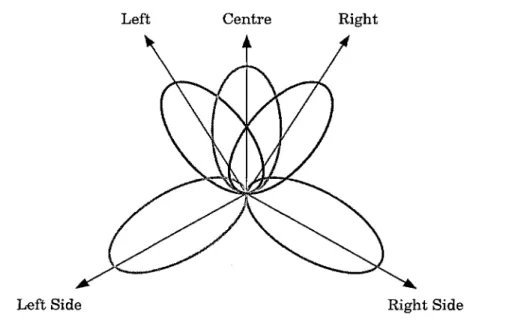
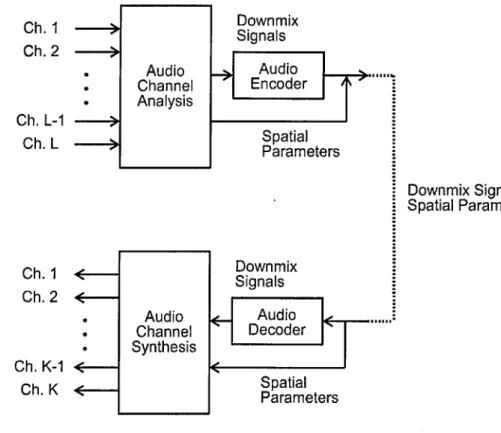
3.1 Illustration of microphone beam patterns for 5.1 audio recording . 29 3.2 Illustration of an SAC a p p ro a c h ... 34
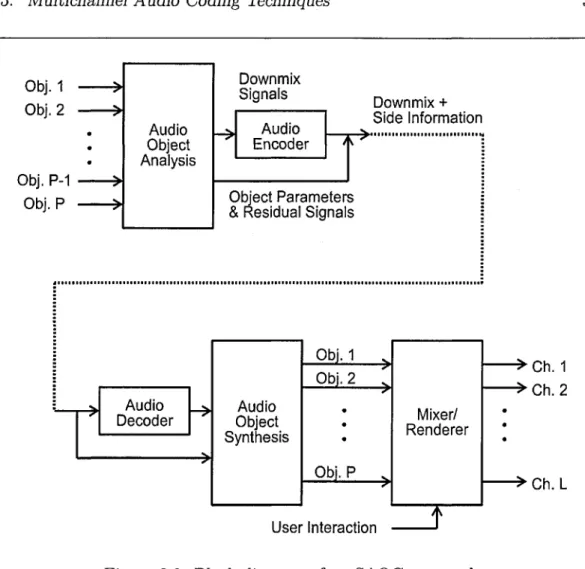
3.3 Block diagram of an SAGC approach . ... 39
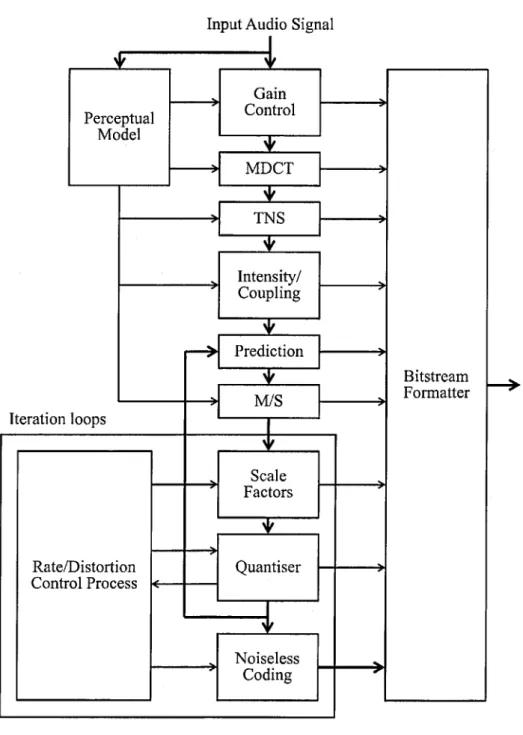
4.1 Block diagram of M PEC AAC E n c o d e r... 45
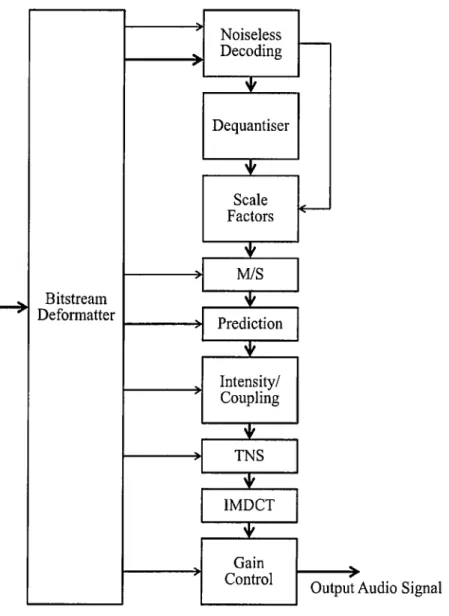
4.2 Block diagram of M PEC AAC D e c o d e r... 46
4.3 Flowchart of the inner iteration loop ... 51
4.4 Flowchart of the outer iteration l o o p ... 54
4.5 Block diagram of M PEC Surround... 57
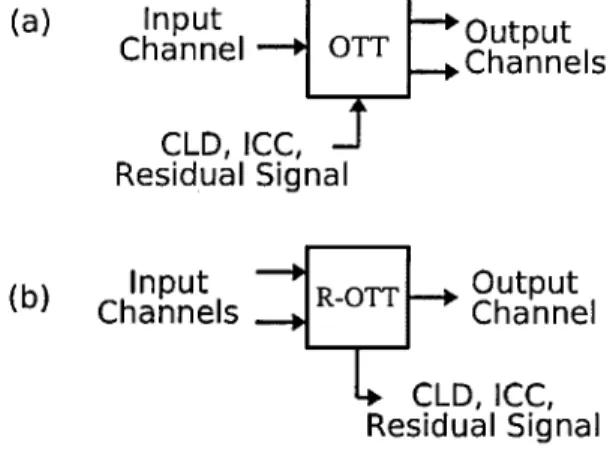
4.6 Block diagram of Analysis Q uadrature Mirror Filterbank (A-QMF) 59 4.7 Block diagram of (a) OTT module and (b) R-OTT module as used in M PS... 61
4.8 Block diagram of (a) the T T T and (b) the R -TT T modules. . . . 64
5.1 Analysis by synthesis framework for encoding spatial audio. . . . 70
5.2 Block diagram of the closed-loop R-OTT module... 74
5.3 The closed-loop R-OTT modules are employed within a multichan nel audio encoder. Any type of audio encoder, highlighted as a dashed block, can be employed... 75
List o f Figures vii
5.4 The segSNR per f r a m e ... 81
5.5 Average SegSNRs of 5-channel audio coders are plotted against the bitrates. At a bitrate of 160 kb/s per audio channel, the improve ment achieved by the closed-loop R-OTT module is 5.66 dB . . . 83
6.1 The block diagram of L-channel MDCT-based closed-loop R-OTT. 89
6.2 SegSNR of MDCT-based R-OTT m o d u le ... 91
6.3 SegSNR of MDCT-based closed-loop R-O TT ... 93
6.4 SegSNR of MDCT-based closed-loop R-O TT m o d u l e ... 94
7.1 A tree of R-O TT modules for encoding L-channel audio signals. . 102
7.2 Block diagram of the AbS-SAC encoder... 109
7.3 Performance of the proposed AbS approach using simplified AbS
algorithm... 115
7.4 Performance of the AbS-SAC for various bitrates in comparison with AAC and M PS... 117
8.1 A tree scheme of R-OTT modules used in the experiments . . . . 121
8.2 The results of the subjective test: (a) the SDC scores of the tested audio codecs averaged over all audio excerpts (b) the SDC scores of all audio excerpts averaged over the tested audio codecs (c) the SDC scores of the tested audio codec for Applause audio excerpt. 127
8.3 Objective difference grade (ODC) of the AbS-SAC for various bi trates in comparison with the tested AAC. The ODC scores of the tested AAC encoding 10-channel audio signals are not plotted as they are similar to the ODC scores of the tested AAC encoding 5-channel audio signals... 129
List o f Tables
4.1 The number of coefficients in each scale factor band [ 1 ] .... 50
4.2 Description of AAC Huffman C o d e b o o k s... 55
4.3 Mapping of 71 hybrid bands to 20 param eter b a n d s ... 66
5.1 Average SegSNR (dB) of 2 Channel Audio C o d e rs ... 78
5.2 Average SegSNR (dB) of 5 Channel Audio C o d e rs ... 80
6.1 Mapping of 49 Scale Factor Bands to 20 Param eter Bands . . . . 88
6.2 Average SegSNR (dB) of Various R-OTT Methods ... 95
6.3 Average segSNRs (in decibels) of MDCT-Based Codecs Compared to FB-Based R - O T T ... 97
7.1 Complexity of simplified AbS alg o rith m ... 112
7.2 Average segSNRs (in decibels) of A bS-SA C ...113
8.1 List of Audio Excerpts for E x p e rim en ts... 120
8.2 SegSNRs (in decibels) of the Closed-Loop R-O TT (CL R-OTT) Compared to the Open-Loop R-OTT (OL R - O T T ) ...122
8.3 SegSNRs (dB) of Various Signal Transformation Schemes Using QMF and M D C T ... 124
C hapter 1
In trod u ction
1.1
Background
Having in mind the growing demand for the reliable delivery of high quality mul tichannel audio in applications such as home entertainment, digital audio broad casting, computer games, music streaming services as well as teleconferencing, efficient coding techniques [2-4] have become paramount in the audio processing arena. The traditional approach for compressing multichannel audio has been to encode each audio channel using a mono audio coder, such as Dolby AC-3 [5,6] and M PEC Advanced Audio Coding (AAC) [7-9]. However, for the m ajority of coders adopting this method, the number of bits to be transm itted tends to increase linearly with the number of channels.
Recently, a new concept for encoding multichannel audio signals has been pro posed. It comprises the extraction of the spatial cues and the downmixing of multiple audio channels into a mono or stereo audio signal [10]. The downmix signals are subsequently compressed by an existing audio encoder and then trans m itted, accompanied by the spatial cues coded as a spatial parameter. Any re
1.1. Background
ceiver system th a t cannot handle multichannel audio can simply remove this side information and just render the downmix signals. This provides the coder with backward compatibility, which is im portant for implementation in various legacy systems. In addition, by utilising the spatial parameters, the downmix signals can be directly upmixed at the decoder side into a multi-channel configuration th at may be different from the one used at the encoder side. This technique is known as Spatial Audio Coding (SAC) [10-12].
Various SAC techniques, such as Binaural Cue Coding, (BCC) [13-15] and MP3 Surround [16-18] have been proposed. Inter-Channel Level Difference (ICLD), Inter-Channel Time Difference (ICTD), and Inter-Channel Coherence (ICC) are extracted as spatial parameters th a t are based on human spatial hearing cues [19]. SAC techniques such as Param etric Stereo (PS) [20-22] and M PEC Surround (MPS) [23-25] may also utilise signal processing techniques, such as decorrela tion. The great benefit of these perceptual-based coders is th a t they can achieve bitrates as low as 3 kb/s for transm itting spatial parameters, as in the case of MPS [24].
There are other techniques based on the extraction of the source location infor mation from multiple channels, thus simplifying the representation of the spatial scene. These techniques calculate the direction vectors representing the direc tional composition of a scene. At the decoder side, virtual sources are created from the downmix signal at those positions given by the direction vectors. This approach provides flexibility in the decoder output format and the multi-channel configuration. Examples for this technique include Spatial Audio Scene Coding (SASC) [26-28] and Directional Audio Coding (DirAC) [29-32]. Dir AC is slightly different in th at it incorporates a recording system using a microphone array [33], where the direction vectors are calculated from the microphone signals.
1.2. Research A im and Objectives
called Spatial Audio Object Coding (SAGC) [34-36], analyses object signals in stead of channel signals. This offers the end users the flexibility to recompose and reproduce the audio scene. Object Level Difference (OLD) and Inter-Object Cross-coherence (IOC) are extracted as object parameters and transm itted as the side information of a mono or stereo downmix signal. SAOC also provides users with an ability to render either only vocals (to enhance speech intelligibility) or only background music for applications such as karaoke. Its implementation, in combination with DirAC, to help capture audio object has been reported in [35].
As one can observe, each of these coding techniques has its unique advantages and disadvantages. However, they can all be classified as open-loop systems, where the encoders of BCC [15], MP3 Surround [16] and MPS [37], do not consider the decoding process during encoding. The major drawback of an open-loop system is th a t there is no mechanism employed to reduce the error introduced by quantising the spatial parameters and coding the downmix signals. In this thesis, an Analysis by Synthesis Spatial Audio Coding (AbS-SAC) technique is presented, which provides the advantages of a closed-loop system in order to improve the quality of multichannel audio reproduction at a cost of increasing encoder complexity. It is believed th a t the AbS-SAC technique can be implemented in any of the recent SAC schemes, even though in this work the AbS-SAC is applied solely in the context of the MPS architecture.
1.2
R esearch A im and O bjectives
The aim of this work is to develop a new SAC technique for encoding multichannel audio signals th a t operates in closed-loop to minimise signal distortion due to encoding and quantisation processes. In order to develop a systematic research methodology, this aim can be broken down into the following technical:
1.3. Outline o f Thesis
• To develop a novel SAC approach based on an Analysis by Synthesis (AbS) concept. Various possible ways to perform the spatial audio coding tech nique in the form of AbS will be investigated, and a system th a t can be a basis for those various possible implementation will be defined as the AbS-SAC framework.
• To implement the state-of-the-art spatial audio coding technique, i.e. M PEG Surround (MPS), within the AbS-SAC framework. The Reverse One-To- Two (R-OTT) module th a t is used in the MPS will be developed in the form of a closed-loop system. Investigation will be focused to find an approach for improving the objective fidelity of the reconstructed audio signals, in terms of segmental Signal-to-Noise-Ratio (segSNR).
• To investigate the possibility of performing an AbS optimisation to achieve further improvement of segSNR of the reconstructed audio signals. The complexity of the AbS optimisation algorithm will also be investigated and a simplified algorithm will be developed in order to make the proposed technique a practical solution.
• To perform various methods to evaluate the proposed AbS-SAC approach in comparison to the state-of-the-art techniques. The segSNR measurement is considered to be useful for a comprehensive evaluation, as the AbS approach actually operates in such a way th a t the output audio signals will be the same as the input signals. In addition, objective and subjective perceptual tests will also be used.
1.3
O utline o f Thesis
1.3. Outline o f Thesis
Chapter 2: The Fundamentals o f audio coding
Chapter 2 introduces briefly the fundamentals of audio coding th at include basic principles of digital audio as well as techniques th a t are closely related to audio coding. Compression artifacts th at frequently appear in audio coding as well as the m ethod to evaluate the performance of an audio codec are discussed. Moreover, other related topics are also briefly presented, such as the applications of the audio coding technique and the analysis by synthesis concept th a t is used as a basis for the proposed AbS-SAC technique.
Chapter 3: Spatial audio coding
Basic knowledge about spatial audio coding is discussed in this chapter. Firstly, a psychoacoustic background of spatial audio coding is illustrated, followed by a dis cussion about the spatial audio processing, including the recording, transmission and reproduction stages. Subsequently, several multichannel coding techniques are described. Finally, a performance comparison of those coding techniques is presented.
Chapter f : Advanced audio coding and M P E G surround
In this chapter, two state-of-the-art coding techniques th at are currently available for delivering multichannel audio signals are presented. Both techniques th a t are MPEG AAC and MPEG Surround standards are the basis for the development of the proposed AbS approach.
Chapter 5: A closed-loop R - O T T module
Chapter 5 presents the framework for the analysis by synthesis Spatial Audio Coding (AbS-SAC). The adaptation of the Reverse One-To-Two (R-OTT) mod ule, an elementary block used in MPEG surround, is described. Moreover, the discussion is followed by several experimental results showing the segSNR im provement achieved by the proposed AbS-SAC technique.
1.4. Original Contributions
This chapter discusses the MDCT-based closed-loop R-OTT module which is able to further improve the performance of the proposed closed-loop R-OTT module. Additionally, it also simplifies the coding structure. As in the previous chapter, the experimental results are presented to dem onstrate th at a significant improvement is achieved.
Chapter 1: Simplified A bS algorithm
In chapter 6, the AbS optimisation procedure is discussed. The simplest case of the full search AbS optimisation is presented. However, as complexity is the main challenge of this implementation, a simplified algorithm is proposed in Chapter 7. Experimental results show th a t the proposed algorithm can increase further the segSNR.
Chapter 8: Audio codec evaluation
In chapter 8, the overall performance of the proposed AbS-SAC technique is evaluated. Several critical test materials are prepared. Objective test methods, such as segSNR measurement, as well as an objective perceptual evaluation using Objective Difference Grade (ODG) metrics, are presented. Furthermore, the results of subjective test are also presented.
Chapter 9: Conclusions
Chapter 9 summarises all the work presented in the thesis. The objectives of the work as well as the proposed solution are restated. In addition, possible future work is presented.
1.4
Original C ontributions
• A novel AbS-SAC framework for encoding multichannel audio signals has been proposed. It is believed th a t a spatial analysis and synthesis tech nique can be implemented within this AbS-SAC framework. In addition.
1.4. Original Contributions
any number of input and output channels can be used. Furthermore, any suitable error criteria can be utilised. For taking into consideration the error introduced in the communication channel, an additional block th at models the channel error can be included in the AbS-SAC framework.
• An adapted version of the closed-loop R-OTT module has been developed. The downmix and the residual signal are recalculated based on the quan tised spatial parameters. Using this method the quantisation error of the spatial param eter can be compensated in the new downmix and residual signals. Implementation of this closed-loop R-OTT module in the MPEG Surround architecture has been investigated. The experimental results show th a t the closed-loop R-OTT module increases the segSNR. However, it is indicated th a t the performance can be improved further.
• Based on the previous investigation the MDCT-based R-O TT has been pro posed. This is the solution, due to the disadvantage of implementing the closed-loop R-OTT module in the subband domain of the Q uadrature Mir ror Filterbank (QMF) filterbank which is applied in the MPS. The results of the experiments show th a t the MDCT-based closed-loop R-O TT module is capable of minimising the error introduced by the quantisation of the spatial parameters.
• An AbS optimisation for finding the reconstructed audio signals with min imum segSNR has been proposed. However, it is shown th a t the full search AbS optimisation is extremely complex because there are as many as 6.6564 X 10^° combination of parameters th a t need to be tested in order to select one of them which produces minimum segSNR. To enable low com plexity implementation, a simplified AbS optimisation has been proposed. Several possible implementations in terms of algorithm complexity have been investigated. A case of implementation applying 243 iterations, which
1.4. Original Contributions
is a reasonable level of complexity, has been tested which shows further improvement of the segSNR.
C hapter 2
T he Fundam entals of A udio
C oding
This chapter provides an overview of fundamental principles in audio coding. It begins with a brief discussion of digital audio th a t includes audio signal sampling and quantisation, time-frequency transformation and perceptual-based audio cod ing. It then offers a brief review of compression artifacts, followed by an evalua tion of the performance of audio codecs. The applications of and standardisation activities for audio coding are also included in this chapter.
2.1
Basics o f D igital A udio
2.1.1
A udio Signal
An audio signal is normally represented in the time domain, describing the mag nitude of the signal against the time. It is also useful in some applications, however, to represent the audio signal in the frequency domain. Audible signals
2.1. Basics o f Digital Audio 10
th a t can be heard by humans such as speech, music, and other similar sounds generally have a frequency range between 20 Hz and 20 KHz. Speech signal have a slightly narrower bandwidth (generally less than 16 KHz) while music signals have a wider frequency component.
2.1.2
Sam pling and Q uantisation
Audio waveforms are naturally available as an analog signal, but almost every sound processing device is currently working in a digital format. To represent audio signals as digital data for storage and transmission purposes, i.e. Analog to Digital Conversion (ADC), two basic processes are required. These are sampling and quantisation. Firstly, a sampling process is used to convert a continuous time signal to a discrete-time signal. To sample an audio signal having a 20 KHz frequency bandwidth, for example, a sampling frequency of at least 40 KHz is theoretically required based on Nyquist-Shannon theorem [38,39], to be able to perfectly reproduce the original signal. If a lower sampling frequency is applied, the reconstructed audio signal may be different from the original (i.e. distortion is introduced). This phenomenon is called aliasing [40,41]. Normally, however, a sampling frequency of between 44.1 and 48 KHz is applied.
Secondly, a quantisation process converts a continuous-amplitude signal to a discrete-amplitude signal. The magnitude of an audio sample in an analog to digital conversion is normally represented as 16 bits, which means th a t 2^^ quan tisation levels are available. As with the sampling frequency, above, the larger the number of the quantisation levels the smaller the difference between the con tinuous and discrete signals. The magnitude difference between the continuous and discrete signals is defined as quantisation error or quantisation noise.
2.1. Basics o f Digital Audio 11
2.1.3
Sound Q uality
The bandwidth of the captured audio signal along with the number of bits used to represent each sample of audio signal will determine the quality of the repro duced audio signal. For instance, a speech signal limited in the frequency range between 200 and 3400 Hz and then sampled at 8 KHz [42] is assumed to be acceptable for communication through public telephone networks, even though high frequency parts of the speech signal are discarded. This range was used in the first standardised speech coder. For better rendering, telephony systems are now accommodating a wider speech bandwidth, such as 7 and 15 KHz, which are sampled at 16 and 32 KHz, respectively [43]. A CD quality audio signal, on the other hand, is sampled at 44.1 or 48 KHz in order to capture up to the 20-KHz frequency band of audio signals.
Regarding the number of bits used to represent each sample of audio signal, a Pulse Code Modulation (PCM) [44] represents every sample of speech or audio signal as either 8, 16, or 24 bits. For telecommunication, speech signals sampled at 8 KHz (i.e. 8000 speech samples per second) can be transm itted at 64 k b /s by representing every sample as 8 bits. In contrast, a stereo audio signal sampled at 44.1 KHz, with each sample allocated 16 bits, requires 1.4 M b/s.
2.1.4
A udio Com pression
For the majority of applications it is desirable to have the audio format as compact as possible while trying to maintain the quality of the reproduced audio signal. In order to achieve this compression, an audio encoder is used to remove redundancy in the audio data. At the end of the process an audio decoder is used to recreate the original audio signal. In most cases, however, the audio encoder and decoder introduce some noise into the signal.
2.1. Basics o f Digital Audio 12
PCM is one of the earliest and most straightforward coding approaches th a t can be applied to speech and audio signals. Later developments of PCM are known; they incude Delta Modulation (DM), and Adaptive Differential PCM (ADPCM). In general, all of these approaches exploit the redundancy of the time domain waveform of speech and audio signal. However, modern audio coders employ ad vanced techniques th a t rely upon time-frequency decomposition, as well as taking advantage of the psychoacoustic model [45]. The most popular coding technique is MPEC-1 layer 3, commonly known as the MP3. The m ajority of audio appli cations available at the moment can support this MP3 audio format. However, there are other coding techniques th a t are developed for specific purposes. For instance. Code Excited Linear Prediction (CELP) [46] was specifically developed for encoding speech signals.
2.1.5
Tim e-Frequency Transform
In order to represent the signal in as few bits as possible, various different types of audio coding techniques have been proposed. Recent techniques basically process the time domain audio signal in a frame or a block of audio samples. The frame size, when 48 KHz of sampling frequency is applied, may normally range from 400 samples (8.3 ms) to 4096 samples (85.3 ms) [47-49]. However, a longer or shorter frame size can be applied. Using a longer audio frame potentially gives a higher coding efficiency than a shorter one, however, it can longer the processing delay. Additionally, increasing the audio frame size possibly makes the encoder fail to properly model the characteristic of the audio signal. On the other hand, for applications th a t require a lower delay, a shorter audio frame, such as 5.8 ms th a t is used in Constrained-Energy Lapped Transform (CELT) [47], will be useful at a cost of reducing coding efficiency. The audio frame is then either transformed into the frequency domain (a process termed transform coding), or is decomposed
2.1. Basics o f Digital Audio 13
as sub-band signals (subband coding). Transformation or decomposition tools, such as Discrete Fourier Transform (DFT), filterbank, and Modified Discrete Co sine Transform (MDCT), are currently widely used in cutting-edge audio coding techniques. Representing audio signals in the frequency domain instead of in the time domain is generally assumed to be more effective in reducing signal distor tion. In addition, processing the audio signal in the frequency domain also allows for the possibility of utilising the psychoacoustic model, which is very im portant for reducing signal distortion.
2.1.6
P erceptual-based C oding
Knowledge and understanding about human perception of sound signals is also exploited in most modern coding techniques. This kind of approach is called a perceptual-based audio codec. Basically, a psychoacoustic model estimating parameters, such as the hearing and masking threshold, is utilised. The main benefit of the audio codec employing this model is the ability to effectively allocate bits, in the quantisation process, into any part of audio signal th a t is audible to the human hearing system. Used this way, any imperceptible part of the audio signal will be removed.
2.1.7
T hree-D im ensional (3D ) A udio
The release of the MPEG-1 standard in 1993 motivated the widespread imple mentation of digital audio materials. The most popular MPEG-1 layer 3 [50-52], widely known as the MP3, facilitated representation of the audio signal in a more compact way than the conventional audio GD format. Since then, most digital audio materials were available in the MP3 format for both on-line audio services
2.2. Compression Artifacts 14
such as Digital Audio Broadcasting (DAB) and off-line audio services th a t can be rendered in various portable media players.
In addition to the benefit of providing a compact audio representation, MPEG-1 layer 3 can also support stereo audio format. It is easy now to find audio m ate rials, such as music albums, in the format of the MP3 stereo. Even though the stereo audio format increases the audio data size, because it consists of two audio channels, it is interesting to see th a t a stereo audio format frequently becomes the first choice for digital audio representation, instead of a mono audio format. This is due to the fact th a t the stereo audio format will increase the realism of a real acoustic environment. Hence, it is favorable to represent the audio m aterials in stereo rather than mono formats even though a bigger data size is needed.
Representation of audio materials as stereo formats, or even a larger number of audio channels, has been possible and has been used for many years in multiple applications (particularly in the cinema industry). It is well understood th a t multichannel audio representation has ability to convey much more information about 3-Dimensional (3-D) audio scenes including the individual sounding ob jects, their positions as well as the acoustic of the environment. Started by the cinema industry, it is now used in many off-line and on-line applications including home entertainment and the Internet applications. Moreover, the importance of 3-D audio is projected to increase even further, due to the introduction of 3D television services and the spread of 3-D displays.
2.2
C om pression A rtifacts
An efficient audio coding technique basically employs two approaches. The first approach is to simply capture as narrow a bandwidth as possible. For instance, in an encoder employing Spectral Band Replication (SBR), the high frequency
2.2. Compression Artifacts 15
regions of the audio signal are modeled and parameters are extracted. At the de coder side, the parameters are applied to create the replica of the high frequency parts of the audio signal. The second approach is to represent every audio sample with as few bits as possible. This may be achieved by employing an efficient quan tisation technique. Both approaches are performed in such a way as to maintain the reconstructed audio quality. However, both approaches may introduce audio distortion or artifact.
In order to reconstruct an indistinguishable audio signal from compact audio data, attention should be paid not only to the efficient technique of audio coding but also to the artifacts th a t usually appear in compressing the audio signal. Several major audio artifacts have been identified, such as pre-echo, speech reverberation, aliasing, and birdies [53]. In addition, other artifacts may also be present, due to the process of audio recording as well as format conversion or tandem coding.
Compression artifacts mainly occur due to the processing of audio signal in a frame basis, particularly in encoding a segment of audio signal th a t contains an abrupt change of magnitude during a short time duration. This event is known as a transient or attack signal. A transient event in a time domain signal will transform to a widespread spectrum in the frequency domain. As a result the psychoacoustic model may fail to calculate the correct allowed distortion over all subbands. It means th a t quantisation errors may be introduced in the whole frequency spectrum of the frame. At the decoder side, these errors will transform to distortion over all samples in the audio block including in the preceding of the transient event. This distortion th at may be audible is known as pre-echo.
Pre-echo occurs during the application of a long length of audio frame, and it can be avoided by shortening the size of the frame. Therefore, advanced audio coders employ an adaptive length of audio frame. This can be realised by predicting the energy of the upcoming frame. If a transient is detected then the frame size
2.3. Evaluation o f Audio Codec Performance 16
will be switched to a short size. A case similar to pre-echo in encoding speech signal is called speech reverberation. Some parts of speech signal can be classified as a non-stationary signal th a t has the same properties as a transient signal. In encoding this kind of speech signal, distortion can be introduced in the previous and after the original transient event. However, speech reverberation is usually audible after the sound of the original transient signal. The noise th a t following the transient event will decrease in the time.
Aliasing artifact is mainly caused by the implementation of critically-sampled filterbank. This type of filter has a set of overlapped bandpass filters. The outputs of the filterbank are down-sampled by a particular factor which is usually chosen to be equal to the number of subband signal. Even though it is designed to obtain a perfect audio reconstruction by eliminating the aliasing, distortion is still introduced due to the imperfect frequency response of the filter. Furthermore, quantisation of subband signals th at is performed in between the analysis and synthesis filterbanks also introduce further distortion.
Birdies artifact is discontinuities th a t exist in the frequency domain. Due to the implementation of psychoacoustic-based bit allocation, specific spectral co efficients may be temporarily allocated sufficient bits, but may not be sufficient in some audio blocks. Consequently, these spectral coefficients would appear in some frames but disappear in the other frames.
2.3
Evaluation of A udio C odec Perform ance
The quality of the reconstructed audio signal is the most im portant factor to be considered in designing and developing an audio codec. Other factors include delay and complexity. For this reason, an accurate audio evaluation m ethod is necessary to assess the performance of the audio codec. The most reliable and
2.3. Evaluation o f Audio Codec Performance 17
relevant m ethod to perform this quality assessment is to undertake a listening subjective test, such as those recommended in the ITU-R BS.1116-1 [54] and the ITU-R BS.1534 recommendations [55]. The ITU-R BS.1116-1 Recommendation is often used in the assessment of audio signal, including multiple audio signals, th at introduce small impairments which cannot be detected easily. In order to detect these small impairments it is frequently necessary to repeatedly listen to the audio signal. Thus, it is specified in [54] th a t to score an audio excerpt several trials of listening may be required. On the other hand, the ITU-R BS.1534 entitled method for the subjective assessment of intermediate quality level of coding systems, is frequently applied to evaluate the quality of the audio signal th at contains a larger level of distortion which is easily detectable even in a single listening.
Both of those recommendations specify th at a minimum number of five critical audio excerpts, typically having duration of 10 to 25 s, selected from a large number of audio materials, should be used in the assessment. The quality of the audio codec under test in encoding these audio excerpts is judged by a number of expert listeners who have the ability to detect the audio impairments. The expertise of the listeners becomes more im portant when the impairments are small. It is specified in [54] th at an appropriate conclusion of the subjective test is achieved when at least 20 expert listeners participate in the listening test.
As the subjective assessment methods are very expensive and time-consuming, in order to provide a quick estimation of the reproduced audio quality, perform ing an objective test is preferable. The conventional methods used to perform this objective test include measurements of Signal-to-Noise-Ratio (SNR) and Harmonic-Distortion (HD), where the time and frequency domain of the orig inal and reconstructed audio waveforms are compared. However, these objective metrics are no longer suitable, especially for assessing the quality of the audio sig nals reconstructed from modern perceptual based coding techniques. The ITU-R
2.4. Applications o f Audio Coding Technique 18
BS. 1387-1 [56], recommending a method for objective measurement of perceived audio quality, is assumed to have ability giving a more accurate audio quality as sessment, instead of those traditional SNR and HD metrics. Using this objective test, an Objective Difference Grade (ODG) is obtained to represent the quality of the tested audio signals compared to the original signals. Five grades are avail able in this ODG metric, similar to the Subjective Difference Grade (SDG). They are:
• 0 (imperceptible)
• -1 (perceptible but not annoying)
• -2 (slightly annoying)
• -3 (annoying)
• -4 (very annoying)
2.4
A pplications o f A udio C oding Technique
MPFG-1 layer 3 (MP3) is a very popular method for compressing audio signals. Its high coding efficiency makes it possible to represent a 3-minute music clip as a piece of data sized around 4 Mb. Since it was standardised, MP3 compressed audio signals have become preferable for many applications, such as those used in home and portable entertainment devices, digital audio broadcasting, music downloading and streaming services, as well as other Internet applications (such as teleconferencing).
Teleconference is a popular way to communicate remotely. Using it, several peo ple can participate in a talk, discussion, or meeting. However, this technology is
2.4. Applications o f Audio Coding Technique 19
still far from being categorised as a comfortable communication system. Many users often find th at it is difficult to identify and understand the voice and speech of remote talkers, because all sounds come from a single loudspeaker. This specif ically occurs when multiple talkers are speaking simultaneously.
In order to overcome this problem, a multichannel audio system is required where each voice is reproduced by a single loudspeaker at a particular source position. Using this system, user perception increases significantly, particularly in identify ing voices from different talkers [57]. However, this additional perceptual realism does not affect the ability to convey the message delivered [58]. For teleconfer encing, DirAC [59] and S^AC [60] have been implemented before as spatial audio coding techniques. However, their performance was limited by the performance of the applied audio coding.
Another promising application of a multichannel audio coding is the enablement of personalised music remixes. Users often want to modify rendered music com position. This feature has actually been available for long a time as a limited function, in th a t the modification is applied into the whole music composition without the capability to adjust any audio object (i.e. singer vocal or musi cal instruments). W ith the recent development of Spatial Audio Object Coding (SAGC) technology, it is now possible to provide users with an interaction fea ture in the rendering stage to independently m anipulate every audio object. For instance, with a Karaoke application, users have an option to play either vocals only (A Capella) or to play background music only.
2.5. Standardisation Activities for Speech and Audio Coding Technique 20
2.5
Standardisation A ctivities for Speech and
A udio C oding Technique
Several standardisation bodies, such as the International Telecommunication Union (ITU), Moving Picture Expert Group (MPEG), European Telecommunication Standards Institute (ETSI), have regular activities in developing new standards of speech and audio coding. Current and future activities show th a t there is an interesting trend emerging in speech and audio coding standardisation. The MPEG audio group has released various audio codec standards. The first is MPEG-1 audio standard, released in 1993, consists of layers 1, 2 and 3, where the MPEG-1 layer 3 is widely known as the MP3. This codec has the ability to encode mono and stereo audio signals. Moreover, the MPEG-2 audio part has two types of audio codecs th a t are backward and non-backward compatible. The MPEG-2 non-backward compatible version was released in 1997, and was later called MPEG Advanced Audio Coding (AAG). It is able to encode multiple au dio signals in up to 48 channels. Specifically designed for encoding multichannel audio signals, MPEG Surround was subsequently released in 2008, while M PEG Spatial Audio Object Coding (SAGC) was released in 2010. All those audio codec standards typically sample audio signals at 48 KHz while other sampling frequencies are also accommodated. In order to accommodate a speech signal, as it has a specific signal characteristic, Gode-Excited Linear Prediction (GELP) is also currently adopted as a tool in the MPEG standard, ISO /IEC 23003-3/FDIS, Unified Speech and Audio Coding (USAC) [61,62].
On the other hand, ITU has a long history of standardisation activities in speech coding. Several speech codec standards, generally capturing speech signals at 8 KHz, have been released in past years, where one of them was widely imple mented, such as GELP. Recently, ITU has also been working to standardise a
2.6. The Principle o f Analysis by Synthesis 21
new speech coder th a t can transm it a wider bandwidth speech signal and, thus, make it possible to also encode an audio signal. In order to make it suitable to different networks, backward compatibility, as well as bandw idth and bitrate scalability, are also targeted to be the features of this codec. Moreover, a mono to multichannel upmixing capability is required. It seems th a t both standardisation bodies represent similar trends in speech and audio coding activities.
New speech coding standards, such as G.729.1 [63,64], G .711.1 [65] and G.718 [66,67], have been developed for delivering wideband speech signals sampled at 16 KHz. In addition, the terms superwideband and fullband speech coders [68], sampling speech signals at 32 KHz and 48 KHz respectively, have been introduced. For instance, ITU-T is currently working to extend G.729.1 as a standard for super wideband speech and audio [69]. Furthermore, ITU-T has also released a newly standardised super wideband codec extension for G.718 [70]. Similarly, another extension was jointly developed for both G.711.1 and G.722 [71-73]. These coders are designed to be backward compatible to the previous coders. They also have bandwidth and bitrate scalability. Moreover, a new G.719 has also been standardised as the first ITU -T’s fullband audio coder [74,75]. For the next standard, ITU-T also has a study group working to develop a new standard th a t includes a multichannel upmixing capability [43,76]. These activities seem to accommodate a transmission of multichannel audio signals in-line with M PEG audio activities.
2.6
T he Principle of A nalysis by Synthesis
Analysis by Synthesis (AbS) technique [77, 78] is a generic m ethod th a t has already been implemented in many areas, such as estimation and identifica tion [79,80]. Several decades ago, this concept was proposed as a framework
2.7. Conclusions 22 Input Signal Transmitted Parameters Decoder Error Minimisation Encoder
Figure 2.1: Block diagram of a typical Analysis by Synthesis technique.
for encoding speech signals and determining the excitation signal in a Linear Predictive Coding (LPC)-based speech coder [81,82]. Since then, many other speech coders have been proposed within this framework, such as the most pop ular Code-Excited Linear Prediction (CELP) [46], which is currently specified as one of the tools in the MPEG-4 Audio standard [83]. CELP is also currently adopted in development of the MPEG standard, ISO /IEC 23003-3/FDIS, Uni fied Speech and Audio Coding (USAC) [61,62]. The AbS technique is currently applied in many applications, including the quantisation of spectral coefficients of the MPEG-AAC audio codec.
An AbS system, depicted in Fig. 2.1, is able to synthesise a signal by a set of parameters where the values of these parameters are usually made variable in order to produce the best matched synthesised signal. The difference between the observed signal and the synthesised signal, called the error signal, is utilised in an error minimisation block. A set of parameters which produce minimum error signal are selected as optimal parameters and sent to the decoder.
2.7
C onclusions
This chapter has given a brief overview of fundamental principles in audio coding th a t are necessary in understanding the development of any spatial audio
cod-2.7. Conclusions 23
ing technique. A basic concept of audio compression, as well as artifacts, often introduced in recent audio codecs, is presented, followed by a brief discussion about methods used to evaluate the performance of an audio codec. In addition, promising applications of audio coding techniques, as well as related standardis ation activities, are also briefly illustrated in this chapter.
C hapter 3
Spatial A udio C oding
This chapter discusses spatial audio coding. A brief overview of psychoacoustics is presented at the beginning of the chapter. The next section presents spatial audio processing methods, including recording, transmission and reproduction, followed by a description of techniques used for spatial audio compression. At the end of this chapter, a comparison of different coding methods is presented.
3.1
Psychoacoustic Background
3.1.1
H um an A u d itory System
A deeper understanding of the human auditory system has motivated the de velopment of more efficient and powerful quantisation methods employed in an audio coder. The human ear can listen to a very large range of sound levels. The minimum level th a t can be heard for a particular frequency is defined as the hearing threshold or threshold in quiet [1,19]. The human hearing system cannot detect any sound level below this threshold, even in a very quiet condition. This
3.1. Psychoacoustic Background 25
threshold may be different for each frequency. The hearing threshold phenomenon is then taken into consideration when the quantisation process is performed. It suggests th a t it is not necessary to transm it any frequency component of an audio signal with a sound level below the hearing threshold. In addition, as long as the quantisation noise is below the hearing threshold, the noise will not be heard.
In addition to the hearing threshold, the masking phenomenon [1,19] should also be considered in developing an effective quantisation technique in an audio coder. When two sounds, with similar frequencies, occur at the same time, the louder sound can cause the other sound to be undetectable, even though its level is higher than th at of the threshold in quiet. This phenomenon is termed frequency masking, where the louder sound is named the masking or masker sound, and the softer sound is called the maskee. In the presence of a high-level masker sound, it is useful to determine a specific sound level, because below this level other sounds will be masked by the masker. This level is defined as the masking threshold. The values of the masking threshold are generally high in the frequencies around the masker frequency. However, they tend to decrease as the frequency gets farther away from the masker.
Another type of masking phenomenon is temporal masking. It occurs when two sounds are not presented simultaneously. In this situation the louder sound is still able to mask the other sounds present before and after the masker. Temporal masking is normally effective only for a few milliseconds before and after the masker sound. Exploiting the masking phenomena benefits a quantisation process where it is not relevant to transm it the maskee sound, as it would not be heard by humans.
Further exploration in the frequency masking phenomena led to the understand ing of the principle of critical bandwidth [1,19], which relates to the frequency range where the masking threshold around the masker frequency is fiat. In order
3.1. Psychoacoustic Background 26
to develop an effective audio coder it is useful to perform the quantisation pro cess in the frequency range or frequency subband th a t is similar to the critical bandwidth, so th a t the audio signal component below the masking threshold will be discarded.
Based on knowledge of the human hearing system, a psychoacoustic model can be designed. It actually tries to model all relevant factors th a t influence the hearing process, including the hearing and masking threshold. The goal of the psychoacoustic model is to calculate the Signal to Mask Ratio (SMR), which is a comparison between the level of the audio signals and the masking threshold. Then, the calculated SMR is used to determine how many bits should be allo cated to a certain frequency range in order to ensure the quantisation error is imperceptible.
3.1.2
Spatial H earing
Having two ears, humans can localise where a sound is coming from. Sound waves coming from a sound source may reach the two human ears, the left and the right, at different times, because they travel different distances. Due to these sound propagation properties the human brain detects the time difference between the sound waves from the left and the right ears. This cue is named an Inter- aural Time Difference (ITD) [19,84]. This may also cause the sound pressure detected by each ear to have a slightly different level. However, shadowing by the human head, reflection and diffraction by surrounding environments can make the differences smaller or larger, creating another cue. Inter-aural Level Difference (ILD) [19,84]. The human hearing system simply perceives the position of a sound source by processing these inter-aural time and level difference cues. In the case of the sound wave experiencing various reflections, the resulting sound waves arrive at human ears with different amplitudes and different time delays. Consequently,
3.2. Spatial Audio Processing 27
the sound waves at both ears will be partially incoherent, creating a perception of widening the sound source.
However, there are some positions, such as in front or in the back of the human head [19,85], which would produce identical ITDs and ILDs. If a sound comes from these places, the human brain cannot precisely determine where the source position is. This phenomenon is known as cone of confusion [86] and can be solved by head movements [87]. Another situation th a t makes the human brain fail to locate the proper position of the sound source occurs when there are two or more similar sound sources, located in different locations, transm itting sound waves with small time delays. These sounds will be perceived as a single sound, instead of two or more sounds, coming from a position closer to the earlier sound source. Such a situation is called the precedence effect [88].
The human head’s size, the shape of pinna, and the reflections off the shoulder and body also affect the human ability to localise a sound source. All of these cues can be represented as a Head-Related Transfer Function (HRTF) [89]. This function is actually a frequency response of the human auditory system. It is measured for a sound signal coming from every possible source direction. All of these cues, ITD, ILD, inter-aural correlation, along with other cues, can be taken into account in developing an effective spatial audio coding technique.
3.2
Spatial A udio P rocessing
For a long time period, sound waves were captured, for the purpose of storage and transmission, by a single microphone th a t discarded all those relevant cues th a t could describe the individual sounding objects, along with their positions, as well as the acoustics of the environment. Consequently, the reconstructed sound reproduced by a loudspeaker lost its spatial impression. In order to m aintain its
3.2. Spatial Audio Processing 28
spatial effect, sound is usually recorded, transm itted and reproduced in several channels (two, five, or more, for instance). The two-channel audio system, widely known as stereo audio, has been a popular option for many applications due to its simplicity. Two channels, the left and right channels, are located in front of the listeners as most listeners focus on the sound in front of them. Significance improvement of spatial impression is provided compared to a single monophonic audio. However, stereo audio system cannot provide surround sound as there is no channel th at intended to represent sounds located on the side and at the back of the listeners. Thus, acoustics of the environment particularly at those positions of the listener will not be presented with a stereo audio system.
The most frequently used number of audio channels for surround sound is five. This configuration was recommended by ITU and has been known as the 5.1 audio system [90]. Three channels are located in front of the listener (the center, left and right channels), and two channels are positioned in the back (the rear/side channels). The .1 is for Low Frequency Enhancement (LEE) channel, where the approximately 120-Hz audio bandwidth required for this channel is much lower than the others. This LEE channel is actually intended to give a special impression on a specific low frequency audio content th at needs larger sound pressure particularly for audiovisual applications. Other channel configurations are also available, such as 7.1, 10.2, and 22.2 [91,92] audio systems th a t are useful for rendering more accurate three dimensional surround sound [86]. Principally, all of these systems are intended to give more spatial effects to the listener.
3.2.1
R ecording, Transm ission, and R ep rod u ction
Each channel of a multichannel audio content is usually recorded separately by a single microphone th a t is usually intended to capture sound waves coming from a specific area. For example, in Fig. 3.1, a microphone beam p attern for 5.1 audio
3.2. Spatial Audio Processing 29
Left Centre Right
Left Side Right Side
Figure 3.1: Illustration of microphone beam patterns for 5.1 audio recording
recording is presented. Otherwise, all channels can be recorded by a microphone array th a t provides a set of microphone signals such as B-format [93,94]. Some commercial microphone products such as Holophone [95] and SoundField [96] are available to capture high quality spatial audio and record B-format microphone signals.
For digital transmission and storage, audio signals are generally represented in fewer channels, often two. Conventional techniques, such as Dolby stereo. Sur round and Prologic [86], are available by matrixing multichannel signals. Dema- trixing is required to reproduce multichannel signals. Otherwise, each channel at multichannel audio content can be coded and transm itted by an audio coder such as one implemented in MPEG-2 A AC. However, this m ethod is clearly not effective in terms of the amount of bits needed to be transm itted. For this reason. Spatial Audio Coding (SAC), where the total bitrate needed for transmission may be less than the discrete multichannel audio coding, is becoming popular.
num-3.2. Spatial Audio Processing 30
ber of loudspeakers. Generally, audio signals recorded by a specific channel config uration should be reproduced by the same configuration. For mobile applications, headphones can be an interesting option to reproduce multichannel audio signals by trans-coding multichannel audio into binaural audio.
3.2.2
V irtual Source Principle
Due to limitations in the number of loudspeakers, a virtual sound source can be created in the area between two loudspeakers or the area among three loud speakers. The listener will perceive the sound coming from the point where the virtual source is located. The most popular way to create such a virtual source is by using Vector Based Amplitude Panning (VBAP) [97-101]. The position of the virtual source is represented by a unit vector. The gain of the audio signal fed to each loudspeaker is then determined by the component of the unit vec tor. In addition, other panning techniques, such as Ambisonic, can be used. For reproducing a virtual source by a headphone, the HRTFs can be utilised and im plemented as a filter. Such an application is known as binaural rendering. W ith this binaural rendering, a listener can perceive th a t a virtual source is kept in a constant position even though the listener moves his head. The HRTF has been implemented for binaural rendering in MPEG Surround standard [102].
Amplitude panning techniques are not able to create a virtual source outside the area between the loudspeakers. This problem can be solved by Wave Field Synthesis (WFS) [103]. The WFS technique usually requires a large number of loudspeakers. Each loudspeaker is configured to reproduce a different phase of audio signals. Hence, a specific wavefront can be constructed for a sound source at a specific location, even for a position behind the loudspeakers. However, due to the need for a large number of loudspeakers, this WFS technique is not favorable for home consumers’ implementation.
3.3. Multichannel Audio Coding Techniques 31
3.3
M ultichannel A udio C oding Techniques
For the purpose of storage and transmission, it is always desirable to make the multichannel audio signals as a compact as possible. Reducing either the num ber of channels or the number of bits required for representing the audio signals is the basic option. However, it is necessary to maintain the spatial impression th a t would be created by those compact-represented audio signals. For this rea son, efficient coding techniques play an essential role in delivering high quality multichannel audio. In this section, various approaches proposed to encode mul tichannel audio signals are discussed.
3.3.1 M atrixed Surround Sound System s
A conventional approach to store or transm it multiple audio signals is to represent the audio signals in fewer channels, such as two. This basic idea is exploited in a matrixed surround technique, where multiple channels are downmixed into mono or stereo audio by a m atrix conversion process. Dolby Stereo, intended for cinema sound application matrixing of three or up to six channels into stereo, is among the one of the approaches available using a m atrix surround method. Later products from Dolby, such as Dolby Surround, Prologic and Prologic II, and Lexicon Logic 7 [86] are also based on this approach. In order to properly reconstruct the original channels, the dematrixing process should be carefully performed at the decoder side. However, side-effects such as crosstalk, where an audio signal from a particular channel can be present in the other channels, always exist. Among these techniques, Dolby Prologic II is the most popular, as it has a feature optimised for home theater applications.
![Table 4.1: The number of coefficients in each scale factor band [1]](https://thumb-us.123doks.com/thumbv2/123dok_us/10056780.2905370/62.830.266.605.226.549/table-number-coefficients-scale-factor-band.webp)