Electrical and Computer Engineering Publications
Electrical and Computer Engineering
2018
C3LES: Codes for Coded Computation that
Leverage Stragglers
Anindya B. Das
Iowa State University, [email protected]
Aditya Ramamoorthy
Iowa State University, [email protected]
Follow this and additional works at:
https://lib.dr.iastate.edu/ece_pubs
Part of the
Systems and Communications Commons
, and the
Theory and Algorithms Commons
The complete bibliographic information for this item can be found at
https://lib.dr.iastate.edu/
ece_pubs/200
. For information on how to cite this item, please visit
http://lib.dr.iastate.edu/
howtocite.html
.
This Article is brought to you for free and open access by the Electrical and Computer Engineering at Iowa State University Digital Repository. It has been accepted for inclusion in Electrical and Computer Engineering Publications by an authorized administrator of Iowa State University Digital Repository. For more information, please [email protected].
C3LES: Codes for Coded Computation that Leverage Stragglers
Abstract
In distributed computing systems, it is well recognized that worker nodes that are slow (called stragglers) tend
to dominate the overall job execution time. Coded computation utilizes concepts from erasure coding to
mitigate the effect of stragglers by running "coded" copies of tasks comprising a job. Stragglers are typically
treated as erasures in this process. While this is useful, there are issues with applying, e.g., MDS codes in a
straightforward manner. Specifically, several applications such as matrix-vector products deal with sparse
matrices. MDS codes typically require dense linear combinations of submatrices of the original matrix which
destroy their inherent sparsity. This is problematic as it results in significantly higher processing times for
computing the submatrix-vector products in coded computation. Furthermore, it also ignores partial
computations at stragglers.
In this work, we propose a fine-grained model that quantifies the level of non-trivial coding needed to obtain
the benefits of coding in matrix-vector computation. Simultaneously, it allows us to leverage partial
computations performed by the straggler nodes. For this model, we propose and evaluate several code designs
and discuss their properties.
Disciplines
Electrical and Computer Engineering | Systems and Communications | Theory and Algorithms
Comments
This is a pre-print of the article Das, Anindya B., Li Tang, and Aditya Ramamoorthy. "C3LES: Codes for
Coded Computation that Leverage Stragglers."
arXiv preprint arXiv:1809.06242
(2018). Posted with
permission.
C
3
LES
: Codes for Coded Computation that
Leverage Stragglers
Anindya B. Das, Li Tang and Aditya Ramamoorthy
Department of Electrical and Computer Engineering Iowa State University
Ames, IA 50010, U.S.A.
{abd149,litang,adityar}@iastate.edu
Abstract—In distributed computing systems, it is well recog-nized that worker nodes that are slow (called stragglers) tend to dominate the overall job execution time. Coded computation utilizes concepts from erasure coding to mitigate the effect of stragglers by running “coded” copies of tasks comprising a job. Stragglers are typically treated as erasures in this process.
While this is useful, there are issues with applying, e.g., MDS codes in a straightforward manner. Specifically, several applications such as matrix-vector products deal with sparse matrices. MDS codes typically require dense linear combinations of submatrices of the original matrix which destroy their inherent sparsity. This is problematic as it results in significantly higher processing times for computing the submatrix-vector products in coded computation. Furthermore, it also ignores partial computations at stragglers.
In this work, we propose a fine-grained model that quantifies the level of non-trivial coding needed to obtain the benefits of coding in matrix-vector computation. Simultaneously, it allows us to leverage partial computations performed by the straggler nodes. For this model, we propose and evaluate several code designs and discuss their properties.
Index Terms—Distributed computing, stragglers
I. INTRODUCTION
Distributed computation plays a major role in several prob-lems in machine learning. For example, large scale matrix-vector multiplication is repeatedly used in gradient descent which is typically used in high dimensional machine learning problems. The size of the underlying matrices makes it imprac-tical to perform the computation on a single computer (both from a speed and a storage perspective). Thus, the computation is typically subdivided into smaller tasks that are run in parallel across multiple worker nodes.
In these systems the overall execution time is typically dominated by the speed of the slowest worker. Thus, the presence of stragglers (as these slow workers are called) can negatively impact the performance of distributed computation. In recent years, techniques from coding theory [1]–[4] have been used to mitigate the effect of stragglers for problems such as matrix-vector and matrix-matrix multiplication. For instance, the work of [1] proposes to partition the computation ofAxby first splittingAT = [AT
1 AT2]T into an equal number This work was supported in part by the National Science Foundation (NSF) under grant CCF-1718470.
of rows and assigning three workers, the task of computing
A1x, A2x and (A1+A2)x, respectively. Evidently, the load
on each node is half of the original job. Furthermore, it is easy to see thatAxcan be recovered as soon as any two workers complete their tasks (with some minimal post-processing). Thus, this system is resilient to one straggler. The work of [3], poses the multiplication of two matrices in a form that is roughly equivalent to a Reed-Solomon code. In particular, each worker node’s task (which is multiplying smaller submatrices) can be imagined as a coded symbol. As long as enough tasks are complete, the master node can recover the matrix product by polynomial interpolation.
For such systems we can define a so-called recovery thresh-old, which is defined as the minimum value of τ, such that the master node can obtain the result as long asanyτ workers complete their tasks. Thus, at the top level, in these systems stragglers are treated as the equivalent of erasures in coding theory, i.e., the assumption is that no useful information can be obtained from the stragglers.
While these are interesting ideas, there are certain issues that are ignored in the majority of prior work (see [5]–[7] for some exceptions). Firstly, several practical cases of matrix-vector or matrix-matrix multiplication involve sparse matrices. Using MDS coding strategies in a straightforward manner will often destroy the sparsity of the matrices being processed by the worker nodes. In fact, as noted in [7], this can cause the overall job execution time to actually go up rather than down. Secondly, in the distributed computation setting, we make the observation that it is possible to leverage partial computations that are performed by the stragglers. Thus, a slow worker may not necessarily be a useless worker.
A. Main Contributions
• In this work we present a more fine-grained model of the
distributed matrix-vector multiplication that allows us to (i) leverage partial computations performed by stragglers and (ii) impose constraints on the extent to which coding is allowed in the solution. Our formulation leads to some new questions in the domain of code design that to our best knowledge have not been investigated systematically in the literature before.
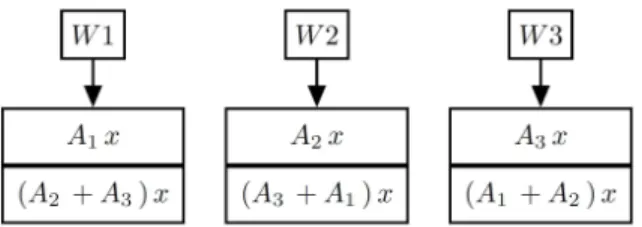
Fig. 1:MatrixAis divided into three submatrices. Each worker is assigned two of the submatrices.
• We present two models in our work. In the first model, the tasks assigned to the workers are uncoded, whereas in the second model we allow for a user specified fraction of coded tasks. In both cases, we present bounds on the amount of computation that the workers need to perform in the worst case and the straggler resilience of the system. We also present matching construction schemes in some cases. We emphasize that the uncoded model applies in general to anycomputation problem, and the bounds and constructions hold in significant generality for that case.
II. PROBLEMFORMULATION
We consider a scenario where a master node has a matrix
Aand a vectorxand needs to computeAx. The computation needs to be carried out in a distributed fashion overnnodes. Each node receives a certain fraction (denoted by γ) of the rows of A and the vector x. The node is responsible for computing the product of its assigned submatrix and x.
We assume that the storage fraction γ can be expressed as
`/∆where both`and∆are integers. In this work, we assume thatAis large enough so that we can choose any large enough value of∆. Following this, we partition the rows ofAinto∆
submatrices denoted A1, . . . ,A∆; we will also refer to these
as the blocks ofA. Each node is assigned the equivalent of`
block rows. The assigned block rows can simply be subsets of
{A1, . . . ,A∆}; in this case we call the solution “uncoded”.
Alternatively, the assigned block rows can be suitably chosen functions of {A1, . . . ,A∆}; in this case we call the solution
“coded”. Each worker node processes its assigned block rows sequentially from the top to the bottom. In particular, if a node is currently processing the i-the block row (1 ≤i≤l), then it has already processed blocks 1 through i−1. As we shall show, the processing order matters in this problem.
We assume that each time a node computes the block product (withx) it transmits the result to the master node. We enforce the requirement that the master node should be able to recoverAxas long it receivesanyQblock products from the worker nodes. This formulation subsumes treating stragglers as non-working nodes. Indeed, suppose that we want a system that is resilient to s stragglers. Then, a sufficient condition would be that Q≤(n−s)` in our system.
Example 1. Consider a system with n = 3 worker nodes with γ = 2/3. We partition A into ∆ = 3 row blocks and the assignment of blocks to each node is shown in Fig. 1
Fig. 2:MatrixAis divided into three submatrices. Each worker is assigned two submatrices one of which is coded.
(this is an uncoded solution). We emphasize that the order of the computation also matters here, i.e., worker node 1 (for example) computesA1xfirst and then A2x. For the specific
assignment it is clear that the computation is successful as long as any four block products are returned. Thus, for this systemQ= 4.
On the other hand, Fig. 2 demonstrates a coded solution, where the assignment in the second block rows of the work-ers are some suitably chosen functions of the elements of
{A1x,A2x,A3x}. For this assignment, it is obvious that the
master can recover Ax as long as any three block products are returned by the workers, so in this systemQ= 3.
For any time t, we let wi(t)represent the state of
compu-tation of thei-th worker node, i.e.,wi(t)is a positive integer
between0 and ` which represents the number of block rows that have been processed by worker nodei. Thus, our system requirement states as long as Pn
i=1wi(t) ≥ Q, the master
node should be able to determine Ax. As ∆ is a parameter that can be chosen, our objective is to minimize the value of Q/∆ for such a system. This formulation minimizes the overall computation performed by the worker nodes.
Remark 1. It is important to note that the uncoded formula-tion applies to any computation job that can be subdivided into ∆ tasks. In particular, the structure of matrix-vector multiplication is not important in this context. Thus, the discussion in the subsequent sections for the uncoded setup applies in significantly more generality.
III. UNCODEDSCHEME
The advantage of an uncoded scheme is that it does not require any computation from the master to recover Ax
because the assignment to any worker is simply a subset of
{A1x,A2x, . . . ,A∆x}.
To avoid trivialities, we emphasize that each worker node only contains at most one copy of each block row. In what follows, we use r to represent the replication factor of each
Ai. Thus, each Ai appearsr times across all worker nodes.
We use the notation hn, `,∆, ri-uncoded system to represent an uncoded system with the corresponding parameters.
Theorem 1. Consider an hn, `,∆, ri-uncoded system. If the system needs to be resilient to s stragglers, then r ≥s+ 1
andnγ=r.
Proof. It is evident thatr≥s+ 1 since we need at least one copy of each block row to be present even in the presence
Fig. 3:Ahn, `,∆, ri=h5,3,5,3i-uncoded system designed using Algorithm 1. The dotted blocks show the blocks that can be
processed in the worst case without processingA5.
of sstragglers. Next, the total number of symbols across all nodes equals ∆r. A simple double counting argument, yields the equality n`= ∆r which further implies that nγ =r by
the definition of γ.
Theorem 2. Consider an hn, `,∆, ri-uncoded system. Then,
Q≥max(∆,∆r−r
2(l+ 1) + 1).
Proof. For the system under consideration the master node requires each block product,Ajx wherej= 1,2, ...,∆to be
computed at least once by the n worker nodes. It is evident that the system needs to process at least ∆ blocks, so that
Q ≥ ∆. Let Qj represent the maximum number of block
rows that are processed in the worst case without obtaining
Ajx(see Fig. 3 for an example). It is evident in this case that
Q= maxj=1,...,∆Qj+ 1.
Our strategy is to calculate the average Q = ∆ P
j=1
Qj/∆
and use the simple bound Q≥Q+ 1. Toward this end, note that for any uncoded solution, we can calculate P∆
j=1Qj in
a different way. For a worker i, there are ` assigned block rows and ∆−` do not appear in it. Thus, in the calculation of P∆
j=1Qj, worker nodei contributes `
X
k=1
(k−1) + (∆−`)`,
which is clearly independent ofi. Therefore,
Q=n ` P k=1 (k−1) + (∆−`)` ∆ =n`− n` 2∆(`+ 1) = ∆r− r 2(`+ 1),
where we usedn`= ∆rin the last step above. Thus, Theorem 1 gives an upper bound on the number of stragglers that a system tolerates and Theorem 2 provides a lower bound on Q. Both these results can be treated as benchmarks for an uncoded scheme. We now propose a
Algorithm 1: Cyclic Uncoded Scheme
Input : MatrixAand vectorx,n-number of worker nodes, replication factorr.
1 Set∆ =nand`=r. PartitionA into∆ block rows
A1, . . . ,A∆;
2 fori←1 to ndo
3 AssignAi,Ai+1, . . . ,Ai+`−1 from top to bottom
(subscripts reduced modulo ∆) to worker node i
4 end
Output: hn, `,∆, riuncoded system with stragger resiliencer−1and optimal Q/∆.
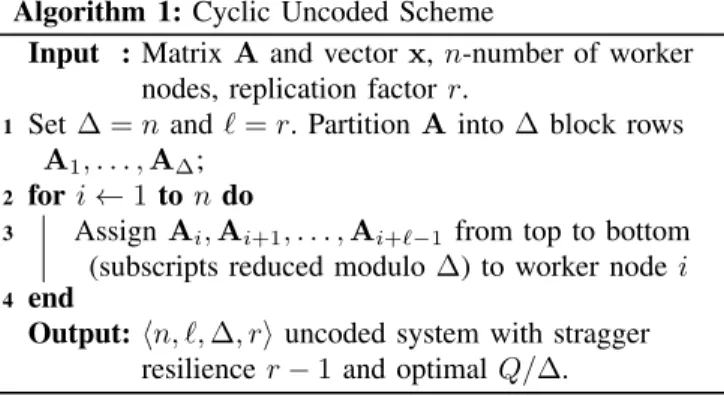
construction (see Algorithm 1) which meets both these bounds. The basic idea in Algorithm 1 is to set∆ =nand place the block rows in a cyclic fashion (see Fig. 3).
Theorem 3. The Cyclic Uncoded Scheme (cf.Algorithm 1) is resilient to(r−1)stragglers and meets the bound in Theorem 2.
Proof. It is evident from the cyclic nature of the construction that each block row appears r times in r different worker nodes. Thus, the scheme is resilient tor−1stragglers. Next, we show thatQj (defined in the proof of Theorem 2) in this
construction is the same for all block rowsAj,j= 1, . . . ,∆.
To see this we note that the maximum number of block rows that can be processed without processingAjcan be calculated
as follows.
• We can process the(i−1)rows in worker node[(j−i) modn] + 1fori= 1, . . . , r.
• All the block rows in othern−rworkers can be processed as well. Thus, we have Qj= [1 + 2 + 3 +...+ (`−1)] + (n−r)` = (`−1)` 2 +n`−` 2 (as r=`) =n`−` 2(`+ 1).
Again, using the fact that n= ∆and`=r, we have
Qj= ∆r−
r
2(`+ 1).
Thus,Qj is independent ofj and thereforeQ= ∆r−r2(`+
1) + 1.
Example 2. As an example, consider Fig. 3, where we have
∆ = n = 5 and ` = r = 3. The scheme is resilient to
(r−1) = 2stragglers and it can be verified that Axcan be computed once anyQ= 10block rows have been processed.
IV. CODEDSCHEME
We now explore coded schemes in our setting. As demon-strated in Example 1, the value ofQin the coded scenario can be strictly lesser than in the uncoded case. A simple solution to this problem is to use MDS (maximum distance separable) codes as was done in some of the inital papers [1] in this
area. Namely, one could use an(n`,∆)-MDS code for some value of ∆ and n` ≥ ∆. The block rows A1, . . . ,A∆ will
be combined using the corresponding generator matrix (with an appropriate mapping from the finite field to the real field). It is clear that in this case, the master node can compute Ax
as long as any ∆ rows are processed. However, such codes may require rather dense linear combination of the rows ofA
and this may incur a significant overhead in the computation performed by the worker nodes, especially in the practical case when Ais sparse to begin with.
Accordingly, in this part of the work we are interested in examining schemes where we can specify the fraction of coded blocks. We now assume that each node receives aγ=γu+γc
fraction of the rows ofA, whereγu andγc correspond to the
uncoded and coded parts respectively. The replication factor for the uncoded portion isruand the number of uncoded block
assignments in a worker is denoted as`u= ∆γu. This implies
that n`u = ∆ru. We let `c = ∆γc represent the number of
coded blocks in each worker.
For our bounds we assume that each processed coded block is useful to the master node. This can be ensured by our choice of coding coefficients that are obtained from Cauchy matrices of appropriate dimension. In what follows, we consider two different schemes. In one case the coded blocks appear at the bottom of each node while in the other case the coded blocks appear at the top. The first case leans towards easier decoding by the master node, whereas the second one aims to minimize the computation performed by the worker nodes. We use the notation hn, `u, `c,∆, rui-bottom and hn, `u, `c,∆, rui-top to
refer to the corresponding systems. The value of Qfor these systems will be denoted by Qcb and Qct respectively (the
subscripts are self-explanatory).
A. Coded blocks at the bottom
In this case, the results of Section III (See Theorem 2) immediately imply thatQcb≥max(∆,∆ru−r2u(`+ 1) + 1)
(the subscript denotes that the coded blocks appear at the bottom). This follows by applying the previous arguments to the uncoded part of the solution. A construction that meets these bounds is outlined in Algorithm 2. The algorithm uses a Cauchy matrix of dimension n`c×∆.
Theorem 4. The scheme in Algorithm 2 satisfies Qcb =
max(∆,∆ru− r2u(`u+ 1) + 1). Furthermore, it is resilient
to n2γc+nγu−1 nγc+1 stragglers.
Proof. We need to show that for any pattern of Qcb blocks
the master node can decode Ax. Towards this end, from the discussion in Section III, we know that any pattern of Qcb uncoded blocks allows the recovery of ∆ distinct
blocks. In other words for any computation state vector
w(t) = [w1(t) w2(t) . . . wn(t)] such that wi(t) ≤ `u and
Pn
i=1wi(t)≥Qcbthe master node can decode. Now, consider
a vector w0(t) such that (w.l.o.g.) w01(t). . . w0α(t) ≥ `u+ 1
andw0α+1(t), . . . , wn0(t)≤`uandP n
i=1w0i(t)≥Qcb, i.e., the
first αworker nodes process coded blocks whereas the others
Algorithm 2: Cyclic Coded at Bottom Scheme
Input : MatrixAand vectorx,n-number of worker nodes, total storage capacity fractionγ, replication factor for uncoded portionru.
1 Set∆ =n,`u=ru,`=γ∆,`c =`−`u. Determine a
Cauchy matrixC of dimension n`c×∆;
2 PartitionA into∆ block rowsA1, . . . ,A∆;
3 fori←1 to ndo
4 AssignAi,Ai+1, . . . ,Ai+`u−1 from top to bottom (subscripts reduced modulo ∆) to worker node i;
5 forj←1 to `c do
6 DefineT ={i, i+ 1, . . . , i+`u−1} mod ∆; 7 Pick a rowcofC and assign coded block
P∆
k=1ck1k /∈TAk;
8 Remove cfrom C, so C ← C\{c} ;
9 end
10 end
Output: hn, `u, `c,∆, rui-bottom system.
do not. It is not too hard to determine a different vectorw˜(t)
with the following properties.
˜
wi(t) =
(
`u 1≤i≤α,
w0i(t) +βi α+ 1≤i≤n,
whereβi’s are positive integers such thatw0i(t) +βi ≤`uand
Pn
i=1w˜i(t) = Qcb. Thus, w˜(t) corresponds to a pattern of Qcbuncoded blocks that recovers ∆distinct blocks.
Now, we compare the vectors w0(t) and w˜(t). Let the uncoded symbols inw0(t)be denoted by the setA. Then the set of uncoded symbols in w˜(t) can be expressed as A ∪ B
where the set B results from the transformation above. It is evident that for computation state vectorw0(t)the master node has
α
P
i=1
(wi0(t)−`u)equations with∆− |A|variables. Now, α
X
i=1
(wi0(t)−`u)≥ |B| ≥ |B \ A|= ∆− |A|.
In particular, this establishes that we have at least as many equations as variables. As, any square submatrix of a Cauchy matrix is invertible, we have the required result.
To establish the straggler resilience of our construction we identify the set of worker nodes that contain the least number of uncoded blocks. With some work (the details appear in the full version of the paper) it can be established that anyk
workers have at leastmin(`u+k−1,∆)uncoded blocks. For
our construction, these correspond to picking k consecutive worker nodes. Thus, we are trying to determine the minimum value ofksuch that
`u+ (k−1) +k(`−`u)≥∆
which further implies
k≥ n−`u+ 1
`−`u+ 1
= n−nγu+ 1
as n= ∆. So, if the system is resilient tosstragglers then s≤ n− n−nγu+ 1 nγ−nγu+ 1 = n2γc+nγu−1 nγc+ 1 .
Remark 2. We emphasize that the construction in Algorithm 2 is not isomorphic to a MDS code, even if ru= 1.
Example 3. Consider again the setting of Example 2 where
∆ =n= 5,γ=35. Suppose that we setγu=25 andγc= 15.
This scheme is resilient to
n2γ c+nγu−1 nγc+1 = 3 stragglers and it can be verified that Ax can be computed once any Q = ∆ru−r2u(`u+ 1) + 1 = 8block rows have been processed.
Thus, we can conclude that introducing a single coded block in each worker (at the bottom), helps to improve bothQand the straggler resilience of the system as compared to an uncoded system.
B. Coded blocks at the top
The situation is quite different when we consider the place-ment of the coded blocks at the top of the worker nodes. In this case a given worker node only processes uncoded blocks after having processed `c coded blocks. Thus, if x coded blocks
have been processed by the worker nodes before starting work on the uncoded blocks, it suffices if any∆−xdistinct uncoded blocks are processed. This weaker requirement allows us to potentially improve theQct/∆ ratio as compared to the
previous constructions.
We now develop a lower bound on Qct. Suppose that we
consider an arbitrary set of β worker nodes that process all their blocks and another set of worker nodes that only contribute x coded blocks. Evidently, in this case the total number of coded blocks is x+`cβ. Let A denote the set of
distinct uncoded blocks obtained from the chosen set of β
worker nodes. We note that
Qct≥x+`β+ 1, when
x+`cβ+|A|<∆.
This is because, we do not have enough equations to decode the ∆− |A|unknowns.
Next, we use another averaging argument. We calculate the average size of A when considering all possible nβ worker nodes via a double counting argument.
Consider a bipartite graph G, whose vertex set is U ∪ V. Each element of U is the set of uncoded blocks contained in a particular set of β workers. Thus, the cardinality of U is
|U |= nβ
. The setV is the set of all possible uncoded blocks so that |V|= ∆. There is an edge betweenu∈ U andv∈ V
if v ∈ u. The degree of v ∈ V in G can be computed by observing that there are n−ru
β
sets that do not contain v. Therefore, the degree of vis nβ− n−ru
β
. Thus, the average degree of the nodes inU is given by
¯ dU = ∆× " 1− n−ru β n β # . It follows that if x+`cβ+ ¯dU<∆,
there is at least one choice of β worker nodes that will not allow the decoding of Ax. Our lower bound on Qct can be
derived by solving the following optimization problem. maximize x+`β+ 1 subject to (x+`cβ)<∆ " n−ru β n β # . (1)
Example 4. We can consider a hn, `u, `c,∆, rui =
h15,3,1,15,3i-top system and derive the boundQct≥18>
∆ = 15 by solving the optimization problem in (1). The optimal setting turns out to be x= 1 andβ= 4.
Example 5. Continuing our discussion of the setting in Examples 2 and 3, if we assign the coded blocks at the top rows of the workers and apply cyclic scheme for the uncoded portion, we can show that Qct = 6 while being resilient to
s = 3 stragglers. Thus, moving the coded rows to the top provides the best construction in terms of Q and straggler resilience.
V. CONCLUSION
In this paper we have formulated a new model for dis-tributed coded matrix-vector multiplication. Our model allows us to leverage partial work performed by stragglers while controlling the level to which coding is utilized in the solution. We propose lower bounds on the required computation from the worker nodes in the worst case and present matching con-structions in certain cases. Our proposed model demonstrates that the ordering of the computations within different worker nodes plays an important role in the overall job execution time. This in turn leads to new (to our best knowledge) code design problems that should be interesting to investigate.
REFERENCES
[1] K. Lee, M. Lam, R. Pedarsani, D. Papailiopoulos, and K. Ramchandran, “Speeding up distributed machine learning using codes,”IEEE Trans. on Info. Th., vol. 64, no. 3, pp. 1514–1529, 2018.
[2] S. Dutta, V. Cadambe, and P. Grover, “Short-dot: Computing large linear transforms distributedly using coded short dot products,” in Proc. of Advances in Neural Information Processing Systems (NIPS), 2016, pp. 2100–2108.
[3] Q. Yu, M. Maddah-Ali, and S. Avestimehr, “Polynomial codes: an optimal design for high-dimensional coded matrix multiplication,” in Proc. of Advances in Neural Information Processing Systems (NIPS), 2017, pp. 4403–4413.
[4] R. Tandon, Q. Lei, A. G. Dimakis, and N. Karampatziakis, “Gradient coding: Avoiding stragglers in distributed learning,” inProc. of Intl. Conf. on Machine Learning (ICML), 2017.
[5] S. Kiani, N. Ferdinand, and S. C. Draper, “Exploitation of stragglers in coded computation,” in IEEE Intl. Symposium on Info. Th., 2018, pp. 1988–1992.
[6] A. Mallick, M. Chaudhari, and G. Joshi, “Rateless codes for near-perfect load balancing in distributed matrix-vector multiplication,” preprint, 2018, [Online] Available: https://arxiv.org/abs/1804.10331.
[7] S. Wang, J. Liu, and N. Shroff, “Coded sparse matrix multiplication,” in Proc. of Intl. Conf. on Machine Learning (ICML), 2018.