Georg-August-Universität
Göttingen
Zentrum für Informatik
ISSN
1612-6793
Nummer ZFI-BM-2006-35
Masterarbeit
im Studiengang "Angewandte Informatik"
Entwicklung und Implementierung
eines Domain Brokers
für das Semantic Web
Tobias Knabke
in der Arbeitsgruppe für
Datenbanken & Informationssysteme
Bachelor- und Masterarbeiten
des Zentrums für Informatik
Georg-August-Universität Göttingen
Zentrum für Informatik
Lotzestraße 16-18
37083 Göttingen
Germany
Tel.
+49 (5 51) 39-1 44 14
Fax
+49 (5 51) 39-1 44 15
[email protected]
WWW www.informatik.uni-goettingen.de
Ich erkläre hiermit, dass ich die vorliegende Arbeit selbständig verfasst und keine
anderen als die angegebenen Quellen und Hilfsmittel verwendet habe.
Master Thesis
Development and Implementation
of a Domain Broker
for the Semantic Web
Tobias Knabke
November 1, 2006
Supervised by Prof. Dr. Wolfgang May
Databases and Information Systems Group
Abstract
Autonomously evolving information systems are the basis of the Semantic Web. In contrast to the World Wide Web of today, the nodes in this Semantic Web reach beyond the pure viewing of web pages. As known from Web Services, they are able to answer on requests. But moreover, the reaction on events, such as database updates generated on remote nodes in the web, is possible.
This reactive behavior was implemented in the Framework for Evolution and Reactivity in the Semantic Web via Event-Condition-Action (ECA) rules. The designated action will be executed if a specific event occurs and an optional condition is fulfilled as well.
To also allow for automated reasoning, the above mentioned framework follows an ontology-based approach. An ontology, which is usually distributed over several nodes in the decentral-ized Semantic Web, defines a meaningful, computer-processable relation between concepts of a domain as a knowledge base. With these ontologies, a domain-dependent reaction on events is possible.
In this thesis, a Domain Brokering Service for the distribution of events with an Event Broker and the execution of actions with the help of an Action Broker is developed. Additionally, information retrieval in form of SPARQL requests is realized by a Query Broker. To support the facile integration of the Domain Broker and its components into existing information services, standard web technologies are used.
Acknowledgments
First of all, I would like to thank Prof. Dr. Wolfgang May for offering me this interesting topic as a master thesis and for the excellent personal and scientific supervision, not only of this thesis but also during my course of studies.
Likewise, I wish to thank Prof. Dr. Jos´e J´ulio Alves Alferes for co-supervising this thesis. Furthermore, I appreciate Erik Behrends, Oliver Fritzen, Franz Schenk and especially Daniel Schubert for their technological and scientific support.
I am grateful to Kristin Stamm and Franz-Josef Rolfes for their constructive comments and motivation.
Special thanks go to my parents, my sister and particularly to my girlfriend Nadine for their support and their patience at any time.
Contents
List of Figures iii
1 Introduction 1
1.1 Motivation . . . 1
1.2 Structure of the Thesis . . . 2
2 Basics 3 2.1 Semantic Web . . . 3
2.2 Ontology . . . 3
2.3 XML and Related Recommendations . . . 4
2.4 URI . . . 6
2.5 RDF and RDF Schema . . . 6
2.6 OWL . . . 8
3 Rules 9 3.1 Rules and Ontologies . . . 9
3.2 Types . . . 10
3.2.1 Deductive Rules . . . 10
3.2.2 ECA Rules . . . 12
4 A General Framework for Evolution and Reactivity in the Semantic Web 13 4.1 General Architecture . . . 13
4.2 Modeling of Domain Ontologies . . . 16
4.3 Rules in Ontologies . . . 18
4.4 ECA Rules . . . 19
4.4.1 ECE Rules . . . 20
4.4.2 ACA Rules . . . 21
4.5 Rule Markup . . . 22
4.5.1 Logical Derivation Rules . . . 22
4.5.2 ECA Rules . . . 22
4.6 Communication Markup . . . 25
4.7 Opaque Expressions . . . 27
4.8 Language and Service Registries . . . 27
Contents
5 Jena Semantic Web Framework 29
5.1 Jena RDF API . . . 29
5.2 Reasoning and Inference . . . 30
5.3 ARQ and SPARQL . . . 31
5.3.1 ARQ . . . 31 5.3.2 SPARQL . . . 32 6 Domain Brokering 39 6.1 Event Brokering . . . 39 6.2 Action Brokering . . . 43 6.3 Query Brokering . . . 47 6.3.1 Request Format . . . 49 6.3.2 Query Decomposition . . . 50
6.3.3 Required Nodes Selection . . . 51
6.3.4 Data Integration . . . 52 6.3.5 Query Answering . . . 53 6.4 Miscellaneous . . . 54 7 Implementation 55 7.1 Employed Technologies . . . 55 7.2 General Architecture . . . 56 7.3 Common Classes . . . 56 7.3.1 Utility classes . . . 56 7.3.2 Ontology . . . 56 7.4 Domain Broker . . . 58
7.4.1 Communication Interface of the Domain Broker . . . 58
7.4.2 Architecture of the Domain Broker . . . 61
7.4.3 Architecture of the Event Broker . . . 61
7.4.4 Architecture of the Action Broker . . . 63
7.4.5 Architecture of the Query Broker . . . 63
7.5 Domain Broker Client . . . 65
8 Conclusion 69
List of Figures
4.1 General Framework Architecture . . . 14
4.2 Kinds and Components of Ontologies . . . 17
4.3 Derivation and Mapping Rules for Events, Literals and Actions . . . 19
6.1 Architecture: Communication with Event Brokers . . . 40
6.2 RDF Graph of a Travel Route offered by DB . . . 49
6.3 United Ontology . . . 52
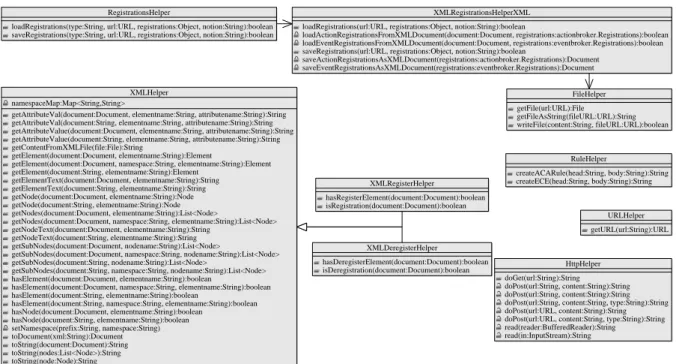
7.1 Class Diagram for Utility Classes . . . 57
7.2 Class Diagram for Ontology . . . 58
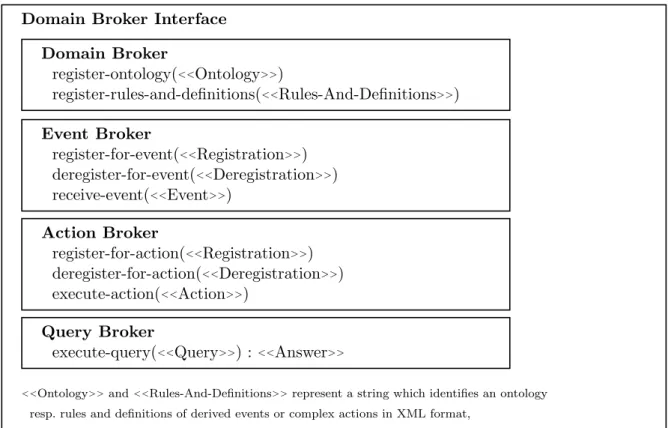
7.3 Communication Interface of the Domain Broker . . . 59
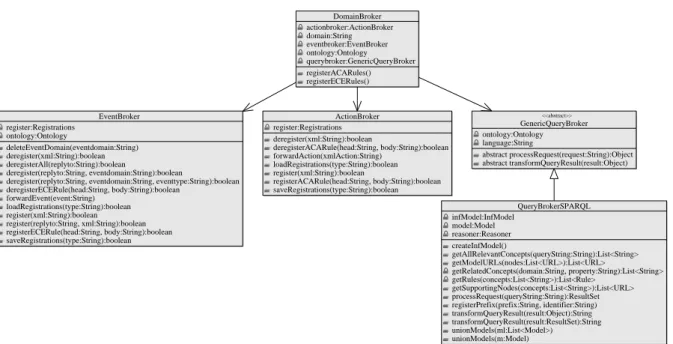
7.4 Class Diagram for the Domain Broker . . . 62
7.5 Class Diagram for the Event Broker . . . 62
7.6 Class Diagram for the Action Broker . . . 63
7.7 Class Diagram for the Query Broker . . . 64
7.8 Managing Registrations with the Domain Broker Client . . . 65
7.9 Sending SPARQL Queries with the Domain Broker Client . . . 66
1 Introduction
1.1 Motivation
The World Wide Web of today is undergoing an extensive change. The former static web evolves more and more from a medium mainly dealing with documents for people into another kind of web. In this Semantic Web that is not a new one but an extension of the current web, information is given a well-defined meaning . This enables machines to “understand” and process the data stored in the Semantic Web and thus to provide behavior in form of portals orWeb Services.
Hence, the nodes inside the Semantic Web can not only be considered as static sources for the storage of web pages anymore. They are rather autonomously evolving heterogeneous information systems. For these data systems it is not sufficient to just act on their local databases. The propagation of information requested from other information systems instead is one central aspect of the Semantic Web.
As the Semantic Web is decentralized, the languages used by the (distributed) nodes are heterogeneous. Since each node usually has its own local data sources, mostly portals are used in the web of today to integrate the information that is isolated in different nodes. A traveler, for example, could use a flight portal, where information about flights (companies, dates, prices, etc.) is shown on a central web page, to choose cost optimal flights from different companies for his journey.
The example above describes an extract of the real world, which could be part of thetravel domain. A domain consists of related issues in a specific area and usually consists of several nodes. In the travel domain, a flight company, e.g., offers its flights on different airports. The booking of a flight by a customer yields a debit of his bank account. This is where the travel domain interferes with another application domain, i.e., the banking domain.
Such application domains could be distributed over several nodes in the Semantic Web. Each of the nodes has its own data and thus a special behavior. The booking of the last available seat of a flight, known from a local database update, could trigger different local inference rules at the node, e.g., that seats in the fully booked airplane are not available anymore.
The information retrieval via manually programmed portals is very inflexible. To be able to describe the evolution of and the reactive behavior in the Web, the Framework for Evolution and
1 Introduction
The information as a knowledge base can be distributed over several nodes. As a Semantic Web application, the framework allows for the propagation of knowledge and changes in a semantic way. To incorporate the heterogeneity of the web, independent concepts and languages, such as URI, XML, RDF, and OWL, are used for the definition of ontologies and the propagation of information.
As a first step to achieve additional information from underlying concepts, inference rules stored wrt. ontologies provide means for the conduction of automated reasoning. To bridge the gap between reactivity on the one and the heterogeneity of languages in the web on the other side,Event-Condition-Action (ECA)rules are used in the framework. These rules, comparable to triggers known from databases, do not only formalize the behavior of a single node in the framework, but they also enable the description of global, i.e., node-overlapping, application-wide behavior. Furthermore, ECA rules take events into account and thus support the integra-tion of dynamic behavior of a node or an applicaintegra-tion.
To achieve high flexibility, the framework is modularly composed. For example, the ECA rules offer the usage of different languages in their components. This modularity also takes the diverse abstraction levels existing in the Semantic Web into account and separates the semantics of ECA rules from the semantics of the underlying events and actions (cf. [13]).
To manage the dynamic propagation and execution of events and actions respectively, this thesis deals with the development of a Domain Broker as a mediator between different frame-work components. Taking the existing infrastructure and architecture of the frameframe-work as a basis, information retrieval is additionally handled by an implemented Query Broker. To pro-vide a suitable test environment, an exemplary information system acting on a travel ontology has been developed.
1.2 Structure of the Thesis
The thesis is structured as follows: In the next chapter, the basic terms and definitions that come along with this thesis are explained. Different types of rules and their effects wrt. on-tologies are described in Chapter 3. A general outline of the framework and a review about framework specific rules as well as their rule markup are given in Chapter 4. Chapter 5 in-troduces the Jena Semantic Web Framework and gives an impression of SPARQL. Afterwards, Domain Brokering wrt. the Framework of Evolution and Reactivity in the Semantic Web is explained. This includes the processes related to the brokering of events and actions just as much as the handling of a query inside the Query Broker. The implementation of a the Do-main Broker is described in Chapter 7. Finally, the thesis is concluded and the Do-main topics wrt. Domain Brokering are identified to be developed in the further implementation of the
2 Basics
This thesis is based on the Framework for Evolution and Reactivity in the Semantic Web that has been introduced in [24]. It follows an ontology- and resources-based approach and provides its reactive behavior by the use of Event-Condition-Action (ECA) rules.
In this chapter a basic view of principal concepts and languages is given. These are either used in this thesis or during the development and implementation of a prototypical Domain Broker for the Semantic Web.
2.1 Semantic Web
Today, the World Wide Web is a network of different information resources. The content, usually marked up in HTML1, is kept in the nodes of this huge heterogeneous network. It was designed almost solely for humans to read and understand. Through the increasing size of the web combined with the availability of new technologies and applications, a strong need arises for computer programs to access information “stored” in the World Wide Web (cf. [34]).
Computers shall get a reliable way to process the semantics of web content rather than fulfill “just” routines like parsing or searching. This extension of the current web, which is not a separate one, is called Semantic Web (see [4]). It can be seen as a web of data which relies on common formats for interchange of data, not only documents (cf. [31]).
As the Framework for Evolution and Reactivity in the Semantic Web, which is a Semantic Web application as well, follows an ontology-based approach, the notionontology is explained next.
2.2 Ontology
The word ontology originally deals with a theory of being or existence. Thomas R. Gruber defines an ontology as “an explicit specification of a conceptualization”[16].
In computer science, an ontology is a (shared) model of a domain used as knowledge repre-sentation. It consists of a taxonomy which describes a class hierarchy. In addition, an ontology does not only contain what notions are used, but also how they are named. Through these
1
2 Basics
URIs2 that connect notions and objects, resources can also be identified uniquely (see Sec-tion 2.4). Moreover, an ontology defines all kinds of relaSec-tionships between the noSec-tions of a domain. This gives the notions a meaning which can then be used for reasoning purposes.
Additionally, ontologies might contain rules that are used for reasoning and allow for making implicit knowledge explicit. For details see [2], [34] and [15].
To be able to describe an ontology with computer-processable instruments and to express computer-understandable meaning, more technologies, for example, for knowledge representa-tion, are needed. The concepts which are useful for this thesis are standardized by the W3C [39] and will be introduced briefly in the next sections.
2.3 XML and Related Recommendations
XML. The Extensible Markup Language (XML) is a generic, very flexible but simple text format which was derived from the SGML (for details see [14]) standard. By utilizing element tags and attributes it is used for marking up semistructured data. It allows to add arbitrary structure to a human- and machine-readable document. Therefore, XML can be used as data exchange format.
Since XML is capable of defining the rules for such tree-structured documents, it is called a meta language. For a concrete XML application, the structure of an XML document has to be specified, i.e., which names and values of elements and attributes are allowed to appear in which (nested) order.
This can be done in a Document Type Definition (DTD) or more restrictively by an XML Schema Definition (see below). XML can either be used to store data in a well-defined format3 or to exchange data4. To give a very brief impression how XML could look like, consider the following XML snippet:
<root-element>
<subelement-one attribute-one="attribute value" attribute-two="another value">
element text
</subelement-one>
<subelement-two attribute="value">
another element text
</subelement-two>
...
</root-element>
2
Uniform Resource Identifiers.
3
For example, serialized in files or databases.
2.3 XML and Related Recommendations
For more information see [12] and [42].
XML Schema. XML Schema is a schema definition language expressed in XML (1.0) syntax. It describes the structure of an XML document and provides means to constrain the content, i.e., names and values of elements and attributes. A schema is an XML document itself and supplies methods to define the structure, content, and semantics of XML documents in more detail than a DTD does.5
A general XML document is mapped to a special application domain through the restriction from its schema and thus the content of the XML document gets more semantics (cf. [43] and [12]).
But the possibilities XML Schema offers wrt. semantics are still not sufficient for reasoning. See [41], [5] or [43] for more details.
XSLT. The Extensible Stylesheet Language Transformations (XSLT) is one part of the XSL family [46]. It allows for the transformation of one XML source document into a result docu-ment6.
The transformation of elements is rule-based and applied recursively. It combines declarative and functional aspects and uses XPath (see below) as addressing language. In [21], [36] and [47] more information can be found.
XPath. The XML Path Language (XPath) is a language applied to XML documents in order to access (as a small query language) and adress individual elements, attributes, or sets of them. The syntax of an XPath expression is abutted to the Unix directory notation.
For navigating from one node to another, each navigation step consists of an axis specifier, a node test, and a predicate. XPath is a basic technology for other standards, e.g., XSLT or XQuery (see below). For detailed information see [44].
XQuery. The XML Query Language (XQuery) is, as the name already implies, a query lan-guage to query XML data. It has an SQL-like syntax but also provides programming lanlan-guage features like variable binding and is, different from SQL, orthogonal.
XQuery uses XPath as addressing language.7 The development of XQuery has been influ-enced by languages like XQL, XML-QL, OQL, XPath, and SQL. Detailed information can be found at [45].
5
It allows, e.g., the definition of complex types.
6
Note that the structure of the result can completely differ from the source structure and is not necessarily in XML format.
7
2 Basics
Since issues that could be described with the languages introduced above are not necessarily combined in one single document, URIs are needed to identify resources.
2.4 URI
Uniform Resource Identifiers (URIs)8 are attached a great importance in the Semantic Web (see Section 2.5). A URI is a character string that identifies uniquely physical or abstract resources.9 These resources can be in the scope of the Internet, e.g., web pages, but also outside of machine reachability, like real world persons. The very generic structure of a URI looks like <scheme>:<scheme specific part>.
There are different types of URIs such as Uniform Resource Locators (URLs), Uniform Re-source Names (URN), etc. With URLs a reRe-source is identified via its primary access mechanism, i.e., through its location (e.g.,httporftp), while URNs identify resources through their names or namespaces (urn:isbn for example), regardless of its location.10 More information can be found in [38].
As RDF, RDF Schema, and OWL add semantics to computer-processable data by using the concepts described above, these languages will be introduced in the following sections.
2.5 RDF and RDF Schema
In literature, it is often distinguished between thedata level and theinformation orknowledge level. The concepts introduced by now, mainly XML and XML Schema, operate on the data level and do not provide additional information or support reasoning (cf. [13]). Therefore, more expressive languages are needed which are described below.
RDF. The Resource Description Framework (RDF) has been developed by the W3C to encode metadata. It can be used to describe any kind of resource. These resources can be accessed and uniquely identified through a URI (cf. Section 2.4). This allows for the distribution of a resource’s description over different nodes, e.g., somewhere in the web. RDF can be represented in many ways, e.g., with a graph, with triples, or in an XML markup called RDF/XML [29]. RDF mainly distinguishes between three components:
• Resource: Resources can be any type of data which is identified by a URI and described
by RDF expressions. 8
Originally called Universal Resource Identifier.
9
An identical URI used in different documents expresses that the same resource is meant.
10
2.5 RDF and RDF Schema
• Property: A property defines a special aspect of a resource.
• Statement: A statement assigns a value to a property of a specific resource. A statement,
also called triple in RDF terminology, has three components:
– a subject which is a resource,
– a predicate which is a property of the resource,
– and an object which is the value of the property. This can, e.g., be a text literal or another resource.
To get a view what RDF basically looks like, consider the following example11 which describes some book with any title written by some author. The first description uses the N-Triple notation12:
<http://someurl/little-rdf-book/> <http://purl.org/dc/elements/1.1/creator>“John Doe” .
<http://someurl/little-rdf-book/> <http://purl.org/dc/elements/1.1/title> “John Doe’s Little RDF Book” . The example above can also be expressed in RDF/XML and would lead to the same RDF graph:
<rdf:RDF xmlns:rdf="http://www.w3.org/1999/02/22-rdf-syntax-ns#"
xmlns:dc="http://purl.org/dc/elements/1.1/">
<rdf:Description rdf:about="http://someurl/little-rdf-book/"> <dc:creator>John Doe</dc:creator>
<dc:title>John Doe’s Little RDF Book</dc:title> </rdf:RDF>
Thus, RDF can be used to assign responsibilities to resources via properties, for example, a domain could be allocated to a domain broker. To get more information about RDF, have a look at [7], [15], [2] and [27].
RDF Schema. The RDF Vocabulary Description Language, RDF Schema (RDFS), adds se-mantics to an RDF data model by defining its vocabulary. It is similar to XML and XML Schema, for it transfers a general RDF concept to a specific application domain. Written in RDF, the schema description provides possibilities to characterize groups of related resources and their relationships. Moreover, it allows for inference with the use of metadata. For more information see [12] and [28].
11
The example uses Dublin Core [10].
12
2 Basics
To offer more possibilities to represent machine-interpretable content and to have more facilities to express meanings, the Web Ontology Language that is based on above described concepts, such as XML, RDF , and RDF Schema, is introduced in the next section.
2.6 OWL
The Web Ontology Language (OWL) is a language to define, publish and distribute ontologies. It is technically based on the RDF syntax, but goes beyond it in its ability to add semantics to the machine-processable and understandable content.
OWL is more powerful in expressing meaning and semantics than XML, RDF, and RDFS. For example, OWL extends RDFS and adds more vocabularies to describe classes, their rela-tionships and properties, e.g., of a domain in the Semantic Web.
Furthermore it permits reasoning over data expressed in OWL. The Web Ontology Language is derived from the DAML+OIL Web Ontology Language [8] and is divided in layers: OWL Lite, OWL DL13, and OWL Full. Together with RDF it forms the basis of the Semantic Web. For more information see [15] and [26].
By now, only information explicitly stated in a data model or an ontology can be extracted. To be able to gain also implicitly stored knowledge, rules are needed. This will be the focus in the next chapter.
13
3 Rules
In this chapter it is described how rules can be used to get infered information from an ontology. Afterwards different types of rules will be illustrated.
3.1 Rules and Ontologies
To get more information from an ontology than it explicitly contains, rules can be used. With their help, implicit knowledge can be extracted, e.g., to get inferred models. To achieve this, the rules have to be deposited inside an ontology and proofed against it.
The following example forms a basis for the samples given in the following sections. It serves as a foundation the later defined rules are applied to.
Example 3.1 Consider the following RDF statements that could be part of a travel ontology.
It represents different sections of a train schedule:
<travel:Section rdf:about="#Hamburg-Bremen"> <travel:from rdf:resource="#Hamburg"/> <travel:to rdf:resource="#Bremen"/> </travel:Section>
<travel:Section rdf:about="#Bremen-Oldenburg"> <travel:from rdf:resource="#Bremen"/>
<travel:to rdf:resource="#Oldenburg"/> </travel:Section>
<travel:Section rdf:about="#Oldenburg-Osnabr¨uck"> <travel:from rdf:resource="#Oldenburg"/>
<travel:to rdf:resource="#Osnabr¨uck"/> </travel:Section>
<travel:Section rdf:about="#Osnabr¨uck-Hannover"> <travel:from rdf:resource="#Osnabr¨uck"/> <travel:to rdf:resource="#Hannover"/> </travel:Section>
3 Rules
3.2 Types
There are several types of rules. On the one hand there are rules that describe adomain. They have to be validated wrt. the domain to prove their correctness. This kind of rules specifies the relationship between objects, events and actions of the ontology.
On the other hand rules can also specify the behavior of anapplication, e.g., business rules. The change of such rules results in a different behavior of the application (cf. [1]).
In the next sections, different types of rules which are able to specify a domain and the behavior of an application will be explained.
3.2.1 Deductive Rules
General rules consist of several components. Deductive rules14 known from logical languages like Prolog (see [37]) or Datalog (see [22]) contain a rule head and arule body.
The knowledge base in logical languages consists of a set of facts (predicates) and rules.15 To allow for the deduction of new facts, logical statements of the formhead :- bodyare specified. If the rule body is valid, this directly implies the validity of the head. The :- can be read as “if”. Thus, C :- A,Bcan be read as “C is true if A and B are true”. The “,” between A and B in the rule body could have also been written as A & B(cf. [37]).
Example 3.2 To express the sections16 mentioned in Example 3.1 in a logical programming
way, the following facts are used:
section(’Hamburg’, ’Bremen’). section(’Bremen’, ’Oldenburg’). section(’Oldenburg’, ’Osnabr¨uck’). section(’Osnabr¨uck’, ’Hannover’).
The following rules use (free) variables17 to express that in the simplest case X is connected with Y if X is linked by a section (train route) to Y. The second rule states a connection between X and Z if a section between X and Y exists and also Y and Z are connected. The second rule formulates the transitive closure (transitivity) of a connection.
14
Deductive rules are also called derivation rules.
15
Because this thesis does not mainly deal with rules, it is assumed that basic notions related to rules, such as
predicates or (free) variables, are known to the reader. Detailed explanations as well as information about
syntax can be found at [37] or [22].
16
Note that a section from A to B is not the same as a section from B to A.
17
Variables are written in capital letters, whereas predicate symbols, constants and function symbols begin with lower case letters.
3.2 Types
connection(X,Y) :- section(X,Y).
connection(X,Z) :- section(X,Y), connection(Y,Z).
Now it is possible to query the database to get all connections from X to Y:
?- connection(X,Y).
This would lead to the following variable bindings in the rule body for the first rule
X→ “Hamburg”, Y →“Bremen” and
X→ “Bremen”, Y→ “Oldenburg” and
X→ “Oldenburg”, Y→ “Osnabr¨uck” and
X→ “Osnabr¨uck”, Y→ “Hannover”
and
X → “Hamburg”, Y→ “Bremen”, Z →“Oldenburg” and
X → “Hamburg”, Y→ “Bremen”, Z →“Osnabr¨uck” and
X → “Hamburg”, Y→ “Bremen”, Z →“Hannover” and
X → “Bremen”, Y→ “Oldenburg”, Z→ “Osnabr¨uck” and
X → “Bremen”, Y→ “Oldenburg”, Z→ “Hannover” and
X → “Oldenburg”, Y→ “Osnabr¨uck”, Z → “Hannover”
for the second rule. They are now used in the head to derive the facts
connection(’Hamburg’, ’Bremen’). connection(’Hamburg’, ’Oldenburg’). connection(’Hamburg’, ’Osnabr¨uck’). connection(’Hamburg’, ’Hannover’). connection(’Bremen’, ’Oldenburg’). connection(’Bremen’, ’Osnabr¨uck’). connection(’Bremen’, ’Hannover’). connection(’Oldenburg’, ’Osnabr¨uck’). connection(’Oldenburg’, ’Hannover’). connection(’Osnabr¨uck’, ’Hannover’).
which leads to the result of the query:
X→ “Hamburg”, Y →“Bremen” and
X→ “Hamburg”, Y →“Oldenburg” and
X→ “Hamburg”, Y →“Osnabr¨uck” and
X→ “Hamburg”, Y →“Hannover” and
3 Rules
X→ “Bremen”, Y→ “Osnabr¨uck” and
X→ “Bremen”, Y→ “Hannover” and
X→ “Oldenburg”, Y→ “Osnabr¨uck” and
X→ “Oldenburg”, Y→ “Hannover” and
X→ “Osnabr¨uck”, Y →“Hannover” .
Until now, no impulse, i.e., an event from the “outside world” has been needed to extract new information with the help of rules. Just acondition, in form of the rule body, has to be fulfilled to provoke an action that is in this case the derivation of the rule head. Hence, the inferred information can be seen as static because it was derived fromstatic facts.
Thus, by now reasoning is just possible withstatic rules which belong to the ontology. But this is not sufficient for the Semantic Web which also needs the application of active rules.
To integrate also dynamic aspects, another kind of rules must be taken into consideration which is described now.
3.2.2 ECA Rules
As mentioned earlier, the Semantic Web consists of many (autonomous) nodes. Each of them has a local state of facts, metadata, and optionally a knowledge base. Again optional, behavior can be described in a node through ECA (Event-Condition-Action) rules. ECA rules will fire an action provoked by an event if a certain condition is fulfilled (cf. [24]).
ECA rules show a similarity to triggers known from databases. From an external point of view they can be formulated as “when something happens and some conditions are fulfilled then something has to be done”. The semantics of ECA rules can be generalized as
ONeventAND additional knowledgeIF condition DOsomething.
Such active rules permit to control an application’s behavior. These very abstract ECA rules are called ECA-Business rules.
ECA rules in contrast to deductive rules also take events into account (cf. [1]). To integrate dynamic behavior in form of ECA rules, a framework is needed. This framework will be introduced in the next chapter.
4 A General Framework for Evolution and Reactivity in
the Semantic Web
The Web of today does not only consist of browsing-oriented documents but also of nodes which, in general, provide a behavior, often summarized asWeb Services (see [22]). Fixed sets of autonomous information systems are integrated through portals usually by “hard coded” services. This problem of thedataandsemantic heterogeneityshall be bridged by the Semantic Web. The basis of this thesis is a framework which deals with evolution and reactivity in the Semantic Web. It was introduced in [24]. After the general description of the framework and domain ontologies, framework specific rules and their corresponding markup are explained.
4.1 General Architecture
As mentioned above, the Semantic Web consists of many heterogeneous nodes. Hence, it is not surprising that the Framework for Reasoning and Evolution in the Semantic Web is employed in a distributed environment as well. It has to be taken care of a multitude of resources in form of application nodes in different domains wrt. different ontologies.
Domains and the different languages appearing in the Semantic Web are identified by their URIs (see Section 2.4). They are resources like every object that is integrated in the framework. Thus, the framework is resource-based.
As the nodes inside the Semantic Web are heterogeneous, different languages appear in the framework, too. The implementation of each language is done by a Web Service that is associated with the language (cf. [1]).
The architecture of the framework is illustrated in Figure 4.118. The following example (adapted from [30]) describes the coherences depicted in this figure and is based on a use case of the travel domain.
Example 4.1 Imagine a client C, in this case a travel agency, wants to be informed via email
about events (canceled flights) from the travel domain in order to inform its staff to book a hotel room for the customer and to reschedule the next flight on the journey.
18
Note that Figure 4.1 gives an abstract overview of the architecture of the framework and does not show every aspect as, for example, the handling of queries stated against the Domain Broker.
4 A General Framework for Evolution and Reactivity in the Semantic Web Event DetectionS snoop: Atomic Event Matcher A match: ECA Engine R eca: Action Engine ccs: Domain Broker travel: SMTP Mail Service smtp: Lufthansa travel: SNCFtravel: ClientC: Travel Agency travel: 1.1: register rule eca: travel: match: snoop: ccs: smtp: 1.2: register event
travel: match: snoop:
1.3: atomic event patterns match: travel: 1.4: register me travel: 2.1a: atomic events travel: 2.1b: atomic events travel: 2.2: atomic events travel: 3: detected
parameters 4: detectedparameters 5.1: action ccs: travel: smtp: 5.2a: atomic actions travel: 5.2b: atomic actions smtp: 5.3b: message (here: flight-canceled) by url L an gu ag e S er v ic es A p p li ca ti on D om ai n 5.3a: LH booking travel:
Figure 4.1: General Framework Architecture (adapted from [13])
Therefore, the agency registers a rule that contains a composite event at the ECA engineR (1.1). This composite event is composed of a flight-booked event that covers the name and the email address of the passenger, the flight number and the flight date. A flight-canceled event terminates the event composition which is given in SNOOP [6].
Because the ECA engine is not responsible for the detection of (composite) events, it registers the event component after analyzing the rule at an appropriate Event Detection ServiceS (1.2) that is able to detect composite events specified in SNOOP. The SNOOP service S then submits the atomic event patterns at an adequate Atomic Event Matcher (AEM) A (1.3).
To be able to detect the occurrence of the relevant events, the requirements of the events are defined by Atomic Event Specifications (AESs). AESs are the simplest kind of event components and thus they can be seen as the leaves of an event component. An AES specifies on which events a reaction has to be taken. Hence, the AES for an event in this example contains the name of the event (canceled-flight) and its parameters. The formalisms to detect the relevant events are implemented by an AEM.19
19
4.1 General Architecture
The AEM, in turn, registers at a dedicated Event Broker of the travel domain (1.4) since the atomic events are part of the traveldomain. The Event Broker is managed by a Domain Broker (shown in Figure 4.1) that consists of an Event-, Action-, and Query Broker20.
This is just one possible solution how the Event Detection Engine becomes aware of all rele-vant atomic events. Before an Event Broker has been implemented during this thesis, the clients had to find out about relevant events themselves.21 In case an event occured, clients forwarded the events to the rule evaluation service. Afterwards, this service forwarded the event to all common event detection engines.
The Event Broker serves as a mediator for the distribution of events of a specific domain. Atomic events are produced inside an application at nodes somewhere in the sphere of the framework. A node which produces atomic events of the travel domain, e.g., the Lufthansa or SNCF, has to identify the responsible Event Broker22 for the domain and send the events to the broker (2.1a and 2.1b respectively). The task of the Event Broker is now to forward the received event to the registered AEM A (2.2).
A informs the Event Detection in case the event matches the registered patterns (3). If the former registered composite event is detected by the Event Detection,R will be notified (4). The ECA engine then evaluates the appropriate rules and triggers, for example, the processing of the action part of the rule registered in step 1.1.
The basic procedure of an action processing is the same as for events (cf. [13]). Therefore, consider an extension of the rule described at the beginning of the example that in case of a flight cancellation automatically a new flight on the next day is booked (additionally to the sending of an email to the travel agency). At an appropriate action language service (here: CCS (Calculus of Communication Systems)), the action component is submitted (5.1). The Action Engine, in return, looks up the responsible Action Broker for the domain (travelin this case) and forwards the atomic actions to the Action Broker, managed by the superior Domain Broker (5.2a). The Action Broker disposes the execution of the action (the booking of a new flight on the next day) at the appropriate domain nodes (5.3a). If the registered rule (1.1) contains a notification request (sending of an email in this case) from Client C, the Action Engine also will send the action to a domain-independent service (5.2b), here an SMTP Mail Service, which, in turn, sends a message to the Client C (5.3b).
As described in Example 4.1, client nodes inside the Semantic Web, e.g., a travel agency, want to be informed about special events and react on them. Events are generated by other nodes somewhere in the web. To specify the behavior of the reactions, clients register their rules
20
The Query Broker will not explicitly be mentioned in this example.
21
This solution is not shown in Figure 4.1.
22
4 A General Framework for Evolution and Reactivity in the Semantic Web
locally or remotely. Remote rules are evaluated by an evaluation service, namely an ECA engine. These engines can be interpreted as main objects for the reactive behavior in the framework.
An event can trigger, for example, the evaluation and execution of ECA rules which are handled by ECA engines. The propagation of events is done by Event Brokers that receive registrations for events of a certain domain and event type. A registration that is sent to an Event Broker basically looks as follows:
<register>
<reply-to>URL where the events shall be forwarded to</reply-to> <domain>domain-URI</domain>
<event-type>event type</event-type> </register>
Incoming events are forwarded wrt. the obtained registrations by the Event Broker of the domain. The events as well as the actions have to be instantiated at appropriate services, e.g., at a CCS engine or at a domain node in order to be processed correctly by the relevant brokers. To react on events, (some) nodes must be able to execute actions. Hence, Action Brokers are informed by certain nodes that an action has to be performed. For example, an airport operating company could decide to cancel a flight due to weather conditions. Then the Action Broker has to find out where23 the action has to be executed.
Beside the propagation of events and the execution of actions, the retrieval of information is another important service of the framework. To offer a wide functionality to the clients, it must be possible to state queries against the nodes integrated in the framework. A hotel, for example, may be asked by a customer to rent a high class car for an excursion. Therefore, the hotel wants to know which nearby car rental company provides these cars and at what price they are offered. Requests like these are processed by Query Brokers. They have to decompose the request, check which concepts and nodes are relevant, integrate the collected data, state the query, and finally send the result back to the asking node.
To be able to provide the services described above, the framework follows an ontology-based approach. How the ontologies of specific domains are structured is subject of the next section.
4.2 Modeling of Domain Ontologies
A domain ontology describes all objects and their relationships of a specific domain. Acomplete domain ontology does not only containstaticissues, but also thedynamicaspects of the domain.
23
4.2 Modeling of Domain Ontologies
The resources in a Semantic Web environment build the static part of the domain ontology, while, e.g., events and actions represent dynamic issues. Furthermore, a domain ontology can be classified by answering the question if a domain ontology depends on an application or not. Application domain ontologies describe all static and dynamic aspects that are related di-rectly with the application. For example, an ontology of a travel domain characterizes resources like railway or flight companies with their associated schedules. The dynamic part could contain events like train-delayed orflight-half-booked, whereas cancel-flight stands for an action.
In contrast to the just presented ontologies, application-independent domain ontologies talk aboutan application (see Figure 4.2). They make a generic infrastructure available by providing services like transactions, messaging, or calendars. Application-independent domains contain also static and dynamic notions and can be combined with arbitrary application domains. An example of an application-independent domain ontology is acalendar. It can be seen as a class of service that defines, e.g., a year as a resource and can also provide first day of year as an event.
A complete ontology in the Semantic Web combines these different types of ontologies. Note that in a Semantic Web application often several domains interfere with each other, e.g., travel and banking.24 Figure 4.2 illustrates the relationship between the components of an ontology and the interaction between the different types of ontologies.
Ontologies of Application-Independent Domains: communication/messages, transactions, etc.
Named Events Literals Named Actions
Application-Domain Ontology
Named Events Literals Named Actions
talk about
Figure 4.2: Kinds and Components of Ontologies (from [13])
As seen in Figure 4.2, a domain ontology contains literal notions, named events and named actions. Events and actions can be structured comparable to a class hierarchy. Ametadomain contains notions that define and structure a domain ontology. This metadomain is associated
24
Flight tickets are booked at a travel agency which is part of thetravel domain, but the clearing takes places at a node belonging to thebanking domain.
4 A General Framework for Evolution and Reactivity in the Semantic Web
with the world namespace that is connected to the URL
http://www.semwebtech.org/domains/2006/world. Themetadomainmight, for example, contain
the following definitions:
<world:Domain, rdf:type, owl:Class>
<world:Event, rdf:type, owl:Class>
<world:Action, rdf:type, owl:Class>
In the framework, each domain, e.g., the travel domain, is usually associated with an URL, where descriptions of the special domain can be found. This referenced document contains the RDF/RDFS and OWL expressions that define the domain ontology itself. The travel domain contains, among others, the following definitions (cf. [13]):
<travel:, rdf:type, world:Domain>
<travel:airline, rdfs:subClassOf, world:Domain-Service>
<travel:flight-event, rdfs:subClassOf, world:Event>
<travel:car-rental, rdfs:subClassOf, world:Domain-Service>
<travel:cancellation, rdf:type, world:Event>
<travel:canceled-flight, rdf:type, world:Event>
<travel:canceled-flight, rdfs:subClassOf, travel:cancellation>
<travel:canceled-flight, rdfs:subClassOf, world:Event>
<travel:cancel-flight, rdf:type, world:Action>
<travel:delay-flight, rdf:type, world:Action>
<travel:fully-booked, rdf:type, world:Event>
<travel:half-booked, rdf:type, world:Event>
<travel:booking, rdf:type, world:Event>
Besides events and actions, an ontology contains different kinds of rules which define the be-havior of an application. These will be explained in the following sections.
4.3 Rules in Ontologies
In ontologies occur different types of rules, namely:
• logical derivation rules that derive property instances or concept memberships,
• Event-Condition-Event (ECE) rules which infer composite events from simpler ones, and • Action-Condition-Action (ACA) rules that map high-level actions to simpler ones.
4.4 ECA Rules
Some rules directly belong to an ontology while others are connected to certain services. Figure 4.3 shows types of rules that belong to an ontology.
Application-Domain Ontology
Named Events Literals Named Actions
Derivation
ECE Deriv. ACA Mapping
Figure 4.3: Derivation and Mapping Rules for Events, Literals and Actions (from [13])
Usually, ECE rules derive composite events from other events while ACA rules define complex (e.g., composite) actions which are built upon other actions (e.g., simpler or lower-level actions). Since ECE and ACA rules are special kinds of ECA rules, the latter are explained more detailed in the next section.
4.4 ECA Rules
The Framework for Evolution and Reactivity in the Semantic Web follows an ECA-based approach, i.e., ECA rules implement the behavior of an application and in the next step the underlying ontologies will be extended to act as a base for reasoning (cf. [1]).
Different languages may occur in the rule components to support the heterogeneity of nodes in the Semantic Web. These rule components are, in turn, handled by different nodes. Therefore, the framework provides the ability to use diverse languages in the components.
Component Languages in ECA Rules. Prolog and Datalog are rule-based languages. The expressions of their head and body are both written in the same language. This is not the case for ECA rules required in the framework (cf. [24]). As the structure is distributed over many different nodes in the Semantic Web, different languages in the components of a rule have to be taken into account to realize interoperability between the nodes. Therefore, every rule uses an event language, one or more query languages, one test language, and one or more action languages in its components (cf. [30]):
• Event Language: The language used in the event component has to support the detection of events. Atomic events are given as an XML fragment, thus, the applied language must
4 A General Framework for Evolution and Reactivity in the Semantic Web
be able to deal with the content and the structure of such an XML document. XPath matches the demanded conditions. SNOOP can be used to handle composite events, which are built by several atomic events.
• Query Language: Query languages must provide the functionality to deal with sets of data items which can also be bound to variables. Logic and functional languages offer this functionality. XQuery provides this functional property, too.
• Test Language: Expressions of test languages must result in a logical truth value, i.e., false or true. Results of functional languages (including XPath and XQuery) can be interpreted as such.
• Action Language: In the action component it is expressed what actually has to be done. Here, arbitrary languages, like “classical” programming languages (Java,...) or algebraic languages (as process algebras), can be used. The use of Web Services via HTTP requests is also possible.
Used on different levels, such user-defined, “actual” rules act on events and are responsible for the behavior of the application. ECA rules are used internally for the detection of events of the respective level (see [1]).
Since ECE and ACA rules are special types of ECA rules, their implementation is based on ECA rules. They also use (different) languages in their components. As a characteristic, the condition component is not only used as a test, but also as query part, e.g., for the extension of variable bindings (cf. [13]). These specific ECA rules are described in detail below.
4.4.1 ECE Rules
Event-Condition-Event (ECE) rules infer an (composite) event from other events. Thus, the action consists of raising another event. For example, the event hotel booked up on 31.12.2006 could be derived from book room xy on 31.12.2006 if room xy was the last available room on that date.
ECE rules can be classified in the following way (cf. [1]):
• horizontal ECE rules: The high-level event is derived under certain conditions from an-other event on the same abstraction level. These events are logically related and a change of the events would affect the behavior of the application and invalidate it wrt. its ontol-ogy.
4.4 ECA Rules
• upward vertical ECE rules: These rules are evoked by changes in the underlying database. Here, the events are not logically connected but related through the physical implemen-tation of the application. An example could be the change of a flight’s arrival time in a database which results in a delayed flight. The change of such rules will again invalidate the application wrt. its ontology.
4.4.2 ACA Rules
An Action-Condition-Action (ACA) rule maps higher-level actions to lower-level or simpler actions. These rules are needed because the direct execution of abstract rules is often not possible. This kind of rules is called reduction rules because they reduce abstract actions to simpler levels, e.g., in the same application domain or to its components on a lower level. ACA rules can be divided as follows (cf. [1]):
• Horizontal reduction ACA rules are described by their components which are in terms of the application, i.e., on the same abstraction level. For example, the transfer of money from a bank account to another is split up intothe debit of money from one account and the deposition to another bank account.
• Vertical reduction ACA rules reduce one higher level action into lower ones, for example, the deposition of money from a bank account is broken down intoreading the amount of money,adding the deposition value, and writing the new value.
• Horizontal non-reduction ACA rules use the concept of rule chaining. An action that is not mapped to other actions and thus has to be executed as it is, is seen as an event. This yields the triggering of another action. This kind of rules is more related to ECA rules. A change of this rule would change the behavior of an application, but not invalidate it. To clarify the partitioning in a nutshell, transfer 500 Euro from account A to B by debit 500 Euro from account Aanddeposit 500 Euro to account Bis an example for the first type of ACA rules (i.e., horizontal reduction ACA rules), whereasdebit 500 Euro from account Ayieldsread value from account A,subtract 500, and write the new value back is an example for a vertical reduction ACA rule.
To operate the rules in a distributed environment, a uniform markup is needed which is ex-plained in the next section.
4 A General Framework for Evolution and Reactivity in the Semantic Web
4.5 Rule Markup
In order to use rules in a heterogeneous and dynamic environment, their markup has to be general and independent from certain languages. Different kinds of markups are introduced below.
4.5.1 Logical Derivation Rules
Logical derivation rules or deductive rules are used wrt. an ontology. The very generic XML based markup follows the RuleML proposal described in [17]. The basic structure is shown below:
<ruleml:imp annotation="rule-specific annotation">
<!-- there may be several head elements for the derivation of new facts -->
<ruleml:head>head specification</ruleml:head>
<!-- there may be several body elements -->
<ruleml:body>body specification</ruleml:body> </ruleml:imp>
4.5.2 ECA Rules
An XML based markup language, called ECA-ML and described in [23], is used in the frame-work to define ECA rules. The basic markup has the following form (cf. [30]):
<eca:rule rule-specific attributes>
rule-specific content, for example, declaration of logical variables
<eca:eventidentification of the language>
event specification, probably binding variables
</eca:event>
<!-- there may be several queries -->
<eca:query identification of the language>
query specification, using variables, binding others
</eca:query>
<eca:testidentification of the language>
condition specification, using variables
</eca:test>
<!-- there may be several actions -->
<eca:action identification of the language>
action specification, using variables, probably binding local variables
</eca:action> </eca:rule>
4.5 Rule Markup
The event specification enveloped in<eca:event>also contains the atomic event specifications (AESs) in an appropriate format, e.g., in XML-QL Style Matching or based on the SNOOP algebra (cf. [1]). Comparable to events, the atomic action specifications (AASs) are enclosed in the (action specification) expressions inside the<eca:action>element.25
To clarify what a concrete ECA rule looks like, the rule verbally described at the beginning of Example 4.1 is shown below:
<eca:rule xmlns:eca="http://www.semwebtech.org/eca/2006/eca-ml"
xmlns:snoopy="http://www.semwebtech.org/eca/2006/snoopy"
xmlns:travel="http://www.semwebtech.org/domains/2006/travel"
xmlns:mail="..."> <eca:event>
<snoopy:sequence>
<travel:book-flight date="{$date}" flight="{$flight}" name="{$name}"
email="{$travel-agency}"/>
<travel:canceled-flight date="{$date}"flight="{$flight}"/> </snoopy:sequence>
</eca:event> <eca:action>
<eca:input-variable name="travel-agency"use="$travel-agency"/> <eca:input-variable name="flight"use="$flight"/>
<mail:send-message to="$travel-agency">
we are very sorry ... but the flight $flight had to be canceled
</mail:send-message> </eca:action>
</eca:rule>
ECE Rules inside Ontologies. ECE rules are special types of ECA rules (cf. Section 4.3). The action part of the ECA rule here is the raise of a new (derived) event. The markup for ECE rules basically looks as follows (cf. [13]):
<world:definition annotation="rule-specific annotation"> <world:defined syntax="xml">
<!-- pattern of the event to be derived --> pattern of the derived event, marked up in XML
</world:defined>
<world:defined-as syntax="xml">
<!-- event components --> event pattern, marked up in XML <!-- test component -->
25
Since the languages for specifying atomic events or actions do not belong to the topic of this thesis, these are not discussed in detail here. For further information see [1].
4 A General Framework for Evolution and Reactivity in the Semantic Web
test pattern, marked up in XML, can contain opaque expressions
</world:defined-as> </world:definition>
ACA Rules inside Ontologies. Analogously to ECE rules, in this case the event part of an ACA rule consists of an action. This more complex, abstract action can be broken down into simpler named actions which are still abstract or into local implementations of named actions. Below, the structure of ACA rules is shown (cf. [13]):
<world:definition annotation="rule-specific annotation"> <world:defined syntax="xml">
<!-- pattern of the abstract action -->
pattern of the abstract action to be broken down, marked up in XML
</world:defined>
<world:defined-as syntax="xml">
<!-- test component -->
test pattern, marked up in XML, can contain opaque expressions <!-- action components -->
action patterns to which the abstract action is broken down, marked up in XML
</world:defined-as> </world:definition>
ECE and ACA Rules for Framework Exchange. To be able to operate ECE and ACA rules inside the framework, the rule definitions have to be converted into a framework-known format that can be handled by a dedicated engine, e.g., an ECA engine26. The structure for ECE rules was briefly introduced in [13] and is shown below:
<eca:rule>
contents of the body of the ECE rule definition; i.e. the triggering event description and the condition
<eca:action>
<eca:raise-event>
head of the ECE rule; i.e. the derived event specification
</eca:raise-event> </eca:action>
</eca:rule>
ACA rules have also to be transformed into a format that framework-aware engines can deal with. Therefore, a structure was described in [13] that looks as follows:
26
4.6 Communication Markup
<eca:aca-rule>
variable declarations
<eca:define-action>
head of the ACA rule, i.e. the abstract action specification
</eca:define-action>
<!-- there may be no, one or more queries -->
<eca:query>
query specifications, using variables, binding others
</eca:query>
<!-- there may be no or one test -->
<eca:test>
condition specifications, using variables
</eca:test>
<!-- there may be several actions -->
<eca:action>
action specification to which the abstract action is broken down
</eca:action> </eca:aca-rule>
Besides rules, also other information types have to be exchanged inside the framework. For example, the result of a SPARQL query that was stated against a Query Broker (cf. Section 6.3). Therefore, the framework-wide communication format for variable exchange is introduced in the next section.
4.6 Communication Markup
Before the framework-wide representation for variable bindings will be described, different kinds of information interchange, based on logical variables, are introduced first.
Downward Communication. In case of a rule registration, the event component is communi-cated to an appropriate event detection engine (cf. Example 4.1 and Section 4.5.2 for the rule instance). Moreover, if variables are already bound, they can also be contained in the message sent to the event detection service. If an event occurs that is sought-after, then queries, tests, and actions will result in certain variable bindings due to rule evaluation. These bindings have to be published to other services as well (cf. [13]).
Upward Communication. As part of upward communication, the results and variable bindings of evaluation services have to be returned. These can, for example, be sets of data items as result of queries (cf. [1]).
4 A General Framework for Evolution and Reactivity in the Semantic Web
As also events and actions have to be interchanged as fragments, great importance is ascribed to the Domain Broker (cf. Chapter 6) .
To be able to interchange variable bindings within the framework, a unique communication format, described in [13], is used. Its basic structure is illustrated below27:
<!ELEMENT answers (answer*)>
<!ELEMENT answer (result|variable-bindings|(result,variable-bindings))> <!ELEMENT result ANY>
<!ELEMENT variable-bindings (tuple+)> <!ELEMENT tuple (variable+)>
<!ELEMENT variable ANY>
<!ATTLIST variable name CDATA #REQUIRED
ref URI #IMPLIED><!-- variable has either ref or content-->
<logic:answers> <logic:answer>
<logic:result>
any result structure
</logic:result>
<logic:variable-bindings> <logic:tuple>
<logic:variable name="name" ref="URI"/> <logic:variable name="name">
any value </logic:variable> : </logic:tuple> </logic:variable-bindings> </logic:answer> <logic:answer> : </logic:answer> </logic:answers>
Even if a unique communication format is used to interact consistently among the nodes that act inside the framework, it should not be ignored that nodes in the Semantic Web use different languages. Hence, a Semantic Web application has to take the heterogeneity of its participants into account. As mentioned in Section 4.4, the Framework for Evolution and Reactivity in the Semantic Web allows for the use of different languages by usingopaque expressions. These are described in the following section.
27
4.7 Opaque Expressions
4.7 Opaque Expressions
As many different nodes act inside the framework, not every service is framework-aware and accordingly marked up in XML. Therefore, means have to be provided to offer the integration of these nodes.
With opaque expressions, services that are framework-unaware and/or not marked up in XML can be embedded into the framework. Opaque expressions can, e.g., occur in queries sent to a query engine managed by a Domain Broker (see Section 6.3). To use opaque languages in ECA rules, the framework-unaware language has to be embedded as follows:
<opaque lang="language specification">
opaque code
</opaque>
To detect which services are offered inside the framework and to identify to which languages the services are connected to, Language and Service Registries are needed.
4.8 Language and Service Registries
Language and Service Registries (LSR)28 implement the identification of appropriate services, i.e., who offers which service. They can be offered by every node inside the Semantic Web. A central LSR is not provided by the ECA framework. Thus, it is sufficient to know agood LSR or to know, for example, an ECA engine that, in turn, knows agood LSR.
In the final version, LSRs can be used by nodes in the framework to get and look up infor-mation. The request has a connection to a language and the answer from the LSR contains information how the task can be requested (cf. [13]).
But such services are not only needed globally, i.e., overlapping all domains on the framework level. To publish which nodes of a certain domain actually support which of the domain notions (described in Section 4.2), Domain Service Registries are needed.
4.9 Domain Service Registries
A Domain Service Registry (DSR) provides metadata information about the services offered by individual nodes of the domain inside the framework. Since the name implies, a DSR is a registry and, thus, not static, but can be changed through the addition of a new service.
28
4 A General Framework for Evolution and Reactivity in the Semantic Web
Application services are available at a URL. The information about an application service is maintained by DSRs. A DSR declares which concepts are actually supported by a certain application service. A railway company, for example, will support delay-train but not cancel-flight.
The statements below could be part of an application service description maintained by a DSR:29 <LH, rdf:type, world:company> <LH, world:uses-domain, http://www.semwebtech.org/domains/2006/travel> <LH, world:uses-domain, http://www.semwebtech.org/domains/2006/business> <LH, business:has-business, world:airline> <LH, world:has-service, http://url-to-service/lh> <LH, world:has-url, http://url-to-lh-homepage/index.html> <LH, world:supports, travel:airport> <LH, world:supports, travel:flight-connection> <LH, world:supports, travel:cancel-flight> <LH, world:supports, travel:is-delayed>
As seen above, domain ontologies are assisted by application services which, in turn, make use of domain ontologies. An application service, for example, an airline company, can use several domains. The booking of a flight ticket is assigned to the travel domain, while the payment of a booked ticket is included in the banking domain. As an application service can use different domains, it can also support several ones, e.g., travel and business in case of an airplane company.
This dynamic information about specific domains is provided by the world ontology that supplies concepts to state which node in the Semantic Web actually supports which domain and notion as well as which brokers are related to a domain.
In this chapter, the Framework for Evolution and Reactivity in the Semantic Web with its basic architecture and concepts has been introduced. Another kind of framework that supports the development of Semantic Web applications is described in the next chapter. It has been used during this thesis to implement the Domain Broker and its components.
29
Because there is no DSR available as a Web Service in the framework yet, this information would be content of an ontology file inside a Domain Broker.
5 Jena Semantic Web Framework
Jena [20] is an open source framework for building Semantic Web applications with Java [35]. It arose from the HP Labs Semantic Web Programme [18]. The provided environment allows for dealing with RDF, RDFS, OWL and SPARQL (see Section 5.3.2). Moreover, it includes an (rule-based) inference engine. While offering the mentioned functionality, the Jena Framework is very convenient to model ontologies and their related issues.
The Jena Framework supports the user in many ways: It provides an RDF- and OWL-API30, has means to read and write RDF/XML as well as N3 and N-Triples respectively. Moreover, the modeled data can either be stored in-memory or persistent. To support to query a constructed ontology, a SPARQL query engine is available.
The provided means that are relevant for this thesis are introduced now (more detailed information related to this chapter can also be found at [20]).
5.1 Jena RDF API
The Jena RDF API provides tools in form of Java classes to deal with RDF. It permits the creation of RDF models with Java by using the dedicated APIs. To keep the code readable, the use of prefixes is supported. Therefore, Jena makes methods available to write an RDF model to a file as serialized XML. Methods for reading models from a file are also designated. But to work with RDF data, reading and writing files is not sufficient. Thus, Jena supports methods to navigate through a model in order to process the information held in a model. The framework offers the access and manipulation of the objects that are represented as sets of statements, each containing subject,predicate, and object of the RDF graph.
Moreover, the Jena Framework provides means to query models. But the core API of Jena supports only very restricted search primitives. As the queries are embedded in Java, they have to be formulated imperatively. Hence, they are not as powerful as declarative query languages as, for example, SQL or SPARQL (described in Section 5.3.2).
Jena enables several operations on models: union, intersection, and difference. These con-cepts are known from mathematical set theory and behave in the same way in Jena.
30
5 Jena Semantic Web Framework
5.2 Reasoning and Inference
To support the usage of languages like OWL or RDFS, one part of the Jena Framework provides means for reasoning. Therefore, diverse reasoning engines31 can be plugged into Jena. To work with a reasoner, it is useful to create inferred models by using the functionality provided by the Jena API. This thesis focuses on the general rule based reasoner that allows inference with the application of self defined rules. Therefore, a brief overview of the rule format that Jena claims is given now.
Rule Format. Rules in Jena basically consist of an optional rule name and a rule term which can be nested and constructed under the use of functions.
Example 5.1 The following rule defines an “aunt” and visualizes the basic rule syntax in
Jena, here in forward mode (body → head) :
[aunt: (?m ns:mother ?x) (?s ns:sister ?m)→ (?s ns:aunt ?x)]
The rule says, that ifm32 is amother33 ofx and s is asister of m, thens is anaunt of x. Jena supports different ways to express and process rules. Besides a forward and backward mode, it is also possible to combine these rule styles.
Forward Chaining Engine. The evaluation of rules in a bottom-up style is called forward chaining, since it starts from facts to derive new tuples. This results in a benefit of forward chaining34, because optimization and evaluation techniques from relational algebra may be applied (for details see [22]).
The first time an inferred model is queried by applying a reasoner configured in forward mode35, a deduction graph is created. Rules that fire can trigger additional rules. Thus, the process holds on until the graph is stable.36 This leads to a drawback of forward chaining: If a request is interested only in a small area of the data basis, nevertheless the whole data will be comprised in the inference and after that the relevant section will be extracted (see [22]).
31
Two examples of predefined reasoners are the Transitive Reasoner or the Generic Rule Reasoner.
32
Variables are denoted by a? at the beginning.
33
“ns” in the rule stands for a specific namespace.
34
To be able to process rules specified in forward (“→”) mode, the applied reasoner has to be configured to run
in forward mode.
35
Note that a reasoner configured in forward mode treats all rules as if they were forward rules, even backward rules.
36
![Figure 4.1: General Framework Architecture (adapted from [13])](https://thumb-us.123doks.com/thumbv2/123dok_us/1823890.2763379/28.892.143.790.139.576/figure-general-framework-architecture-adapted-from.webp)
![Figure 4.2: Kinds and Components of Ontologies (from [13])](https://thumb-us.123doks.com/thumbv2/123dok_us/1823890.2763379/31.892.233.649.604.843/figure-kinds-components-ontologies.webp)
![Figure 4.3: Derivation and Mapping Rules for Events, Literals and Actions (from [13])](https://thumb-us.123doks.com/thumbv2/123dok_us/1823890.2763379/33.892.129.786.213.396/figure-derivation-mapping-rules-events-literals-actions.webp)
![Figure 6.1: Architecture: Communication with Event Brokers (from [13])](https://thumb-us.123doks.com/thumbv2/123dok_us/1823890.2763379/54.892.116.779.229.728/figure-architecture-communication-event-brokers.webp)