an Agile Implementation Model for ERP
Meyliana
Information Systems Department, School of Information Systems
Bina Nusantara University Jakarta, Indonesia 11480
Abstract – The growing impact of industrial dynamics will be a challenge to increase productivity. Productivity is a demand for improving organizational performance. ERP systems are a way to increase productivity. Therefore, ERP implementation is important to ensure that ERP runs well. Critical factors in ERP implementation must get serious attention to project management. Even so, the reality of ERP implementation is slowly, even tends to experience failure, resulting in highly expensive. The previous research that carried out ERP implementation showed that the failure reached 40%, and the achievement of the benefits of ERP implementation in Indonesia is still not optimal. It can be said that ERP implementation is a complexity project. For this reason, it is necessary to consider other implementation methods that can overcome the problem in implementing ERP. An agile method is a proactive and reactive alternative to handle the problem in implementing of ERP. The development of an agile ERP model is one way to achieve success in ERP implementation. This research methodology is a survey approach to the study of literature. This research will propose an agile ERP model which will be used as an effective guide for achieving the success of ERP implementation.
.H\ZRUGV– agile method, agile ERP model, ERP implementation
I.INTRODUCTION
The rapid technological developments will lead to changes in device methodology from the waterfall model to incremental and iterative models. This incremental and iterative model will make it possible to develop agile frameworks, project team structures, share tasks and responsibilities, develop active communication and training implementation plan according to user needs, develop effective feedback processes in each iteration related to focusing on system integration and do iterations in stages to test system integration. The software methodology is one tool that can be used to develop system. The
system methodology has undergone developments and has difficulty dealing with possible changes.
Many company have failure in ERP implementation. The results of a survey of 117 industries that the rate of failed in implementing an ERP system reached 40%. The main critical failure factors in implementing of ERP is project management issues [4, 12, and 21]. Thus, it can be said that enhance the success of implementing of ERP is managing project management. In the 1990s a new methodology was introduced which was known as an agile method. The word of agile means something is fast, light, free to move and alert. The agile method is a method that prioritizes flexibility in changes of business processes that occur in the process of developing a system. Besides that, the agile model is one approach that needs to be considered to reduce gaps and failures in implementing ERP. The agile practice will end at each iteration with a demonstration of software that is functioning optimally. The agile ERP implementation makes it possible to use iterations to show that configuration without customization will truly help business processes and work flow to be more efficient in order for improving organizational performance. According to previous research, shows that the agile method is one approach for improving the quality and reducing the failure factors of ERP implementation. Thus, the authors conducted a survey recent literature on the subject relate to the agile implementation model for ERP.
The purpose of this research addresses to the find gaps and the solution in reducing failure risk in ERP implementation, the authors suggest that this assessment provide detailed answers to the questions:
a. What is the agile implementation model suitable for ERP use?
Santo Fernandi Wijaya Information Systems Department,
School of Information Systems, Computer Science Department, BINUS Graduate Program - Doctor of
Computer Science Bina Nusantara University Jakarta, Indonesia 11480
Harjanto Prabowo Computer Science Department, BINUS Graduate Program - Doctor of
Computer Science Management Department, BINUS Business School Undergraduate
Program Bina Nusantara University Jakarta, Indonesia 11480
Raymondus Raymond Kosala Computer Science Department, BINUS Graduate Program – Doctor of
Computer Science Bina Nusantara University Jakarta, Indonesia 11480
978-1-7281-3333-1/19/$31.00 ©2019 IEEE
2019 International Conference on Information Management and Technology (ICIMTech)
b. What kind of agile ERP model is suitable for implementation in the industry?
II. LITERATURESEARCH
A An agile method
One of the biggest critical failure factors in ERP implementation is poor project management effectiveness. For this reason, other methods need to be considered to improve the quality of ERP implementation for the industry [20]. Organizations find it difficult to implement ERP to meet business needs, because most organizations still use traditional implementation models. For this reason to consider the agile model in implementation. The comparison of the results of applying traditional and agile models in ERP implementation for the industry, showing that agile models can be considered for reducing the failure of ERP implementation can be shown in the following table: [16]
TABLE I. COMPARISONOFTHESUCCESRATESOFERP IMPLEMENTATION
The development of an agile method is a follow-up of the traditional method that causes the system development process not to meet business requirement. The agile concept in software development was coined by Kent Beck along with 16 colleagues “agile manifesto” which agile software development is a way to building software to get involved in building software. The agile method is one of several methods used in system development that requires rapid flexible of the changes. Besides that, the interaction and personnel activities are the key factors. The function of application is more important than complete documentation. The communication with people and responsiveness to change are the critical factors than following a plan [7].
B. Principle of the agile method
The agile method principle is to satisfy customers and business processes reengineering that aim to provide the role of the application to work optimally. The principle of the agile method also consists of process, people, product, and practice factors, which focus on meeting business needs, sending in a timely manner, collaborating information, communicating and interacting intensively and clearly, as well as carrying out a strict supervision process in an effort to improve organizational performance [15, and 5]. The principle of the agile method will build from an iteration to iteration and new features that can be added to the next iteration. It aims to harmonize changes in business processes and increase and add value to a system development
project. The principle of the agile method can be shown in the following table:
TABLE II. THEPRINCIPLESOFTHEAGILEAPPROACH
The principle of the agile method will make change a process in the development of information systems. The agile principle is used as an approach to developing a responsive and dynamic system of change so that it is possible to work proactively to manage changes in business processes and work more intelligently in order to improve the effectiveness and productivity. The agile methods issues are responsive for achieving information system project success [23].
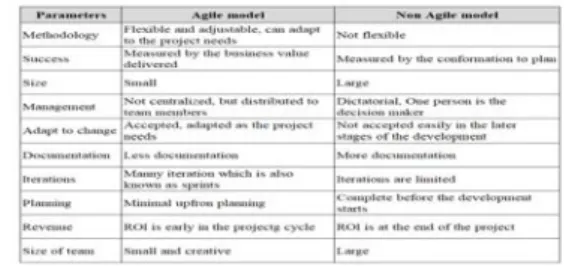
C. Differential between the agile model and not agile model
To understand of the concept of agile model and not agile model, so it is necessary to give attention to dimensions such as approach to methodology, measurement of success, project size, management style, ability to adapt to change, documentation required [17].
TABLE III. DIFFERENCEOFTHEAGILEMODELANDNOTAGILE
D. Project Management and ERP
ERP implementation success depends on solving problems in the project management process [4]. This is a challenge in ERP implementation which is to reengineer by identifying the critical factors in the project management. The challenge in implementing ERP is managing project management effectively and efficiently [1]. The building project management in ERP implementation is important, namely implementing business process management concepts that support project management activities as a business strategy to overcome complexity in ERP implementation and achieve the organizational performance. The system development approach in the agile method is different from the traditional approach. The development of agile methods emphasizes business processes that are simple and adapt dynamically [14]. However, in many cases, the ERP systems cannot provide an overall solution for carrying out business processes of the organization. This is causes the gaps need to further analyze to improve synchronizing with the
current business processes, allowing the organization's need to customization of business processes from existing ERP systems [1]. To carry out the customization process, it is necessary to approach the project management method in managing adaptive customization that fits the business requirement. The project management aims to meet the business processes as need requirement of the business. It is to make the complexity of ERP implementation. The agile project management for ERP is the project management used in ERP implementation that can provide the ability to adapt and support changes of business processes and follow technological trends [21]. The main challenges of ERP systems are change management and the driver factors to change management are people, business process and technology. [24].
E. Comparison of the previous research
The contextual factors, such as industry type, structure and organizational size will determine the enhancing success of ERP results. So, to achieve the organizational performance, needed the mapping process between the factors contextual of business and implementation processes. The implementation process that needs attention are factors such as actor, structure, technology, data and task [10].
Fig. 1. Contextual framework ERP implementation
In an effort to enhance the organizational performance, so it must ensure users have used ERP systems intensively in supporting organizational activities. Ensuring ERP use is determined by 9 important factors which are grouped into 3 dimensions that are organization, process and technology. The factors from organizational dimensions are top management support, clear vision & planning, and communications. The factors of the process dimension are change management, effective project, team work and composition, training. The factors of technology dimension are data quality and integrity, IT infrastructure [17].
Fig. 2. Conceptual model of ERP systems usage
To achieve success in ERP implementation that it will be evidenced by factors such as user satisfaction, individual impact,
organizational impact, intended business and performance improvement. The success of ERP implementation are determined by dimensions such as organizational, user, system, ERP vendor. The factors of the organizational are top management support, company-wide support, business process reengineering, effective project management and organizational culture. The factors of user are education and training, user involvement, user characteristics. The factors of system are ERP software suitability, information quality, system quality. The factors of ERP vendor are ERP vendor quality [25].
Fig. 3. ERP implementation success model
To achieve the success in developing agile software projects is influenced by factors such as quality, scope, time, and cost. The development of agile software projects are determined dimensions such as organizational, people, process, technical, and project. The factors of organizational are management commitment, organizational and team. The factors of people are team capability, customer involvement. The factors of process are project management process, project definition process. The factors of technical are agile software techniques, delivery strategy. The factors of project are project nature, project type, project schedule [3].
Fig. 4. Agile Software Development Project Success Model
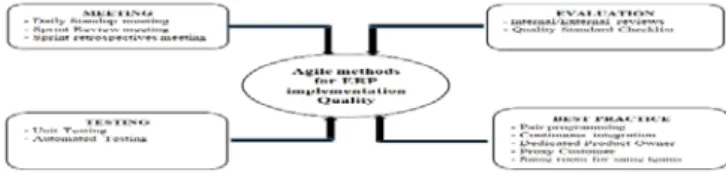
The quality implementation of the agile method are determined by dimensions such as meeting, testing, evaluation, best practice. The factors of the meeting dimensions are daily stand-up meetings, sprint review meetings, sprint retrospective meetings. The factors of testing dimension are unit testing, automated testing. The factors of evaluation dimensions are internal/external reviews, quality standard checklist. The factors of best practice dimension are pair programming, continuous integration, dedicated product owner, proxy customer, same room for same teams [2].
Fig. 5. Agile methods for ERP implementation quality
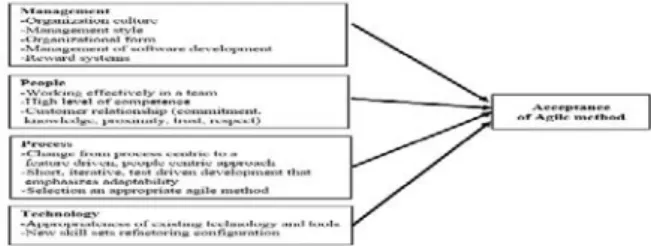
The acceptance from users of the agile method is influenced by the dimensions of management, people, process and
978-1-7281-3333-1/19/$31.00 ©2019 IEEE
2019 International Conference on Information Management and Technology (ICIMTech)
technology. The factors from the dimensions of management are organization culture, management style, organizational form, management of system development and reward systems. The factors of the dimensions of people are effective work in a team. The factors of process dimension are responsive to change and people focus approach, The factors of process dimension technology are appropriateness of existing technology, tools and new skill sets refactoring configuration management [18].
Fig. 6. Key issue in migration to agile method
The achieving success of ERP implementation requires managing good project management, where organizations must have effective and efficient business strategies and tactics [11]. The main stages of the project management life cycle depend on the active involvement of all parties involved, which includes stages of definition, planning, executive and delivery. In all of these stages, the involvement of managerial levels will actively determine the ERP implementation process run well according to predetermined targets. Even so, many organizations have experience ERP implementation failures, which are caused by several factors, such as lack of focus on changes in business processes and change management. The change management is one of the important factors in achieving successful ERP implementation. Business process reengineering has a close relationship with ERP implementation, where changes in reengineer must be done iteratively and in harmony with the business strategy. ERP system project management is a significant challenge for success in ERP implementation. For this reason, ERP systems must meet business needs with the involvement of related parties. Therefore it becomes important to choose the best people who are members of the ERP implementation project team, ERP vendors, and consultant teams. The ERP implementation project team will be responsible for communicating actively between departments, making detailed project plans, determining project schedules, and completing target project in a timely manner. The ERP implementation project management cycle can be shown in the following figure:
Fig. 7. Cycle project management of ERP implementation
The implementing of ERP process is similar to business process reengineering. ERP systems aim to improve organizational performance and designed to integrate all
information processes through the application of business processes and identifying operations that are relevant to the relevant departments [11].
III. RESEARCH METHOD A. Research method
The research methodology used approach model based on the literature review. The research methodology is a survey approach to study of literature. This research will propose an agile ERP model which will be used as a prototyping tool in ERP implementation in industry for minimize the risk of the failure.
B. Agile implementation model
The agile method approach will be classified in dimensions such as strategies, technologies, systems and people [9]. The factors of strategies dimensions are virtual enterprise, supply chain, concurrent engineering. The factors of technological dimensions are hardware tools and equipment’s, information technologies. The factors of system dimensions are design systems, production planning and control systems, system integration and database management. The factors of people dimensions are knowledge workers, top management support and employee empowerment, training and education. The agile classification approach can be shown as follows:
TABLE IV. THECLASSIFICATIONOFAGILEAPPROACH
The project management in ERP implementation can provide adaptability to support technological changes and trends. The agile method practice for ERP implementation can provide such as increase participation that has an interest; add business value incrementally and iteratively; maximum asset returns using a decision-making process. The agile method has an underlying value in managing project management which includes the following activities [1]:
• Communication is an important social activity in the project management.
• Simplicity is defining the determinants of project success by choosing a simple solution.
• Feedback is perform a feedback process to provide a solution to the problems faced.
• Courage of decision making in the management of changes to artifacts that have a contribution and added value to the organization.
• Humility is the project manager must involve parties who are interested in making decisions.
The stages of agile implementation consist of the baseline and sprint realization stages, which allow them to be able to
Classification Sub-classification
Virtual enterprise Supply chain Concurrent engineering Hardware-tools and equipments Information technologies Design systems
Production planning and control systems System integration & database management Knowledge workers
Top management support & employee empowerment Training & education
Strategies
Technologies
Systems
supervise each stage [8]. The components of the agile implementation approach can be seen in the following table:
TABLE V. AGILEIMPLEMENTATIONAPPROACH
IV. DISCUSSION AND RESULT
A. What is the agile implementation model suitable for ERP use? The build information success, needed attention to the relationship and relevance of the factors, such as structure, task, technology and people [13].
Fig. 8. The organizational interaction diamond model
The building an agile implementation model, therefore need consider that the model allows iterations to occur at each stage, starting from the stages of agile assessment, train team, project plan, and implement. The agile method is one alternative approach that can be used to provide solutions in achieving success in ERP implementation. The factors of complexity in ERP implementation are managing the project management. The ERP system is an integrated system according to business processes that has been tested and said to be best practices in general. The ideal ERP system implementation process is to run the ERP system by following the business process of an ERP system in a practical manner. For this reason, the ERP system implementation process requires planning in good project management and does not make significant business process changes from the ERP systems that are available. The results of the explanation that the authors did before show that the agile model is suitable to assess and help for enhance success of ERP implementation. Therefore, the agile model can be used as an alternative approach in achieving ERP implementation success.
B. What kind of agile ERP model is suitable for implementation in the industry?
The results of analyze and mapping the previous research related to the discussion of agile implementation models for ERP which the agile ERP model is categorized by the stages of planning, project, and enhancement. At the planning stage, it is necessary to pay attention to factors: environment, business risk, current business process, and organization readiness. At the project stage, you need to pay attention to factors: process, people, organization and technology. These factors will be
consolidated with the agile process. At the stage of enhancement, it needs to attention to the factor such as organizational performance. The authors propose an experimental research model which focuses on analyzing success in implementing ERP. For this reason, the authors propose the agile ERP model that can be used as a breakthrough to achieve success in implementing ERP for the organizations. The agile ERP model can be seen in the following figure:
Fig. 9. Agile ERP success model
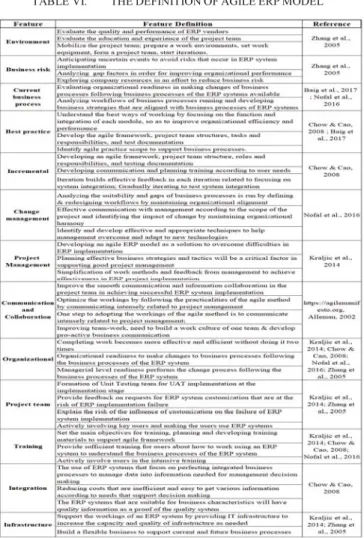
The definition of each factor and component of the Agile ERP model can be described as follows:
TABLE VI. THEDEFINITIONOFAGILEERPMODEL
978-1-7281-3333-1/19/$31.00 ©2019 IEEE
2019 International Conference on Information Management and Technology (ICIMTech)
C. Limitations and future research
This research has a limitation, because the discussion about the issues of agile implementation model for ERP based on survey model to study literature only. Therefore, needed to improve future research to proving with the real case in business by focusing on case studies with questionnaire and making the prototyping system for verify and implementing of many different industries as the objects for development of the agile implementation model for ERP.
V.CONCLUSION
ERP implementation success depends on managing project management similar to business processes reengineering by identifying the critical factors and important components. Managing project management in ERP implementation by applying the concept of business process management as a business strategy to overcome the complexity in ERP implementation, by applying agile method. Applying values from the principle of the agile method can enhance the success of ERP implementation and minimizes the risk of failure of ERP implementation. Development of the agile implementation model for ERP can be done based on a simpler and faster moving work method and improving the application operation functions as quickly as possible, to support changes in business processes. This minimizes the risk of failure in implementing ERP. The agile method prioritizes flexibility in changes of business processes that occur in the process of developing a system. For this reason that the ERP agile model is one approach that needs to be considered to handle the gaps and the factors of failures in implementing ERP. The agile model will end at each iteration with a demonstration of software that functions optimally. The implementing of agile ERP concept allows iterations to show that configuration without customization can make business processes and work flow to be more efficient and enhance productivity and organization performance. This is the purpose of this study that the build of agile ERP implementation model are important and impact as a breakthrough to achieve success in implementing ERP for the organizations.
REFERENCES
[1] Alleman, GB (2002). Agile project management methods for ERP: how to apply agile processes to complex COTS projects and live to tell about it. In Conference on Extreme Programming and Agile Methods. Springer, Berlin, Heidelberg.
[2] Baig, JJA., Shah, A., & Sajjad, F. (2017). Evaluation of agile methods for quality assurance and quality control in ERP implementation. In Intelligent Computing and Information Systems (ICICIS), 2017 Eighth International Conference on (pp. 252-257). IEEE.
[3] Chow, T, & Cao, DB. (2008). A survey study of critical success factors in agile software projects. Journal of systems and software, 81(6), 961-971. [4] Chen, CC., Law, CC., & Yang, SC. (2009). Managing ERP
implementation failure: a project management perspective. IEEE transactions on engineering management, 56(1), 157-170.
[5] Campanelli & Parreiras (2015). Agile methods tailoring–A systematic literature review. Journal of Systems and Software, 110, 85-100. [6] Delone, W. H., & McLean, E. R. (2003). The DeLone and McLean model
of information systems success: a ten-year update. Journal of management information systems, 19(4), 9-30.
[7] Fowler, M., & Highsmith, J. (2001). The agile manifesto. Software Development, 9(8), 28-35.
[8] Fetouh AA, el Abbassy A, & Moawad R. (2011). Applying Agile Approach in ERP Implementation. IJCSNS, 11(8), 173.
[9] Gunasekaran, A. (1999). Agile manufacturing: a framework for research and development. International journal of production economics, 62(1-2), 87-105.
[10] Kraljic, A., Kraljic, T., Poels, G., & Devos, J. (2014). Business process modelling in ERP implementation literature review. In 8th European Conference on IS Management and Evaluation (ECIME) (pp. 298-308). Academic Conferences and Publishing International Limited.
[11] Liao, L. M., Huang, C. J., & Lin, X. Y. (2018). Applying Project Management Perspective for ERP Implementation: A Case Study. Proceedings of Engineering and Technology Innovation, 8, 40-45. [12] Laurie D Hughes, Nripendra P. Rana , Antonis C. Simintiras. (2017). The changing landscape of IS project failure: an examination of the key factors, Journal of Enterprise Information Management, Vol. 30 Iss: 1. [13] Leavitt, H. J. (1965). Applied Organizational Change in Industry,
Structural, Technological and Humanistic Approaches. Handbook of organizations, 264.
[14] Lee, G., & Xia, W. (2010). Toward agile: an integrated analysis of quantitative and qualitative field data on software development agility. Mis Quarterly, 34(1), 87-114.
[15] Kaushik, S., Bharadwaj, A., Awasthi, V., & Sharma, R. (2017). A Novel Framework for Requirement Prioritization for ERP Implementation. Indian Journal of Science and Technology, 9(48).
[16] Kaushik, S., Bharadwaj, A., Awasthi, V. (2015). Need for blending Agile Methodologies and Lean Thinking for ERP Implementation: An industry point of view. In Next Generation Computing Technologies (NGCT), 2015 1st International Conference on (pp. 751-755). IEEE.
[17] Nofal, MIM, & Yusof, ZM. (2016). Conceptual model of enterprise resource planning and business intelligence systems usage. International Journal of Business Information Systems, 21(2), 178-194.
[18] Nerur S., Mahapatra R., Mangalaraj G. (2005). Challenges of migrating to agile methodologies. Communications of the ACM, 48(5), 72-78. [19] Petersen, K., & Wohlin, C. (2009). A comparison of issues and
advantages in agile and incremental development between state of the art and an industrial case. Journal of systems and software, 82(9), 1479-1490 [20] Peci M & Vazan P. (2014). The biggest critical failure factors in ERP implementation. In Applied Mechanics and Materials (Vol. 519, pp. 1478-1482). Trans Tech Publications.
[21] Shahin, A., & Jamshidian, M. (2006). Critical success factors in project management: A comprehensive review. In Proceedings of 1st International Project Management Conference (pp. 1-14).
[22] Smaizys, A., & Vasilecas, O. (2009). Business Rules based agile ERP systems development. Informatica, 20(3), 439-460.
[23] Uppstrom, Lonn. Hoffsten, & Thorstrom, J. (2015). New implications for customization of ERP systems. In System Sciences (HICSS), 2015 48th Hawaii International Conference on (pp. 4220-4229). IEEE.
[24] Wijaya S.F, Prabowo, H., Kosala, R. R. Meyliana (2018). Agile Methods for ERP Implementation: A Systematic Literature Review. In 2018 International Conference on Information Management and Technology (ICIMTech) (pp. 1-9). IEEE.
[25] Wijaya, S.F., Prabowo, H., Kosala, R., Meyliana (2017). Identification of key success factors and challenges for ERP systems - A systematic literature review. In 2017 International Conference on Applied Computer and Communication Technologies (ComCom) (pp. 1-6). IEEE. [26] Zhang, Lee, Huang, P., Zhang, L, & Huang, X. (2005). A framework of
ERP systems implementation success in China: An empirical study. International Journal of Production Economics, 98(1), 56-80.