ISSN: 1930-9325
DIALOG FROM THE FIELD
Head Start Professional Development: great leadership, great intentions
and great expectations
Meghan M. Fitzgerald
Borough of Manhattan Community College/City University of New York
The article is a retelling of the professional development (PD) and related efforts of the Head Start program. It provides an overview of the training and professional development efforts and the evolution of those efforts overtime. This HS professional development review is unique due to the author’s focus on teachers. The article uses a variety of resources, such as HS conference speeches and presentations, government reviews, reports of research, peer-reviewed articles, Head Start publications and regulations, and many retrospective books. Here, I argue that Head Start led the field to create professional learning experiences for and by its community-based staff members and it is not able to maintain high quality experiences for all young and adult learners yet. The presentation organizes the chronological review into a variety of periods and offers ideas for going forward.
Keywords: systems, professional development, Head Start, leadership
Head Start has led the field of Early Childhood Education (ECE) by consistently providing Professional Development (PD) to its teachers (Bowman, 2004). In fact, Head Start contributed to the need for early childhood-related teacher education programs. It was always the intention of Head Start to provide high quality PD to teachers as well as high quality programming to children. However, this review shows that Head Start has had trouble crafting high impact PD to teachers; further, research shows that Head Start quality is not always more than just adequate (U.S. Department of Health and Human Services, 2010). Head Start's latest legislation expects programs to implement high quality programming to its just over 900,000 enrolled children. It mandates quality through both legislation and regulations. As of November 2011, President Obama maintains (Landler, 2011) that if any of its 1,600 programs (Head Start Bureau, 2012) do not improve in quality, then such programs will be replaced by other programs that can or have a history of providing higher quality care. Thus, as this article demonstrates, with regard to PD, Head Start has a long and equally mixed history of great leadership, great intentions and great expectations.
Early childhood teachers draw from many years of professional learning to respond to children, to make decisions about curriculum, and to engage in the many other tasks required of teachers for classrooms to work (Bransford, Darling-Hammond, Lepage, 2005; Howes et al., 2008). But research also shows that the educational experience of teachers varies widely (Early, et al, 2006; National Research Council, 2001) and, further, that teachers need to engage in
continuous professional growth experiences to be effective in their classroom work (Brookfield, 2006). In high quality early childhood settings, children’s experiences are rich and have the potential benefits of advanced math and language outcomes later in the school age years (Cost, Quality, Outcomes Study Team, 1995). But what contributes most to the quality of a child’s early experiences within early childhood settings is each child’s teacher (Barnett, 2003; National Research Council, 2001, Pianta, et al, 2005; Pianta, 2006; Pianta, LaParo, Hamre, 2007; Siegel, 2012). The teacher – a mindful adult – facilitates that moment of engagement in order to benefit the child, and thus plays a critical role.
Within the ECE field, Head Start forged the understanding that PD and on-going learning by teachers is important (Bowman, 2004). Head Start contributed to the understanding that early childhood directors need to understand the classroom settings of each teacher (Bloom, 1997) and their teaching teams (Fitzgerald & Theilheimer, 2013). And, Head Start launched the idea that on-going PD and learning within ECE programs are a necessary programmatic provision and expenditure for staff to maintain high quality experiences (LeMoine, 2008; Talan & Bloom, 2004).
Plenty of historical reviews broadly outline a variety of contributions Head Start has made to the early childhood field (see Rose, 2010; Zigler & Styfco, 2010). However, based on the knowledge that regards teachers as the crucial ingredient to any child’s learning experience, few, if any, historical reviews of Head Start succinctly outline how the program was structured to address the PD experiences and learning needs of Head Start teachers.
The following outlines the history of Head Start’s PD efforts, maintaining a focus on teachers for a few reasons. Based on an understanding of teaching and learning theory, I acknowledge that teachers’ daily decisions influence the degree to which classrooms benefit young children. And further, that classroom and program history can, and often does, influence how programs continue to make decisions as well as whether or not programs continue. Just as a learner’s prior knowledge is linked to what is learned next, I believe that a focused retelling of Head Start’s PD history might fuel understanding of PD within early childhood programs. Leaders of ECE PD research have touted that the field is well beyond deciding the first generation of questions of does it work, how it works, and can it be improved (Ochshorn, 2011). But, no researcher yet has documented the first generation PD model forged by Head Start.
This historical glance at Head Start relies on a variety of resources, including conference speeches, presentations, government reviews, reports of research, peer-reviewed articles, Head Start publications and regulations, and many retrospective books. At times, former program staff and federal analysts have also offered suggestions to this effort. As many as three or more resources addressed the same efforts made by Head Start. When this overlap occurred, the sources served to corroborate the accuracy of the details provided. The reports of available research are used not so much for the findings of the research involved, but for the glimpse of Head Start PD offerings that the research provides.
OVERVIEW: HEAD START AND PROFESSIONAL DEVELOPMENT
Head Start, one of the few federally funded ECE programs, regularly provides PD opportunities to teachers (see Ackerman, 2006). However, no systematic data have been maintained for Training and Technical Assistance System or Network (T/TA Network) efforts throughout Head Start’s history. The T/TA Network, through the Office of Head Start particularly, has represented the PD program component. Across more than 45 years of Head Start’s life, there have been
numerous changes in its design and the make-up of its PD component. In regard to teachers, Ellsworth and Ames (1998) were the first to offer the critique that too little information discusses what “worked, when, how, and for whom” (p. 340). Hence, now what is clear across this 48-year history is that Head Start has had trouble crafting and maintaining an efficient and effective nationwide PD system that is able to support all Head Start classrooms.
The Head Start program historically has used PD, or training of teachers and technical assistance for programs, to influence quality and child outcomes of the overall program. But these initiatives may have been underfunded. Total funding for the summer program of 1965 was $84 million dollars with $11 million spent on training for the initial summer as well as the full-year programs (Levitan, 1969, p. 139). By 2013, the total funding for the program was approximately $7.6 billion dollars (Head Start Bureau, 2013) and the allocation for a wide variety of support activities to Head Start exceeded only $295 million dollars. However, compensation for teachers and quality of PD activities has not grown at that same exponential rate (Ochshorn, 2011).
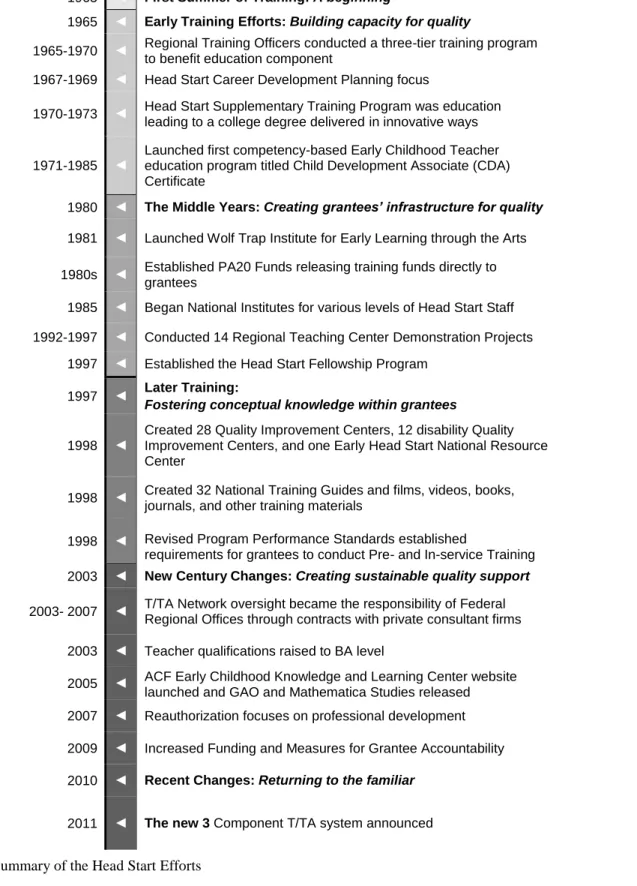
Figure 1 is a summative timeline of this Head Start PD story from the initial Training Branch to the current T/TA system. The figure serves to support the information presented within this article. Federal investment in Head Start has informed PD as the ECE field knows it today.
Figure 1. Summary of the Head Start Efforts
Timeline of Head Start Professional Development Efforts Dates Professional Development Effort
1965 ◄ First Summer of Training: A beginning
1965 ◄ Early Training Efforts: Building capacity for quality
1965-1970 ◄ Regional Training Officers conducted a three-tier training program to benefit education component
1967-1969 ◄ Head Start Career Development Planning focus
1970-1973 ◄ Head Start Supplementary Training Program was education leading to a college degree delivered in innovative ways
1971-1985 ◄
Launched first competency-based Early Childhood Teacher education program titled Child Development Associate (CDA) Certificate
1980 ◄ The Middle Years: Creating grantees’ infrastructure for quality
1981 ◄ Launched Wolf Trap Institute for Early Learning through the Arts 1980s ◄ Established PA20 Funds releasing training funds directly to
grantees
1985 ◄ Began National Institutes for various levels of Head Start Staff 1992-1997 ◄ Conducted 14 Regional Teaching Center Demonstration Projects
1997 ◄ Established the Head Start Fellowship Program 1997 ◄ Later Training:
Fostering conceptual knowledge within grantees
1998 ◄
Created 28 Quality Improvement Centers, 12 disability Quality Improvement Centers, and one Early Head Start National Resource Center
1998 ◄ Created 32 National Training Guides and films, videos, books,
journals, and other training materials
1998 ◄ Revised Program Performance Standards established
requirements for grantees to conduct Pre- and In-service Training 2003 ◄ New Century Changes: Creating sustainable quality support 2003- 2007 ◄ T/TA Network oversight became the responsibility of Federal
Regional Offices through contracts with private consultant firms 2003 ◄ Teacher qualifications raised to BA level
2005 ◄ ACF Early Childhood Knowledge and Learning Center website launched and GAO and Mathematica Studies released 2007 ◄ Reauthorization focuses on professional development 2009 ◄ Increased Funding and Measures for Grantee Accountability 2010 ◄ Recent Changes: Returning to the familiar
THE FIRST SUMMER OF TRAINING: A BEGINNING
In 1965, Head Start’s initial training efforts were housed in the Office of Economic Opportunity (OEO), and focused on employing and “training” members of this country’s most impoverished communities (Economic Opportunity Act of 1964, Trickett, 1979). During that first summer, staff and volunteers at 11,068 centers served approximately 561,360 children and their families (Levitan, 1969; Washington & Oyemade-Bailey, 1995).
This early period encouraged grantees to hire as many community members as possible as paraprofessionals (Trickett, 1979; Washington & Oyemade-Bailey, 1995). In describing the typical employee of Head Start of this period, Washington and Oyemade-Bailey (1995) write: “As with most day care settings, special training in child development or early childhood education [was] generally not a prerequisite to employment in Head Start” (p. 62). At that time, few colleges offered courses in early childhood specifically (McCarthy, 1988); a pronounced shortage of qualified staff existed (Richmond, Stipek, & Zigler, 1979). The staffing issue “necessitated the development of training programs designed to prepare inexperienced personnel for their jobs” (Trickett, 1979, p. 316).
Greenberg (1969), a facilitator at one of the first summer’s training sessions, describes how in-service training involved a range of activities from teacher preparation for the next day of classes with children to listening to lectures regarding best practices. Greenberg reflects on training for the 1965 Child Development Group of Mississippi (CDGM):
In spite of what was not done and the perhaps immature and unattractive reasons why it wasn’t, we came out of the summer knowing more than we started. We had known to begin with that, theoretically, teaching would work best with the kids if poor parents did it. But now we knew that these parents would do it, that they would respond eagerly to bringing the best in education to their long starved children. We now knew they regarded CDGM as a pipeline under the wall to sources of information and choice. We knew for a fact that what we had assumed at the beginning of the summer – that our uncredentialed
and credentialed teachers alike could scarcely read, write, and spell was true. (p. 168) Greenberg’s critical account documents that not only was it the first summer for Head Start and a time of social change, but also that the program struggled to create a viable workforce of
individuals from low-income communities. Greenberg observed that no matter what the training activity, it made a difference in the lives of the neighborhoods and communities. Professional development at the time was deemed a necessary safety measure because of the federal program’s size and there were few specified early childhood teacher education programs (Richmond, 1979). Greenberg’s account is different than other reports about program history (e.g., Ellsworth & Ames, 1998; Mills, 1998; Peters, 1998): Hers is the only account from the practical vantage point of an educator who was present at the time as a Training Branch
facilitator in 1965. Most importantly, Greenberg consistently discussed PD in relationship to its users – the local program leaders and staff.
EARLY TRAINING EFFORTS: BUILDING CAPACITY FOR QUALITY Providing for low-income communities through training and work opportunities from 1965-1970, Head Start efforts evolved from a “staff training” to a “career development” focus. According to Trickett (1979, p. 332), “early training” efforts were guided by centralized guidelines and funds, and had of three components: (1) a 40-hour training program prior to the working year, (2) an 8-week training program that was comprised of university-based courses, and (3) consultant utilization. This began a system of personnel supervised by Regional Training Officers (RTOs). RTOs were academicians in child development or a related field who served as liaisons between the national Head Start office and the local program consulting on points of implementation guidance. According to Trickett, there was one RTO to two grantees. The RTO structure of grantee oversight and support did not last because, as the Head Start expanded, the RTO system became cumbersome (Washington & Oyemade-Bailey, 1995). Research from the era critiqued the RTO system, stating that only 2,700 staff members were trained out of 18,000 instructional staff employed at the time (Levitan, 1969). There seem to be no sources to confirm or dispute this critique.
Between 1967 to 1969, in response to a push for academics (Riessman & Popper, 1968) and with the need for a well-trained Head Start teaching staff (Greenberg, 1969; Zigler & Muenchow, 1992), Head Start promoted career development as it was mandated by Office of Economic Opportunity instructions to programs (Trickett, 1979). Each grantee would have to articulate its career development plan in its annual refunding application (OEO Instruction 6902-1, as cited in Trickett, 1979); this plan evolved and became known as a Grantee Training Plan, but now is called a PD Plan.
By 1970, training efforts evolved, initiating both the Head Start Supplementary Training program [HSST] (OCD Instruction I-33-324-1, 1973, as cited by Trickett, 1979) and the Child Development Associates credential [CDA] (Council for Professional Recognition, 2007). Specifically, the HSST program involved education coursework leading to a college degree, delivered in innovative ways to meet the needs of an estimated 12,000 working female heads-of-household whose children qualified for Head Start (Careers Bulletin, 1970, as cited by Trickett, 1979).
The HSST program was complex; initially it was centralized, involving only six regions, but then it expanded to involve over 250 junior and senior colleges. According to Trickett (1979), during this early period of 1965-1973, there was guidance that grantees should be re-organized to reflect pre-service, in-service training for staff, as well as include special Head Start training programs. However, Trickett notes that program mandates were not funded, which made implementation of the HSST guidance difficult for grantees. Noteworthy is Head Start’s inability to account and track how many teachers received educational opportunities through HSST. Details, as such, might have contributed to longevity and documented the good intentions and great expectations pinned to that PD program. Instead, HSST ended by 1973. Details regarding HSST innovation are limited, but Trickett recalls the inclusion of local strategies, such as release time, overcoming transportation problems, and salary increases. What is clear about HSST was that it was only one component of an emerging larger system that was to be handed down to local communities (Stipek, Valentine, & Zigler, 1979).
Child Development Associates (CDA) credential. Launched in 1971, the first CDA
competency-based training program for ECE (Bailey, 2004; Zigler & Muenchow, 1992). Designed to create a viable workforce, the CDA provided 13 standard teacher competencies as grounds for assessing early childhood teachers’ performance (Zigler & Muenchow, 1992). The content was delivered in courses, while observations and evaluations of teachers took place during their work hours. Originally, CDA training incorporated a final performance assessment, but now the final evaluation is a standardized test.
During the early 1970s, controversy developed around the creation of the CDA. In hindsight, Head Start recognized that just as the ECE field was struggling to establish itself (McCarthy, 1988), the CDA was offered without any connection to credit-bearing education requirements. Some within the ECE field disparaged the CDA, thinking that it devalued credit-bearing ECE learning. These objections were levied even as the CDA alleviated the financial burdens entailed in higher education systems (Jencks & Riesman, 1968; Steiner, 1976). Despite the promotion and expansion of the CDA credential program by the federal Head Start leadership, local staffs and programs maintained their preference for the credit-bearing HSST program (Trickett, 1979). But by 1980, Head Start regulations required that grantees employ at least one teacher with a CDA for each classroom. Within that decade, grantees implemented the use of the CDA as a systemic PD strategy strengthening local programs through this alignment with the CDA requirement. Today, more than 200,000 individuals have earned a CDA credential (Council for Professional Recognition, 2007) and many are not Head Start affiliated teachers. Even with its controversy, the CDA is another example of how PD started by Head Start has had a long lasting impact on the greater ECE field today.
Early on Head Start contributed to what is known about implementing PD strategies. Research reports highlight how the CDA is used by grantees as a PD strategy, either through mandatory (Beers, 1993) or voluntary participation by Head Start education staff (Greenough, 1993). Native American and Alaskan Native American Head Start CDA facilitators, they qualitatively share how adult learning theory and pedagogy influenced the adult learners of two different CDA programs. Strategies employed were guiding questions, observation, feedback, dialogue, journal writing, and self-reflection. Even though the CDA was controversial, this program directly supports the characteristics of adult learning with its concern for the teacher as learner (Jones, 1993).
Head Start initiated other training efforts for instruction and program guidance during this period. The Head Start Bureau issued more specific program guidelines called Head Start Program Performance Standards, the implementation of which was supported by the T/TA Network (Lascarides & Hinitz, 2000; Washington & Oyemade-Bailey, 1995). These program standards built upon earlier program guidelines called the Head Start Daily Program I (1971, as cited in Biber, 1979). The first edition of Program Performance Standards was published in July 1975 (Biber, 1979), though it first appeared in the Federal Register (Volume 40, Number 126, Part II) on June 30 of that year. It provided guidance on health, safety, dental, nutritional, and educational services and addressed program governance, staff training, and program finance requirements specific to the education and care of young children. It was the first time the Head Start community had coherent ideas regarding teaching or learning and program management and it clarified service related terminology. An additional, program governance strategy was initiated in the late 1970s in an effort to provide the Head Start Bureau with information about local programs. The strategy was called Program Information Reporting (Administration on Children, Youth and Families, 2006). Head Start called it “PIR” and required programs to
annually self-report program related information, such as staff training levels, enrollment, and demographic information to the then federal Head Start Bureau.
In 1979, Head Start began planning the Wolf Trap Institute for Early Learning through the Arts. When convened in 1981, the instruction effort developed drama, music, and movement activities for staff learning. There was no data available to confirm the number of teachers impacted by this institute. In brief, these T/TA Network guidance and related PD activities nudged Head Start toward an emerging system by establishing nationwide program norms and on-going learning activities to benefit children and teachers.
THE MIDDLE YEARS OF TRAINING: DOING MORE WITH LESS
During the 1980s, the political context of the federal program changed. Funding increased to serve more children; however, the T/TA Network, which represented the program quality effort, was not incorporated into the funding increase (Washington & Oyemade-Bailey, 1995). Some believed that the Administration on Children, Youth, and Families (ACYF) had begun to “decentralize the [T/TA] delivery system” (p.121). According to Zigler and Muenchow (1992), during the 1980s, changes were made to the funding source for Head Start PD efforts – specifically named PA20 funds. These funds had been set aside from the program grants and allocated to support funding of the T/TA network. However, this centralized funding policy was changed, allowing the PA20 Funds to pass directly to grantees. This new decentralized allocation policy, to some degree, reduced the T/TA Network’s original funding. Many historical texts express concern that, at the time, there was “no real assurance that the [efforts] would continue at the same level of intensity” (Zigler & Muenchow, 1992, p.197).
Even with funds waning for PD, Head Start maintained some training. The T/TA Network managed to produce, at minimum, one education coordinator institute as well as a training manual for education coordinators (Head Start Bureau, 1986). This was evidenced by one keynote speech addressing the attendees of the First National Institute for Head Start Education Coordinators (Jones, 1986). There was a continuous effort for improvement, though only incremental and narrowly focused to assist education coordinators.
Commenting on the next decade, the 1990s, Washington and Oyemade-Bailey (1995) observed overall quality improvement measures. Head Start funded 14 Regional Teaching Center Demonstration Projects. As a result, research studies were published and two studies supplied evidence to support the general idea that training improves quality (Fantuzzo et al., 1996; Horm, Caruso, & Golas, 2003). The Teaching Centers provided training within the setting of an exemplary Head Start program. The centers hosted visiting grantee trainees. Trainees worked and learned in teams. The centers demonstrated a range of teaching and learning content and strategies using observations of exemplary program operations to guide participation in practice activities. The activities included mentoring, collaborative learning, individualized attention, PD planning, and goal setting (Administration for Children & Families, n.d.). However, the studies did not explore how grantee-teams implemented what they had learned locally. By 1997, with the completion of the projects and research (Fantuzzo et al., 1996), the Teaching Centers ended.
The middle years produced additional research and regulations that informed the work of the T/TA Network. Both the Smart Start initiative (see U.S. GAO, 1990) and the Head Start Public School Early Childhood Transition Demonstration Projects were launched. The latter intended to explore best practices for children transitioning into school systems (Ramey, et al.,
2000). Head Start produced the Multicultural Principles to promote understanding of and respect for cultural differences. Legislation established State Head Start Collaboration Offices in 48 states, the District of Columbia, and Puerto Rico. In collaboration with the Council for Early Childhood Professional Recognition, Head Start launched the National Head Start Fellows Program, which continues to provide unique learning opportunities to promising leaders of both Head Start and Early Head Start1 programs.
LATER TRAINING EFFORTS: FOSTERING CONCEPTUAL KNOWLEDGE From 1997 to 2003, Head Start continued the center PD strategy and began the Quality Improvement Centers (QICs) for Head Start community. According to Herren (2003), these 28 regionally based centers created a system of centrally governed and funded resources to serve as the base for a national professional learning network for grantees. The QICs offered a continuum of services to grantees, (e.g., pre-service, in-service, association meetings, workshops, on-site technical assistance, institutes, mentoring) and included an ongoing cycle of activity that included four phases, needs assessment, strategic planning, implementation, and evaluation (ACYF, 1998). The latter activity supported the federal planning for nationwide PD. Yet, beyond corrective action for compliance issues, there was little information about gaining access to the QICs and little data available about how QIC services supported programs locally.
According to some (Herren, 2003; Mann, 2002), the new QICs had great expectations for supporting quality through information sharing and PD specifically for special child populations. The system included 12 Disability Quality Improvement Centers (DS/QICS) and one Early Head Start National Resource Center (EHS-NRC) (Mann, 2002). The goal was to increase awareness of, understanding of, and commitment to shared Head Start values outlined by the revised Program Performance Standards and reissued Multicultural Principles. The true aim was to develop local personnel’s knowledge about quality, in the hopes that programs would then address their own quality issues. The QICs reportedly served this aim however, studies about quality in programs again challenged Head Start to change.
The QICs assisted implementation of PD and increased communication and collaboration (Herren, 2003), often through turnkey PD experiences (Bowman, 2004). According to Herren, QICs were flexible enough to assist grantees in building their own local capacity to facilitate PD activities as well as to organize and convene national conferences. Evidence of this was the National Head Start Child Development Institute that convened during this period. Roughly 3,200 education leaders from grantees attended the institute (ACF, 2005). This effort also resulted in the creation of 32 training manuals, self-management professional learning materials, the first distance learning opportunities, and the development of a variety of approaches to PD (Head Start Bureau, 1998; Herren, 2003). Some QICs collaborated with colleges, merging credit-bearing prospects with local PD (Head Start Bureau, 2002). The QICs conducted region-wide assessments of PD needs as well.
Just prior to 2000, crucial change emerged for the Head Start community in a mandate (see the Community Opportunities, Accountability, and Training and Educational Services Act of 1998) requiring grantees “to achieve 50 percent degreed teaching staff by the end of FY 2003”
1Early Head Start was launched in 1995 to provide comprehensive child and family development services for
low-income pregnant women and families with infants and toddlers ages birth to three years (Administration on Children and Families, 2005).
(Office of Inspector General, 2004, p. 1). This was a confusing reversal on the once credit-bearing-to-non-credit bearing or “HSST v. CDA” strategy established during the 1970s to 1980s. However, in many states over the course of three decades, state-led preschool systems emerged alongside many local government-led and maintained early childhood systems (Herren, 2003). Given the expansion of ECE program options, the QICs were outdated. According to Mann (2002), the QICS had served their singular Head Start mission. This center design strategy ended in 2003.
Other general program developments bolstered Head Start PD. A revision of the Program Performance Standards supported a more comprehensive and conceptually based PD strategy. Specifically standard 45CFR1306.23 required training education staff through: pre- and in-service PD opportunities. However, the standards lacked specificity about content, amount, or duration of training and lacked any reporting requirement about PD activities, so it allowed grantees a great amount of flexibility. Little data, if any, are available about grantees meeting this requirement.
Program Performance Standard revisions also included specific program regulations for children ages birth-to-five, pregnant women, and mothers of Head Start children, as well as multicultural principles and it bolstered by parallel national training initiative announcements. Training initiatives led grantees towards areas of education services development, addressing areas such as challenging child behaviors and early literacy (Zigler & Styfco, 2010), the development of a classroom curriculum (Center on the Social Emotional Foundations for Early Learning, n.d.) and parent education curriculum. Similarly crafted, training initiatives highlight activities that continue to support quality program implementation and teacher learning today, but little data is available about the implementation of these initiatives to foster conceptual knowledge.
NEW CENTURY AND MORE CHANGES: ATTEMPTING SUSTAINABLE QUALITY SUPPORT
The organization of PD for Head Start changed in 2004 presenting only one similarity to previous T/TA Networks. Technical assistance functions, such as the identification of needs and the provision of assistance to grantees by specialized network resources (ACYF, 2003a), would remain. However, the network would no longer seek to foster conceptual knowledge for all grantees directly (Sibley & Kelly, 2005), rather, the T/TA Network provide grantees access to resources made available by the Office of Head Start. In other words, grantees were responsible for addressing their own issues. Another major difference in this revision was how the Office of Head Start decentralized management of the T/TA Network contracts but centralized authority over grantees as well as the Administration for Children and Families (ACF) Regional Offices (ACYF, 2003a). One example of this shift in authority was the development of the National Reporting System (NRS) in 2003 (Hill, 2003), designed to create a systematic means of tracking the progress of children in the areas of early literacy and math skills for grantees (Zill, 2009). Grantees, when reporting results for the NRS, by-passed their regional offices and submitted assessment results directly to the federal Office of Head Start (ACYF, 2003b). Another example of change for the TTA Network was less apparent and it took the form of a shift in authority in its operations and content. An example of centralization, federal authority expanded to include greater control over the content of what was taught to Head Start programs. An example of
decentralization, the twelve regional Head Start Offices began oversight of day-to-day operations of the TTA Network and a handful of consultant-firm contracts.
The ambiguous structure and governance was on display at a T/TA Network contractor conference held in the spring of 2003. There, regionally contracted teams showing promise shared their technical assistance process and PD practices with other regions. It was apparent that regional TTA Network priorities were given precedence over nationally set content priorities (ACYF, 2003a). Though the T/TA Network contracts required documentation and progress reporting to the federal Office of Head Start (OHS), it was clear from the presentations that, again, TTA Network data collection was not systematic across all regions that tracked the number of grantees or staff involved in T/TA Network activities. Due to the shifts between centralized and decentralized control regarding the functions and funding of the TTA Network, Head Start continued to lack clear structures necessary for sustaining quality.
However, there were other ways that the federal Office of Head Start exerted a centralized call for grantees to conduct PD activities circumventing regional T/TA Networks. Grantees continued to receive PD funds directly from OHS, i.e., “PA20 funds” (Boller, 2006; Head Start Act). These PA20 Direct Funds reportedly empowered grantees to manage and implement their training plans independently (Boller, 2006). Additionally, the federal office implemented a variety of national training initiatives. Each initiative involved centralized contracts with universities or early childhood expert consultants and resulted in the production of training and curricular materials. For example, for the topics of family literacy and mentor coaching (see Head Start Bureau, 2005), the regional T/TA Network staff used the training and curricular materials for PD activities with grantees. However, for these initiatives, grantee involvement was optional because no additional funding was given to grantees to support involvement. Training initiatives such as for mentoring and family literacy resulted in a nation-wide approach to PD that varied and did not consistently reach teachers. Grantee level funding (PA 20 funds) was not expanded. The consultant firm and universities approach to PD created centralized training initiatives intending to support program services quality, but it was disconnected from local practice and did not reach the true learning needs of classroom teachers.
Research: Looking Closely at Reality. Since 1965, numerous studies have examined
Head Start for various purposes unrelated to PD. During the early 2000s, education related research emphasized the impact of program organization and fiscal management on overall program quality. But, Head Start has only a few studies explored the PD efforts of the Head Start Training and Technical Assistance Network.
In 2005, with a research-based understanding that program and fiscal management indeed impact PD opportunities given to teachers (see Bloom, 1996), the United States Government Accountability Office (GAO) released a study about Head Start fiscal oversight. The report entitled, ‘‘Head Start: Comprehensive Approach to Identifying and Addressing Risks Could Help Prevent Grantee Financial Management Weaknesses’’ (U.S. GAO–05– 176), discussed and analyzed triennial review data. The purpose of this analysis was to inform creation of fiscal oversight regulations that would in turn benefit the overall administration of Head Start programs, including PD provisions for staff. Eventually, and in part prompted by the GAO’s report, legislators revised the statutory provisions set forward to govern financial management of programs in the Improving Head Start for School Readiness Act of 2007.
More explicitly focusing on PD practices of Head Start, there was one exploratory study conducted by Mathematica in 2005. It focused solely on the new consultant structure and
approach used by the current T/TA Network. The principal investigator, Boller, explored how the 2003-2005 T/TA Network operated. The purpose of the study was to describe the decentralized, contractor-based T/TA system implementation, to identify common challenges, and to highlight innovative strategies. This study offered only one finding concerning T/TA activities related to classrooms. The contractor-design network reportedly struggled to focus “T/TA services on improving classroom quality and child outcomes” (Boller, 2006). Overall, the interview and focus group design fell short of collecting data from instructional staff members and did not describe practices currently used by the T/TA Network to address classroom needs, which limits this study. Even less is known about how support is offered to facilitate quality classrooms.
RECENT T/TA NETWORK CHANGES: RETURNING TO THE FAMILIAR In December of 2007 and February of 2009, Head Start again received the attention of Congress. First, Congress reauthorized Head Start and Early Head Start through the Improving Head Start for School Readiness Act of 2007, P.L. 110-134 (Head Start Act). Then, the American Recovery and Reinvestment Act of 2009, P.L. 111-5 (Recovery Act) infused funds and new accountability measures into the earlier reauthorization. The 2007 provisions, among other things, outlined old and new PD priorities and the 2009 provisions made Head Start programs accountable for maintenance of their program quality.
The 2007 Head Start Act provisions maintained and increased staff qualifications of teachers and teaching assistants, respectively (Administration for Children & Families, 2008a). With the new staff qualifications deadline set in 2013, the 2007 legislation required programs to
identify and report progress toward meeting professional qualifications, provide a minimum of 15 in-service hours for each Head Start teacher, and maintain that PD opportunities be “high-quality, sustained, intensive, and classroom-focused.” This last phrase represents a dynamic and centralized focus. Equally important, though, is that the legislation calls for programs to match PD opportunities to the outlined PD goals set by each program. Finally, the 2007 Head Start Act requires programs to develop individual PD plans for each teacher and teaching assistant.
To support programs in achieving the provisions of the legislation, the now officially named OHS began several efforts. OHS swiftly centralized all triennial and first year on-site, program-monitoring reviews (ACF, 2006a). There was the launch of the new interactive web site, the Early Childhood Learning and Knowledge Center (ECLKC). The ECLKC continues to offer relevant, timely information to grantees and the early childhood community (Administration for Children & Families, 2006b). The OHS also initiated programs’ use of the Classroom Assessment Scoring System (CLASS) (ACF, 2008b). CLASS provides programs and the T/TA Network a research based glance at teacher-child interactions through an observation assessment tool. Project Solar was begun to provide technical assistance to programs about best practices for development of staffing training plans (Administration for Children & Families, 2008c). During the period of 2007 to 2010, not all programs were introduced to these pilot projects and due to lack of opportunities for related training, these initiatives were not implemented nationwide. It was only in 2008, when Project Solar became a web-based tool, that it could be accessed using Head Start’s ECLKC website and all grantees were given access.
Though the consultant structure of the T/TA Network was unchanged, the reauthorization refocused this same structure to assist programs with required improvements. The regulations
supported the aims of program quality improvements and addressed the challenges outlined by the Mathematica study (Boller, 2006). For example, the adoption of the CLASS outlined to the T/TA network how consultant-based network staff would identify issues that impeded classroom quality. Yet, not addressed by this reauthorization was the need for additional funding that might support each grantee’s ability to determine and address their PD needs.
Late in 2009, Congressional legislation again prompted revision in program-related PD. Soon after the Recovery Act infused an additional 2.1 billion dollars into the program, the OHS announced the renaming and restructuring of the T/TA Network. The renamed Training and Technical Assistance System (T/TA System) was comprised of three components: (1) five National Centers of Early Childhood Excellence, (2) the 48 State T/TA Systems, as well as (3) maintenance of the direct funding to grantees. In the proposed T/TA System, the OHS announced that grantees are the “most critical component” (ACF, 2010). Each Head Start grantee had discretionary use of T/TA dollars (i.e., PA20 Direct Funds) to use with community or national experts, institutions of higher learning, or private consultants in order to make improvements identified by grantees.
The irony of this latest revision, though, is that the new T/TA System reflects various remnants of former T/TA Network practices. It is similar because it uses the contractor/consultant model from 2003. The research centers are similar to the QICS design and are run by higher education institutions as they were during the 1990s. Unchanged is the PA20 Direct Fund for each grantee given for discretionary training purposes originally during the 1980s. This current organization of the T/TA Network has resulted in little published information about the effects of this latest revision.
CONCLUSIONS: LEADING, INTENDING AND EXPECTING
When the Head Start program began, it led the field, often times, by default because there was no other nation-wide early childhood program to which it could be compared. Yet, the Head Start program challenged educational systems and people to support its goals. It prompted creation of ECE specific teacher education programs, the development of the CDA credential, and higher-education collaborations specifically for underserved populations (Head Start Bureau, 2002). The program outlined many different means of delivering services to low socio-economic communities and it fueled the growth of PD into a nationwide network.
We need better data about the teaching staff. When training began 48 years ago, PD addressed the professional learning needs of its teachers in their classrooms (see Greenberg, 1969). Yet, later in Head Start’s history, the program intended to demonstrate how the program could evolve and revise its design. Though its policies developed its workforce and supported children and families affected by poverty, Head Start missed an opportunity. The opportunity outlined 30 years ago by Trickett (1979) based on the observation that there was no research on the effects of Head Start on its teachers. There continues to be very limited research (see Boller, 2006) and systematic data documenting the program requirement of providing PD. Much of the published data available merely tracks the percentage of teachers with an earned baccalaureate degree. It is as if the leadership of Head Start has forgotten that teaching begins in the context of learner-centered relationships, using data and analysis, then planning curriculum, and engaging in teacher reflection. Tricket (1979) was accurate: Head Start needs to ask more qualitative
questions about its workforce and their experienced PD to begin data-driven revisions of the network and program monitoring.
We need PD to be accessible. Much of the current PD initiatives use regional or national centers, which responds to many expectations and influences. However, this format has had both successes and had troubles. And, honestly, the results of these expenditures are mixed. Not all grantees are high quality programs and not all staff members have access to the latest PD initiatives or learning experiences that are meaningful to them. There might be a connection between these issues. If local program leaders do not have access to learning experiences, then they must continue to support themselves and staff members in a top-down vacuum. This historical review iterates how true ECE professional learning suffers when the learner – in this case, a Head Start teacher – is not acknowledged nor can influence his or her learning process. I argue the lack of real change in the structure, related policies and governance of Head Start and its TTA Network is a terrible error because today’s children do not get another opportunity for their teachers to grow and learn.
We need flexible supports for programs, teachers, families, and children. Across 48 years, Head Start did not always provide flexible support and this issue is not a new dilemma for the federally based program (see Ellsworth & Ames, 1998, Greenberg, 1969, or Stipek, Valentine & Zigler, 1979). Over this same period, local communities evolved with changing populations, funding sources and possibly new local regulations and expectations. Just like local communities, each teacher has his or her own concerns for the children placed in his or her care. These are influences on teachers that can change a classroom immediately and each demands flexible support, which is not currently modeled, offered or supported to all teachers. It could be that the network, such as it is, is obsolete and we need to reconsider the aims and structure of Head Start’s PD design.
As the 50th anniversary approaches, I urge Head Start to reflect, consider their goal to benefit children, and reconsider the PD and data systems currently funded to support teachers. Head Start needs to continue to lead and facilitate local programs to collect, document, and analyze program data, as well as critically think and consider new learning goals for themselves. Head Start’s PD activities and data systems need to change with the times. It needs to change on behalf of each classroom learning environment, the theories, understandings, and expectations Head Start helped to create, and the quintessential moment of learning between the child and teacher that we better understand because of Head Start’s existence.
REFERENCES
Ackerman, D. J. (2006, April). The learning never stops: Lessons from military child development centers for teacher professional development. Paper presented at the annual meeting of the American Educational Research Association, San Francisco.
Administration for Children and Families. (n.d.). Preliminary report on the Head Start teaching center demonstration project. Retrieved on http://www.acf.hhs.gov/programs/hsb/research/hstc/index.htm. Administration for Children and Families (Producer). (2005). Head Start anniversary 1965-2005: Honoring the
past; strengthening the future [DVD]. (Available from the Head Start Information and Publication Center, 1200 N. Henry St., Suite E, Alexandria, VA 22314)
Administration for Children and Families. (2006a). Information memorandum: Fiscal Year 2007 PRISM Monitoring. Log No. ACF-IM-HS-06-06. Retrieved from
Administration for Children and Families. (2006b). Information memorandum: Early Childhood Learning and Knowledge Center. Log No. ACF-IM-HS-06-03. Retrieved from
http://eclkc.ohs.acf.hhs.gov/hslc/standards/IMs/2006/resour_ime_00110_060506.html
Administration for Children and Families. (2008a). Information memorandum: Availability of FY 2008 One-time Training and Technical Assistance Funding. Log No. ACF-IM-HS-08-09. Retrieved from
http://www.acf.hhs.gov/programs/ohs/policy/im2008/acfimhs_08_09.html
Administration for Children and Families. (2008b). Information memorandum: Classroom Assessment Scoring System. Log No. ACF-IM-HS-08_11. Retrieved from
http://eclkc.ohs.acf.hhs.gov/hslc/standards/IMs/2008/resour_ime_011_0081908.html
Administration for Children and Families. (2008c). Information memorandum: Project SOLAR – T/TA and Staff Development Planning Tool. Log No. ACF-IM-HS-08-16. Retrieved from http://www.acf.hhs.
gov/programs/ohs/policy/im2008/acfimhs_08_16.html
Administration for Children and Families. (2010). Information memorandum: Training and Technical Assistance System. Log No. ACF-IM-HS-10-01. Retrieved from
http://eclkc.ohs.acf.hhs.gov/hslc/standards/IMs_and_PIs_in_PDF/PDF_IMs/IM2010/ACF-IM-HS-10-01.pdf
Administration on Children, Youth, and Families. (1998). Training and Technical Assistance Quality Improvement Centers (QICs). Retrieved from http://eclkc.ohs.acf.hhs.gov/hslc/Program%20Design%20and%20 Management/Head%20Start%20Requirements/IMs/1998/resour_ime_00702_021506.html.
Administration on Children, Youth, and Families. (2002). Program Review Instrument for Systems Monitoring (PRISM). Retrieved from http://www.acf.
hhs.gov/programs/opre/ehs/perf_measures/reports/resources_measuring/res_meas_impi.html
Administration on Children, Youth, and Families. (2003a). Information memorandum: New Head Start Training and Technical Assistance (T/TA) System FY 2004 Log No. ACYF-IM-HS-03-10. Retrieved from http://eclkc.ohs.acf.hhs.gov/hslc/Program%20Design%20and%20Management/Head%20Start%20Require ments/IMs/2002/2003/resour_ime_00209_020206.html.
Administration on Children, Youth and Families. (2003b). Information memorandum: Implementation of the Head Start National Reporting System on Child Outcomes. Log No. ACYF-IM-HS-03-07. Retrieved from http://eclkc.ohs.acf.hhs.gov/hslc/standards/Historical%20Archive/Information%20Memoranda%20and%20 Program%20Instructions/2003%20Information%20Memoranda/resour_ime_00206a_020206.html
Administration on Children, Youth, and Families. (2006). Information memorandum: Program Information Report (PIR) Validation Study and Program Review Instrument for Systems Monitoring (PRISM) Re-Review Study. Log No. ACYF-IM-HS-06-03. Retrieved from
http://eclkc.ohs.acf.hhs.gov/hslc/standards/IMs/2006/resour_ime_00105_051706.html. American Recovery and Reinvestment Act of 2009, Pub. L. No. 111-5. § 701, 123 Stat. 179 (2009).
Bailey, C. T. (2004). The 2004 National Survey of Child Development Associates (CDAs). Council for Professional Recognition. Retrieved from http://www.cdacouncil.org/PDF/ CDA_SURVEY_04.pdf.
Barnett, W. S. (2003). Better teachers, better preschools: Student achievement linked to teacher qualifications
(Preschool Policy Matters, Issue 2). New Brunswick, NJ: National Institute for Early Education Research. Beers, C. D. (1993). Telling our stories: The CDA process in Native American Head Start. In E. Jones (Ed.),
Growing teachers: Partnerships in staff development (pp. 2-21). Washington, DC: National Association for the Education of Young Children.
Biber, B. (1979). The preschool-education component of Head Start: Introduction (Section II). In E. Zigler & J. Valentine (Eds.), Project Head Start: A legacy of the War on Poverty (pp. 155-161). New York: Free Press.
Bloom, P. J. (1996). The quality of work life in NAEYC accredited and non-accredited early childhood programs.
Early Education and Development, 7(4), 301-317.
Bloom, P. J. (1997). A great place to work. Washington, DC: National Association for the Education of Young Children.
Boller, K. (2006). Head Start National T/TA System quality assurance study: Focus on system implementation [Mathematica]. Paper presented at the annual meeting of the Head Start Training and Technical Assistance Network, Washington, DC.
Bowman, B. (2004). The future of Head Start. In E. Zigler & S. J. Styfco (Eds.), The Head Start debates (pp. 533-544). Baltimore, MD: Brookes.
Brookfield, S. D. (2006). The skillful teacher: On technique, trust, and responsiveness in the classroom. San Francisco, CA: Jossey- Bass.
Center on the Social Emotional Foundations for Early Learning. (n.d.). About us. Retrieved from http://www.vanderbilt.edu/csefel/staff.html
Cost, Quality, and Child Outcomes Study Team. (1995). Cost, quality, and child outcomes in child care centers.
Denver: University of Colorado at Denver.
Community Opportunities, Accountability, and Training and Educational Services Act of 1998, (P.L. 105-285), Sec. 115.
Council for Professional Recognition. (2007). History of CDA. Retrieved from http://www.cdacouncil.org/ab_his.htm
Bransford, Darling-Hammond, Lepage, (2005). Introduction. pp. 1-40. In Darling-Hammond, L. Bransford, J., LePage, J. Hammerness, K., Duffy, H. [Eds] (2005). Preparing teachers for a changing world: what teachers should know and be able to do. San Francisco, CA: Wiley & Sons.
Early, D. M., Bryant, D. M., Pianta, R. C., Clifford, R. M., Burchinal, M.R. Ritchie, S., et al. (2006). Are teachers’ education, major, and credentials related to classroom quality and children’s academic gains in pre-kindergarten? Early Childhood Research Quarterly, 21(2), 174-195.
Economic Opportunity Act of 1964, PL 88-452, 42 U.S.C. §§2701 et seq.
Ellsworth, J., & Ames, L. J. (1998). Concluding thoughts: Hope and challenge: Head Start past, present, future. In J. Ellsworth & L. Ames (Eds.), Critical perspectives on project Head Start: Revisioning the hope and challenge (pp. 334-341). Albany: State University of New York Press.
Fantuzzo, J., Childs, S., Stevenson, H., Coolahan, K.C., Ginsburg, M., Gay, K., et al. (1996). The Head Start teaching center: An evaluation of an experiential, collaborative, training model for Head Start teachers and parent volunteers. Early Childhood Research Quarterly, 11, 79-99.
Fitzgerald, M. & Theilheimer, R. (2013). Moving toward teamwork through professional development activities.
Early Childhood Education Journal, 41, 103-113. doi: 10.1007/s10643-012-0515-z
Greenberg, P. (1969/1990). The devil has slippery shoes: A biased biography of the Child Development Group of Mississippi – A story of maximum feasible poor parent participation. Washington, DC: Youth Policy Institute.
Greenough, K. (1993). Moving out of silence: The CDA process with Alaska native teachers. In E. Jones (Ed.),
Growing teachers: Partnerships in staff development (pp. 22–37). Washington, DC: National Association for the Education of Young Children.
Head Start Act as amended by the Improving Head Start for School Readiness Act of 2007, P.L. 110-134, 42 U.S.C. §§9801 et seq
Head Start Bureau. (1986). A guide for education coordinators in Head Start. Washington, DC: US Department of Health and Human Services, Administration for Children and Families, Administration on Children, Youth, and Families, Head Start Bureau.
Head Start Bureau. (1998). Creative adventure: Supporting development and learning through art, music, movement, and dialogue. Washington, DC: US Department of Health and Human Services, Administration for Children and Families, Administration on Children, Youth, and Families, Head Start Bureau.
Head Start Bureau. (2002). Communique: Head Start higher education partnerships, 1(1). Washington DC: Author. Head Start Bureau. (2005). Steps to Success: An instructional design for early literacy mentor-coaches in Head Start
and Early Head Start. Washington, DC: Department of Health and Human Services, Head Start Bureau Publications.
Head Start Bureau. (2012). Head Start fact sheet. Retrieved from
http://eclkc.ohs.acf.hhs.gov/hslc/mr/factsheets/docs/hs-program-fact-sheet-2012.pdf Head Start Bureau. (2013). Head Start fact sheet. Retrieved from
https://eclkc.ohs.acf.hhs.gov/hslc/data/factsheets/docs/hs-program-fact-sheet-2013.pdf
Herren, J. K. (2003, August). Training and technical assistance retrospective II, 1997-2003. Paper presented at the annual meeting of the Head Start Training and Technical Assistance Network, Washington, DC.
Hill, W. (2003). The National Reporting System: What is it and how will it work? Head Start child outcomes – Setting the context for the National Reporting System. Head Start Bulletin, 76. Washington, DC: Department of Health and Human Services, Administration for Children and Families, Administration on Children, Youth, and Families, Head Start Bureau.
Horm, D. M., Caruso, D. A., & Golas, J. (2003, February). Head Start Teaching Center: Differential training effects for Head Start personnel. Child and Youth Care Forum, 32(1), 23-46.
Howes, C., Burchinal, M., Pianta, R., Bryant, D., Early, D., Clifford, R., et al. (2008). Ready to learn? Children's pre-academic achievement in pre-Kindergarten programs. Early Childhood Research Quarterly, 23(1), 27-50.
Jencks, C., & Riesman, D. (1968). The academic revolution. New York: Doubleday.
Jones, E. (1986, June).Reflection and dialogue: Ways to grow staff. Keynote address presented at the First National Institute for Head Start Education Coordinators, Los Angeles.
Jones, E. (1993). Introduction: Growing Teachers. In E. Jones (Ed.), Growing teachers: Partnerships in staff development (pp. 22–37). Washington, DC: National Association for the Education of Young Children. Landler, M. (2011, November 8). Head Start is Given New Rules for Grants. The New York Times. Retrieved from
http://www.nytimes.com/2011/11/09/us/politics/obama-announces-stricter-financing-standards-for-head-start.html?_r=1&ref=headstartprogram.
Lascarides, V. C., & Hinitz, B. F. (2000). History of early childhood education. New York: Falmer Press.
LeMoine, S. 2008. Workforce Designs: A Policy Blueprint for State Early Childhood Professional Development Systems. Washington, DC: National Association for the Education of Young Children (NAEYC).
Levitan, S. (1969) The Great Society’s Poor Law: A new approach to poverty. Baltimore, MD: Johns Hopkins University Press.
Mann, T. L. (2002). The role of training and technical assistance in supporting the delivery of high quality services in Early Head Start. Infant Mental Health Journal, 23(1-2), 36-47.
McCarthy, J. (1988). State certification of early childhood teachers: An analysis of the 50 states and the District of Columbia. Paper presented at the NAEYC Early Childhood Teacher Education Colloquium, Miami, FL. Mills, K. (1998). Something better for my children: How Head Start has changed the lives of millions of children.
New York: Penguin Putnam.
National Research Council. (2001). Eager to learn: Educating our preschoolers (Committee on Early Childhood Pedagogy; B. T. Bowman, M. S. Donovan, & M. S. Burns, eds.; Commission on Behavioral and Social Sciences and Education). Washington, DC: National Academy Press.
Office of Inspector General. (2004). Status of efforts to increase qualifications of Head Start teachers (OIE-07-01-00560). Washington, DC: Department of Health and Human Services.
Ochshorn, S. (2011). Forging a New Framework for Professional Development: A Report on “The Science of
Professional Development in Early Childhood Education: A National Summit”. Washington, DC: ZERO TO THREE.
Peters, B. J. (1998). The Head Start mother: Low-income mothers’ empowerment through participation. New York: Garland.
Pianta, R., Howes, C., Burchinal, M., Bryant, D., Clifford, R. M., Early, D. M., & Barbarin, O. (2005). Features of pre-kindergarten programs, classrooms, and teachers: Prediction of observed classroom quality and teacher-child interactions. Applied Developmental Science, 9(3), 144-159.
Pianta, R.C., LaParo, K.M., Hamre, B.K. (2007). Classroom Assessment Scoring System (CLASS) Manual (Pre-k). Baltimore, MD: Brookes.
Pianta, R. (2006). Standardized observation and professional development: A focus on individualized implementation and practices. In M. Zaslow & I. Martinez-Beck (Eds.), Critical issues in early childhood professional development (pp. 231-254). Baltimore, MD: Brookes.
Ramey, S., Ramey, C., Phillips, M., Lanzi, R., Brezausek, C., Katholi, C., & Snyder, S. (2000). Head Start children’s entry into public school: A report on the national Head Start/public school early childhood transition demonstration study (Contract number 105-95-1935). Washington, DC: U.S. Department of Health & Human Services, Administration for Children & Fmailies, Head Start Bureau.
Riessman, F., & Popper, G. I. (Eds.) (1968). Up from poverty: New career ladders for non-professionals. New York: Harper & Row.
Richmond, J. B. (1979). Head Start, a retrospective view: The founders – entering the arena of Head Start. In E. Zigler & J. Valentine (Eds.), Project Head Start: A Legacy of the War on Poverty (pp. 121-128). New York: Free Press.
Richmond, J. B., Stipek, D.J., & Zigler, E. (1979). A decade of Head Start. In E. Zigler & J. Valentine (Eds.),
Project Head Start: A Legacy of the War on Poverty (pp. 135-152). New York: Free Press.
Rose, E. (2010). The Promise of preschool: From Head Start to universal pre-kindergarten. New York: Oxford University Press.
Siegel, D.J., (2012). The Developing Mind, Second Edition: How Relationships and the Brain Interact to Shape Who We Are. New York, NY: Guilford Press
Sibley, A. & Kelly, W. (2005). Technical assistance for early childhood programs: A review of systems and initiatives [Report]. Atlanta: Quality Assist Inc for Bright from the Start Georgia Department of Early Care and Learning.
Stipek, D.J., Valentine, J., Zigler, E. (1979). Project Head Start: A critique of theory and practice. In E. Zigler & J. Valentine (Eds.), Project Head Start: A Legacy of the War on Poverty (pp. 477-494). New York: Free Press.
Talan, T. N., & Bloom, P. J. (2004). The Program Administration Scale: Measuring early childhood leadership and management. New York: Teachers College Press.
Trickett, P. K. (1979). Career development in Head Start. In E. Zigler & J. Valentine (Eds.), Project Head Start: The Legacy of The war on Poverty (pp. 315-336). New York: Free Press.
U.S. Department of Health and Human Services. (2010). Head Start Impact Study: Final Report, January 2010.
Washington, DC: Administration for Children and Families, Office of Planning, Research and Evaluation. Retrieved from http://www.acf.hhs.gov/programs/opre/hs/impact_study/
U.S. General Accounting Office. (1990). Early childhood programs: What are the costs of high-quality programs?
(GAO/HRD-90-43Br). Washington, DC: US GAO.
U.S. Government Accountability Office, (2005). Head Start: Comprehensive Approach to Identifying and Addressing Risks Could Help Prevent Grantee Financial Management Weaknesses (GAO–05– 176). Retrieved from: http://www.gao.gov/ new.items/d05176.pdf.
Washington V., & Oyemade-Bailey, U. J. (1995). Project Head Start: Models and strategies for the twenty-first century. New York: Garland.
Zigler, E. & Muenchow, S. (1992). Head Start: The inside story of America’s most successful educational
experiment. New York: Basic Books.
Zigler, E., & Styfco, S. (2010). The Hidden History of Head Start. New York: Oxford University Press.
Zill, N. (2009, April 20). Head Start National Reporting System: Westat presentation at the National Academy of Science Retrieved on www.bocyf.org/Zill_Presentation.pdf