For More Information
Visit RAND at
www.rand.org
Explore the
RAND Corporation
View
document details
Support RAND
Browse Reports & Bookstore
Make a charitable contribution
Limited Electronic Distribution Rights
This document and trademark(s) contained herein are protected by law as indicated in a notice appearing
later in this work. This electronic representation of RAND intellectual property is provided for
non-commercial use only. Unauthorized posting of RAND electronic documents to a non-RAND website is
prohibited. RAND electronic documents are protected under copyright law. Permission is required from
RAND to reproduce, or reuse in another form, any of our research documents for commercial use. For
information on reprint and linking permissions, please see
RAND Permissions
.
Skip all front matter:
Jump to Page 1
6
The RAND Corporation is a nonprofit institution that helps improve policy and
decisionmaking through research and analysis.
This electronic document was made available from
www.rand.org
as a public service
of the RAND Corporation.
CHILDREN AND FAMILIES EDUCATION AND THE ARTS ENERGY AND ENVIRONMENT
HEALTH AND HEALTH CARE INFRASTRUCTURE AND
TRANSPORTATION INTERNATIONAL AFFAIRS LAW AND BUSINESS NATIONAL SECURITY POPULATION AND AGING PUBLIC SAFETY SCIENCE AND TECHNOLOGY TERRORISM AND HOMELAND SECURITY
This report is part of the RAND Corporation research report series. RAND reports
present research findings and objective analysis that address the challenges facing the
public and private sectors. All RAND reports undergo rigorous peer review to ensure
high standards for research quality and objectivity.
Assessing the Potential to Expand
Community College
Baccalaureate
Programs
in Texas
C O R P O R A T I O NLindsay Daugherty
Charles A. Goldman
Lindsay Butterfield
Trey Miller
Prepared for
the Texas
Higher Education
Coordinating Board
The research in this report was produced for the Texas Higher Education Coordinating Board by RAND
Education, a unit of the RAND Corporation, and the Texas Higher Education Policy Initiative (HEPI). RAND
and HEPI publications do not necessarily reflect the opinions of their research clients and sponsors.
The RAND Corporation is a nonprofit institution that helps improve policy and decisionmaking through
research and analysis.
Support RAND—make a tax-deductible charitable contribution at www.rand.org/giving/contribute.html. RAND® is a registered trademark.
Cover Images
Left: Fotolia/michaeljung, Right: Fotolia/Stephen Coburn
Interior Images
page 8: Fotolia/Wellford Tiller, page 10: Fotolia/michaeljung, page 13: Fotolia/Eimantas Buzas, page 14: Fotolia/apops, page 15: Fotolia/ PictureArt, page 16: Fotolia/Rob, page 17: Fotolia/ndoeljindoel, page 18: Fotolia/Stephen Coburn, page 39: Fotolia/Monkey Business,
page 51: Fotolia/micromonkey, page 61: Fotolia/Igor Mojzes, page 68: Fotolia/WavebreakMediaMicro, page 74: Fotolia/michaeljung,
page 83: Fotolia/Lisa F. Young, page 97: Fotolia/WavebreakMediaMicro, page 107: Fotolia/michaeljung
© Copyright 2014 RAND Corporation
This document and trademark(s) contained herein are protected by law. This representation of RAND intellectual property is provided for noncommercial use only. Unauthorized posting of RAND documents to a non-RAND website is prohibited. RAND documents are protected under copyright law. Permission is given to duplicate this document for personal use only, as long as it is unaltered and complete. Permission is required from RAND to reproduce, or reuse in another form, any of our research documents for commercial use. For information on reprint and linking permissions, please see the RAND permissions page (www.rand.org/pubs/permissions.html).
Design by KSA-Plus Communications, Inc.
RAND Offices
Assessing the Potential to Expand
Community College
Baccalaureate
Programs
in Texas
Lindsay Daugherty
Charles A. Goldman
Lindsay Butterfield
Trey Miller
Preface
States are increasingly exploring a greater role for community colleges in baccalaureate-level education. As
of 2014, 17 states including Texas allow at least some community colleges to offer bachelor’s degrees. Texas
currently limits this authority to three community colleges.
On May 22, 2013, the Texas Legislature approved Senate Bill 414 mandating a study to consider further
expanding community college baccalaureate degrees in Texas. The College for All Texans Foundation, which
works to further the objectives of the Texas Higher Education Coordinating Board (THECB), asked RAND
Education, a unit of the RAND Corporation, to partner with the Texas Higher Education Policy Initiative
(HEPI) to conduct the study.
This study assesses unmet workforce-development needs, particularly those necessitating baccalaureate
degrees, in nursing and four applied science occupations: computer and information technology,
management of fire sciences, management of production/operations technicians, and health information
technology. The report provides evidence to support the THECB and legislators in making policy decisions
about whether to expand community college baccalaureate programs in these and other areas. The study
also recommends activities and processes that can support the policy that is adopted.
This report was released in draft form for public comment and was revised to respond to the 22 public
comments received, as well as two peer technical reviews.
Contents
Preface
______________________________________________________________________
1
Figures
______________________________________________________________________
4
Tables
_______________________________________________________________________
5
Summary
_____________________________________________________________________
7
Acknowledgments
___________________________________________________________
19
Abbreviations
_______________________________________________________________
21
1
Introduction
___________________________________________________________
22
2
Background
___________________________________________________________
24
3
Research Questions and Methodology
__________________________________
32
4
Identifying Unmet Workforce Needs
____________________________________
40
5
Potential Benefits of Community College Baccalaureate Expansion
_______
62
6
Concerns About Community College Baccalaureate Expansion
___________
68
7
Other Provision Options, Costs, and Funding
___________________________
78
8
Policy Options for Community College Baccalaureate Expansion
_________
84
9
Recommendations for Process and Supporting Activities
_________________
92
10
Conclusion
____________________________________________________________
96
Appendix. Interview Protocols and Survey
____________________________________
98
References
_________________________________________________________________
108
Figures
Figure S.1
The Five Degree Fields of Focus
____________________________________
9
Figure S.2
The Four “Deep-Dive” Regions
____________________________________
9
Figure 3.1
The Four-Stage Decisionmaking Framework
_______________________
33
Figure 4.1
Percentage of RNs Who Held BSNs in 2012, by WDA
______________
47
Figure 4.2
Growth in Enrollment and Graduation
among BSN Programs in Texas, 2007–13
__________________________
48
Figure 4.3
Projected Annual Openings in Computer and
Information Technology Between 2010 and 2020, by WDA
_________
52
Figure 4.4
Projected Annual Openings in Management
in Fire Sciences Positions Between 2010 and 2020, by WDA
_______
54
Figure 4.5
Projected Annual Openings in Management of Production/Operations
Technicians Positions Between 2010 and 2020, by WDA
___________
56
Figure 4.6
Projected Annual Openings in Health Information
Technology Positions Between 2010 and 2020, by WDA
___________
58
Figure 6.1
Florida Graduation Rates for Bachelor’s- and
Associate-Level Students
_________________________________________
70
Figure 6.2
Number of Associate Degree Nursing Programs in Texas
Tables
Table S.1
Study Objectives and Research Questions
___________________________
8
Table S.2
Number of Stakeholders Interviewed for the Study,
by Affiliation and Location
________________________________________
10
Table 2.1
Texas Postsecondary Student Characteristics, by Institution Type
____
25
Table 2.2
Number of Applied Baccalaureate Graduates,
by Field, Institution, and Degree Type in Texas, 2013
_______________
28
Table 3.1
Study Objectives and Research Questions
__________________________
33
Table 3.2
Number of Institutions Covered and Stakeholders
Interviewed for the Study, by Affiliation and Location
_________________
35
Table 3.3
Occupations Examined for Each Degree Field
_______________________
38
Table 4.1
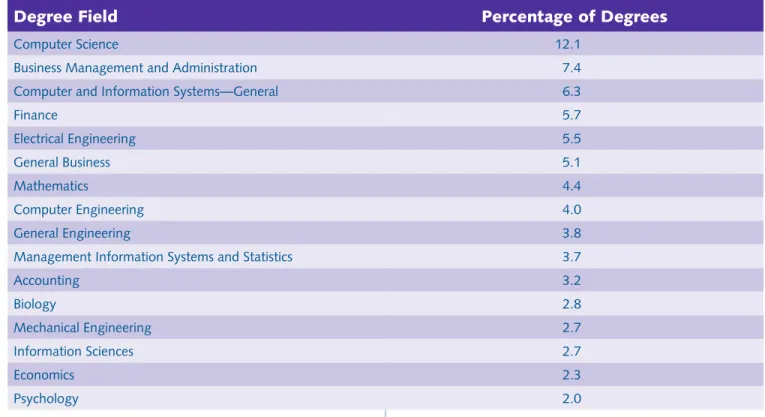
The Most Common Degree Fields Among Computer Systems Analysts
with a Baccalaureate Degree in Texas, 2010–11
____________________
43
Table 4.2
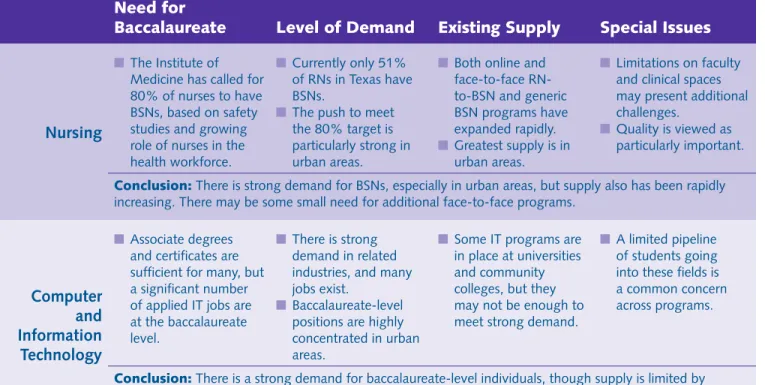
Summary of Findings on Unmet Workforce Needs
for the Five Occupations of Focus
_________________________________
45
Table 4.3
BSN Enrollees and Graduates in 2013, by Institution
________________
48
Table 6.1
Tuition Rate Growth in Florida and Washington,
2004–05 and 2013–14
____________________________________________
71
Table 6.2
Lower-Division Tuition Rate Growth at the Three Community Colleges
with Pilot Programs, 2009–13
_____________________________________
71
Table 8.1
Summary of Detailed Policy Options
_______________________________
91
Summary
Like much of the United States, Texas has seen significant expansion in higher education in recent years.
Yet many workforce-development needs, particularly those requiring additional baccalaureate degrees,
remain unmet in some areas of the state. Employers and students are calling for additional programs
to develop workplace skills and to provide opportunities for career advancement. Increasing levels
of education also would benefit individuals and society. Baccalaureate-level needs have been served
primarily by universities, sometimes in partnership with community colleges, where a large percentage of
students complete the first portion of a degree program. Community colleges are particularly important
for first-generation college students from low-income families and for older students, many of whom
work while enrolled in classes.
In an effort to make higher education more effective in meeting workforce needs, states are exploring whether community colleges might play a greater role in baccalaureate-level education. Supporters argue that community college expansion is necessary to meet local workforce needs and support a robust economy. They also contend that authorizing community colleges to offer baccalaureate programs will expand students’ opportunities to improve their knowledge, skills, and abilities, and to attain credentials for career advancement. Yet there is considerable
debate over the efficacy of community college baccalaureate expansion. Opponents express doubt that expanded community colleges will continue to fulfill their critical missions of workforce preparation and open enrollment. They also fear that expansion may lead community colleges and universities to compete with each other for students, state funding, and other limited resources.
C O R P O R A T I O N
Assessing the Potential to Expand
Community College
Baccalaureate
Programs
in Texas
Lindsay Daugherty
Charles A. Goldman
Lindsay Butterfield
Trey Miller
Prepared for the
Texas Higher Education
Coordinating Board
Should community colleges provide
baccalaureate degrees?
On May 22, 2013, the Texas Legislature approved a bill mandating a study on whether community college baccalaureate degree programs should be expanded in Texas. The Texas Higher Education Coordinating Board (THECB)
asked the RAND Corporation to partner with the Texas Higher Education Policy Initiative (HEPI) to conduct the study. The study has several objectives, which we list along with the corresponding research questions, in Table S.1.
Table S.1. Study Objectives and Research Questions
Study Objective
Research Question
Assess unmet workforce-development needs in nursing andthe applied sciences Are there unmet workforce-development needs for baccalaureate degrees in nursing and four applied science occupational groups in Texas?
Assess the arguments for and against baccalaureate expansion and other information (e.g., costs) to support THECB and legislative policymaking related to community college baccalaureate expansion
Do community colleges provide an appropriate way of meeting unmet workforce-development needs, particularly those requiring greater baccalaureate production in nursing or the applied sciences?
Recommend potential activities to support implementation of any new policies undertaken to expand the community college baccalaureate
If the state determines community college baccalaureate expansion is an appropriate means to meet unmet workforce-development needs, what process should it use to recommend and approve new programs?
Community College Baccalaureate Programs
in Texas
Community college baccalaureate programs are not new in Texas. In 2003, the state authorized the three community colleges of Brazosport College, Midland College, and South Texas College to each offer as many as five baccalaureate programs. The programs had to be approved by the THECB, and the community colleges themselves had to be authorized by their regional accrediting agencies to become baccalaureate-granting institutions. After a two-year approval process, the institutions began enrolling students in fall 2005 in the following Bachelor of Applied Technology programs.
■
■ Brazosport College—Management of Operation/
Production Technicians
■
■ Midland College—Organizational Management
■
■ South Texas College—Computer and Information
Sciences, Technology Management, Medical and Health Services Management, and Organizational Leadership In 2010, the THECB and three external consultants conducted a study (as mandated by the Texas Legislature) and found that each of these community colleges had a strong commitment to the baccalaureate degree and to the quality of its programs. Graduates and their employers seemed satisfied with the education received. Nevertheless, the study also revealed several concerns, particularly about the costs, both startup and ongoing, that institutions incur when they implement baccalaureate degree programs.
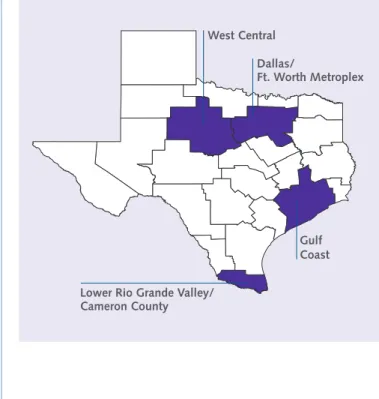
Gulf Coast Lower Rio Grande Valley/
Cameron County
Dallas/
Ft. Worth Metroplex West Central
Study Methodology
To support the state in determining whether community college baccalaureate offerings should be expanded, we first needed to ascertain whether Texas has unmet workforce needs that such programs could address. Based on input from the presidents and provosts of all Texas community colleges, we elected to focus our study on five fields (Figure S.1): nursing and four applied science fields:
■
■ Computer and information technology
■
■ Management in fire sciences
■
■ Management of production/operations technicians
■
■ Health information technology
Figure S.1. The Five Degree Fields of Focus
We also elected to focus on four distinct regions of Texas, which were chosen to represent the state’s range of policy and workforce environments. We identified two regions with large urban centers and two regions that represent rural or otherwise distinct regions, and we conducted more detailed, deep-dive analyses within them. These regions (Figure S.2) are:
■
■ the Dallas–Fort Worth region;
■
■ the Gulf Coast region, including Houston and surrounding areas;
■
■ the region of South Texas stretching from Laredo to Brownsville; and
■
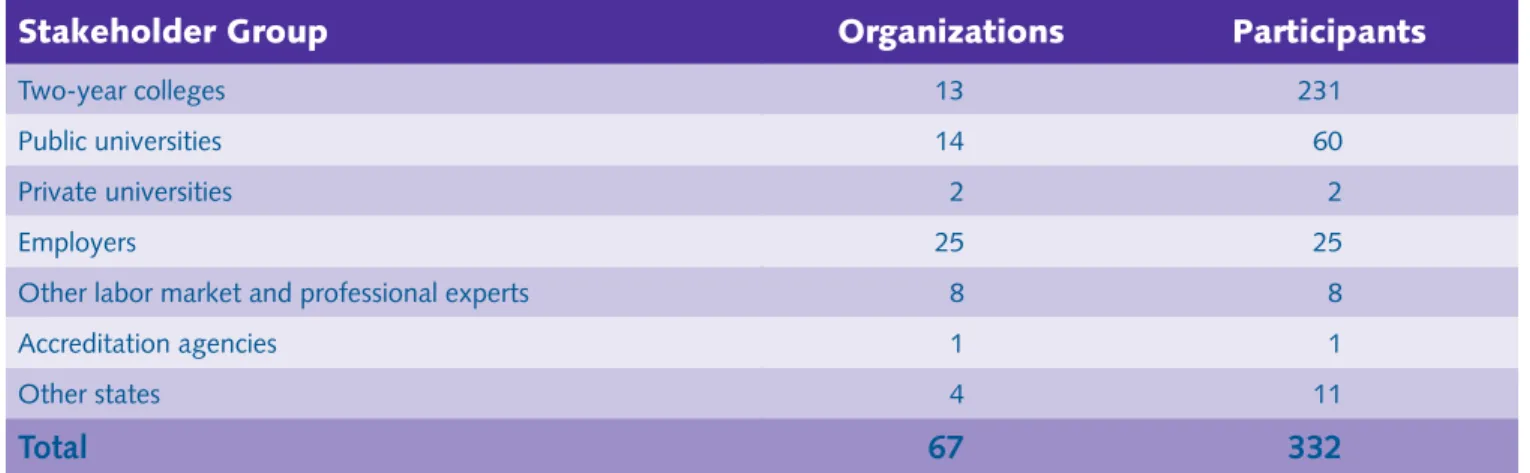
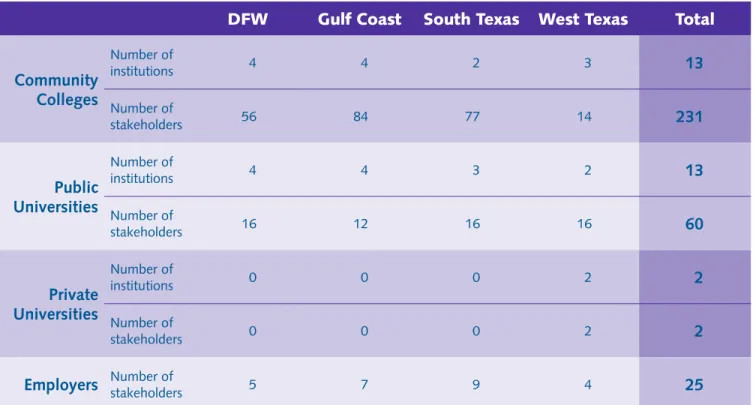
■ the West Central Texas region surrounding Abilene. We visited the four regions in January and February 2014, spending one week in each to speak with a wide variety of stakeholders. We interviewed more than 300 people in total, including employers as well as institutional leaders and departmental experts at universities and community colleges (Table S.2). We also conducted literature reviews and surveys and analyzed quantitative data from the Texas
Workforce Commission, the American Community Survey, the Texas Department of State Health Services, the Integrated Postsecondary Education Data System, the College Board, and other sources.
Figure S.2. The Four “Deep-Dive” Regions
Nursing
Computer and
information
technology
Management
in fire science
Management
of production/
operations
technicians
Health
information
technology
Table S.2. Number of Stakeholders Interviewed for the Study, by Affiliation and Location
Stakeholder Group
Organizations
Participants
Two-year colleges 13 231
Public universities 14 60
Private universities 2 2
Employers 25 25
Other labor market and professional experts 8 8 Accreditation agencies 1 1
Other states 4 11
Total
67
332
Given the time and resources available for the study, we faced a number of limitations. In assessing unmet workforce-development needs, we looked closely at several indicators of supply and demand, but we did not conduct a full assessment of shortages. RAND and HEPI are currently working on a study, also mandated by the Texas Legislature, to develop a workforce model to improve the ability of the state to identify the occupations with the greatest unmet needs. To assess unmet workforce-development needs, we considered:
■
■ Do positions with unmet needs require a baccalaureate degree?
■
■ What is the level of demand for candidates with baccalaureate degrees?
■
■ What are the current sources and supply levels of candidates with baccalaureate degrees?
Although we spoke with a large number of stakeholders in our interviews and focus groups, we were unable to capture the perspectives of many more people inside and outside of Texas. Our analysis focused on just four regions of Texas, and there are likely to be some issues not raised here that are important elsewhere in Texas. Finally, we note there is limited objective evidence regarding many of the potential benefits and concerns related to community college baccalaureates, so we relied heavily on stakeholder perspectives.
Findings on Unmet Workforce
Development Needs
Our analysis identified a number of workforce-development issues.
Nursing. Texas, like many other states, is facing serious nursing shortages. The 2010 recommendation of the Institute of Medicine that 80 percent of registered nurses (RNs) hold a Bachelor of Science in Nursing degree (BSN) has placed particular pressure on the demand for baccalaureate-degreed nurses. The demand for BSN nurses is particularly strong in urban areas, where the focus on meeting the 80 percent target is the greatest. Even maintaining the state’s current 50 percent proportion of registered nurses holding BSN degrees will require that colleges continue to graduate 4,800 degree-holders each year. Increasing that proportion to 80 percent will require a substantial expansion of BSN programs.
Computer and information technology. Computer and information technology occupations increasingly demand knowledge, skills, and attributes beyond what can be provided in a 60-credit hour associate degree program, although associate degrees and advanced certificates still provide a common means of entry to these high-demand occupations. Compared with the level of demand, there are few information technology programs targeted at developing applied skills at universities, and traditional computer science programs do not focus on the applied skills needed in these occupations. Student demand, however, appears to be low, which presents a barrier to higher production. It is essential that any new programs address the pipeline issue.
Management in fire sciences. Management positions in fire sciences occupations—the supervision of firefighting and fire prevention—increasingly require candidates to hold bachelor’s degrees, but Texas currently has no specific programs in the management of fire sciences. The Bachelor of Applied Arts and Sciences (BAAS) programs that are offered at universities might be able to meet these needs if universities offer a few industry-specific courses, but those courses may not provide the level of fire sciences proficiency
that employers seek. A modest demand for baccalaureate degrees in fire sciences is spread around the state, so
programs would need to draw from students statewide, likely through distance learning. A key limitation to sustaining or expanding programs is that working firefighters, who will generate the demand for these programs, are exempt from paying tuition for such courses.
Management of production/operations technicians.
Those who manage production/operations technicians typically progress through their careers after earning an associate degree. For these technicians to move into management positions, some employers require baccalaureate-level education in leadership and business. The modest demand for these occupations is concentrated in specific regions, especially the Gulf Coast, and in specific industries or by large employers. Similar to fire sciences, BAAS programs at universities may be able to meet these needs but may not be able to provide the level of industry-specific proficiency that employers prefer. Baccalaureate-granting community colleges and a few of the regional universities offer more targeted programs that also can meet this need.
Health information technology. Health information technology accounts for several different occupations, including medical records coding, health information system design, and health information management. Medical records coding positions are unlikely to require education beyond the associate level. Occupations in the design of health information systems and system management typically require a graduate degree. The increasing use of information technology is driving new demands, but it is not clear that these changes will necessarily lead to new demand at the baccalaureate level. Employers and some community college stakeholders noted a preference for students entering graduate education in health information technology to hold degrees in nursing or information technology. In short, new baccalaureate programs in health information technology do not appear to be needed.
Potential Benefits of
Community College Baccalaureate Expansion
Texas could realize a range of potential benefits from expanding community college baccalaureate programs. We identified the benefits described below from both the literature and our interviews.
The ability to help meet workforce needs. Community colleges may be well suited to meet local workforce needs because of their connections with employers, their flexibility in creating and modifying programs, and the geographic mobility patterns of their graduates. We found that, compared with universities, community colleges generally have a stronger connection with employers and a greater demonstrated willingness to work with employers to create programs that directly meet a workforce need. Some regional universities have placed an emphasis on workforce relationships and applied program development, but most universities have not made this a priority to the degree that most community colleges have. Community college stakeholders argue that because they attract working adults, their baccalaureate graduates may be more likely to remain in the region and help meet local workforce needs, but increased degree attainment also could motivate graduates to migrate to areas with high demand.
The potential for increased student access and degree attainment. There are several reasons why community colleges may appeal to students who otherwise would not pursue a baccalaureate degree: their lower cost relative to universities, their flexibility in course scheduling and delivery, their open-enrollment policies, and the ability for students to make a seamless transition from an associate program to a bachelor’s program within the same institution. We found that, compared with universities, community colleges serve a more diverse, nontraditional
student population and, therefore, may attract students who otherwise might not pursue a baccalaureate-level education. Evidence from Washington and Florida suggests that
community college baccalaureate programs have continued to attract students who are distinct from university baccalaureate enrollees. The evidence suggests that if Texas community colleges implement baccalaureate programs on a larger scale the community colleges would likely continue to offer low costs, flexible scheduling, and seamless transitions. Although community colleges offer open enrollment in their two-year programs, they may choose to establish more restrictive enrollment policies for baccalaureate programs. We note that the increased access provided by community colleges may differ by field and region.
Greater experience with applied education. Applied education encompasses certificate, associate, and bachelor’s degrees in applied technical or vocational fields. Such education is contextualized within specific occupations and is primarily targeted toward preparation for employment. Community colleges may have more expertise than universities in delivering applied education. The baccalaureate programs of community colleges often build directly on associate-level programs and require a clear understanding of workforce needs. The advantage of community colleges in applied education, however, may be weaker in the field of nursing, where many universities offer programs.
A small, supportive environment for students.
Particularly in small, specialized programs such as the potential baccalaureate programs, community colleges (and some universities) typically offer students small class sizes and close interactions with instructors and other students. These close interactions can be a source of student support. Because academic counseling departments at both community colleges and universities are severely understaffed, meeting student needs is a challenge at all types of institutions. While there is variation in size across both community colleges and universities, the smaller average class and cohort size in community colleges, particularly in the baccalaureate programs, could help to support students’ needs.
Community colleges could help meet
workforce needs in applied fields
and expand access to
baccalaureate-level education.
Concerns About
Community College Baccalaureate Expansion
Many stakeholders we spoke with in Texas contended that benefits of community college baccalaureate expansion would be outweighed by concerns associated with these programs and their potential negative effects on the higher education system. We identified the concerns described below from both the literature and our interviews.
Mission creep at community colleges. Mission creep was the most commonly cited concern. Many stakeholders fear that community college baccalaureate expansion would shift focus away from certificate and associate degree programs, increase costs for all students, and threaten some open-enrollment policies. The evidence for mission creep is mixed. Although there has been rapid growth of community college baccalaureate programs in Florida and Washington, these programs continue to account for a very small portion of community college enrollment in these states. Additional research and monitoring are needed to determine whether mission creep will lead to long-term problems for Texas higher education. Evidence does not support fears that expansion of community college baccalaureate programs will affect tuition costs across most institutions, even though one of the baccalaureate-granting community colleges in Texas has seen a large increase in tuition costs relative to other institutions in
the state. Community colleges are unlikely to retain open-enrollment policies for baccalaureate programs, but this may not necessarily be related to mission creep as much as to higher admissions standards necessary to ensure that students are prepared for baccalaureate-level education.
Counterproductive competition between universities and community colleges. Specific concerns involved competition between universities and community colleges to attract upper-division students, faculty, and other limited resources; competition for state funding; and damage to existing university–community college partnerships. The degree of competition is likely to vary substantially by field and region. Duplication concerns are particularly strong in fields such as nursing, where universities offer programs. The recent expansion of RN-to-BSN programs in universities, combined with the challenges that university programs face in recruiting qualified faculty, suggests that community college programs may ultimately compete with universities for students. This situation also suggests that introducing nursing programs into community colleges might exacerbate faculty shortages to a greater degree than would university expansion. In computer and information technology, there may be competition for a limited supply of students. In
other applied sciences, the level of competition may vary by region. In the areas where regional universities have been proactive about meeting needs, competition from community colleges may damage existing programs, but in other areas of the state, it is clear that needs are being underserved and community college programs would be unlikely to generate counterproductive competition.
A decline in the overall quality of the Texas baccalaureate. Specific concerns about the ability of community colleges to produce baccalaureate degrees of equivalent value to those offered at universities have two sources. First, some note the challenges community colleges may face in providing the liberal arts courses required for baccalaureate degrees. Second, some question whether employers and graduate programs would accept community college–conferred baccalaureates. (We found little evidence among employers and graduate programs to support the latter concern.) In occupations that demand the knowledge, skills, and abilities associated with a broad liberal arts education, community colleges may not be able to match the quality provided by universities. Nevertheless, as previously noted, community colleges may have an advantage over universities in serving occupations that demand applied skills
Ongoing Efforts to Meet Workforce Needs
In addition to considering the benefits and concerns associated with community college baccalaureate programs, decisionmakers also must consider other options to meet workforce needs and the ways in which community college baccalaureate expansion might complement or compete with them. Many universities and community colleges are currently partnering to improve students’ access to bachelor’s degrees by establishing articulation agreements, implementing simultaneous enrollment programs, or offering upper-division
university courses at community college campuses or regional higher education centers.
Stakeholders thought it was vital that any new policy not undermine these ongoing efforts. They also argued that new community college programs should be developed, particularly when existing pathways fail to meet workforce needs.
Potential benefits of community
college baccalaureate programs may
be outweighed by concerns about
mission creep, counterproductive
competition, and quality.
Costs and Funding
In evaluating options, decisionmakers must consider both the cost of various options for expanding baccalaureate production and the allocation of those costs across different funding sources. Stakeholders disagreed on the relative costs of options, with both community colleges and universities claiming advantages in some situations.
Financial records from two Texas community colleges with experience offering bachelor’s degrees indicate that these colleges have been able to cover their identified operating costs from tuition revenue and state reimbursement. The colleges did experience significant startup costs both for institutional upgrades to meet accreditation requirements and for normal program startup costs until a full complement of students enrolled. The state provided each college with $1.2 million in special funding, which appears to have covered the startup costs at the two colleges we reviewed. Startup costs for future programs are expected to be lower because there will be no, or low, institutional costs.
Although community colleges have set upper-division tuition above the lower-division rate, it remains only one-half to two-thirds the cost of state university tuition. Thus, community colleges have been more affordable for students. To date, community colleges have been receiving the same state reimbursement for upper-division courses that universities receive. If the state lowers that reimbursement rate in the future, students or local taxpayers could face increased costs. Our analysis did not examine the indirect costs for facilities and central administration that growing baccalaureate programs may require (and, indeed, at least one college now has built facilities with local funding). More detailed analysis of the full costs of expansion, including indirect costs, is needed to ensure that expansion of baccalaureate programs occurs at the institutions that can meet workforce needs most efficiently.
Policy Options for
Community College Baccalaureate Expansion
Essentially, Texas has three major policy options to consider:
1. Make no significant policy changes.
2. Authorize community college baccalaureate expansion without special restrictions beyond those imposed by accreditation standards and THECB program approval.
3. Authorize community college baccalaureate expansion with restrictions.
Although there was substantial disagreement among
stakeholders about the best path forward for Texas, we found consensus around six general principles that should guide the selection of policy options related to community college baccalaureates:
1. Meeting unmet workforce needs should be a priority.
2. The state and students should realize some benefits from any new program.
3. Any policies limiting the scope of community college bachelor’s degrees should seek to address concerns such as mission creep and duplication of efforts without unnecessarily limiting benefits such as student access to expanded programs.
4. Policies should complement and promote investments in other pathways, particularly university–community college partnerships.
5. Decisions about policy should consider costs.
6. Policies should be fair and transparent.
Authorizing community college baccalaureate expansion within specified limits would strike a balance between potential benefits and concerns. Some possible policies might:
■
■ limit the scope of provision statewide by setting
restrictions on fields or degree types, or on the number of programs offered by each community college;
■
■ limit the scope of provision regionally by allowing universities the opportunity to develop programs first or requiring increased evidence of need when programs overlap;
■
■ require additional planning or monitoring by limiting the number of community colleges initially authorized to offer baccalaureate programs, requiring self-studies for all proposals, or conducting follow-up studies to monitor quality and mission creep; or
■
■ change financial arrangements by limiting reimbursement rates or changing the source of funding.
Any decision regarding community college baccalaureate expansion will necessarily involve difficult tradeoffs, balancing the potential benefits of expansion with the concerns that expansion raises.
Recommendations for Processes
and Supporting Activities
In the course of our research, we identified a number of supporting activities that the state could pursue to address some concerns about mission creep, counterproductive competition, and threats to quality. Some of these activities would be valuable even without expansion of community college baccalaureate programs; others would be appropriate only if expansion occurs.
Clarify different degree types. Texas currently has three different types of applied baccalaureate degrees, and there is confusion about the distinctions between different degree types. As the applied baccalaureate expands in the state of Texas, students and employers would benefit from a well-defined set of degree types and a clear understanding of the student and workforce needs that are met by a degree to ensure some consistency and transparency across programs.
Clearly define fields of study. The legislature has suggested community colleges focus on the applied sciences, yet there is no clear definition of applied science fields. If community colleges are authorized to propose baccalaureate degrees in the applied sciences, it is essential that a clear definition of each field be adopted to guide all parties.
Continue to use THECB criteria for program approval. Most stakeholders agreed that the criteria for program approval should be the same for universities and community colleges, but university stakeholders also argued for restrictions on the types of programs that community colleges can offer. Community college stakeholders asked that the process for program approval be transparent and that the criteria for program approval be applied fairly.
Coordinate proposals across institutions when demand is limited or resources are constrained.
When student demand is limited across the state, or there are resources that could be seriously strained by approving too many programs, comparing proposals from all interested institutions can identify the best approach.
Provide guidance and mentoring to community colleges. The three existing Texas community colleges that confer baccalaureate degrees can be valuable guides for future colleges; future colleges also can support each other through networking and mentoring arrangements.
Conduct more empirical analyses. More detailed analysis of costs, outcomes, and mission creep would be very valuable in understanding the tradeoffs Texas faces and in improving decisionmaking in the future.
Conclusion
Our review of evidence from Texas and other states highlighted a number of benefits that community college baccalaureate programs could offer but also raised several concerns.
We found a range of situations across the five specific occupations we examined, with some occupations experiencing major shortages of workers that community colleges might be able to address and others in which there is either no clear shortage or no clear need for an industry-specific bachelor’s degree.
The state has three broad options related to community college baccalaureate programs:
1. It can rely on the existing arrangements with no new community colleges authorized to add baccalaureate programs.
2. It can expand the number of community colleges authorized to add baccalaureate programs without any restrictions other than those imposed by the existing requirements to receive regional accreditation and THECB program approval.
3. It can expand authorization of baccalaureate programs under some specific limitations, which could address the concerns raised by expansion but also might limit the benefits of expansion.
Acknowledgments
This report was produced in collaboration with the Texas Higher Education Policy Initiative (HEPI) of Texas
Higher Education Coordinating Board. HEPI is funded by a generous grant from Houston Endowment to
ensure that policymakers have access to objective research on topical higher education policy issues.
The authors would like to thank the commissioner and staff of the THECB for helpful guidance throughout
the research process, with particular acknowledgement to Gary Johnstone, Susan Brown, David Gardner,
Julie Eklund, Stacey Silverman, Rex Peebles, and Nina Wright. We also thank Paul Turcotte, Ginger Gossman,
and Jana Cossairt, who undertook essential analyses of THECB data to support the project.
We appreciate the valuable assistance of staff of the Texas Workforce Commission and a number of business
service representatives in the four regions we visited in helping us contact employers for the study. Peter
Gawenda also provided a great deal of valuable information.
We also thank RAND colleagues Diana Lavery for expert research assistance and Erin-Elizabeth Johnson
and Clifford Grammich for helping us communicate our findings in a clear and engaging way. We greatly
appreciate the thoughtful reviews of Tom Bailey, Susan Gates, and Cathy Stasz on the project’s briefings and
the drafts of this report.
We acknowledge the contributions made by 22 individuals and institutions that responded with thoughtful
comments when a draft of this report was released for public comment.
Finally, we thank our interview participants, who numbered more than 300. Although we agreed not to
name them or their institutions, we deeply appreciate their cooperation, without which this report would
not be possible.
Abbreviations
ACS
American Community Survey
ADN
Associate Degree of Nursing
APIN
Academic Progression in Nursing
BAAS
Bachelor of Applied Arts and Sciences
BAS
Bachelor of Applied Science
BAT
Bachelor of Applied Technology
BSN
Bachelor of Science in Nursing
DFW
Dallas–Fort Worth
DNP
Doctor of Nursing Practice
KSA
knowledge, skills, and abilities
O*NET
Occupational Information Network
RN
registered nurse
SACS-COC
Southern Association of Colleges and Schools Commission on Colleges
THECB
Texas Higher Education Coordinating Board
TWC
Texas Workforce Commission
Introduction
1
From 2000 to 2010, the annual number of undergraduate degrees awarded in the United States increased
nearly 40 percent, with more than 800,000 associate degrees and 1.6 million bachelor’s degrees awarded
in 2009–10 (NCES, 2012a). In Texas, the annual number of undergraduate degrees awarded has increased
at an even faster pace, jumping from 116,000 in 2001 to 186,000 in 2011 (THECB, 2012a). Yet there
remains a need to increase educational attainment to meet the demand for baccalaureate-degreed
workers (Achieve, 2012; Deloitte and the Manufacturing Institute, 2011; Faberman and Mazumder,
2012). Increasing human capital also can increase individual income and employment satisfaction and
yield broader societal benefits. Yet many students, particularly those who are working adults or have low
income, face several challenges in completing degree programs.
There are many different approaches to meeting the needs of employers, individuals, and society for increased educational attainment. Traditionally, the community college provided the first two or three years of education and awarded associate degrees, which allowed students to transfer to universities and complete baccalaureate degrees. Now the community college is increasingly becoming a way to provide baccalaureate-level education. In 2003, the state of Texas authorized three community colleges—Brazosport College, Midland College, and South Texas College—to offer baccalaureate degrees in the applied sciences. These three community colleges now offer a total of seven baccalaureate programs in fields such as organizational management, health administration,
and computer and information technology and have produced more than 600 graduates with Bachelor of Applied Technology (BAT) degrees.
Supporters of community college expansion argue that current higher education pathways are not sufficiently meeting workforce needs, and there is a demand for new opportunities for baccalaureate-level education to meet local workforce needs. Community college baccalaureate programs also offer individuals more ways to improve their knowledge and skills and to attain career credentials. Other stakeholders, however, contend that offering baccalaureate programs may affect the ability of community colleges to continue
serving their traditional mission and create counterproductive competition with universities over students, state funding, and other limited resources (Floyd, 2006; Russell, 2010).
To assess the implications of expanding community college baccalaureate-degree programs in Texas, the Texas Legislature in May 2013 approved Senate Bill 414, mandating a study on regional need for community college baccalaureate programs and to identify the metrics for determining such needs, with a focus on potential baccalaureate programs in nursing and specified applied fields.
The Texas Higher Education Coordinating Board (THECB) asked the RAND Corporation to partner with the Texas Higher Education Policy Initiative (HEPI) to conduct a study with the following objectives:
■
■ Assess unmet workforce-development needs for baccalaureate-degreed individuals in nursing and the applied sciences.
■
■ Assess the arguments for and against baccalaureate expansion and other key evidence to support THECB and legislative policymaking related to community college baccalaureate expansion.
■
■ Recommend potential activities to support implementation of any new policies undertaken, including possible expansion.
Our work included a literature review, descriptive data analysis, and interviews and focus groups with more than 300 stakeholders in Texas, as well as interviews with stakeholders in several other states.
This report describes the study’s findings. In Chapter 2, we provide some background on Texas higher education, applied baccalaureate degrees, and the expanding role of community colleges in baccalaureate-level education. Chapter 3 provides a framework that can be used to model the decisionmaking process for meeting workforce needs through higher education programs, identifies the research questions for the study, and explains the study’s methodological approaches and limitations. In Chapter 4, we assess the potential unmet workforce needs of five specific occupations or occupational groups corresponding to the degree fields of nursing, computer and information technology, management in fire sciences, management of science/operations technicians, and health information technology. After identifying unmet workforce needs, we describe the potential benefits of community college baccalaureate programs in Chapter 5. Chapter 6 presents concerns about community college baccalaureate expansion. State policymakers also will want to consider unmet workforce needs, including the alternatives to community college baccalaureate expansion, the cost of the various options, and funding for those options, which we discuss in Chapter 7. Chapter 8 describes the range of policy options that the state can consider in addressing the issue of community college baccalaureate expansion, and it outlines some principles on which to base these decisions. In Chapter 9, we make recommendations for the processes and implementation efforts that should be considered to support state policy decisions. Finally, we conclude with a brief summary of the study’s findings and the implications for community college baccalaureate expansion in Texas.
Background
2
We begin with some background on the Texas higher education system and the national landscape for
community college baccalaureate programs. We first describe the roles of different types of institutions
in Texas. We then discuss the role of the applied baccalaureate in Texas. Next, we discuss the national
movement toward increased provision of baccalaureate programs by community colleges, and the history
of community college baccalaureate programs in Texas.
The Role of Texas Institutions
Community Colleges
Public community colleges enroll a substantial number of college students; in fall 2010, 26 percent of all full-time college students and 64 percent of all part-time college students were enrolled in public community colleges (NCES, 2012a). Public two-year institutions across the United States granted nearly one million degrees and certificates in 2010–11 (NCES, 2013). Community colleges provide particularly important pathways into higher education for nontraditional students, with nearly 90 percent of community college students meeting at least one definition of nontraditional: delaying enrollment into postsecondary education (with 46 percent not enrolling until at least age 20), attending part-time, being financially independent of parents, working full
time while enrolled, having dependents other than a spouse, or lacking a standard high school diploma (Choy, 2002; Berkner and Choy, 2008). Community colleges are the most common entry to postsecondary education for first-generation students from low-income families, 57 percent of whom start at a two-year institution.
Higher education programs fall into two broad categories: academic programs and workforce-development programs. Academic programs lead to associate, bachelor’s, and graduate degrees in fields such as the arts, sciences, engineering, and education. Workforce-development programs lead to certificates or associate or bachelor’s degrees in technical or vocational fields and typically are contextualized within a specific occupation. These fields
include technologies related to production, maintenance, and repair; technical healthcare specialty roles such as radiology technician and dental hygienist; and service fields such as cosmetology and culinary arts. In some cases there may be some overlap between academic and workforce-development programs. For example, aspects of management may be addressed by an academic business degree or by a workforce degree in applied organizational leadership.
Community colleges offer both academic programs and
workforce-development programs. Community college academic degrees and programs offer an affordable, open-access pathway to complete all or part of the first two years of a bachelor’s degree and then transfer to a university to complete that degree. Workforce-development programs at community colleges prepare students directly for employment in an applied or technical field.
According to Rudd and Bragg (2010, p. 13), “an overarching function of the community college is to respond and react to the needs of the surrounding community.” Many community college mission statements specifically identify the local community as a priority. Community colleges in Texas and many other states are governed by local boards and draw significant public funding from the local community.
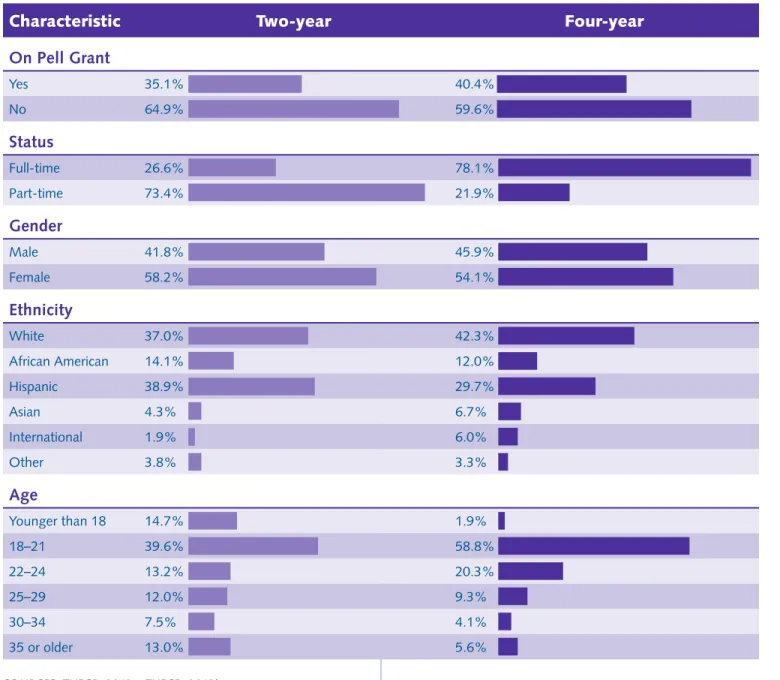
Table 2.1. Texas Postsecondary Student Characteristics, by Institution Type
Characteristic
Two-year
Four-year
On Pell Grant
Yes 35.1% 40.4% No 64.9% 59.6%Status
Full-time 26.6% 78.1% Part-time 73.4% 21.9%Gender
Male 41.8% 45.9% Female 58.2% 54.1%Ethnicity
White 37.0% 42.3% African American 14.1% 12.0% Hispanic 38.9% 29.7% Asian 4.3% 6.7% International 1.9% 6.0% Other 3.8% 3.3%Age
Younger than 18 14.7% 1.9% 18–21 39.6% 58.8% 22–24 13.2% 20.3% 25–29 12.0% 9.3% 30–34 7.5% 4.1% 35 or older 13.0% 5.6%SOURCES: THECB, 2013a; THECB, 2013b.
Within Texas, more than 60 percent
of college enrollees begin at
community colleges or technical
colleges.
Technical colleges provide another means of access to workforce-development programs. According to Section 135.01 of the Texas Education Code, technical colleges were “designed to provide vocational and technical education to people entering the workforce or in the midst of a career change.” These institutions offer programs that look similar to many of the programs at community colleges, and serve similar populations of students.
Within Texas, more than 60 percent of college enrollees begin at community colleges or technical colleges (THECB, n.d.). As Table 2.1 suggests, two-year community colleges in Texas serve a somewhat different population than that served by the state’s four-year universities, with enrollees who are much more likely to attend part-time, be low-income or Hispanic, or be 25 or older.
Public and Private Universities
Texas universities and private colleges focus on providing baccalaureate and graduate education. Universities have long been the primary provider of baccalaureate degrees. These institutions concentrate on academic programs, although some also offer applied workforce-development programs at the baccalaureate level. The public regional universities often provide a combination of academic and workforce programs and often serve a population that is drawn largely from the local population, so there is significant crossover
with community colleges. Universities often aim to prepare students for the state, national, or global workforces, and they place much greater emphasis on advancing research than community colleges. Public research universities tend to focus almost exclusively on academic education. Universities often aim to prepare students for the state, national, or global workforces, and they place much greater emphasis on advancing research than community colleges. In Texas and many other states, public universities are managed by statewide boards and receive public funding from the state rather than localities.
Private institutions also play a significant role in higher education in Texas and the U.S., with private nonprofit institutions accounting for 30 percent of all baccalaureate degrees awarded, and private for-profit institutions
accounting for seven percent (NCES, 2012b). The role of for-profit colleges has grown at a particularly rapid pace in recent years, accounting for more than 11 percent of all enrollment in 2009, compared with just four percent of enrollment in 2000 (Baum and Payea, 2011). Many for-profit programs offer a number of associate and certificate-level programs in addition to meeting baccalaureate needs. Some suggest that the movement of for-profit institutions into the higher education sector provides evidence that public institutions are not sufficiently meeting the needs of employers and students.
Applied Baccalaureate Degrees in Texas
In recent decades, there has been greater demand among students for educational credentials in both academic and workforce-preparation programs. Changing workforce needs and increased demand for advanced skills require individuals with additional educational preparation. The state also seeks increased educational attainment to improve the wellbeing of residents, increase economic growth, and attract high-skill industries to the region. In academic fields, the demand for educational credentials has led to higher entry-level requirements, greater enrollment, and increased numbers of students seeking graduate degrees. For programs that focus on workforce preparation, demand for educational credentials has led to an increasing demand for the applied baccalaureate. Texas has a long history with the applied baccalaureate. Some of its universities have provided this degree for more than 30 years, and three community colleges have provided them for the past decade (THECB, 2009). Applied baccalaureate programs can contribute to goals of increased higher
education participation and success (THECB, 2010b, p. 7). Applied baccalaureate programs seek to close enrollment and graduation gaps and to allow technical students to achieve the skills needed for career advancement by:
■
■ overcoming the “terminal” character of the Associate of Applied Science (AAS) degrees;
■
■ creating seamless transitions by allowing students to use a block of technical courses from AAS degrees as a major or concentration in an applied bachelor’s program; and
■
■ providing coursework that builds on the technical expertise of applied students.
The THECB defines applied baccalaureates as “generally flexible degrees that usually involve large transfers of credit, sometimes in the form of an associate degree” (THECB, 2009, p. 4). For all baccalaureate programs, including the applied baccalaureate, the THECB requires that applied baccalaureates contain at least
24 semester credit hours of upper-level coursework, meet the 42 credit hour general education core requirement, and ensure that all courses be taught by properly credentialed faculty (THECB, 2009, p. 6). Applied baccalaureate programs typically are offered through face-to-face, blended (face-to-face and online), and online learning platforms to ensure that they are accessible to nontraditional students (e.g., older students or students working during college). In addition, applied baccalaureates are attractive to many students because they may grant credit for both previous coursework and experiential credit (THECB, 2009, p. 4).
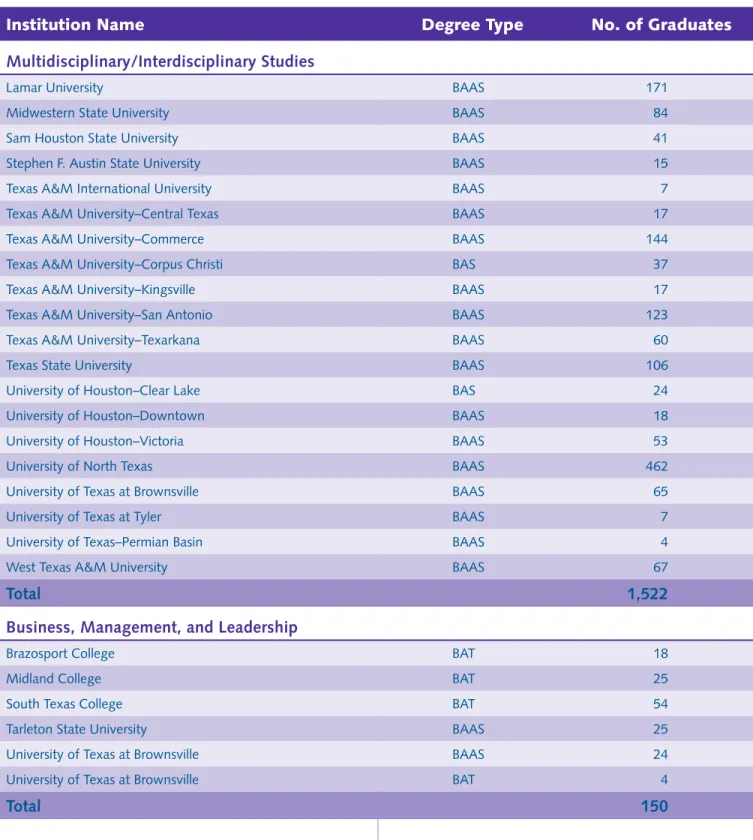
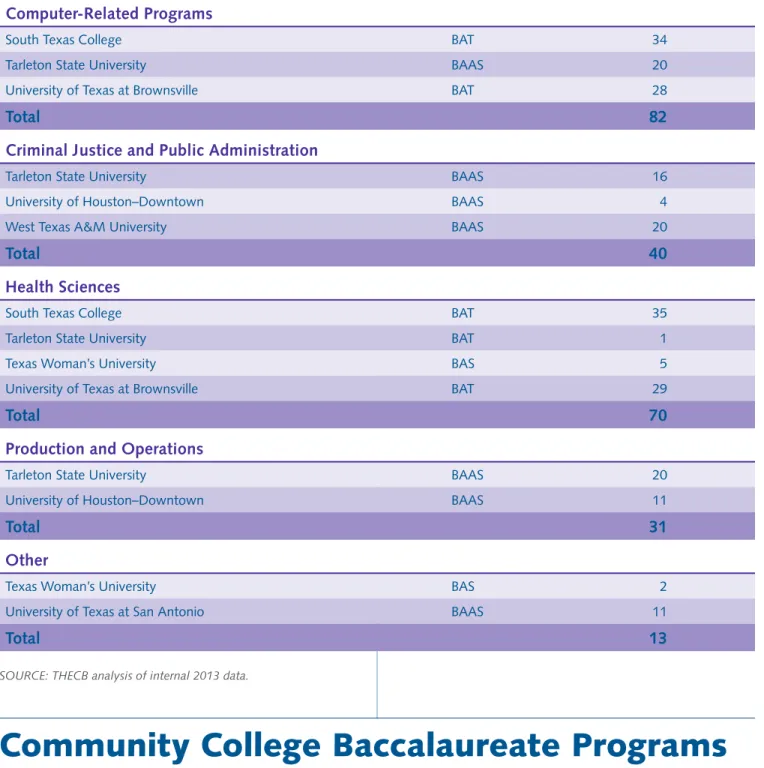
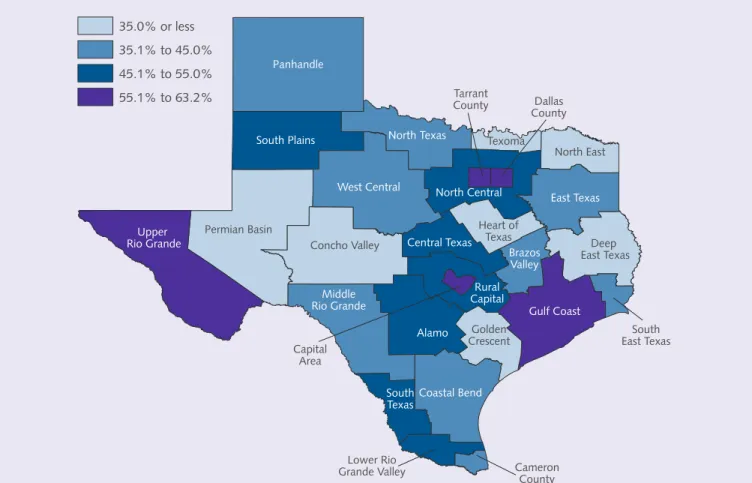
Applied baccalaureate programs in Texas fall into three different categories: Bachelor of Applied Sciences (BAS) programs, Bachelor of Applied Arts and Sciences (BAAS) programs, and Bachelor of Applied Technology (BAT) programs. The specific applied baccalaureate type varies by the preferences of each institution, the level of the institution, and the subject matter of the program (THECB, 2009). Table 2.2 presents the number of 2013 graduates for all of the applied baccalaureate programs in Texas. BAAS programs are the most common, with 18 universities offering these programs, while BAT and BAS programs are less common, with just five institutions offering BAT programs and three institutions offering BAS programs.
Both universities and community colleges play important roles in providing applied baccalaureate degrees in Texas. THECB data indicates that 1,741 students graduated from universities with applied degrees in 2013. Though the total numbers are small relative to the number of graduates from other baccalaureate programs, Texas universities produce more applied baccalaureate graduates than many other states. Washington, for example, had little experience with the applied baccalaureate prior to developing community college baccalaureate programs, and Washington universities were not particularly interested in applied baccalaureates, despite demonstrated workforce needs for such programs. Nearly 90 percent of applied baccalaureate graduates from universities in Texas graduate with an interdisciplinary BAAS degree. As noted, three Texas community colleges are currently authorized to grant bachelor’s degrees, specifically the BAT degree. These programs graduated a total of 166 students in 2013, so community colleges currently account for less than 10 percent of all applied baccalaureate degrees in Texas. BAAS programs are typically described as inverted degrees that allow students with technical or applied associate degrees to advance their education. The associate degree
serves as the student’s major, and the BAAS coursework includes completion of general education requirements and the selection of a student-determined focus from a broad multidisciplinary menu of upper-division courses. The upper division courses taken in these general BAAS degrees are selected from the universities existing pool of courses, so students often take academic courses together with students in academic baccalaureate programs.
BAT and BAS degree programs, by contrast, have a more clearly defined course of study, typically preparing individuals for employment in a particular occupation. The coursework in these programs is often distinct from the coursework required for comparable academic degree programs, with a more clearly applied focus. For example, the Texas A&M University-San Antonio applied baccalaureate concentration in information security features contextualized subjects like network security and computer forensics, whereas the university’s academic computer science degree focuses on the theoretical foundations of software development. The area of business provides another example. Academic baccalaureate degrees in business administration include finance and accounting, and the courses may focus to a greater degree on business theory, whereas applied baccalaureate programs in organizational leadership typically exclude finance and accounting and focus on skills like human resources and interpersonal relations that are required for day-to-day management of employees.
Some universities offer programs that they label BAAS programs, but are virtually indistinguishable from BAS and BAT degrees in that they allow students to build advanced applied skills in a particular well-defined course of study. For example, the BAAS program in Information Technology at Tarleton State University is very similar to the BAT program in Computer Information Systems Technology at the University of Texas (UT) at Brownsville. Of the applied baccalaureate graduates in Texas in 2013, 77 percent graduated with a BAAS from a multidisciplinary program, three percent graduated from multidisciplinary BAS programs, and 20 percent graduated from more targeted BAAS, BAS, and BAT programs with clearly defined programs of study.
The differences between BAAS, BAT, and BAS degrees are not well defined, and the understandings of these differences vary widely across stakeholders. As of early 2014, the BAT was the only degree type included in the THECB’s definition of an applied baccalaureate program, described as the “degree offered at community colleges” (THECB, 2012, p. 9). However, the BAT was first offered at UT–Brownsville and continues to be offered at two universities in Texas. As described above, a
substantial distinction between BAT/BAS programs and many BAAS programs is that the BAAS programs are meant to be general and multidisciplinary, while BAT and BAS programs have a more focused course of study. However, as noted, BAAS programs at some institutions do have a specific focus, and some BAT programs have begun to look more like general management programs. Other stakeholders argue that BAT programs are applied baccalaureates at community colleges,
while BAS and BAAS programs are applied baccalaureates at universities. Stakeholders from one institution distinguish BAS and BAT degrees by noting BAS graduates can pursue graduate studies, but other interviewees note that graduates from BAT programs at UT–Brownsville and South Texas College are strongly encouraged to pursue graduate education and a substantial proportion of graduates have been accepted to graduate programs.
Table 2.2. Number of Applied Baccalaureate Graduates, by Field, Institution, and Degree Type in Texas, 2013
Institution Name
Degree Type
No. of Graduates
Multidisciplinary/Interdisciplinary Studies
Lamar University BAAS 171
Midwestern State University BAAS 84 Sam Houston State University BAAS 41 Stephen F. Austin State University BAAS 15 Texas A&M International University BAAS 7 Texas A&M University–Central Texas BAAS 17 Texas A&M University–Commerce BAAS 144 Texas A&M University–Corpus Christi BAS 37 Texas A&M University–Kingsville BAAS 17 Texas A&M University–San Antonio BAAS 123 Texas A&M University–Texarkana BAAS 60 Texas State University BAAS 106 University of Houston–Clear Lake BAS 24 University of Houston–Downtown BAAS 18 University of Houston–Victoria BAAS 53 University of North Texas BAAS 462 University of Texas at Brownsville BAAS 65 University of Texas at Tyler BAAS 7 University of Texas–Permian Basin BAAS 4 West Texas A&M University BAAS 67
Total
1,522
Business, Management, and Leadership
Brazosport College BAT 18
Midland College BAT 25
South Texas College BAT 54 Tarleton State University BAAS 25 University of Texas at Brownsville BAAS 24 University of Texas at Brownsville BAT 4
Table 2.2. Number of Applied Baccalaureate Graduates, by Field, Institution, and Degree Type in Texas, 2013 (continued)
Institution Name
Degree Type
No. of Graduates
Computer-Related Programs
South Texas College BAT 34 Tarleton State University BAAS 20 University of Texas at Brownsville BAT 28
Total
82
Criminal Justice and Public Administration
Tarleton State University BAAS 16 University of Houston–Downtown BAAS 4 West Texas A&M University BAAS 20
Total
40
Health Sciences
South Texas College BAT 35 Tarleton State University BAT 1 Texas Woman’s University BAS 5 University of Texas at Brownsville BAT 29
Total
70
Production and Operations
Tarleton State University BAAS 20 University of Houston–Downtown BAAS 11
Total
31
Other
Texas Woman’s University BAS 2 University of Texas at San Antonio BAAS 11
Total
13
SOURCE: THECB analysis of internal 2013 data.
Community College Baccalaureate Programs
Several efforts over the past 25 years have sought to expand the role of community colleges in baccalaureate-level education. In 1989, West Virginia became the first state to authorize community college baccalaureate programs, with one such institution in the state now offering six approved programs (Community College Baccalaureate Association [CCBA], 2013). As of early 2014, 17 states had authorized
community college baccalaureate programs (CCBA, 2013). Across these states, the proportion of community colleges offering baccalaureate programs varies widely, with Idaho authorizing such programs but offering none, while most community colleges in Florida and Washington offer baccalaureate degrees.