“EFFECT OF METAL VEHICLE EMISSIONS ON
PHYSIOCHEMICAL AND BIOLOGICAL
PROPERTIES OF A ROADSIDE SOIL”
A thesis submitted in fulfilment of the requirements for the degree of
Doctor of Philosophy
by
M. Shamali De Silva
BSc (Hons), M.Eng
Environmental Engineering
School of Engineering
College of Science, Engineering and Health, RMIT University,
Melbourne, Australia
ii
Declaration
I certify that, except where due acknowledgement has been made, the work is that of the author alone; the work has not been submitted previously, in whole or in part, to qualify for any other academic award; the content of the thesis is the result of work which has been carried out since the official commencement date of the approved research program; any editorial work, paid or unpaid, carried out by a third party, is acknowledged; and ethics procedures and guidelines have been followed.
M. Shamali De Silva 14th November 2016
iii
ABSTRACT
Vehicle emissions result in the release of potentially toxic metals into the environment. In addition, metals non biodegradable in nature and thus roadside soil and the associated ecosystems can act as a long term environmental sink. The overall aim of this research was to investigate the effect of metals from vehicular emissions on Melbourne roadside soil and its potential effects on biological functioning.
This study assessed the relationships between traffic characteristics (traffic density, road age and vehicular speed), roadside soil heavy metal loadings, and the bioavailability of metals accumulated in roadside soil using CaCl2 and Diffusive Gradients in Thin-films (DGT)
techniques. In addition, the study assessed relationships between metals accumulated in roadside soil and biological accumulation using roadside field collected grass mostly
Stenotaphrum secundatum (buffalo grass), Triticum aestivum (wheat) grown in controlled
conditions and Folsomia candida (springtail). Finally the effects of metals on soil microbial functioning were assessed using enzyme assays and polymerase chain reaction-denaturing gradient gel electrophoresis (PCR-DGGE).
Roadside soil samples were collected to reflect different road characteristics including road age (new =2 to 5 years old, medium =10 to 15 years old and old aged, ≥30 years old), traffic (low, ≤ 5000 vehicles/day), medium ≥ 5000-10,000 vehicles/day and high traffic, ≥ 15,000 vehicles/day) and maximum vehicle speed (60, 80 and 100 km/h). Generally, elevated concentrations of metals were recorded in Melbourne roadside soils. Analysis of the results derived from road characteristics showed a possible relationship between the occurrence of heavy metals in roadside soil and road characteristics. Significant levels were recorded for Cd (0.06-0.59 mg/kg), Cr (18-29 mg/kg), Cu (4-12 mg/kg), Ni (7-20 mg/kg), Mn (92-599 mg/kg), Pb (16 -144 mg/kg) and Zn (10.36-88.75 mg/kg) with Mn concentrations exceeding the Ecological Investigation Level. Significant correlations (P<0.05) were found between
iv
roadside soil metal concentration and vehicular speed (r= 0.90), road age (r= 0.82) and traffic volume (r=0.68). Concentrations of recently introduced metals in automotive technology (e.g. Mn and Sb) were higher in younger roads, while the metals which have been used for many years (e.g. Cd, Cu, Pb, Zn) were higher in medium and old age roads, confirming the risk of significant metal deposition and soil metal retention in roadside soils. Silver, Co and Sb were found as other emerging risks. Soil pH was reduced due to vehicular emissions in roadside soils over the years.
Assessment of the bioavailability of metals in roadside soils using CaCl2 metal extraction
method was not found to be a representative of the available metal concentration for plant uptake. In contrast, estimation of the total metal concentrations in soil and soil solution (pore water concentrations) was found to be the best potential measure of the bioavailability of metals to plants. Cromium, Cu, Ni, Sb and Zn accumulated significantly in grass shoots. Copper and Ni in roadside soil were found to be bioavailable for plant uptake as demonstrated by the wheat assay experiment. The presence of metals in old roads has the potential to cause stress in Triticum astivum. The Mn uptake seems to be regulated by the soil pH. A clear trend with age of the roads metal contamination and metal uptake by plants was not found in this study.
This study also detected signs of the metal aging effect in soil. The study showed that the dissociation time (TC) of metal release from the solid phase to the solution phase was a good
indicator of the soil metal aging effect. The results showed that TC was pH dependent for
most metals (Cd, Ni and Zn). However soil pH was found to be the key parameter controlling aging of metals in roadside soil.
Folsomia candida was found not to be affected by other contaminants including petrogenic
v
effect on the growth of F. candida. The presence of metal Mn concentrations in soil was found not to be in toxic concentrations to F. candida survival. In contrast Cu concentrations were found to present at potentially toxic concentrations, as demonstrated by the correlation of survival % with total metal concentrations (r= -0.941, P<0.05). Additionally, it was found that F. candida Zn accumulation in body was suppressed by the presence of Cu (r= -919, P<0.05) and Ni (r= -0.962, P<0.05) in soil. Both survival and metal accumulation of F.
candida was found to be independent of any metal aging effect in soil; however their
biomass was found to be affected (r= -0.896, P<0.05).
Metals from roadside soil were accumulated in plants, Stenotaphrum secundatum, Triticum
aestivum and Folsomia candida species. All plants and soil arthropods were able to
accumulate of metals, with particular accumulation of Mn, Pb and Zn. This study also demonstrated that the presence of multiple metals in soil could potentially hinder the accumulation of metals by plants/organisms. Thus this research has demonstrated the potential of metals in roadside topsoil to be absorbed by plants and animals. These metals may be incorporated into the tissues of these organisms and have the potential to transfer up the local food chain where they may also affect ecosystem functions.
The study provides little evidence that elevated metals, at the concentrations detected in these roadside soils, resulted in reduced soil enzyme activity. However soil P (basal respiration: phosphomonoesterase, r = -0.430, P<0.05) and N cycle (basal respiration: urease, r = -0.566, P<0.01) seems to be affected. The findings in this study also demonstrated the importance of soil physical properties such as clay, total organic carbon (TOC), pH, and cation exchange capacity (CEC), on soil enzymes. This study also demonstrate that the presence of heavy metals at the concentrations found in these Melbourne roadside soils do not greatly change the microbial community structure as determined by PCR-DGGE; however their growth was affected, as evidenced by basal respiration along theage of the roads. Further analysis of the
vi
resultant DGGE gels separated bacterial profiles from the soils examined into three distinct clusters representing recent exposure, moderate exposure and long term exposure to metals. No such clusters were found for roadside soil fungi. Roadside grown fungi were found to be more sensitive to soil metal concentration than soil bacteria.
As demonstrated in this study, soil contamination by metals is a serious environmental issue that has been found to carry significant effects to the ecosystem and its biological functioning. Overall this research demonstrated the risk of metal accumulation on roadside soil and risk of metal retention in soil. The accumulated metals were able to uptake by plants and organisms causing potential effects on soil microbial functioning and metal food chain transfer. Considering the relationships found in this study, the present results are considered to be applicable to other similar urban areas. Thus consequent remediation strategies to reduce the emissions and dispersal of vehicular derived metals into the surrounding roadside environments are important.
vii
LIST OF PUBLICATIONS ARISING FROM THIS THESIS
Journal publications
De Silva, S., Ball, A. S., Huynh, T., & Reichman, S. M. (2016). Metal accumulation in roadside soil in Melbourne, Australia: Effect of road age, traffic density and vehicular speed. Environmental Pollution, 208, 102-109.
Conference proceedings
De Silva S. & Reichman, S. M (2013). The impact of vehicular emission on biological functioning of Melbourne roadside soil. Third SETAC Australasia conference,
viii
Table of Contents
ABSTRACT……….……….... iii
PUBLICATION ARISING FROM THIS THEISIS……….….…….… vii
TABLE OF CONTENTS………...…….... viii
LIST OF TABLES………... xvi
LIST OF FIGURES ……….…………..… xix
ABREVATIONS USED IN THIS THESIIS ……….………….………. xxv
ACKNOWLEDGEMENTS………..………...……...…... xxx
1 INTRODUCTION... 1
1.1 Back Ground ... 1
1.2 Research Aim, Objectives and Rsercah questions ... 2
1.2.1 ... Aim ... 2
1.2.2 ... Objectives ... 2
1.2.3 ... Research questions ... 3
2 LITERATURE REVIEW ... 4
2.1 Introduction ... 4
2.2 Common sources of vehicular emissions ... 5
2.2.1 ... Fuel ... 6
2.2.2 ... Engine oil ... 7
2.2.3 ... Brake wear ... 7
2.2.4 ... Vehicular exhaust catalysts (VEC) ... 8
ix
2.2.6 ... Road wear ... 9
2.3 Roadside soil ... 9
2.3.1 ... Manganese and Pb in roadside soil ... 10
2.3.2 ... Cadmium, Cr, Cu, Ni and Zn in roadside soil ... 12
2.3.3 ... Platinum group element (PGE) metals in roadside soil ... 14
2.3.4 ... Arsenic and Sb - metalloids in roadside soil ... 15
2.3.5 ... Other metals in roadside soil ... 16
2.4 Metal Bioavailability ... 17
2.4.1 ... Soil properties affecting metal bioavailability ... 18
2.4.2 ... Methods to measure bioavailability ... 21
2.5 Biotic metal absorption ... 23
2.5.1 ... Microbes (fungi and bacteria) ... 23
2.5.2 ... Plants ... 25
2.5.3 ... Animals ... 29
2.5.4 ... Invertebrates ... 30
2.5.5 ... Vertebrates ... 32
2.6 Australian context in roadside soil studies ... 35
2.7 Conclusions ... 37
3 METAL ACCUMULATION IN ROADSIDE SOIL IN MELBOURNE, AUSTRALIA: EFFECT OF ROAD AGE, TRAFFIC DENSITY AND VEHICULAR SPEED ... 39
x
3.2 Materials ... 40
3.2.1 ... Sampling ... 40
3.2.2 ... Analytical methods ... 43
3.2.2.1 Soil metal analysis ... 43
3.2.2.2 Other soil analysis ... 43
3.2.3 ... Statistical Analysis ... 44
3.3 Results ... 44
3.3.1 ... Soil characteristics ... 44
3.3.2 ... Heavy metal concentration in roadside soil effects of site, traffic and road age 45 3.3.3 ... Correlations between the metal accumulation in roadside soil and road characteristics ... 50
3.4 Discussion ... 51
3.5 Conclusions ... 54
4 ROADSIDE SOIL METAL: BIOAVAILABILITY, PLANT UPTAKE AND ESTIMATED METAL RELEASE KINETICS WITH RESPECT TO METAL AGING IN SOIL USING A 2D DIFS MODEL ... 55
4.1 Introduction ... 55
4.2 Method ... 58
4.2.1 ... Soil Sampling ... 58
4.2.2 ... Wheat Assay ... 58
4.2.3 ... Analysis methods for metals in soil ... 60
4.2.3.1 Total metal digestion... 60
xi
4.2.3.3 Other methods ... 60
4.2.4 ... Diffusive gradients in thin films technique (DGT) ... 60
4.2.4.1 DGT data analysis ... 62
4.2.5 ... Statistical analysis ... 64
4.3 Results ... 64
4.3.1 ... Soil properties ... 64
4.3.2 ... Wheat uptake and soil effective (CE) and interface (CDGT) metal concentrations ... 65
4.3.3 ... Wheat uptake results, comparisons between bioavailability assays ... 67
4.3.4 ... Metal aging effect in soil and dissociation time of the metal (Tc) ... 69
4.4 Discussion ... 73
4.4.1 ... Roadside soil metal uptake by plants and DGT ... 73
4.4.2 ... Metal aging in soil, metal dissociation time (TC) and soil kinetics ... 76
4.5 Conclusions ... 77
5 METAL UPTAKE BY GRASS FROM ROADSIDE SOIL IN MELBOURNE, AUSTRALIA ... 78
5.1 Introduction ... 78
5.2 Method ... 79
5.2.1 ... Soil sampling ... 79
5.2.2 ... Grass sampling ... 79
5.2.3 ... Wheat (Triticum aestivum) assay and plant chemical analysis for metals ... 80
xii
5.2.5 ... Other soil methods ... 80
5.2.6 ... Statistical analysis ... 80
5.3 Results ... 81
5.3.1 ... Soil ... 81
Different exposure periods (road age : years) new (N = 2-5 years), medium (M= 5-10 years) and old (O ≥ 15 years) roads. ... 82
C = soil not exposed to vehicular emissions (control). ... 82
5.3.2 ... Field Stenotaphrum secundatum responses ... 82
5.3.3 ... Relationships between total metal concentration in soil and metal concentrations in roadside grass ... 85
5.3.4 ... Wheat responses... 86
5.3.5 ... Triticum aestivum bioassay ... 87
5.3.6 ... Relationships between total metal concentration in soil and metal concentrations in wheat ... 91
5.4 Discussion ... 92
5.4.1 ... Metals in shoots of roadside grass and wheat ... 92
5.4.2 ... Metals and plant responses ... 93
5.4.3 ... Metal-plant bioavailability relationships ... 94
5.5 Conclusion ... 95
6 EFFECTS OF VEHICULAR EMISSIONS ON Folsomia candida: METAL ACCUMULATION, SURVIVAL AND GROWTH ... 96
6.1 Introduction ... 96
xiii
6.2.1 ... Culture of Folsomia candida ... 97
6.2.2 ... Soil sampling ... 98
6.2.3 ... Folsomia candida exposure method and analysis ... 98
6.2.4 ... Total soil metal extraction ... 100
6.2.5 ... CaCl2 extraction of soluble metals in soil ... 100
6.2.6 ... Analysis of PAH and TPH in soil samples ... 100
6.2.7 ... Other soil methods ... 101
6.2.8 ... Calculation of Pollution Load index (PLI) ... 101
6.2.9 ... Statistical analysis ... 101
6.3 Results ... 102
6.3.1 ... Soil physico-chemical properties ... 102
6.3.2 ... Folsomia candida survival and growth... 103
6.3.3 ... Folsomia candida body metal concentrations ... 104
6.3.4 ... Relationships between Folsomia candida and soil properties ... 107
6.4 Discussion ... 108
6.4.1 ... Folsomia candida growth, survival and metal accumulation ... 108
6.4.2 ... Metal aging effect in soil and F. candida ... 110
6.5 Conclusions ... 111
7 EFFECTS OF VEHICULAR EMISSIONS ON ROADSIDE SOIL MICROBIAL FUNCTION AND NUTRIENT CYCLING... 112
7.1 Introduction ... 112
xiv
7.2.1 ... Sample site selection ... 114
7.2.2 ... Physical and chemical properties of soil ... 114
7.2.3 ... Determination of carbon, nitrogen, phosphorus and sulfur content in soil ... 114
7.2.4 ... Soil total metals and available metal analysis... 114
7.2.4.1 Total metal extraction ... 114
7.2.4.2 CaCl2 extractable metals ... 115
7.2.5 ... Analysis of PAH and TPH in soil samples ... 115
7.2.6 ... Soil microbial basal respiration ... 115
7.2.7 ... Enzyme assays for soil phosphomonoesterase (PHMO), arylsulfatase (ARYL), -glucosidase (β-GLU) and urease (UR) ... 116
7.2.8 ... Soil DNA extraction ... 117
7.2.8.1 Microbial community analysis ... 117
7.2.9 ... Statistical analysis ... 118
7.3 RESULTS ... 118
7.3.1 ... Physiochemical properties of the roadside soil ... 118
7.3.2 ... Soil microbial basal respiration ... 120
7.3.3 ... Bacterial diversity ... 122
7.3.4 ... Fungal diversity ... 124
7.3.5 ... Soil enzymes and nutrients ... 125
7.3.5.1 Phosphomonoesterase (PHOM) ... 126
7.3.5.2 Arylsulfatase (ARYL) ... 126
xv
7.3.5.4 β-Glucosidase (β-GLU) ... 127
7.3.6 ... Soil microbial community fingerprinting ... 129
7.3.7 ... Soil pollution and microbes ... 133
7.4 Discussion ... 134
7.4.1 ... Microbial diversity ... 134
7.4.2 ... Soil Enzymes ... 135
7.4.3 ... Microbial community fingerprinting ... 136
7.4.4 ... Microbial survival and functionality ... 137
7.5 Conclusions ... 138
8 SUMMARY, CONCLUSIONS AND RESEARCH IMPLICATIONS ... 140
8.1 Back to research aim and objectives ... 140
8.2 Summary of the techniques used ... 141
8.3 Summary of the findings ... 142
8.4 Answering the research objectives ... 147
8.5 Future research focus ... 148
9 APPENDIX ... 149
xvi
List of tables
Table 2.1 Vehicle emission sources and associated metal contamination ... 5 Table 2.2 Register of roadside soil microbial studies retrieved from peer-reviewed literature
reported worldwide. Search engines used were Scopus, SpringerLink, Web of Science and Google Scholar. ... 24 Table 2.3 Register of roadside plant studies retrieved from peer-reviewed literature reported
worldwide. Search engines used were Scopus, SpringerLink, Web of Science and Google Scholar... 27 Table 2.4 Register of roadside invertebrates studies retrieved from peer-reviewed literature
reported worldwide. Search engines used were Scopus, SpringerLink, Web of Science and Google Scholar. ... 31 Table 2.5 Some of the vertebrate studies reported around the world. Search engines used were
Scopus, SpringerLink, Web of Science and Google Scholar... 34 Table 2.6 Summary of Australian studies investigating the effects of vehicle emissions of
metals on roadsides. Search engines used were Scopus, SpringerLink, Web of Science and Google Scholar. ... 36 Table 3.1 Soil parameters measured in roadside soil samples. ... 45 Table 3.2 Statistical significance of the ANOVA analysis one-way ANOVA for road type
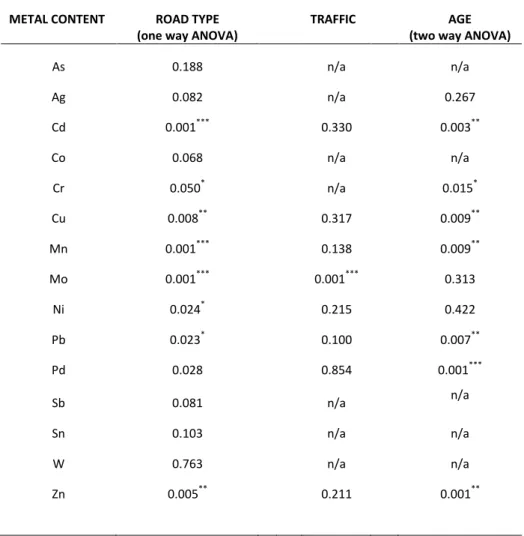
(n=30) and two way ANOVA for traffic and age (n=27) of metal concentrations found in roadside soils. The data was analysed using the Levenes test with P>0.05 considered nonsignificanct, tested with nonparametric analysis (Cd, Cr, Cu, Ni, Pb, and Zn). ... 46 Table 3.3 Optimised linear models for the relationship between metal concentration in
xvii
Models were determined by stepwise regression using list wise backward and forward selection (criteria of 0.05 for entry and 0.10 for removal). ... 50 Table 4.1 Soil characteristics for roadside soils in western Melbourne, Australia, on newer
volcanic parent material; values are mean (n=3) ± standard error. Samples were divided into new (N = 2-5 years), medium (M= 5-10 years) and old (O ≥ 15 years) roads. Numbers in a column with the same letter are not significantly different (P>0.05). ... 65 Table 4.2 Metal concentrations (Cd, Cu, Mn, Ni and Zn) in soil, wheat, DGT, CE, CSOL,
CaCl2 extractable metals. P<0.05 ... 66
Table 4.3 Pearson correlations (r) between the soil properties recorded in roadside soil samples. Soils were measured prior to the wheat pot trial. Values of significance are bolded in black. ... 68 Table 4.4. Optimised linear models for the relationship between heavy metal concentration in
wheat, CE, CSOL, CaCl2 and Tc (dissociation time of the metal) in roadside soil and
soil chemical and physical properties. Models were determined by stepwise regression using list wise forward selection (criteria of 0.05 for entry). ... 70 Table 5.1 Metal concentrations (mg/kg) measured in roadside soil from Melbourne, Australia.
Values are means ± standard error. Within columns, values with the same lower case letter are not significantly different (P>0.05)... 82 Table 5.2 Linear relationships between S. secundatum/T. aestivum shoot (dry weight) CaCl2
extractable metal concentrations. Some parameters (as indicated in the table) were log10 transformed to improve correlations. The significant R2 values are
highlighted in bold. ... 91 Table 6.1 PAH and TPH concentrations (mg/kg) measured in roadside soils ... 102 Table 6.2 Pollution Load Index (PLI) for roadside soil sites ... 102
xviii
Table 6.3 Pearson correlation coefficients (r) comparing relationships between organism responses and soil parameters for Folsomia candida cultured in soil collected from roadsides in the west of Melbourne, Victoria ... 106 Table 7.1 Descriptive statistics for the studied soil properties, n=28 ... 119 Table 7.2 Descriptive statistics of the metal characteristics of the studied soils, n=28 ... 120 Table 7.3 Pearson correlations of microbial diversity and enzyme activity with soil physical
properties, nutrients, total metals and hydrocarbons ... 123 Table 9.1 Register of roadside soil studies retrieved from peer-reviewed literature reported
worldwide. Search engines used were Scopus, SpringerLink, Web of Science and Google Scholar... 149
xix
List of figures
Figure 2.1 Vehicle emissions and associated metal contamination pathways ... 6 Figure 2.2 Roadside soil Mn and Pb concetrations retrieved from the raw data reported in
peer-reviewed literature around the world. Search engines used were Scopus, SpringerLink, Web of Science and Google Scholar. ... 11 Figure 2.3 Roadside soils Cd, Cr, Cu, Ni and Zn concetrations retrieved from the raw data
reported in peer-reviewed literature around the world. Search engines used were Scopus, SpringerLink, Web of Science and Google Scholar... 13 Figure 2.4 Roadside soil Pt, Pd and Rh concentrations retrieved from the raw data reported in
peer-reviewed literature around the world. Search engines used were Scopus, SpringerLink, Web of Science and Google Scholar. ... 15 Figure 2.5 Three step concept of bioavailability in soil for plants. Source (Kim et al., 2015) 18 Figure 2.6 Roadside soil plant Cd, Cr, Cu, Mn, Ni, Pb and Zn concetrations retrieved from
the raw data reported in peer-reviewed literature around the world. Search engines used were Scopus, SpringerLink, Web of Science and Google Scholar.28 Figure 2.7 Cadmium, Cu, Pb and Zn concetrations in the tissues of roadside soil invertebrates
retrieved from the raw data reported in peer-reviewed literature around the world. Search engines used were Scopus, SpringerLink, Web of Science and Google Scholar... 32 Figure 2.8 Cadmium and Pb concentrations in the tissues of roaside soil vertebrates retrieved
from the raw data reported in peer-reviewed literature around the world. Other metals were not included because there was not enough data available for statistical summaries. Search engines used were Scopus, SpringerLink, Web of Science and Google Scholar. ... 35
xx
Figure 3.1 Representative map of greater Melbourne, Victoria, Australia showing the major road network. The dark pink colour represents the distribution of newer volcanic geology. 27 roadside soil sites were selected together with 3 control sites. Abbreviations used are: C=control site, NL=new low traffic roads, NM=new medium traffic roads, NH=new high traffic roads, ML=medium low traffic roads, MM=medium medium traffic roads, MH=medium high traffic roads, OL=old low traffic roads, OM= old medium traffic roads and OH=old high traffic roads. ... 41 Figure 3.2 Sampling sites (A) Free way sampling site (B) Control sampling site ... 42 Figure 3.3 The relationship between total metals in roadside soil (Cd (a), Cr (b), Cu (c), Mn
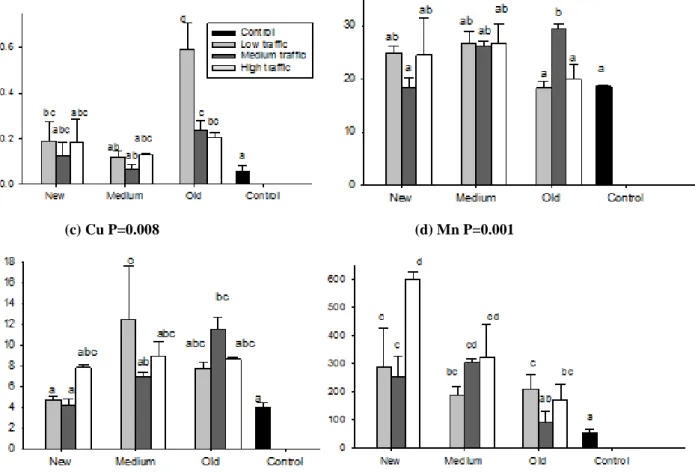
(d), Ni (e), Pb (f) and Zn (g) and road age i.e. new (3-5 years old), medium (10-15 years old) and old (≥(10-15 years old) . Values are means (n=3) ± standard error. Values within a graphs with the same letter are not sigfnicantly different (P>0.05). ... 47 Figure 3.4 The relationship between total metals in roadside soil Ni (e), Pb (f), Zn (g) and
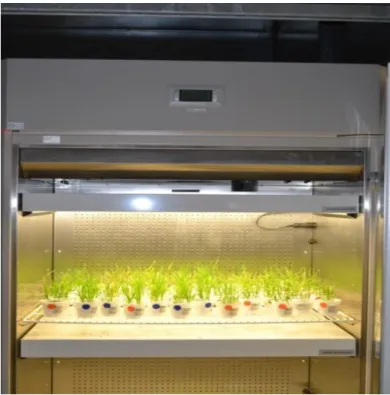
road age i.e. new (3-5 years old), medium (10-15 years old) and old (≥15 years old) . Values are means (n=3) ± standard error. Values within a graphs with the same letter are not significantly different (P>0.05). ... 48 Figure 4.1 Triticum aestivum experiment in Growth chamber at 21°C /15°C on a 14 h/10 h
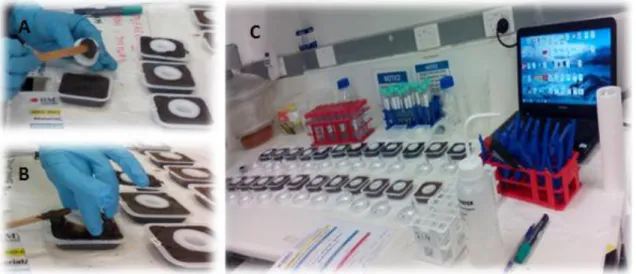
light/dark cycle... 59 Figure 4.2 Different stages of DGT experiment deployment: (A) Application of soil paste on
to the DGT. (B) Embedding the DGT facing downwards in the soil paste. (C) DGT deployment ... 62
xxi
Figure 4.3 The relationship between the roadside soil metal dissociation time Tc (s) for Cd, Cu , Mn and the age of the adjacent roads representing soil exposure to vehicular emissions (years). AG represents soil after the growth of wheat in it. ... 71 Figure 4.4 The relationship between the roadside soil metal dissociation time Tc (s) Ni and
Zn and the age of the adjacent roads representing soil exposure to vehicular emissions (years). AG represents soil after the growth of wheat in it. ... 72 Figure 5.1 Grass sample collection, 2cm above the soil surface using clean stainless steel
scissors ... 79 Figure 5.2 Mean (± standard error) metal concentrations in Stenotaphrum secundatum shoots
(mg/kg) dry weight collected from roadside soil in western Melbourne, Australia. ... 83 Figure 5.3 Relationships between total soil metal concentrations and Stenotaphrum
secundatum shoots (dry weight) metal concentrations of Cd, Cr, Cu, Mn for
grass harvested from roadside soils in western Melbourne, Australia... 84 Figure 5.4 Relationship between soil metal concentrations and Stenotaphrum secundatum shoots metal concentrations for Ni, Pb, Sb and Zn. ... 85 Figure 5.5 Triticum astivum yield (mean ± standard error) for fresh and dry weight (g).
Where sites where new (N), medium (M), old (O) aged roads and control (C) site. ... 86 Figure 5.6 Visual observation of Triticum aestivum grown in roadside soil under controlled
environmental conditions. Where control (C ) site and New (N), medium (M) and old (O) aged roads. ... 87 Figure 5.7Mean metal concentrations in Triticum aestivum shoots (mg/kg) dry weight grown
in roadside soil. Error bar represents the ± standard error. Where site new (N), medium (M), old (O) aged roads and control (C). ... 88
xxii
Figure 5.8 Relationship between soils metals and Triticum aestivum shoot metal concentrations Cd, Cr, Cu, and Mn... 89 Figure 5.9 Relationship between soils metal concentrations and Triticum aestivum shoot
metal concentrations for Ni, Pb, Sb and Zn. ... 90 Figure 6.1 Experimental set up for Folsomia candida (not to scale)... 98 Figure 6.2 Folsomia candida survival after 28 day exposure to roadside soil collected from
western Melbourne, Australia (values are mean ± standard error, n=3). Different letters indicate site locations: new age roadside soil (N = 2-5 yrs), medium aged roadside soil (M= 10-15 yrs), old aged road side soil (O ≥ 30 yrs), C = control soil from a site not directly exposed to vehicular emissions, C_s = substrate control with no soil. P<0.05 ... 103 Figure 6.3 Folsomia candida growth (values are mean values ± standard error, n=3) after 28
day exposure to roadside soil collected from western Melbourne, Australia. Different letters indicate site locations: new age roadside soil (N = 2-5 years), medium aged roadside sol (M= 10-15 years), old aged road side soil (O ≥ 30 years), C = control soil from a site not directly exposed to vehicular emissions, C_s = substrate control with no soil. P<0.05 ... 104 Figure 6.4 Metal concentrations in Folsomia candida, after 28 d exposure to roadside soil
from western Melbourne, Australia. Different letters indicate site locations: new age roadside soil (N = 2-5 years), medium aged roadside sol (M= 10-15 years), old aged road side soil (O ≥ 30 years), C = control soil from a site not directly exposed to vehicular emissions, C_s = substrate control with no soil. Samples were pooled to ensure enough tissue for metal analysis and thus each column represents one pooled sample. ... 105
xxiii
Figure 7.1 Roadside soil basal respiration [µgC-CO2 (mg microbial carbon-C-1 day-1)]. Bars
representing red= young roads (2-5 years of age), blue = medium aged roads (5-10 years of age), orange=old roads (≥15 years of age), dotted line represents the control soil basal respiration, n=28, each bar represents mean of 3, error bars are not presented. ... 121 Figure 7.2 Roadside soil Shannon Diversity Index for bacteria and Fungi. Bars representing
red= young (2-5 years of age), blue = medium (5-10 years of age), and orange = old (≥15years of age) roads, dotted line represents the control soil diversity n=28. ... 121 Figure 7.3 Soil enzyme activity (µg (x)/g dry soil/h) B-GLU (β glucosidase), UR (urease),
PHMO (phosphomonoessterase) and AYRL (arylsulfatase) as related to road age (years). The dotted line represents the corresponding concentration in the control soil sample. The red bars represents young aged roads (2-5 years), blue bars represents medium aged roads (5-10 years) and the orange bars represents old aged roads (≥15 years). n=30, each bar represents mean of 3, error bars are not presented. ... 125 Figure 7.4 Linear regression relationships determined between soil enzymes and their
respective nutrient concentration in roadside soil. (A) ARYL and S (SO4-2) (B)
βGLU and TOC (c) PHMO and P (PO4-1) (d) UR and N (NO2-1 +NO3-1), n=30 128
Figure 7.5 Unweighted Pair Group Method with Arithmetic Mean (UPGMA) dendrogram of microbial communities (bacteria) based on 16S rDNA DGGE profiles of roadside soil samples generated with Phoretix software (Non-Linear Dynamics, Durham, USA), X= recent exposure, Y = moderate exposure, and Z = long term exposure to vehicular emissions, A and B represents microbial bands, n=27 ... 130
xxiv
Figure 7.6. Unweighted Pair Group Method with Arithmetic Mean (UPGMA) dendrogram of microbial communities (fungal) DGGE profiles of roadside soil samples generated with Phoretix software n=20. ... 131 Figure 7.7. Principal Component Analysis (PCA) based on biological and physio-chemical
properties of the soils; Bacteria H’D are Shannon Diversity indices of microbial diversities from PCR-DGGE. (a) represents total soil metals and soil physical properties (b) represents the PCA analysis for soil available metals and other soil properties studied. n=28 ... 132 Figure 7.8 Principal Component Analysis (PCA) based on biological and physio-chemical
properties of the soils; Bacteria H’D are Shannon Diversity indices of microbial diversities from PCR-DGGE. (a) represents total soil metals and soil physical properties (b) represents the PCA analysis for soil available metals and other soil properties studied. n=28 ... 132 Figure 8.1 A flow diagram showing the research objectives and the summary of the study 141 Figure 8.2 Summary of the metal transfer in roadside soil. Boxes highlighted in blue were not
xxv
ABREVATIONS
USED IN THIS THESIS
AAS Atomic absorption spectrometry
AG after growth
ARYL arylsulfatase BR basal respiration
C control/not exposed to vehicular emissions C_s control substrate
Ca(NO3)2 calcium nitrate
CaCl2 calcium chloride
CaCO3 calcium carbonate
CDGT metal concentration determined by DGT
CE effective solution concentration
CEC cation exchange capacity
CO carbon monoxide
CO2 carbon dioxide
CSOL total metal dissolved in the soil solution
DGGE diffusive gradient gel electrophoresis DGT diffusive gradients thin films
xxvi DNA deoxyribonucleic acid
DTPA diethylene-triamine-penta-acetic acid EC electrical conductivity
ECEC effective cation exchange capacity EDTA ethylene-diamine-tetra-acetic acid EIL Ecological Investigation Level H2CO3 carbonic acid
H2O2 hydrogen peroxide
HCl hydrochloric acid
HDPE High Density Poly Ethylene
HF hydrogen fluoride
HIL human investigation limits HNO3 nitric acid
HNO3/HCl aqua regia,
ICP-MS Inductively Coupled Plasma-Mass Spectrometry ISO International Standard Organisation
ITS Internal transcribed spacer Kd distribution ratio
xxvii Medium M= 5-10 yrs
Metals throughout this thesis the term ‘metal’ is used to include metals such as Zn (zinc), Cu (copper), Mn (manganese), Cr (chromium), Ni (nickel), Hg (mercury), platinum group elements [ (PGE) such as Pt (platinum), Pd (palladium) and Rh (rhodium)] and Pb (lead)] as well as metalloids [such as As (arsenic), Cr (chromium), Cd (cadmium) and Sb (antimony).
MgCl2 magnesium chloride
MH medium age-high traffic ML medium age roads-low traffic MM medium age-medium traffic
MMT CH3C5H4)Mn(CO)3 (methylcyclopentadienyl manganese tricarbonyl)
MWHC maximum water holding capaity
N nitrogen
NaCl sodium chloride NaNO3 sodium nitrate
NaOH sodium hydroxide New N = 2-5 years
NH new age roads-high traffic NL new age roads-low traffic NM new age roads-medium traffic
xxviii NOx nitrogen oxides
NPG p-nitrophenyl-β-D-glucoside
OC organic carbon
OECD Organisation for Economic Co-operation and Development
OH old age-high traffic OL old roads-low traffic Old O ≥ 15 years
OM old age-medium traffic road
P phosphorous
PAH polycyclic aromatic hydrocarbon PCA principal component analysis PCR polymerase chain reaction PGE platinum group elements PHMO phosphomonoesterase P-NPP p-nitrophenylphosphate P-NPS p-nitrophenyl sulphate
RDIFF ratio of the theoretical metal concentration in the soil and soil solution
S sulfur
xxix
Tc response times
TEL (CH3CH2)4Pb (tetraethyl lead)
TOC total organic carbon
TPH total petroleum hydrocarbon
UR urease
VESC’s vehicular catalytic converters WHO world health organization β-GLU β-glucosidase
xxx
ACKNOWLEDGEMENTS
I would like to express my sincere gratitude to my primary supervisor Dr Suzie Reichman for her guidance, professional advice and mentoring throughout my PhD. I could not have imagined having a better advisor and mentor for my PhD study. I also extremely appreciate and thank my associate supervisors Prof Andy Ball and Dr Trang Huynh for their valuable support, professional guidance and advice throughout my study. All knowledge I gained will be carried throughout my professional carrier and the credit will always remain with my supervisors. I also would like to acknowledge the School of Civil, Environmental and Chemical Engineering, RMIT for providing me with the school research scholarship and necessary facilities.
I would like to extend my sincere gratitude to the Engineering lab technical staff Dr. Babu Iyer, Dr, Sandro Logano, Cameron Crombi, Peggy Chang and Ramesh Dilipsing. From the Environmental Chemistry laboratory I would like to thank Karl Lang, Paul Morison and Fiona Lu. From the Laboratory of Microbial Life, School of Science, Bundoora I would like to express my thanks to Dr. Esmaeil Shahsavari.
Also thanks to the many RMIT academic staff members and colleagues for their continuous encouragement and constructive discussions and support. Also thank you to Dr Adam Warwick, Coffey Environmental for sharing his experience in enzyme assay and technical advice. Also to Dr Duncan Seddon for sharing his knowledge and experience in road fuels, Dr. Peter Martin, Luke Gaynor, and Kal Moore from NSW DPI for providing me with wheat seeds free of charge, I’d also like to thank Dr Ken Walker, Museum Victoria for taking time to find me a Folsomia candida species provider, Dr Penny Greenslade, Federation University for providing me with the Folsomia candida culture. Also I would like to thank staff at the State Library, Victoria and Vic Roads for allowing me to use their facilities to gather
xxxi
information on the road network system in Melbourne. Many thanks Val and Nigel Creese and my fellow team members from the Biogeochemical Lab.
Thank you to my husband (Channa), my son (Demidu) and my daughter (Viduni) to whom this thesis is dedicated. You all unconditionally tolerated my absence, long hours of work, intense stress and were my soul companions throughout my PhD rollercoaster. Channa I am in debt to you for your continuous support for long years of my study and understanding how much I wanted this thesis. Also my parents thank you to my dad and my mother for your continuous encouragement and support enabling me to complete my work.
1
1
INTRODUCTION
1.1
Back Ground
Today there are over 700 million vehicles on roads, and this number is expected to double within 30 years time (Iaych et al., 2009). Vehicle emissions (brake and tyre wear, engine oil and fuel exhaust) result in the release of potentially toxic metals1, including lead (Pb), antimony (Sb), cadmium (Cd), chromium Cr), copper (Cu), manganese (Mn), nickel (Ni), platinum (Pt), palladium (Pd), rhodium (Rh), selenium (Se) and zinc (Zn), to the surrounding environment (Trombulak and Frissell, 2000; Li et al.,2004). These metals depositing on soil are non biodegradable in nature and accumulate in soil over time (Radha et al., 1997). Vehicle emitted metals also have the potential to bio-accumulate in animals and plants via the food chain (Dan-Badj et al., 2008, Wong, Li & Thornton, 2006).
Over the last three decades major changes in vehicle engines and fuels, such as the introduction of Mn in petrol as a Pb replacement, the introduction of Sb in brake pads, as a result of banning asbestos, and the introduction of platinum group metals (PGE), such as Pt, Pd and Rh in vehicular catalytic converters (VEC), are likely to have resulted in significantly higher emissions of Mn, Sb, Pt, Pd and Rh from vehicles. The impact that prior metal deposition (e.g. Pb) might still be having on roadside soil/biota has had minimal research focus. Recent studies have shown the relationship between the vehicle emitted metals and roadside metal contamination (Li et al., 2004), mostly in respect to traffic density and/or distance from the road edge (Turer and Maynard, 2001). In Australia to date a comprehensive
1 Throughout this thesis the term ‘metal’ is used to include metals such as Zn (zinc), Cu (copper), Mn
(manganese), Cr (chromium), Ni (nickel), Hg (mercury), platinum group elements [ (PGE) such as Pt (platinum), Pd (palladium) and Rh (rhodium)] and Pb (lead)], as well as metalloids [such as As (arsenic), Cr (chromium), Cd (cadmium) and Sb (antimony).
2
study has not yet been undertaken in relation to vehicle emissions and roadside soil contamination. In addition, worldwide most of the impacts of the newly added heavy metals (such as Sb, Mn, Pd, Pt, Rb) are not yet fully documented, both with respect to the metal loading, and in relation to roadside biological functioning. Further, there has been no investigation that has explored the effects of roadside ecosystems and the associated functioning of ecosystem processes. To fill these research gaps in roadside soil studies this research proposed to investigate the “effects of vehicular emissions (metals) on Melbourne roadside soil and their potential effects on biological functioning”.
1.2
Research Aim, Objectives and Rsercah questions
1.2.1
Aim
The aim of this research was to investigate the effect of vehicular emissions (heavy metals) on Melbourne roadside soil and its potential impacts on biological functioning.
1.2.2
Objectives
There are 3 main objectives in this study:
1. To quantify the effects of road characteristics on vehicle emission related metals in roadside soil in Melbourne, Australia.
2. To determine the relationship between metals in roadside soil and biological responses. 3. To assess roadside soil biological responses to metals from vehicles at the molecular level
3
1.2.3
Research questions
Research question 1
What are the effects of road characteristics (road age, speed and traffic volume) in Melbourne on roadside soil metal accumulation and bioavailability as a result of vehicular emissions? Research question 2
Is there a relationship between road characteristics, roadside soil metal concentrations and biological responses?
Research question 3
Are the soil biodiversity responses reflected at the microbial community level? If so, does it show a correlation with metal contamination?
4
2
LITERATURE REVIEW
2.1
Introduction
Vehicular emissions include gases (e.g. CO, CO2, NOx, SO2), hydrocarbons [e.g. polycyclic
aromatic hydrocarbon (PAHs), total petroleum hydrocarbon(TPH)] and metals, that are produced from fossil fuel combustion, wear and tear of vehicular parts, and the use of motor oils (Flueckiger et al., 1984; Yassoglou et al., 1987; Wong et al., 2006). These emissions end up in the air, water and soil (Adriano, 2001; Garcia and Millán, 1998). In particular, water and soil act as sinks for metal contaminants from vehicle emissions (Harrison et al., 1981; Sternbeck et al., 2002; Wong et al., 2006; Yassoglou et al., 1987).
The emissions of metals from vehicles are of particular concern in highly populated urban areas due to the high concentrations of metals being emitted from vehicles (Radha et al., 1997). The metals depositing on roadside soil cannot be degraded and are thus retained in the soil (Radha et al., 1997). However, these metals have the potential to move into the food chain and bioaccumulate in plant and animal tissues (Dan-Badjo et al., 2008). A number of studies have indicated the potential harmful impacts of metals to road side biota (Iqbal and Rikihisa, 1994; Khan and Frankland, 1983; Muskett and Jones, 1980; Nakayama et al., 2011; Ndiokwere, 1984; Turer and Maynard, 2003).
This review will outline the importance of roadside metal pollution in soil from vehicle emissions and the growing body of evidence that this type of pollution has an effect on roadside biota.
5
2.2
Common sources of vehicular emissions
Motor vehicles are responsible for the release of a range of contaminants into the environment. Vehicular exhaust contains a wide range of metals. Some of these metals are directly deposited on the exhaust pipe, while the remainder are released into the surroundings (Winther, 2012) . Fuels, engine oils, tyre wear, brake wear, vehicular exhaust catalysts (VEC) and road abrasion all release metals to the environment (Table 2.1, Figure 2.1).
Table 2.1 Vehicle emission sources and associated metal contamination
Source Metal Ag As Cd Co Cr Cu Mn Mo Ni Pb Pd Pt Rh Sb Se Ti Zn Break wear Tyre wear Engine oil Road abrasions VEC Fuel
VEC = Vehicular Exhaust Catalyst Sources; (Araratyan and Zakharyan, 1988; Davis et al., 2001; Folkeson, 2005; Garcia-Miragaya et al., 1981; Gjessing et al., 1984; Li et al., 2001; Lindgren, 1996; Luhana et al., 2004; von Uexküll et al., 2005; Winther and Slento, 2010)
6
Figure 2.1 Vehicle emissions and associated metal contamination pathways
2.2.1
Fuel
Petrol and diesel fuel contains many different metals, including As, Cd, Cr, Cu, Mn Ni, Pb, Se and Zn (Table 3.1). Previously, Pb was added to petrol around the world (Li et al., 2001) in the form of tetraethyl lead [TEL-(CH3CH2)4Pb]. The use of TEL was popular from the
1920’s as it was inexpensive and had effective anti-knocking properties (Lytle et al., 1995). The lead additive has been reported to have been used in high concentrations (exceeding 0.8 g/l) in countries like Australia, Brazil, Greece, USA and Indonesia (Lovei, 1998). Over time, the combustion of leaded gasoline released large quantities of lead into the environment (Boutron et al., 1995). The use of lead has been phased out in countries including Australia (2002), Japan (1986), USA (1996) and South Africa (2006) (Harper et al., 1998; Lovei, 1998; Newell and Rogers, 2003; NICNAS, 2003). Today, instead of the addition of Pb/TEL, an organic manganese compound called methylcyclopentadienyl manganese tricarbonyl /(CH3C5H4)Mn(CO)3 or MMT is often added to petrol (Lytle et al., 1995; Zayed et al., 1999).
7
Even though MMT has now replaced TEL, the concentration of Pb in urban roadside soil is still elevated, due to the historic use of Pb in petrol (Zayed et al., 1999).
2.2.2
Engine oil
Engine oil is used for a variety of purposes, including as a lubricant to protect against engine wear, to reduce friction, to protect from corrosion, and as a coolant. Some individuals also add additives to engine oil to provide additional engine protection (Van Donkelaar, 1990). The most common sources of metals released from vehicle engines are Ag (trace element in engine oil), Cd (engine alloys, trace from fuel), Cr (rings, trace element), Cu (bronze parts, Cu brushings, bearings, engine oil additive), Mn (trace element, additive), Mo (anti-wear additive, coatings on new rings, washes), Ni (trace element in steel), Pb (bearings), Ti (trace element) and Zn (anti-wear additive) (Winther, 2012). For example, new motor oil contains approximately 1,500 mg/kg of Zn and 0.087 mg/kg of Cd (Vazquez-Duhalt, 1989).
2.2.3
Brake wear
Brake wear emissions result from the wear of brake lining materials and the brake disc/drum in vehicles. The brake linings have five main components i.e. fibers, abrasives, lubricants, fillers and binders (Chan and Stachowiak, 2004). There are a variety of metals present in brake linings, including Cd, Co, Cr, Cu, Mn, Mo, Ni, Pb, Sb, Se, Sr and Zn (Thorpe and Harrison, 2008), with the most abundant being Sb and Zn (Gietl et al., 2010). In the 1980’s, Sb2S3 was introduced into the brake wear linings (Holinski et al., 2005). As a result, in recent
years, brake wear emissions have been recognized as an important source of Sb into the environment (Jang and Kim, 2000; Thorpe and Harrison, 2008; von Uexküll et al., 2005). The ratio of Cu:Sb in brake linings is approximately 5:1. Finding a similar Cu:Sb ratio in environmental matrices is considered indicative of the presence of brake related particles in
8
comparison to the crustal ratio for Cu:Sb of approximately 125:1 (Arditsoglou and Samara, 2005; Thorpe and Harrison, 2008).
2.2.4
Vehicular exhaust catalysts (VEC)
Catalytic converters, using a VEC, were introduced in many countries (e.g. USA in 1975, UK in 1993, Germany in 1984, European Union in 1993) to reduce the emissions of carbon monoxide (CO), nitrogen oxides (NOx), and unburned hydrocarbons from vehicle exhaust (Zayed et al., 1999). Vehicular exhaust catalysts are composed of a surface coat of Pt, Pd and Rh (Ravindra et al., 2004). Vehicular exhaust catalysts convert more than 90% of the main vehicular pollutants (CO, NOx, hydrocarbons) into relatively benign substances with minimal
climate change impact (Alt et al., 1997). Catalytic converters can emit platinum group elements (Pt, Pd and Rh) to the environment as a result of deterioration or the presence of surface abrasions in the catalytic converter (Zereini and Alt, 2006). Measurements of the levels of PGE emitted from catalytic converters have shown a relationship between vehicle velocity and driving conditions with emission concentrations. In particular, rapid acceleration causes stress to the catalyst resulting in increased PGE emission (Zereini and Alt, 2006).
2.2.5
Tyre wear emissions
Tyre wear is an important source of metals into roadside soils. The annual losses of rubber from tyres in the UK alone has been estimated to be 53 x 106 kg (EA, 1998). The materials released from tyre wear include both organic and inorganic compounds (Thorpe and Harrison, 2008). Several metals are utilized in the tyre manufacturing process including Cd, Cu, Ni, Pb and Zn (Table 2.1) (Thorpe and Harrison, 2008). For example, Zn is added as ZnO during the vulcanization process (Kennedy and Gadd, 2003) and accounts for 1% by weight of tyre material (Smolders and Degryse, 2002). Tyre wear is therefore recognized as an important potential source of Zn emissions to the environment (Thorpe and Harrison, 2008)
9
2.2.6
Road wear
It is difficult to differentiate between the re-entrainment of metals emitted from vehicles and metals directly released from the road surface. However, it is clear that bitumen and mineral filter materials (usually granite or quartz), commonly used as road surface materials, are released into the environment as a result of road abrasion (Hansen et al., 2004). According to Winther (2012) the amount of Zn in bitumen varies from 309 to 948 mg/kg. The composition of the emitted particle depends on many factors, including tyre characteristics, road surface construction material, and vehicular characteristics such as operational conditions etc. (Winther, 2012).
2.3
Roadside soil
Soil is composed of minerals, organic matter, living organisms, water and air. Soil acts as a sink for vehicle-emitted metals (Uwah and John, 2014). The accumulation of metals in roadside topsoil mainly occurs as a result of atmospheric deposition (Li et al., 2001) . Metals have been referred to as chemical time bombs due to their non-biodegradability and long residence time in soils (Stigliani et al., 1991).
Metal depositions on the surface of soil can be dispersed further by rain/surface runoff, wind (Birch and Scollen, 2003; Callender and Rice, 2000; Wong et al., 2006), and gravity (Trombulak and Frissell, 2000). Re-entrainment of vehicle-emitted metals also depends on the surrounding topography (Wong et al., 2006), soil properties (Yassoglou et al., 1987), metal solubility, (Hernandez et al., 2003), daily traffic (Fakayode and Olu-Owolabi, 2003; Leharne et al., 1992; Smith, 1976), horizontal and ventral distance from the road (Dan-Badjo et al., 2008; Trombulak and Frissell, 2000), and wind direction (Lin et al., 2008). Wind is an important factor in metal entrainment, as soil seems to be the main final reservoir for dust (Chen et al., 2010). Vehicle-derived metals are mainly found in the soil surface layer (0- 5
10
cm), but they can also leach deeper into the soil profile (Lytle et al., 1995; Wong et al., 2006). More mobile metals like Cd and Zn could be further leached into the deeper soil horizons over time (Legret and Pagotto, 2006; Werkenthin et al., 2014). Heavy metals from vehicle exhausts have been demonstrated to accumulate in roadside soil, with metal depositions observed up to 100 m away from roads (Dan-Badjo et al., 2008; Forman, 2004; Hamurcu et al., 2010; Post and Beeby, 1993; Trombulak and Frissell, 2000).The metal concentrations in soil adjacent to roads decreases with increasing distance and depth (Garcia and Millán, 1998; Hjortenkrans et al., 2008).
Roadside metal deposition studies across the world have demonstrated that significant quantities of metals are deposited from vehicle emissions: in Turkey-Istanbul (Sezgin et al., 2003), Germany (Zereini et al., 2005), UK (Charlesworth et al., 2003), China (Chen et al., 2010; Li et al., 2001; Lu and Bai, 2010) and Korea (Duong and Lee, 2011a) (See Appendix, Table 9.1)
2.3.1
Manganese and Pb in roadside soil
Lead and Mn emitted from vehicle exhausts are incorporated in roadside topsoil. Once deposited in soil, Pb tends to be associated with organic, inorganic and residual fractions of the soil such as sulphates, carbonates and oxides (Garcia-Miragaya et al., 1981; Mbakwa, 2015). Manganese deposited in soil tends to be bound to oxides, carbonates and silicates (Mbakwa, 2015). Manganese emitted from vehicular emissions can be deposited on surface soil as dry (gravitational settling) or wet depositions (Baird and Cann, 2005).
Over recent decades extensive studies have occurred concerning Pb in petrol, the associated roadside soil pollution, and the resulting ecological and human impacts (Garcia-Miragaya et al., 1981; Li et al., 2001). Over 95% of t roadside soil metal-related studies have investigated Pb (Figure 2.2, Appendix Table 9.1).The average Pb concentration in roadside soil across all
11
studies was calculated to be 143 ± 53 mg/kg (mean ± standard error) although the Pb abundance of Pb in the earth’s crust is 17 mg/kg (Rudnick, 2010). A wide variation in soil Pb concentrations have been reported, ranging from 35 mg/kg to over 6000 mg/kg (Figure 2.2). For example, highly elevated Pb concentrations were recorded from Venezuela 6292 mg/kg (Garcia-Miragaya et al., 1981), Athens 3250 mg/kg (Yassoglou et al., 1987) and Hong Kong 2215 mg/kg (Ho and Tai, 1988). There is broad agreement in the research literature that Pb concentrations in the soil started to decline once the use of Pb in petrol was stopped (Byrd et al., 1983; Tong, 1990).
Figure 2.2 Roadside soil Mn and Pb concetrations retrieved from the raw data reported in peer-reviewed literature around the world. Search engines used were Scopus, SpringerLink, Web of Science and Google Scholar.
A study in the USA demonstrated a decline of 40 % in the soil Pb concentration between 1975 to 1985, a trend consistent with the removal of Pb from US petrol (Trefry et al., 1985).
12
However, a lichen study in Pretoria, South Africa, found high concentrations of Pb in lichens, indicating the presence of historical Pb pollution was persisting in the environment (Forbes et al., 2009).
Until recently, Mn has received little attention in roadside soil studies. The mean Mn calculated in roadside soil was 312 ± 96 mg/kg (mean ± standard error) (Figure 2.2). A wide range of Mn concentrations were recorded in roadside soils throughout the world (Figure 2.2). The highest Mn concentration in roadside soil recorded in the literature was 625mg/kg from Spain, Gipuzkoa (Garcia and Millán, 1998), and the lowest was 0.47 mg/kg from Maiduguri, Nigeria (Uwah and John, 2014). In comparison, more moderate concentrations of Mn were recorded in roadside soils in Ota metropolis, Nigeria (21.17- 95.48 mg/kg) (Olukanni and Adebiyi, 2012), Hongkong, China (408-428 mg/kg) (Ho and Tai, 1988), and Dubai UAE (57.95–166.43 mg/kg) (Aslam et al., 2013). However Mn is a highly abundant metal (950 mg/kg) in the Earth’s crust (Nature's Building Blocks, 2001)There is evidence for Mn accumulation in roadside soils in a number of authors; however they have failed to derive clear relationships between road and vehicle characteristics and Mn concentrations in roadside soil.
2.3.2
Cadmium, Cr, Cu, Ni and Zn in roadside soil
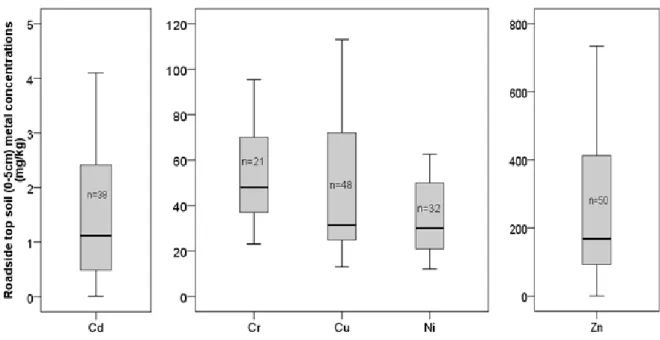
A number of studies have focused on the metal accumulation of Cd, Cu, Cr, Zn and Ni in roadside soil. The mean concentrations for these metals in roadside soils globally have been estimated at: Cd (0.93 ± 0.2 mg/kg); Cr (65 ± 10 mg/kg); Cu (5 ± 6 mg/kg); Ni (34 ± 5 mg/kg) and Zn (118 ± 16 mg/kg) (mean ± standard error) (Table 2.2, Figure 2.3) with a wide range of metal concentrations of Cd, Cr, Cu, Ni and Zn recorded from across the world. The highest concentration for Cd were recorded in the New York, USA (8.0 mg/kg) (Fergusson and Ryan, 1984), Cr from Honolulu, USA (273 mg/kg) (Sutherland and Tolosa, 2000), Cu from Hamburg, Germany 147 mg/kg (Lux, 1993), Ni from Torino, Italy (209 mg/kg)
13
(Biasioli et al., 2006), and Zn from Hongkong (1450 mg/kg) (Li et al., 2001). For comparison, the crustal abundance for each metal is Cr 92 mg/kg and the lowest was Cd 0.09 mg/kg, Cu Ni and Zn was 28 mg/kg, 47 mg/kg and 67 mg/kg respectively (Rudnick, 2010). Thus, it can be seen that the Zn concentrations, in roadside soils in particular were highly altered compared to crustal abundances.
Figure 2.3 Roadside soils Cd, Cr, Cu, Ni and Zn concetrations retrieved from the raw data reported in peer-reviewed literature around the world. Search engines used were Scopus, SpringerLink, Web of Science and Google Scholar.
There are many countries that have recorded elevated Zn concentrations in roadside soils. These roadside soils with elevated Zn were found in Shanghai, China, 733 mg/kg (Shi et al., 2008), Hamilton, Canada, 645 mg/kg (Droppo et al., 1998), Christchurch, New Zealand, 548 mg/kg (Fergusson and Ryan, 1984), Gipuzkoa, Spain, 503 mg/kg (Garcia and Millán, 1998) and Hamburg, Germany, 516 mg/kg (Lux, 1993).
14
2.3.3
Platinum group element (PGE) metals in roadside soil
Very few studies have focused on roadside soil PGE (Pt, Pd and Rh) accumulation. The vehicular emissions of PGE are lower than a number of other elements, but when emissions from over 700 million vehicles globally are accounted for, there is considerable potential for urban PGE pollution from vehicle emissions (Rauch et al., 2005). Studies that have been completed for PGE have been conducted in Germany, Mexico, Australia and England. The contamination of Pt on roadside soil in Germany is reported to be around 7 times higher than background levels (Barefoot, 1999). This is likely to be a result of the increased use of Pt in vehicles since 1987, following the introduction of automobile catalytic converters to Germany (Alt et al., 1997).
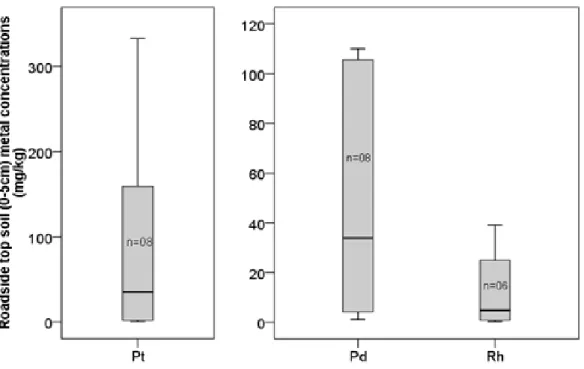
Mean values of 120 (± 67) µg/kg Pd, 8 (± 60) µg/kg Pt and 22 (± 13) µg/kg Rh (mean ± standard error) were recorded in roadside soils around the world (Fig. 2.4). A study by Morcelli et al. (2005) in Sao Paulo, Brazil reported Pt concentrations ranging from 1.1-58 µg/kg, Pd 0.13-7.2 µg/kg and Rh 0.61-13.0 µg/kg. These concentrations of Pd, Pt and Rh were in higher than their geogenic background concentrations: Pt (0.4µg/kg), Pd (0.4 µg/kg) and Rh (0.06 µg/kg) (Morcelli et al., 2005) though the occurrence of PGE in the earth’s crust is rarer (Pt 1.0 µg/kg, Pd 6X10⁻¹ µg/kg and Rh 2.0X10⁻¹ µg/kg) (Nature's Building Blocks, 2001).
15
Figure 2.4 Roadside soil Pt, Pd and Rh concentrations retrieved from the raw data reported in peer-reviewed literature around the world. Search engines used were Scopus, SpringerLink, Web of Science and Google Scholar.
Whiteley and Murray (2003) studied roadside dust from Western Australia and recorded high PGE concentrations ranging from 30.96-419.41 µg/kg of Pt, 58.15-440.46 µg/kg of Pd and 3.47-91.40 µg/kg of Rh. The PGE concentrations in road dust of the city of Braunscheweig, Germany in 1999 to 2005 showed a rapid increase in concentration, especially for Pt as it increased from 67 µg/kg to 1,730 µg/kg (Wichmann et al., 2007). These studies concluded that the use of VEC’s is likely to result in the release of airborne particles containing metals.
2.3.4
Arsenic and Sb - metalloids in roadside soil
Few studies have reported concentrations of Sb and As in roadside soils (Appendix, Table 9.1), despite the presence of As in brake wear and fuel and of Sb in brake linings. Thus, an individual car that may emit small amounts of As and Sb in the short term, but it would account for greater amounts in the long term and for all vehicles combined (Ozaki et al., 2004).
16
Arsenic is considered as a hyper-toxic element and emitted during the use of fossil fuels and by brake wear in motor vehicles. Petrol has been reported to contain 0.03–0.12 mg/kg of As (Nakamoto, 2000). Some values reported for As from roadside soil are, 14.7 mg/kg from Jeddah City, Saudi Arabia, (Kadi, 2009), 7.33 mg/kg from Xuzhou, China (Ozaki et al., 2004) and 6 mg/kg in Dubai, UAE (Aslam et al., 2013). In comparison, As abundance in the earth’s crust is 4.8 mg/kg (Rudnick, 2010).
Studies investigating Sb accumulation in roadside soils have reported that soil humic acids act as a reservoir for Sb (Steely et al., 2007) and are vital for the mobilization of Sb (Ozaki et al., 2004). Antimony also has the ability to bind with trace elements due to the presence of numerous ligands in soil (Stevenson, 1994). A study of the distribution of Sb and its organic species in soil from Austria confirmed vehicular emissions as an important source of Sb accumulation in roadside soil (Amereih et al., 2005). Amereih et al (2005) reported Sb (V) as the predominant form of Sb species occurring in roadside soil. However some other studies have failed to confirm Sb accumulation in roadside soil from vehicular emissions related sources (Kadi, 2009). A study from Xuzhou, China, reported that median of Sb concentrations of 0.96 mg/kg was recorded from the roadside top soil (Wang, 2009). This is higher than the earth’s crust abundance recorded for Sb which is 0.4 mg/kg (Rudnick, 2010). Due to the lack of data in the literature, As and Sb were not presented as a statistical summary or graphically, as for other metals in this review.
2.3.5
Other metals in roadside soil
Metals such as Co, Mo, Se, Sn, Sr and Ti are considered as metal in vehicular emissions (Table 2.1) however these metals have received minimal attention in roadside soil studies (see Appendix Table 9.1). Although these metals are low in emissions, they are important to
17
incorporate into roadside soil studies because novel techniques in motor vehicle technology may result in increased emissions of these elements in future vehicular emissions.
An example of a novel technology is the study of perovskite, fortified with metals for use in diesel vehicles as a replacement for VEC’s (Brodrick et al., 2001). Perovskite oxides have been studied for their ability for use as catalysts for decades. It has been suggested that by substituting some of the atoms in lanthanum-cobalt or lanthanum-manganese in perovskites with strontium atoms, the efficiency of oxidising NO in vehicular emissions can be improved. If this takes place in future there will be a possible addition of Sr rather than Pt to the environment.
2.4
Metal Bioavailability
There are many definitions in the literature for bioavailability of metals in soil with agreement yet to be reached on a precise definition (Harmsen, 2007; Lanno et al., 2004; McLaughlin et al., 2000; Kim et al., 2015; Warrington and Skogley, 1997). It is not within the scope of this review to evaluate different definitions of bioavailability in detail; reference may be made to an extensive assessment of bioavailability of metals in soils which has been undertaken by Kim et al. (2015). A simple definition for bioavailability is the “availability of a chemical/metal to an animal, plant or microorganism, which may be assayed by measurement of uptake, toxicity or biodegradability (Linz and Nakles, 1997)”.
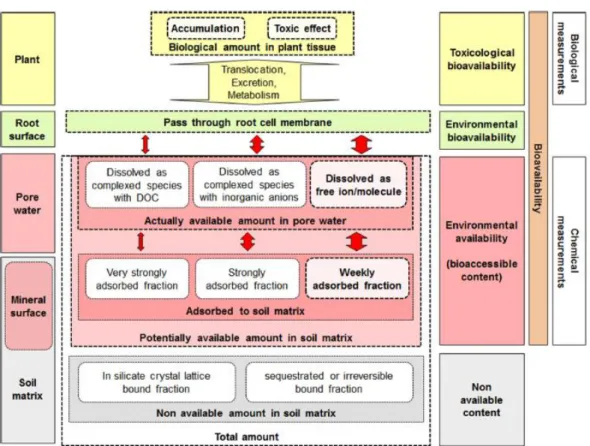
It is widely accepted that the total metal concentration in soil is not a good predictor of bioavailability (Förstner, 1993; Pagnanelli et al., 2004). Only a small fraction of the metals in a soil are known to be bioavailable (Figure 2.5). A large fraction of the total metals are associated with minerals. This portion of the metal is bound so firmly that it is effectively non-bioavailable. In roadside soil, the bioavailability of some metals has received a large
18
amount of attention while other metals have received less attention. During the 1970 and 1980’s almost all studies were focussed on Pb. Recently introduced metals in vehicle emissions such as Sb, Mn and PGE (Pt, Pd and Rh) have received less attention in bioavailability studies (Table 2.2).
Figure 2.5 Three step concept of bioavailability in soil for plants. Source (Kim et al., 2015)
2.4.1
Soil properties affecting metal bioavailability
Soil bioavailability is controlled by the desorption/adsorption properties of soil, which are influenced by soil physiochemical properties such as soil total metal concentrations, pH, texture, clay content, redox potential, organic matter content, iron and manganese oxides, cation and anions in the solution, and by other miscellaneous factors such as temperature, particle size, solubility, CaCO3 content, presence of earthworms, microbial activity and
19
Metals are strongly or weakly bounded to the soil and may be present in different forms, for example: metals which are held on cation exchange sites would be more bioavailable than the precipitates of oxides of iron and manganese or those bound with insoluble organic species (Rieuwerts et al., 1998; Thornton, 1991).
For most metals, the soil pH is recognised as the principal factor governing solubility and bioavailability in soil (McBride, 1994; Turner and Ross, 1994). At low pH, metals are non-specifically adsorbed to the binding sites of cation exchange sites on clay minerals and this pool of metals is considered readily bioavailable (Brümmer et al., 1983). For this reason metals are more bioavailable in acidic pH compared to alkaline pH, so metal solubility tends to increase at lower pH and decrease at higher pH values (Garcia-Miragaya, 1984; Thornton, 1991).
In soils, metals associated with organic matter and iron and manganese oxide coatings have reduced bioavailability. The stability of soil organic complexes may vary with the type of the metal, pH and type of organic matter (Zhou and Wong, 2003). Inorganic and organic anions are also able to form complexes with metal ions, and these reactions potentially influence the solubility of metals in soils (Violante et al., 2010). The presence of organic matter indicates strong capacity to bind metals, while high CEC represent higher adsorption capacity in soil (White, 2013). At a given soil pH, Cd and Zn exhibit a lower stability of their metal-organic complexes than that of Pb, Cu and Cr complexes (Brümmer, 1986). A mechanism for increased bioavailability under reducing conditions is the dissolution of Fe–Mn hydroxides, resulting in the release of adsorbed metals (Rieuwerts et al., 1998).
Soil dwelling organisms are an essential part of the healthy functioning of soil. They represent a significant proportion of the soil biomass and are considered as an useful indicator of soil health and quality (Edwards, 2004). Soil organisms such as earthworms and micro-organisms are known to affect metal solubility in soil (Lodenius and Autio, 1989). The
20
importance of root activity to the bioavailability of metals has also been previously reported (Kabata-Pendias, 2004, Kabata-Pendias, 2010; Xian and Shokohifard, 1989). Plant roots exude acid materials like H2CO3 which lowers the rhizosphere pH, increasing the absorption
of metals by plants. Soil temperature has been found to be positively correlated with plant uptake of Pb and Cd (Hooda and Alloway, 1993) .
There are also suggestions that metals are proportionately more bioavailable in contaminated soils than when they occur naturally in soil. This is supported by Banin et al. (1987) who suggested that with increasing total soil metal concentration, the metal fixation capacity of the soil becomes saturated due to cation competition for adsorption sites and therefore these excess metals have the ability to enter the soil solution. Metals also show increasing bioavailability with decreasing particle size, thus in roadside soil studies the bioavailability of metals in soil was lower compared to atmospheric suspended particulates and runoff (Preciado and Li, 2006).