1
UC3M Working papers
Departamento de Economía
Economics
Universidad Carlos III de Madrid
17-08
Calle Madrid, 126
July, 2017
28903 Getafe (Spain)
ISSN 2340-5031
Fax (34) 916249875
Dynamic Conditional Score Models with Time-Varying
Location, Scale and Shape Parameters
Astrid Ayala
a
, Szabolcs Blazsek
a
and Alvaro Escribano
,
b
a
School of Business, Universidad Francisco Marroquín, Guatemala
b
Department of Economics, Universidad Carlos III de Madrid, Spain
Abstract
We introduce new dynamic conditional score (DCS) models with time-varying
location, scale and shape parameters. For these models, we use the Student's-t, GED
(general error distribution), Gen-t (generalized-t), Skew-Gen-t (skewed generalized-t),
EGB2 (exponential generalized beta of the second kind) and NIG (normal-inverse
Gaussian) distributions. We show that the maximum likelihood (ML) estimates of the
new DCS models are consistent and asymptotically Gaussian. As an illustration, we
use daily log-return time series data from the S&P 500 index for period 1950 to 2016.
We find that, with respect to goodness-of-fit and predictive performance, the DCS
models with dynamic shape are superior to the DCS models with constant shape and
the benchmark AR-t-GARCH model.
Keywords: dynamic conditional score models, score-driven shape parameters
JEL codes: C22, C52, C58
Corresponding author. UC3M-Chair for Internationalization. Department of Economics, Universidad
Carlos III de Madrid, Calle Madrid 126, 28903, Getafe (Madrid), Spain. Telephone: +34 916249854.
(E-mail:[email protected])
1. Introduction
The precise forecasting of the probability distribution of financial returns and, more specifically,
the precise forecasting of volatility, are important concerns of practitioners for the effective
management of financial portfolios. When probability distributions that include scale and shape
parameters are used to model financial returns, then both parameters influence volatility. In
standard financial time series models, the scale parameter is dynamic and the shape parameter
(if it is specified) is constant over time. We suggest new financial time series models, for which
both the scale and shape parameters of financial returns are dynamic. We show that changes
in the scale are more related to the normal risk (non-extreme risk) of the investment (i.e., news
of low or moderate impacts that frequently updates asset prices), while changes in the shape
are more related to the extreme risk of the investment (i.e., news that appears from time to
time with significant influence on asset prices). We also show that the normal risk component
of dynamic shape is significant, which motivates the use of the new models.
Our models extend the previous financial time series models with constant shape parameters,
since: (i) they have a superior likelihood-based statistical performance and forecast performance;
(ii) they estimate the dynamics of both scale and shape parameters effectively; (iii) news on asset
value updates the distribution of financial return not only through scale, but also through shape;
(iv) they use different dynamic tail shape for the left and right tails of the return distribution;
(v) they identify extreme events and sudden changes in extreme risk effectively; (vi) they can
be used to separate the normal risk and extreme risk components of scale and shape, and to
study the influence of those components on volatility.
In the body of literature relevant to this field, different econometric methods are used to
investigate dynamic tail shape for financial returns. Quintos et al. (2001) construct tests of tail
shape constancy that allow for an unknown breakpoint, and present applications of those tests for
stock price data from Thailand, Malaysia and Indonesia. Galbraith and Zernov (2004) present
applications of the same tests for the Dow Jones Industrial Average (DJIA) and Standard &
Poor’s 500 (S&P 500) indexes. More recently, Bollerslev and Todorov (2011) suggest a flexible
nonparametric method of dynamic tail shape, which is used by the same authors for
high-frequency data from the S&P 500. There are several methods in the body of literature that
use options data to estimate dynamic tail shape for financial returns (e.g., Bakshi et al. 2003;
Bollerslev et al. 2009; Backus et al. 2011). In relation to options data and dynamic tail
shape, we also refer to the recent works of Bollerslev and Todorov (2014) and Bollerslev et al.
(2015). Furthermore, by using panel data models, Kelly and Jiang (2014) identify a common
variation in the tail shape of United States (US) stock returns. In our paper, (i) we use a
new flexible parametric approach to estimate dynamic tail shape; (ii) the proposed econometric
models are not only for the dynamic modeling of tail shape, but also for that of the asymmetry
and peakedness of the distribution.
The main contribution of this paper is that we introduce new dynamic conditional score
(DCS) models (Harvey 2013), for which the shape parameters are dynamic. We introduce those
models for the Student’s-
t
, GED (general error distribution), Gen-
t
(generalized-
t
),
Skew-Gen-t
(skewed generalized-
t
), EGB2 (exponential generalized beta of the second kind) and NIG
(normal-inverse Gaussian) distributions. The new models are extensions of the DCS models
with constant shape introduced in the works of Harvey (2013), Caivano and Harvey (2014),
Harvey and Sucarrat (2014) and Harvey and Lange (2017). In addition, to the best of our
knowledge the Skew-Gen-
t
-DCS and NIG-DCS specifications used in this paper are new, since
(i) for Skew-Gen-
t
-DCS, we use a density function that has not yet been used in the body of DCS
literature, and (ii) the NIG distribution has not yet been used in the body of DCS literature.
As an illustration, we use return time series data from the adjusted S&P 500 index for period
1950 to 2016. The analysis of S&P 500 data is useful, for example, for investors of (i)
well-diversified US equity portfolios; (ii) S&P 500 futures and options contracts traded at Chicago
Mercantile Exchange (CME); (iii) exchange traded funds (ETFs) related to the S&P 500.
We apply the results of Jensen and Rahbek (2004) to argue that the maximum likelihood
(ML) estimates of the DCS models with dynamic shape are consistent and asymptotically
Gaus-sian. We compare the statistical performance of the new DCS models with that of the DCS
models with constant shape and the standard AR (autoregressive) (Box and Jenkins 1970)
plus
t
-GARCH (generalized autoregressive conditional heteroskedasticity) with leverage effects
(Bollerslev 1987; Glosten et al. 1993) model. We find that the score-driven dynamics of shape
are significant for the new DCS models, and show that the likelihood-based performance of
the new DCS models is superior to that of DCS with constant shape and AR-
t
-GARCH. We
separate the normal risk and extreme risk components of scale and shape, and study the
dif-ferent importances of those components. We find that changes in scale are more related to the
normal risk component, and changes in shape are more related to the extreme risk component.
Finally, we undertake an out-of-sample exercise, and show that the density forecast performance
of EGB2-DCS with dynamic shape is superior to that of
t
-GARCH with leverage effects.
The remainder of this paper is organized as follows. Section 2 presents the econometric
frame-work. Section 3 presents the model specifications. Section 4 presents the statistical inferences.
Section 5 presents the empirical results. Section 6 concludes.
2. Econometric framework
In all econometric specifications of this paper, we model the daily log-return time series
y
t=
ln(
p
t/p
t−1) for days
t
= 1
, . . . , T
, where
p
tis closing price, adjusted for dividends and stock
splits, of a financial asset for day
t
(for
p
0, we use pre-sample data).
2.1. Benchmark model
As the benchmark model, we use AR(
p
) plus
t
-GARCH(1,1) with leverage effects. For this
standard financial time-series model
y
t=
µ
t+
v
t=
µ
t+
λ
1/2
t
t, where
tis the error term
with the Student’s
t
-distribution and a constant shape parameter (i.e., the degrees of freedom
parameter). The location and squared-scale equations of this model are specified as:
µ
t=
c
+
pX
j=1φ
jy
t−j(2.1)
λ
t=
ω
+
βλ
t−1+ [
α
+
α
∗1
(
t−1<
0)]
v
t−2 1(2.2)
of freedom parameter implies a finite conditional variance of
y
t. We initialize
µ
tby using
pre-sample data and
λ
tby parameter
λ
0. The conditional distribution of
y
tis the non-standardized
Student’s
t
-distribution
t
[
µ
t, λ
1/2
t
,
exp(
δ
1) + 2]. The conditional mean and volatility of
y
tare
µ
tand
λ
1t/2[1 + 2 exp(
−
δ
1)]
1/2, respectively. The log-density of
y
tis
ln
f
(
y
t|
y
1, . . . , y
t−1) = ln Γ
exp(
δ
1) + 3
2
−
ln Γ
exp(
δ
1) + 2
2
−
1
2
ln(
πλ
t)
(2.3)
−
1
2
ln[exp(
δ
1) + 2]
−
exp(
δ
1) + 3
2
ln
1 +
2 texp(
δ
1) + 2
2.2. DCS models of location, scale and shape
The general form of DCS models is
y
t=
µ
t+
v
t=
µ
t+ exp(
λ
t)
t, where
µ
tand exp(
λ
t) are
the dynamic location and scale parameters, respectively. For
t, we use the Student’s-
t
, GED,
Gen-
t
, Skew-Gen-
t
, EGB2 and NIG distributions. Potentially, there may be more than one
shape parameter of
t, and it is determined by the parameter
ρ
k,t(
k
= 1 if there is one shape
parameter, and
k
≥
1 if the number of shape parameters is greater than one). We consider
constant and dynamic alternatives of
ρ
k,t. For the dynamic alternatives,
ρ
k,tis driven by the
conditional score of the log-likelihood (LL) with respect to
ρ
k,t(hereafter, score function).
We present the DCS models of location, scale and shape, by using the representation of
Harvey (2013) that can be related to the unobserved components models (Harvey 1989). A
DCS model is obtained from an unobserved components model by replacing its error terms with
the score functions. The location, scale and shape equations of the DCS model are given by
µ
t=
c
+
pX
j=1φ
jµ
t−j!
+
θu
µ,t−1(2.4)
λ
t=
ω
+
βλ
t−1+
αu
λ,t−1+
α
∗sgn(
−
t−1)(
u
λ,t−1+ 1)
(2.5)
ρ
k,t=
δ
k+
γ
kρ
k,t−1+
κ
ku
ρ,k,t−1(2.6)
y
t,
λ
tby parameter
λ
0and
ρ
k,tby using
δ
k/
(1
−
γ
k). It is worth noting that, as an alternative,
we also use parameter
ρ
k,0to initialize
ρ
k,t. For each DCS model with dynamic shape, we also
consider the alternative
ρ
k,t=
δ
kthat is a DCS model with constant shape.
The general notation
ρ
k,tis specified as
ν
t,
η
t,
τ
t,
ξ
tand
ζ
tfor different shape parameters
(Section 3). If a given DCS model includes more than one shape parameter, then we use a
different parameter index for each shape parameter. For example, we use
δ
1,
γ
1and
κ
1for
ν
tand
δ
2,
γ
2and
κ
2for
η
tfor the case of Gen-
t
-DCS (Section 3.3).
The parameters
µ
t,
λ
tand
ρ
k,tare updated by lags of the score functions
u
µ,t,
u
λ,tand
u
ρ,k,t, respectively. For
µ
t, we use the DCS-QAR(
p
) model (Harvey 2013). For
λ
t, we use the
DCS-EGARCH (exponential GARCH) model with leverage effects (Harvey and Chakravarty
2008; Harvey 2013). In the body of literature, DCS-EGARCH with constant shape parameters
that uses the Student’s
t
, GED, Gen-
t
, Skew-Gen-
t
and EGB2 distributions for
tis named as
Beta-
t
-EGARCH (Harvey and Chakravarty 2008), GED-EGARCH (Harvey 2013), Beta-Gen-
t
-EGARCH (Harvey and Lange 2017), Beta-Skew-Gen-
t
-EGARCH (Harvey and Lange 2017) and
EGB2-EGARCH (Caivano and Harvey 2014), respectively. For
ρ
k,t, we use the DCS-QAR(1)
model that is applied for location
µ
tin the work of Harvey (2013). To the best of our knowledge,
the use of score-driven shape parameters is new in the body of literature.
It is noteworthy that in this paper we use the Skew-Gen-
t
density function from the work of
McDonald and Michelfelder (2017) for
t, which is different from the Skew-Gen-
t
density function
used in the work of Harvey and Lange (2017). Furthermore, to the best of our knowledge, the
present paper is the first to use the NIG distribution (Barndorff-Nielsen and Halgreen 1977) for
DCS models of location, scale and shape. We name DCS-EGARCH with NIG distribution, as
the NIG-EGARCH model.
2.3. Error terms of DCS models with time-varying location, scale and shape
In this section, we present the six alternative specifications of
t. In Fig. 1, for illustration, we
present the probability density function of each specification for different shape parameters, and
compare each of them with the standard normal distribution.
First,
t∼
t
[0
,
1
,
exp(
ν
t) + 2], where
ν
tinfluences the tail-heaviness of
t. The conditional
mean and variance of
tare
E
(
t|
y
1, . . . , y
t−1) = 0
(2.7)
Var(
t|
y
1, . . . , y
t−1) = 1 + 2 exp(
−
ν
t)
(2.8)
respectively. In this specification, the degrees of freedom parameter [exp(
ν
t) + 2] is greater than
two, hence, the conditional variance is finite.
Second,
t∼
GED[0
,
1
,
exp(
ν
t)], where
ν
tinfluences the peakedness of
t. The conditional
mean and variance of
tare
E
(
t|
y
1, . . . , y
t−1) = 0
(2.9)
Var(
t|
y
1, . . . , y
t−1) = 2
2 exp(−νt)Γ[3 exp(
−
ν
t)]
Γ[exp(
−
ν
t)]
(2.10)
respectively, where Γ(
x
) is the gamma function.
Third,
t∼
Gen-
t
[0
,
1
,
exp(
ν
t) + 2
,
exp(
η
t)], where
ν
tand
η
tinfluence the tail-heaviness and
peakedness of
t, respectively. The conditional mean and variance of
tare
E
(
t|
y
1, . . . , y
t−1) = 0
(2.11)
Var(
t|
y
1, . . . , y
t−1) = [exp(
ν
t) + 2]
2 exp(−ηt)×
Γ [3 exp(
−
η
t)] Γ[exp(
ν
t−
η
t)]
Γ [exp(
−
η
t)] Γ
h
exp(νt)+2exp(ηt)
i
(2.12)
respectively. In this specification, the degrees of freedom parameter [exp(
ν
t) + 2] is greater than
two, hence, the conditional variance is finite.
For the Student’s-
t
, GED and Gen-
t
models,
tis a martingale difference sequence (MDS),
i.e.,
E
(
t|
y
1, . . . , y
t−1) = 0. We estimate the residuals by using ˆ
t= (
y
t−
µ
ˆ
t) exp(
−
λ
ˆ
t). For ˆ
t,
as suggested by Harvey (2013), we apply the MDS test of Escanciano and Lobato (2009) that
involves an automatic procedure for lag selection in the statistical test.
Fourth,
t∼
Skew-Gen-
t
[0
,
1
,
tanh(
τ
t)
,
exp(
ν
t) + 2
,
exp(
η
t)], where tanh(
x
) is the hyperbolic
tangent function, and
τ
t,
ν
tand
η
tinfluence asymmetry, tail-heaviness and peakedness,
respec-tively, of
t. The Skew-Gen-
t
distribution uses different dynamic tail shape for the left and right
tails, similar to the recent works of Bollerslev and Todorov (2014) and Bollerslev et al. (2015).
The conditional mean and variance of
tare
E
(
t|
y
1, . . . , y
t−1) =
2tanh(
τ
t)[exp(
ν
t) + 2]
exp(−ηt)B
n
2 exp(ηt),
exp(νt)+1 exp(ηt)o
B
n
exp(1ηt),
exp(exp(νt)+2ηt)o
(2.13)
Var(
t|
y
1, . . . , y
t−1) = [exp(
ν
t) + 2]
2 exp(−ηt)×
(2.14)
×
[3tanh
2(
τ
t) + 1]
B
h
3 exp(ηt),
exp(νt) exp(ηt)i
B
h
exp(1ηt),
exp(exp(νt)+2ηt)i
−
4tanh
2(
τ
t)
B
2h
2 exp(ηt),
exp(νt)+1 exp(ηt)i
B
2h
1 exp(ηt),
exp(νt)+2 exp(ηt)i
respectively, where
B
(
x, y
) = Γ(
x
)Γ(
y
)
/
Γ(
x
+
y
) is the Beta function. In this specification, the
degrees of freedom parameter [exp(
ν
t) + 2] is greater than two, hence, the conditional variance
is finite. Furthermore, the asymmetry parameter tanh(
τ
t) is in the interval (
−
1
,
1), as required
for Skew-Gen-
t
.
Fifth,
t∼
EGB2[0
,
1
,
exp(
ξ
t)
,
exp(
ζ
t)], where
ξ
tand
ζ
tinfluence both asymmetry and
tail-heaviness. EGB2 uses different dynamic tail shape for the left and right tails, similar to the
recent works of Bollerslev and Todorov (2014) and Bollerslev et al. (2015). The conditional
mean and variance of
tare
E
(
t|
y
1, . . . , y
t−1) = Ψ
(0)[exp(
ξ
t)]
−
Ψ
(0)[exp(
ζ
t)]
(2.15)
Var(
t|
y
1, . . . , y
t−1) = Ψ
(1)[exp(
ξ
t)] + Ψ
(1)[exp(
ζ
t)]
(2.16)
respectively, where Ψ
(0)(
x
) and Ψ
(1)(
x
) are polygamma functions of orders 0 and 1, respectively.
Sixth,
t∼
NIG[0
,
1
,
exp(
ν
t)
,
exp(
ν
t)tanh(
η
t)], where
ν
tand
η
tinfluence tail-heaviness and
similar to the recent works of Bollerslev and Todorov (2014) and Bollerslev et al. (2015). The
conditional mean and variance of
tare
E
(
t|
y
1, . . . , y
t−1) =
tanh(
η
t)
[1
−
tanh
2(
η
t)]
1/2(2.17)
Var(
t|
y
1, . . . , y
t−1) =
exp(
−
ν
t)
[1
−
tanh
2(
η
t)]
3/2(2.18)
respectively. In this specification, the absolute value of the asymmetry parameter
|
exp(
ν
t)tanh(
η
t)
|
is less than the tail-heaviness parameter exp(
ν
t) that is required for NIG.
For the Skew-Gen-
t
, EGB2 and NIG models,
E
(
t|
y
1, . . . , y
t−1)
6
= 0. The conditional mean
of
y
tfor these models is
E
(
y
t|
y
1, . . . , y
t−1) =
µ
t+ exp(
λ
t)
E
(
t|
y
1, . . . , y
t−1). Given the formula
of
E
(
t|
y
1, . . . , y
t−1) for Skew-Gen-
t
, EGB2 and NIG, we define the transformed residuals as
∗t=
t−
E
(
t|
y
1, . . . , y
t−1). We estimate the transformed residuals by using
ˆ
∗t= (
y
t−
µ
ˆ
t) exp(
−
ˆ
λ
t)
−
E
ˆ
(
t|
y
1, . . . , y
t−1)
(2.19)
For ˆ
∗t, we apply the MDS test of Escanciano and Lobato (2009).
3. DCS specifications of location, scale and shape
In this section, for each error specification, we present the conditional distribution of
y
t, the
conditional mean and volatility of
y
t, the log of the conditional density of
y
t, and the score
functions with respect to location, scale and shape.
3.1.
t-DCS model
The conditional distribution of the log-return
y
tis the non-standardized Student’s
t
-distribution
t
[
µ
t,
exp(
λ
t)
,
exp(
ν
t) + 2]. The conditional mean and volatility of the log-return
y
tare
µ
tand
exp(
λ
t)[1 + 2 exp(
−
ν
t)]
1/2, respectively. The log of the conditional density of
y
tis
ln
f
(
y
t|
y
1, . . . , y
t−1) = ln Γ
exp(
ν
t) + 3
2
−
ln Γ
exp(
ν
t) + 2
2
(3.1)
−
ln(
π
) + ln[exp(
ν
t) + 2]
2
−
λ
t−
exp(
ν
t) + 3
2
ln
1 +
2 texp(
ν
t) + 2
In general, the conditional score of
y
tis the partial derivative of ln
f
(
y
t|
y
1, . . . , y
t−1) with respect
to a time-varying parameter (Harvey 2013). In the
t
-DCS model, the score functions with respect
to
µ
t,
λ
tand
ν
tare as follows. First, the score function with respect to
µ
tis
∂
ln
f
(
y
t|
y
1, . . . , y
t−1)
∂µ
t=
exp(
λ
t)
t 2 t+ exp(
ν
t) + 2
×
exp(
ν
t) + 3
exp(2
λ
t)
=
u
µ,t×
exp(
ν
t) + 3
exp(2
λ
t)
(3.2)
where
u
µ,tis the scaled score function. Second, the score function with respect to
λ
tis
u
λ,t=
∂
ln
f
(
y
t|
y
1, . . . , y
t−1)
∂λ
t=
[exp(
ν
t) + 3]
2 texp(
ν
t) + 2 +
2t−
1
(3.3)
Third, the score function with respect to
ν
tis
u
ν,t=
exp(
ν
t)
2
Ψ
(0)exp(
ν
t) + 3
2
−
exp(
ν
t)
2
Ψ
(0)exp(
ν
t) + 2
2
−
exp(
ν
t)
2 exp(
ν
t) + 4
(3.4)
+
exp(
ν
t)[exp(
ν
t) + 3]
2 t2[exp(
ν
t) + 2][
2t+ exp(
ν
t) + 2]
−
exp(
ν
t)
2
×
ln
1 +
2 texp(
ν
t) + 2
3.2. GED-DCS model
The conditional distribution of the log-return
y
tis the non-standardized GED distribution,
denoted as GED[
µ
t,
exp(
λ
t)
,
exp(
ν
t)]. The conditional mean and volatility of
y
tare
µ
tand
exp(
λ
t)2
exp(−νt)×
Γ[3 exp(
−
ν
t)]
Γ[exp(
−
ν
t)]
1/2(3.5)
respectively. The log of the conditional density of
y
tis
ln
f
(
y
t|
y
1, . . . , y
t−1) =
−
[1 + exp(
−
ν
t)] ln(2)
−
λ
t−
ln Γ[1 + exp(
−
ν
t)]
−
1
2
|
t|
exp(νt)
(3.6)
function with respect to
µ
tis
∂
ln
f
(
y
t|
y
1, . . . , y
t−1)
∂µ
t=
t|
t|
exp(νt)−2×
exp(
ν
t−
λ
t)
2
=
u
µ,t×
exp(
ν
t−
λ
t)
2
(3.7)
where
u
µ,tis the scaled score function. Second, the score function with respect to
λ
tis
u
λ,t=
∂
ln
f
(
y
t|
y
1, . . . , y
t−1)
∂λ
t=
exp(
ν
t)
2
|
t|
exp(νt)−
1
(3.8)
Third, the score function with respect to
ν
tis
u
ν,t=
∂
ln
f
(
y
t|
y
1, . . . , y
t−1)
∂ν
t= exp(
−
ν
t) ln(2) + exp(
−
ν
t)Ψ
(0)[1 + exp(
−
ν
t)]
(3.9)
−
exp(
ν
t)
2
|
t|
exp(νt)
ln
|
t
|
3.3. Gen-t-DCS model
The conditional distribution of
y
tis the non-standardized Gen-
t
distribution that we denote by
Gen-
t
[
µ
t,
exp(
λ
t)
,
exp(
ν
t) + 2
,
exp(
η
t)]. The conditional mean and volatility of
y
tare
µ
tand
exp(
λ
t)[exp(
ν
t) + 2]
exp(−ηt)×
Γ[3 exp(
−
η
t)]Γ[exp(
ν
t−
η
t)]
Γ[exp(
−
η
t)]Γ
h
exp(νt)+2 exp(ηt)i
1/2(3.10)
respectively. The log of the conditional density of
y
tis
ln
f
(
y
t|
y
1, . . . , y
t−1) =
η
t−
λ
t−
ln(2)
−
ln[exp(
ν
t) + 2]
exp(
η
t)
−
ln Γ
{
[exp(
ν
t) + 2] exp(
−
η
t)
}
(3.11)
−
ln Γ[exp(
−
η
t)] + ln Γ
{
[exp(
ν
t) + 3] exp(
−
η
t)
} −
exp(
ν
t) + 3
exp(
η
t)
ln
1 +
|
t|
exp(ηt)exp(
ν
t) + 2
as follows. First, the score function with respect to
µ
tis
∂
ln
f
(
y
t|
y
1, . . . , y
t−1)
∂µ
t=
exp(
λ
t)
t|
t|
exp(ηt)−2|
t|
exp(ηt)+ exp(
ν
t) + 2
×
exp(
ν
t) + 3
exp(2
λ
t)
=
u
µ,t×
exp(
ν
t) + 3
exp(2
λ
t)
(3.12)
where
u
µ,tis the scaled score function. Second, the score function with respect to
λ
tis
u
λ,t=
∂
ln
f
(
y
t|
y
1, . . . , y
t−1)
∂λ
t=
[exp(
ν
t) + 3]
|
t|
exp(ηt)|
t|
exp(ηt)+ exp(
ν
t) + 2
−
1
(3.13)
Third, the score function with respect to
ν
tis
u
ν,t=
∂
ln
f
(
y
t|
y
1, . . . , y
t−1)
∂ν
t=
−
exp(
ν
t−
η
t)
[exp(
ν
t) + 2]
(3.14)
−
exp(
ν
t−
η
t)Ψ
(0)exp(
ν
t) + 2
exp(
η
t)
+ exp(
ν
t−
η
t)Ψ
(0)exp(
ν
t) + 3
exp(
η
t)
−
exp(
ν
t−
η
t) ln
1 +
|
t|
exp(ηt)exp(
ν
t) + 2
+
exp(
ν
t−
η
t)[exp(
ν
t) + 3]
|
t|
exp(ηt)[exp(
ν
t) + 2][
|
t|
exp(ηt)+ exp(
ν
t) + 2]
Fourth, the score function with respect to
η
tis
u
η,t=
∂
ln
f
(
y
t|
y
1, . . . , y
t−1)
∂η
t= 1 +
ln[exp(
ν
t) + 2]
exp(
η
t)
+
exp(
ν
t) + 2
exp(
η
t)
Ψ
(0)exp(
ν
t) + 2
exp(
η
t)
(3.15)
+
1
exp(
η
t)
Ψ
(0)1
exp(
η
t)
−
exp(
ν
t) + 3
exp(
η
t)
Ψ
(0)exp(
ν
t) + 3
exp(
η
t)
−
[exp(
ν
t) + 3]
|
t|
exp(ηt)ln
|
t
|
|
t|
exp(ηt)+ exp(
ν
t) + 2
+
exp(
ν
t) + 3
exp(
η
t)
×
ln
1 +
|
t|
exp(ηt)exp(
ν
t) + 2
3.4. Skew-Gen-t-DCS model
The conditional distribution of
y
tis
The conditional mean of
y
tis
µ
t+ 2 exp(
λ
t)tanh(
τ
t)[exp(
ν
t) + 2]
exp(−ηt)×
B
n
exp(2ηt),
exp(exp(νt)+1ηt)o
B
n
exp(1ηt),
exp(exp(νt)+2ηt)o
(3.17)
The conditional volatility of
y
tis
exp(
λ
t)[exp(
ν
t) + 2]
exp(−ηt)×
(3.18)
×
[3tanh
2(
τ
t) + 1]
B
h
3 exp(ηt),
exp(νt) exp(ηt)i
B
h
exp(1ηt),
exp(exp(νt)+2ηt)i
−
4tanh
2(
τ
t)
B
2h
2 exp(ηt),
exp(νt)+1 exp(ηt)i
B
2h
1 exp(ηt),
exp(νt)+2 exp(ηt)i
1/2The log of the conditional density of
y
tis
ln
f
(
y
t|
y
1, . . . , y
t−1) =
η
t−
λ
t−
ln(2)
−
ln[exp(
ν
t) + 2]
exp(
η
t)
−
ln Γ
exp(
ν
t) + 2
exp(
η
t)
(3.19)
−
ln Γ[exp(
−
η
t)] + ln Γ
exp(
ν
t) + 3
exp(
η
t)
−
exp(
ν
t) + 3
exp(
η
t)
ln
1 +
|
t|
exp(ηt)[1 + tanh(
τ
t)sgn(
t)]
exp(ηt)×
[exp(
ν
t) + 2]
First, the score function with respect to
µ
tis
∂
ln
f
(
y
t|
y
1, . . . , y
t−1)
∂µ
t=
(3.20)
=
exp(
λ
t)
t|
t|
exp(ηt)−2
|
t|
exp(ηt)+ [1 + tanh(
τ
t)sgn(
t)]
exp(ηt)[exp(
ν
t) + 2]
×
exp(
ν
t) + 3
exp(2
λ
t)
=
=
u
µ,t×
exp(
ν
t) + 3
exp(2
λ
t)
where
u
µ,tis the scaled score function. Second, the score function with respect to
λ
tis
u
λ,t=
∂
ln
f
(
y
t|
y
1, . . . , y
t−1)
∂λ
t=
|
t|
exp(ηt)[exp(
ν
t) + 3]
|
t|
exp(ηt)+ [1 + tanh(
τ
t)sgn(
t)]
exp(ηt)[exp(
ν
t) + 2]
Third, the score function with respect to
τ
tis
u
τ,t=
∂
ln
f
(
y
t|
y
1, . . . , y
t−1)
∂τ
t=
[exp(
ν
t) + 3]
|
t|
exp(ηt)sgn(
t
)sech(
τ
t)
[sgn(
t)sinh(
τ
t) + cosh(
τ
t)]
×
(3.22)
×
|
t|
exp(ηt)+ [1 + tanh(
τ
t)sgn(
t)]
exp(ηt)[exp(
ν
t) + 2]
−1
Fourth, the score function with respect to
ν
tis
u
ν,t=
∂
ln
f
(
y
t|
y
1, . . . , y
t−1)
∂ν
t=
−
exp(
ν
t−
η
t)
exp(
ν
t) + 2
−
exp(
ν
t−
η
t)Ψ
(0)exp(
ν
t) + 2
exp(
η
t)
(3.23)
+ exp(
ν
t−
η
t)Ψ
(0)exp(
ν
t) + 3
exp(
η
t)
+
exp(
ν
t−
η
t)[exp(
ν
t) + 3]
|
t|
exp(ηt)[exp(
ν
t) + 2]
{|
t|
exp(ηt)+ [1 + tanh(
τ
t)sgn(
t)]
exp(ηt)[exp(
ν
t) + 2]
}
−
exp(
ν
t−
η
t) ln
1 +
|
t|
exp(ηt)
[1 + tanh(
τ
t)sgn(
t)]
exp(ηt)[exp(
ν
t) + 2]
Fifth, the score function with respect to
η
tis
u
η,t=
∂
ln
f
(
y
t|
y
1, . . . , y
t−1)
∂η
t= 1 +
ln[exp(
ν
t) + 2]
exp(
η
t)
+
exp(
ν
t) + 2
exp(
η
t)
Ψ
(0)exp(
ν
t) + 2
exp(
η
t)
(3.24)
+
1
exp(
η
t)
Ψ
(0)1
exp(
η
t)
−
exp(
ν
t) + 3
exp(
η
t)
Ψ
(0)exp(
ν
t) + 3
exp(
η
t)
+
exp(
ν
t) + 3
exp(
η
t)
ln
1 +
|
t|
exp(ηt)[1 + tanh(
τ
t)sgn(
t)]
−exp(ηt)exp(
ν
t) + 2
+
[exp(
ν
t) + 3]
|
t|
exp(ηt)ln[1 + tanh(
τ
t)sgn(
t)]
|
t|
exp(ηt)+ [exp(
ν
t) + 2][1 + tanh(
τ
t)sgn(
t)]
exp(ηt)−
[exp(
ν
t) + 3]
|
t|
exp(ηt)
ln(
|
t
|
)
|
t|
exp(ηt)+ [exp(
ν
t) + 2][1 + tanh(
τ
t)sgn(
t)]
exp(ηt)3.5. EGB2-DCS model
The conditional distribution of
y
tis EGB2[
µ
t,
exp(
−
λ
t)
,
exp(
ξ
t)
,
exp(
ζ
t)]. The conditional mean
and volatility of
y
tare
µ
t+ exp(
λ
t)
Ψ
(0)[exp(
ξ
Ψ
(1)[exp(
ζ
t)]
}
1/2, respectively. The log of the conditional density of
y
tis
ln
f
(
y
t|
y
1, . . . , y
t−1) = exp(
ξ
t)
t−
λ
t−
ln Γ[exp(
ξ
t)]
−
ln Γ[exp(
ζ
t)]
(3.25)
+ ln Γ[exp(
ξ
t) + exp(
ζ
t)]
−
[exp(
ξ
t) + exp(
ζ
t)] ln[1 + exp(
t)]
The score functions with respect to
µ
t,
λ
t,
ξ
tand
ζ
tare as follows. First, the score function with
respect to
µ
tis
∂
ln
f
(
y
t|
y
1, . . . , y
t−1)
∂µ
t=
u
µ,t× {
Ψ
(1)[exp(
ξ
t)] + Ψ
(1)[exp(
ζ
t)]
}
exp(2
λ
t)
(3.26)
where
u
µ,t=
{
Ψ
(1)[exp(
ξ
t)]+Ψ
(1)[exp(
ζ
t)]
}
exp(
λ
t)
[exp(
ξ
t) + exp(
ζ
t)]
exp(
t)
exp(
t) + 1
−
exp(
ξ
t)
(3.27)
is the scaled score function. Second, the score function with respect to
λ
tis
u
λ,t=
∂
ln
f
(
y
t|
y
1, . . . , y
t−1)
∂λ
t= [exp(
ξ
t) + exp(
ζ
t)]
texp(
t)
exp(
t) + 1
−
exp(
ξ
t)
t−
1
(3.28)
Third, the score function with respect to
ξ
tis
u
ξ,t=
∂
ln
f
(
y
t|
y
1, . . . , y
t−1)
∂ξ
t= exp(
ξ
t)
t−
exp(
ξ
t)Ψ
(0)[exp(
ξ
t)]
(3.29)
+ exp(
ξ
t)Ψ
(0)[exp(
ξ
t) + exp(
ζ
t)]
−
exp(
ξ
t) ln[1 + exp(
t)]
Fourth, the score function with respect to
ζ
tis
u
ζ,t=
∂
ln
f
(
y
t|
y
1, . . . , y
t−1)
∂ζ
t=
−
exp(
ζ
t)Ψ
(0)[exp(
ζ
t)]
(3.30)
3.6. NIG-DCS model
The conditional distribution of
y
tis
y
t|
(
y
1, . . . , y
t−1)
∼
NIG[
µ
t,
exp(
λ
t)
,
exp(
ν
t−
λ
t)
,
exp(
ν
t−
λ
t)tanh(
η
t)]
(3.31)
The conditional mean and volatility of
y
tare
µ
t+
exp(
λ
t)tanh(
η
t)
[1
−
tanh
2(
η
t)]
1/2(3.32)
exp(2
λ
t−
ν
t)
[1
−
tanh
2(
η
t)]
3/2 1/2(3.33)
respectively. The log of the conditional density of
y
tis
ln
f
(
y
t|
y
1, . . . , y
t−1) =
ν
t−
λ
t−
ln(
π
) + exp(
ν
t)[1
−
tanh
2(
η
t)]
1/2(3.34)
+ exp(
ν
t)tanh(
η
t)
t+ ln
K
(1)h
exp(
ν
t)
p
1 +
2 ti
−
1
2
ln(1 +
2 t)
where
K
(1)(
x
) is the modified Bessel function of the second kind of order 1. The score functions
with respect to
µ
t,
λ
t,
ν
tand
η
tare as follows. First, the score function with respect to
µ
tis
∂
ln
f
(
y
t|
y
1, . . . , y
t−1)
∂µ
t=
−
exp(
ν
t−
λ
t)tanh(
η
t) +
texp(
λ
t)(1 +
2t)
(3.35)
+
exp(
p
ν
t−
λ
t)
t1 +
2 t×
K
(0)h
exp(
ν
t)
p
1 +
2 ti
+
K
(2)h
exp(
ν
t)
p
1 +
2 ti
2
K
(1)h
exp(
ν
t)
p
1 +
2 ti
where
K
(0)(
x
) and
K
(2)(
x
) are the modified Bessel functions of the second kind of orders 0 and 2,
respectively. We define the scaled score function with respect to
µ
tas
u
µ,t=
∂
ln
f
(
y
t|
y
1, . . . , y
t−1)
∂µ
tSecond, the score function with respect to
λ
tis
u
λ,t=
∂
ln
f
(
y
t|
y
1, . . . , y
t−1)
∂λ
t=
−
1
−
exp(
ν
t)tanh(
η
t)
t+
2 t1 +
2 t(3.37)
+
exp(
ν
t)
2 tp
1 +
2 t×
K
(0)h
exp(
ν
t)
p
1 +
2 ti
+
K
(2)h
exp(
ν
t)
p
1 +
2 ti
2
K
(1)h
exp(
ν
t)
p
1 +
2 ti
Third, the score function with respect to
ν
tis
u
ν,t=
∂
ln
f
(
y
t|
y
1, . . . , y
t−1)
∂ν
t= 1 + exp(
ν
t)[1
−
tanh
2(
η
t)]
1/2+ exp(
ν
t)tanh(
η
t)
t(3.38)
−
exp(
ν
t)
p
1 +
2 t×
K
(0)h
exp(
ν
t)
p
1 +
2 ti
+
K
(2)h
exp(
ν
t)
p
1 +
2 ti
2
K
(1)h
exp(
ν
t)
p
1 +
2 ti
Fourth, the score function with respect to
η
tis
u
η,t=
∂
ln
f
(
y
t|
y
1, . . . , y
t−1)
∂η
t= exp(
ν
t)sech
2(
η
t)
t−
exp(
ν
t)tanh(
η
t)sech(
η
t)
(3.39)
where sech(
x
) is the hyperbolic secant function.
4. Statistical inference
We estimate the parameters of all models by using the ML method (Davidson and MacKinnon
2003). We introduce the notation Θ = (Θ
1, . . . ,
Θ
K)
0for the
K
×
1 vector of time-constant
parameters. The ML estimator of parameters is
ˆ
Θ
ML= arg max
ΘLL(
y
1, . . . , y
T; Θ) = arg max
Θ1
T
TX
t=1ln
f
(
y
t|
y
1, . . . , y
t−1; Θ)
(4.1)
Our criterion for effective ML estimation is convergence to the maximum LL at interior points
of the parameter space, with 10
−5convergence tolerance for the gradient.
We numerically
estimate the standard errors of parameters SE
Θ= (SE
Θ1, . . . ,
SE
ΘK)
0. We use the delta method
H
0: Θ
j= 0, by using the standard normal distribution for ˆ
Θ
j/
SE
ˆ
Θj. The use of the standard
normal distribution for ML is validated in the remainder of this section.
4.1. AR plus
t-GARCH with leverage effects
We evaluate two conditions of consistency and asymptotic normality of the ML estimates. First,
for the AR(
p
) equation, we numerically solve 1
−
φ
1z
−
φ
2z
2−
. . .
−
φ
pz
p= 0 (Hamilton
1994), and compute the minimum modulus of all roots that we denote as
C
µ. This condition
requires that
C
µ>
1. Second, for the GARCH(1,1) with leverage effects equation, we estimate
C
λ=
α
+ 0
.
5
α
∗+
β
(Glosten et al. 1993). This condition requires that
C
λ<
1.
4.2. DCS models of location, scale and shape
In the first step, we evaluate those conditions of consistency and asymptotic normality of the ML,
which are sufficient conditions for the DCS models with constant shape (Harvey 2013). For the
QAR(
p
) location equation, we use Harvey (2013, Chapter 3.5), and denote the maximum
modu-lus of eigenvalues of the matrix
A
(Harvey 2013, Equation 3.33, Chapters 3.5.2 and 3.5.3) by
us-ing
C
µ. This condition requires that
C
µ<
1. For DCS-EGARCH(1,1) with leverage effects,
Har-vey (2013, Equation 4.38) defines
C
λ=
β
2+ 2
βαE
(
∂u
λ,t/∂λ
t) + [
α
2+ (
α
∗)
2]
E
[(
∂u
λ,t/∂λ
t)
2]. Two
conditions for DCS-EGARCH(1,1) with leverage effects are
|
β
|
<
1 and
C
λ<
1. For the QAR(1)
shape equation, Harvey (2013, Equation 2.35) defines:
C
ρ,k=
γ
k2+ 2
γ
kκ
kE
(
∂u
ρ,k,t/∂ρ
k,t) +
κ
2k
E
[(
∂u
ρ,k,t/∂ρ
k,t)
2]. Two conditions for QAR(1) are
|
γ
k|
<
1 and
C
ρ,k<
1.
In the second step, we use Lemma 1 of Jensen and Rahbek (2004, p. 1206), which provides
sufficient conditions for the consistency and asymptotic normality of the ML estimator for DCS
models with dynamic shape parameters. The conditions of Lemma 1 are
(A.1) LL(
y
1, . . . , y
T; Θ) is three times continuously differentiable in Θ.
(A.2) The true value of parameters Θ
0is an interior point of the compact parameter space.
(A.3) As
T
→ ∞
,
√
T ∂
LL(
y
1, . . . , y
T; Θ
0)
/∂
Θ
→
DN
(0
,
Ω
S), Ω
s>
0.
(A.4) As
T
→ ∞
,
−
∂
2LL(
y
(A.5) max
h,i,j=1,...,Ksup
Θ∈N(Θ0)|
∂
3LL(
y
1, . . . , y
T; Θ
0)
/∂
Θ
h∂
Θ
i∂
Θ
j| ≤
c
T, where
N
(Θ
0) is a
neigh-borhood of Θ
0, 0
≤
c
T→
Pc
and 0
< c <
∞
.
Under these conditions, Jensen and Rahbek (2004) demonstrate that
(B.1) With probability tending to one as
T
→ ∞
, there exists a unique ˆ
Θ
ML.
(B.2) As
T
→ ∞
, ˆ
Θ
ML→
PΘ
0.
(B.3) As
T
→ ∞
,
√
T
( ˆ
Θ
ML−
Θ
0)
→
DN
(0
,
Ω
−I1Ω
sΩ
−I1).
(A.1) and (A.2) are supported by all models of this paper. (A.3) is supported due to the
Lindeberg–L´
evy central limit theorem (Harvey 2013, Chapter 2.2.4). (A.4) is supported because
the function LL(
y
1, . . . , y
T; Θ) is concave and it attains an isolated local maximum for all models
estimated in our paper. We verify condition (A.5) in Appendix.
5. Empirical results
5.1. Data
As an illustration, we use daily log-return data from the adjusted S&P 500 index
p
tfor
pe-riod 1950 to 2016. Some descriptive statistics of
y
tare presented in Table 1. The negative
skewness estimate indicates that the mass of the distribution of
y
tis concentrated on the right
side, and the high excess kurtosis estimate suggests heavy tails of
y
t. The negative correlation
coefficient Corr(
y
2t
,
y
t−1) suggests that high volatility often follows significant negative returns.
We also present the partial autocorrelation function (PACF) (Hamilton 1994) up to 30 lags in
Table 1. We find significant serial correlation for the first and second lags, and we also find
sig-nificant serial correlation for the lags in multiples of around five (this indicates weekly stochastic
seasonality effects). Motivated by PACF, we use the lag order 30 for all models of location.
5.2. ML estimation results
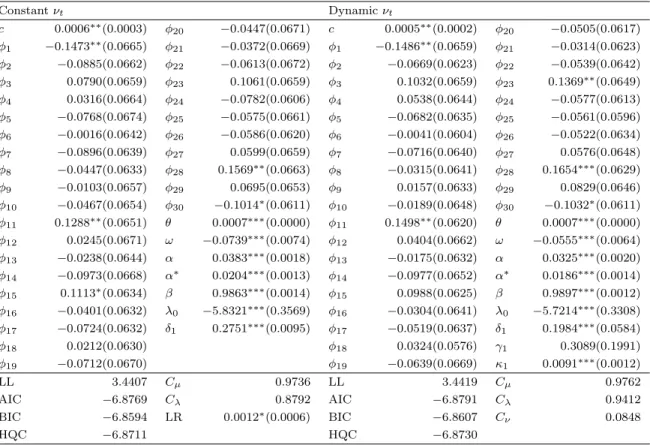
In this section, we present the ML results for AR-
t
-GARCH with leverage effects (Table 2),
t
-DCS (Table 2), GED--DCS (Table 3), Gen-
t
-DCS (Table 4), Skew-Gen-
t
-DCS (Table 5),
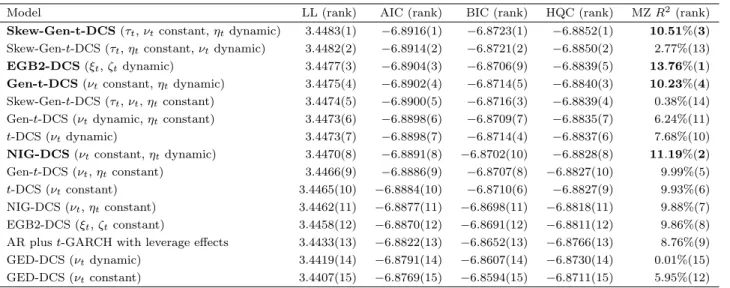
EGB2-DCS (Table 6) and NIG-EGB2-DCS (Table 7). We compare the LL-based performance of these models
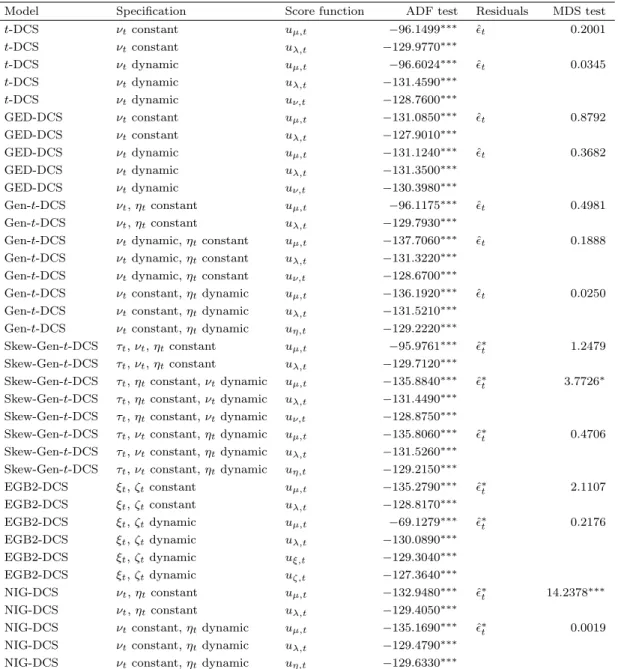
in Table 8. We present diagnostics of score functions and residuals in Table 9. We present the
evolution of scale parameters, shape parameters and volatility for all DCS models in Figs. 2 to 6.
For
t
-DCS, GED-DCS and EGB2-DCS, the ML procedure converged effectively for all
spec-ifications (i.e., all shape parameters are constant or all shape parameters are dynamic). For
Gen-
t
-DCS, three specifications were identified: (i)
ν
tand
η
tare constant (
ν
t=
δ
1and
η
t=
δ
2);
(ii)
ν
tis dynamic (
ν
t=
δ
1+
γ
1ν
t−1+
κ
1u
ν,t−1) and
η
tis constant (
η
t=
δ
2); (iii)
ν
tis constant
(
ν
t=
δ
1) and
η
tis dynamic (
η
t=
δ
2+
γ
2η
t−1+
κ
2u
η,t−1). For Skew-Gen-
t
-DCS, three
specifi-cations were identified: (i)
τ
t,
ν
tand
η
tare constant (
τ
t=
δ
1,
ν
t=
δ
2and
η
t=
δ
3); (ii) only
ν
tis dynamic (
τ
t=
δ
1,
ν
t=
δ
2+
γ
2ν
t−1+
κ
2u
ν,t−1and
η
t=
δ
3); (iii) only
η
tis dynamic (
τ
t=
δ
1,
ν
t=
δ
2and
η
t=
δ
3+
γ
3η
t−1+
κ
3u
η,t−1). For NIG-DCS, two specifications were identified: (i)
ν
tand
η
tare constant (
ν
t=
δ
1and
η
t=
δ
2); (ii)
ν
tis constant (
ν
t=
δ
1) and
η
tis dynamic
(
η
t=
δ
2+
γ
2η
t−1+
κ
2u
η,t−1). Our estimation results are summarized as follows.
First, for all cases, we find that some of the
φ
jparameters are significantly different from
zero. The scaling parameter of the score function with respect to location
θ
is positive and
significant for all models. For all cases, we find highly significant parameters of conditional
volatility. For almost all cases, we find that the dynamic parameters of shape (i.e.,
γ
1,
γ
2and
γ
3) are significant and positive (the only exception is GED-DCS with dynamic
ν
t, for which
γ
1is not significant). We also find that the scaling parameter of the score function with respect
to the shape (i.e.,
κ
1,
κ
2and
κ
3) is significantly different from zero for all cases (i.e., all DCS
specifications with dynamic shape are identified; Harvey 2013).
Second, we use the following model performance metrics: mean LL, mean Akaike information
criterion (AIC), mean Bayesian information criterion (BIC) and mean Hannan-Quinn criterion
(HQC) (Davidson and MacKinnon 2003). We find that the AIC-, BIC- and HQC-based
statisti-cal performances of the DCS model with dynamic shape are superior to the performance of the
DCS model with constant shape (Table 2 to 7). We also undertake a likelihood-ratio (LR) test
for non-nested models (Vuong 1989). We denote the conditional density functions of
y
tof the
respectively. We define
d
t= ln
f
(
y
t|
y
1, . . . , y
t−1)
−
ln
g
(
y
t|
y
1, . . . , y
t−1). We test whether LL of
DCS with dynamic shape is superior to that of DCS with constant shape by estimating
d
t=
c
+
twith OLS-HAC (ordinary least squares heteroskedasticity and autocorrelation consistent; Newey
and West 1987). If
c
is significantly positive then DCS with dynamic shape is superior to DCS
with constant shape. For almost all cases, we find that the DCS model with dynamic shape is a
superior specification (the only exception is Gen-
t
-DCS with dynamic
ν
tand constant
η
t). We
rank the LL-based performances of different models in Table 8.
Third, we estimate the Mincer–Zarnowitz (1969) (hereafter, MZ) regression, to rank volatility
forecast performances. For each model, we use ˆ
v
t2(i.e., a conditionally unbiased volatility proxy;
Patton 2011) as the dependent variable and the square of the conditional volatility (Section 3)
as the explanatory variable. Meddahi (2002) shows that the ranking of models based on the
R
2of the MZ regression is robust to noise for conditionally unbiased volatility proxies. We
indicate four models with the highest
R
2by using bold numbers in Table 8. Interestingly, all
those models have dynamics in
η
t,
ξ
tand
ζ
t, but not in
ν
t. Dynamic
ν
t(i.e., dynamic heavy
tails) reduces the MZ
R
2. The parameters
η
t,
ξ
tand
ζ
tare responsible for dynamic asymmetry
and dynamic peakedness of the distribution (Fig. 1).
Fourth, we present the MDS test results for ˆ
tand ˆ
∗tin Table 9. For most of the cases,
we find that the null hypothesis of the MDS hypothesis is not rejected at the 10% level of
significance (the only exceptions are NIG-DCS with
ν
tand
η
tconstant, and Skew-Gen-
t
-DCS
with
τ
t,
η
tconstant and
ν
tvariable).
Fifth, the conditions for
C
µ,
C
λand
C
ρ,kare satisfied for all models (Section 4).
Sixth, Figs. 2 to 6 indicate the following: (i) the shape parameters are time-varying for all
DCS models; (ii) for the DCS models with dynamic shape, the shape parameters identify the
dates of some extreme events; (iii) the scale and shape parameters can be decomposed into a
normal risk component influenced by small or moderate changes, and an extreme component
influenced by large jumps or falls; (iv) volatility exhibits greater jumps due to extreme events
for DCS with dynamic shape than for DCS with constant shape.
5.3. Decomposition of normal risk and extreme risk components
For the DCS models with dynamic shape, news updates volatility through
λ
tand
ρ
k,t. The
significant parameters
β
and
γ
k(Tables 2 to 7), and the estimates of
λ
tand
ρ
k,t(Figs. 2 to 6)
indicate that each series can be decomposed into a normal risk component that can be related
to normal events, and an extreme risk component involving significant jumps or falls that can
be related to extreme events.
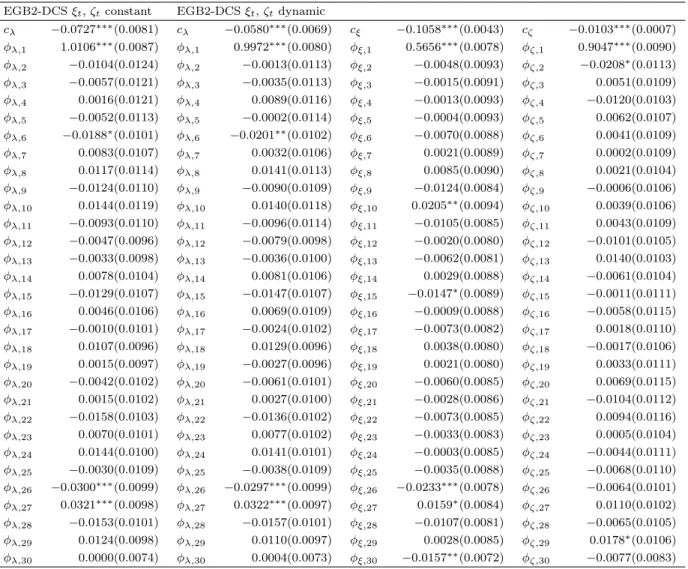
We decompose all ˆ
λ
tand ˆ
ρ
k,tseries by using the equations ˆ
λ
t=
c
λ+
P
30j=1
φ
λ,jˆ
λ
t−j+
e
λ,tand
ˆ
ρ
k,t=
c
ρ,k+
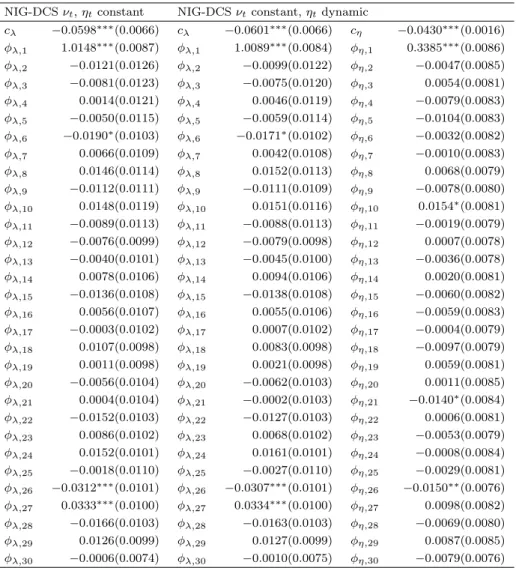
P
30j=1