The Geographical Journal, Vol. 174, No. 1, March 2008, pp. 45–62 Blackwell Publishing Ltd
Climate change in the Arctic: current and future
vulnerability in two Inuit communities in Canada
JAMES D FORD*, BARRY SMIT†, JOHANNA WANDEL†, MISHAK ALLURUT‡, KIK
SHAPPA‡, HARRY ITTUSARJUAT§ AND KEVIN QRUNNUT§
*Department of Geography, McGill University, 805 Sherbrooke St. W.,
Montreal, Quebec, Canada H3A 2K6 E-mail: [email protected]
†Department of Geography, University of Guelph, Guelph, Ontario, Canada N1G 2W1
E-mails: [email protected]; [email protected]
‡Hamlet of Arctic Bay, Nunavut X0A 0HO
§Hamlet of Igloolik, Nunavut XA 0LO
This paper was accepted for publication in July 2007
Climate change is already occurring in the Arctic and the Arctic Climate Impact Assessment recently concluded that future climate change could be devastating for Inuit. This paper characterises vulnerability to climate change in two Inuit communities in the Canadian territory of Nunavut, focusing on the resource harvesting sector. In both communities, Inuit have demonstrated significant adaptability in the face of current changes in climatic conditions. This adaptability is facilitated by traditional Inuit knowledge, strong social networks, flexibility in resource use, and institutional support. Changing Inuit livelihoods, however, have undermined certain aspects of adaptive capacity and have resulted in emerging vulnerabilities. Global and regional climate projections indicate that climatic conditions which currently pose risks are expected to be negatively affected by future climate change. These projections are not without precedent and analysis of current vulnerability and identification of adaptation constraints by Inuit in the two communities indicate the continued importance of traditional coping mechanisms. The ability to draw on these coping mechanisms in light of future climate change, however, will be unequal and the research indicates that young Inuit and those without access to economic resources, in particular, are vulnerable.
KEY WORDS: Nunavut, Canada, Arctic, climate change, vulnerability, Inuit, participatory research, resource management
Introduction
T
here is strong evidence that climate change is already occurring in the Canadian Arctic (McBean et al. 2005; Bonsal and Prowse 2006; Moore 2006). Documented changes include signifi-cant warming, increased precipitation, alterations in sea-ice dynamics, and a change in climatic variability and the occurrence of extremes (Gough et al. 2004; ACIA 2005; Stirling and Parkinson 2006). These changes are posing risks and hazards to Inuit com-munities in the Canadian territory of Nunavut, andresidents have expressed growing concern (Shirley 2005; Furgal and Sequin 2006). Many of these risks are associated with the harvesting of renewable resources, which continues to have importance to Inuit (AHDR 2004; Duhaime et al. 2004; Ford et al. 2006a). The procurement, sharing and consumption of traditional food contributes significantly to cultural identity, tradition and social cohesion, and estimates of the value of Nunavut’s land-based economy are between 40 and 60 million Canadian dollars per year (Conference Board of Canada 2001; Thompson 2004; Chan et al. 2006).
46 Climate change in the Arctic
Geographical Journal Vol. 174 No. 1, pp. 45–62, 2008 © 2007 The Author(s). Journal compilation © 2007 The Royal Geographical Society Global climate models (GCMs) project continued
increases in temperature and precipitation over the Canadian Arctic; alterations to the frequency, magnitude, and geographic distribution of climate related events; reduced areal extent and thickness of the sea ice and permafrost; and shifts in the distribution, abundance, and migratory behaviour of Arctic wildlife species (Derocher et al. 2004; Correll 2006; Serreze and Francis 2006; Serreze et al. 2007; Teng et al. 2006). These changes are likely to have widespread implications for resource harvesting, occurring in the context of challenges posed by ongoing social, cultural and economic change (Nuttall et al. 2005).
While there is general agreement that future changes in climate are likely to pose serious challenges to Inuit, little is known about the nature of change that can be accommodated by existing ways of life, what aspects of Indigenous livelihoods are at risk, what aspects of climate change are important to communities, how societal changes will affect how people experience climate change and their ability to respond, and what can be done to increase community adaptability (Duerden 2004; Nuttall et al. 2005). Policymakers and Inuit are demanding answers to these questions, and assessing climate change vulnerabilities has been identified as a major area where further research is required (GN 2003; ICARP 2005; Shirley 2005; Watt-Cloutier et al. 2005; Chapin et al. 2006; Gearhead et al. 2006).
This paper characterises vulnerability to climate change in two Inuit communities in the Canadian territory of Nunavut, focusing on the resource harvest-ing sector. It begins by reviewharvest-ing and synthesisharvest-ing previous research by the authors, identifying current climate-related conditions that are important to community livelihoods, documenting how they are managed, and characterising those factors that con-strain or enable management strategies. A synthesis of the dynamics of current levels of vulnerability outlined in previous research is a necessary first step in understanding the potential implications of climate change, providing a baseline from which to analyse future vulnerability. The paper then uses climate change projections to estimate how current climatic risks will be affected by climate change, and examines their potential implications for local livelihoods. Analogues of past response to climate variability and extremes, synthesised from previous research and interpreted in the context of climate projections and local impacts, are then used to evaluate adaptability to future change, completing the vulnerability analysis. The paper begins by describing the approach to assessing vulnerability employed here and how it was applied in the case study communities.
The vulnerability approach
To characterise vulnerability to climate change, this paper utilises the vulnerability approach of Ford and Smit (2004) and Ford et al. (2006a), which conceptualises vulnerability to climate change as a function of exposure and adaptive capacity. Exposure reflects the susceptibility of people and communities to climatic conditions, and adaptive capacity reflects a community’s potential or ability to address, plan for, or adapt to exposure. Exposure and adaptive capacity are not mutually exclusive. Exposure to repeated climate-related conditions, for instance, can develop experience of how to manage the climatic conditions, and enables ‘response with learning’, thus increasing the adaptive capacity of the system. Certain adaptive strategies can also change the nature of the community (location, structure, organisation), such that the community is more or less exposed, or exposed in a different way. In this conceptualisation, vulnerability at a local level is viewed as being conditioned by social, economic, cultural, political and climatic conditions and processes, operating at multiple scales over time and space, which affect community exposure and adaptive capacity. This is broadly consistent with other approaches to vulner-ability, including Turner et al. (2003), Eriksen et al. (2005), Belliveau et al. (2006), and Smit and Wandel (2006).
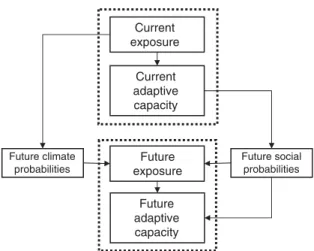
The analytical framework for vulnerability analysis is highlighted in Figure 1. Analysis starts by examin-ing past and present experience and response to climate variability, change and extremes, to charac-terise ‘current vulnerability’ (current exposure and
Figure 1 Analytical framework for vulnerability analysis (after Ford and Smit 2004)
Climate change in the Arctic 47 current adaptive capacity). This involves (1)
identifi-cation of climatic conditions that represent risks to community members; (2) characterisation of how communities manage and experience these risks; and (3) identification of those processes and con-ditions that influence exposure to climatic risks and determine the efficacy, availability, and success of past and present adaptations. ‘Future vulnerability’ (future exposure and future adaptive capacity) is assessed by estimating directional changes in community-identified climate-related exposures and assessing future adaptive capacity on the basis of past behaviour and community identification of future adaptation options, constraints, and opportunities.
Place-based case studies are employed in this approach to characterise vulnerability. Vulnerability will vary between nations, regions, communities, and even within communities, on the basis of differential exposure to climate change effects and differential adaptive capacity (Turner et al. 2003). Understand-ing the dynamic interaction between humans and the environment requires case studies situated in particular places and cultures. Furthermore, identifying climate-related conditions that are relevant to people, how they affect people and their livelihoods, the management strategies they employ, and how climate change might affect future activities, can only be achieved through engaging communities directly and documenting their knowledge (Tyler et al. 2006). Actively involving communities in the research process is also ethically important and central in linking research to policy. Interventions to reduce vulnerability will be more successful if they are identified and developed in co-operation with local actors, as they are more likely to have the trust of the community and be meaningful to individuals and communities (Chapin et al. 2006).
Case study communities
Several criteria were established to guide the selection of the case study communities. Firstly, the communities had to have indicated the need for the proposed research. This was established on the basis of consultation with regional and national Inuit organisations, regional science bodies and pre-liminary community visits. Secondly, to avoid research contamination and to avoid community ‘research overload’, it was important that communities had limited research in progress, or scheduled, at the time of planned fieldwork, especially research on climate change. Thirdly, the communities had to be in the same territory to allow for comparison of research findings: Nunavut was selected due to the severity of observed and projected changes in climate and established research need. Finally, the selected communities had to be representative of
communities throughout Nunavut (small, largely Inuit, and dependent upon the harvesting of renew-able resources) to provide a lens with which to examine the processes shaping current and future vulnerability across the territory. On the basis of these criteria, Arctic Bay and Igloolik were selected (Figure 2).
Igloolik is a coastal Inuit community of 1538 people located on Igloolik Island in northern Foxe Basin, approximately 320 km north of the Arctic Circle. Arctic Bay is also a coastal Inuit community of 690 people, located on north Baffin Island approximately 700 km north of the Arctic Circle. Both settlements have expanded rapidly since the 1960s, and their economies have shifted from being based largely on subsistence activities to mixed economies, where both the informal and formal economic sectors assume an important role. Harvest-ing of renewable resources continues to be a valued activity in both communities and is central to social, cultural and economic well-being.
Data collection
During the first field season (2004–5), in-depth semi-structured interviews with community members were conducted to identify climate-related risks that people have to deal with (current exposure); to provide insights into how these risks are experi-enced and managed (current adaptive capacity); to identify the processes and conditions which have determined the efficacy, availability, and success of past and present adaptations (current adaptive capacity); and to characterise community adaptability to cope with future climate change (future adaptive capacity).
In Igloolik, 40 interviews were conducted with a cross section of community members and in Arctic Bay, 65. Semi-structured interviews are a standard method for gathering information in an open-ended format and have been used widely in various northern research contexts (Huntington 1998; Fienup-Riordan 1999; Gearhead et al. 2006). A fixed list of ques-tions was avoided in favour of an interview guide identifying the key themes to cover. This allowed for flexibility in the interview: participants were guided by the interviewer’s questions, but the direction and scope of the discussion followed the associations they identified, thereby allowing participants to identify and specify conditions and processes they found important, with openness allowing for new and unexpected relationships to be conveyed. A purposive sampling strategy was employed to obtain sufficient representation of all groups in the community. Within identified groups, interviewees were identified by a ‘snowball’ sampling method under which community assistants identified
48 Climate change in the Arctic
Geographical Journal Vol. 174 No. 1, pp. 45–62, 2008 © 2007 The Author(s). Journal compilation © 2007 The Royal Geographical Society people willing to take part, who in turn suggested
others who might be willing to be involved. The data collection was undertaken with two Inuit colleagues in each community. Interviews were conducted in Inuktitut and in English, with the majority of interviews taking place in the homes of interviewees. Simultaneous translation by local Inuit colleagues was employed for interviews conducted in Inuktitut.
The interviews were complemented with experien-tial hunting trips with Inuit and informal meetings with key informants. The analysis of secondary sources, including interviews in the Igloolik Oral History Project, government reports, newspaper articles, books, university theses, accounts of polar explorers, and journal articles, was used to add an historical context on how communities manage and experience climatic variability and change (current exposure and current adaptive capacity). Collabor-ation with researchers in the climate science com-munity and analysis of published scientific papers was used to evaluate the likelihood and nature of changes in the climatic exposures identified by the communities as being important to their livelihoods,
and to identify new risks which may emerge with future climate change (future exposure). A char-acterisation of future exposure provided the basis from which to assess community adaptability to cope with climate change.
During the second field season (2005–6), the results and interpretation from the first field session were evaluated and reviewed with community members via follow-up interviews, radio show discussion, and community question and answer sessions.
Current exposure in Arctic Bay and Igloolik
Exposure to climatic risks in the harvesting sector is jointly determined by the characteristics of clim-atic conditions and harvesting behaviour. Climclim-atic characteristics of particular concern include magni-tude, frequency, spatial dispersion, duration, speed of onset, timing, and temporal spacing of conditions. Whether these conditions represent risks depends upon harvesting behaviour: for example, thin sea ice in late spring is only a problem if hunters are utilising the ice at this time of the year. Harvesting behaviour,
Figure 2 Location of Arctic Bay and Igloolik, Nunavut Source: Ford et al. (2007)
Climate change in the Arctic 49 and hence exposure, varies between individuals
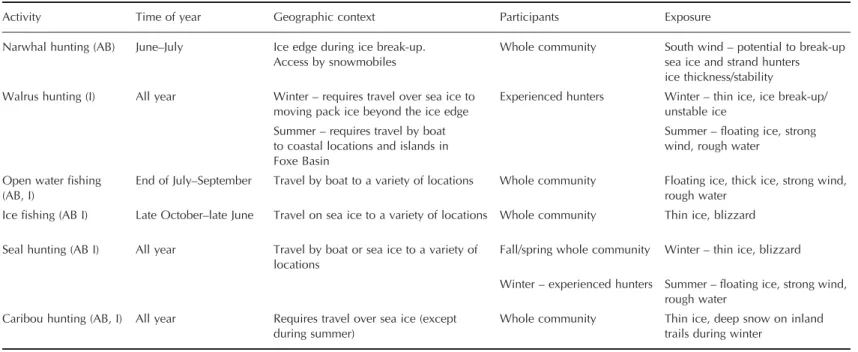
within a community and between communities, according to what animals are harvested, where, and at what time of the year. These decisions are influenced by an individual’s knowledge of the environment, past experience, time constraints, and access to appropriate technology. Table 1 demon-strates how exposure varies according to the nature of harvesting in Arctic Bay and Igloolik.
A combination of changing climatic conditions, superimposed on longer term changes in harvesting behaviour, has altered and tended to increase harvesting-related exposures. These are discussed below.
Climate change
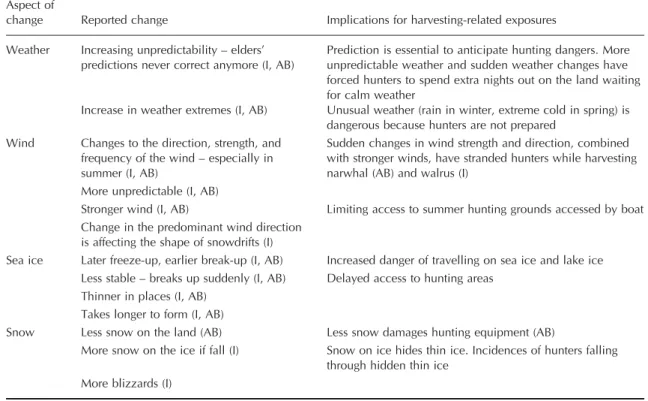
There is a widespread feeling among Inuit in Arctic Bay and Igloolik that climatic conditions have been changing beyond expected natural fluctuations and variability since the 1990s (Shooyook 2004; Ulayuruluk 2004; Ford 2005). These observations are consistent with instrumental records for the eastern Canadian Arctic (McBean et al. 2005; Noonan et al. 2005; Moore 2006). Superimposed on changing harvesting behaviour, this has amplified the magnitude and frequency of hazardous conditions associated with hunting and reduced access to hunting loca-tions. Table 2 identifies observed changes and their implications for harvesting related exposures.
Some of the most dramatic changes have occurred in the strength, direction, and predictability of the wind and ice conditions; conditions to which narwhal and walrus hunting in particular are highly sensitive (Ikummaq 2004; Akumalik 2004). Cues that were traditionally used to predict weather and to assess the safety of travel on the sea ice and open water, for example, are now less predictive (Kalluk 2004; Qavavauq 2004; Ulayuruluk 2004). Other changes have been observed in the condition of the sea ice, including later and longer ice freeze-up, earlier break-freeze-up, thinner ice, more snow on the ice, and new areas of open water (Awa 2004; Enoogoo 2004). All activities which require travel on the sea ice are sensitive to changes in ice con-ditions, and climate change is increasing the dangers of sea-ice use.
Changes in harvesting behaviour
The latter half of the twentieth century witnessed dramatic changes in Inuit hunting strategies. One of the most significant changes has been the devel-opment of the floe edge (i.e. edge of ice that is anchored to the land) narwhal hunt in Arctic Bay. Traditionally narwhal were only hunted from open water in August and September by kayak (Attagutsiak
2004; Oyukuluk 2004). However, starting in the 1970s, a combination of growth in the waged economy in Arctic Bay, settlement of semi-nomadic hunting groups in the community, development of a com-mercial hunt, imposition of quotas on narwhal, and the use of snowmobiles resulted in hunters harvesting narwhal from the floe edge in late spring (classed as June and July by Inuit in Arctic Bay) during sea-ice break up. This significantly changed the nature of exposure. The ice in late spring is in the final stages of melting prior to break-up. Ice leads, cracks, and pools of water on the ice make travel time-consuming and dangerous. Hunters are also at risk of being caught on drifting ice which is detached from the floe edge by a southerly wind. Each year people get stranded and have to wait for a north wind to push them back into the landfast ice, or wait to be rescued (George 2000; Barnabas 2004). By contrast, hunting narwhal by kayak in open water entailed relatively few risks (Shappa 2005; see Aporta and Higgs 2005 for Igloolik example of changes in harvesting behaviour).
Exposure has also been affected by changes in individual risk assessment when making decisions regarding hunting, with people more likely to harvest at times of the year, or in weather conditions, traditionally considered unsuitable (MacDonald 2004; Ungalak 2004). Ford et al. (2006a) argue that this is partly due to the reduced time available to harvest, with many hunters having full or part-time jobs in addition to hunting activities. Time off from work, to be used for hunting trips, must be booked in advance. Weather or safety concerns may, therefore, be superseded by consideration of time availability when harvesting decisions are made (Awa 2004; Kalluk 2004). More risk-taking behaviour is also associated with technological developments, includ-ing the use of global positioninclud-ing systems (GPS), VHF radios, and the functioning of community search and rescue teams. As Aporta and Higgs (2005) note, while such technologies increase safety, in many ways they have also resulted in less caution and some overconfidence stemming from an increasing sense of security. Consequently, some hunters are now travelling and hunting in conditions that would have traditionally been considered too dangerous (Attitaq 2004; Ikummaq 2004; Ungalak 2004). Concerns have also been expressed that adoption of such technology, and less frequent participation in hunting among younger generations, have resulted in the loss of certain skills necessary for safe hunting (Issigaituk 2004; Paniaq 2004; Ulayuruluk 2004). These skills include the ability to identify precursors to hazardous conditions, what to do in certain dangerous situations, how to dress appropriately, and what equipment to take along on trips. A consequence of this has been that climatic stresses
50
Climate change in the Arctic
Geographical Journal
Vol. 174 No. 1, pp. 45–62, 2008
© 2007 The Author(s). Journal compilation © 2007 The Royal Geographical Society
Table 1 The nature of current exposure in Arctic Bay (AB) and Igloolik (I)
Activity Time of year Geographic context Participants Exposure Narwhal hunting (AB) June–July Ice edge during ice break-up.
Access by snowmobiles
Whole community South wind – potential to break-up sea ice and strand hunters ice thickness/stability Walrus hunting (I) All year Winter – requires travel over sea ice to
moving pack ice beyond the ice edge
Experienced hunters Winter – thin ice, ice break-up/ unstable ice
Summer – requires travel by boat to coastal locations and islands in Foxe Basin
Summer – floating ice, strong wind, rough water
Open water fishing (AB, I)
End of July–September Travel by boat to a variety of locations Whole community Floating ice, thick ice, strong wind, rough water
Ice fishing (AB I) Late October–late June Travel on sea ice to a variety of locations Whole community Thin ice, blizzard Seal hunting (AB I) All year Travel by boat or sea ice to a variety of
locations
Fall/spring whole community Winter – thin ice, blizzard Winter – experienced hunters Summer – floating ice, strong wind,
rough water Caribou hunting (AB, I) All year Requires travel over sea ice (except
during summer)
Whole community Thin ice, deep snow on inland trails during winter
Climate change in the Arctic 51
that previously caused hunters few problems are now a matter of life and death for many young Inuit. Dynamic exposure
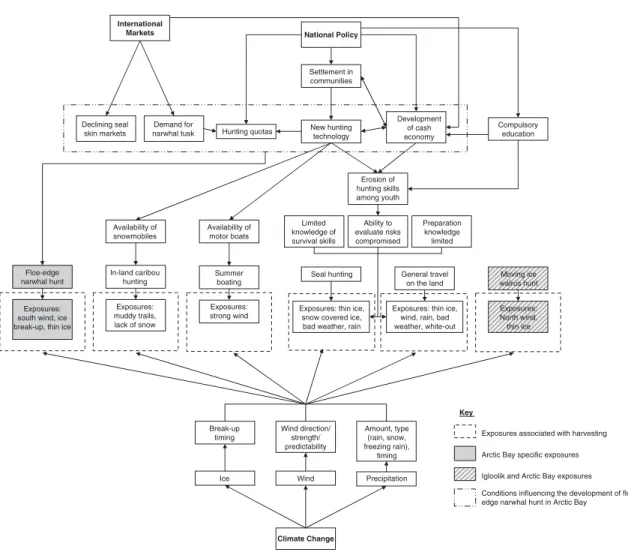
As the above discussion makes clear, harvesting-related climatic exposures are clearly dynamic, changing as harvesting behaviour relative to the climatic conditions changes, and changing as the climatic conditions themselves change. Figure 3 illustrates how these drivers of changing exposure are interdependent, how processes operating at different spatial scales have combined to alter exposure at a community level, as well as the importance of inter-actions between human and climatic processes. For example, it highlights how, over time, the erosion of hunting skills, traced to community sedentarisation in the 1960s and the imposition of ‘southern’ educational requirements by the Canadian federal government, has increased exposure of young Inuit to risks associated with seal hunting by gradually eroding traditional land skills over time, and how climate change has subsequently compounded this trend by increasing the dangers of a lack of hunting knowledge and skills. It highlights how new technology – also traced to sedentarisation in
the 1960s and associated reduced harvesting flexibility (see Wenzel 1991) – has altered hunting behaviour thereby increasing susceptibility to climatic conditions. Thus, in Igloolik many travel long dis-tances (>150 km) over Melville Peninsula to access caribou, an activity susceptible to snow depth and texture. In recent years, powdery soft snow has made accessing caribou difficult by increasing the travel time and fuel costs (Ulayuruluk 2006; Uttak 2006). Prior to the use of snowmobiles, dog teams were less susceptible to powdery snow and hunting camps were often located close to the caribou, thereby negating the need for long-distance travel.
While in the geographic literature the dynamic nature of physical exposure has long been acknow-ledged (Hewitt 1983; Watts 1983; Cutter, 1996; O’Brien et al. 2004), research in the climate change field in general, and the Arctic in particular, has largely focused on physical stress in isolation from human interaction. As the above discussion makes clear, changing exposure in many instances can only be understood in relation to changes in how people use the environment. Even in the most remote areas, national and international processes shape local resource use and hence exposure to climate risks.
Table 2 Implications of changing climatic conditions for harvesting-related exposures in Arctic Bay (AB) and Igloolik (I) Aspect of
change Reported change Implications for harvesting-related exposures Weather Increasing unpredictability – elders’
predictions never correct anymore (I, AB)
Prediction is essential to anticipate hunting dangers. More unpredictable weather and sudden weather changes have forced hunters to spend extra nights out on the land waiting for calm weather
Increase in weather extremes (I, AB) Unusual weather (rain in winter, extreme cold in spring) is dangerous because hunters are not prepared
Wind Changes to the direction, strength, and frequency of the wind – especially in summer (I, AB)
Sudden changes in wind strength and direction, combined with stronger winds, have stranded hunters while harvesting narwhal (AB) and walrus (I)
More unpredictable (I, AB)
Stronger wind (I, AB) Limiting access to summer hunting grounds accessed by boat Change in the predominant wind direction
is affecting the shape of snowdrifts (I)
Sea ice Later freeze-up, earlier break-up (I, AB) Increased danger of travelling on sea ice and lake ice Less stable – breaks up suddenly (I, AB) Delayed access to hunting areas
Thinner in places (I, AB) Takes longer to form (I, AB)
Snow Less snow on the land (AB) Less snow damages hunting equipment (AB)
More snow on the ice if fall (I) Snow on ice hides thin ice. Incidences of hunters falling through hidden thin ice
52 Climate change in the Arctic
Geographical Journal Vol. 174 No. 1, pp. 45–62, 2008 © 2007 The Author(s). Journal compilation © 2007 The Royal Geographical Society Current adaptive capacity
Adaptive strategies
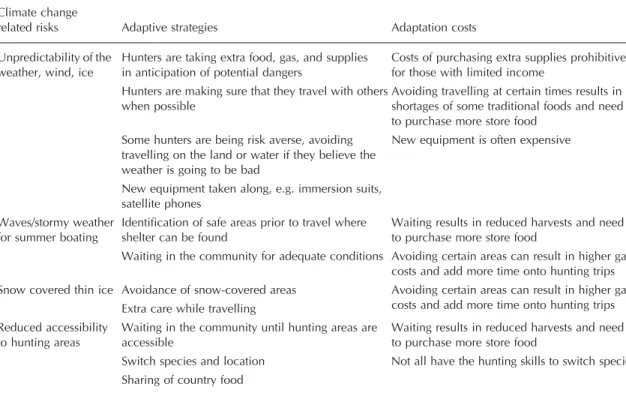
Table 3 shows how changes in exposure are being managed using several strategies, including risk management, risk avoidance and risk sharing. As Ford et al. (2006b) note, these are being undertaken in response to observed and anticipated changes in climatic and environmental conditions. Many of these adaptive strategies are being utilised through-out the Canadian Arctic (Berkes and Jolly 2002; Nickels et al. 2005; Gearhead et al. 2006; Pearce 2006). Table 3 also highlights that these strategies are not without their costs and not all people have equal access to them. Technological adaptations,
for instance, are only available to those who can afford them, and there is evidence that the adoption of new technology may increase inequalities within communities. The effectiveness of adaptation also varies. Some adaptation technologies, such as GPS and VHF radios, can increase exposure by encourag-ing risk-takencourag-ing behaviour (Aporta and Higgs 2005). Determinants of adaptive capacity
The ability of Inuit in Arctic Bay and Igloolik to cope with changing exposure is indicative of their adaptive capacity. As argued by Ford et al. (2006b), this adaptive capacity is facilitated by Inuit traditional knowledge and land-based skills, strong social net-works, resource use flexibility and institutional support.
Figure 3The interaction of climatic and human processes at multiple scales driving changing exposure in Arctic Bay and Igloolik
Climate change in the Arctic 53
Inuit traditional knowledge and land-based skills are important in facilitating adaptive capacity. From knowledge passed down the generations and from personal experience, hunters learn the inherent dangers of hunting; how to evaluate risks; what preparations to make before hunting; and what to do in emergency situations (Aqiaruq 2004; Kalluk 2004). As a repository of accumulated experience and knowledge of changing conditions and success-ful adaptations, Inuit knowledge is drawn upon by hunters to minimise the risks of hunting and maximise opportunities. It is a highly experiential form of knowledge, continually being updated and revised in light of observations, trial and error experience, and incorporation of non-traditional knowledge alongside the traditional (Wenzel 1991; Stevenson 1997; Berkes 1999; Laidler 2006). As Ford et al. (2006a 2006b) note, the increasing unpredictability of climatic conditions in recent years, for example, is now part of the collective social memory that frames individual practice and decision-making. Hunters now make extra preparations in expectation of being stranded and are being more careful when travelling on the ice (Arnatsiaq 2004; Ikummaq 2004; Qavavauq 2004). This ability to learn and to
combine new experiences with traditional knowledge confers significant adaptability.
Strong social networks are drawn upon to manage exposure. In both Igloolik and Arctic Bay, there is a high level of interdependence within the extended family unit, and a strong sense of collective community responsibility (Aqiaruq 2004; Joseph 2004; Levi 2004). Sharing remains an affirmation of Inuit identity, and people take the responsibility seriously. Social networks facilitate the sharing of traditional foods in the extended family unit. This is particularly important in underpinning the food security of those who do not have the time, money or knowledge to hunt in light of changing exposure. Equipment, such as GPS, radios, and other safety equipment, is shared within the extended family unit and occasionally with friends. In coping with changing climatic conditions, this is particularly important given the expense of equipment. The sharing of knowledge facilitates the communication of information about risks and adaptive strategies. Knowledgeable and experienced hunters act as an ‘institutional memory’, maintaining and transmitting local knowledge and providing information during periods of change.
Table 3 Strategies currently employed to manage climate change related risks in Arctic Bay and Igloolik Climate change
related risks Adaptive strategies Adaptation costs
Unpredictability of the weather, wind, ice
Hunters are taking extra food, gas, and supplies in anticipation of potential dangers
Costs of purchasing extra supplies prohibitive for those with limited income
Hunters are making sure that they travel with others when possible
Avoiding travelling at certain times results in shortages of some traditional foods and need to purchase more store food
Some hunters are being risk averse, avoiding travelling on the land or water if they believe the weather is going to be bad
New equipment is often expensive
New equipment taken along, e.g. immersion suits, satellite phones
Waves/stormy weather for summer boating
Identification of safe areas prior to travel where shelter can be found
Waiting results in reduced harvests and need to purchase more store food
Waiting in the community for adequate conditions Avoiding certain areas can result in higher gas costs and add more time onto hunting trips Snow covered thin ice Avoidance of snow-covered areas Avoiding certain areas can result in higher gas
costs and add more time onto hunting trips Extra care while travelling
Reduced accessibility to hunting areas
Waiting in the community until hunting areas are accessible
Waiting results in reduced harvests and need to purchase more store food
Switch species and location Not all have the hunting skills to switch species Sharing of country food
54 Climate change in the Arctic
Geographical Journal Vol. 174 No. 1, pp. 45–62, 2008 © 2007 The Author(s). Journal compilation © 2007 The Royal Geographical Society Indigenous resource use systems in the
unpre-dictable and variable Arctic climate are based on sequential utilisation of a large number of ecological and climate niches (Tyler et al. 2006). Such systems distribute risk through diversity and flexibility, facilitating the management of fluctuations in the availability and accessibility of resources. Inuit hunting in Igloolik and Arctic Bay is opportunistic. While there are preferred seasons and locations to hunt, hunters will harvest what is available when it is available and where. In Arctic Bay, for instance, if the caribou hunt in August and September fails, other fall-back species, such as seal, will be harvested (Akumalik 2004; Allurut 2004). Substitution allows people to cope with variations in animal numbers, enables the management of changes in the accessibility of hunting locations, and enables the advantage of new hunting opportunities to be taken as they arise. Inuit in Arctic Bay and Igloolik have adapted their hunting and fishing times to compensate for the changes in species availability and access, to continue to provide fresh traditional foods.
Economic and institutional support is also impor-tant in enabling Inuit to manage harvesting-related climatic exposures. Monetary transfers from the federal government, and emerging institutional support from the Nunavut government and Inuit institutions, play an important role in providing financing for the purchase of equipment to cope with the changing exposure. This is particularly important in an Arctic context, where high levels of unemployment and limited opportunities to earn money limit the extent to which hunters can purchase safety equipment. Emerging vulnerabilities
Limits to adaptation are already evident in Igloolik and Arctic Bay. Financial costs in many instances limit access to adaptive strategies, adaptive strate-gies are not always effective, and they may entail unacceptable socio-cultural costs, as indicated in Table 3. Furthermore, Ford et al. (2006a 2006b) note that characteristics of Inuit society that traditionally facilitated adaptive capacity have also been altered as a result of changing livelihoods during the latter half of the twentieth century. Over time, this has resulted in the emergence of vulnerable groups, specifically younger generation Inuit and those without access to economic resources.
An erosion of Inuit traditional knowledge – through which hunting risks are managed – has been documented among younger generation Inuit in Igloolik and Arctic Bay (Aporta 2004; Takano 2004; Pratley 2005), and throughout the Canadian Arctic (Condon et al. 1995; Newton 1995; Gearhead et al. 2006; Henshaw 2007; Pearce 2006). While subsistence activities remain important to younger
generations, few could be considered active hunters, compared to their parents or what would have traditionally been expected of youth. This has been attributed to southern educational requirements which result in decreased time to participate in hunting; increased dependence on waged employ-ment; the expense of hunting; a general shift in social norms; and inter-generational segregation between younger and older generations (Condon et al. 1995; Kral 2003; Takano 2004; Henshaw 2007). This disconnection from the land has had wide-ranging implications. The processes by which Inuit traditional knowledge and land-based skills are developed and learned require experience of being regularly out on the land and observing others. Absence from participation in hunting while growing up prevents youth from gaining the experience necessary to hunt safely and productively. Certain skills necessary for safe and successful harvesting have been lost, including traditional forms of navigat-ing without instruments (Kalluk 2004; Muckpaloo 2004; Ungalak 2004; Ulayuruluk 2004). Other skills have been inadequately developed, including how to dress appropriately, what to take along on trips, and the ability to identify precursors to hazardous conditions (Ikummaq 2004; Joseph 2004). This has increased the vulnerability of young Inuit when they travel and hunt without experienced hunters.
The functioning of social networks has been affected by a decrease in importance of the extended family unit, the emergence of inter-generational segregation, a decline in the practice of traditional cultural values, a concentration of resources in fewer hands, and the emergence of social conflict (Arnatsiaq 2004; Ivvalu 2004; Tatatuopik 2004). The increasing importance of money has created division and social tension, and has entered into previously non-monetary sharing practices. The sharing of equipment, in particular, is under increasing stress with many younger family members expressing disinclination to share their equipment with others in the family unit and demanding payment where sharing does occur. Access to money and equipment provided by family sharing networks is critical in facilitating the ability of full-time hunters, and those without access to economic resources, to harvest safely and successfully, especially in light of climate change which is placing increasing financial burden on hunters. Adaptive capacity is constrained in instances where access to sharing networks is limited, to the extent that engaging in the subsistence economy, or res-ponding to climate change, is not possible for some. The increasing importance of money has also resulted in the economic dependence of both Arctic Bay and Igloolik to the volatility of external markets and government support. For example, as Ford et al. (2006a) and the Government of Nunavut
Climate change in the Arctic 55 note (DSD 2002), the recent closure of the Nanisivik
lead–zinc mine near Arctic Bay forced many former employees to sell their hunting equipment which they can no longer afford. For young Inuit, in particular, the lack of monetary resources limits the opportunities to take part in harvesting activities, further reinforcing the decline in participation and erosion of land-based skills.
New technology, to an extent, has emerged to fill the weakening of social networks and the erosion of traditional Inuit knowledge and land-based skills. GPS, for instance, means that knowledge of tradi-tional navigatradi-tional skills is not as essential for safe travel. Snowmobiles permit hunters to travel long distances quickly, and without the knowledge required to operate a dog team. New technology, however, has increased risk-taking behaviour and has increased dependency on monetary resources (Aporta and Higgs 2005). Institutional support from government is also important: people no longer starve in years when there are no animals, as happened occasionally in the past. Equally, there is also evidence that such support has heightened some inequalities in the community, further promoting a weakening of social networks (Ford et al. 2006a).
Future exposure
In the framework for vulnerability analysis, future exposure characterises how those climatic conditions identified by communities as being important for harvesting activities will be affected by climate change, and identifies unforeseen climate change risks. Where available, regionally downscaled climate change projections were used to achieve this. Down-scaled projections provide detailed regional and site scenarios of climate change for community-based vulnerability analyses, incorporating regional climate controls omitted by coarse-scale global climate models (GCMs) (see CICS 2006). Where only coarse resolution projections were available, general trends identified by scenarios were utilised to indicate the direction of expected change. Future exposure also involves characterising how changes in livelihood conditions will affect how people experience chang-ing climatic conditions.
Future climate change: projections and implications Travel and hunting on the sea ice Travel and hunting on the sea ice is affected by the thickness, stability, and extent of the ice. Narwhal and walrus hunting, in particular, are activities affected by the ice; both are conducted at locations and at times of the year recognised to be dangerous, due to the susceptibility of sea ice to induce break-up (Paniaq 2004; Shooy-ook 2004). Ice conditions also play an important
role in determining the accessibility of the floe edge where narwhal and walrus are harvested. In 1987, for instance, poor ice conditions (thin and unstable ice) resulted in the narwhal harvest being only 18% of the previous 4 years in Arctic Bay (Roberge and Dunn 1990). In the Igloolik region, Dumas et al. (2005) project a decrease in sea ice thickness of 50 cm by 2081–2100 and a reduction in ice stability. While no model runs have been completed for Arctic Bay, the projections from Igloolik provide a guide to the general trends in sea ice likely to be experienced in the Arctic Bay region (Dumas personal communication). Such changes would increase the dangers of travelling to the floe edge and reduce accessibility. Furthermore, by the end of the century, scenarios indicate a decrease in ice duration of 2 months by 2081–2100, with break-up occurring in early June compared with July (Dumas et al. 2005). This is not necessarily a problem for walrus hunting, which takes place in winter, but would compromise the ability to harvest narwhal from the floe edge in July.
Accessibility of hunting areas is affected by the time it takes for the sea to freeze. Sea-ice models for the Igloolik region indicate climate change will delay the timing of freeze-up (Dumas et al. 2005), a trend that can also be expected in the Arctic Bay region (Dumas personal communication). This will be problematic, particularly for hunters from Igloolik. Igloolik is located on an island and once the ocean freezes, preventing the use of boats, waiting for the ice to reach a thickness capable of supporting snowmobiles is critical; until this thickness is reached, hunters are unable to access hunting areas on the mainland and at the floe edge (Ittusujurat 2004; Qrunnut 2004). This has resulted in shortages of traditional food in the past and creates anxiety in the community. Additionally, increasing temperatures are likely to make the sea ice more labile and dynamic, and reduce connectivity (Derocher et al. 2004). This will increase the risks of travelling on the ice, especially during freeze-up, compounding the problems caused by the longer freeze-up in Igloolik. Travel on the sea ice is also sensitive to wind conditions (speed, direction, predictability), espe-cially during freeze-up and break-up. In Igloolik, a wind from north-west pushes the moving pack ice, on which hunters harvest walrus, away from the stable landfast ice (Ikummaq 2004; Paniaq 2004). In Arctic Bay, a south wind, if strong enough, can detach floe-edge ice from the stable landfast ice and blow it out to the open ocean; each year hunters get stranded this way and occasionally have to be rescued (George 2000; Ford and the Community of Arctic Bay 2006). Climate change models indicate the potential for an increase in extreme events and wind. However, predictions at a local to regional
56 Climate change in the Arctic
Geographical Journal Vol. 174 No. 1, pp. 45–62, 2008 © 2007 The Author(s). Journal compilation © 2007 The Royal Geographical Society level are insufficient at present to justify any firm
conclusions about how wind might be affected by climate change (Kattsov and Kallen 2005). Open water travel and fishing From mid-July to early October, travel by boat is possible in both Arctic Bay and Igloolik. Boats are used to access hunting areas, fish stocks, and, in Igloolik, to hunt walrus amongst the loose pack ice. In both communities, trips can involve travel over significant distances of exposed water. These activities are sensitive to winds, floating ice and fog which affect the ability to use a boat and compromise safety (Aqiaruq 2004; MacDonald 2004). Climate change will affect these conditions. By the end of the century, models indicate a decrease in ice duration of 2 months by 2081–2100, with break-up occurring in early June and freeze-up in late October/early November (Dumas et al. 2005). By 2041–2060, ice duration is predicted to decrease by 1 month. These changes – while problematic for the Arctic Bay narwhal hunt – would extend the boating and open-water fishing season, which both communities identify as beneficial (Awa 2004; Kalluk 2004). Regarding sensitivities surrounding wind, fog, and floating ice, the available research is insufficient at present to indicate how they might be affected by climate change (Kattsov and Kallen 2005).
Land travel In both communities, people travel over land to access hunting areas, to travel to camps and to visit other communities. Travel largely takes place by snowmobile from October to July and is dependent upon the presence, depth and type of snow. Too little snow on the trails can damage snowmobiles; too much snow can make travel slow and increase fuel costs. There are large uncertainties in projecting the implications of climate change for snow cover, although Walsh and Chapman (2007) indicate that it is reasonable to assume that a warming climate has the potential to increase snowfall. Increased snowfall would have negative implications for Igloolik caribou hunters. In 2006, deep powdery snow on Melville Peninsula (a major hunting area) increased the time and financial costs of hunting caribou, forcing many to avoid the hunt, and a shortage of caribou meat followed (Uttak 2006). In Arctic Bay, however, too little snow on the land has been a problem in recent years, causing damage to snowmobiles, and more snow, to a certain extent, would be beneficial.
Weather extremes Hunting is sensitive to weather extremes. Precipitation in the form of rainfall and wet snow is problematic in both Igloolik and Arctic Bay in spring. Spring is generally popular for hunting and travelling, with its significant daylight, warmer
temperatures and stable ice. This time of the year is particularly popular with young Inuit, who on ‘warm days’ (in springtime above around −10°C) will often go hunting without adequate winter clothing (MacDonald 2004). If the weather changes and it starts to rain or wet snow falls or there are rapid temperature shifts, then lack of adequate clothing can be fatal. Near-death experiences have been documented in both communities (George 2000; Ford et al. 2006a). Climate change will have impli-cations for these extremes. Higher amounts of precipitation and greater precipitation intensity are projected for Arctic regions, including the high eastern Canadian Arctic, especially in spring and summer (Gagnon and Gough 2005; Kattsov and Kallen 2005).
Animal abundance and distribution Climate change is expected to have implications for the presence, abundance, distribution and migration of wildlife species which are of cultural and economic impor-tance to Inuit in Arctic Bay and Igloolik. In combina-tion with changes in accessibility and hazardousness of hunting described above, it will present challenges to resource harvesting.
Decreasing numbers and accessibility of narwhal would have serious ramifications for Inuit in Arctic Bay. Narwhal are mammals of particular importance to Arctic Bay’s Inuit. Predicted increases in sea-ice concentrations and later ice break-up in narwhal wintering areas in Baffin Bay (Sewall and Sloan 2004) could delay the timing at which narwhal arrive in the Arctic Bay region until August and negatively affect numbers (Laidre and Heide-Jorgensen 2005; Simmonds and Isaac 2007). Combined with pre-dicted earlier sea-ice break-up in the Arctic Bay region, this could make floe-edge narwhal hunting no longer viable.
Ringed seals are hunted year-round by experienced hunters, youth and ‘weekend hunters’. Seals are believed to be particularly vulnerable to changes in the extent and character of sea ice because they depend on the ice for pupping, lactation, haul-out, moulting, and as a resting platform (Tynan and DeMaster 1997; Ferguson 2005). Harwood et al. (2000), for instance, demonstrate a link between the premature break-up of the sea ice and high pup mortality. Predictions of earlier sea-ice break-up could therefore have negative implications for seal numbers in the Igloolik and Arctic Bay region. Stirling and Smith (2004) predict that increased rainfall in spring will increase the collapse of birth lairs, resulting in higher pup mortality in Nunavut. Ferguson (2005) demonstrates such a link in his work in Hudson Bay, where lower snow depth and warmer temperatures in the months of April and May from 1990 to 2001 resulted in low seal pup survival.
Climate change in the Arctic 57 Caribou are hunted all year for food and clothing.
Past episodes of caribou die-off, due to adverse environmental conditions, indicate their potential sensitivity to climate change. Of critical importance to caribou survival in winter is the accessibility of forage beneath the winter snow pack (Gunn 1993). A deep snowpack can limit foraging and cold snaps, following wet snow or icing on the ground surface, can create a layer of thick impenetrable ice (Weladji and Oystein 2003). Miller and Gunn (2003), for instance, documented a 97% decrease in caribou numbers from 1994 to 1995/6 in the Canadian High Arctic, associated with an unusually hard icy snow pack during early winter (September– November) which created unfavourable foraging conditions. Hunters in Arctic Bay and Igloolik documented similar events to have occurred histor-ically (Akumalik 2004; Ulayuruluk 2004). Climate models indicate that these unfavourable conditions will be more common in the future, with increased frequency of winter freeze–thaw cycles and freezing rain affecting the structure and quality of the snowpack to the detriment of caribou (Walsh and Chapman 2007). It would be particularly problem-atic if such unfavourable years were to occur back to back or within a few years of each other, causing potentially irreversible caribou decline (Miller and Gunn 2003).
Harvesting behaviour
With future climate change, hunting will become more dangerous, access to hunting areas at certain times will be reduced, and there is potential for a decline in wildlife populations of importance to Inuit. Future exposure, however, will differ within the community, conditioned by who is hunting what, where and at what time, and according to the extent to which individuals rely on hunting for their livelihoods.
Current trends indicate declining numbers of young people involved in harvesting and a reduced reliance on traditional foods. The decline in the participation of youth is most pronounced with regards to hunting in winter, in processing products from the hunt and in consuming traditional foods. Youth generally spend less time on the land, which may result in limited exposure, and hence reduced vulnerability, to climate change. Increased reliance on store purchased food also reduces the exposure of younger generation Inuit to changes in the availability and accessibility of traditional food resources. Youth and ‘weekend hunters’, however, still remain active in spring and summer ringed seal harvests, the narwhal hunt in Arctic Bay, and the use of the sea ice to access other settlements. They are therefore exposed to the potential for increased weather extremes in
spring and summer, declines in seal numbers, and increases in sea-ice instability and reduced ice thickness. Re-assertion of cultural values may also counter the trend of declining youth participation in, and dependence on, harvesting activities. Research has also shown that as youth grow older, they become more involved in harvesting activities as they take up a more prominent role in family sharing networks and as they are expected to be providers of traditional foods (Condon et al. 1995; Collings et al. 1998; Wenzel personal communica-tion). More engagement in the harvesting economy later in life – a positive social, cultural, and economic goal – would increase exposure to climatic variability, change, and extremes.
Those who rely on hunting for their livelihoods, spending significant time on the land in all seasons, and relying on the products of the harvest for food, clothes, and money will have a high level of exposure to future climate change. Decreasing access to hunting areas, increasing hazardousness of hunting, and changes in animal numbers will pose a severe challenge.
Analysis of current exposure shows that decisions, such as where to hunt, when, at what time, and the degree to which people engage in the harvesting sector are influenced by social, economic, and political processes and conditions operating at multiple spatial and temporal scales. The imposi-tion of government quotas on the narwhal hunt in Arctic Bay, for instance, in combination with other factors, resulted in the development of the floe-edge narwhal hunt. Future resource development in the north, including mining projects (diamond prospecting is underway near Arctic Bay and Igloo-lik), the development of the tourist economy, the potential for commercialisation of harvesting, and growing jobs in the wage-based economy will continue to affect Inuit harvesting relationships, exacerbating or moderating the implications of future climate change.
Future adaptive capacity
Climate change is not a new phenomenon in Nunavut, even over the timescale of human memory, and projections of changing climatic conditions are not without historical precedent (Ford et al. 2006b). Analysis of current response to changing exposure and community identification of future adaptation options and constraints indicates sig-nificant adaptive capacity to deal with changing climate-related exposures. This capacity, however, will vary among different groups in the community, will depend upon the nature of changing exposure, and will be conditioned by social changes in the two communities.
58 Climate change in the Arctic
Geographical Journal Vol. 174 No. 1, pp. 45–62, 2008 © 2007 The Author(s). Journal compilation © 2007 The Royal Geographical Society Differential adaptive capacity
Inuit traditional knowledge and land-based skills Those who rely on hunting for their livelihoods will have a high level of climate change exposure. They also have considerable adaptive capacity, drawing upon Inuit traditional knowledge and land-based skills to manage routine events and to respond creatively to novel events, utilising a diverse array of hunting strategies to ensure successful hunting, and having a strong sense of collective responsibility. For example, with regards to predicted changes in the timing of the narwhal migration into the Arctic Bay region, community members indicated that this would not necessarily be a problem. Historically, narwhal were hunted from open water by kayak (Wilkinson 1955; Brody 1976; Akumalik 2004; Shappa 2004). Among elders and experienced hunters, knowledge still exists with regards to open-water hunting. In Igloolik, the potential for the increasing hazardousness of the pack-ice walrus hunt may reduce the opportunities to hunt at this location, but will not eliminate them. Experienced hunters will continue to use the environment opportunistically, going to the pack-ice whenever conditions are right. While there may be fewer hunting opportunities in the winter, extended open-water seasons may increase opportunities for hunting the open-water walrus.
Young generation Inuit may have limited exposure, but will have lower adaptive capacity. Current experience shows that, when faced with dangerous and novel situations, younger Inuit are often ill-prepared and do not know what to do. There is also evidence that youth are involved in more risk-taking behaviour and engage in more dangerous hunting practices. In Igloolik, for example, the death of two young Inuit in December 2004 was attributed by many study participants to the high speed of travel in an area regarded as being dangerous. Climate change will increase the consequences of a lack of knowledge and risk-taking behaviour. The adapta-bility of younger generations to future climate change will depend upon how well they acquire Inuit traditional knowledge and land-based skills. Re-assertion of cultural values may counter the erosion of Inuit knowledge, thereby strengthening adaptive capacity. More widespread use of new technologies may also enable youth to hunt without the traditional knowledge of their forefathers, although experience with new technology has been mixed (see Aporta and Higgs 2005).
Access to economic resources It is noted above that adaptability is currently limited by a lack of mone-tary resources to purchase equipment necessary to access hunting areas and to hunt safely in the face
of changing conditions. The costs of new technology can be prohibitive, especially for full-time hunters and youth with limited income opportunities. Lack of monetary resources is already constraining Inuit adaptability. The ability to make extra preparations before hunting, for instance, is conditional upon the ability to purchase those extra supplies or to access them through sharing networks. In Arctic Bay, lack of financial resources could be a major factor constraining the ability of hunters to switch to open-water hunting that might become necessary with climate change. Boats are expensive to purchase and maintain and, unlike snowmobiles, few people have their own or have access to other people’s. Surveys by Poppel et al. (2007) in Nunavut, for example, documented 73% of respondents owning and using snowmobiles, compared with only 44% for canoes/kayak, and 12% for other boats (data specific to Arctic Bay and Igloolik are not available). For those who cannot afford such equipment, the narwhal hunt may no longer be possible.
Increased exposure to climatic risks and increasing financial losses associated with hunting accidents could compound existing economic constraints on adaptation, by reducing the resources available to groups and individuals to resist and recover from future losses. For example, hunters can partially recover losses associated with hunting accidents through a variety of programmes offered through the Government of Nunavut and Inuit organisations. Increasing claims, however, are already stretching the money available in such funds and are reducing the amount available to cover future claims. At an individual level, these stresses are even more acute. Replacing a snowmobile lost or damaged in an accident (at a cost of around US$10 000) without any external support is a serious financial outlay and one that can only be undertaken occasionally. The majority of hunters would not be able to replace high-value equipment if there were successive accidents in a short period of time. This would entail a significant decrease in the ability to hunt and to procure traditional foods, reinforcing economic hardship.
Social networks For those who cannot access hunting areas in conditions of climate change, due to lack of access to technology or lack of time or hunting skills, the sharing of traditional foods will be important in maintaining food security. Switching to store purchased food is expensive and, for many community members, purchased foods are not considered an equal trade-off for traditional foods, which are preferred because they are considered to be healthier, fresher and better tasting. However, as discussed above, sharing networks are coming under increasing stress, although food is still widely
Climate change in the Arctic 59 shared with new forms of reciprocity emerging to
balance changing intra-family relationships (see Wenzel 1995; Ford et al. 2006a). Inter-community sharing networks will be important for Igloolik in particular, as it is likely that there will be limited access to hunting areas during sea-ice freeze-up. Traditional foods are occasionally sent by scheduled plane service for nearby Hall Beach and Resolute Bay (which have access to terrestrial hunting grounds all year round) and will be important if food security is to be maintained at critical times of the year. Nature of climate change
The nature of climate change will also be important in determining adaptive capacity. A substantial reduction in ringed seals, due to changes in sea-ice conditions, would severely threaten adaptability. Ringed seals are a major source of food and are a fall-back species, hunted when others are unavailable or inaccessible. It is unlikely that population numbers of other species would be large enough to support a significant decrease in seal numbers. Increased incidence of caribou mass die-offs, precipitated by severe ice conditions, would also be difficult to manage. During periods of climate-induced high caribou mortality in the High Arctic between 1973 and 1974, communities had to limit, and even ban, the caribou hunt (Harding 2004). A shortage of caribou meat and fur for clothing would stress the livelihoods of full-time hunters who rely on hunting for food, income, and clothing.
Novel and largely unknown risks, including predictions of increased rain during winter and spring, and sudden temperature variations, have the potential to be more problematic than an increase in the magnitude and frequency of existing well-known risks, such as extreme winter temperatures. Regarding novel risks, hunters have limited experience or knowledge of how to prepare or respond; in comparison, hunters can respond with experience to well-known risks. This points to the importance of climate change on the timing of events – adaptive capacity will depend on the timing as well as magnitude of change.
Conclusion
Vulnerability to climate change is inherently dynamic. This paper demonstrates that changing climatic conditions, superimposed on changes in harvesting behaviour, have altered, and have tended to increase, exposure to climatic risks. Conditions to which harvesting is currently exposed are predicted to be negatively affected by future climate change. Exposure to these effects will be differentiated within the two communities. Those who rely upon
hunting for their livelihood will have a high level of exposure. For young Inuit the picture is more complex; while they have less reliance on hunting, and the products it provides, they nonetheless still hunt and travel at times of the year when changes will be experienced. Inuit traditional knowledge, social networks and flexibility have underpinned adaptability to changing conditions for generations and will be important in facilitating adaptive capa-city to future changes. However, analysis of current adaptive capacity and community identification of future adaptation challenges indicate that the ability to adapt will be unequal. Young Inuit and those with limited access to economic resources, in particular, will have limited adaptive capacity.
Vulnerability is also differentiated between the two communities. This is largely reflective of differences in the nature of harvesting and of physiography. For Igloolik, projections of changes in the timing and duration of the sea-ice freeze-up and break-up are important given the community’s location on a small island. In Arctic Bay, projections of changes in the timing of the sea-ice break-up, relative to narwhal migration patterns, are important given the cultural and economic importance of narwhal to the community. At the level of the factors and pro-cesses that shape vulnerability, however, there are similarities. The adaptive strategies drawn upon to manage climatic exposures are similar, and both communities are witnessing the emergence of vulner-able groups, especially among the young and those without access to economic resources.
The work described in this paper is the first com-ponent of a comprehensive vulnerability assessment in the Canadian Arctic. Future research, conducted as part of the International Polar Year, will examine the extent to which the key trends and drivers of vulnerability in Arctic Bay and Igloolik are represent-ative of Inuit communities throughout northern Canada. Future research will also explore in greater depth the nature of climate change vulnerability, obtaining regionally downscaled climate projections to provide detailed regional and site scenarios of climate change for Arctic Bay and Igloolik.
Acknowledgements
The insights and generous hospitality provided by residents of Arctic Bay and Igloolik are gratefully acknowledged, particularly the contributions of John MacDonald and Leah Otak. The contributions of Jamal Shirley of the Nunavut Research Institute, Eric Loring and Scott Nickels of Inuit Tapiriit Kana-tami, Robert McLeman at the University of Ottawa, George Wenzel at McGill University, and Tristan Pearce at the University of Guelph are also acknow-ledged. Thanks to Lea Berrang Ford for academic
60 Climate change in the Arctic
Geographical Journal Vol. 174 No. 1, pp. 45–62, 2008 © 2007 The Author(s). Journal compilation © 2007 The Royal Geographical Society input and comment, and for Figure 2. The research
was supported by ArcticNet project 4.2, a Seed Grant from the Integrated Management Node of the Ocean Management Research Network, the Social Sciences and Humanities Research Council of Canada, the Climate Change Impacts Adaptation Program, and the International Polar Year CAVIAR project. Thanks to two anonymous reviewers for construc-tive feedback. The research was conducted under Nunavut Research Institute License #0203204N-M.
References
ACIA 2005 Arctic climate impacts assessment Cambridge University Press, Cambridge, UK
AHDR 2004 Arctic human development report Stefansson Arctic Institute, Akureyri, Iceland
Akumalik M 2004 Interview in Arctic Bay, Nunavut conducted by James Ford, translation by Kik Shappa 10 July
Allurut M 2004 Interview in Arctic Bay, Nunavut conducted by Johanna Wandel 4 July
Aporta C 2004 Routes, trails and tracks: trail breaking among the Inuit of Igloolik Inuit Studies 28 9 –38
Aporta C and Higgs E 2005 Satellite culture: global positioning systems, Inuit wayfinding, and the need for a new account of technology Current Anthropology 46 729 –53
Aqiaruq D 2004 Interview in Igloolik, Nunavut conducted by James Ford, translation by Kevin Qrunnut 17 November
Arnatsiaq N 2004 Interview in Igloolik, Nunavut conducted by James Ford 19 November
Attagutsiak Q 2004 Interview in Arctic Bay, Nunavut conducted by Johanna Wandel, translation by Mishak Allurut 2 July
Attitaq J 2004 Interview in Arctic Bay, Nunavut conducted by James Ford 6 July
Awa P 2004 Interview in Igloolik, Nunavut conducted by James Ford, translation by Kevin Qrunnut 16 November
Barnabas L 2004 Interview in Arctic Bay, Nunavut conducted by James Ford 19 July
Belliveau S, Smit B and Bradshaw B 2006 Multiple exposures and dynamic vulnerability: evidence from the grape and wine industry in the Okanagan Valley, British Columbia Canada
Global Environmental Change 20 1–21
Berkes F 1999 Sacred ecology: traditional ecological knowledge
and resource management Taylor and Francis, London
Berkes F and Jolly D 2002 Adapting to climate change: social-ecological resilience in a Canadian Western Arctic community
Conservation Ecology 5 (http://www.consecol.org/vol5/iss2/
art18/) Accessed 20 August 2007
Bonsal B and Prowse T 2006 Regional assessment of GCM-simulated current climate over northern Canada. Arctic 59 115–28
Brody H 1976 Inuit land use in northern Baffin Island and northern Foxe Basin in Freeman M R ed Inuit land use and occupancy project, Inuit land use in northern Baffin Island
and northern Foxe Basin Ottawa 153–72
Chan H M, Fediuk K, Hamilton S E, Rostas L, Caughey A, Kuhnlein H V, Egeland G and Loring E 2006 Food security
in Nunavut, Canada: barriers and recommendations Inter
-national Journal of Circumpolar Health 65 416 –31
Chapin F S, Lovecraft A L, Zavaleta E S, Nelson J, Robards M, Kofinas G, Trainor S, Peterson G D, Huntington H and Naylor R L 2006 Policy strategies to address sustainability of Alaskan boreal forests in response to a directionally changing climate Proceedings of the National Academy of Sciences
early edition 1–7
CICS 2006 Downscaling background The Canadian Institute for Climate Studies, University of Victoria (http://www.cics.uvic.ca/ scenarios/index.cgi?More_Info-Downscaling_Background) Accessed 29 May 2007
Collings P, Wenzel G and Condon R 1998 Modern food sharing networks and community integration in the central Canadian Arctic Arctic 51 301–26
Condon R, Collings P and Wenzel G 1995 The best part of life: subsistence hunting, ethnicity, and economic development among young adult Inuit males Arctic 48 31– 46
Conference Board of Canada 2001 Nunavut economic over-view The Conference Board of Canada, Ottawa
Correll R W 2006 Challenges of climate change: an Arctic perspective Ambio 35 148 –152
Cutter S 1996 Vulnerability to environmental hazards Progress
in Human Geography 20 529 –39
Derocher A, Lunn N J and Stirling I 2004 Polar bears in a warming climate Integrative Comparative Biology 44 163–76
DSD 2002 The Nanisivik legacy in Arctic Bay: a socio-economic
impact study Prepared for Department of Sustainable
Development Government of Nunavut by Brubacher Associates, Ottawa 113
Duerden F 2004 Translating climate change impacts at the community level Arctic 57 204 –12
Duhaime G, Searles E, Usher P J and Frachette P 2004 Social cohesion and living conditions in the Canadian Arctic: from theory to measurement Social Indicators Research 66 295 –317
Dumas J, Flato G and Brown R D 2005 Future projections of landfast ice thickness and duration in the Canadian Arctic
Journal of Climate 19 5175 –89
Enoogoo K 2004 Interview in Arctic Bay, Nunavut conducted by James Ford, translation by Kik Shappa 14 July
Eriksen S, Brown K and Kelly P M 2005 The dynamics of vulnerability: locating coping strategies in Kenya and Tanzania
The Geographical Journal 171 287–305
Ferguson S H 2005 Climate change and ringed seal (Phoca hispida) recruitment in western Hudson Bay Marine Mammal
Science 21 121–35
Fienup-Riordan A 1999 Yaqulget qaillun pilartat (what the birds do): Yup’ik Eskimo understanding of geese and those who study them Arctic 52 1–22
Ford J 2005 Living with change in the Arctic World Watch
September/October 18–21
Ford J and the Community of Arctic Bay 2006 Vulnerability of Arctic Bay Narwhal hunter to climate change in Oakes J and Riewe R eds Climate change: linking traditional and scientific
knowledge Aboriginal Issues Press, Winnipeg 202–35
Ford J, Pearce B, Smit B, Wandel J, Allurut M, Shappa K, Ittusarjuat H and Qrunnut K 2007 Reducing vulnerability to