u n i ve r s i t y o f co pe n h ag e n
Understanding the Distribution of Foreign Direct Investment in Developing Countries
Sunesen, Eva Rytter
Publication date:
2009
Document version
Early version, also known as pre-print
Citation for published version (APA):
Sunesen, E. R. (2009). Understanding the Distribution of Foreign Direct Investment in Developing Countries. Department of Economics, University of Copenhagen. PhD Series, No. 144, Vol.. 2011
PhD Thesis No. 180
Understanding the Distribution of Foreign
Direct Investment in Developing Countries
by
Eva Rytter Sunesen
April 2009
Department of Economics
University of Copenhagen
Øster Farimagsgade 5, building 26
DK-1353 Copenhagen K.
PhD Thesis
Understanding the Distribution of Foreign Direct
Investment in Developing Countries
By
Eva Rytter Sunesen Department of Economics University of Copenhagen
Advisors: Carl Johan Dalgaard and Heino Bohn Nielsen Submitted: 06/02/09
Contents
Preface
Summary
Chapter 1
Examining the Regional Aspect of Foreign Direct Investment to Developing Countries By Eva Rytter Sunesen
Chapter 2
Measuring Idiosyncratic Risk: Implications for Capital Flows By Eva Rytter Sunesen
Chapter 3
A Mean-Variance Explanation of FDI Flows to Developing Countries By Eva Rytter Sunesen
Chapter 4
Does Aid Increase Foreign Direct Investment? By Pablo Selaya and Eva Rytter Sunesen
Preface
This collection of four essays constitutes my Ph.D. thesis on "Understanding the Dis-tribution of Foreign Direct Investment in Developing Countries". The research for this thesis was carried out while I was a Ph.D. student at Copenhagen University.
I would like to take this opportunity to thank colleagues, friends and family for their invaluable support and encouragement throughout the project. I am particularly indebted to my supervisors, Carl Johan Dalgaard and Heino Bohn Nielsen, for their inspiration, engagement and enthusiasm throughout the process. Their critical questions and …rm guidance when I was o¤ track have speeded up the working process and enabled me to keep important deadlines. I have appreciated the straightforward and humorous tone in our discussions and their readiness to read through my papers whenever I needed their feedback.
Special thanks go to my colleagues in the Development and Economic Research Group (DERG) for contributing to an inspiring and stimulating research environment. It was always enjoyable to debate the most recent political events and to get the latest faculty gossip at the Wednesday breakfasts. And, in particular, I acknowledge Finn Tarp for devoting so much time and e¤ort to raise the funds that make it all possible.
A thought also goes to my co-author Pablo Selaya - it has been a constructive and
pleasant experience to work with you. I have also appreciated the company of my
“roomies” Pablo Selaya and Christo¤er Sonne-Schmidt with whom I have had many useful discussions about econometric issues, STATA programming and life in general.
Finally, and most importantly, I am indebted to my husband, Morten Rytter Sunesen, for his unconditional and invaluable encouragement throughout the project. Being with you and our three wonderful daughters always made me stay on track and helped me stand by my values and priorities.
I hope you enjoy the reading.
Eva Rytter Sunesen
Summary
Foreign direct investment (FDI) has become an increasingly important source of capital in developing countries during the last decade with FDI in‡ows more than tripling since the mid 1990s. Due to its potential to transfer knowledge and technology, create jobs, boost overall productivity, and enhance competitiveness and entrepreneurship, attracting FDI to developing countries is essential to contribute to economic growth, development and poverty reduction. For these reasons, it is important for policy makers in these countries to understand the driving forces of FDI.
So far, researchers have been unable to reach a consensus on a theoretical framework to guide empirical work on FDI, which has resulted in an enormous volume of empir-ical papers that vary in their selection of explanatory variables, in their econometric methodology and in their theoretical foundation. The four papers contained in this thesis contribute to the literature on FDI in several ways.
The …rst paper provides a systematic review of empirical studies in order to detect regularities in the regional distribution of FDI among developing countries. The second paper attempts to solve the ambiguity in the choice of political, economic and commercial risk variables by deriving a deep-rooted and structural idiosyncratic risk measure. The third paper argues that global and regional business cycle e¤ects should be accounted for in the empirical FDI speci…cation, and it proposes to use a portfolio approach to explain the distribution of FDI across developing countries. Finally, the fourth paper emphasises the importance of complementary factors in a country’s attractiveness for foreign investors and concludes that foreign aid should be directed towards such factors in order to have a dynamic e¤ect on FDI.
The papers included in this thesis build on a broad selection of micro-econometric tools (cross-section and panel data estimation techniques). Each chapter is self-contained but Chapter 3 applies the risk measure derived in Chapter 2. Also, the review in Chapter 1 provides a base of knowledge that bene…ts the remaining chapters. A summary of each chapter is given below.
Chapter 1Examining the Regional Aspect of Foreign Direct Investment to Developing
Countries sets out to detect regularities in the regional distribution of FDI by reviewing
the part of the literature that in some way or the other tackles the regional aspect of FDI. Furthermore, the results from a general-to-speci…c analysis suggest that regional di¤erences in FDI in‡ows to African, Asian and Latin American countries can be explained by structural characteristics rather than …xed regional e¤ects. The implication is that countries that are lagging behind other developing countries in attracting foreign capital have the opportunity to implement policies aimed at improving the investment climate for foreign investors and thereby increase FDI in‡ows. This also means that there is no African bias.
Furthermore, we …nd that growth and in‡ation are robust and signi…cant across regions although the size of their impact varies, while other variables clearly turn out to be region-speci…c. While African and Asian countries are largely heterogeneous both with respect to the set of explanatory variables and their impact on FDI, Asian and Latin American countries are more homogeneous and can more readily be pooled as long as proper interaction terms are speci…ed.
Chapter 2 Measuring Idiosyncratic Risk: Implications for Capital Flows o¤ers a
re-…ned risk measure that is based on the variance of GDP growth. Since the variance of GDP growth can only be interpreted as idiosyncratic country risk when events are unpredictable, this paper o¤ers a re…nement that serves to take out the structural and systematic components and ends up with an improved proxy for idiosyncratic risk. The chapter proceeds in two steps. First, we derive a conditional risk measure by drawing on the augmented Solow growth model to account for structural characteristics of the host country that move only slowly and therefore can be partly predicted by the investor. Second, since countries are interdependent there will be some systematic components in the local return to investment that depend on common factors, and we use a principal components analysis to adjust for the systematic risk caused by synchronisations in global and regional business cycles.
The decomposition of risk into its systematic and idiosyncratic components reveals that not only are African countries on average characterised by a larger conditional risk than Asian and Latin American countries, but the idiosyncratic risk factor also repre-sents a larger share than in other developing countries. As a …nal exercise we use a general-to-speci…c methodology and …nd that both economic and political risk variables are important determinants of idiosyncratic risk whereas the commercial aspects of risk are poorly de…ned. Rather than including various risk measures on an ad hoc basis, our results indicate that the ability of a country to service its debt, the current account balance, government consumption, democratic accountability and external con‡icts are important determinants of risk.
Chapter 3 A Mean-Variance Explanation of FDI Flows to Developing Countries is
based on the observation that an important feature of the world economy is the close global and regional integration due to strong trade and investment relations among countries. The high degree of integration between countries is likely to give rise to business cycle synchronisation in which case shocks spill over from one country to another thus giving rise to systematic movements in returns that can be partly predicted by an investor. This chapter utilises a simple mean-variance optimisation framework where global and regional factors capture the interdependence between countries. The model implies that FDI is driven by the risk-adjusted rate of return as well as global and regional spillovers.
We test the implications of the theoretical model in a cross-section of 60 developing countries. We …nd that the strong relationship between FDI in‡ows and the risk adjusted
rate of return can only be observed when a precise measure of idiosyncratic risk is applied; that is once we control for systematic movements due to both global and regional business cycle synchronisation. We also …nd that there is a relatively large and positive net e¤ect from global integration. On the regional level, there is a positive net e¤ect of being located in Asia and (to a lesser extent) in Africa.
Chapter 4 Does Aid Increase Foreign Direct Investment? analyses the notion that
O¢ cial Development Assistance (ODA) and FDI are complementary sources of capital, i.e. that ODA has a "catalysing" e¤ect on FDI. We set up an open-economy Solow model with perfect capital mobility that distinguishes between aid directed towards complementary factors of production and aid invested in physical capital. The distinction serves to illustrate, on the one hand, that aid invested in complementary factors increases MPK in the recipient country, which tends to draw in additional foreign resources, and thus helps to sustain a higher level of capital over time. On the other hand, the model also shows that increased foreign aid invested in physical capital competes with other types of capital, and thus replaces investments that private actors would have undertaken anyway. In this case, capital mobility and rate-of-return equalisation across countries mean that aid in‡ows will only give rise to a ‡ight of other types of capital.
The chapter takes the implications of the theoretical model to the data utilising a panel of 84 countries over the period 1970-2001. The results strongly support the hypotheses that aid invested in complementary inputs draws in foreign capital while aid invested in physical capital crowds out FDI. The combined e¤ect of these two types of aid is small but on average positive, which implies that more aid should be directed towards inputs complementary to physical capital in order to optimise the return on aid.
Chapter 1
Examining the Regional Aspect of Foreign Direct
Investment to Developing Countries
Eva Rytter Sunesen
yDepartment of Economics, University of Copenhagen
Abstract
This paper applies a general-to-speci…c analysis to detect regularities in the driving forces of foreign direct investment (FDI) that can explain why some regions are more attractive to foreign investors than others. The results suggest that re-gional di¤erences in FDI in‡ows to African, Asian and Latin American countries can be fully explained by structural characteristics rather than …xed regional e¤ects. The implication of this …nding is that countries that are lagging behind other de-veloping countries in attracting foreign capital have the opportunity to implement policies aimed at improving the investment climate for foreign investors. This also means that there is no African bias. Among a large number of return and risk variables applied in the empirical literature, growth and in‡ation turn out to be the only robust and signi…cant FDI determinants across regions although the size of their impact varies.
Keywords: Foreign direct investment, Africa, Asia, Latin America, general-to-speci…c
JEL classi…cations: F21, O57
1
Introduction
During the last two decades, most developing countries have reformed their institutions, improved their infrastructure and liberalised their regulatory framework in order to attract foreign direct investments (FDI). However, Table 1 shows that FDI in‡ows in absolute terms remain unevenly distributed among developing countries and regions. Asia proved to be the biggest destination of FDI accounting for more than half of total FDI going to developing countries, followed by Latin America that absorbed close to one third. In Asia,
I am grateful for the valulable comments by Carl-Johan Dalgaard and Heino Bohn Nielsen.
yDepartment of Economics, University of Copenhagen. Studiestræde 6, 1455 Copenhagen K, Denmark.
the main part of FDI ‡ows to East Asia, where China is the most favoured FDI destination
receiving more than 20 per cent of FDI going to developing countries.1 Africa, on the other
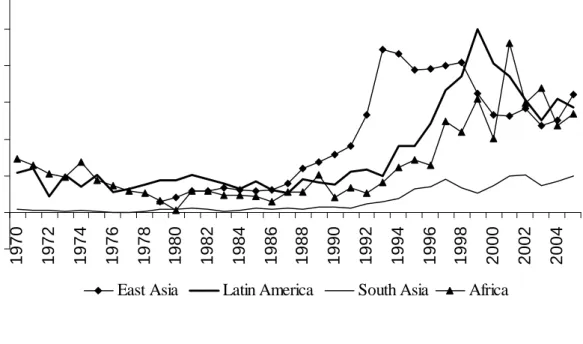
hand, received a small and declining share of FDI. If we adjust for the economic size of the country and analyse FDI as a share of GDP, Figure 1 shows a more even distribution of FDI although regional di¤erences persist. While East Asia took o¤ in the 1990s, recently Africa has managed to attract further FDI in‡ows. Relative to its economic size, FDI to Africa is now at comparable levels with East Asia and Latin America. South Asia continues to be lagging behind. This paper sets out to analyse regional di¤erences in FDI
between African, Asian and Latin American countries.2
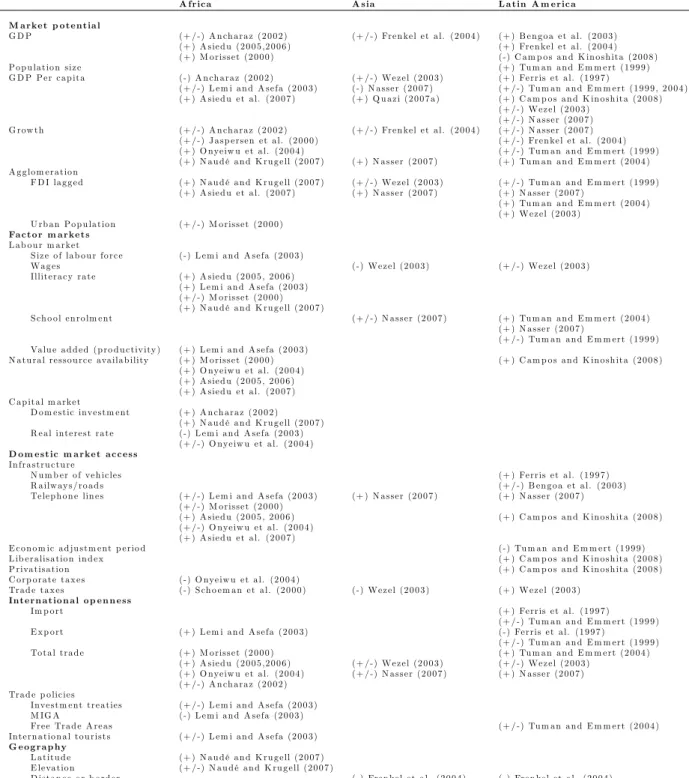
First, it reviews the subset of FDI studies that have tackled the regional aspect of the FDI decision by including regional dummies, by including interactions between regional dummies and selected explanatory variables or by analysing FDI ‡ows on a regional basis. While the broad FDI literature has been reviewed quite frequently, this paper is the …rst to focus on the regional aspect of FDI and to collect regional studies in a coherent framework. This approach provides information about regularities in the driving forces of FDI across regions and points out possible region-speci…c variables. The …ndings suggest that regional dummies rarely turn out signi…cant in elaborate models of FDI, that the signi…cance of interactions between regional dummies and FDI determinants suggests that there is a large degree of heterogeneity between regions and, …nally, that there seems to be a pool of common FDI determinants but that region-speci…c characteristics should also be taken into account.
Since the empirical studies reviewed in this paper vary widely in their sample selection, estimation method, time horizon and set of explanatory variables the results are not directly comparable, and it is therefore di¢ cult to draw conclusions about why we observe di¤erences in the regional distribution of FDI. Since there is no consensus of a theoretical framework for FDI, we let the data speak.
In the second part of the paper we apply a general-to speci…c analysis of the many FDI determinants that have been applied in the existing literature. We do so both in a broad cross-section of developing countries, where we also include regional dummy variables, and on a region-by-region basis. Overall, the results suggest that regional di¤erences are not due to …xed regional e¤ects. We …nd that growth and in‡ation are robust and signi…cant across regions although the size of their impact varies, while other variables clearly turn out to be region-speci…c. While African and Asian countries are largely heterogeneous both with respect to the set of explanatory variables and their impact on FDI, Asian and
1In light of China’s outstanding role, some studies exclude China from the sample (see UNCTAD (1994) and World Bank (1996) for further discussion). As an alternative, Jakobsen and Soysa (2006) include a China dummy that turn out positive and highly signi…cant.
2A large number of studies analyse the ‡ow of FDI to Eastern European countries. These studies are typically based on a gravity model speci…cation of bilateral FDI ‡ows and will not be reviewed here. Also, studies of FDI to the Middle East and North African countries are too scarce to draw meaningful comparisons.
Latin American countries are more homogeneous and can more readily be pooled as long as proper interaction terms are speci…ed.
The paper proceeds as follows. Section 2 gives a short introduction to the ways regional di¤erences have been modelled econometrically in the empirical FDI literature. Section 3 reviews the subset of empirical FDI studies that have set out to explain regional di¤er-ences in FDI by including regional dummies, by including interactions between regional dummies and selected explanatory variables to control for heterogeneity, or undertaking regional studies that assume complete heterogeneity between regions and furthermore al-low for the inclusion of region-speci…c variables. Section 4 applies a general-to-speci…c analysis of 36 potential FDI determinants in 100 developing countries on an overall as well as on a regional basis. Finally, Section 5 summarises and concludes.
2
Modelling the Regional Aspect of FDI
The regional aspect of FDI has been approached in many di¤erent ways in the empirical FDI literature. At one extreme, it has been argued that foreign investors think of countries as being completely independent and homogeneous so that FDI ‡ows can be explained by the same set of explanatory variables and homogeneous parameters independent of the countries included in the sample:
F DIit = +x 0
it +uit; (1)
where F DIit is the in‡ow of FDI to countryi (i = 1; :::; N) as a share of GDP,N is the
number of developing countries in the sample at time t (t = 1; :::; T), xit is a vector of
FDI determinants and uit is an error term. In this case, regional di¤erences in the in‡ow
of foreign capital can be fully explained by di¤erent country characteristics captured by
xit. The broad FDI literature based on (1) has been reviewed quite frequently but so
far no consensus about the theoretical model or the econometric speci…cation of the FDI
relation has been reached (see Bloningen (2005) for a recent survey).
The inability of (1) to explain the distribution of FDI across countries and regions
has lead some researchers to look for new explanatory variables to be included in xit
(most notable is the recent inclusion of various risk variables), while others have tested alternative ways to model FDI. This paper focuses on the latter approach and reviews empirical FDI studies that allow for regional heterogeneity.
The …rst group of studies bases the analysis on a panel of countries belonging to di¤erent regions. In general, this group of studies base their empirical FDI speci…cation on a variant of:
F DIijt= j +x 0
where j is a regional dummy variable that takes on the value one for countries
belong-ing to region j and zero otherwise (j = 1; :::; J where J is the number of regions) and
which adjusts for time invariant regional e¤ects. In this case, xijt is a vector of
explana-tory variables that possibly includes interactions between regional dummies and selected explanatory variables.
The panel studies with regional dummies (reviewed in Section 3.1) explain regional di¤erences in FDI in‡ows by time-invariant regional e¤ects. If one believes that FDI ‡ows are ultimately driven by arbitrage that leads to the equalisation of marginal productivity of production factors, see Selaya and Sunesen (2008), then this approach argues that the uneven distribution of FDI is due to some regional e¤ect that allows the productivity of production factors in one region to di¤er systematically from other regions. We could think of this as "historic agglomeration e¤ects" that have given the region a reputation or as permanent di¤erences in production factors. If such time-invariant regional e¤ects turn out to be important, the implication is that a country that is lagging behind today will stay behind irrespective of its ability to implement policies aimed at strengthening the institutions that are positively associated with FDI (included in xijt).
The panel studies with heterogeneous e¤ects (reviewed in Section 3.2) use interactions between regional dummies and selected explanatory variables to allow for heterogene-ity in the response to FDI determinants. One reason for such structural di¤erences is that investors are attracted to di¤erent countries according to their motive for investing
abroad.3 If the composition of FDI in this way varies systematically across regions, it
is likely that the ‡ow of FDI to these regions will respond di¤erently to traditional FDI determinants. Empirically, this means that the vector of explanatory variables should include interactions between the regional dummy variable and the explanatory variables thereby allowing parameter estimates to vary across regions.
The second group of studies (reviewed in Section 3.3) bases the analysis on a panel of countries that belong to the same region and estimates (1) for the region under review.
This estimation method therefore allows for full heterogeneity in both i and i between
regions. One reason for using this approach is that some studies aim at answering ques-tions, which require the use of region-speci…c variables that might not be relevant or might not even exist for other regions. Examining the impact of transition on FDI in‡ows to Eastern European countries could be one example.
In the next section we review the large number of empirical studies that have modelled the regional aspect of FDI explicitly. We do so in order to detect empirical regularities in the driving forces of FDI that can inform us about the degree of heterogeneity across regions. Ultimately, this should lead to a greater understanding of what causes regional di¤erences in the distribution of FDI.
3The literature typically distinguishes between market-seeking, resource-seeking, e¢ ciency-seeking and asset-seeking FDI.
3
Review of Empirical FDI Studies
This section provides a comprehensive and structured review of empirical studies of FDI to African, Asian and Latin American countries that have taken the regional distribution of FDI into account by including regional dummy variables, by incorporating interactions between regional dummy variables and potential FDI determinants or by analysing FDI on a regional basis. These papers are typically based on panel data estimation methods where the dependent variable is FDI as a share of GDP but where the number of countries, the time dimension and the selection of explanatory variables di¤er widely.
3.1
Panel Studies with Regional Dummies
Table 2 summarises the …ndings of 10 studies that are based on (2) in that they include regional dummy variables. In general, the regional dummy variables should be interpreted relative to other developing countries. A signi…cant African dummy thus suggests that Africa is di¤erent from other developing countries. As one exception, the regional dummies in Addison and Heshmati should be interpreted relative to developed countries. Overall, we …nd that only 10 out of the 17 dummy variables included in the 10 studies under review report dummy variables that are signi…cant and robust to the inclusion of an extended set of explanatory variables.
More than half of the studies included in this review have analysed if there is a
par-ticular e¤ect of being located in Africa. Jaspersen et al. (2000) and Asiedu (2002) …nd
that African countries receive 2% and 1.3% points, respectively, less FDI than a compa-rable country outside the region. The African dummy in Addison and Heshmati (2003), Noorbakhsh and Youssef (2001), Ancharaz (2002) and Wilhelms and Witter (1998), on the other hand, turned out insigni…cant once economic, political and structural characteristics were taken into account.
The negative South Asian regional dummy found in Addison and Heshmati (2003)
remains after controlling for traditional FDI determinants as well as the democratic sit-uation in these countries. However, the signi…cant South Asian e¤ect in Gani (2007) disappears once governance indicators (rule of law, control of corruption and regulatory quality) are adjusted for. While a number of studies have found a positive and signi…cant East Asiandummy only in the case of Addison and Heshmati (2003) did it turn out to
be robust to an extended set of explanatory variables. The Latin American dummy
in Noorbakhsh and Youssef (2001), Edwards (1990) and Hein (1992) was not robust to the inclusion of other control variables, while the results in Addison and Heshmati (2003) suggest that Latin American countries receive 1.2% points more FDI than comparable countries.
3.2
Panel Studies with Heterogeneous E¤ects
The six papers reviewed in this section are based on the premise that the relative im-pact of FDI determinants should be allowed to vary across regions, and the speci…cation therefore includes interactions between FDI determinants and the regional dummy
vari-ables like in (2).4 The results suggest that agglomeration e¤ects, growth and openness
are equally important in all regions, whereas the return on investment, infrastructure, political instability and …scal incentives, among others, have a heterogeneous impact on FDI across regions. We also …nd that region-speci…c factors should be taken into account. A number of studies analyse if countries in one region are di¤erent from other devel-oping countries. Asiedu (2002) and Kolstad and Villanger (2008) …nd that openness has an equal impact on FDI irrespective of regional location. Asiedu (2002) also …nds that the provision of infrastructure and the return on investment have a larger impact on FDI to African than non-African countries. The latter result is con…rmed by Raza…mahefa and Hamori (2005). Kolstad and Villanger (2008) …nd that FDI to Latin America is particularly sensitive to political instability, while the absence of regulation appears to have been a particularly bene…cial factor.
Another set of studies compare determinants of FDI in several regions. Asiedu and Lien (2004) …nd that the impact of capital controls on FDI varies by region: capital controls have no e¤ect on FDI to African countries but a¤ect FDI to East Asia and Latin America adversely. Chen (1998) …nds that agglomeration, growth and government expenditures are equally important in Latin America and South East Asia, whereas …scal incentives and growth of export have a heterogeneous impact on FDI in the two regions. In his comparison of Asia and Latin America, Nasser (2007) …nds a great degree of heterogeneity between the two regions. While agglomeration e¤ects are equally important in the two regions, infrastructure (telephone lines) and political instability (revolutions and assassinations) have signi…cant but di¤erent e¤ects in the two regions. A large number of factors (GDP, in‡ation, current account, schooling and political rights) only turn out signi…cant in one of the regions.
3.3
Regional Studies
Table 3 and Table 4 review 21 regional studies of FDI that base their FDI speci…cation
on (1) for the group of either African, Asian or Latin American countries.5 To ease
inter-pretation and comparison, the FDI determinants have been divided into return (market
4Chen (1998) also uses dummy variables to compare FDI in Latin American and South East Asian countries. However, this paper is excluded since the dependent variable is FDI in per capita terms which invalidates comparisons with the other papers in the review.
5Kandiero and Chitiga (2003), Quazi (2007b), Chen (1998), Trevino et al. (2002a, 2002b), Vogiatzou-glou (2007) and Trevino and Mixon (2004) are excluded from the review since they use absolute FDI or FDI in per capita terms as their dependent variable.
potential, factor market characteristics, domestic market access, international openness and geography) and (economic, political and commercial) risk. The overall picture arising from these studies is very much in line with the …ndings in Section 3.2. While growth, agglomeration and in‡ation are important in all regions, the impact of other FDI determi-nants turns out to vary with regional location. Natural resource availability, infrastructure and …nancial stability are important in Africa; labour costs and …scal incentives in Asia; and …scal balance, exchange rate stability, …nancial stability and political instability in Latin America.
Of the return variables listed in Table 3, the market potential proxies are the most
frequently used. The preferred variables are GDP, population size, GDP per capita and
GDP growth, which most often have a signi…cant and positive e¤ect on FDI.6 The results
also show strong agglomeration e¤ects. The regions di¤er widely in their dependence on various factors of production. While labour costs and labour availability are relatively important in Asia, the relatively poor quality of the labour force has been an important deterrent factor for FDI to African and Latin American countries. Also, natural resource availability has been a driving force in Africa. Infrastructure turns out to be important in most regions but most often so in Africa where landlocked and geographically isolated countries face big problems in attracting foreign capital. Advancements in structural reforms and privatisation have been important for the relative attractiveness of countries in Latin America. Finally, trade openness (the most frequently used being total trade) appears to be important in all regions except Asia.
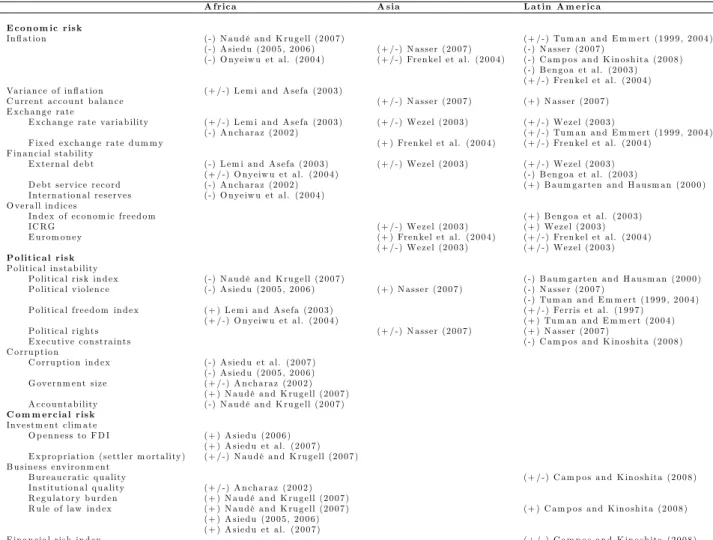
From Table 4 it is clear that therisk of investing abroad has only received attention
recently probably due to the inability of traditional return determinants to explain the regional distribution of FDI. The economic risk variables are the most frequently included risk measures although their impact varies widely across regions. While high in‡ation has been a deterrent factor in most regions, …nancial and political instability seems to have scared away investors in African and Latin American countries. Asian countries, on the other hand, appear to have bene…ted from a stable or even …xed exchange rate regime. Interestingly, commercial risk is rarely accounted for in Asian and Latin American countries. An accommodating investment climate and business environment (in particular rule of law) as well as …nancial stability, on the other hand, have had a signi…cant impact on FDI in African countries.
6A few exceptions include Campos and Kinoshita (2008), Botric and Sku‡ic (2006), Ancharaz (2002) and Nasser (2007) where GDP, population size or GDP per capita turn out to have a negative impact on FDI. However, these papers also include growth as an explanatory variable in which case an explanation might be that growth turns out to be the most important proxy for market potential whereas additional market size proxies capture something else (for example, the level of development).
4
A General-to-Speci…c Analysis of FDI Flows
One of the main drawbacks in the FDI literature has been the lack of a coherent and generally accepted theoretical framework to think about FDI and to form the basis for empirical analysis. The theoretical vacuum has resulted in an ad hoc selection of FDI determinants, which complicates direct comparisons across studies. To take an example, all empirical papers have included some measure of market potential where GDP, GDP per capita, population or GDP growth are the most commonly used proxies, and valid theoretical arguments can be put forward for each of them. Which one should we pick? To what extent is it appropriate to pick the same proxy irrespective of regional belonging? And when can we expect one variable to have the same impact on FDI irrespective of regional belonging?
Since potential explanatory variables are highly correlated, it is a challenge to select several or all of them while avoiding multicollinearity in the model. We therefore use a general-to-speci…c model selection approach, which enables us to "test down" among
the large set of explanatory variables. We use the P cGets software, which automatically
selects an undominated, congruent model where statistically insigni…cant variables are eliminated and where diagnostic tests check the validity of reductions to ensure a con-gruent …nal selection. Equation mis-speci…cation tests include residual autocorrelation, ARCH, heteroscedasticity, functional form mis-speci…cation, and non-normality. The path is terminated when all the variables that remain are signi…cant, or a diagnostic test fails. In some cases insigni…cant variables are therefore retained. We refer to Hendry (1995, Chapter 9) for further details on this data-based model selection methodology.
Based on the empirical papers reviewed in Tables 3 and 4, we have collected data on 19 return proxies and 14 risk measures to enter the general-to-speci…c analysis along with regional dummy variables for Africa, Asia and Latin America. Data is calculated as an average over the time period 1980-2004 for a cross-section of 100 developing countries
(43 belonging to Africa, 35 located in Asia and 22 Latin American countries).7 A list of
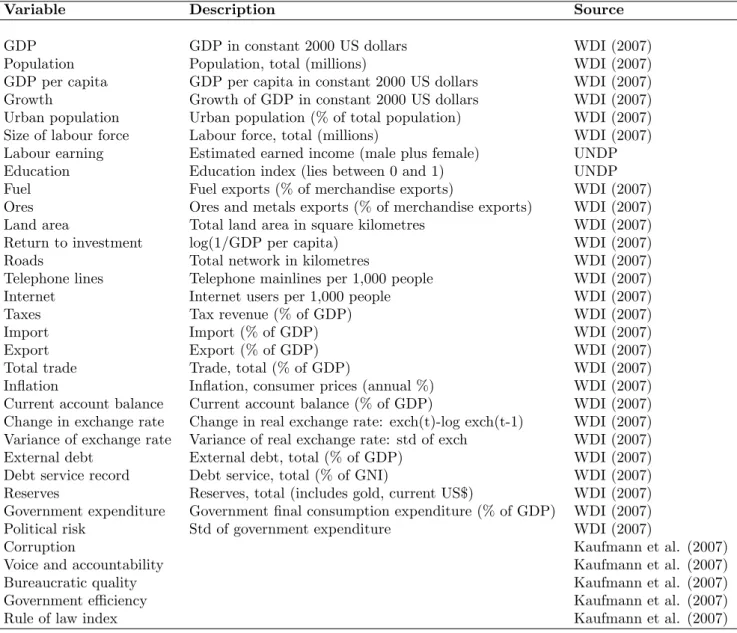
countries can be found in Appendix. Details on the data are given in Table 5.
4.1
Empirical Findings
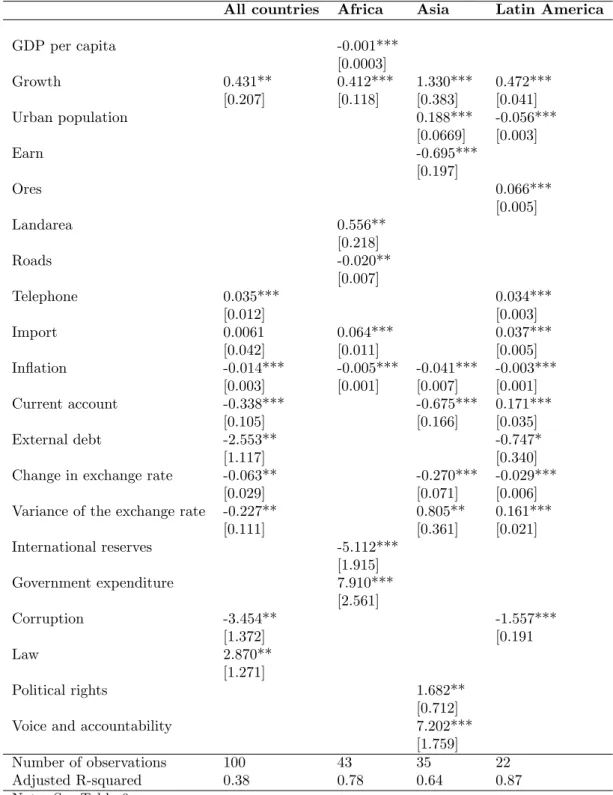
Table 6 reports the main results. One of the most important …ndings is that none of the regional variables turn out signi…cant, which suggests that regional di¤erences in FDI in‡ows can be fully explained by structural characteristics. This means that there is no African bias (see Asiedu, 2002, among others). Also, we see that growth and in‡ation are the only two variables that turn out signi…cant in all speci…cations although their marginal
7Using averages over 25 years and thus eliminating the time dimension, the cross-sectional approach allows us to look for deep structural determinants of FDI. The disadvantage is that in some circumstances our results will not be directly comparable to the panel studies reviewed in the previous section. For example, it will not be possible to test for agglomeration e¤ects by including a lagged dependent variable.
e¤ects vary across regions. While in‡ation has been a deterrent factor to FDI in‡ows to Latin American countries, in‡ation has had a smaller marginal e¤ect in Asian and African countries. Also, high economic growth rates have been relatively more important for Asian countries than African and Latin American countries.
A number of observations from Section 3 are con…rmed by the general-to-speci…c analy-sis. International openness (trade) is important in all regions except Asia; the stability of the exchange rate regime is important for Asian and Latin American countries; …nancial and political stability (external debt, current account balance, corruption and rule of law) are important in Latin American countries; while low wages have been a comparative advantage in Asian countries. The results also indicate that the focus on economic risk in studies of FDI into Asia is misleading since political and commercial risk (political rights as well as voice and accountability) are equally important for this region.
International openness has typically been proxied by total trade as a share of GDP, the import share or the export share. Since trade is a linear combination of imports and exports it is not possible to include all three of them at the same time. Table 7 reports the results when we use the import and export shares instead of total trade as our openness proxy. The results from Table 6 are con…rmed and we see that the positive e¤ect of trade was driven by import, which was also the case in Janicki and Wunnava (2004) and Ferris et al. (1997).
Also, we …nd that some variables are region-speci…c: GDP per capita, land area, roads, international reserves and government expenditure for Africa; wage earnings, political rights and the Kaufmann voice and accountability index for Asia; and telephone, external debt, corruption and ores export for Latin America. The remaining six variables lie somewhere in between where four variables turn out signi…cant in both Asia and Latin America (urban population, current account, change in the exchange rate, variance of the exchange rate) and two enter both the speci…cation in Africa and Latin America (trade openness and rule of law). This suggests that Africa and Asia do not seem to be well described by the same set of variables and one should exercise caution when pooling the two regions. Latin American and Asian countries can more readily be pooled but interaction terms should still be incorporated to adjust for heterogeneity in the impact of common explanatory variables.
5
Summary and Conclusion
This paper provides a comprehensive and structured review of the part of the empirical literature that has analysed the regional di¤erences in FDI in‡ows. A number of observa-tions are worth highlighting. First, regional dummy variables rarely turn out to be robust once structural characteristics of the host country are properly accounted for. Second, the large number of signi…cant interaction terms between regional dummies and selected
explanatory variables suggests that regions are highly heterogeneous and that investors perceive regions di¤erently. And, third, regional studies suggest that there is a pool of common FDI determinants whose impact varies across regions but also that region-speci…c characteristics should be taken into account.
Since the empirical studies reviewed in this paper vary widely in their sample selec-tion, estimation method, time horizon and set of explanatory variables the results are not directly comparable. We therefore let the data speak and apply a general-to speci…c analysis of the many determinants that have been applied in the existing FDI literature. The results suggest that regional di¤erences are not due to …xed regional e¤ects. We …nd that growth and in‡ation are robust and signi…cant across regions although the size of their impact varies. The impact from in‡ation seems stronger in Latin America than in Asian and African countries. Also, economic growth has had a larger marginal e¤ect in Asian countries than in African and Latin American countries. While African and Asian countries turn out to be largely heterogeneous both with respect to the set of explanatory variables and their impact on FDI, Asian and Latin American countries can more readily be pooled as long as proper interaction terms are speci…ed. Finally, some variables appear to be region-speci…c: GDP per capita, land area, roads, international reserves and govern-ment expenditure for Africa; wage earnings, political rights and the Kaufmann voice and accountability index for Asia; and telephone, external debt, corruption and ores export for Latin America.
The …ndings in this paper suggest that foreign investors respond quite di¤erently to common determinants of FDI across regions and also that region-speci…c variables are important to take into account when analysing FDI in a broad sample of developing countries. However, this paper does not o¤er an explanation as to why this is so. One interesting topic for future work could, for example, be to analyse FDI on a more disag-gregated level to see if the observed regional heterogeneity can be explained by di¤erences in the sectoral distribution of FDI.
References
[1] Addison, T. and A. Heshmati (2003),The New Global Determinants of FDI Flows to
Developing Countries: The Impacts of ICT and Democratisation, WIDER Discussion
Paper 45.
[2] Ancharaz, V. D. (2002), "The Determinants of Foreign Direct Investment in a
Com-parative Perspective: Is there a Bias against Sub-Saharan Africa?",Law Management
and Social Sciences Research Journal 4: 11-31.
[3] Asiedu, E. (2006), "Foreign Direct Investment in Africa: The Role of Government Policy, Institutions and Political Instability", World Economy 29(1): 63-77.
[4] Asiedu, E. (2005), Foreign Direct Investment in Africa: The Role of Natural
Re-sources, Market Size, Government Policy, Institutions and Political Instability,
WIDER Research Paper 24.
[5] Asiedu, E. (2002), "On the Determinants of Foreign Direct Investment to Developing
Countries: Is Africa Di¤erent?", World Development 30(1): 107-119.
[6] Asiedu, E. and K. Gyimah-Brempong (2007), "The E¤ect of the Liberalisation of Investment Policies on Employment and Investment of Multinational Corporations in Africa", Forthcoming in African Development Review.
[7] Asiedu, E. and D. Lien (2004), "Capital Controls and Foreign Direct Investment",
World Development 32(3): 479-490.
[8] Baumgarten, S. A. and A. Hausman (2000), "An Analysis of the Correlates of US
Foreign Direct Investment in Latin America",Journal of Transnational Management
Development 5(4): 57-82.
[9] Bengoa, M. and B. Sanchez-Robles (2003), "Foreign Direct Investment, Economic
Freedom and Growth: New Evidence from Latin America", European Journal of
Political Economy 19: 529-545.
[10] Bevan, A. A. and S. Estrin (2004), "The Determinants of Foreign Direct Investment
into European Transition Economies", Journal of Comparative Economics 32:
775-787.
[11] Bloningen, B. A. (2005), "A Review of the Empirical Literature on FDI Determi-nants", Atlantic Economic Journal 33(4): 383-403.
[12] Botric, V. and L. Sku‡ic (2006), "Main Determinants of Foreign Direct Investment
[13] Campos, N. F. and Y. Kinoshita (2008), Foreign Direct Investment and Structural
Reforms: Evidence from Eastern Europe and Latin America, IMF Working Paper
26.
[14] Chen, J. -H. (1998), "The E¤ects of International Competition of Fiscal Incentives
on Foreign Direct Investment", Economia Internazionale 53(4): 497-516.
[15] Edwards, S. (1990),Capital Flows, Foreign Direct Investment and Debt-Equity Swaps
in Developing Countries, NBER Working Paper 3497.
[16] Ferris, S. P., G. R. Thompson and C. Valsan (1997), "An Analysis of Foreign
Di-rect Investment in Latin America: The Case of the Guyanese Economy", Pakistan
Economic and Social Review 35(1): 11-24.
[17] Frenkel, M., K. Funke and G. Stadtmann (2004), "A Panel Analysis of Bilateral FDI
Flows to Emerging Economies", Economic Systems 28: 281-300.
[18] Gani, A. (2007), "Governance and Foreign Direct Investment Links: Evidence from
Panel Data Estimation", Applied Economics Letters 14(10): 753-756.
[19] Hein, S. (1992), "Trade Strategy and the Dependence Hypothesis: A Comparison of Policy, Foreign Investment and Economic Growth in Latin America and East Asia",
Economic Development and Cultural Change 40(3): 495-521.
[20] Hendry, D. F. (1995), Dynamic Econometrics, Oxford: Oxford University Press.
[21] Jakobsen, J. and I. de Soysa (2006), "Do Foreign Investors Punish Democracy?
The-ory and Empirics, 1984-2001", KYKLOS 59(3): 383-410.
[22] Janicki, H. P. and P. V. Wunnava (2004), "Determinants of Foreign Direct
Invest-ment: Empirical Evidence from EU Accession Candidates", Applied Economics 36:
505-509.
[23] Jaspersen, F. Z., A. H. Aylward and A. David Knox (2000), "Risk and Private
Investment: Africa Compared with Other Developing Countries", in Investment and
Risk in Africa ed. by P. Collier and C. Pattillo, London: Macmillan.
[24] Kandiero, T. and M. Chitiga (2003), "Trade Openness and Foreign Direct Investment in Africa", Paper prepared for the Economic Society of Southern Africa, Annual Conference, Cape Town, South Africa.
[25] Kaufmann, D., A. Kraay and M. Mastruzzi (2008), Governance Matters VII:
Ag-gregate and Individual Governance Indicators for 1996-2007. World Bank Policy
[26] Kolsted, I. and Villanger; E. (2008), "Foreign Direct Investment in the Caribbean",
Development Policy Review 26(1): 79-89.
[27] Lemi, A. and S. Asefa (2003), "Foreign Direct Investment and Uncertainty: Empirical
Evidence from Africa", African Finance Journal 5(1): 36-67.
[28] Morisset, J. (2000),Foreign Direct Investment in Africa - Policies Also Matter, World Bank Policy Research Working Paper 2481.
[29] Nasser, O. M. A. (2007), "The Determinants of the US Foreign Direct Investment:
Does the Region Matter?", Global Economic Review 36(1): 37-51.
[30] Naudé, W. A. and W. F. Krugell (2007), "Investigating Geography and Institutions
as Determinants of Foreign Direct Investment in Africa Using Panel Data", Applied
Economics 39(10): 1223-1233.
[31] Noorbakhsh, A. P. F. and A. Youssef (2001), "Human Capital and FDI In‡ows to
Developing Countries: New Empirical Evidence", World Development 29(9):
1593-1610.
[32] Onyeiwu, S. and H. Shrestha (2004), "Determinants of Foreign Direct Investment in Africa", Journal of Developing Societies 20(1-2): 89-106.
[33] Quazi, R. (2007a), "Economic Freedom and Foreign Direct Investment in East Asia",
Journal of Asia Paci…c Economy 12(3): 329-344.
[34] Quazi, R. (2007b), "Foreign Direct Investment in Latin America: A Panel Regression
Study", International Journal of Management and Marketing Research 2(1): 65-69.
[35] Raza…mahefa, I. and S. Hamori (2005), "An Empirical Analysis of FDI
Competitive-ness in Sub-Saharan Africa and Developing Countries", Economics Bulletin 6(20):
1-8.
[36] Selaya, P. and E. R. Sunesen (2008), Does Foreign Aid Increase Foreign Direct
In-vestment?, Department of Economics Discussion Paper 08-04.
[37] Schoeman, N. J., Z. C. Robinson and T. J. de Wet (2000), "Foreign Direct Investment
Flows and Fiscal Discipline in South Africa", SAJEMS NS 3(2): 235-244.
[38] Trevino, L. J. and F. G. Mixon Jr. (2004), "Strategic Factors A¤ecting Foreign Direct
Investment Decisions by Multinational Enterprises in Latin America", Journal of
World Business 39: 233-243.
[39] Trevino, L. J., J. D. Daniels and H. Arbeláez (2002a), "Market Reform and FDI
in Latin America: An Empirical Investigation", Transnational Corporations 11(1):
[40] Trevino, L. J., J. D. Daniels, H. Arbeláez and K. P. Upadhyaya (2002b), "Market Reform and Foreign Direct Investment in Latin America: Evidence from an Error
Correction Model", The International Trade Journal 16(4): 367-392.
[41] Tuman, J. P. and C. F. Emmert (2004), "The Political Economy of U.S. Foreign
Direct Investment in Latin America:. A Reappraisal", Latin American Economic
Review 39(3): 9-28.
[42] Tuman, J. P. and C. F. Emmert (1999), "Explaining Japanese Foreign Direct
Invest-ment in Latin America, 1979-1992", Social Science Quarterly 80(3): 539-555.
[43] UNCTAD (1994), World Investment Report, Geneva: UNCTAD.
[44] Vogiatzoglou, K. (2007), "Vertical Specilisation and New Determinants of FDI:
Evi-dence from South and East Asia", Global Economic Review 36(3): 245-266.
[45] Wezel, T. (2003),Determinants of German Foreign Direct Investment in Latin
Amer-ican and Asian Emerging Markets in the 1990s, Economic Research Centre of the
Deutsche Bundesbank 11.
[46] Wilhelms, S. K. S. and M. S. D. Witter (1998), Foreign Direct Investment and Its
Determinants in Emerging Economies, African Economic Policy Paper 9.
[47] World Bank (1996), Managing Capital Flows in East Asia, Washington, DC: World
Bank.
[48] Yang, B. (2007), "Autocracy, Democracy and FDI In‡ows to the Developing Coun-tries", International Economic Journal 21(3): 419-439.
Appendix
Africa: Algeria, Angola, Benin, Botswana, Burkina Faso, Burundi, Cameroon, Cape
Verde, Chad, Congo, Cote d’Ivoire, Egypt, Ethiopia, Gabon, Gambia, Ghana, Guinea-Bissau, Iran, Jordan, Kenya, Madagascar, Malawi, Mali, Mauritania, Mauritius, Morocco, Mozambique, Niger, Nigeria, Oman, Rwanda, Senegal, Sierra Leone, South Africa, Sudan, Swaziland, Syria, Tanzania, Togo, Tunisia, Uganda, Zambia and Zimbabwe.
Latin America and Caribbean: Argentina, Belize, Bolivia, Brazil, Chile, Colombia, Costa Rica, Dominican Republic, Ecuador, El Salvador, Guatemala, Guyana, Haiti, Hon-duras, Jamaica, Mexico, Nicaragua, Panama, Peru, Trinidad and Tobago, Uruguay and Venezuela.
Asia: Albania, Armenia, Bangladesh, Belarus, Bhutan, Bulgaria, Cambodia, China,
Croatia, Czech Republic, Estonia, Fiji, Georgia, Hungary, India, Indonesia, Kazakhstan, Latvia, Lithuania, Malaysia, Moldova, Mongolia, Nepal, Pakistan, Papua New Guinea, Philippines, Poland, Romania, Solomon Islands, Sri Lanka, Thailand, Tonga, Turkey, Ukraine and Vanuatu.
Tables and Figures
Figure 1. The Development of FDI as a Share of GDP, 1970-2006
-1 0 1 2 3 4 5 6 1970 1972 1974 1976 1978 1980 1982 1984 1986 1988 1990 1992 1994 1996 1998 2000 2002 2004
Table 1: Regional Distribution of FDI
1970-1980 1980-1990 1990-2000 2000-2006
Developing economies (millions) 5922 20580 118185 255648
Africa 15.9 6.4 3.9 4.7 Nigeria 5.4 2.1 1.3 1.0 South Africa 1.6 0.1 0.7 0.9 Latin America 47.6 31.8 35.6 29.6 Argentina 2.2 2.8 5.8 1.7 Brazil 21.4 8.4 8.4 7.5 Mexico 7.6 11.6 7.2 7.9 Asia 29.3 43.3 56.2 53.8 East Asia 7.5 22.4 35.6 38.2 China 0.0 7.9 24.6 22.1 Hong Kong 4.5 10.4 7.6 12.3 South Korea 1.8 1.6 2.1 2.3 South Asia 1.1 1.2 2.0 3.5 South-East Asia 20.8 19.7 18.6 12.0 Indonesia 7.4 1.6 1.8 0.4 Singapore 5.1 9.3 7.2 6.1 Thailand 1.3 2.5 2.7 2.3
Note: Shows FDI as a share of total FDI going to developing countries. Source: FDI data is from the UNCTAD database (constant 2000 US Dollars).
Table 2: Panel Data Models: Regional Dummies
Africa South Asia East Asia Latin America
Noorbakhsh and Youssef (2001) (+/-) (+/-)
Edwards (1990) (+) (+/-)
Asiedu (2002) (-)
Jaspersen et al. (2000) (-)
Ancharaz (2002) (+/-)
Gani (2007) (-)
Wilhelms and Witter (1998) (-) (+)
Addison and Heshmati (2003) (+/-) (-) (+) (+)
Yang (2007) (-)
Hein (1992) (+/-) (+/-)
Note: (-), (+) and (+/-) indicate a signi…cant negative, a signi…cant positive and an insigni…cant regional dummy at a 10% signi…cance level, respectively.
Table 3: Regional Studies (Return Variables) A fr ic a A s ia L a t in A m e r ic a M a r ke t p o t e n t ia l G D P (+ / -) A n ch a ra z (2 0 0 2 ) ( + / -) Fre n ke l e t a l. ( 2 0 0 4 ) (+ ) B e n g o a e t a l. (2 0 0 3 ) (+ ) A s ie d u (2 0 0 5 ,2 0 0 6 ) (+ ) Fre n ke l e t a l. ( 2 0 0 4 ) (+ ) M o ris s e t (2 0 0 0 ) (-) C a m p o s a n d K in o s h it a ( 2 0 0 8 ) P o p u la tio n s iz e (+ ) Tu m a n a n d E m m e rt ( 1 9 9 9 ) G D P P e r c a p ita (-) A n ch a ra z (2 0 0 2 ) ( + / -) W e z e l ( 2 0 0 3 ) (+ ) Fe rris e t a l. (1 9 9 7 ) (+ / -) L e m i a n d A s e fa ( 2 0 0 3 ) (-) N a s s e r ( 2 0 0 7 ) (+ / -) Tu m a n a n d E m m e rt ( 1 9 9 9 , 2 0 0 4 ) (+ ) A s ie d u e t a l. ( 2 0 0 7 ) (+ ) Q u a z i (2 0 0 7 a ) (+ ) C a m p o s a n d K in o s h ita ( 2 0 0 8 ) (+ / -) W e z e l (2 0 0 3 ) (+ / -) N a s s e r (2 0 0 7 ) G row t h (+ / -) A n ch a ra z (2 0 0 2 ) ( + / -) Fre n ke l e t a l. ( 2 0 0 4 ) (+ / -) N a s s e r (2 0 0 7 ) (+ / -) J a s p e rs e n e t a l. ( 2 0 0 0 ) (+ / -) Fre n ke l e t a l. (2 0 0 4 ) (+ ) O nye iw u e t a l. (2 0 0 4 ) (+ / -) Tu m a n a n d E m m e rt ( 1 9 9 9 ) (+ ) N a u d é a n d K ru g e ll ( 2 0 0 7 ) (+ ) N a s s e r (2 0 0 7 ) (+ ) Tu m a n a n d E m m e rt (2 0 0 4 ) A g g lo m e ra tio n F D I la g g e d ( + ) N a u d é a n d K ru g e ll (2 0 0 7 ) (+ / -) W e z e l (2 0 0 3 ) (+ / -) Tu m a n a n d E m m e rt (1 9 9 9 ) (+ ) A s ie d u e t a l. ( 2 0 0 7 ) (+ ) N a s s e r (2 0 0 7 ) (+ ) N a s s e r ( 2 0 0 7 ) (+ ) Tu m a n a n d E m m e rt ( 2 0 0 4 ) (+ ) W e z e l (2 0 0 3 ) U rb a n P o p u la tio n ( + / -) M o ris s e t (2 0 0 0 ) Fa c t o r m a r ke t s L a b o u r m a rke t S iz e o f la b o u r fo rc e ( -) L e m i a n d A s e fa (2 0 0 3 ) W a g e s (-) W e z e l (2 0 0 3 ) (+ / -) W e z e l (2 0 0 3 ) Illite ra c y ra te ( + ) A s ie d u (2 0 0 5 , 2 0 0 6 ) (+ ) L e m i a n d A s e fa (2 0 0 3 ) (+ / -) M o ris s e t ( 2 0 0 0 ) (+ ) N a u d é a n d K ru g e ll ( 2 0 0 7 ) S ch o o l e n ro lm e nt (+ / -) N a s s e r (2 0 0 7 ) (+ ) Tu m a n a n d E m m e rt ( 2 0 0 4 ) (+ ) N a s s e r (2 0 0 7 ) (+ / -) Tu m a n a n d E m m e rt (1 9 9 9 ) Va lu e a d d e d (p ro d u c tiv ity ) ( + ) L e m i a n d A s e fa (2 0 0 3 )
N a tu ra l re s s o u rc e ava ila b ility (+ ) M o ris s e t (2 0 0 0 ) (+ ) C a m p o s a n d K in o s h ita (2 0 0 8 ) (+ ) O nye iw u e t a l. (2 0 0 4 ) (+ ) A s ie d u (2 0 0 5 , 2 0 0 6 ) (+ ) A s ie d u e t a l. ( 2 0 0 7 ) C a p it a l m a rke t D o m e s tic inve s tm e nt ( + ) A n ch a ra z (2 0 0 2 ) (+ ) N a u d é a n d K ru g e ll ( 2 0 0 7 ) R e a l int e re s t ra t e ( -) L e m i a n d A s e fa (2 0 0 3 ) (+ / -) O nye iw u e t a l. ( 2 0 0 4 ) D o m e s t ic m a r ke t a c c e s s In fra s t ru c tu re N u m b e r o f ve h ic le s (+ ) Fe rris e t a l. (1 9 9 7 ) R a ilw ay s / ro a d s (+ / -) B e n g o a e t a l. (2 0 0 3 ) Te le p h o n e lin e s ( + / -) L e m i a n d A s e fa (2 0 0 3 ) (+ ) N a s s e r ( 2 0 0 7 ) (+ ) N a s s e r (2 0 0 7 ) (+ / -) M o ris s e t ( 2 0 0 0 ) (+ ) A s ie d u (2 0 0 5 , 2 0 0 6 ) (+ ) C a m p o s a n d K in o s h ita ( 2 0 0 8 ) (+ / -) O nye iw u e t a l. ( 2 0 0 4 ) (+ ) A s ie d u e t a l. ( 2 0 0 7 ) E c o n o m ic a d ju s t m e nt p e rio d (-) Tu m a n a n d E m m e rt (1 9 9 9 ) L ib e ra lis a tio n in d e x (+ ) C a m p o s a n d K in o s h ita (2 0 0 8 ) P riva tis a tio n (+ ) C a m p o s a n d K in o s h ita (2 0 0 8 ) C o rp o ra te ta x e s (-) O nye iw u e t a l. (2 0 0 4 ) Tra d e ta x e s (-) S ch o e m a n e t a l. (2 0 0 0 ) ( -) W e z e l ( 2 0 0 3 ) (+ ) W e z e l ( 2 0 0 3 ) In t e r n a t io n a l o p e n n e s s Im p o rt (+ ) Fe rris e t a l. (1 9 9 7 ) (+ / -) Tu m a n a n d E m m e rt (1 9 9 9 ) E x p o rt ( + ) L e m i a n d A s e fa ( 2 0 0 3 ) (-) Fe rris e t a l. (1 9 9 7 ) (+ / -) Tu m a n a n d E m m e rt (1 9 9 9 ) To ta l t ra d e ( + ) M o ris s e t (2 0 0 0 ) (+ ) Tu m a n a n d E m m e rt ( 2 0 0 4 ) (+ ) A s ie d u (2 0 0 5 ,2 0 0 6 ) (+ / -) W e z e l (2 0 0 3 ) (+ / -) W e z e l (2 0 0 3 ) (+ ) O nye iw u e t a l. (2 0 0 4 ) (+ / -) N a s s e r ( 2 0 0 7 ) (+ ) N a s s e r ( 2 0 0 7 ) (+ / -) A n ch a ra z ( 2 0 0 2 ) Tra d e p o lic ie s
Inve s tm e nt tre a tie s ( + / -) L e m i a n d A s e fa (2 0 0 3 ) M IG A ( -) L e m i a n d A s e fa (2 0 0 3 )
Fre e Tra d e A re a s (+ / -) Tu m a n a n d E m m e rt (2 0 0 4 ) Inte rn a tio n a l to u ris ts (+ / -) L e m i a n d A s e fa (2 0 0 3 )
G e o g r a p h y
L a t it u d e ( + ) N a u d é a n d K ru g e ll (2 0 0 7 ) E le va tio n ( + / -) N a u d é a n d K ru g e ll ( 2 0 0 7 )
D is ta n c e o r b o rd e r (-) Fre n ke l e t a l. (2 0 0 4 ) (-) Fre n ke l e t a l. ( 2 0 0 4 ) N o te : ( -), (+ ) a n d (+ / -) in d ic a t e a s ig n i…c a nt n e g a tive , a s ig n i…c a nt p o s itive a n d a n in s ig n i…c a nt e x p la n a t o ry va ria b le a t a 1 0 % s ig n i…c a n c e le ve l, re s p e c t ive ly.
Table 4: Regional Studies (Risk Variables) A fr ic a A s ia L a t in A m e r ic a E c o n o m ic r is k In ‡a tio n (-) N a u d é a n d K ru g e ll (2 0 0 7 ) (+ / -) Tu m a n a n d E m m e rt ( 1 9 9 9 , 2 0 0 4 ) (-) A s ie d u ( 2 0 0 5 , 2 0 0 6 ) (+ / -) N a s s e r ( 2 0 0 7 ) (-) N a s s e r (2 0 0 7 ) (-) O nye iw u e t a l. (2 0 0 4 ) ( + / -) Fre n ke l e t a l. ( 2 0 0 4 ) (-) C a m p o s a n d K in o s h it a ( 2 0 0 8 ) (-) B e n g o a e t a l. (2 0 0 3 ) (+ / -) Fre n ke l e t a l. ( 2 0 0 4 ) Va ria n c e o f in ‡a tio n (+ / -) L e m i a n d A s e fa ( 2 0 0 3 )
C u rre nt a c c o u nt b a la n c e (+ / -) N a s s e r ( 2 0 0 7 ) (+ ) N a s s e r (2 0 0 7 ) E x ch a n g e ra t e E x ch a n g e ra t e va ria b ility ( + / -) L e m i a n d A s e fa (2 0 0 3 ) ( + / -) W e z e l ( 2 0 0 3 ) (+ / -) W e z e l (2 0 0 3 ) (-) A n ch a ra z (2 0 0 2 ) (+ / -) Tu m a n a n d E m m e rt ( 1 9 9 9 , 2 0 0 4 ) F ix e d e x ch a n g e ra te d u m m y ( + ) Fre n ke l e t a l. ( 2 0 0 4 ) (+ / -) Fre n ke l e t a l. (2 0 0 4 ) F in a n c ia l s ta b ility E x te rn a l d e b t ( -) L e m i a n d A s e fa (2 0 0 3 ) ( + / -) W e z e l ( 2 0 0 3 ) (+ / -) W e z e l (2 0 0 3 ) (+ / -) O nye iw u e t a l. ( 2 0 0 4 ) (-) B e n g o a e t a l. (2 0 0 3 ) D e b t s e rv ic e re c o rd ( -) A n ch a ra z (2 0 0 2 ) (+ ) B a u m g a rte n a n d H a u s m a n (2 0 0 0 ) Inte rn a t io n a l re s e rve s ( -) O nye iw u e t a l. (2 0 0 4 )
O ve ra ll in d ic e s In d e x o f e c o n o m ic fre e d o m (+ ) B e n g o a e t a l. ( 2 0 0 3 ) IC R G (+ / -) W e z e l (2 0 0 3 ) ( + ) W e z e l (2 0 0 3 ) E u ro m o n e y (+ ) Fre n ke l e t a l. (2 0 0 4 ) ( + / -) Fre n ke l e t a l. (2 0 0 4 ) (+ / -) W e z e l (2 0 0 3 ) ( + / -) W e z e l ( 2 0 0 3 ) P o lit ic a l r is k P o lit ic a l in s ta b ility
P o lit ic a l ris k in d e x ( -) N a u d é a n d K ru g e ll ( 2 0 0 7 ) (-) B a u m g a rte n a n d H a u s m a n (2 0 0 0 ) P o lit ic a l v io le n c e ( -) A s ie d u (2 0 0 5 , 2 0 0 6 ) ( + ) N a s s e r (2 0 0 7 ) (-) N a s s e r ( 2 0 0 7 )
(-) Tu m a n a n d E m m e rt (1 9 9 9 , 2 0 0 4 ) P o lit ic a l fre e d o m in d e x ( + ) L e m i a n d A s e fa ( 2 0 0 3 ) (+ / -) Fe rris e t a l. (1 9 9 7 )
(+ / -) O nye iw u e t a l. ( 2 0 0 4 ) (+ ) Tu m a n a n d E m m e rt (2 0 0 4 ) P o lit ic a l rig hts ( + / -) N a s s e r (2 0 0 7 ) (+ ) N a s s e r (2 0 0 7 )
E x e c u tive c o n s tra int s (-) C a m p o s a n d K in o s h ita (2 0 0 8 ) C o rru p tio n C o rru p tio n in d e x ( -) A s ie d u e t a l. ( 2 0 0 7 ) (-) A s ie d u ( 2 0 0 5 , 2 0 0 6 ) G ove rn m e nt s iz e ( + / -) A n ch a ra z (2 0 0 2 ) (+ ) N a u d é a n d K ru g e ll ( 2 0 0 7 ) A c c o u nt a b ility ( -) N a u d é a n d K ru g e ll ( 2 0 0 7 ) C o m m e r c ia l r is k Inve s tm e nt c lim a te O p e n n e s s to F D I ( + ) A s ie d u (2 0 0 6 ) (+ ) A s ie d u e t a l. ( 2 0 0 7 ) E x p ro p ria t io n ( s e ttle r m o rta lity ) ( + / -) N a u d é a n d K ru g e ll ( 2 0 0 7 ) B u s in e s s e nv iro n m e nt
B u re a u c ra tic q u a lity (+ / -) C a m p o s a n d K in o s h ita ( 2 0 0 8 ) In s titu tio n a l q u a lity ( + / -) A n ch a ra z (2 0 0 2 )
R e g u la t o ry b u rd e n ( + ) N a u d é a n d K ru g e ll (2 0 0 7 )
R u le o f law in d e x ( + ) N a u d é a n d K ru g e ll (2 0 0 7 ) (+ ) C a m p o s a n d K in o s h ita (2 0 0 8 ) (+ ) A s ie d u (2 0 0 5 , 2 0 0 6 )
(+ ) A s ie d u e t a l. ( 2 0 0 7 )
F in a n c ia l ris k in d e x (+ / -) C a m p o s a n d K in o s h ita ( 2 0 0 8 ) N o te : ( -), (+ ) a n d (+ / -) in d ic a t e a s ig n i…c a nt n e g a tive , a s ig n i…c a nt p o s itive a n d a n in s ig n i…c a nt e x p la n a t o ry va ria b le a t a 1 0 %
Table 5: List of Variables
Variable Description Source
GDP GDP in constant 2000 US dollars WDI (2007)
Population Population, total (millions) WDI (2007)
GDP per capita GDP per capita in constant 2000 US dollars WDI (2007) Growth Growth of GDP in constant 2000 US dollars WDI (2007) Urban population Urban population (% of total population) WDI (2007) Size of labour force Labour force, total (millions) WDI (2007) Labour earning Estimated earned income (male plus female) UNDP Education Education index (lies between 0 and 1) UNDP Fuel Fuel exports (% of merchandise exports) WDI (2007) Ores Ores and metals exports (% of merchandise exports) WDI (2007) Land area Total land area in square kilometres WDI (2007)
Return to investment log(1/GDP per capita) WDI (2007)
Roads Total network in kilometres WDI (2007)
Telephone lines Telephone mainlines per 1,000 people WDI (2007)
Internet Internet users per 1,000 people WDI (2007)
Taxes Tax revenue (% of GDP) WDI (2007)
Import Import (% of GDP) WDI (2007)
Export Export (% of GDP) WDI (2007)
Total trade Trade, total (% of GDP) WDI (2007)
In‡ation In‡ation, consumer prices (annual %) WDI (2007) Current account balance Current account balance (% of GDP) WDI (2007) Change in exchange rate Change in real exchange rate: exch(t)-log exch(t-1) WDI (2007) Variance of exchange rate Variance of real exchange rate: std of exch WDI (2007) External debt External debt, total (% of GDP) WDI (2007) Debt service record Debt service, total (% of GNI) WDI (2007) Reserves Reserves, total (includes gold, current US$) WDI (2007) Government expenditure Government …nal consumption expenditure (% of GDP) WDI (2007) Political risk Std of government expenditure WDI (2007)
Corruption Kaufmann et al. (2007)
Voice and accountability Kaufmann et al. (2007)
Bureaucratic quality Kaufmann et al. (2007)
Government e¢ ciency Kaufmann et al. (2007)
Table 6: PcGets Results: Return and Risk Variables (Trade)
All countries Africa Asia Latin America
GDP per capita -0.001*** [0.0001] Growth 0.423** 0.419*** 1.330*** 0.417*** [0.186] [0.119] [0.383] [0.043] Urban population 0.188*** -0.055*** [0.0669] [0.003] Earn -0.205* -0.695*** [0.107] [0.197] Ores 0.055*** [0.004] Landarea 0.738*** [0.233] Roads -0.014** [0.007] Telephone 0.031*** 0.026*** [0.011] [0.002] Tax rate -0.009 [0.007] Trade 0.010 0.033*** 0.014*** [0.011] [0.006] [0.003] In‡ation -0.016*** -0.005*** -0.041*** -0.217* [0.003] [0.001] [0.007] [0.001] Current account -0.339*** -0.675*** 0.185*** [0.097] [0.166] [0.033] External debt -2.861** -1.095*** [1.092] [0.331]
Change in exchange rate -0.077** -0.270*** -0.002***
[0.031] [0.071] [0.006]
Variance of the exchange rate -0.226** 0.805** 0.134***
[0.110] [0.361] [0.021] International reserves -3.475** [1.602] Government expenditure 6.047** [2.350] Corruption -3.181** -1.728*** [1.395] [0.263] Law 3.387*** 0.677* 0.759*** [1.241] [0.344] [0.237] Political rights 1.682** [0.712]
Voice and accountability 7.202***
[1.759]
RSS 816 18 344 4
Number of observations 100 43 35 22
Adjusted R-squared 0.39 0.78 0.64 0.88
Note: A constant term is included but not reported. Diagnostic tests include residual autocorrelation, ARCH, heteroscedasticity, functional form mis-speci…cation and non-normality. ***, ** and * indicate signi…cance on a 1, 5 and 10 percent signi…cance level. Standard errors are in paranthesis.
Table 7: PcGets Results: Return and Risk Variables (Import and Export)
All countries Africa Asia Latin America
GDP per capita -0.001*** [0.0003] Growth 0.431** 0.412*** 1.330*** 0.472*** [0.207] [0.118] [0.383] [0.041] Urban population 0.188*** -0.056*** [0.0669] [0.003] Earn -0.695*** [0.197] Ores 0.066*** [0.005] Landarea 0.556** [0.218] Roads -0.020** [0.007] Telephone 0.035*** 0.034*** [0.012] [0.003] Import 0.0061 0.064*** 0.037*** [0.042] [0.011] [0.005] In‡ation -0.014*** -0.005*** -0.041*** -0.003*** [0.003] [0.001] [0.007] [0.001] Current account -0.338*** -0.675*** 0.171*** [0.105] [0.166] [0.035] External debt -2.553** -0.747* [1.117] [0.340]
Change in exchange rate -0.063** -0.270*** -0.029***
[0.029] [0.071] [0.006]
Variance of the exchange rate -0.227** 0.805** 0.161***
[0.111] [0.361] [0.021] International reserves -5.112*** [1.915] Government expenditure 7.910*** [2.561] Corruption -3.454** -1.557*** [1.372] [0.191 Law 2.870** [1.271] Political rights 1.682** [0.712]
Voice and accountability 7.202***
[1.759]
Number of observations 100 43 35 22
Adjusted R-squared 0.38 0.78 0.64 0.87
Chapter 2
Measuring Idiosyncratic Risk: Implications for
Capital Flows
Measuring Idiosyncratic Risk: Implications for
Capital Flows
Eva Rytter Sunesen
yDepartment of Economics, University of Copenhagen
Abstract
This paper o¤ers a re…ned risk measure based on the variance of GDP growth. First, we condition growth on structural characteristics of the host country that move only slowly and therefore can be partly predicted by the investor. Second, we adjust for the systematic components due to global and regional interdependence between alternative investment locations. The decomposition of risk into its sys-tematic and idiosyncratic components reveals that not only are African countries on average characterised by a larger conditional risk than Asian and Latin Amer-ican countries, but the idiosyncratic risk factor also represents a larger share than in other developing countries. Finally, using a general-to-speci…c methodology, we …nd that both economic and political risk factors are important elements in the investment decision. The commercial aspect of risk is, however, poorly de…ned.
Keywords: Foreign direct investment, risk decomposition
JEL classi…cations: E32, F21, O16, C23
1
Introduction
Foreign direct investment (FDI) has become an important source of capital in developing countries during the last decade with FDI in‡ows more than tripling since the mid 1990s. Despite e¤orts to improve the investment climate, see UNCTAD (1999), the regional distribution of FDI has been heavily biased against the poor African countries. This means that in spite of absolute increases in FDI in‡ows throughout the period, Africa has experienced a drop in FDI in‡ows relative to other developing countries.
I am grateful for the valulable comments by Carl-Johan Dalgaard, Heino Bohn Nielsen, John Rand and Finn Tarp.
yDepartment of Economics, University of Copenhagen. Studiestræde 6, 1455 Copenhagen K, Denmark.
While a large part of the empirical literature on FDI has focussed mainly on the tra-ditional low-return explanation of insu¢ cient FDI in‡ows to certain developing countries, more recent studies have applied various risk measures to control for the country risk of investing abroad. The importance of risk stems from the fact that, in the face of the uncertainty connected to foreign investments, the objective of investors is to maximise the
expected return of their investment. This means that risk becomes a critical element in
the investment decision. Since aggregate data on returns to FDI is generally unavailable for a satisfactory number of countries for a su¢ cient number of years, it is impossible to capture risk by the variance of such returns. Basically, empirical papers on FDI and risk can be grouped into two according to the way they proxy for country risk.
First, a large part of the literature has included various economic, political and com-mercial risk measures. While there seems to have been reached a consensus on the im-portance of economic risk (and which proxies to include), the inclusion of political and commercial risk measures has been more ad hoc and a large variety of proxies have been tested. The second branch of the literature has applied a selection of volatility measures to capture risk. Suggested volatility measures have been based on in‡ation, exchange rates or terms of trade, but the most frequently used risk proxy is the variance of GDP growth. This paper provides a bridge between these two empirical methodologies.
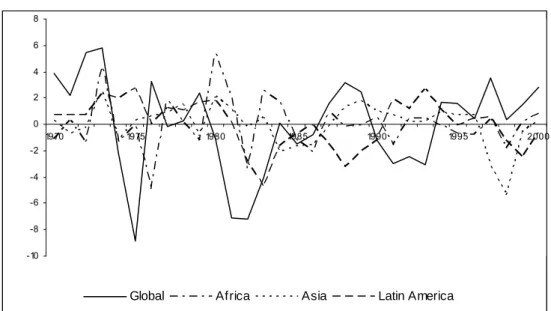
Since the variance of GDP growth can only be interpreted as idiosyncratic country risk when events are unpredictable, this paper o¤ers a re…nement that serves to take out the structural and systematic components of the variance of GDP growth. We proceed in two steps. First, we derive a conditional risk measure by drawing on the augmented Solow (1956) growth model to account for the structural characteristics of the host country that move only slowly and therefore can be partly predicted by the investor. Second, by using a principal components analysis (PCA) we adjust for the systematic risk caused by global and regional business cycle e¤ects. In the end, this exercise allows us to decompose conditional risk into its global, regional and idiosyncratic risk components.
Results show that not only are African countries on average characterised by a higher conditional risk, but idiosyncratic country risk also constitutes a larger share of total risk as compared with Asian and Latin American countries. This means that the puzzling combination of relatively high rates of return in Africa, the average return on US invest-ment to Africa over the period 1983-97 was 23% compared with 21% for Asia & Paci…c and 12% for Latin America & Caribbean as documented in UNCTAD (1999), and low in‡ows of FDI to African countries. This paper suggests that the relevant measure for comparison should be the expected rate of return, that is returns adjusted for idiosyncratic country risk.
As a …nal exercise we are interested in systematically analysing how the re…ned risk measure correlates with the economic, political and commercial risk measures suggested in the empirical FDI literature. Overall, we conclude that both economic and political risk
variables are important determinants of idiosyncratic risk whereas the commercial aspects of risk are poorly de…ned. Rather than including various risk measures on an ad hoc basis, our results indicate that the ability of a country to service its debt, the current account balance, government consumption, democratic accountability and external con‡icts are important determinants of risk.
The paper proceeds as follows. Section 2 derives a re…ned risk measure that conditions total risk on slowly moving economic fundamentals of the host economy and takes the systematic risk components due to global and regional integration into account. Using econometric tools, we are then able to decompose total risk into its conditional, systematic and idiosyncratic components. Section 3 applies a general-to-speci…c framework to select those economic, political and commercial risk measures that best describe idiosyncratic risk. Finally, Section 4 summarises and concludes.
2
A Re…ned Measure of Risk
The increased attention towards explaining FDI ‡ows by expected returns has highlighted
the need to take risk into account. Since aggregate data on returns to FDI is generally unavailable it is impossible to capture risk by the variance of such returns. The starting point in this paper is the variance of GDP growth to capture overall risk, which has been done by Hausmann and Gavin (1995), Ramey and Ramey (1995), Servén (1998), and Calderón, Loyaza and Servén (2003) among others. The focus on GDP growth is motivated by the new growth literature, which argues that GDP growth per worker re‡ects the most important elements of economic policy and performance. Not only does it re‡ect the market potential of an economy (the strength of local demand), as highlighted by Guiso and Parigi (1998), but eventually all ine¢ ciencies, instabilities and incapabilities of an economy will show up in the growth rate. This argument is con…rmed by Calderón, Loayza and Servén (2003) who …nd that when stock-market returns are regressed on other underlying indicators (in‡ation, exchange rate, political and …nancial risk), GDP growth takes the bulk of the explained variance of returns.
Yet, it is quite obvious that variability only amounts to risk when events are unpre-dictable and a re…ned measure of risk is therefore required.1 First, we derive a conditional
risk measure by taking out the part of GDP growth caused by growth determinants that move only slowly and therefore can be partly predicted by the investor. Second, since countries are interdependent there will be some systematic components in the local re-turn to investment that will depend on common global and regional factors. Adjusting for such structural and systematic factors will give us an improved measure of idiosyncratic
1This statement was stressed by Servén (1998) who draws the distinction between sample variation and uncertainty. The argument is that the former may overstate the latter by including not only truly unpre-dictable innovations to the variables of interest, but possibly also (cyclical) movements partly preunpre-dictable from the past.