Assessing a rural electrification program in Malaysia:
system performance analysis on 11 solar PV-diesel
hybrid systems
Abdul Muhaimin Mahmud
1, Richard E. Blanchard
2 Centre for Renewable Energy Technology System School of Electronic, Electrical & System EngineeringLoughborough University United Kingdom
1[email protected], 2[email protected]
Abstract— In 2006, there was a significant numbers of schools in rural Sabah in Malaysia that had no access to 24-hours electricity. Extension of grid electricity networks becomes uneconomical because of the geographical conditions of these areas and the low electrical energy density demand of the population. Malaysia’s rural development policies, therefore, emphasizes on the need to improve the learning and living condition at the rural schools. The abundant solar energy resource in the region is used for providing alternative power supply for these schools. 160 schools in rural Sabah were installed with solar photovoltaic (PV)-diesel hybrid systems. Even though the systems have been in operation for some years, knowledge informing the systems performance is difficult to find. Thus, understanding the system operation is a highly valuable experience and lessons can be learned for implementation of the rural electrification program (REP). This paper describes the finding from a field study at 11 solar PV-diesel hybrid systems. It highlighted some parameters that define the reliability of a solar PV system. The solar PV systems installed at schools in rural Sabah were found to be reliable. They reduced dependency on the diesel fuel consumption and fully utilized clean energy from the sun. It is essential to have reliable solar PV system that can provide sufficient energy for the load demand.
Keywords—Solar PV, rural electrification program (REP), system performance, reliability
I. INTRODUCTION
Rural electrification is the process, plans, programs or initiatives by government, private sectors, institution or organization that bring electricity to the rural and remote areas where 24-hour electricity connection does not exist. People and communities can develop towards modern civilization if electricity is made available because it can benefit their lifestyle by improving the level of health, education, economy and technology [1]. Renewable energy technology system is recognized as the alternative technology to grid electricity
network and solar photovoltaic (PV) system is a popular option [2].
Malaysia, in recent years has achieved 96.86% of 24 hours electricity access. The electricity access coverage in Peninsular Malaysia is the highest at 99.72% as compared to Sarawak (88.01%) and Sabah (92.94%). The geographical conditions and the low electricity energy density demand, of the remaining none electrified areas, has made extension of grid electricity networks uneconomical and in some areas impossible.
The Malaysian government shows high commitment in extending modernization to rural areas. However planning, initiatives and strategies in REP for community need longer time for its complexity to be implemented. Barriers like geographical isolation, inadequate community and social integration risk the implementation of any REP [3]. The aspiration to reduce the gap in education excellence between urban and rural areas lead to the initiative of 160 school solar PV-diesel hybrid systems being implemented in rural Sabah. 78 systems were installed and in operation during 2009, with the remaining coming online in the time period 2010-2014.
The system comprises of solar PV modules as the primary energy generator, battery as the energy storage, diesel generator to support the system and inverter that convert DC and AC voltage in both direction. 78 systems use charge controller and bidirectional inverter. The other systems use two types of inverter systems, grid inverter and bidirectional inverter. The systems were installed with standard capacity depending on the school load demand (10 kWp, 15 kWp, 20 kWp, 30 kWp, 40 kWp, 45 kWp, 50 kWp, 55 kWp and 60 kWp).
A study to determine the success of the solar home system in Bangladesh was conducted by [4] which used quantitative and qualitative survey methods. For long term performance of solar PV system, [5] observed the load consumption, energy productivity, diesel usage and energy generation strategies. Evaluation of solar home systems was conducted by [2] to confirm the specification of the installation. It is envisaged that the installation will be analyzed after the systems are in
operation for several years. The information is valuable for knowledge and learning purposes and provides understanding on the systems operation. Thus, this paper (1) describes system performance indices as tools in determining the reliability of the solar PV systems and (2) evaluate 11 solar PV systems using the system performance indices.
II. METHODOLOGY
A. Scope of Study
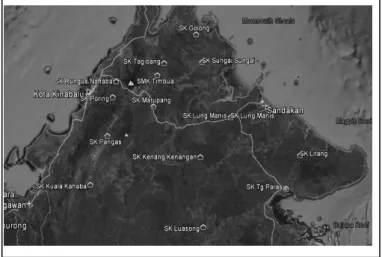
11 schools were selected and characterized into several categories which are system capacity, geographical condition and year of operation to ensure the population is defined in several homogeneous subgroups [6]. The locations are shown in Fig. 1.
Fig. 1. Location of the 11 systems.
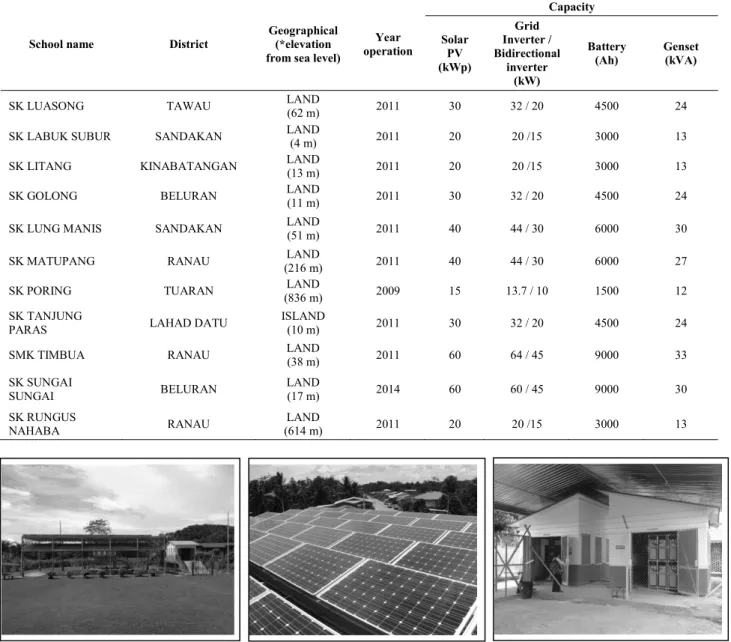
A field study was conducted from August 2014 to September 2014. The detail of the solar PV-diesel hybrid capacity of each school is shown in Table 1 below and Fig. 3 shows the installed system. The system operation was measured and recorded using a Sunny Webbox data logger. Sunny Sensor Box is used to record meteorological data as reference parameters. The data was recorded every 15 minutes for parameters including the meteorology data; DC and AC voltage and current at the solar PV array, inverter and battery system; operation of diesel generator; and schools load consumption to examine the system’s energy balance and performance indices.
B. System Performance Indices
System performance indicators are identified and the reference values are defined from standard, specification and literatures and describes below.
a) Charge factor [5], [8]-[10]
- An overcharge capacity of the previous discharge output receives by battery.
- Reference value: 1.1 – 1.4. It is essential to have lower charge factor due to energy losses during the charge-discharge process
b) PV generator capacity (Ca) [8], [11]
- Ratio of energy produced by PV divided by energy consumed by load in a period of time.
- Reference value: 1.0 – 1.2.
c) Accumulator capacity (Cs) [8]
- Ratio of maximum energy available from the battery divided by energy consumed by load in a period of time with respect to actual battery energy efficiency.
- Reference value: 3 ≤ CS ≤ 5 (for rural
electrification)
d) Solar PV fraction
- Fraction of energy produced by solar PV as compared to the total energy generation from all sources. The ratio of solar PV and diesel generator is expected to be 9:1 as specified from the design. - Reference value: > 90%
e) Balance of system (BOS) efficiency [12]
- Overall efficiency of the other components of the system.
- Reference value: No specific value but the higher the efficiency indicates lower losses within the system components (excluding the PV panel).
III. RESULTANDANALYSIS
A. Energy Resources
The irradiation level at each school is higher than the region average [13] (Fig. 2) except at SK Poring due to its location at highland (836 m) and the area is always surrounded with cloud especially in the afternoon.
Fig. 2. Annual irradiation recorded at 11 schools.
A. System performance analysis
The recorded data obtained from 11 systems were analysed. In general, the system operation was recorded for one to two years for each system. Data losses were found to have occurred during some periods of time for some systems. Table 2 describes the performance values of the systems.
TABLE I. LIST OF THE 11 SCHOOLS AND THE SOLAR PV-DIESEL HYBRID SYSTEMS CAPACITY.(SK MEANS PRIMARY SCHOOL AND SMK MEANS SECONDARY SCHOOL)
School name District
Geographical (*elevation from sea level)
Year operation Capacity Solar PV (kWp) Grid Inverter / Bidirectional inverter (kW) Battery (Ah) Genset (kVA)
SK LUASONG TAWAU LAND (62 m) 2011 30 32 / 20 4500 24
SK LABUK SUBUR SANDAKAN LAND (4 m) 2011 20 20 /15 3000 13
SK LITANG KINABATANGAN LAND (13 m) 2011 20 20 /15 3000 13
SK GOLONG BELURAN LAND (11 m) 2011 30 32 / 20 4500 24
SK LUNG MANIS SANDAKAN LAND (51 m) 2011 40 44 / 30 6000 30
SK MATUPANG RANAU (216 m) LAND 2011 40 44 / 30 6000 27
SK PORING TUARAN (836 m) LAND 2009 15 13.7 / 10 1500 12
SK TANJUNG
PARAS LAHAD DATU
ISLAND
(10 m) 2011 30 32 / 20 4500 24
SMK TIMBUA RANAU LAND (38 m) 2011 60 64 / 45 9000 33
SK SUNGAI
SUNGAI BELURAN LAND (17 m) 2014 60 60 / 45 9000 30
SK RUNGUS
NAHABA RANAU (614 m) LAND 2011 20 20 /15 3000 13
Fig. 3. (left) Solar PV structure and power house at SK Labuk Subur, (centre) solar PV panels at SK Sungai sungai, (right) system power house for batteries, inverters, diesel generator and other accessories at SK Lung Manis.
TABLE II. SYSTEM PERFORMANCE OF 11 SOLAR PV SYSTEMS
Parameters Unit Mean SD
BOS efficiency % 95.79 1.89 PV fraction % 90.99 9.29 Charge factor 1.34 0.08 PV generator capacity 1.13 0.09 Accumulator capacity 3.13 0.57 aSD = standard deviation
The BOS efficiency for all systems were more than 90% with average at 95.79% (SD = 1.89). The systems were installed to high quality and complied with standards and specifications [14].
Overall, 328 MWh of electricity energy were generated by the solar PV panels to meet the load demand and to charge the batteries. In contrast, 25.5 MWh was produced by diesel generators which contributed 7.22% of the total energy produced by the systems. Three systems (SK Golong, SK Litang and SK Poring) did not meet the reference value of 90% solar PV fraction. The load ratio for SK Golong and SK Litang was almost 100% as describes in Fig. 4 and battery problem at SK Poring are the reasons for higher usage of diesel generator. The lowest diesel generator usage was observed at SK Labuk Subur with 181 hours of running hours recorded. Teachers and staff live off site at a nearby village is the reason for low load at 22.69 kWh/day. The other two systems with the same capacity have a load double that of SK Labuk Subur. The charge factor was a mean 1.34 and SD 0.08. The highest charge factor was found at SK Poring (1.58).
Standalone PV system requires high reliability and can be determined by the capacity of the PV and the batteries with the amount of load consumed in a period of time (daily, monthly or annually) [8]. The PV generator capacity is found at 1.13 (SD=0.09) and the accumulator capacity at 3.13 (SD=0.57). The solar PV systems generate sufficient electrical power that meet the demand by the load and the batteries. Furthermore, the batteries contain adequate capacities which compensate the period of low or zero energy production from the solar PV, as well as supporting the diesel generator operation.
Fig. 4. The ratio of the actual load and the expected load.
Fig. 5 below describes the energy generation from solar PV and diesel generator at SK Poring in January 2011. The diesel generator was in operation every weekday of the month – the same situation was observed in other months. The actual load was recorded at 14.12 kWh/day, which is half the expected value at 28.8 kWh/day. The battery SOC level dropped to just 20%. This happened after midnight, which initiated the diesel generator for the charging process (Fig. 6). The battery voltage was at low voltage level (1.8 Vdc per cell)
even though the SOC level was more than 50%. The batteries were unable to produce sufficient energy as its actual capacity was lower than the nominal value. Hence, this condition reduces the reliability of the solar PV system.
Fig. 5. Energy generation from solar PV and diesel generator for January 2011 at SK Poring.
Fig. 6. Battery state of charge (SOC) and voltage on 17-18/1/2011 at SK Poring.
IV. CONCLUSION
This paper gives an understanding of off-grid solar PV system operation. The fact that information on field performance data is not easily found in literatures makes findings from this paper valuable.
This paper reports on the work to evaluate the performance of 11 solar PV systems which have been installed at schools in rural Sabah. Methods in evaluating the system performance indices that determine the reliability of the system have been presented. 10 systems were found to be highly reliable and give sufficient power for the schools load demand. Though the system at SK Poring could meet the load demand, the issues in higher consumption of the diesel generator is highlighted. In this case the problem was found to have occurred because the battery system did not have sufficient capacity.
The information from this paper is to be used in constructing guidelines for evaluating solar PV system performance. In the future, several milestones are to be achieved such as defining the effectiveness of the REP in transforming the education excellence in rural areas and developing a REP model that is high in sustainable value.
ACKNOWLEDGMENT
The authors would like to thank officers at Electrical Engineering Branch, Public Works Department of Malaysia, for their assistances and supports during the field study. Abdul Muhaimin Mahmud wishes to thank the Public Service Department of Malaysia for sponsoring the study.
REFERENCES
[1] F. S. Javadi, B. Rismanchi, M. Sarraf, O. Afshar, R. Saidur, H. W. Ping, and N. a. Rahim, “Global policy of rural electrification,” Renew. Sustain. Energy Rev., vol. 19, pp. 402–416, Mar. 2013.
[2] S. A. Chowdhury, M. Mourshed, S. M. R. Kabir, M. Islam, T. Morshed, M. R. Khan, and M. N. Patwary, “Technical appraisal of solar home
systems in Bangladesh: A field investigation,” Renew. Energy, vol. 36, no. 2, pp. 772–778, Feb. 2011.
[3] J. Hazelton, A. Bruce, and I. MacGill, “A review of the potential benefits and risks of photovoltaic hybrid mini-grid systems,” Renew. Energy, Dec. 2013.
[4] T. Urmee and D. Harries, “Determinants of the success and sustainability of Bangladesh’s SHS program,” Renew. Energy, vol. 36, no. 11, pp. 2822–2830, Nov. 2011.
[5] P. Díaz, R. Peña, J. Muñoz, C. A. Arias, and D. Sandoval, “Field analysis of solar PV-based collective systems for rural electrification,” Energy, vol. 36, no. 5, pp. 2509–2516, May 2011.
[6] M. K. . Trochim, Research Methods Knowledge Base. Statistic’s Solution Consulting. [Online]. Available: http://socialresearchmethods.net.
[7] SMA Solar Technology AG, SunnyBoy
3000TL/3600TL/4000TL/500TL with reactive power control. SMA Solar Technology AG, Niestetal, Germany.
[8] A. Luque and S. Hegedus, A handbook of photovoltaic science and engineering. Chichester:Wiley, 2003.
[9] R.-S. Liu, L. Zhang, X. Sun, H. Liu, and J. Zhang, Electrochemical Technologies for Energy Storage and Conversion. Weinham, Germany: Wiley-VCH Verlag & Co. KGaA, 2012.
[10] B. Espinar and M. Didier, “The role of energy storage for mini-grid stabilization : IEA PVPS Task 11 Report,” France, 2011.
[11] T. Khatib, A. Mohamed, K. Sopian, and M. Mahmoud, “Optimal sizing of building integrated hybrid PV/diesel generator system for zero load rejection for Malaysia,” Energy Build., vol. 43, no. 12, pp. 3430–3435, Dec. 2011.
[12] British Standards Institution, Photovoltaic system performance monitoring — Guidelines for measurement , data exchange and analysis. 1998.
[13] S. Shaari, A. M. Omar, A. H. Haris, R. Abdul Rahman, and S. I. Sulaiman, Solar Photovoltaic Power : Irradiation data for Malaysia. Ministry of Energy, Green Technology & Water, Malaysia / Malaysia Building Intergrated Photovoltaic Project, 2010.
[14] A. M. Mahmud, R. Blanchard, and R. Gottschalg, “Impact Study on Rural Electrification Program Using Solar PV-Diesel Hybrid System for Rural Schools in Sabah, Malaysia,” 4th Symposium small PV-application - Rural electrification and commercial use, 2015, p. 145.