Key-Value Coding
Contents
Introduction
6Organization of This Document 6
See Also 7
What Is Key-Value Coding?
8Key-Value Coding and Scripting 8
Using Key-Value Coding to Simplify Your Code 9
Terminology
11Key-Value Coding Fundamentals
12Keys and Key Paths 12
Getting Attribute Values Using Key-Value Coding 12
Setting Attribute Values Using Key-Value Coding 13
Dot Syntax and Key-Value Coding 14
Key-Value Coding Accessor Methods
15Commonly Used Accessor Patterns 15
Collection Accessor Patterns for To-Many Properties 17
Indexed Accessor Pattern 17
Unordered Accessor Pattern 21
Key-Value Validation
25Validation Method Naming Convention 25
Implementing a Validation Method 25
Invoking Validation Methods 26
Automatic Validation 27
Validation of Scalar Values 27
Ensuring KVC Compliance
29Attribute and To-One Relationship Compliance 29
Scalar and Structure Support
31Representing Non-Object Values 31
Handling nil Values 31
Wrapping and Unwrapping Scalar Types 32
Wrapping and Unwrapping Structs 33
Collection Operators
35Data Used In Examples 36
Simple Collection Operators 37
@avg 37 @count 37 @max 37 @min 38 @sum 38 Object Operators 38 @distinctUnionOfObjects 39 @unionOfObjects 39
Array and Set Operators 39
@distinctUnionOfArrays 40
@unionOfArrays 41
@distinctUnionOfSets 41
Accessor Search Implementation Details
43Accessor Search Patterns for Simple Attributes 43
Default Search Pattern for setValue:forKey: 43
Default Search Pattern for valueForKey: 43
Accessor Search Pattern for Ordered Collections 44
Accessor Search Pattern for Uniquing Ordered Collections 45
Accessor Search Pattern for Unordered Collections 46
Describing Property Relationships
48Class Descriptions 48
Performance Considerations
49Overriding Key-Value Coding Methods 49
Optimizing To-Many Relationships 49
Figures, Tables, and Listings
What Is Key-Value Coding?
8Listing 1 Implementation of data-source method without key-value coding 9
Listing 2 Implementation of data-source method with key-value coding 10
Key-Value Coding Accessor Methods
15Listing 1 Accessor naming variations for a hidden property key 15
Listing 2 Alternate form accessor for a hidden property key 15
Listing 3 Accessor naming convention to support a hidden property key 16
Listing 4 Example-count<Key>implementation 18
Listing 5 Example-objectIn<Key>AtIndex:and-<key>AtIndexes:implementations 18
Listing 6 Example-get<Key>:range:implementation 19
Listing 7 Example-insertObject:in<Key>AtIndex:and-insert<Key>:atIndexes:accessors
20
Listing 8 Example-removeObjectFrom<Key>AtIndex:and-remove<Key>AtIndexes:accessors
20
Listing 9 Example-replaceObjectIn<Key>AtIndex:withObject:and
-replace<Key>AtIndexes:with<Key>:accessors 21
Listing 10 Example-countOf<Key>,-enumeratorOf<Key>, and-memberOf<Key>:accessors 22
Listing 11 Example-add<Key>Object:and-add<Key>:accessors 23
Listing 12 Example-remove<Key>Object:and-remove<Key>:accessors 23
Listing 13 Example-intersect<Key>:and-set<Key>:implementations 24
Key-Value Validation
25Listing 1 Validation method declaration for the property name 25
Listing 2 Validation method for the name property 26
Listing 3 Validation method for a scalar property 27
Scalar and Structure Support
31Table 1 Scalar types as wrapped inNSNumberobjects 32
Table 2 Common struct types as wrapped usingNSValue. 33
Table 1 Example data for theTransactionsobjects 36
This document describes theNSKeyValueCodinginformal protocol, which defines a mechanism allowing applications to access the properties of an object indirectly by name (or key), rather than directly through invocation of an accessor method or as instance variables.
You should read this document to gain an understanding of how to use key-value coding in your applications and how to make your classes key-value coding compliant for interacting with other technologies. Key-value coding is a fundamental technology when working with key-value observing, Cocoa bindings, Core Data, and making your application AppleScript-able. You are expected to be familiar with the basics of Cocoa development and the Objective-C language.
Organization of This Document
Key-Value Coding includes these articles:● What Is Key-Value Coding? (page 8) provides an overview of key-value coding.
● Terminology (page 11) defines the terms commonly used to refer to an object’s properties.
● Key-Value Coding Fundamentals (page 12) describes the basic principles required to use key-value coding. ● Key-Value Coding Accessor Methods (page 15) describes the accessor methods your classes should
implement.
● Key-Value Validation (page 25) tells you how to implement property validation.
● Ensuring KVC Compliance (page 29) describes the capabilities a class must implement to be key-value
coding compliant.
● Scalar and Structure Support (page 31) describes the data types supported by key-value coding. ● Collection Operators (page 35) lists the available collection operators and describes their use.
● Accessor Search Implementation Details (page 43) explains how the appropriate accessor method or
instance variable is determined.
● Describing Property Relationships (page 48) describes the use of meta-data to define the relationships
between objects and their properties.
Introduction
See Also
There are other technologies, not covered in this document, that are related to key-value coding.
● Key-Value Observing Programming Guide describes the features of the key-value observing protocol that
allows objects to observe changes in other objects. Introduction
Key-value coding is a mechanism for accessing an object’s properties indirectly, using strings to identify properties, rather than through invocation of an accessor method or accessing them directly through instance variables. In essence, key-value coding defines the patterns and method signatures that your application’s accessor methods implement.
Accessor methods, as the name suggests, provide access to your application’s data model’s property values. There are two basic forms of accessor—get accessors and set accessors. Get accessors, also referred to as getters, return the values of a property. Set accessors, also referred to as setters, set the value of a property. There are getter and setter variants for dealing with both object attributes and to-many relationships. Implementing key-value coding compliant accessors in your application is an important design principle. Accessors help to enforce proper data encapsulation and facilitate integration with other technologies such as key-value observing, Core Data, Cocoa bindings, and scriptability. Key-value coding methods can, in many cases, also be utilized to simplify your application’s code.
The essential methods for key-value coding are declared in theNSKeyValueCodingObjective-C informal protocol and default implementations are provided byNSObject.
Key-value coding supports properties with object values, as well as the scalar types and structs. Non-object parameters and return types are detected and automatically wrapped, and unwrapped, as described inScalar and Structure Support (page 31).
Key-Value Coding and Scripting
The scripting support in Cocoa is designed so that an application can easily implement scripting by accessing its model objects—the objects that encapsulate the application’s data. When the user executes an AppleScript command that targets your application, the goal is for that command to go directly to the application’s model objects to get the work done.
Scripting in OS X relies heavily on key-value coding to provide automatic support for executing AppleScript commands. In a scriptable application, a model object defines a set of keys that it supports. Each key represents a property of the model object. Some examples of scripting-related keys arewords,font,documents, and
What Is Key-Value Coding?
As you design the objects of your application, you should define the set of keys for your model objects and implement the corresponding accessor methods. Then when you define the script suites for your application, you can specify the keys that each scriptable class supports. If you support key-value coding, you will get a great deal of scripting support “for free.”
In AppleScript, object hierarchies define the structure of the model objects in an application. Most AppleScript commands specify one or more objects within your application by drilling down this object hierarchy from parent container to child element. You can define the relationships between properties available through key-value coding in class descriptions. SeeDescribing Property Relationships (page 48) for more details. Cocoa’s scripting support takes advantage of key-value coding to get and set information in scriptable objects. The method in the Objective-C informal protocolNSScriptKeyValueCodingprovides additional capabilities for working with key-value coding, including getting and setting key values by index in multi-value keys and coercing (or converting) a key-value to the appropriate data type.
Using Key-Value Coding to Simplify Your Code
You can use key-value coding methods in your own code to generalize implementations. For example, in OS X
NSTableViewandNSOutlineViewobjects both associate an identifier string with each of their columns. By making this identifier the same as the key for the property you wish to display, you can significantly simplify your code.
Listing 1 shows an implementation of anNSTableViewdelegate method without using key-value coding. Listing 2 shows an implementation that takes advantage of key-value coding to return the appropriate value using the column identifier as the key.
Listing 1 Implementation of data-source method without key-value coding
- (id)tableView:(NSTableView *)tableview
objectValueForTableColumn:(id)column row:(NSInteger)row {
ChildObject *child = [childrenArray objectAtIndex:row]; if ([[column identifier] isEqualToString:@"name"]) {
return [child name]; }
if ([[column identifier] isEqualToString:@"age"]) { return [child age];
}
if ([[column identifier] isEqualToString:@"favoriteColor"]) {
What Is Key-Value Coding?
return [child favoriteColor]; }
// And so on. }
Listing 2 Implementation of data-source method with key-value coding
- (id)tableView:(NSTableView *)tableview
objectValueForTableColumn:(id)column row:(NSInteger)row {
ChildObject *child = [childrenArray objectAtIndex:row]; return [child valueForKey:[column identifier]];
}
What Is Key-Value Coding?
In addition to overloading existing terms, key-value coding defines some unique terminology of its own. Key-value coding can be used to access three different types of object values: attributes, to-one relationships, and to-many relationships. The termpropertyrefers to any of these types of values.
Anattributeis a property that is a simple value, such as a scalar, string, or Boolean value. Value objects such asNSNumberand other immutable types such as asNSColorare also considered attributes.
A property that specifies ato-one relationshipis an object that has properties of its own. These underlying properties can change without the object itself changing. For example, anNSViewinstance’s superview is a to-one relationship.
Finally, a property that specifies ato-many relationshipconsists of a collection of related objects. An instance ofNSArrayorNSSetis commonly used to hold such a collection. However, key-value coding allows you to use custom classes for collections and still access them as if they were anNSArrayorNSSetby implementing the key-value coding accessors discussed inCollection Accessor Patterns for To-Many Properties (page 17).
Terminology
This article describes the basic principles of key-value coding.
Keys and Key Paths
A key is a string that identifies a specific property of an object. Typically, a key corresponds to the name of an accessor method or instance variable in the receiving object. Keys must use ASCII encoding, begin with a lowercase letter, and may not contain whitespace.
Some example keys would bepayee,openingBalance,transactionsandamount.
A key path is a string of dot separated keys that is used to specify a sequence of object properties to traverse. The property of the first key in the sequence is relative to the receiver, and each subsequent key is evaluated relative to the value of the previous property.
For example, the key pathaddress.streetwould get the value of theaddressproperty from the receiving object, and then determine thestreetproperty relative to theaddressobject.
Getting Attribute Values Using Key-Value Coding
The methodvalueForKey:returns the value for the specified key, relative to the receiver. If there is no accessor or instance variable for the specified key, then the receiver sends itself avalueForUndefinedKey:
message. The default implementation ofvalueForUndefinedKey:raises anNSUndefinedKeyException; subclasses can override this behavior.
Similarly,valueForKeyPath:returns the value for the specified key path, relative to the receiver. Any object in the key path sequence that is not key-value coding compliant for the appropriate key receives a
valueForUndefinedKey:message.
The methoddictionaryWithValuesForKeys:retrieves the values for an array of keys relative to the receiver. The returned NSDictionary contains values for all the keys in the array.
Note: Collection objects, such asNSArray,NSSet, andNSDictionary, can’t containnilas a value. Instead, you representnilvalues using a special object,NSNull.NSNullprovides a single instance that represents thenilvalue for object properties. The default implementations of
dictionaryWithValuesForKeys:andsetValuesForKeysWithDictionary:translates betweenNSNullandnilautomatically, so your objects don’t have to explicitly test forNSNull
values.
When a value is returned for a key path that contains a key for a to-many property, and that key is not the last key in the path, the returned value is a collection containing all the values for the keys to the right of the to-many key. For example, requesting the value of the key pathtransactions.payeereturns an array containing all thepayeeobjects, for all the transactions. This also works for multiple arrays in the key path. The key pathaccounts.transactions.payeewould return an array with all the payee objects, for all the transactions, in all the accounts.
Setting Attribute Values Using Key-Value Coding
The methodsetValue:forKey:sets the value of the specified key, relative to the receiver, to the provided value. The default implementation ofsetValue:forKey:automatically unwrapsNSValueobjects that represent scalars and structs and assigns them to the property. SeeScalar and Structure Support (page 31) for details on the wrapping and unwrapping semantics.
If the specified key does not exist, the receiver is sent asetValue:forUndefinedKey:message. The default implementation ofsetValue:forUndefinedKey:raises anNSUndefinedKeyException; however, subclasses can override this method to handle the request in a custom manner.
The methodsetValue:forKeyPath:behaves in a similar fashion, but it is able to handle a key path as well as a single key.
Finally,setValuesForKeysWithDictionary:sets the properties of the receiver with the values in the specified dictionary, using the dictionary keys to identify the properties. The default implementation invokes
setValue:forKey:for each key-value pair, substitutingnilforNSNullobjects as required.
One additional issue that you should consider is what happens when an attempt is made to set a non-object property to a nil value. In this case, the receiver sends itself asetNilValueForKey:message. The default implementation ofsetNilValueForKey:raises anNSInvalidArgumentException. Your application can override this method to substitute a default value or a marker value, and then invokesetValue:forKey:
with the new value.
Key-Value Coding Fundamentals
Dot Syntax and Key-Value Coding
Objective-C’s dot syntax and key-value coding are orthogonal technologies. You can use key-value coding whether or not you use the dot syntax, and you can use the dot syntax whether or not you use KVC. Both, though, make use of a “dot syntax.” In the case of key-value coding, the syntax is used to delimit elements in a key path. Remember that when you access a property using the dot syntax, you invoke the receiver’s standard accessor methods.
You can use key-value coding methods to access a property, for example, given a class defined as follows:
@interface MyClass
@property NSString *stringProperty; @property NSInteger integerProperty; @property MyClass *linkedInstance; @end
you could access the properties in an instance using KVC:
MyClass *myInstance = [[MyClass alloc] init];
NSString *string = [myInstance valueForKey:@"stringProperty"]; [myInstance setValue:@2 forKey:@"integerProperty"];
To illustrate the difference between the properties dot syntax and KVC key paths, consider the following.
MyClass *anotherInstance = [[MyClass alloc] init]; myInstance.linkedInstance = anotherInstance; myInstance.linkedInstance.integerProperty = 2;
This has the same result as:
MyClass *anotherInstance = [[MyClass alloc] init]; myInstance.linkedInstance = anotherInstance;
[myInstance setValue:@2 forKeyPath:@"linkedInstance.integerProperty"];
Key-Value Coding Fundamentals Dot Syntax and Key-Value Coding
In order for key-value coding to locate the accessor methods to use for invocations ofvalueForKey:,
setValue:forKey:,mutableArrayValueForKey:, andmutableSetValueForKey:, you need to implement the key-value coding accessor methods.
Note: The accessor patterns in this section are written in the form-set<Key>:or-<key>. The
<key>text is a placeholder for the name of your property. Your implementation of the corresponding method should substitute the property name for<Key>or<key>respecting the case specified by key. For example, for the propertyname,-set<Key>:would expand to-setName:,-<key>would simply be-name.
Commonly Used Accessor Patterns
The format for an accessor method that returns a property is-<key>. The-<key>method returns an object, scalar, or a data structure. The alternate naming form-is<Key>is supported for Boolean properties.
The example in Listing 1 shows the method declaration for thehiddenproperty using the typical convention, and Listing 2 shows the alternate format.
Listing 1 Accessor naming variations for a hidden property key
- (BOOL)hidden {
// Implementation specific code. return ...;
}
Listing 2 Alternate form accessor for a hidden property key
- (BOOL)isHidden {
// Implementation specific code. return ...;
}
In order for an attribute or to-one relationship property to supportsetValue:forKey:, an accessor in the formset<Key>:must be implemented. Listing 3 shows an example accessor method for thehiddenproperty key.
Listing 3 Accessor naming convention to support a hidden property key
- (void)setHidden:(BOOL)flag { // Implementation specific code. return;
}
If the attribute is a non-object type, you must also implement a suitable means of representing anilvalue. The key-value coding methodsetNilValueForKey:method is called when you attempt to set an attribute tonil. This provides the opportunity to provide appropriate default values for your application, or handle keys that don’t have corresponding accessors in the class.
The following example sets thehiddenattribute toYESwhen an attempt is made to set it tonil. It creates anNSNumberinstance containing the Boolean value and then usessetValue:forKey:to set the new value. This maintains encapsulation of the model and ensures that any additional actions that should occur as a result of setting the value will actually occur. This is considered better practice than calling an accessor method or setting an instance variable directly.
- (void)setNilValueForKey:(NSString *)theKey {
if ([theKey isEqualToString:@"hidden"]) { [self setValue:@YES forKey:@"hidden"]; }
else {
[super setNilValueForKey:theKey]; }
}
Key-Value Coding Accessor Methods Commonly Used Accessor Patterns
Collection Accessor Patterns for To-Many Properties
Although your application can implement accessor methods for to-many relationship properties using the
-<key>and-set<Key>:accessor forms, you should typically only use those to create the collection object. For manipulating the contents of the collection it is best practice to implement the additional accessor methods referred to as the collection accessor methods. You then use the collection accessor methods, or a mutable collection proxy returned bymutableArrayValueForKey:ormutableSetValueForKey:.
Implementing the collection accessor methods, instead of, or in addition to, the basic getter for the relationship, can have many advantages:
● Performance can be increased in the case of mutable to-many relationships, often significantly.
● To-many relationships can be modeled with classes other thanNSArrayorNSSetby implementing the
appropriate collection accessors. Implementing collection accessor methods for a property makes that property indistinguishable from an array or set when using key-value coding methods.
● You can use the collection accessor methods directly to make modifications to the collection in a key-value
observing compliant way. SeeKey-Value Observing Programming Guidefor more information on key-value observing.
There are two variations of collection accessors: indexed accessors for ordered to-many relationships (typically represented byNSArray) and unordered accessors for relationships that don’t require an order to the members (represented byNSSet).
Indexed Accessor Pattern
The indexed accessor methods define a mechanism for counting, retrieving, adding, and replacing objects in an ordered relationship. Typically this relationship is an instance ofNSArrayorNSMutableArray; however, any object can implement these methods and be manipulated just as if it was an array. You are not restricted to simply implementing these methods, you can also invoke them as well to interact directly with objects in the relationship.
There are indexed accessors which return data from the collection (the getter variation) and mutable accessors that provide an interface formutableArrayValueForKey:to modify the collection.
Getter Indexed Accessors
In order to support read-only access to an ordered to-many relationship, implement the following methods:
● -countOf<Key>. Required. This is the analogous to theNSArrayprimitive methodcount.
● -objectIn<Key>AtIndex:or-<key>AtIndexes:. One of these methods must be implemented. They
correspond to theNSArraymethodsobjectAtIndex:andobjectsAtIndexes:. Key-Value Coding Accessor Methods
● -get<Key>:range:. Implementing this method is optional, but offers additional performance gains. This
method corresponds to theNSArraymethodgetObjects:range:.
An implementation of the-countOf<Key>method simply returns the number of objects in the to-many relationship as anNSUInteger. The code fragment in Listing 4 illustrates the-countOf<Key>implementation for the to-many relationship propertyemployees.
Listing 4 Example-count<Key>implementation
- (NSUInteger)countOfEmployees { return [self.employees count]; }
The-objectIn<Key>AtIndex:method returns the object at the specified index in the to-many relationship. The-<key>AtIndexes:accessor form returns an array of objects at the indexes specified by theNSIndexSet
parameter. Only one of these two methods must be implemented.
The code fragment in Listing 5 shows-objectIn<Key>AtIndex:and-<key>AtIndexes:implementations for a to-many relationship propertyemployees.
Listing 5 Example-objectIn<Key>AtIndex:and-<key>AtIndexes:implementations
- (id)objectInEmployeesAtIndex:(NSUInteger)index { return [employees objectAtIndex:index];
}
- (NSArray *)employeesAtIndexes:(NSIndexSet *)indexes { return [self.employees objectsAtIndexes:indexes]; }
If benchmarking indicates that performance improvements are required, you can also implement
-get<Key>:range:. Your implementation of this accessor should return in the buffer given as the first parameter the objects that fall within the range specified by the second parameter.
Listing 6 shows an example implementation of the-get<Key>:range:accessor pattern for the to-many
employeesproperty.
Key-Value Coding Accessor Methods
Listing 6 Example-get<Key>:range:implementation
- (void)getEmployees:(Employee * __unsafe_unretained *)buffer range:(NSRange)inRange {
// Return the objects in the specified range in the provided buffer. // For example, if the employees were stored in an underlying NSArray [self.employees getObjects:buffer range:inRange];
}
Mutable Indexed Accessors
Supporting a mutable to-many relationship with indexed accessors requires implementing additional methods. Implementing the mutable indexed accessors allow your application to interact with the indexed collection in an easy and efficient manner by using the array proxy returned bymutableArrayValueForKey:. In addition, by implementing these methods for a to-many relationship your class will be key-value observing compliant for that property (seeKey-Value Observing Programming Guide).
Note: You are strongly advised to implement these mutable accessors rather than relying on an accessor that returns a mutable set directly. The mutable accessors are much more efficient when making changes to the data in the relationship.
In order to be key-value coding compliant for a mutable ordered to-many relationship you must implement the following methods:
● -insertObject:in<Key>AtIndex:or-insert<Key>:atIndexes:. At least one of these methods
must be implemented. These are analogous to theNSMutableArraymethodsinsertObject:atIndex:
andinsertObjects:atIndexes:.
● -removeObjectFrom<Key>AtIndex:or-remove<Key>AtIndexes:. At least one of these methods
must be implemented. These methods correspond to theNSMutableArraymethods
removeObjectAtIndex:andremoveObjectsAtIndexes:respectively.
● -replaceObjectIn<Key>AtIndex:withObject:or-replace<Key>AtIndexes:with<Key>:.
Optional. Implement if benchmarking indicates that performance is an issue.
The-insertObject:in<Key>AtIndex:method is passed the object to insert, and anNSUIntegerthat specifies the index where it should be inserted. The-insert<Key>:atIndexes:method inserts an array of objects into the collection at the indices specified by the passedNSIndexSet. You are only required to implement one of these two methods.
Listing 7 shows sample implementations of both insert accessors for the to-manyemployeeproperty. Key-Value Coding Accessor Methods
Listing 7 Example-insertObject:in<Key>AtIndex:and-insert<Key>:atIndexes:accessors
- (void)insertObject:(Employee *)employee inEmployeesAtIndex:(NSUInteger)index { [self.employees insertObject:employee atIndex:index];
return; }
- (void)insertEmployees:(NSArray *)employeeArray atIndexes:(NSIndexSet *)indexes {
[self.employees insertObjects:employeeArray atIndexes:indexes]; return;
}
The-removeObjectFrom<Key>AtIndex:method is passed anNSUIntegervalue specifying the index of the object to be removed from the relationship. The-remove<Key>AtIndexes:is passed anNSIndexSet
specifying the indexes of the objects to be removed from the relationship. Again, you are only required to implement one of these methods.
Listing 8 shows sample implementations of-removeObjectFrom<Key>AtIndex:and
-remove<Key>AtIndexes:implementations for the to-manyemployeeproperty.
Listing 8 Example-removeObjectFrom<Key>AtIndex:and-remove<Key>AtIndexes:accessors
- (void)removeObjectFromEmployeesAtIndex:(NSUInteger)index { [self.employees removeObjectAtIndex:index]; } - (void)removeEmployeesAtIndexes:(NSIndexSet *)indexes { [self.employees removeObjectsAtIndexes:indexes]; }
If benchmarking indicates that performance improvements are required, you can also implement one or both of the optional replace accessors. Your implementation of either
-replaceObjectIn<Key>AtIndex:withObject:or-replace<Key>AtIndexes:with<Key>:are called when an object is replaced in a collection, rather than doing a remove and then insert.
Key-Value Coding Accessor Methods
Listing 9 Example-replaceObjectIn<Key>AtIndex:withObject:and-replace<Key>AtIndexes:with<Key>: accessors
- (void)replaceObjectInEmployeesAtIndex:(NSUInteger)index withObject:(id)anObject {
[self.employees replaceObjectAtIndex:index withObject:anObject]; }
- (void)replaceEmployeesAtIndexes:(NSIndexSet *)indexes withEmployees:(NSArray *)employeeArray {
[self.employees replaceObjectsAtIndexes:indexes withObjects:employeeArray]; }
Unordered Accessor Pattern
The unordered accessor methods provide a mechanism for accessing and mutating objects in an unordered relationship. Typically, this relationship is an instance ofNSSetorNSMutableSet. However, by implementing these accessors, any class can by used to model the relationship and be manipulated using key-value coding just as if it was an instance ofNSSet.
Getter Unordered Accessors
The getter variations of the unordered accessor methods provide simple access to the relationship data. The methods return the number of objects in the collection, an enumerator to iterate over the collection objects, and a method to compare an object with the contents of the collection to see if it is already present.
Note: It’s rare to have to implement the getter variations of the unordered accessors. To-many unordered relationships are most often modeled using instance of NSSet or a subclass. In that case the key-value coding will, if it doesn’t find these accessor patterns for the property, directly access the set. Typically, you only implement these methods if you are using a custom collection class that needs to be accessed as if it was a set.
In order to support read-only access to an unordered to-many relationship, you would implement the following methods:
● -countOf<Key>. Required. This method corresponds to theNSSetmethodcount.
● -enumeratorOf<Key>. Required. Corresponds to theNSSetmethodobjectEnumerator.
Key-Value Coding Accessor Methods
● -memberOf<Key>:. Required. This method is the equivalent of theNSSetmethodmember:
Listing 10 shows simple implementations of the necessary getter accessors that simply pass the responsibilities to thetransactionsproperty.
Listing 10 Example-countOf<Key>,-enumeratorOf<Key>, and-memberOf<Key>:accessors
- (NSUInteger)countOfTransactions { return [self.transactions count]; }
- (NSEnumerator *)enumeratorOfTransactions { return [self.transactions objectEnumerator]; }
- (Transaction *)memberOfTransactions:(Transaction *)anObject { return [self.transactions member:anObject];
}
The-countOf<Key>accessor implementation should simply return the number of items in the relationship. The-enumeratorOf<Key>method implementation must return anNSEnumeratorinstance that is used to iterate over the items in the relationship. See Enumeration: Traversing a Collection’s Elements inCollections Programming Topics for more information about enumerators.
The-memberOf<Key>:accessor must compare the object passed as a parameter with the contents of the collection and returns the matching object as a result, ornilif no matching object is found. Your
implementation of this method may useisEqual:to compare the objects, or may compare objects in another manner. The object returned may be a different object than that tested for membership, but it should be the equivalent as far as content is concerned.
Mutable Unordered Accessors
Supporting a mutable to-many relationship with unordered accessors requires implementing additional methods. Implementing the mutable unordered accessors for your application to interact with the collection in an easy and efficient manner through the use of the array proxy returned bymutableSetValueForKey:. In addition, by implementing these methods for a to-many relationship your class will be key-value observing Key-Value Coding Accessor Methods
Note: You are strongly advised to implement these mutable accessors rather than relying on an accessor that returns a mutable array directly. The mutable accessors are much more efficient when making changes to the data in the relationship.
In order to be key-value coding complaint for a mutable unordered to-many relationship you must implement the following methods:
● -add<Key>Object:or-add<Key>:. At least one of these methods must be implemented. These are
analogous to theNSMutableSetmethodaddObject:.
● -remove<Key>Object:or-remove<Key>:. At least one of these methods must be implemented. These
are analogous to theNSMutableSetmethodremoveObject:.
● -intersect<Key>:. Optional. Implement if benchmarking indicates that performance is an issue. It
performs the equivalent action of the NSSet methodintersectSet:.
The-add<Key>Object:and-add<Key>:implementations add a single item or a set of items to the relationship. You are only required to implement one of the methods. When adding a set of items to the relationship you should ensure that an equivalent object is not already present in the relationship. Listing 11 shows an example pass-through implementation for thetransactionsproperty.
Listing 11 Example-add<Key>Object:and-add<Key>:accessors
- (void)addTransactionsObject:(Transaction *)anObject { [self.transactions addObject:anObject]; } - (void)addTransactions:(NSSet *)manyObjects { [self.transactions unionSet:manyObjects]; }
Similarly, the-remove<Key>Object:and-remove<Key>:implementations remove a single item or a set of items from the relationship. Again, implementation of only one of the methods is required. Listing 12 shows an example pass-through implementation for thetransactionsproperty.
Listing 12 Example-remove<Key>Object:and-remove<Key>:accessors
- (void)removeTransactionsObject:(Transaction *)anObject { [self.transactions removeObject:anObject];
}
Key-Value Coding Accessor Methods
- (void)removeTransactions:(NSSet *)manyObjects { [self.transactions minusSet:manyObjects]; }
If benchmarking indicates that performance improvements are required, you can also implement the
-intersect<Key>:or-set<Key>:methods (see Listing 13).
The implementation of-intersect<Key>:should remove from the relationship all the objects that aren’t common to both sets. This is the equivalent of theNSMutableSetmethodintersectSet:.
Listing 13 Example-intersect<Key>:and-set<Key>:implementations
- (void)intersectTransactions:(NSSet *)otherObjects { return [self.transactions intersectSet:otherObjects]; }
Key-Value Coding Accessor Methods
Key-value coding provides a consistent API for validating a property value. The validation infrastructure provides a class the opportunity to accept a value, provide an alternate value, or deny the new value for a property and give a reason for the error.
Validation Method Naming Convention
Just as there are conventions for naming accessor methods, there is a convention for naming a property’s validation method. A validation method has the formatvalidate<Key>:error:. The example in Listing 1 shows the validation method declaration for the propertyname.
Listing 1 Validation method declaration for the property name
-(BOOL)validateName:(id *)ioValue error:(NSError * __autoreleasing *)outError { // Implementation specific code.
return ...; }
Implementing a Validation Method
Validation methods are passed two parameters by reference: the value object to validate and the NSError used to return error information.
There are three possible outcomes from a validation method:
1. The object value is valid, soYESis returned without altering the value object or the error.
2. The object value is not valid and a valid value cannot be created and returned. In this caseNOis returned after setting the error parameter to anNSErrorobject that indicates the reason validation failed.
3. A new object value that is valid is created and returned. In this caseYESis returned after setting the value parameter to the newly created, valid value. The error is returned unaltered. You must return a new object, rather than just modifying the passedioValue, even if it is mutable.
This variant is typically discouraged because it can be difficult to ensure values are propagated consistently.
Key-Value Validation
The example in Listing 2 implements a validation method for anameproperty that ensures that the value object is a string and that the name is capitalized correctly.
Listing 2 Validation method for the name property
-(BOOL)validateName:(id *)ioValue error:(NSError * __autoreleasing *)outError{
// The name must not be nil, and must be at least two characters long. if ((*ioValue == nil) || ([(NSString *)*ioValue length] < 2)) {
if (outError != NULL) {
NSString *errorString = NSLocalizedString(
@"A Person's name must be at least two characters long", @"validation: Person, too short name error");
NSDictionary *userInfoDict = @{ NSLocalizedDescriptionKey : errorString };
*outError = [[NSError alloc] initWithDomain:PERSON_ERROR_DOMAIN code:PERSON_INVALID_NAME_CODE userInfo:userInfoDict]; } return NO; } return YES; }
Important: A validation method that returnsNOmust first check whether theoutErrorparameter is
NULL; if theoutErrorparameter is notNULL, the method should set theoutErrorparameter to a valid
NSErrorobject.
Invoking Validation Methods
You can call validation methods directly, or by invokingvalidateValue:forKey:error:and specifying the key. The default implementation of validateValue:forKey:error: searches the class of the receiver for a validation method whose name matches the patternvalidate<Key>:error:. If such a method is found, it Key-Value Validation
Warning: An implementation of-set<Key>:for a property should never call the validation methods.
Automatic Validation
In general, key-value coding does not perform validation automatically—it is your application’s responsibility to invoke the validation methods.
Some technologies do perform validation automatically in some circumstances: Core Data automatically performs validation when the managed object context is saved; in OS X, Cocoa bindings allow you to specify that validation should occur automatically (see Cocoa Bindings Programming Topics for more information).
Validation of Scalar Values
Validation methods expect the value parameter to be an object, and as a result values for non-object properties are wrapped in anNSValueorNSNumberobject as discussed inScalar and Structure Support (page 31). The example in Listing 3 demonstrates a validation method for the scalar propertyage.
Listing 3 Validation method for a scalar property
-(BOOL)validateAge:(id *)ioValue error:(NSError * __autoreleasing *)outError {
if (*ioValue == nil) {
// Trap this in setNilValueForKey.
// An alternative might be to create new NSNumber with value 0 here. return YES;
}
if ([*ioValue floatValue] <= 0.0) { if (outError != NULL) {
NSString *errorString = NSLocalizedStringFromTable( @"Age must be greater than zero", @"Person", @"validation: zero age error");
NSDictionary *userInfoDict = @{ NSLocalizedDescriptionKey : errorString };
NSError *error = [[NSError alloc] initWithDomain:PERSON_ERROR_DOMAIN code:PERSON_INVALID_AGE_CODE
userInfo:userInfoDict];
Key-Value Validation Automatic Validation
*outError = error; } return NO; } else { return YES; } // ... Key-Value Validation Validation of Scalar Values
In order for a class to be considered KVC compliant for a specific property, it must implement the methods required forvalueForKey:andsetValue:forKey:to work for that property.
Attribute and To-One Relationship Compliance
For properties that are an attribute or a to-one relationship, this requires that your class:
● Implement a method named-<key>,-is<Key>, or have an instance variable <key>or_<key>.
Although key names frequently begin with a lowercase letter, KVC also supports key names that begin with an uppercase letter, such asURL.
● If the property is mutable, then it should also implement-set<Key>:.
● Your implementation of the-set<Key>:method should not perform validation.
● Your class should implement -validate<Key>:error:if validation is appropriate for the key.
Indexed To-Many Relationship Compliance
For indexed to-many relationships, KVC compliance requires that your class:● Implement a method named-<key>that returns an array. ● Or have an array instance variable named<key>or_<key>.
● Or implement the method-countOf<Key>and one or both of-objectIn<Key>AtIndex:or
-<key>AtIndexes:.
● Optionally, you can also implement-get<Key>:range:to improve performance.
For a mutable indexed ordered to-many relationship, KVC compliance requires that your class also:
● Implement one or both of the methods-insertObject:in<Key>AtIndex:or
-insert<Key>:atIndexes:.
● Implement one or both of the methods-removeObjectFrom<Key>AtIndex:or
-remove<Key>AtIndexes:.
● Optionally, you can also implement-replaceObjectIn<Key>AtIndex:withObject:or
-replace<Key>AtIndexes:with<Key>:to improve performance.
Unordered To-Many Relationship Compliance
For unordered to-many relationships, KVC compliance requires that your class:● Implement a method named-<key>that returns a set. ● Or have a set instance variable named<key>or_<key>.
● Or implement the methods-countOf<Key>,-enumeratorOf<Key>, and-memberOf<Key>:.
For a mutable unordered to-many relationship, KVC compliance requires that your class also:
● Implement one or both of the methods-add<Key>Object:or-add<Key>:.
● Implement one or both of the methods-remove<Key>Object:or-remove<Key>:.
● Optionally, you can also implement-intersect<Key>:and-set<Key>:to improve performance.
Ensuring KVC Compliance
Key-value coding provides support for scalar values and data structures by automatically wrapping and unwrappingNSNumberandNSValueinstance values.
Representing Non-Object Values
The default implementations ofvalueForKey:andsetValue:forKey:provide support for automatic object wrapping of the non-object data types, both scalars and structs.
OncevalueForKey:has determined the specific accessor method or instance variable that is used to supply the value for the specified key, it examines the return type or the data type. If the value to be returned is not an object, anNSNumberorNSValueobject is created for that value and returned in its place.
Similarly,setValue:forKey:determines the data type required by the appropriate accessor or instance variable for the specified key. If the data type is not an object, then the value is extracted from the passed object using the appropriate-<type>Valuemethod.
Handling nil Values
An additional issue arises whensetValue:forKey:is invoked withnilpassed as the value for a non-object property. There is no generalized action that is appropriate. The receiver is sent asetNilValueForKey:
message whennilis passed as the value for a non-object property. The default implementation of
setNilValueForKey:raises anNSInvalidArgumentExceptionexception. A subclass can override this method to provide the appropriate implementation specific behavior.
The example code in Listing 1 responds to an attempt to set a person’s age, a float value, to anilvalue by instead setting the age to 0.
Note: For backward binary compatibility,unableToSetNilForKey:is invoked instead of
setNilValueForKey:if the receiver’s class has overridden the NSObject implementation of
unableToSetNilForKey:.
Listing 1 Example implementation of setNilValueForKey:
- (void)setNilValueForKey:(NSString *)theKey {
if ([theKey isEqualToString:@"age"]) {
[self setValue:[NSNumber numberWithFloat:0.0] forKey:@”age”]; } else
[super setNilValueForKey:theKey]; }
Wrapping and Unwrapping Scalar Types
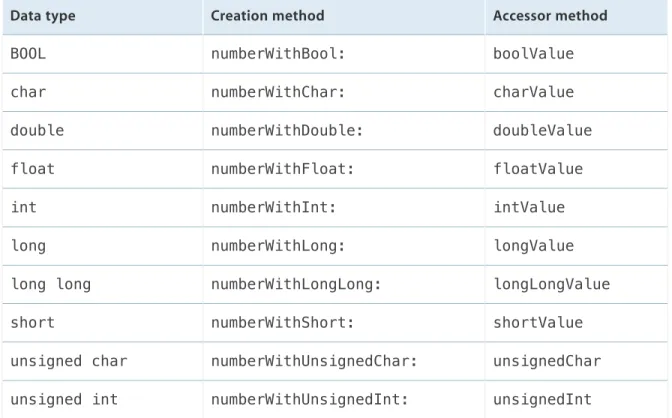
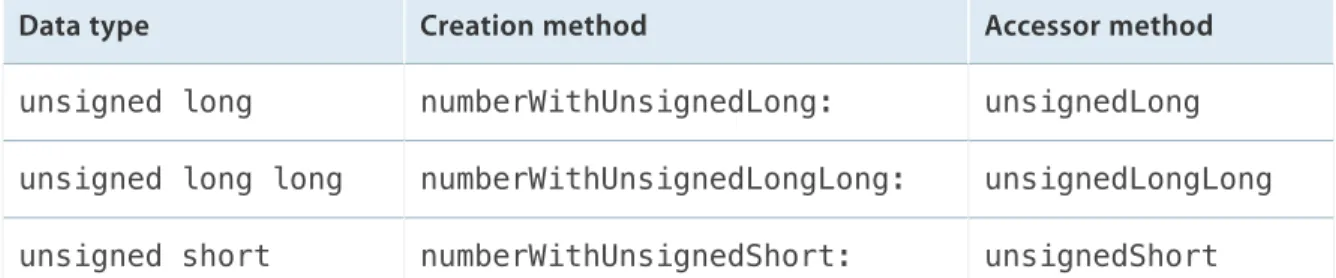
Table 1 lists the scalar types that are wrapped usingNSNumberinstances.
Table 1 Scalar types as wrapped inNSNumberobjects
Accessor method Creation method Data type boolValue numberWithBool: BOOL charValue numberWithChar: char doubleValue numberWithDouble: double floatValue numberWithFloat: float intValue numberWithInt: int longValue numberWithLong: long longLongValue numberWithLongLong: long long shortValue numberWithShort: short
Scalar and Structure Support
Accessor method Creation method Data type unsignedLong numberWithUnsignedLong: unsigned long unsignedLongLong numberWithUnsignedLongLong:
unsigned long long
unsignedShort numberWithUnsignedShort:
unsigned short
Wrapping and Unwrapping Structs
Table 2 (page 33) shows the creation and accessor methods use for wrapping the commonNSPoint,NSRange,
NSRect, andNSSizestructs.
Table 2 Common struct types as wrapped usingNSValue.
Accessor method Creation method Data type pointValue valueWithPoint: NSPoint rangeValue valueWithRange: NSRange rectValue valueWithRect:(OS X only).
NSRect
sizeValue valueWithSize:
NSSize
Automatic wrapping and unwrapping is not confined toNSPoint,NSRange,NSRect, andNSSize—structure types (that is, types whose Objective-C type encoding strings start with{) can be wrapped in anNSValue
object. For example, if you have a structure and class like this:
typedef struct { float x, y, z; } ThreeFloats; @interface MyClass - (void)setThreeFloats:(ThreeFloats)threeFloats; - (ThreeFloats)threeFloats; @end
Scalar and Structure Support Wrapping and Unwrapping Structs
Sending an instance ofMyClassthe message valueForKey: with the parameter@"threeFloats"will invoke theMyClassmethodthreeFloatsand return the result wrapped in anNSValue. Likewise sending the instance ofMyClassasetValue:forKey:message with anNSValueobject wrapping aThreeFloats
struct will invokesetThreeFloats:and pass the result of sending theNSValueobject agetValue:message.
Note: This mechanism doesn’t take reference counting or garbage collection into account, so take care when using with object-pointer-containing structure types.
Scalar and Structure Support Wrapping and Unwrapping Structs
Collection operators allow actions to be performed on the items of a collection using key path notation and an action operator. This article describes the available collection operators, example key paths, and the results they’d produce.
Collection operators are specialized key paths that are passed as the parameter to thevalueForKeyPath:
method. The operator is specified by a string preceded by an at sign (@). The key path on the left side of the collection operator, if present, determines the array or set, relative to the receiver, that is used in the operation. The key path on the right side of the operator specifies the property of the collection that the operator uses. Figure 1 illustrates the operator key path format.
Figure 1 Operator key path format
[email protected] Left key path Collection operator Right key path
All the collection operators, with the exception of@count, require a key path to the right of the collection operator.
Note: It is not currently possible to define your own collection operators.
The type of object value returned depends on the operator:
● Simple collection operators return strings, numbers, or dates depending on the value right hand key (see
Simple Collection Operators (page 37)).
● Object operators return anNSArrayinstance, as do the object operators (seeObject Operators (page
38)).
● Array and set operators return an array or set object, depending on the operator (seeArray and Set
Operators (page 39)).
Data Used In Examples
Each of the operators inSimple Collection Operators (page 37),Object Operators (page 38), andArray and Set Operators (page 39) includes an example code snippet using a key path containing an operator, as well as the results that would be generated. To illustrate this it is necessary to use a theoretical class, in this case theTransactionclass. TheTransactionclass encapsulates the simplest form of checkbook entires. It contains three properties:payee(anNSString),amount(anNSNumber), anddate(anNSDate).
TheTransactioninstances are stored in a collection object that is assigned to the hypothetical variable
transactions, which is an instance ofNSArray. For the operator that operates on anNSSetcollection, it can be assumed that thetransactionscollection is an instance ofNSSet. This is discussed in the relevant operators.
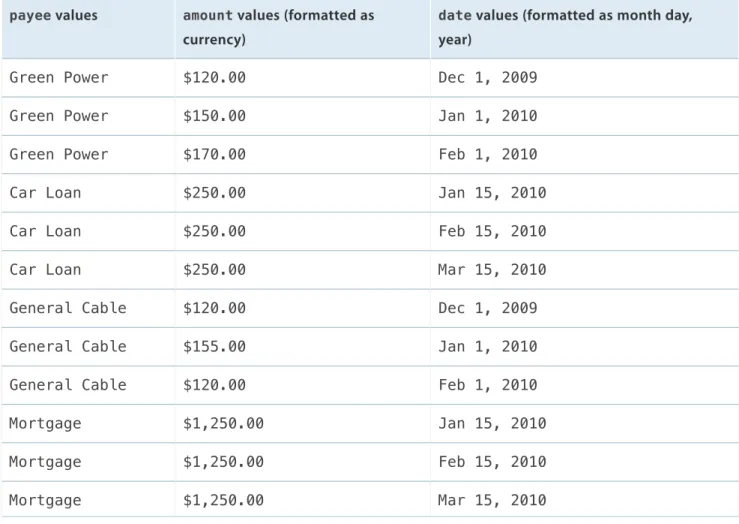
In order to provide results data for the operator action on thetransactionscollection sample data is required. Each row in Table 1 contains the data for an instance ofTransaction. The values in the table have been formatted (where applicable) to make them easier to understand. The results displayed by the examples are also formatted.
Table 1 Example data for theTransactionsobjects
datevalues (formatted as month day, year)
amountvalues (formatted as currency) payeevalues Dec 1, 2009 $120.00 Green Power Jan 1, 2010 $150.00 Green Power Feb 1, 2010 $170.00 Green Power Jan 15, 2010 $250.00 Car Loan Feb 15, 2010 $250.00 Car Loan Mar 15, 2010 $250.00 Car Loan Dec 1, 2009 $120.00 General Cable Jan 1, 2010 $155.00 General Cable Feb 1, 2010 $120.00 General Cable Jan 15, 2010 $1,250.00 Mortgage Collection Operators Data Used In Examples
datevalues (formatted as month day, year)
amountvalues (formatted as currency)
payeevalues
Jul 15, 2010 $600.00
Animal Hospital
Simple Collection Operators
Simple collection operators operate on the properties to the right of the operator in either an array or set.
@avg
The@avgoperator usesvalueForKeyPath:to get the values specified by the property specified by the key path to the right of the operator, converts each to adouble, and returns the average value as an instance of
NSNumber. In the case where the value isnil,0is assumed instead.
The following example returns the average value of the transaction amount for the objects intransactions:
NSNumber *transactionAverage = [transactions valueForKeyPath:@"@avg.amount"];
The formatted result oftransactionAverageis $456.54.
@count
The@countoperator returns the number of objects in the left key path collection as an instance ofNSNumber, the key path to the right of the operator is ignored.
The following example returns the number ofTransactionobjects intransactions:
NSNumber *numberOfTransactions = [transactions valueForKeyPath:@"@count"];
The value ofnumberOfTransactionsis 13.
@max
The@maxoperator compares the values of the property specified by the key path to the right of the operator and returns the maximum value found. The maximum value is determined using thecompare:method of the objects at the specified key path. The compared property objects must support comparison with each other. If the value of the right side of the key path isnil, it is ignored.
Collection Operators Simple Collection Operators
The following example returns the maximum value of the date values (date of the latest transaction) for the
Transactionobjects intransactions:
NSDate *latestDate = [transactions valueForKeyPath:@"@max.date"];
ThelatestDatevalue (formatted) is Jul 15, 2010.
@min
The@minoperator compares the values of the property specified by the key path to the right of the operator and returns the minimum value found. The minimum value is determined using thecompare:method of the objects at the specified key path. The compared property objects must support comparison with each other. If the value of the right side of the key path isnil, it is ignored.
The following example returns the minimum value (date of the earliest transaction) of thedateproperty for theTransactionobjects intransactions:
NSDate *earliestDate = [transactions valueForKeyPath:@"@min.date"];
TheearliestDatevalue (formatted) is Dec 1, 2009.
@sum
The@sumoperator returns the sum of the values of the property specified by the key path to the right of the operator. Each number is converted to adouble, the sum of the values is computed, and the total is wrapped as an instance ofNSNumberand returned. If the value of the right side of the key path isnil, it is ignored. The following example returns the sum of theamountsproperty for the transactions intransactions:
NSNumber *amountSum = [transactions valueForKeyPath:@"@sum.amount"];
The resultingamountSumvalue (formatted) is $5,935.00.
Object Operators
Collection Operators@distinctUnionOfObjects
The@distinctUnionOfObjectsoperator returns an array containing the distinct objects in the property specified by the key path to the right of the operator.
The following example returns thepayeeproperty values for the transactions intransactionswith any duplicate values removed:
NSArray *payees = [transactions valueForKeyPath:@"@distinctUnionOfObjects.payee"];
The resultingpayeesarray contains the following strings: Car Loan, General Cable, Animal Hospital, Green Power, Mortgage.
The@unionOfObjectsoperator is similar, but does not remove duplicate objects.
Important: This operator raises an exception if any of the leaf objects isnil.
@unionOfObjects
The@unionOfObjectsoperator returns an array containing the distinct objects in the property specified by the key path to the right of the operator. Unlike @distinctUnionOfObjects, duplicate objects are not removed. The following example returns thepayeeproperty values for the transactions intransactions:
NSArray *payees = [transactions valueForKeyPath:@"@unionOfObjects.payee"];
The resultingpayeesarray contains the following strings: Green Power, Green Power, Green Power, Car Loan, Car Loan, Car Loan, General Cable, General Cable, General Cable, Mortgage, Mortgage, Mortgage, Animal Hospital.
The@distinctUnionOfArraysoperator is similar, but removes duplicate objects.
Important: This operator raises an exception if any of the leaf objects isnil.
Array and Set Operators
The array and set operators operate on nested collections, that is, a collection where each entry contains a collection.
Collection Operators Array and Set Operators
The variablearrayOfTransactionsis used in the example for each operator. It is an array containing two arrays ofTransactionobjects.
The following code snippet shows how the nested collection would be created:
// Create the array that contains additional arrays. self.arrayOfTransactionsArray = [NSMutableArray array];
// Add the array of objects used in the above examples. [arrayOfTransactionsArray addObject:transactions];
// Add a second array of objects; this array contains alternate values. [arrayOfTransactionsArrays addObject:moreTransactions];
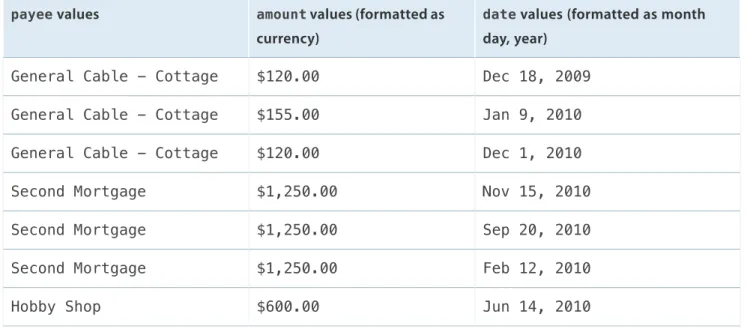
The first array ofTransactionobjects contains the data listed inTable 1 (page 36) and the second array (moreTransactions) containsTransactionobjects with the hypothetical data in Table 2.
Table 2 HypotheticalTransactiondata in themoreTransactionsarray
datevalues (formatted as month day, year)
amountvalues (formatted as currency)
payeevalues
Dec 18, 2009 $120.00
General Cable - Cottage
Jan 9, 2010 $155.00
General Cable - Cottage
Dec 1, 2010 $120.00
General Cable - Cottage
Nov 15, 2010 $1,250.00 Second Mortgage Sep 20, 2010 $1,250.00 Second Mortgage Feb 12, 2010 $1,250.00 Second Mortgage Jun 14, 2010 $600.00 Hobby Shop
@distinctUnionOfArrays
The@distinctUnionOfArraysoperator returns an array containing the distinct objects in the property Collection Operators
The following code example will return the distinct values of thepayeeproperty in all the arrays with
arrayOfTransactionsArrays:
NSArray *payees = [arrayOfTransactionsArrays valueForKeyPath:@"@distinctUnionOfArrays.payee"];
The resultingpayeesarray contains the following values: Hobby Shop, Mortgage, Animal Hospital, Second Mortgage, Car Loan, General Cable - Cottage, General Cable, Green Power.
The@unionOfArraysoperator is similar, but does not remove duplicate objects.
Important: This operator raises an exception if any of the leaf objects isnil.
@unionOfArrays
The@unionOfArraysoperator returns an array containing the objects in the property specified by the key path to the right of the operator. Unlike@distinctUnionOfArrays, duplicate objects are not removed.
The following code example will return the values of thepayeeproperty in all the arrays with
arrayOfTransactionsArrays:
NSArray *payees = [arrayOfTransactionsArrays valueForKeyPath:@"@unionOfArrays.payee"];
The resultingpayeesarray contains the following values: Green Power, Green Power, Green Power, Car Loan, Car Loan, Car Loan, General Cable, General Cable, General Cable, Mortgage, Mortgage, Mortgage, Animal Hospital, General Cable - Cottage, General Cable - Cottage, General Cable - Cottage, Second Mortgage, Second Mortgage, Second Mortgage, Hobby Shop.
Important: This operator raises an exception if any of the leaf objects isnil.
@distinctUnionOfSets
The@distinctUnionOfSetsoperator returns a set containing the distinct objects in the property specified by the key path to the right of the operator.
This operator works the same as@distinctUnionOfArrays, except that it expects anNSSetinstance containingNSSetinstances ofTransactionobjects rather than arrays. It returns anNSSetinstance. Using the example data set, the returned set would contain the results as those shown in@distinctUnionOfArrays (page 40).
Collection Operators Array and Set Operators
Important: This operator raises an exception if any of the leaf objects isnil. Collection Operators
Key-value coding attempts to use accessor methods to get and set values, before resorting to directly accessing the instance variable. This article describes how the key-value coding methods determine how the value is accessed.
Accessor Search Patterns for Simple Attributes
Default Search Pattern for setValue:forKey:
When the default implementation ofsetValue:forKey:is invoked for a property the following search pattern is used:
1. The receiver’s class is searched for an accessor method whose name matches the patternset<Key>:.
2. If no accessor is found, and the receiver’s class methodaccessInstanceVariablesDirectlyreturns
YES, the receiver is searched for an instance variable whose name matches the pattern_<key>,_is<Key>,
<key>, oris<Key>, in that order.
3. If a matching accessor or instance variable is located, it is used to set the value. If necessary, the value is extracted from the object as described inRepresenting Non-Object Values (page 31).
4. If no appropriate accessor or instance variable is found,setValue:forUndefinedKey: is invoked for the receiver.
Default Search Pattern for valueForKey:
When the default implementation ofvalueForKey:is invoked on a receiver, the following search pattern is used:
1. Searches the class of the receiver for an accessor method whose name matches the patternget<Key>,
<key>, oris<Key>, in that order. If such a method is found it is invoked. If the type of the method's result is an object pointer type the result is simply returned. If the type of the result is one of the scalar types supported byNSNumberconversion is done and anNSNumberis returned. Otherwise, conversion is done and anNSValueis returned. Results of arbitrary types are converted toNSValueobjects, not justNSPoint,
NSRange,NSRect, andNSSizetypes).
2. Otherwise (no simple accessor method is found), searches the class of the receiver for methods whose names match the patternscountOf<Key>andobjectIn<Key>AtIndex:(corresponding to the primitive methods defined by theNSArrayclass) and<key>AtIndexes:(corresponding to theNSArraymethod
objectsAtIndexes:).
If thecountOf<Key>method and at least one of the other two possible methods are found, a collection proxy object that responds to allNSArraymethods is returned. EachNSArraymessage sent to the collection proxy object will result in some combination ofcountOf<Key>,objectIn<Key>AtIndex:, and<key>AtIndexes:messages being sent to the original receiver ofvalueForKey:. If the class of the receiver also implements an optional method whose name matches the patternget<Key>:range:
that method will be used when appropriate for best performance.
3. Otherwise (no simple accessor method or set of array access methods is found), searches the class of the receiver for a threesome of methods whose names match the patternscountOf<Key>,
enumeratorOf<Key>, andmemberOf<Key>:(corresponding to the primitive methods defined by the
NSSetclass).
If all three methods are found, a collection proxy object that responds to allNSSetmethods is returned. EachNSSetmessage sent to the collection proxy object will result in some combination ofcountOf<Key>,
enumeratorOf<Key>, andmemberOf<Key>:messages being sent to the original receiver of
valueForKey:.
4. Otherwise (no simple accessor method or set of collection access methods is found), if the receiver's class methodaccessInstanceVariablesDirectlyreturnsYES, the class of the receiver is searched for an instance variable whose name matches the pattern_<key>,_is<Key>,<key>, oris<Key>, in that order. If such an instance variable is found, the value of the instance variable in the receiver is returned. If the type of the result is one of the scalar types supported byNSNumberconversion is done and anNSNumber
is returned. Otherwise, conversion is done and anNSValueis returned. Results of arbitrary types are converted toNSValueobjects, not justNSPoint,NSRange,NSRect, andNSSizetypes.
5. If none of the above situations occurs, returns a result the default implementation invokes
valueForUndefinedKey:.
Accessor Search Pattern for Ordered Collections
The default search pattern formutableArrayValueForKey:is as follows:1. The receiver's class is searched for a pair of methods whose names match the patterns
insertObject:in<Key>AtIndex:andremoveObjectFrom<Key>AtIndex:(corresponding to the Accessor Search Implementation Details
respectively), or methods matching the patterninsert<Key>:atIndexes:and
remove<Key>AtIndexes:(corresponding to theNSMutableArrayinsertObjects:atIndexes:and
removeObjectsAtIndexes:methods).
If at least one insertion method and at least one removal method are found eachNSMutableArray
message sent to the collection proxy object will result in some combination of
insertObject:in<Key>AtIndex:,removeObjectFrom<Key>AtIndex:,insert<Key>:atIndexes:, andremove<Key>AtIndexes:messages being sent to the original receiver of
mutableArrayValueForKey:.
If receiver's class also implements the optional replace object method matching the pattern
replaceObjectIn<Key>AtIndex:withObject:orreplace<Key>AtIndexes:with<Key>:that method will be used when appropriate for best performance.
2. Otherwise, the receiver's class is searched for an accessor method whose name matches the pattern
set<Key>:. If such a method is found eachNSMutableArraymessage sent to the collection proxy object will result in aset<Key>:message being sent to the original receiver ofmutableArrayValueForKey:. It is much more efficient to implement the indexed accessor methods discussed in the previous step.
3. Otherwise, if the receiver's class respondsYEStoaccessInstanceVariablesDirectly, the receiver's class is searched for an instance variable whose name matches the pattern_<key>or<key>, in that order. If such an instance variable is found, eachNSMutableArraymessage sent to the collection proxy object will be forwarded to the instance variable's value, which typically will be an instance ofNSMutableArray
or a subclass ofNSMutableArray.
4. Otherwise, returns a mutable collection proxy object that results in asetValue:forUndefinedKey:
message being sent to the original receiver of themutableArrayValueForKey:message whenever the proxy receives anNSMutableArraymessage.
The default implementation of setValue:forUndefinedKey: raises anNSUndefinedKeyException, but you can override it in your application.
Note: The repetitiveset<Key>:messages implied by the description in step 2 are a potential performance problem. For better performance, implement methods that fulfill the requirements for Step 1 in your key-value coding-compliant class.
Accessor Search Pattern for Uniquing Ordered Collections
The default implementation ofmutableOrderedSetValueForKey:recognizes the same simple accessor methods and ordered set accessor methods asvalueForKey(seeDefault Search Pattern for valueForKey: (page 43)), and follows the same direct instance variable access policies, but always returns a mutable collection proxy object instead of the immutable collection thatvalueForKey:would return. It also:
Accessor Search Implementation Details